 Скачать презентацию 4 B 2 C B 2 E Systems
c596b3330c0e3643644ca56bb4f997ff.ppt
- Количество слайдов: 37



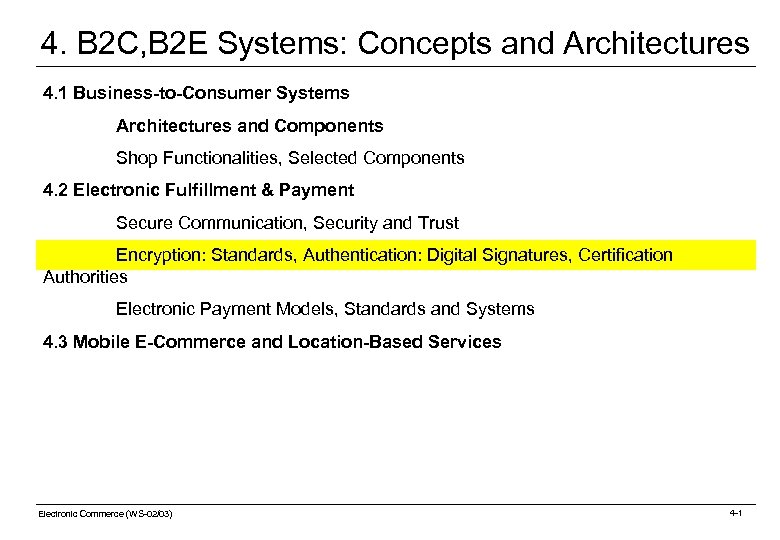
4. B 2 C, B 2 E Systems: Concepts and Architectures 4. 1 Business-to-Consumer Systems Architectures and Components Shop Functionalities, Selected Components 4. 2 Electronic Fulfillment & Payment Secure Communication, Security and Trust Encryption: Standards, Authentication: Digital Signatures, Certification Authorities Electronic Payment Models, Standards and Systems 4. 3 Mobile E-Commerce and Location-Based Services Electronic Commerce (WS-02/03) 4 -1
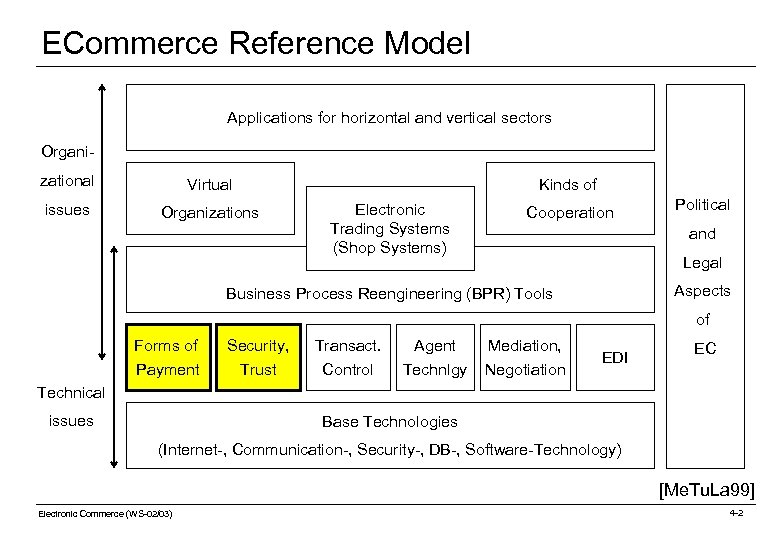
ECommerce Reference Model Applications for horizontal and vertical sectors Organizational Virtual issues Organizations Kinds of Electronic Trading Systems (Shop Systems) Cooperation Political and Legal Aspects Business Process Reengineering (BPR) Tools of Forms of Payment Security, Trust Transact. Control Agent Technlgy Mediation, Negotiation EDI EC Technical issues Base Technologies (Internet-, Communication-, Security-, DB-, Software-Technology) [Me. Tu. La 99] Electronic Commerce (WS-02/03) 4 -2
Authentication: Digital Signatures (1) Definition A digital signature is applied to a digital document. It states that the document (as an entirety) has been signed by the signer. Others can verify this. Electronic Commerce (WS-02/03) 4 -3
Digital Signatures with Public Keys Electronic Commerce (WS-02/03) 4 -4
Digital Signatures with Secret Keys MACs: Message Authentication Codes digest See: MD 5, SHA Electronic Commerce (WS-02/03) 4 -5
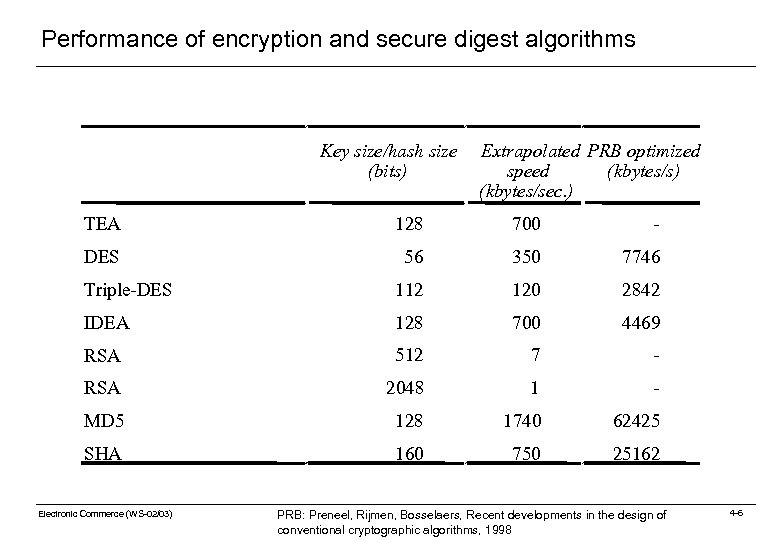
Performance of encryption and secure digest algorithms Key size/hash size (bits) Extrapolated PRB optimized speed (kbytes/s) (kbytes/sec. ) TEA 128 700 - DES 56 350 7746 Triple-DES 112 120 2842 IDEA 128 700 4469 RSA 512 7 - RSA 2048 1 - MD 5 128 1740 62425 SHA 160 750 25162 Electronic Commerce (WS-02/03) PRB: Preneel, Rijmen, Bosselaers, Recent developments in the design of conventional cryptographic algorithms, 1998 4 -6
Problem: How to distribute keys? Key distribution by non-networked means is impractical for distributed object systems Key distribution is a problem for both secret and public keys o. Secret keys: Obvious o. Public keys: How do we know the principal that gives us a public key is who we assume the principal is? Use trusted key distribution service and secure key distribution protocol! Electronic Commerce (WS-02/03) 4 -7
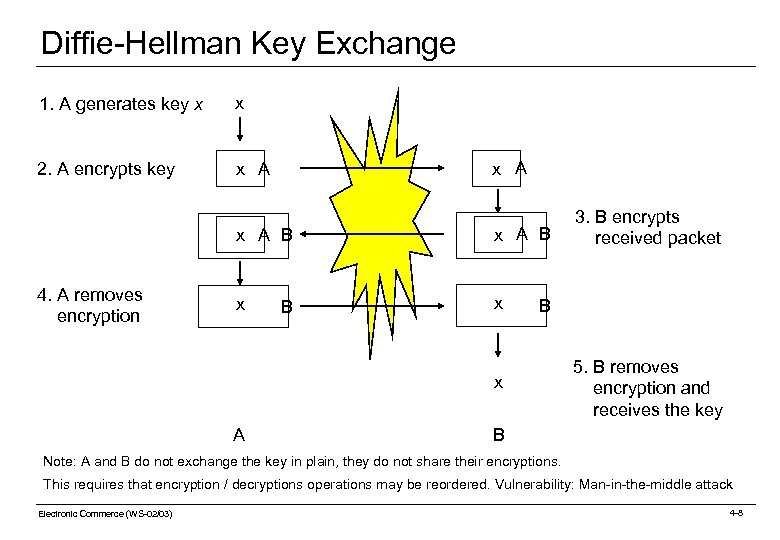
Diffie-Hellman Key Exchange 1. A generates key x x 2. A encrypts key x A x A B 4. A removes encryption x A B x x B B x A 3. B encrypts received packet 5. B removes encryption and receives the key B Note: A and B do not exchange the key in plain, they do not share their encryptions. This requires that encryption / decryptions operations may be reordered. Vulnerability: Man-in-the-middle attack Electronic Commerce (WS-02/03) 4 -8
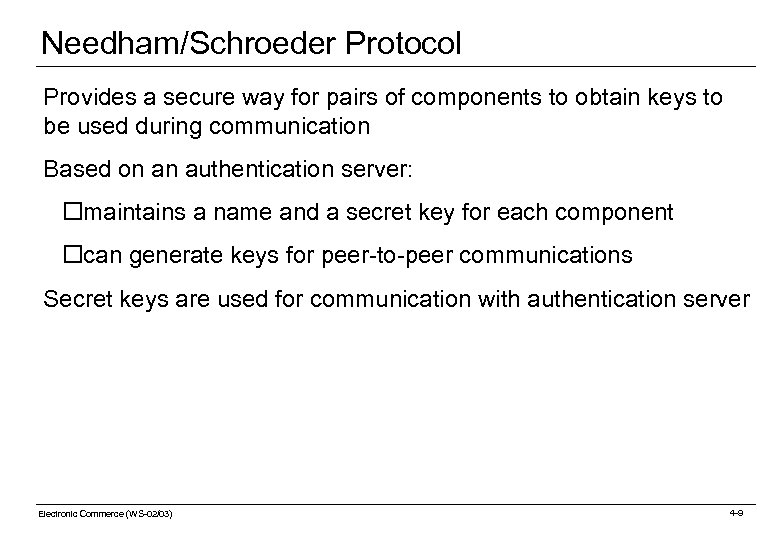
Needham/Schroeder Protocol Provides a secure way for pairs of components to obtain keys to be used during communication Based on an authentication server: omaintains a name and a secret key for each component ocan generate keys for peer-to-peer communications Secret keys are used for communication with authentication server Electronic Commerce (WS-02/03) 4 -9
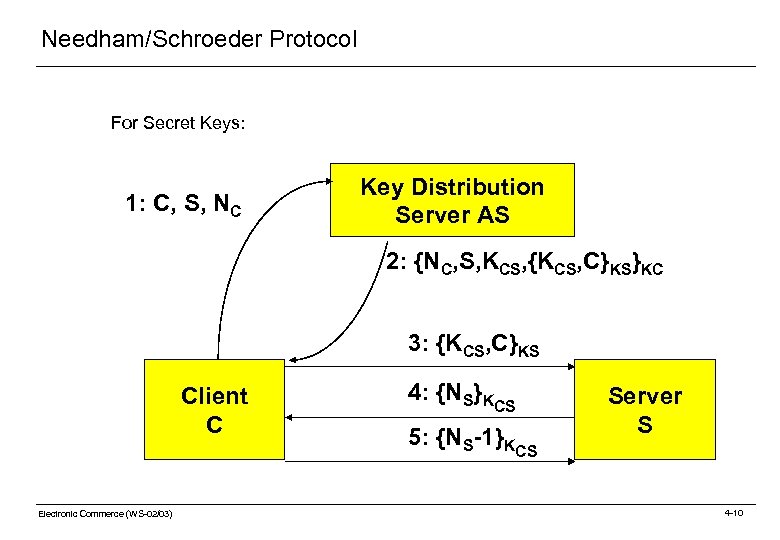
Needham/Schroeder Protocol For Secret Keys: 1: C, S, NC Key Distribution Server AS 2: {NC, S, KCS, {KCS, C}KS}KC 3: {KCS, C}KS Client C Electronic Commerce (WS-02/03) 4: {NS}KCS 5: {NS-1}KCS Server S 4 -10
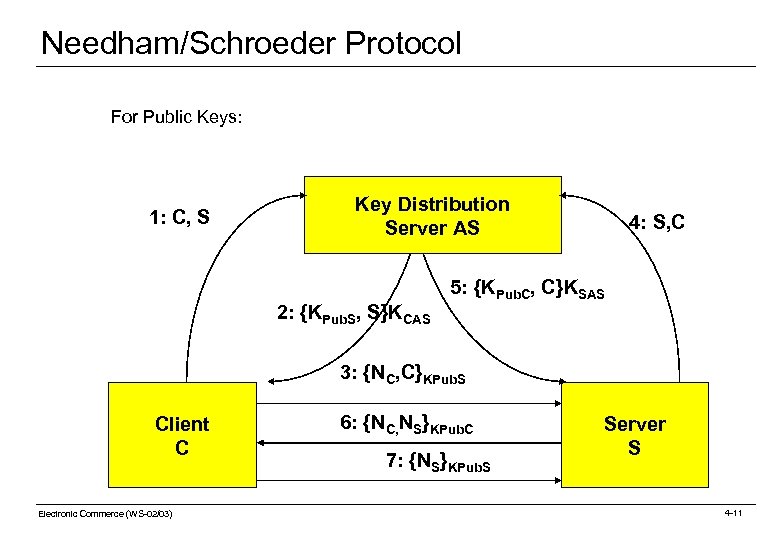
Needham/Schroeder Protocol For Public Keys: 1: C, S Key Distribution Server AS 2: {KPub. S, S}KCAS 4: S, C 5: {KPub. C, C}KSAS 3: {NC, C}KPub. S Client C Electronic Commerce (WS-02/03) 6: {NC, NS}KPub. C 7: {NS}KPub. S Server S 4 -11
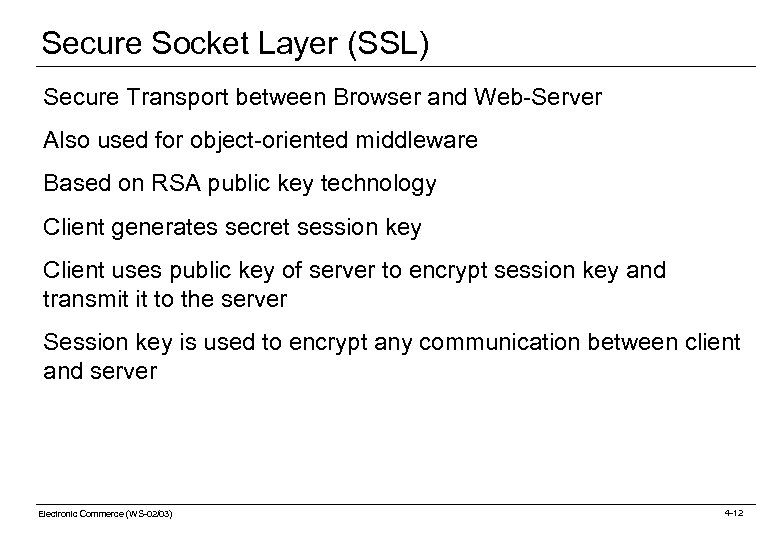
Secure Socket Layer (SSL) Secure Transport between Browser and Web-Server Also used for object-oriented middleware Based on RSA public key technology Client generates secret session key Client uses public key of server to encrypt session key and transmit it to the server Session key is used to encrypt any communication between client and server Electronic Commerce (WS-02/03) 4 -12
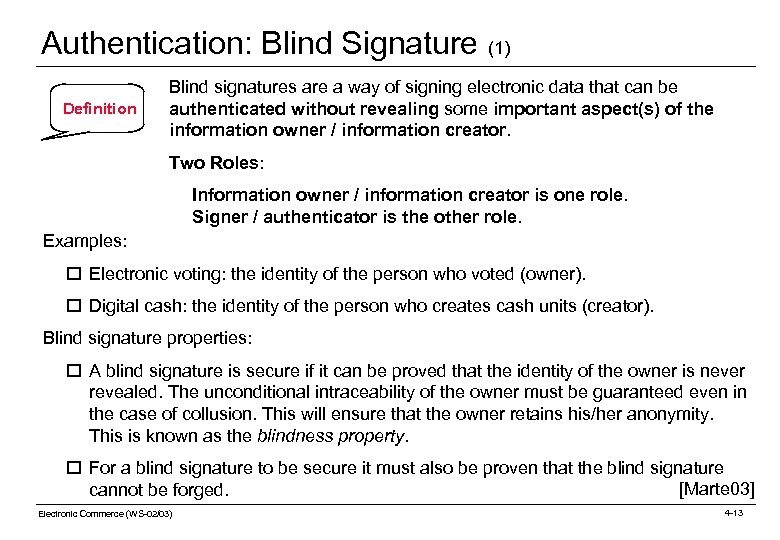
Authentication: Blind Signature (1) Definition Blind signatures are a way of signing electronic data that can be authenticated without revealing some important aspect(s) of the information owner / information creator. Two Roles: Information owner / information creator is one role. Signer / authenticator is the other role. Examples: o Electronic voting: the identity of the person who voted (owner). o Digital cash: the identity of the person who creates cash units (creator). Blind signature properties: o A blind signature is secure if it can be proved that the identity of the owner is never revealed. The unconditional intraceability of the owner must be guaranteed even in the case of collusion. This will ensure that the owner retains his/her anonymity. This is known as the blindness property. o For a blind signature to be secure it must also be proven that the blind signature [Marte 03] cannot be forged. Electronic Commerce (WS-02/03) 4 -13
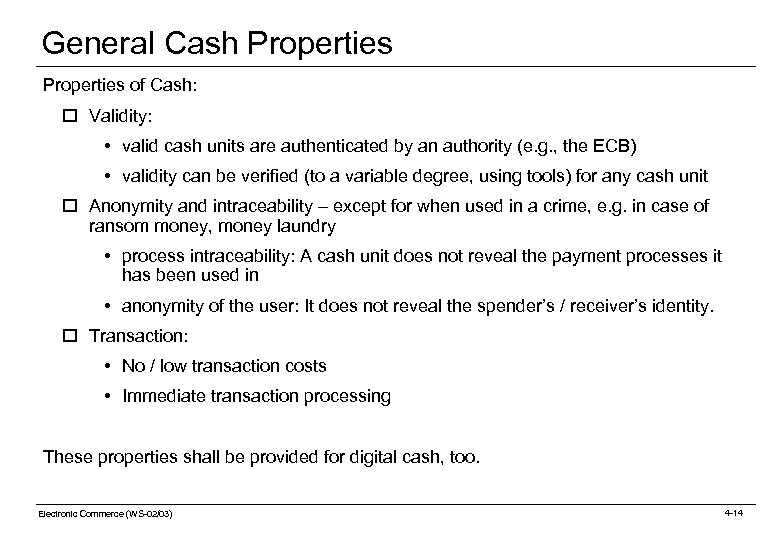
General Cash Properties of Cash: o Validity: • valid cash units are authenticated by an authority (e. g. , the ECB) • validity can be verified (to a variable degree, using tools) for any cash unit o Anonymity and intraceability – except for when used in a crime, e. g. in case of ransom money, money laundry • process intraceability: A cash unit does not reveal the payment processes it has been used in • anonymity of the user: It does not reveal the spender’s / receiver’s identity. o Transaction: • No / low transaction costs • Immediate transaction processing These properties shall be provided for digital cash, too. Electronic Commerce (WS-02/03) 4 -14
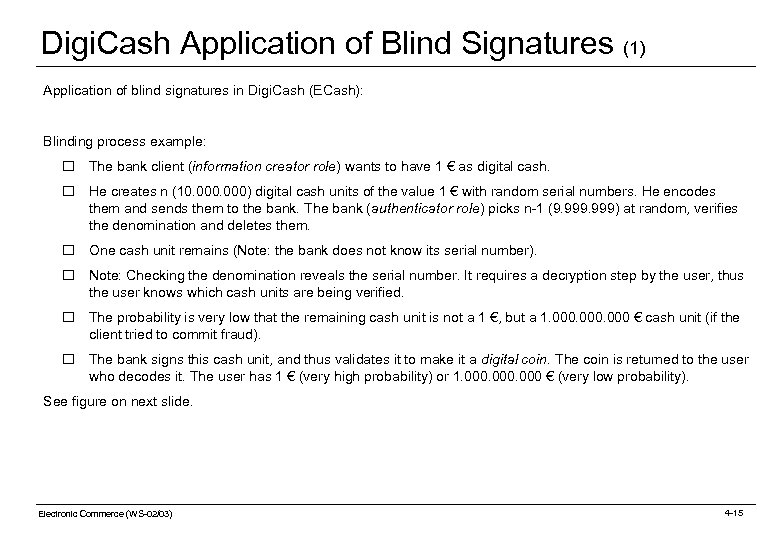
Digi. Cash Application of Blind Signatures (1) Application of blind signatures in Digi. Cash (ECash): Blinding process example: o The bank client (information creator role) wants to have 1 € as digital cash. o He creates n (10. 000) digital cash units of the value 1 € with random serial numbers. He encodes them and sends them to the bank. The bank (authenticator role) picks n-1 (9. 999) at random, verifies the denomination and deletes them. o One cash unit remains (Note: the bank does not know its serial number). o Note: Checking the denomination reveals the serial number. It requires a decryption step by the user, thus the user knows which cash units are being verified. o The probability is very low that the remaining cash unit is not a 1 €, but a 1. 000 € cash unit (if the client tried to commit fraud). o The bank signs this cash unit, and thus validates it to make it a digital coin. The coin is returned to the user who decodes it. The user has 1 € (very high probability) or 1. 000 € (very low probability). See figure on next slide. Electronic Commerce (WS-02/03) 4 -15
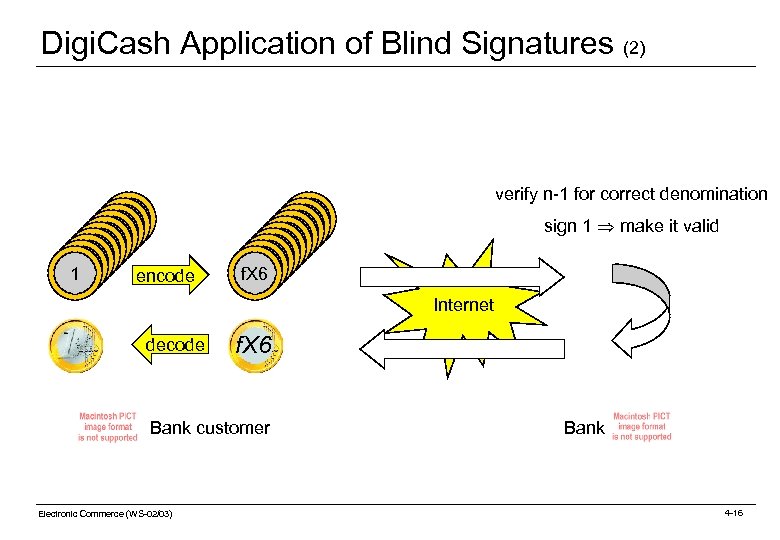
Digi. Cash Application of Blind Signatures (2) verify n-1 for correct denomination 1 1 1 1 1 encode f. X 6 f. X 6 sign 1 make it valid Internet decode f. X 6 Bank customer Electronic Commerce (WS-02/03) Bank 4 -16
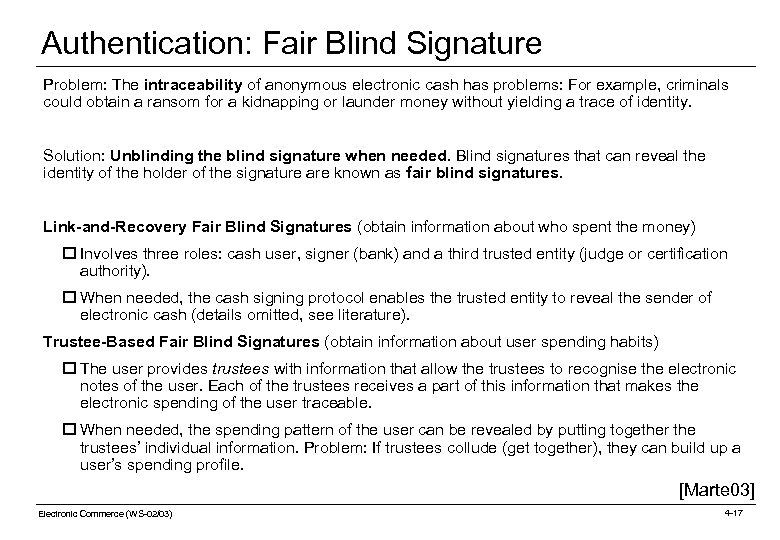
Authentication: Fair Blind Signature Problem: The intraceability of anonymous electronic cash has problems: For example, criminals could obtain a ransom for a kidnapping or launder money without yielding a trace of identity. Solution: Unblinding the blind signature when needed. Blind signatures that can reveal the identity of the holder of the signature are known as fair blind signatures. Link-and-Recovery Fair Blind Signatures (obtain information about who spent the money) o Involves three roles: cash user, signer (bank) and a third trusted entity (judge or certification authority). o When needed, the cash signing protocol enables the trusted entity to reveal the sender of electronic cash (details omitted, see literature). Trustee-Based Fair Blind Signatures (obtain information about user spending habits) o The user provides trustees with information that allow the trustees to recognise the electronic notes of the user. Each of the trustees receives a part of this information that makes the electronic spending of the user traceable. o When needed, the spending pattern of the user can be revealed by putting together the trustees’ individual information. Problem: If trustees collude (get together), they can build up a user’s spending profile. [Marte 03] Electronic Commerce (WS-02/03) 4 -17
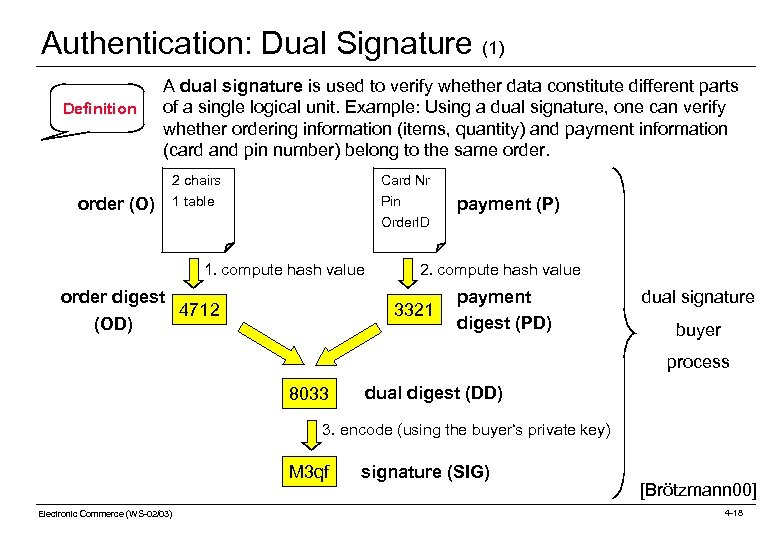
Authentication: Dual Signature (1) Definition A dual signature is used to verify whether data constitute different parts of a single logical unit. Example: Using a dual signature, one can verify whether ordering information (items, quantity) and payment information (card and pin number) belong to the same order. 2 chairs order (O) Card Nr 1 table Pin Order. ID 1. compute hash value order digest (OD) 4712 payment (P) 2. compute hash value 3321 payment digest (PD) dual signature buyer process 8033 dual digest (DD) 3. encode (using the buyer‘s private key) M 3 qf Electronic Commerce (WS-02/03) signature (SIG) [Brötzmann 00] 4 -18
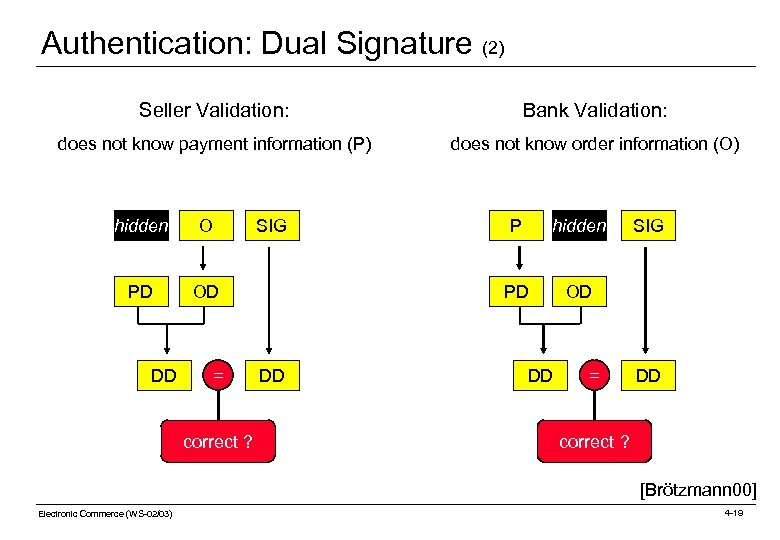
Authentication: Dual Signature (2) Seller Validation: Bank Validation: does not know payment information (P) does not know order information (O) hidden O PD OD DD = correct ? SIG hidden PD DD P OD DD = SIG DD correct ? [Brötzmann 00] Electronic Commerce (WS-02/03) 4 -19
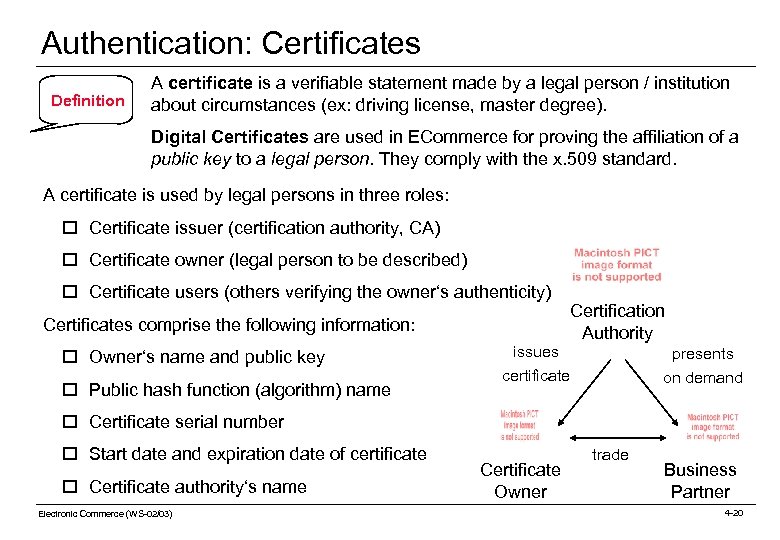
Authentication: Certificates Definition A certificate is a verifiable statement made by a legal person / institution about circumstances (ex: driving license, master degree). Digital Certificates are used in ECommerce for proving the affiliation of a public key to a legal person. They comply with the x. 509 standard. A certificate is used by legal persons in three roles: o Certificate issuer (certification authority, CA) o Certificate owner (legal person to be described) o Certificate users (others verifying the owner‘s authenticity) Certificates comprise the following information: o Owner‘s name and public key o Public hash function (algorithm) name Certification Authority issues presents certificate on demand o Certificate serial number o Start date and expiration date of certificate o Certificate authority‘s name Electronic Commerce (WS-02/03) Certificate Owner trade Business Partner 4 -20
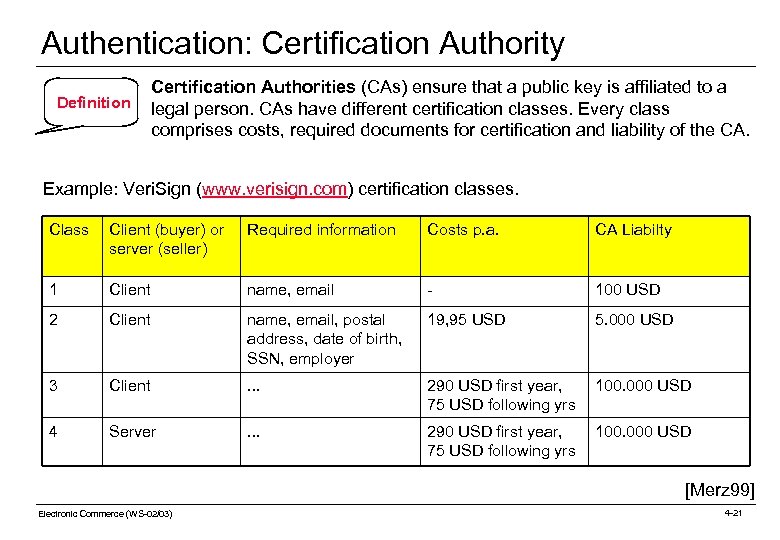
Authentication: Certification Authority Definition Certification Authorities (CAs) ensure that a public key is affiliated to a legal person. CAs have different certification classes. Every class comprises costs, required documents for certification and liability of the CA. Example: Veri. Sign (www. verisign. com) certification classes. Class Client (buyer) or server (seller) Required information Costs p. a. CA Liabilty 1 Client name, email - 100 USD 2 Client name, email, postal address, date of birth, SSN, employer 19, 95 USD 5. 000 USD 3 Client . . . 290 USD first year, 75 USD following yrs 100. 000 USD 4 Server . . . 290 USD first year, 75 USD following yrs 100. 000 USD [Merz 99] Electronic Commerce (WS-02/03) 4 -21
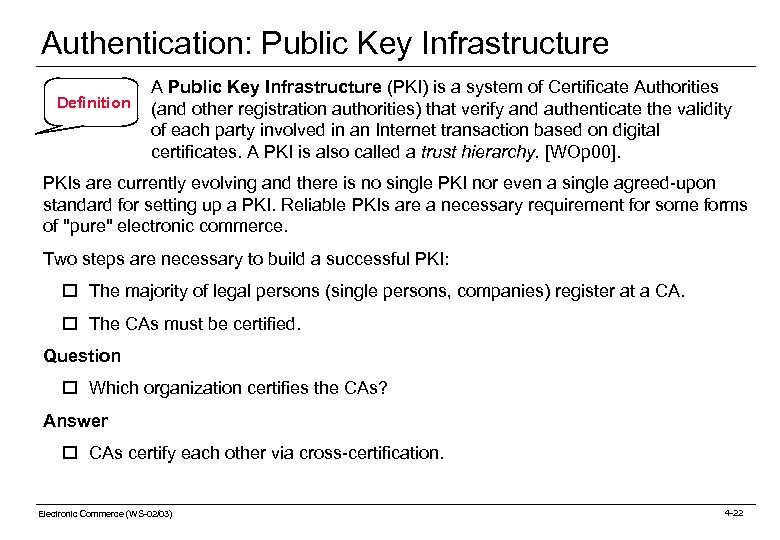
Authentication: Public Key Infrastructure Definition A Public Key Infrastructure (PKI) is a system of Certificate Authorities (and other registration authorities) that verify and authenticate the validity of each party involved in an Internet transaction based on digital certificates. A PKI is also called a trust hierarchy. [WOp 00]. PKIs are currently evolving and there is no single PKI nor even a single agreed-upon standard for setting up a PKI. Reliable PKIs are a necessary requirement for some forms of "pure" electronic commerce. Two steps are necessary to build a successful PKI: o The majority of legal persons (single persons, companies) register at a CA. o The CAs must be certified. Question o Which organization certifies the CAs? Answer o CAs certify each other via cross-certification. Electronic Commerce (WS-02/03) 4 -22
![Electronic Payment (1) Classification of payments by transaction volume [Merz 99]: o Zeropayments (0](https://present5.com/presentation/c596b3330c0e3643644ca56bb4f997ff/image-23.jpg "Electronic Payment (1) Classification of payments by transaction volume [Merz 99]: o Zeropayments (0")
Electronic Payment (1) Classification of payments by transaction volume [Merz 99]: o Zeropayments (0 €) o Nanopayments (0. 001 – 0. 1 €) o Micropayments (0. 1 - 5 €) o Medium Payments (5 – 1. 000 €) o Macropayments (> 1. 000 €) Different transaction volumes require different forms of payment. Example: Credit cards are not suitable for nano– and micropayments as transactions costs are higher than transaction volume. Electronic Commerce (WS-02/03) 4 -23
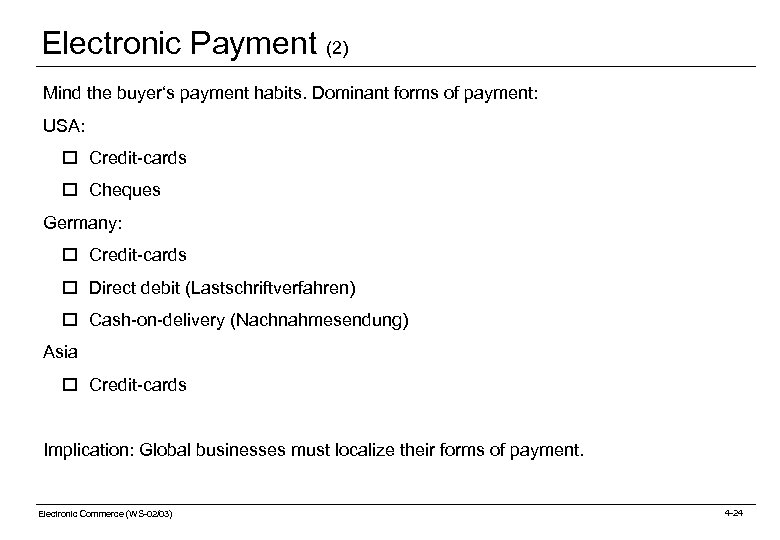
Electronic Payment (2) Mind the buyer‘s payment habits. Dominant forms of payment: USA: o Credit-cards o Cheques Germany: o Credit-cards o Direct debit (Lastschriftverfahren) o Cash-on-delivery (Nachnahmesendung) Asia o Credit-cards Implication: Global businesses must localize their forms of payment. Electronic Commerce (WS-02/03) 4 -24
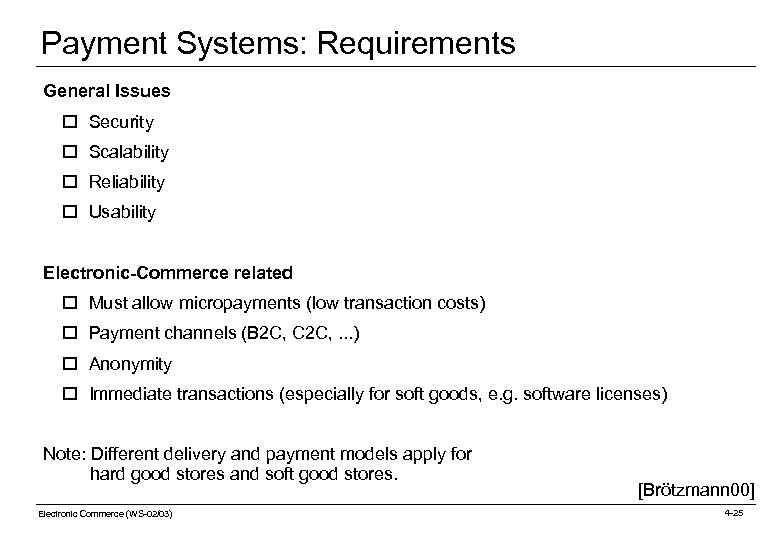
Payment Systems: Requirements General Issues o Security o Scalability o Reliability o Usability Electronic-Commerce related o Must allow micropayments (low transaction costs) o Payment channels (B 2 C, C 2 C, . . . ) o Anonymity o Immediate transactions (especially for soft goods, e. g. software licenses) Note: Different delivery and payment models apply for hard good stores and soft good stores. Electronic Commerce (WS-02/03) [Brötzmann 00] 4 -25
Payments: Macropayments Transactions volume: > 1. 000 € Established business relationship between sellers and buyers. Business relationship is fixed by contracts. Therefore, payments are not as important as continuous business relationship. Payments are not internet-based No internet based payment infrastructure. Electronic Commerce (WS-02/03) 4 -26
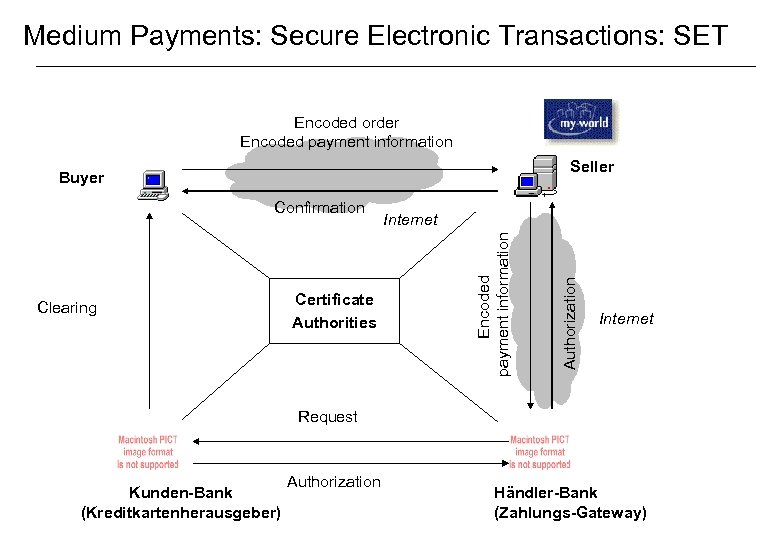
Medium Payments: Secure Electronic Transactions: SET Encoded order Encoded payment information Seller Buyer Certificate Authorities Authorization Clearing Internet Encoded payment information Confirmation Internet Request Kunden-Bank Electronic Commerce (WS-02/03) (Kreditkartenherausgeber) Authorization Händler-Bank (Zahlungs-Gateway) 4 -27
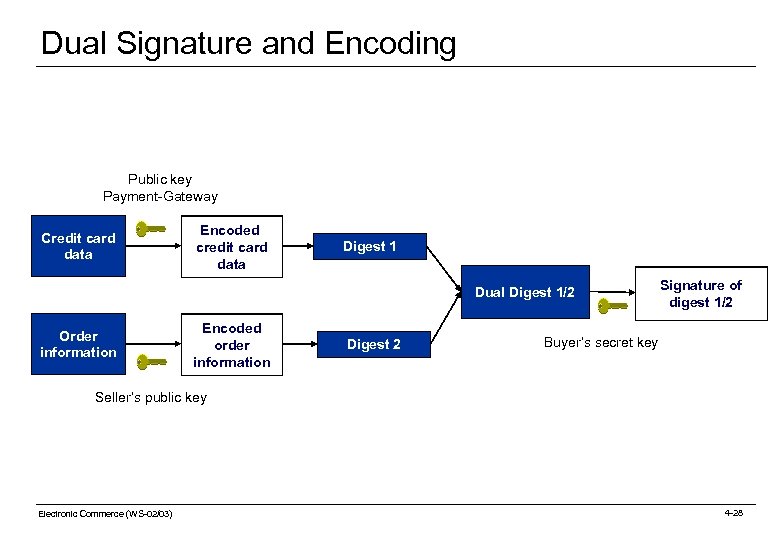
Dual Signature and Encoding Public key Payment-Gateway Credit card data Encoded credit card data Digest 1 Dual Digest 1/2 Order information Encoded order infromation information Digest 2 Signatur von Signature of Fingerabdruck 1/2 digest 1/2 Buyer‘s secret key Seller‘s public key Electronic Commerce (WS-02/03) 4 -28
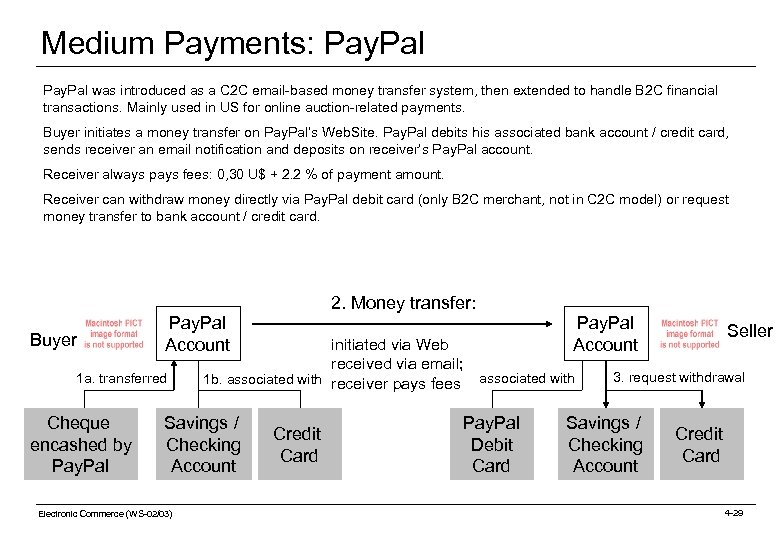
Medium Payments: Pay. Pal was introduced as a C 2 C email-based money transfer system, then extended to handle B 2 C financial transactions. Mainly used in US for online auction-related payments. Buyer initiates a money transfer on Pay. Pal‘s Web. Site. Pay. Pal debits his associated bank account / credit card, sends receiver an email notification and deposits on receiver‘s Pay. Pal account. Receiver always pays fees: 0, 30 U$ + 2. 2 % of payment amount. Receiver can withdraw money directly via Pay. Pal debit card (only B 2 C merchant, not in C 2 C model) or request money transfer to bank account / credit card. Buyer Pay. Pal Account 1 a. transferred Cheque encashed by Pay. Pal 2. Money transfer: initiated via Web received via email; 1 b. associated with receiver pays fees associated with Savings / Checking Account Electronic Commerce (WS-02/03) Pay. Pal Account Credit Card Pay. Pal Debit Card Seller 3. request withdrawal Savings / Checking Account Credit Card 4 -29
Payments: Micropayments (1) Transactions volume: 0. 1 – 5 € o Form of payment in traditional commerce: cash. o Idea: Map cash to electronic commerce digital cash. o Currently, there is no successful and widely adapted digital cash model. Success factors for digital cash are: o Offline usability (No bank needed / wanted for verification at every transaction) o Anonymity (money spender stays anonymous, unless trying to double-spend digital cash) Electronic Commerce (WS-02/03) 4 -30
Payments: Micropayments (2) Current digital cash models: Billing: Reduce costs by consolidating transaction volumes o Phone + Code: Call a number. After a period of time a code is disclosed. Important: What percentage of the fee is taken by the telecommunication service provider (Germany: 50% by Deutsche Telekom!) o Token-based and account-based billing systems (see following slides) Money cards: o White Cards (anonymous users), e. g. , Mondex Digital cash (buyer is anonymous, double spending problem) o e. Cash Electronic Commerce (WS-02/03) 4 -31
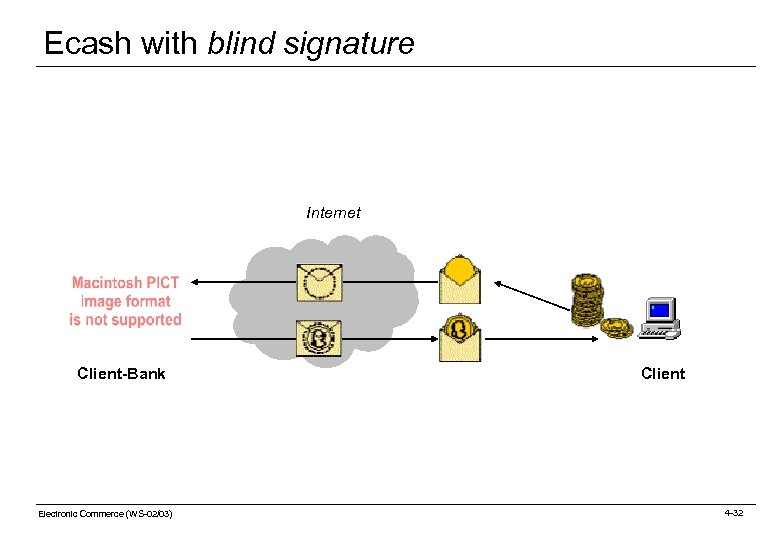
Ecash with blind signature Internet Client-Bank Electronic Commerce (WS-02/03) Client 4 -32
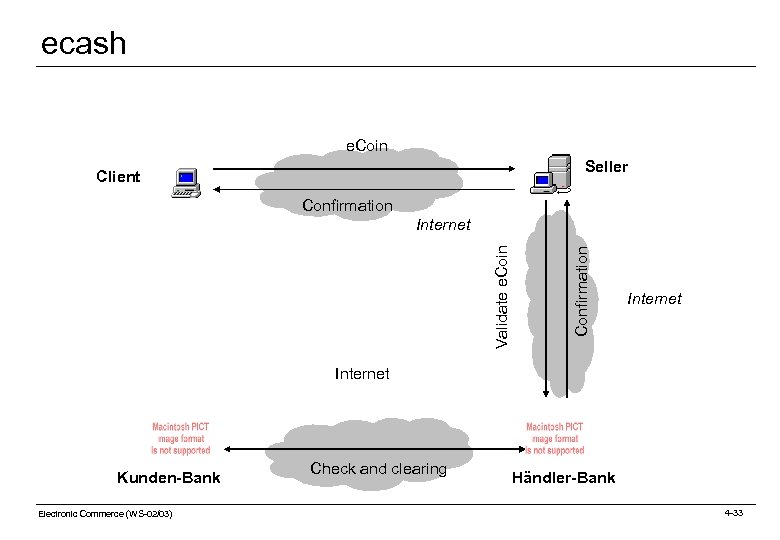
ecash e. Coin Seller Client Confirmation Validate e. Coin Internet Kunden-Bank Electronic Commerce (WS-02/03) Check and clearing Händler-Bank 4 -33
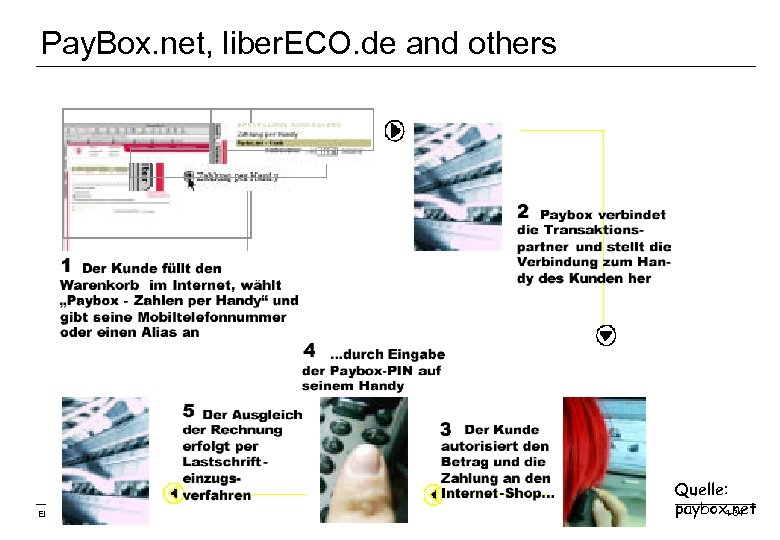
Pay. Box. net, liber. ECO. de and others Electronic Commerce (WS-02/03) Quelle: paybox. net 4 -34
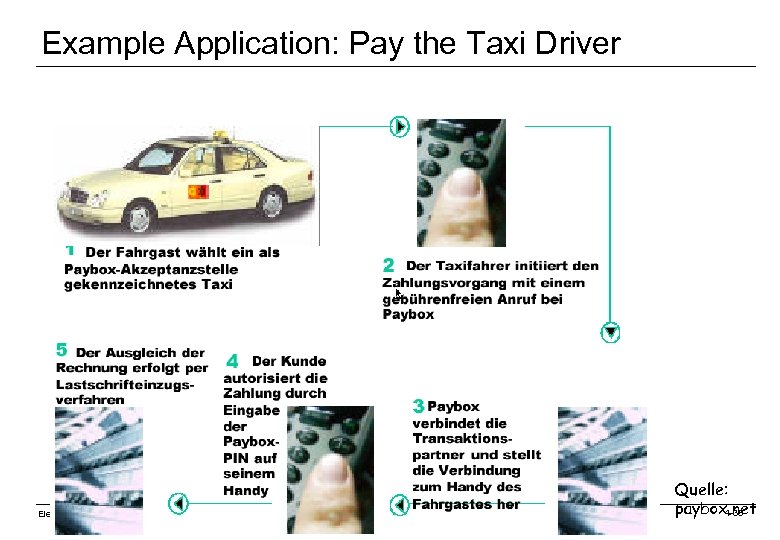
Example Application: Pay the Taxi Driver Electronic Commerce (WS-02/03) Quelle: paybox. net 4 -35
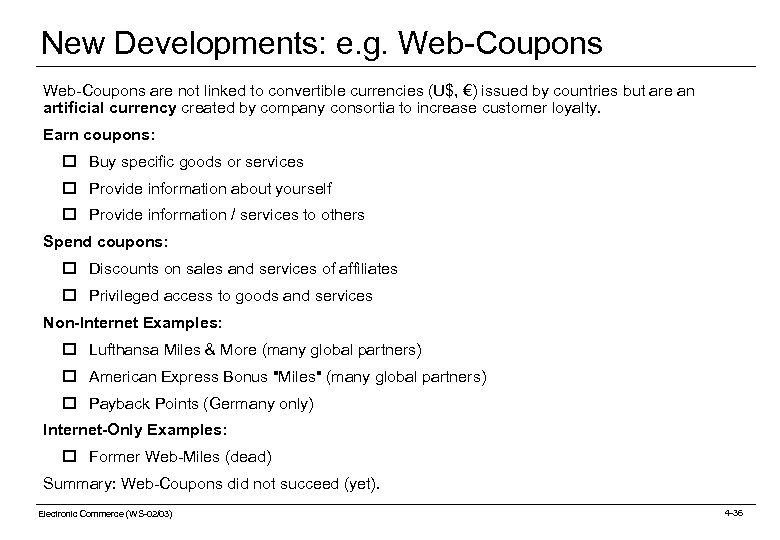
New Developments: e. g. Web-Coupons are not linked to convertible currencies (U$, €) issued by countries but are an artificial currency created by company consortia to increase customer loyalty. Earn coupons: o Buy specific goods or services o Provide information about yourself o Provide information / services to others Spend coupons: o Discounts on sales and services of affiliates o Privileged access to goods and services Non-Internet Examples: o Lufthansa Miles & More (many global partners) o American Express Bonus "Miles" (many global partners) o Payback Points (Germany only) Internet-Only Examples: o Former Web-Miles (dead) Summary: Web-Coupons did not succeed (yet). Electronic Commerce (WS-02/03) 4 -36
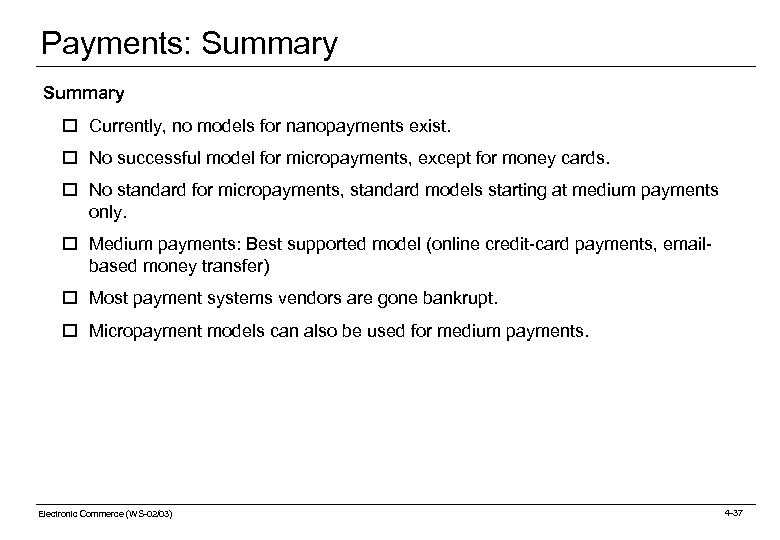
Payments: Summary o Currently, no models for nanopayments exist. o No successful model for micropayments, except for money cards. o No standard for micropayments, standard models starting at medium payments only. o Medium payments: Best supported model (online credit-card payments, emailbased money transfer) o Most payment systems vendors are gone bankrupt. o Micropayment models can also be used for medium payments. Electronic Commerce (WS-02/03) 4 -37
Скачать презентацию 4 B 2 C B 2 E Systems
c596b3330c0e3643644ca56bb4f997ff.ppt