 Скачать презентацию 4 7 Greywater treatment Learning objectives Get familiar
e0af352e488e4ef1a2abda1c20109af8.ppt
- Количество слайдов: 31



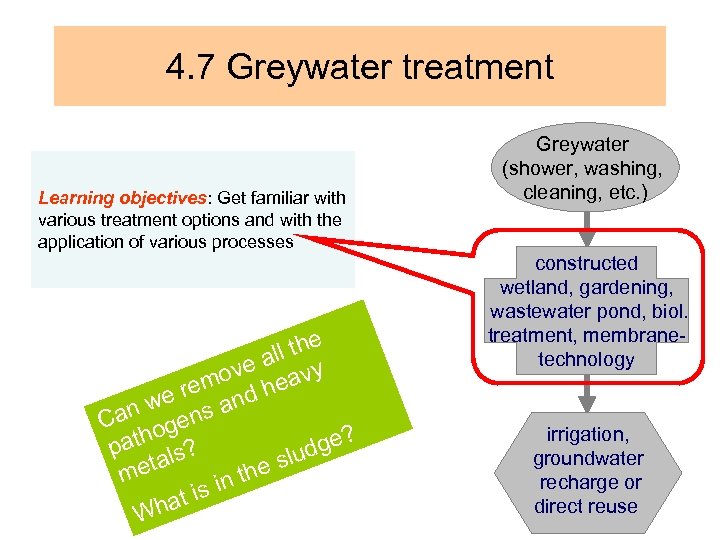
4. 7 Greywater treatment Learning objectives: Get familiar with various treatment options and with the application of various processes e ll th ve a avy emo d he r we s an Can ogen ath s? ge? p slud tal e me n th i t is a Wh Greywater (shower, washing, cleaning, etc. ) constructed wetland, gardening, wastewater pond, biol. treatment, membranetechnology irrigation, groundwater recharge or direct reuse
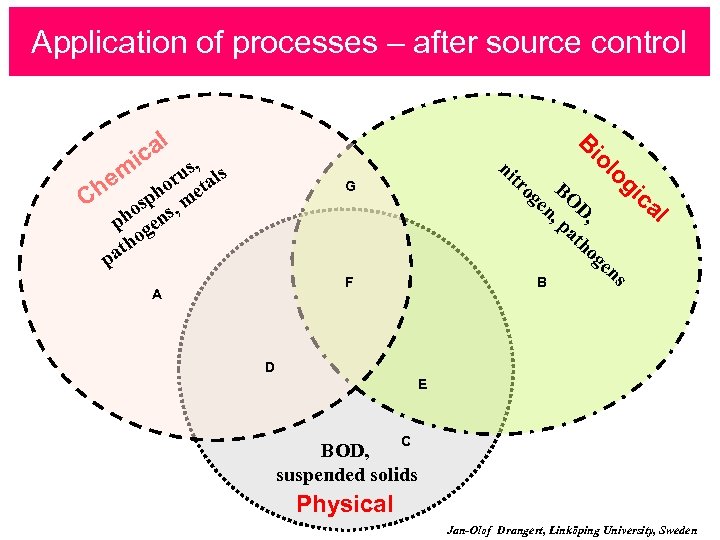
Application of processes – after source control B al ic , m us als he phor et C F A lo g og BO en D , p , at ho g G m s ho ens, p g o th pa io ni tr B ic al en s D E C BOD, suspended solids Physical Jan-Olof Drangert, Linköping University, Sweden
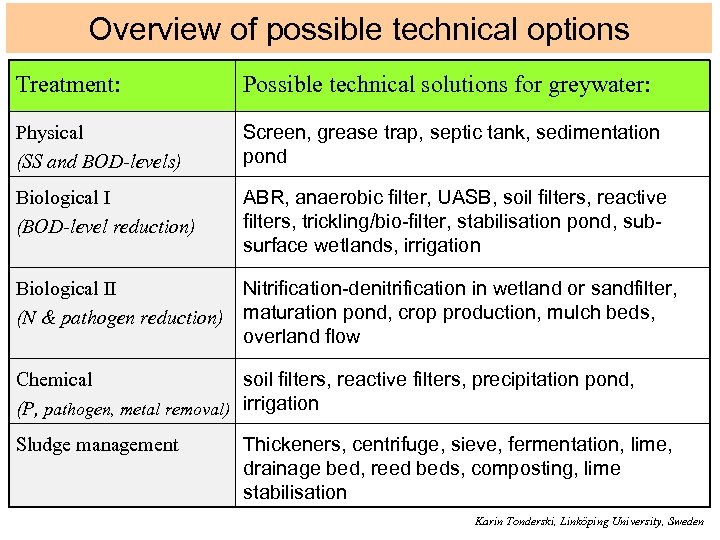
Overview of possible technical options Treatment: Possible technical solutions for greywater: Physical (SS and BOD-levels) Screen, grease trap, septic tank, sedimentation pond Biological I (BOD-level reduction) ABR, anaerobic filter, UASB, soil filters, reactive filters, trickling/bio-filter, stabilisation pond, subsurface wetlands, irrigation Biological II Nitrification-denitrification in wetland or sandfilter, (N & pathogen reduction) maturation pond, crop production, mulch beds, overland flow Chemical soil filters, reactive filters, precipitation pond, (P, pathogen, metal removal) irrigation Sludge management Thickeners, centrifuge, sieve, fermentation, lime, drainage bed, reed beds, composting, lime stabilisation Karin Tonderski, Linköping University, Sweden
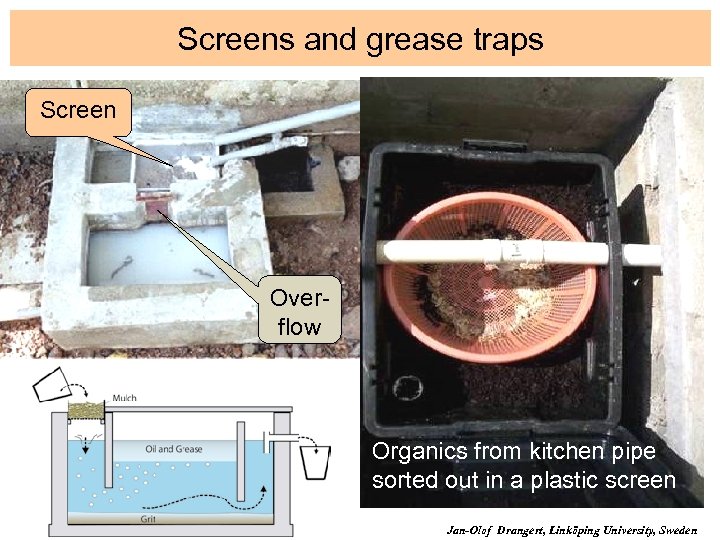
Screens and grease traps Screen Overflow Organics from kitchen pipe sorted out in a plastic screen Jan-Olof Drangert, Linköping University, Sweden
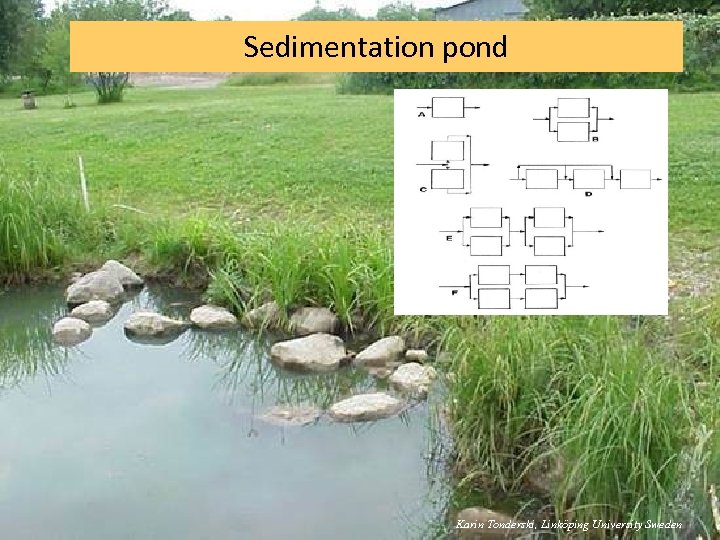
Sedimentation pond Karin Tonderski, Linköping University Sweden
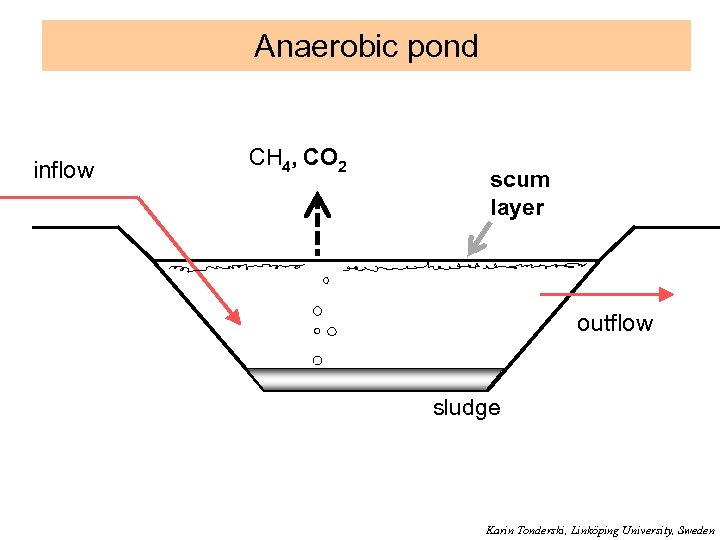
Anaerobic pond inflow CH 4, CO 2 scum layer outflow sludge Karin Tonderski, Linköping University, Sweden
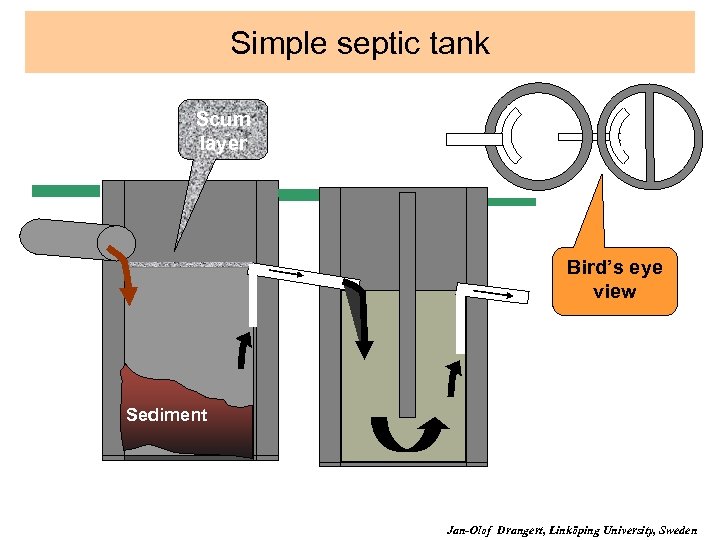
Simple septic tank Scum layer Bird’s eye view Sediment Jan-Olof Drangert, Linköping University, Sweden
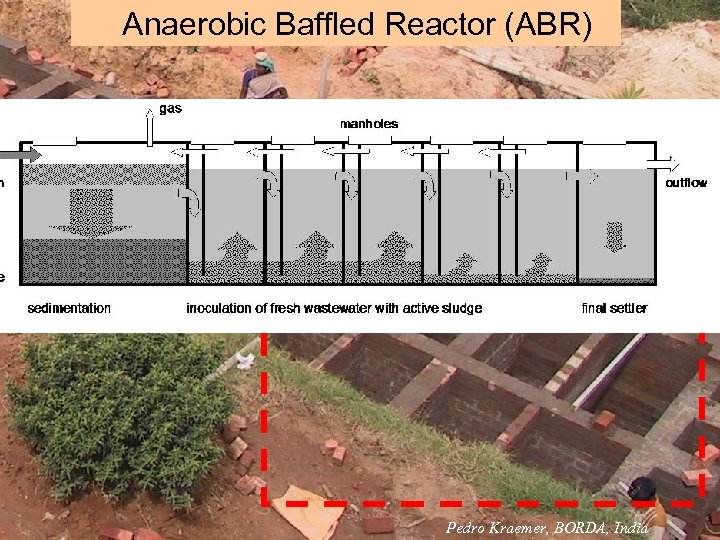
Off-plot Reactor (ABR) Anaerobic Baffledsystem Anaerobic baffled reactor Pedro Kraemer, BORDA, India
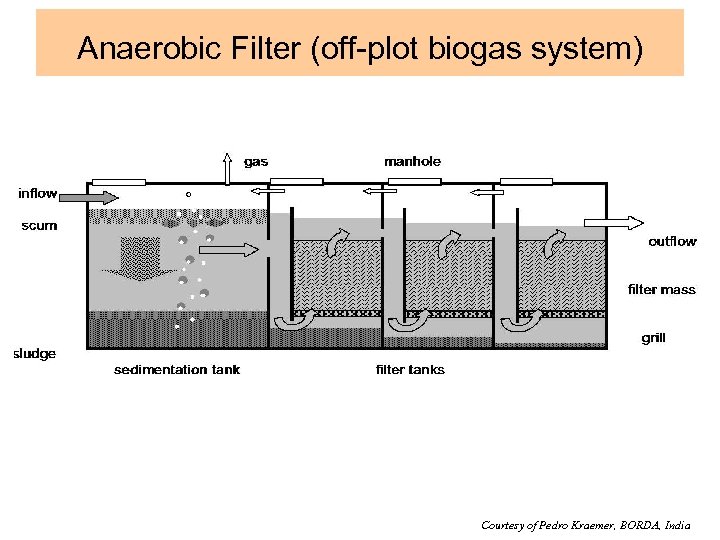
Anaerobic Filter (off-plot biogas system) Courtesy of Pedro Kraemer, BORDA, India
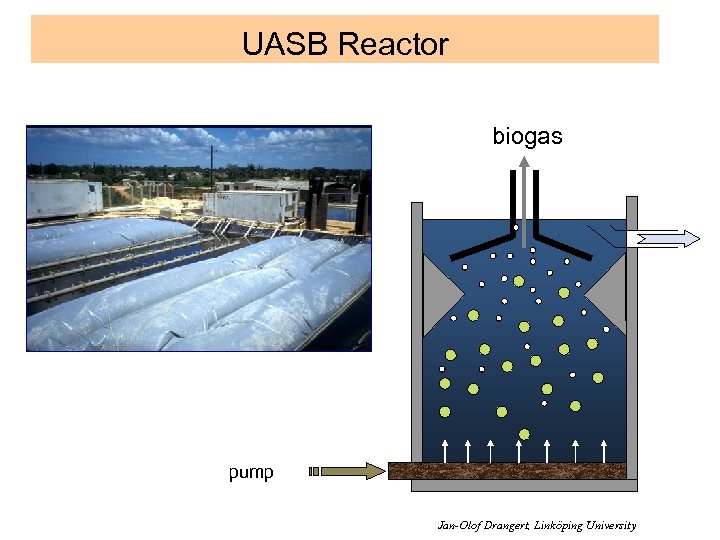
UASB Reactor biogas pump Jan-Olof Drangert, Linköping University
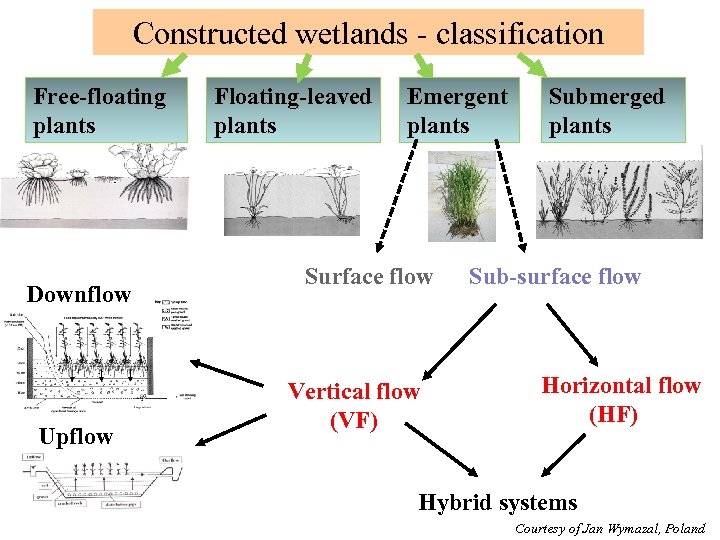
Constructed wetlands - classification Free-floating plants Downflow Upflow Floating-leaved plants Emergent plants Surface flow (FWS) Vertical flow (VF) Submerged plants Sub-surface flow Horizontal flow (HF) Hybrid systems Courtesy of Jan Wymazal, Poland
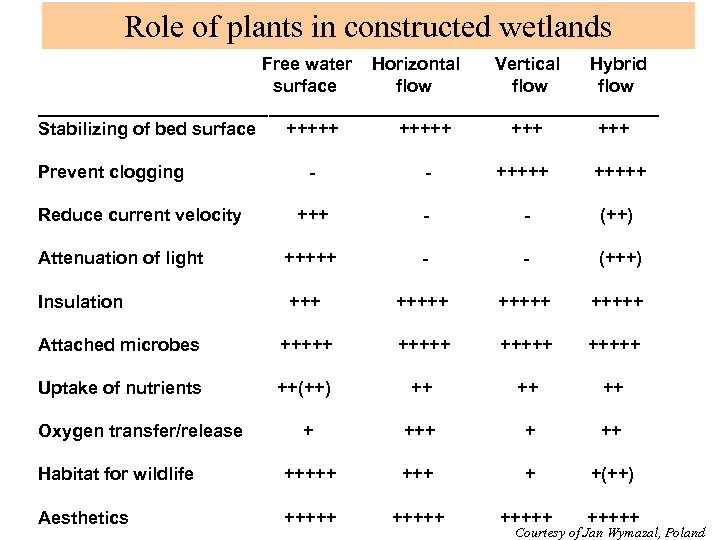
Role of plants in constructed wetlands Free water Horizontal Vertical Hybrid surface flow _______________________________ Stabilizing of bed surface +++++ +++ Prevent clogging - - +++++ +++ - - (++) Attenuation of light +++++ - - (+++) Insulation +++++ Attached microbes +++++ Uptake of nutrients ++(++) ++ ++ ++ Habitat for wildlife +++++ + +(++) Aesthetics +++++ Reduce current velocity Oxygen transfer/release Courtesy of Jan Wymazal, Poland
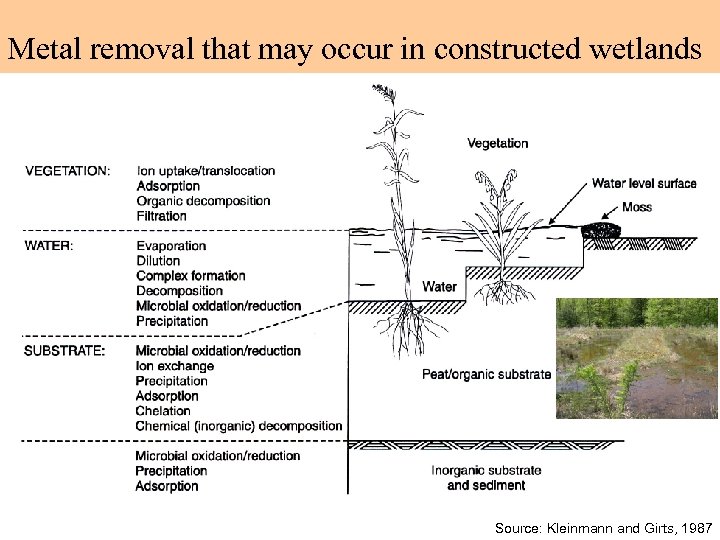
Metal removal that may occur in constructed wetlands Source: Kleinmann and Girts, 1987
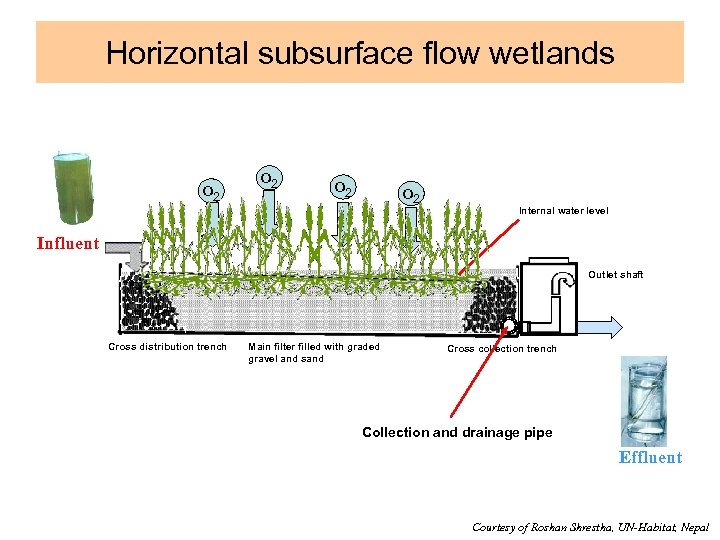
Horizontal subsurface flow wetlands o 2 o 2 Internal water level Influent Outlet shaft Cross distribution trench Main filter filled with graded gravel and sand Cross collection trench Collection and drainage pipe Effluent Courtesy of Roshan Shrestha, UN-Habitat, Nepal
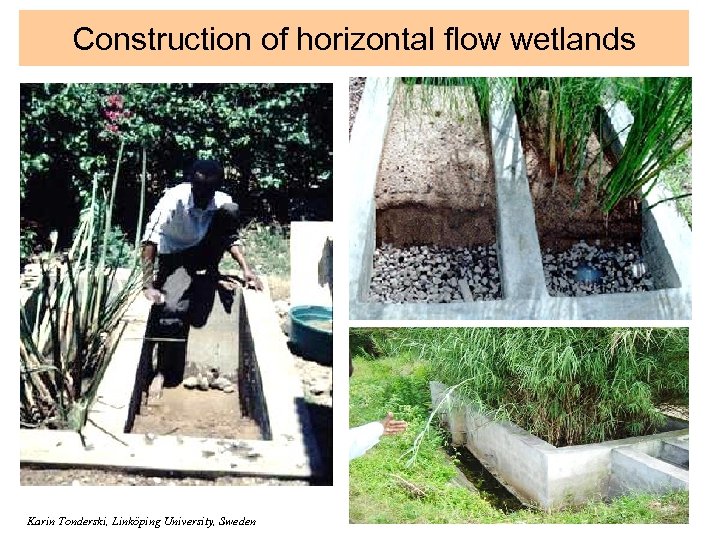
Construction of horizontal flow wetlands Karin Tonderski, Linköping University, Sweden
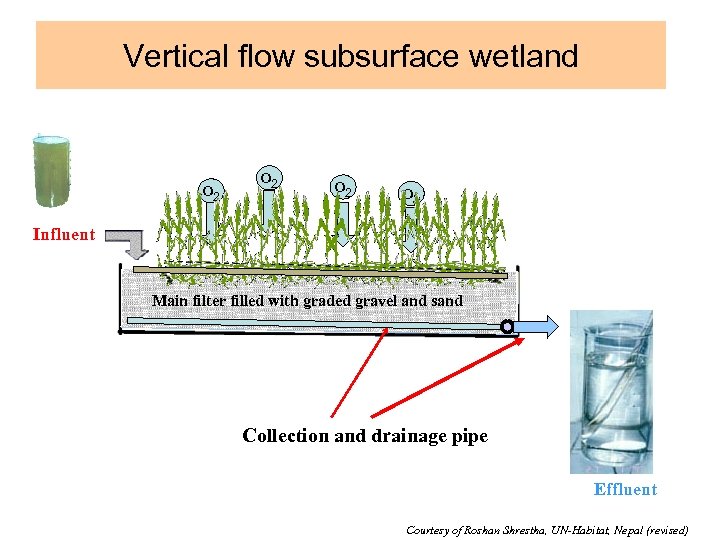
Vertical flow subsurface wetland o 2 o 2 Influent Main filter filled with graded gravel and sand Collection and drainage pipe Effluent Courtesy of Roshan Shrestha, UN-Habitat, Nepal (revised)
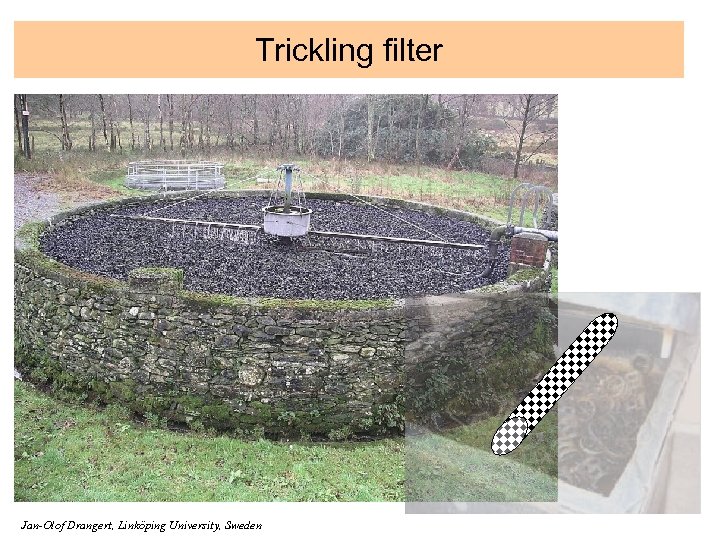
Trickling filter Jan-Olof Drangert, Linköping University, Sweden
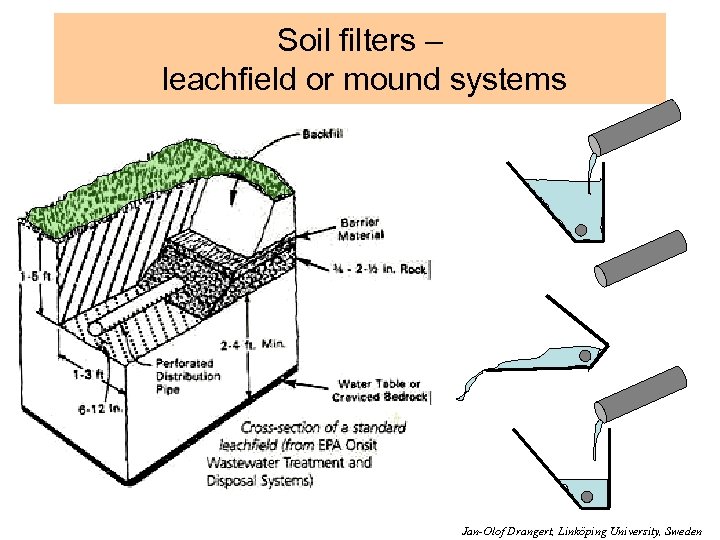
Soil filters – leachfield or mound systems Jan-Olof Drangert, Linköping University, Sweden
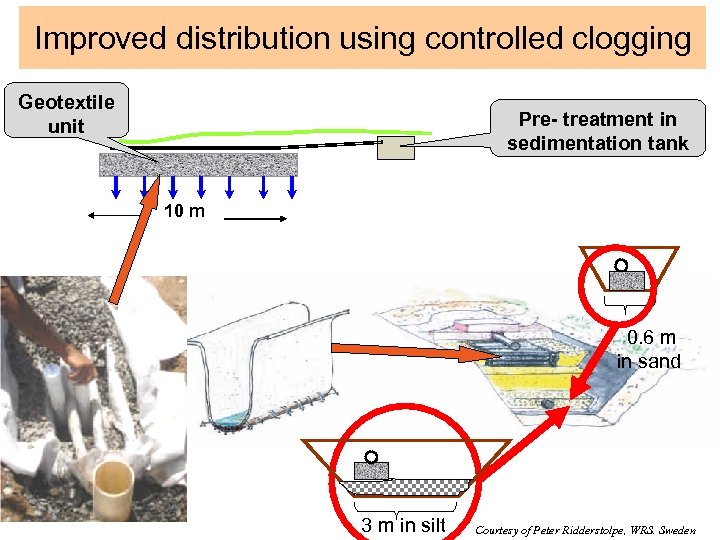
Improved distribution using controlled clogging Geotextile unit Pre- treatment in sedimentation tank 10 m 0. 6 m in sand 3 m in silt Courtesy of Peter Ridderstolpe, WRS. Sweden
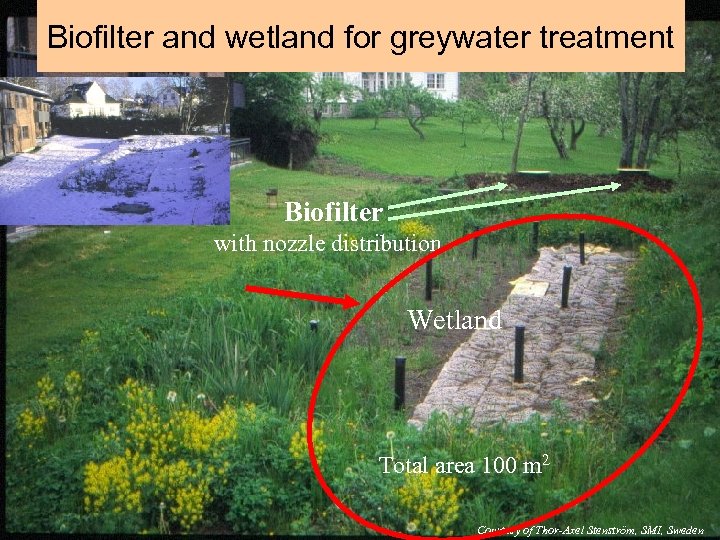
Biofilter and wetland for greywater treatment Biofilter with nozzle distribution Wetland Total area 100 m 2 Courtesy of Thor-Axel Stenström, SMI, Sweden
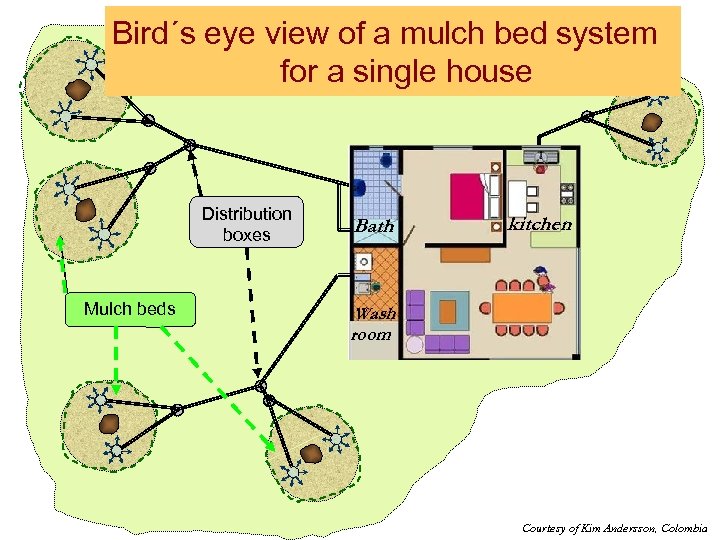
Bird´s eye view of a mulch bed system for a single house Registro de Distribution división de flujos boxes Mulch beds Cajete de acolchado Bath kitchen Wash room Courtesy of Kim Andersson, Colombia
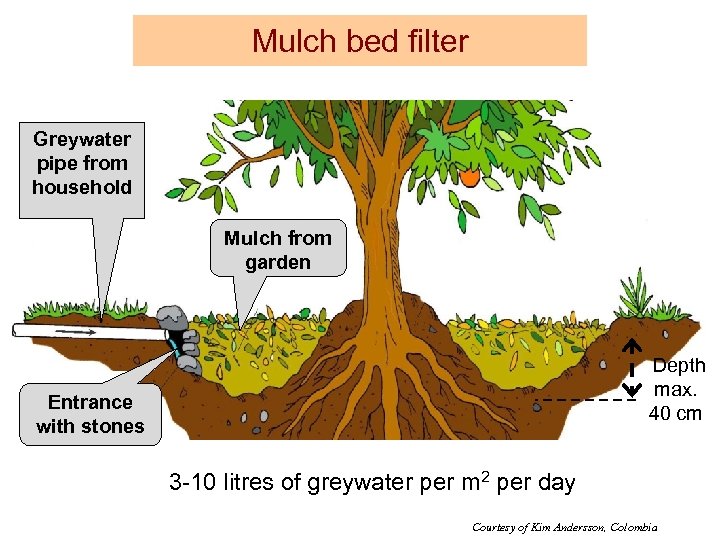
Mulch bed filter Greywater pipe from household Mulch from garden Depth max. 40 cm Entrance with stones 3 -10 litres of greywater per m 2 per day Courtesy of Kim Andersson, Colombia
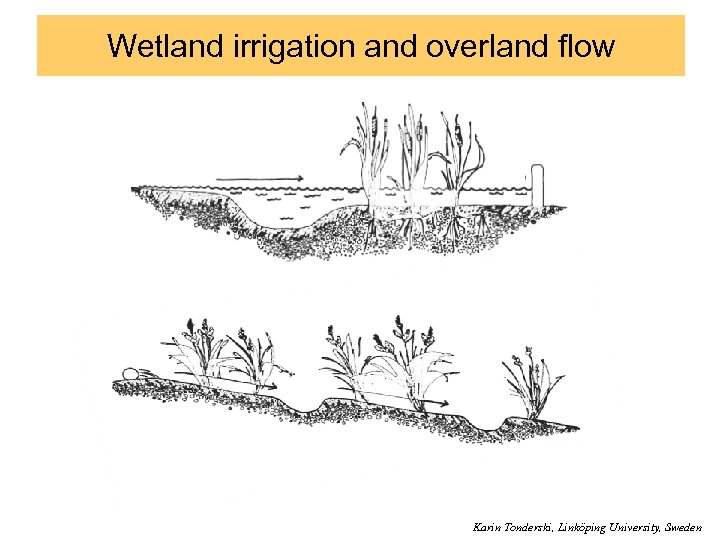
Wetland irrigation and overland flow Karin Tonderski, Linköping University, Sweden
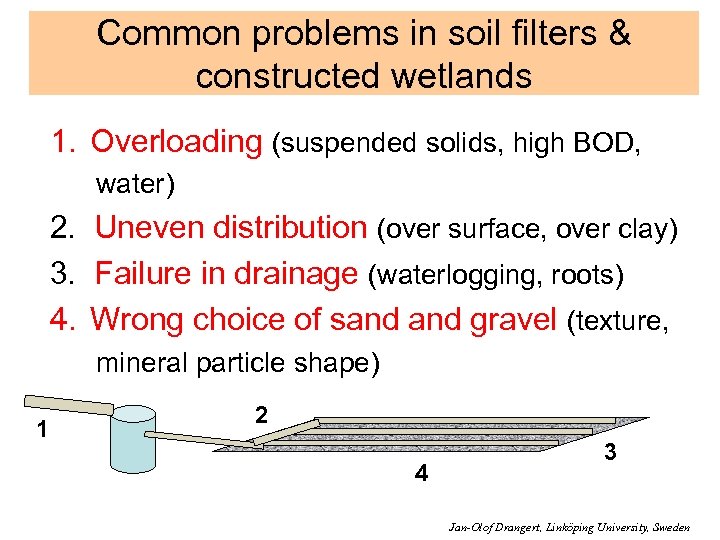
Common problems in soil filters & constructed wetlands 1. Overloading (suspended solids, high BOD, water) 2. Uneven distribution (over surface, over clay) 3. Failure in drainage (waterlogging, roots) 4. Wrong choice of sand gravel (texture, mineral particle shape) 1 2 4 3 Jan-Olof Drangert, Linköping University, Sweden
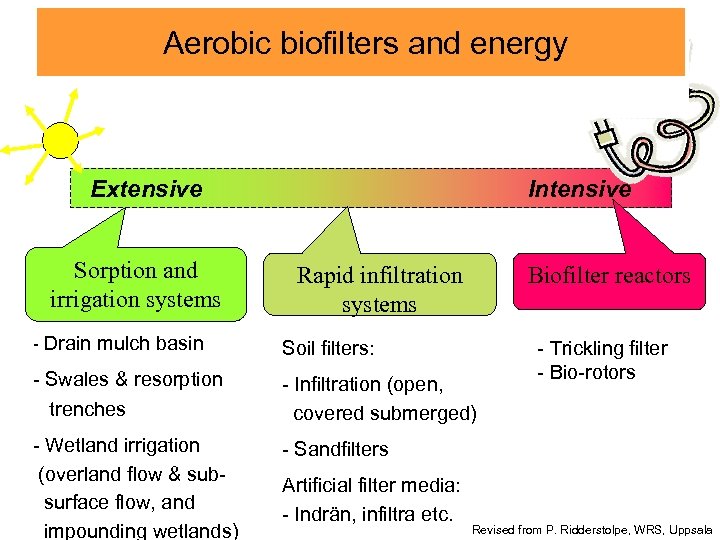
Aerobic biofilters and energy Extensive Sorption and irrigation systems Intensive Biofilter reactors Rapid infiltration systems - Drain mulch basin Soil filters: - Swales & resorption trenches - Infiltration (open, covered submerged) - Wetland irrigation (overland flow & subsurface flow, and impounding wetlands) - Sandfilters Artificial filter media: - Indrän, infiltra etc. - Trickling filter - Bio-rotors Revised from P. Ridderstolpe, WRS, Uppsala
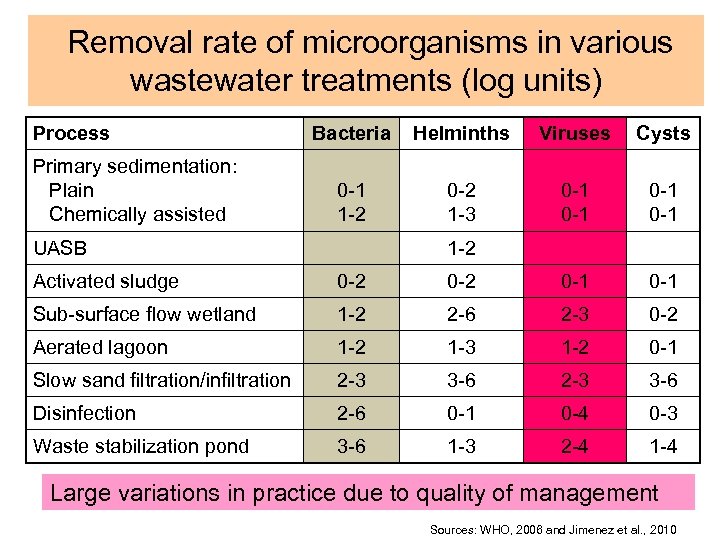
Removal rate of microorganisms in various wastewater treatments (log units) Process Primary sedimentation: Plain Chemically assisted Bacteria Helminths Viruses Cysts 0 -1 1 -2 0 -2 1 -3 0 -1 0 -1 UASB 1 -2 Activated sludge 0 -2 0 -1 Sub-surface flow wetland 1 -2 2 -6 2 -3 0 -2 Aerated lagoon 1 -2 1 -3 1 -2 0 -1 Slow sand filtration/infiltration 2 -3 3 -6 Disinfection 2 -6 0 -1 0 -4 0 -3 Waste stabilization pond 3 -6 1 -3 2 -4 1 -4 Large variations in practice due to quality of management Sources: WHO, 2006 and Jimenez et al. , 2010
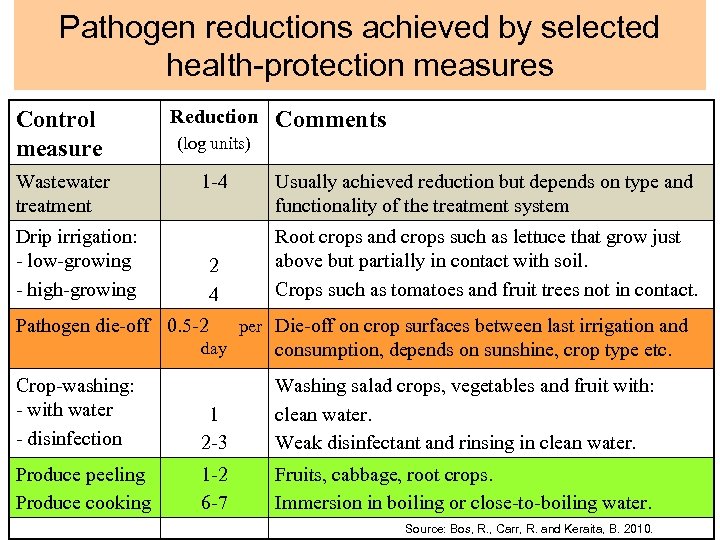
Pathogen reductions achieved by selected health-protection measures Control measure Reduction Wastewater treatment 1 -4 Comments (log units) Drip irrigation: - low-growing - high-growing 2 4 Pathogen die-off 0. 5 -2 Usually achieved reduction but depends on type and functionality of the treatment system Root crops and crops such as lettuce that grow just above but partially in contact with soil. Crops such as tomatoes and fruit trees not in contact. per Die-off on crop surfaces between last irrigation and day consumption, depends on sunshine, crop type etc. Crop-washing: - with water - disinfection 1 2 -3 Washing salad crops, vegetables and fruit with: clean water. Weak disinfectant and rinsing in clean water. Produce peeling Produce cooking 1 -2 6 -7 Fruits, cabbage, root crops. Immersion in boiling or close-to-boiling water. Source: Bos, R. , Carr, R. and Keraita, B. 2010.
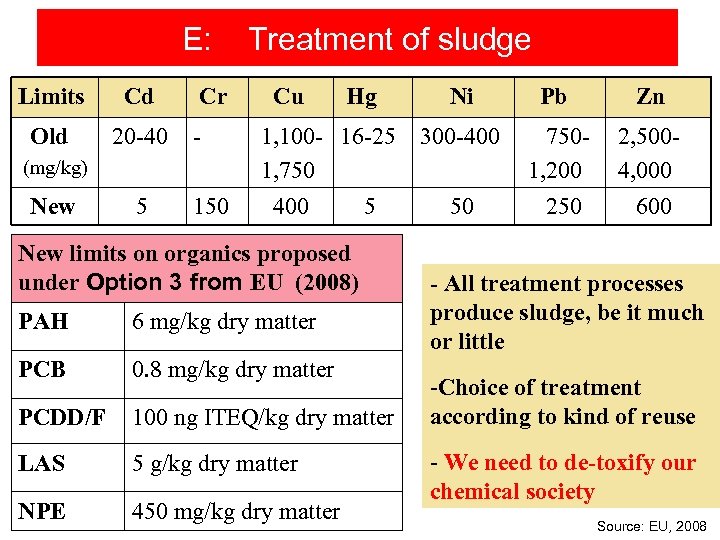
E: Limits Cd Old 20 -40 Cr - (mg/kg) New 5 150 Treatment of sludge Cu Hg Ni 1, 100 - 16 -25 300 -400 1, 750 400 5 50 New limits on organics proposed under Option 3 from EU (2008) PAH 6 mg/kg dry matter PCB 0. 8 mg/kg dry matter PCDD/F 100 ng ITEQ/kg dry matter LAS 5 g/kg dry matter NPE 450 mg/kg dry matter Pb Zn 7501, 200 250 2, 5004, 000 600 - All treatment processes produce sludge, be it much or little -Choice of treatment according to kind of reuse - We need to de-toxify our chemical society Source: EU, 2008
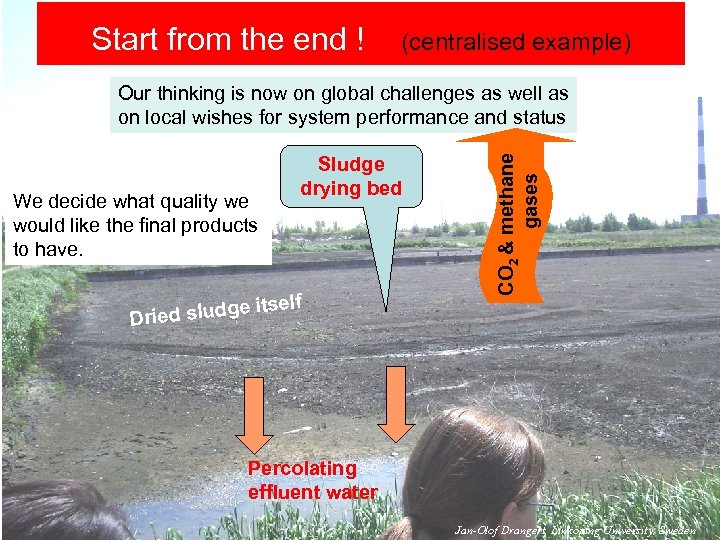
Start from the end ! (centralised example) We decide what quality we would like the final products to have. ge Dried slud Sludge drying bed itself CO 2 & methane gases Our thinking is now on global challenges as well as on local wishes for system performance and status Percolating effluent water Jan-Olof Drangert, Linköping University, Sweden
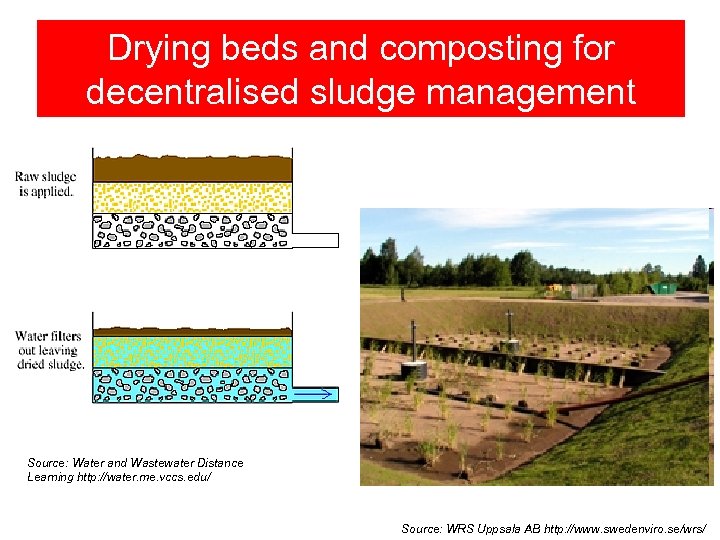
Drying beds and composting for decentralised sludge management e Dried sludg itself Source: Water and Wastewater Distance Learning http: //water. me. vccs. edu/ Source: WRS Uppsala. Drangert, Linköping University, Sweden J-O AB http: //www. swedenviro. se/wrs/
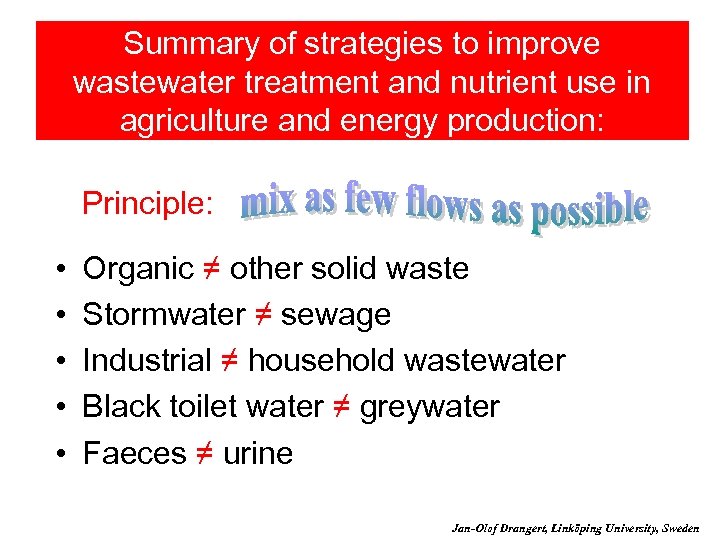
Summary of strategies to improve wastewater treatment and nutrient use in agriculture and energy production: Principle: • • • Organic ≠ other solid waste Stormwater ≠ sewage Industrial ≠ household wastewater Black toilet water ≠ greywater Faeces ≠ urine Jan-Olof Drangert, Linköping University, Sweden
Скачать презентацию 4 7 Greywater treatment Learning objectives Get familiar
e0af352e488e4ef1a2abda1c20109af8.ppt