 Скачать презентацию 4 4 Mr Erik Shay CIB SL Briefing
b6cb977b0a2819e92c79a73a80cfe4fd.ppt
- Количество слайдов: 53



4
4 Mr. Erik Shay CIB/SL Briefing 4 th Brigade JROTC
4 Ground Rules Show mutual respect, one speaker at a time Hold Questions to the end of the presentation Only 2 hours for training, need to be aware of time
4 AGENDA • Continuous Improvement Brief (CIB) • Service Learning Brief • Open Discussion/Questions
4 Continuous Improvement Brief (CIB) Initiated, planned, led, executed, and documented by Cadets begin by reviewing JROTC program mission, vision, values, and outcomes and discuss how these relate to their Battalion goals and desired outcomes are established an action plan is developed and executed. The goals are continuously measured, documenting desired outcome accomplishment. Successful implementation of this process documents that Cadets understand the processes of continuous improvement, problem solving, planning, goal setting and how to use them to guide the organization throughout the year. For this presentation the entire Battalion staff (BC, XO, S 1, S 2, S 3, S 4, S 5) will brief their involvement in the project. NOTE CSM is the only Cadet that is not part of this briefing unless SAI and AI want them to be. Their plan for improvement will state the data to justify the issue, how they developed a continuous improvement strategy, their implementation process, and continuous improvement results.
Continuous Improvement Brief (CIB) 4 The following outlines the Continuous Improvement Process for Leadership: Plan At the start of a new school year, Cadet staff plans their activities for the year, assuring that each activity supports the JROTC mission, vision, program outcomes and their Battalion goals. If they are not addressing one of the program goals with an activity, they may need to plan something else or rethink the importance of the goal in the first place.
4 Continuous Improvement Brief (CIB) Do/Act The Cadet Battalion Commander, assisted by the Battalion staff, begins by establishing a mission and vision for that school year. SMART goals are established based on unit data from years past. Desired outcomes or measures of success are established and each Cadet Battalion staff member is assigned as a project officer for each goal. This Cadet leader executes the plan for goal achievement, measures, and document progress. Cadets should do all the work of the planning, establish the funds or resources needed, finding volunteer Cadets to help setup, clean-up, publicize, execute the project, and send reports to their supervising instructor. When an activity is accomplished that supports a goal; the progress towards goal achievement and measures of success should be recorded and kept in a portfolio. A monthly special staff meeting (a self-check-up) is conducted where each staff officer responsible for a goal, presents to the staff how the unit is doing in relation to accomplishing that goal. Depending on success or lack thereof on each goal, the staff discusses changes or corrections they may need to make to complete the organizational goal by year‘s end. This process, along with quantifying data, is also documented in a notebook or computer spreadsheet.
4 Continuous Improvement Brief (CIB) Evaluate The validation of the Continuous Improvement Process will be briefed to brigade personnel as part of the JROTC Program for Accreditation process. 35 Possible points for this briefing.
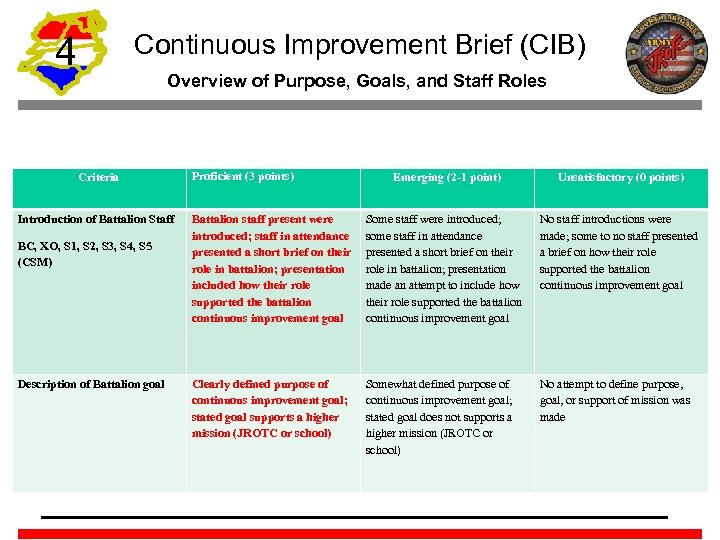
4 Continuous Improvement Brief (CIB) Overview of Purpose, Goals, and Staff Roles Criteria Introduction of Battalion Staff BC, XO, S 1, S 2, S 3, S 4, S 5 (CSM) Description of Battalion goal Proficient (3 points) Emerging (2 -1 point) Unsatisfactory (0 points) Battalion staff present were introduced; staff in attendance presented a short brief on their role in battalion; presentation included how their role supported the battalion continuous improvement goal Some staff were introduced; some staff in attendance presented a short brief on their role in battalion; presentation made an attempt to include how their role supported the battalion continuous improvement goal No staff introductions were made; some to no staff presented a brief on how their role supported the battalion continuous improvement goal Clearly defined purpose of continuous improvement goal; stated goal supports a higher mission (JROTC or school) Somewhat defined purpose of continuous improvement goal; stated goal does not supports a higher mission (JROTC or school) No attempt to define purpose, goal, or support of mission was made
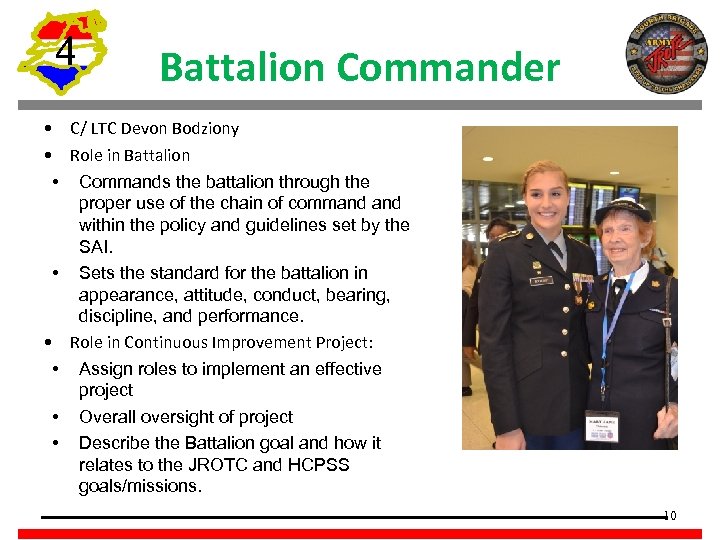
4 Battalion Commander • C/ LTC Devon Bodziony • Role in Battalion • Commands the battalion through the proper use of the chain of command within the policy and guidelines set by the SAI. • Sets the standard for the battalion in appearance, attitude, conduct, bearing, discipline, and performance. • Role in Continuous Improvement Project: • Assign roles to implement an effective project • Overall oversight of project • Describe the Battalion goal and how it relates to the JROTC and HCPSS goals/missions. 10
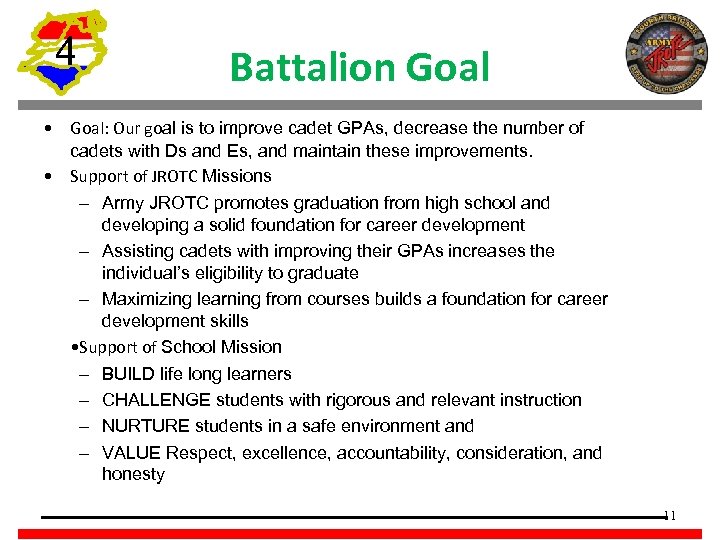
4 Battalion Goal • Goal: Our goal is to improve cadet GPAs, decrease the number of cadets with Ds and Es, and maintain these improvements. • Support of JROTC Missions – Army JROTC promotes graduation from high school and developing a solid foundation for career development – Assisting cadets with improving their GPAs increases the individual’s eligibility to graduate – Maximizing learning from courses builds a foundation for career development skills • Support of School Mission – BUILD life long learners – CHALLENGE students with rigorous and relevant instruction – NURTURE students in a safe environment and – VALUE Respect, excellence, accountability, consideration, and honesty 11
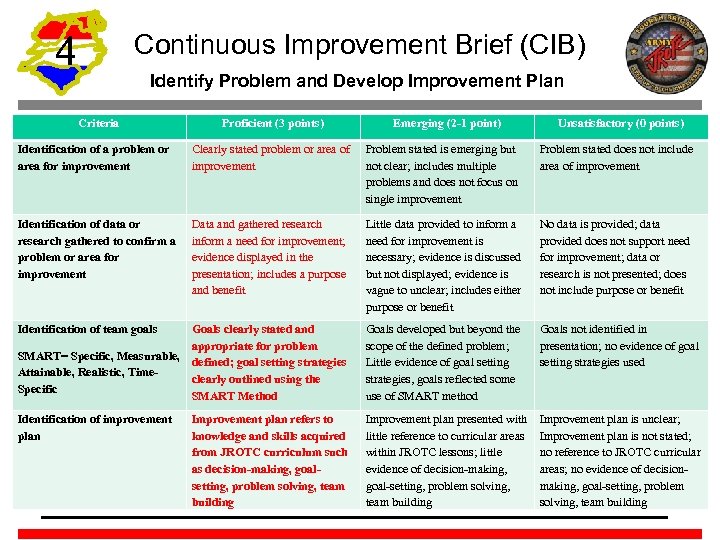
4 Continuous Improvement Brief (CIB) Identify Problem and Develop Improvement Plan Criteria Proficient (3 points) Emerging (2 -1 point) Unsatisfactory (0 points) Identification of a problem or area for improvement Clearly stated problem or area of improvement Problem stated is emerging but not clear; includes multiple problems and does not focus on single improvement Problem stated does not include area of improvement Identification of data or research gathered to confirm a problem or area for improvement Data and gathered research inform a need for improvement; evidence displayed in the presentation; includes a purpose and benefit Little data provided to inform a need for improvement is necessary; evidence is discussed but not displayed; evidence is vague to unclear; includes either purpose or benefit No data is provided; data provided does not support need for improvement; data or research is not presented; does not include purpose or benefit Goals clearly stated and appropriate for problem SMART= Specific, Measurable, defined; goal setting strategies Attainable, Realistic, Timeclearly outlined using the Specific SMART Method Goals developed but beyond the scope of the defined problem; Little evidence of goal setting strategies, goals reflected some use of SMART method Goals not identified in presentation; no evidence of goal setting strategies used Identification of improvement plan Improvement plan presented with little reference to curricular areas within JROTC lessons; little evidence of decision-making, goal-setting, problem solving, team building Improvement plan is unclear; Improvement plan is not stated; no reference to JROTC curricular areas; no evidence of decisionmaking, goal-setting, problem solving, team building Identification of team goals Improvement plan refers to knowledge and skills acquired from JROTC curriculum such as decision-making, goalsetting, problem solving, team building
4 Area for Improvement • Problem – Many individuals in JROTC had Ds and Es as their first quarter grades – The average GPA of JROTC was lower than the school’s average GPA 13
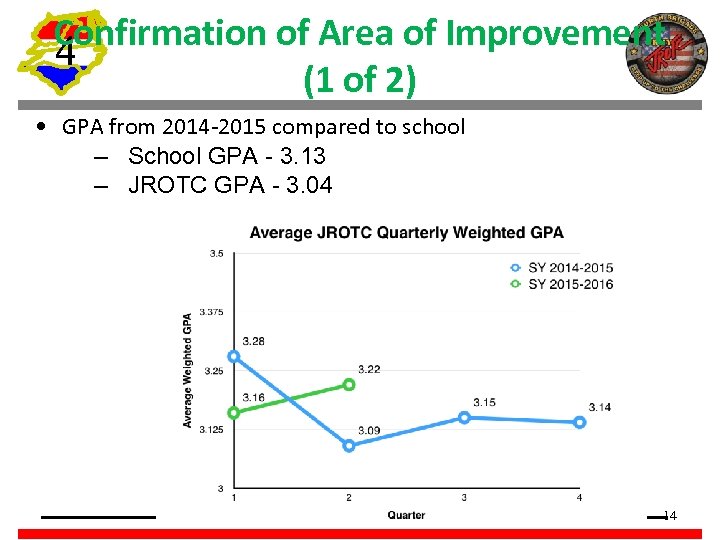
Confirmation of Area of Improvement 4 (1 of 2) • GPA from 2014 -2015 compared to school – School GPA - 3. 13 – JROTC GPA - 3. 04 14
Confirmation of Area of Improvement 4 (2 of 2) • Purpose – Increase GPAs to a level at or above the average school GPA – Decrease cadets with Ds or Es • Benefit of Improvement – Cadets’ future prospects • Cadets will be less likely to drop out, repeat a grade, or repeat a course • Cadets will be better prepared to excel in postsecondary options and career pathways 15
4 Team Goals • Goal – Decrease number of cadets with final grades of Ds or Es by at least ⅓ (71 → 47) – Have the average JROTC GPA meet or exceed the average school GPA. (3. 13) • SMART Method – Specific - Goal is tailored to GPA increases and number of Ds and Es – Measurable - GPAs are measured each quarter and at the end of the year – Attainable - Reducing number of cadets with Ds and Es by ⅓ is manageable – Realistic - Requires an average BN GPA increase by. 1 – Time-Specific - Limited to this school year in order to assess and reevaluate our project while the current staff is in place 16
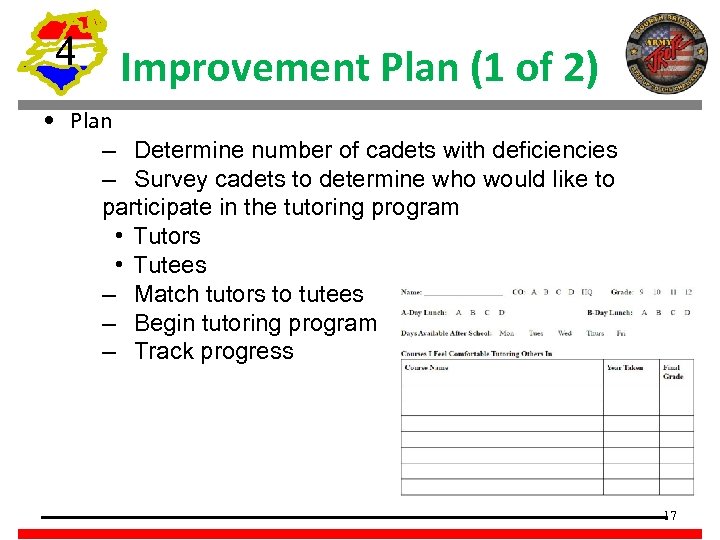
4 Improvement Plan (1 of 2) • Plan – Determine number of cadets with deficiencies – Survey cadets to determine who would like to participate in the tutoring program • Tutors • Tutees – Match tutors to tutees – Begin tutoring program – Track progress 17
4 Improvement Plan (2 of 2) • Support from JROTC Curriculum – U 3 -C 1 -L 1 - Self Awareness – U 3 -C 1 -L 3 - Personal Growth Plan – U 3 -C 1 -L 4 - Becoming an Active Learner • Critical thinking techniques • Distinguish between active and passive learning – U 3 -C 2 -L 3 - Learning Style and Processing Preferences – U 3 -C 2 -L 4 - Multiple Intelligences – U 3 -C 3 -L 3 - Study Habits • Relate personal learning preferences to study habits • Identify effective study skills and test-preparation strategies • Each of these lessons have been taught 18
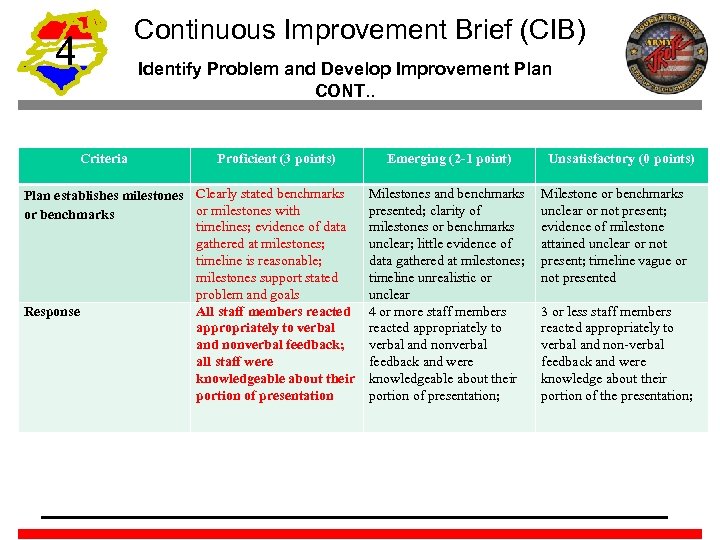
Continuous Improvement Brief (CIB) 4 Identify Problem and Develop Improvement Plan CONT. . Criteria Proficient (3 points) Plan establishes milestones Clearly stated benchmarks or milestones with or benchmarks timelines; evidence of data gathered at milestones; timeline is reasonable; milestones support stated problem and goals Response All staff members reacted appropriately to verbal and nonverbal feedback; all staff were knowledgeable about their portion of presentation Emerging (2 -1 point) Milestones and benchmarks presented; clarity of milestones or benchmarks unclear; little evidence of data gathered at milestones; timeline unrealistic or unclear 4 or more staff members reacted appropriately to verbal and nonverbal feedback and were knowledgeable about their portion of presentation; Unsatisfactory (0 points) Milestone or benchmarks unclear or not present; evidence of milestone attained unclear or not present; timeline vague or not presented 3 or less staff members reacted appropriately to verbal and non-verbal feedback and were knowledge about their portion of the presentation;
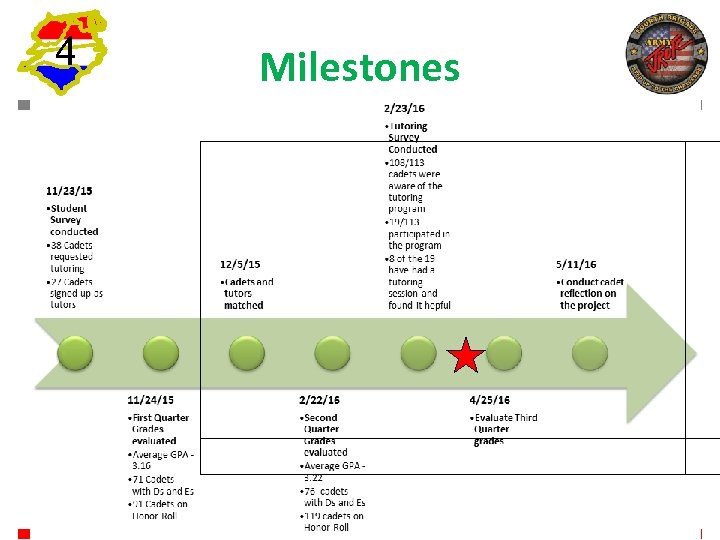
4 Milestones 20
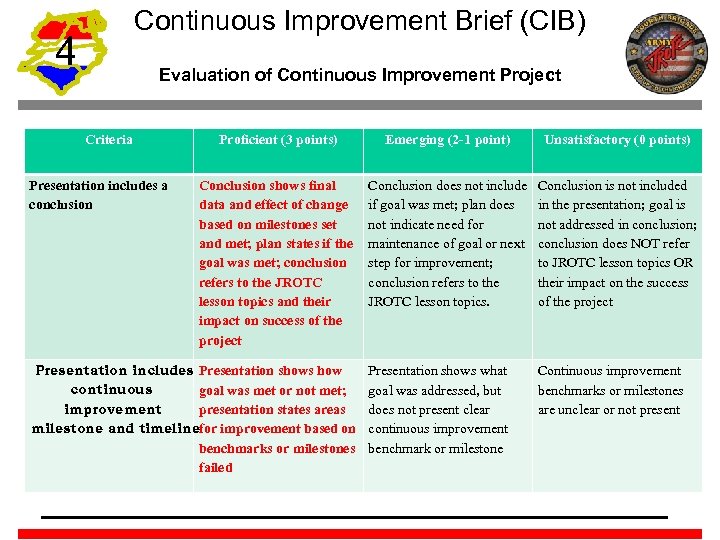
Continuous Improvement Brief (CIB) 4 Evaluation of Continuous Improvement Project Criteria Presentation includes a conclusion Proficient (3 points) Emerging (2 -1 point) Unsatisfactory (0 points) Conclusion shows final data and effect of change based on milestones set and met; plan states if the goal was met; conclusion refers to the JROTC lesson topics and their impact on success of the project Conclusion does not include if goal was met; plan does not indicate need for maintenance of goal or next step for improvement; conclusion refers to the JROTC lesson topics. Conclusion is not included in the presentation; goal is not addressed in conclusion; conclusion does NOT refer to JROTC lesson topics OR their impact on the success of the project Presentation shows what goal was addressed, but does not present clear continuous improvement benchmark or milestone Continuous improvement benchmarks or milestones are unclear or not present Presentation includes Presentation shows how continuous goal was met or not met; improvement presentation states areas milestone and timelinefor improvement based on benchmarks or milestones failed
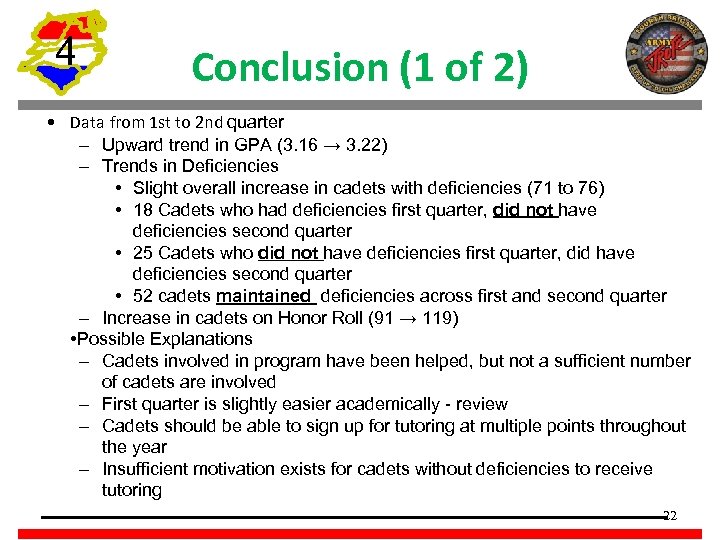
4 Conclusion (1 of 2) • Data from 1 st to 2 nd quarter – Upward trend in GPA (3. 16 → 3. 22) – Trends in Deficiencies • Slight overall increase in cadets with deficiencies (71 to 76) • 18 Cadets who had deficiencies first quarter, did not have deficiencies second quarter • 25 Cadets who did not have deficiencies first quarter, did have deficiencies second quarter • 52 cadets maintained deficiencies across first and second quarter – Increase in cadets on Honor Roll (91 → 119) • Possible Explanations – Cadets involved in program have been helped, but not a sufficient number of cadets are involved – First quarter is slightly easier academically - review – Cadets should be able to sign up for tutoring at multiple points throughout the year – Insufficient motivation exists for cadets without deficiencies to receive tutoring 22
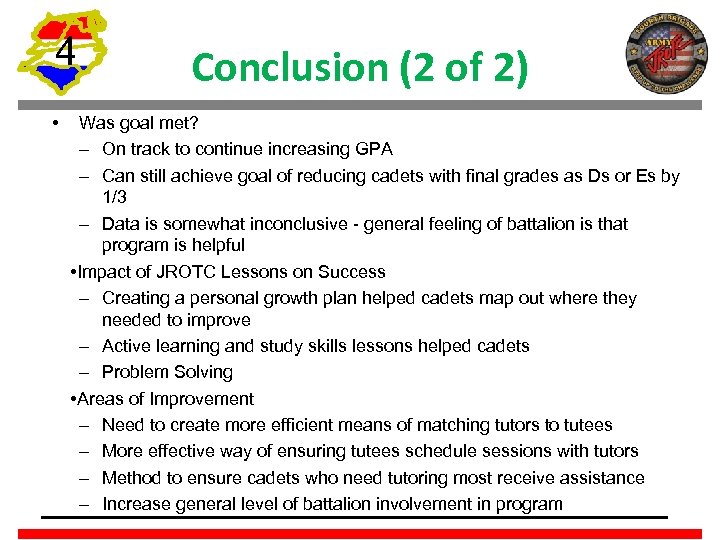
4 • Conclusion (2 of 2) Was goal met? – On track to continue increasing GPA – Can still achieve goal of reducing cadets with final grades as Ds or Es by 1/3 – Data is somewhat inconclusive - general feeling of battalion is that program is helpful • Impact of JROTC Lessons on Success – Creating a personal growth plan helped cadets map out where they needed to improve – Active learning and study skills lessons helped cadets – Problem Solving • Areas of Improvement – Need to create more efficient means of matching tutors to tutees – More effective way of ensuring tutees schedule sessions with tutors – Method to ensure cadets who need tutoring most receive assistance – Increase general level of battalion involvement in program
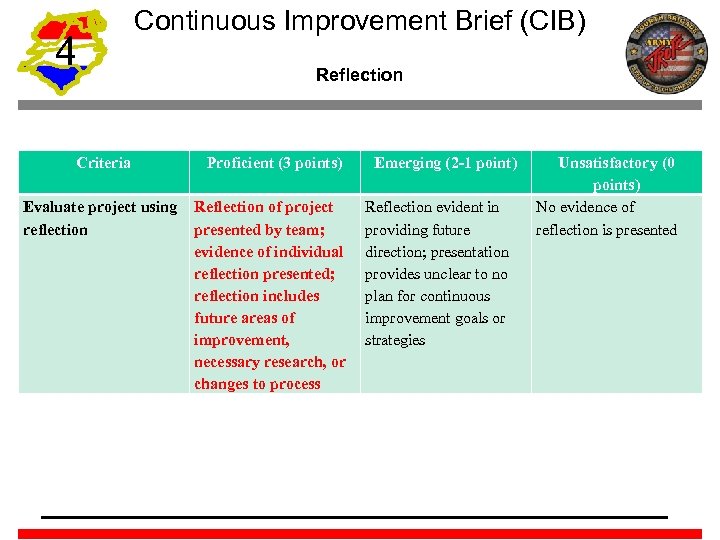
4 Continuous Improvement Brief (CIB) Reflection Criteria Proficient (3 points) Evaluate project using reflection Reflection of project presented by team; evidence of individual reflection presented; reflection includes future areas of improvement, necessary research, or changes to process Emerging (2 -1 point) Reflection evident in providing future direction; presentation provides unclear to no plan for continuous improvement goals or strategies Unsatisfactory (0 points) No evidence of reflection is presented
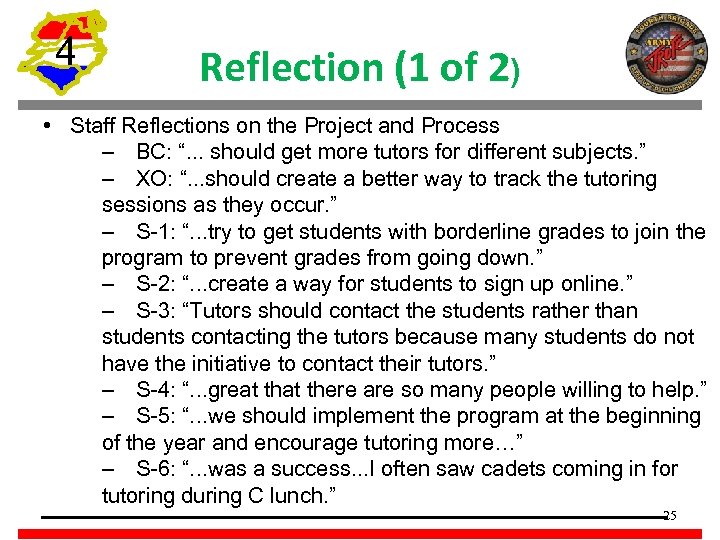
4 Reflection (1 of 2) • Staff Reflections on the Project and Process – BC: “. . . should get more tutors for different subjects. ” – XO: “. . . should create a better way to track the tutoring sessions as they occur. ” – S-1: “. . . try to get students with borderline grades to join the program to prevent grades from going down. ” – S-2: “. . . create a way for students to sign up online. ” – S-3: “Tutors should contact the students rather than students contacting the tutors because many students do not have the initiative to contact their tutors. ” – S-4: “. . . great there are so many people willing to help. ” – S-5: “. . . we should implement the program at the beginning of the year and encourage tutoring more…” – S-6: “. . . was a success. . . I often saw cadets coming in for tutoring during C lunch. ” 25
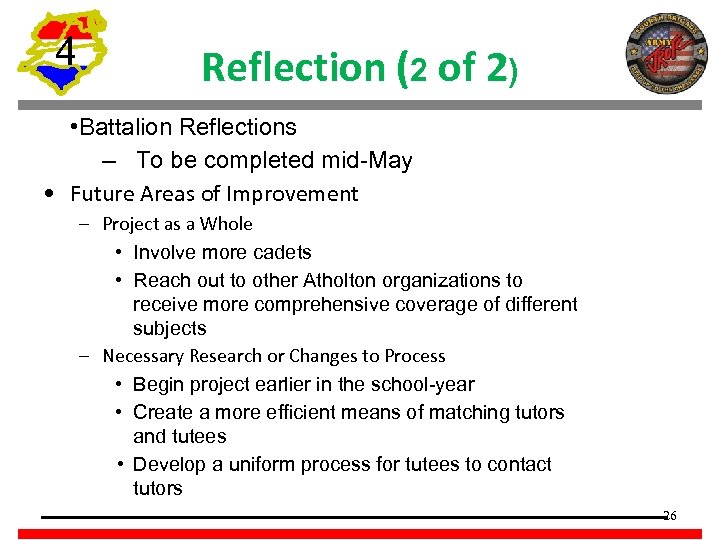
4 Reflection (2 of 2) • Battalion Reflections – To be completed mid-May • Future Areas of Improvement – Project as a Whole • Involve more cadets • Reach out to other Atholton organizations to receive more comprehensive coverage of different subjects – Necessary Research or Changes to Process • Begin project earlier in the school-year • Create a more efficient means of matching tutors and tutees • Develop a uniform process for tutees to contact tutors 26
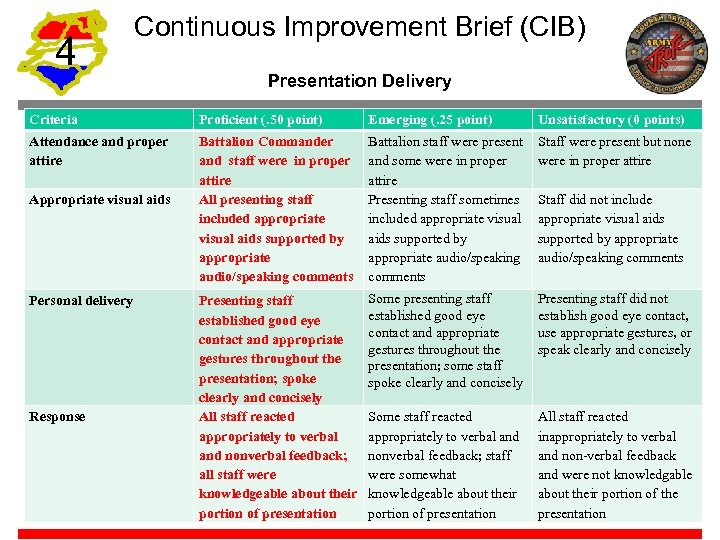
4 Continuous Improvement Brief (CIB) Presentation Delivery Criteria Proficient (. 50 point) Emerging (. 25 point) Unsatisfactory (0 points) Attendance and proper attire Battalion Commander and staff were in proper attire All presenting staff included appropriate visual aids supported by appropriate audio/speaking comments Battalion staff were present and some were in proper attire Presenting staff sometimes included appropriate visual aids supported by appropriate audio/speaking comments Staff were present but none were in proper attire Presenting staff established good eye contact and appropriate gestures throughout the presentation; spoke clearly and concisely All staff reacted appropriately to verbal and nonverbal feedback; all staff were knowledgeable about their portion of presentation Some presenting staff established good eye contact and appropriate gestures throughout the presentation; some staff spoke clearly and concisely Presenting staff did not establish good eye contact, use appropriate gestures, or speak clearly and concisely Some staff reacted appropriately to verbal and nonverbal feedback; staff were somewhat knowledgeable about their portion of presentation All staff reacted inappropriately to verbal and non-verbal feedback and were not knowledgable about their portion of the presentation Appropriate visual aids Personal delivery Response Staff did not include appropriate visual aids supported by appropriate audio/speaking comments
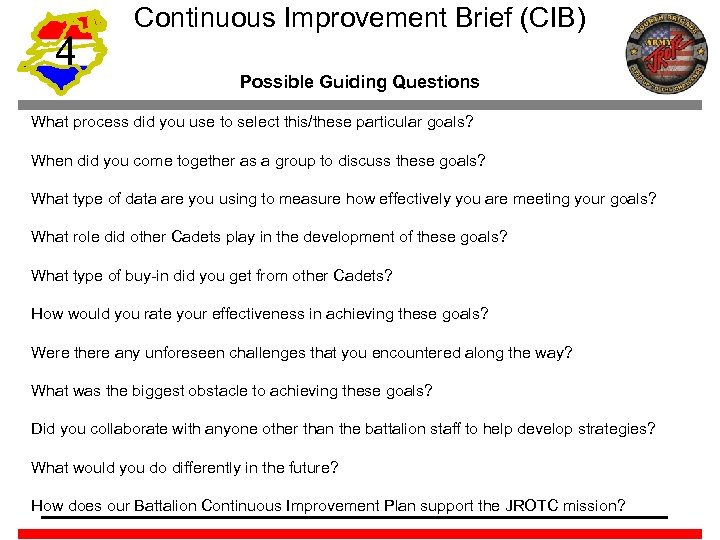
4 Continuous Improvement Brief (CIB) Possible Guiding Questions What process did you use to select this/these particular goals? When did you come together as a group to discuss these goals? What type of data are you using to measure how effectively you are meeting your goals? What role did other Cadets play in the development of these goals? What type of buy-in did you get from other Cadets? How would you rate your effectiveness in achieving these goals? Were there any unforeseen challenges that you encountered along the way? What was the biggest obstacle to achieving these goals? Did you collaborate with anyone other than the battalion staff to help develop strategies? What would you do differently in the future? How does our Battalion Continuous Improvement Plan support the JROTC mission?
4 Service Learning Brief 1. A minimum of three Cadets will brief the presentation. These Cadets will not be from the Battalion staff, but should represent their role in service learning as a LET 1, 2, 3, or 4 Cadets must be from different LET Levels. 2. For this presentation, the Cadet team members (LET 1, 2, 3 or 4) will explain their service learning goal, planning strategies, preparation, and implementation of the project. They will also discuss the overall success of the project and provide team/personal reflection on service learning. 3. 20 Possible points for this briefing.
4 Service Learning Brief Good Examples of a Service Learning Brief 1. 2. 3. 4. 5. 6. 7. Blood Drives Special Olympics Restoring a historical monument Visiting a nursing home Tutoring elementary children Starting a recycling program Collecting clothing for Homeless
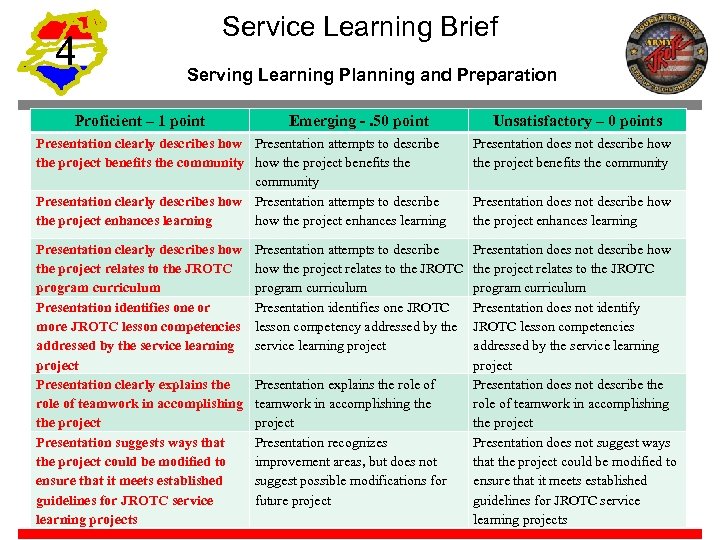
4 Service Learning Brief Serving Learning Planning and Preparation Proficient – 1 point Emerging -. 50 point Unsatisfactory – 0 points Presentation clearly describes how Presentation attempts to describe the project benefits the community how the project benefits the community Presentation clearly describes how Presentation attempts to describe the project enhances learning how the project enhances learning Presentation does not describe how the project benefits the community Presentation clearly describes how the project relates to the JROTC program curriculum Presentation identifies one or more JROTC lesson competencies addressed by the service learning project Presentation clearly explains the role of teamwork in accomplishing the project Presentation suggests ways that the project could be modified to ensure that it meets established guidelines for JROTC service learning projects Presentation does not describe how the project relates to the JROTC program curriculum Presentation does not identify JROTC lesson competencies addressed by the service learning project Presentation does not describe the role of teamwork in accomplishing the project Presentation does not suggest ways that the project could be modified to ensure that it meets established guidelines for JROTC service learning projects Presentation attempts to describe how the project relates to the JROTC program curriculum Presentation identifies one JROTC lesson competency addressed by the service learning project Presentation explains the role of teamwork in accomplishing the project Presentation recognizes improvement areas, but does not suggest possible modifications for future project Presentation does not describe how the project enhances learning
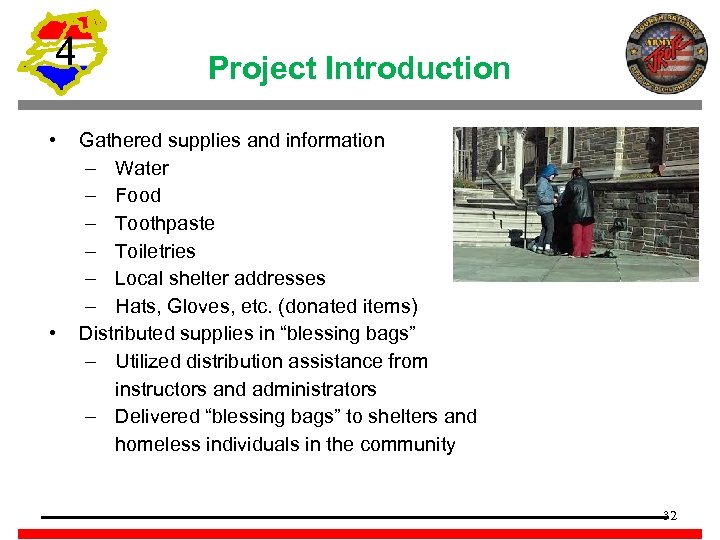
4 • • Project Introduction Gathered supplies and information – Water – Food – Toothpaste – Toiletries – Local shelter addresses – Hats, Gloves, etc. (donated items) Distributed supplies in “blessing bags” – Utilized distribution assistance from instructors and administrators – Delivered “blessing bags” to shelters and homeless individuals in the community 32
4 How the Community Benefits The service learning project: • Provides opportunities to receive basic necessities (food/water) and improve hygiene – Improves health – Increases opportunities for employment • Helps locate shelters • Encourages the community to get involved and make a difference 33
How the Project Enhances 4 Learning Allows students to: • Distinguish between service learning and community service • Compare the types of service learning already available in the community • Identify benefits of serving the community • Discover the roles and responsibilities of a service learning team 34
4 Connection to the Curriculum (Lesson Competencies) U 3 C 8 L 1 -Orientation to Service Learning • Evaluated examples of service learning to obtain ideas • Developed proposals for battalion projects • Chose a single project included the features and benefits of service learning most fully U 3 C 8 L 2 - Plan and Train for Your Exploratory Project • Identified the steps needed to conduct the project • Learned how to develop a project plan that contained essential components, goals, and outcomes of a service learning project U 3 C 8 L 3 - Project Reflection and Integration • Implemented and evaluated the project • Reflect on project 35
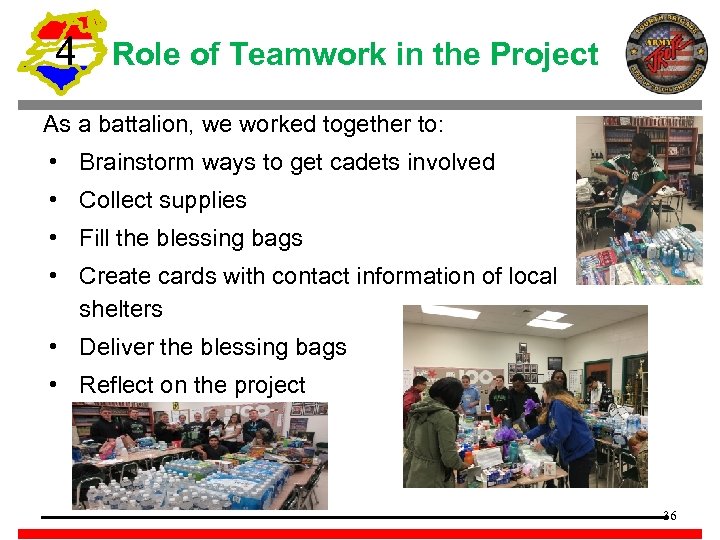
4 Role of Teamwork in the Project As a battalion, we worked together to: • Brainstorm ways to get cadets involved • Collect supplies • Fill the blessing bags • Create cards with contact information of local shelters • Deliver the blessing bags • Reflect on the project 36
4 Modification Suggestions Modifications for Current Project: • Creation of assembly line to speed up the production of the blessing bags in order to meet the deadline • Give cadets a more advanced notice to donate supplies Modifications for Future Years: • Create a checklist for items that are needed for each blessing bag • Give cadets more time to collect supplies • Expand the project throughout the community/school • Distribute the bags over a longer period of time 37
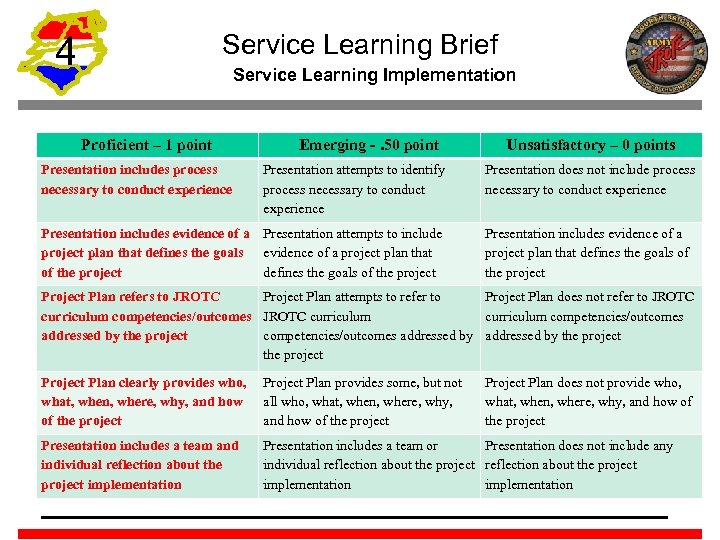
4 Service Learning Brief Service Learning Implementation Proficient – 1 point Presentation includes process necessary to conduct experience Emerging -. 50 point Presentation attempts to identify process necessary to conduct experience Presentation includes evidence of a Presentation attempts to include project plan that defines the goals evidence of a project plan that of the project defines the goals of the project Unsatisfactory – 0 points Presentation does not include process necessary to conduct experience Presentation includes evidence of a project plan that defines the goals of the project Plan refers to JROTC Project Plan attempts to refer to Project Plan does not refer to JROTC curriculum competencies/outcomes addressed by the project competencies/outcomes addressed by the project Project Plan clearly provides who, what, when, where, why, and how of the project Plan provides some, but not all who, what, when, where, why, and how of the project Plan does not provide who, what, when, where, why, and how of the project Presentation includes a team and individual reflection about the project implementation Presentation includes a team or Presentation does not include any individual reflection about the project implementation
4 Process of Project Creation: • Cadet Jascewsky developed/presented the idea for the battalion’s service learning project Organization: • Logistics of the project • Incentive to get cadets involved in the project • Production and distribution of the Blessing Bags AAR: • Reflect on ways to improve for future projects 39
4 Project Plan Goals for Community Support: • Encourage individuals in the community to get involved – Have participants outside of the JROTC program help pick up and distribute the bags. – Get the community involved with advertising the project for donations. Goals for Cadet Education/Learning: • Learn how to create a successful service learning project • Apply lessons learned during the project to future projects and the cadets’ education Goals for Cadet Service: • Cadets who aided in the production and distribution of the Blessing Bags received varied service hours depending on their involvement 40
4 JROTC Curriculum Outcomes (In Addition to the Lesson Competencies Listed Previously) The Outcomes Supported by this Project: • Maximize potential for success through learning and self -management • Develop leadership and communication skills • Build effective relationships with peers, co-workers, and the community • Promote citizenship through engaging in civic duty in the community 41
4 The Battalion’s Project Who? C/SSG Nicholas Jascewsky presented the idea of blessing bags. The cadets of our battalion supplied the items needed. What? Create bags that contained supplies and contact information for various shelters. When? December 2015 Why? We completed this project in order to help individuals in need during the holiday season. How? We asked cadets, parents, and teachers, to donate as many supplies as they could. These supplies included food, water, personal hygiene items, etc. 42
4 Team/Individual Reflection • Conducting regular meetings to discuss what was being done and what our next step was going to be allowed for the project run smoothly. • Communication within the team and from the team to the battalion was strong • The team could have improved by having a better system of organization • An even inventory of items for the bags was needed 43
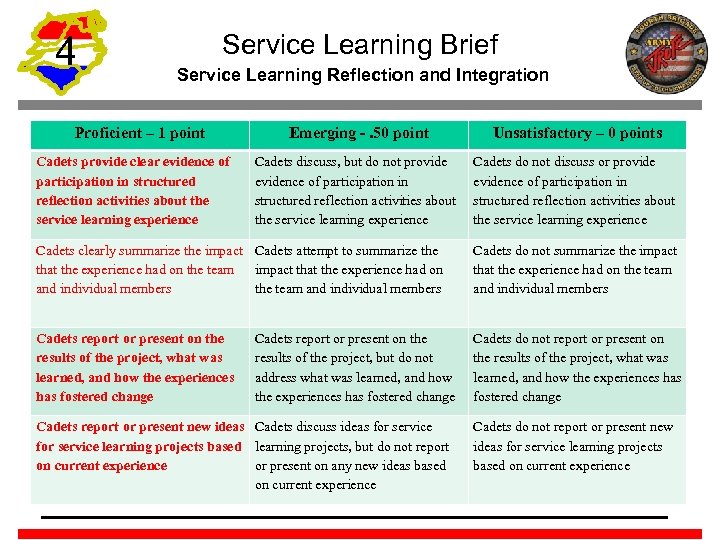
4 Service Learning Brief Service Learning Reflection and Integration Proficient – 1 point Cadets provide clear evidence of participation in structured reflection activities about the service learning experience Emerging -. 50 point Unsatisfactory – 0 points Cadets discuss, but do not provide evidence of participation in structured reflection activities about the service learning experience Cadets do not discuss or provide evidence of participation in structured reflection activities about the service learning experience Cadets clearly summarize the impact Cadets attempt to summarize that the experience had on the team impact that the experience had on and individual members the team and individual members Cadets do not summarize the impact that the experience had on the team and individual members Cadets report or present on the results of the project, what was learned, and how the experiences has fostered change Cadets do not report or present on the results of the project, what was learned, and how the experiences has fostered change Cadets report or present on the results of the project, but do not address what was learned, and how the experiences has fostered change Cadets report or present new ideas Cadets discuss ideas for service learning projects based learning projects, but do not report on current experience or present on any new ideas based on current experience Cadets do not report or present new ideas for service learning projects based on current experience
4 Team/Individual Reflection • Conducting regular meetings to discuss what was being done and what our next step was going to be allowed for the project run smoothly. • Communication within the team and from the team to the battalion was strong • The team could have improved by having a better system of organization • An even inventory of items for the bags was 45 needed
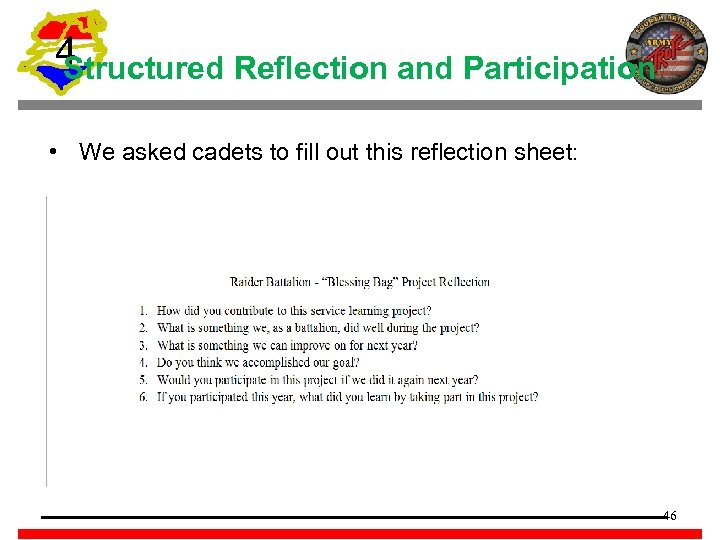
4 Structured Reflection and Participation • We asked cadets to fill out this reflection sheet: 46
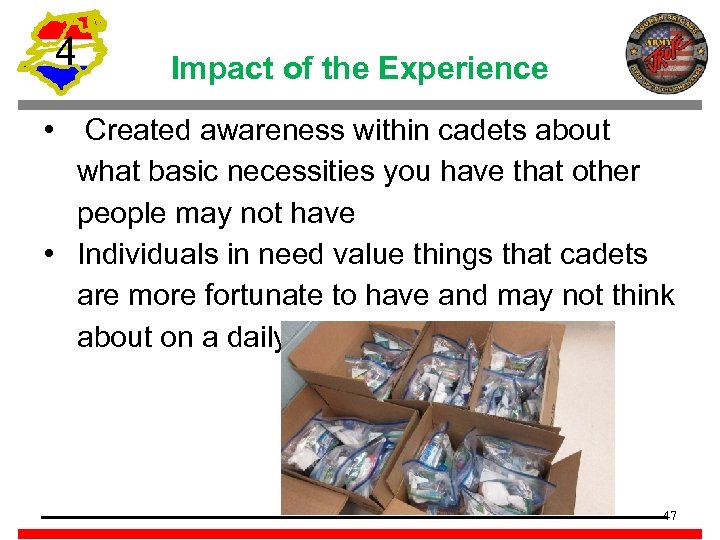
4 Impact of the Experience • Created awareness within cadets about what basic necessities you have that other people may not have • Individuals in need value things that cadets are more fortunate to have and may not think about on a daily basis 47
4 Results (1 of 2) • 100% of cadets said they would like to continue this project next year • Our battalion learned many lessons such as: • Small items can make a huge difference in the life of another individual • How to create and effectively organize a service learning project • It is easy to get involved and make a positive impact on your community • Cadets worked together to make the Blessing Bags and deliver them to shelters and individuals during the holiday season 48
4 Results (2 of 2) Our project fostered change because: • It reminded cadets the importance of giving back to their community • Taught cadets how to create a successful service learning project • Encouraged cadets to make a difference in their community • Developed a sense of change on the community and individual level 49
4 New Ideas for Service Learning • Build a shelter for the playground used by the HCPSS employee daycare center – Provides protection during inclement weather in case of a fire drill • Organize a 5 K run to raise money for breast cancer research • Hold a canned food drive to provide food for local shelters • Continue to be more involved in school supported service projects. 50
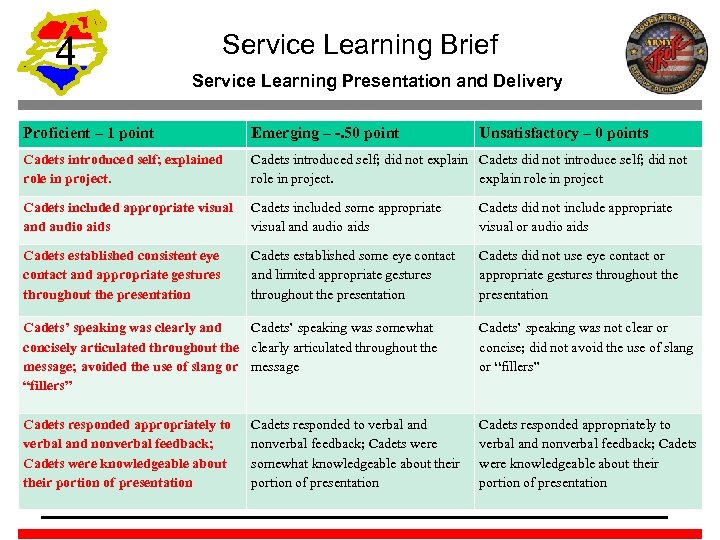
4 Service Learning Brief Service Learning Presentation and Delivery Proficient – 1 point Emerging – -. 50 point Unsatisfactory – 0 points Cadets introduced self; explained role in project. Cadets introduced self; did not explain Cadets did not introduce self; did not role in project. explain role in project Cadets included appropriate visual and audio aids Cadets included some appropriate visual and audio aids Cadets did not include appropriate visual or audio aids Cadets established consistent eye contact and appropriate gestures throughout the presentation Cadets established some eye contact and limited appropriate gestures throughout the presentation Cadets did not use eye contact or appropriate gestures throughout the presentation Cadets’ speaking was clearly and Cadets’ speaking was somewhat concisely articulated throughout the clearly articulated throughout the message; avoided the use of slang or message “fillers” Cadets’ speaking was not clear or concise; did not avoid the use of slang or “fillers” Cadets responded appropriately to verbal and nonverbal feedback; Cadets were knowledgeable about their portion of presentation Cadets responded to verbal and nonverbal feedback; Cadets were somewhat knowledgeable about their portion of presentation
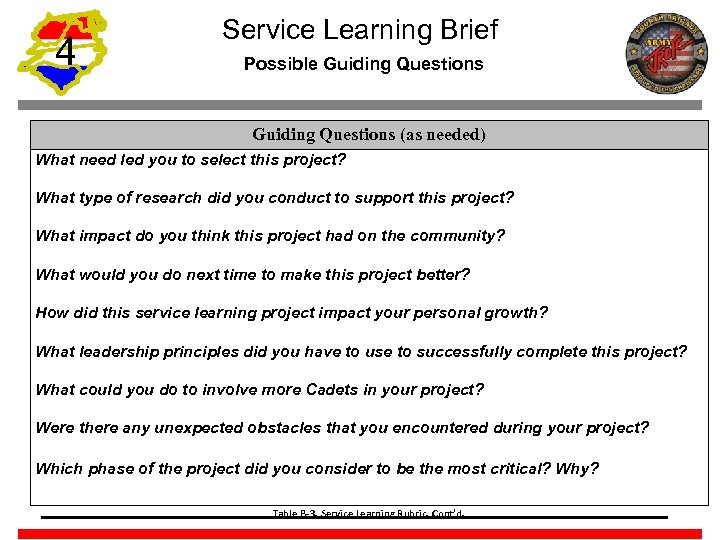
4 Service Learning Brief Possible Guiding Questions (as needed) What need led you to select this project? What type of research did you conduct to support this project? What impact do you think this project had on the community? What would you do next time to make this project better? How did this service learning project impact your personal growth? What leadership principles did you have to use to successfully complete this project? What could you do to involve more Cadets in your project? Were there any unexpected obstacles that you encountered during your project? Which phase of the project did you consider to be the most critical? Why? Table B-3. Service Learning Rubric, Cont’d.
4 QUESTIONS
Скачать презентацию 4 4 Mr Erik Shay CIB SL Briefing
b6cb977b0a2819e92c79a73a80cfe4fd.ppt