


 Скачать презентацию 4 4 4 4 44 4 4 Association
00f0569a9b011f0421b2f0d94e922f9b.ppt
- Количество слайдов: 39

 4 4 4 4 44 4 4 Association of Pensioners of the OAS Retirement and Pension Fund (ASPEN) OAS Staff Association OAS Retirement and Pension Fund PRERETIREMENT LECTURE SERIES OAS Staff Federal Credit Union 4 4 44 4 Department of Human Resources of the OAS Association of Retirees of the OAS (AROAS)
 For participants close to retirement Pre-Retirement Lecture Series : IV. Investment of financial resources received at retirement Presents: OAS Retirement and Pension Fund and Association of Pensioners of the OAS Retirement and Pension Fund December 7, 2006 Washington, DC
 Assets and its Characteristics
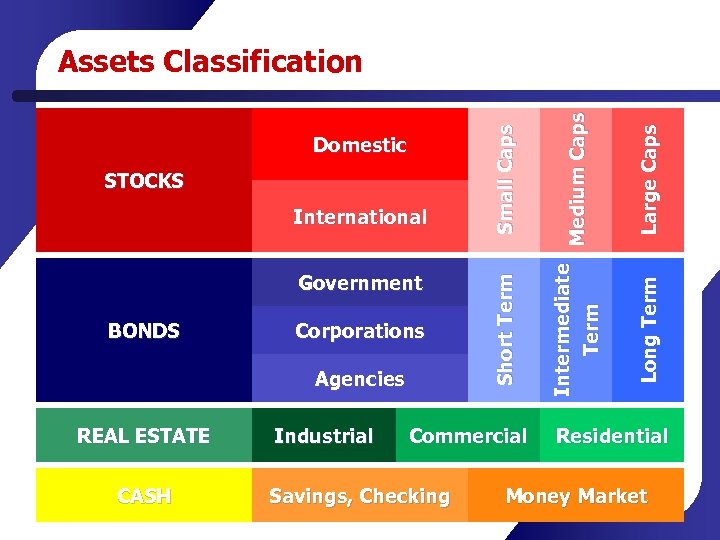 Government BONDS Corporations Agencies REAL ESTATE CASH Industrial Commercial Savings, Checking La r g e C a p s L o ng T e r m International I nt e r m e d i a t e Me d i u m C a p s Te r m STOCKS S ho r t T e r m Domestic Sm a l l C a p s Assets Classification Residential Money Market
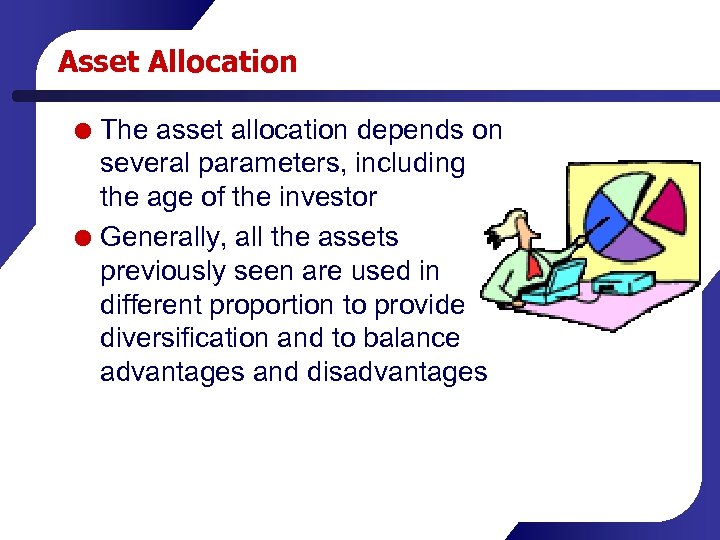 Asset Allocation The asset allocation depends on several parameters, including the age of the investor Generally, all the assets previously seen are used in different proportion to provide diversification and to balance advantages and disadvantages
 Stocks When the investor buys stocks, he/she is becoming owner of a part of the company (shares) Stocks provide growth and protect against inflation If the company does well, its capital grows, the investor earns through capitalization of his/her shares and the dividends the company pays
 Bonds When the investor is buying a bond, he/she is actually lending money to a government, company or agency Bonds provide income through the interest they pay and provide for portfolio stability Company owner Debt
 Real Estate Most investors may already have some sort of real estate investment (own house), so they should be careful and not to upset the asset allocation Real Estate protects against inflation However, this type of asset is very poor in terms of liquidity
 Cash and Equivalents provide liquidity and may be used to take advantage of investment opportunities The problem is that they provide lower expected rates of return
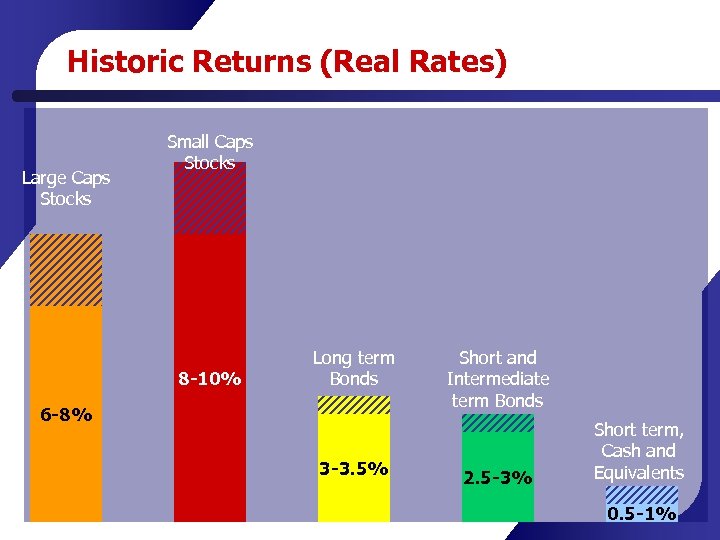 Historic Returns (Real Rates) Large Caps Stocks Small Caps Stocks 8 -10% Long term Bonds 6 -8% 3 -3. 5% Short and Intermediate term Bonds 2. 5 -3% Short term, Cash and Equivalents 0. 5 -1%
 Investment Process
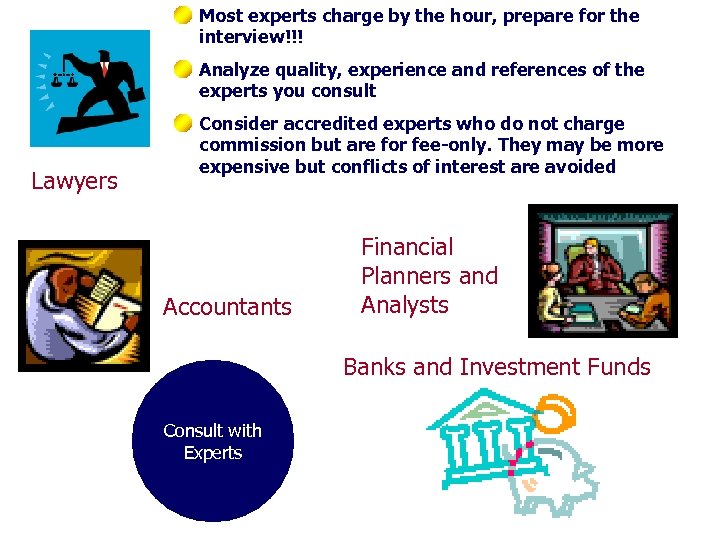 Most experts charge by the hour, prepare for the interview!!! Analyze quality, experience and references of the experts you consult Lawyers Consider accredited experts who do not charge commission but are for fee-only. They may be more expensive but conflicts of interest are avoided Accountants Financial Planners and Analysts Banks and Investment Funds Consult with Experts
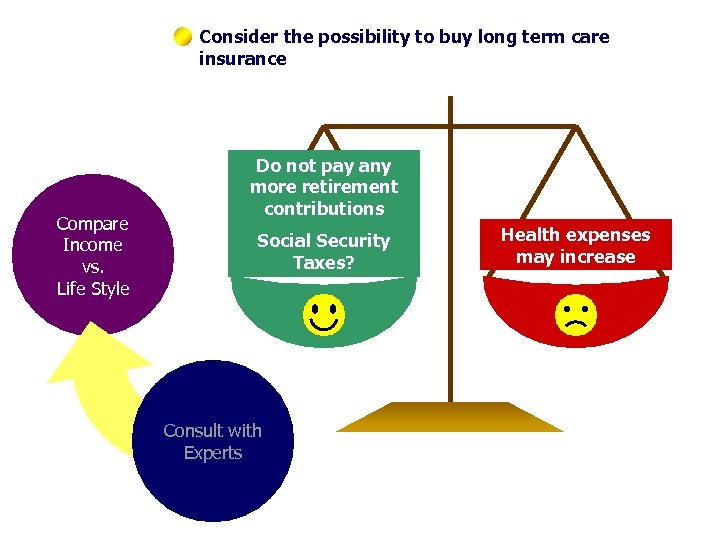 Consider the possibility to buy long term care insurance Compare Income vs. Life Style Do not pay any more retirement contributions Social Security Taxes? Consult with Experts Health expenses may increase
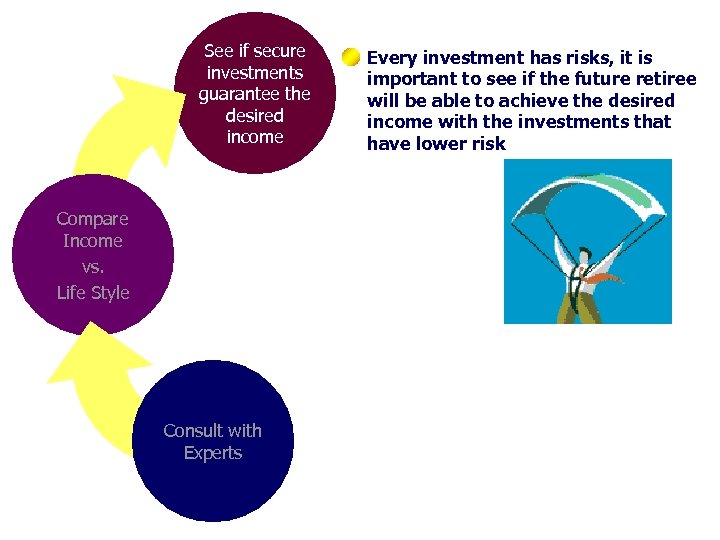 See if secure investments guarantee the desired income Compare Income vs. Life Style Consult with Experts Every investment has risks, it is important to see if the future retiree will be able to achieve the desired income with the investments that have lower risk
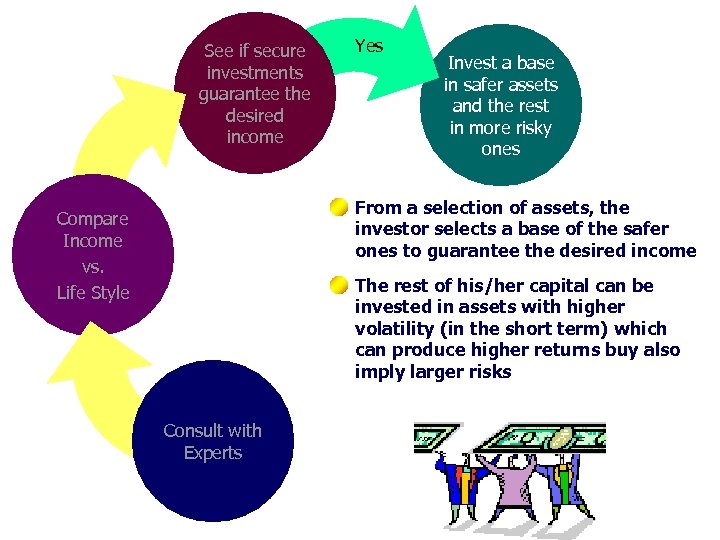 See if secure investments guarantee the desired income Yes Invest a base in safer assets and the rest in more risky ones From a selection of assets, the investor selects a base of the safer ones to guarantee the desired income Compare Income vs. Life Style The rest of his/her capital can be invested in assets with higher volatility (in the short term) which can produce higher returns buy also imply larger risks Consult with Experts
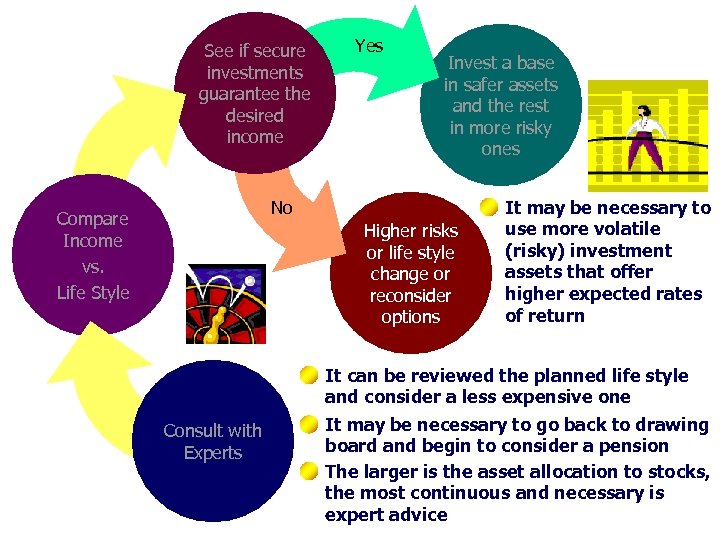 See if secure investments guarantee the desired income Yes Invest a base in safer assets and the rest in more risky ones No Compare Income vs. Life Style Higher risks or life style change or reconsider options It may be necessary to use more volatile (risky) investment assets that offer higher expected rates of return It can be reviewed the planned life style and consider a less expensive one Consult with Experts It may be necessary to go back to drawing board and begin to consider a pension The larger is the asset allocation to stocks, the most continuous and necessary is expert advice
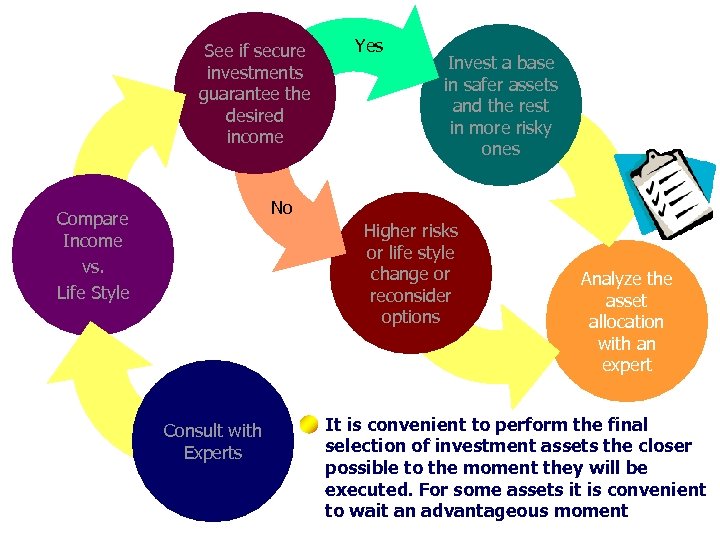 See if secure investments guarantee the desired income Yes Invest a base in safer assets and the rest in more risky ones No Compare Income vs. Life Style Higher risks or life style change or reconsider options Consult with Experts Analyze the asset allocation with an expert It is convenient to perform the final selection of investment assets the closer possible to the moment they will be executed. For some assets it is convenient to wait an advantageous moment
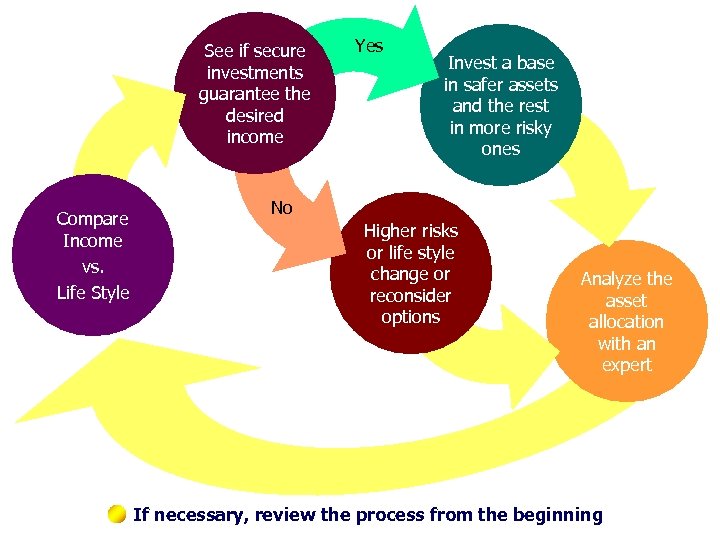 See if secure investments guarantee the desired income Compare Income vs. Life Style Yes Invest a base in safer assets and the rest in more risky ones No Higher risks or life style change or reconsider options Analyze the asset allocation with an expert If necessary, review the process from the beginning
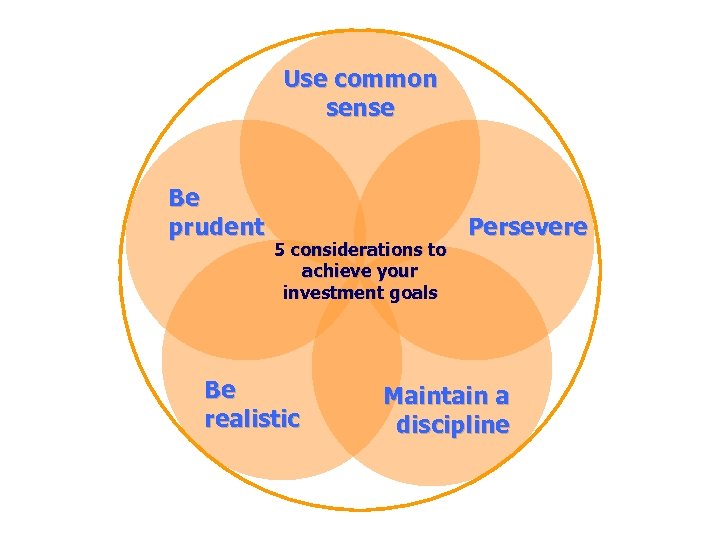 Use common sense Be prudent 5 considerations to achieve your investment goals Be realistic Persevere Maintain a discipline
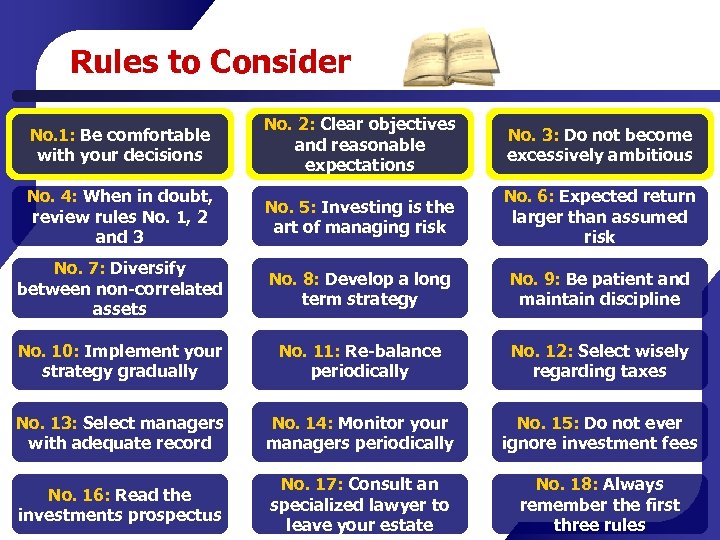 Rules to Consider No. 1: Be comfortable with your decisions No. 2: Clear objectives and reasonable expectations No. 3: Do not become excessively ambitious No. 4: When in doubt, review rules No. 1, 2 and 3 No. 5: Investing is the art of managing risk No. 6: Expected return larger than assumed risk No. 7: Diversify between non-correlated assets No. 8: Develop a long term strategy No. 9: Be patient and maintain discipline No. 10: Implement your strategy gradually No. 11: Re-balance periodically No. 12: Select wisely regarding taxes No. 13: Select managers with adequate record No. 14: Monitor your managers periodically No. 15: Do not ever ignore investment fees No. 16: Read the investments prospectus No. 17: Consult an specialized lawyer to leave your estate No. 18: Always remember the first three rules
 Considerations about RISKS
 Risks In the investment world you cannot avoid risks The most an investor can aspire is to manage them When trying to protect himself/herself against a risk the investor normally will take others A compromise is created between the risks taken
 Market Risk Comes with the lost of capital as a consequence of market volatility The larger the expected rate of return of an asset, the larger is the risk to lose capital, particularly in the short term One of the assets more associated with this type of risk is equity (stocks) If a company that issued stocks is doing badly, the same happens to the investor who purchased its stocks Large Caps vs. Small Caps
 Market Risk: CONTROL Select investment assets were the expected rate of return is proportionally larger than the volatility (Rule No. 6) Develop a long term investment strategy (Rule No. 8) There is evidence that the risk associated to a particular asset is decreased in the long term Diversify investments (Rule No. 7) and re-balance the portfolio periodically (Rule No. 11) By diversifying if an asset is not giving good return, another investment can be providing them Re-balancing ensures that the portfolio will never be excessively exposed to a particular type of risk
 Inflation Risk When inflation is sustained, even if the capital is maintained, purchasing power decreases Inflation is not constant, varies through time The investor has to be careful when assessing this parameter and monitor inflation periodically It is not convenient to over evaluate inflation, since there may be assets in the investor portfolio that are protecting him/her against inflation
 Inflation Risk: CONTROL Stocks tend to protect against inflation (larger return) but they have larger market risk than other assets (compromise between two risks) Real estate investment tends to protect against inflation but generates another type of risk: low liquidity There are other types of investments that protect against inflation: Step-up CDs TIPS (Treasury Inflation Protected Securities) But!!! The initial rates of return are lower!!!
 Risk: Change of Rates The investor should not care about nominal rates but for real rates, adjusted for inflation If inflation accelerates, depositors will claim higher interest rates to fight the lost of purchasing power Change of interest rates affect most assets but the effect is larger in bonds, when the interest rates increase the value of bonds decrease The larger the maturity of the bond, the larger the effect of the change in the interest rates on its value
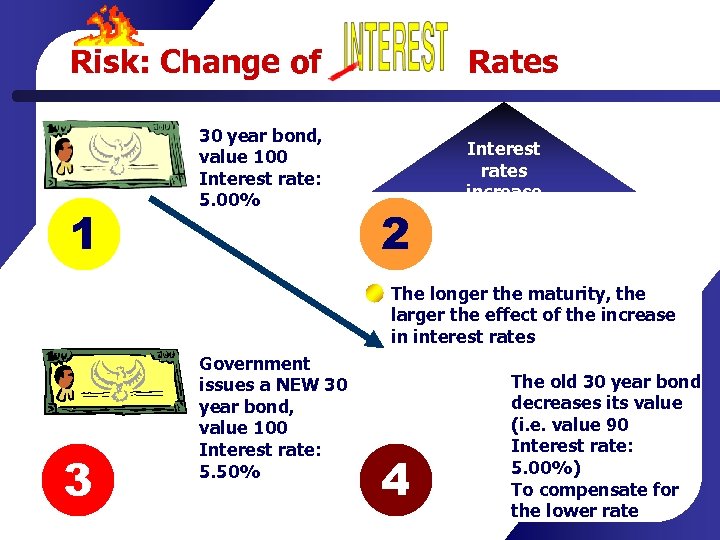 Risk: Change of 1 30 year bond, value 100 Interest rate: 5. 00% Rates 2 Interest rates increase The longer the maturity, the larger the effect of the increase in interest rates 3 Government issues a NEW 30 year bond, value 100 Interest rate: 5. 50% 4 The old 30 year bond decreases its value (i. e. value 90 Interest rate: 5. 00%) To compensate for the lower rate
 Change of Interest Rates: CONTROL The same measures used to control inflation are used to control the change of interest rates When a bond matures, independently of its market value, the face value will be paid to the investor, so one protection would be to wait until maturity Build a bond ladder: This can soften the effect of the change of interest rates The investor waits for the bond to mature, and then buys other bonds of longer maturity and better interest rates
 Risk: Credit Quality Not all bonds have the same quality, even if they have the same maturity Healthier companies issue bonds that have better quality than more indebted companies With governments is the same, countries with bigger problems issue riskier bonds that promise to pay higher returns The relationship quality-risk is an inverse one The higher the bond quality, the safer the investment. There is less risk but the promised return is also lower Very indebted companies issue bonds with very low quality that promise to pay the highest returns (if the company does not go bankrupt!!)
 Credit Quality: CONTROL If an investor is going to have low quality bonds in his/her portfolio the first thing he/she has to do is to be aware of this The investor has to achieve a healthy diversification and balance with higher quality securities (Rule No. 7) The investor should control his/her ambition (Rule No. 3), promises of higher return come hand to hand with higher risk, if the economic environment produces a downturn the companies in worse condition are the first to go bankrupt!!
 Risk: Lack of Liquidity It is when the investor needs cash but did not take enough precautions to have it available This may force him/her to sell assets in the worst moment and realize a loss Unfortunately, The more liquid assets are the more affected by inflationary pressures and the ones that promise lower returns Another typical compromise between different types of risks
 Lack of Liquidity: CONTROL Plan expenses carefully to determine cash needs with the highest possible precision In some cases the accumulation of cash reserves is good to take advantage of “investment opportunities” i. e. during low interest rate periods, forecasting an increase Have emergency reserves or access low interest loans to avoid “realizing” losses and be able to wait a more advantageous moment to sell other asset needed to cover cash needs
 Risk: Currency Exchange The currency exchange risk is particularly important for investors that have overseas investments
 Currency Exchange: CONTROL One can “hedge” the portfolio (is like buying an insurance) to control this risk, but it may be too expensive for a small investor Perhaps more practical is to invest in mutual funds that have country and currency diversification so currency exchange risks cancel out (Rule No. 7)
 Risk of Bond Recalls Some bonds are issued with a recall option, meaning that the company or country that issued it can repay the debt to the investor at any time; the risk is not for loss of capital (because the recaller pays the face value of the bond) but to have to invest that capital in a moment that might not be opportune, i. e. if the interest rates are now lower than when the original bond was bought
 Risk of Bond Recalls: CONTROL For the case of recallable bonds, the first thing for the investor is to be aware of that quality to plan accordingly; second, a good diversification will allow that even if one bond is recalled other bonds remain in the portfolio that will reduce the effect of recall (Rule No. 7)
 Questions and Comments?