 Скачать презентацию 4 -2 Global Human Resource Management GHRM l
4abf0a3a6ed2278e6195b15a8e6a4e81.ppt
- Количество слайдов: 35




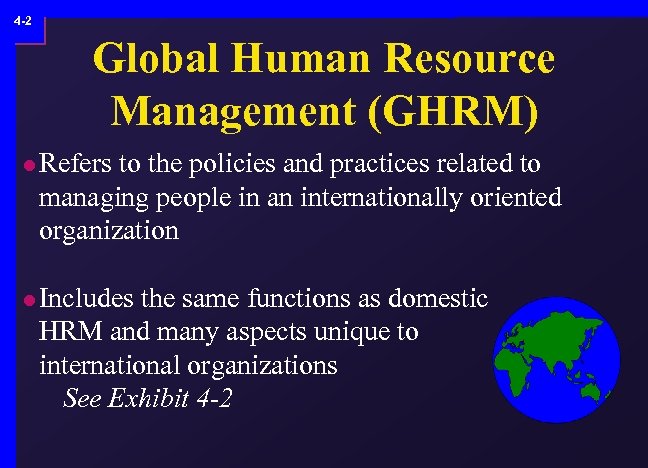
4 -2 Global Human Resource Management (GHRM) l Refers to the policies and practices related to managing people in an internationally oriented organization l Includes the same functions as domestic HRM and many aspects unique to international organizations See Exhibit 4 -2
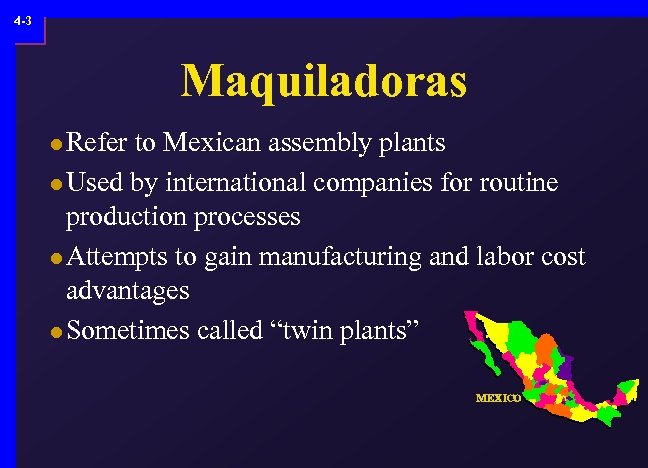
4 -3 Maquiladoras l Refer to Mexican assembly plants l Used by international companies for routine production processes l Attempts to gain manufacturing and labor cost advantages l Sometimes called “twin plants”
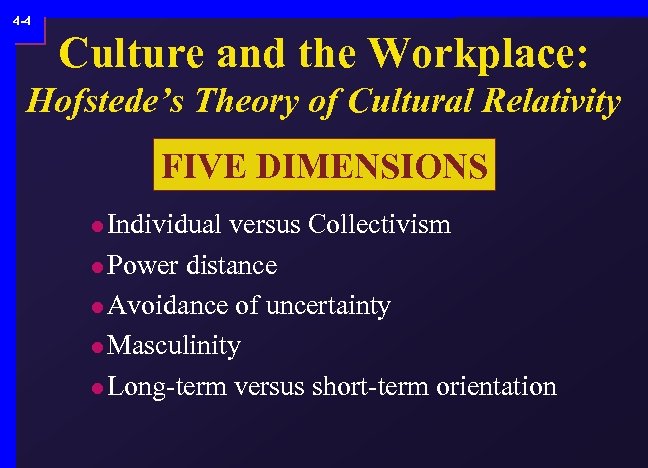
4 -4 Culture and the Workplace: Hofstede’s Theory of Cultural Relativity FIVE DIMENSIONS l Individual versus Collectivism l Power distance l Avoidance of uncertainty l Masculinity l Long-term versus short-term orientation
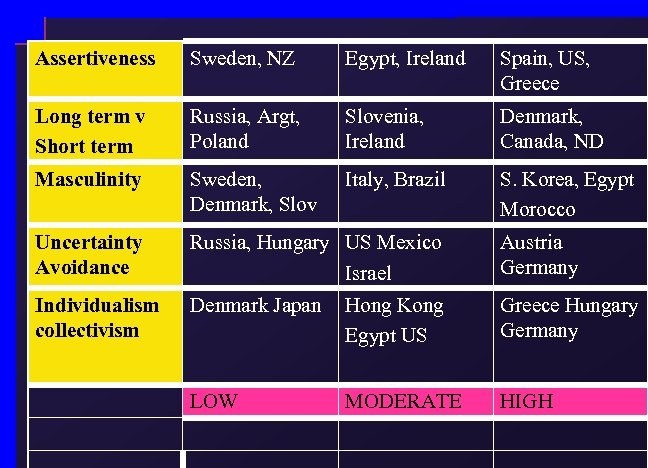
Assertiveness Sweden, NZ Egypt, Ireland Spain, US, Greece Long term v Short term Russia, Argt, Poland Slovenia, Ireland Denmark, Canada, ND Masculinity Sweden, Denmark, Slov Italy, Brazil S. Korea, Egypt Morocco Uncertainty Avoidance Russia, Hungary US Mexico Israel Austria Germany Individualism collectivism Denmark Japan Hong Kong Egypt US Greece Hungary Germany LOW MODERATE HIGH
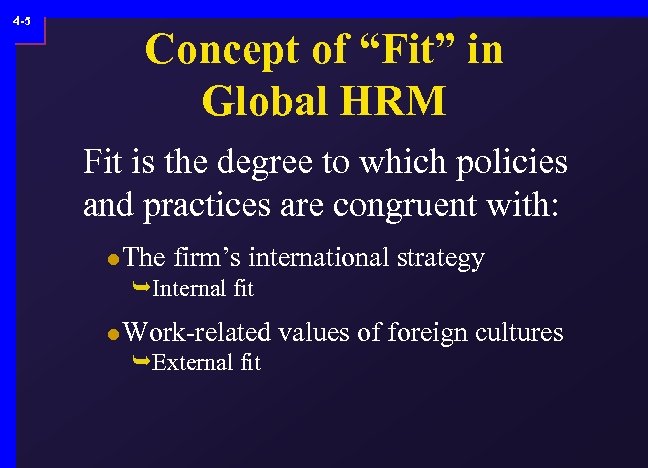
4 -5 Concept of “Fit” in Global HRM Fit is the degree to which policies and practices are congruent with: l The firm’s international strategy ÊInternal fit l Work-related ÊExternal fit values of foreign cultures
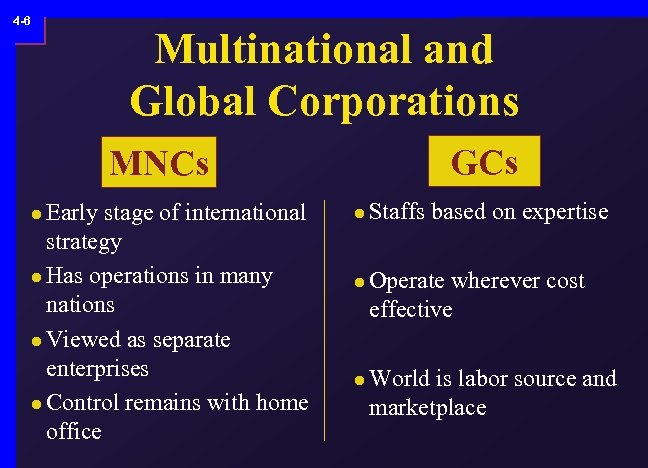
4 -6 Multinational and Global Corporations GCs MNCs l Early stage of international strategy l Has operations in many nations l Viewed as separate enterprises l Control remains with home office l Staffs based on expertise l Operate wherever cost effective l World is labor source and marketplace
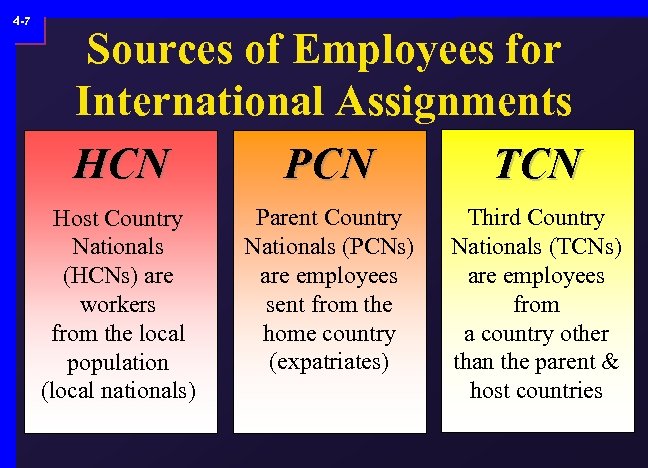
4 -7 Sources of Employees for International Assignments HCN TCN PCN Host Country Nationals (HCNs) are workers from the local population (local nationals) Parent Country Nationals (PCNs) are employees sent from the home country (expatriates) Third Country Nationals (TCNs) are employees from a country other than the parent & host countries
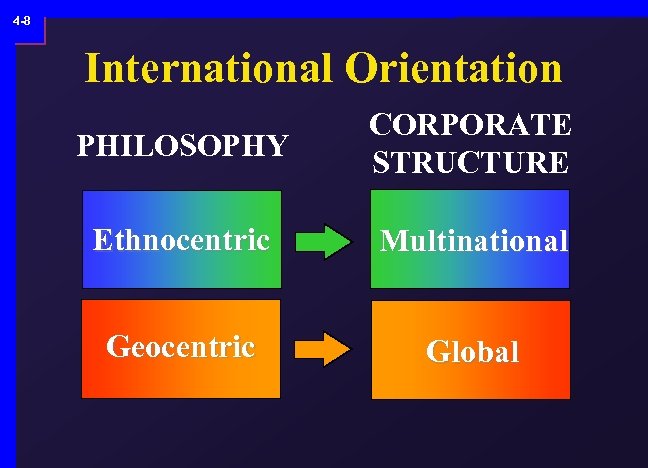
4 -8 International Orientation PHILOSOPHY CORPORATE STRUCTURE Ethnocentric Multinational Geocentric Global
4 -9 The Expatriate Manager Managing the expatriate’s adjustment is a primary focus of GHRM functions like: l Selection for expatriate assignments l Comprehensive pre-departure training l Compensation and benefits packages that consider situational factors like family l Development and career planning

4 -10 Culture Shock l. Feelings l. Results of frustration and confusion from being constantly subjected to strange and unfamiliar cues about what to do and how to get it done
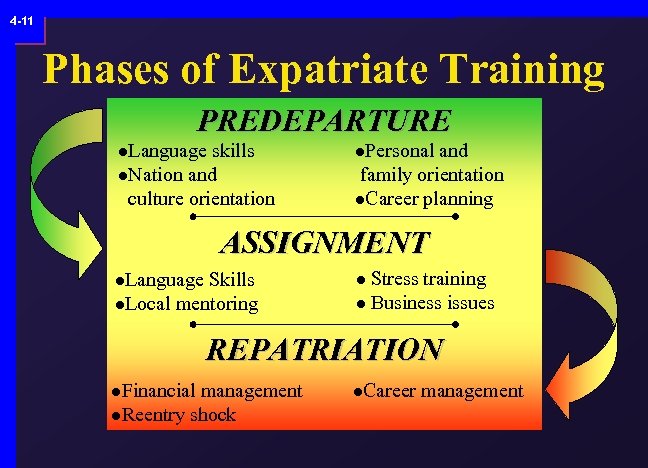
4 -11 Phases of Expatriate Training PREDEPARTURE l. Language skills l. Nation and culture orientation l. Personal and family orientation l. Career planning ASSIGNMENT l. Language Skills l. Local mentoring Stress training l Business issues l REPATRIATION l. Financial management l. Reentry shock l. Career management
4 -12 Resistance to Using Locals (HCNs) Locals will not adopt the parent company’s culture and management style. l l The level of commitment that locals may have to the organization. l The host country nationals may not have the expertise that expatriates have. l Effective communication will be impaired between the host country and home offices.
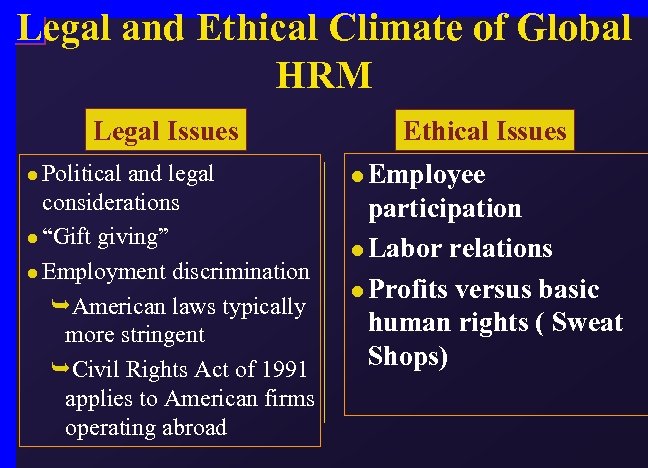
Legal and Ethical Climate of Global HRM Legal Issues l Political and legal considerations l “Gift giving” l Employment discrimination ÊAmerican laws typically more stringent ÊCivil Rights Act of 1991 applies to American firms operating abroad Ethical Issues l Employee participation l Labor relations l Profits versus basic human rights ( Sweat Shops)






Expatriate Assignments How much do they cost? Are they worth it?
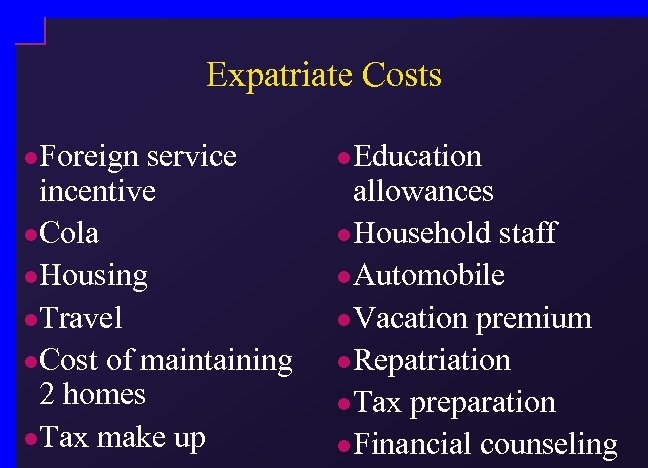
Expatriate Costs l. Foreign service incentive l. Cola l. Housing l. Travel l. Cost of maintaining 2 homes l. Tax make up l. Education allowances l. Household staff l. Automobile l. Vacation premium l. Repatriation l. Tax preparation l. Financial counseling
Expatriate Risks *Out of the loop *Repatriation Problems

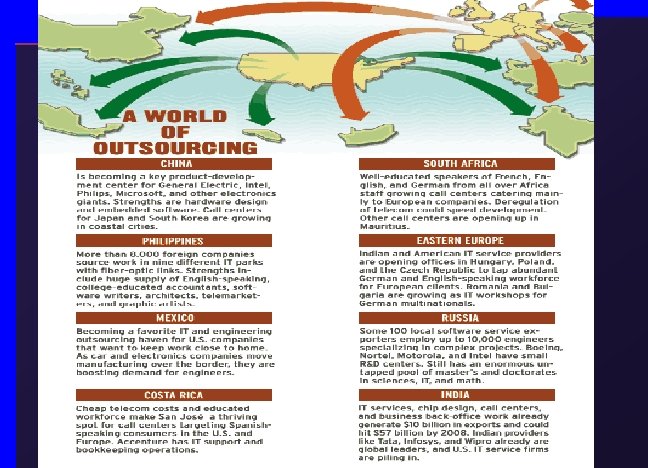






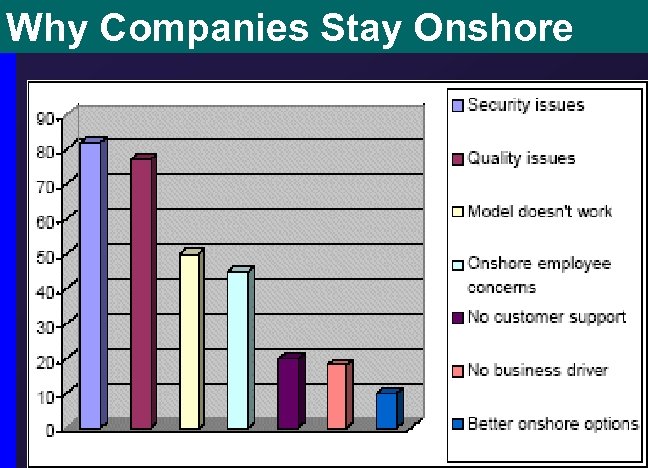
Why Companies Stay Onshore
 Скачать презентацию 4 -2 Global Human Resource Management GHRM l
4abf0a3a6ed2278e6195b15a8e6a4e81.ppt