


 Скачать презентацию 4 1 Performance Introduction to Programming in Java
1d46c4ca8626ef68efd87b567dff821b.ppt
- Количество слайдов: 47
 4. 1 Performance Introduction to Programming in Java: An Interdisciplinary Approach · Robert Sedgewick and Kevin Wayne · Copyright © 2008 · * *
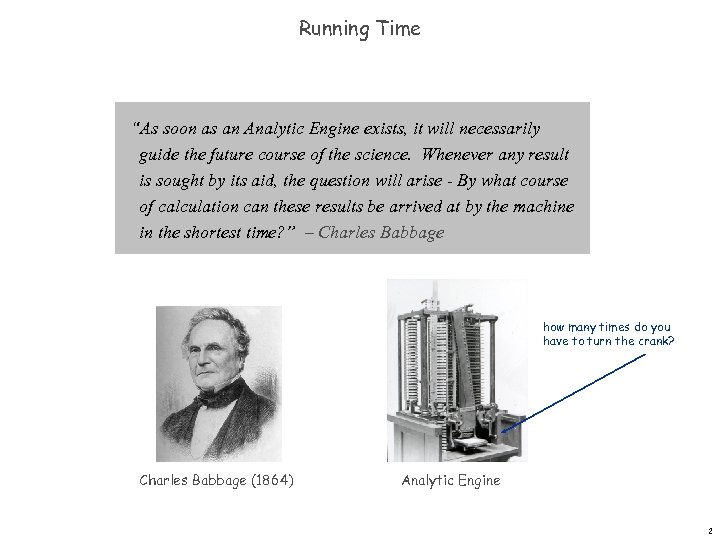 Running Time “As soon as an Analytic Engine exists, it will necessarily guide the future course of the science. Whenever any result is sought by its aid, the question will arise - By what course of calculation can these results be arrived at by the machine in the shortest time? ” – Charles Babbage how many times do you have to turn the crank? Charles Babbage (1864) Analytic Engine 2
 The Challenge Q. Will my program be able to solve a large practical problem? compile debug on test case solve problems in practice Key insight. [Knuth 1970 s] Use the scientific method to understand performance. 3
 Scientific Method Scientific method. Observe some feature of the natural world. Hypothesize a model that is consistent with the observations. Predict events using the hypothesis. Verify the predictions by making further observations. Validate by repeating until the hypothesis and observations agree. n n n Principles. Experiments we design must be reproducible. Hypothesis must be falsifiable. n n 4
 Reasons to Analyze Algorithms Predict performance. Will my program finish? When will my program finish? n n Compare algorithms. Will this change make my program faster? How can I make my program faster? n n Basis for inventing new ways to solve problems. Enables new technology. Enables new research. n n 5
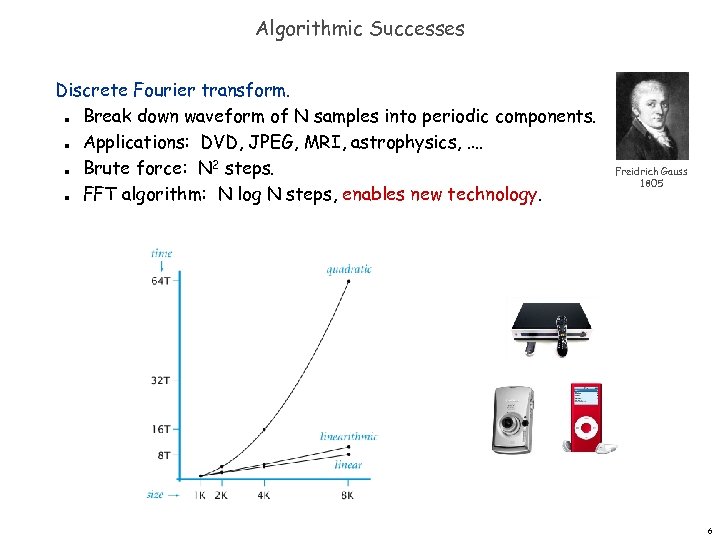 Algorithmic Successes Discrete Fourier transform. Break down waveform of N samples into periodic components. Applications: DVD, JPEG, MRI, astrophysics, …. Brute force: N 2 steps. FFT algorithm: N log N steps, enables new technology. n n n Freidrich Gauss 1805 n 6
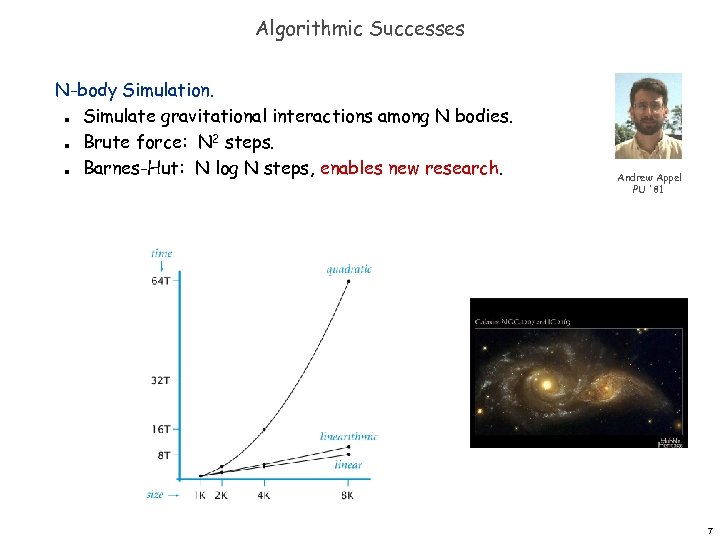 Algorithmic Successes N-body Simulation. Simulate gravitational interactions among N bodies. Brute force: N 2 steps. Barnes-Hut: N log N steps, enables new research. n n n Andrew Appel PU '81 7
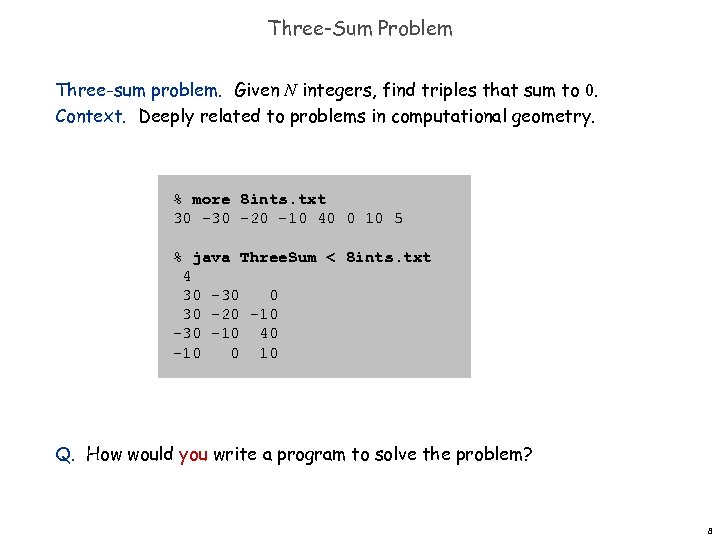 Three-Sum Problem Three-sum problem. Given N integers, find triples that sum to 0. Context. Deeply related to problems in computational geometry. % more 8 ints. txt 30 -20 -10 40 0 10 5 % java Three. Sum < 8 ints. txt 4 30 -30 0 30 -20 -10 -30 -10 40 -10 0 10 Q. How would you write a program to solve the problem? 8
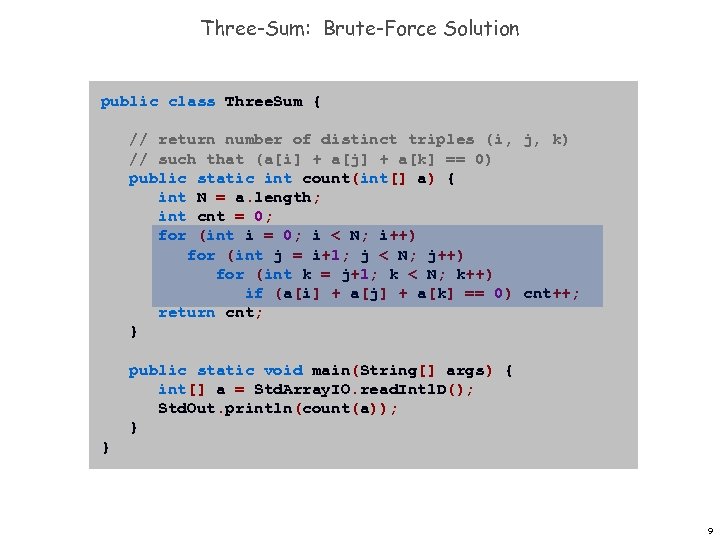 Three-Sum: Brute-Force Solution public class Three. Sum { // return number of distinct triples (i, j, k) // such that (a[i] + a[j] + a[k] == 0) public static int count(int[] a) { int N = a. length; int cnt = 0; for (int i = 0; i < N; i++) for (int j = i+1; j < N; j++) for (int k = j+1; k < N; k++) if (a[i] + a[j] + a[k] == 0) cnt++; return cnt; } public static void main(String[] args) { int[] a = Std. Array. IO. read. Int 1 D(); Std. Out. println(count(a)); } } 9
 Empirical Analysis
 Empirical Analysis Empirical analysis. Run the program for various input sizes. N time † 512 0. 03 1024 0. 26 2048 2. 16 4096 17. 18 8192 136. 76 † Running Linux on Sun-Fire-X 4100 with 16 GB RAM 11
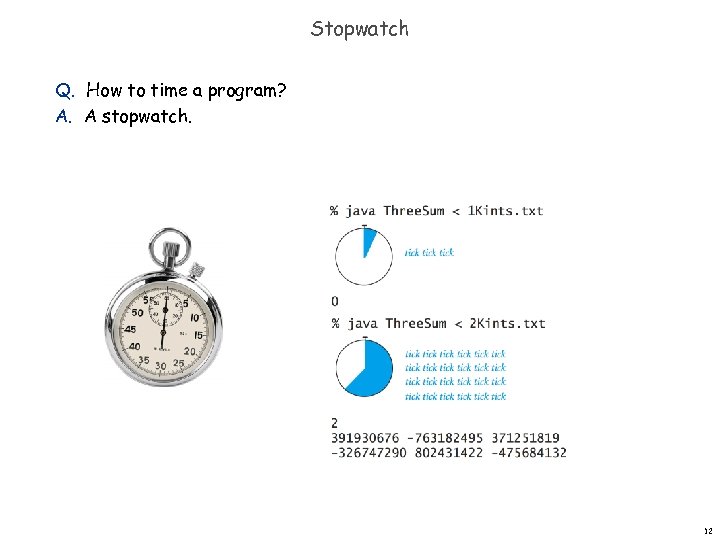 Stopwatch Q. How to time a program? A. A stopwatch. 12
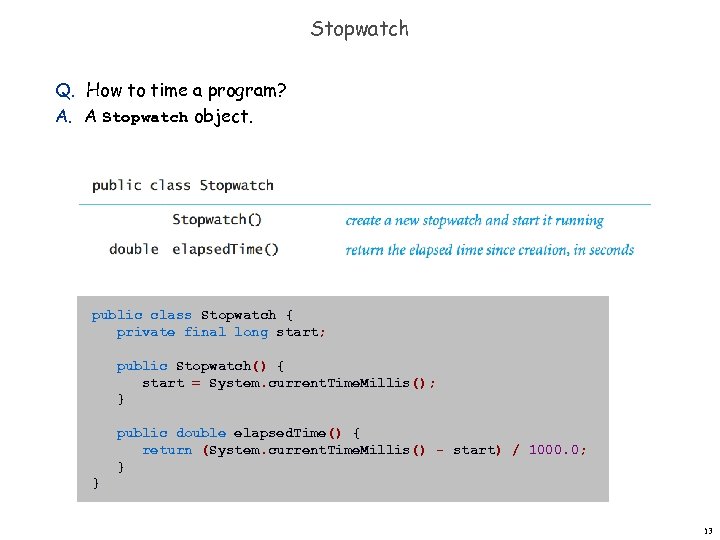 Stopwatch Q. How to time a program? A. A Stopwatch object. public class Stopwatch { private final long start; public Stopwatch() { start = System. current. Time. Millis(); } public double elapsed. Time() { return (System. current. Time. Millis() - start) / 1000. 0; } } 13
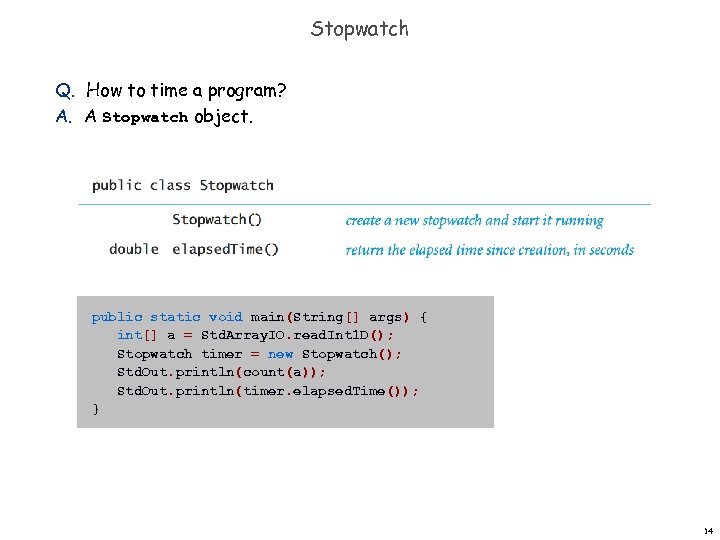 Stopwatch Q. How to time a program? A. A Stopwatch object. public static void main(String[] args) { int[] a = Std. Array. IO. read. Int 1 D(); Stopwatch timer = new Stopwatch(); Std. Out. println(count(a)); Std. Out. println(timer. elapsed. Time()); } 14
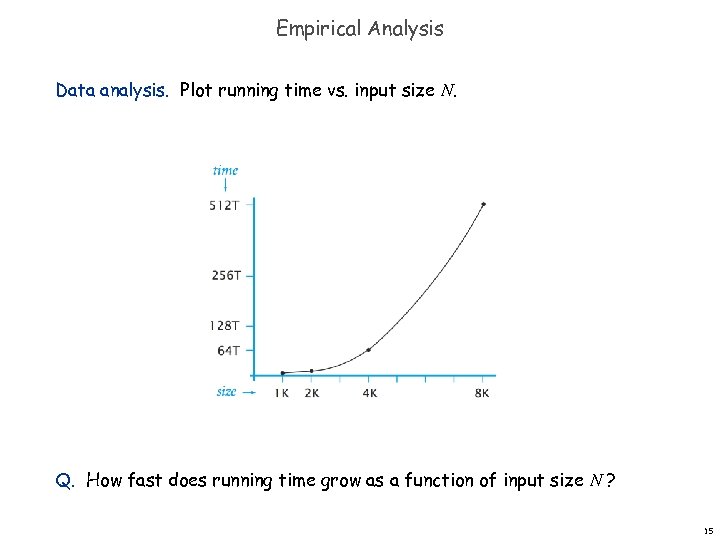 Empirical Analysis Data analysis. Plot running time vs. input size N. Q. How fast does running time grow as a function of input size N ? 15
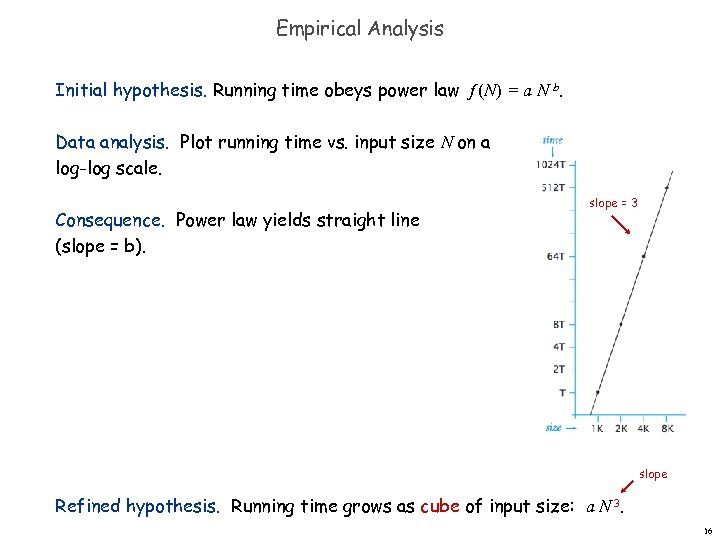 Empirical Analysis Initial hypothesis. Running time obeys power law f (N) = a N b. Data analysis. Plot running time vs. input size N on a log-log scale. Consequence. Power law yields straight line (slope = b). slope = 3 slope Refined hypothesis. Running time grows as cube of input size: a N 3. 16
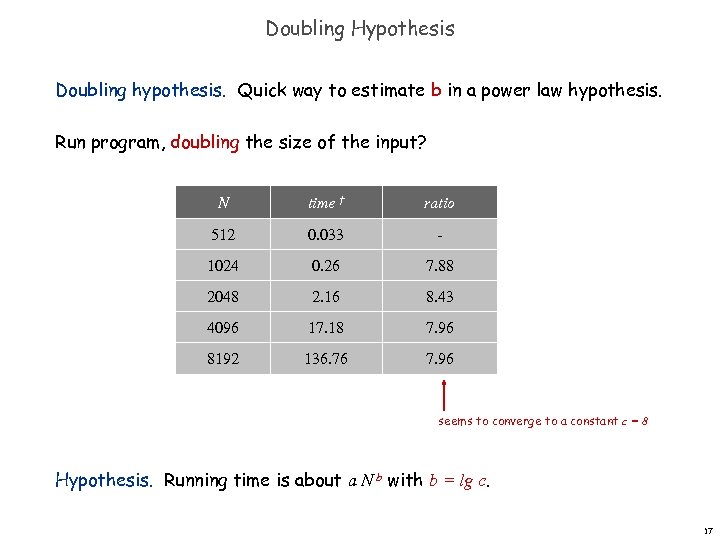 Doubling Hypothesis Doubling hypothesis. Quick way to estimate b in a power law hypothesis. Run program, doubling the size of the input? N time † ratio 512 0. 033 - 1024 0. 26 7. 88 2048 2. 16 8. 43 4096 17. 18 7. 96 8192 136. 76 7. 96 seems to converge to a constant c = 8 Hypothesis. Running time is about a N b with b = lg c. 17
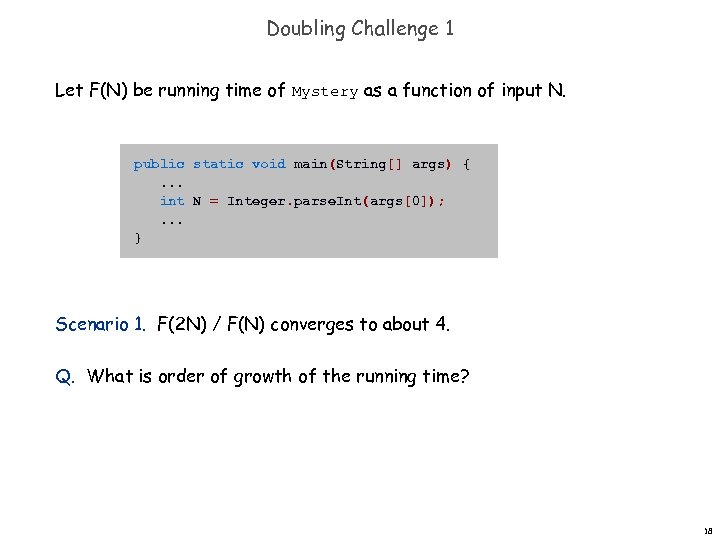 Doubling Challenge 1 Let F(N) be running time of Mystery as a function of input N. public static void main(String[] args) {. . . int N = Integer. parse. Int(args[0]); . . . } Scenario 1. F(2 N) / F(N) converges to about 4. Q. What is order of growth of the running time? 18
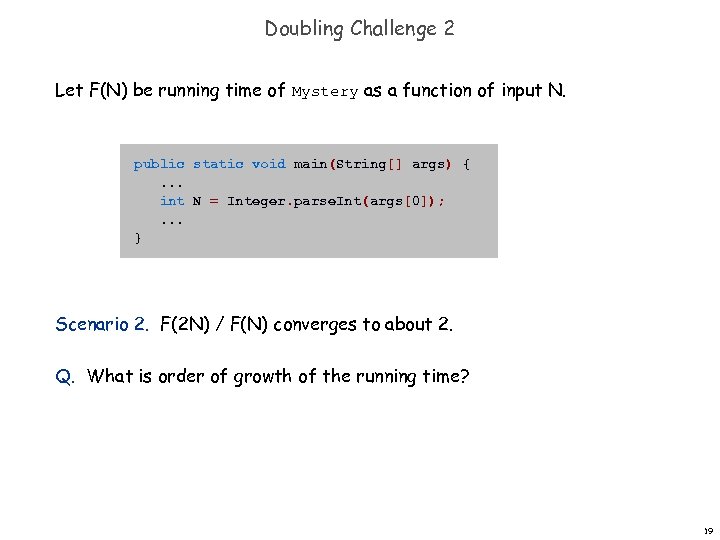 Doubling Challenge 2 Let F(N) be running time of Mystery as a function of input N. public static void main(String[] args) {. . . int N = Integer. parse. Int(args[0]); . . . } Scenario 2. F(2 N) / F(N) converges to about 2. Q. What is order of growth of the running time? 19
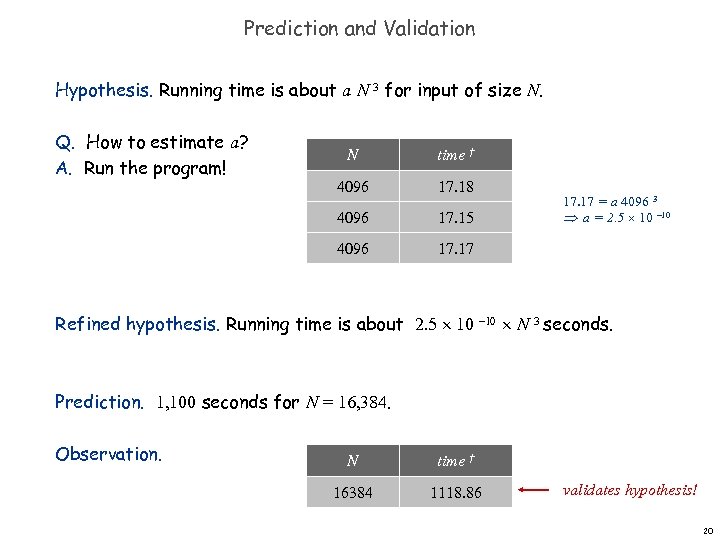 Prediction and Validation Hypothesis. Running time is about a N 3 for input of size N. Q. How to estimate a? A. Run the program! N time † 4096 17. 18 4096 17. 15 4096 17. 17 = a 4096 3 a = 2. 5 10 – 10 Refined hypothesis. Running time is about 2. 5 10 – 10 N 3 seconds. Prediction. 1, 100 seconds for N = 16, 384. Observation. N time † 16384 1118. 86 validates hypothesis! 20
 Mathematical Analysis Donald Knuth Turing award '74
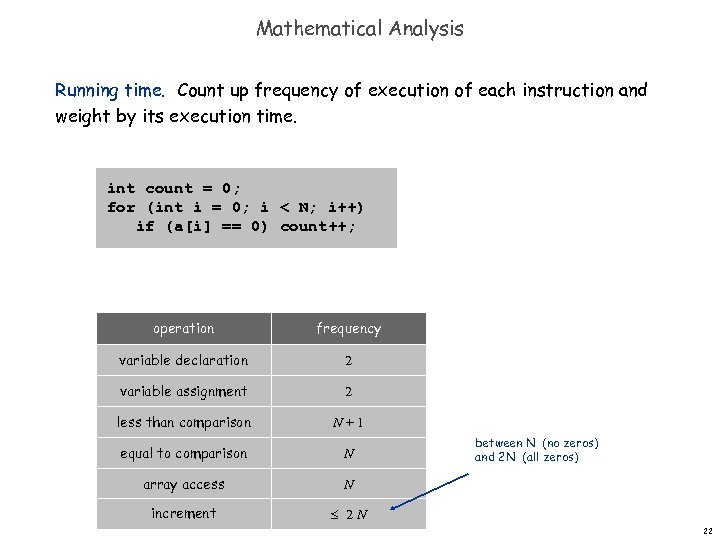 Mathematical Analysis Running time. Count up frequency of execution of each instruction and weight by its execution time. int count = 0; for (int i = 0; i < N; i++) if (a[i] == 0) count++; operation frequency variable declaration 2 variable assignment 2 less than comparison N+1 equal to comparison N array access N increment 2 N between N (no zeros) and 2 N (all zeros) 22
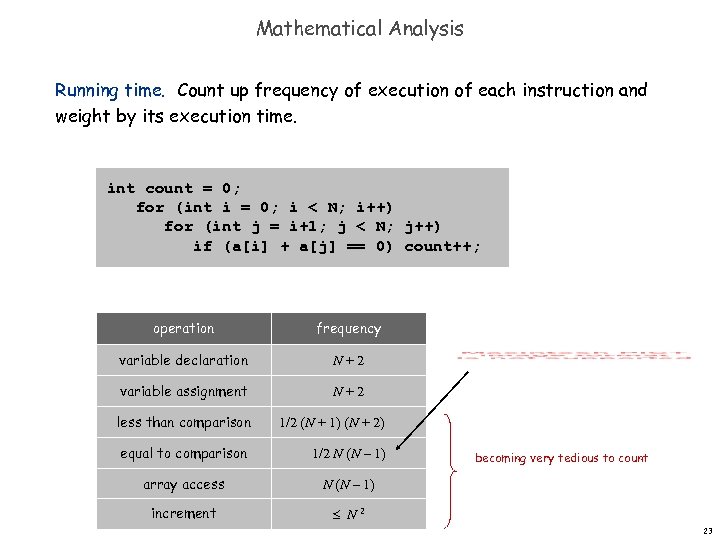 Mathematical Analysis Running time. Count up frequency of execution of each instruction and weight by its execution time. int count = 0; for (int i = 0; i < N; i++) for (int j = i+1; j < N; j++) if (a[i] + a[j] == 0) count++; operation frequency variable declaration N+2 variable assignment N+2 less than comparison 1/2 (N + 1) (N + 2) equal to comparison 1/2 N (N – 1) array access N (N – 1) increment N 2 becoming very tedious to count 23
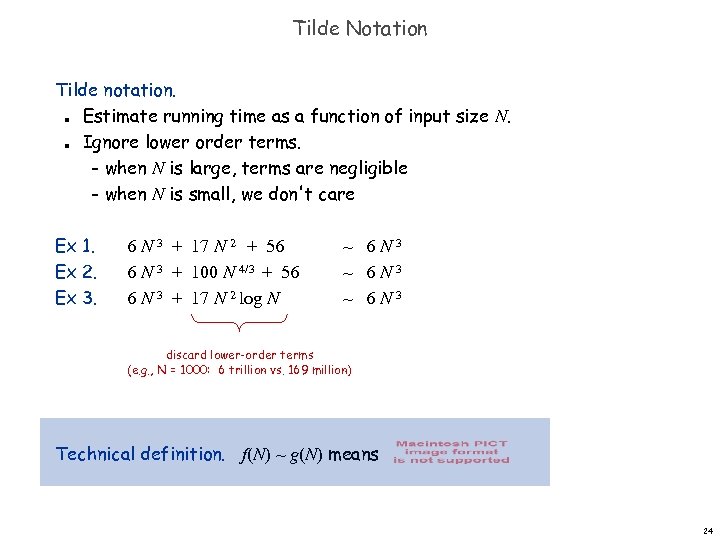 Tilde Notation Tilde notation. Estimate running time as a function of input size N. Ignore lower order terms. – when N is large, terms are negligible – when N is small, we don't care n n Ex 1. Ex 2. Ex 3. 6 N 3 + 17 N 2 + 56 6 N 3 + 100 N 4/3 + 56 6 N 3 + 17 N 2 log N ~ 6 N 3 discard lower-order terms (e. g. , N = 1000: 6 trillion vs. 169 million) Technical definition. f(N) ~ g(N) means 24
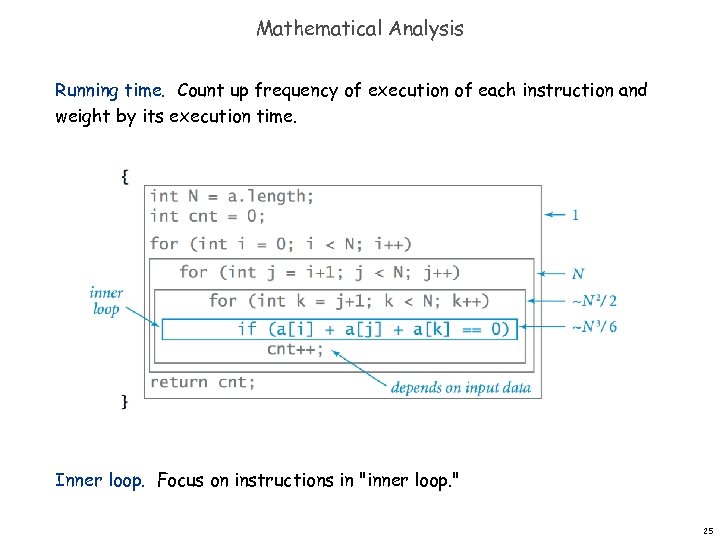 Mathematical Analysis Running time. Count up frequency of execution of each instruction and weight by its execution time. Inner loop. Focus on instructions in "inner loop. " 25
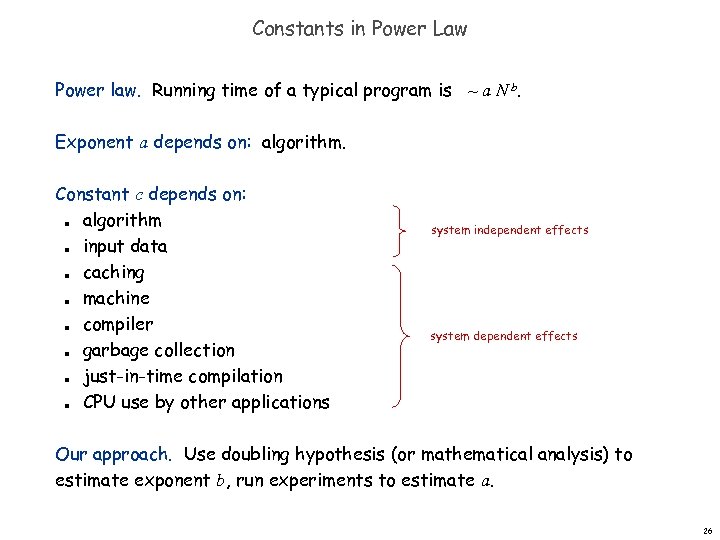 Constants in Power Law Power law. Running time of a typical program is ~ a N b. Exponent a depends on: algorithm. Constant c depends on: algorithm input data caching machine compiler garbage collection just-in-time compilation CPU use by other applications n system independent effects n n system dependent effects n n n Our approach. Use doubling hypothesis (or mathematical analysis) to estimate exponent b, run experiments to estimate a. 26
 Analysis: Empirical vs. Mathematical Empirical analysis. Measure running times, plot, and fit curve. Easy to perform experiments. Model useful for predicting, but not for explaining. n n n Mathematical analysis. Analyze algorithm to estimate # ops as a function of input size. May require advanced mathematics. Model useful for predicting and explaining. n n n Critical difference. Mathematical analysis is independent of a particular machine or compiler; applies to machines not yet built. 27
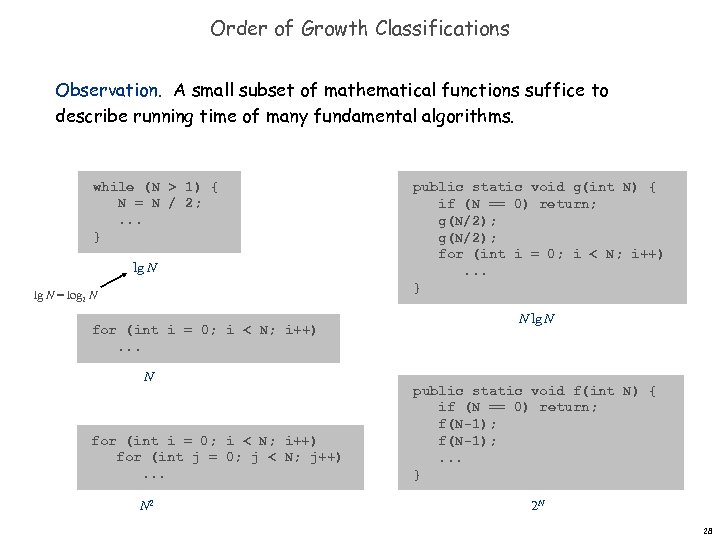 Order of Growth Classifications Observation. A small subset of mathematical functions suffice to describe running time of many fundamental algorithms. while (N > 1) { N = N / 2; . . . } lg N = log 2 N for (int i = 0; i < N; i++). . . N for (int i = 0; i < N; i++) for (int j = 0; j < N; j++). . . N 2 public static void g(int N) { if (N == 0) return; g(N/2); for (int i = 0; i < N; i++). . . } N lg N public static void f(int N) { if (N == 0) return; f(N-1); . . . } 2 N 28
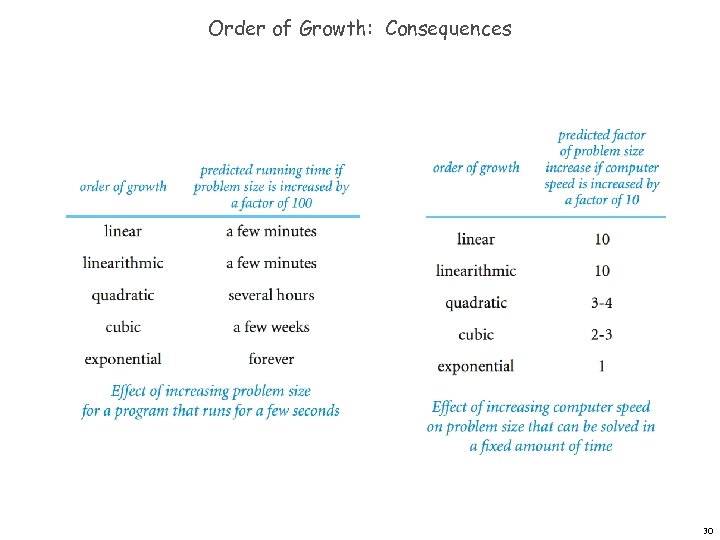
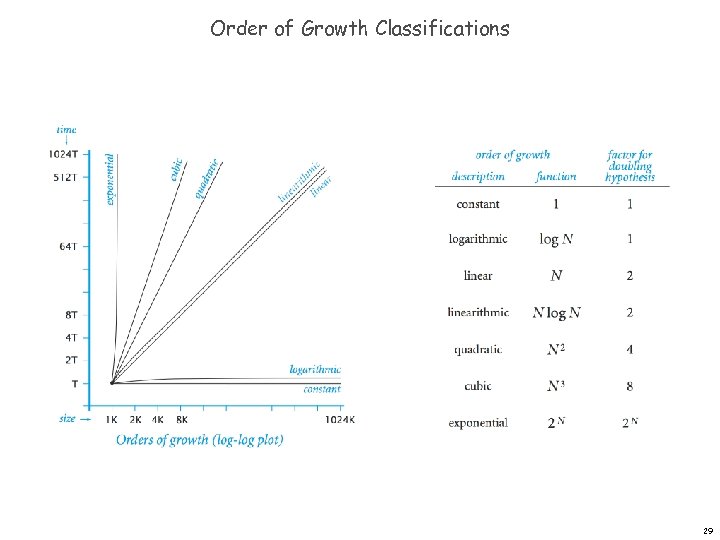 Order of Growth Classifications 29
 Order of Growth: Consequences 30
 Dynamic Programming
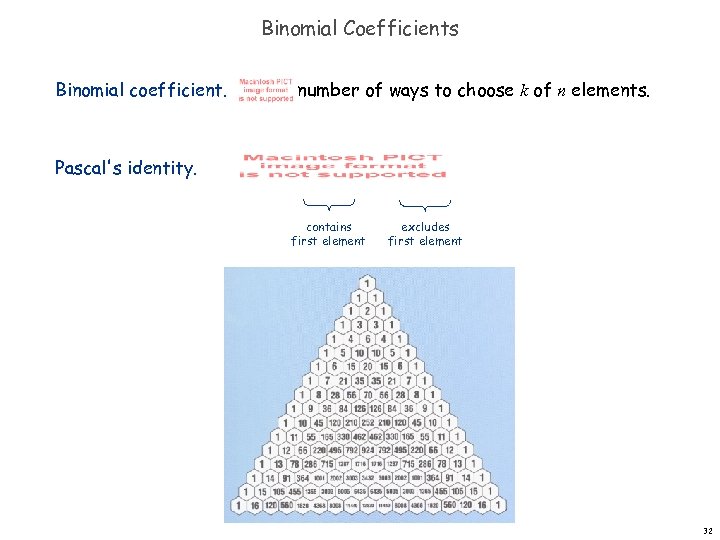 Binomial Coefficients Binomial coefficient. number of ways to choose k of n elements. Pascal's identity. contains first element excludes first element 32
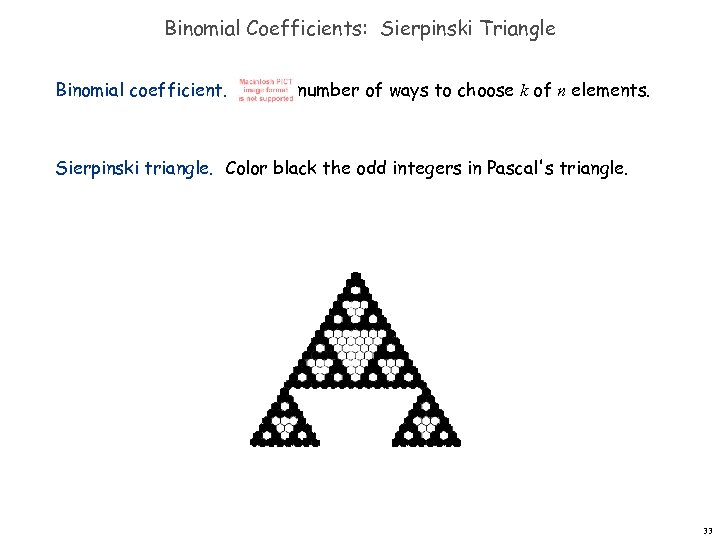 Binomial Coefficients: Sierpinski Triangle Binomial coefficient. number of ways to choose k of n elements. Sierpinski triangle. Color black the odd integers in Pascal's triangle. 33
 Binomial Coefficients: Poker Odds Binomial coefficient. number of ways to choose k of n elements. Probability of "quads" in Texas hold 'em: Probability of 6 -4 -2 -1 split in bridge: 34
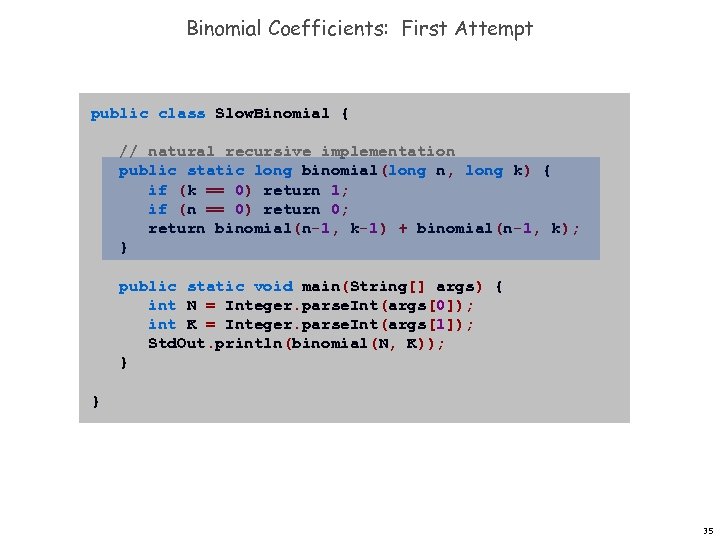 Binomial Coefficients: First Attempt public class Slow. Binomial { // natural recursive implementation public static long binomial(long n, long k) { if (k == 0) return 1; if (n == 0) return 0; return binomial(n-1, k-1) + binomial(n-1, k); } public static void main(String[] args) { int N = Integer. parse. Int(args[0]); int K = Integer. parse. Int(args[1]); Std. Out. println(binomial(N, K)); } } 35
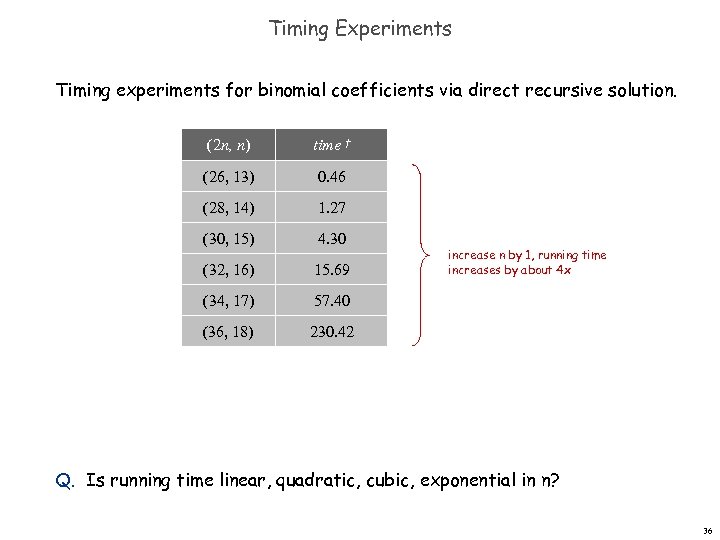 Timing Experiments Timing experiments for binomial coefficients via direct recursive solution. (2 n, n) time † (26, 13) 0. 46 (28, 14) 1. 27 (30, 15) 4. 30 (32, 16) 15. 69 (34, 17) 57. 40 (36, 18) 230. 42 increase n by 1, running time increases by about 4 x Q. Is running time linear, quadratic, cubic, exponential in n? 36
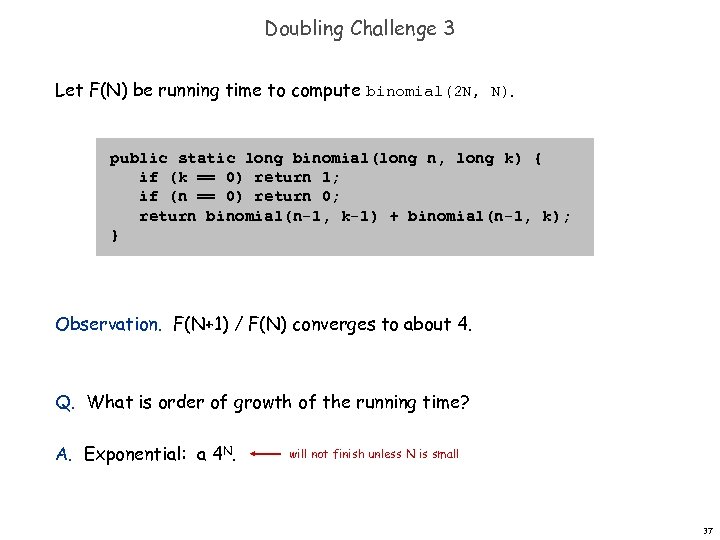 Doubling Challenge 3 Let F(N) be running time to compute binomial(2 N, N). public static long binomial(long n, long k) { if (k == 0) return 1; if (n == 0) return 0; return binomial(n-1, k-1) + binomial(n-1, k); } Observation. F(N+1) / F(N) converges to about 4. Q. What is order of growth of the running time? A. Exponential: a 4 N. will not finish unless N is small 37
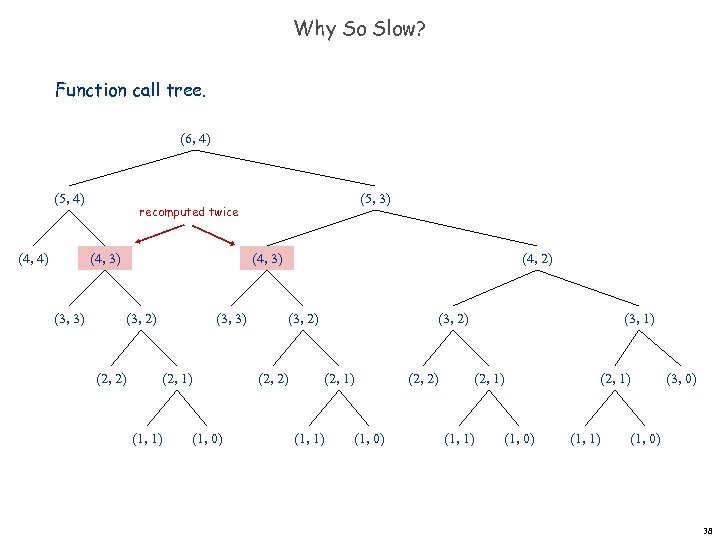 Why So Slow? Function call tree. (6, 4) (5, 4) (4, 3) (3, 3) (5, 3) recomputed twice (4, 3) (3, 2) (2, 2) (3, 3) (2, 1) (1, 0) (4, 2) (3, 2) (2, 1) (1, 0) (2, 2) (3, 1) (2, 1) (1, 0) (2, 1) (1, 1) (3, 0) (1, 0) 38
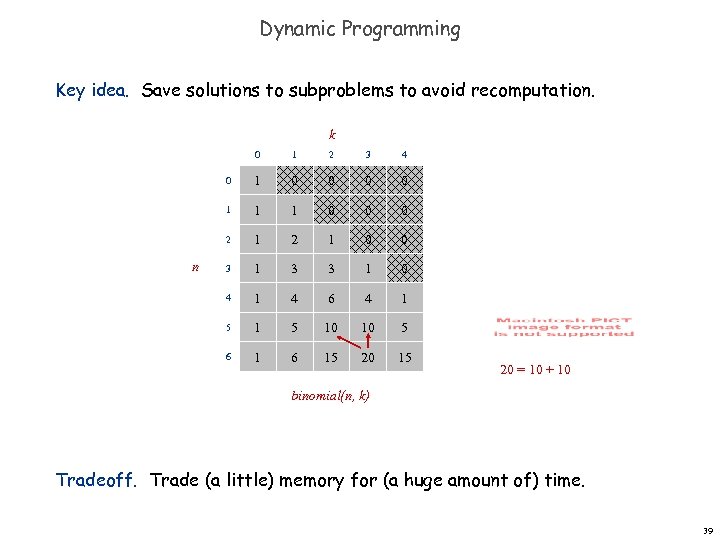 Dynamic Programming Key idea. Save solutions to subproblems to avoid recomputation. k 0 2 3 4 0 1 0 0 1 1 1 0 0 0 2 1 0 0 3 1 3 3 1 0 4 1 4 6 4 1 5 10 10 5 6 n 1 1 6 15 20 = 10 + 10 binomial(n, k) Tradeoff. Trade (a little) memory for (a huge amount of) time. 39
![Binomial Coefficients: Dynamic Programming public class Binomial { public static void main(String[] args) {](https://present5.com/presentation/1d46c4ca8626ef68efd87b567dff821b/image-40.jpg "Binomial Coefficients: Dynamic Programming public class Binomial { public static void main(String[] args) {") Binomial Coefficients: Dynamic Programming public class Binomial { public static void main(String[] args) { int N = Integer. parse. Int(args[0]); int K = Integer. parse. Int(args[1]); long[][] bin = new long[N+1][K+1]; // base cases for (int k = 1; k <= K; k++) bin[0][K] = 0; for (int n = 0; n <= N; n++) bin[N][0] = 1; // bottom-up dynamic programming for (int n = 1; n <= N; n++) for (int k = 1; k <= K; k++) bin[n][k] = bin[n-1][k-1] + bin[n-1][k]; // print results Std. Out. println(bin[N][K]); } } 40
Binomial Coefficients: Dynamic Programming public class Binomial { public static void main(String[] args) { int N = Integer. parse. Int(args[0]); int K = Integer. parse. Int(args[1]); long[][] bin = new long[N+1][K+1]; // base cases for (int k = 1; k <= K; k++) bin[0][K] = 0; for (int n = 0; n <= N; n++) bin[N][0] = 1; // bottom-up dynamic programming for (int n = 1; n <= N; n++) for (int k = 1; k <= K; k++) bin[n][k] = bin[n-1][k-1] + bin[n-1][k]; // print results Std. Out. println(bin[N][K]); } } 40
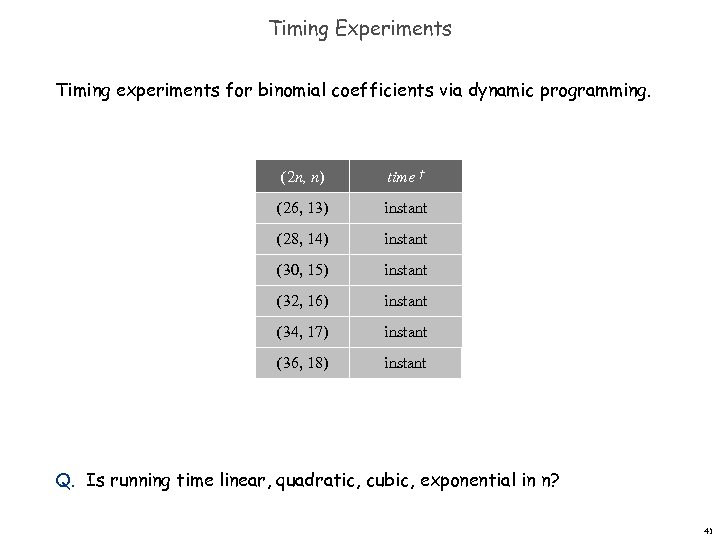 Timing Experiments Timing experiments for binomial coefficients via dynamic programming. (2 n, n) time † (26, 13) instant (28, 14) instant (30, 15) instant (32, 16) instant (34, 17) instant (36, 18) instant Q. Is running time linear, quadratic, cubic, exponential in n? 41
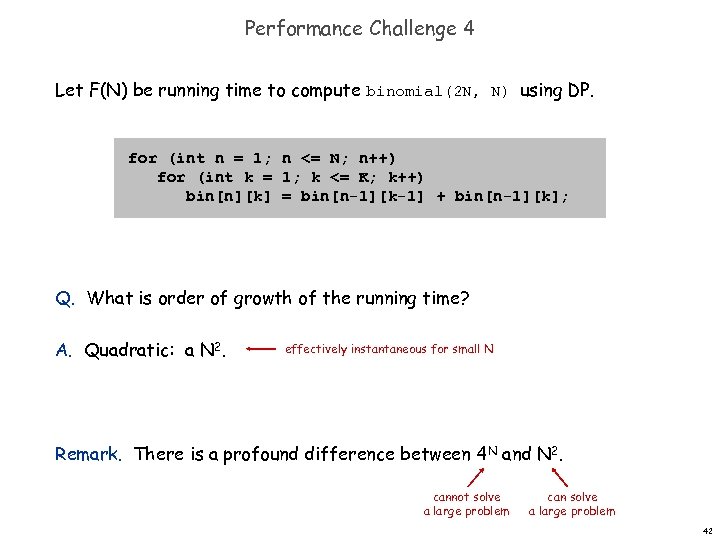 Performance Challenge 4 Let F(N) be running time to compute binomial(2 N, N) using DP. for (int n = 1; n <= N; n++) for (int k = 1; k <= K; k++) bin[n][k] = bin[n-1][k-1] + bin[n-1][k]; Q. What is order of growth of the running time? A. Quadratic: a N 2. effectively instantaneous for small N Remark. There is a profound difference between 4 N and N 2. cannot solve a large problem can solve a large problem 42
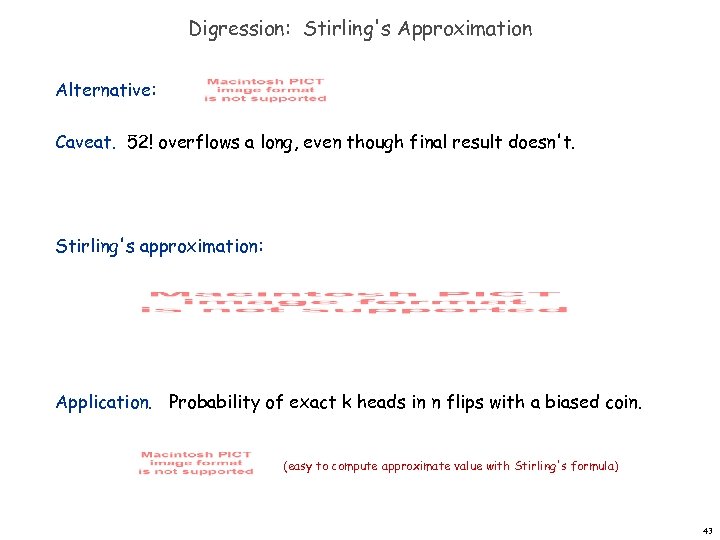 Digression: Stirling's Approximation Alternative: : Caveat. 52! overflows a long, even though final result doesn't. Stirling's approximation: Application. Probability of exact k heads in n flips with a biased coin. (easy to compute approximate value with Stirling's formula) 43
 Memory
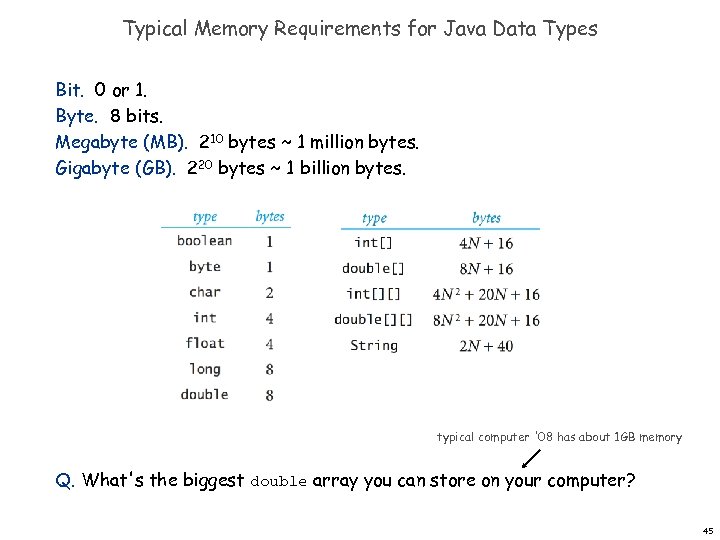 Typical Memory Requirements for Java Data Types Bit. 0 or 1. Byte. 8 bits. Megabyte (MB). 210 bytes ~ 1 million bytes. Gigabyte (GB). 220 bytes ~ 1 billion bytes. typical computer '08 has about 1 GB memory Q. What's the biggest double array you can store on your computer? 45
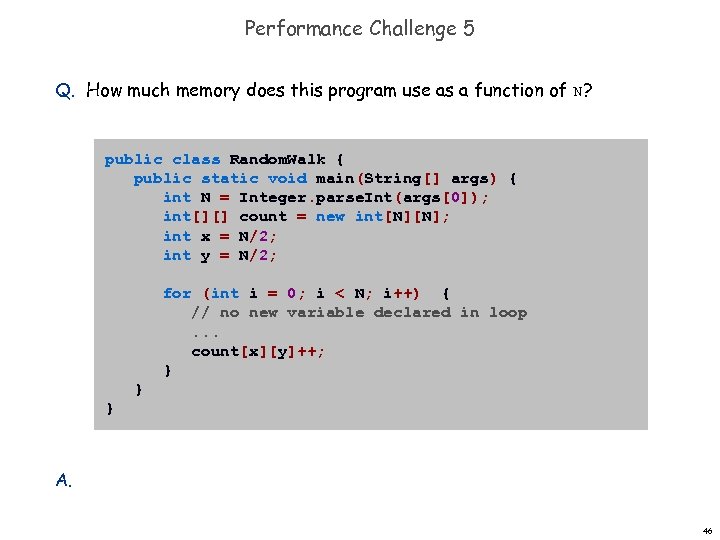 Performance Challenge 5 Q. How much memory does this program use as a function of N? public class Random. Walk { public static void main(String[] args) { int N = Integer. parse. Int(args[0]); int[][] count = new int[N][N]; int x = N/2; int y = N/2; for (int i = 0; i < N; i++) { // no new variable declared in loop. . . count[x][y]++; } } } A. 46
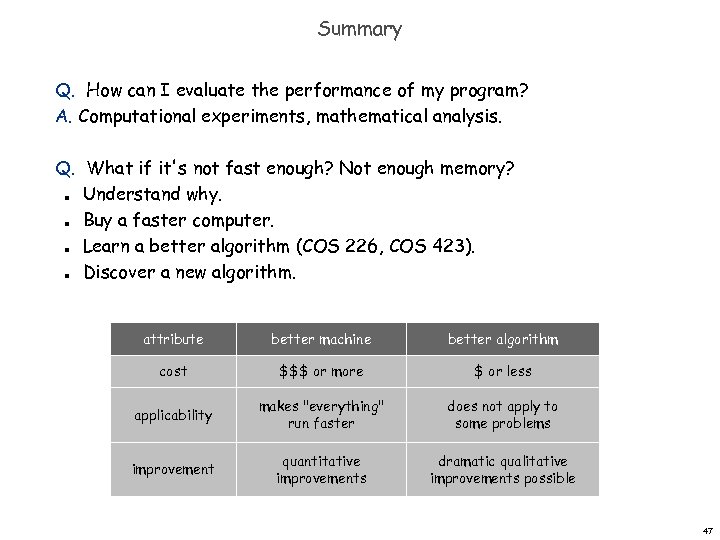 Summary Q. How can I evaluate the performance of my program? A. Computational experiments, mathematical analysis. Q. What if it's not fast enough? Not enough memory? Understand why. Buy a faster computer. Learn a better algorithm (COS 226, COS 423). Discover a new algorithm. n n attribute better machine better algorithm cost $$$ or more $ or less applicability makes "everything" run faster does not apply to some problems improvement quantitative improvements dramatic qualitative improvements possible 47