


 Скачать презентацию 38 CO 2000 Economics of Intellectual Property Rights
f91c9f4675f375f6a3056d612793a90e.ppt
- Количество слайдов: 25
 38 CO 2000 Economics of Intellectual Property Rights (IPRs) Spring 2006: Lecture 3 Practical issues: -The course lasts until 3. 5. -The exam is 9. 5. , 9 -13. Needs a registration via weboodi. Extra exams? - I could have reduced one lecture against the lecture on 8. 11, but instead we will have four guest lectures -12. 4. Borenius & Kemmpinen. A, or perhaps, the leading business law service company in Finland. Topic is likely to be related to the question of competition policy aspects of IP management. - 19. 4 Electronic Frontier Finland. Topic is likely to be related on the (negative) effects of copyright protection on real economy - 24. 4. National Patent and Registration Agency of Finland. Topic is likely to be related on the management of IPs in SMEs -26. 4. Nokia. Topic is likely to be related on the management of IPs in large Es
 RECAP from the last time 1) Knowledge is a public good. Non-rival and to various extent nonexcludable. - There is a fundamental tradeoff between the creation of the incentive to innovate and using innovations once made - Ex ante, before investments in knowledge production, there is an appropriability problem. - Ex post, once knowledge exists, it does not wear out and there is no point to restricts its use -Intellectual property makes knowledge (more) excludable and hence creates the incentive to innovate ex ante but restricts its use ex post. -This fundamental tradeoff is underlying the most debate concerning IPRs! -E. g. , the comments on the RIM-NTP case on the Black Berry patent (Settled after RIM paid 612 500 000$)
 2) IP is not the only mechanism to encourage innovation. The other mechanism include prizes, public production and procurement, and subsidies. - IP is very roughly speaking worse in solving the ex post problem but better in solving the ex ante problem - Its key virtue is that it decentralizes the making of the decision on what to invest. A capitalistic solution to a market failure. -Its key defect is dead weight loss Note - DWL arises because there are consumers that would be willing to buy the product with a price above its duplication cost but below the price charged by the holder of IPR. - However, DWL could be reduced or even eliminated, if the IPR holder would be able to discriminate on price - Some form of price discrimination is possible in practice even on information goods. E. g. , the price of software/scientific journals when licensed to institutions vs. on private users. - Price discrimination is difficult and perfect price discrimination is impossible DWL remains
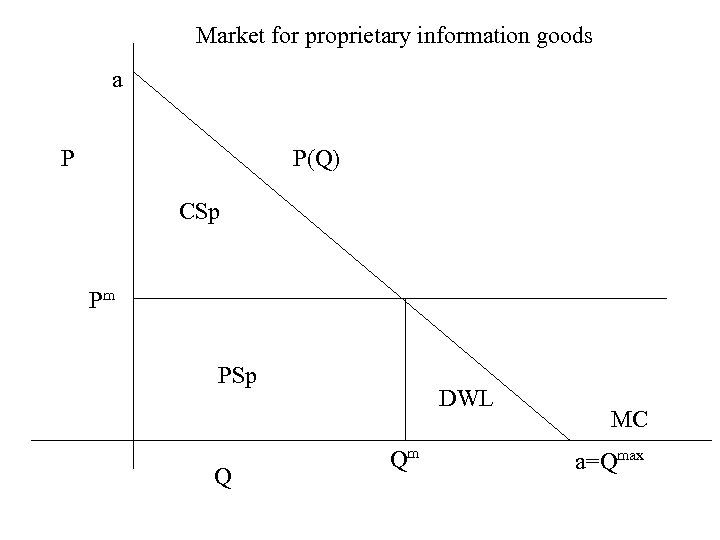 Market for proprietary information goods a P P(Q) CSp Pm PSp Q DWL Qm MC a=Qmax
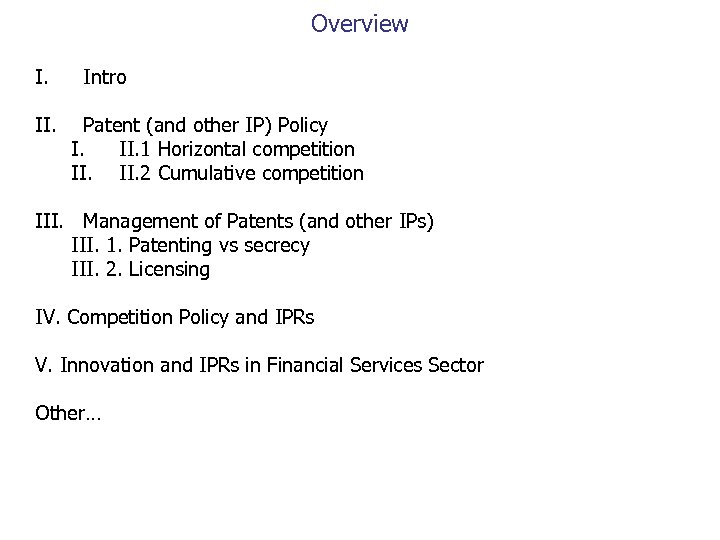 Overview I. II. Intro Patent (and other IP) Policy I. II. 1 Horizontal competition II. 2 Cumulative competition III. Management of Patents (and other IPs) III. 1. Patenting vs secrecy III. 2. Licensing IV. Competition Policy and IPRs V. Innovation and IPRs in Financial Services Sector Other…
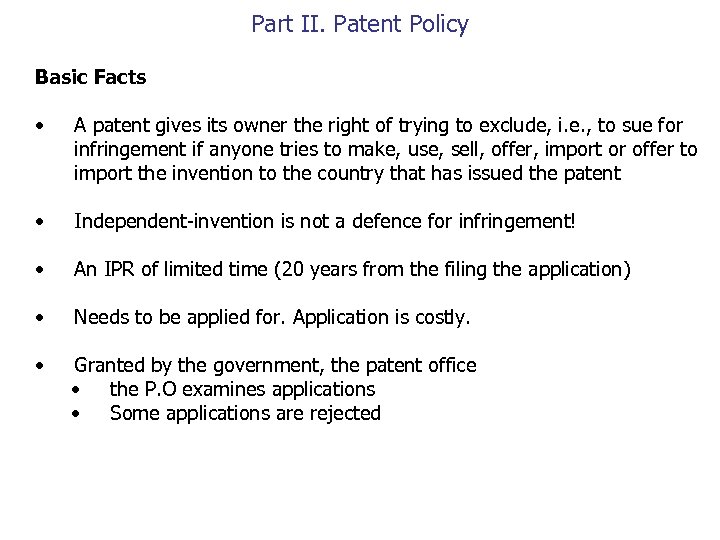 Part II. Patent Policy Basic Facts • A patent gives its owner the right of trying to exclude, i. e. , to sue for infringement if anyone tries to make, use, sell, offer, import or offer to import the invention to the country that has issued the patent • Independent-invention is not a defence for infringement! • An IPR of limited time (20 years from the filing the application) • Needs to be applied for. Application is costly. • Granted by the government, the patent office • the P. O examines applications • Some applications are rejected
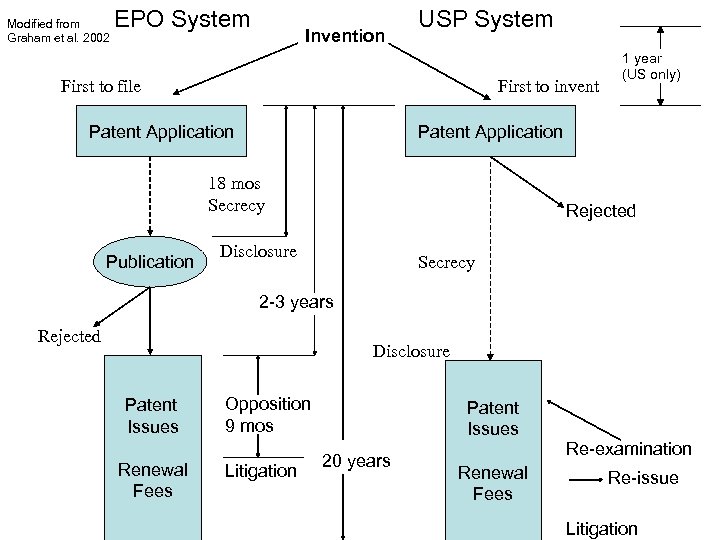 Modified from Graham et al. 2002 EPO System Invention USP System First to file First to invent Patent Application 18 mos Secrecy Publication 1 year (US only) Rejected Disclosure Secrecy 2 -3 years Rejected Disclosure Patent Issues Renewal Fees Opposition 9 mos Litigation Patent Issues 20 years Renewal Fees Re-examination Re-issue Litigation
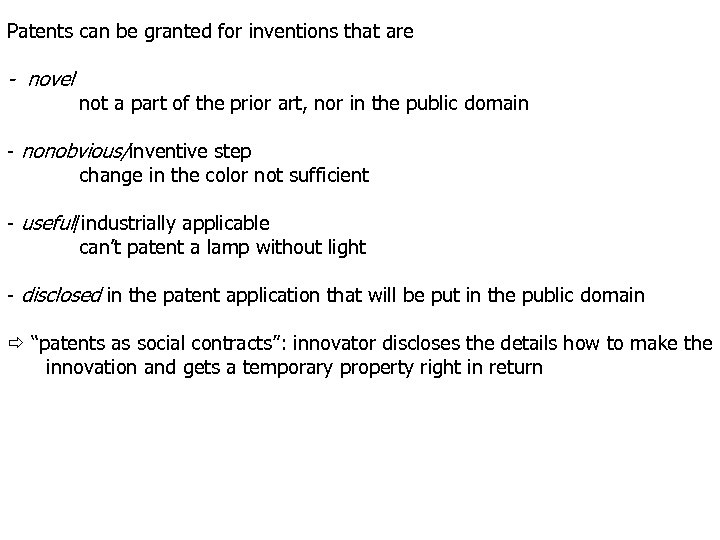 Patents can be granted for inventions that are - novel not a part of the prior art, nor in the public domain - nonobvious/inventive step change in the color not sufficient - useful/industrially applicable can’t patent a lamp without light - disclosed in the patent application that will be put in the public domain “patents as social contracts”: innovator discloses the details how to make the innovation and gets a temporary property right in return
 • Reward theory of IPRs (non-exclusivity of innovation): - unprotected innovations are easy to imitate (the approbriability problem) - IPRs needed to provide the right to try to exclude others - the right to exclude is a source for market power - the market power boosts the incentive to innovate • Contract theory of IPRs (patents) (non-rivalry of innovations): - in the absence of patent protection, innovations are kept in secret - to induce disclosure & avoid unnecessary duplication of innovation costs, a temporary “monopoly” right to innovation • Are these theories mutually consistent?
 Covered subject matter: - Traditionally patents were granted on machines, industrial process etc recently expanded on, in particular in the US in software, biotechnology, mathematical algorithms, business methods, plants, animals, cell lines, genes etc Boundaries of the patent system under the heated debate. - There are moral objections to patenting. We concentrate on economics. - In the EU, the law explicitly states (cf. Suomen patenttilaki 1 § 2) that one cannot patent - scientific theories and mathematical methods - artistic creations - presentations of knowledge - plans, rules, methods and computer software for any commercial or other intelligent activity - Rules on patenting of plants and animals complicated. Be it as it may, there are thousands of patents on software in the EU
 Remedies • Damages. • Difficult to determine what is the loss caused by the infringement • Damages can be higher if infringement is willful • Injunctions • Preliminary injunctions. Can be used strategically Exemptions and defenses, e. g. , • Invalidity: Typically a firm that is sued for infringement claims that the patent is invalid • Failure to disclose the technical details of invention • Despite this patents are obscure • Failure to renew • Research exemption (no longer relevant? )
 Breadth of protection • Not a legal concept but essential in practice and economics • If a patent were restricted to the original invention exactly, protection would be trivial to circumvent (invent around) • Breadth vs. inventive step • Doctrine of equivalents: “patent covers any product that does the same work substantially the same way to obtain the same result” • E. g. , if you patent a bottle that is closed by a screw cork the invention covers a bottle closed by an oak cork • Infringement must be established with respect to patent claims • Patent protects what is claimed for • Claims chosen by the applicant and checked by the examiner • All claims should be related to one invention Writing claims carefully/strategically very important
 Notes: 1) Duration • Because of the renewal fees less than 10% patents are kept force full period (evidence for Finland? ) 2) Breadth • Patents do not necessary or even typically leverage a monopoly or strong market power on output market e. g. , because • • Breadth is nonetheless limited and patents can be invented-around Patents and protected innovations are usually inputs, i. e. , seldom ready to be sold as such Substitute inputs/patents are available New products need increasingly many inputs Þ fragmentation of IPRs (cf. Rahnasto 03)
 3) Breadth vs. Inventive Step • Inventive step determines which inventions are patentable • Determines a minimum amount that an invention must advance technological progress to be patentable • Benchmark: prior art • Relevant in cumulative innovation context • Breadth determines how different another product or technology must be to escape infringement • Determines a minimum difference between inventions • Relevant both in static and cumulative contexts • Tempting to think that breadth and inventive step are equivalent: • if an invention satisfies the inventive step, it cannot infringe • if an invention does not infringe, it is patentable • But • • this is wrong. An invention can be unpatentable, infringing patentable, non-infringing patentable, infringing (blocking patents) unpatentable, non-infringing
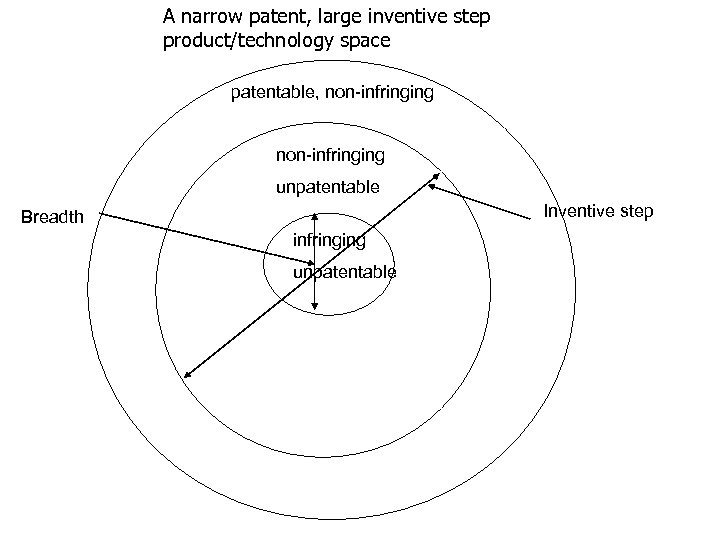 A narrow patent, large inventive step product/technology space patentable, non-infringing unpatentable Inventive step Breadth infringing unpatentable
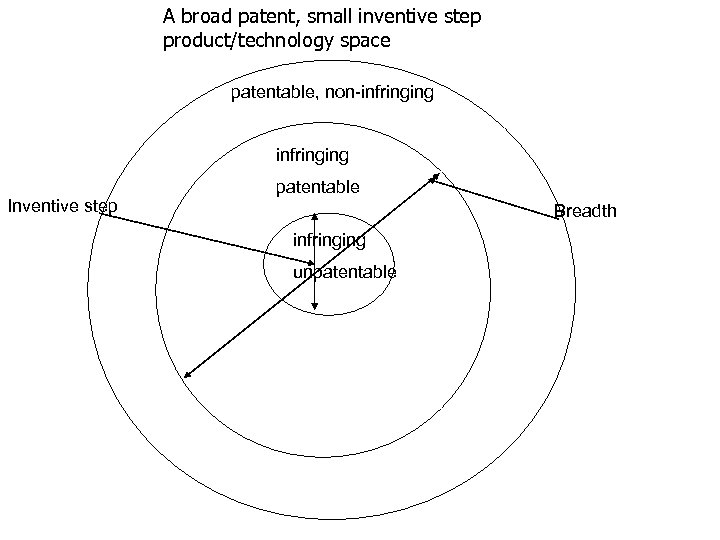 A broad patent, small inventive step product/technology space patentable, non-infringing Inventive step patentable Breadth infringing unpatentable
 4) Patent Quality • There is a widespread concern of deteriorating patent quality in the US • Examination quality • • In particular in “new” areas, patents of dubious standards issue • Fail to meet novelty requirement Reasons for the development • The incentives of the PO examiners • Harder to search prior art in new areas • Opposition procedure matters
 II. 1. Optimal Design of Patents (when competition is horizontal) • Scotchmer, chapter 4 and Takalo (2001) • How to think about innovation? Production function vs. ideas model Production function - Let W= the social value of innovation E. g, with zero MC and a linear inverse demand P=a-Q, W=a 2/2 - = success probability of making an innovation - Cost of innovation C( ). C’>0, C’’<0. - The society should maximize W-C( ). • I. e. , innovation is just matter of investing resources. If W were known ex ante, why not just to post a prize equal to it? Or produce publicly?
 Ideas model: • Ideas are generated first and then decision to invest in developing an idea is made • • W is not known at least prior to some one thinking the idea. Ideas are scarce in the sense that an idea also identifies an economic need (W). • In this kind of environment the IP system has its virtues: - potential inventors are the one who come up with ideas - they and not some government agency decide whether to invest in the idea or not - if the idea turns out to be valuable for market/society, IP system guarantees that the inventors get rewarded
 • Ideas view applies in particular to the patent system as it operates as the level of ideas/inventions - Copyright in traditional context: the choice is about a career rather than which idea to pursue Food for thought: - Where do ideas come from? - Would pouring more money to the production of ideas yield more ideas? Back in the production function model • - In what follows we for brevity use production function approach Keep in mind that presumption is that ideas, or their values (W) are non-observable or at least non-verifiable by an outside party (government agency)
 • Focus on the basic problem of public good aspect of innovative output • Trade-off between ex ante and ex post considerations • • Ex-ante: how to provide the incentive to innovate Ex-post: inefficient to restrict use since knowledge does not wear out • Patent life: clear-cut, measures the time-period the patent is in force Statutory life usually differs from economic life • Patent breadth: determines how different a competing product must be to avoid infringement
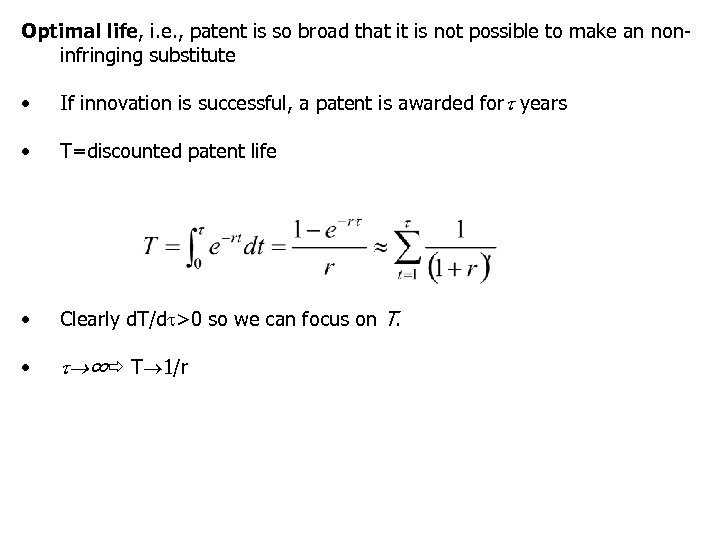 Optimal life, i. e. , patent is so broad that it is not possible to make an noninfringing substitute • If innovation is successful, a patent is awarded for years • T=discounted patent life • Clearly d. T/d >0 so we can focus on T. • ∞ T 1/r
 • Consider an inventor with an idea • Cost of innovation C • If C is invested, probability of making an invention = • When the patent is in force, a profit flow p • Eg with a zero MC and a linear inverse demand P=a-Q, p=a 2/4 • When the patent expires, entry by rivals drive the profits down to c [0, p] • If imitation/entry costless, c=0
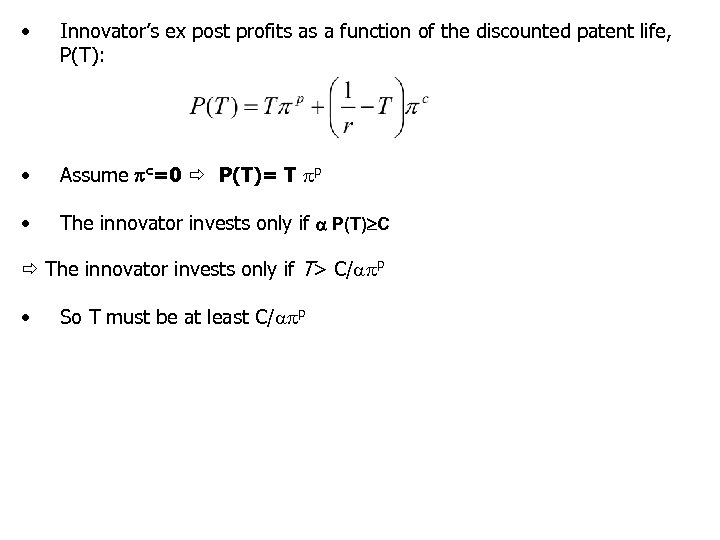 • Innovator’s ex post profits as a function of the discounted patent life, P(T): • Assume c=0 P(T)= T p • The innovator invests only if P(T) C The innovator invests only if T> C/ p • So T must be at least C/ p
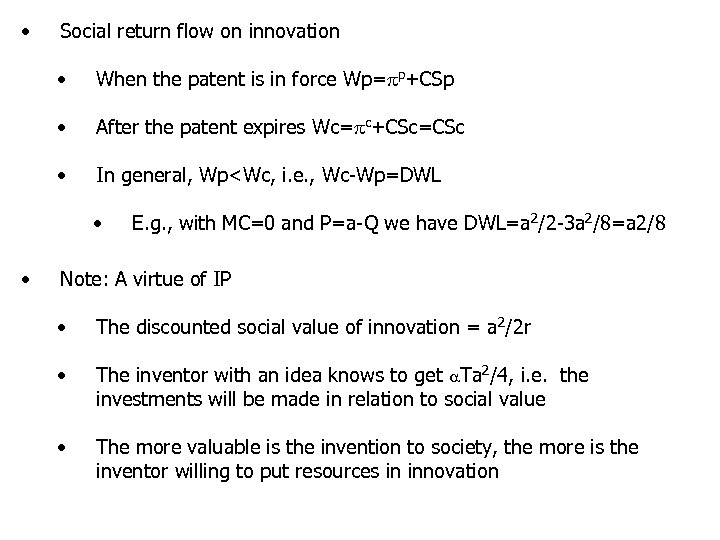 • Social return flow on innovation • When the patent is in force Wp= p+CSp • After the patent expires Wc= c+CSc=CSc • In general, Wp