


 Скачать презентацию 35 USC 112 First Paragraph Written Description
7754ba8688d65c8a10cd502076c539d9.ppt
- Количество слайдов: 72
 35 USC § 112, First Paragraph, Written Description 03 -28 -11 Refresher- 35 USC 112, First Paragraph, Written Description
 Objectives You will become more familiar with: • • • Review 35 USC § 112, first paragraph, Written Description requirement Review the Written Description Analysis Apply the Analysis to Examples Discuss how this analysis may apply to YOUR art area • Tips and Conclusion 03 -28 -11 Refresher- 35 USC 112, First Paragraph, Written Description 2
 Written Description Requirement The specification shall contain a written description of the invention, and of the manner and process of making and using it, in such full, clear, concise, and exact terms as to enable any person skilled in the art to which it pertains, or with which it is most nearly connected, to make and use the same, and shall set forth the best mode contemplated by the inventor of carrying out his invention. 03 -28 -11 Refresher- 35 USC 112, First Paragraph, Written Description 3
 Written Description Requirement (cont. ) Written Description Requirement: • is an inquiry/analysis of whether the applicant was in possession of the invention he/she seeks to patent. See: MPEP § 2163 and • ensures that the inventor had possession, as of the filing date of the application, of the specific subject matter claimed. 03 -28 -11 Refresher- 35 USC 112, First Paragraph, Written Description 4
 Written Description Requirement (cont. ) Possession is shown by describing the invention, with all its claimed limitations. 03 -28 -11 Refresher- 35 USC 112, First Paragraph, Written Description 5
 Written Description Requirement (cont. ) Although the applicant does not have to describe exactly the subject matter claimed, the description must clearly allow persons skilled in the art to recognize that the applicant(s) invented what is claimed. See: In re Gosteli, 10 USPQ 2 d 1614, 1618 (Fed. Cir. 1989); MPEP § 2163. 02 03 -28 -11 Refresher- 35 USC 112, First Paragraph, Written Description 6
 Written Description Requirement (cont. ) A description of what a material does, rather than what it is, usually is not sufficient. 03 -28 -11 Refresher- 35 USC 112, First Paragraph, Written Description 7
 Type of Claims Subject to Written Description All claims are subject to the written description requirement, including: • Original claims • New claims and amended claims • Claims asserting benefit of an earlier priority or filing date 03 -28 -11 Refresher- 35 USC 112, First Paragraph, Written Description 8
 General Principles • Basic inquiry: Would one skilled in the art reasonably conclude that the inventor had possession of the claimed invention at the time the application was filed. See: MPEP §§ 2163, 2163. 02; 2163. 03 • Written description requirement is separate and distinct from the enablement requirement. See: MPEP § 2163 03 -28 -11 Refresher- 35 USC 112, First Paragraph, Written Description 9
 Written Description Inquiry The Written Description Requirement is satisfied by the disclosure of such descriptive means as • Formulas • Words • Structures • Figures • Diagrams • Functional characteristics when coupled with a known or disclosed correlation between function and structure that fully set forth the claimed invention. 03 -28 -11 Refresher- 35 USC 112, First Paragraph, Written Description 10
 Basics of Examiner’s Analysis Determine the scope of each claim as a whole – Broadest reasonable interpretation in light of and consistent with written description See: MPEP § 2111. – Determine whether the disclosure supports the full scope of the claimed invention. 03 -28 -11 Refresher- 35 USC 112, First Paragraph, Written Description 11
 Basics of Examiner’s Analysis (cont. ) Review the entire application to understand how the applicant provides support for the claimed invention including: • Consideration for each element and/or step claimed; and • Comparing the claim scope with the scope of the disclosure. 03 -28 -11 Refresher- 35 USC 112, First Paragraph, Written Description 12
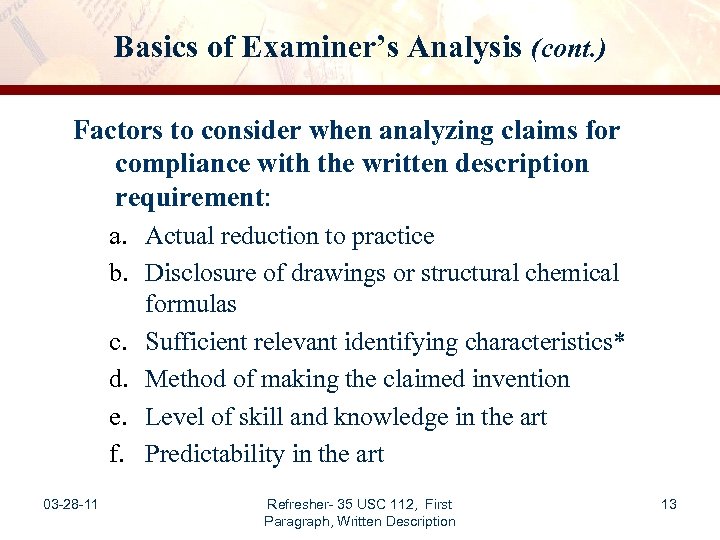 Basics of Examiner’s Analysis (cont. ) Factors to consider when analyzing claims for compliance with the written description requirement: a. Actual reduction to practice b. Disclosure of drawings or structural chemical formulas c. Sufficient relevant identifying characteristics* d. Method of making the claimed invention e. Level of skill and knowledge in the art f. Predictability in the art 03 -28 -11 Refresher- 35 USC 112, First Paragraph, Written Description 13
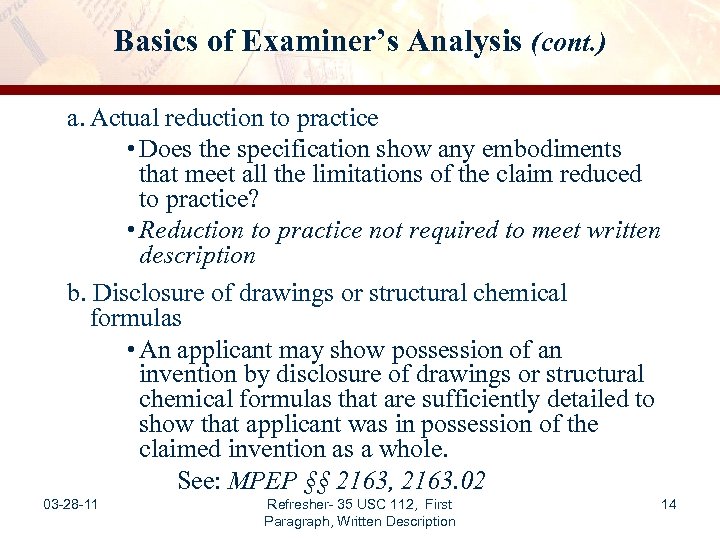 Basics of Examiner’s Analysis (cont. ) a. Actual reduction to practice • Does the specification show any embodiments that meet all the limitations of the claim reduced to practice? • Reduction to practice not required to meet written description b. Disclosure of drawings or structural chemical formulas • An applicant may show possession of an invention by disclosure of drawings or structural chemical formulas that are sufficiently detailed to show that applicant was in possession of the claimed invention as a whole. See: MPEP §§ 2163, 2163. 02 03 -28 -11 Refresher- 35 USC 112, First Paragraph, Written Description 14
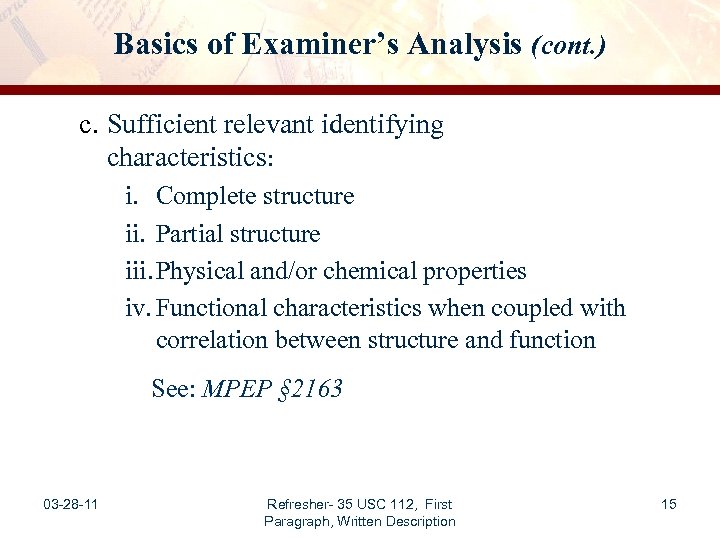 Basics of Examiner’s Analysis (cont. ) c. Sufficient relevant identifying characteristics: i. Complete structure ii. Partial structure iii. Physical and/or chemical properties iv. Functional characteristics when coupled with correlation between structure and function See: MPEP § 2163 03 -28 -11 Refresher- 35 USC 112, First Paragraph, Written Description 15
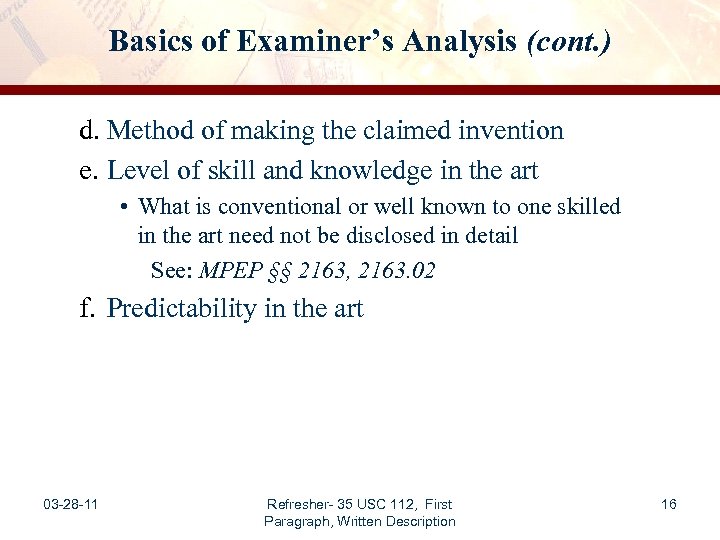 Basics of Examiner’s Analysis (cont. ) d. Method of making the claimed invention e. Level of skill and knowledge in the art • What is conventional or well known to one skilled in the art need not be disclosed in detail See: MPEP §§ 2163, 2163. 02 f. Predictability in the art 03 -28 -11 Refresher- 35 USC 112, First Paragraph, Written Description 16
 Basics of Examiner’s Analysis (cont. ) Written Description Determination for Genus Claims: • Possession is analyzed for each claim drawn to a single embodiment or species first, and • Then for each claim drawn to a genus 03 -28 -11 Refresher- 35 USC 112, First Paragraph, Written Description 17
 Basics of Examiner’s Analysis (cont. ) Written Description Determination for Genus Claims: • Written description for claimed genus may be satisfied through sufficient description of a representative number of species: See: MPEP § 2163 § inverse function of the skill and knowledge in the art. § depends on whether one of skill in the art would recognize necessary common attributes or features possessed by the members of the genus § in an unpredictable art, adequate written description of a genus which embraces widely variant species cannot be achieved by disclosing only one species within the genus. 03 -28 -11 Refresher- 35 USC 112, First Paragraph, Written Description 18
 New or Amended Claims, or Claims Asserting Entitlement to Earlier Filing Date • Each claim limitation must be expressly, implicitly, or inherently supported in the originally filed disclosure. • Each claim must include all elements which applicant has described as essential or critical. 03 -28 -11 Refresher- 35 USC 112, First Paragraph, Written Description 19
 Example 1: Claim 1. An acetabular cup prosthesis comprising: a body extending generally longitudinally and terminating into front and rear surfaces, the front surface extending substantially transversely toward the body; and at least one fin for securing the cup to a prepared acetabulum cavity, the fin having a length extending generally longitudinally from the front surface continuously along the body toward the rear surface thereby engaging the body with the cavity and securing the cup. Claim 2. The prosthesis of claim 1, wherein the body has a generally conical outer surface. 03 -28 -11 Refresher- 35 USC 112, First Paragraph, Written Description 20
 Example 1 (cont. ): Specification The specification is directed to an artificial hip socket that includes cup implants adapted to replace the acetabulum (the cup-shaped socket of the hip bone). The specification discloses that the shape of the cup is not important, so long as the implant can effectively function as an artificial hip socket. The application is a continuation-in-part (CIP). The parent application describes an acetabular cup prosthesis wherein the cup is a trapezoid, a truncated cone, or of conical shape. All of these terms describe a conical-shaped cup. In contrast to the CIP specification, the parent specification touts the criticality of a conical cup over all other shaped cups. 03 -28 -11 Refresher- 35 USC 112, First Paragraph, Written Description 21
 Example 1 (cont. ): Reference A reference disclosing the claimed invention was published between the filing date of the parent application and the instant application. Applicant asserts entitlement to the filing date of the parent application. 03 -28 -11 Refresher- 35 USC 112, First Paragraph, Written Description 22
 Example 1 (cont. ): Question Should the claimed invention have the benefit of priority to the parent application? 03 -28 -11 Refresher- 35 USC 112, First Paragraph, Written Description 23
 Example 1 (cont. ): Analysis of Claim 1 • Claim 1 is broadly drawn to an acetabular cup prosthesis that is generic as to shape. • The parent application more narrowly describes acetabular cup prostheses. For example, the parent application discloses only conical shaped cups, and discloses that a conical shape is critical to cup function compared with other cup shapes. 03 -28 -11 Refresher- 35 USC 112, First Paragraph, Written Description 24
 Example 1 (cont. ): Conclusion of Analysis of Claim 1 The parent application fails to adequately describe the full scope of the genus of Claim 1. Thus, Claim 1 is not entitled to the benefit of the parent application filing date. Accordingly, a rejection should be made under the appropriate section(s) of 35 USC § 102 over the intervening prior art. 03 -28 -11 Refresher- 35 USC 112, First Paragraph, Written Description 25
 Example 1 (cont. ): Analysis of Claim 2 is narrowly drawn to an acetabular cup prosthesis that has a conical outer surface. Because the parent application likewise describes acetabular cup prostheses that have conical shapes, a person of ordinary skill in the art would view the applicant to have been in possession of the narrow subject matter claimed based on the single species disclosed the earlier-filed application. 03 -28 -11 Refresher- 35 USC 112, First Paragraph, Written Description 26
 Example 1 (cont. ): Conclusion of Analysis for Claim 2 Conclusion: The specification satisfies the written description requirement of 35 USC § 112, first paragraph, with respect to the full scope of Claim 2. A notation should be made in the file that Claim 2 is entitled the benefit of the parent application filing date. Claim 2 would not be rejected for anticipation. 03 -28 -11 Refresher- 35 USC 112, First Paragraph, Written Description 27
 Example 2 Claim 1. An acetabular cup prosthesis comprising: a body extending generally longitudinally and terminating into front and rear surfaces, the front surface extending substantially transversely toward the body; and at least one fin for securing the cup to a prepared acetabulum cavity, the fin having a length extending generally longitudinally from the front surface continuously along the body toward the rear surface thereby engaging the body with the cavity and securing the cup. 03 -28 -11 Refresher- 35 USC 112, First Paragraph, Written Description 28
 Example 2 (cont. ): Specification The specification is directed to an artificial hip socket that includes cup implants adapted to replace the acetabulum (the cup-shaped socket of the hip bone). The specification discloses that a conical-shaped cup is critical to the prosthesis effectively functioning as an artificial hip socket. The specification describes an acetabular cup prosthesis wherein the cup is a trapezoid, a truncated cone, or of conical shape. All of these terms describe a conical cup. The specification also touts the criticality of a conical-shaped cup over all other shaped cups. 03 -28 -11 Refresher- 35 USC 112, First Paragraph, Written Description 29
 Example 2 (cont. ): Question Does that claim comply with the Written Description requirement of 35 USC § 112, first paragraph? 03 -28 -11 Refresher- 35 USC 112, First Paragraph, Written Description 30
 Example 2 (cont. ): Analysis • Claim 1 is broadly drawn to an acetabular cup prosthesis that is generic as to shape. • The specification discloses only conical shaped cups. • There is no reduction to practice or disclosure of shapes other than conical. 03 -28 -11 Refresher- 35 USC 112, First Paragraph, Written Description 31
 Example 2 (cont. ): Analysis (cont. ) • The specification also discloses that prosthesis shape is critical to the proper functioning of the claimed invention, and that the device will not work without the proper shape. However, the specification does not disclose what other shapes might function as claimed. Further, no information is provided from which a person of ordinary skill in the art could predict which shapes would function properly, i. e. , there is no known or disclosed structure-function correlation. 03 -28 -11 Refresher- 35 USC 112, First Paragraph, Written Description 32
 Example 2 (cont. ): Analysis (cont. ) Because a conical shape is the only contemplated shape of the invention, a person of ordinary skill in the art would not view the applicant to have been in possession of the generic subject matter claimed based on the single species disclosed in the specification. 03 -28 -11 Refresher- 35 USC 112, First Paragraph, Written Description 33
 Example 2 (cont. ): Conclusion The specification fails to satisfy the written description requirement of 35 USC § 112, first paragraph, with respect to the full scope of Claim 1. 03 -28 -11 Refresher- 35 USC 112, First Paragraph, Written Description 34
 Example 3: Specification and Background Information The specification is directed to a unit of a sectional sofa with a console between two reclining chairs, wherein the control means for the reclining chairs are mounted on the console. The specification clearly identifies the console as the only possible location for the controls, and provides for only the most minor variation in the location of the controls, i. e. , the controls may be mounted on the top, front, or side surfaces of the console. Additionally, the specification states that the purpose of the console is to house the controls. The original claims required the controls to be on the console. The applicant subsequently amends the claims to remove this limitation. 03 -28 -11 Refresher- 35 USC 112, First Paragraph, Written Description 35
 Example 3 (cont. ): Claim 1. (Amended) A sectional sofa comprising: a pair of reclining seats disposed in parallel relationship with one another in a double reclining seat sofa section, each of said reclining seats having a backrest and seat cushions and being movable between upright and reclined positions, a fixed console disposed in the double reclining seat sofa section between the pair of reclining seats, and a pair of control means mounted on the double reclining seat sofa section to enable each of the pair of reclining seats to move separately between the reclined and upright positions. 03 -28 -11 Refresher- 35 USC 112, First Paragraph, Written Description 36
 Example 3 (cont. ): Question Is the claimed invention supported by the specification as amended? 03 -28 -11 Refresher- 35 USC 112, First Paragraph, Written Description 37
 Example 3 (cont. ): Analysis • The examiner should first compare the scope of the amended claim to the scope of the original claim(s) and the disclosure in the specification. • Here, the amended claim is directed to a sectional sofa comprising, inter alia, a pair of control means mounted anywhere on the double reclining seat sofa sectional unit. The original claim required that the pair of control means was located on the center console. Thus, the amended claim is broader than the original claim, because it is missing an element (limitation) that was recited in the original claim. 03 -28 -11 Refresher- 35 USC 112, First Paragraph, Written Description 38
 Example 3 (cont. ): Analysis (cont. ) Next, determine whether the missing element is described in the specification as being a critical feature of the invention. (What did the background tell us? ) 03 -28 -11 Refresher- 35 USC 112, First Paragraph, Written Description 39
 Example 3 (cont. ): Analysis (cont. ) Because the specification supports only a narrow understanding of the location of the controls, the specification does not support a broader claim that omits this limitation. Accordingly, the specification does not adequately describe the genus recited in Claim 1. 03 -28 -11 Refresher- 35 USC 112, First Paragraph, Written Description 40
 Example 3 (cont. ): Conclusion The specification fails to satisfy the written description requirement of 35 USC § 112, first paragraph, with respect to Claim 1. 03 -28 -11 Refresher- 35 USC 112, First Paragraph, Written Description 41
 Example 4: Claim 1. In a modem including data input port for connecting said modem to a utilization device, and a telephone port for connecting said modem to a telephone line, said modem being of the type having two distinct modes of operation; a transparent mode of operation for which said modem provides modulated signals to said telephone port in response to data signals provided to said data input port; and a command mode of operation for which said modem responds to said data signals provided to said data input port as instructions to said modem; said modem including means defining a predetermined sequence of said data signals as an escape character, the improvement comprising: timing means for detecting each occurrence of a passage of a predetermined period of time after provision of one of said data signals to said data input port; and means, operative when said modem is in said transparent mode of operation, for detecting provision of said predetermined sequence of said data signals, and for causing said modem to switch to said command mode of operation, if and only if said predetermined sequence of data signals occurs contiguous in time with at least one said occurrence of said passage of said predetermined period of time during which none of said data signals 03 -28 -11 Refresher- 35 42 are provided to said data input port. USC 112, First Paragraph, Written Description
 Example 4 (cont. ): Specification The specification is directed to a mechanism for controlling the mode of operation of a modem. A modem is used for modulating and demodulating signals, both analog and digital, over telephone lines. It has two modes: (1) a transparent mode, in which the modem performs the modulation-demodulation function, and (2) a command mode, in which the modem responds to predetermined commands and performs operations by executing a set of instructions stored in Read-Only-Memory (ROM) or firmware. An escape command tells the modem when to switch between transparent and command modes. 03 -28 -11 Refresher- 35 USC 112, First Paragraph, Written Description 43
 Example 4 (cont. ): Specification (cont. ) The application claims an improved mechanism for detecting an escape command by a modem. The decision making capability and timing means preferably reside in a microprocessor, preferably a Z-8 type microprocessor. The specification discloses logic flow diagrams and provides a detailed functional recitation that describes how to program computers to detect an escape command, but the specification does not provide a computer program listing with source code. The specification describes the escape sequence as one full second of no data, followed by the predetermined escape command, followed by another full second of no data. 03 -28 -11 Refresher- 35 USC 112, First Paragraph, Written Description 44
 Example 4 (cont. ): Question Is the claimed invention described? 03 -28 -11 Refresher- 35 USC 112, First Paragraph, Written Description 45
 Example 4 (cont. ): Analysis • Claim 1 is drawn to a genus of modems having two modes of operation (transparent and command), a timing means, and a means for detecting an escape sequence and causing the modem to switch from the transparent to the command mode. • The specification does not describe a reduction to practice of modems having two modes of operation (transparent and command) with any particular timing means or means for detecting the escape command switching to the command mode. 03 -28 -11 Refresher- 35 USC 112, First Paragraph, Written Description 46
 Example 4 (cont. ): Analysis (cont. ) • Nonetheless, a search of the prior art indicates that the hardware required to construct the claimed modems is conventional, and that one skilled in the art would know how to program a microprocessor to perform the necessary steps described in the specification and detailed drawings. A review of the prior art also indicates that there would be no substantial variation expected among the species of modem within the claimed genus. 03 -28 -11 Refresher- 35 USC 112, First Paragraph, Written Description 47
 Example 4 (cont. ): Analysis (cont. ) Because the claimed invention is supported by conventional hardware structure and because there is a detailed description, including drawings, of what the software does to operate the computer, there is sufficient description of the claimed invention. Disclosing a microprocessor capable of performing certain functions is sufficient to satisfy the written description requirement, when one skilled in the relevant art would understand what is being described and recognize that the applicant was in possession of the invention claimed. 03 -28 -11 Refresher- 35 USC 112, First Paragraph, Written Description 48
 Example 4 (cont. ): Conclusion The specification satisfies the Written Description requirement of 35 USC § 112, first paragraph, with respect to Claim 1. 03 -28 -11 Refresher- 35 USC 112, First Paragraph, Written Description 49
 Example 5: Claims Claim 1. A candy comprising a soft chocolate center covered in a hard candy colored coating. Claim 2. The candy of claim 1 where the coating is blue. Claim 3. The candy of claim 1 wherein the center further comprises a peanut. 03 -28 -11 Refresher- 35 USC 112, First Paragraph, Written Description 50
 Example 5 (cont. ): Specification The specification discloses candy that is typically brightly colored, such as red, yellow, blue, and brown. The candy has a soft chocolate inside surrounded by a hard candy shell. The inside could also contain peanuts, almonds, peanut butter, or other edible material. 03 -28 -11 Refresher- 35 USC 112, First Paragraph, Written Description 51
 Example 5 (cont. ): Question Do the claims meet the written description requirement of 35 USC § 112, first paragraph? 03 -28 -11 Refresher- 35 USC 112, First Paragraph, Written Description 52
 Example 5 (cont. ): Analysis Ask yourself- Does the specification sufficiently identify the relevant characteristics? The specification clearly discloses the complete structure of the candy, soft chocolate inside followed by hard candy shell. Where the inside could also contain peanuts, etc. 03 -28 -11 Refresher- 35 USC 112, First Paragraph, Written Description 53
 Example 5 (cont. ): Analysis (cont. ) Ask yourself-What is the level of skill in the candy art? It is low, so a description of how to make or actual reduction to practice not required. -How predictable is the art? The candy-making art is predictable. 03 -28 -11 Refresher- 35 USC 112, First Paragraph, Written Description 54
 Example 5 (cont. ): Analysis (cont. ) Ask yourself-Do the genus and species claims have support in the specification? The specification clearly discloses a candy comprising a soft chocolate center covered in a hard candy with multiple species of colored coatings. (Claim 1) The specification also specifically states the coating could be blue. (Claim 2) The specification also specifically states the inside could also contain a peanut. (Claim 3) 03 -28 -11 Refresher- 35 USC 112, First Paragraph, Written Description 55
 Example 5 (cont. ): Conclusion Because the specification discloses several examples of colors, and of edible materials to add to the chocolate center, and because the candy-making art is well-established and the skill level is low, the specification would be considered by one of ordinary skill in the art to adequately describe a genus of colors for the candy shell and a genus of edible materials to add to the chocolate center. The specification adequately describes Claims 1 -3 and thus meets the written description requirement of 35 USC § 112, first paragraph. 03 -28 -11 Refresher- 35 USC 112, First Paragraph, Written Description 56
 Exercise • Please break into groups of 4 -6 people. • Come up with one example in your art where written description of an original claim might fail the written description analysis. • Come up with one example in your art where a genus claim would meet the written description analysis. 03 -28 -11 Refresher- 35 USC 112, First Paragraph, Written Description 57
 Inquiry Consideration Remember- the Examiner has the initial burden of presenting evidence or reasons why a person skilled in the art, upon reading applicant’s disclosure, would not have recognized the inventor to have been in possession of the claimed invention at the time of filing. 03 -28 -11 Refresher- 35 USC 112, First Paragraph, Written Description 58
 Examiner Burden Examiner burden with regard to the Written Description Requirement: • Description as filed presumed adequate • No per se rules • Unsupported allegation of unpredictability in the art is insufficient • Need reasonable basis to challenge § Evidence § Technical reasoning See: MPEP § 2163. 04 03 -28 -11 Refresher- 35 USC 112, First Paragraph, Written Description 59
 Inquiry Consideration • There is a strong presumption that an adequate written description of the claimed invention is present in the specification as originally filed. • However, for new claims or amended claims, Applicant should show support in the original disclosure, and can be required by the examiner to do so pursuant to Rule 1. 105 if necessary. 03 -28 -11 Refresher- 35 USC 112, First Paragraph, Written Description 60
 Tips • Subject matter which is well known or conventional to one of ordinary skill in the art need not be disclosed in detail. • Exact wording of claim (haec verba) is not required. • Limitations may be supported through express, implicit or inherent disclosure. See: MPEP § 2163. 07(a)); MPEP §§ 2162 and 2163 03 -28 -11 Refresher- 35 USC 112, First Paragraph, Written Description 61
 Tips: Not New Matter • Correction of an obvious error where both the error and correction are apparent to one of ordinary skill in the art does not constitute new matter. See: MPEP § 2163. 07 • Mere Rephrasing of a passage where the same meaning remains intact does not constitute new matter. See: MPEP § 2163. 07 • Subject Matter added to Specification supported by original claim is not new matter. See: MPEP § 2316. 06 III 03 -28 -11 Refresher- 35 USC 112, First Paragraph, Written Description 62
 Tips: New Matter & Art Rejections • New matter limitations must be treated with respect to the prior art, e. g. , they cannot be ignored and the claim must be examined with the new matter limitation taken into consideration. • Always write a “complete” action, not just the new matter rejection. See: MPEP § 2163. 06 I 03 -28 -11 Refresher- 35 USC 112, First Paragraph, Written Description 63
 Guidelines, Examples, & Notices USPTO written description Guidelines and Training Materials can be found in MPEP section 2163. 03 -28 -11 Refresher- 35 USC 112, First Paragraph, Written Description 64
 More Tips • Original Claims are part of the original specification as filed. Do not make a 35 USC § 112, first paragraph, written description, rejection based on original claim language for the sole reason that the language is not otherwise found in the specification. • Amended/New claims which include features not disclosed in the original specification are appropriately rejected under 35 USC § 112, first paragraph, written description. • If amendments to the specification add features not originally disclosed, the specification should be objected to under 35 USC § 132. 03 -28 -11 Refresher- 35 USC 112, First Paragraph, Written Description 65
 Summary You should now feel more comfortable with: • 35 USC § 112, first paragraph, Written Description requirement • Written Description Analysis • Applying the Analysis to real claims • Discussing how this analysis applies to YOUR art area • How to handle different 35 USC § 112, first paragraph, Written Description, situations 03 -28 -11 Refresher- 35 USC 112, First Paragraph, Written Description 66
 Reference Materials Written Description Guidelines (66 FR 1099 (Jan. 5, 2001); 1242 O. G. 168 (Jan. 30, 2001) • http: //www. uspto. gov/web/menu/current. html #register Training Materials • Revision I of the Written Description Training materials, posted 4/11/08: http: //www. uspto. gov/web/menu/written. pdf 03 -28 -11 Refresher- 35 USC 112, First Paragraph, Written Description 67
 Reference Materials Basic inquiry: Would one skilled in the art reasonably conclude that the inventor had possession of the claimed invention at the time the application was filed? – Regents of the Univ. of Calif. v. Eli Lilly & Co. , 119 F. 3 d 1559, 1566 -67, 43 USPQ 2 d 1398, 1404 -05 (Fed. Cir. 1997); Hyatt v. Boone, 146 F. 3 d 1348, 1354, 47 USPQ 2 d 1128, 1132 (Fed. Cir. 1998); MPEP § 2106. 03 -28 -11 Refresher- 35 USC 112, First Paragraph, Written Description 68
 Reference Materials Written description requirement is separate and distinct from the enablement requirement. –See: e. g. , Vas-Cath, Inc. v. Mahurkar, 935 F. 2 d 1555, 1560, 19 USPQ 2 d 1111, 1114 (Fed. Cir. 1991). See also: Univ. of Rochester v. G. D. Searle & Co. , 358 F. 3 d 916, 920 -23, 69 USPQ 2 d 1886, 1890 -93 (Fed. Cir. 2004) (discussing history and purpose of the written description requirement); In re Curtis, 354 F. 3 d 1347, 1357, 69 USPQ 2 d 1274, 1282 (Fed. Cir. 2004) ("conclusive evidence of a claim's enablement is not equally conclusive of that claim's satisfactory written description"). 03 -28 -11 Refresher- 35 USC 112, First Paragraph, Written Description 69
 Reference Materials (cont. ) Determine the scope of each claim as a whole –Broadest reasonable interpretation in light of and consistent with written description Phillips v. AWH Corp. , 415 F. 3 d 1303, 75 USPQ 2 d 1321 (Fed. Cir. 2005). Actual reduction to practice –Does the specification show any embodiments that meet all the limitations of the claim reduced to practice? –Reduction to practice not required to meet written description cf. : Ariad Pharm. Inc. v. Eli Lilly & Co. , 598 F. 3 d 1336, 1352, 94 USPQ 2 d 1161, 1172 (Fed. Cir. 2010). 03 -28 -11 Refresher- 35 USC 112, First 70 Paragraph, Written Description
 Reference Materials (cont. ) Disclosure of drawings or structural chemical formulas –An applicant may show possession of an invention by disclosure of drawings or structural chemical formulas that are sufficiently detailed to show that applicant was in possession of the claimed invention as a whole. See, e. g. , Vas-Cath, 935 F. 2 d at 1565, 19 USPQ 2 d at 1118; In re Wolfensperger, 302 F. 2 d 950, 133 USPQ 537 (CCPA 1962); Autogiro Co. of Amer. v. United States, 384 F. 2 d 391, 398, 155 USPQ 697, 703 (Ct. Cl. 1967); Eli Lilly, 119 F. 3 d at 1568, 43 USPQ 2 d at 1406. 03 -28 -11 Refresher- 35 USC 112, First Paragraph, Written Description 71
 Reference Materials (cont. ) Sufficient relevant identifying characteristics: Enzo Biochem. , 323 F. 3 d at 964, 63 USPQ 2 d at 1613. Written description for claimed genus may be satisfied through sufficient description of a representative number of species See: Enzo Biochem. , 323 F. 3 d at 966, 63 USPQ 2 d at 1615; Noelle v. Lederman, 355 F. 3 d 1343, 1350, 69 USPQ 2 d 1508, 1514 (Fed. Cir. 2004); Eli Lilly, 119 F. 3 d at 1568, 43 USPQ 2 d at 1406. 03 -28 -11 Refresher- 35 USC 112, First Paragraph, Written Description 72