


 Скачать презентацию 318 -355 Spring 2003 Team 3 CLOSED-LOOP MOTOR
226b90a8de2e68c8eb3943aab65801bb.ppt
- Количество слайдов: 173
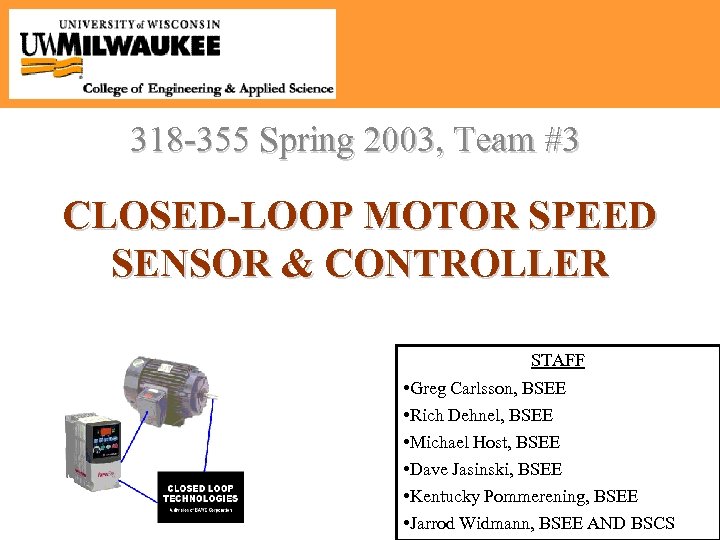 318 -355 Spring 2003, Team #3 CLOSED-LOOP MOTOR SPEED SENSOR & CONTROLLER STAFF • Greg Carlsson, BSEE • Rich Dehnel, BSEE • Michael Host, BSEE • Dave Jasinski, BSEE • Kentucky Pommerening, BSEE • Jarrod Widmann, BSEE AND BSCS
 318 -355 Spring 2003, Team #3 CLOSED-LOOP MOTOR SPEED SENSOR & CONTROLLER Project Abstract • Precision AC motor control is currently an expensive option requiring a $200+ encoder and supporting circuitry. This project aims to design a cost effective alternative with a flexible interface which can be implemented in nearly any industrial AC motor application to provide closed-loop control. • Cost, reliability, accuracy, and safety are key aspects in the scope of this project. Page 2
 318 -355 Spring 2003, Team #3 CLOSED-LOOP MOTOR SPEED SENSOR & CONTROLLER Product Description • The input to the Closed Loop Motor Speed Sensor and Controller will be generated by an optical interrupting device which detects the shaft speed of a motor. • The input signal will be sent to a microprocessor which compares the input signal to a pre-programmed reference value. • This value will then be manipulated in the digital domain to provide an analog feedback signal to the motor controller. • A user interface is used to enter the reference value to the micro and display the actual motor shaft speed. • A power supply is used to supply the various circuits. Page 3
 318 -355 Spring 2003, Team #3 Page 4 CLOSED-LOOP MOTOR SPEED SENSOR & CONTROLLER Product Feature Set The desired features for our product included: • Accurate control of desired speed level • Analog output of 0 -10 VDC or 4 -20 m. A. This signal will be used as a control signal to an AC motor drive, or as a monitor signal to a chart recorder or data logger. • Instantaneous under/over speed indicator • Programmable scaling factor for display output • Constantly displayed set-point and actual speed values.
 318 -355 Spring 2003, Team #3 CLOSED-LOOP MOTOR SPEED SENSOR & CONTROLLER Target Market • This product is being developed for use in industrial environments that require precision speed control of an AC induction motor. A variable frequency drive containing an analog input of 0 -10 VDC or 4 -20 m. A should be controlling the motor. • An alternative application of this device is for data logging an application containing a rotating machine. • The prototype design is geared toward the North American market (120 VAC, 60 Hz), but can easily be adapted to conform to other electrical power systems throughout the world. Page 5
 Page 6 318 -355 Spring 2003, Team #3 CLOSED-LOOP MOTOR SPEED SENSOR & CONTROLLER Team Page (1) • Greg Carlsson • Rich Dehnel • Michael Host Expertise: Audio Systems, hardware design, audio op-amp implementation Expertise: Control & integration, building electrical systems layout Expertise: HW, board layout, VHDL, digital design, product troubleshooting Experience: 3 years at Audio Video Specialties Experience: 12 years at Grande Cheese, 2 years at Lang Associates Experience: 1. 5 Years at Rockwell Automation, Quality Systems Engineering
 Page 7 318 -355 Spring 2003, Team #3 CLOSED-LOOP MOTOR SPEED SENSOR & CONTROLLER Team Page (2) • Dave Jasinski Expertise: Quality control, reliability, product safety & manufacturing processes Experience: 22+ years in electronics manufacturing, currently employed at • Kentucky Pommerening • Jarrod Widmann Expertise: Hardware design, board layout, compliance testing Expertise: Software, embedded systems & digital design Experience: 1 year internship at ABB – Research and Development Experience: Three co -op sessions at Hamilton Sundstrand Aerospace
 318 -355 Spring 2003, Team #3 CLOSED-LOOP MOTOR SPEED SENSOR & CONTROLLER Team Logistics • Due to the fact that two members are part-time students, the team met primarily on weekends, mostly Sunday afternoons. Action items were assigned, ideas exchanged, and questions were discussed and resolved. • Emails were constantly being exchanged between members to share information. • Each team member dedicated about 8 hours per week to this project. Responsibilities were assigned as follows: • Website Manager: Greg Carlsson • Project Archiver: Rich Dehnel • Presentation Manager: Dave Jasinski • Report Managers: Mike Host and Kentucky Pommenering • Financial Manager: Jarrod Widmann Page 8
 318 -355 Spring 2003, Team #3 CLOSED-LOOP MOTOR SPEED SENSOR & CONTROLLER Product Performance Requirements • 0. 4% accuracy – actual versus displayed speed of motor shaft • Less than 4. 0 W power consumption • User interface keypad chosen for industrial environment • The user display will be viewable from five feet • Under-speed and over-speed indicators on user interface • Over-current and over-voltage protection on input power • Shaft speeds to 1800 RPM • Compatibility with AC motor drives and PLCs containing analog inputs. • Operable in environments from 0 – 50ºC • Mounting by DIN rail or panel screws. • Installation with basic hand tools. Page 9
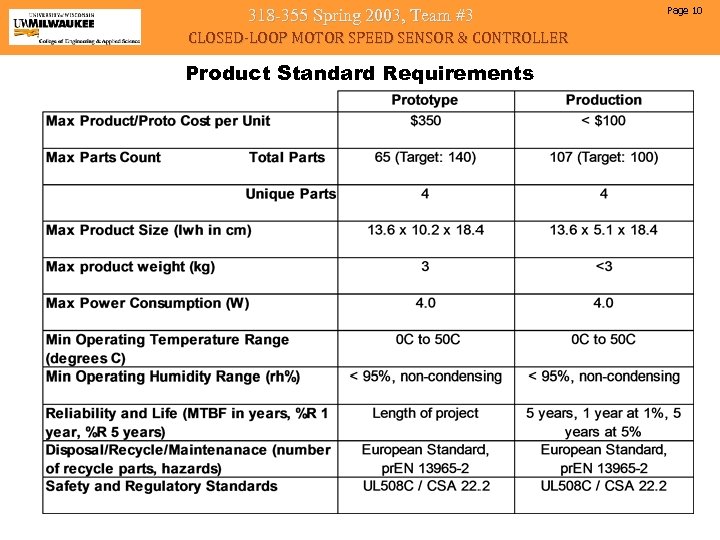 318 -355 Spring 2003, Team #3 CLOSED-LOOP MOTOR SPEED SENSOR & CONTROLLER Product Standard Requirements Page 10
 318 -355 Spring 2003, Team #3 Page 11 CLOSED-LOOP MOTOR SPEED SENSOR & CONTROLLER Productization Aspects & Requirement • Environmental Aspects & Requirement • This product does have any adverse affects on the environment when operating. Upon disposal, all required state and local recycling requirements will be adhered to, along with the requirements of European Standard pr. EN 13965 -2. Health & Safety Aspects & Requirement • This product is designed for an industrial installation, therefore operational aspects were created for the industrial user. • Proper fusing and over-voltage protection are incorporated into the power supply. • Components derated for worst-case operation limits. • Packaging is user-friendly and free of sharp edges. • All components are enclosed and nonaccessible by the user. Operates well below 40ºC. • Sensor circuit is properly guarded to prevent inadvertent pinch points. • User manual contains required warnings and comprehensive installation instructions. • Compliant UL 508 C and CSA 22. 2, standards for industrial equipment.
 318 -355 Spring 2003, Team #3 Page 12 CLOSED-LOOP MOTOR SPEED SENSOR & CONTROLLER Productization Aspects & Requirement • Legal/Ethical Aspects & Requirement • Basic operator’s manual including usage and troubleshooting instructions will be included. • Manual printed to be printed in multiple languages per Marketing requirements. • Includes UL and warning labeling. • Labeling on product in English for all user interfaces. • Societal Aspects & Requirement • No known societal aspects • Economic Aspects & Requirement • Prototype cost came is at $262 (Target $300) • Target production cost is $107. 77 (Target $100) • Provides cost effective alternative for users of motor encoders. • Warranty: one year • No known liabilities regarding malfunctions. • Sustaining Aspects & Requirement • Product cannot be service in field • Long term production support for any circuit design issues will be managed by a Continuation Engineering group. • Customer installation issues will be handled by Technical Service Department. • Reliability Aspects & Requirement • Reliability calculations support a five-year warranty period.
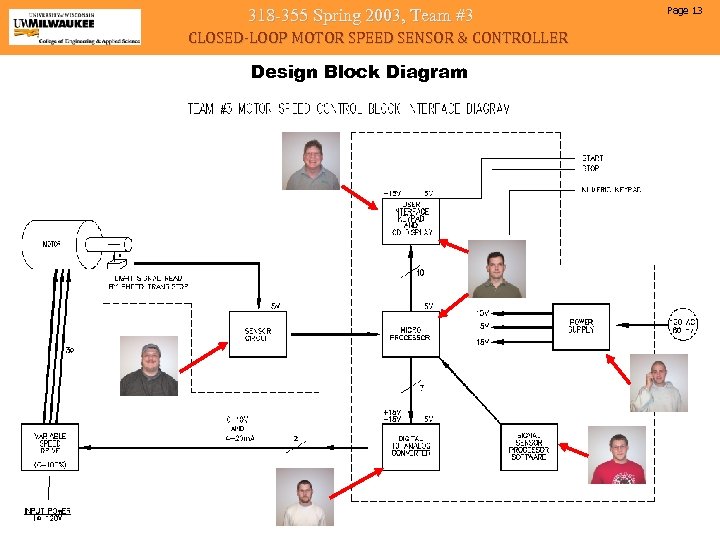 318 -355 Spring 2003, Team #3 CLOSED-LOOP MOTOR SPEED SENSOR & CONTROLLER Design Block Diagram Page 13
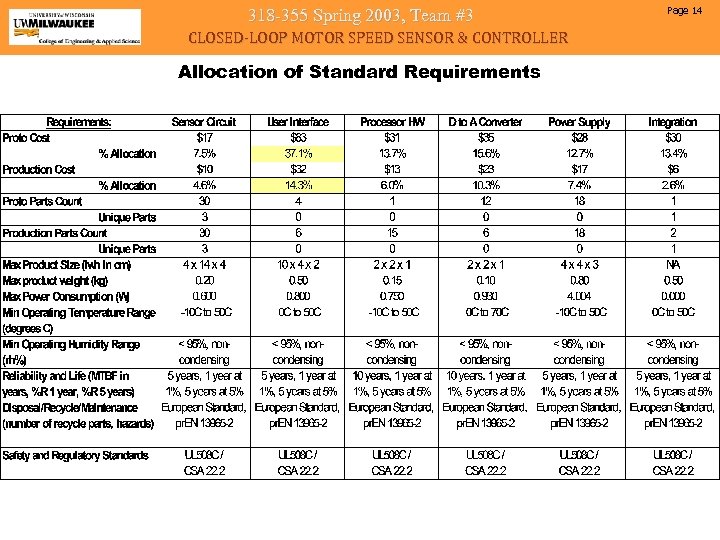 318 -355 Spring 2003, Team #3 CLOSED-LOOP MOTOR SPEED SENSOR & CONTROLLER Allocation of Standard Requirements Page 14
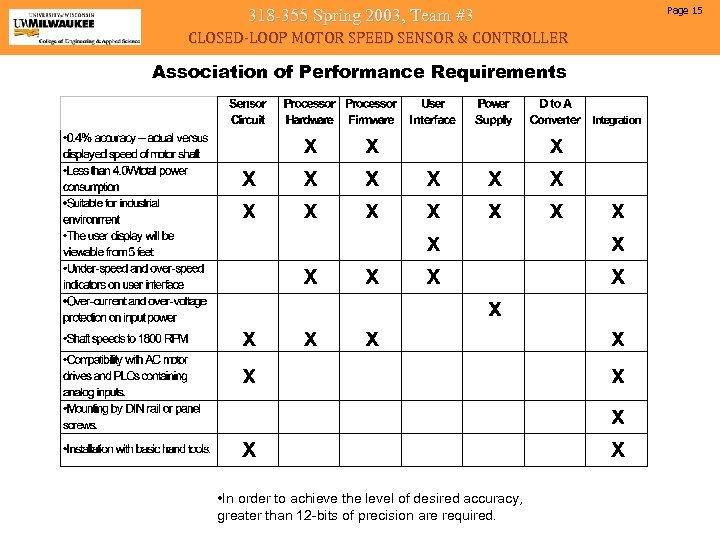 318 -355 Spring 2003, Team #3 CLOSED-LOOP MOTOR SPEED SENSOR & CONTROLLER Association of Performance Requirements • In order to achieve the level of desired accuracy, greater than 12 -bits of precision are required. Page 15
 318 -355 Spring 2003, Team #3 Page 16 CLOSED-LOOP MOTOR SPEED SENSOR & CONTROLLER Functional Block Description Agenda • User Interface – Dave Jasinski / Mike Host • Sensor Circuit– Rich Dehnel • Microprocessor Hardware – Mike Host • Microprocessor Software – Jarrod Widmann • D to A Conversion and Signal Output – Greg Carlsson • Power Supply – Kentucky Pommerening • Integration – Dave Jasinski Let’s start out with the user interface. . .
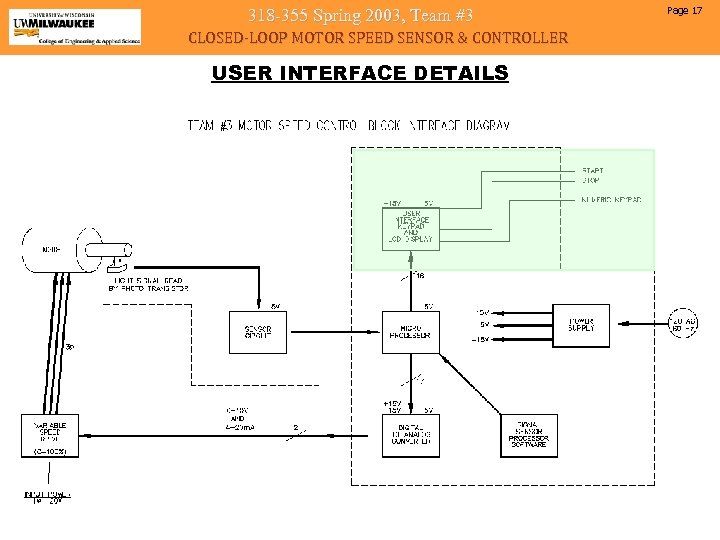 318 -355 Spring 2003, Team #3 CLOSED-LOOP MOTOR SPEED SENSOR & CONTROLLER USER INTERFACE DETAILS Page 17
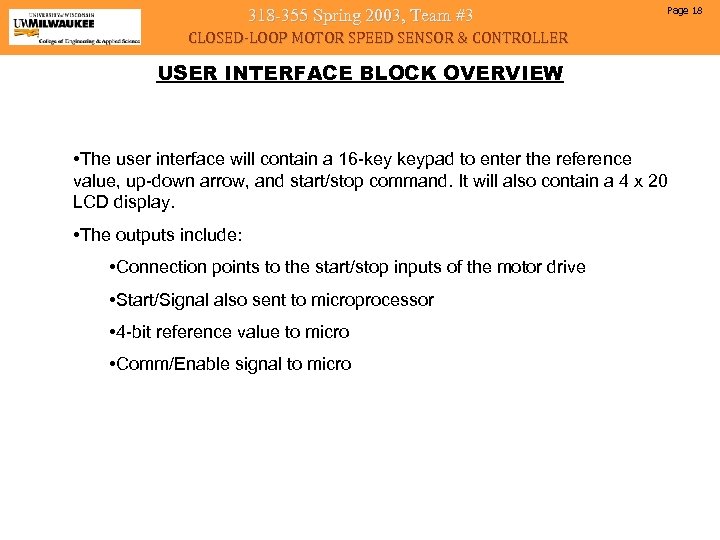 318 -355 Spring 2003, Team #3 Page 18 CLOSED-LOOP MOTOR SPEED SENSOR & CONTROLLER USER INTERFACE BLOCK OVERVIEW • The user interface will contain a 16 -key keypad to enter the reference value, up-down arrow, and start/stop command. It will also contain a 4 x 20 LCD display. • The outputs include: • Connection points to the start/stop inputs of the motor drive • Start/Signal also sent to microprocessor • 4 -bit reference value to micro • Comm/Enable signal to micro
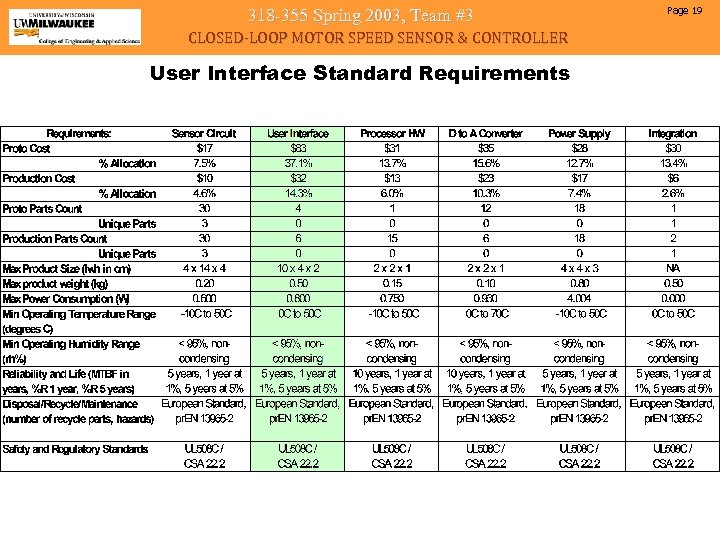 318 -355 Spring 2003, Team #3 CLOSED-LOOP MOTOR SPEED SENSOR & CONTROLLER User Interface Standard Requirements Page 19
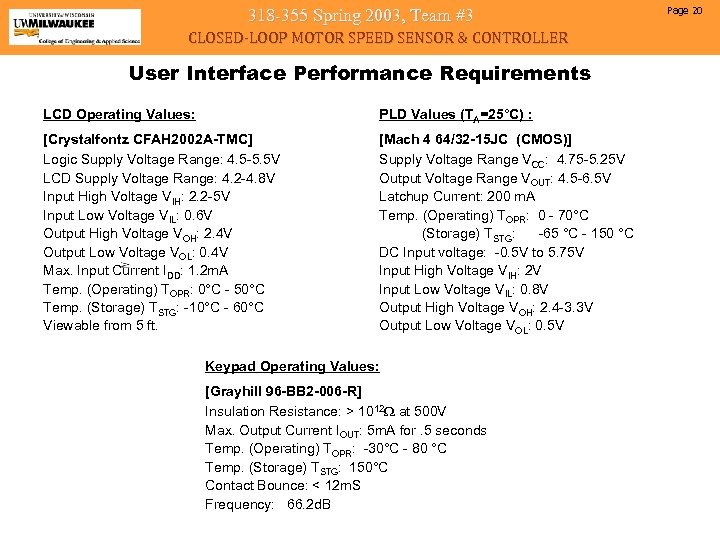 318 -355 Spring 2003, Team #3 CLOSED-LOOP MOTOR SPEED SENSOR & CONTROLLER User Interface Performance Requirements LCD Operating Values: PLD Values (TA=25°C) : [Crystalfontz CFAH 2002 A-TMC] Logic Supply Voltage Range: 4. 5 -5. 5 V LCD Supply Voltage Range: 4. 2 -4. 8 V Input High Voltage VIH: 2. 2 -5 V Input Low Voltage VIL: 0. 6 V Output High Voltage VOH: 2. 4 V Output Low Voltage VOL: 0. 4 V Max. Input Current IDD: 1. 2 m. A Temp. (Operating) TOPR: 0°C - 50°C Temp. (Storage) TSTG: -10°C - 60°C Viewable from 5 ft. [Mach 4 64/32 -15 JC (CMOS)] Supply Voltage Range VCC: 4. 75 -5. 25 V Output Voltage Range VOUT: 4. 5 -6. 5 V Latchup Current: 200 m. A Temp. (Operating) TOPR: 0 - 70°C (Storage) TSTG: -65 °C - 150 °C DC Input voltage: -0. 5 V to 5. 75 V Input High Voltage VIH: 2 V Input Low Voltage VIL: 0. 8 V Output High Voltage VOH: 2. 4 -3. 3 V Output Low Voltage VOL: 0. 5 V Keypad Operating Values: [Grayhill 96 -BB 2 -006 -R] Insulation Resistance: > 1012 at 500 V Max. Output Current IOUT: 5 m. A for. 5 seconds Temp. (Operating) TOPR: -30°C - 80 °C Temp. (Storage) TSTG: 150°C Contact Bounce: < 12 m. S Frequency: 66. 2 d. B Page 20
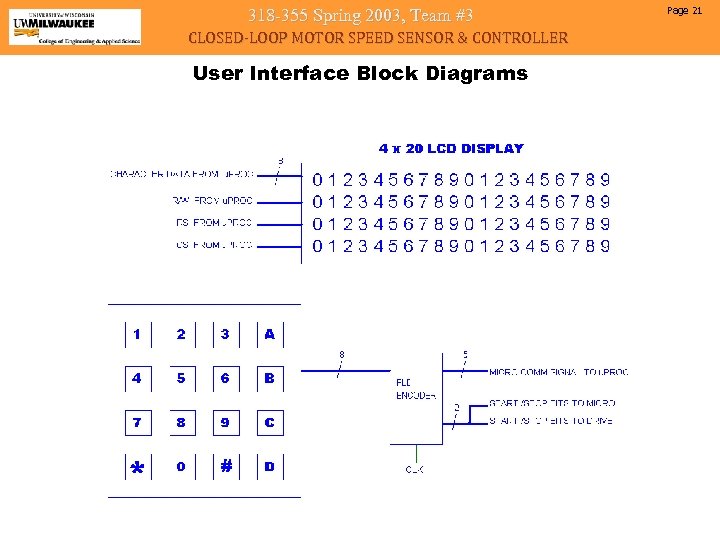 318 -355 Spring 2003, Team #3 CLOSED-LOOP MOTOR SPEED SENSOR & CONTROLLER User Interface Block Diagrams Page 21
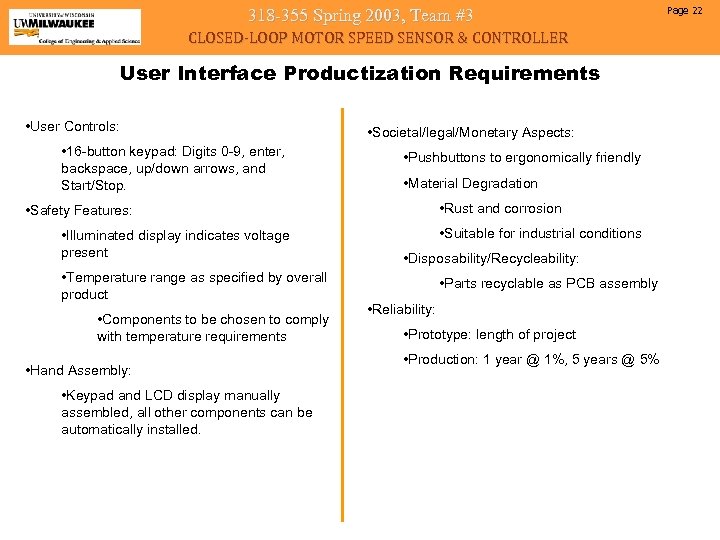 318 -355 Spring 2003, Team #3 CLOSED-LOOP MOTOR SPEED SENSOR & CONTROLLER User Interface Productization Requirements • User Controls: • 16 -button keypad: Digits 0 -9, enter, backspace, up/down arrows, and Start/Stop. • Safety Features: • Illuminated display indicates voltage present • Temperature range as specified by overall product • Components to be chosen to comply with temperature requirements • Hand Assembly: • Keypad and LCD display manually assembled, all other components can be automatically installed. • Societal/legal/Monetary Aspects: • Pushbuttons to ergonomically friendly • Material Degradation • Rust and corrosion • Suitable for industrial conditions • Disposability/Recycleability: • Parts recyclable as PCB assembly • Reliability: • Prototype: length of project • Production: 1 year @ 1%, 5 years @ 5% Page 22
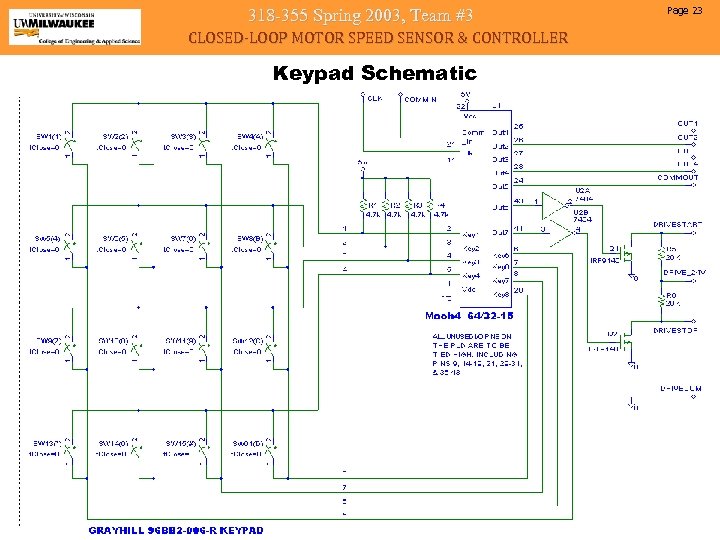 318 -355 Spring 2003, Team #3 CLOSED-LOOP MOTOR SPEED SENSOR & CONTROLLER Keypad Schematic Page 23
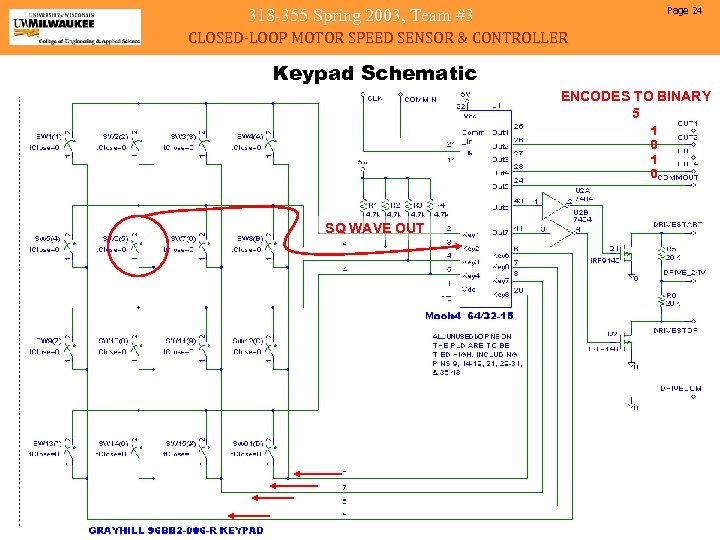 Page 24 318 -355 Spring 2003, Team #3 CLOSED-LOOP MOTOR SPEED SENSOR & CONTROLLER Keypad Schematic ENCODES TO BINARY 5 1 0 SQ WAVE OUT
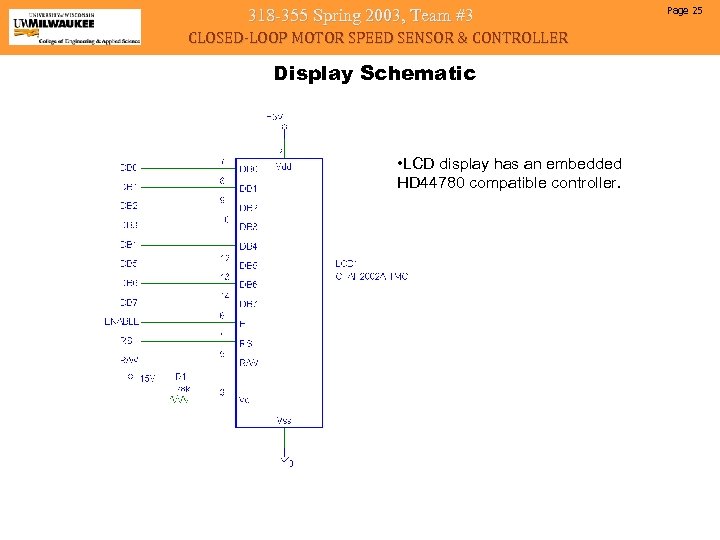 318 -355 Spring 2003, Team #3 CLOSED-LOOP MOTOR SPEED SENSOR & CONTROLLER Display Schematic • LCD display has an embedded HD 44780 compatible controller. Page 25
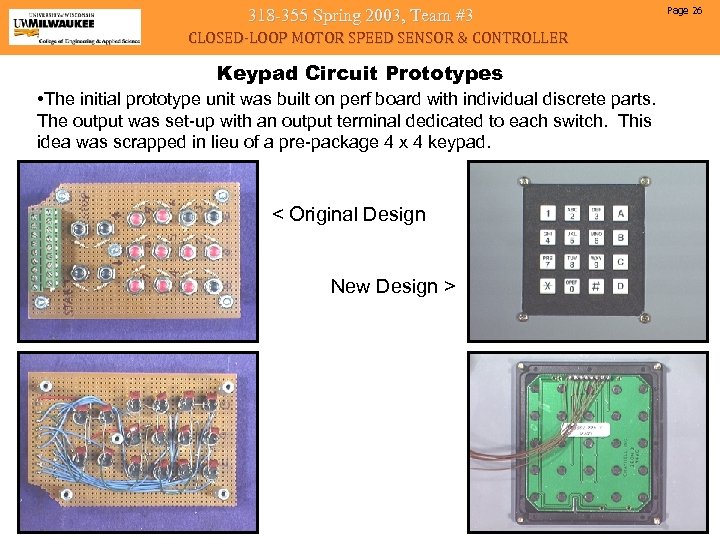 318 -355 Spring 2003, Team #3 CLOSED-LOOP MOTOR SPEED SENSOR & CONTROLLER Keypad Circuit Prototypes • The initial prototype unit was built on perf board with individual discrete parts. The output was set-up with an output terminal dedicated to each switch. This idea was scrapped in lieu of a pre-package 4 x 4 keypad. < Original Design _ ___ New Design > Page 26
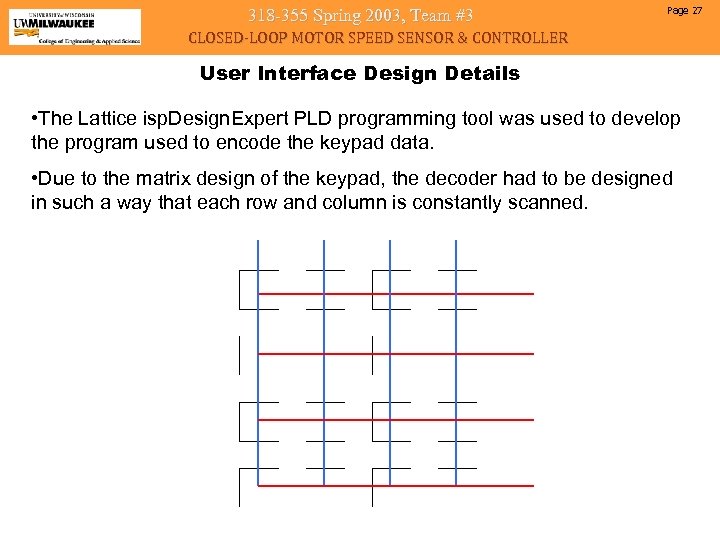 318 -355 Spring 2003, Team #3 Page 27 CLOSED-LOOP MOTOR SPEED SENSOR & CONTROLLER User Interface Design Details • The Lattice isp. Design. Expert PLD programming tool was used to develop the program used to encode the keypad data. • Due to the matrix design of the keypad, the decoder had to be designed in such a way that each row and column is constantly scanned.
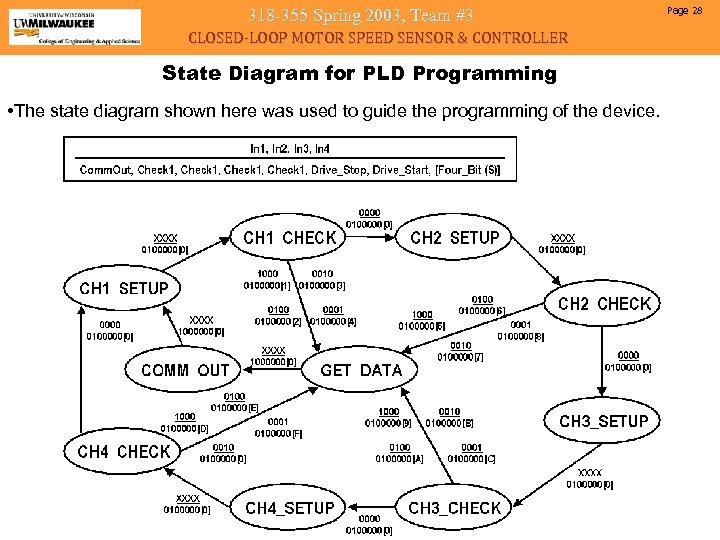 318 -355 Spring 2003, Team #3 CLOSED-LOOP MOTOR SPEED SENSOR & CONTROLLER State Diagram for PLD Programming • The state diagram shown here was used to guide the programming of the device. Page 28
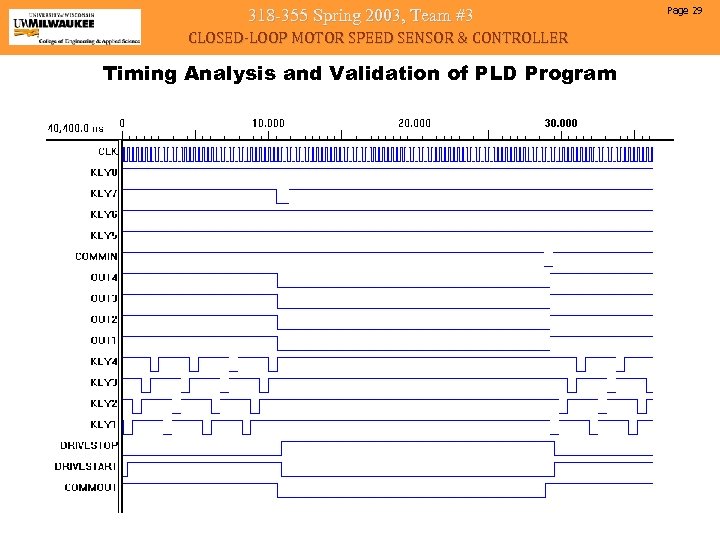 318 -355 Spring 2003, Team #3 CLOSED-LOOP MOTOR SPEED SENSOR & CONTROLLER Timing Analysis and Validation of PLD Program Page 29
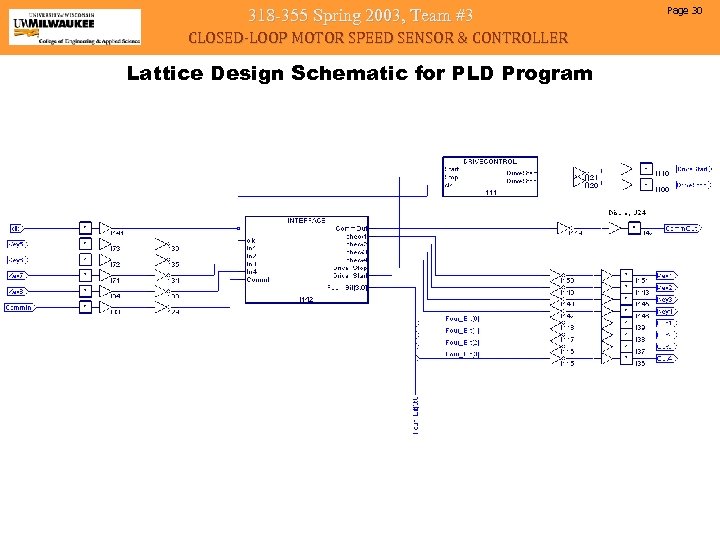 318 -355 Spring 2003, Team #3 CLOSED-LOOP MOTOR SPEED SENSOR & CONTROLLER Lattice Design Schematic for PLD Program Page 30
 318 -355 Spring 2003, Team #3 Page 31 CLOSED-LOOP MOTOR SPEED SENSOR & CONTROLLER User Interface Worst Case Analysis • Worst Case Analysis: Timing analysis for user interface and microprocessor circuit will be detailed in Microprocessor Hardware section. Mass Production Aspects • The user interface will consists of three assembly sections: • LCD Display: Manually installed on front of enclosure, interconnected with flat cable. • Keypad: Manually installed on front of enclosure, interconnected with flat cable. • Encoder Circuitry: Located on main PCB. Components to be SMT, automatically installed.
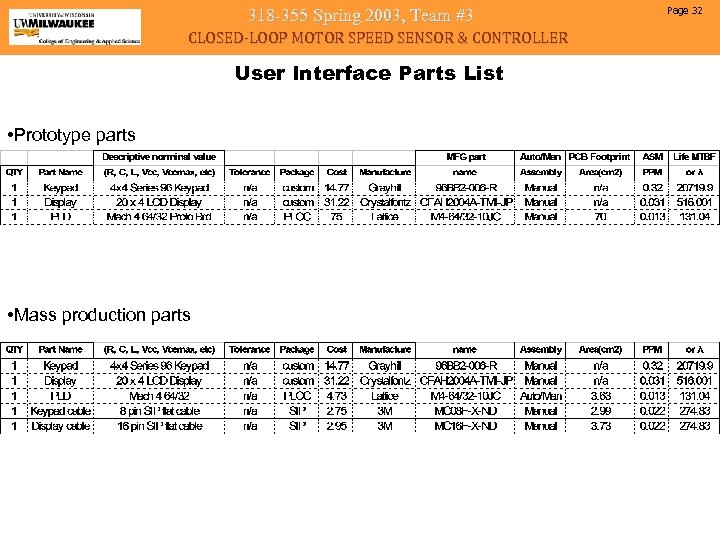 318 -355 Spring 2003, Team #3 CLOSED-LOOP MOTOR SPEED SENSOR & CONTROLLER User Interface Parts List • Prototype parts • Mass production parts Page 32
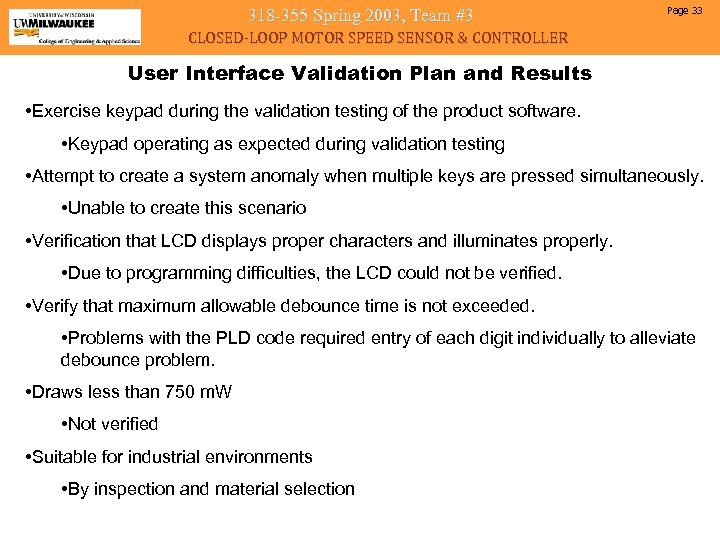 318 -355 Spring 2003, Team #3 Page 33 CLOSED-LOOP MOTOR SPEED SENSOR & CONTROLLER User Interface Validation Plan and Results • Exercise keypad during the validation testing of the product software. • Keypad operating as expected during validation testing • Attempt to create a system anomaly when multiple keys are pressed simultaneously. • Unable to create this scenario • Verification that LCD displays proper characters and illuminates properly. • Due to programming difficulties, the LCD could not be verified. • Verify that maximum allowable debounce time is not exceeded. • Problems with the PLD code required entry of each digit individually to alleviate debounce problem. • Draws less than 750 m. W • Not verified • Suitable for industrial environments • By inspection and material selection
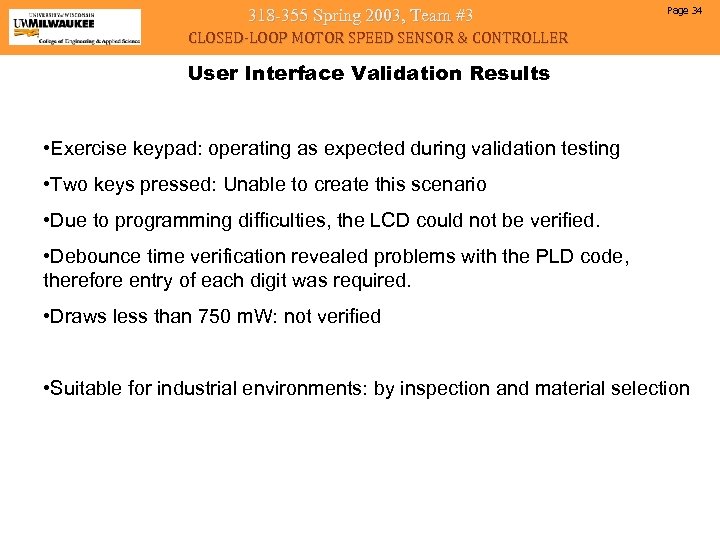 318 -355 Spring 2003, Team #3 Page 34 CLOSED-LOOP MOTOR SPEED SENSOR & CONTROLLER User Interface Validation Results • Exercise keypad: operating as expected during validation testing • Two keys pressed: Unable to create this scenario • Due to programming difficulties, the LCD could not be verified. • Debounce time verification revealed problems with the PLD code, therefore entry of each digit was required. • Draws less than 750 m. W: not verified • Suitable for industrial environments: by inspection and material selection
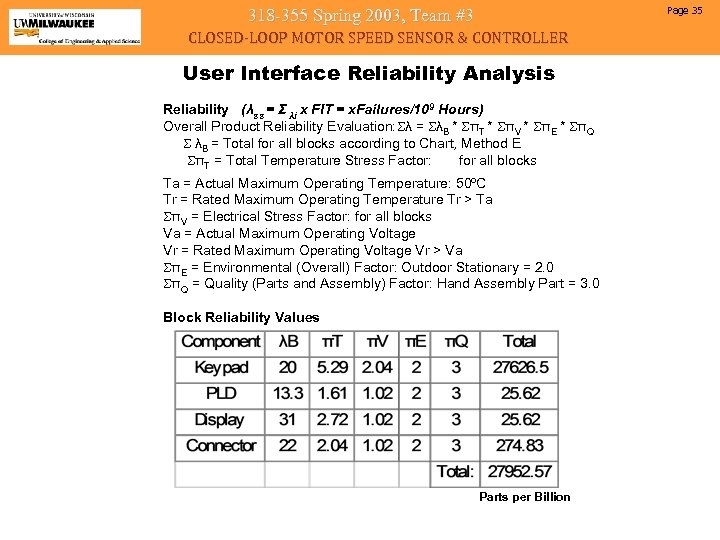 Page 35 318 -355 Spring 2003, Team #3 CLOSED-LOOP MOTOR SPEED SENSOR & CONTROLLER User Interface Reliability Analysis Reliability (λss = Σ λi x FIT = x. Failures/109 Hours) Overall Product Reliability Evaluation: λ = λB * πT * πV * πE * πQ λB = Total for all blocks according to Chart, Method E πT = Total Temperature Stress Factor: for all blocks Ta = Actual Maximum Operating Temperature: 50ºC Tr = Rated Maximum Operating Temperature Tr > Ta πV = Electrical Stress Factor: for all blocks Va = Actual Maximum Operating Voltage Vr = Rated Maximum Operating Voltage Vr > Va πE = Environmental (Overall) Factor: Outdoor Stationary = 2. 0 πQ = Quality (Parts and Assembly) Factor: Hand Assembly Part = 3. 0 Block Reliability Values Parts per Billion
 318 -355 Spring 2003, Team #3 Page 36 CLOSED-LOOP MOTOR SPEED SENSOR & CONTROLLER Let’s cover the Sensor Circuit next. .
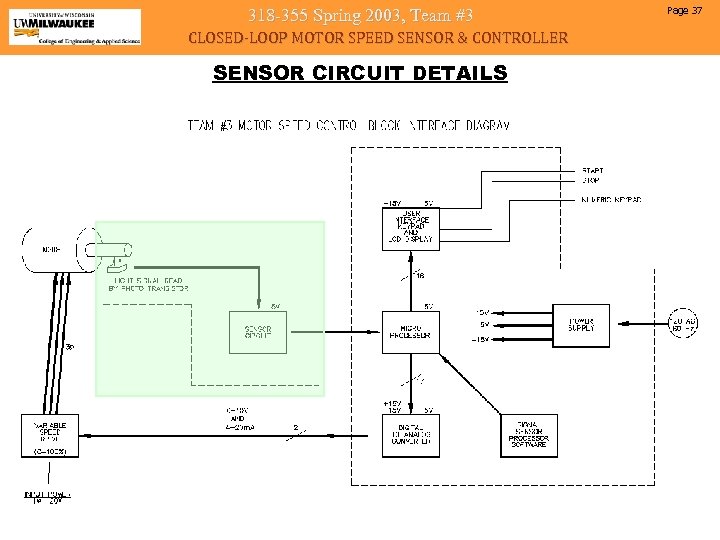 318 -355 Spring 2003, Team #3 CLOSED-LOOP MOTOR SPEED SENSOR & CONTROLLER SENSOR CIRCUIT DETAILS Page 37
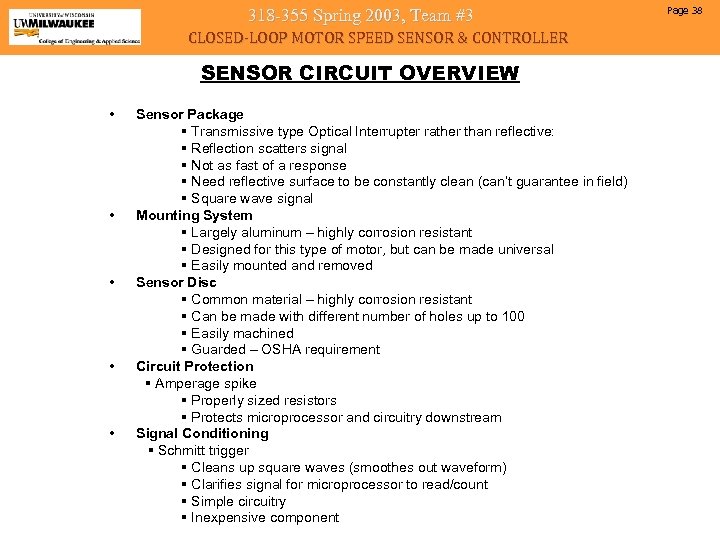 318 -355 Spring 2003, Team #3 CLOSED-LOOP MOTOR SPEED SENSOR & CONTROLLER SENSOR CIRCUIT OVERVIEW • • • Sensor Package Transmissive type Optical Interrupter rather than reflective: Reflection scatters signal Not as fast of a response Need reflective surface to be constantly clean (can’t guarantee in field) Square wave signal Mounting System Largely aluminum – highly corrosion resistant Designed for this type of motor, but can be made universal Easily mounted and removed Sensor Disc Common material – highly corrosion resistant Can be made with different number of holes up to 100 Easily machined Guarded – OSHA requirement Circuit Protection Amperage spike Properly sized resistors Protects microprocessor and circuitry downstream Signal Conditioning Schmitt trigger Cleans up square waves (smoothes out waveform) Clarifies signal for microprocessor to read/count Simple circuitry Inexpensive component Page 38
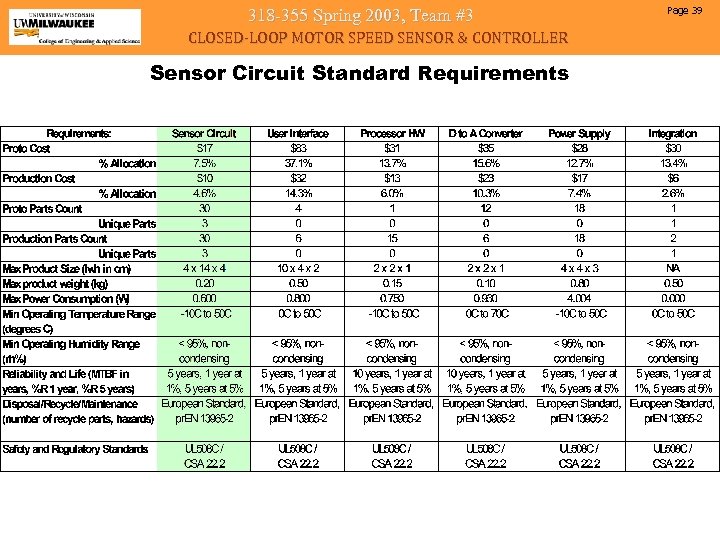 318 -355 Spring 2003, Team #3 CLOSED-LOOP MOTOR SPEED SENSOR & CONTROLLER Sensor Circuit Standard Requirements Page 39
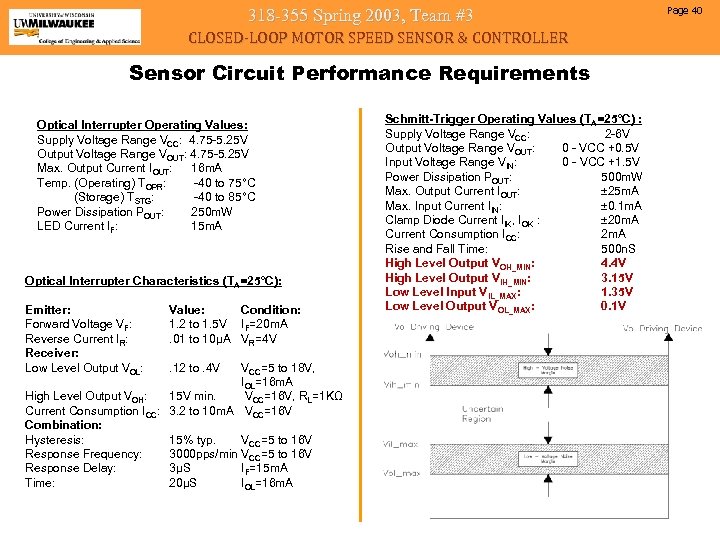 318 -355 Spring 2003, Team #3 CLOSED-LOOP MOTOR SPEED SENSOR & CONTROLLER Sensor Circuit Performance Requirements Optical Interrupter Operating Values: Supply Voltage Range VCC: 4. 75 -5. 25 V Output Voltage Range VOUT: 4. 75 -5. 25 V Max. Output Current IOUT: 16 m. A Temp. (Operating) TOPR: -40 to 75°C (Storage) T STG: -40 to 85°C Power Dissipation POUT: 250 m. W LED Current IF: 15 m. A Optical Interrupter Characteristics (TA=25°C): Emitter: Forward Voltage VF: Reverse Current IR: Receiver: Low Level Output VOL: Value: Condition: 1. 2 to 1. 5 V IF=20 m. A. 01 to 10μA VR=4 V. 12 to. 4 V VCC=5 to 18 V, IOL=16 m. A High Level Output VOH: 15 V min. VCC=16 V, RL=1 KΩ Current Consumption ICC: 3. 2 to 10 m. A VCC=16 V Combination: Hysteresis: 15% typ. VCC=5 to 16 V Response Frequency: 3000 pps/min VCC=5 to 16 V Response Delay: 3μS IF=15 m. A Time: 20μS IOL=16 m. A Schmitt-Trigger Operating Values (TA=25°C) : Supply Voltage Range VCC: 2 -6 V Output Voltage Range VOUT: 0 - VCC +0. 5 V Input Voltage Range VIN: 0 - VCC +1. 5 V Power Dissipation POUT: 500 m. W Max. Output Current IOUT: ± 25 m. A Max. Input Current IIN: ± 0. 1 m. A Clamp Diode Current IIK, IOK : ± 20 m. A Current Consumption ICC: 2 m. A Rise and Fall Time: 500 n. S High Level Output V OH_MIN: 4. 4 V High Level Output V IH_MIN: 3. 15 V Low Level Input V IL_MAX: 1. 35 V Low Level Output V OL_MAX: 0. 1 V Page 40
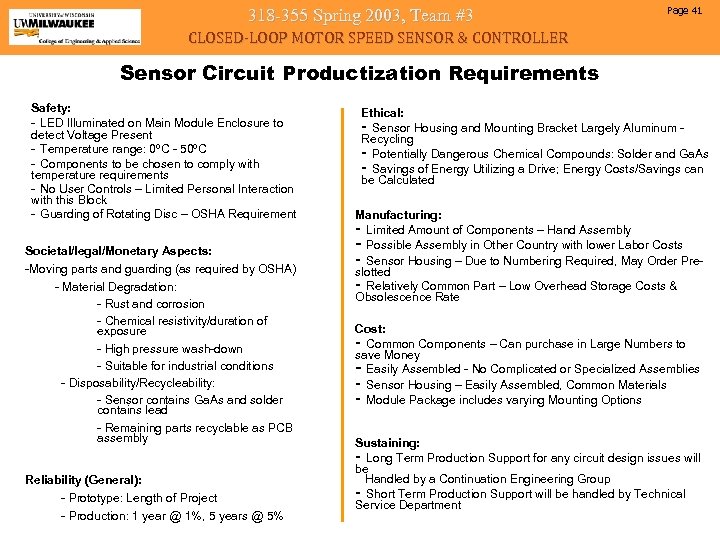 318 -355 Spring 2003, Team #3 Page 41 CLOSED-LOOP MOTOR SPEED SENSOR & CONTROLLER Sensor Circuit Productization Requirements Safety: - LED Illuminated on Main Module Enclosure to detect Voltage Present - Temperature range: 0ºC - 50ºC - Components to be chosen to comply with temperature requirements - No User Controls – Limited Personal Interaction with this Block - Guarding of Rotating Disc – OSHA Requirement Societal/legal/Monetary Aspects: -Moving parts and guarding (as required by OSHA) - Material Degradation: - Rust and corrosion - Chemical resistivity/duration of exposure - High pressure wash-down - Suitable for industrial conditions - Disposability/Recycleability: - Sensor contains Ga. As and solder contains lead - Remaining parts recyclable as PCB assembly Reliability (General): - Prototype: Length of Project - Production: 1 year @ 1%, 5 years @ 5% Ethical: - Sensor Housing and Mounting Bracket Largely Aluminum - Recycling - Potentially Dangerous Chemical Compounds: Solder and Ga. As - Savings of Energy Utilizing a Drive; Energy Costs/Savings can be Calculated Manufacturing: - Limited Amount of Components – Hand Assembly - Possible Assembly in Other Country with lower Labor Costs - Sensor Housing – Due to Numbering Required, May Order Preslotted - Relatively Common Part – Low Overhead Storage Costs & Obsolescence Rate Cost: - Common Components – Can purchase in Large Numbers to save Money - Easily Assembled - No Complicated or Specialized Assemblies - Sensor Housing – Easily Assembled, Common Materials - Module Package includes varying Mounting Options Sustaining: - Long Term Production Support for any circuit design issues will be Handled by a Continuation Engineering Group - Short Term Production Support will be handled by Technical Service Department
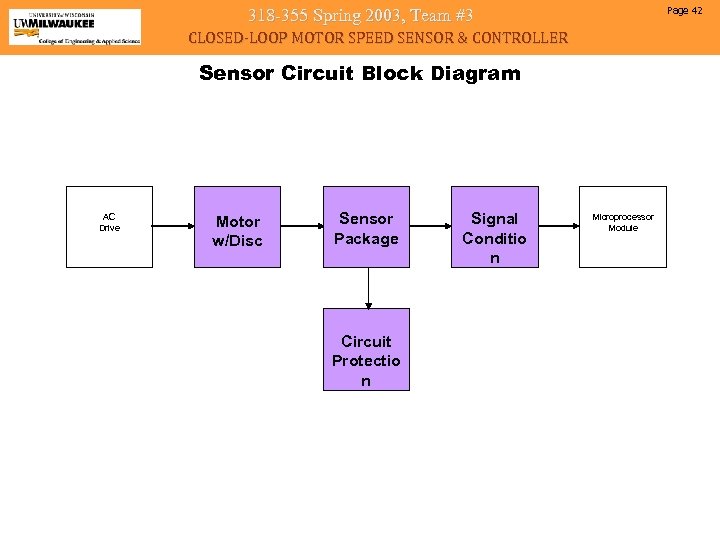 Page 42 318 -355 Spring 2003, Team #3 CLOSED-LOOP MOTOR SPEED SENSOR & CONTROLLER Sensor Circuit Block Diagram AC Drive Motor w/Disc Sensor Package Circuit Protectio n Signal Conditio n Microprocessor Module
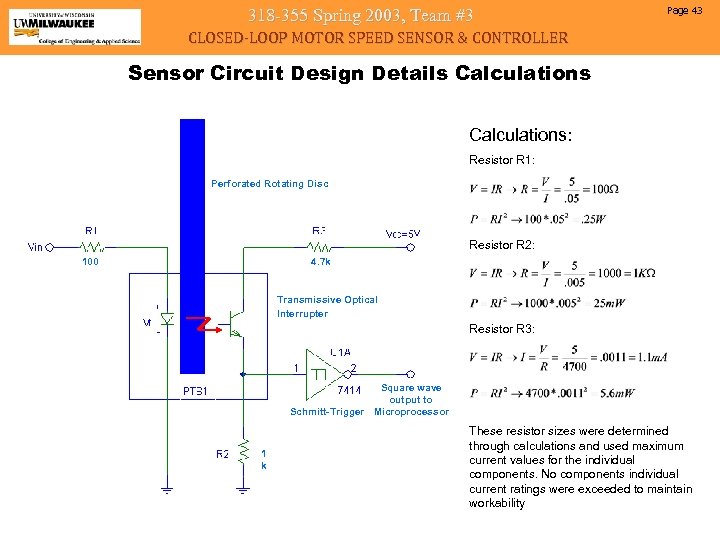 318 -355 Spring 2003, Team #3 Page 43 CLOSED-LOOP MOTOR SPEED SENSOR & CONTROLLER Sensor Circuit Design Details Calculations: Resistor R 1: Perforated Rotating Disc Resistor R 2: 100 4. 7 k Transmissive Optical Interrupter Resistor R 3: Square wave output to Schmitt-Trigger Microprocessor 1 k These resistor sizes were determined through calculations and used maximum current values for the individual components. No components individual current ratings were exceeded to maintain workability
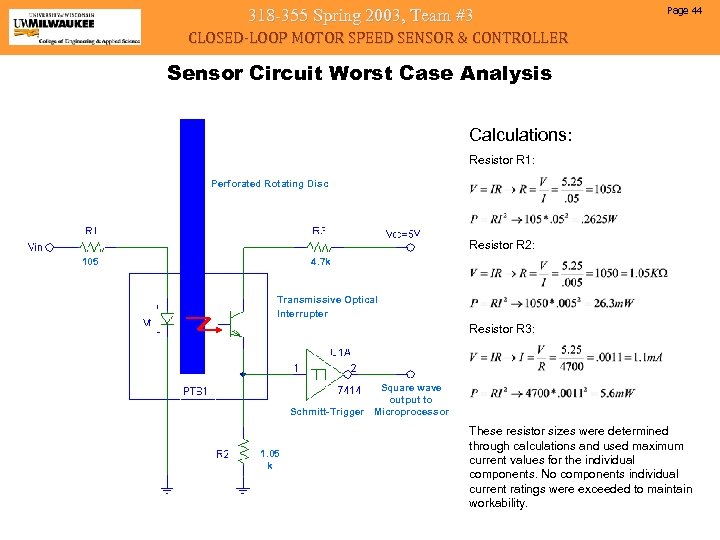 318 -355 Spring 2003, Team #3 Page 44 CLOSED-LOOP MOTOR SPEED SENSOR & CONTROLLER Sensor Circuit Worst Case Analysis Calculations: Resistor R 1: Perforated Rotating Disc Resistor R 2: 105 4. 7 k Transmissive Optical Interrupter Resistor R 3: Square wave output to Schmitt-Trigger Microprocessor 1. 05 k These resistor sizes were determined through calculations and used maximum current values for the individual components. No components individual current ratings were exceeded to maintain workability.
 318 -355 Spring 2003, Team #3 CLOSED-LOOP MOTOR SPEED SENSOR & CONTROLLER Sensor Circuit Mass Production • Final assembly of the sensor circuit will be primarily hand assembly due to the mechanical nature of the design. • The discrete components will be mounted on a PC board using surface mount technology. • For mass production, the enclosure could be redesigned to eliminate any fasteners, and replace then with a snap-fit configuration. Page 45
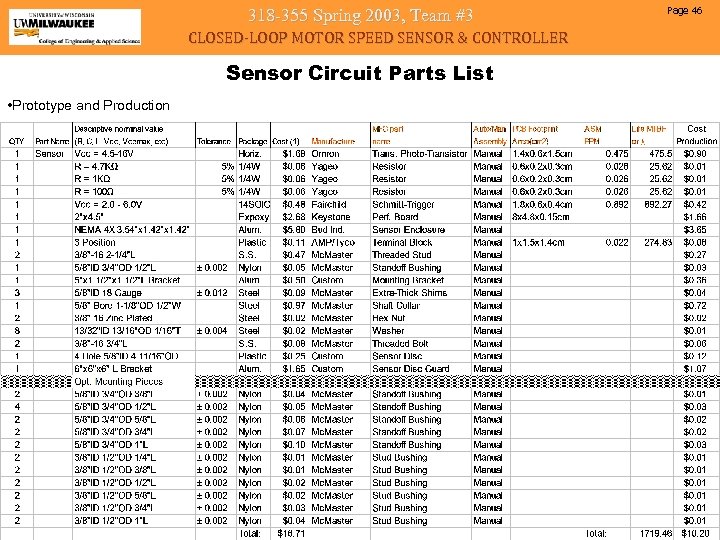 318 -355 Spring 2003, Team #3 CLOSED-LOOP MOTOR SPEED SENSOR & CONTROLLER Sensor Circuit Parts List • Prototype and Production Page 46
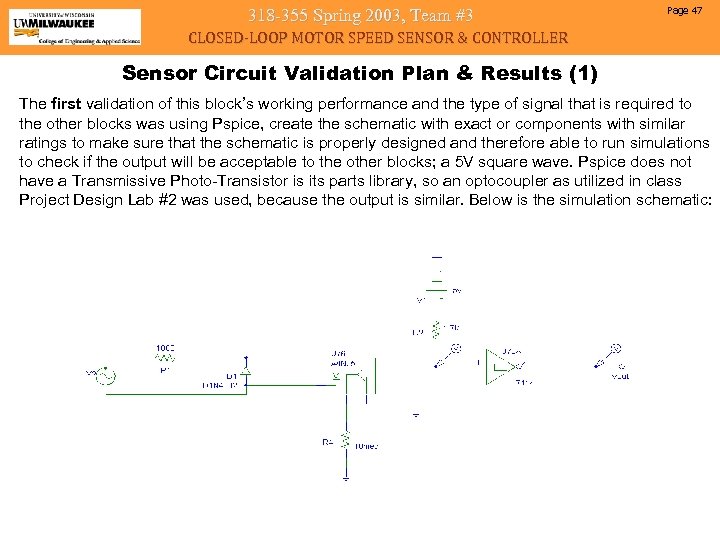 318 -355 Spring 2003, Team #3 Page 47 CLOSED-LOOP MOTOR SPEED SENSOR & CONTROLLER Sensor Circuit Validation Plan & Results (1) The first validation of this block’s working performance and the type of signal that is required to the other blocks was using Pspice, create the schematic with exact or components with similar ratings to make sure that the schematic is properly designed and therefore able to run simulations to check if the output will be acceptable to the other blocks; a 5 V square wave. Pspice does not have a Transmissive Photo-Transistor is its parts library, so an optocoupler as utilized in class Project Design Lab #2 was used, because the output is similar. Below is the simulation schematic:
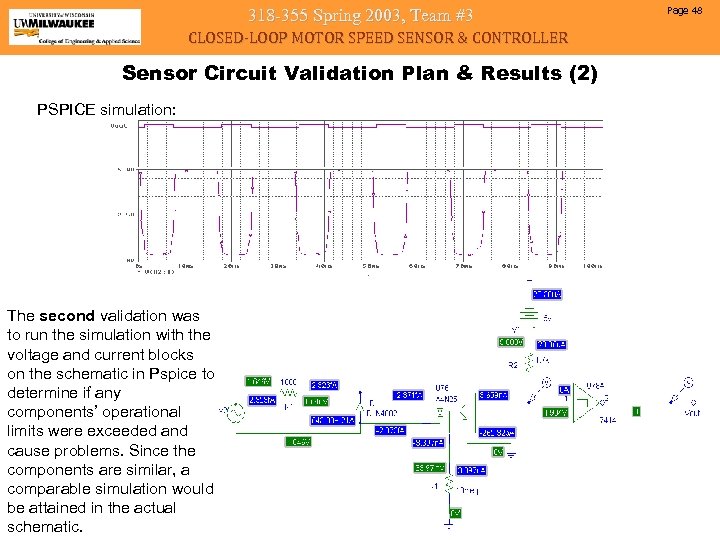 318 -355 Spring 2003, Team #3 CLOSED-LOOP MOTOR SPEED SENSOR & CONTROLLER Sensor Circuit Validation Plan & Results (2) PSPICE simulation: The second validation was to run the simulation with the voltage and current blocks on the schematic in Pspice to determine if any components’ operational limits were exceeded and cause problems. Since the components are similar, a comparable simulation would be attained in the actual schematic. Page 48
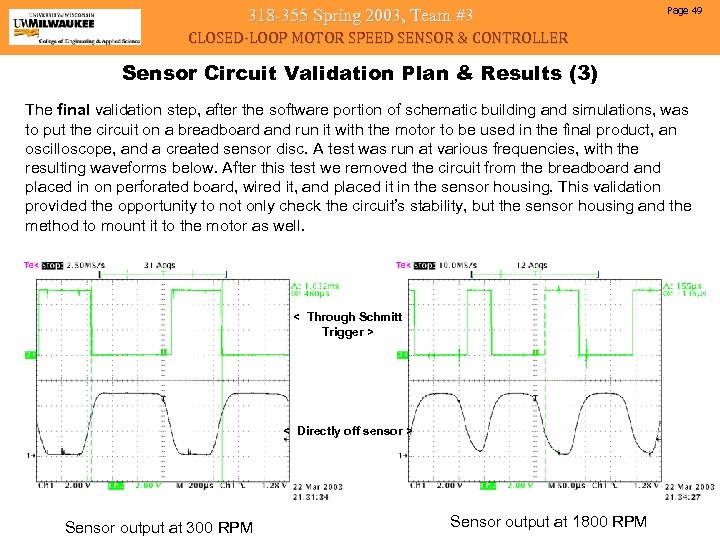 318 -355 Spring 2003, Team #3 Page 49 CLOSED-LOOP MOTOR SPEED SENSOR & CONTROLLER Sensor Circuit Validation Plan & Results (3) The final validation step, after the software portion of schematic building and simulations, was to put the circuit on a breadboard and run it with the motor to be used in the final product, an oscilloscope, and a created sensor disc. A test was run at various frequencies, with the resulting waveforms below. After this test we removed the circuit from the breadboard and placed in on perforated board, wired it, and placed it in the sensor housing. This validation provided the opportunity to not only check the circuit’s stability, but the sensor housing and the method to mount it to the motor as well. < Through Schmitt Trigger > < Directly off sensor > Sensor output at 300 RPM Sensor output at 1800 RPM
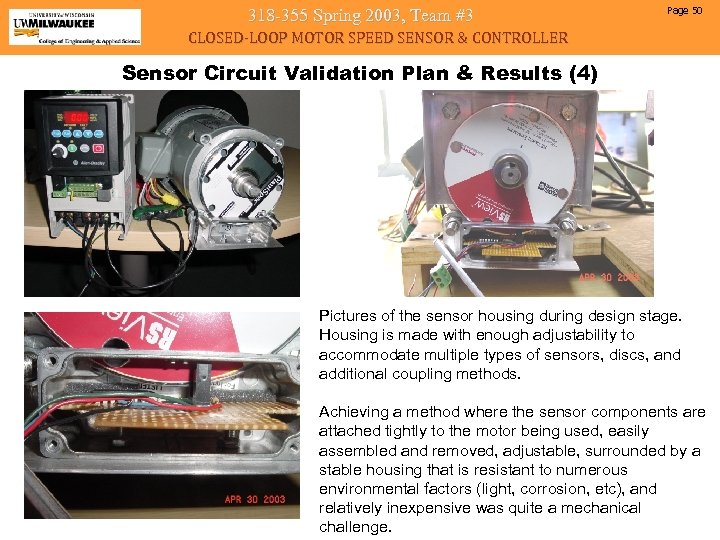 318 -355 Spring 2003, Team #3 Page 50 CLOSED-LOOP MOTOR SPEED SENSOR & CONTROLLER Sensor Circuit Validation Plan & Results (4) Pictures of the sensor housing during design stage. Housing is made with enough adjustability to accommodate multiple types of sensors, discs, and additional coupling methods. Achieving a method where the sensor components are attached tightly to the motor being used, easily assembled and removed, adjustable, surrounded by a stable housing that is resistant to numerous environmental factors (light, corrosion, etc), and relatively inexpensive was quite a mechanical challenge.
 318 -355 Spring 2003, Team #3 Page 51 CLOSED-LOOP MOTOR SPEED SENSOR & CONTROLLER Sensor Circuit Validation Plan & Results (5) • Draws less than 600 m. W: not verified • Suitable for industrial environments: by inspection and material selection • Can be installed with basic hand tools • Only tested on one brand of drive, could not attain other drive products for testing.
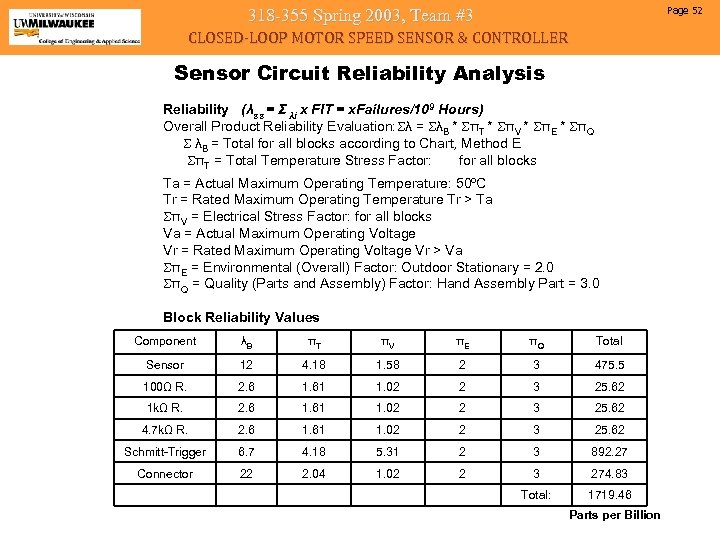 Page 52 318 -355 Spring 2003, Team #3 CLOSED-LOOP MOTOR SPEED SENSOR & CONTROLLER Sensor Circuit Reliability Analysis Reliability (λss = Σ λi x FIT = x. Failures/109 Hours) Overall Product Reliability Evaluation: λ = λB * πT * πV * πE * πQ λB = Total for all blocks according to Chart, Method E πT = Total Temperature Stress Factor: for all blocks Ta = Actual Maximum Operating Temperature: 50ºC Tr = Rated Maximum Operating Temperature Tr > Ta πV = Electrical Stress Factor: for all blocks Va = Actual Maximum Operating Voltage Vr = Rated Maximum Operating Voltage Vr > Va πE = Environmental (Overall) Factor: Outdoor Stationary = 2. 0 πQ = Quality (Parts and Assembly) Factor: Hand Assembly Part = 3. 0 Block Reliability Values Component λB πT πV πE πQ Total Sensor 12 4. 18 1. 58 2 3 475. 5 100Ω R. 2. 6 1. 61 1. 02 2 3 25. 62 1 kΩ R. 2. 6 1. 61 1. 02 2 3 25. 62 4. 7 kΩ R. 2. 6 1. 61 1. 02 2 3 25. 62 Schmitt-Trigger 6. 7 4. 18 5. 31 2 3 892. 27 Connector 22 2. 04 1. 02 2 3 274. 83 Total: 1719. 46 Parts per Billion
 318 -355 Spring 2003, Team #3 Page 53 CLOSED-LOOP MOTOR SPEED SENSOR & CONTROLLER Next is the Microprocessor Hardware Overview. . .
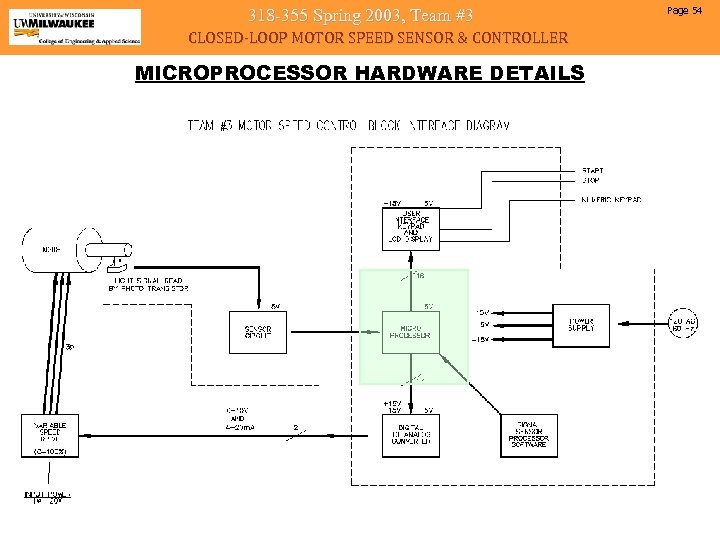 318 -355 Spring 2003, Team #3 CLOSED-LOOP MOTOR SPEED SENSOR & CONTROLLER MICROPROCESSOR HARDWARE DETAILS Page 54
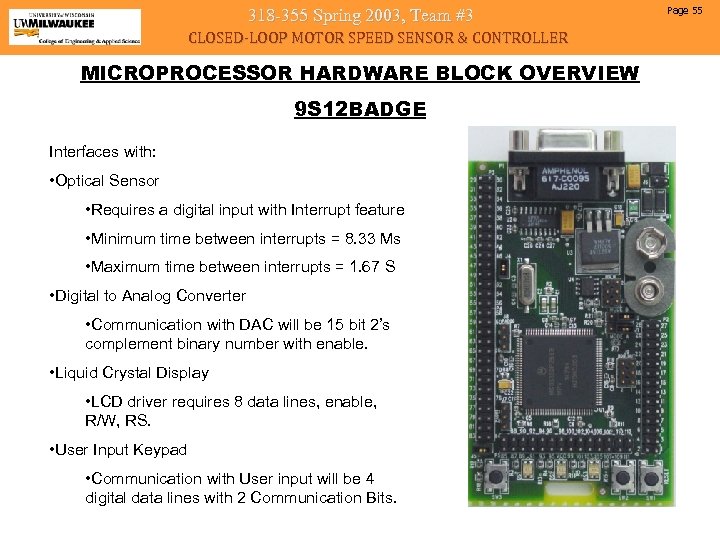 318 -355 Spring 2003, Team #3 CLOSED-LOOP MOTOR SPEED SENSOR & CONTROLLER MICROPROCESSOR HARDWARE BLOCK OVERVIEW 9 S 12 BADGE Interfaces with: • Optical Sensor • Requires a digital input with Interrupt feature • Minimum time between interrupts = 8. 33 Ms • Maximum time between interrupts = 1. 67 S • Digital to Analog Converter • Communication with DAC will be 15 bit 2’s complement binary number with enable. • Liquid Crystal Display • LCD driver requires 8 data lines, enable, R/W, RS. • User Input Keypad • Communication with User input will be 4 digital data lines with 2 Communication Bits. Page 55
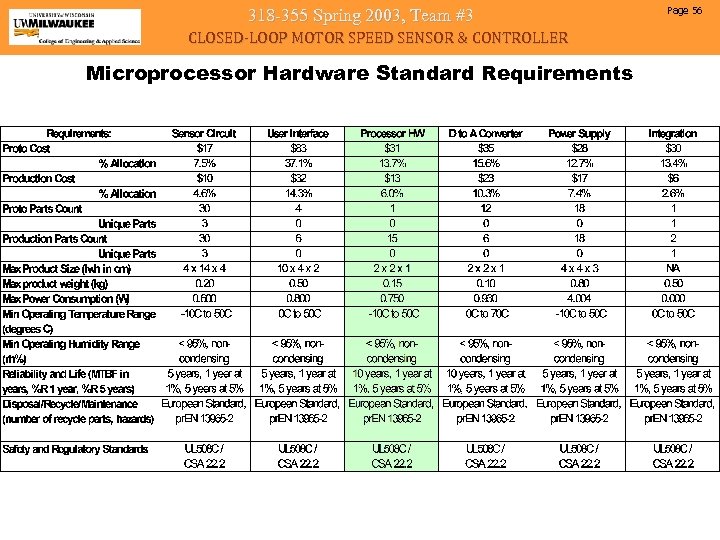 318 -355 Spring 2003, Team #3 CLOSED-LOOP MOTOR SPEED SENSOR & CONTROLLER Microprocessor Hardware Standard Requirements Page 56
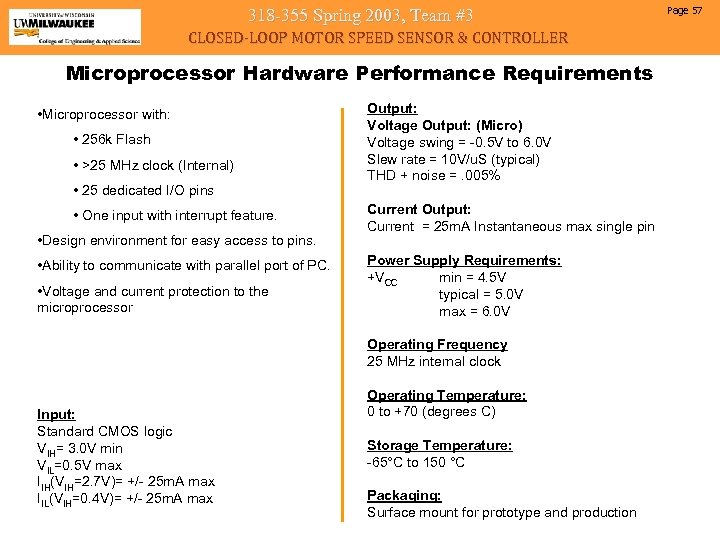 318 -355 Spring 2003, Team #3 CLOSED-LOOP MOTOR SPEED SENSOR & CONTROLLER Microprocessor Hardware Performance Requirements • Microprocessor with: • 256 k Flash • >25 MHz clock (Internal) • 25 dedicated I/O pins • One input with interrupt feature. • Design environment for easy access to pins. • Ability to communicate with parallel port of PC. • Voltage and current protection to the microprocessor Output: Voltage Output: (Micro) Voltage swing = -0. 5 V to 6. 0 V Slew rate = 10 V/u. S (typical) THD + noise =. 005% Current Output: Current = 25 m. A Instantaneous max single pin Power Supply Requirements: +VCC min = 4. 5 V typical = 5. 0 V max = 6. 0 V Operating Frequency 25 MHz internal clock Input: Standard CMOS logic VIH= 3. 0 V min VIL=0. 5 V max IIH(VIH=2. 7 V)= +/- 25 m. A max IIL(VIH=0. 4 V)= +/- 25 m. A max Operating Temperature: 0 to +70 (degrees C) Storage Temperature: -65°C to 150 °C Packaging: Surface mount for prototype and production Page 57
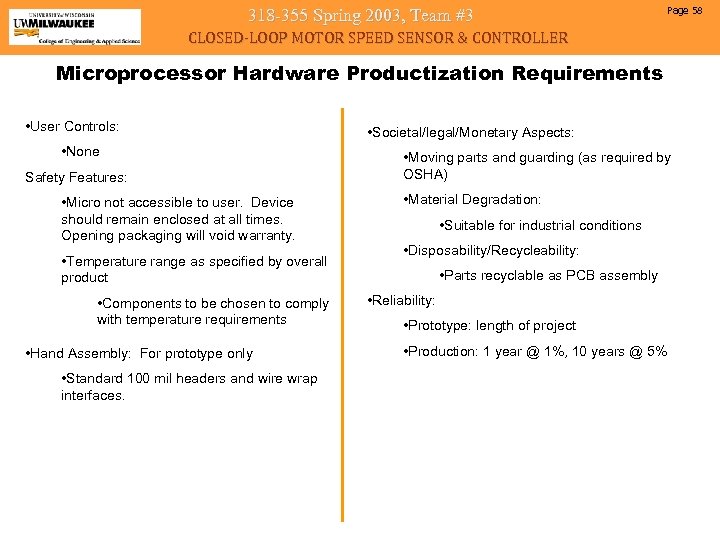 318 -355 Spring 2003, Team #3 Page 58 CLOSED-LOOP MOTOR SPEED SENSOR & CONTROLLER Microprocessor Hardware Productization Requirements • User Controls: • None Safety Features: • Micro not accessible to user. Device should remain enclosed at all times. Opening packaging will void warranty. • Temperature range as specified by overall product • Components to be chosen to comply with temperature requirements • Hand Assembly: For prototype only • Standard 100 mil headers and wire wrap interfaces. • Societal/legal/Monetary Aspects: • Moving parts and guarding (as required by OSHA) • Material Degradation: • Suitable for industrial conditions • Disposability/Recycleability: • Parts recyclable as PCB assembly • Reliability: • Prototype: length of project • Production: 1 year @ 1%, 10 years @ 5%
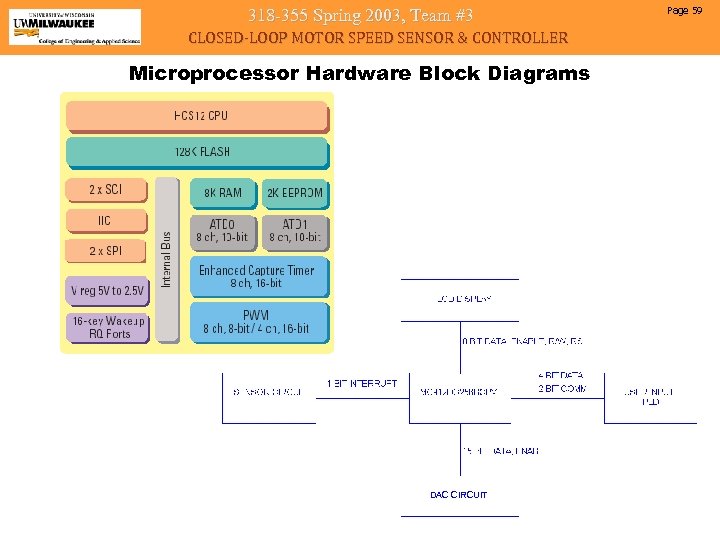 318 -355 Spring 2003, Team #3 CLOSED-LOOP MOTOR SPEED SENSOR & CONTROLLER Microprocessor Hardware Block Diagrams DAC CIRCUIT Page 59
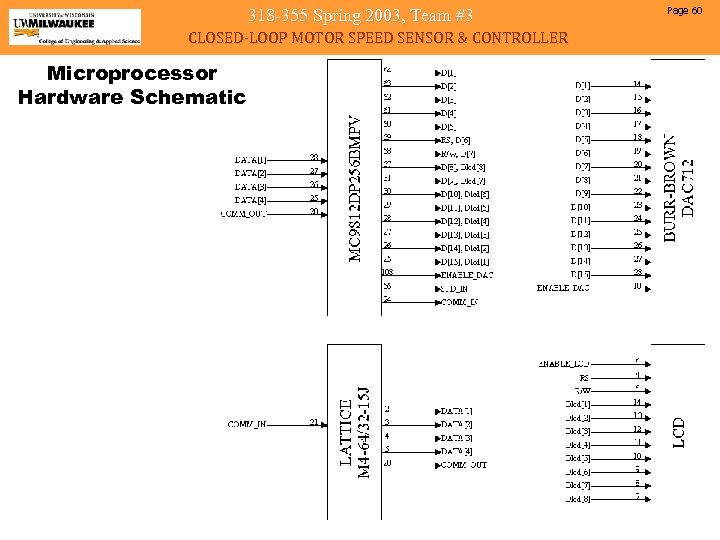 318 -355 Spring 2003, Team #3 CLOSED-LOOP MOTOR SPEED SENSOR & CONTROLLER Microprocessor Hardware Schematic Page 60
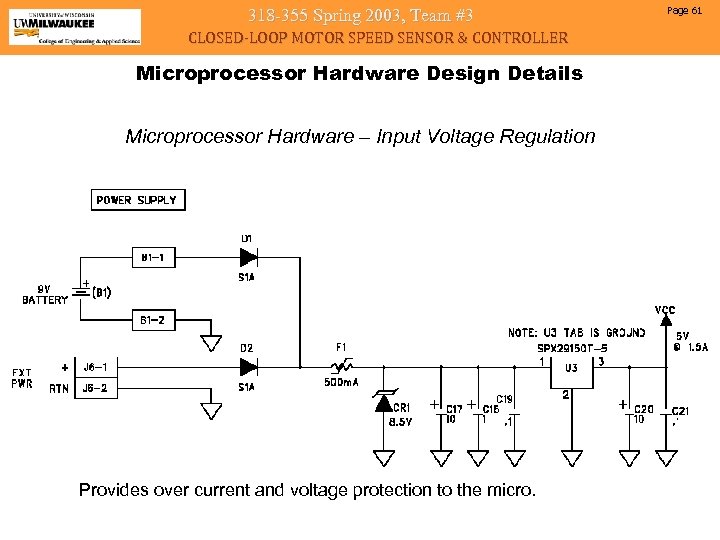 318 -355 Spring 2003, Team #3 CLOSED-LOOP MOTOR SPEED SENSOR & CONTROLLER Microprocessor Hardware Design Details Microprocessor Hardware – Input Voltage Regulation Provides over current and voltage protection to the micro. Page 61
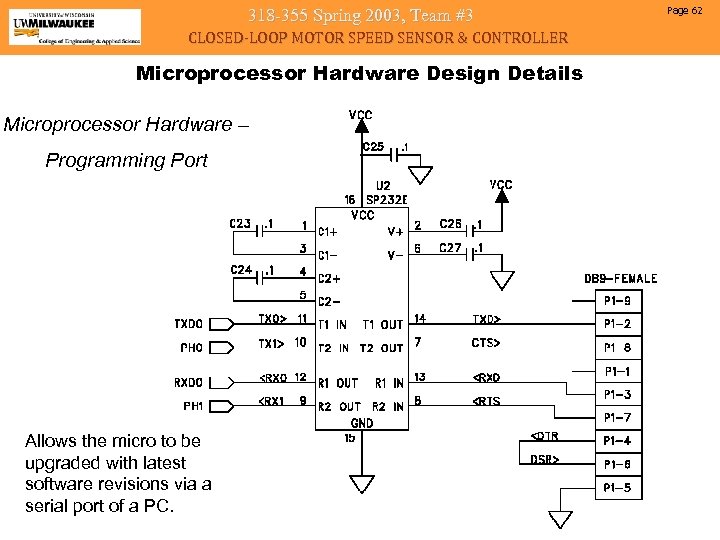 318 -355 Spring 2003, Team #3 CLOSED-LOOP MOTOR SPEED SENSOR & CONTROLLER Microprocessor Hardware Design Details Microprocessor Hardware – Programming Port Allows the micro to be upgraded with latest software revisions via a serial port of a PC. Page 62
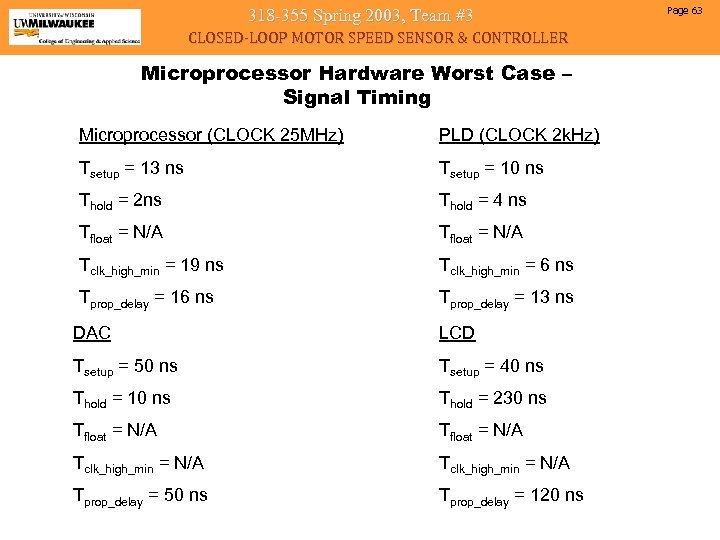 318 -355 Spring 2003, Team #3 CLOSED-LOOP MOTOR SPEED SENSOR & CONTROLLER Microprocessor Hardware Worst Case – Signal Timing Microprocessor (CLOCK 25 MHz) PLD (CLOCK 2 k. Hz) Tsetup = 13 ns Tsetup = 10 ns Thold = 2 ns Thold = 4 ns Tfloat = N/A Tclk_high_min = 19 ns Tclk_high_min = 6 ns Tprop_delay = 16 ns Tprop_delay = 13 ns DAC LCD Tsetup = 50 ns Tsetup = 40 ns Thold = 10 ns Thold = 230 ns Tfloat = N/A Tclk_high_min = N/A Tprop_delay = 50 ns Tprop_delay = 120 ns Page 63
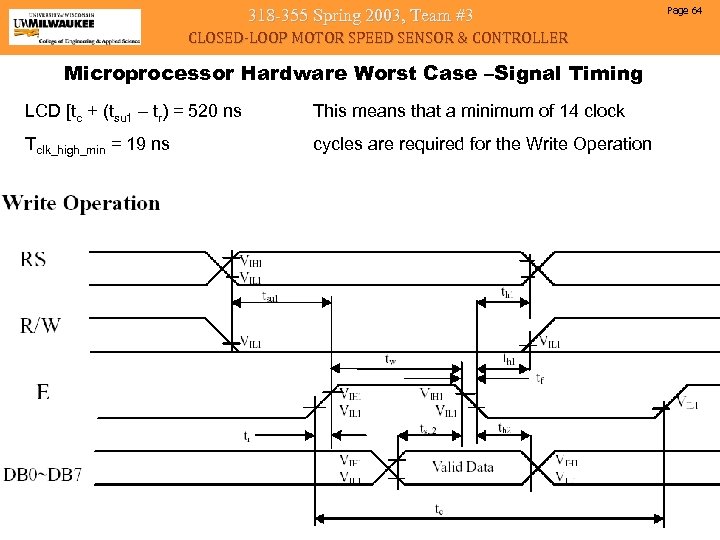 318 -355 Spring 2003, Team #3 CLOSED-LOOP MOTOR SPEED SENSOR & CONTROLLER Microprocessor Hardware Worst Case –Signal Timing LCD [tc + (tsu 1 – tr) = 520 ns This means that a minimum of 14 clock Tclk_high_min = 19 ns cycles are required for the Write Operation Page 64
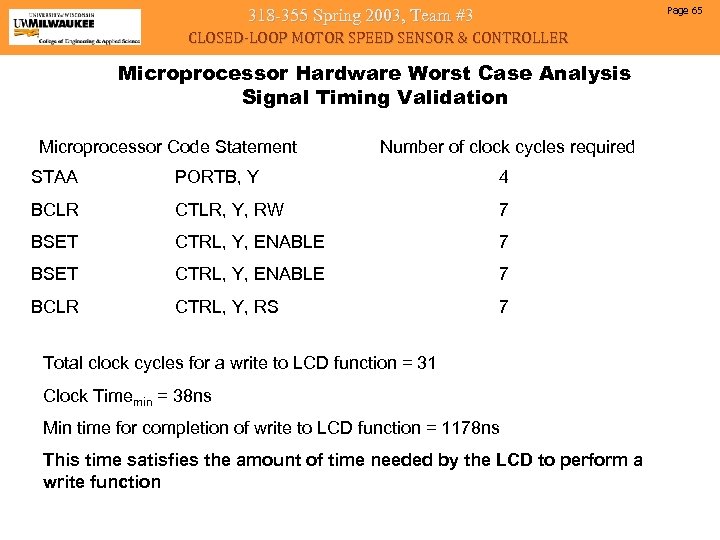 Page 65 318 -355 Spring 2003, Team #3 CLOSED-LOOP MOTOR SPEED SENSOR & CONTROLLER Microprocessor Hardware Worst Case Analysis Signal Timing Validation Microprocessor Code Statement Number of clock cycles required STAA PORTB, Y 4 BCLR CTLR, Y, RW 7 BSET CTRL, Y, ENABLE 7 BCLR CTRL, Y, RS 7 Total clock cycles for a write to LCD function = 31 Clock Timemin = 38 ns Min time for completion of write to LCD function = 1178 ns This time satisfies the amount of time needed by the LCD to perform a write function
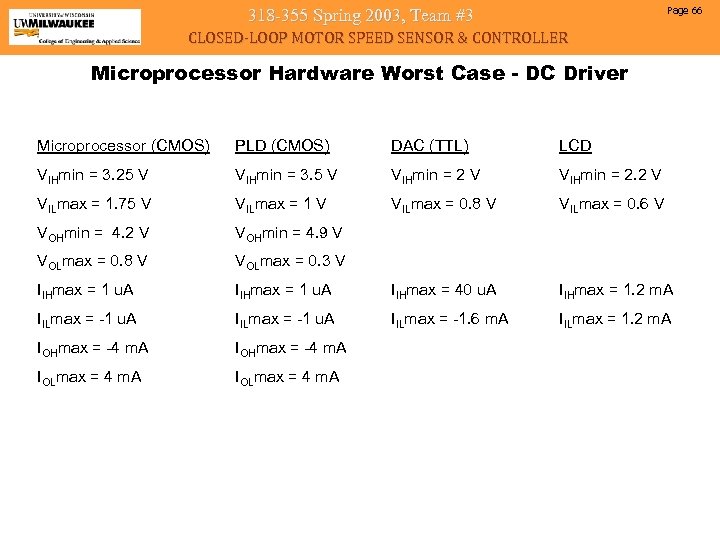 Page 66 318 -355 Spring 2003, Team #3 CLOSED-LOOP MOTOR SPEED SENSOR & CONTROLLER Microprocessor Hardware Worst Case - DC Driver Microprocessor (CMOS) PLD (CMOS) DAC (TTL) LCD VIHmin = 3. 25 V VIHmin = 3. 5 V VIHmin = 2. 2 V VILmax = 1. 75 V VILmax = 1 V VILmax = 0. 8 V VILmax = 0. 6 V VOHmin = 4. 2 V VOHmin = 4. 9 V VOLmax = 0. 8 V VOLmax = 0. 3 V IIHmax = 1 u. A IIHmax = 40 u. A IIHmax = 1. 2 m. A IILmax = -1 u. A IILmax = -1. 6 m. A IILmax = 1. 2 m. A IOHmax = -4 m. A IOLmax = 4 m. A
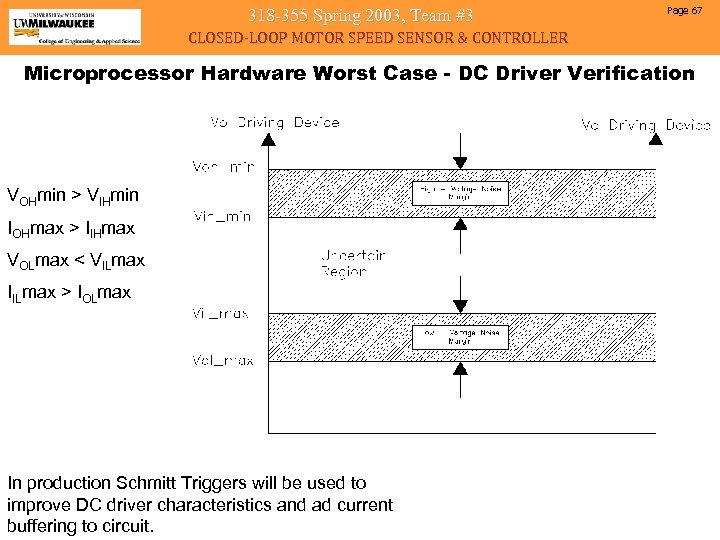 318 -355 Spring 2003, Team #3 Page 67 CLOSED-LOOP MOTOR SPEED SENSOR & CONTROLLER Microprocessor Hardware Worst Case - DC Driver Verification VOHmin > VIHmin IOHmax > IIHmax VOLmax < VILmax IILmax > IOLmax In production Schmitt Triggers will be used to improve DC driver characteristics and ad current buffering to circuit.
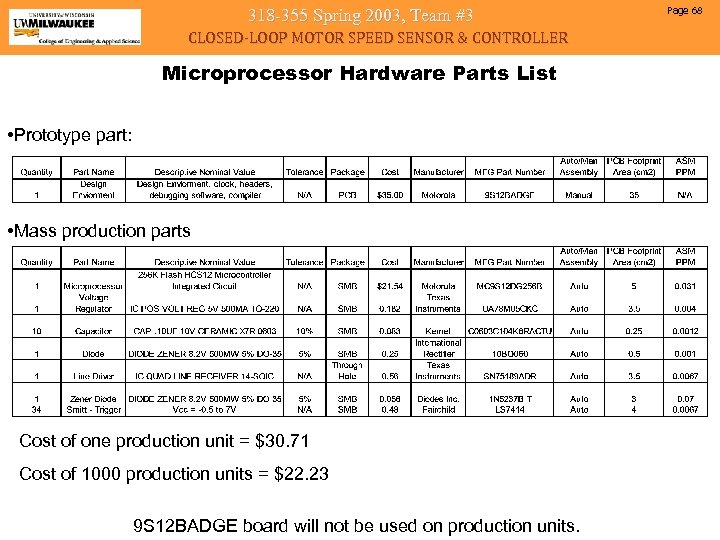 318 -355 Spring 2003, Team #3 CLOSED-LOOP MOTOR SPEED SENSOR & CONTROLLER Microprocessor Hardware Parts List • Prototype part: • Mass production parts Cost of one production unit = $30. 71 Cost of 1000 production units = $22. 23 9 S 12 BADGE board will not be used on production units. Page 68
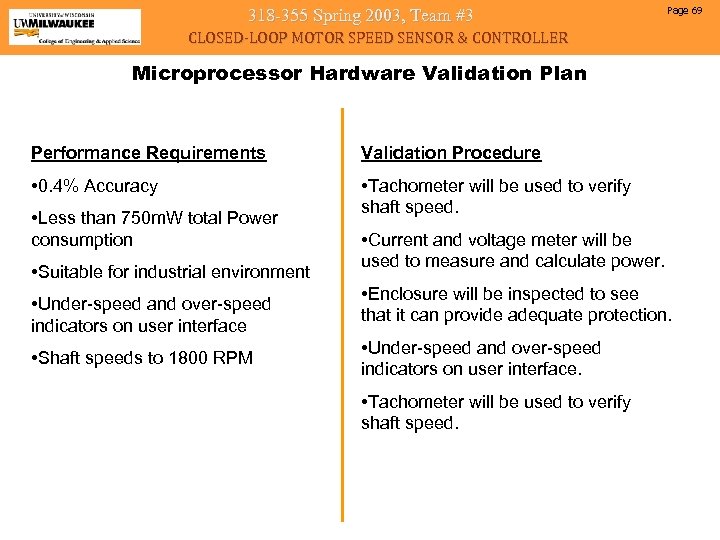 318 -355 Spring 2003, Team #3 Page 69 CLOSED-LOOP MOTOR SPEED SENSOR & CONTROLLER Microprocessor Hardware Validation Plan Performance Requirements Validation Procedure • 0. 4% Accuracy • Tachometer will be used to verify shaft speed. • Less than 750 m. W total Power consumption • Suitable for industrial environment • Under-speed and over-speed indicators on user interface • Shaft speeds to 1800 RPM • Current and voltage meter will be used to measure and calculate power. • Enclosure will be inspected to see that it can provide adequate protection. • Under-speed and over-speed indicators on user interface. • Tachometer will be used to verify shaft speed.
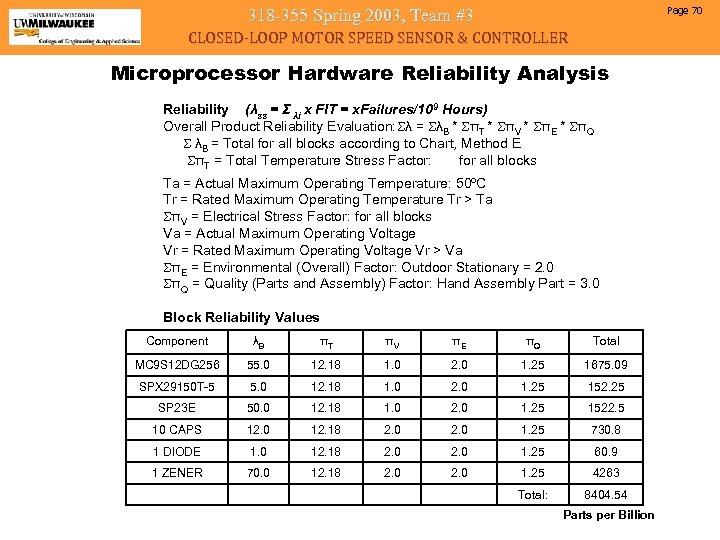 Page 70 318 -355 Spring 2003, Team #3 CLOSED-LOOP MOTOR SPEED SENSOR & CONTROLLER Microprocessor Hardware Reliability Analysis Reliability (λss = Σ λi x FIT = x. Failures/109 Hours) Overall Product Reliability Evaluation: λ = λB * πT * πV * πE * πQ λB = Total for all blocks according to Chart, Method E πT = Total Temperature Stress Factor: for all blocks Ta = Actual Maximum Operating Temperature: 50ºC Tr = Rated Maximum Operating Temperature Tr > Ta πV = Electrical Stress Factor: for all blocks Va = Actual Maximum Operating Voltage Vr = Rated Maximum Operating Voltage Vr > Va πE = Environmental (Overall) Factor: Outdoor Stationary = 2. 0 πQ = Quality (Parts and Assembly) Factor: Hand Assembly Part = 3. 0 Block Reliability Values Component λB πT πV πE πQ Total MC 9 S 12 DG 256 55. 0 12. 18 1. 0 2. 0 1. 25 1675. 09 SPX 29150 T-5 5. 0 12. 18 1. 0 2. 0 1. 25 152. 25 SP 23 E 50. 0 12. 18 1. 0 2. 0 1. 25 1522. 5 10 CAPS 12. 0 12. 18 2. 0 1. 25 730. 8 1 DIODE 1. 0 12. 18 2. 0 1. 25 60. 9 1 ZENER 70. 0 12. 18 2. 0 1. 25 4263 Total: 8404. 54 Parts per Billion
 318 -355 Spring 2003, Team #3 Page 71 CLOSED-LOOP MOTOR SPEED SENSOR & CONTROLLER Let’s cover the Microprocessor Software Details next. . .
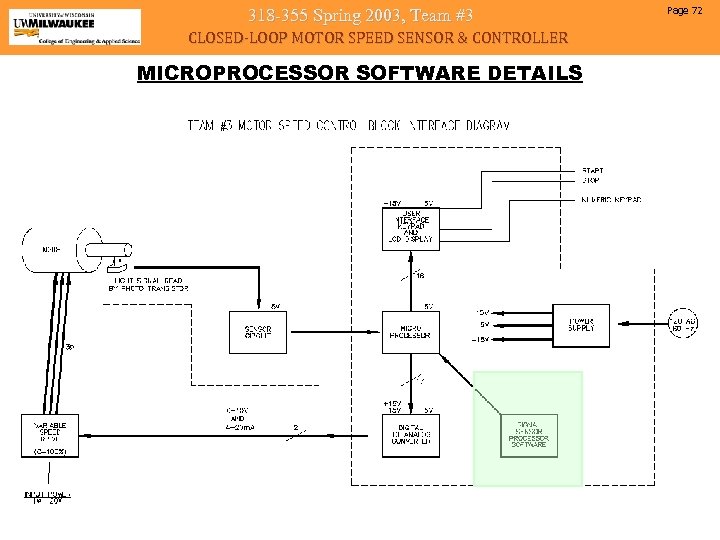 318 -355 Spring 2003, Team #3 CLOSED-LOOP MOTOR SPEED SENSOR & CONTROLLER MICROPROCESSOR SOFTWARE DETAILS Page 72
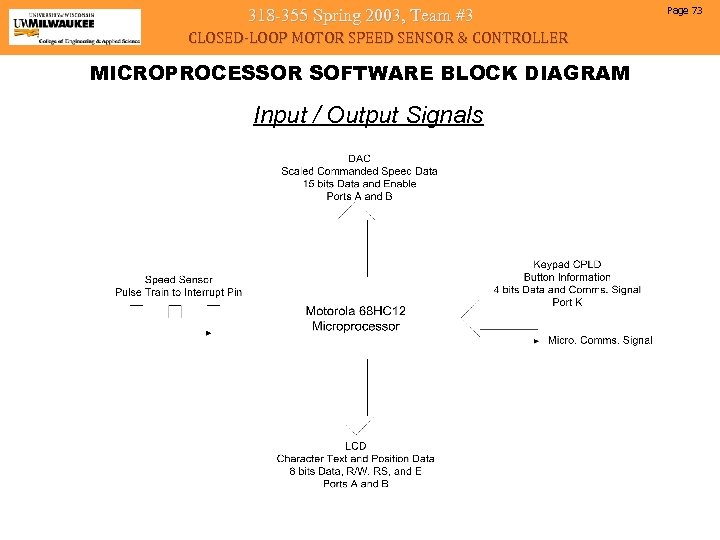 318 -355 Spring 2003, Team #3 CLOSED-LOOP MOTOR SPEED SENSOR & CONTROLLER MICROPROCESSOR SOFTWARE BLOCK DIAGRAM Input / Output Signals Page 73
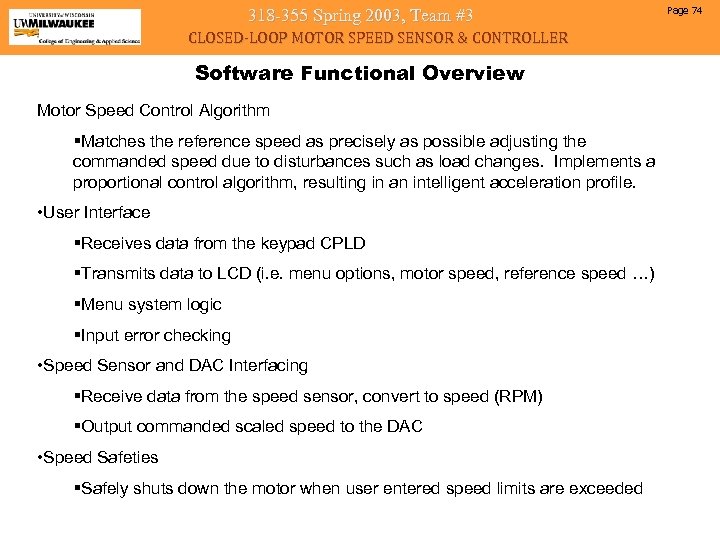 318 -355 Spring 2003, Team #3 CLOSED-LOOP MOTOR SPEED SENSOR & CONTROLLER Software Functional Overview Motor Speed Control Algorithm Matches the reference speed as precisely as possible adjusting the commanded speed due to disturbances such as load changes. Implements a proportional control algorithm, resulting in an intelligent acceleration profile. • User Interface Receives data from the keypad CPLD Transmits data to LCD (i. e. menu options, motor speed, reference speed …) Menu system logic Input error checking • Speed Sensor and DAC Interfacing Receive data from the speed sensor, convert to speed (RPM) Output commanded scaled speed to the DAC • Speed Safeties Safely shuts down the motor when user entered speed limits are exceeded Page 74
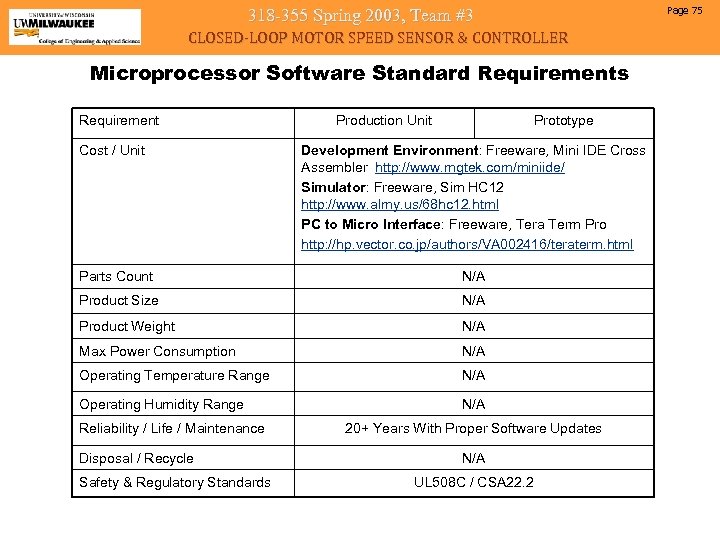 Page 75 318 -355 Spring 2003, Team #3 CLOSED-LOOP MOTOR SPEED SENSOR & CONTROLLER Microprocessor Software Standard Requirements Requirement Cost / Unit Production Unit Prototype Development Environment: Freeware, Mini IDE Cross Assembler http: //www. mgtek. com/miniide/ Simulator: Freeware, Sim HC 12 http: //www. almy. us/68 hc 12. html PC to Micro Interface: Freeware, Tera Term Pro http: //hp. vector. co. jp/authors/VA 002416/teraterm. html Parts Count N/A Product Size N/A Product Weight N/A Max Power Consumption N/A Operating Temperature Range N/A Operating Humidity Range N/A Reliability / Life / Maintenance Disposal / Recycle Safety & Regulatory Standards 20+ Years With Proper Software Updates N/A UL 508 C / CSA 22. 2
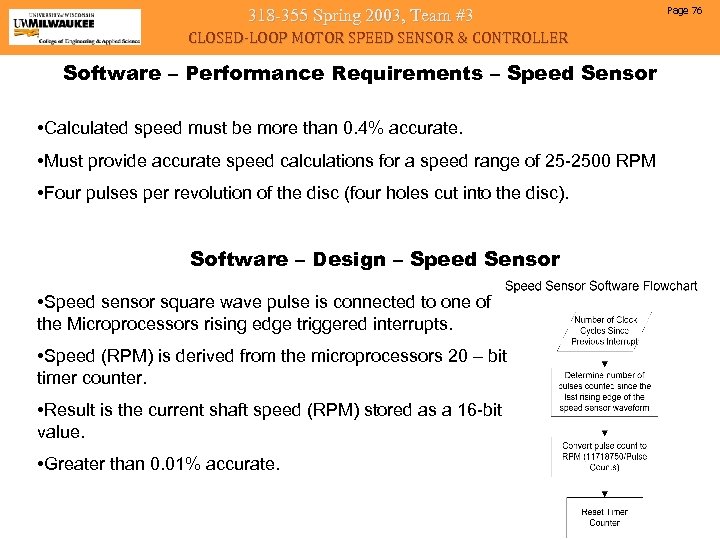 318 -355 Spring 2003, Team #3 CLOSED-LOOP MOTOR SPEED SENSOR & CONTROLLER Software – Performance Requirements – Speed Sensor • Calculated speed must be more than 0. 4% accurate. • Must provide accurate speed calculations for a speed range of 25 -2500 RPM • Four pulses per revolution of the disc (four holes cut into the disc). Software – Design – Speed Sensor • Speed sensor square wave pulse is connected to one of the Microprocessors rising edge triggered interrupts. • Speed (RPM) is derived from the microprocessors 20 – bit timer counter. • Result is the current shaft speed (RPM) stored as a 16 -bit value. • Greater than 0. 01% accurate. Page 76
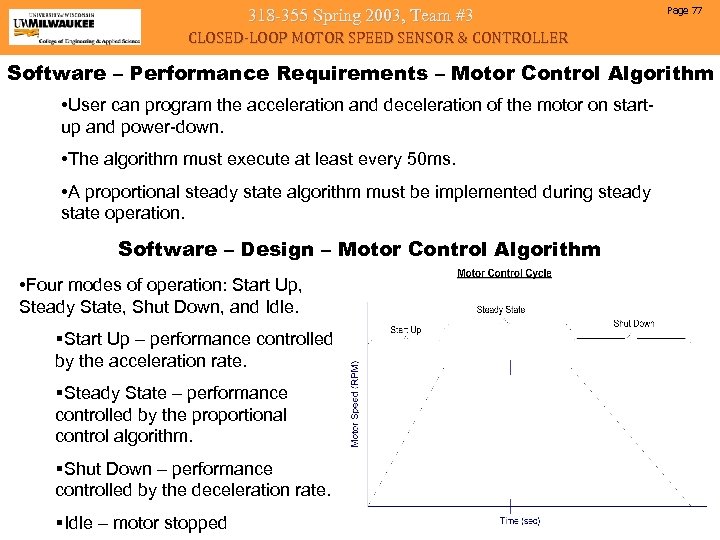 318 -355 Spring 2003, Team #3 Page 77 CLOSED-LOOP MOTOR SPEED SENSOR & CONTROLLER Software – Performance Requirements – Motor Control Algorithm • User can program the acceleration and deceleration of the motor on startup and power-down. • The algorithm must execute at least every 50 ms. • A proportional steady state algorithm must be implemented during steady state operation. Software – Design – Motor Control Algorithm • Four modes of operation: Start Up, Steady State, Shut Down, and Idle. Start Up – performance controlled by the acceleration rate. Steady State – performance controlled by the proportional control algorithm. Shut Down – performance controlled by the deceleration rate. Idle – motor stopped
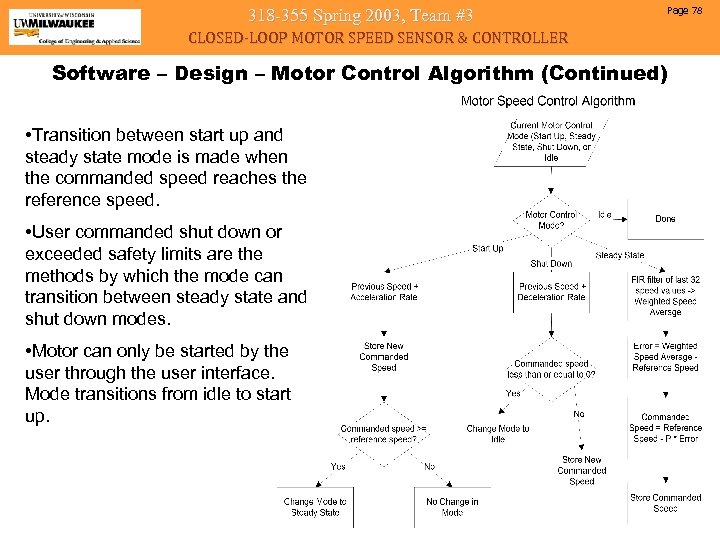 318 -355 Spring 2003, Team #3 Page 78 CLOSED-LOOP MOTOR SPEED SENSOR & CONTROLLER Software – Design – Motor Control Algorithm (Continued) • Transition between start up and steady state mode is made when the commanded speed reaches the reference speed. • User commanded shut down or exceeded safety limits are the methods by which the mode can transition between steady state and shut down modes. • Motor can only be started by the user through the user interface. Mode transitions from idle to start up.
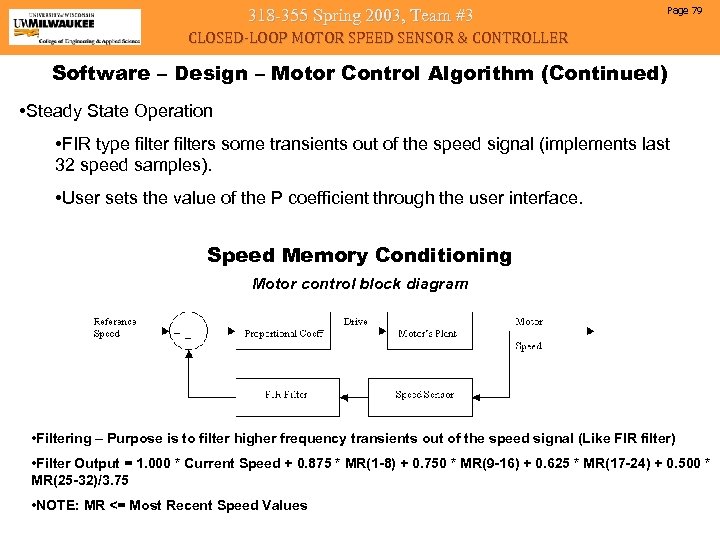 318 -355 Spring 2003, Team #3 Page 79 CLOSED-LOOP MOTOR SPEED SENSOR & CONTROLLER Software – Design – Motor Control Algorithm (Continued) • Steady State Operation • FIR type filters some transients out of the speed signal (implements last 32 speed samples). • User sets the value of the P coefficient through the user interface. Speed Memory Conditioning Motor control block diagram • Filtering – Purpose is to filter higher frequency transients out of the speed signal (Like FIR filter) • Filter Output = 1. 000 * Current Speed + 0. 875 * MR(1 -8) + 0. 750 * MR(9 -16) + 0. 625 * MR(17 -24) + 0. 500 * MR(25 -32)/3. 75 • NOTE: MR <= Most Recent Speed Values
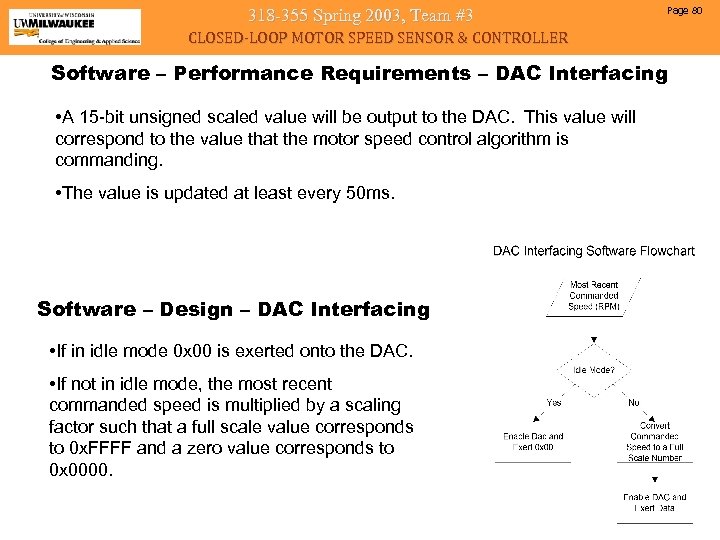 318 -355 Spring 2003, Team #3 Page 80 CLOSED-LOOP MOTOR SPEED SENSOR & CONTROLLER Software – Performance Requirements – DAC Interfacing • A 15 -bit unsigned scaled value will be output to the DAC. This value will correspond to the value that the motor speed control algorithm is commanding. • The value is updated at least every 50 ms. Software – Design – DAC Interfacing • If in idle mode 0 x 00 is exerted onto the DAC. • If not in idle mode, the most recent commanded speed is multiplied by a scaling factor such that a full scale value corresponds to 0 x. FFFF and a zero value corresponds to 0 x 0000.
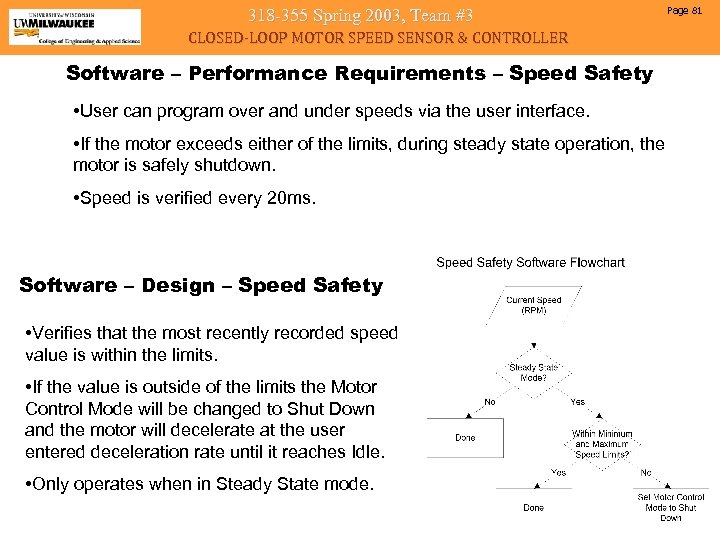 318 -355 Spring 2003, Team #3 Page 81 CLOSED-LOOP MOTOR SPEED SENSOR & CONTROLLER Software – Performance Requirements – Speed Safety • User can program over and under speeds via the user interface. • If the motor exceeds either of the limits, during steady state operation, the motor is safely shutdown. • Speed is verified every 20 ms. Software – Design – Speed Safety • Verifies that the most recently recorded speed value is within the limits. • If the value is outside of the limits the Motor Control Mode will be changed to Shut Down and the motor will decelerate at the user entered deceleration rate until it reaches Idle. • Only operates when in Steady State mode.
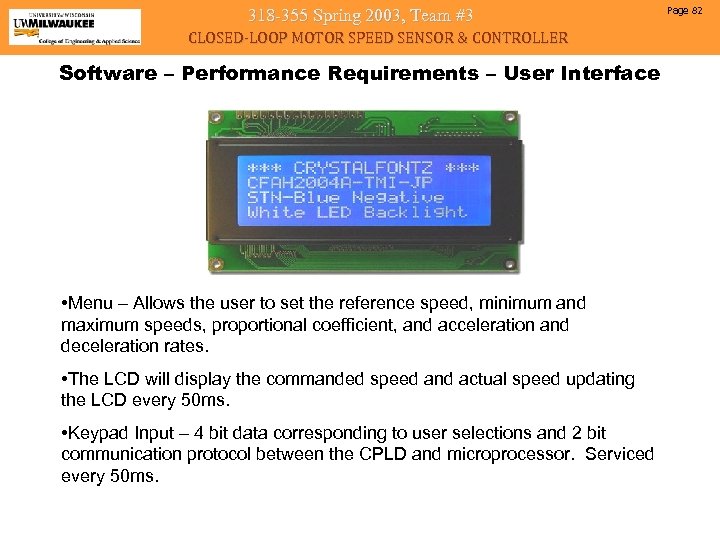 318 -355 Spring 2003, Team #3 CLOSED-LOOP MOTOR SPEED SENSOR & CONTROLLER Software – Performance Requirements – User Interface • Menu – Allows the user to set the reference speed, minimum and maximum speeds, proportional coefficient, and acceleration and deceleration rates. • The LCD will display the commanded speed and actual speed updating the LCD every 50 ms. • Keypad Input – 4 bit data corresponding to user selections and 2 bit communication protocol between the CPLD and microprocessor. Serviced every 50 ms. Page 82
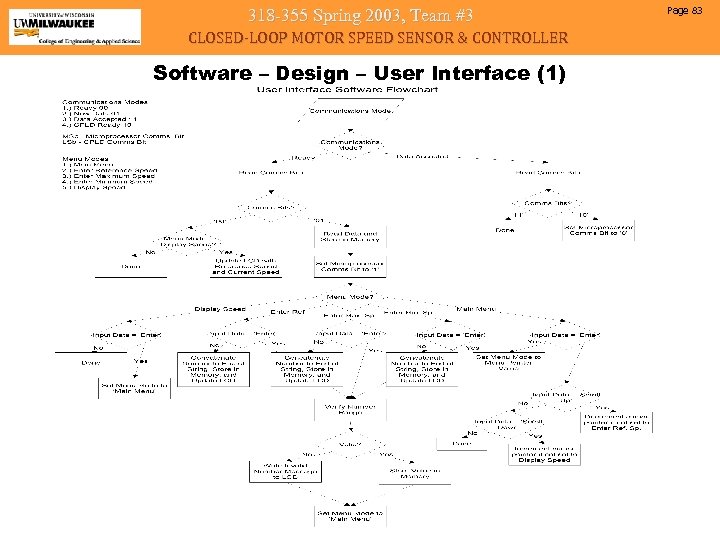 318 -355 Spring 2003, Team #3 CLOSED-LOOP MOTOR SPEED SENSOR & CONTROLLER Software – Design – User Interface (1) Page 83
 318 -355 Spring 2003, Team #3 CLOSED-LOOP MOTOR SPEED SENSOR & CONTROLLER Software – Design – User Interface (2) • Main Menu – Allows user to select any of the following Enter reference speed Enter maximum speed Enter minimum speed Enter proportional coefficient Display current and reference speed • Software updates LCD using the HD 44780 LCD driver instructions set. • Both text and LCD instructions are communicated between the LCD driver and the microprocessor. • HD 44780 driver chip is an industry standard for driving LCD character displays. • All numerical input is checked for validity. Page 84
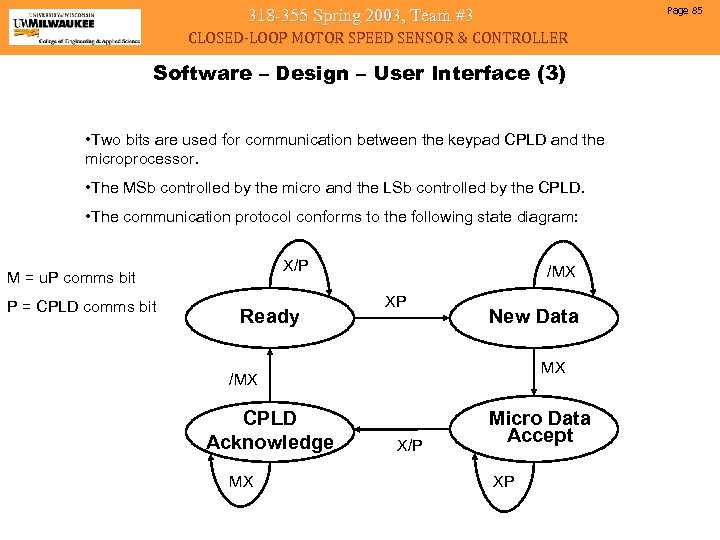 Page 85 318 -355 Spring 2003, Team #3 CLOSED-LOOP MOTOR SPEED SENSOR & CONTROLLER Software – Design – User Interface (3) • Two bits are used for communication between the keypad CPLD and the microprocessor. • The MSb controlled by the micro and the LSb controlled by the CPLD. • The communication protocol conforms to the following state diagram: X/P M = u. P comms bit P = CPLD comms bit Ready /MX XP New Data MX /MX CPLD Acknowledge MX X/P Micro Data Accept XP
 318 -355 Spring 2003, Team #3 CLOSED-LOOP MOTOR SPEED SENSOR & CONTROLLER Microprocessor Software Engineering Issues • Maintainability • The software is highly functionalized, modular, and well documented. • Each subroutine’s overall function is thoroughly described an explanation for each line of code is given. • This allows future software engineers to easily understand make fixes or upgrades to the code. • Software can be assembled on any 68 HC 12 compatible cross assembler. Page 86
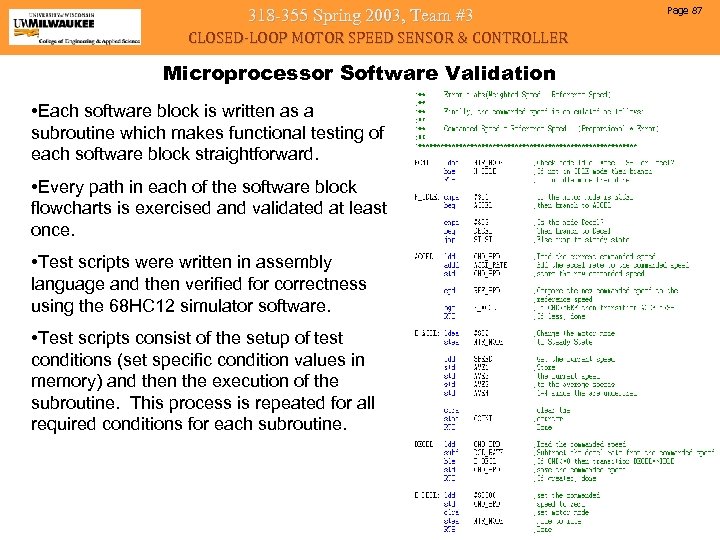 318 -355 Spring 2003, Team #3 CLOSED-LOOP MOTOR SPEED SENSOR & CONTROLLER Microprocessor Software Validation • Each software block is written as a subroutine which makes functional testing of each software block straightforward. • Every path in each of the software block flowcharts is exercised and validated at least once. • Test scripts were written in assembly language and then verified for correctness using the 68 HC 12 simulator software. • Test scripts consist of the setup of test conditions (set specific condition values in memory) and then the execution of the subroutine. This process is repeated for all required conditions for each subroutine. Page 87
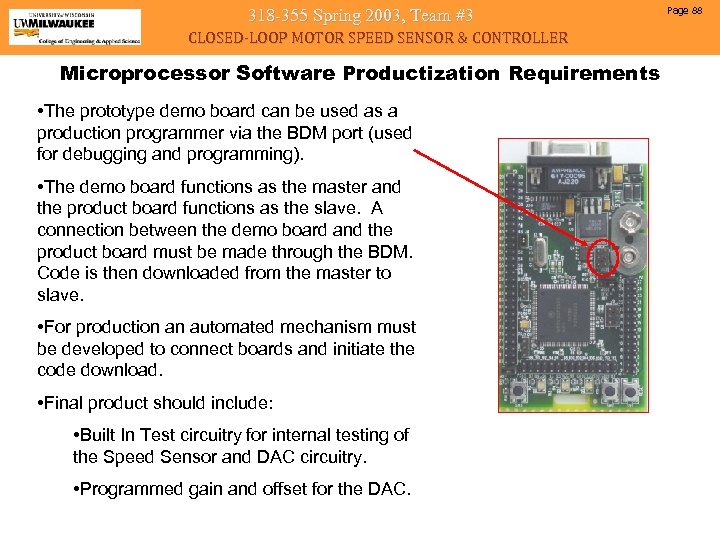 318 -355 Spring 2003, Team #3 CLOSED-LOOP MOTOR SPEED SENSOR & CONTROLLER Microprocessor Software Productization Requirements • The prototype demo board can be used as a production programmer via the BDM port (used for debugging and programming). • The demo board functions as the master and the product board functions as the slave. A connection between the demo board and the product board must be made through the BDM. Code is then downloaded from the master to slave. • For production an automated mechanism must be developed to connect boards and initiate the code download. • Final product should include: • Built In Test circuitry for internal testing of the Speed Sensor and DAC circuitry. • Programmed gain and offset for the DAC. Page 88
 318 -355 Spring 2003, Team #3 Page 89 CLOSED-LOOP MOTOR SPEED SENSOR & CONTROLLER Next we’ll cover the DAC circuit. . .
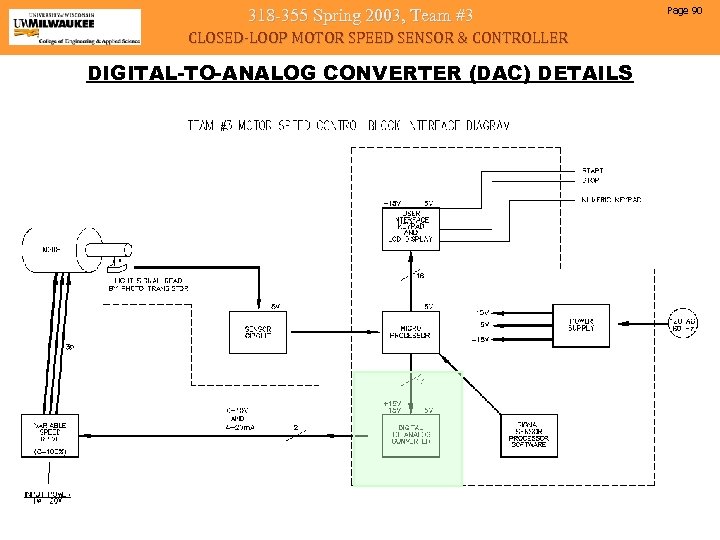 318 -355 Spring 2003, Team #3 CLOSED-LOOP MOTOR SPEED SENSOR & CONTROLLER DIGITAL-TO-ANALOG CONVERTER (DAC) DETAILS Page 90
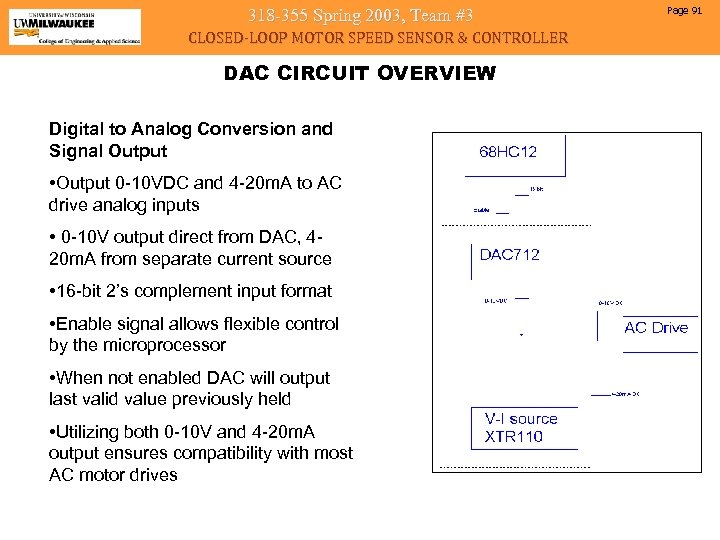 318 -355 Spring 2003, Team #3 CLOSED-LOOP MOTOR SPEED SENSOR & CONTROLLER DAC CIRCUIT OVERVIEW Digital to Analog Conversion and Signal Output • Output 0 -10 VDC and 4 -20 m. A to AC drive analog inputs • 0 -10 V output direct from DAC, 420 m. A from separate current source • 16 -bit 2’s complement input format • Enable signal allows flexible control by the microprocessor • When not enabled DAC will output last valid value previously held • Utilizing both 0 -10 V and 4 -20 m. A output ensures compatibility with most AC motor drives Page 91
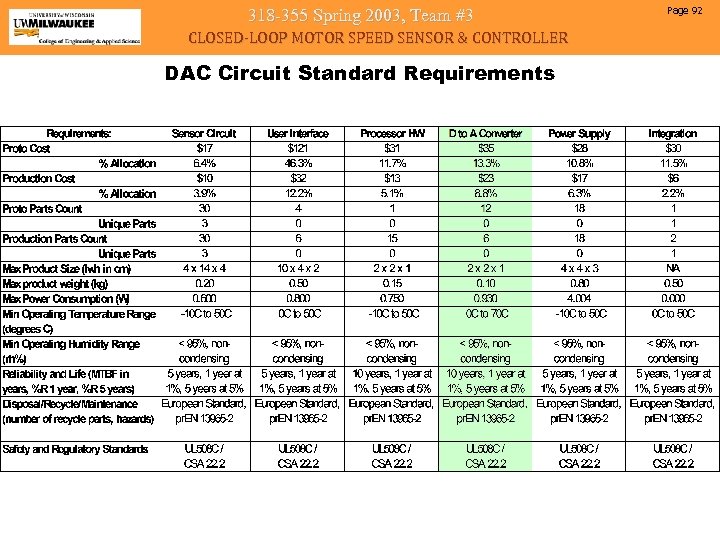 318 -355 Spring 2003, Team #3 CLOSED-LOOP MOTOR SPEED SENSOR & CONTROLLER DAC Circuit Standard Requirements Page 92
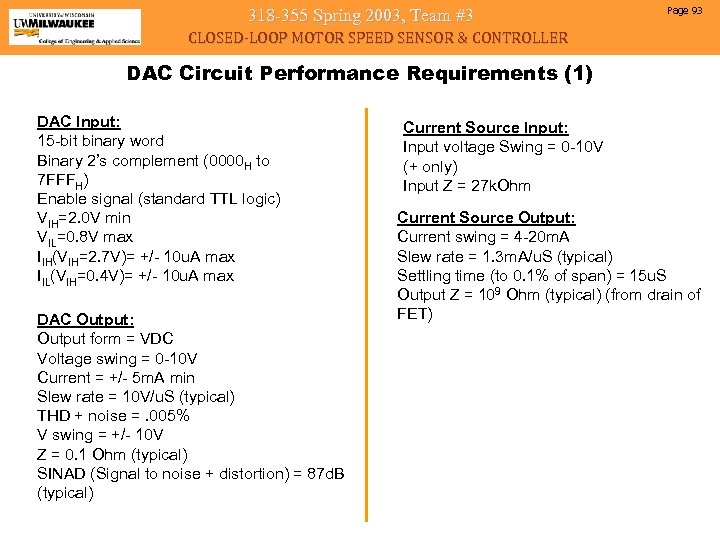 318 -355 Spring 2003, Team #3 Page 93 CLOSED-LOOP MOTOR SPEED SENSOR & CONTROLLER DAC Circuit Performance Requirements (1) DAC Input: 15 -bit binary word Binary 2’s complement (0000 H to 7 FFFH) Enable signal (standard TTL logic) VIH=2. 0 V min VIL=0. 8 V max IIH(VIH=2. 7 V)= +/- 10 u. A max IIL(VIH=0. 4 V)= +/- 10 u. A max DAC Output: Output form = VDC Voltage swing = 0 -10 V Current = +/- 5 m. A min Slew rate = 10 V/u. S (typical) THD + noise =. 005% V swing = +/- 10 V Z = 0. 1 Ohm (typical) SINAD (Signal to noise + distortion) = 87 d. B (typical) Current Source Input: Input voltage Swing = 0 -10 V (+ only) Input Z = 27 k. Ohm Current Source Output: Current swing = 4 -20 m. A Slew rate = 1. 3 m. A/u. S (typical) Settling time (to 0. 1% of span) = 15 u. S Output Z = 109 Ohm (typical) (from drain of FET)
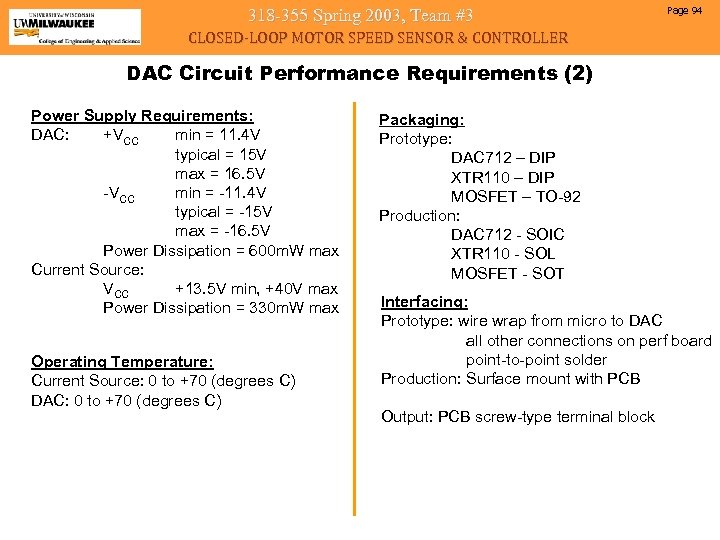 318 -355 Spring 2003, Team #3 Page 94 CLOSED-LOOP MOTOR SPEED SENSOR & CONTROLLER DAC Circuit Performance Requirements (2) Power Supply Requirements: DAC: +VCC min = 11. 4 V typical = 15 V max = 16. 5 V -VCC min = -11. 4 V typical = -15 V max = -16. 5 V Power Dissipation = 600 m. W max Current Source: VCC +13. 5 V min, +40 V max Power Dissipation = 330 m. W max Operating Temperature: Current Source: 0 to +70 (degrees C) DAC: 0 to +70 (degrees C) Packaging: Prototype: DAC 712 – DIP XTR 110 – DIP MOSFET – TO-92 Production: DAC 712 - SOIC XTR 110 - SOL MOSFET - SOT Interfacing: Prototype: wire wrap from micro to DAC all other connections on perf board point-to-point solder Production: Surface mount with PCB Output: PCB screw-type terminal block
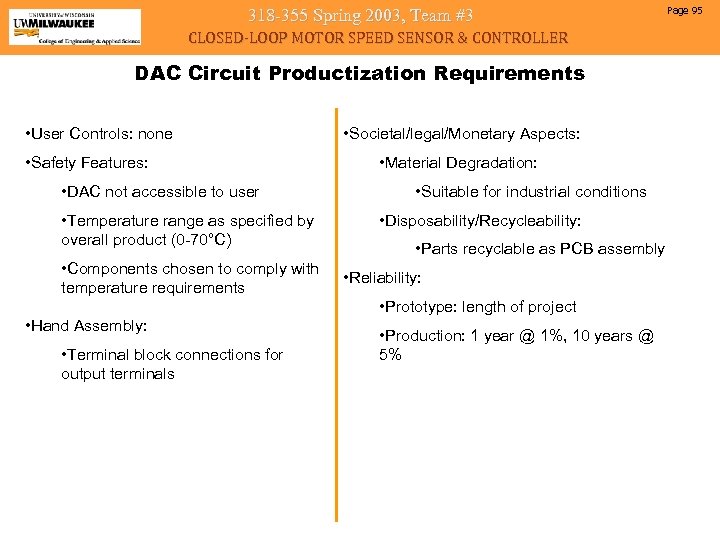 318 -355 Spring 2003, Team #3 CLOSED-LOOP MOTOR SPEED SENSOR & CONTROLLER DAC Circuit Productization Requirements • User Controls: none • Safety Features: • DAC not accessible to user • Temperature range as specified by overall product (0 -70°C) • Components chosen to comply with temperature requirements • Societal/legal/Monetary Aspects: • Material Degradation: • Suitable for industrial conditions • Disposability/Recycleability: • Parts recyclable as PCB assembly • Reliability: • Prototype: length of project • Hand Assembly: • Terminal block connections for output terminals • Production: 1 year @ 1%, 10 years @ 5% Page 95
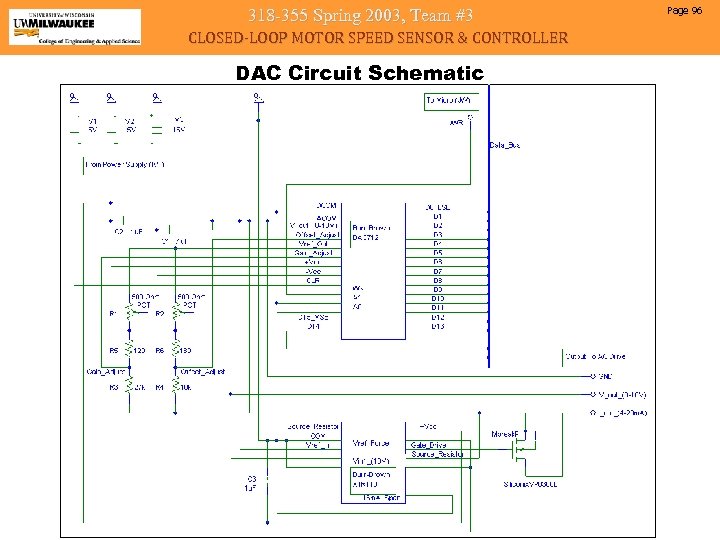 318 -355 Spring 2003, Team #3 CLOSED-LOOP MOTOR SPEED SENSOR & CONTROLLER DAC Circuit Schematic Page 96
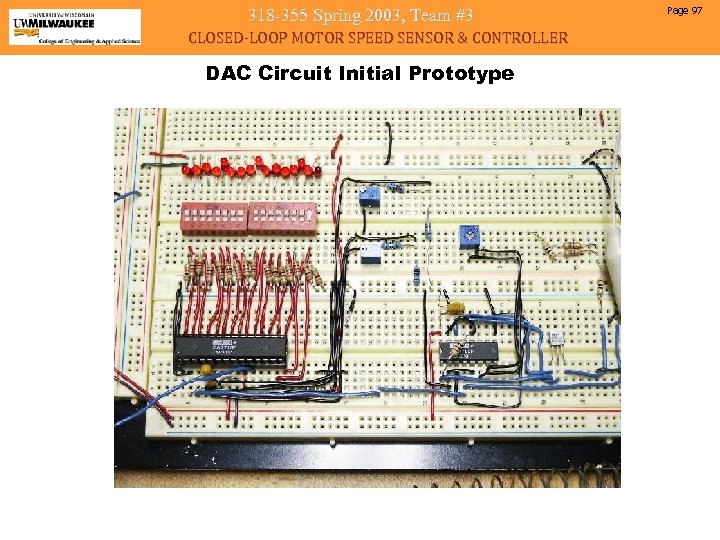 318 -355 Spring 2003, Team #3 CLOSED-LOOP MOTOR SPEED SENSOR & CONTROLLER DAC Circuit Initial Prototype Page 97
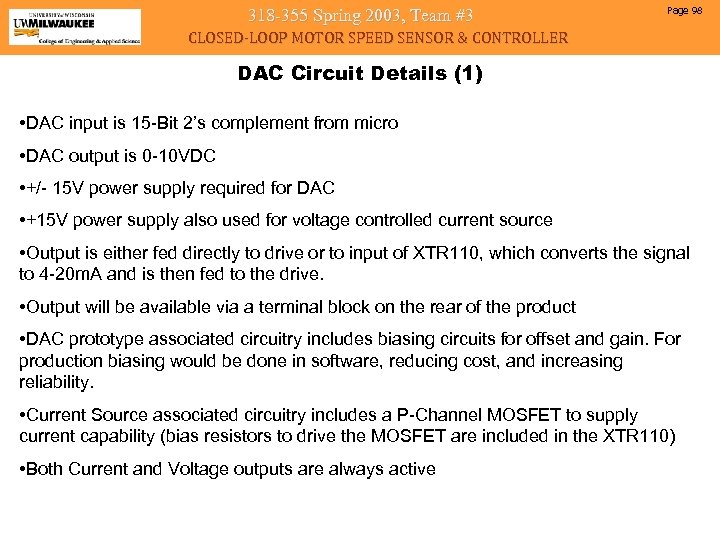 318 -355 Spring 2003, Team #3 Page 98 CLOSED-LOOP MOTOR SPEED SENSOR & CONTROLLER DAC Circuit Details (1) • DAC input is 15 -Bit 2’s complement from micro • DAC output is 0 -10 VDC • +/- 15 V power supply required for DAC • +15 V power supply also used for voltage controlled current source • Output is either fed directly to drive or to input of XTR 110, which converts the signal to 4 -20 m. A and is then fed to the drive. • Output will be available via a terminal block on the rear of the product • DAC prototype associated circuitry includes biasing circuits for offset and gain. For production biasing would be done in software, reducing cost, and increasing reliability. • Current Source associated circuitry includes a P-Channel MOSFET to supply current capability (bias resistors to drive the MOSFET are included in the XTR 110) • Both Current and Voltage outputs are always active
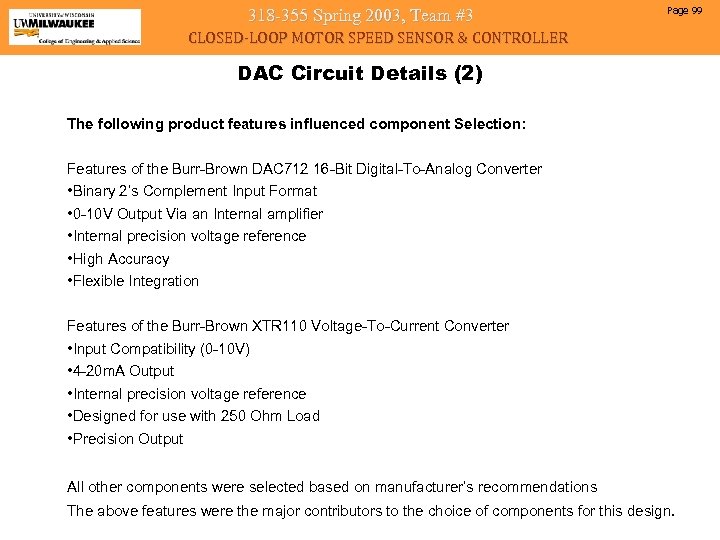 318 -355 Spring 2003, Team #3 Page 99 CLOSED-LOOP MOTOR SPEED SENSOR & CONTROLLER DAC Circuit Details (2) The following product features influenced component Selection: Features of the Burr-Brown DAC 712 16 -Bit Digital-To-Analog Converter • Binary 2’s Complement Input Format • 0 -10 V Output Via an Internal amplifier • Internal precision voltage reference • High Accuracy • Flexible Integration Features of the Burr-Brown XTR 110 Voltage-To-Current Converter • Input Compatibility (0 -10 V) • 4 -20 m. A Output • Internal precision voltage reference • Designed for use with 250 Ohm Load • Precision Output All other components were selected based on manufacturer’s recommendations The above features were the major contributors to the choice of components for this design.
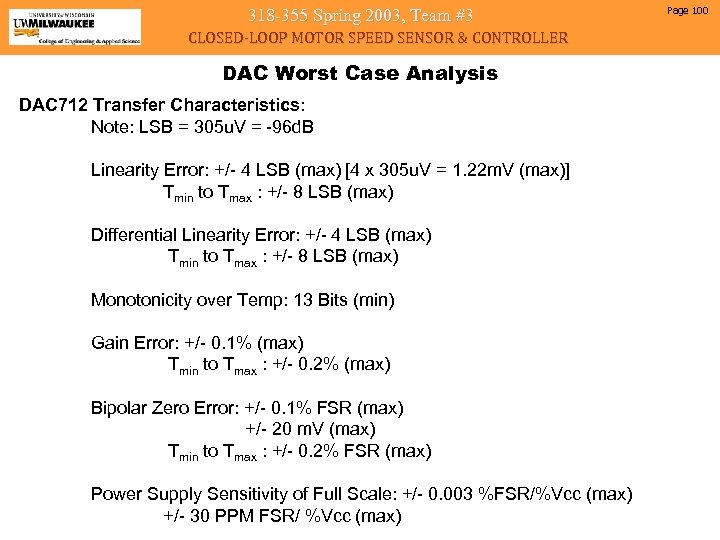 318 -355 Spring 2003, Team #3 CLOSED-LOOP MOTOR SPEED SENSOR & CONTROLLER DAC Worst Case Analysis DAC 712 Transfer Characteristics: Note: LSB = 305 u. V = -96 d. B Linearity Error: +/- 4 LSB (max) [4 x 305 u. V = 1. 22 m. V (max)] Tmin to Tmax : +/- 8 LSB (max) Differential Linearity Error: +/- 4 LSB (max) Tmin to Tmax : +/- 8 LSB (max) Monotonicity over Temp: 13 Bits (min) Gain Error: +/- 0. 1% (max) Tmin to Tmax : +/- 0. 2% (max) Bipolar Zero Error: +/- 0. 1% FSR (max) +/- 20 m. V (max) Tmin to Tmax : +/- 0. 2% FSR (max) Power Supply Sensitivity of Full Scale: +/- 0. 003 %FSR/%Vcc (max) +/- 30 PPM FSR/ %Vcc (max) Page 100
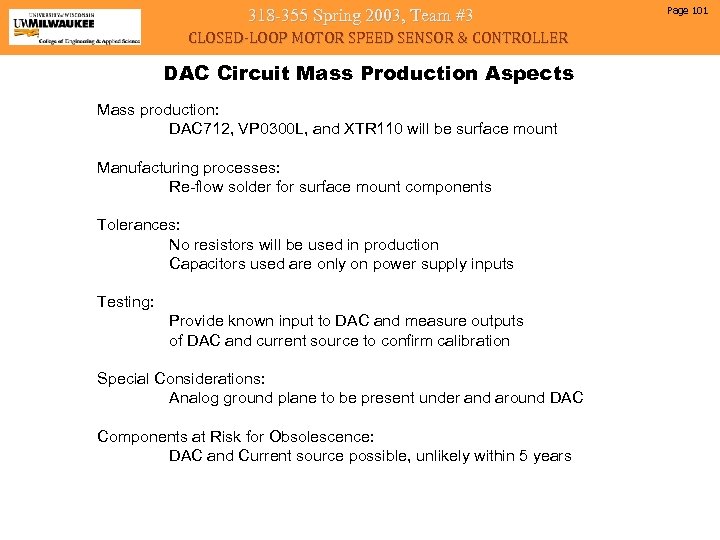 318 -355 Spring 2003, Team #3 CLOSED-LOOP MOTOR SPEED SENSOR & CONTROLLER DAC Circuit Mass Production Aspects Mass production: DAC 712, VP 0300 L, and XTR 110 will be surface mount Manufacturing processes: Re-flow solder for surface mount components Tolerances: No resistors will be used in production Capacitors used are only on power supply inputs Testing: Provide known input to DAC and measure outputs of DAC and current source to confirm calibration Special Considerations: Analog ground plane to be present under and around DAC Components at Risk for Obsolescence: DAC and Current source possible, unlikely within 5 years Page 101
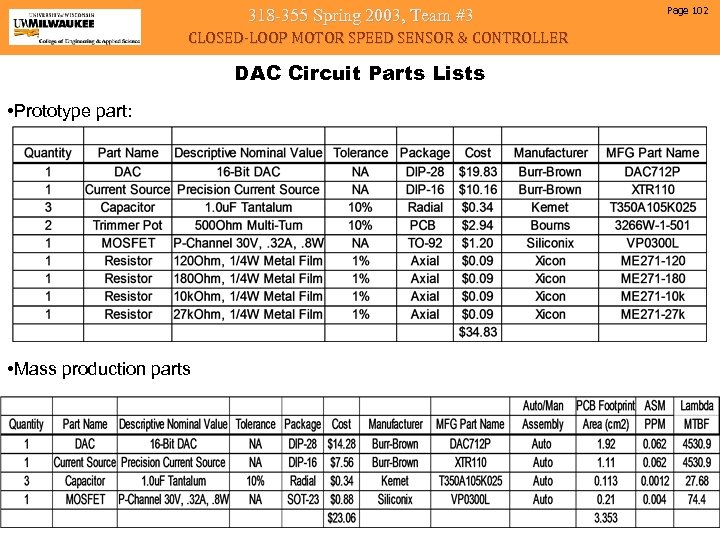 318 -355 Spring 2003, Team #3 CLOSED-LOOP MOTOR SPEED SENSOR & CONTROLLER DAC Circuit Parts Lists • Prototype part: • Mass production parts Page 102
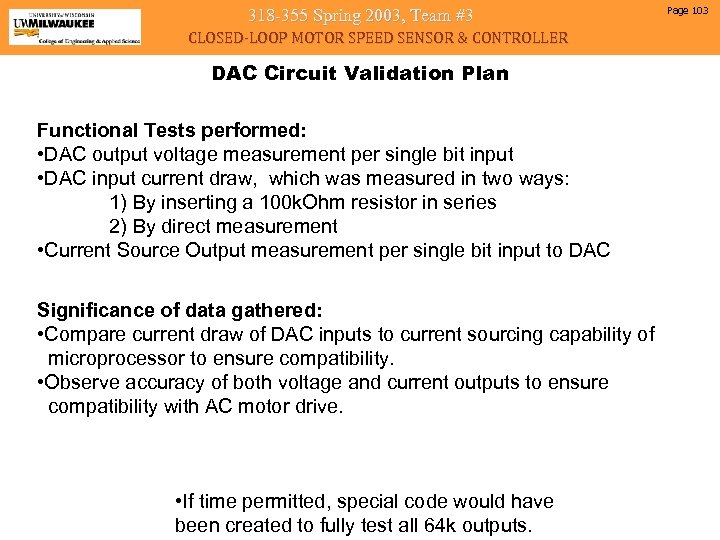 318 -355 Spring 2003, Team #3 CLOSED-LOOP MOTOR SPEED SENSOR & CONTROLLER DAC Circuit Validation Plan Functional Tests performed: • DAC output voltage measurement per single bit input • DAC input current draw, which was measured in two ways: 1) By inserting a 100 k. Ohm resistor in series 2) By direct measurement • Current Source Output measurement per single bit input to DAC Significance of data gathered: • Compare current draw of DAC inputs to current sourcing capability of microprocessor to ensure compatibility. • Observe accuracy of both voltage and current outputs to ensure compatibility with AC motor drive. • If time permitted, special code would have been created to fully test all 64 k outputs. Page 103
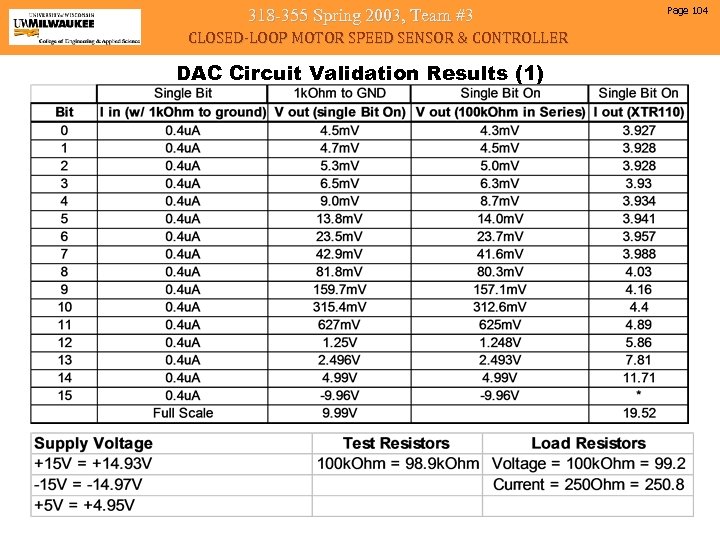 318 -355 Spring 2003, Team #3 CLOSED-LOOP MOTOR SPEED SENSOR & CONTROLLER DAC Circuit Validation Results (1) Page 104
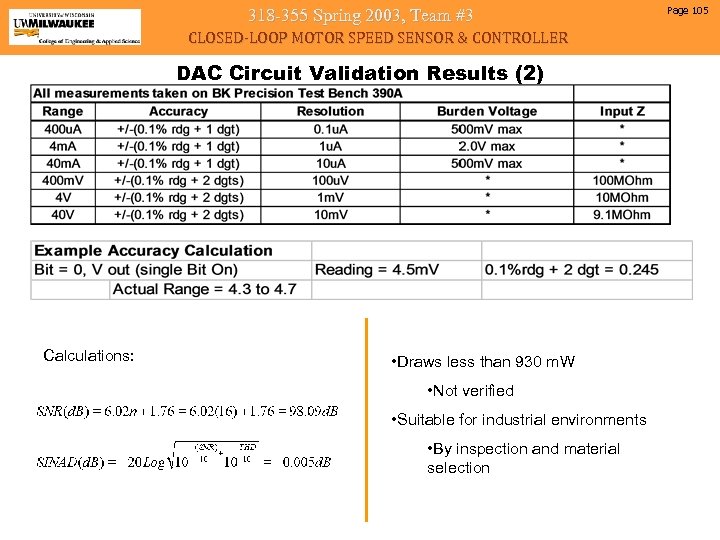 318 -355 Spring 2003, Team #3 CLOSED-LOOP MOTOR SPEED SENSOR & CONTROLLER DAC Circuit Validation Results (2) Calculations: • Draws less than 930 m. W • Not verified • Suitable for industrial environments • By inspection and material selection Page 105
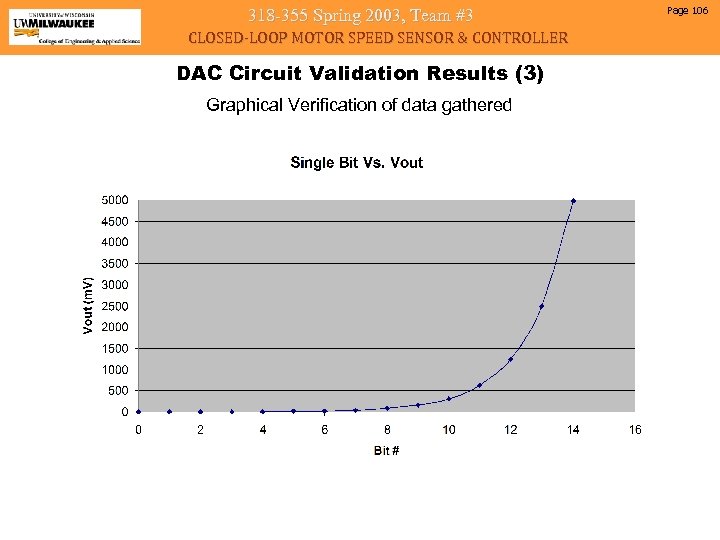 318 -355 Spring 2003, Team #3 CLOSED-LOOP MOTOR SPEED SENSOR & CONTROLLER DAC Circuit Validation Results (3) Graphical Verification of data gathered Page 106
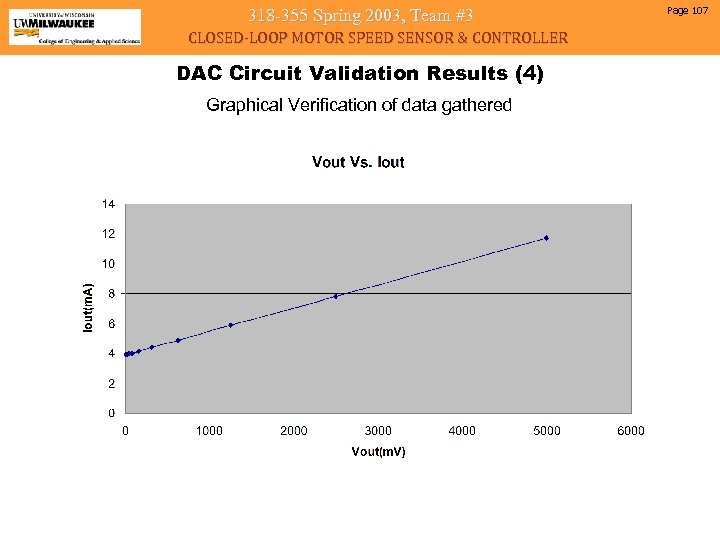 318 -355 Spring 2003, Team #3 CLOSED-LOOP MOTOR SPEED SENSOR & CONTROLLER DAC Circuit Validation Results (4) Graphical Verification of data gathered Page 107
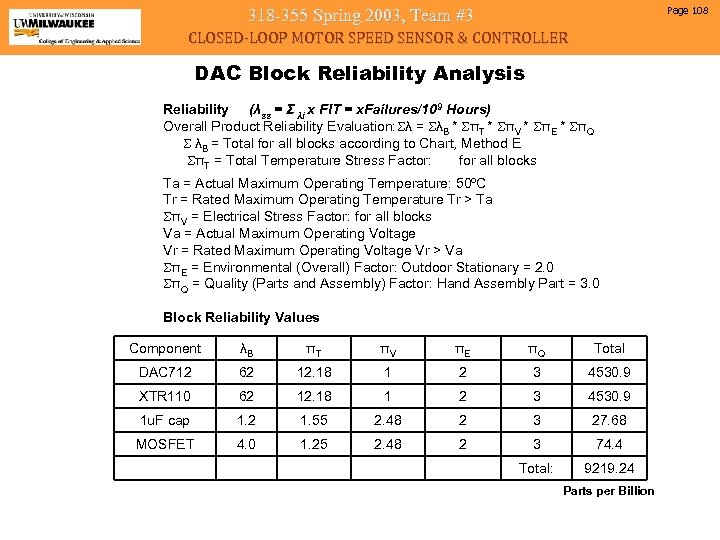 Page 108 318 -355 Spring 2003, Team #3 CLOSED-LOOP MOTOR SPEED SENSOR & CONTROLLER DAC Block Reliability Analysis Reliability (λss = Σ λi x FIT = x. Failures/109 Hours) Overall Product Reliability Evaluation: λ = λB * πT * πV * πE * πQ λB = Total for all blocks according to Chart, Method E πT = Total Temperature Stress Factor: for all blocks Ta = Actual Maximum Operating Temperature: 50ºC Tr = Rated Maximum Operating Temperature Tr > Ta πV = Electrical Stress Factor: for all blocks Va = Actual Maximum Operating Voltage Vr = Rated Maximum Operating Voltage Vr > Va πE = Environmental (Overall) Factor: Outdoor Stationary = 2. 0 πQ = Quality (Parts and Assembly) Factor: Hand Assembly Part = 3. 0 Block Reliability Values Component λB πT πV πE πQ Total DAC 712 62 12. 18 1 2 3 4530. 9 XTR 110 62 12. 18 1 2 3 4530. 9 1 u. F cap 1. 2 1. 55 2. 48 2 3 27. 68 MOSFET 4. 0 1. 25 2. 48 2 3 74. 4 Total: 9219. 24 Parts per Billion
 318 -355 Spring 2003, Team #3 Page 109 CLOSED-LOOP MOTOR SPEED SENSOR & CONTROLLER And for the final functional block, we’ll discuss the power supply. . .
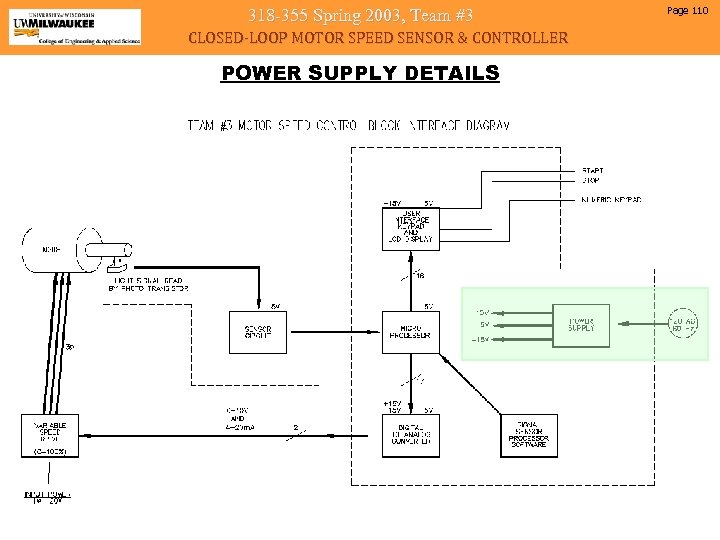 318 -355 Spring 2003, Team #3 CLOSED-LOOP MOTOR SPEED SENSOR & CONTROLLER POWER SUPPLY DETAILS Page 110
 318 -355 Spring 2003, Team #3 CLOSED-LOOP MOTOR SPEED SENSOR & CONTROLLER POWER SUPPLY BLOCK OVERVIEW The power supply requirements: • Input Power: 98 to 132 VAC, 58 -63 Hz • Outputs (Regulated DC Voltages): • +15 VDC (14. 4 VDC to 15. 6 VDC) • -15 VDC (– 15. 6 VDC to – 14. 4 VDC) • +5 VDC (4. 75 VDC to 5. 25 VDC) • Safety features: • Over-current and over-voltage protection • Molded line cord (UL compliant) Page 111
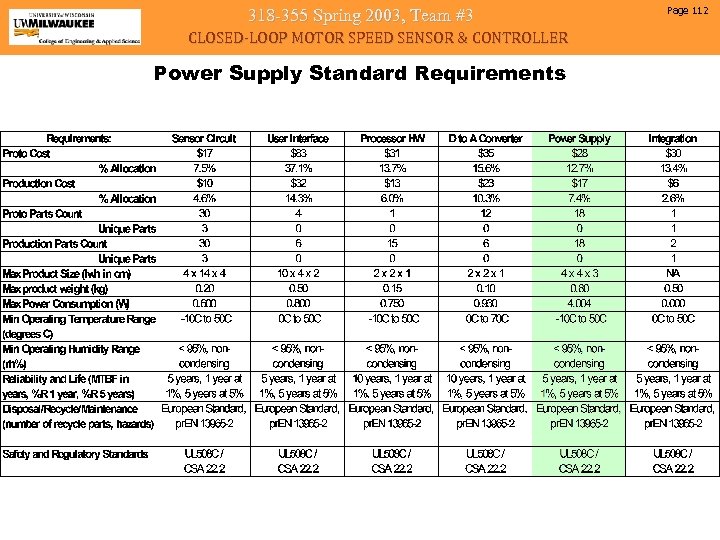 318 -355 Spring 2003, Team #3 CLOSED-LOOP MOTOR SPEED SENSOR & CONTROLLER Power Supply Standard Requirements Page 112
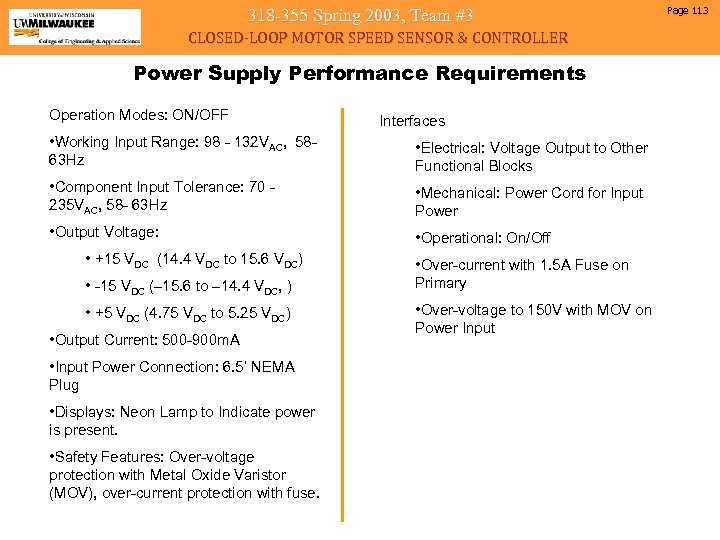 318 -355 Spring 2003, Team #3 CLOSED-LOOP MOTOR SPEED SENSOR & CONTROLLER Power Supply Performance Requirements Operation Modes: ON/OFF Interfaces • Working Input Range: 98 - 132 VAC, 5863 Hz • Electrical: Voltage Output to Other Functional Blocks • Component Input Tolerance: 70 - 235 VAC, 58 - 63 Hz • Mechanical: Power Cord for Input Power • Output Voltage: • Operational: On/Off • +15 VDC (14. 4 VDC to 15. 6 VDC) • -15 VDC (– 15. 6 to – 14. 4 VDC, ) • +5 VDC (4. 75 VDC to 5. 25 VDC) • Output Current: 500 -900 m. A • Input Power Connection: 6. 5’ NEMA Plug • Displays: Neon Lamp to Indicate power is present. • Safety Features: Over-voltage protection with Metal Oxide Varistor (MOV), over-current protection with fuse. • Over-current with 1. 5 A Fuse on Primary • Over-voltage to 150 V with MOV on Power Input Page 113
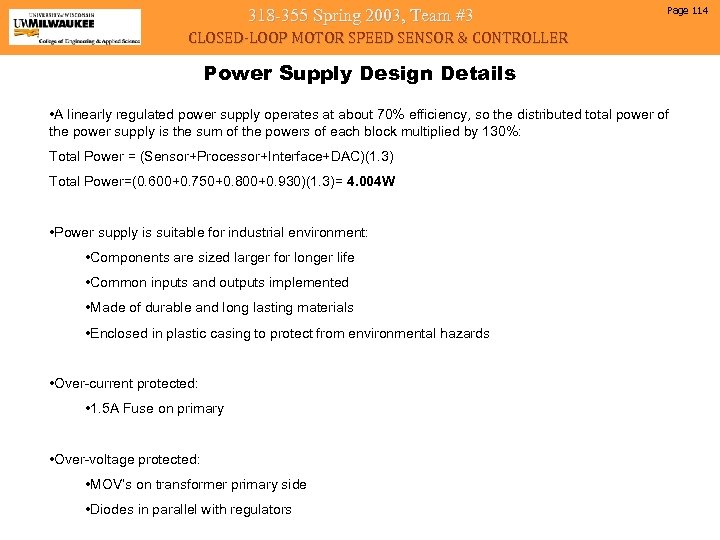 318 -355 Spring 2003, Team #3 Page 114 CLOSED-LOOP MOTOR SPEED SENSOR & CONTROLLER Power Supply Design Details • A linearly regulated power supply operates at about 70% efficiency, so the distributed total power of the power supply is the sum of the powers of each block multiplied by 130%: Total Power = (Sensor+Processor+Interface+DAC)(1. 3) Total Power=(0. 600+0. 750+0. 800+0. 930)(1. 3)= 4. 004 W • Power supply is suitable for industrial environment: • Components are sized larger for longer life • Common inputs and outputs implemented • Made of durable and long lasting materials • Enclosed in plastic casing to protect from environmental hazards • Over-current protected: • 1. 5 A Fuse on primary • Over-voltage protected: • MOV’s on transformer primary side • Diodes in parallel with regulators
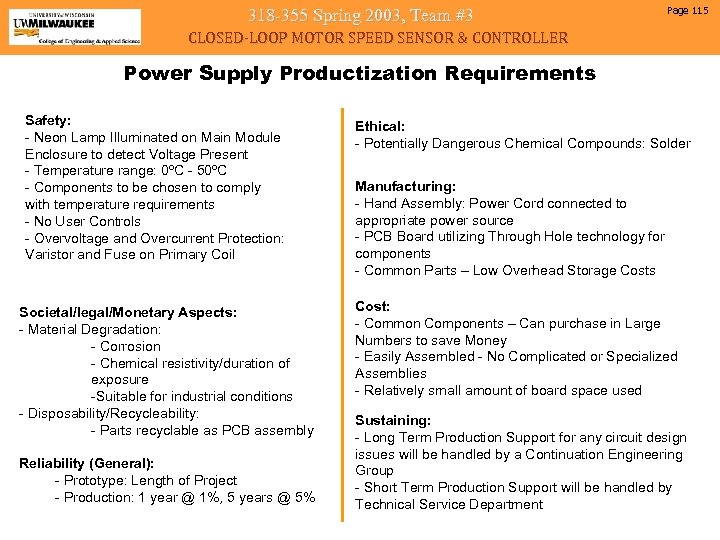 318 -355 Spring 2003, Team #3 Page 115 CLOSED-LOOP MOTOR SPEED SENSOR & CONTROLLER Power Supply Productization Requirements Safety: - Neon Lamp Illuminated on Main Module Enclosure to detect Voltage Present - Temperature range: 0ºC - 50ºC - Components to be chosen to comply with temperature requirements - No User Controls - Overvoltage and Overcurrent Protection: Varistor and Fuse on Primary Coil Societal/legal/Monetary Aspects: - Material Degradation: - Corrosion - Chemical resistivity/duration of exposure -Suitable for industrial conditions - Disposability/Recycleability: - Parts recyclable as PCB assembly Reliability (General): - Prototype: Length of Project - Production: 1 year @ 1%, 5 years @ 5% Ethical: - Potentially Dangerous Chemical Compounds: Solder Manufacturing: - Hand Assembly: Power Cord connected to appropriate power source - PCB Board utilizing Through Hole technology for components - Common Parts – Low Overhead Storage Costs Cost: - Common Components – Can purchase in Large Numbers to save Money - Easily Assembled - No Complicated or Specialized Assemblies - Relatively small amount of board space used Sustaining: - Long Term Production Support for any circuit design issues will be handled by a Continuation Engineering Group - Short Term Production Support will be handled by Technical Service Department
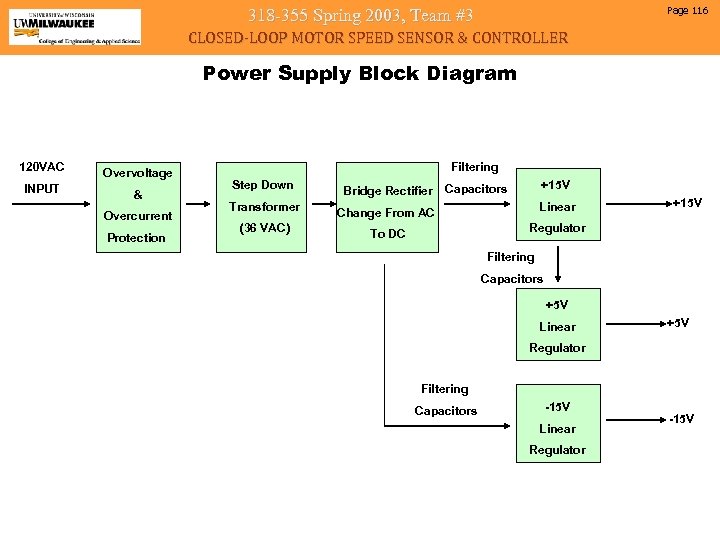 Page 116 318 -355 Spring 2003, Team #3 CLOSED-LOOP MOTOR SPEED SENSOR & CONTROLLER Power Supply Block Diagram 120 VAC Overvoltage INPUT & Overcurrent Protection Filtering Step Down Bridge Rectifier +15 V Transformer Change From AC Linear (36 VAC) To DC Regulator Capacitors +15 V Filtering Capacitors +5 V Linear +5 V Regulator Filtering Capacitors -15 V Linear Regulator -15 V
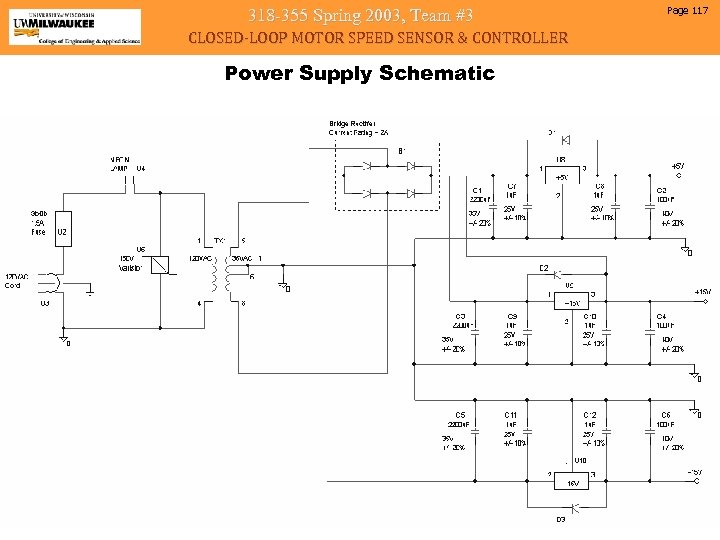 Page 117 318 -355 Spring 2003, Team #3 CLOSED-LOOP MOTOR SPEED SENSOR & CONTROLLER Power Supply Schematic + + +
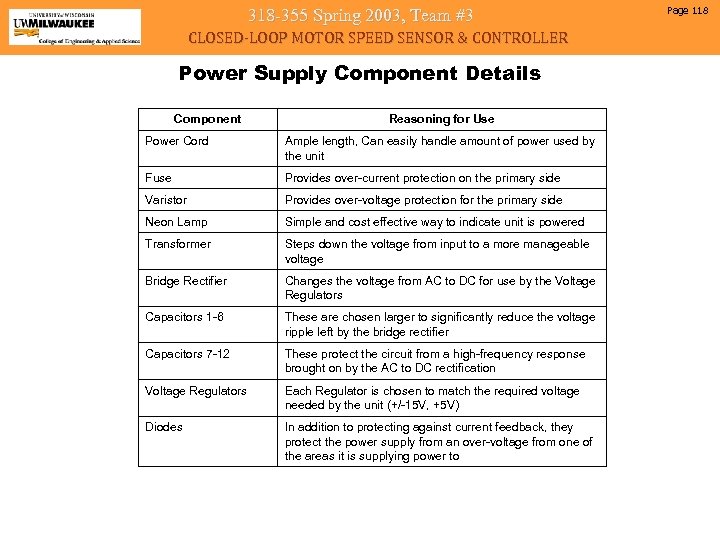 318 -355 Spring 2003, Team #3 CLOSED-LOOP MOTOR SPEED SENSOR & CONTROLLER Power Supply Component Details Component Reasoning for Use Power Cord Ample length, Can easily handle amount of power used by the unit Fuse Provides over-current protection on the primary side Varistor Provides over-voltage protection for the primary side Neon Lamp Simple and cost effective way to indicate unit is powered Transformer Steps down the voltage from input to a more manageable voltage Bridge Rectifier Changes the voltage from AC to DC for use by the Voltage Regulators Capacitors 1 -6 These are chosen larger to significantly reduce the voltage ripple left by the bridge rectifier Capacitors 7 -12 These protect the circuit from a high-frequency response brought on by the AC to DC rectification Voltage Regulators Each Regulator is chosen to match the required voltage needed by the unit (+/-15 V, +5 V) Diodes In addition to protecting against current feedback, they protect the power supply from an over-voltage from one of the areas it is supplying power to Page 118
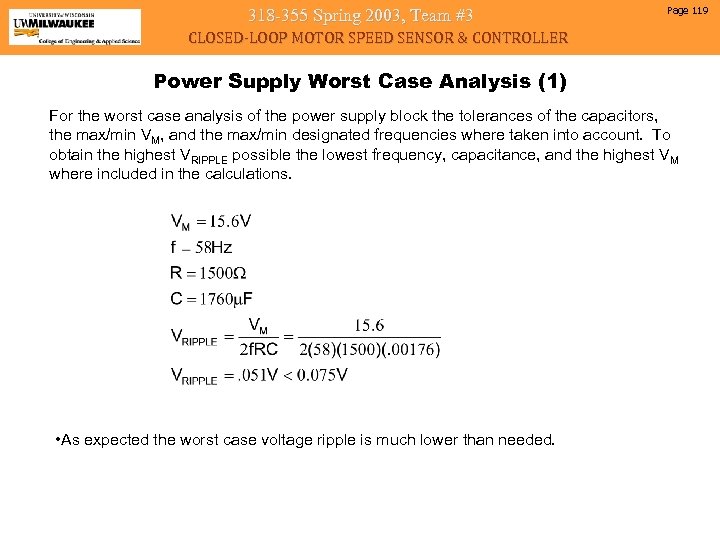 318 -355 Spring 2003, Team #3 Page 119 CLOSED-LOOP MOTOR SPEED SENSOR & CONTROLLER Power Supply Worst Case Analysis (1) For the worst case analysis of the power supply block the tolerances of the capacitors, the max/min VM, and the max/min designated frequencies where taken into account. To obtain the highest VRIPPLE possible the lowest frequency, capacitance, and the highest VM where included in the calculations. • As expected the worst case voltage ripple is much lower than needed.
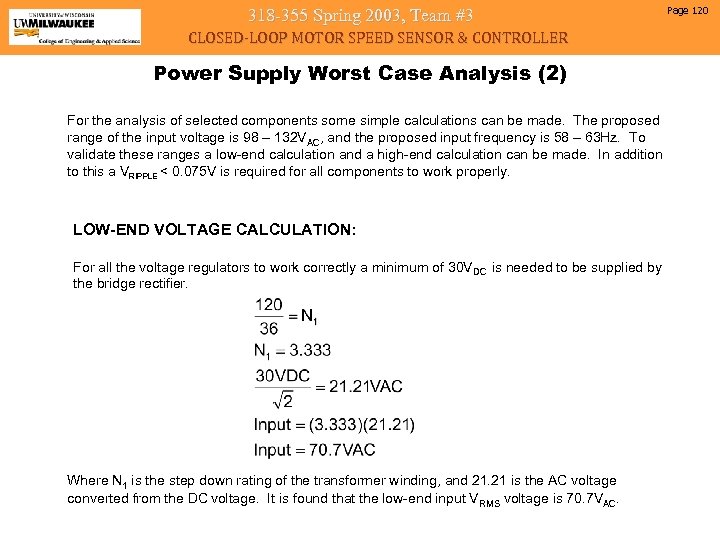 318 -355 Spring 2003, Team #3 CLOSED-LOOP MOTOR SPEED SENSOR & CONTROLLER Power Supply Worst Case Analysis (2) For the analysis of selected components some simple calculations can be made. The proposed range of the input voltage is 98 – 132 VAC, and the proposed input frequency is 58 – 63 Hz. To validate these ranges a low-end calculation and a high-end calculation can be made. In addition to this a VRIPPLE < 0. 075 V is required for all components to work properly. LOW-END VOLTAGE CALCULATION: For all the voltage regulators to work correctly a minimum of 30 VDC is needed to be supplied by the bridge rectifier. Where N 1 is the step down rating of the transformer winding, and 21. 21 is the AC voltage converted from the DC voltage. It is found that the low-end input VRMS voltage is 70. 7 VAC. Page 120
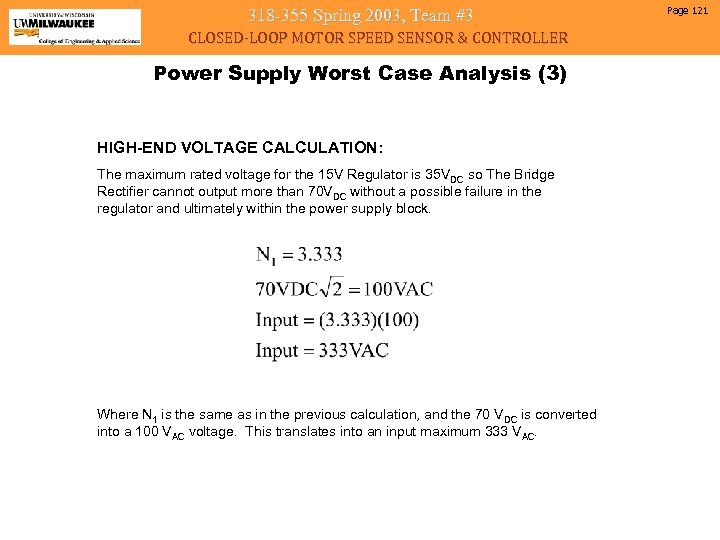 318 -355 Spring 2003, Team #3 CLOSED-LOOP MOTOR SPEED SENSOR & CONTROLLER Power Supply Worst Case Analysis (3) HIGH-END VOLTAGE CALCULATION: The maximum rated voltage for the 15 V Regulator is 35 VDC so The Bridge Rectifier cannot output more than 70 VDC without a possible failure in the regulator and ultimately within the power supply block. Where N 1 is the same as in the previous calculation, and the 70 VDC is converted into a 100 VAC voltage. This translates into an input maximum 333 VAC. Page 121
 318 -355 Spring 2003, Team #3 CLOSED-LOOP MOTOR SPEED SENSOR & CONTROLLER Power Supply Mass Production • All power supply components are suitable for printed circuit board assembly, except for the line cord, fuse holder, and the power indicator lamp. • A separate board will be used for the power supply for isolation. This assembly will contain all through hole components for uniform assembly. Page 122
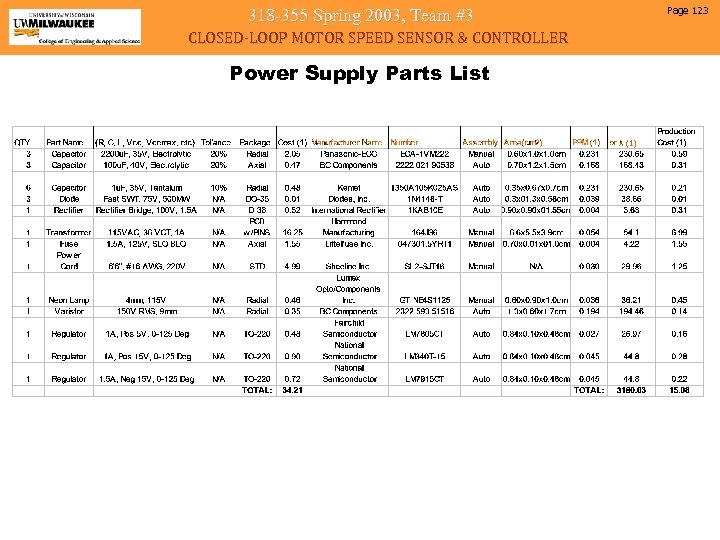 318 -355 Spring 2003, Team #3 CLOSED-LOOP MOTOR SPEED SENSOR & CONTROLLER Power Supply Parts List Page 123
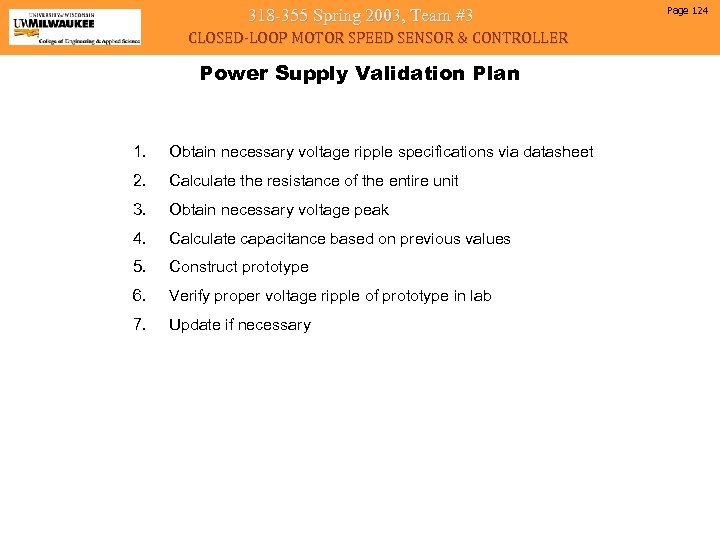 318 -355 Spring 2003, Team #3 CLOSED-LOOP MOTOR SPEED SENSOR & CONTROLLER Power Supply Validation Plan 1. Obtain necessary voltage ripple specifications via datasheet 2. Calculate the resistance of the entire unit 3. Obtain necessary voltage peak 4. Calculate capacitance based on previous values 5. Construct prototype 6. Verify proper voltage ripple of prototype in lab 7. Update if necessary Page 124
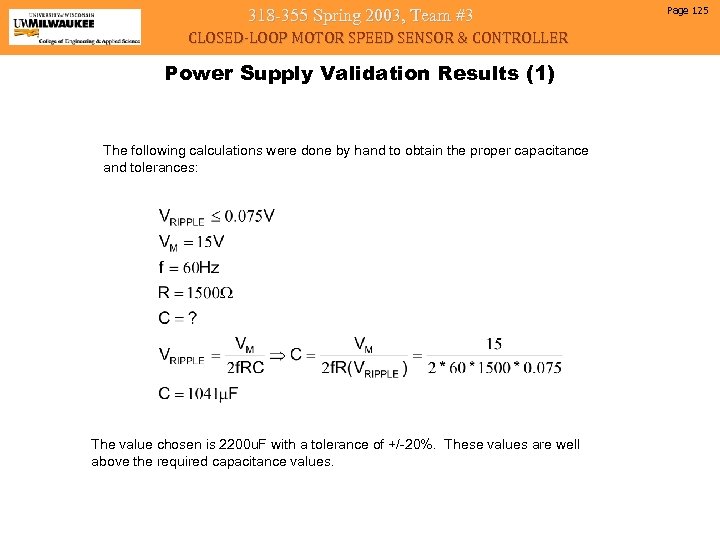 318 -355 Spring 2003, Team #3 CLOSED-LOOP MOTOR SPEED SENSOR & CONTROLLER Power Supply Validation Results (1) The following calculations were done by hand to obtain the proper capacitance and tolerances: The value chosen is 2200 u. F with a tolerance of +/-20%. These values are well above the required capacitance values. Page 125
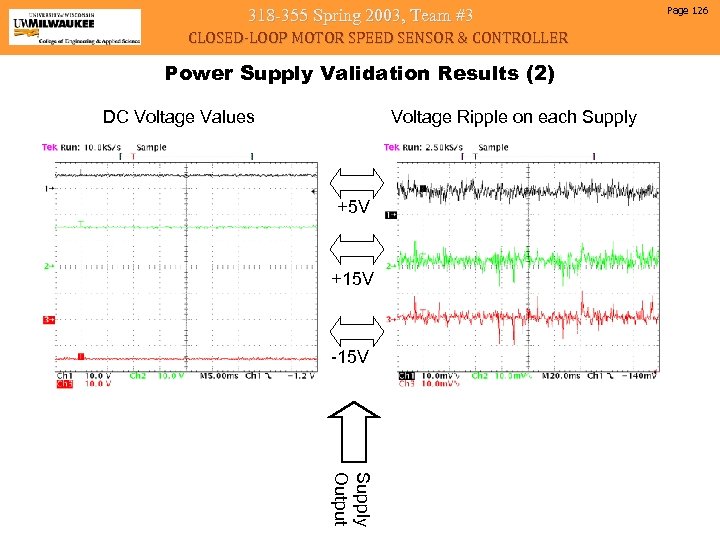 318 -355 Spring 2003, Team #3 CLOSED-LOOP MOTOR SPEED SENSOR & CONTROLLER Power Supply Validation Results (2) DC Voltage Values Voltage Ripple on each Supply +5 V +15 V -15 V Page 126 Supply Output
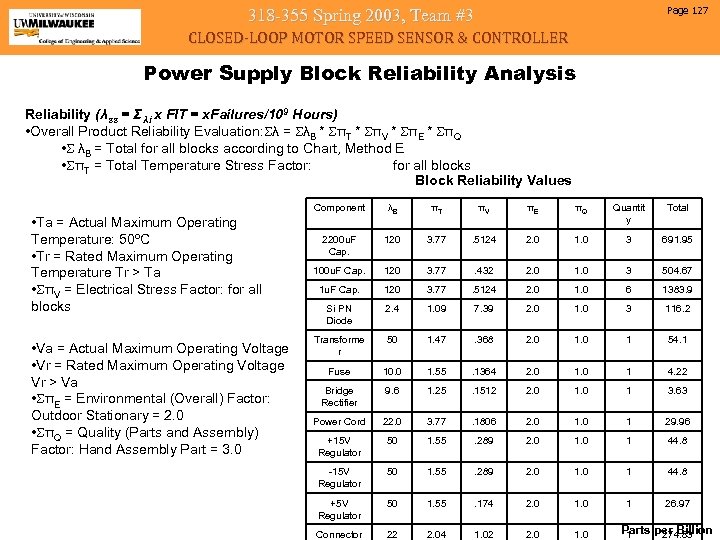 Page 127 318 -355 Spring 2003, Team #3 CLOSED-LOOP MOTOR SPEED SENSOR & CONTROLLER Power Supply Block Reliability Analysis Reliability (λss = Σ λi x FIT = x. Failures/109 Hours) • Overall Product Reliability Evaluation: λ = λB * πT * πV * πE * πQ • λB = Total for all blocks according to Chart, Method E • πT = Total Temperature Stress Factor: for all blocks Block Reliability Values Component • Ta = Actual Maximum Operating Temperature: 50ºC • Tr = Rated Maximum Operating Temperature Tr > Ta • πV = Electrical Stress Factor: for all blocks • Va = Actual Maximum Operating Voltage • Vr = Rated Maximum Operating Voltage Vr > Va • πE = Environmental (Overall) Factor: Outdoor Stationary = 2. 0 • πQ = Quality (Parts and Assembly) Factor: Hand Assembly Part = 3. 0 λB πT πV πE πQ Quantit y Total 2200 u. F Cap. 120 3. 77 . 5124 2. 0 1. 0 3 691. 95 100 u. F Cap. 120 3. 77 . 432 2. 0 1. 0 3 504. 67 1 u. F Cap. 120 3. 77 . 5124 2. 0 1. 0 6 1383. 9 Si PN Diode 2. 4 1. 09 7. 39 2. 0 1. 0 3 116. 2 Transforme r 50 1. 47 . 368 2. 0 1 54. 1 Fuse 10. 0 1. 55 . 1364 2. 0 1 4. 22 Bridge Rectifier 9. 6 1. 25 . 1512 2. 0 1 3. 63 Power Cord 22. 0 3. 77 . 1806 2. 0 1 29. 96 +15 V Regulator 50 1. 55 . 289 2. 0 1 44. 8 -15 V Regulator 50 1. 55 . 289 2. 0 1 44. 8 +5 V Regulator 50 1. 55 . 174 2. 0 1 26. 97 Connector 22 2. 04 1. 02 2. 0 1. 0 Parts per Billion 1 274. 83
 318 -355 Spring 2003, Team #3 Page 128 CLOSED-LOOP MOTOR SPEED SENSOR & CONTROLLER Prototype integration and validation details next. . .
 318 -355 Spring 2003, Team #3 CLOSED-LOOP MOTOR SPEED SENSOR & CONTROLLER Prototype Integration Details • Prototype consisted of six boards: • Main Board containing power supply and DAC • CPLD encoder board • Microprocessor board • LCD display • Keypad • Sensor circuit • All of the circuits discussed, except the sensor circuit, are housed in a plastic enclosure. This enclosure was customized to mount the keypad, display, terminals blocks, fuse holder and power cord. • Perf board, with point to point soldering, was used for the power supply and DAC circuits. • Wire-wrapping was used to interconnect the microprocessor board, CPLD board, LCD display, keypad, and the terminal blocks. • Assembly of the prototype was a team effort, with all members contributing. Page 129
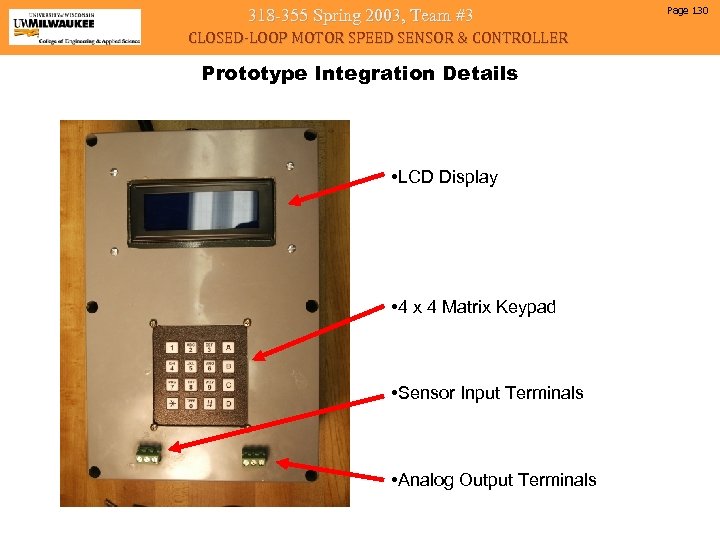 318 -355 Spring 2003, Team #3 CLOSED-LOOP MOTOR SPEED SENSOR & CONTROLLER Prototype Integration Details • LCD Display • 4 x 4 Matrix Keypad • Sensor Input Terminals • Analog Output Terminals Page 130
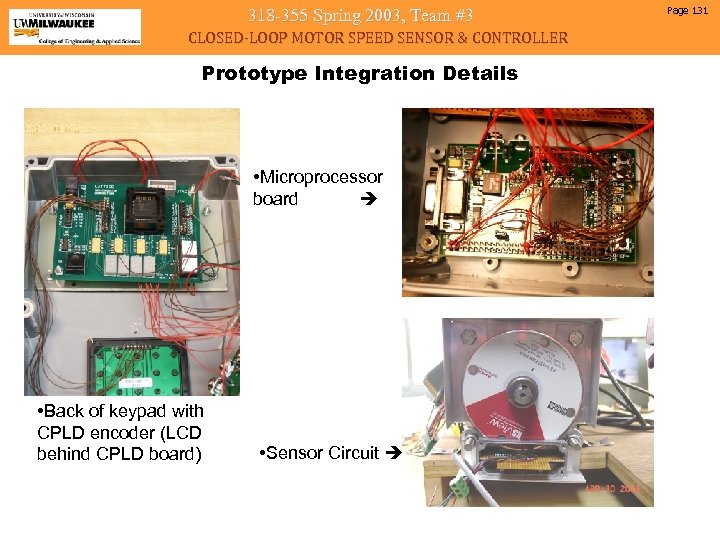 318 -355 Spring 2003, Team #3 CLOSED-LOOP MOTOR SPEED SENSOR & CONTROLLER Prototype Integration Details • Microprocessor board • Back of keypad with CPLD encoder (LCD behind CPLD board) • Sensor Circuit Page 131
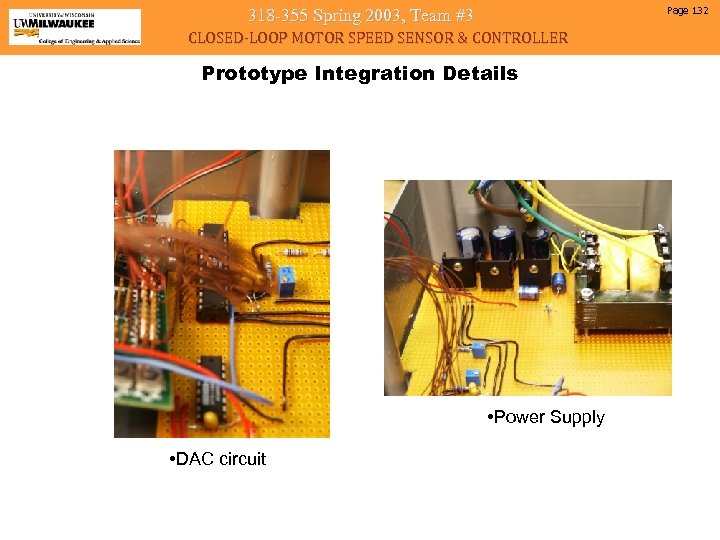 Page 132 318 -355 Spring 2003, Team #3 CLOSED-LOOP MOTOR SPEED SENSOR & CONTROLLER Prototype Integration Details • Power Supply • DAC circuit
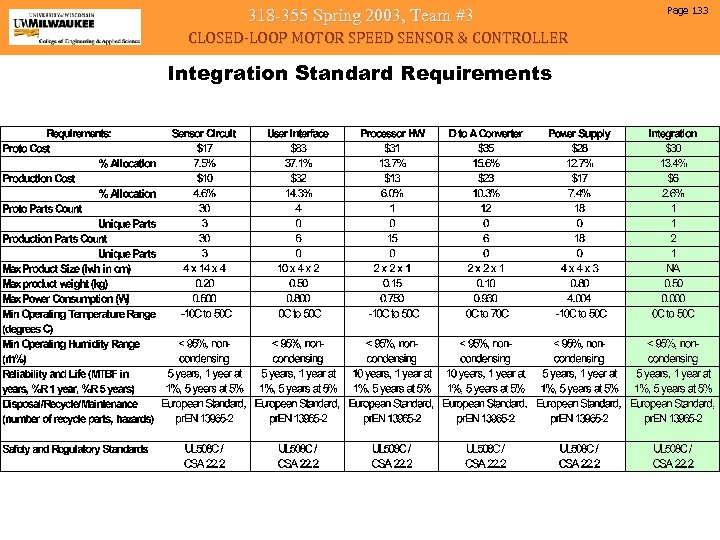 318 -355 Spring 2003, Team #3 CLOSED-LOOP MOTOR SPEED SENSOR & CONTROLLER Integration Standard Requirements Page 133
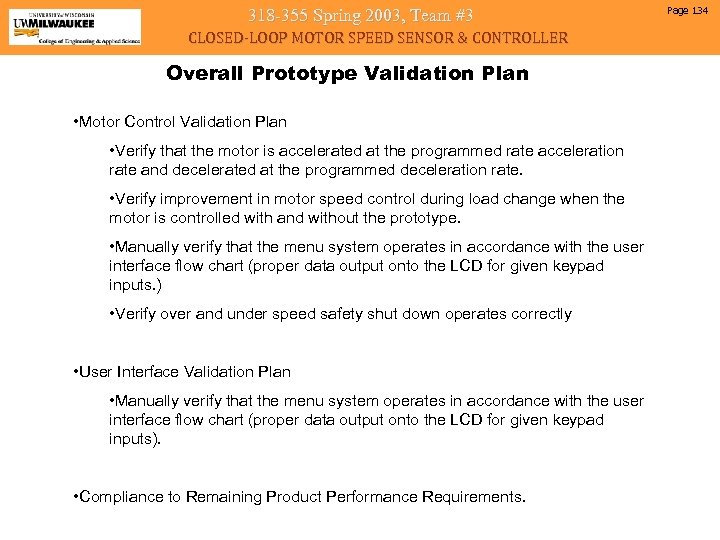 318 -355 Spring 2003, Team #3 CLOSED-LOOP MOTOR SPEED SENSOR & CONTROLLER Overall Prototype Validation Plan • Motor Control Validation Plan • Verify that the motor is accelerated at the programmed rate acceleration rate and decelerated at the programmed deceleration rate. • Verify improvement in motor speed control during load change when the motor is controlled with and without the prototype. • Manually verify that the menu system operates in accordance with the user interface flow chart (proper data output onto the LCD for given keypad inputs. ) • Verify over and under speed safety shut down operates correctly • User Interface Validation Plan • Manually verify that the menu system operates in accordance with the user interface flow chart (proper data output onto the LCD for given keypad inputs). • Compliance to Remaining Product Performance Requirements. Page 134
 318 -355 Spring 2003, Team #3 CLOSED-LOOP MOTOR SPEED SENSOR & CONTROLLER Prototype Validation Test Results • Verified Validation Tests: Page 135
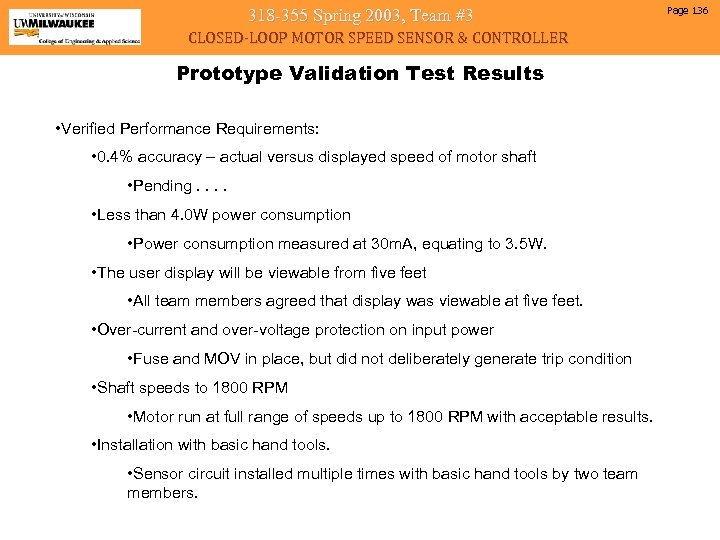 318 -355 Spring 2003, Team #3 CLOSED-LOOP MOTOR SPEED SENSOR & CONTROLLER Prototype Validation Test Results • Verified Performance Requirements: • 0. 4% accuracy – actual versus displayed speed of motor shaft • Pending. . • Less than 4. 0 W power consumption • Power consumption measured at 30 m. A, equating to 3. 5 W. • The user display will be viewable from five feet • All team members agreed that display was viewable at five feet. • Over-current and over-voltage protection on input power • Fuse and MOV in place, but did not deliberately generate trip condition • Shaft speeds to 1800 RPM • Motor run at full range of speeds up to 1800 RPM with acceptable results. • Installation with basic hand tools. • Sensor circuit installed multiple times with basic hand tools by two team members. Page 136
 318 -355 Spring 2003, Team #3 CLOSED-LOOP MOTOR SPEED SENSOR & CONTROLLER Prototype Validation Test Results • Unverified Validation Tests: Page 137
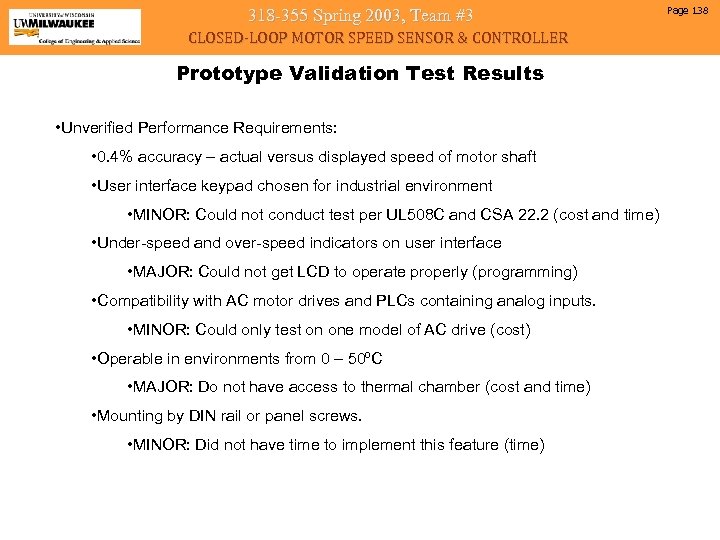 318 -355 Spring 2003, Team #3 CLOSED-LOOP MOTOR SPEED SENSOR & CONTROLLER Prototype Validation Test Results • Unverified Performance Requirements: • 0. 4% accuracy – actual versus displayed speed of motor shaft • User interface keypad chosen for industrial environment • MINOR: Could not conduct test per UL 508 C and CSA 22. 2 (cost and time) • Under-speed and over-speed indicators on user interface • MAJOR: Could not get LCD to operate properly (programming) • Compatibility with AC motor drives and PLCs containing analog inputs. • MINOR: Could only test on one model of AC drive (cost) • Operable in environments from 0 – 50ºC • MAJOR: Do not have access to thermal chamber (cost and time) • Mounting by DIN rail or panel screws. • MINOR: Did not have time to implement this feature (time) Page 138
 318 -355 Spring 2003, Team #3 Page 139 CLOSED-LOOP MOTOR SPEED SENSOR & CONTROLLER Next is reliability, warranty, and servicing
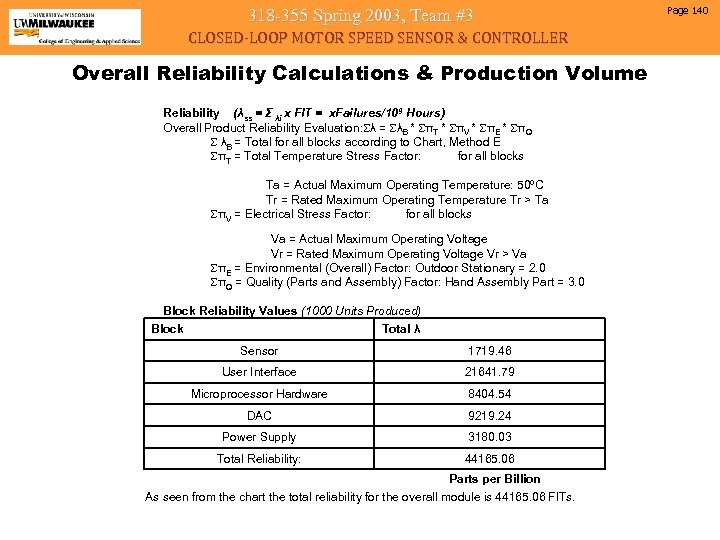 318 -355 Spring 2003, Team #3 CLOSED-LOOP MOTOR SPEED SENSOR & CONTROLLER Overall Reliability Calculations & Production Volume Reliability (λss = Σ λi x FIT = x. Failures/109 Hours) Overall Product Reliability Evaluation: λ = λB * πT * πV * πE * πQ λB = Total for all blocks according to Chart, Method E πT = Total Temperature Stress Factor: for all blocks Ta = Actual Maximum Operating Temperature: 50ºC Tr = Rated Maximum Operating Temperature Tr > Ta πV = Electrical Stress Factor: for all blocks Va = Actual Maximum Operating Voltage Vr = Rated Maximum Operating Voltage Vr > Va πE = Environmental (Overall) Factor: Outdoor Stationary = 2. 0 πQ = Quality (Parts and Assembly) Factor: Hand Assembly Part = 3. 0 Block Reliability Values (1000 Units Produced) Block Total λ Sensor 1719. 46 User Interface 21641. 79 Microprocessor Hardware 8404. 54 DAC 9219. 24 Power Supply 3180. 03 Total Reliability: 44165. 06 Parts per Billion As seen from the chart the total reliability for the overall module is 44165. 06 FITs. Page 140
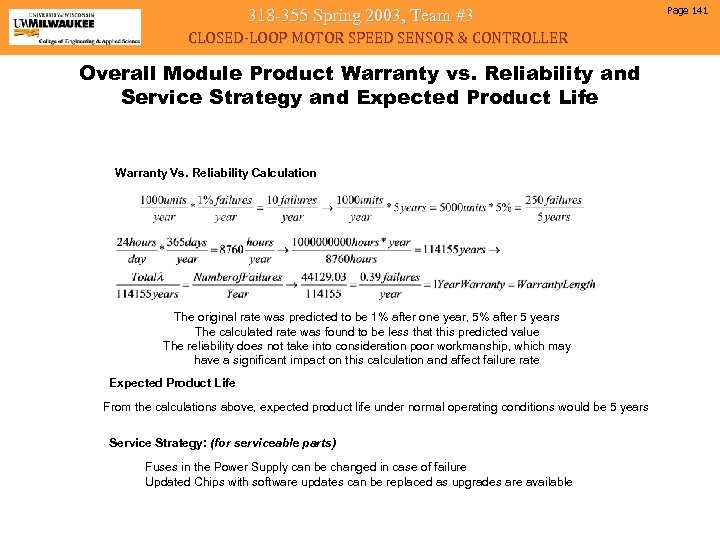 318 -355 Spring 2003, Team #3 CLOSED-LOOP MOTOR SPEED SENSOR & CONTROLLER Overall Module Product Warranty vs. Reliability and Service Strategy and Expected Product Life Warranty Vs. Reliability Calculation The original rate was predicted to be 1% after one year, 5% after 5 years The calculated rate was found to be less that this predicted value The reliability does not take into consideration poor workmanship, which may have a significant impact on this calculation and affect failure rate Expected Product Life From the calculations above, expected product life under normal operating conditions would be 5 years Service Strategy: (for serviceable parts) Fuses in the Power Supply can be changed in case of failure Updated Chips with software updates can be replaced as upgrades are available Page 141
 318 -355 Spring 2003, Team #3 Page 142 CLOSED-LOOP MOTOR SPEED SENSOR & CONTROLLER Overall Module Serviceable Parts and Instructions, Disposal of Serviceable Parts and Reclamation Serviceable Parts: -Microprocessor chip can be reprogrammed with updated software and replaced -PLD chip can be reprogrammed with updated software and replaced -All other parts are non-repairable Disposal of Serviceable Parts: -All serviceable parts that are passed serviceability that are recyclable will be recycled of per state/federal regulations (refer to disposal/recycling standards of the technical report for more information and requirements) • All serviceable parts that are passed serviceability that are not recyclable will be disposed of per state/federal regulations (refer to disposal/recycling standards of the technical report for more information and requirements) Reclamation of Parts for Disposal or Recycling: -All returned modules will be tested at bawd’s corporate manufacturing facility to determine if any parts are serviceable and be reclaimed or if the whole module is to be disassembled for further processing -All reclamation/disassembly/recycling processes will be done by contract with an external contractor such as Central Metal Fabricators of Waukesha Instructions: -Operator instructions and other pertinent specifications can be found in the specification manual distributed to this product presentation’s attendees
 318 -355 Spring 2003, Team #3 Page 143 CLOSED-LOOP MOTOR SPEED SENSOR & CONTROLLER Production aspects, obsolescence, and the closing will wrap it up!
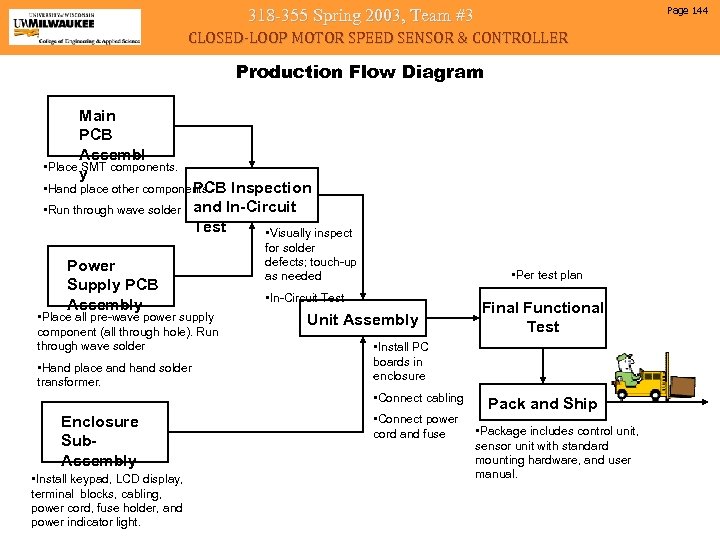 Page 144 318 -355 Spring 2003, Team #3 CLOSED-LOOP MOTOR SPEED SENSOR & CONTROLLER Production Flow Diagram Main PCB Assembl • Place SMT components. y • Hand place other components PCB • Run through wave solder Inspection and In-Circuit Test • Visually inspect Power Supply PCB Assembly • Place all pre-wave power supply component (all through hole). Run through wave solder • Hand place and hand solder transformer. for solder defects; touch-up as needed • Per test plan • In-Circuit Test Unit Assembly • Install PC boards in enclosure • Connect cabling Enclosure Sub. Assembly • Install keypad, LCD display, terminal blocks, cabling, power cord, fuse holder, and power indicator light. Final Functional Test • Connect power cord and fuse Pack and Ship • Package includes control unit, sensor unit with standard mounting hardware, and user manual.
 318 -355 Spring 2003, Team #3 Page 145 CLOSED-LOOP MOTOR SPEED SENSOR & CONTROLLER Mass Production Test Strategy (1) • Computer automated in-circuit testing for the Speed Sensor, DAC, LCD, and Keypad. • DAC – A range of 15 bit values input to the DAC. Corresponding output voltage verified with a DVM. • Speed Sensor Photo-Transistor – Mechanical device to trigger sensor at minimum and maximum frequencies. • Speed Sensor Conditioning Circuit– Square wave input of varying frequencies input with a function generator. Output circuit frequency and voltage verified with oscilloscope. • Keypad – Buttons depressed with a solenoid array. 16 wire output connected to computer parallel port. Proper output signal verified through computer connection. • LCD – Text output script input to LCD. Verified optically through image sensors. • Test Equipment Required – Personal Computer, DVM, Frequency Generator, Function Generator, Oscilloscope, Solenoid Array, Image Sensors, and Bed of Nails.
 318 -355 Spring 2003, Team #3 CLOSED-LOOP MOTOR SPEED SENSOR & CONTROLLER Mass Production Test Strategy (2) • System Functional Testing • All system testing automated through test scripts. • Simulates a complete motor control cycle including (input parameters set through keypad, motor start, acceleration rate verified, steady state load change analysis, shut down, deceleration rate verified, and optical verification of LCD output. • Test equipment is identical to that used for sub – assembly testing. • Production Yield • Goal of 90% first-pass yield; technician area to be established to handle production repair issues. Long-term goal of 96% to achieve world class manufacturing status. • Potential Volume • Production line will be design to produce a projected yearly volume of 1000 units. Page 146
 318 -355 Spring 2003, Team #3 CLOSED-LOOP MOTOR SPEED SENSOR & CONTROLLER Overall Production Aspects • Integration of blocks to three PCBs assemblies: main board, power supply board, and sensor board. • Surface mount technology to be used on main board and sensor board. • Thru-hole technology to be used on power supply board • Solder reflow and wave solder processes to be used. • Hand assembly of product enclosure and packaging. • Assembly line setup will emphasize “lean” principals. Process FMEA will be conducted to optimize process flow and other efficiencies. Page 147
 318 -355 Spring 2003, Team #3 CLOSED-LOOP MOTOR SPEED SENSOR & CONTROLLER Production Costs • Tooling • ICT fixture: $15, 000 • Functional Test Stand: $7, 500 • Fixtures for assembly purposes: $6, 500 • Infrastructure • Building / Overhead: based on region and economy • Workbenches, hand tools, etc: $50, 000 • Other incidentals: based on region and economy Page 148
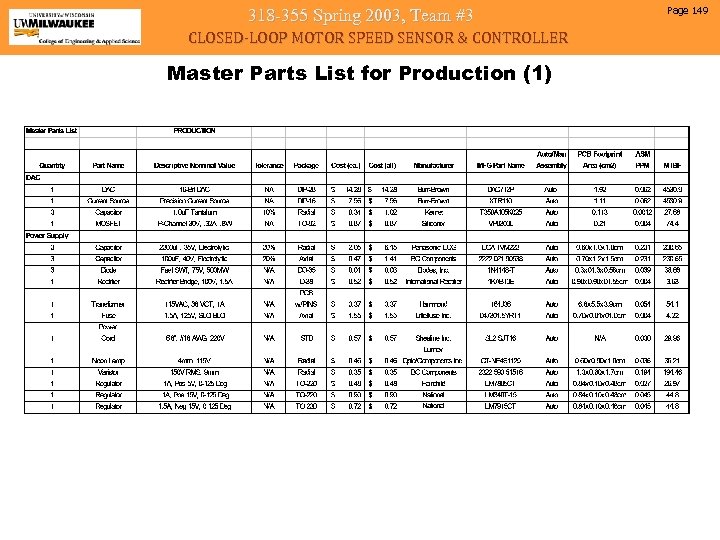 318 -355 Spring 2003, Team #3 CLOSED-LOOP MOTOR SPEED SENSOR & CONTROLLER Master Parts List for Production (1) Page 149
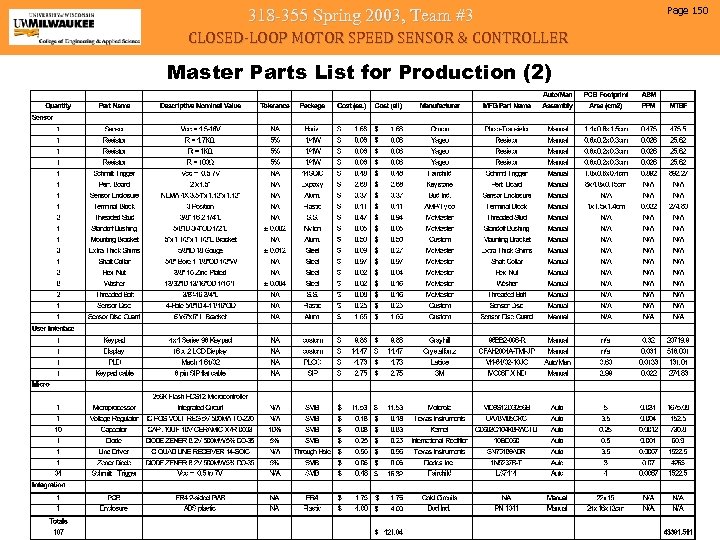 318 -355 Spring 2003, Team #3 CLOSED-LOOP MOTOR SPEED SENSOR & CONTROLLER Master Parts List for Production (2) Page 150
 318 -355 Spring 2003, Team #3 CLOSED-LOOP MOTOR SPEED SENSOR & CONTROLLER Product Packaging / Accessories • Package includes control unit, sensor unit with standard mounting hardware, and a user manual. • Packaging material will include a cardboard carton, appropriate labeling, and paper-matrix inserts to stabilize and protect the contents. • Customer will be responsible for providing a three-conductor cable for interconnection between the sensor and the control box. • Additional hardware kits will be sold separately for non-standard mounting configurations. Page 151
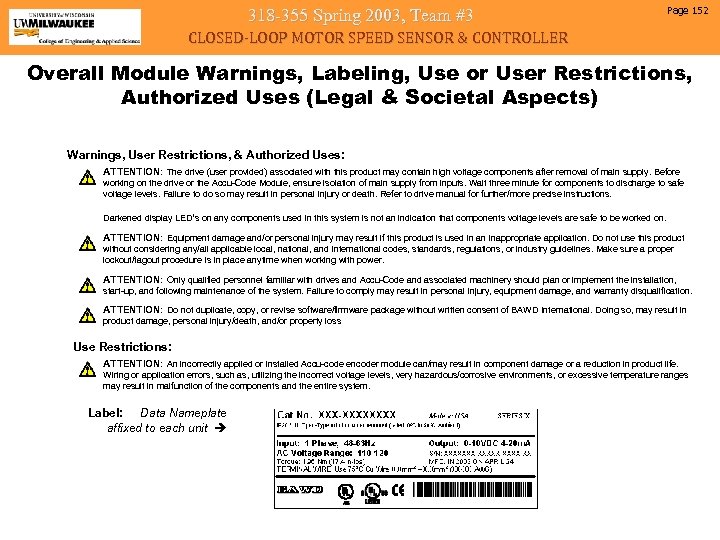 318 -355 Spring 2003, Team #3 Page 152 CLOSED-LOOP MOTOR SPEED SENSOR & CONTROLLER Overall Module Warnings, Labeling, Use or User Restrictions, Authorized Uses (Legal & Societal Aspects) Warnings, User Restrictions, & Authorized Uses: ATTENTION: The drive (user provided) associated with this product may contain high voltage components after removal of main supply. Before working on the drive or the Accu-Code Module, ensure isolation of main supply from inputs. Wait three minute for components to discharge to safe voltage levels. Failure to do so may result in personal injury or death. Refer to drive manual for further/more precise instructions. Darkened display LED’s on any components used in this system is not an indication that components voltage levels are safe to be worked on. ATTENTION: Equipment damage and/or personal injury may result if this product is used in an inappropriate application. Do not use this product without considering any/all applicable local, national, and international codes, standards, regulations, or industry guidelines. Make sure a proper lockout/tagout procedure is in place anytime when working with power. ATTENTION: Only qualified personnel familiar with drives and Accu-Code and associated machinery should plan or implement the installation, start-up, and following maintenance of the system. Failure to comply may result in personal injury, equipment damage, and warranty disqualification. ATTENTION: Do not duplicate, copy, or revise software/firmware package without written consent of BAWD International. Doing so, may result in product damage, personal injury/death, and/or property loss Use Restrictions: ATTENTION: An incorrectly applied or installed Accu-code encoder module can/may result in component damage or a reduction in product life. Wiring or application errors, such as, utilizing the incorrect voltage levels, very hazardous/corrosive environments, or excessive temperature ranges may result in malfunction of the components and the entire system. Label: Data Nameplate affixed to each unit
 318 -355 Spring 2003, Team #3 Page 153 CLOSED-LOOP MOTOR SPEED SENSOR & CONTROLLER Hazardous Materials / Disposal and Recyclability Hazardous Materials Present: Lead (in solder), Ga. As (in photo-transistor) Disposal of Hazardous Materials: • With current manufacturing technology, quantities of lead and Ga. As can be minimized • These materials do pose an environmental threat, however recycling of failed components is not feasible at this point. • Components that have not failed can be extracted from the PCB assembly and recycled. The gold plating on the PCB will also be extracted for reuse. • Due to the nature of the design and components used in this product, it is very likely that failures will be isolated in specific circuits. This allows for a high percentage of potential component re-use
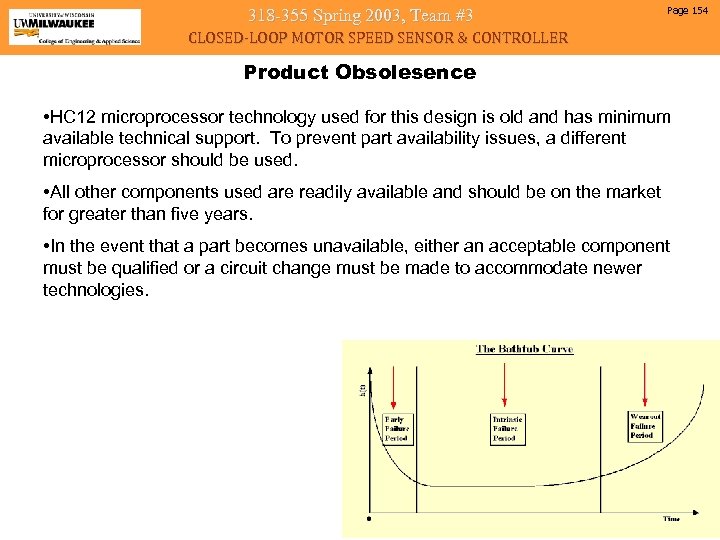 318 -355 Spring 2003, Team #3 Page 154 CLOSED-LOOP MOTOR SPEED SENSOR & CONTROLLER Product Obsolesence • HC 12 microprocessor technology used for this design is old and has minimum available technical support. To prevent part availability issues, a different microprocessor should be used. • All other components used are readily available and should be on the market for greater than five years. • In the event that a part becomes unavailable, either an acceptable component must be qualified or a circuit change must be made to accommodate newer technologies.
 318 -355 Spring 2003, Team #3 Page 155 CLOSED-LOOP MOTOR SPEED SENSOR & CONTROLLER Closing • This product proved to be more challenging than originally anticipated. • The whole design process revealed to all team members the complexity of the complete design, development, and manufacturing processes. • We would like to thank the following: • Jim Cummins for his help with VHDL programming. • Fred Lers for his help with the sensor enclosure and disc. • Jeff Kautzer for his design advice. • Rockwell Automation for borrowing us the AC drive and motor. • Our wives, daughters, girlfriends, and motorcycles for being understanding for all the time away. • And, finally, the CEAS faculty and staff at UW-M for all the years of support.
 318 -355 Spring 2003, Team #3 CLOSED-LOOP MOTOR SPEED SENSOR & CONTROLLER Page 156
 318 -355 Spring 2003, Team #3 CLOSED-LOOP MOTOR SPEED SENSOR & CONTROLLER Page 157
 318 -355 Spring 2003, Team #3 CLOSED-LOOP MOTOR SPEED SENSOR & CONTROLLER Page 158
 318 -355 Spring 2003, Team #3 CLOSED-LOOP MOTOR SPEED SENSOR & CONTROLLER Page 159
 318 -355 Spring 2003, Team #3 CLOSED-LOOP MOTOR SPEED SENSOR & CONTROLLER Page 160
 318 -355 Spring 2003, Team #3 CLOSED-LOOP MOTOR SPEED SENSOR & CONTROLLER Appendix Page 161
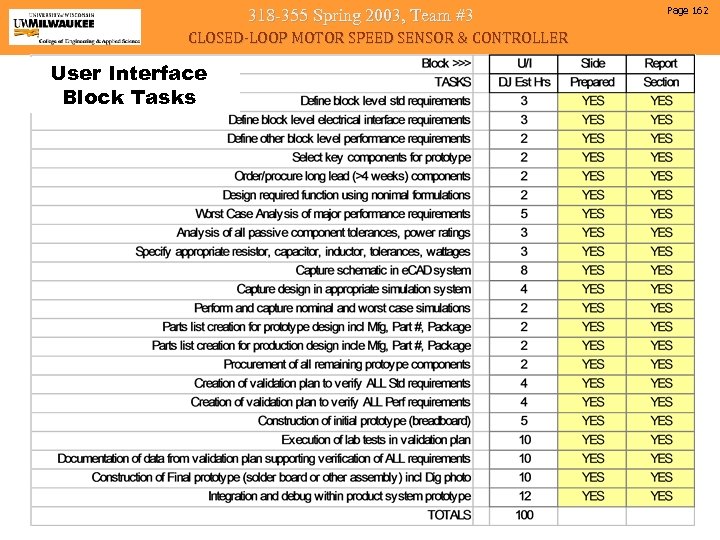 318 -355 Spring 2003, Team #3 CLOSED-LOOP MOTOR SPEED SENSOR & CONTROLLER User Interface Block Tasks Page 162
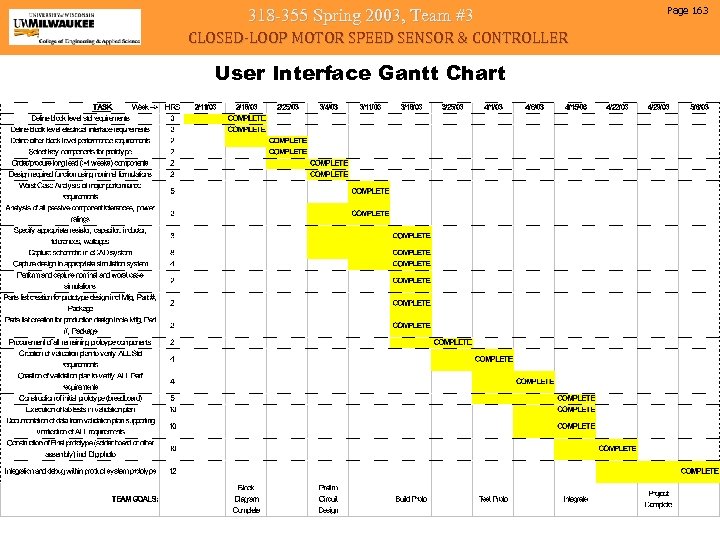 318 -355 Spring 2003, Team #3 CLOSED-LOOP MOTOR SPEED SENSOR & CONTROLLER User Interface Gantt Chart Page 163
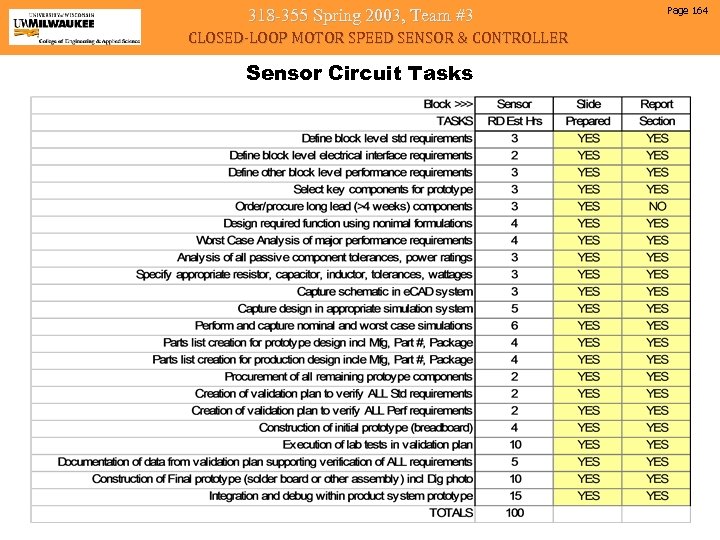 318 -355 Spring 2003, Team #3 CLOSED-LOOP MOTOR SPEED SENSOR & CONTROLLER Sensor Circuit Tasks Page 164
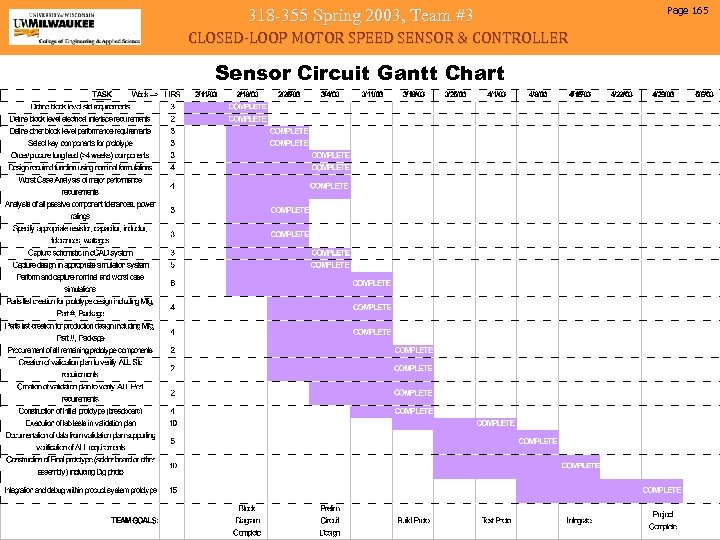 318 -355 Spring 2003, Team #3 CLOSED-LOOP MOTOR SPEED SENSOR & CONTROLLER Sensor Circuit Gantt Chart Page 165
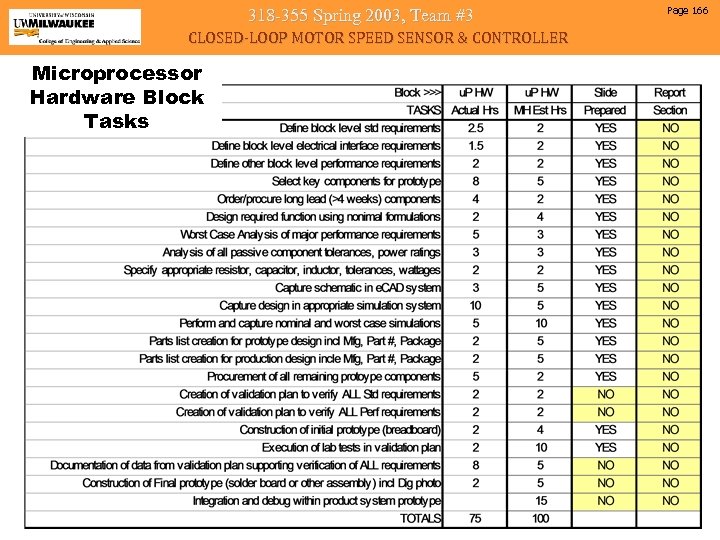 318 -355 Spring 2003, Team #3 CLOSED-LOOP MOTOR SPEED SENSOR & CONTROLLER Microprocessor Hardware Block Tasks Page 166
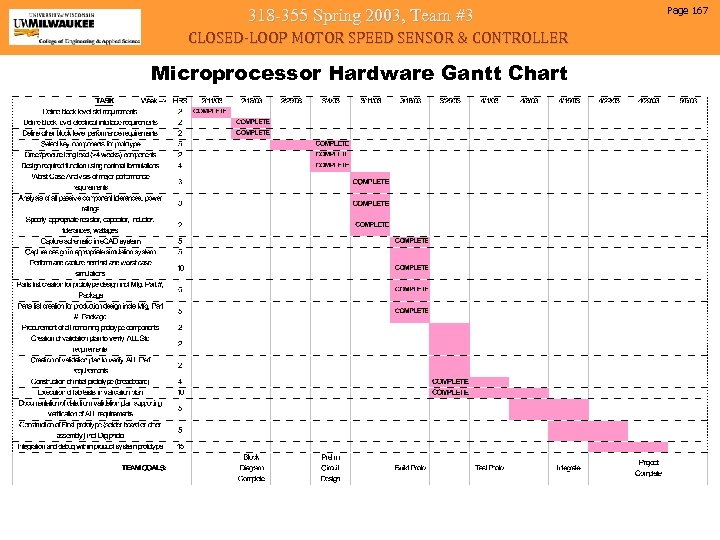 318 -355 Spring 2003, Team #3 CLOSED-LOOP MOTOR SPEED SENSOR & CONTROLLER Microprocessor Hardware Gantt Chart Page 167
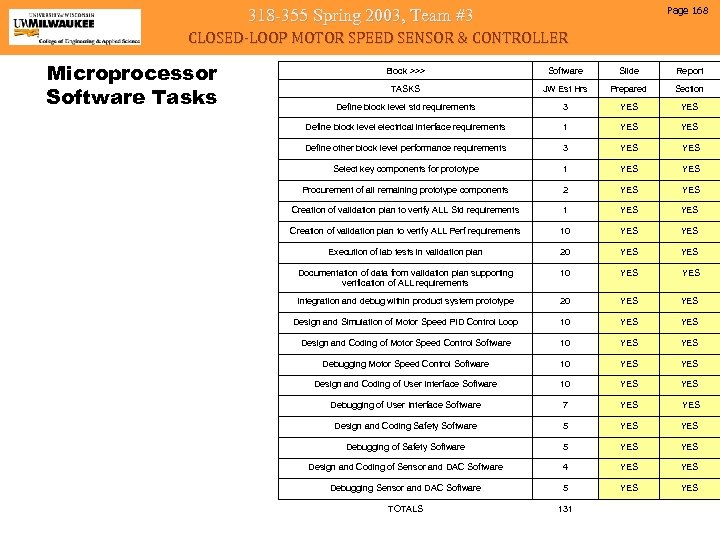 Page 168 318 -355 Spring 2003, Team #3 CLOSED-LOOP MOTOR SPEED SENSOR & CONTROLLER Microprocessor Software Tasks Block >>> Software Slide Report TASKS JW Est Hrs Prepared Section Define block level std requirements 3 YES Define block level electrical interface requirements 1 YES Define other block level performance requirements 3 YES Select key components for prototype 1 YES Procurement of all remaining prototype components 2 YES Creation of validation plan to verify ALL Std requirements 1 YES Creation of validation plan to verify ALL Perf requirements 10 YES Execution of lab tests in validation plan 20 YES Documentation of data from validation plan supporting verification of ALL requirements 10 YES Integration and debug within product system prototype 20 YES Design and Simulation of Motor Speed PID Control Loop 10 YES Design and Coding of Motor Speed Control Software 10 YES Debugging Motor Speed Control Software 10 YES Design and Coding of User Interface Software 10 YES Debugging of User Interface Software 7 YES Design and Coding Safety Software 5 YES Debugging of Safety Software 5 YES Design and Coding of Sensor and DAC Software 4 YES Debugging Sensor and DAC Software 5 YES TOTALS 131
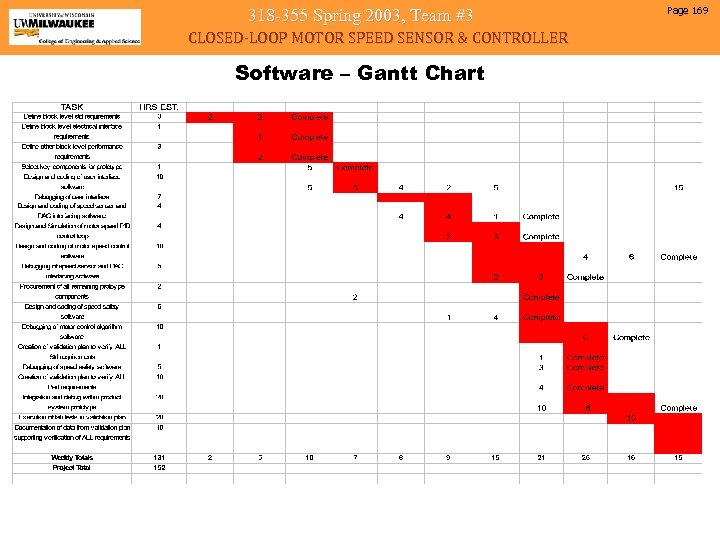 318 -355 Spring 2003, Team #3 CLOSED-LOOP MOTOR SPEED SENSOR & CONTROLLER Software – Gantt Chart Page 169
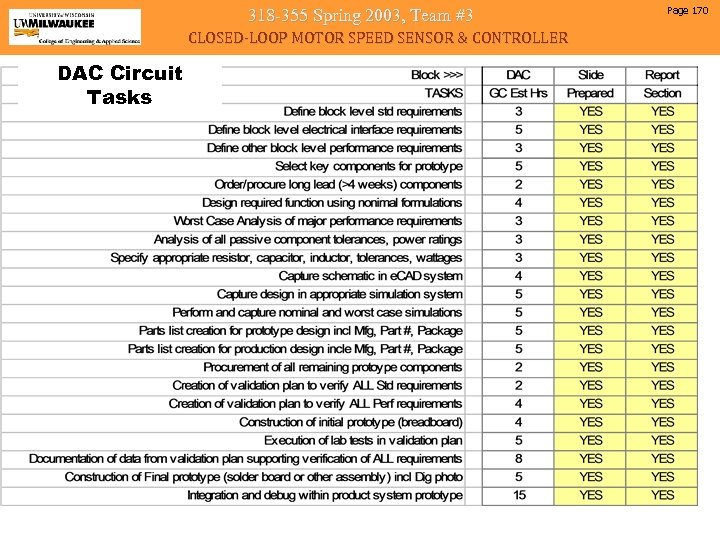 318 -355 Spring 2003, Team #3 CLOSED-LOOP MOTOR SPEED SENSOR & CONTROLLER DAC Circuit Tasks Page 170
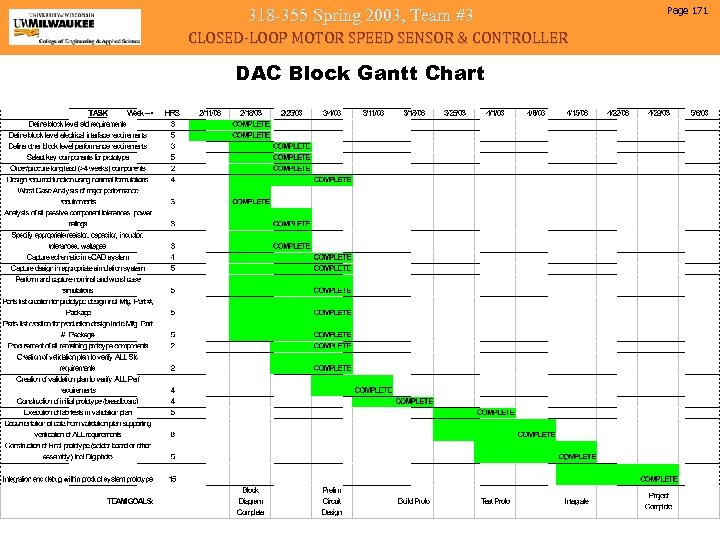 318 -355 Spring 2003, Team #3 CLOSED-LOOP MOTOR SPEED SENSOR & CONTROLLER DAC Block Gantt Chart Page 171
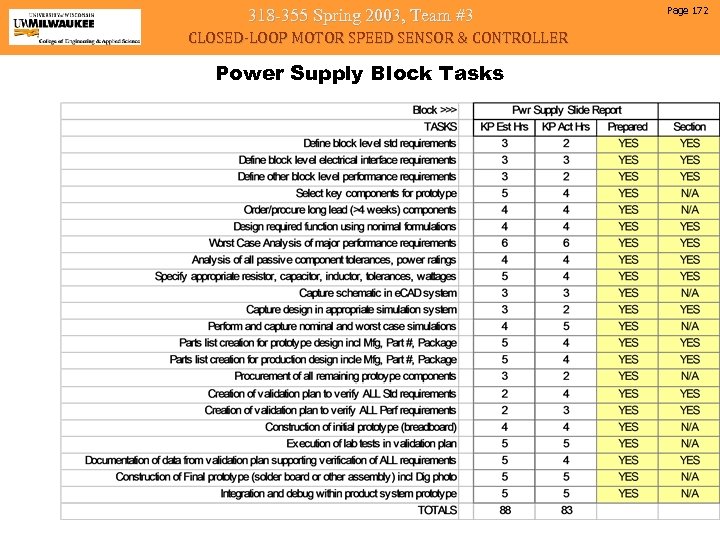 318 -355 Spring 2003, Team #3 CLOSED-LOOP MOTOR SPEED SENSOR & CONTROLLER Power Supply Block Tasks Page 172
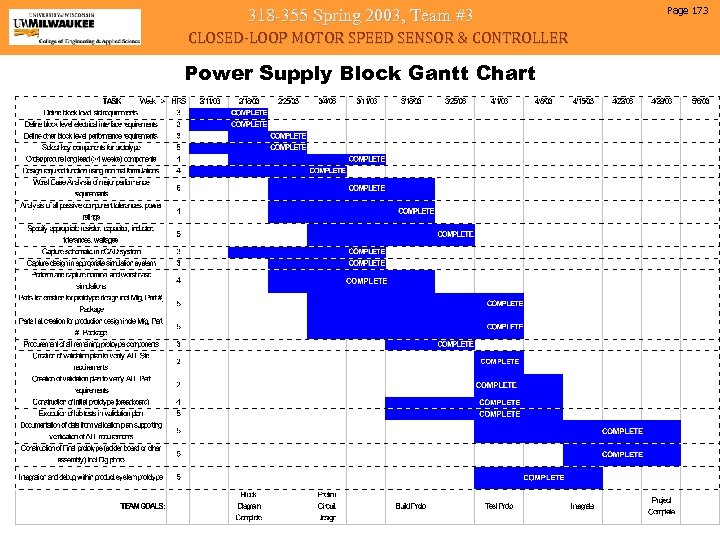 318 -355 Spring 2003, Team #3 CLOSED-LOOP MOTOR SPEED SENSOR & CONTROLLER Power Supply Block Gantt Chart Page 173