 Скачать презентацию 3 th October 2014 Understand
a80c9daf4de906410441b13c7488abe1.ppt
- Количество слайдов: 29



3 th October 2014
• Understand more about what phonics is and how we teach it at school • Not to scare you – handouts will be a reference for you with some of the hard language involved with phonics • To give you practical ideas on games and activities you can be playing at home with your children • For you to feel more confident in supporting us in teaching your child to read letters, words, sentences and texts
It has been proven that by following a systematic and structured programme for 20 minutes every day, children are more able to deal with the complexities of reading and writing. However, this is just one of the methods that we use.
Reception Covers Phases 1, 2 and 3 Year 1 Covers Phases 4 and 5
Letters and Sounds Phase 0 ne
Phase One aspects • • Environmental sounds Instrumental sounds Body percussion Rhythm and rhyme Alliteration Voice sounds Oral blending and segmenting
Environmental Sounds • Listening walks (indoors and outdoors) • Drumming outdoors • Sound lotto • Singing phonics
Instrumental sounds • Match the sound • Which instrument? • Music to story
Body Percussion • Action songs • Sounds made by different parts of body • Pass the sound around the circle
Rhythm and rhyme • Silly soup game • Nursery rhymes and songs • Playing with words • Repetitive stories
Alliteration • Digging for treasure – hiding pictures/objects in the sand all beginning with the same sound. • Same sound sentences eg Sam spied seashells on the seashore.
Voice sounds • Mouth movements – making bubbles/blowing/watching in the mirror. • Voice change ie. pitch
Oral blending and segmenting • Adult begins to model oral blending e. g. get your h-a-t • I spy • Sound talk across the river game
Phase One was designed to help children to: • • • Listen attentively Develop/Broaden their vocabulary Speak confidently Discriminate phonemes Reproduce audibly the phonemes they hear
Phonics Phase 2 and 3 Reception
Phase 2 • Is the start of systematic phonic work. • Begins the understanding of grapheme- phoneme correspondence. • Understand that words are constructed from phonemes and that phonemes are represented by graphemes.
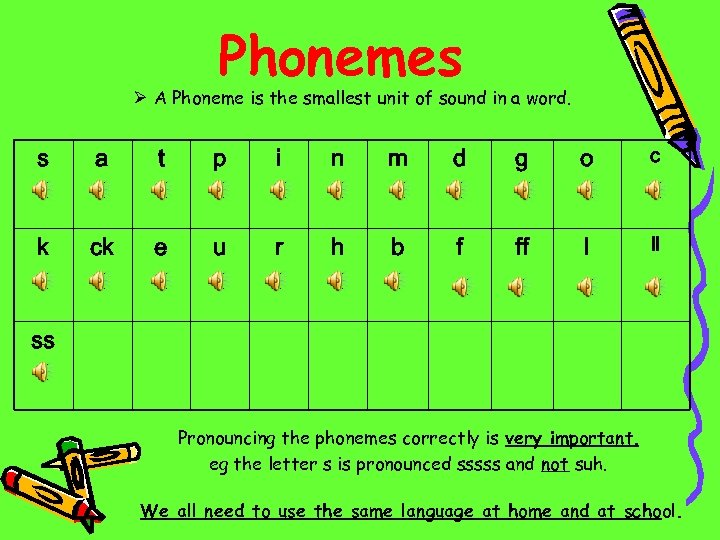
Phonemes Ø A Phoneme is the smallest unit of sound in a word. s a t p i n m d g o c k ck e u r h b f ff l ll ss Pronouncing the phonemes correctly is very important. eg the letter s is pronounced sssss and not suh. We all need to use the same language at home and at school.
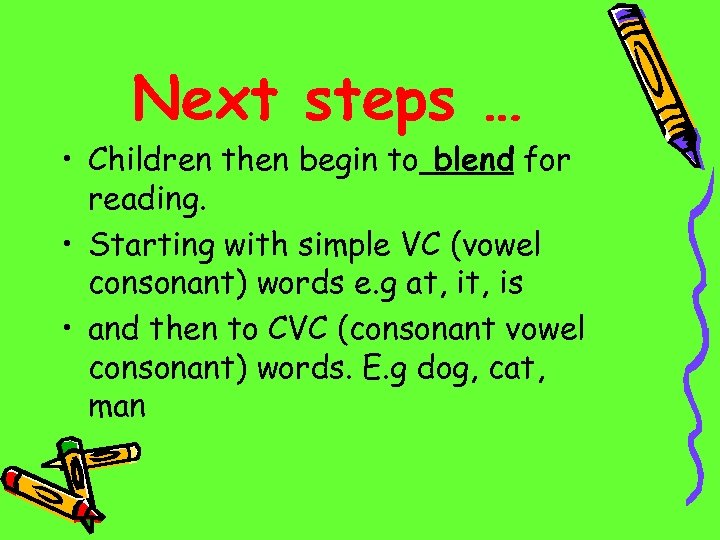
Next steps … • Children then begin to blend for reading. • Starting with simple VC (vowel consonant) words e. g at, is • and then to CVC (consonant vowel consonant) words. E. g dog, cat, man
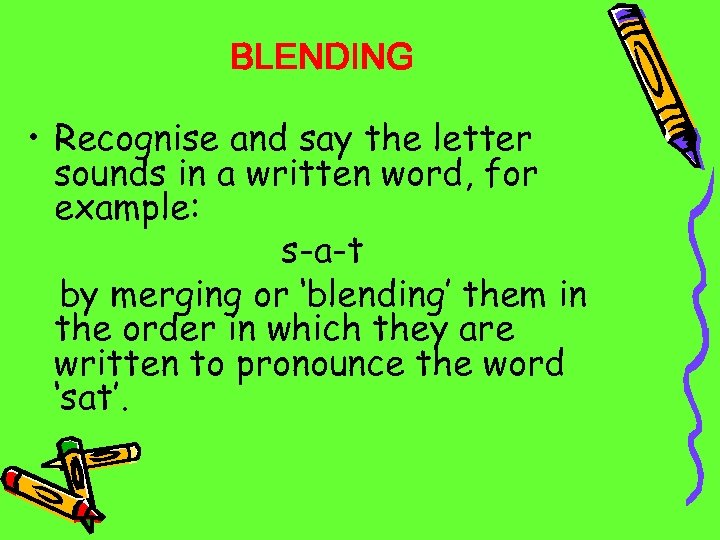
BLENDING • Recognise and say the letter sounds in a written word, for example: s-a-t by merging or ‘blending’ them in the order in which they are written to pronounce the word ‘sat’.
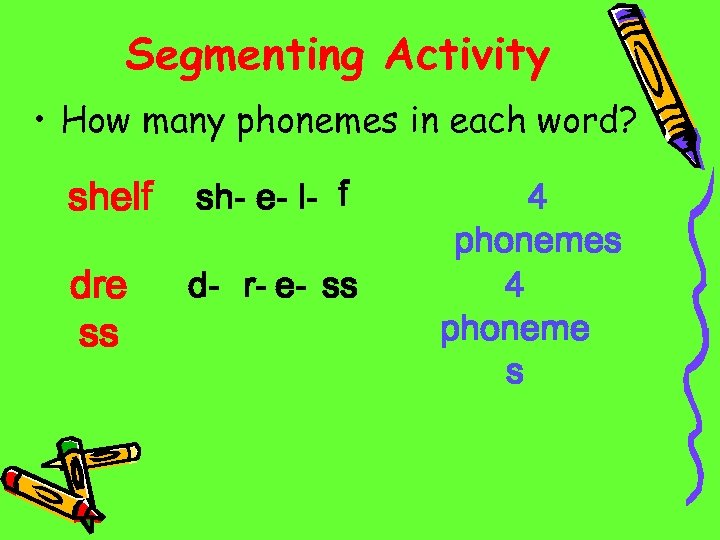
Segmenting Activity • How many phonemes in each word? shelf sh- e- l- f dre ss d- r- e- ss 4 phoneme s
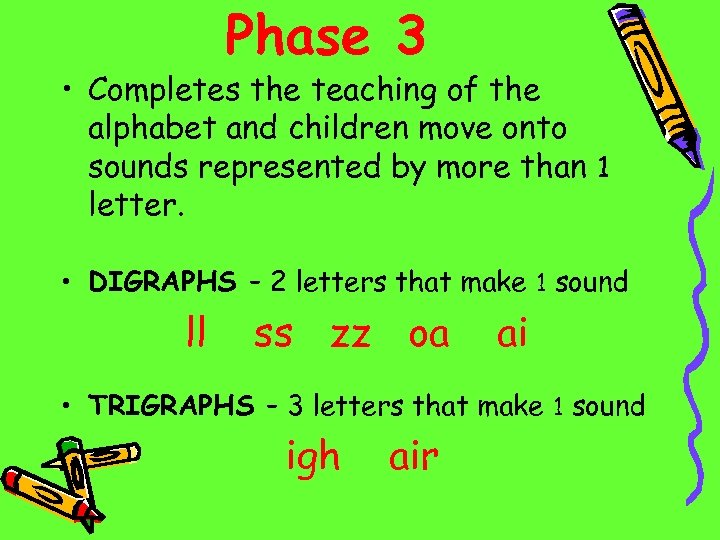
Phase 3 • Completes the teaching of the alphabet and children move onto sounds represented by more than 1 letter. • DIGRAPHS – 2 letters that make 1 sound ll ss zz oa ai • TRIGRAPHS – 3 letters that make 1 sound igh air
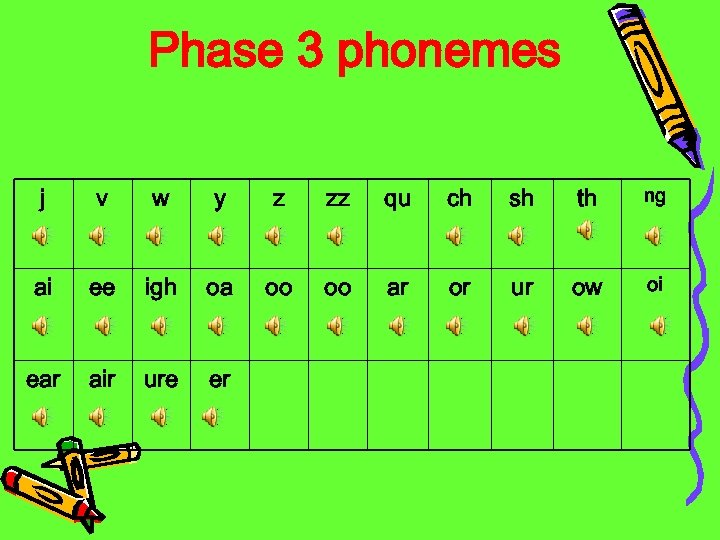
Phase 3 phonemes j v w y z zz qu ch sh th ng ai ee igh oa oo oo ar or ur ow oi ear air ure er
TRICKY WORDS • Words that are not decodable. • e. g. was, the, I. • Some are ‘tricky’ to start with but will become decodable once we have learned the harder phonemes. • e. g. out, there.
Now you have the knowledge…. • Play lots of sound and listening games with your child. For Example… Ø I spy. Ø Use the phonic packs that school provides to make words (real and nonsense ones) sounding them out. Ø Make duplicate sounds and play pairs… matching games. Ø Stick sounds on items that start with that letter sound. Ø At home, on car journeys, outings ask children to find as many things they can that start with a sound chosen. Ø Let them hear sounds… sound talk to them. “Fetch me your c-oa-t”! • Read as much as possible to and with your child. • Encourage and praise – get them to have a ‘good guess’. • Ask if you want to know more. ØMake it fun and in short, sharp bursts
Phase 4 and Phase 5
Phase 4 • In Phase 4, no new graphemes are introduced. The main aim of this phase is to consolidate the children's knowledge and to help them learn to read and spell words which have adjacent consonants, such as trap, string and milk. Phase 4 is generally started at the beginning of Year 1.
Phase 5 • In Phase Five, children will learn more graphemes and phonemes. For example, they already know ai as in rain, but now they will be introduced to “ay” as in day and “a-e” as in make. • Alternative pronunciations for graphemes will also be introduced, e. g. “ch” as in church, chemist and brochure. Phase 5 is a long unit, taught throughout Year 1.
Y 1 task during the summer term • All children in Year 1 across England will undertake a “decoding” test, where the results will be published. Such words will include pseudo words and real words. It is expected to test their knowledge of Phase 5 phonemes/graphemes.
Thank you for taking the time to attend this meeting. • As it is only an overview of what goes on in the classroom please do not hesitate to come and ask me, or any other members of staff, at any time during your child’s time at KPA school.
Скачать презентацию 3 th October 2014 Understand
a80c9daf4de906410441b13c7488abe1.ppt