


 Скачать презентацию 3 rd Summer School in Spectrum Management for
ffc126fa57f3f090d3dd598f51f3362d.ppt
- Количество слайдов: 71
 3 rd Summer School in Spectrum Management for Radio Astronomy Mitaka, Tokyo, 31 May – 4 June 2010 ITU-R : its structure, frequency allocations and use in general Monday, 31 May 2010 Hyun. Soo Chung KASI 3 rd Summer School in Spectrum Management for Radio Astronomy, Tokyo, 31 May – 4 June, 2010 International Telecommunication Union
 IUCAF 3 rd SS Another SS = Spectrum SHARING Why PROTECION How Free from Interference 3 rd Summer School in Spectrum Management for Radio Astronomy, Tokyo, 31 May – 4 June, 2010 International Telecommunication Union
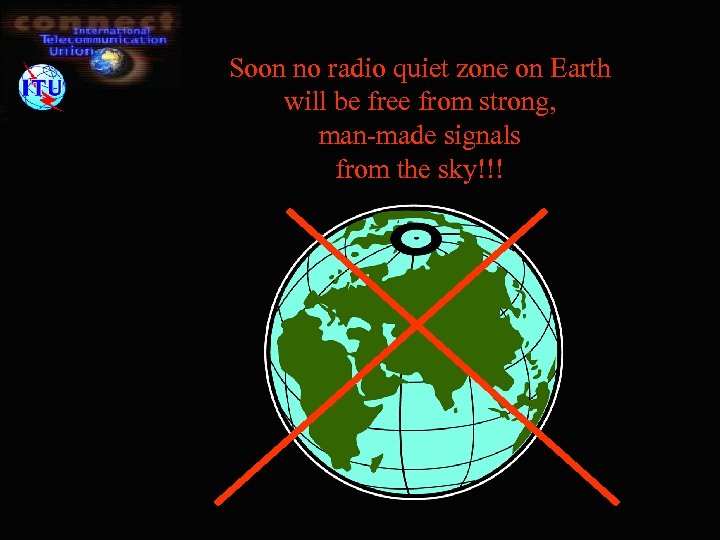 Soon no radio quiet zone on Earth will be free from strong, man-made signals from the sky!!! 3 rd Summer School in Spectrum Management for Radio Astronomy, Tokyo, 31 May – 4 June, 2010 International Telecommunication Union
 Index World Radiocommunication Conferences § Part I Its Structure § Part II WRC § Part III Frequency Allocations & Use 3 rd Summer School in Spectrum Management for Radio Astronomy, Tokyo, 31 May – 4 June, 2010
 What is ITU? § ITU is the leading United Nations agency for information and communication technology issues, and the global focal point for governments and the private sector in developing networks and services. For nearly 145 years, ITU has coordinated the shared global use of the radio spectrum. ITU also organizes worldwide and regional exhibitions and forums, such as WRC, bringing together the most influential representatives of government and the telecommunications § based in Geneva, Switzerland, 191 Member States and more than 700 Sector Members and Associates. 3 rd Summer School in Spectrum Management for Radio Astronomy, Tokyo, 31 May – 4 June, 2010
 Three ITU Sectors § Radiocommunication (ITU-R) Managing the international radio-frequency spectrum and satellite orbit resources is at the heart of the work of the ITU Radiocommunication Sector (ITU-R). § Standardization (ITU-T) ITU's standards-making efforts are its best-known — and oldest — activity. § Development (ITU-D) Established to help spread equitable, sustainable and affordable access to information and communication technologies (ICT). 3 rd Summer School in Spectrum Management for Radio Astronomy, Tokyo, 31 May – 4 June, 2010
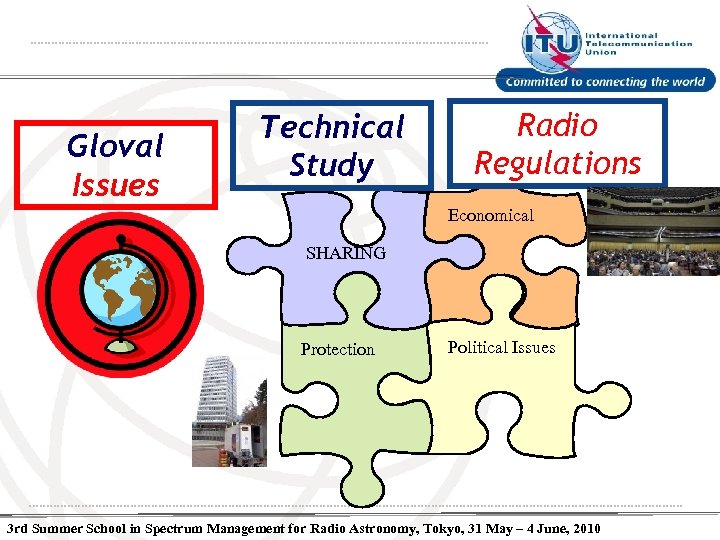 Gloval Issues Technical Study Radio Regulations Economical SHARING Protection Political Issues 3 rd Summer School in Spectrum Management for Radio Astronomy, Tokyo, 31 May – 4 June, 2010
 Presentation • • • Objectives of ITU-R Study Groups Structure of Study Groups Radiocommunication Assembly Scope of Study Groups Some key areas of standardization ITU-R Recommendations, Reports and Handbooks 3 rd Summer School in Spectrum Management for Radio Astronomy, Tokyo, 31 May – 4 June, 2010
 Role of ITU-R • ensure the rational, equitable, efficient and economical use of the radio-frequency spectrum by all radiocommunication services, including passive services(RAS, EESS(passive), SRS(passive) and active services(terrestrial and satellite) • carry out studies without limit of frequency range and adopting Recommendations on radiocommunication matters. (ref. Article 12 of Constitution) 3 rd Summer School in Spectrum Management for Radio Astronomy, Tokyo, 31 May – 4 June, 2010
 Role of ITU-R Role conducted through (inter alia): • World (and Regional) Radiocommunication Conferences • Approval of Recommendations by Member States Technical studies are required which are conducted in Study Groups 3 rd Summer School in Spectrum Management for Radio Astronomy, Tokyo, 31 May – 4 June, 2010
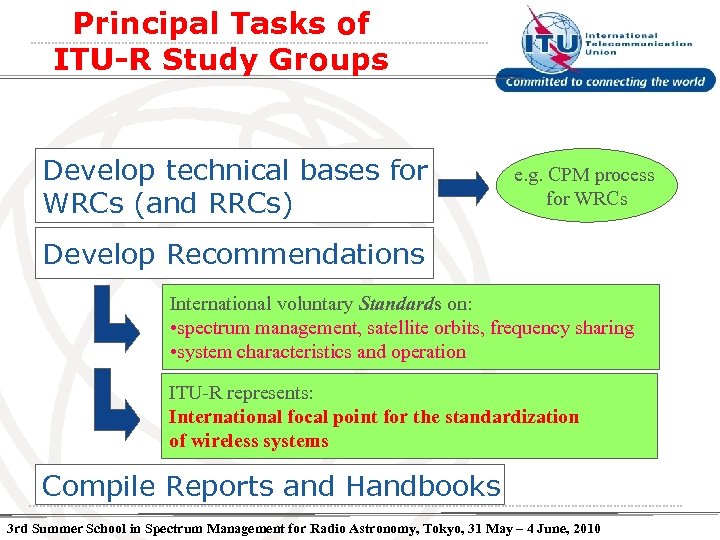 Principal Tasks of ITU-R Study Groups Develop technical bases for WRCs (and RRCs) e. g. CPM process for WRCs Develop Recommendations International voluntary Standards on: • spectrum management, satellite orbits, frequency sharing • system characteristics and operation ITU-R represents: International focal point for the standardization of wireless systems Compile Reports and Handbooks 3 rd Summer School in Spectrum Management for Radio Astronomy, Tokyo, 31 May – 4 June, 2010
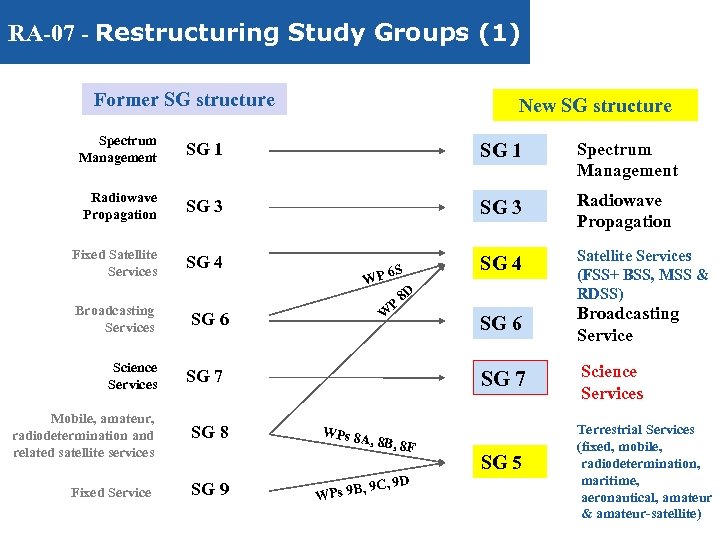 RA-07 - Restructuring Study Groups (1) Former SG structure New SG structure Spectrum Management SG 1 Spectrum Management Radiowave Propagation SG 3 Radiowave Propagation Fixed Satellite Services SG 4 Satellite Services (FSS+ BSS, MSS & RDSS) Broadcasting Services Science Services Mobile, amateur, radiodetermination and related satellite services Fixed Service 6 S WP 8 D P SG 7 SG 8 SG 9 SG 6 Broadcasting Service SG 7 W SG 6 Science Services WPs 8 A , 8 B, 8 F 9 C, 9 D , WPs 9 B SG 5 Terrestrial Services (fixed, mobile, radiodetermination, maritime, aeronautical, amateur & amateur-satellite)
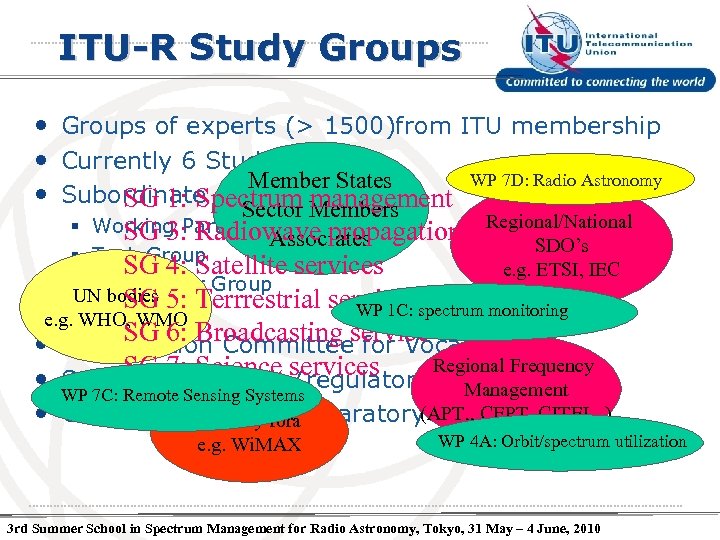 ITU-R Study Groups • Groups of experts (> 1500)from ITU membership • Currently 6 Study Groups WP 7 D: Radio Astronomy Member States • Subordinate groups SG 1: Spectrum management Sector Members § Working Party SG 3: Radiowave propagation Regional/National Associates SDO’s § Task Group SG 4: Satellite services e. g. ETSI, IEC § Rapporteur Group UN bodies SG 5: Terrrestrial services WP 1 C: spectrum monitoring § Joint ……. e. g. WHO, WMO SG 6: Broadcasting service • Coordination Committee for Vocabulary Regional Frequency SG 7: Science services • Special Committee (regulatory/procedural) • Management (APT, , CEPT, CITEL. . ) CPM - Conference Preparatory Meeting Industry fora WP 7 C: Remote Sensing Systems e. g. Wi. MAX WP 4 A: Orbit/spectrum utilization 3 rd Summer School in Spectrum Management for Radio Astronomy, Tokyo, 31 May – 4 June, 2010
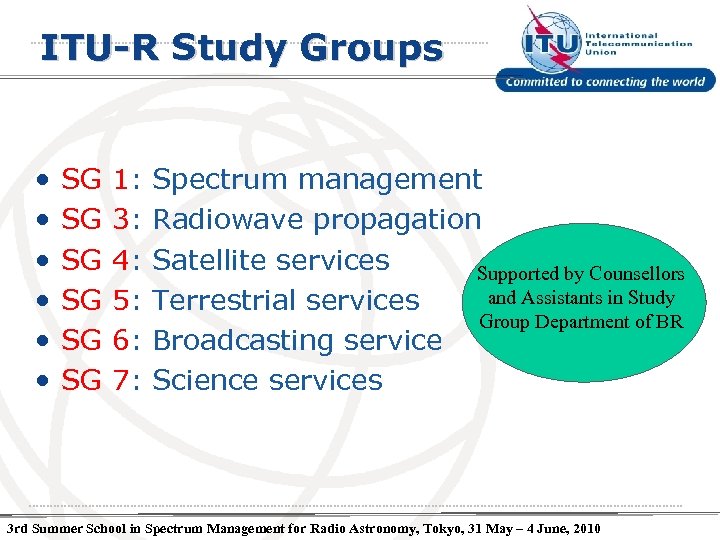 ITU-R Study Groups • • • SG 1: Spectrum management SG 3: Radiowave propagation SG 4: Satellite services Supported by Counsellors and Assistants in Study SG 5: Terrestrial services Group Department of BR SG 6: Broadcasting service SG 7: Science services 3 rd Summer School in Spectrum Management for Radio Astronomy, Tokyo, 31 May – 4 June, 2010
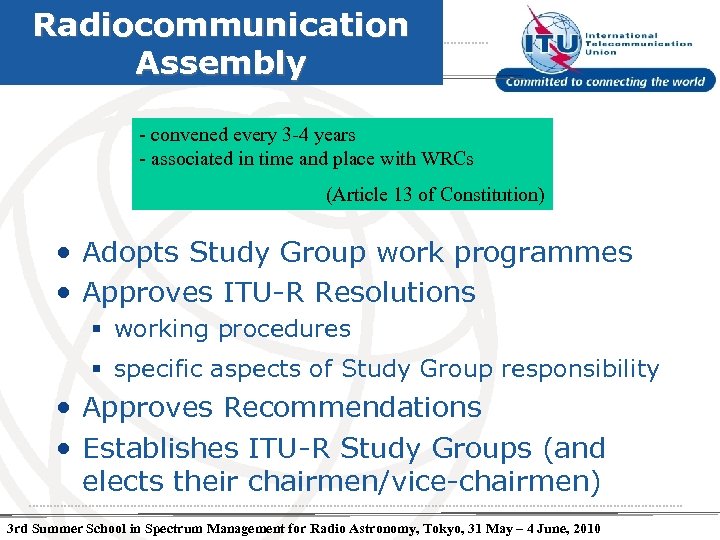 Radiocommunication Assembly - convened every 3 -4 years - associated in time and place with WRCs (Article 13 of Constitution) • Adopts Study Group work programmes • Approves ITU-R Resolutions § working procedures § specific aspects of Study Group responsibility • Approves Recommendations • Establishes ITU-R Study Groups (and elects their chairmen/vice-chairmen) 3 rd Summer School in Spectrum Management for Radio Astronomy, Tokyo, 31 May – 4 June, 2010
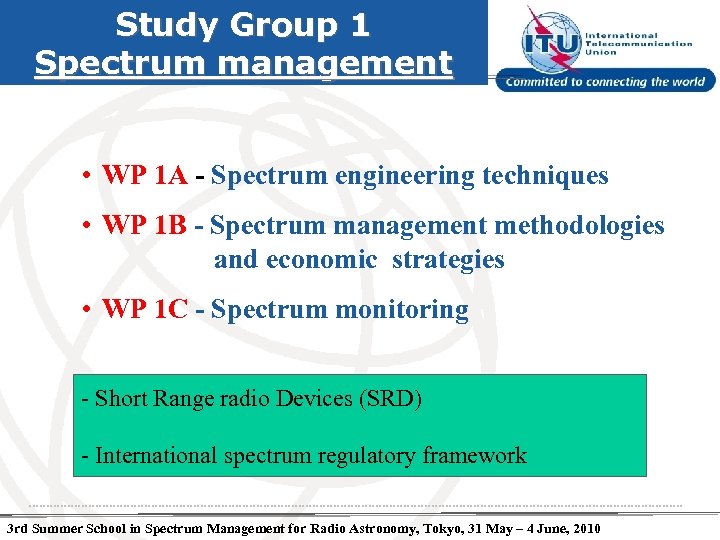 Study Group 1 Spectrum management • WP 1 A - Spectrum engineering techniques • WP 1 B - Spectrum management methodologies and economic strategies • WP 1 C - Spectrum monitoring - Short Range radio Devices (SRD) - International spectrum regulatory framework 3 rd Summer School in Spectrum Management for Radio Astronomy, Tokyo, 31 May – 4 June, 2010
 Study Group 3 Radiowave propagation • WP 3 J - Propagation fundamentals • WP 3 K - Point-to-area propagation • WP 3 L - Ionospheric propagation and radio noise • WP 3 M - Point-to-point and Earth-space propagation - Characteristics and mapping of propagation medium - Propagation prediction methods e. g. for terrestrial digital broadcasting (RRC-06) 3 rd Summer School in Spectrum Management for Radio Astronomy, Tokyo, 31 May – 4 June, 2010
 Study Group 4 Satellite services • WP 4 A - Efficient orbit/spectrum utilization for FSS and BSS • WP 4 B - Systems, air interfaces, performance and availability objectives for FSS, BSS and MSS, including IP-based applications and satellite news gathering • WP 4 C - Efficient orbit/spectrum utilization for MSS and RDSS - Technical characteristics for systems and networks in the RNSS - Satellite radio interface of IMT-2000 3 rd Summer School in Spectrum Management for Radio Astronomy, Tokyo, 31 May – 4 June, 2010
 Study Group 5 Terrestrial services • WP 5 A - Land mobile service above 30 MHz*(excluding IMT); wireless access in the fixed service; amateur and amateur-satellite services • WP 5 B - Maritime mobile service including Global Maritime Distress and Safety System (GMDSS); aeronautical mobile service and radiodetermination service • WP 5 C - Fixed wireless systems; HF and other systems below 30 MHz in the fixed and land mobile services • WP 5 D - IMT Systems • Joint Task Group 5 -6 - Studies on the use of the band 790 -862 MHz by mobile applications and by other services - Next generation mobile access “IMT Advanced” - Spectrum issues for maritime and aeronautical services 3 rd Summer School in Spectrum Management for Radio Astronomy, Tokyo, 31 May – 4 June, 2010
 Study Group 6 Broadcasting service • WP 6 A - Terrestrial broadcasting delivery • WP 6 B - Broadcast service assembly and access • WP 6 C - Programme production and quality assessment • Joint Task Group 5 -6 - Studies on the use of the band 790862 MHz by mobile applications and by other services - Sharing issues at UHF - Multimedia and data broadcasting for mobile reception 3 rd Summer School in Spectrum Management for Radio Astronomy, Tokyo, 31 May – 4 June, 2010
 Study Group 7 Science services • WP 7 A - Time signals and frequency standard emissions • WP 7 B - Space radiocommunication applications • WP 7 C - Remote sensing systems • WP 7 D - Radio astronomy - EESS including meteorological satellite service for disaster prediction and detection, and for climate monitoring - Protection of passive services, e. g. Radio astronomy 3 rd Summer School in Spectrum Management for Radio Astronomy, Tokyo, 31 May – 4 June, 2010
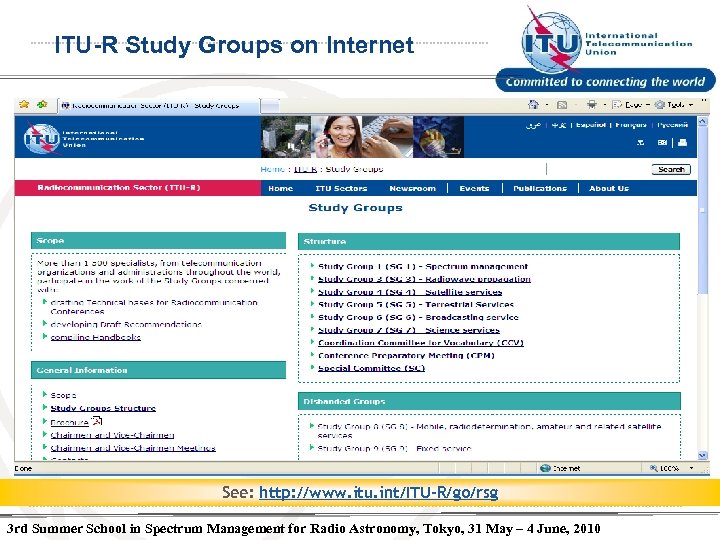 ITU-R Study Groups on Internet See: http: //www. itu. int/ITU-R/go/rsg 3 rd Summer School in Spectrum Management for Radio Astronomy, Tokyo, 31 May – 4 June, 2010
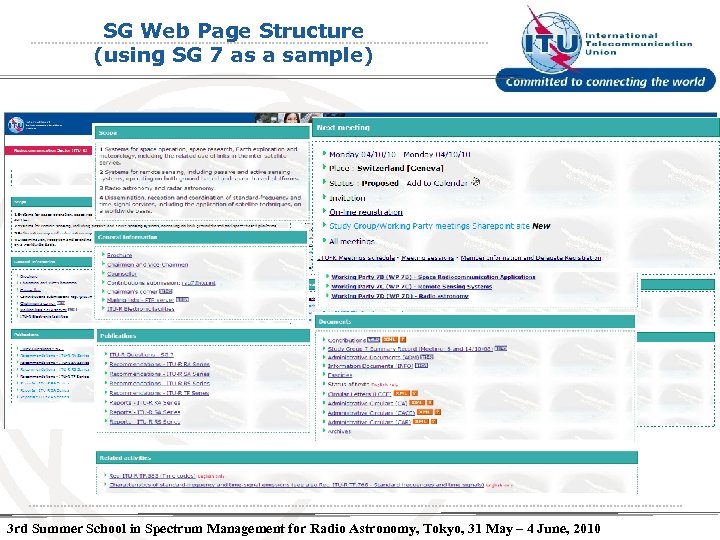 SG Web Page Structure (using SG 7 as a sample) 3 rd Summer School in Spectrum Management for Radio Astronomy, Tokyo, 31 May – 4 June, 2010
 Study Group Products • Technical bases for WRC (and RRC) CPM Report • ITU-R Recommendations • Reports and Handbooks 3 rd Summer School in Spectrum Management for Radio Astronomy, Tokyo, 31 May – 4 June, 2010
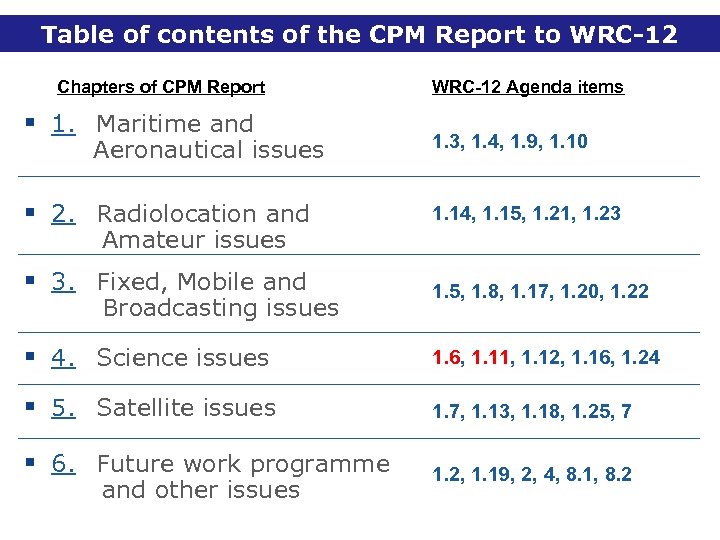 Table of contents of the CPM Report to WRC-12 Chapters of CPM Report § 1. Maritime and Aeronautical issues WRC-12 Agenda items 1. 3, 1. 4, 1. 9, 1. 10 § 2. Radiolocation and 1. 14, 1. 15, 1. 21, 1. 23 § 3. Fixed, Mobile and 1. 5, 1. 8, 1. 17, 1. 20, 1. 22 § 4. Science issues 1. 6, 1. 11, 1. 12, 1. 16, 1. 24 § 5. Satellite issues 1. 7, 1. 13, 1. 18, 1. 25, 7 § 6. Future work programme 1. 2, 1. 19, 2, 4, 8. 1, 8. 2 Amateur issues Broadcasting issues and other issues
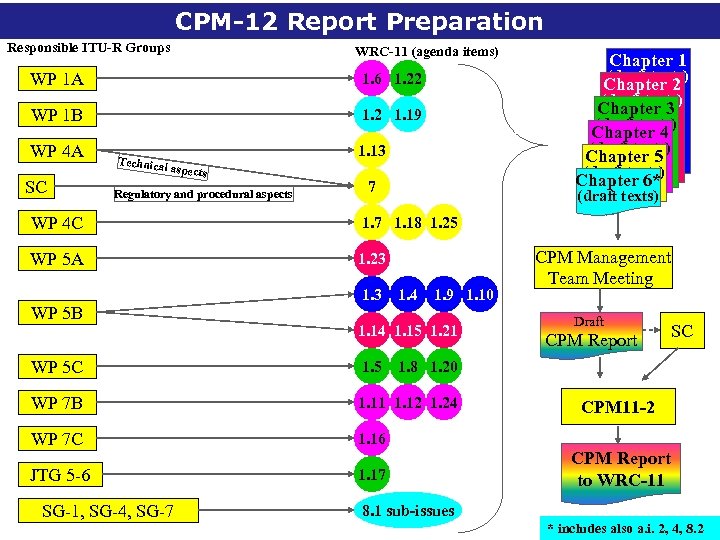 CPM-12 Report Preparation Responsible ITU-R Groups WRC-11 (agenda items) WP 1 A 1. 6 1. 22 WP 1 B 1. 2 1. 19 WP 4 A SC Technica l aspects Regulatory and procedural aspects 1. 13 7 Chapter 1 (draft texts) Chapter 2 (draft texts) Chapter 3 (draft texts) Chapter 4 (draft texts) Chapter 5 (draft texts) Chapter 6* (draft texts) WP 4 C 1. 7 1. 18 1. 25 WP 5 A 1. 23 WP 5 B 1. 3 1. 4 1. 9 1. 10 1. 14 1. 15 1. 21 WP 5 C 1. 5 WP 7 B 1. 11 1. 12 1. 24 WP 7 C JTG 5 -6 Draft CPM Report SC 1. 16 1. 17 CPM Management Team Meeting SG-1, SG-4, SG-7 1. 8 1. 20 CPM 11 -2 CPM Report to WRC-11 8. 1 sub-issues * includes also a. i. 2, 4, 8. 2
 Study Group Products • Technical bases for WRC (and RRC) CPM Report • ITU-R Recommendations • Reports and Handbooks 3 rd Summer School in Spectrum Management for Radio Astronomy, Tokyo, 31 May – 4 June, 2010
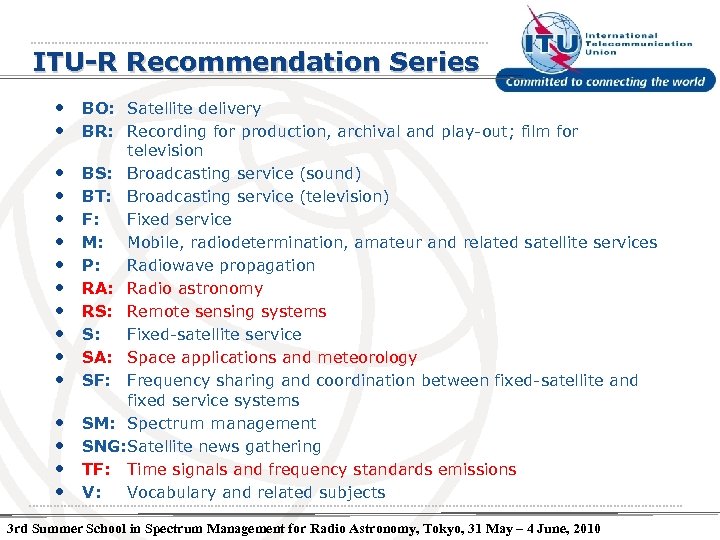 ITU-R Recommendation Series • BO: Satellite delivery • BR: Recording for production, archival and play-out; film for • • • • television BS: Broadcasting service (sound) BT: Broadcasting service (television) F: Fixed service M: Mobile, radiodetermination, amateur and related satellite services P: Radiowave propagation RA: Radio astronomy RS: Remote sensing systems S: Fixed-satellite service SA: Space applications and meteorology SF: Frequency sharing and coordination between fixed-satellite and fixed service systems SM: Spectrum management SNG: Satellite news gathering TF: Time signals and frequency standards emissions V: Vocabulary and related subjects 3 rd Summer School in Spectrum Management for Radio Astronomy, Tokyo, 31 May – 4 June, 2010
 Study Group Products • Technical bases for WRC (and RRC) CPM Report • ITU-R Recommendations • Reports and Handbooks 3 rd Summer School in Spectrum Management for Radio Astronomy, Tokyo, 31 May – 4 June, 2010
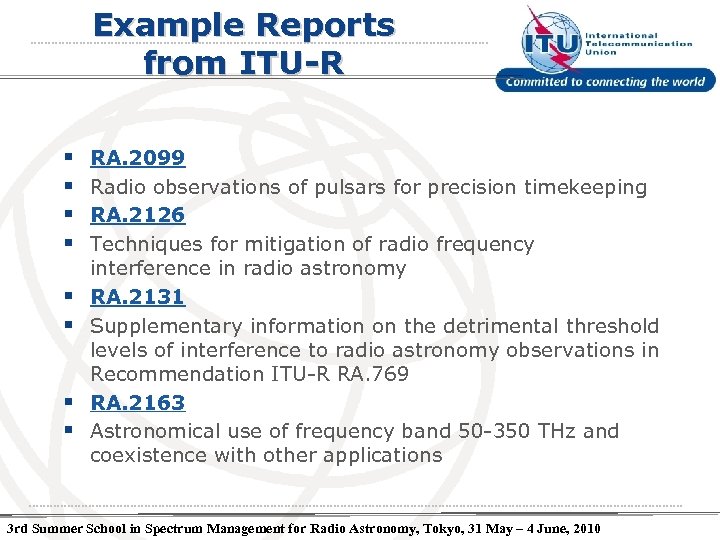 Example Reports from ITU-R § § § § RA. 2099 Radio observations of pulsars for precision timekeeping RA. 2126 Techniques for mitigation of radio frequency interference in radio astronomy RA. 2131 Supplementary information on the detrimental threshold levels of interference to radio astronomy observations in Recommendation ITU-R RA. 769 RA. 2163 Astronomical use of frequency band 50 -350 THz and coexistence with other applications 3 rd Summer School in Spectrum Management for Radio Astronomy, Tokyo, 31 May – 4 June, 2010
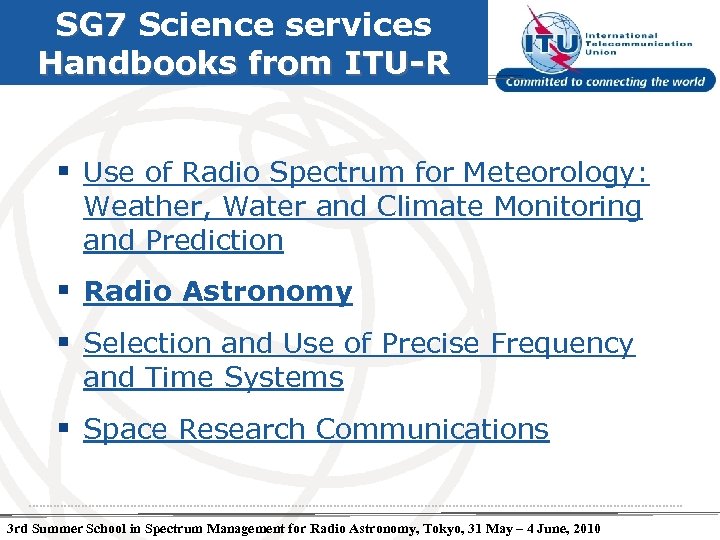 SG 7 Science services SG 7 Handbooks from ITU-R § Use of Radio Spectrum for Meteorology: Weather, Water and Climate Monitoring and Prediction § Radio Astronomy § Selection and Use of Precise Frequency and Time Systems § Space Research Communications 3 rd Summer School in Spectrum Management for Radio Astronomy, Tokyo, 31 May – 4 June, 2010
 Concluding remarks • ITU Radiocommunication Sector represents focal point for standardization of radiocommunication services and systems • The ITU-R Study Groups are the “home” for the technical studies required for the standardization activities • Principal products: • Technical bases for Radiocommunication Conferences • Recommendations, Reports and Handbooks 3 rd Summer School in Spectrum Management for Radio Astronomy, Tokyo, 31 May – 4 June, 2010
 Role of Itu-R World Radiocommunication Conferences § Part I Its Structure § Part II WRC (Wed. , by Gergly) § Part III Frequency Allocations & Use 3 rd Summer School in Spectrum Management for Radio Astronomy, Tokyo, 31 May – 4 June, 2010
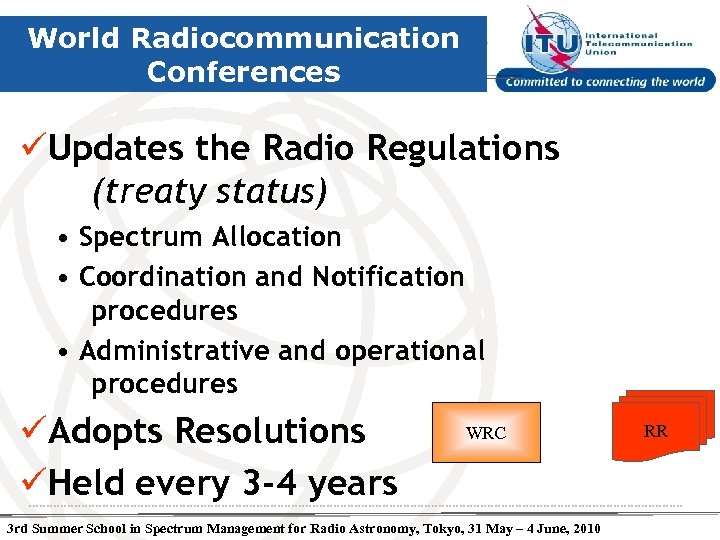 World Radiocommunication Conferences üUpdates the Radio Regulations (treaty status) • Spectrum Allocation • Coordination and Notification procedures • Administrative and operational procedures üAdopts Resolutions üHeld every 3 -4 years WRC 3 rd Summer School in Spectrum Management for Radio Astronomy, Tokyo, 31 May – 4 June, 2010 RR
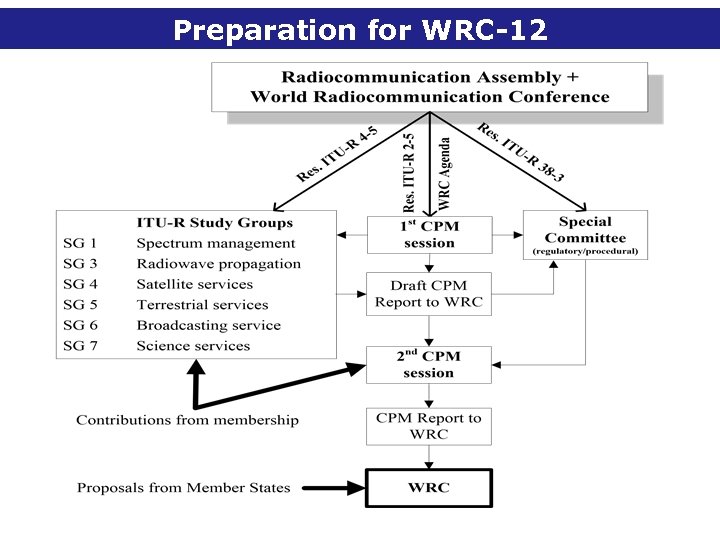 Preparation for WRC-12
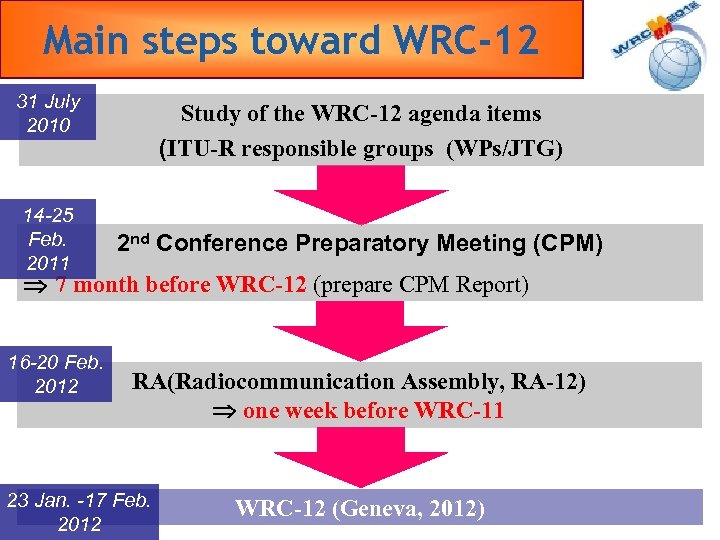 Main steps toward WRC-12 31 July 2010 14 -25 Feb. 2011 Study of the WRC-12 agenda items (ITU-R responsible groups (WPs/JTG) 2 nd Conference Preparatory Meeting (CPM) 7 month before WRC-12 (prepare CPM Report) 16 -20 Feb. 2012 RA(Radiocommunication Assembly, RA-12) one week before WRC-11 23 Jan. -17 Feb. 2012 WRC-12 (Geneva, 2012)
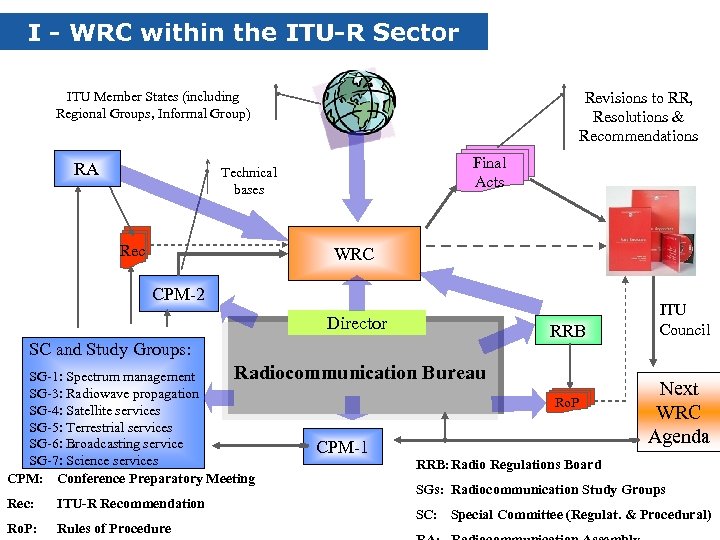 I - WRC within the ITU-R Sector ITU Member States (including Regional Groups, Informal Group) RA Revisions to RR, Resolutions & Recommendations Final Acts Technical bases Rec WRC CPM-2 Director SC and Study Groups: RRB ITU Council Radiocommunication Bureau SG-1: Spectrum management Next SG-3: Radiowave propagation Ro. P SG-4: Satellite services WRC SG-5: Terrestrial services Agenda SG-6: Broadcasting service CPM-1 SG-7: Science services RRB: Radio Regulations Board CPM: Conference Preparatory Meeting SGs: Radiocommunication Study Groups Rec: ITU-R Recommendation SC: Special Committee (Regulat. & Procedural) Ro. P: Rules of Procedure
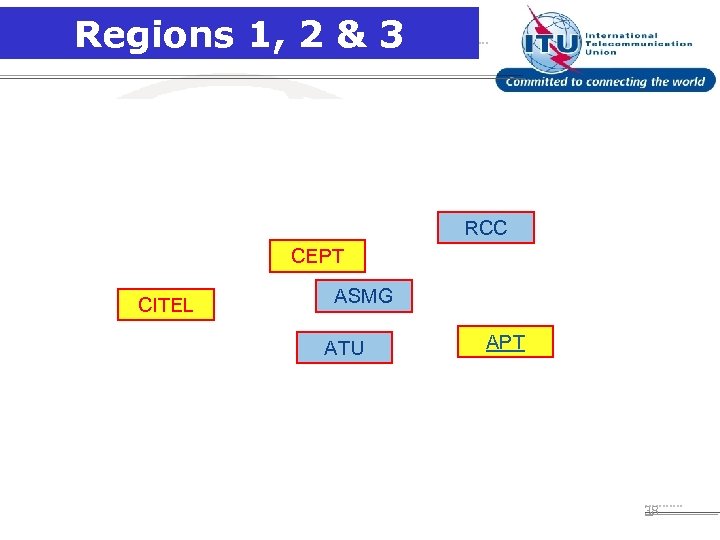 Regions 1, 2 & 3 RCC CEPT CITEL ASMG ATU APT 3 rd IUCAF Summer School, Tokyo 3 rd Summer School in Spectrum Management for Radio Astronomy, Tokyo, 31 May – 4 June, 2010 May 31, 2010 38
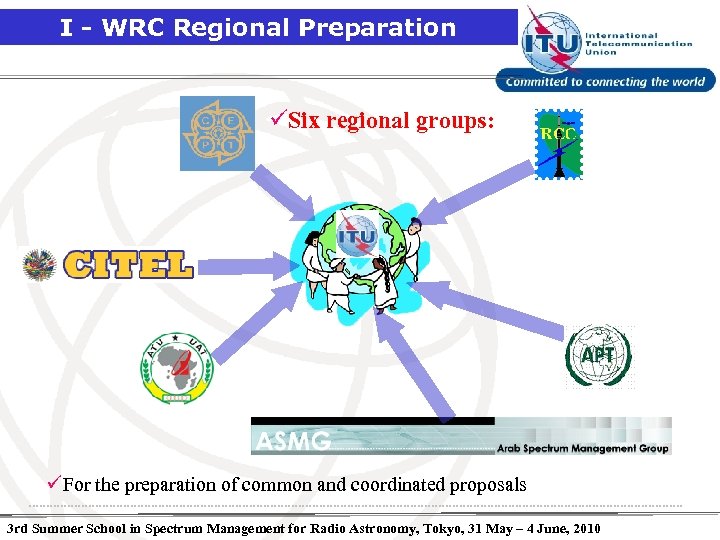 I - WRC Regional Preparation üSix regional groups: üFor the preparation of common and coordinated proposals 3 rd Summer School in Spectrum Management for Radio Astronomy, Tokyo, 31 May – 4 June, 2010
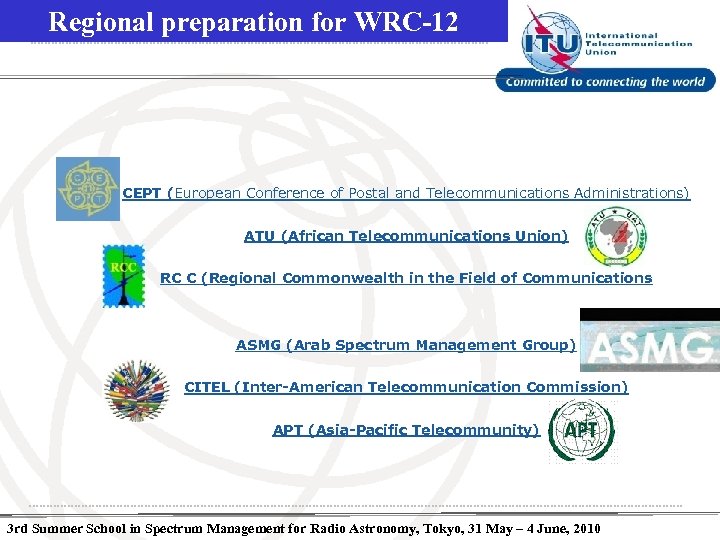 Regional preparation for WRC-12 CEPT (European Conference of Postal and Telecommunications Administrations) ATU (African Telecommunications Union) RC C (Regional Commonwealth in the Field of Communications ASMG (Arab Spectrum Management Group) CITEL (Inter-American Telecommunication Commission) APT (Asia-Pacific Telecommunity) 3 rd Summer School in Spectrum Management for Radio Astronomy, Tokyo, 31 May – 4 June, 2010
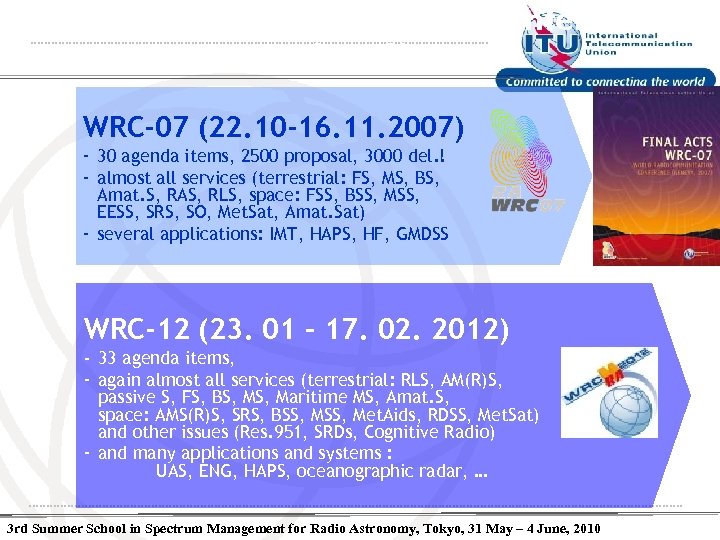 World Radiocommunication Conferences (WRC) WRC-07 (22. 10 -16. 11. 2007) - 30 agenda items, 2500 proposal, 3000 del. ! - almost all services (terrestrial: FS, MS, BS, Amat. S, RAS, RLS, space: FSS, BSS, MSS, EESS, SRS, SO, Met. Sat, Amat. Sat) - several applications: IMT, HAPS, HF, GMDSS WRC-12 (23. 01 – 17. 02. 2012) - 33 agenda items, - again almost all services (terrestrial: RLS, AM(R)S, passive S, FS, BS, Maritime MS, Amat. S, space: AMS(R)S, SRS, BSS, Met. Aids, RDSS, Met. Sat) and other issues (Res. 951, SRDs, Cognitive Radio) - and many applications and systems : UAS, ENG, HAPS, oceanographic radar, … 3 rd Summer School in Spectrum Management for Radio Astronomy, Tokyo, 31 May – 4 June, 2010
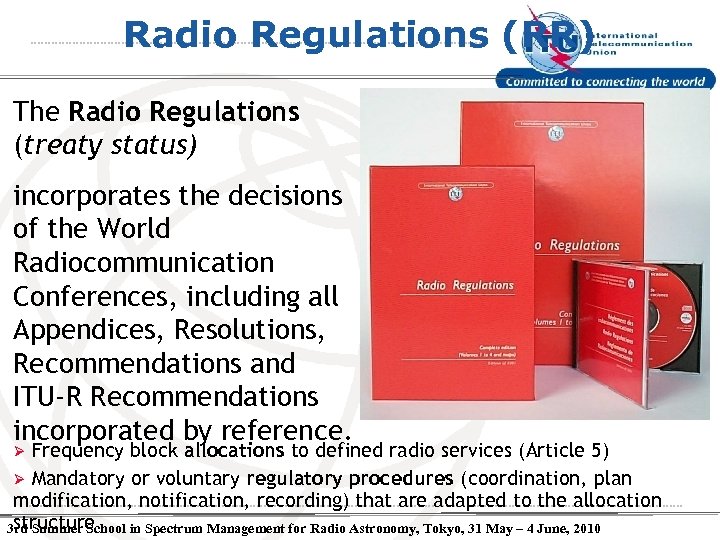 Radio Regulations (RR) The Radio Regulations (treaty status) incorporates the decisions of the World Radiocommunication Conferences, including all Appendices, Resolutions, Recommendations and ITU-R Recommendations incorporated by reference. Frequency block allocations to defined radio services (Article 5) Ø Mandatory or voluntary regulatory procedures (coordination, plan modification, notification, recording) that are adapted to the allocation structure 3 rd Summer School in Spectrum Management for Radio Astronomy, Tokyo, 31 May – 4 June, 2010 Ø
 Role of ITU-R World Radiocommunication Conferences § Part I Its Structure § Part II WRC § Part III Frequency Allocations & Use 3 rd Summer School in Spectrum Management for Radio Astronomy, Tokyo, 31 May – 4 June, 2010
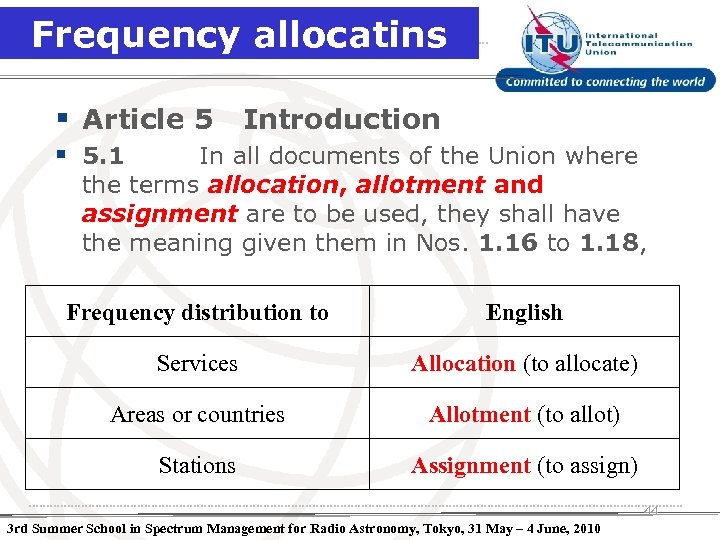 Frequency allocatins § Article 5 Introduction § 5. 1 In all documents of the Union where the terms allocation, allotment and assignment are to be used, they shall have the meaning given them in Nos. 1. 16 to 1. 18, Frequency distribution to English Services Allocation (to allocate) Areas or countries Allotment (to allot) Stations Assignment (to assign) 44 3 rd Summer School in Spectrum Management for Radio Astronomy, Tokyo, 31 May – 4 June, 2010
 Frequency allocations § Article 5 § 5. 2 For the allocation of frequencies the world has been divided into three Regions 1 as shown on the following map and described in Nos. 5. 3 to 5. 9: § 1 5. 2. 1 It should be noted that where the words “regions” or “regional” are without a capital “R” in these Regulations, they do not relate to the three Regions here defined for purposes of frequency allocation. 45 3 rd Summer School in Spectrum Management for Radio Astronomy, Tokyo, 31 May – 4 June, 2010
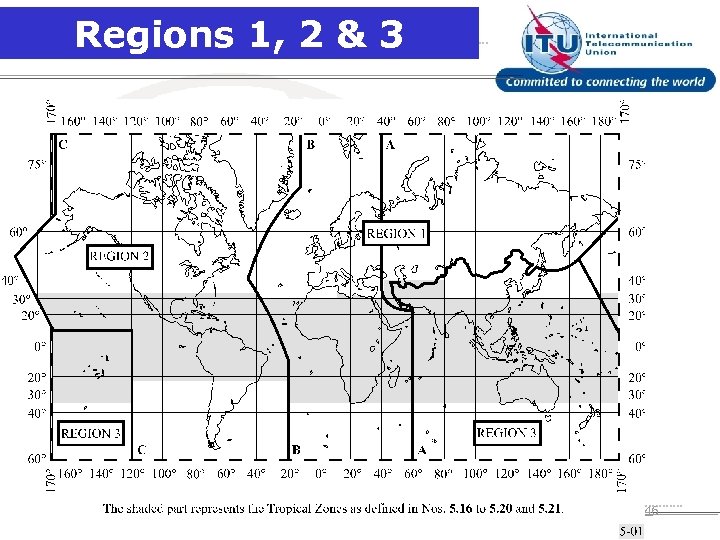 Regions 1, 2 & 3 3 rd IUCAF Summer School, Tokyo 3 rd Summer School in Spectrum Management for Radio Astronomy, Tokyo, 31 May – 4 June, 2010 May 31, 2010 46
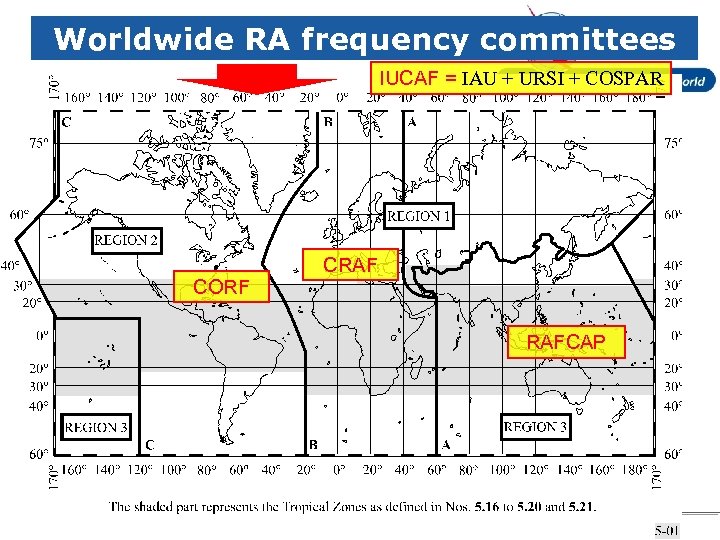 Worldwide RA frequency committees IUCAF = IAU + URSI + COSPAR CORF CRAF RAFCAP 47 3 rd Summer School in Spectrum Management for Radio Astronomy, Tokyo, 31 May – 4 June, 2010
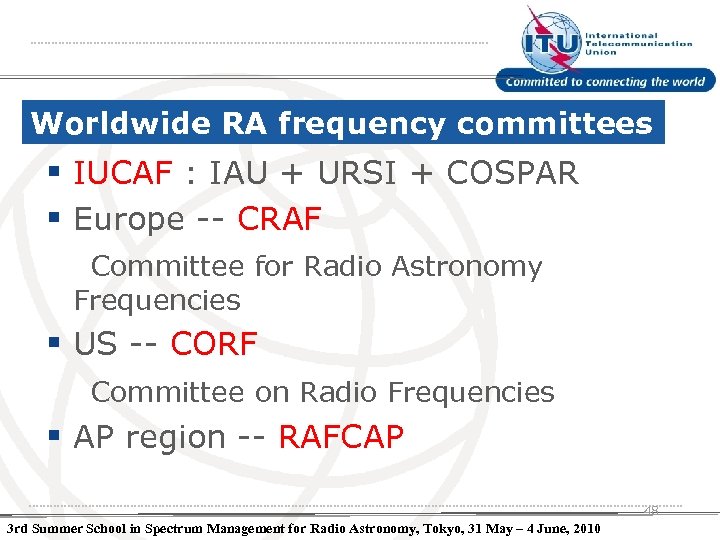 Worldwide RA frequency committees § IUCAF : IAU + URSI + COSPAR § Europe -- CRAF Committee for Radio Astronomy Frequencies § US -- CORF Committee on Radio Frequencies § AP region -- RAFCAP 48 3 rd Summer School in Spectrum Management for Radio Astronomy, Tokyo, 31 May – 4 June, 2010
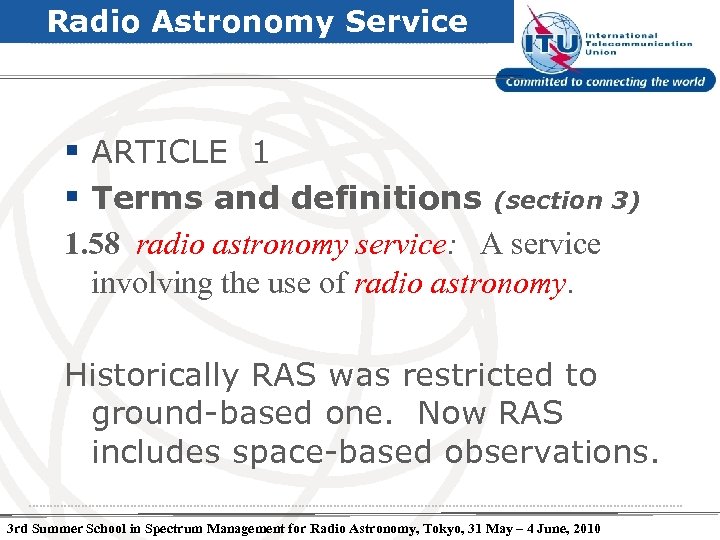 Radio Astronomy Service § ARTICLE 1 § Terms and definitions (section 3) 1. 58 radio astronomy service: A service involving the use of radio astronomy. Historically RAS was restricted to ground-based one. Now RAS includes space-based observations. 3 rd Summer School in Spectrum Management for Radio Astronomy, Tokyo, 31 May – 4 June, 2010
 Passive & Active Service § Passive services - RAS, EESS(passive), SRS(passive) § Active services - See next Tables 3 rd Summer School in Spectrum Management for Radio Astronomy, Tokyo, 31 May – 4 June, 2010
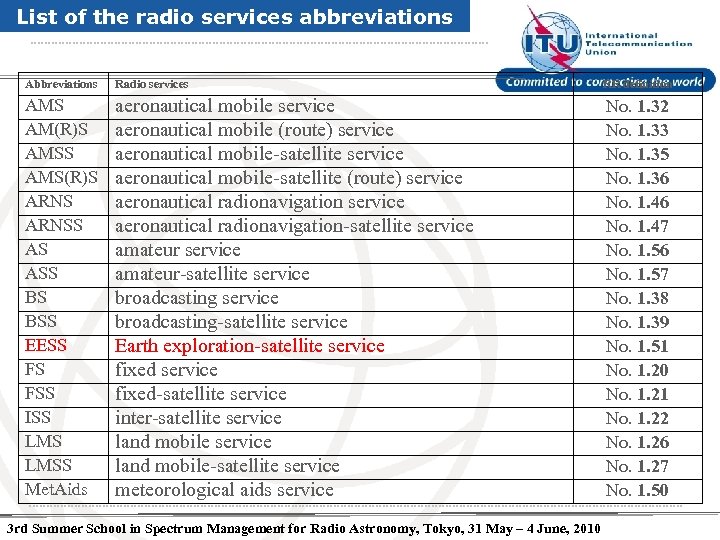 List of the radio services abbreviations Abbreviations Radio services RR definition AMS AM(R)S AMS(R)S ARNSS AS ASS BS BSS EESS FS FSS ISS LMSS Met. Aids aeronautical mobile service aeronautical mobile (route) service aeronautical mobile-satellite (route) service aeronautical radionavigation-satellite service amateur-satellite service broadcasting-satellite service Earth exploration-satellite service fixed-satellite service inter-satellite service land mobile-satellite service meteorological aids service No. 1. 32 No. 1. 33 No. 1. 35 No. 1. 36 No. 1. 47 No. 1. 56 No. 1. 57 No. 1. 38 No. 1. 39 No. 1. 51 No. 1. 20 No. 1. 21 No. 1. 22 No. 1. 26 No. 1. 27 No. 1. 50 3 rd Summer School in Spectrum Management for Radio Astronomy, Tokyo, 31 May – 4 June, 2010
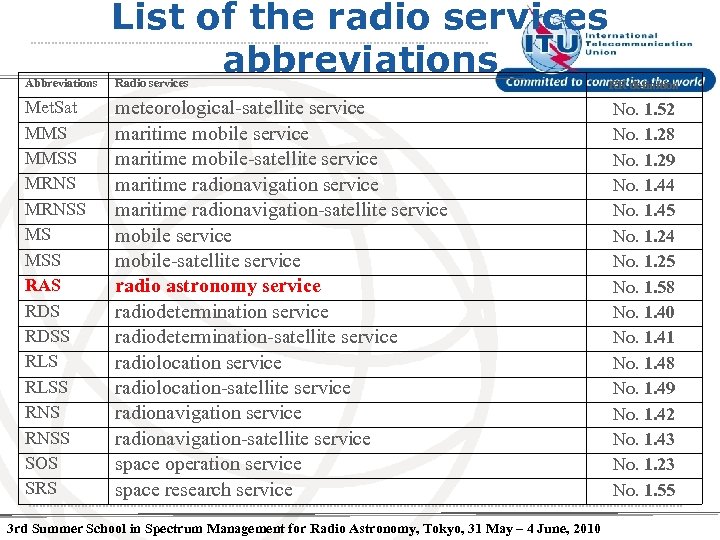 Abbreviations Met. Sat MMSS MRNSS MS MSS RAS RDSS RLSS RNSS SOS SRS List of the radio services abbreviations Radio services RR definition meteorological-satellite service maritime mobile-satellite service maritime radionavigation-satellite service mobile-satellite service radio astronomy service radiodetermination-satellite service radiolocation-satellite service radionavigation-satellite service space operation service space research service No. 1. 52 No. 1. 28 No. 1. 29 No. 1. 44 No. 1. 45 No. 1. 24 No. 1. 25 No. 1. 58 No. 1. 40 No. 1. 41 No. 1. 48 No. 1. 49 No. 1. 42 No. 1. 43 No. 1. 23 No. 1. 55 3 rd Summer School in Spectrum Management for Radio Astronomy, Tokyo, 31 May – 4 June, 2010
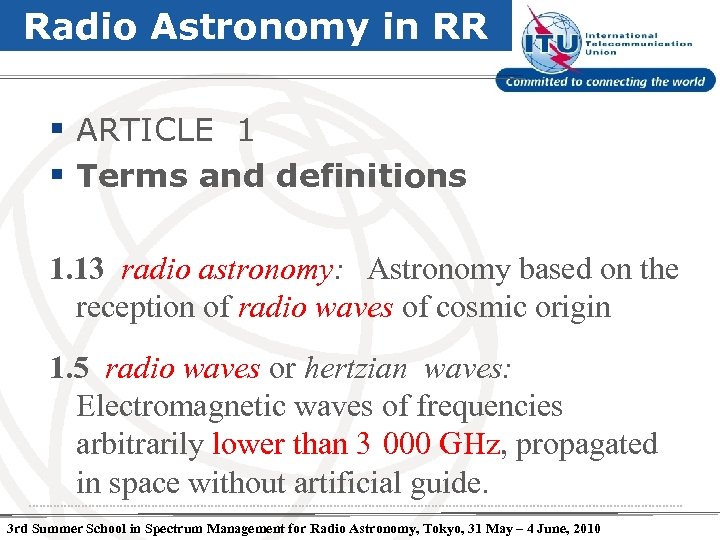 Radio Astronomy in RR § ARTICLE 1 § Terms and definitions 1. 13 radio astronomy: Astronomy based on the reception of radio waves of cosmic origin 1. 5 radio waves or hertzian waves: Electromagnetic waves of frequencies arbitrarily lower than 3 000 GHz, propagated in space without artificial guide. 3 rd Summer School in Spectrum Management for Radio Astronomy, Tokyo, 31 May – 4 June, 2010
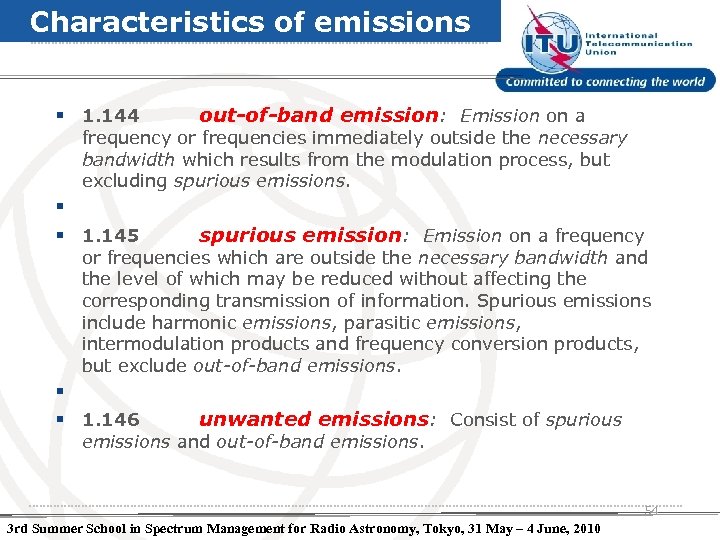 Characteristics of emissions § 1. 144 out-of-band emission: Emission on a § 1. 145 spurious emission: Emission on a frequency § 1. 146 unwanted emissions: Consist of spurious frequency or frequencies immediately outside the necessary bandwidth which results from the modulation process, but excluding spurious emissions. § or frequencies which are outside the necessary bandwidth and the level of which may be reduced without affecting the corresponding transmission of information. Spurious emissions include harmonic emissions, parasitic emissions, intermodulation products and frequency conversion products, but exclude out-of-band emissions. § emissions and out-of-band emissions. 54 3 rd Summer School in Spectrum Management for Radio Astronomy, Tokyo, 31 May – 4 June, 2010
 OOB & Spurious domains 3 rd Summer School in Spectrum Management for Radio Astronomy, Tokyo, 31 May – 4 June, 2010
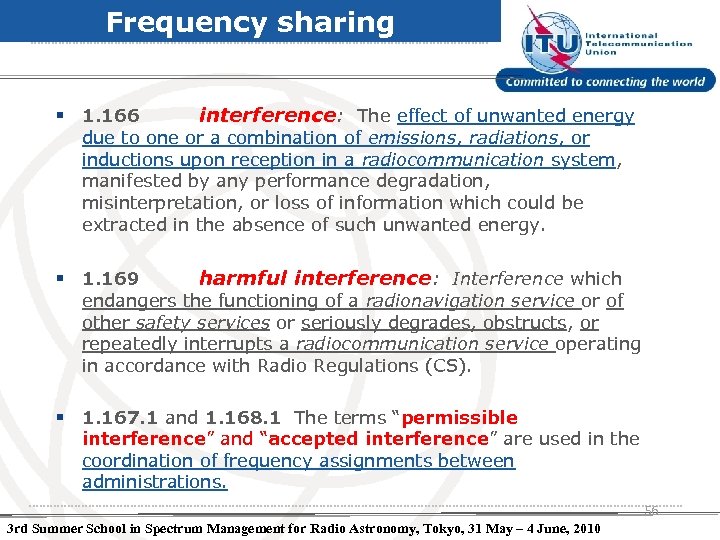 Frequency sharing § 1. 166 interference: The effect of unwanted energy § 1. 169 harmful interference: Interference which due to one or a combination of emissions, radiations, or inductions upon reception in a radiocommunication system, manifested by any performance degradation, misinterpretation, or loss of information which could be extracted in the absence of such unwanted energy. endangers the functioning of a radionavigation service or of other safety services or seriously degrades, obstructs, or repeatedly interrupts a radiocommunication service operating in accordance with Radio Regulations (CS). § 1. 167. 1 and 1. 168. 1 The terms “permissible interference” and “accepted interference” are used in the coordination of frequency assignments between administrations. 56 3 rd Summer School in Spectrum Management for Radio Astronomy, Tokyo, 31 May – 4 June, 2010
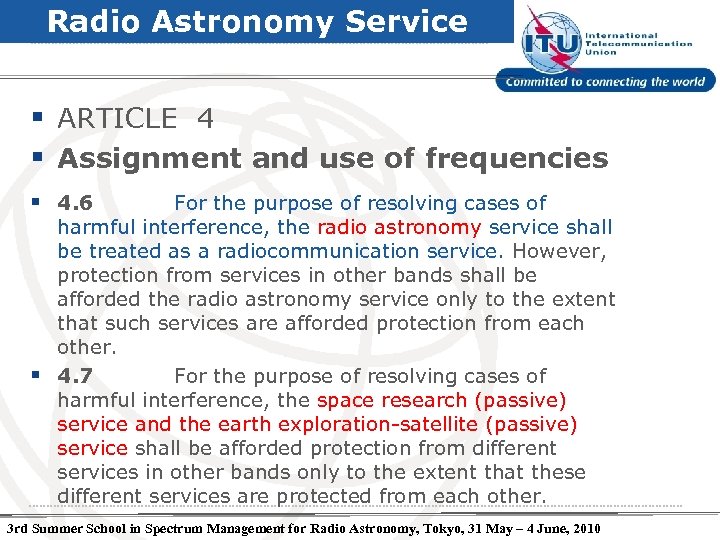 Radio Astronomy Service § ARTICLE 4 § Assignment and use of frequencies § 4. 6 For the purpose of resolving cases of harmful interference, the radio astronomy service shall be treated as a radiocommunication service. However, protection from services in other bands shall be afforded the radio astronomy service only to the extent that such services are afforded protection from each other. § 4. 7 For the purpose of resolving cases of harmful interference, the space research (passive) service and the earth exploration-satellite (passive) service shall be afforded protection from different services in other bands only to the extent that these different services are protected from each other. 3 rd Summer School in Spectrum Management for Radio Astronomy, Tokyo, 31 May – 4 June, 2010
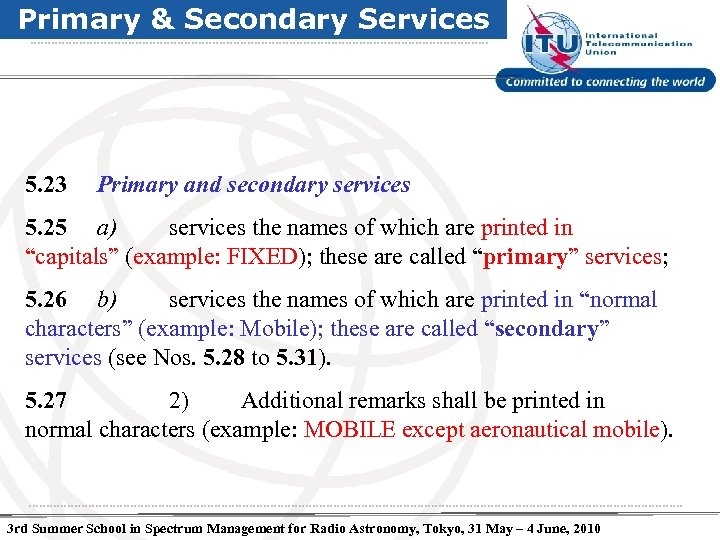 Primary & Secondary Services 5. 23 Primary and secondary services 5. 25 a) services the names of which are printed in “capitals” (example: FIXED); these are called “primary” services; 5. 26 b) services the names of which are printed in “normal characters” (example: Mobile); these are called “secondary” services (see Nos. 5. 28 to 5. 31). 5. 27 2) Additional remarks shall be printed in normal characters (example: MOBILE except aeronautical mobile). 3 rd Summer School in Spectrum Management for Radio Astronomy, Tokyo, 31 May – 4 June, 2010
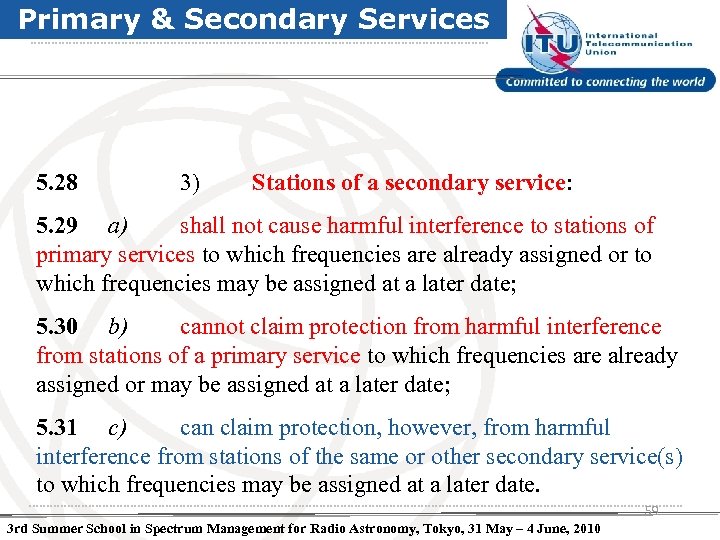 Primary & Secondary Services 5. 28 3) Stations of a secondary service: 5. 29 a) shall not cause harmful interference to stations of primary services to which frequencies are already assigned or to which frequencies may be assigned at a later date; 5. 30 b) cannot claim protection from harmful interference from stations of a primary service to which frequencies are already assigned or may be assigned at a later date; 5. 31 c) can claim protection, however, from harmful interference from stations of the same or other secondary service(s) to which frequencies may be assigned at a later date. 59 3 rd Summer School in Spectrum Management for Radio Astronomy, Tokyo, 31 May – 4 June, 2010
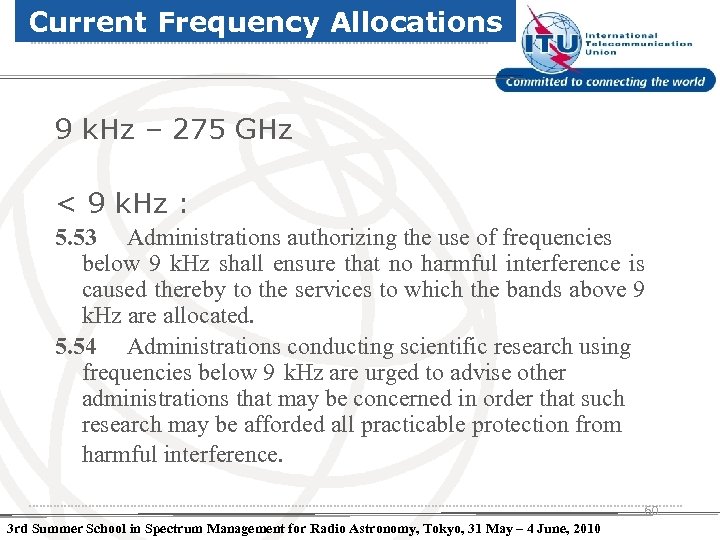 Current Frequency Allocations 9 k. Hz – 275 GHz < 9 k. Hz : 5. 53 Administrations authorizing the use of frequencies below 9 k. Hz shall ensure that no harmful interference is caused thereby to the services to which the bands above 9 k. Hz are allocated. 5. 54 Administrations conducting scientific research using frequencies below 9 k. Hz are urged to advise other administrations that may be concerned in order that such research may be afforded all practicable protection from harmful interference. 60 3 rd Summer School in Spectrum Management for Radio Astronomy, Tokyo, 31 May – 4 June, 2010
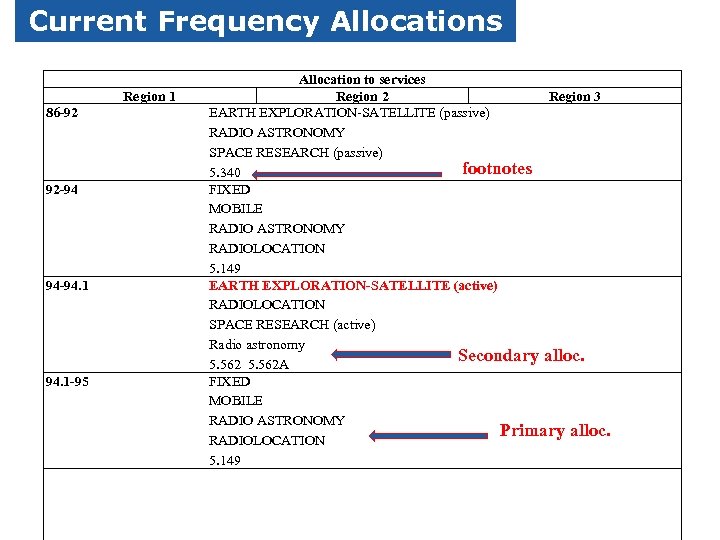 Current Frequency Allocations Region 1 86 -92 92 -94 94 -94. 1 -95 Allocation to services Region 2 Region 3 EARTH EXPLORATION-SATELLITE (passive) RADIO ASTRONOMY SPACE RESEARCH (passive) footnotes 5. 340 FIXED MOBILE RADIO ASTRONOMY RADIOLOCATION 5. 149 EARTH EXPLORATION-SATELLITE (active) RADIOLOCATION SPACE RESEARCH (active) Radio astronomy Secondary alloc. 5. 562 A FIXED MOBILE RADIO ASTRONOMY Primary alloc. RADIOLOCATION 5. 149
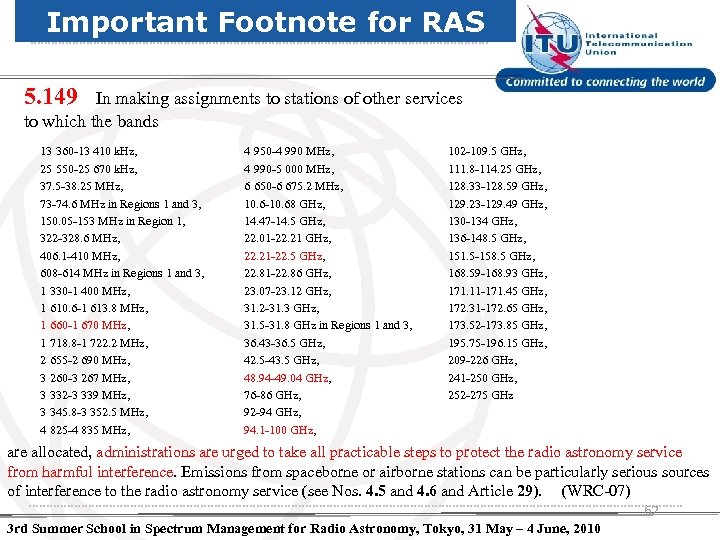 Important Footnote for RAS 5. 149 In making assignments to stations of other services to which the bands 13 360 -13 410 k. Hz, 25 550 -25 670 k. Hz, 37. 5 -38. 25 MHz, 73 -74. 6 MHz in Regions 1 and 3, 150. 05 -153 MHz in Region 1, 322 -328. 6 MHz, 406. 1 -410 MHz, 608 -614 MHz in Regions 1 and 3, 1 330 -1 400 MHz, 1 610. 6 -1 613. 8 MHz, 1 660 -1 670 MHz, 1 718. 8 -1 722. 2 MHz, 2 655 -2 690 MHz, 3 260 -3 267 MHz, 3 332 -3 339 MHz, 3 345. 8 -3 352. 5 MHz, 4 825 -4 835 MHz, 4 950 -4 990 MHz, 4 990 -5 000 MHz, 6 650 -6 675. 2 MHz, 10. 6 -10. 68 GHz, 14. 47 -14. 5 GHz, 22. 01 -22. 21 GHz, 22. 21 -22. 5 GHz, 22. 81 -22. 86 GHz, 23. 07 -23. 12 GHz, 31. 2 -31. 3 GHz, 31. 5 -31. 8 GHz in Regions 1 and 3, 36. 43 -36. 5 GHz, 42. 5 -43. 5 GHz, 48. 94 -49. 04 GHz, 76 -86 GHz, 92 -94 GHz, 94. 1 -100 GHz, 102 -109. 5 GHz, 111. 8 -114. 25 GHz, 128. 33 -128. 59 GHz, 129. 23 -129. 49 GHz, 130 -134 GHz, 136 -148. 5 GHz, 151. 5 -158. 5 GHz, 168. 59 -168. 93 GHz, 171. 11 -171. 45 GHz, 172. 31 -172. 65 GHz, 173. 52 -173. 85 GHz, 195. 75 -196. 15 GHz, 209 -226 GHz, 241 -250 GHz, 252 -275 GHz are allocated, administrations are urged to take all practicable steps to protect the radio astronomy service from harmful interference. Emissions from spaceborne or airborne stations can be particularly serious sources of interference to the radio astronomy service (see Nos. 4. 5 and 4. 6 and Article 29). (WRC‑ 07) 62 3 rd Summer School in Spectrum Management for Radio Astronomy, Tokyo, 31 May – 4 June, 2010
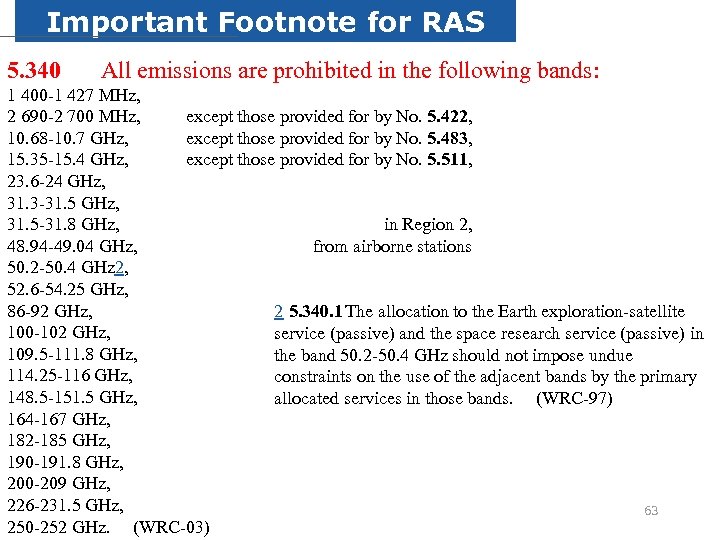 Important Footnote for RAS 5. 340 All emissions are prohibited in the following bands: 1 400 -1 427 MHz, 2 690 -2 700 MHz, except those provided for by No. 5. 422, 10. 68 -10. 7 GHz, except those provided for by No. 5. 483, 15. 35 -15. 4 GHz, except those provided for by No. 5. 511, 23. 6 -24 GHz, 31. 3 -31. 5 GHz, 31. 5 -31. 8 GHz, in Region 2, 48. 94 -49. 04 GHz, from airborne stations 50. 2 -50. 4 GHz 2, 52. 6 -54. 25 GHz, 86 -92 GHz, 2 5. 340. 1 The allocation to the Earth exploration-satellite 100 -102 GHz, service (passive) and the space research service (passive) in 109. 5 -111. 8 GHz, the band 50. 2 -50. 4 GHz should not impose undue 114. 25 -116 GHz, constraints on the use of the adjacent bands by the primary 148. 5 -151. 5 GHz, allocated services in those bands. (WRC-97) 164 -167 GHz, 182 -185 GHz, 190 -191. 8 GHz, 200 -209 GHz, 226 -231. 5 GHz, 63 250 -252 GHz. (WRC‑ 03)
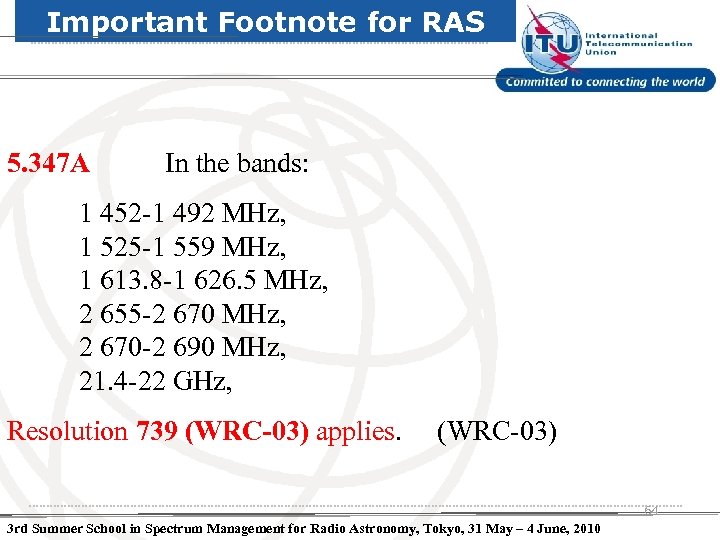 Important Footnote for RAS 5. 347 A In the bands: 1 452 -1 492 MHz, 1 525 -1 559 MHz, 1 613. 8 -1 626. 5 MHz, 2 655 -2 670 MHz, 2 670 -2 690 MHz, 21. 4 -22 GHz, Resolution 739 (WRC-03) applies. (WRC-03) 64 3 rd Summer School in Spectrum Management for Radio Astronomy, Tokyo, 31 May – 4 June, 2010
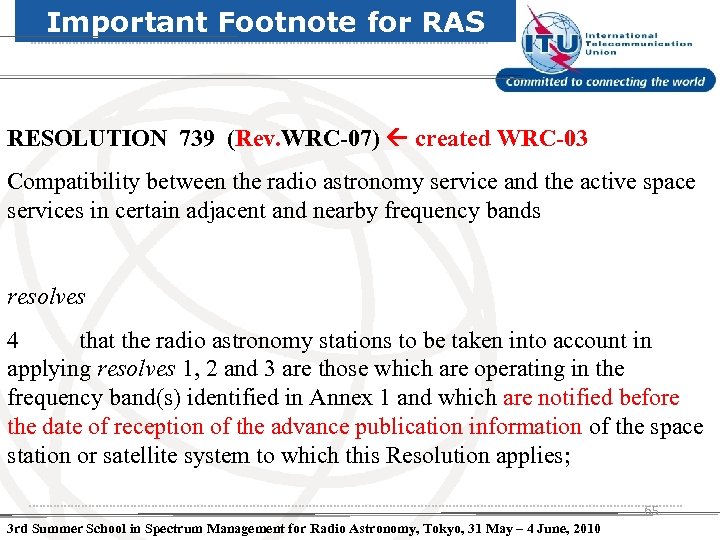 Important Footnote for RAS RESOLUTION 739 (Rev. WRC-07) created WRC-03 Compatibility between the radio astronomy service and the active space services in certain adjacent and nearby frequency bands resolves 4 that the radio astronomy stations to be taken into account in applying resolves 1, 2 and 3 are those which are operating in the frequency band(s) identified in Annex 1 and which are notified before the date of reception of the advance publication information of the space station or satellite system to which this Resolution applies; 65 3 rd Summer School in Spectrum Management for Radio Astronomy, Tokyo, 31 May – 4 June, 2010
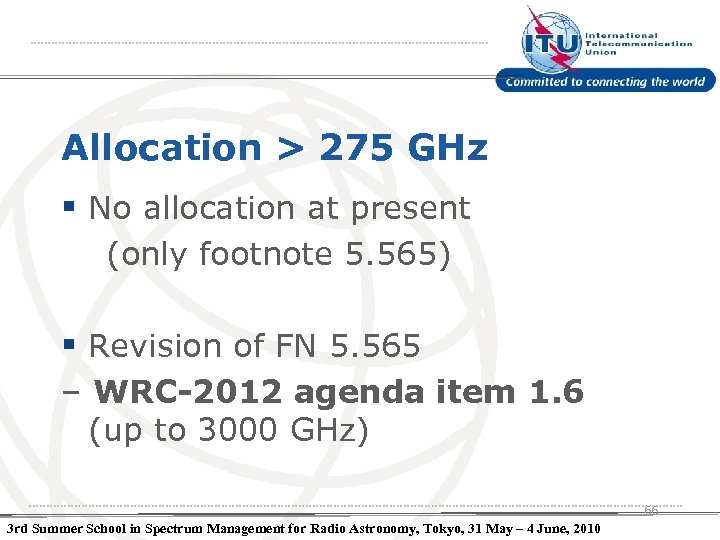 Allocation > 275 GHz § No allocation at present (only footnote 5. 565) § Revision of FN 5. 565 – WRC-2012 agenda item 1. 6 (up to 3000 GHz) 66 3 rd Summer School in Spectrum Management for Radio Astronomy, Tokyo, 31 May – 4 June, 2010
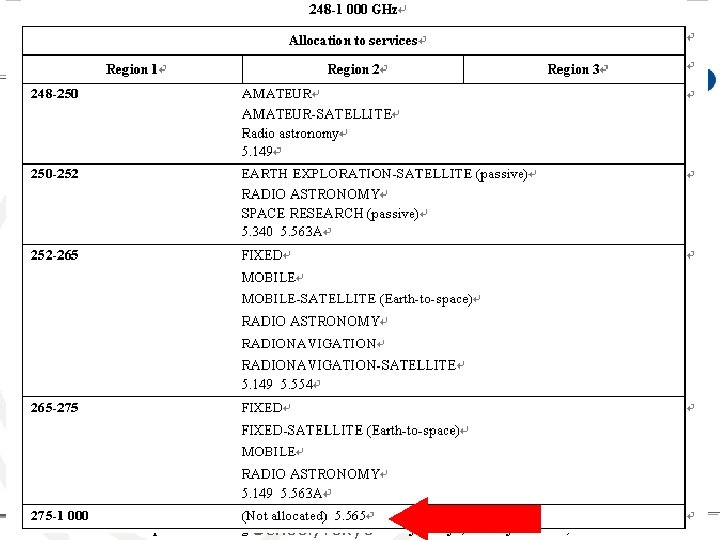 May 31, 2010 3 rd IUCAF Summer 3 rd Summer School in Spectrum Management for Radio Astronomy, Tokyo, 31 May – 4 June, 2010 School, Tokyo 67
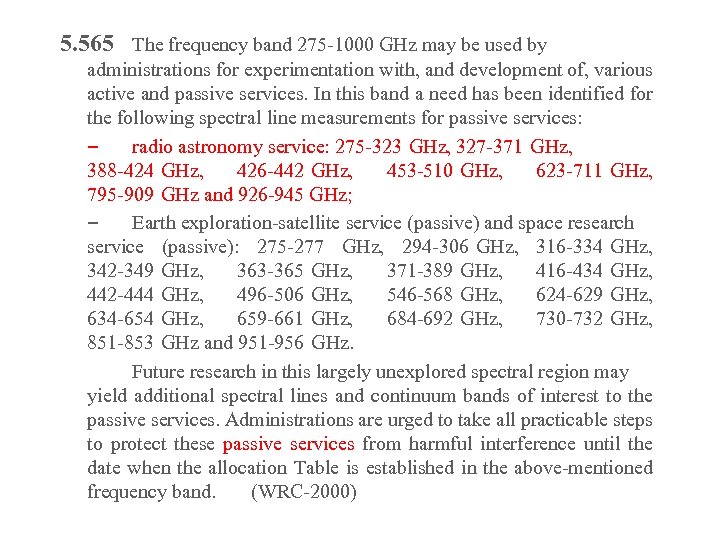 5. 565 The frequency band 275 -1000 GHz may be used by administrations for experimentation with, and development of, various active and passive services. In this band a need has been identified for the following spectral line measurements for passive services: – radio astronomy service: 275‑ 323 GHz, 327‑ 371 GHz, 388‑ 424 GHz, 426‑ 442 GHz, 453‑ 510 GHz, 623‑ 711 GHz, 795‑ 909 GHz and 926 -945 GHz; – Earth exploration-satellite service (passive) and space research service (passive): 275 -277 GHz, 294‑ 306 GHz, 316‑ 334 GHz, 342‑ 349 GHz, 363‑ 365 GHz, 371‑ 389 GHz, 416‑ 434 GHz, 442‑ 444 GHz, 496‑ 506 GHz, 546‑ 568 GHz, 624‑ 629 GHz, 634‑ 654 GHz, 659‑ 661 GHz, 684‑ 692 GHz, 730‑ 732 GHz, 851‑ 853 GHz and 951‑ 956 GHz. Future research in this largely unexplored spectral region may yield additional spectral lines and continuum bands of interest to the passive services. Administrations are urged to take all practicable steps to protect these passive services from harmful interference until the date when the allocation Table is established in the above-mentioned frequency band. (WRC‑ 2000)
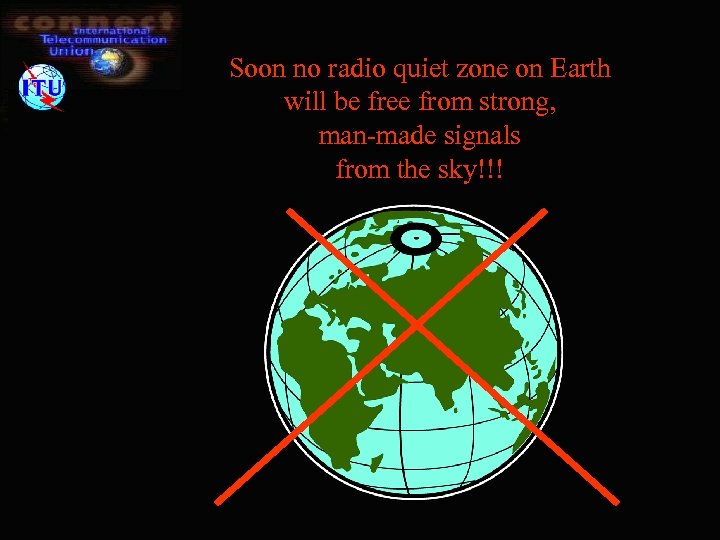 Soon no radio quiet zone on Earth will be free from strong, man-made signals from the sky!!! 3 rd Summer School in Spectrum Management for Radio Astronomy, Tokyo, 31 May – 4 June, 2010 International Telecommunication Union
 RA bands defined in ITU § Frequency usages are regulated in ITU § RA bands rights to be protected 70 3 rd Summer School in Spectrum Management for Radio Astronomy, Tokyo, 31 May – 4 June, 2010
 Thank you! 3 rd Summer School in Spectrum Management for Radio Astronomy, Tokyo, 31 May – 4 June, 2010