


 Скачать презентацию 3 rd Party Software Gail Alverson August 5
4806ce8f62d82b4fbe8c59a0360105f3.ppt
- Количество слайдов: 17
 3 rd Party Software Gail Alverson August 5, 2005
 Outline Part 1 – Case Study: Story of an engineer What’s my software engineering history? Example of Cray software stack/software types Part 2 – 3 rd party software What is it? Why use it – what are the benefits? And what are the costs? References
 My SW Engineering roles 1991 - present Software engineer, libraries and debugger Designed and implemented components Worked with a small team Project lead/Software engineer, libraries and tools Added responsibility for broader direction of the products And project assignments/schedule Manager, programming environments Stepped back from coding to focus on design and project planning More management of engineers More interaction with vendors, customers, and corporate roadmap Senior Manager, OS and PE components Project direction, estimation, planning and execution Integration work and release work Engineer management, including their career growth
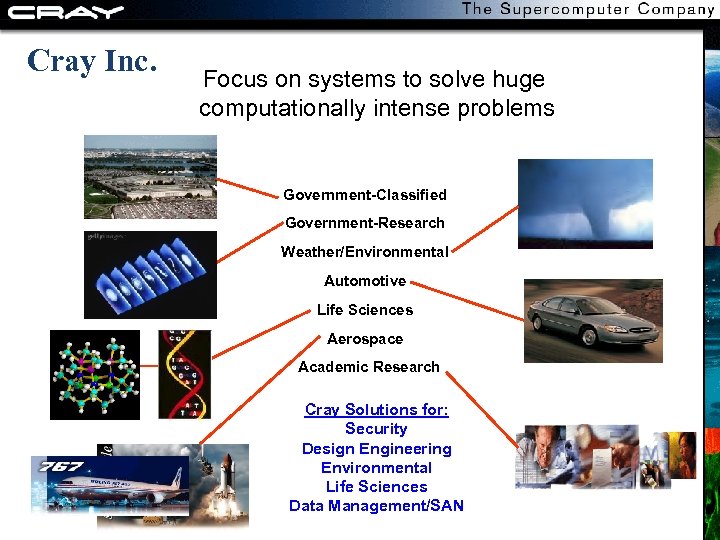 Cray Inc. Focus on systems to solve huge computationally intense problems Government-Classified Government-Research Weather/Environmental Automotive Life Sciences Aerospace Academic Research Cray Solutions for: Security Design Engineering Environmental Life Sciences Data Management/SAN
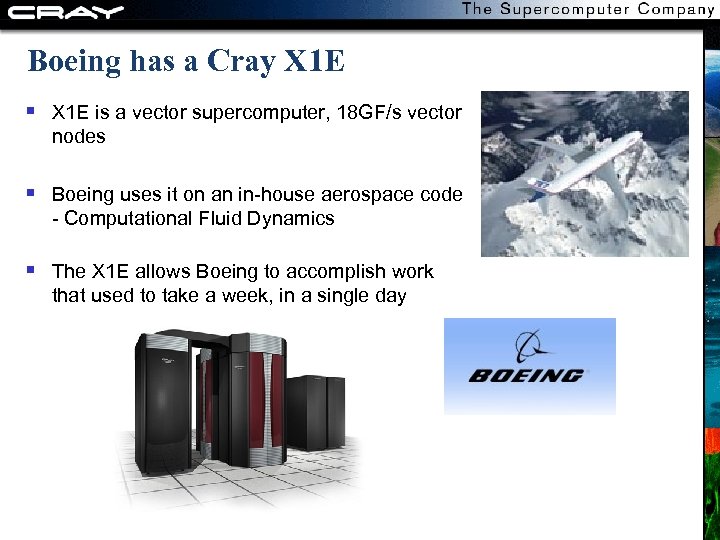 Boeing has a Cray X 1 E is a vector supercomputer, 18 GF/s vector nodes Boeing uses it on an in-house aerospace code - Computational Fluid Dynamics The X 1 E allows Boeing to accomplish work that used to take a week, in a single day
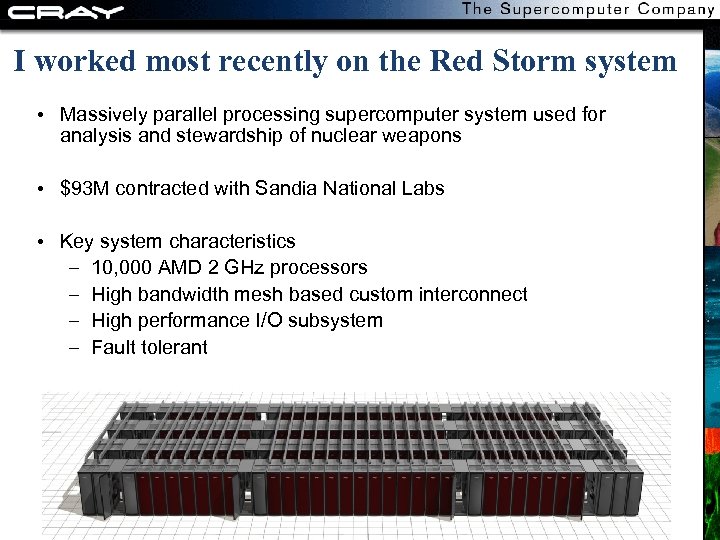 I worked most recently on the Red Storm system • Massively parallel processing supercomputer system used for analysis and stewardship of nuclear weapons • $93 M contracted with Sandia National Labs • Key system characteristics – 10, 000 AMD 2 GHz processors – High bandwidth mesh based custom interconnect – High performance I/O subsystem – Fault tolerant
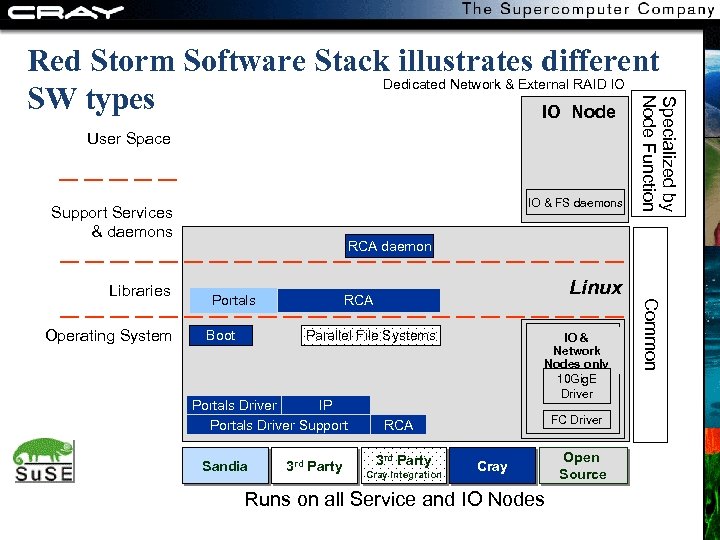 User Space Total. View Compiler Perf. Tool Job Launch Support Services & daemons Operating System PBS mom PBS srv DB IO & FS daemons RCA daemon Portals Boot Linux RCA Parallel File Systems Portals Driver IP Portals Driver Support Sandia 3 rd Party IO & Network Nodes only 10 Gig. E Driver FC Driver RCA 3 rd Party Cray Integration Cray Runs on all Service and IO Nodes Open Source Common Libraries Allocator Accounting Showmesh Specialized by Node Function Red Storm Software Stack illustrates different User’s Environment Dedicated Server Functions Dedicated Network & External RAID IO SW types Server Node Login Node IO Node
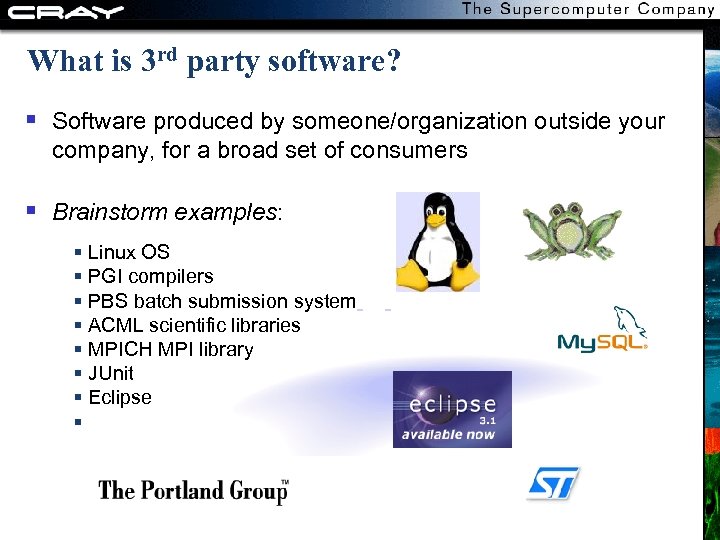 What is 3 rd party software? Software produced by someone/organization outside your company, for a broad set of consumers Brainstorm examples: Linux OS PGI compilers PBS batch submission system ACML scientific libraries MPICH MPI library JUnit Eclipse
 Why use 3 rd party software? Brainstorm motivations: Function exists, why reinvent the wheel Less development time Less development cost Requested by customers Others have expertise Others contribute to the support and evolution
 How can we use it? 1. As a tool in the product development process: Brainstorm examples: 2. As part of a product being shipped: Brainstorm examples:
 We can try to classify 3 rd party software Commercial software Developed, distributed and maintained under a licensing agreement with a vendor, generally for a fee Free software/Open source software Software that one may use, copy, modify, redistribute for free, although certain conditions/licenses may apply Copyright is retained by the author Public domain software Total absence of copyright protection Anyone can copy, modify or use it in any way they wish Others: freeware, shareware, … [tools]
![The hidden costs of using 3 rd party software [in your product] 1. Be](https://present5.com/presentation/4806ce8f62d82b4fbe8c59a0360105f3/image-12.jpg "The hidden costs of using 3 rd party software [in your product] 1. Be") The hidden costs of using 3 rd party software [in your product] 1. Be very aware of the intellectual property (IP) rights associated with the software, such as: Copyright – protect an expression of an idea on a medium Patent – protect an innovation Trade secret – protect a concept/idea/innovation that is not generally known and has value License – allow access to otherwise protected software Ask: Do you have the right to use the software? Is it important to protect some proprietary code (IP) you’re adding? Do the IP rights allow you to do this?
The hidden costs of using 3 rd party software [in your product] 1. Be very aware of the intellectual property (IP) rights associated with the software, such as: Copyright – protect an expression of an idea on a medium Patent – protect an innovation Trade secret – protect a concept/idea/innovation that is not generally known and has value License – allow access to otherwise protected software Ask: Do you have the right to use the software? Is it important to protect some proprietary code (IP) you’re adding? Do the IP rights allow you to do this?
 Case Study: License Require a strcpy() function for your product’s proprietary libc Consider a BSD libc routine and a glibc routine BSD license – generous No requirement to distribute your modified source code Source redistribution requires copyright notices and disclaimers Binary distribution requires copyright notice and disclaimers in the documentation. GPL license – infectious Source must be made available to customers who request it Your modifications (derivative work) must be included with the source LGPL, license for libraries is a middle ground
 The hidden costs of 3 rd party software (2) 2. Take into account integration costs Rarely does the software do exactly what you need it to Typically there is some integration that must occur, and some expertise that must be built inhouse 3. Consider whether additional testing and/or robustification is needed You’re ultimately responsible 4. Don’t forget to plan for updates How will you incorporate updates of the 3 rd party software into your version of it?
 Case Study: Path. Scale Compiler product is based on SGI open source code-GPL Ported the code to a new architecture and enhanced its performance Path. Scale has built a strong knowledge of the Open Source code and maintains it in-house They distribute the Open Source components And engineered the Path. Scale proprietary code to avoid the GPL code (independent and separate works) and thus does not distribute it
 My questions to you What 3 rd party software did you use in your product? Are there any requirements of your company [you] by doing this?
 Summary 3 rd party software is good! 3 rd party software, in particular those used in your company products, has costs and/or restrictions that must be understood before committing to their use References http: //uwsg. ucs. indiana. edu/usail/software/third-party. html/ http: //www. opensource. org/ http: //www. gnu. org http: //www. pathscale. com/