


 Скачать презентацию 3 rd MODPROD Workshop Keynote Technologies for
4092a315853e60fb4b02531a2df97f8d.ppt
- Количество слайдов: 36
 3 rd MODPROD Workshop – Keynote Technologies for Creating Easily Maintainable Component Model Libraries of Complex Physical Systems François E. Cellier Department of Computer Science ETH Zurich Switzerland February 4, 2009 © Prof. Dr. François E. Cellier Start of Presentation
 3 rd MODPROD Workshop – Keynote • The Modelica Standard Library (SL) is growing at an amazing pace. Whereas originally, the SL was meant as a small add-on created for the convenience of the end user, the library is now growing faster in terms of number of lines of code than the Modelica compilers themselves. Fairly soon, the SL will be larger in size than the compilers managing it. • Maintaining such a large library has become a daunting task, especially since this is a highly distributed endeavor, i. e. , there are many researchers contributing regularly to the SL. • The developers of Modelica environments have long recognized this problem, and they are meanwhile offering quite sophisticated library management tools, such as version control, scripts for automated upgrading of libraries from one version of Modelica to the next, etc. February 4, 2009 © Prof. Dr. François E. Cellier Start of Presentation
 3 rd MODPROD Workshop – Keynote • Yet, tools for managing potentially bad models offer only a partial answer to the problem. More important are tools that minimize the complexity of the individual model codes and that support the modeler in making sure that his or her models are correctly reflecting the physics of the underlying physical system to be modeled. • This presentation offers a discussion of such methodologies. February 4, 2009 © Prof. Dr. François E. Cellier Start of Presentation
 3 rd MODPROD Workshop – Keynote 1. Graphical Modeling • Modeling systems graphically is better than modeling them by means of equations. • Graphical models are two-dimensional, whereas equations are one-dimensional. • Hence missing connections can be identified more easily. • The maintenance of graphical models is considerably easier than that of equation models. February 4, 2009 © Prof. Dr. François E. Cellier Start of Presentation
 3 rd MODPROD Workshop – Keynote • Graphical modeling forces the modeler to structure his or her models such that each of them fits entirely onto one screen. • Some graphical modeling environments offer a virtual canvas over which the physical screen can be shifted. • Don’t use it! It’s a mistake. A model that doesn’t fit on a screen needs to be restructured. • A Modelica environment that doesn’t offer a fullfledged graphical front end is not competitive. February 4, 2009 © Prof. Dr. François E. Cellier Start of Presentation
 3 rd MODPROD Workshop – Keynote 2. Bond Graph Modeling • Bond graphs represent the lowest-level graphical model interface that is still fully object oriented. • Bond graph modeling enables the modeler to model graphically further down than any other graphical modeling methodology. • This minimizes the need for using equations, thereby making the so-built libraries easier maintainable. • Bond graphs do not necessarily offer the best suited GUI for the end user. February 4, 2009 © Prof. Dr. François E. Cellier Start of Presentation
 3 rd MODPROD Workshop – Keynote 3. Model Wrapping • Library designers should make use of the best suited graphical modeling methodology for representing their models to the end user. • However, models can use more than one graphical layer. • There is no need to implement the top graphical layer directly using equation models. • Model wrapping enables the library designer to interpret one graphical modeling methodology in terms of another lower-level graphical modeling approach, such as a bond graph. February 4, 2009 © Prof. Dr. François E. Cellier Start of Presentation
 3 rd MODPROD Workshop – Keynote A Crane Crab • Let us look at the following crane crab model: Prismatic Joint Mass 1 Revolute Joint Rod Mass 2 February 4, 2009 © Prof. Dr. François E. Cellier Start of Presentation
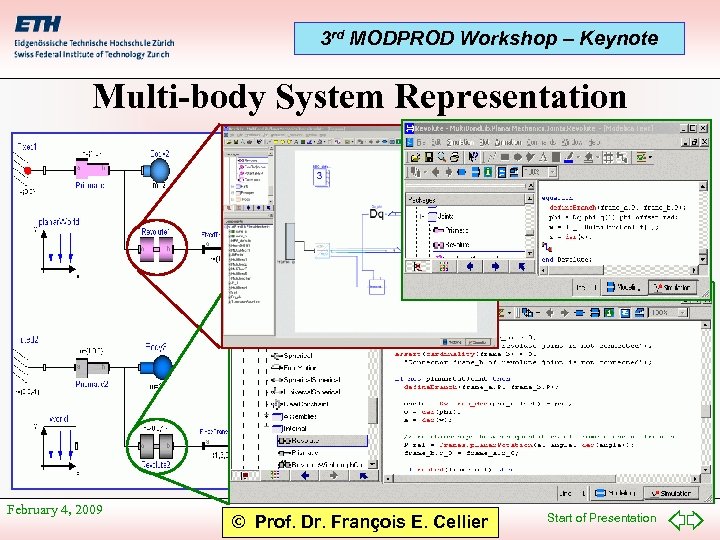 3 rd MODPROD Workshop – Keynote Multi-body System Representation February 4, 2009 © Prof. Dr. François E. Cellier Start of Presentation
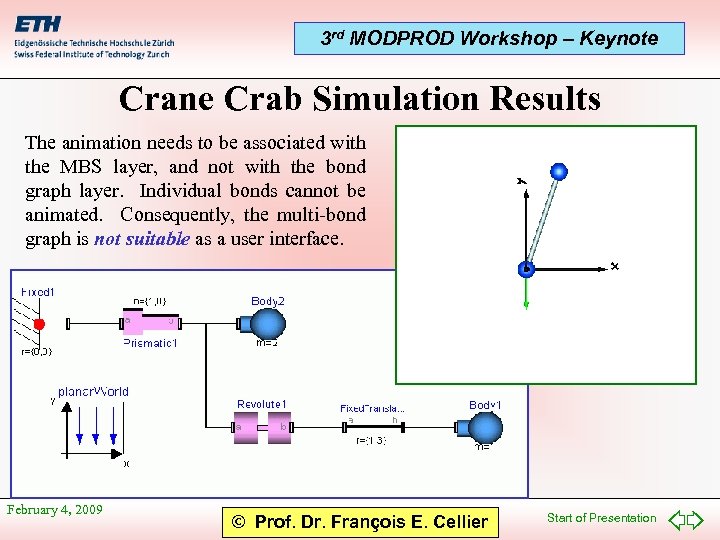 3 rd MODPROD Workshop – Keynote Crane Crab Simulation Results The animation needs to be associated with the MBS layer, and not with the bond graph layer. Individual bonds cannot be animated. Consequently, the multi-bond graph is not suitable as a user interface. February 4, 2009 © Prof. Dr. François E. Cellier Start of Presentation
 3 rd MODPROD Workshop – Keynote Model Wrapping II • Wrapped models contain wrapper models that convert the upper-layer connectors to the lowerlayer connectors, and vice-versa. • They use the protected keyword to hide the internal lower-layer variables from the simulation. In this way, the set of variables offered for display in the simulation window is identical in both libraries. This is called wrapping the model tight. • The state select algorithm is used to ensure that the flattened Modelica model will employ the same state variables in both libraries. February 4, 2009 © Prof. Dr. François E. Cellier Start of Presentation
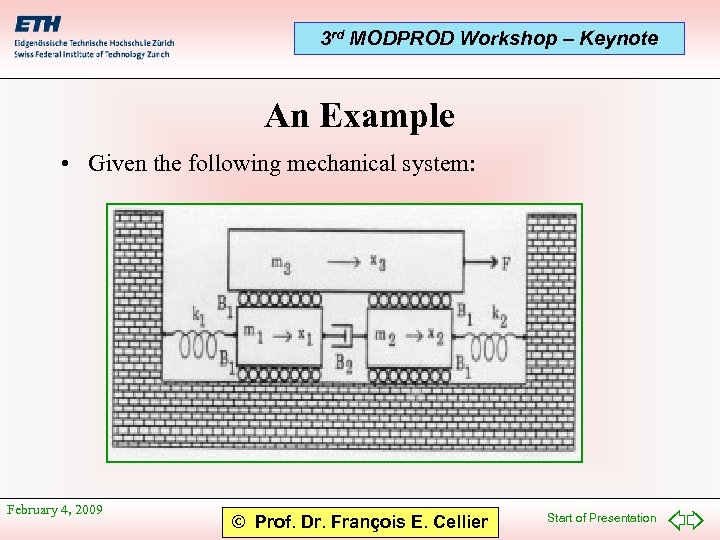 3 rd MODPROD Workshop – Keynote An Example • Given the following mechanical system: February 4, 2009 © Prof. Dr. François E. Cellier Start of Presentation
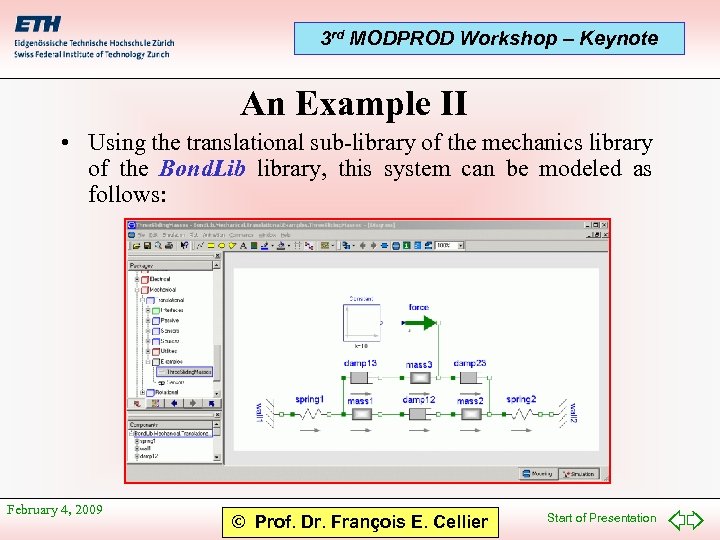 3 rd MODPROD Workshop – Keynote An Example II • Using the translational sub-library of the mechanics library of the Bond. Lib library, this system can be modeled as follows: February 4, 2009 © Prof. Dr. François E. Cellier Start of Presentation
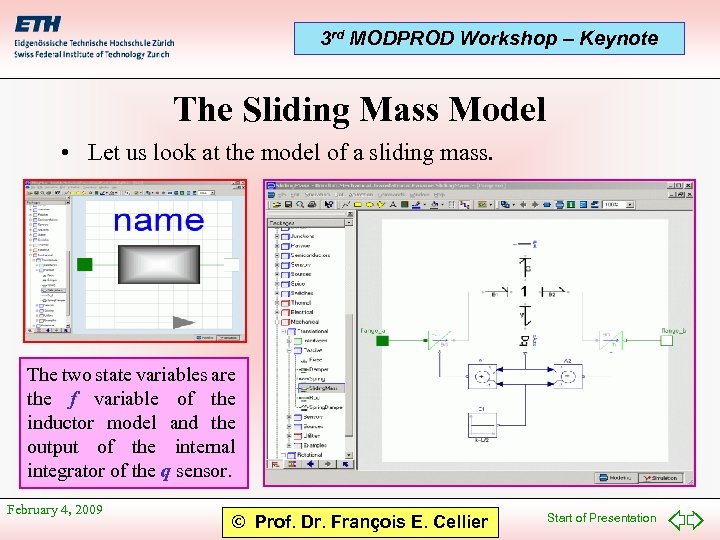 3 rd MODPROD Workshop – Keynote The Sliding Mass Model • Let us look at the model of a sliding mass. The two state variables are the f variable of the inductor model and the output of the internal integrator of the q sensor. February 4, 2009 © Prof. Dr. François E. Cellier Start of Presentation
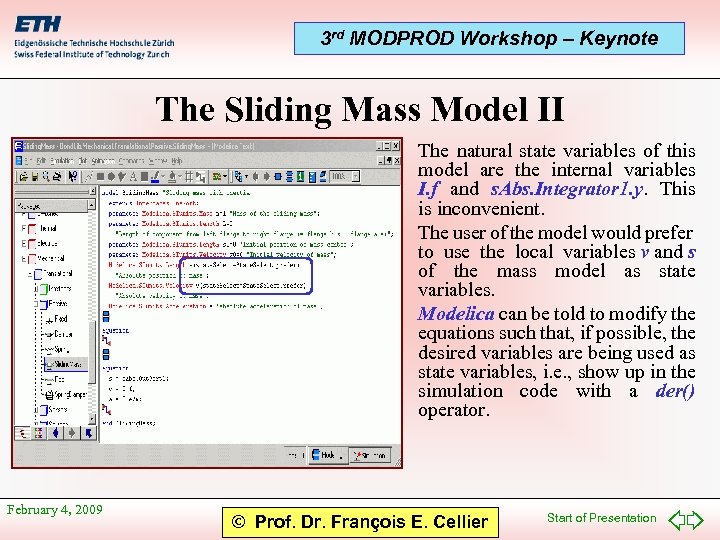 3 rd MODPROD Workshop – Keynote The Sliding Mass Model II • The natural state variables of this model are the internal variables I. f and s. Abs. Integrator 1. y. This is inconvenient. • The user of the model would prefer to use the local variables v and s of the mass model as state variables. • Modelica can be told to modify the equations such that, if possible, the desired variables are being used as state variables, i. e. , show up in the simulation code with a der() operator. February 4, 2009 © Prof. Dr. François E. Cellier Start of Presentation
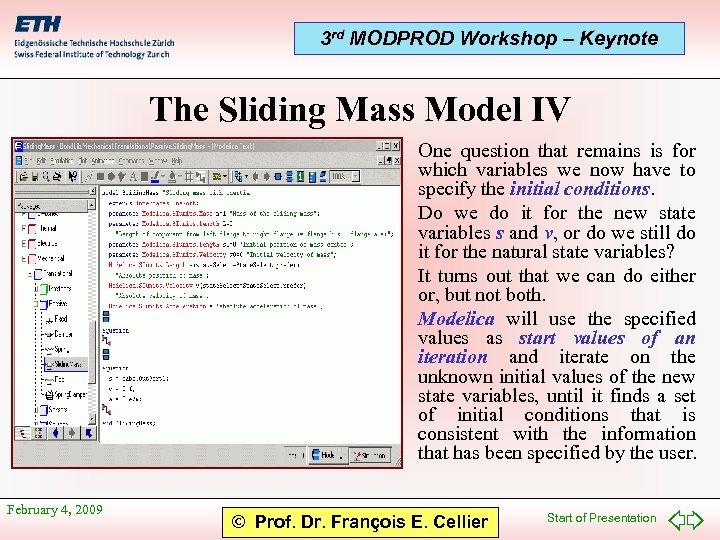 3 rd MODPROD Workshop – Keynote The Sliding Mass Model IV • One question that remains is for which variables we now have to specify the initial conditions. • Do we do it for the new state variables s and v, or do we still do it for the natural state variables? • It turns out that we can do either or, but not both. • Modelica will use the specified values as start values of an iteration and iterate on the unknown initial values of the new state variables, until it finds a set of initial conditions that is consistent with the information that has been specified by the user. February 4, 2009 © Prof. Dr. François E. Cellier Start of Presentation
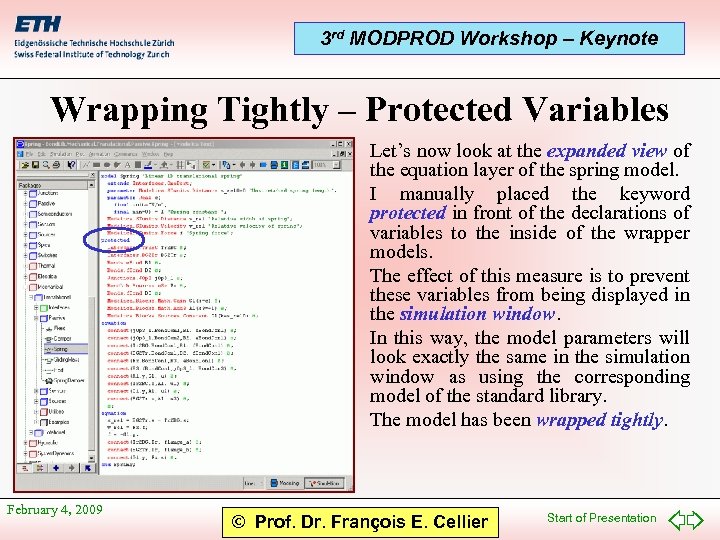 3 rd MODPROD Workshop – Keynote Wrapping Tightly – Protected Variables • Let’s now look at the expanded view of the equation layer of the spring model. • I manually placed the keyword protected in front of the declarations of variables to the inside of the wrapper models. • The effect of this measure is to prevent these variables from being displayed in the simulation window. • In this way, the model parameters will look exactly the same in the simulation window as using the corresponding model of the standard library. • The model has been wrapped tightly. February 4, 2009 © Prof. Dr. François E. Cellier Start of Presentation
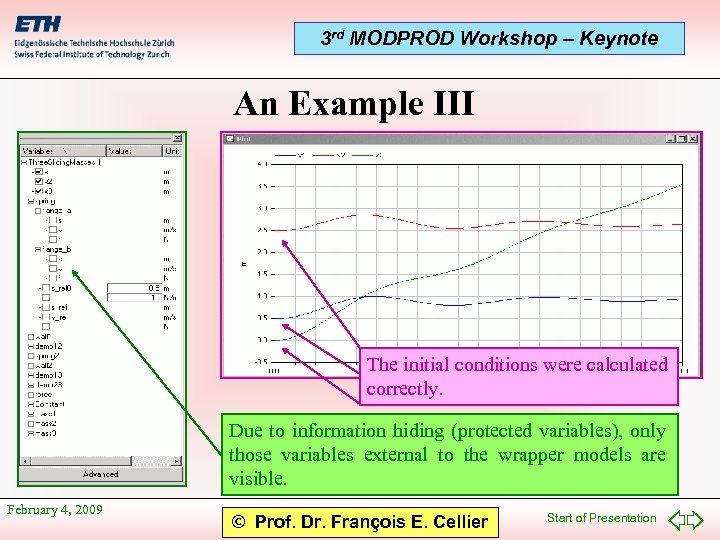 3 rd MODPROD Workshop – Keynote An Example III The initial conditions were calculated correctly. Due to information hiding (protected variables), only those variables external to the wrapper models are visible. February 4, 2009 © Prof. Dr. François E. Cellier Start of Presentation
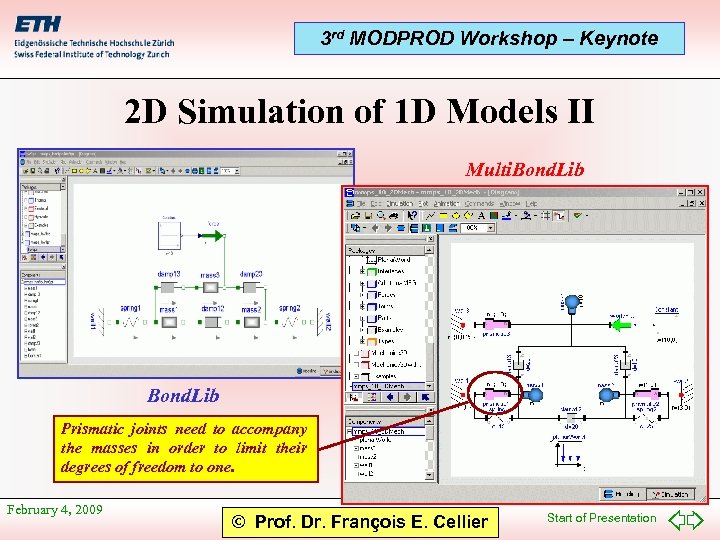 3 rd MODPROD Workshop – Keynote 2 D Simulation of 1 D Models II Multi. Bond. Lib Prismatic joints need to accompany the masses in order to limit their degrees of freedom to one. February 4, 2009 © Prof. Dr. François E. Cellier Start of Presentation
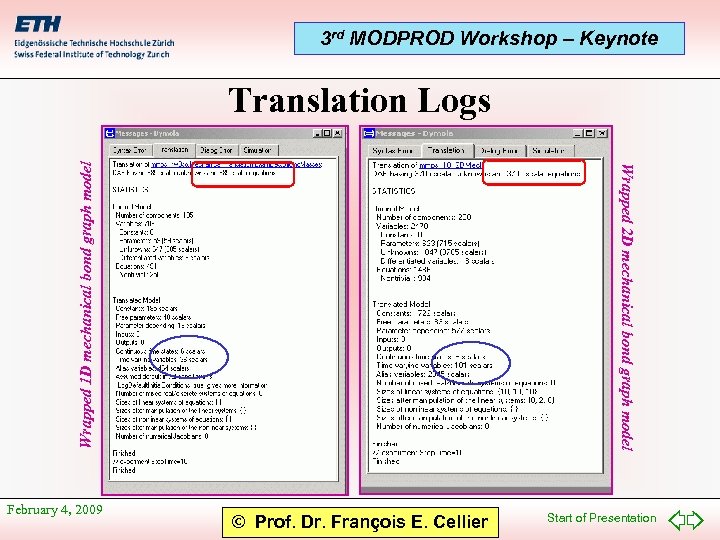 3 rd MODPROD Workshop – Keynote February 4, 2009 Wrapped 2 D mechanical bond graph model Wrapped 1 D mechanical bond graph model Translation Logs © Prof. Dr. François E. Cellier Start of Presentation
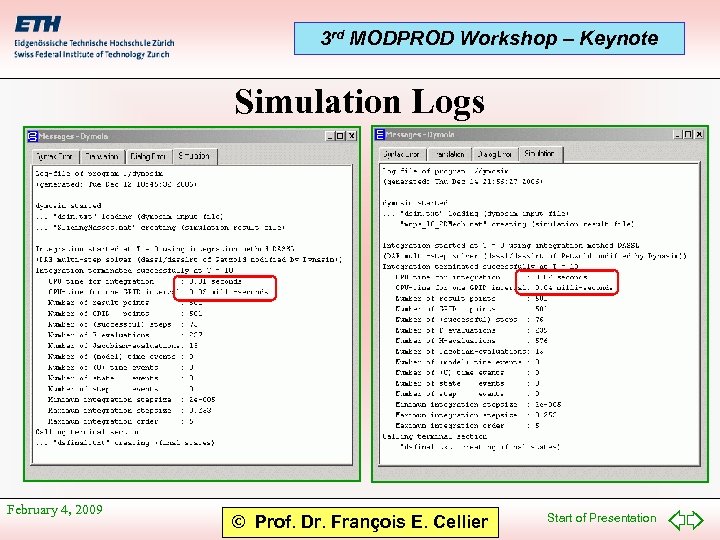 3 rd MODPROD Workshop – Keynote Simulation Logs February 4, 2009 © Prof. Dr. François E. Cellier Start of Presentation
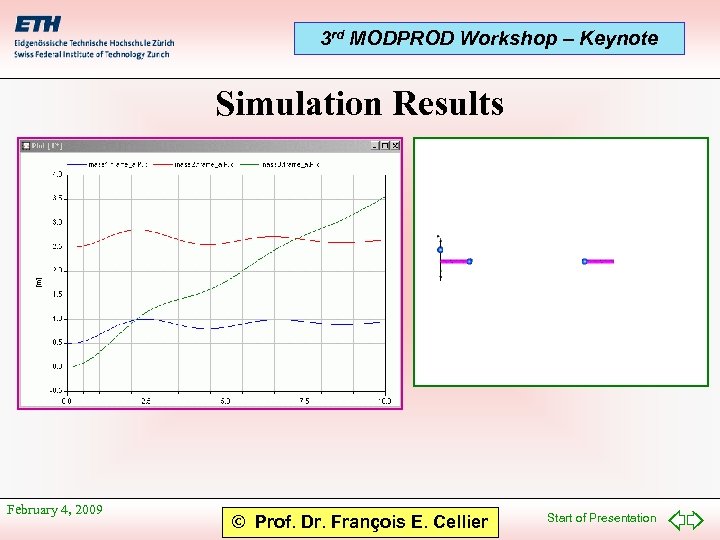 3 rd MODPROD Workshop – Keynote Simulation Results February 4, 2009 © Prof. Dr. François E. Cellier Start of Presentation
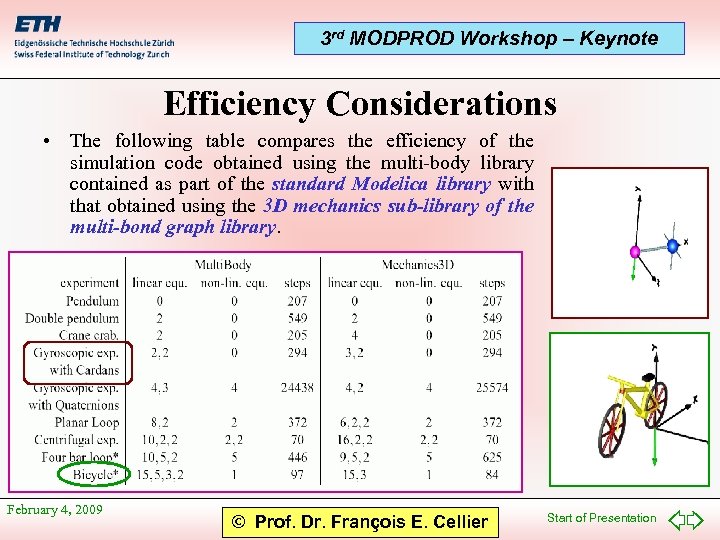 3 rd MODPROD Workshop – Keynote Efficiency Considerations • The following table compares the efficiency of the simulation code obtained using the multi-body library contained as part of the standard Modelica library with that obtained using the 3 D mechanics sub-library of the multi-bond graph library. February 4, 2009 © Prof. Dr. François E. Cellier Start of Presentation
 3 rd MODPROD Workshop – Keynote Bond. Lib • Beside from the standard 1 D bond graph elements, Bond. Lib offers additionally wrapped sub-libraries for electrical analog circuits; for mechanical 1 D translational and rotational motions; a heat transfer sub-library; and a small hydraulics sub-library. • The electrical sub-library contains in addition a full implementation of Spice. February 4, 2009 © Prof. Dr. François E. Cellier Start of Presentation
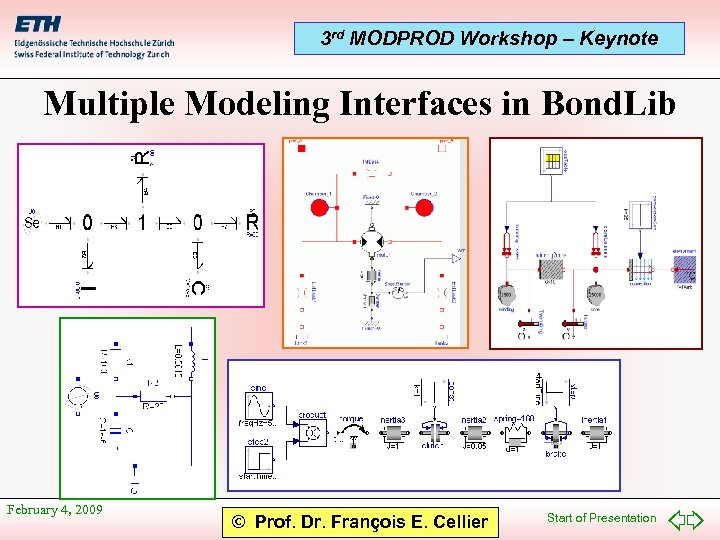 3 rd MODPROD Workshop – Keynote Multiple Modeling Interfaces in Bond. Lib February 4, 2009 © Prof. Dr. François E. Cellier Start of Presentation
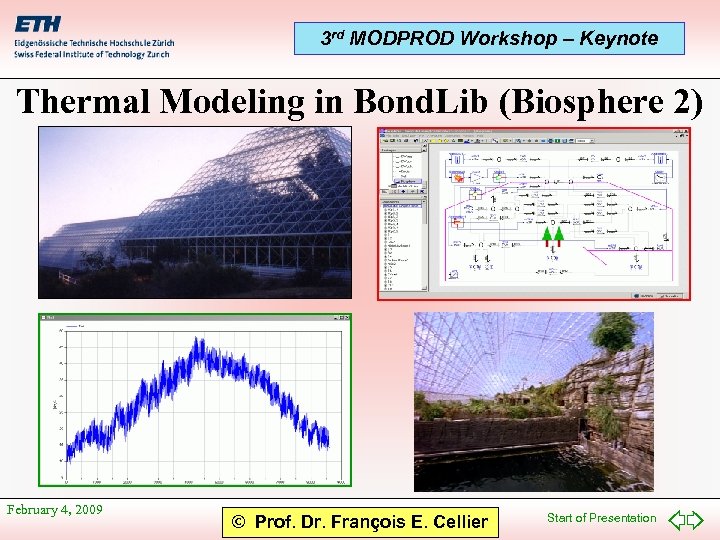 3 rd MODPROD Workshop – Keynote Thermal Modeling in Bond. Lib (Biosphere 2) February 4, 2009 © Prof. Dr. François E. Cellier Start of Presentation
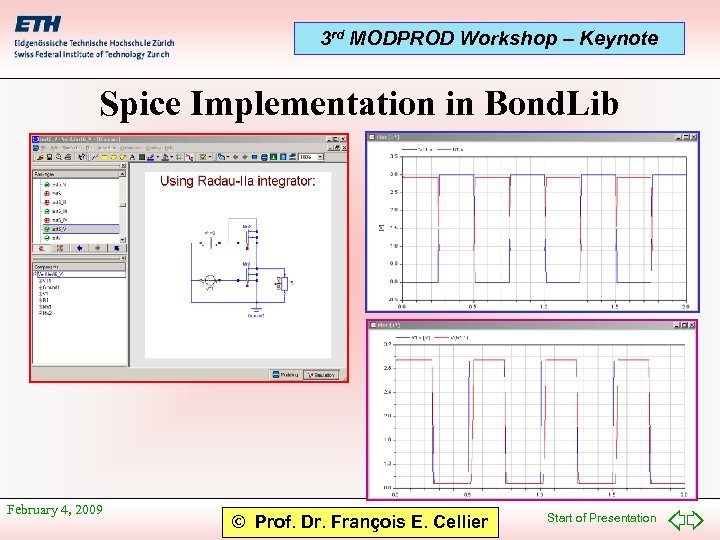 3 rd MODPROD Workshop – Keynote Spice Implementation in Bond. Lib February 4, 2009 © Prof. Dr. François E. Cellier Start of Presentation
 3 rd MODPROD Workshop – Keynote Multi. Bond. Lib • Beside from the standard 2 D and 3 D mechanical multi-bond graph elements, Multi. Bond. Lib offers additionally wrapped sub-libraries for planar mechanical motions and for 3 D mechanical motions including fully automated animation. • These wrapped sub-libraries are equivalent in power and efficiency to the multi-body system library contained as part of the Modelica standard library. • In addition, Multi. Bond. Lib offers separate sub-libraries for planar mechanics; the possibility to model elastic and inelastic impacts between 3 D bodies; as well as the possibility of modeling gravitational pools, such as needed for the simulation of planetary systems. These features are not currently available in the Modelica standard library. February 4, 2009 © Prof. Dr. François E. Cellier Start of Presentation
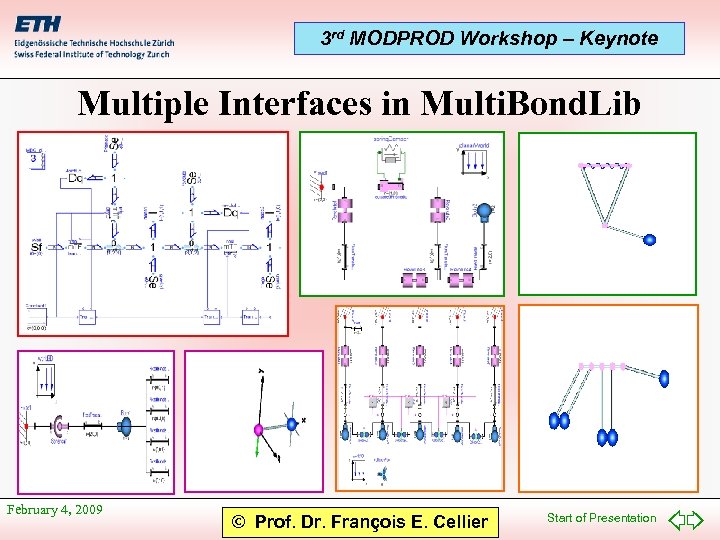 3 rd MODPROD Workshop – Keynote Multiple Interfaces in Multi. Bond. Lib February 4, 2009 © Prof. Dr. François E. Cellier Start of Presentation
 3 rd MODPROD Workshop – Keynote Thermo. Bond. Lib • Thermo. Bond. Lib library was designed for modeling convective flows (simultaneous flows of mass, volume, and heat) using thermo-bond graphs. • There are currently no wrapped thermo-bond graph sub-libraries available yet. • In the future, such wrapped sub-libraries will be added to replicate features of the media and fluid sub-libraries of the Modelica standard library. February 4, 2009 © Prof. Dr. François E. Cellier Start of Presentation
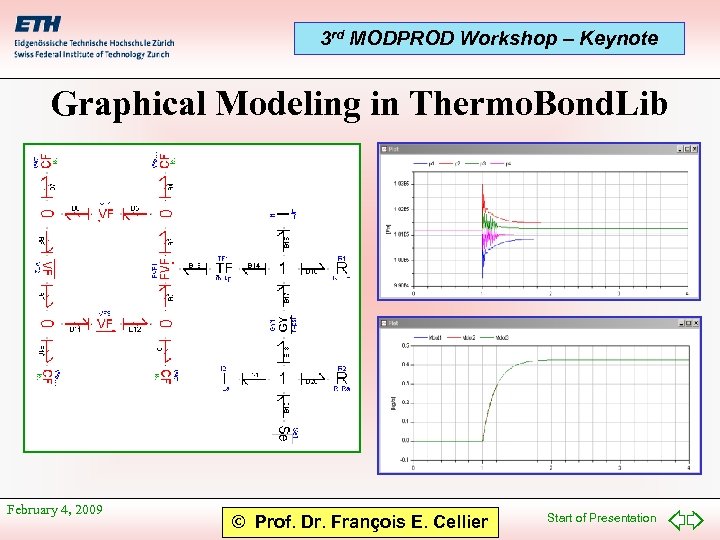 3 rd MODPROD Workshop – Keynote Graphical Modeling in Thermo. Bond. Lib February 4, 2009 © Prof. Dr. François E. Cellier Start of Presentation
 3 rd MODPROD Workshop – Keynote 4. Multiple Implementations • We can never be absolutely sure that our libraries don’t contain errors, or that neither the model compiler nor the simulation engine contain bugs. • To reduce the likelihood of such errors, it is useful to have multiple implementations available. • By comparing the simulation results of the standard library with those of the three bond graph libraries, we can verify the correctness of the libraries. • By comparing the simulation results of e. g. Dymola with those of Open. Modelica, we can verify the correctness of the model compilers and simulation engines. February 4, 2009 © Prof. Dr. François E. Cellier Start of Presentation
 3 rd MODPROD Workshop – Keynote 5. Unit Checking • It is now possible to declare correct measurement units in Modelica. • This feature helps dramatically in debugging models of physical systems. • Bond graph models are generic (multi-domain), and therefore cannot declare measurement units. • For this reason, it must be possible to inherit measurement units downwards from the higher to the lower layers of the model architecture. • It is important that Open. Modelica support unit checking in order to be competitive. February 4, 2009 © Prof. Dr. François E. Cellier Start of Presentation
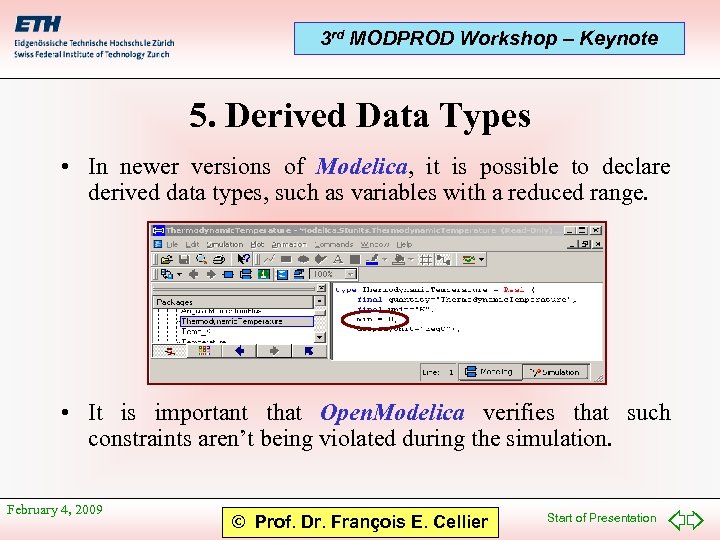 3 rd MODPROD Workshop – Keynote 5. Derived Data Types • In newer versions of Modelica, it is possible to declare derived data types, such as variables with a reduced range. • It is important that Open. Modelica verifies that such constraints aren’t being violated during the simulation. February 4, 2009 © Prof. Dr. François E. Cellier Start of Presentation
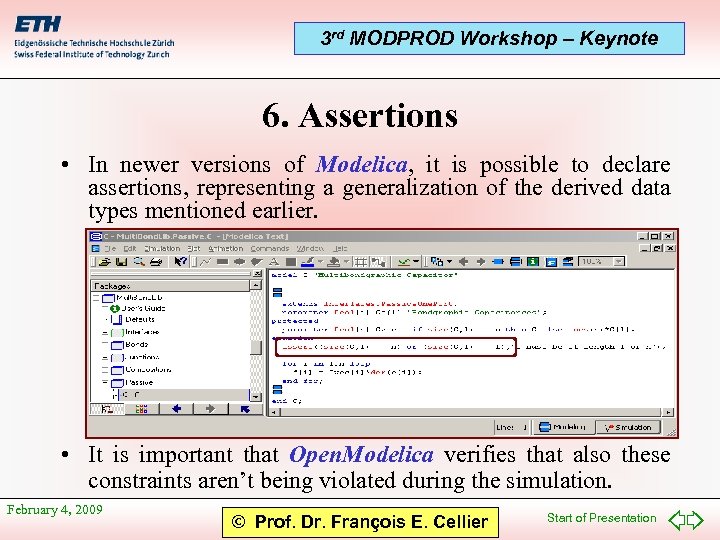 3 rd MODPROD Workshop – Keynote 6. Assertions • In newer versions of Modelica, it is possible to declare assertions, representing a generalization of the derived data types mentioned earlier. • It is important that Open. Modelica verifies that also these constraints aren’t being violated during the simulation. February 4, 2009 © Prof. Dr. François E. Cellier Start of Presentation
 3 rd MODPROD Workshop – Keynote Conclusions • In this presentation, I have looked at a number of features that can help create safer models: 1. 2. 3. 4. 5. 6. graphical modeling bond graph modeling model wrapping multiple implementations derived data types assertions • Together they offer means for creating Modelica libraries that are safer to use and easier to maintain. February 4, 2009 © Prof. Dr. François E. Cellier Start of Presentation