 Скачать презентацию 3 rd IPPC Global Symposium on e Phyto
a3a1e1a747fb65ac5f7b5911964d05d3.ppt
- Количество слайдов: 21



3 rd IPPC Global Symposium on e. Phyto Future e. Phyto Work Plan and Ongoing Communications Peter Neimanis, Chair, IPPC e. Phyto Steering Group. 26 January 2018 Kuala Lumpur, Malaysia
1. Future Work Plan 2. Communications 3. Take home messages
1. Future Work Plan • Service delivery contract • Hub • Ge. NS • Implementation guidance • Business model
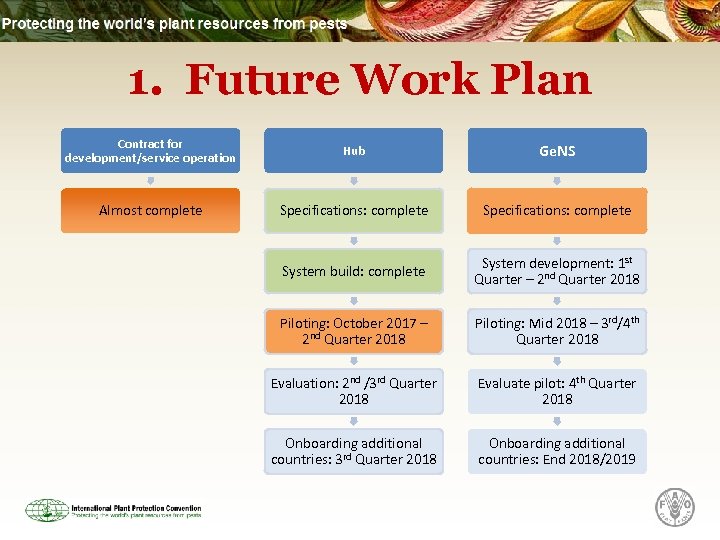
1. Future Work Plan Contract for development/service operation Hub Ge. NS Almost complete Specifications: complete System build: complete System development: 1 st Quarter – 2 nd Quarter 2018 Piloting: October 2017 – 2 nd Quarter 2018 Piloting: Mid 2018 – 3 rd/4 th Quarter 2018 Evaluation: 2 nd /3 rd Quarter 2018 Evaluate pilot: 4 th Quarter 2018 Onboarding additional countries: 3 rd Quarter 2018 Onboarding additional countries: End 2018/2019
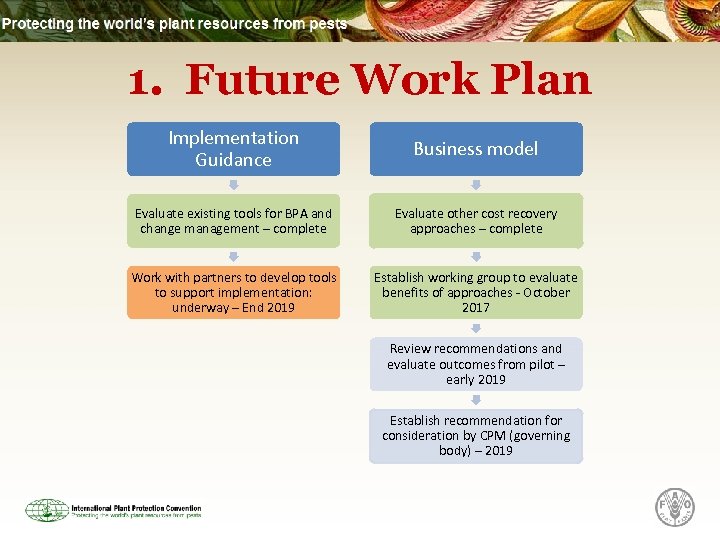
1. Future Work Plan Implementation Guidance Business model Evaluate existing tools for BPA and change management – complete Evaluate other cost recovery approaches – complete Work with partners to develop tools to support implementation: underway – End 2019 Establish working group to evaluate benefits of approaches - October 2017 Review recommendations and evaluate outcomes from pilot – early 2019 Establish recommendation for consideration by CPM (governing body) – 2019
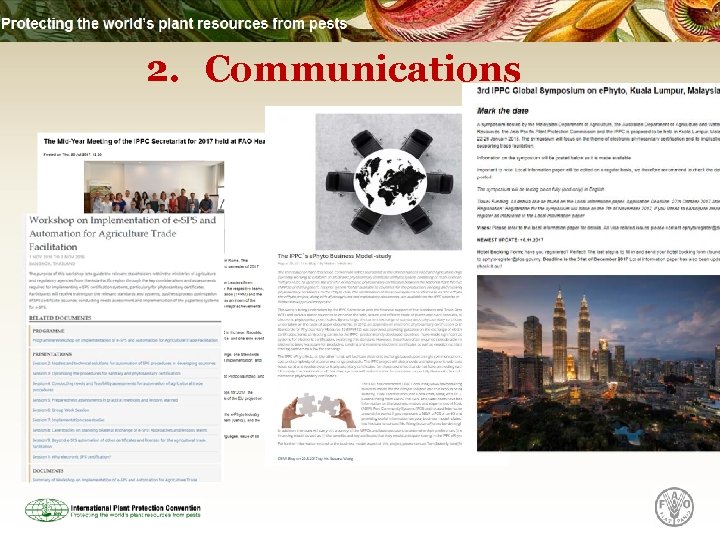
2. Communications 1. Secretariat updates e. Phyto website regularly with current info including factsheets, news items, technical information etc. 2. Secretariat updates Bureau and CPM annually 3. Update letters sent to NPPOs
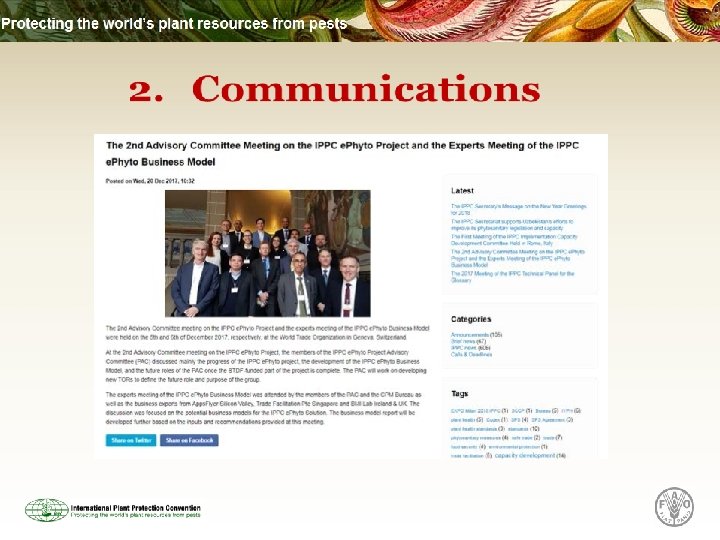
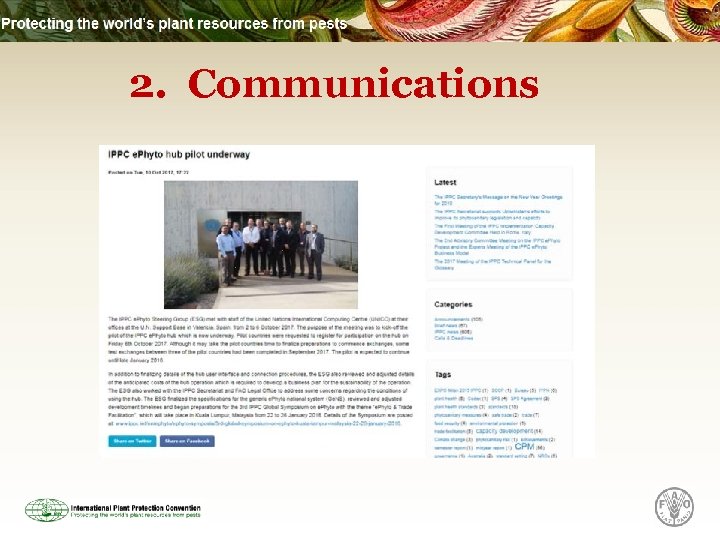
2. Communications
2. Communications
2. Communications Future options - feedback from working groups - social media - subscription based newsletter
3. Take home messages Let us reflect on the Symposium What are you going to do? • take a few minutes to write down 3 -5 key points from the Symposium • feedback from working groups
3. Take home messages International Plant Protection Convention • strategic plan • maintain and extend collaborations • Integration with trade facilitation initiatives • Certification bodies (CODEX, OIE etc) • plan for more countries coming on board • implement a sustainable funding base
3. Take home messages IPPC e. Phyto steering group • continue technical focus on harmonisation, Hub and Ge. NS • communicate global timetable of activities • coordinate development of guidelines for e. Phyto at country level (e. g. legislation; infrastructure; business processes) • define criteria for participating in the IPPC e. Phyto • awareness raising amongst contracting parties via series of fact sheets, standard Power. Point presentations and regional workshops • support work on a sustainable funding base
3. Take home messages Regional Plant Protection Organisation (RPPO) • establish a regional e. Phyto Working Group • member countries to coordinate activities • guided by Terms of Reference agreed by membership • seek agreement at RPPO session for e. Phyto work plan and funding • provide technical feedback to IPPC e. Phyto steering group • coordinate actions across countries • identify countries for next phase of e. Phyto implementation • Identify collaboration opportunities
3. Take home messages The APPPC e. Phyto Working Group aims to achieve the following outcomes, as per Terms of Reference • Foster an environment of co-operation through open information sharing • Increase harmonisation through implementation of Appendix 1 to ISPM 12 • Encourage and support broad uptake of e. Phyto throughout APPPC • Develop and maintain a status report of existing e. Phyto systems within the APPPC • Explore and secure capacity building funding for APPPC members • Develop an e. Phyto Work Plan that will be presented to RPPO planning meeting
3. Take home messages Country level - NPPOs • • • policy decision to pursue e. Phyto – Hub or Ge. NS? investigate trade facilitation initiatives in your country establish e. Phyto project team – multiple roles develop process maps/workflows define user needs (industry and NPPO) increase stakeholder awareness
3. Take home messages Country level - NPPOs review IT to support e. Phyto review legislation to support e. Phyto develop a change management plan estimate benefits and costs of implementation • obtain funding – domestically or regionally • •
3. Take home messages Industry groups – domestic and international • lobby governments to support e. Phyto project • provide practical guidance on the industry impacts of e. Phyto • identify implementation requirements supporting trade facilitation • propose initiatives to raise awareness, understanding and capacity building amongst NPPOs and cooperating border agencies • assist the development of funding proposals and options for the sustainability of e. Phyto
3. Take home messages Provide feedback on what you will do to assist with e. Phyto in your country, when you return home If you have an idea, let us know
Vietnam Acknowledgements Mr Craig Fedchock, IPPC FAO Italy Mr Shane Sela, IPPC FAO Italy Ms Laura Vicaria, IPPC FAO Italy Ms Tanja Lahti, IPPC FAO Italy Mr Peter Neimanis, DAWR Australia Dr Chin Karunaratne, DAWR Australia Dr Piao Yongfan, APPPC FAO Thailand Dr Enrico Perotti, Australian High Commission, KL Mr Hafiz Burkhan, Australian High Commission, KL
Vietnam Acknowledgements Ms Rozilawati Mohd Azman, PBD, DOA Malaysia Mr Ghazali Zakaria, PBD, DOA Malaysia Mr Ramli Md Afandi, PBD, DOA Malaysia Ms Shahira Azwani Ali Sabri, PBD, DOA Malaysia Ms ‘Izzah Syazana Za’bi, PBD, DOA Malaysia
Скачать презентацию 3 rd IPPC Global Symposium on e Phyto
a3a1e1a747fb65ac5f7b5911964d05d3.ppt