


 Скачать презентацию 3 rd International Symposium on University Rankings University
9eae64837be7a3f0054e8d96d9c01b94.ppt
- Количество слайдов: 26
 3 rd International Symposium on University Rankings University of Leiden, February 6 -7, 2009 Moving beyond university rankings: developing world class university systems Tony Sheil Senior Manager, Research Policy & Strategy Griffith University, Australia
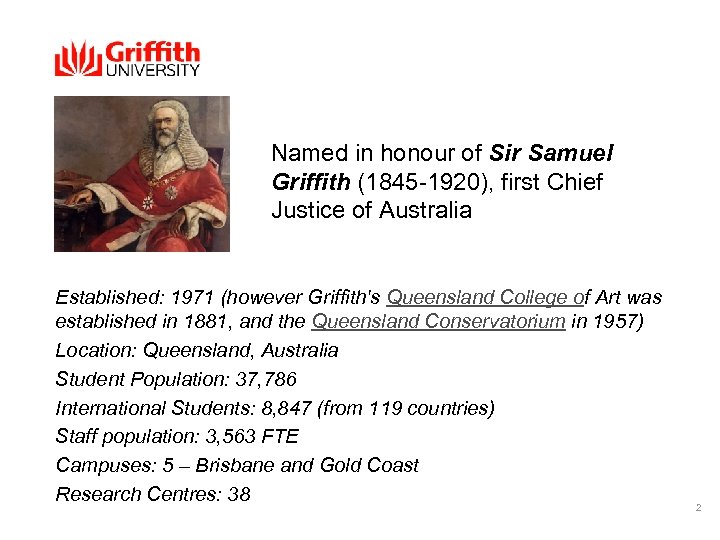 Named in honour of Sir Samuel Griffith (1845 -1920), first Chief Justice of Australia Established: 1971 (however Griffith's Queensland College of Art was established in 1881, and the Queensland Conservatorium in 1957) Location: Queensland, Australia Student Population: 37, 786 International Students: 8, 847 (from 119 countries) Staff population: 3, 563 FTE Campuses: 5 – Brisbane and Gold Coast Research Centres: 38 2
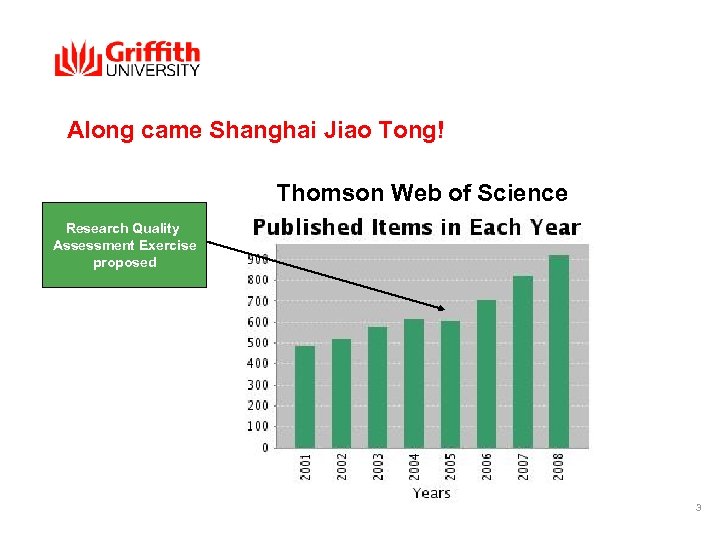 Along came Shanghai Jiao Tong! Thomson Web of Science Research Quality Assessment Exercise proposed 3
 “The reputation of Australia as a quality provider of international education depends on it being able to provide a clear and unequivocal statement about its intention to maintain a world-class university system. ” Review of Australian Higher Education: Final Report, December 2008, p. 124 4
 “Rather than debating whether Australia can support two or three ‘world-class’ universities, the focus should switch to establishing a hundred or more world -class research facilities and research groups across the whole university system. ” Review of the National Innovation System, final report , September 2008 5
 “More of our universities should aim to be within the top 100 internationally and I would like some of our universities to aspire to the top 10. ” The Honourable Julie Bishop, MP Australian Minister for Education, Science & Training August 30, 2007 6
 Policy has changed dramatically…why? “We want our higher education system to be world class so wherever students are in this country, whatever institution they’re at, they’re getting a world class education. ” The Honourable Julia Gillard, MP Deputy Prime Minister and Minister for Education, Employment and Workplace Relations 20 February 2008 7
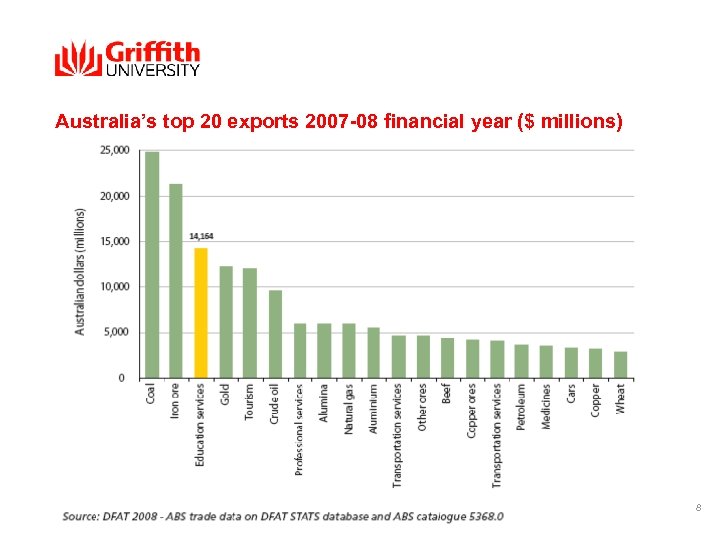 Australia’s top 20 exports 2007 -08 financial year ($ millions) 8
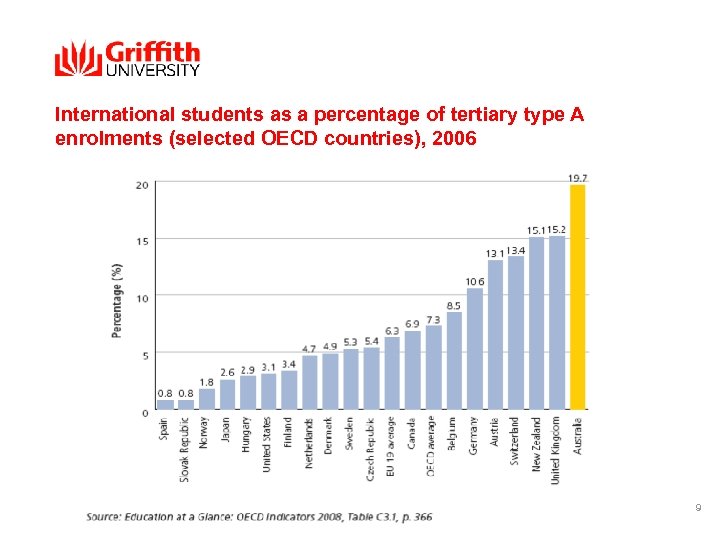 International students as a percentage of tertiary type A enrolments (selected OECD countries), 2006 9
 What are the Shanghai Jiao Tong rankings telling us? Of the world’s 10, 000+ universities, research performance is concentrated in the top 500. There is a band of around 200 world-class researchintensive institutions. There is a ‘super-league’ of approximately 25 world-leading institutions. These world leaders are distinguished by large budgets, large endowments, age, excellent staff to student ratios, and most importantly, access to large pools of highly developed human capital (staff and students). 10
 What are the Shanghai Jiao Tong rankings telling us? There are very few ‘movers’ on the SJTU index. Major non-US movers in the Top 100 (since 2003) are the result of mergers and strategic alliances: Manchester (gained 49 places), Copenhagen (21 places) Paris XI (24 places), Paris VI (UPMC) (21 places). Access to top 25, for the foreseeable future, is beyond most nations. The very top global academic talent is highly concentrated. 11
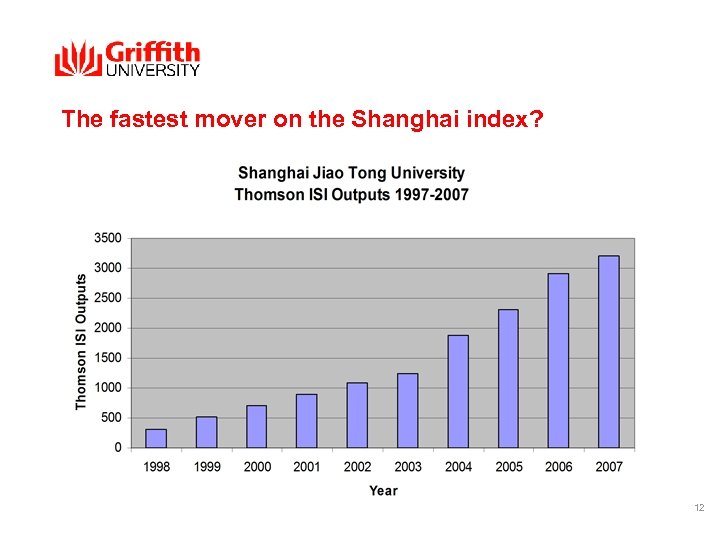 The fastest mover on the Shanghai index? 12
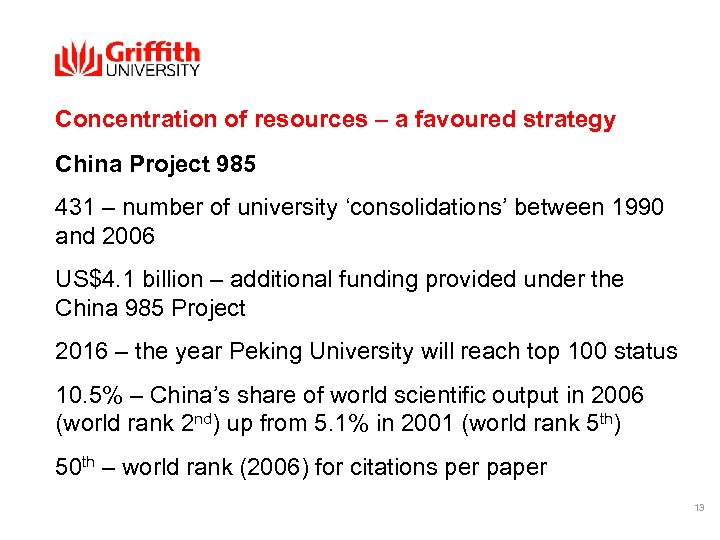 Concentration of resources – a favoured strategy China Project 985 431 – number of university ‘consolidations’ between 1990 and 2006 US$4. 1 billion – additional funding provided under the China 985 Project 2016 – the year Peking University will reach top 100 status 10. 5% – China’s share of world scientific output in 2006 (world rank 2 nd) up from 5. 1% in 2001 (world rank 5 th) 50 th – world rank (2006) for citations per paper 13
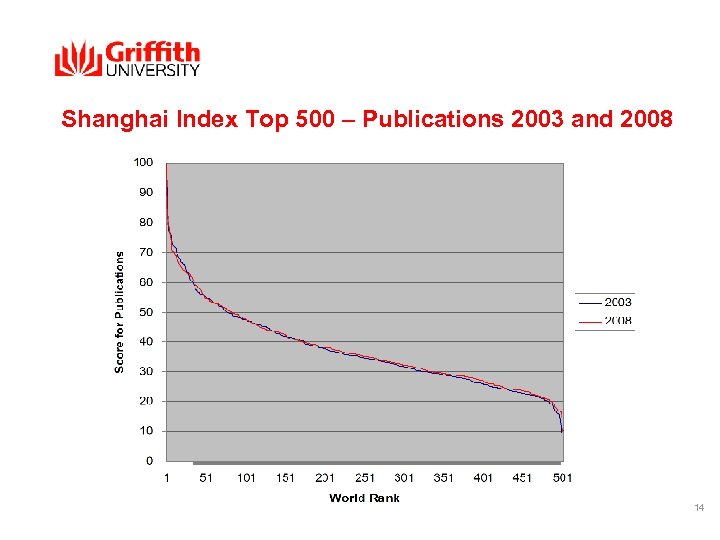 Shanghai Index Top 500 – Publications 2003 and 2008 14
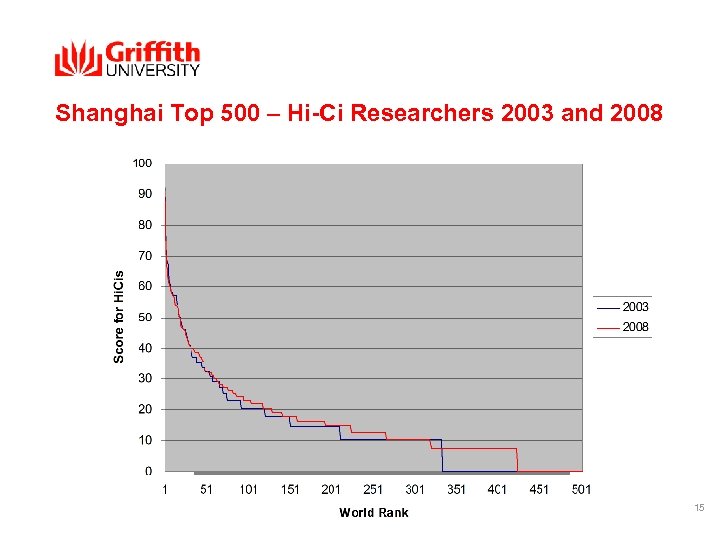 Shanghai Top 500 – Hi-Ci Researchers 2003 and 2008 15
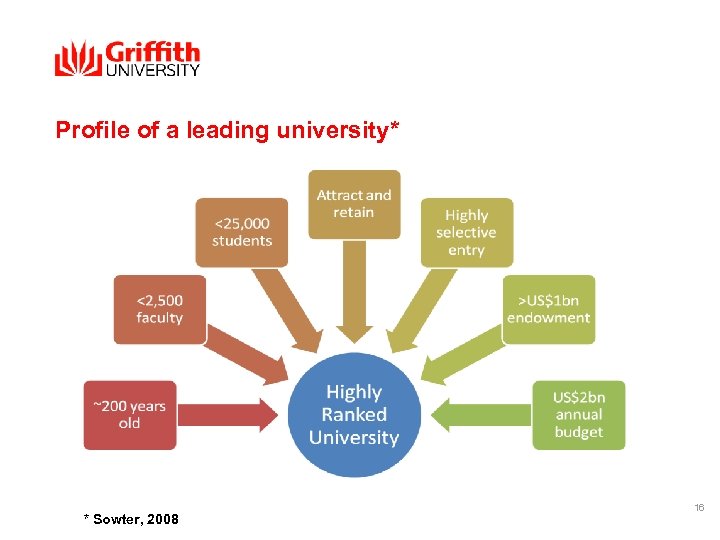 Profile of a leading university* * Sowter, 2008 16
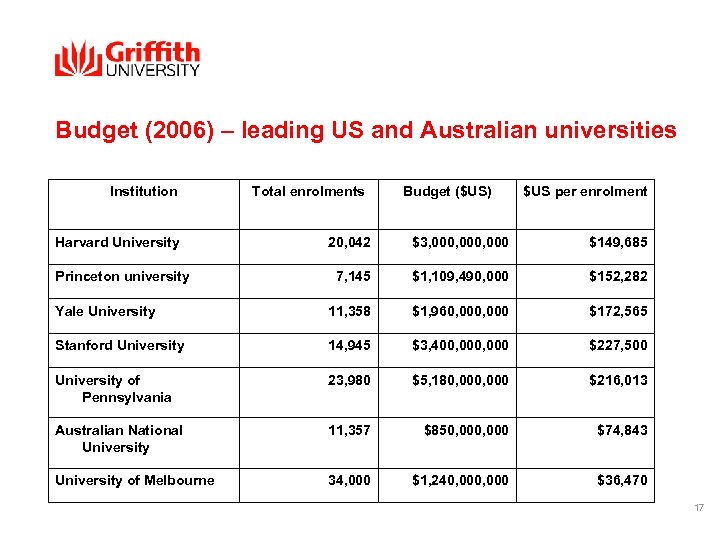 Budget (2006) – leading US and Australian universities Institution Harvard University Total enrolments Budget ($US) $US per enrolment 20, 042 $3, 000, 000 $149, 685 7, 145 $1, 109, 490, 000 $152, 282 Yale University 11, 358 $1, 960, 000 $172, 565 Stanford University 14, 945 $3, 400, 000 $227, 500 University of Pennsylvania 23, 980 $5, 180, 000 $216, 013 Australian National University 11, 357 $850, 000 $74, 843 University of Melbourne 34, 000 $1, 240, 000 $36, 470 Princeton university 17
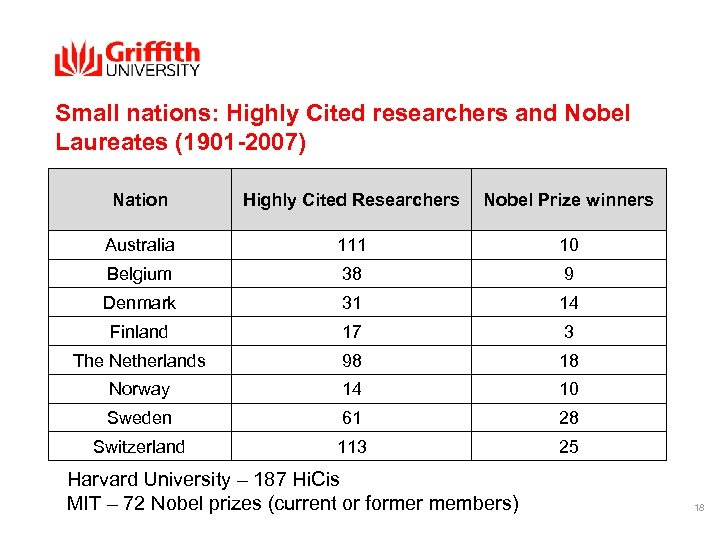 Small nations: Highly Cited researchers and Nobel Laureates (1901 -2007) Nation Highly Cited Researchers Nobel Prize winners Australia 111 10 Belgium 38 9 Denmark 31 14 Finland 17 3 The Netherlands 98 18 Norway 14 10 Sweden 61 28 Switzerland 113 25 Harvard University – 187 Hi. Cis MIT – 72 Nobel prizes (current or former members) 18
 Highly Cited researchers and economic wealth 19
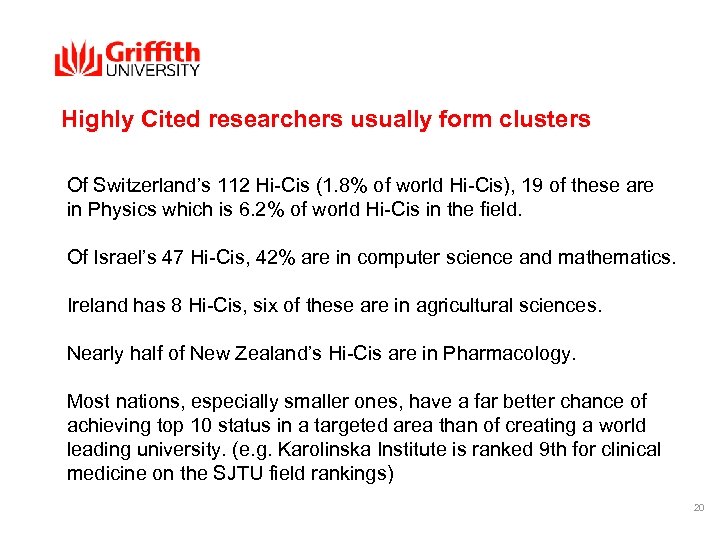 Highly Cited researchers usually form clusters Of Switzerland’s 112 Hi-Cis (1. 8% of world Hi-Cis), 19 of these are in Physics which is 6. 2% of world Hi-Cis in the field. Of Israel’s 47 Hi-Cis, 42% are in computer science and mathematics. Ireland has 8 Hi-Cis, six of these are in agricultural sciences. Nearly half of New Zealand’s Hi-Cis are in Pharmacology. Most nations, especially smaller ones, have a far better chance of achieving top 10 status in a targeted area than of creating a world leading university. (e. g. Karolinska Institute is ranked 9 th for clinical medicine on the SJTU field rankings) 20
 “Small economies such as Singapore, Australia and Switzerland can’t compete with giant economies. In the global economy, small means you have to be focused and nimble, find a niche and work with partners. ” Professor Shih Choon Fong (2007) President, National University of Singapore 21
 Beyond university rankings – university systems Two university systems rankings emerged in 2008: QS SAFE National System Strength Rankings Lisbon Council University Systems Ranking. These form only part of the solution to the onedimensional vice of university rankings. Improved university classifications and benchmarking are needed to develop a more sophisticated understanding of available approaches to university development. 22
 Then we can address the important strategic issues What differentiated structures and organizational arrangements, missions, and supporting strategies are required at various points within our university systems? What expectations should be placed on institutions at various stages of development by way of research performance, learning experiences and outcomes, community engagement activity, commercialisation and internationalisation? What investment is required to produce ‘step change’ and lift universities from all tiers to the next stage of development? What are the optimal levels and mixes of expenditure (government and private), regulation and educational provision needed to ensure that each institution meets its unique mission? 23
 Australia – moving in the right direction Key initiatives to spread the benefits across the university system include: Mission-based compact agreements; Establishment of an $11 billion Education Investment Fund with dividends from 2009 with an objective to “advance the development of a world-class Australian higher education sector”; Immediate distribution to all universities of $500 million Better Universities Renewal Fund, with follow-up funding of $500 million in 2009; Establishment of 1, 000 Future Fellowships for recruitment and retention of early to midcareer researchers; Doubling of Australian Postgraduate Scholarships from 4, 800 to 9, 600; International focus to all Australian Research Council schemes to promote global awareness; The Excellence in Research for Australia (ERA) initiative, using a combination of metrics and peer review, to fund research excellence wherever it is found and to identify Australia’s 24 national capability in 154 Fields of Research.
 Conclusion The choice for governments is to be a servant to the vagaries of university rankings or have the confidence to set their own agenda and move beyond rankings. Focusing on world class systems is one alternative – in which institutions might benefit from promoting their standing within a strong university system. Policy change on its own is insufficient – the ‘culture of comparison’ (clean and free of self interest) still needs to be developed. So do systems of classification and global benchmarking. 25
 Questions and discussion? 26