 Скачать презентацию 3 rd February 2017 Rajat Sachar Adviser E Ministry
ebc746ab5ee431ac00eb6a8668923e6a.ppt
- Количество слайдов: 22



3 rd February, 2017 Rajat Sachar Adviser(E) Ministry of Shipping 1
OUTLINE Ø Backdrop of Port sector reforms Ø Major Port Authorities Bill, 2016 – in Parliament Ø Revamp of Model Concession Agreement Ø Berthing Policy in Major Ports Ø Stevedoring Policy in Major Ports Ø Ease of Doing Business 2
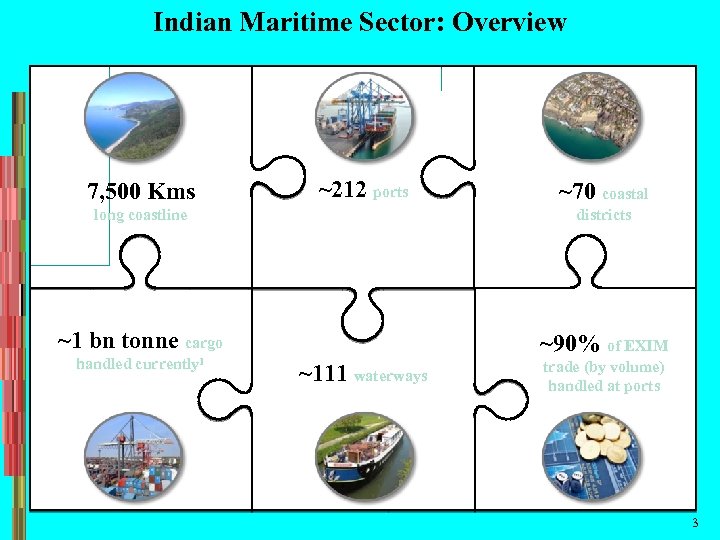
Indian Maritime Sector: Overview 7, 500 Kms ~212 ports ~70 coastal long coastline districts ~1 bn tonne cargo ~90% of EXIM handled currently 1 ~111 waterways trade (by volume) handled at ports 3
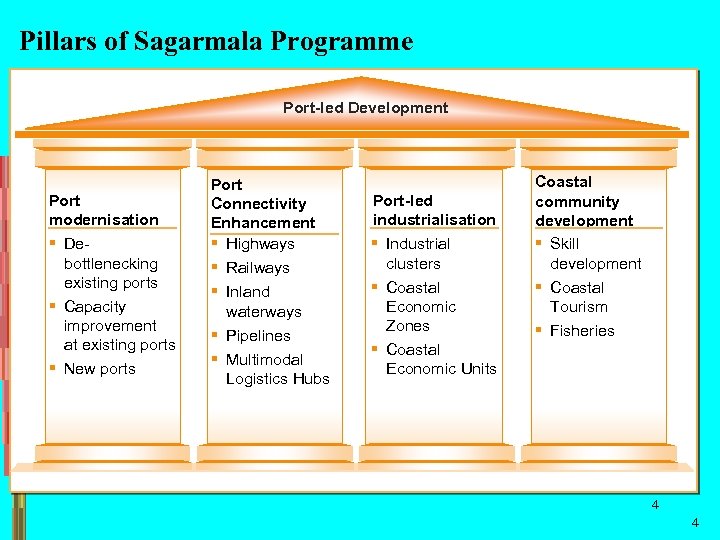
Pillars of Sagarmala Programme Port-led Development Port modernisation ▪ ▪ ▪ Debottlenecking existing ports Capacity improvement at existing ports New ports Port Connectivity Enhancement ▪ Highways ▪ Railways ▪ Inland waterways ▪ ▪ Pipelines Multimodal Logistics Hubs Port-led industrialisation ▪ Industrial clusters ▪ Coastal Economic Zones ▪ Coastal community development ▪ Skill development ▪ Coastal Tourism ▪ Fisheries Coastal Economic Units 4 4
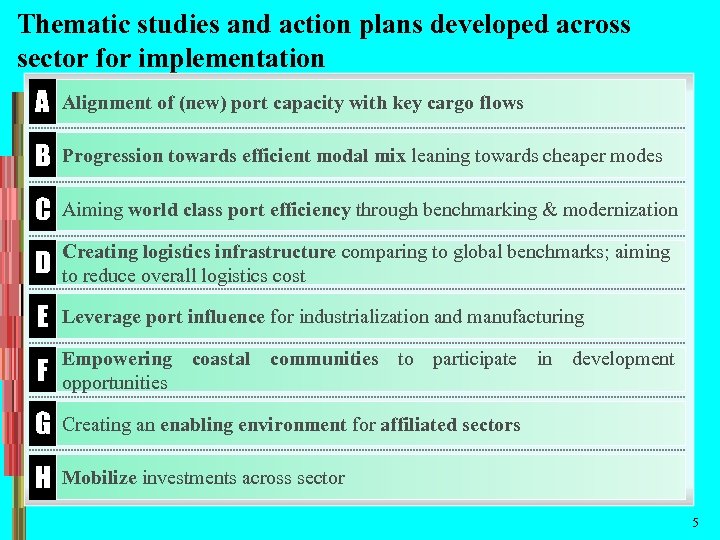
Thematic studies and action plans developed across sector for implementation A Alignment of (new) port capacity with key cargo flows B Progression towards efficient modal mix leaning towards cheaper modes C Aiming world class port efficiency through benchmarking & modernization D Creating logistics infrastructure comparing to global benchmarks; aiming to reduce overall logistics cost E Leverage port influence for industrialization and manufacturing F Empowering coastal communities to participate in development opportunities G Creating an enabling environment for affiliated sectors H Mobilize investments across sector 5
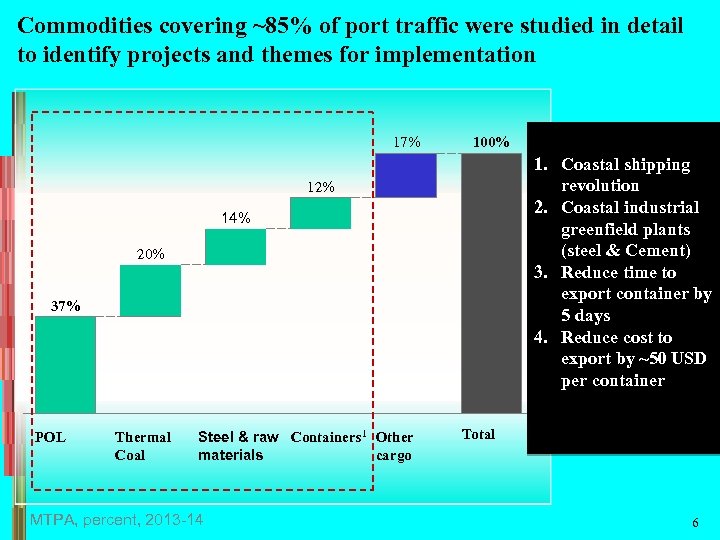
Commodities covering ~85% of port traffic were studied in detail to identify projects and themes for implementation 17% 100% 1. Coastal shipping revolution 2. Coastal industrial greenfield plants (steel & Cement) 3. Reduce time to export container by 5 days 4. Reduce cost to export by ~50 USD per container 12% 14% 20% 37% POL Thermal Coal Steel & raw Containers 1 Other cargo materials MTPA, percent, 2013 -14 Total 6
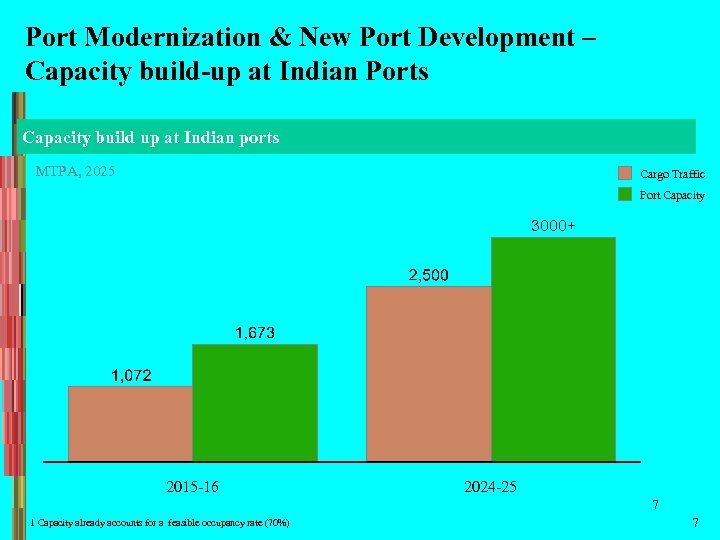
Port Modernization & New Port Development – Capacity build-up at Indian Ports Capacity build up at Indian ports MTPA, 2025 Cargo Traffic Port Capacity 3000+ 2015 16 2024 25 7 1 Capacity already accounts for a feasible occupancy rate (70%) 7
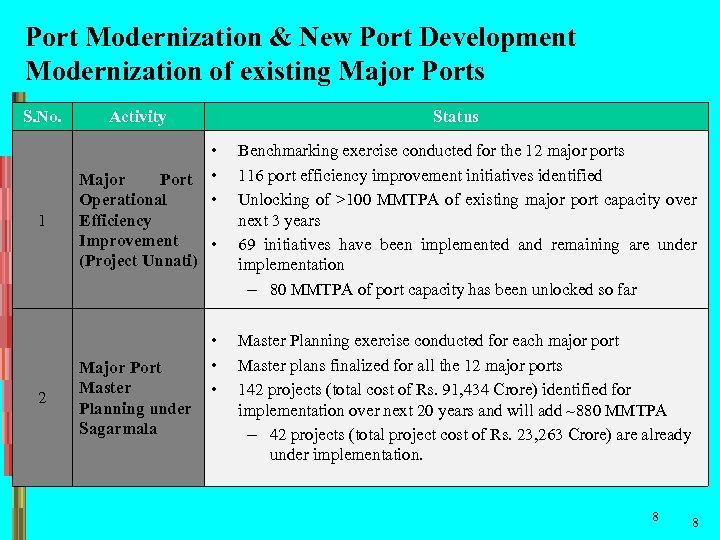
Port Modernization & New Port Development Modernization of existing Major Ports S. No. Activity Status • • • 1 2 Benchmarking exercise conducted for the 12 major ports 116 port efficiency improvement initiatives identified Unlocking of >100 MMTPA of existing major port capacity over next 3 years 69 initiatives have been implemented and remaining are under implementation – 80 MMTPA of port capacity has been unlocked so far • • • Master Planning exercise conducted for each major port Master plans finalized for all the 12 major ports 142 projects (total cost of Rs. 91, 434 Crore) identified for implementation over next 20 years and will add ~880 MMTPA – 42 projects (total project cost of Rs. 23, 263 Crore) are already under implementation. Major Port Operational Efficiency Improvement • (Project Unnati) Major Port Master Planning under Sagarmala 8 8
9
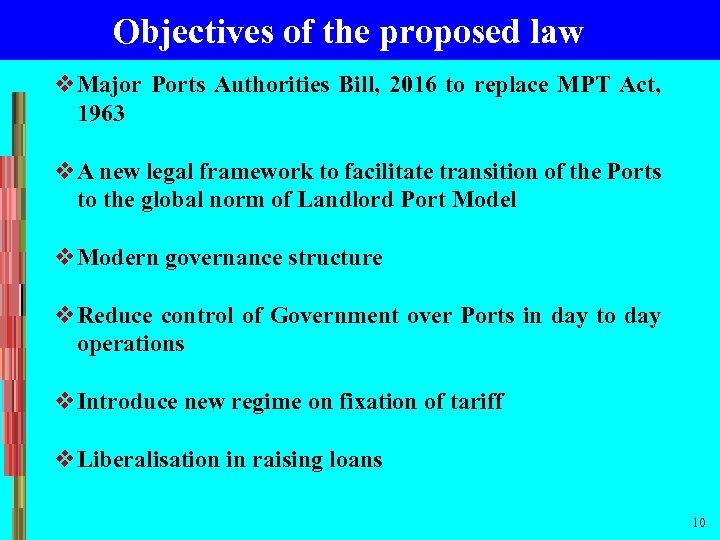
Objectives of the proposed law v Major Ports Authorities Bill, 2016 to replace MPT Act, 1963 v A new legal framework to facilitate transition of the Ports to the global norm of Landlord Port Model v Modern governance structure v Reduce control of Government over Ports in day to day operations v Introduce new regime on fixation of tariff v Liberalisation in raising loans 10
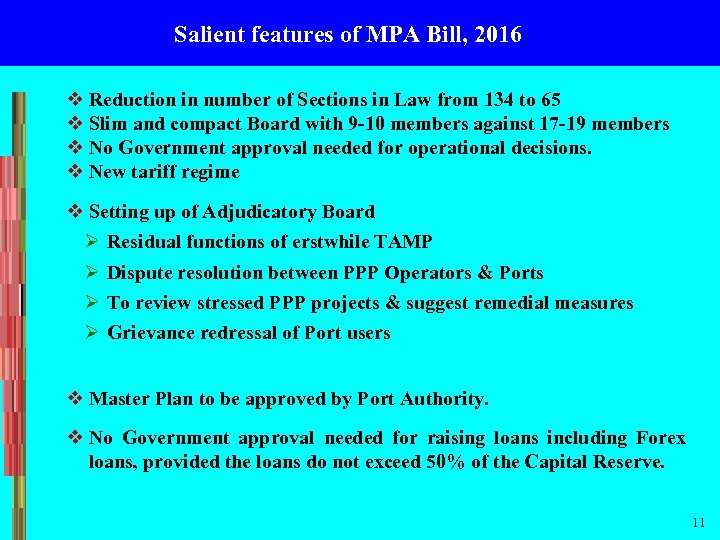
Salient features of MPA Bill, 2016 v Reduction in number of Sections in Law from 134 to 65 v Slim and compact Board with 9 -10 members against 17 -19 members v No Government approval needed for operational decisions. v New tariff regime v Setting up of Adjudicatory Board Ø Residual functions of erstwhile TAMP Ø Dispute resolution between PPP Operators & Ports Ø To review stressed PPP projects & suggest remedial measures Ø Grievance redressal of Port users v Master Plan to be approved by Port Authority. v No Government approval needed for raising loans including Forex loans, provided the loans do not exceed 50% of the Capital Reserve. 11

12
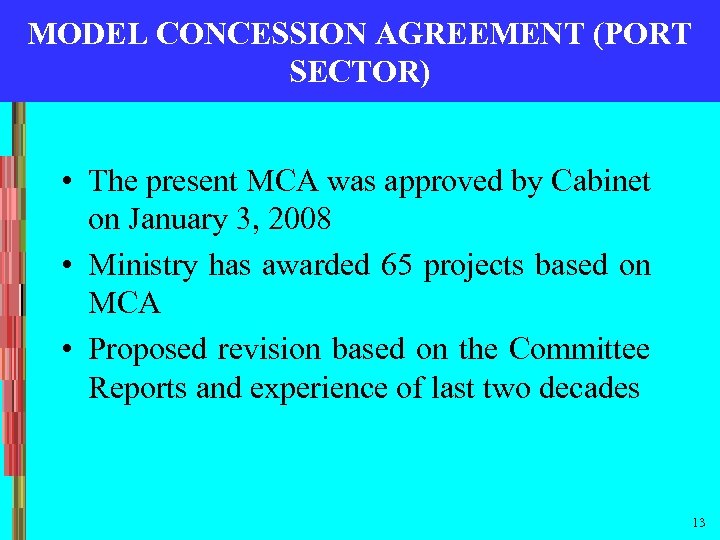
MODEL CONCESSION AGREEMENT (PORT SECTOR) • The present MCA was approved by Cabinet on January 3, 2008 • Ministry has awarded 65 projects based on MCA • Proposed revision based on the Committee Reports and experience of last two decades 13
Key Changes Ø New exit clause for bidder. Ø Revenue Share shall be payable on the quantity of cargo handled. Ø Provision for additional land. Ø Concessionaire is free to deploy higher capacity equipment/facilities for higher productivity. Ø Constitute a Review Board to look into disputes between Port and PPP Operators and also to review the Concession Agreement. Ø Providing for refinancing options. 14
15
Background and Objectives Background Ø Dry bulk cargo makes up more than 26% of the cargo handled at the 12 major ports Ø Performance norms were not being used optimally for improving productivity. Objectives Ø Reduce berthing time & overall turn around time of ships; drive higher cargo throughput using the available infrastructure in the Major Ports Ø Improve utilization of port assets and create additional capacity without any significant capital investment. Ø Increase competitiveness of the Major Port by creating value for the trade through reduced logistics cost 16
Salient features Ø Standardized framework provided for calculations of norms, specific to the commodity handled and the infrastructure available on the berth. Ø Standardize anchorage charges to reduce berthing time & overall turn around time of ships. Ø Drive higher cargo throughput using the available infrastructure in the Major Ports. Ø Introduce a system of incentives and penalties 17
18
Salient Features Ø Policy also applies to Mumbai Port and Haldia where stevedoring is carried out by the Ports. Ø Existing Stevedoring Agents have to switch over to the Scheme new Ø Exemption for all existing contracts till the date of expiry of the contract or 31 st July, 2017, whichever date is earlier; e. g. Haldia Ø TAMP to notify the normative tariff based on a set of Guidelines Ø Tariff to be mandatorily displayed on the Port website Ø Port to appoint a nodal officer responsible for monitoring of Stevedoring and Shore Handling tariffs including complaints 19

20
New Initiatives Ø To reduce congestion at Port gates, manual form 11 & 13 have been dispensed with by introducing Web based e form 13. Ø To facilitate direct port delivery, Import General Manifest has been integrated with Terminal Operating Systems of Major Ports with Customs Software i. e. ICEGATE. Ø 27 out of 33 Shipping Lines at JNPT have implemented issuance of e DO. Ø To enhance security and facilitate seamless movement of traffic across Port gates, RFID System is installed at Major Ports. Ø Procurement and installation of Containers scanners 21

22
Скачать презентацию 3 rd February 2017 Rajat Sachar Adviser E Ministry
ebc746ab5ee431ac00eb6a8668923e6a.ppt