 Скачать презентацию 3 rd EEGLAB Workshop Singapore Mining Event-Related Brain
ddc9449bf9ab8c82a067c5f355c5198c.ppt
- Количество слайдов: 55



3 rd EEGLAB Workshop Singapore Mining Event-Related Brain Dynamics Scott Makeig Swartz Center for Computational Neuroscience, Institute for Neural Computation, UCSD La Jolla CA 2006 Scott Makeig Event-Related Brain Dynamics I
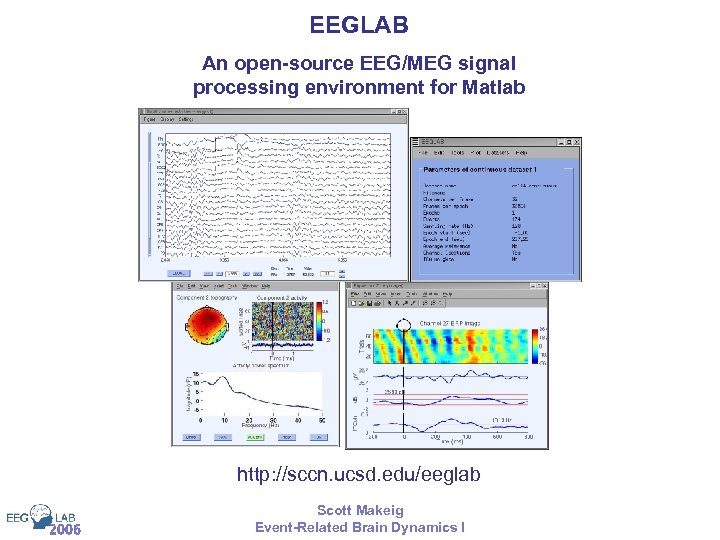
EEGLAB An open-source EEG/MEG signal processing environment for Matlab http: //sccn. ucsd. edu/eeglab 2006 Scott Makeig Event-Related Brain Dynamics I
2006 Scott Makeig Event-Related Brain Dynamics I
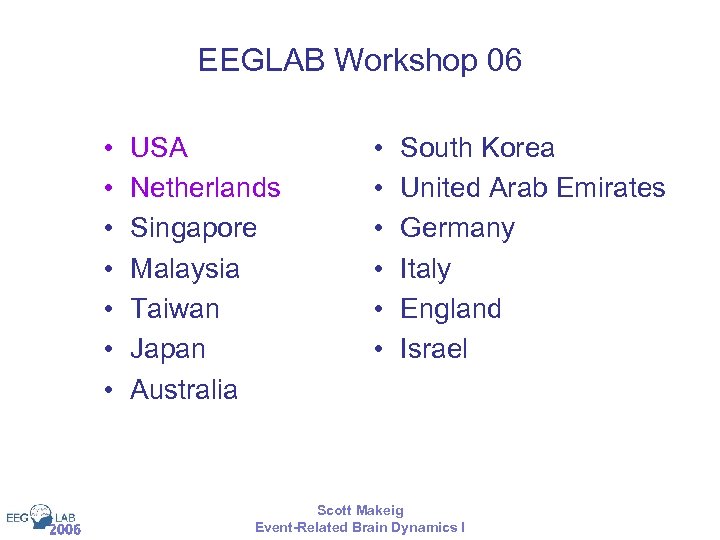
EEGLAB Workshop 06 • • 2006 USA Netherlands Singapore Malaysia Taiwan Japan Australia • • • South Korea United Arab Emirates Germany Italy England Israel Scott Makeig Event-Related Brain Dynamics I
• • • 2006 Who Am I? Cortical macrodynamics Limitations of response averaging A richer model Independent component analysis Time/frequency analysis Scott Makeig Event-Related Brain Dynamics I
I gaped … Who am I? I held … I jumped. . . I swerved … I reached … I ran … I shot … I tossed … I ducked I threw …. I pointed … I smiled … 2006 Scott Makeig Event-Related Brain Dynamics I
I realized that … It struck me that … ? I wondered if … All of a sudden. . . The feeling hit me like … I looked to see if … I noticed that … I looked again at …. I decided that … It occurred to me that … I imagined … 2006 I searched the scene for … Scott Makeig Event-Related Brain Dynamics I
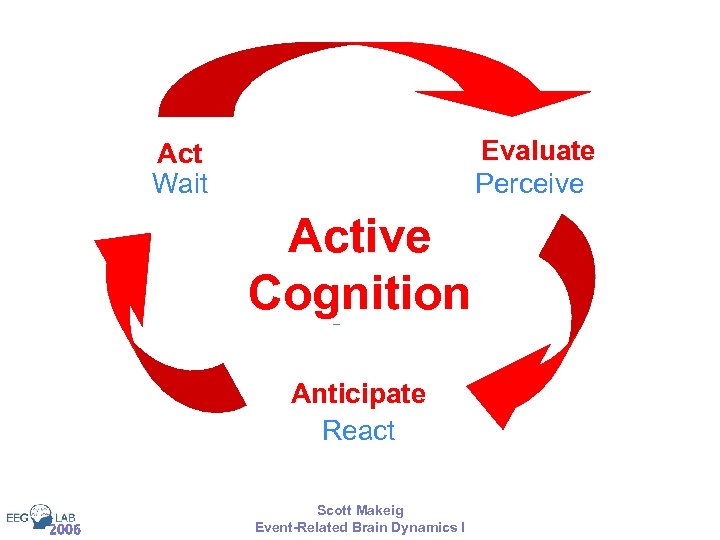
Evaluate Perceive Act Wait Receptive Active Cognition Anticipate React 2006 Scott Makeig Event-Related Brain Dynamics I
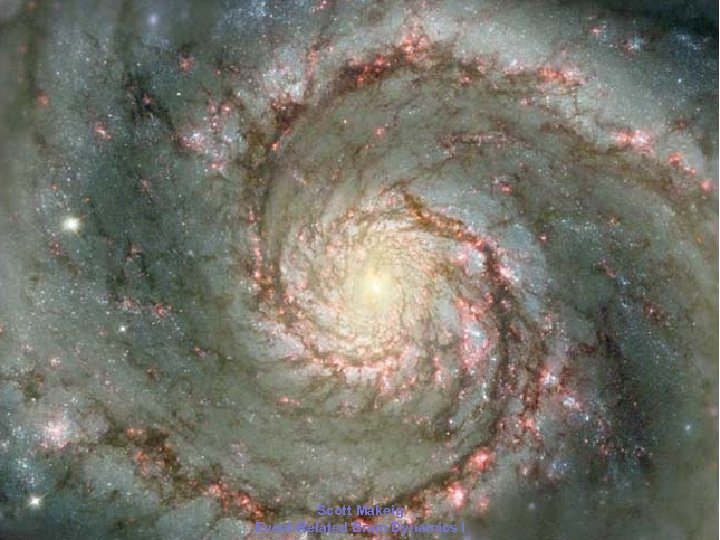
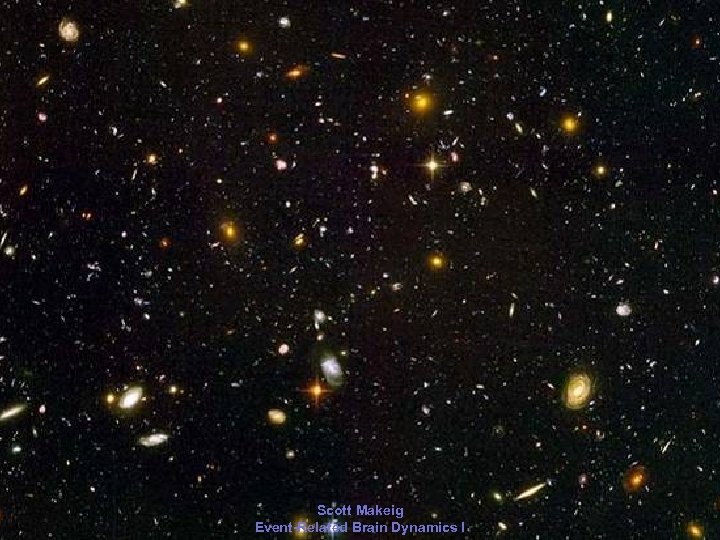
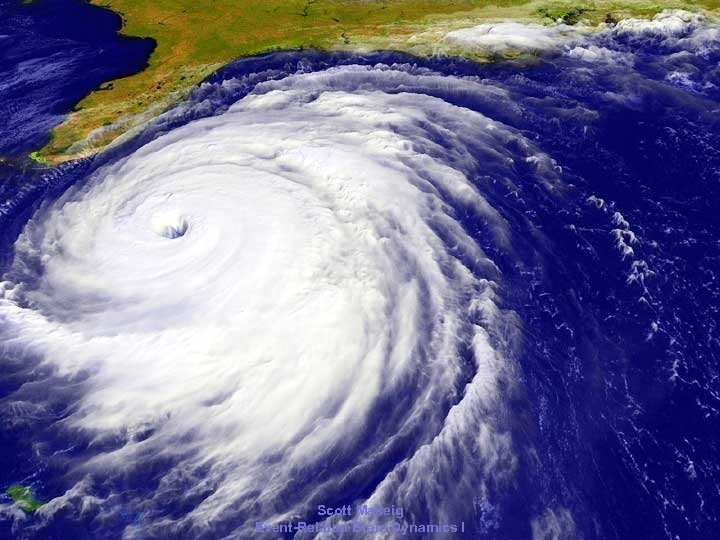
Cortical Macrodynamics Organized field activities are also coherent, spatially organized phenomena in the electrical ‘space’ of the cortex. 2006 Scott Makeig Event-Related Brain Dynamics I
2006 Scott Makeig Event-Related Brain Dynamics I
2006 Scott Makeig Event-Related Brain Dynamics I
2006 Scott Makeig Event-Related Brain Dynamics I
2006 Scott Makeig Event-Related Brain Dynamics I
2006 Scott Makeig Event-Related Brain Dynamics I
Spatiotemporal dynamics are complex … 2006 Scott Makeig Event-Related Brain Dynamics I
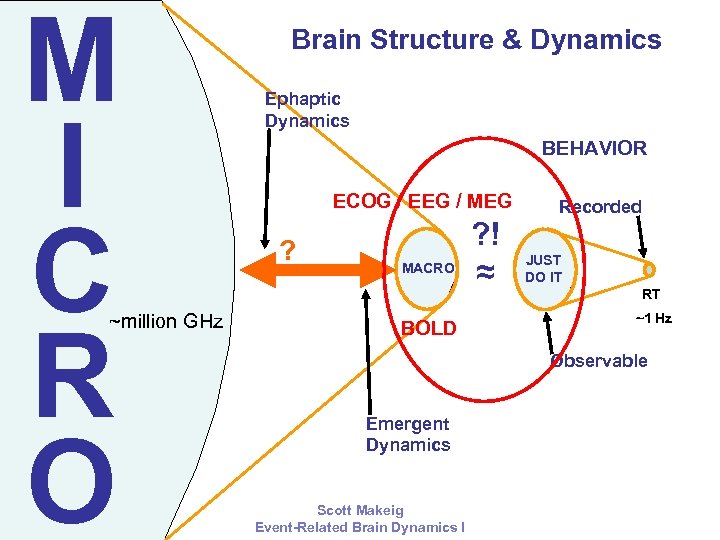
M I C R O ~million GHz 2006 Brain Structure & Dynamics Ephaptic Dynamics BEHAVIOR ECOG / EEG / MEG ? MACRO BOLD ? ! ≈ Recorded JUST DO IT RT ~1 Hz Observable Emergent Dynamics Scott Makeig Event-Related Brain Dynamics I
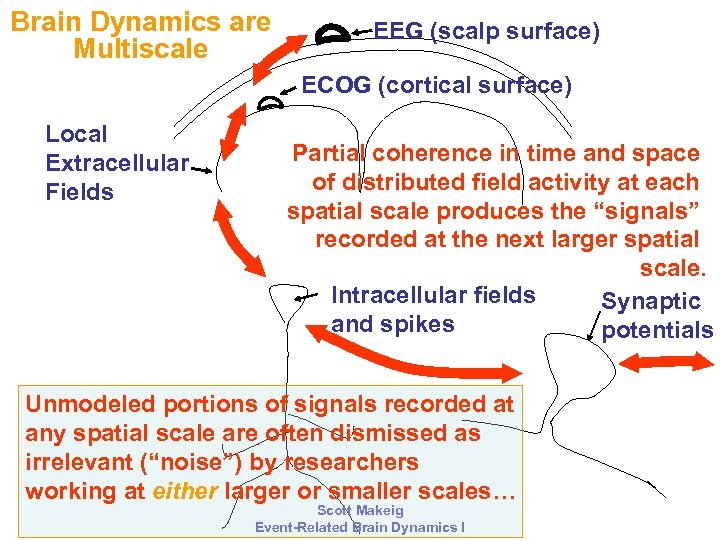
Brain Dynamics are Multiscale EEG (scalp surface) ECOG (cortical surface) Local Extracellular Fields Partial coherence in time and space of distributed field activity at each spatial scale produces the “signals” recorded at the next larger spatial scale. Intracellular fields Synaptic and spikes potentials Unmodeled portions of signals recorded at any spatial scale are often dismissed as irrelevant (“noise”) by researchers working at either larger or smaller scales… 2006 Scott Makeig Event-Related Brain Dynamics I
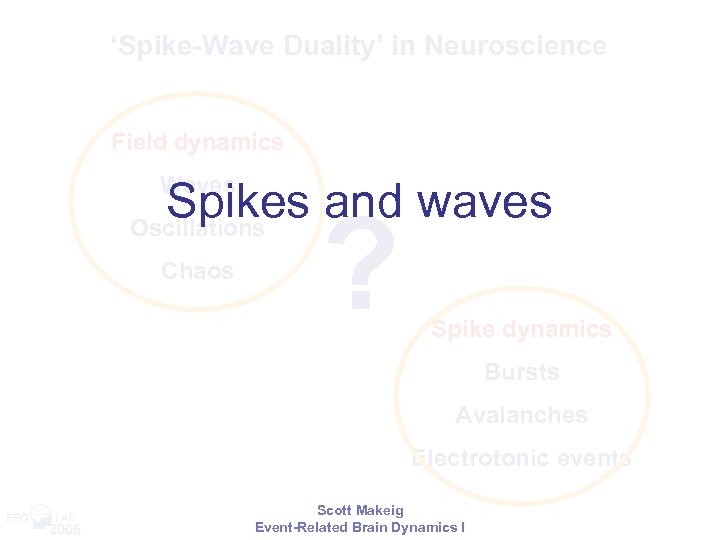
‘Spike-Wave Duality’ in Neuroscience Field dynamics Waves Spikes and waves Oscillations Chaos ? Spike dynamics Bursts Avalanches Electrotonic events 2006 Scott Makeig Event-Related Brain Dynamics I
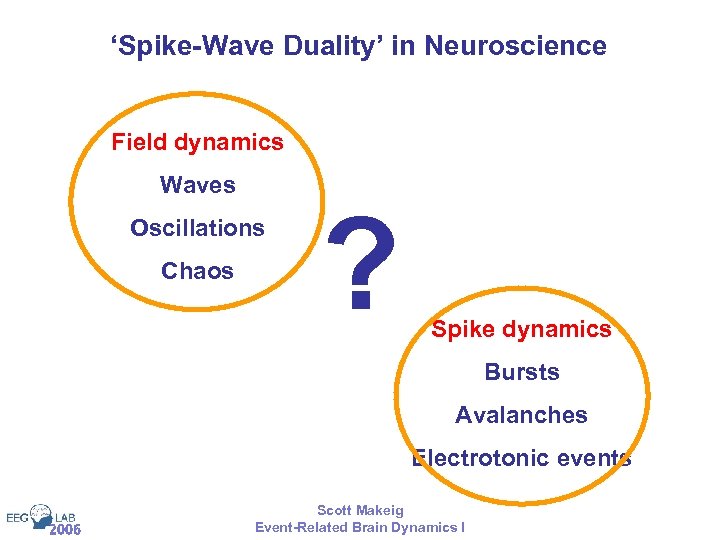
‘Spike-Wave Duality’ in Neuroscience Field dynamics Waves Oscillations Chaos ? Spike dynamics Bursts Avalanches Electrotonic events 2006 Scott Makeig Event-Related Brain Dynamics I
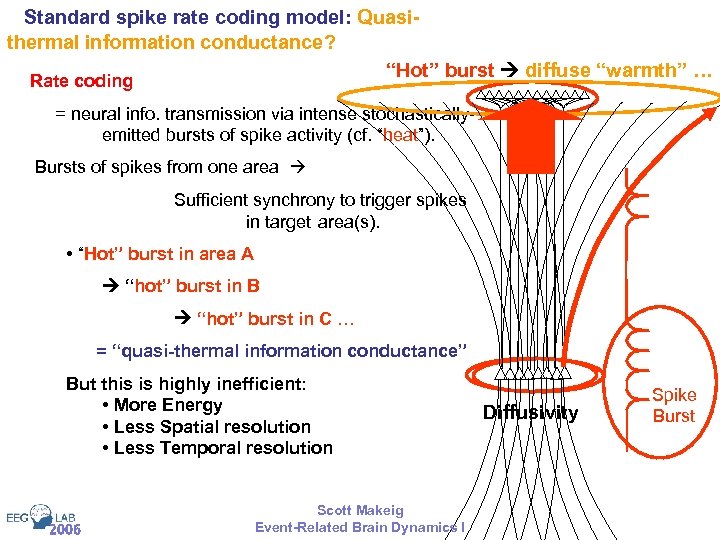
Standard spike rate coding model: Quasithermal information conductance? “Hot” burst diffuse “warmth” … Rate coding = neural info. transmission via intense stochasticallyemitted bursts of spike activity (cf. “heat”). Bursts of spikes from one area Sufficient synchrony to trigger spikes in target area(s). • “Hot” burst in area A “hot” burst in B “hot” burst in C … = “quasi-thermal information conductance” But this is highly inefficient: • More Energy • Less Spatial resolution • Less Temporal resolution 2006 Scott Makeig Event-Related Brain Dynamics I Diffusivity Spike Burst
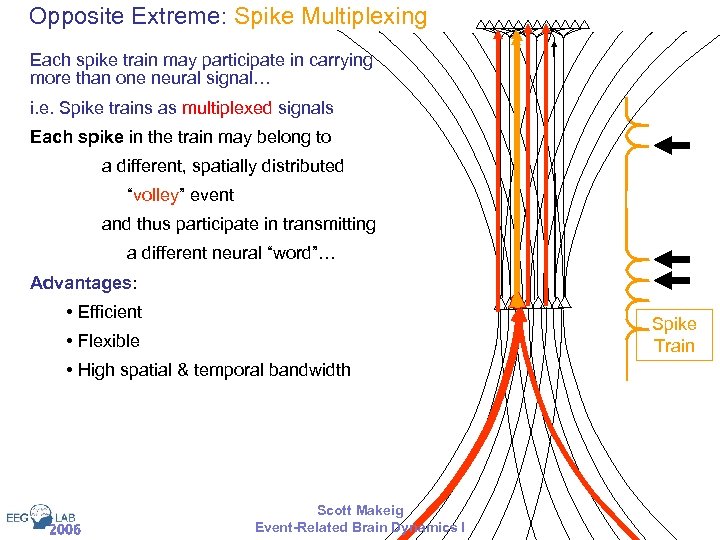
Opposite Extreme: Spike Multiplexing Each spike train may participate in carrying more than one neural signal… i. e. Spike trains as multiplexed signals Each spike in the train may belong to a different, spatially distributed “volley” event and thus participate in transmitting a different neural “word”… Advantages: • Efficient Spike Train • Flexible • High spatial & temporal bandwidth 2006 Scott Makeig Event-Related Brain Dynamics I
What creates Synchronous Input Volleys ? • Electrotonic coupling (threshold sculpting) • Spike time dependent learning • Neural-glial interactions • Extracellular field biasing (ephaptic effects) • Myelin growth control (conductance speed regulation) • etc. … 2006 Scott Makeig Event-Related Brain Dynamics I
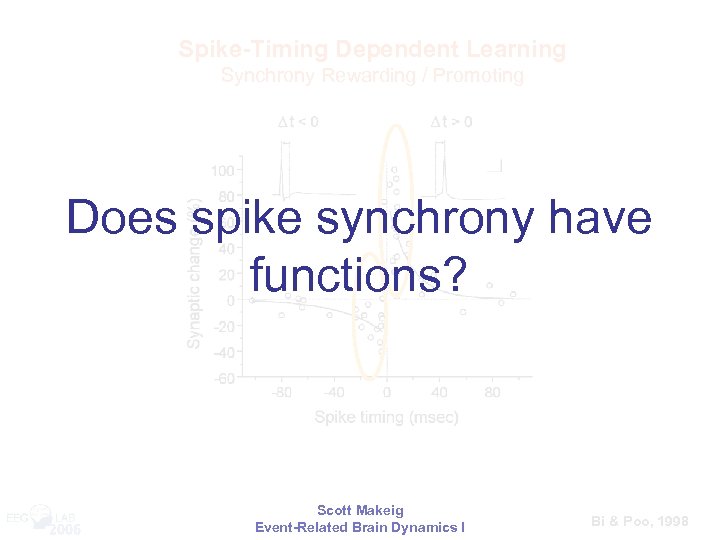
Spike-Timing Dependent Learning Synchrony Rewarding / Promoting Does spike synchrony have functions? 2006 Scott Makeig Event-Related Brain Dynamics I Bi & Poo, 1998
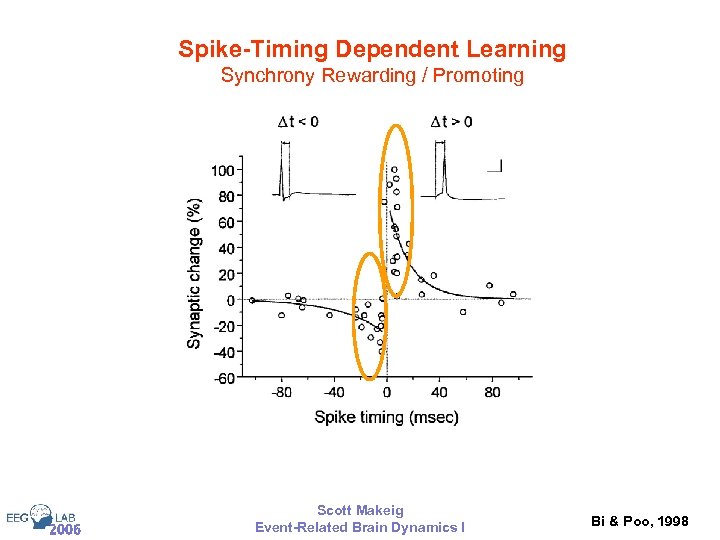
Spike-Timing Dependent Learning Synchrony Rewarding / Promoting 2006 Scott Makeig Event-Related Brain Dynamics I Bi & Poo, 1998
- No: Useless “roar of the crowd …” - Yes, as indicator: Useful index of local synchrony - 2006 Do fields have functions? Yes! They regulate synchrony (ephaptic effects) Scott Makeig Event-Related Brain Dynamics I
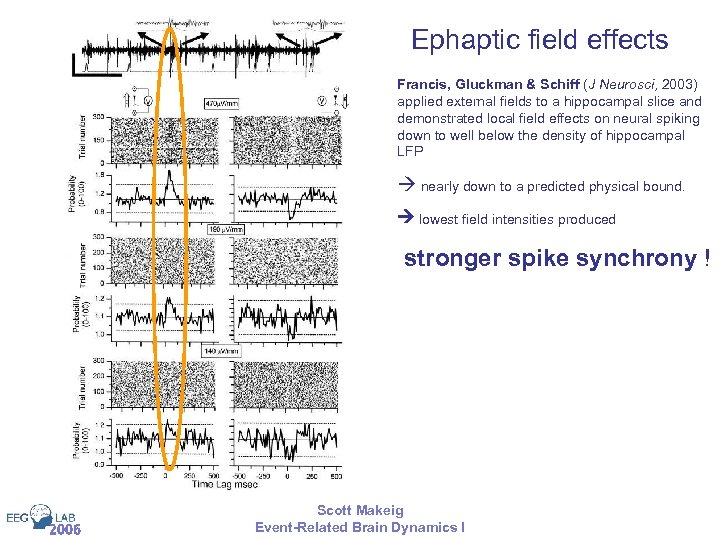
Ephaptic field effects Francis, Gluckman & Schiff (J Neurosci, 2003) applied external fields to a hippocampal slice and demonstrated local field effects on neural spiking down to well below the density of hippocampal LFP nearly down to a predicted physical bound. lowest field intensities produced stronger spike synchrony ! 2006 Scott Makeig Event-Related Brain Dynamics I
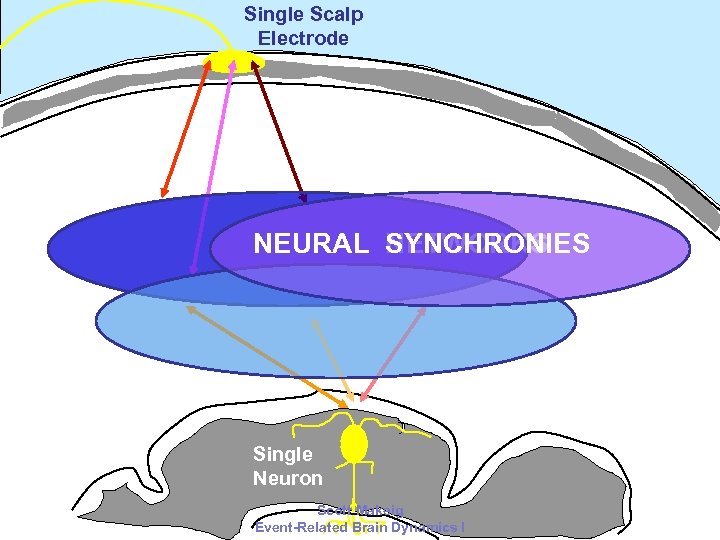
Single Scalp Electrode NEURAL NETWORKS SYNCHRONIES Single Neuron 2006 Scott Makeig Event-Related Brain Dynamics I
“It takes a village to raise a child. ” –Hillary Clinton It takes a neuropile to raise a spike volley To produce a spike requires a near-synchronous spike input volley & a near-threshold external environment & a near-threshold internal environment &… & it takes a neuropile to use a spike volley. 2006 Scott Makeig Event-Related Brain Dynamics I
Multiscale brain communication 1. Spike synchrony, producing extra-cellular fields, and biasing of spike synchrony by extracellular fields, must occur across different spatial scales, with different effects. 2. The spatial scales of partial synchrony giving rise to scalp-recorded fields are currently unknown, but might be extracted from (future) multiscale recordings. 2006 Scott Makeig Event-Related Brain Dynamics I
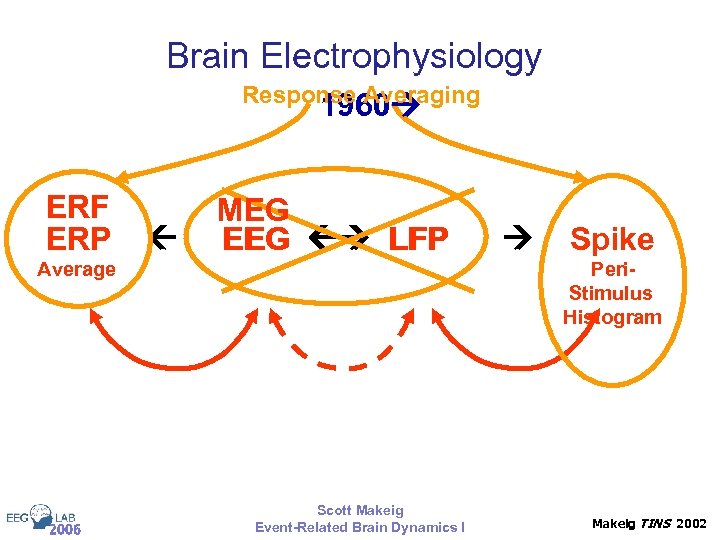
Brain Electrophysiology Response Averaging 1960 ERF ERP MEG EEG LFP Average 2006 Spike Peri. Stimulus Histogram Scott Makeig Event-Related Brain Dynamics I Makeig TINS 2002
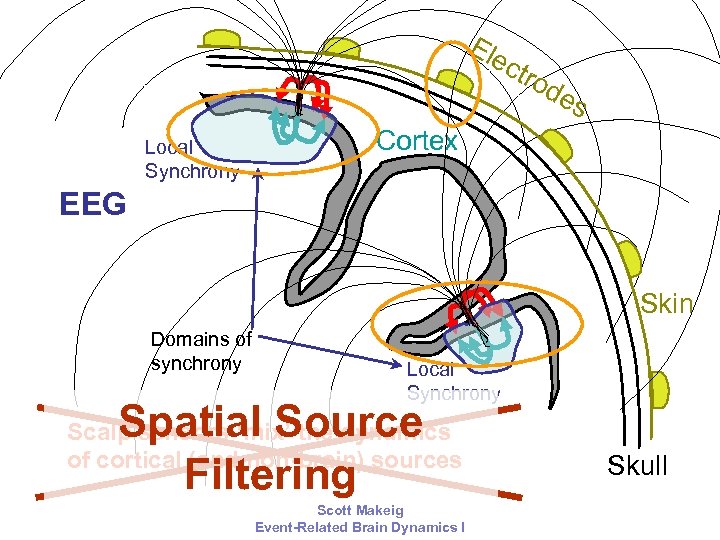
Ele ctr od es Local Synchrony Cortex EEG Skin Domains of synchrony Local Synchrony Spatial Source Filtering Scalp sensors ‘mix’ the dynamics of cortical (and non-brain) sources 2006 Scott Makeig Event-Related Brain Dynamics I Skull
2006 Scott Makeig Event-Related Brain Dynamics I R. Ramirez, 2005
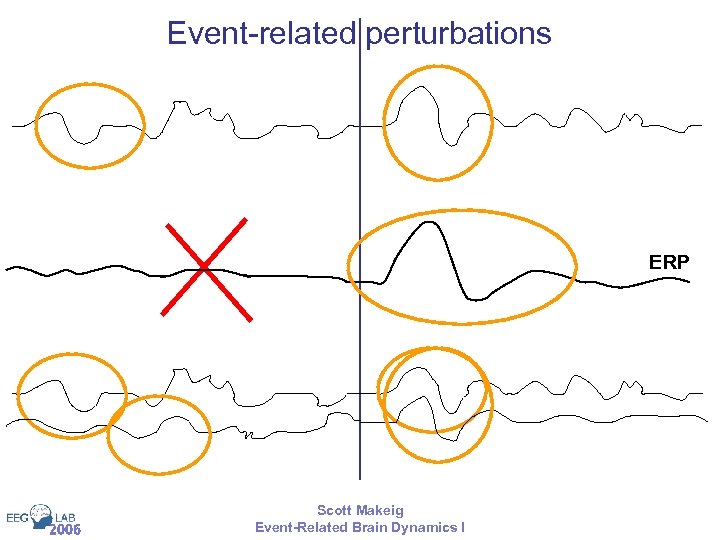
The response averaging model: EEG ERP EEG “noise” BOLD ERB BOLD “noise” Limitations of Data Average + “Background” response averagingonly if: But, this linear decomposition is veridical if & 1. The Average appears in each trial. Not True / Not Defined 2. The “Background” is not perturbed in other ways by the time locking events. Not True 2006 Scott Makeig Event-Related Brain Dynamics I
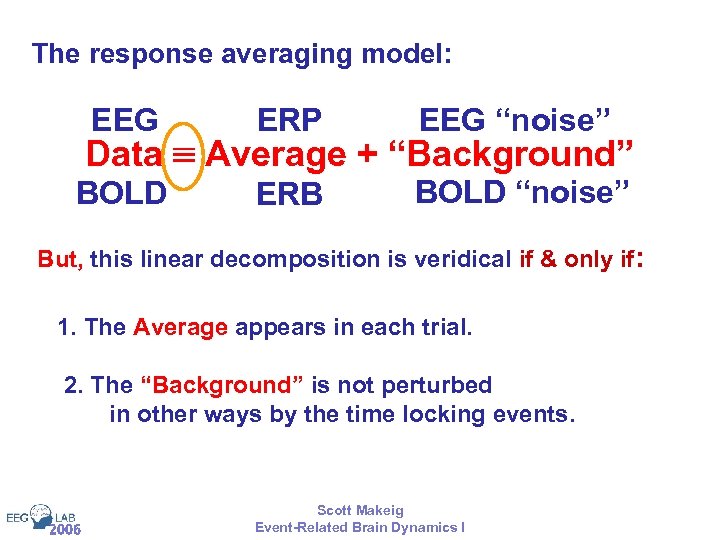
The response averaging model: EEG ERP EEG “noise” BOLD ERB BOLD “noise” Data Average + “Background” But, this linear decomposition is veridical if & only if: 1. The Average appears in each trial. 2. The “Background” is not perturbed in other ways by the time locking events. 2006 Scott Makeig Event-Related Brain Dynamics I
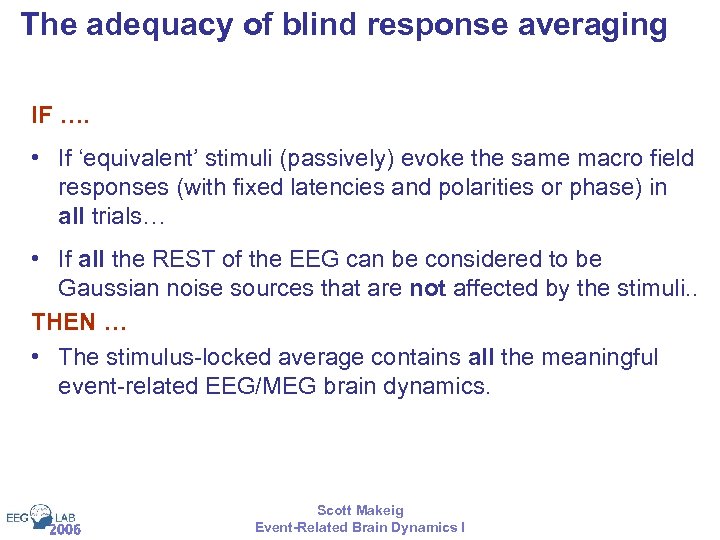
The adequacy of blind response averaging IF …. • If ‘equivalent’ stimuli (passively) evoke the same macro field responses (with fixed latencies and polarities or phase) in all trials… • If all the REST of the EEG can be considered to be Gaussian noise sources that are not affected by the stimuli. . THEN … • The stimulus-locked average contains all the meaningful event-related EEG/MEG brain dynamics. 2006 Scott Makeig Event-Related Brain Dynamics I
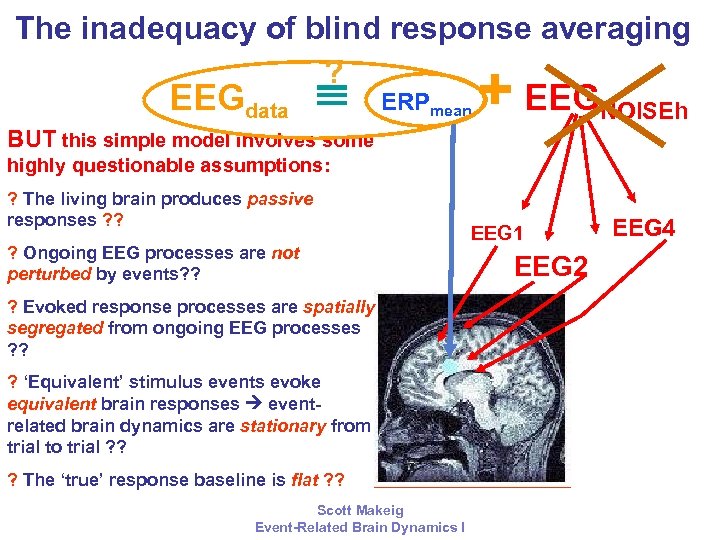
The inadequacy of blind response averaging ? EEGdata ERPmean + EEG NOISEh BUT this simple model involves some highly questionable assumptions: ? The living brain produces passive responses ? ? ? Ongoing EEG processes are not perturbed by events? ? ? Evoked response processes are spatially segregated from ongoing EEG processes ? ? ? ‘Equivalent’ stimulus events evoke equivalent brain responses eventrelated brain dynamics are stationary from trial to trial ? ? ? The ‘true’ response baseline is flat ? ? 2006 Scott Makeig Event-Related Brain Dynamics I EEG 1 EEG 2 EEG 4
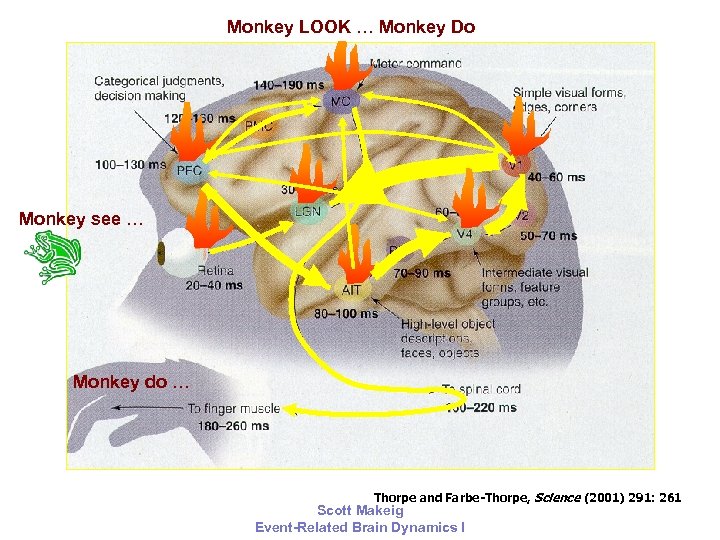
Monkey LOOK … Monkey Do Monkey see … Monkey do … Thorpe and Farbe-Thorpe, Science (2001) 291: 261 2006 Scott Makeig Event-Related Brain Dynamics I
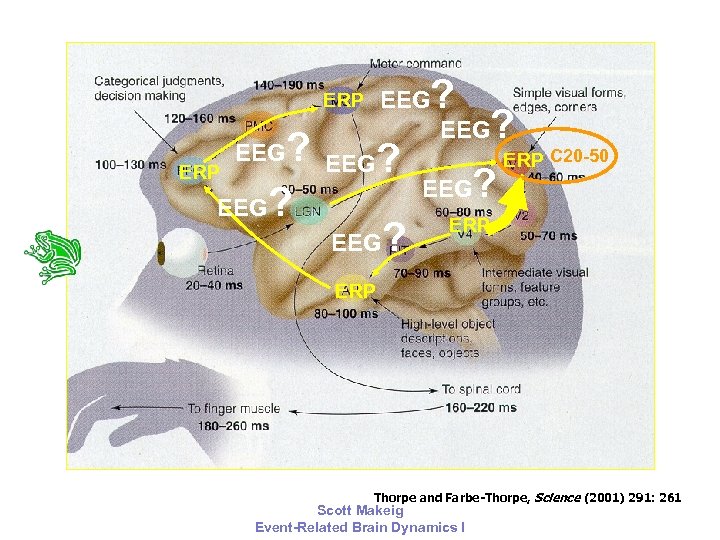
EEG ERP ? ? EEG? ERP C 20 -50 ERP EEG? EEG ERP Thorpe and Farbe-Thorpe, Science (2001) 291: 261 2006 Scott Makeig Event-Related Brain Dynamics I
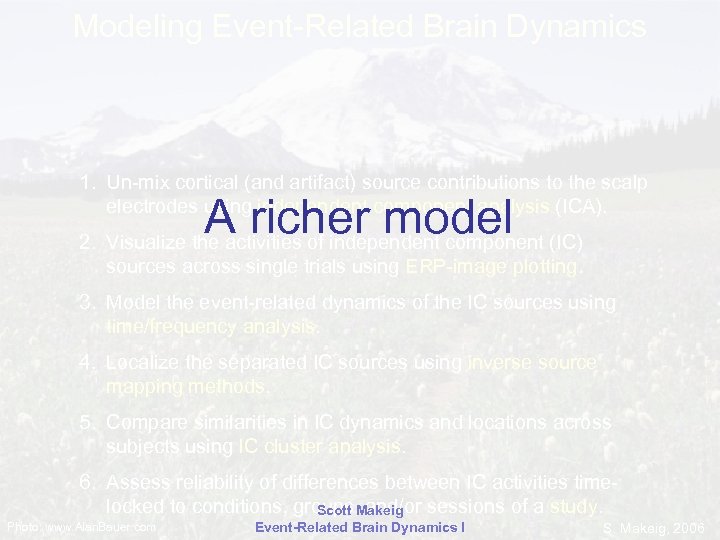
Modeling Event-Related Brain Dynamics 1. Un-mix cortical (and artifact) source contributions to the scalp electrodes using independent component analysis (ICA). A richer model (IC) 2. Visualize the activities of independent component sources across single trials using ERP-image plotting. 3. Model the event-related dynamics of the IC sources using time/frequency analysis. 4. Localize the separated IC sources using inverse source mapping methods. 5. Compare similarities in IC dynamics and locations across subjects using IC cluster analysis. 6. Assess reliability of differences between IC activities timelocked to conditions, groups, Makeig sessions of a study. Scott and/or Photo: www. Alan. Bauer. com 2006 Event-Related Brain Dynamics I S. Makeig, 2006
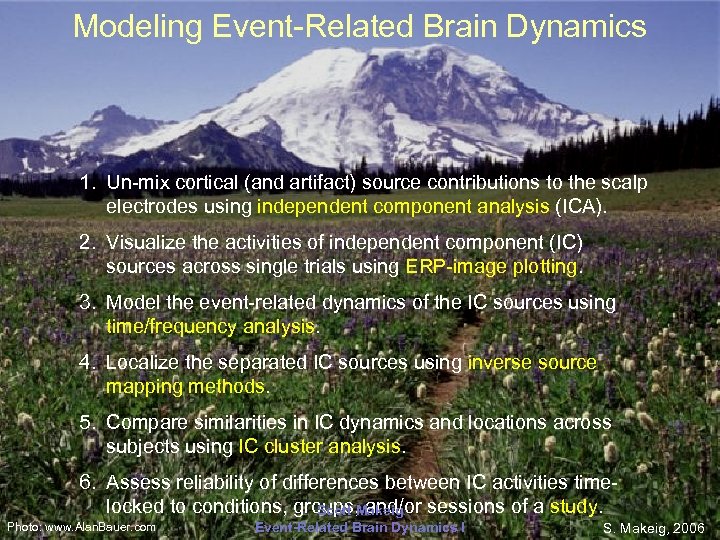
Modeling Event-Related Brain Dynamics 1. Un-mix cortical (and artifact) source contributions to the scalp electrodes using independent component analysis (ICA). 2. Visualize the activities of independent component (IC) sources across single trials using ERP-image plotting. 3. Model the event-related dynamics of the IC sources using time/frequency analysis. 4. Localize the separated IC sources using inverse source mapping methods. 5. Compare similarities in IC dynamics and locations across subjects using IC cluster analysis. 6. Assess reliability of differences between IC activities timelocked to conditions, groups, Makeig sessions of a study. Scott and/or Photo: www. Alan. Bauer. com 2006 Event-Related Brain Dynamics I S. Makeig, 2006
Event-related perturbations ERP 2006 Scott Makeig Event-Related Brain Dynamics I
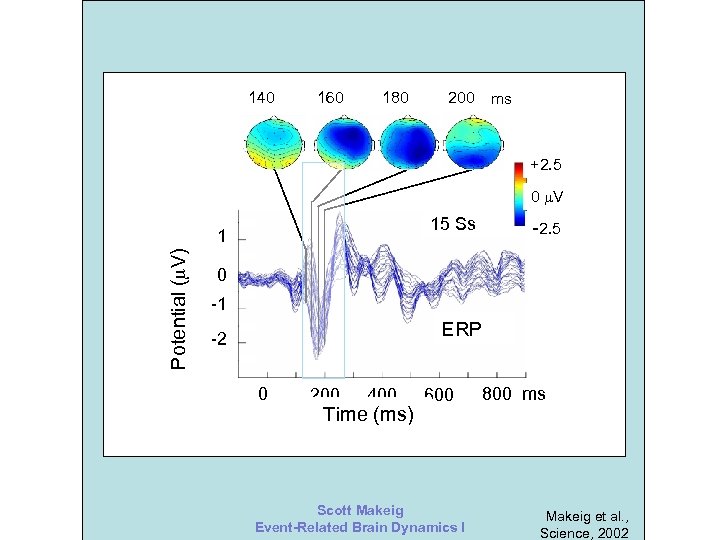
Amplitude (d. B) 140 160 180 Potential (m. V) ms +2. 5 31 Channels 0 m. V 15 Ss 1 -2. 5 0 -1 ERP -2 0 2006 200 400 Time (ms) 600 Scott Makeig Event-Related Brain Dynamics I 800 ms Makeig et al. , Science, 2002
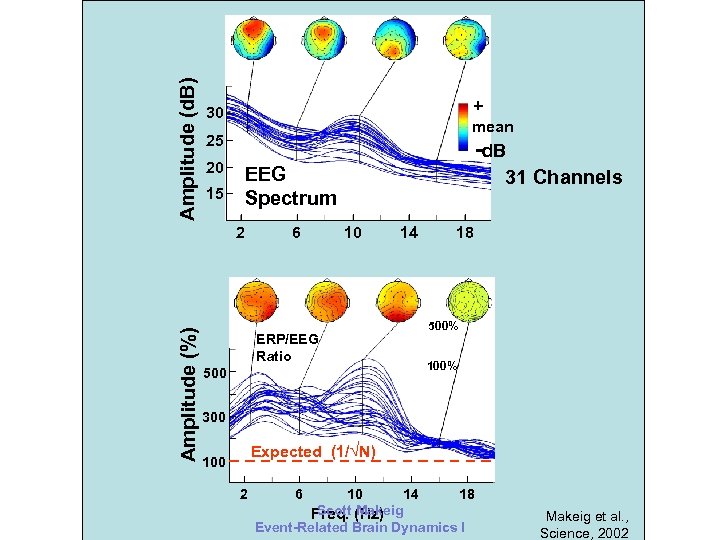
Amplitude (d. B) + 30 mean 25 20 15 -d. B EEG Spectrum 2 6 Rel. Power (d. B) Amplitude (%) 10 14 Frequency (Hz) 2. 5 2006 31 Channels 6 10. 5 ERP/EEG Ratio 500 10 18 16 Hz 500% 100% 300 0 100 -10 ERP Expected (1/√N) Spectrum 2 2 6 6 10 14 Scott Makeig Freq. (Hz) Frequency (Hz) 18 18 Event-Related Brain Dynamics I Makeig et al. , Science, 2002
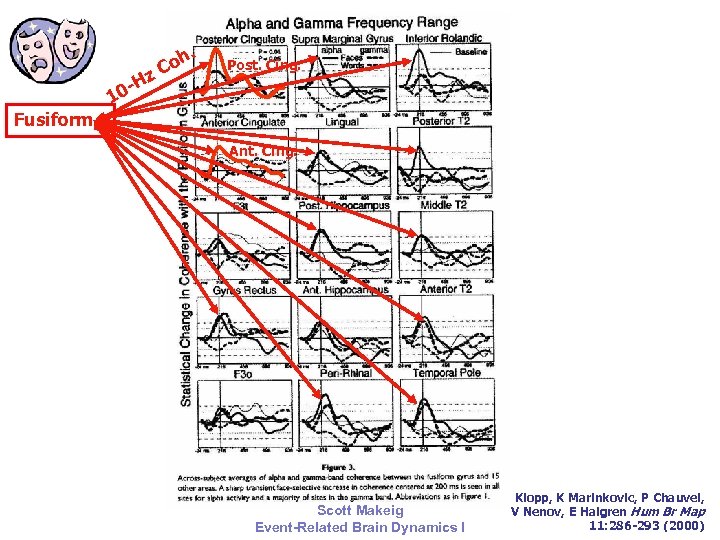
Hz Fusiform 10 h Co . Post. Cing. Ant. Cing. 2006 Scott Makeig Event-Related Brain Dynamics I J Klopp, K Marinkovic, P Chauvel, V Nenov, E Halgren Hum Br Map 11: 286 -293 (2000)
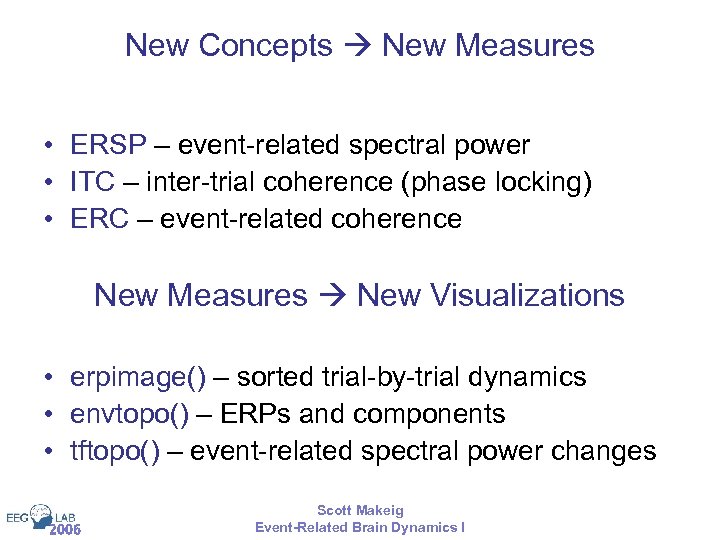
New Concepts New Measures • ERSP – event-related spectral power • ITC – inter-trial coherence (phase locking) • ERC – event-related coherence New Measures New Visualizations • erpimage() – sorted trial-by-trial dynamics • envtopo() – ERPs and components • tftopo() – event-related spectral power changes 2006 Scott Makeig Event-Related Brain Dynamics I
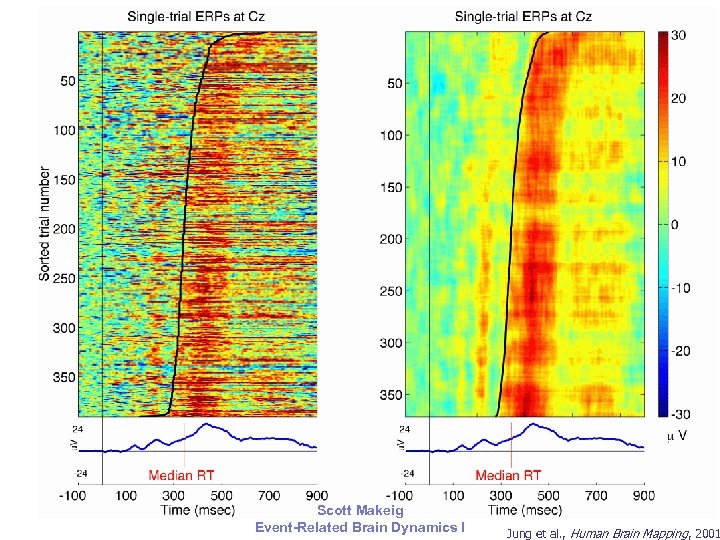
ERP-Image Plotting 1. Display single trials as color-coded horizontal lines (e. g. , red is +µV, blue is -µV, green is 0). 2. Sort all trials according to some variable of interest (here, subject RT). 3. Smooth vertically. 2006 Scott Makeig Event-Related Brain Dynamics I Jung et al. , Human Brain Mapping , 2001
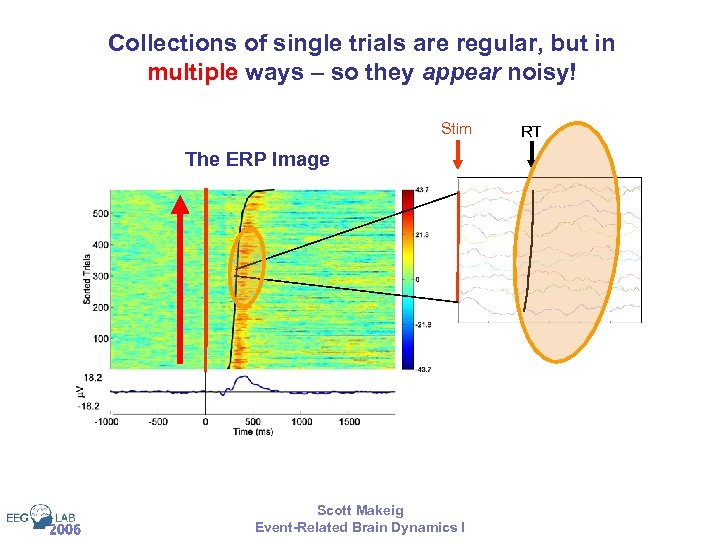
Collections of single trials are regular, but in multiple ways – so they appear noisy! Stim The ERP Image 2006 Scott Makeig Event-Related Brain Dynamics I RT
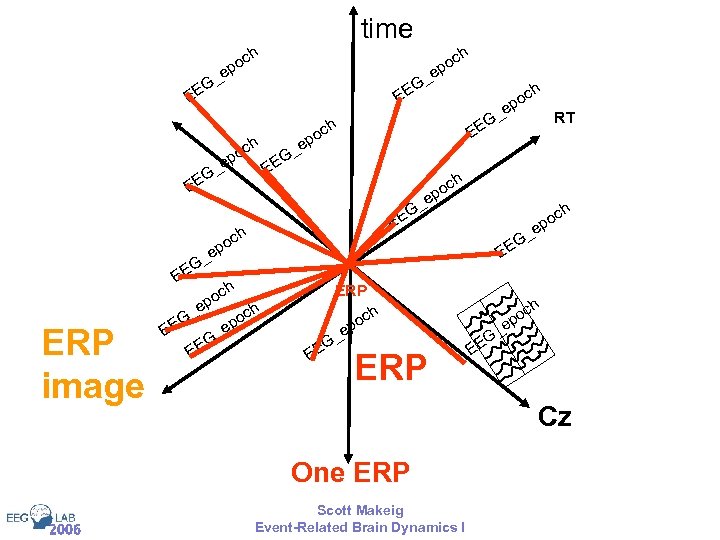
time h c po e G_ E E G G EE p _e ch _e c po ERP image G_ EE e G_ G EE h ch c po o ep ch h oc p _e G EE ERP h h c po h oc e G_ E p e G_ EE ERP E Cz One ERP 2006 RT E _e G EE G_ E h oc p _ o ep EE h c po e E o EE h oc p Scott Makeig Event-Related Brain Dynamics I
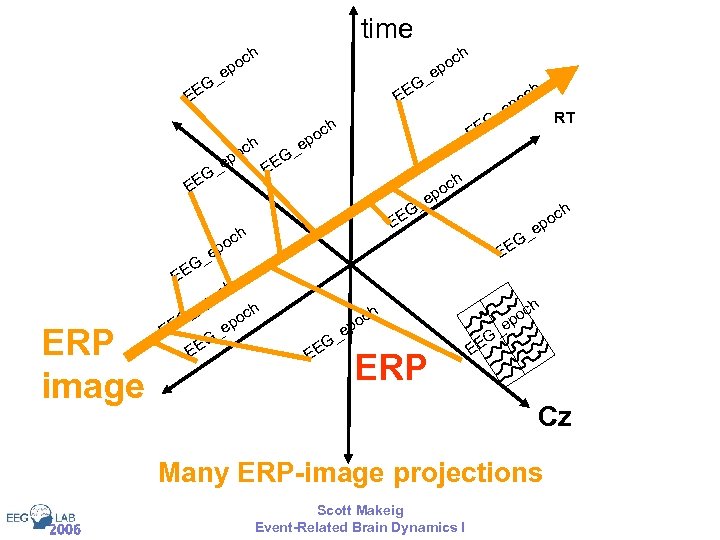
time h c po e G_ E E G G EE p _e ch _e c po ERP image G_ EE e G_ G EE h ch c po RT E _e G EE G_ E h oc p o ep ch _ o ep EE h c po e E o EE h oc p _e G EE h h c po h oc e G_ E p e G_ EE ERP E Cz Many ERP-image projections 2006 Scott Makeig Event-Related Brain Dynamics I
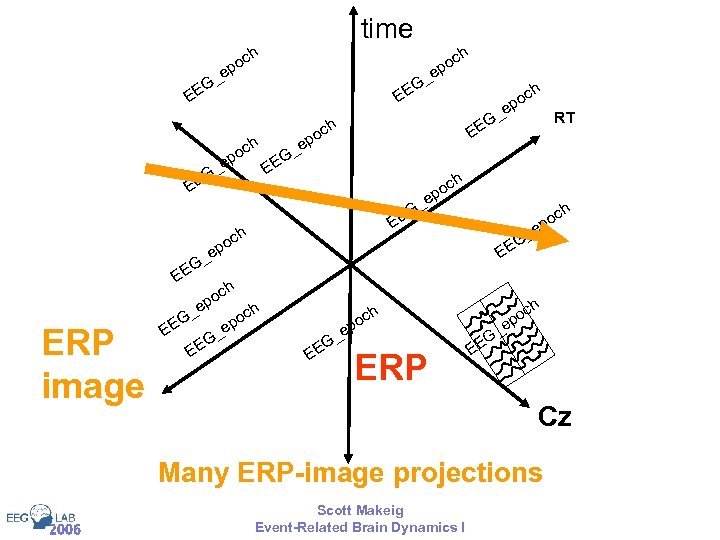
time h c po e G_ E E G G EE p _e ch _e c po ERP image G_ EE e G_ G EE h ch c po RT E _e G EE G_ E h oc p o ep ch _ o ep EE h c po e E o EE h oc p _e G EE h h c po h oc e G_ E p e G_ EE ERP E Cz Many ERP-image projections 2006 Scott Makeig Event-Related Brain Dynamics I
Blind EEG Source Separation ICA Unmixes scalp channel mixing by volume conduction! CSF EEG 2006 ICA Cocktail Party Scott Makeig Event-Related Brain Dynamics I
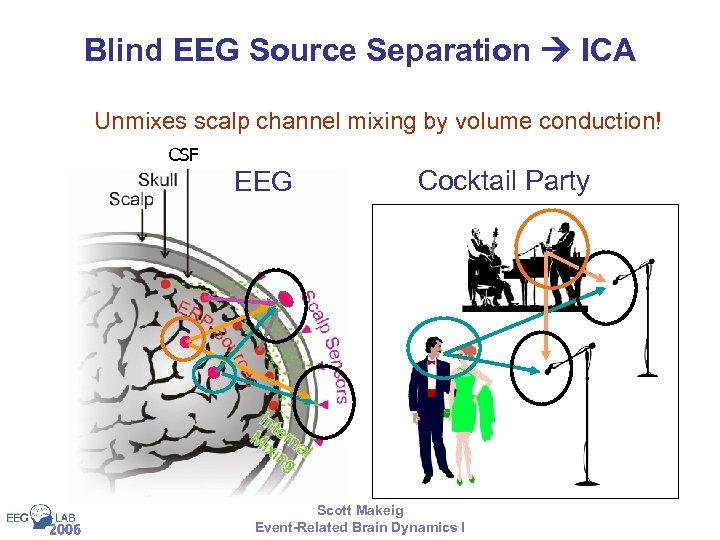
Blind EEG Source Separation ICA Unmixes scalp channel mixing by volume conduction! CSF EEG 2006 Cocktail Party Scott Makeig Event-Related Brain Dynamics I
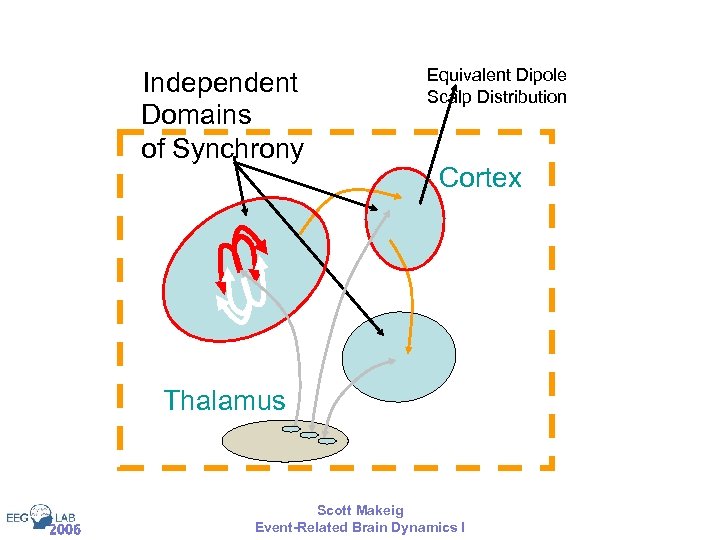
Independent Domains of Synchrony Equivalent Dipole Scalp Distribution Cortex Thalamus 2006 Scott Makeig Event-Related Brain Dynamics I
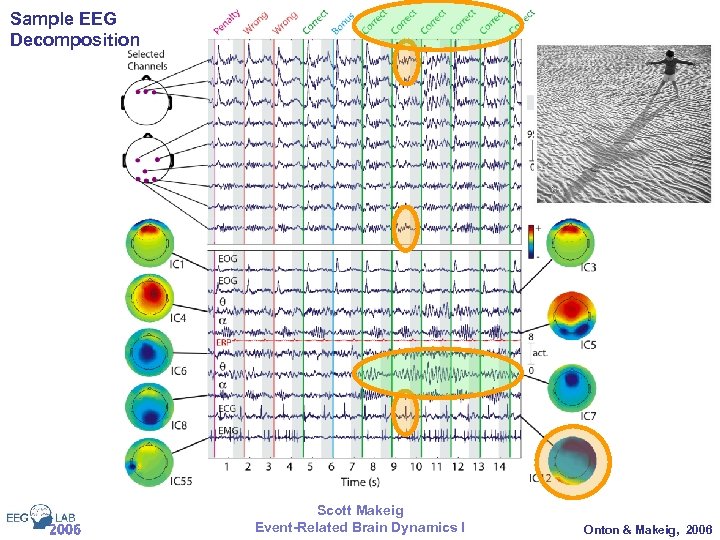
Sample EEG Decomposition 2006 Scott Makeig Event-Related Brain Dynamics I Onton & Makeig, 2006
A New Beginning… 2006 Scott Makeig Event-Related Brain Dynamics I
Скачать презентацию 3 rd EEGLAB Workshop Singapore Mining Event-Related Brain
ddc9449bf9ab8c82a067c5f355c5198c.ppt