 Скачать презентацию 3 Part Two The Global Environment and Social
df7147e816f8aa7b9bad4c5c623dea0f.ppt
- Количество слайдов: 31



3 Part Two The Global Environment and Social and Ethical Responsibilities The Marketing Environment
Objectives 1. To recognize the importance of environmental scanning and analysis 2. To understand how competitive and economic factors affect organizations’ ability to compete and customers’ ability and willingness to buy products 3. To identify the types of political forces in the marketing environment Copyright © Houghton Mifflin Company. All rights reserved. 2
Objectives (cont’d) 4. To understand how laws, government regulations, and self-regulatory agencies affect marketing activities 5. To explore the effects of new technology on society and on marketing activities 6. To analyze sociocultural issues marketers must deal with as they make decisions Copyright © Houghton Mifflin Company. All rights reserved. 3
Chapter Outline • Examining and Responding to the Marketing Environment • Competitive Forces • Economic Forces • Political Forces • Legal and Regulatory Forces • Technological Forces • Sociocultural Forces Copyright © Houghton Mifflin Company. All rights reserved. 4
Examining and Responding to the Marketing Environment • Environmental Scanning – The process of collecting information about forces in the marketing environment • Observation • Secondary sources • Market research Copyright © Houghton Mifflin Company. All rights reserved. 5
Examining and Responding to the Marketing Environment (cont’d) • Environmental Analysis – The process of assessing and interpreting the information gathered through environmental scanning • Accuracy • Consistency • Significance Copyright © Houghton Mifflin Company. All rights reserved. 6
Examining and Responding to the Marketing Environment (cont’d) • Responding to Environmental Forces – Reactive approach • Passive view of environment as uncontrollable • Current strategy is cautiously adjusted to accommodate environmental changes – Proactive approach • Actively attempts to shape and influence environment • Strategies are constructed to overcome market challenges and take advantage of opportunities Copyright © Houghton Mifflin Company. All rights reserved. 7
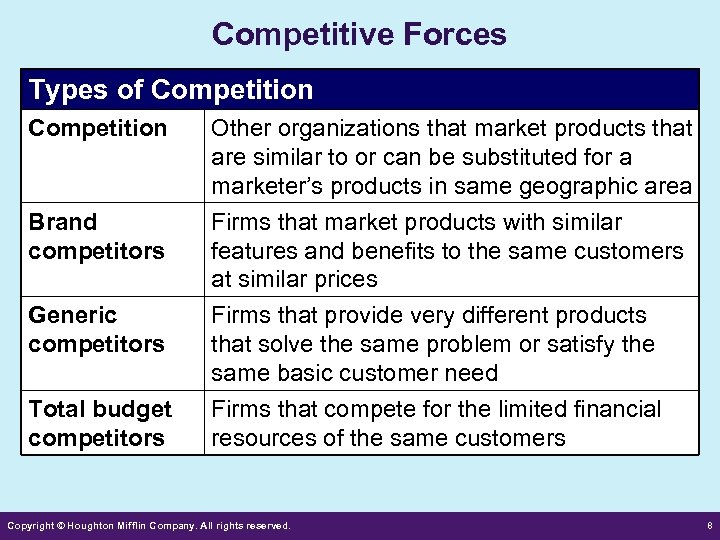
Competitive Forces Types of Competition Other organizations that market products that are similar to or can be substituted for a marketer’s products in same geographic area Brand competitors Firms that market products with similar features and benefits to the same customers at similar prices Firms that provide very different products that solve the same problem or satisfy the same basic customer need Firms that compete for the limited financial resources of the same customers Generic competitors Total budget competitors Copyright © Houghton Mifflin Company. All rights reserved. 8
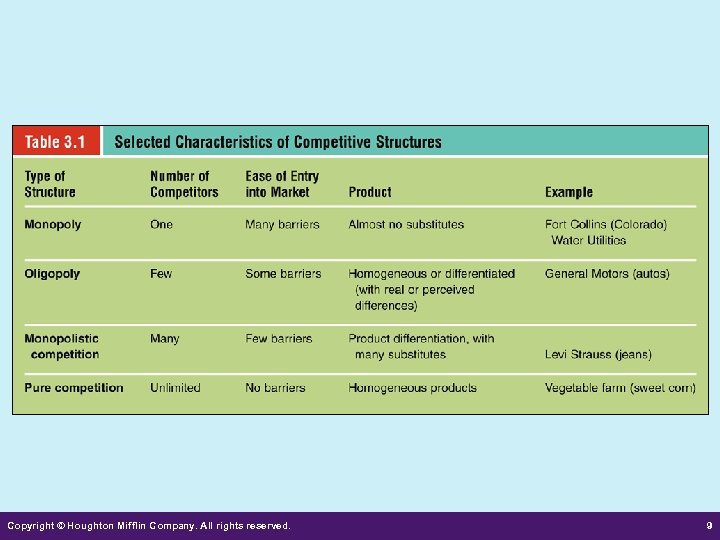
Copyright © Houghton Mifflin Company. All rights reserved. 9
Competitive Forces (cont’d) • Monitoring Competition – Helps determine competitors’ strategies and their effects on firm’s strategies – Guides development of competitive advantage and adjusting firm’s strategy – Provides ongoing information about competitors – Assists in maintaining a marketing orientation Copyright © Houghton Mifflin Company. All rights reserved. 10
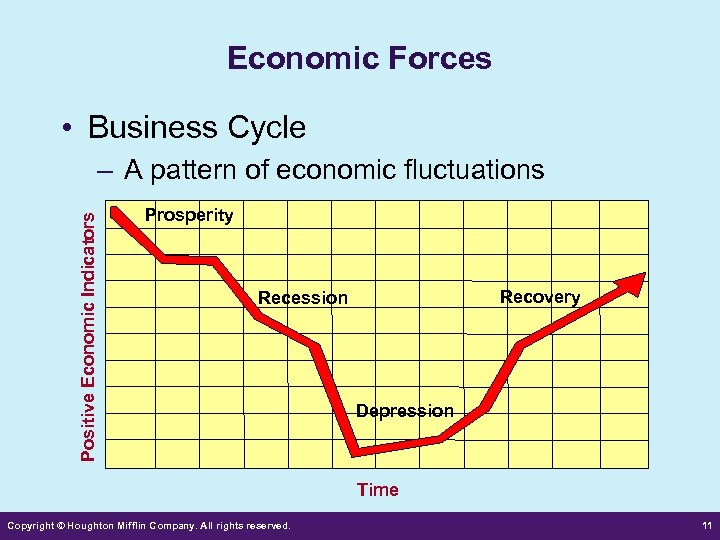
Economic Forces • Business Cycle Positive Economic Indicators – A pattern of economic fluctuations Prosperity Recovery Recession Depression Time Copyright © Houghton Mifflin Company. All rights reserved. 11
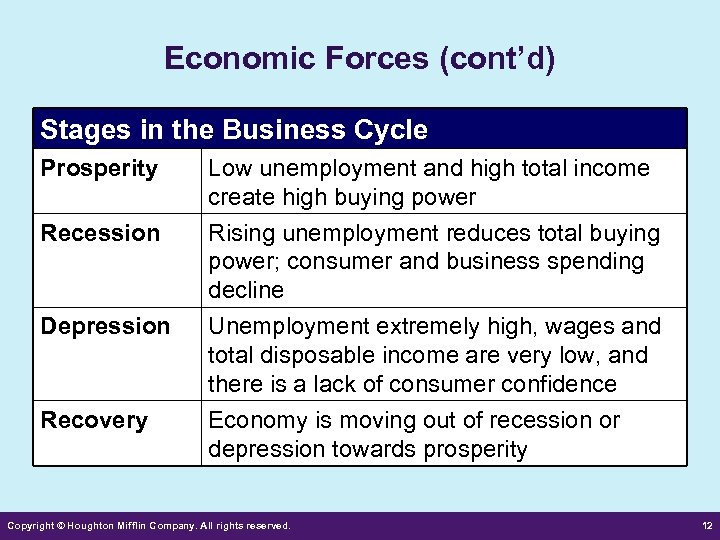
Economic Forces (cont’d) Stages in the Business Cycle Prosperity Low unemployment and high total income create high buying power Recession Rising unemployment reduces total buying power; consumer and business spending decline Unemployment extremely high, wages and total disposable income are very low, and there is a lack of consumer confidence Depression Recovery Economy is moving out of recession or depression towards prosperity Copyright © Houghton Mifflin Company. All rights reserved. 12
Economic Forces (cont’d) • Buying Power – Resources, such as money, goods, and services, that can be traded in an exchange – Income • Disposable income • Discretionary income – Wealth Copyright © Houghton Mifflin Company. All rights reserved. 13
Economic Forces (cont’d) • Willingness to Spend – An inclination to buy because of expected satisfaction from a product, influenced by the ability to buy and numerous psychological and social forces – Expectations influencing the willingness to spend: • • • Future employment Income levels Prices Family size General economic conditions (e. g. , rising prices) Copyright © Houghton Mifflin Company. All rights reserved. 14
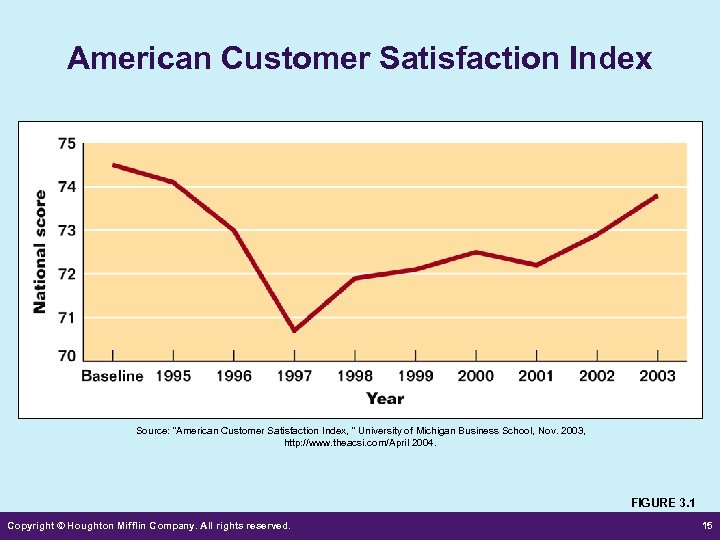
American Customer Satisfaction Index Source: “American Customer Satisfaction Index, “ University of Michigan Business School, Nov. 2003, http: //www. theacsi. com/April 2004. FIGURE 3. 1 Copyright © Houghton Mifflin Company. All rights reserved. 15
Political Forces • Reasons for Maintaining Relations with Elected Officials and Politicians – To influence the creation of laws and regulations affecting industries and specific businesses – Governments are potentially large customers – Political officials can assist in securing foreign markets – Campaign contributions of corporate-related individuals and political action committees may provide influence – Lobbyists work to communicate businesses’ concerns about issues affecting their industries and markets Copyright © Houghton Mifflin Company. All rights reserved. 16
Legal and Regulatory Forces • Sherman Antitrust Act (1890) • Clayton Act (1914) • Federal Trade Commission Act (1914) • Robinson-Patman Act (1936) • Wheeler-Lea Act (1938) • Lanham Act (1946) • Celler-Kefauver Act (1950) • Fair Packaging and Labeling Act (1966) Copyright © Houghton Mifflin Company. All rights reserved. 17
Legal and Regulatory Forces (cont’d) • Magnuson-Moss Warranty (FTC) Act (1975) • Consumer Goods Pricing Act (1975) • Antitrust Improvements Act (1976) • Trademark Counterfeiting Act (1980) • Trademark Law Revision Act (1988) • Nutrition Labeling and Education Act (1990) Copyright © Houghton Mifflin Company. All rights reserved. 18
Legal and Regulatory Forces (cont’d) • Telephone Consumer Protection Act (1991) • Federal Trademark Dilution Act (1995) • Digital Millennium Copyright Act (1996) • Children’s Online Privacy Protection Act (2000) • Do Not Call Implementation Act (2003) Copyright © Houghton Mifflin Company. All rights reserved. 19
Legal and Regulatory Forces (cont’d) • Procompetitive Legislation – Preserve competition – Prevent restraint of trade and monopolizing of markets – Prevent illegal competitive trade practices Copyright © Houghton Mifflin Company. All rights reserved. 20
Legal and Regulatory Forces (cont’d) • Consumer Protection Legislation – Adulterated and mislabeled food and drugs – Deceptive trade practices and the sale of hazardous products – The invasion of personal privacy and the misuse of personal information by firms Copyright © Houghton Mifflin Company. All rights reserved. 21
Legal and Regulatory Forces (cont’d) • Encouraging Compliance with Laws and Regulations – Movement is toward greater organizational accountability for misconduct of employees • Regulatory Agencies – FTC influences marketing activities most; can seek civil penalties and require corrective advertising • Self-Regulatory Forces – Better Business Bureau – National Advertising Review Board (NARB) Copyright © Houghton Mifflin Company. All rights reserved. 22
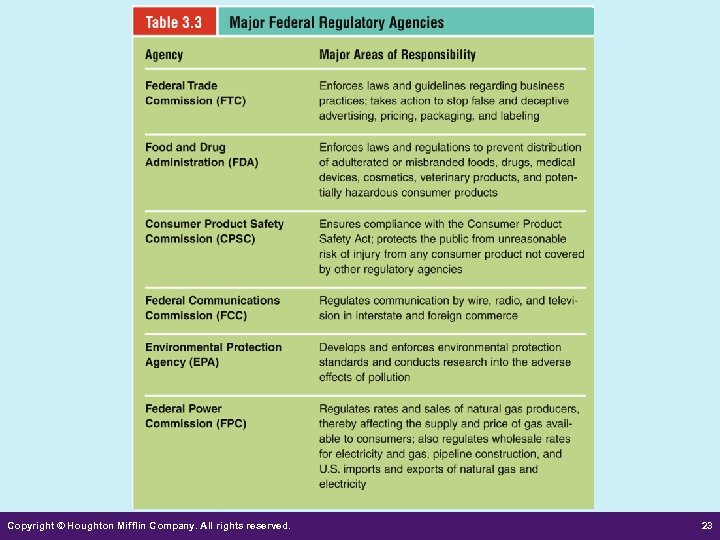
Copyright © Houghton Mifflin Company. All rights reserved. 23
Technological Forces • Technology – The application of knowledge and tools to solve problems and perform tasks more efficiently • Impact of Technology – Dynamic means constant change – Reach refers to how technology quickly moves through society – The self-sustaining nature of technology as the catalyst for even faster development Copyright © Houghton Mifflin Company. All rights reserved. 24
Technological Forces (cont’d) • Adoption and Use of Technology – Failing to adopt new technology can cause a loss of market leadership – Protecting the firm’s inventions is critical – Using a technology assessment allows the firm to foresee the effects of new products and processes on the firm Copyright © Houghton Mifflin Company. All rights reserved. 25
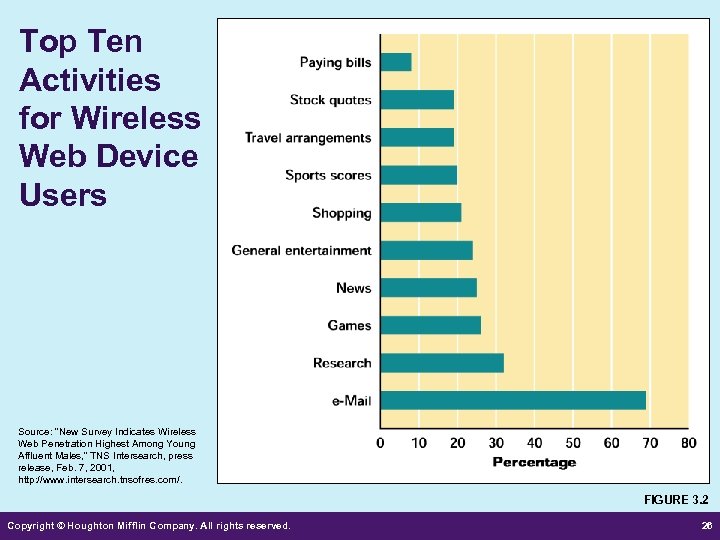
Top Ten Activities for Wireless Web Device Users Source: “New Survey Indicates Wireless Web Penetration Highest Among Young Affluent Males, ” TNS Intersearch, press release, Feb. 7, 2001, http: //www. intersearch. tnsofres. com/. FIGURE 3. 2 Copyright © Houghton Mifflin Company. All rights reserved. 26
Sociocultural Forces • Sociocultural Forces – The influences in a society and its culture(s) that change people’s attitudes, beliefs, norms, customs, and lifestyles • Demographic Diversity and Characteristics – Increasing proportion of older consumers – Rising number of single adults – Entering another baby boom – Increasingly multicultural U. S. society Copyright © Houghton Mifflin Company. All rights reserved. 27
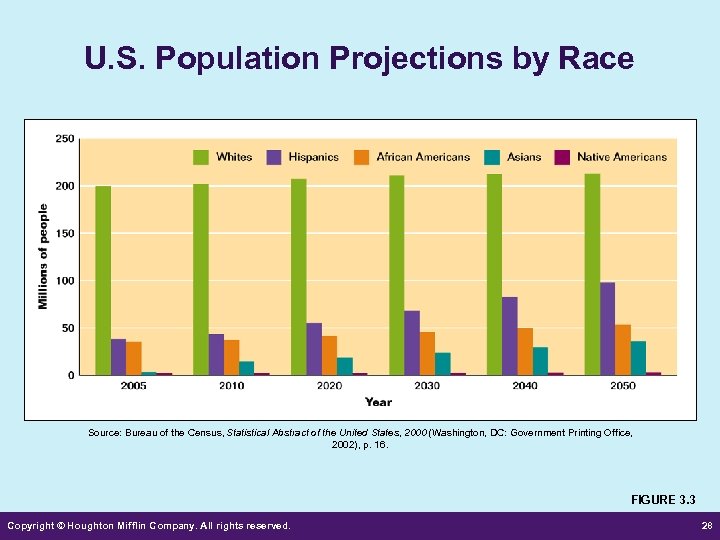
U. S. Population Projections by Race Source: Bureau of the Census, Statistical Abstract of the United States, 2000 (Washington, DC: Government Printing Office, 2002), p. 16. FIGURE 3. 3 Copyright © Houghton Mifflin Company. All rights reserved. 28
Sociocultural Forces (cont’d) • Cultural Values – Primary source of values is the family – Values influence • • Eating habits Alternative health and medical treatment choices Attitudes toward marriage Concern for the natural environment • Consumerism – Organized efforts by individuals, groups, and organizations to protect consumers’ rights Copyright © Houghton Mifflin Company. All rights reserved. 29
After reviewing this chapter you should: • Recognize the importance of environmental scanning and analysis. • Understand how competitive and economic factors affect organizations’ ability to compete and customers’ ability and willingness to buy products. • Be able to identify the types of political forces in the marketing environment. Copyright © Houghton Mifflin Company. All rights reserved. 30
After reviewing this chapter you should: • Understand how laws, government regulations, and self-regulatory agencies affect marketing activities. • Know the effects of new technology on society and on marketing activities. • Be able to analyze sociocultural issues that marketers must deal with as they make decisions. Copyright © Houghton Mifflin Company. All rights reserved. 31
Скачать презентацию 3 Part Two The Global Environment and Social
df7147e816f8aa7b9bad4c5c623dea0f.ppt