


 Скачать презентацию 3 Organizations and Organizational Environment Types of
Session2_Organization and environment.ppt
- Количество слайдов: 26
 3 Organizations and Organizational Environment
 Types of property • Property – any tangible or intangible entity, which is owned by a person, group of people, or a legal entity, such as corporation 2 generally accepted types of property: tangible and intangible Tangible – anything you can touch, real (or immovable) property + personal (moveable property). Factory and machinery in Korea, is a tangible property of GM Intangible – property that is owned and can be transferred to other entities, but has no physical substance. Engine and car design, patents – is an intangible property of GM
 Companies – are property • Private business • A company that is owned by one or more individuals who share liability • Public business • A company, which is traded on the stock exchange • Governmentally owned business • A company, where major stakeholder is government
 Private business • A business that is owned by non-government organization or by a relatively small number of shareholders • Types of private businesses • Sole proprietorship • Partnership – managed by several partners • Corporation – managed by managers, appointed by the Board • Most of the time it’s LLC (limited liability company, or TOB in Ukraine) • Owners bear a limited liability, meaning they will share losses and profits on the degree, they establish in the founding documents
 Public business (public company) • Limited liability company, that offers securities(shares, stocks) in the open market. • Any person can buy “a piece of ownership” through a stock exchange • Every person, that buys shares of the company bears no commercial liability, but has an opportunity to share profits via dividends, however not all companies pay dividends.
 Government business • An enterprise, where the majority of the ownership belongs to the government • Usually a natural monopoly like oil&gas, any natural resources or a sector of strategic interest (Naftogaz, Oblenergos, Ukrspetsexport) • Rarely consumer services business – in Ukraine – Ukrzaliznytsya, Oshchadbank; in US – Fannie Mae, Farmer Mac
 Organizational Environment • Organizational Environment: those forces outside its boundaries that can impact it. • Forces can change over time and are made up of Opportunities and Threats. • Opportunities: openings for managers to enhance revenues or open markets. • New technologies, new markets and ideas. • Threats: issues that can harm an organization. • economic recessions, oil shortages. • Managers must seek opportunities and avoid threats.
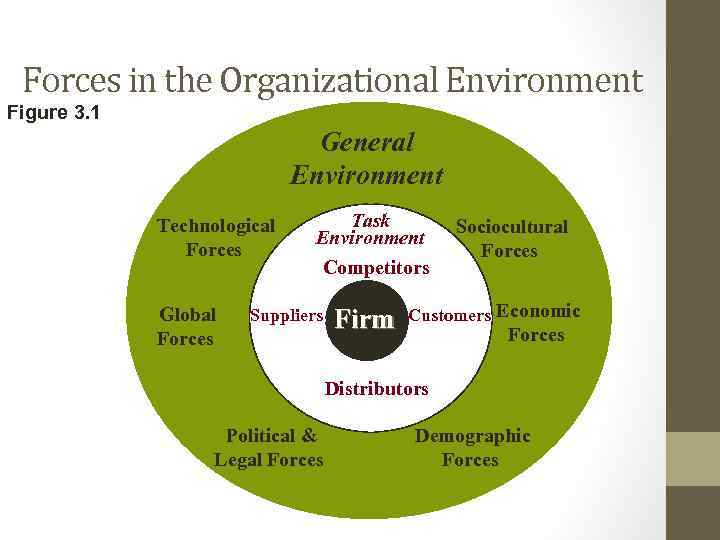 Forces in the Organizational Environment Figure 3. 1 General Environment Technological Forces Global Forces Task Environment Competitors Suppliers Firm Sociocultural Forces Customers Economic Forces Distributors Political & Legal Forces Demographic Forces
 Task Environment • Task Environment: forces from suppliers, distributors, customers, and competitors. • Suppliers: provide organization with inputs • • • Managers need to secure reliable input sources. Suppliers provide raw materials, components, and even labor. • Working with suppliers can be hard due to shortages, unions, and lack of substitutes. • Suppliers with scarce items can raise the price and are in a good bargaining position. Managers often prefer to have many, similar suppliers of each item.
 Task Environment • Distributors: organizations that help others to sell goods. • • Compaq Computer first used special computer stores to sell their computers but later sold through discount stores to reduce costs. Some distributors like Wal-Mart have strong bargaining power. • They can threaten not to carry your product. • Customers: people who buy the goods. • Usually, there are several groups of customers. • For Compaq, there are business, home, & government buyers.
 Task Environment • Competitors: other organizations that produce similar goods. • • • Rivalry between competitors is usually the most serious force facing managers. High levels of rivalry often means lower prices. • Profits become hard to find. Barriers to entry keep new competitors out and result from: • Economies of scale: cost advantages due to large scale production. • Brand loyalty: customers prefer a given product.
 Industry Life Cycle • Reflects the changes that take place in an industry over time. • Birth stage: firms seek to develop a winning technology. • VHS vs. Betamax in video, or 8 -track vs. cassette in audio. • Growth stage: Product gains customer acceptance and grows rapidly. • New firms enter industry, production improves, distributors emerge.
 • Shakeout stage: at end of growth, there is a slowing customer demand. • • Competitor rivalry increases, prices fall. Least efficient firms fail and leave industry. • Maturity stage: most customers have bought the product, growth is slow. • • Relationships between suppliers, distributors more stable. Usually, industry dominated by a few, large firms. • Decline stage: falling demand for the product. • Prices fall, weaker firms leave the industry.
 The General Environment • Consists of the wide economic, technological, demographic and similar issues. • • Managers usually cannot impact or control these. Forces have profound impact on the firm. • Economic forces: affect the national economy and the organization. • • Includes interest rate changes, unemployment rates, economic growth. When there is a strong economy, people have more money to spend on goods and services.
 • Technological forces: skills & equipment used in design, production and distribution. • • • Result in new opportunities or threats to managers. Often make products obsolete very quickly. Can change how we manage. • Socialcultural forces: result from changes in the social or national culture of society. • • • Social structure refers to the relationships between people and groups. • Different societies have vastly different social structures. National culture includes the values that characterize a society. • Values and norms differ widely throughout the world. These forces differ between cultures and over time.
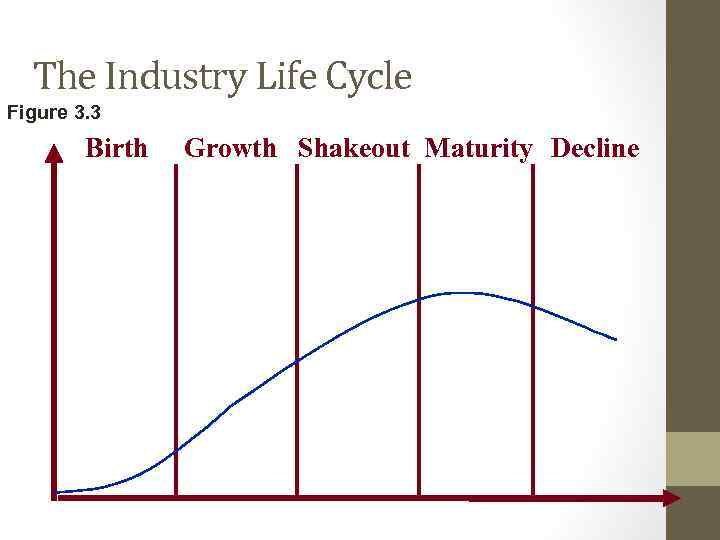 The Industry Life Cycle Figure 3. 3 Birth Growth Shakeout Maturity Decline
 • Demographic forces: result from changes in the nature, composition and diversity of a population. • • These include gender, age, ethnic origin, etc. • For example, during the past 20 years, women have entered the workforce in increasing numbers. Currently, most industrial countries are aging. • This will change the opportunities for firms competing in these areas. • New demand for health care, assisting living can be forecast.
 • Political-legal forces: result from changes in the political arena. • • These are often seen in the laws of a society. Today, there is increasing deregulation of many staterun firms. • Global forces: result from changes in international relationships between countries. • • • Perhaps the most important is the increase in economic integration of countries. Free-trade agreements (GATT, NAFTA, EU) decreases former barriers to trade. Provide new opportunities and threats to managers.
 Managing the Organization Environment • Managers must measure the complexity of the environment and rate of environmental change. • Environmental complexity: deals with the number and possible impact of different forces in the environment. • • Managers must pay more attention to forces with larger impact. Usually, the larger the organization, the greater the number of forces managers must oversee. • The more forces, the more complex the manger’s job becomes.
 • Environmental change: refers to the degree to which forms in the task and general environments change over time. • • Change rates are hard to predict. The outcomes of changes are even harder to identify. • Managers thus cannot be sure that actions taken today will be appropriate in the future given new changes.
 Reducing Environmental Impact • Managers can counter environmental threats by reducing the number of forces. • Many firms have sought to reduce the number of suppliers it deals with which reduces uncertainty. • All levels of managers should work to minimize the potential impact of environmental forces. • Examples include reduction of waste by first line managers, determining competitor’s moves by middle managers, or the creation of a new strategy by top managers.
 Organizational Structure • Managers can create new organizational structures to deal with change. • Many firms use specific departments to respond to each force. • Managers also create mechanistic or organic structures. • • Mechanistic structures have centralized authority. • Roles are clearly specified. • Good for slowly changing environments. Organic structures authority is decentralized. • Roles overlap, providing quick response to change.
 Boundary Spanning • Managers must gain access to information needed to forecast future issues. • Rod Canion’s forecast of Compaq’s future was wrong due to his incorrect view of the environment. • Boundary spanning is the practice of relating to people outside the organization. • • Seek ways to respond and influence stakeholder perception. By gaining information outside, managers can make better decisions about change. • More management levels involved in spanning, yields better overall decision making.
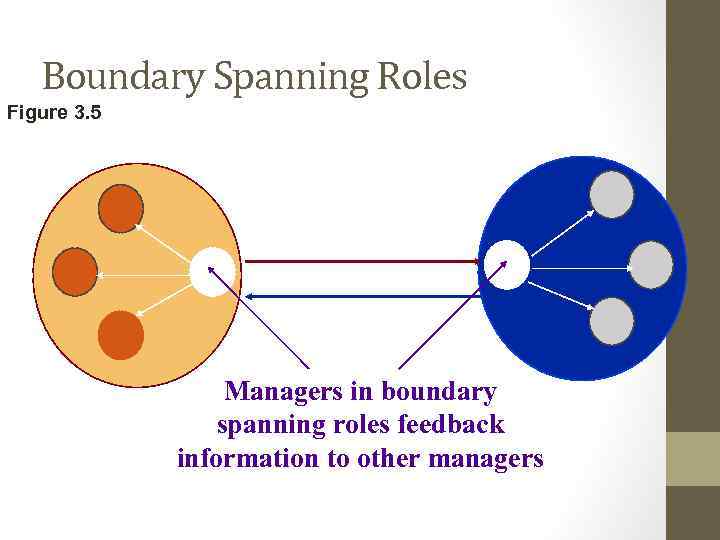 Boundary Spanning Roles Figure 3. 5 Managers in boundary spanning roles feedback information to other managers
 Scanning and Monitoring • Environmental scanning is an important boundary spanning activity. • Includes reading trade journals, attending trade shows, and the like. • Gatekeeping: the boundary spanner decides what information to allow into organization and what to keep out. • Must be careful not to let bias decide what comes in. • Managers can become agents of change and impact the environment. • Interorganizational Relations: firms need alliances globally to best utilize resources.
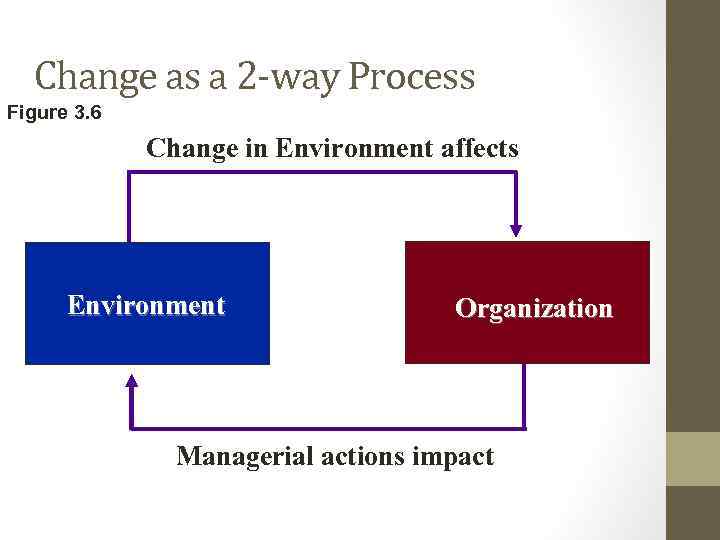 Change as a 2 -way Process Figure 3. 6 Change in Environment affects Environment Organization Managerial actions impact