


 Скачать презентацию 3 nd African American Prostate Cancer Disparity Summit
ccd4a7babe8895c035aa0d8f042f93df.ppt
- Количество слайдов: 24
 3 nd African American Prostate Cancer Disparity Summit Prostate Health Education Network (PHEN) V. Diane Woods, Dr. P. H. , M. S. N. , R. N. Assistant Research Psychologist/Public Health Department of Psychology, Social Psychology Lab University of California Riverside, California Capitol Hill Rayburn House Office Building Washington, DC September 27 -28, 2007 Woods, September 28, 2007
 Utilizing Community-based Particip Research (CBPR) to Engage African American Men in Clinical Trials and Prevention Woods, September 28, 2007 2
 Co-Authors Dr. Susanne Montgomery, Ph. D. , M. P. H. Professor and Director, Center for Health Research Co-Director, Center for Health Disparities and Molecular Medicine Loma Linda University School of Public Health Scholastique Nikuze, M. P. H. Doctoral Student Oregon State University Woods, September 28, 2007 3
 Supported in part by: n n Loma Linda University Center for Health Research Loma Linda University Center for Health Disparities and Molecular Medicine n NIH National Center on Minority Health and Health Disparities Association of Schools of Public Health (ASPH) and Centers for Disease Control and Prevention (CDC) Division of Cancer Prevention and Control Cooperative Agreement #S 1391 -20/20 n African American Health Institute of San Bernardino County n The California Endowment n The Community Foundation of Riverside and San Bernardino Counties n The California Wellness Foundation n Woods, September 28, 2007 4
 Presentation Objectives n To demonstrate how community engagement processes work to increase African American male involvement in prevention and clinical research n Discuss the complexity of health disparities n Provide a framework for eliminating health disparities in African American men and prostate cancer Woods, September 28, 2007 5
 Community-based Participatory Research (CBPR) Modified Bibliography n Israel BA, Checkoway B, Schulz A, Zimmerman M. Health education and community empowerment: Health Educ Q. 1994; 21(2): 149 -170 n Aungst J, Haas A, Ommaya A, Green L. Exploring Challenges, Progress, and New Models for Engaging the Public in the Clinical Research Enterprise: Clinical Research Roundtable Workshop Summary. Washington DC: National Academy of Sciences, 2003 n Viswanathan M, Ammerman A, Eng E, Gartlehner G, et al. Community-based participatory research: Assessing the evidence. AHRQ Publication 04 -E 022 -2. Rockville, MD: Agency for Healthcare Research and Quality, July 2004. n Mickler M. Community-based research partnerships: J Urban Health. 2005; 82(2 Suppl 2): ii 3 -ii 12. Woods, September 28, 2007 6
 Hallmarks of Community-based Participatory Research (CBPR) n Community member involvement to investigate their lived experiences n Community stakeholders participate as equals n Co-learning between community and researchers to generate relevant knowledge, create critical awareness, enhance the quality of the process and products of research n Community members to provide descriptions, rich in detail, of the local social context and real-world constraints (i. e. , replicability), which will improve conceptual robustness and explanatory utility of a study's findings n Community involvement establishes congruence between the study and local reality (i. e. , increasing face validity), particularly for defining the problem, adapting methodology to specific ecologies and contexts, and determining the nature of acceptable solutions n Community participation to improve adequate response rates and minimizing attrition because the research question and data collection methods are likely to be context sensitive and culturally relevant (i. e. , dependability) n The group process to move the group through different modes of participation as a process of empowerment Woods, September 28, 2007 7
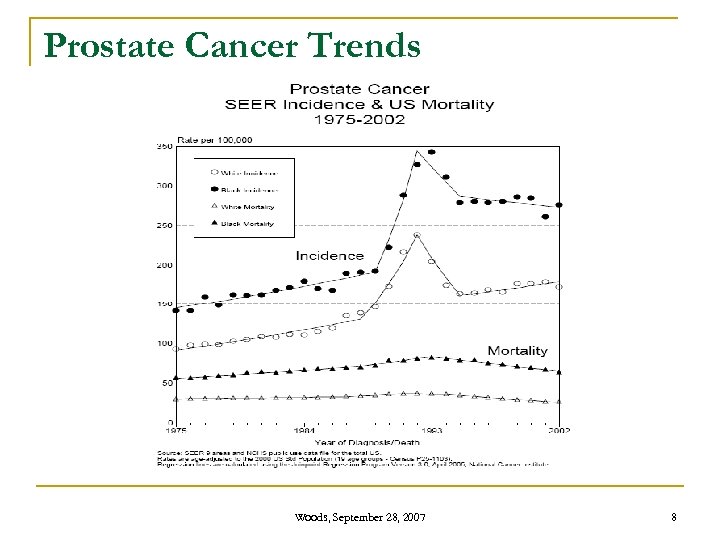 Prostate Cancer Trends Woods, September 28, 2007 8
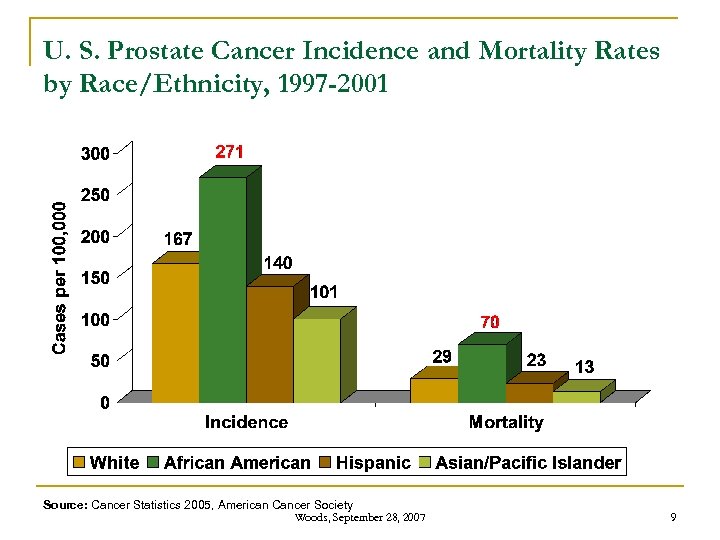 U. S. Prostate Cancer Incidence and Mortality Rates by Race/Ethnicity, 1997 -2001 Source: Cancer Statistics 2005, American Cancer Society Woods, September 28, 2007 9
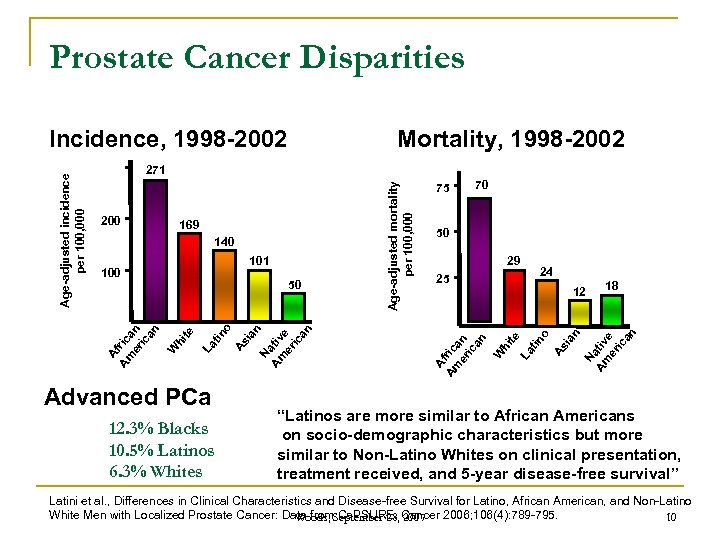 Prostate Cancer Disparities Mortality, 1998 -2002 169 140 101 100 La tin o As ia n Na Am tiv er e ic an 50 Advanced PCa 12. 3% Blacks 10. 5% Latinos 6. 3% Whites 75 70 50 29 25 24 12 18 A Am fric er an ic an W hi te La tin o As ia n N Am ativ er e ic an 200 Age-adjusted mortality per 100, 000 271 A Am fric er an ic an W hi te Age-adjusted incidence per 100, 000 Incidence, 1998 -2002 “Latinos are more similar to African Americans on socio-demographic characteristics but more similar to Non-Latino Whites on clinical presentation, treatment received, and 5 -year disease-free survival” Latini et al. , Differences in Clinical Characteristics and Disease-free Survival for Latino, African American, and Non-Latino White Men with Localized Prostate Cancer: Data from. September 28, Cancer 2006; 106(4): 789 -795. 10 Woods, Ca. PSURE. 2007
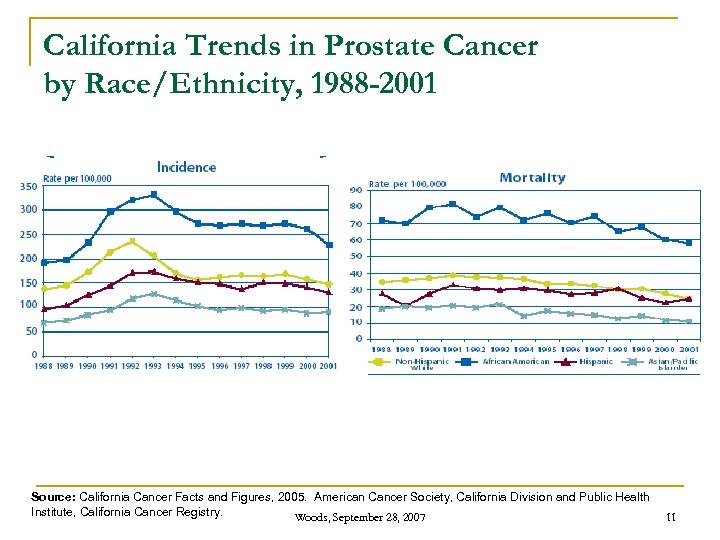 California Trends in Prostate Cancer by Race/Ethnicity, 1988 -2001 Source: California Cancer Facts and Figures, 2005. American Cancer Society, California Division and Public Health Institute, California Cancer Registry. Woods, September 28, 2007 11
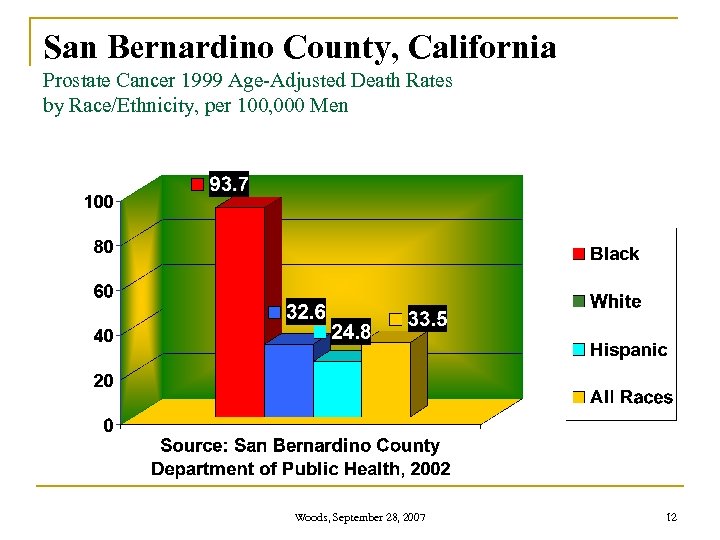 San Bernardino County, California Prostate Cancer 1999 Age-Adjusted Death Rates by Race/Ethnicity, per 100, 000 Men Woods, September 28, 2007 12
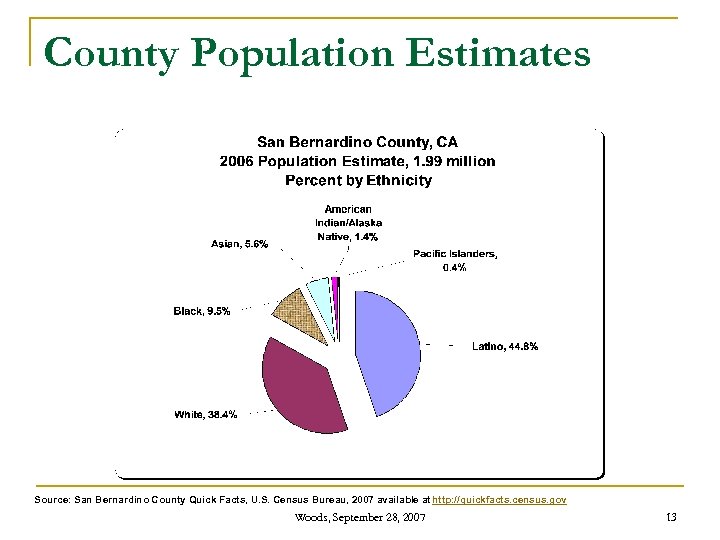 County Population Estimates Source: San Bernardino County Quick Facts, U. S. Census Bureau, 2007 available at http: //quickfacts. census. gov Woods, September 28, 2007 13
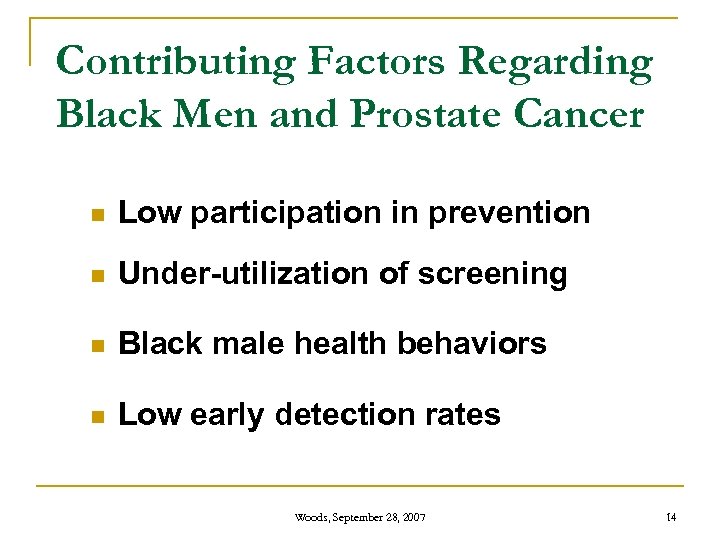 Contributing Factors Regarding Black Men and Prostate Cancer n Low participation in prevention n Under-utilization of screening n Black male health behaviors n Low early detection rates Woods, September 28, 2007 14
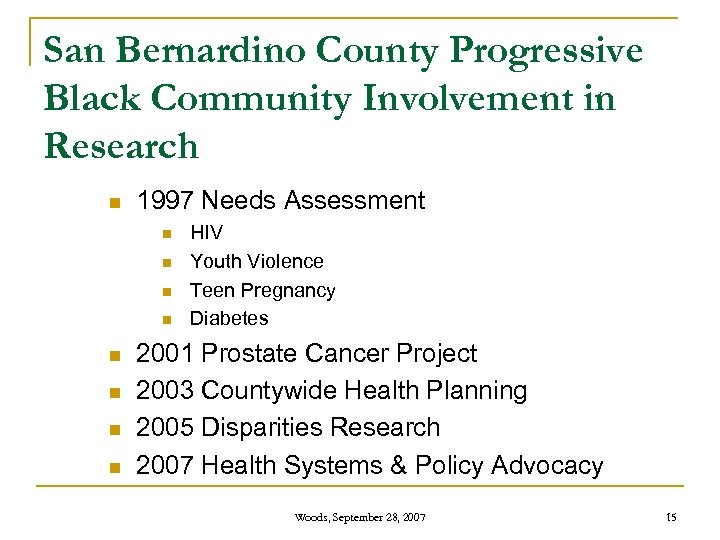 San Bernardino County Progressive Black Community Involvement in Research n 1997 Needs Assessment n n n n HIV Youth Violence Teen Pregnancy Diabetes 2001 Prostate Cancer Project 2003 Countywide Health Planning 2005 Disparities Research 2007 Health Systems & Policy Advocacy Woods, September 28, 2007 15
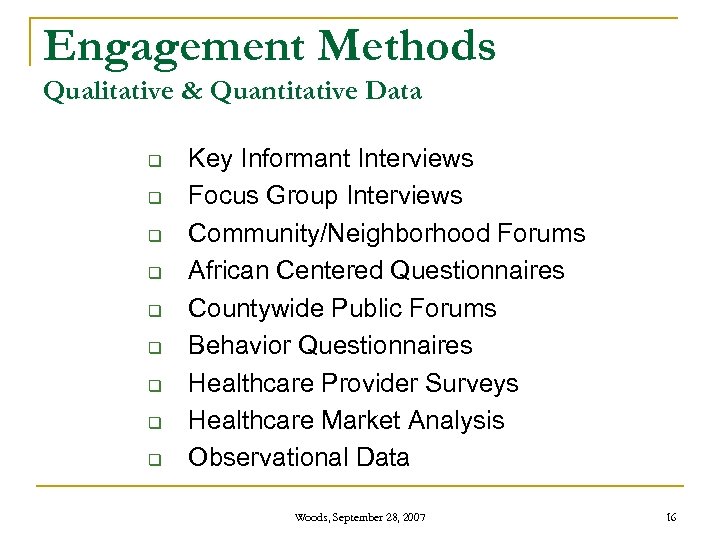 Engagement Methods Qualitative & Quantitative Data q q q q q Key Informant Interviews Focus Group Interviews Community/Neighborhood Forums African Centered Questionnaires Countywide Public Forums Behavior Questionnaires Healthcare Provider Surveys Healthcare Market Analysis Observational Data Woods, September 28, 2007 16
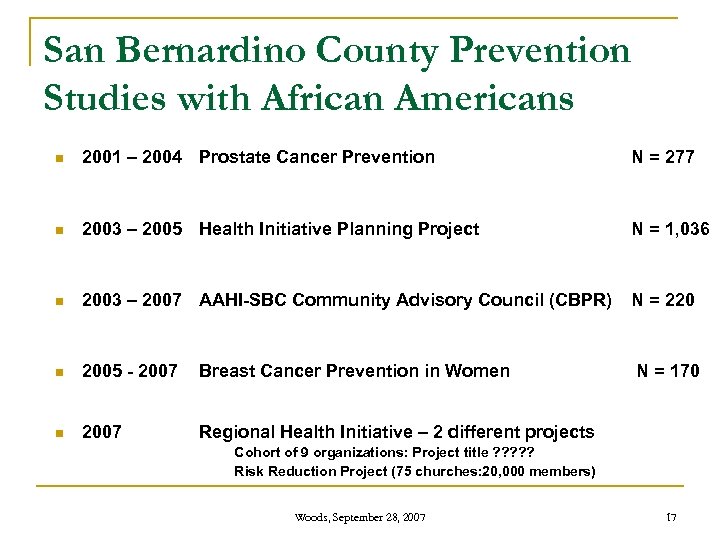 San Bernardino County Prevention Studies with African Americans n 2001 – 2004 Prostate Cancer Prevention N = 277 n 2003 – 2005 Health Initiative Planning Project N = 1, 036 n 2003 – 2007 AAHI-SBC Community Advisory Council (CBPR) N = 220 n 2005 - 2007 Breast Cancer Prevention in Women N = 170 n 2007 Regional Health Initiative – 2 different projects Cohort of 9 organizations: Project title ? ? ? Risk Reduction Project (75 churches: 20, 000 members) Woods, September 28, 2007 17
 Impact n Individual n Community n Health Systems Woods, September 28, 2007 18
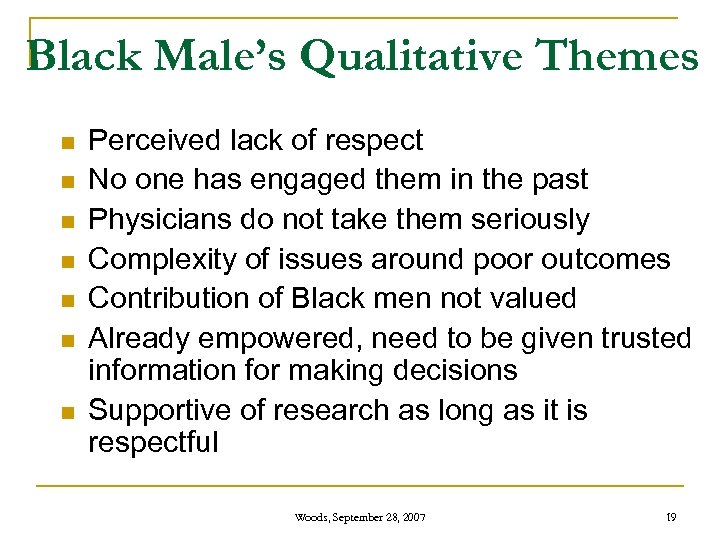 Black Male’s Qualitative Themes n n n n Perceived lack of respect No one has engaged them in the past Physicians do not take them seriously Complexity of issues around poor outcomes Contribution of Black men not valued Already empowered, need to be given trusted information for making decisions Supportive of research as long as it is respectful Woods, September 28, 2007 19
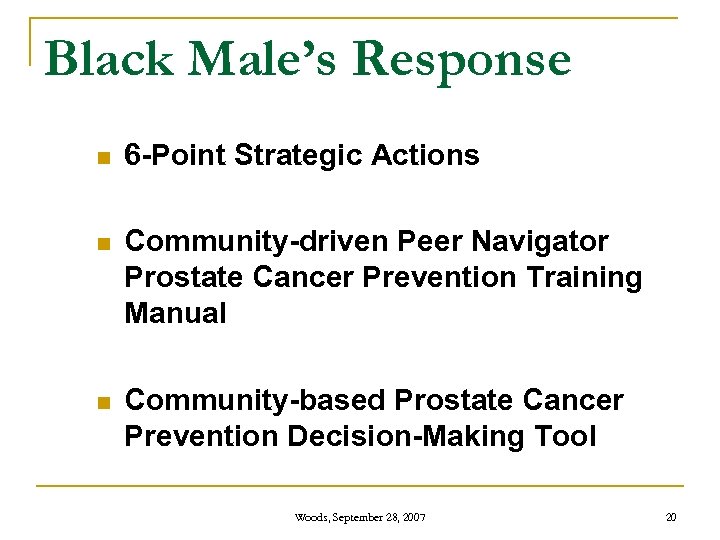 Black Male’s Response n 6 -Point Strategic Actions n Community-driven Peer Navigator Prostate Cancer Prevention Training Manual n Community-based Prostate Cancer Prevention Decision-Making Tool Woods, September 28, 2007 20
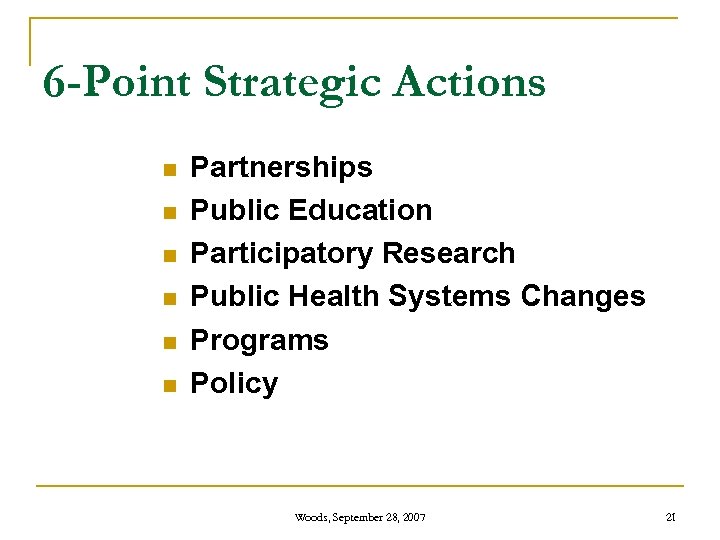 6 -Point Strategic Actions n n n Partnerships Public Education Participatory Research Public Health Systems Changes Programs Policy Woods, September 28, 2007 21
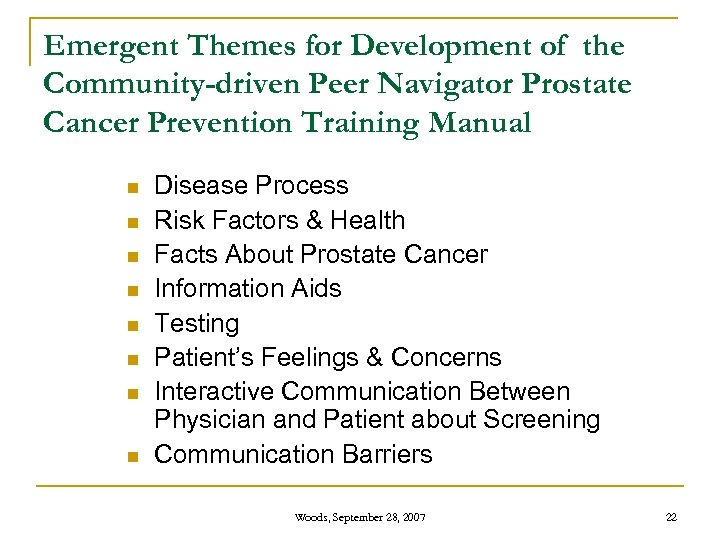 Emergent Themes for Development of the Community-driven Peer Navigator Prostate Cancer Prevention Training Manual n n n n Disease Process Risk Factors & Health Facts About Prostate Cancer Information Aids Testing Patient’s Feelings & Concerns Interactive Communication Between Physician and Patient about Screening Communication Barriers Woods, September 28, 2007 22
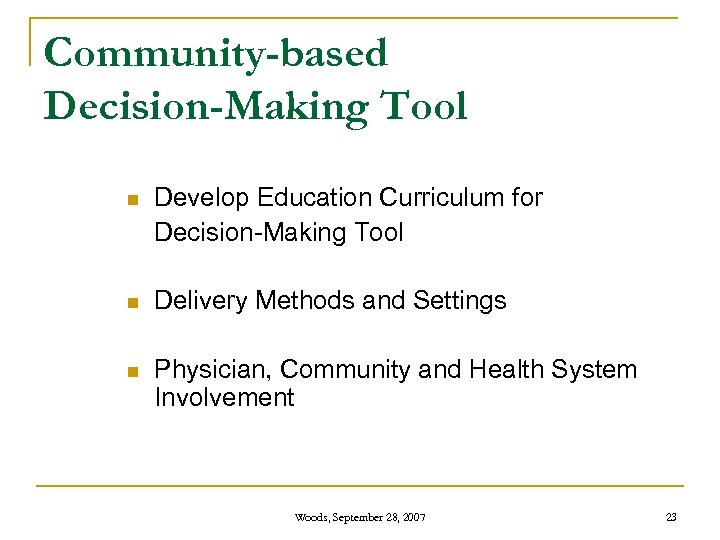 Community-based Decision-Making Tool n Develop Education Curriculum for Decision-Making Tool n Delivery Methods and Settings n Physician, Community and Health System Involvement Woods, September 28, 2007 23
 Community-driven Engagement Research with African American Men for Prostate Cancer Prevention The Missing Link… A Call for Action (909) 880 -2600 Woods, September 28, 2007 24