


 Скачать презентацию 3 National Income Where It Comes From and
b7288d2b57d440b820482a96ce96dd3e.ppt
- Количество слайдов: 43
 3 National Income: Where It Comes From and Where It Goes MACROECONOMICS N. Gregory Mankiw Power. Point ® Slides by Ron Cronovich © 2013 Worth Publishers, all rights reserved
 IN THIS CHAPTER, YOU WILL LEARN: § what determines the economy’s total output/income § how the prices of the factors of production are determined § how total income is distributed § what determines the demand for goods and services § how equilibrium in the goods market is achieved 1
 Outline of model A closed economy, market-clearing model § Supply side § factor markets (supply, demand, price) § determination of output/income § Demand side § determinants of C, I, and G § Equilibrium § goods market § loanable funds market CHAPTER 3 National Income 2
 Factors of production K = capital: tools, machines, and structures used in production L = labor: the physical and mental efforts of workers CHAPTER 3 National Income 3
 The production function: Y = F(K, L) § shows how much output (Y ) the economy can produce from K units of capital and L units of labor § reflects the economy’s level of technology § exhibits constant returns to scale CHAPTER 3 National Income 4
 Returns to scale: a review Initially Y 1 = F (K 1 , L 1 ) Scale all inputs by the same factor z: K 2 = z. K 1 and L 2 = z. L 1 (e. g. , if z = 1. 2, then all inputs are increased by 20%) What happens to output, Y 2 = F (K 2, L 2 )? § If constant returns to scale, Y 2 = z. Y 1 § If increasing returns to scale, Y 2 > z. Y 1 § If decreasing returns to scale, Y 2 < z. Y 1 CHAPTER 3 National Income 5
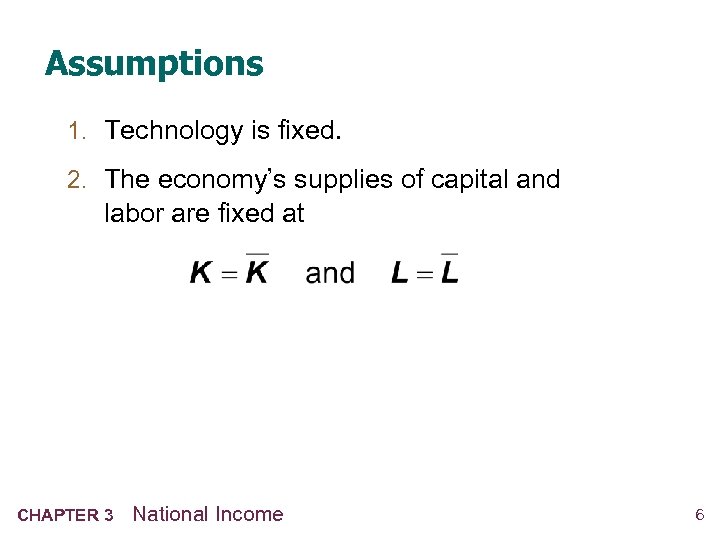 Assumptions 1. Technology is fixed. 2. The economy’s supplies of capital and labor are fixed at CHAPTER 3 National Income 6
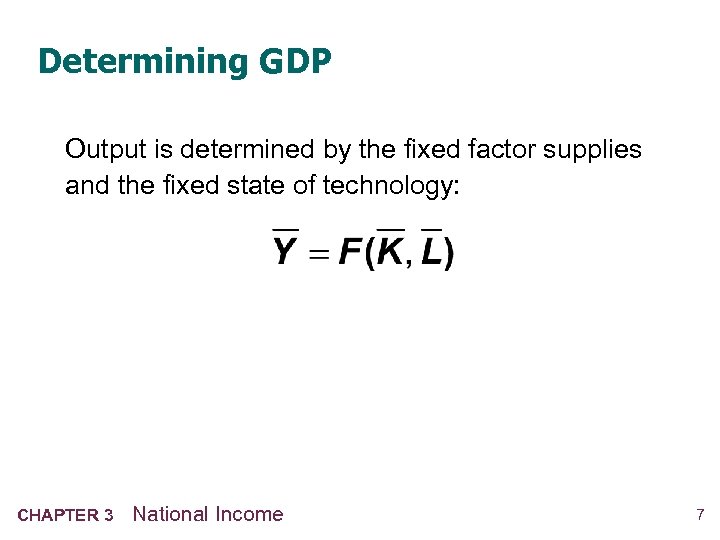 Determining GDP Output is determined by the fixed factor supplies and the fixed state of technology: CHAPTER 3 National Income 7
 Outline of model A closed economy, market-clearing model Supply side q SKIP factor markets (supply, demand, price) DONE q determination of output/income Demand side Next q determinants of C, I, and G Equilibrium q goods market q loanable funds market CHAPTER 3 National Income 8
 Demand for goods and services Components of aggregate demand: C = consumer demand for g & s I = demand for investment goods G = government demand for g & s (closed economy: no NX ) CHAPTER 3 National Income 9
 Consumption, C § def: Disposable income is total income minus total taxes: Y – T. § Consumption function: C = C (Y – T ) Shows that (Y – T ) C § def: Marginal propensity to consume (MPC) is the change in C when disposable income increases by one dollar. CHAPTER 3 National Income 10
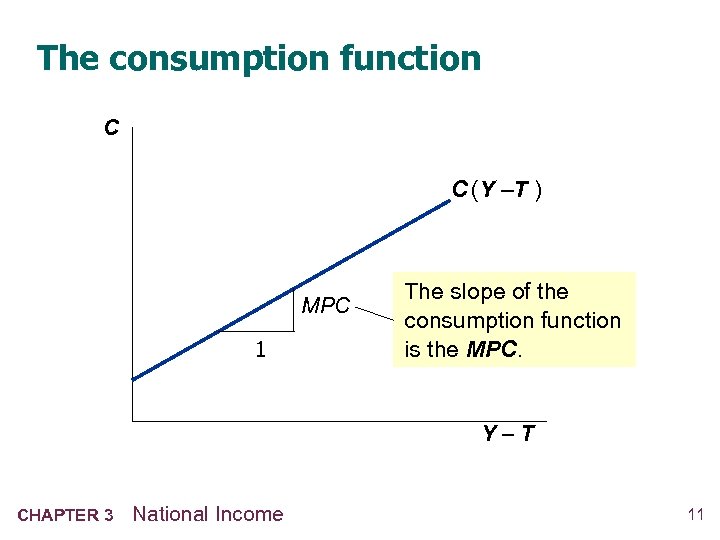 The consumption function C C (Y –T ) MPC 1 The slope of the consumption function is the MPC. Y–T CHAPTER 3 National Income 11
 Investment, I § The investment function is I = I (r ) where r denotes the real interest rate, the nominal interest rate corrected for inflation. § The real interest rate is § the cost of borrowing § the opportunity cost of using one’s own funds to finance investment spending So, r I CHAPTER 3 National Income 12
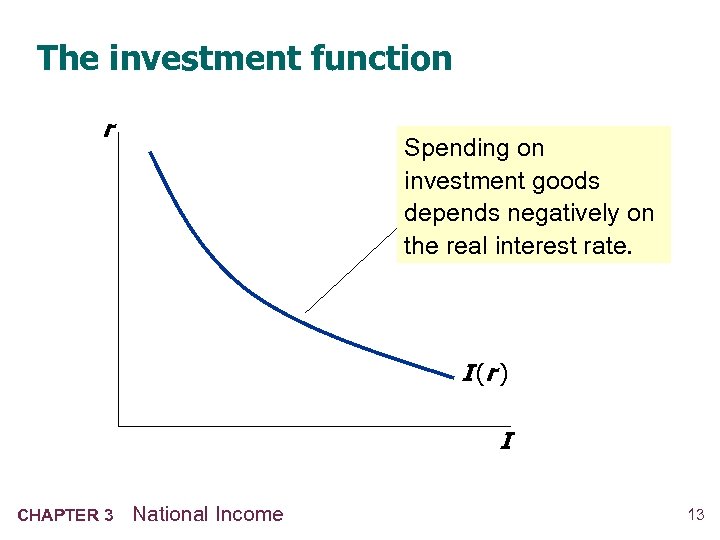 The investment function r Spending on investment goods depends negatively on the real interest rate. I (r ) I CHAPTER 3 National Income 13
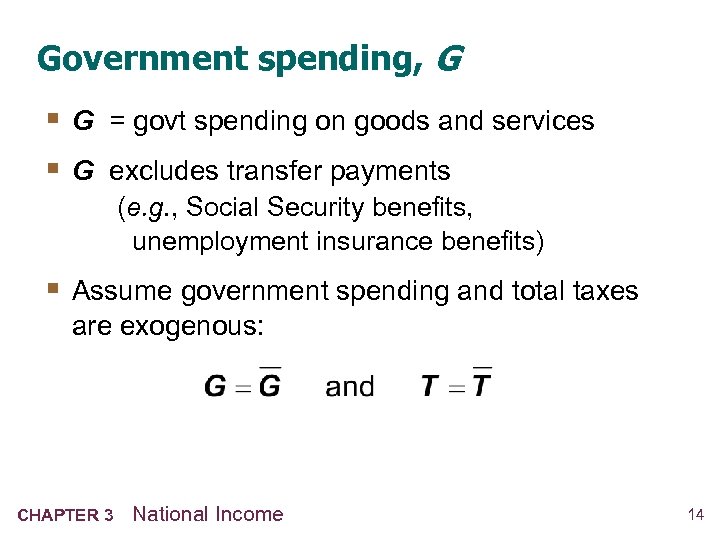 Government spending, G § G = govt spending on goods and services § G excludes transfer payments (e. g. , Social Security benefits, unemployment insurance benefits) § Assume government spending and total taxes are exogenous: CHAPTER 3 National Income 14
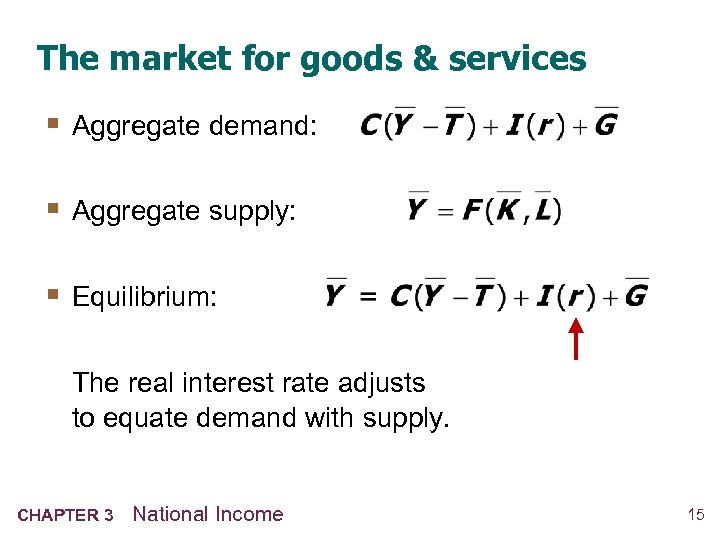 The market for goods & services § Aggregate demand: § Aggregate supply: § Equilibrium: The real interest rate adjusts to equate demand with supply. CHAPTER 3 National Income 15
 The loanable funds market § A simple supply–demand model of the financial system. § One asset: “loanable funds” § demand for funds: investment § supply of funds: saving § “price” of funds: real interest rate CHAPTER 3 National Income 16
 Demand for funds: Investment The demand for loanable funds… § comes from investment: Firms borrow to finance spending on plant & equipment, new office buildings, etc. Consumers borrow to buy new houses. § depends negatively on r, the “price” of loanable funds (cost of borrowing). CHAPTER 3 National Income 17
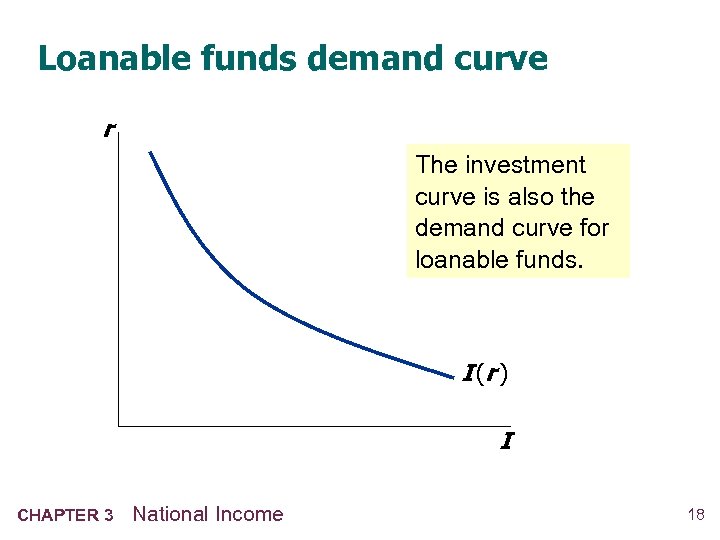 Loanable funds demand curve r The investment curve is also the demand curve for loanable funds. I (r ) I CHAPTER 3 National Income 18
 Supply of funds: Saving § The supply of loanable funds comes from saving: § Households use their saving to make bank deposits, purchase bonds and other assets. These funds become available to firms to borrow to finance investment spending. § The government may also contribute to saving if it does not spend all the tax revenue it receives. CHAPTER 3 National Income 19
 Types of saving private saving = (Y – T ) – C public saving = T – G national saving, S = private saving + public saving = (Y –T ) – C + = CHAPTER 3 T–G Y – C – G National Income 20
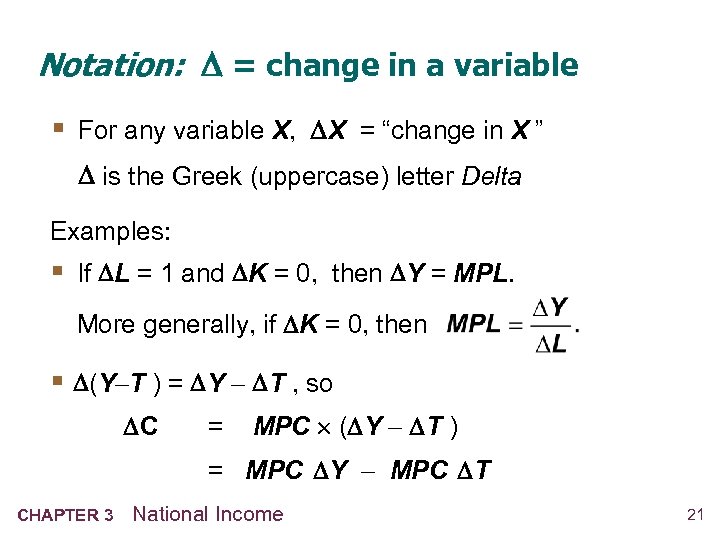 Notation: = change in a variable § For any variable X, X = “change in X ” is the Greek (uppercase) letter Delta Examples: § If L = 1 and K = 0, then Y = MPL. More generally, if K = 0, then § (Y T ) = Y T , so C = MPC ( Y T ) = MPC Y MPC T CHAPTER 3 National Income 21
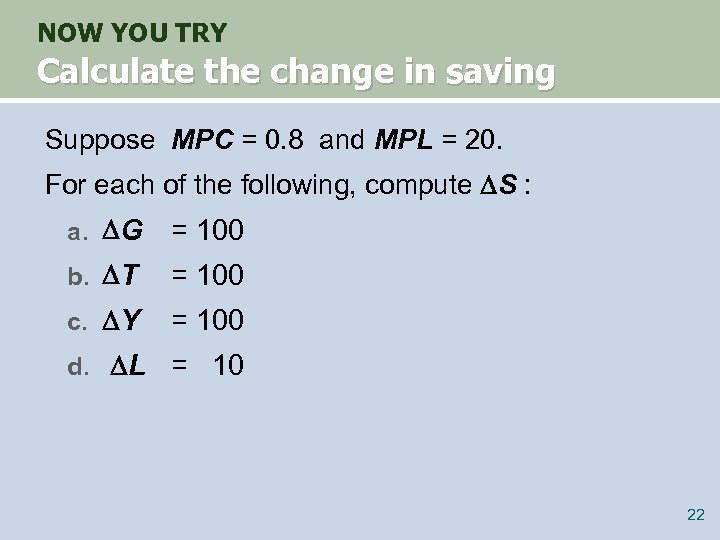 NOW YOU TRY Calculate the change in saving Suppose MPC = 0. 8 and MPL = 20. For each of the following, compute S : a. G = 100 b. T = 100 c. Y = 100 d. L = 10 22
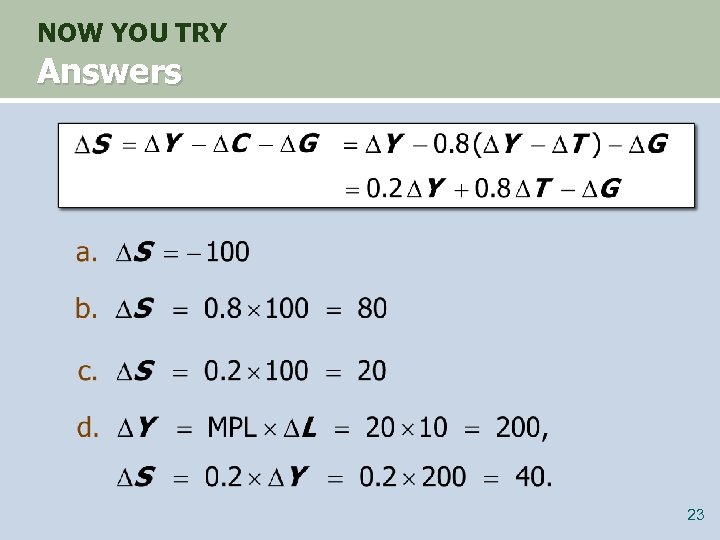 NOW YOU TRY Answers 23
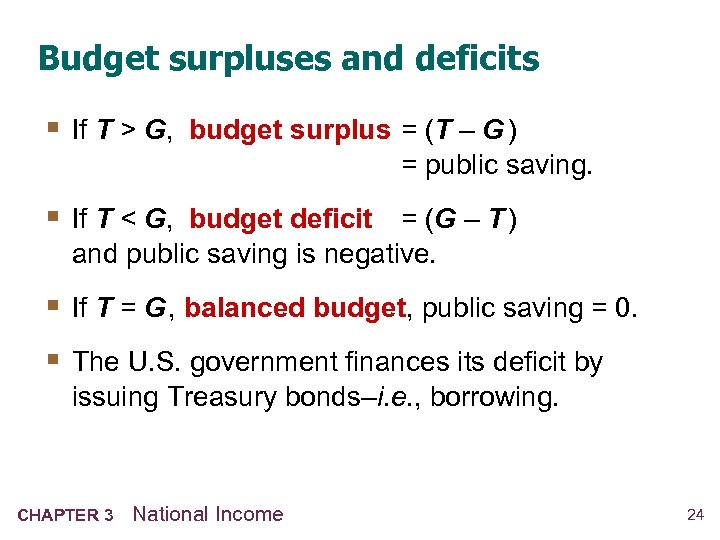 Budget surpluses and deficits § If T > G, budget surplus = (T – G ) = public saving. § If T < G, budget deficit = (G – T ) and public saving is negative. § If T = G , balanced budget, public saving = 0. § The U. S. government finances its deficit by issuing Treasury bonds–i. e. , borrowing. CHAPTER 3 National Income 24
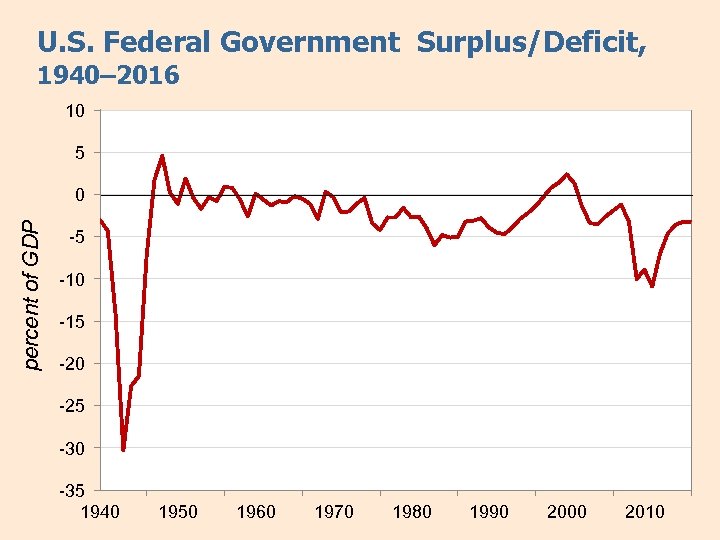 U. S. Federal Government Surplus/Deficit, 1940– 2016 10 5 percent of GDP 0 -5 -10 -15 -20 -25 -30 -35 1940 1950 1960 1970 1980 1990 2000 2010
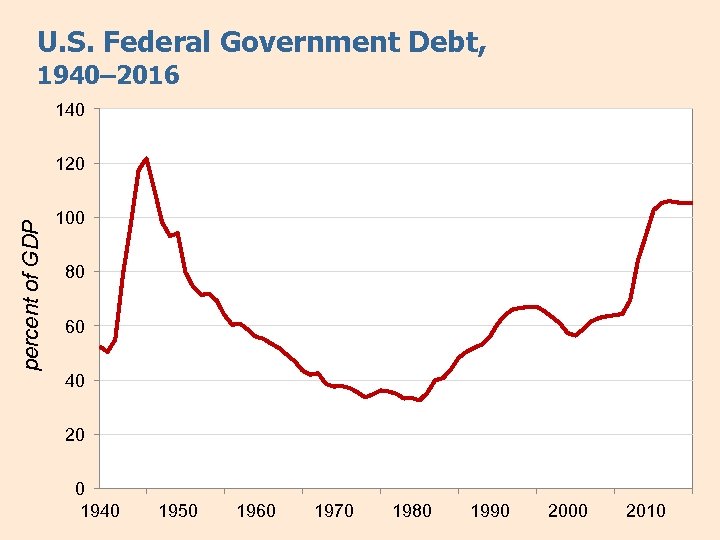 U. S. Federal Government Debt, 1940– 2016 140 percent of GDP 120 100 80 60 40 20 0 1940 1950 1960 1970 1980 1990 2000 2010
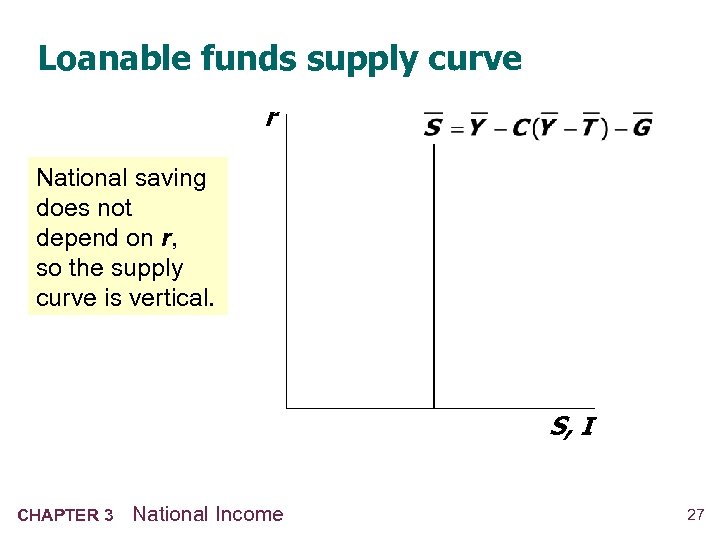 Loanable funds supply curve r National saving does not depend on r, so the supply curve is vertical. S, I CHAPTER 3 National Income 27
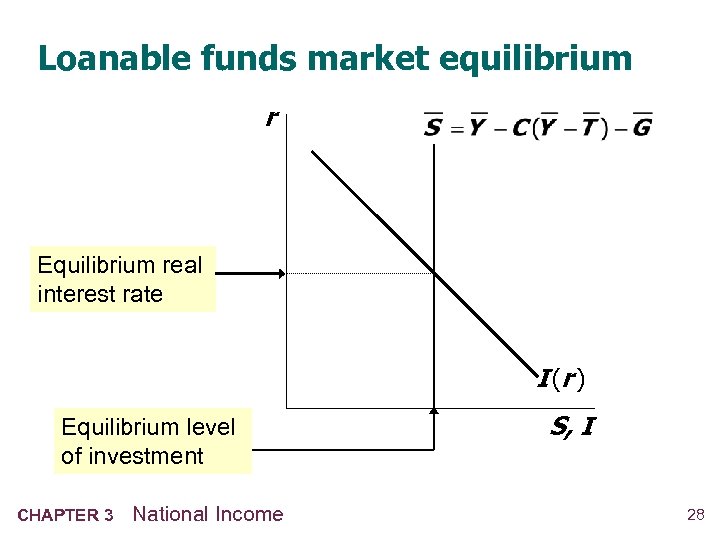 Loanable funds market equilibrium r Equilibrium real interest rate I (r ) Equilibrium level of investment CHAPTER 3 National Income S, I 28
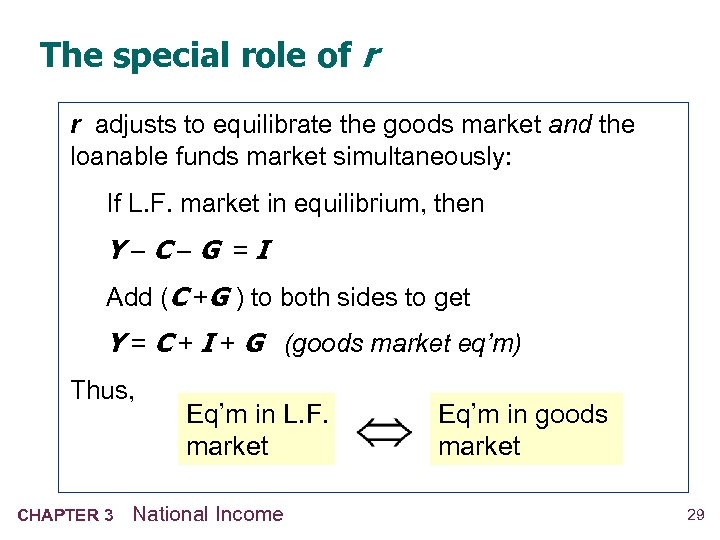 The special role of r r adjusts to equilibrate the goods market and the loanable funds market simultaneously: If L. F. market in equilibrium, then Y–C–G =I Add (C +G ) to both sides to get Y = C + I + G (goods market eq’m) Thus, CHAPTER 3 Eq’m in L. F. market National Income Eq’m in goods market 29
 Digression: Mastering models To master a model, be sure to know: 1. Which of its variables are endogenous and which are exogenous. 2. For each curve in the diagram, know: a. definition b. intuition for slope c. all the things that can shift the curve 3. Use the model to analyze the effects of each item in 2 c. CHAPTER 3 National Income 30
 Mastering the loanable funds model Things that shift the saving curve § public saving § fiscal policy: changes in G or T § private saving § preferences § tax laws that affect saving – 401(k) – IRA – replace income tax with consumption tax CHAPTER 3 National Income 31
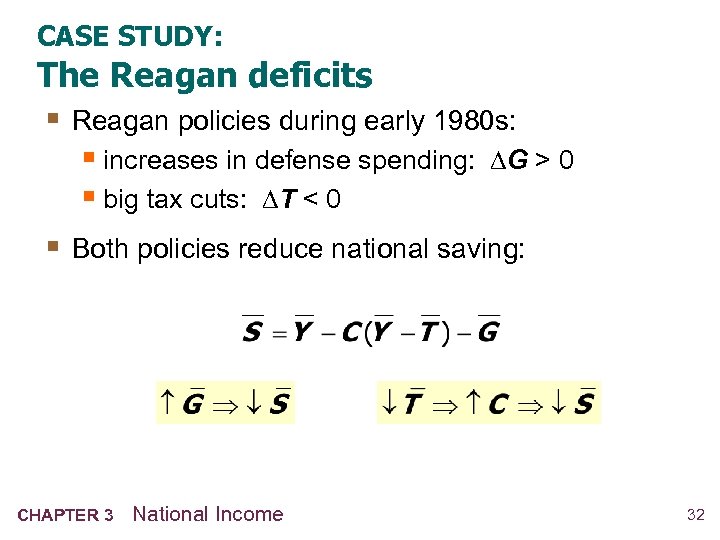 CASE STUDY: The Reagan deficits § Reagan policies during early 1980 s: § increases in defense spending: G > 0 § big tax cuts: T < 0 § Both policies reduce national saving: CHAPTER 3 National Income 32
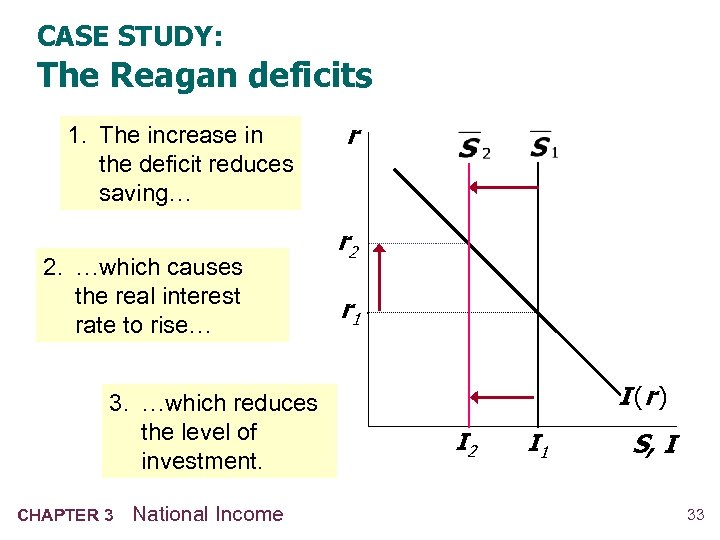 CASE STUDY: The Reagan deficits 1. The increase in the deficit reduces saving… 2. …which causes the real interest rate to rise… 3. …which reduces the level of investment. CHAPTER 3 National Income r r 2 r 1 I (r ) I 2 I 1 S, I 33
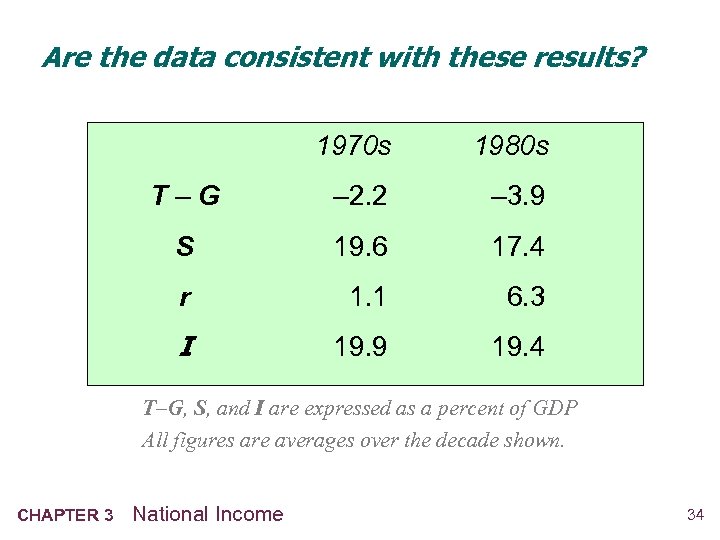 Are the data consistent with these results? 1970 s 1980 s T–G – 2. 2 – 3. 9 S 19. 6 17. 4 r 1. 1 6. 3 I 19. 9 19. 4 T–G, S, and I are expressed as a percent of GDP All figures are averages over the decade shown. CHAPTER 3 National Income 34
 NOW YOU TRY The effects of saving incentives § Draw the diagram for the loanable funds model. § Suppose the tax laws are altered to provide more incentives for private saving. (Assume that total tax revenue T does not change) § What happens to the interest rate and investment? 35
 Mastering the loanable funds model, continued Things that shift the investment curve: § some technological innovations § to take advantage some innovations, firms must buy new investment goods § tax laws that affect investment § e. g. , investment tax credit CHAPTER 3 National Income 36
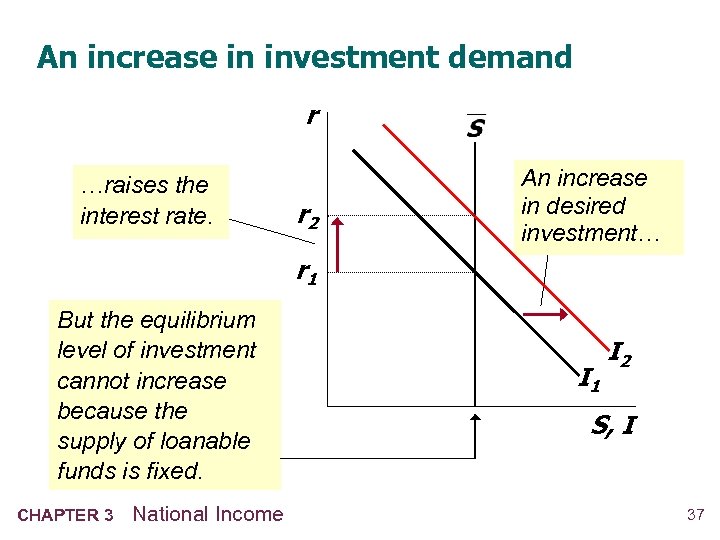 An increase in investment demand r …raises the interest rate. r 2 An increase in desired investment… r 1 But the equilibrium level of investment cannot increase because the supply of loanable funds is fixed. CHAPTER 3 National Income I 1 I 2 S, I 37
 Saving and the interest rate § Why might saving depend on r ? § How would the results of an increase in investment demand be different? § Would r rise as much? § Would the equilibrium value of I change? CHAPTER 3 National Income 38
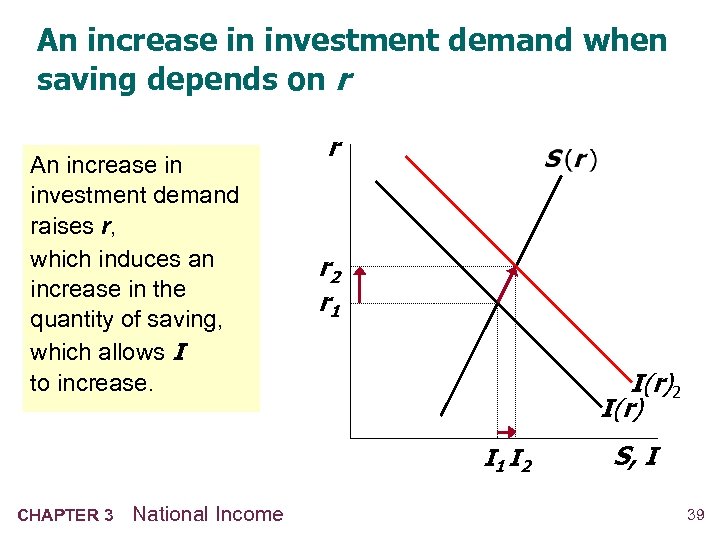 An increase in investment demand when saving depends on r An increase in investment demand raises r, which induces an increase in the quantity of saving, which allows I to increase. r r 2 r 1 I(r)2 I(r) I 1 I 2 CHAPTER 3 National Income S, I 39
 CHAPTER SUMMARY § Total output is determined by: § the economy’s quantities of capital and labor § the level of technology § Competitive firms hire each factor until its marginal product equals its price. § If the production function has constant returns to scale, then labor income plus capital income equals total income (output). 40
 CHAPTER SUMMARY § A closed economy’s output is used for consumption, investment, and government spending. § The real interest rate adjusts to equate the demand for and supply of: § goods and services. § loanable funds. 41
 CHAPTER SUMMARY § A decrease in national saving causes the interest rate to rise and investment to fall. § An increase in investment demand causes the interest rate to rise but does not affect the equilibrium level of investment if the supply of loanable funds is fixed. 42