


 Скачать презентацию 3 GPP Technology Standards Roadmap Stephen Hayes Chair
1a9521d69f114d0cfefd44e8ba3b3dad.ppt
- Количество слайдов: 24
 3 GPP Technology Standards Roadmap Stephen Hayes Chair 3 GPP-SA stephen. hayes@ericsson. com Mobile Broadband Outlook for the Americas, Rio de Janeiro, 26 April 2010 # 1
 Contents • • What is 3 GPP What 3 GPP works on Key 3 GPP Issues More information Mobile Broadband Outlook for the Americas, Rio de Janeiro, 26 April 2010 # 1 2
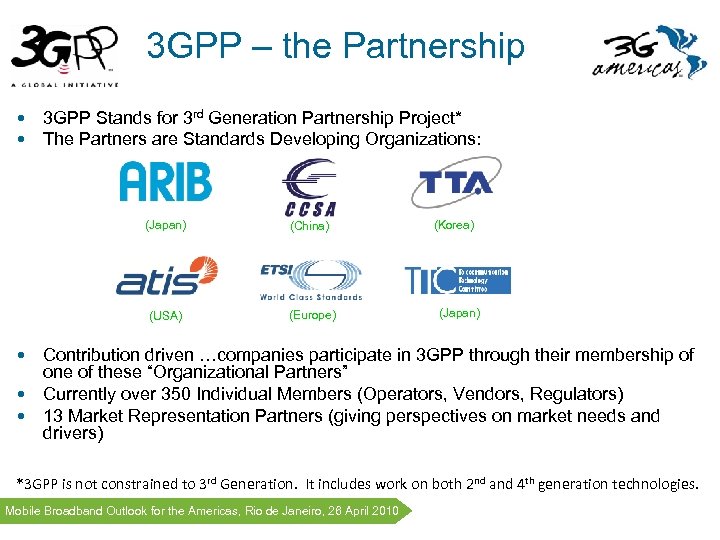 3 GPP – the Partnership • 3 GPP Stands for 3 rd Generation Partnership Project* • The Partners are Standards Developing Organizations: (Japan) (China) (USA) (Europe) (Korea) (Japan) • Contribution driven …companies participate in 3 GPP through their membership of one of these “Organizational Partners” • Currently over 350 Individual Members (Operators, Vendors, Regulators) • 13 Market Representation Partners (giving perspectives on market needs and drivers) *3 GPP is not constrained to 3 rd Generation. It includes work on both 2 nd and 4 th generation technologies. Mobile Broadband Outlook for the Americas, Rio de Janeiro, 26 April 2010 # 1 3
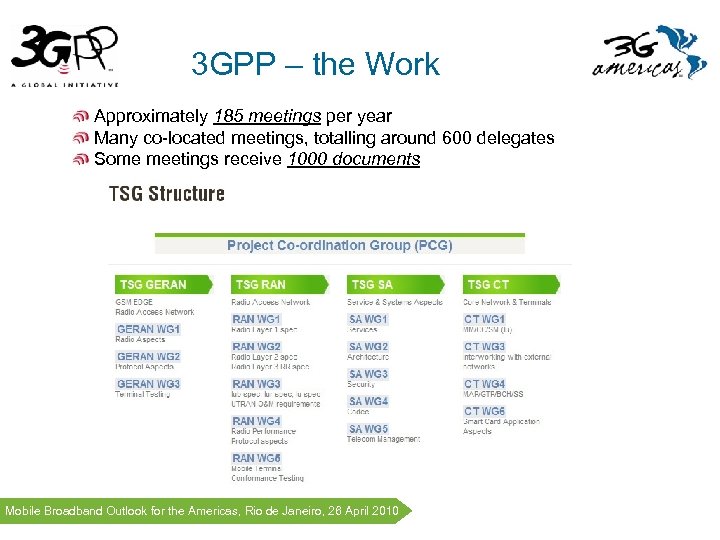 3 GPP – the Work Approximately 185 meetings per year Many co-located meetings, totalling around 600 delegates Some meetings receive 1000 documents Mobile Broadband Outlook for the Americas, Rio de Janeiro, 26 April 2010 # 4 1
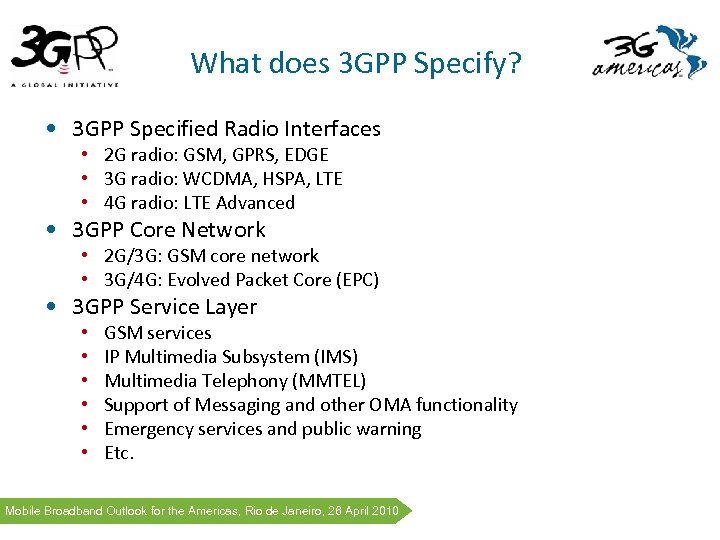 What does 3 GPP Specify? • 3 GPP Specified Radio Interfaces • 2 G radio: GSM, GPRS, EDGE • 3 G radio: WCDMA, HSPA, LTE • 4 G radio: LTE Advanced • 3 GPP Core Network • 2 G/3 G: GSM core network • 3 G/4 G: Evolved Packet Core (EPC) • 3 GPP Service Layer • • • GSM services IP Multimedia Subsystem (IMS) Multimedia Telephony (MMTEL) Support of Messaging and other OMA functionality Emergency services and public warning Etc. Mobile Broadband Outlook for the Americas, Rio de Janeiro, 26 April 2010 # 1
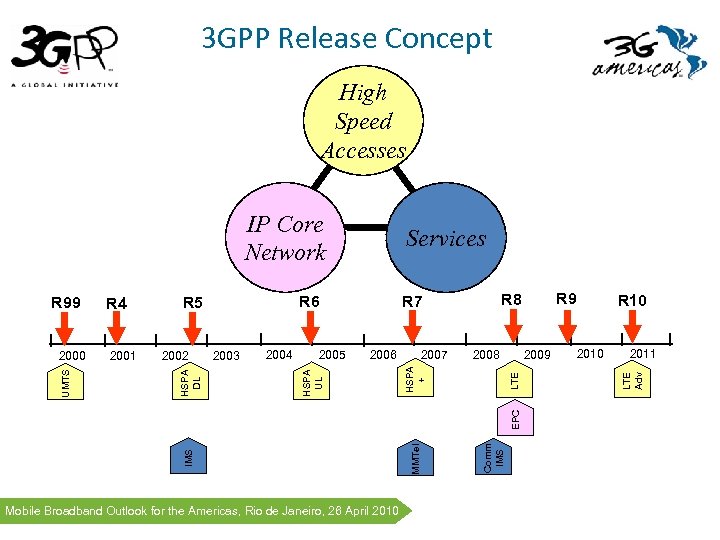 3 GPP Release Concept High Speed Accesses IP Core Network 2005 2006 2007 2009 2008 2010 2011 LTE Adv 2004 R 10 Mobile Broadband Outlook for the Americas, Rio de Janeiro, 26 April 2010 Comm IMS MMTel IMS EPC 2003 LTE 2002 R 9 R 8 R 7 HSPA + 2001 R 6 R 5 HSPA UL UMTS 2000 R 4 HSPA DL R 99 Services # 1
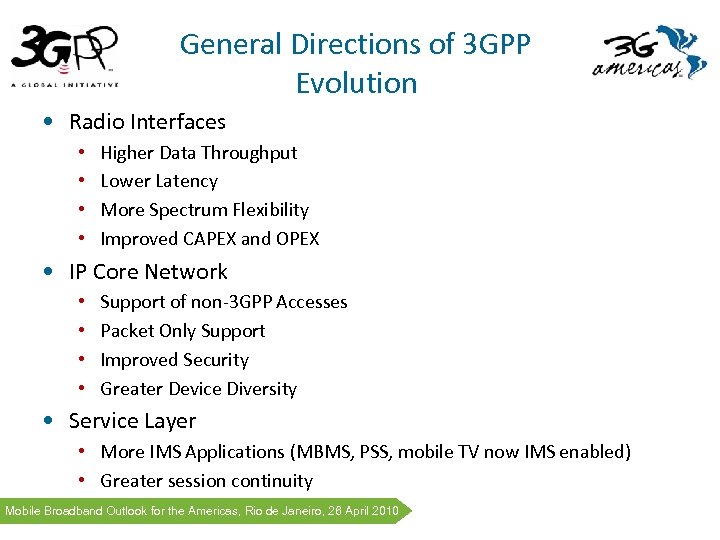 General Directions of 3 GPP Evolution • Radio Interfaces • • Higher Data Throughput Lower Latency More Spectrum Flexibility Improved CAPEX and OPEX • IP Core Network • • Support of non-3 GPP Accesses Packet Only Support Improved Security Greater Device Diversity • Service Layer • More IMS Applications (MBMS, PSS, mobile TV now IMS enabled) • Greater session continuity Mobile Broadband Outlook for the Americas, Rio de Janeiro, 26 April 2010 # 1
 Key 3 GPP Topics • • • Evolution of the Radio Interface Home (e) Node B’s Offloading and Traffic Breakout Machine Type Communications Fixed Mobile Convergence This is only a subset of the 3 GPP topics. A complete list can be found at: http: //www. 3 gpp. org/Work-Plan Mobile Broadband Outlook for the Americas, Rio de Janeiro, 26 April 2010 # 1
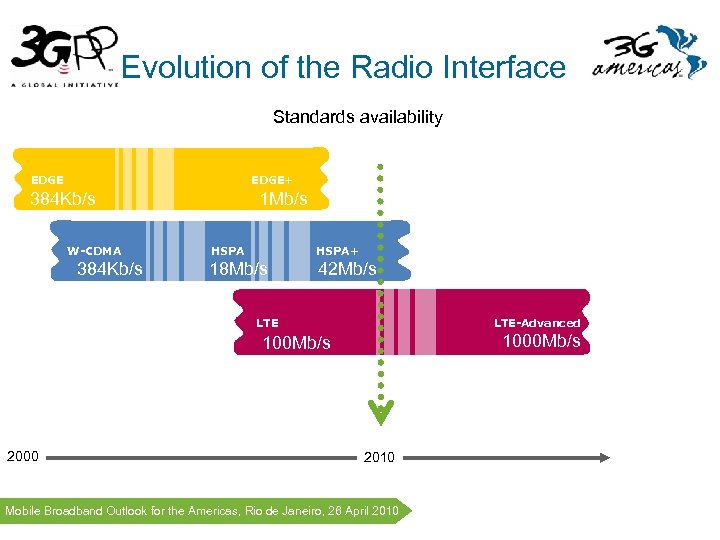 Evolution of the Radio Interface Standards availability EDGE+ 1 Mb/s 384 Kb/s W-CDMA 384 Kb/s HSPA+ 18 Mb/s 42 Mb/s LTE-Advanced 1000 Mb/s 100 Mb/s 2000 2010 Mobile Broadband Outlook for the Americas, Rio de Janeiro, 26 April 2010 # 1 9
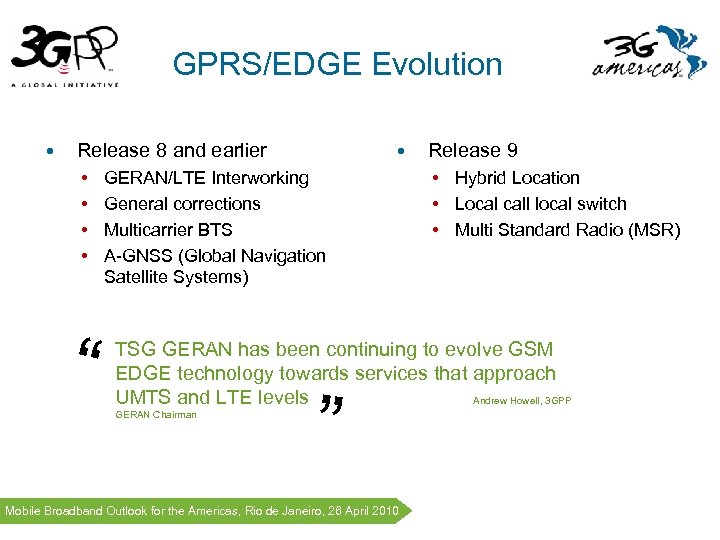 GPRS/EDGE Evolution • • Release 8 and earlier • • “ GERAN/LTE Interworking General corrections Multicarrier BTS A-GNSS (Global Navigation Satellite Systems) Release 9 • Hybrid Location • Local call local switch • Multi Standard Radio (MSR) TSG GERAN has been continuing to evolve GSM EDGE technology towards services that approach UMTS and LTE levels Andrew Howell, 3 GPP GERAN Chairman ” Mobile Broadband Outlook for the Americas, Rio de Janeiro, 26 April 2010 # 1 10
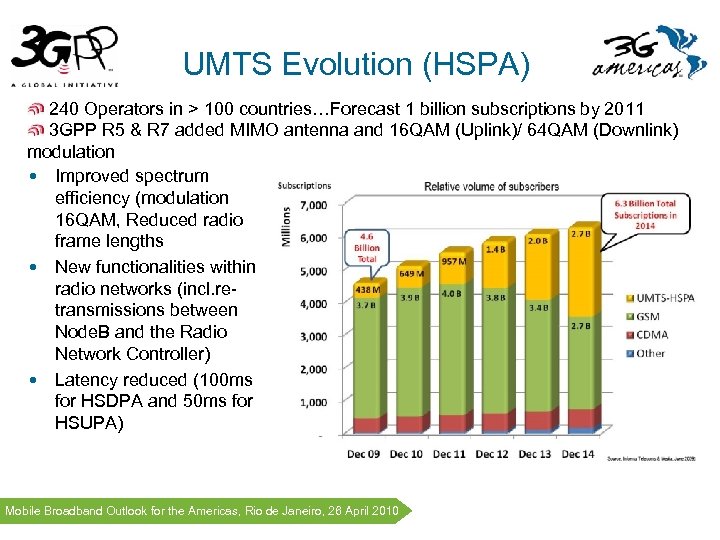 UMTS Evolution (HSPA) 240 Operators in > 100 countries…Forecast 1 billion subscriptions by 2011 3 GPP R 5 & R 7 added MIMO antenna and 16 QAM (Uplink)/ 64 QAM (Downlink) modulation • Improved spectrum efficiency (modulation 16 QAM, Reduced radio frame lengths • New functionalities within radio networks (incl. retransmissions between Node. B and the Radio Network Controller) • Latency reduced (100 ms for HSDPA and 50 ms for HSUPA) Mobile Broadband Outlook for the Americas, Rio de Janeiro, 26 April 2010 # 1 11
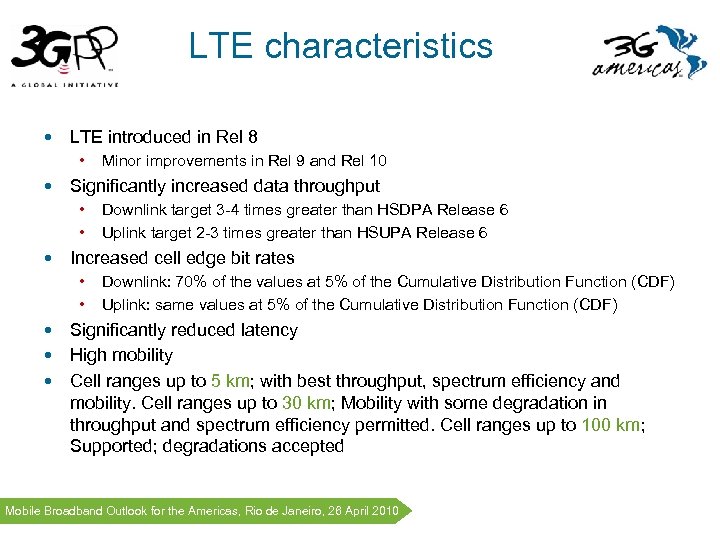 LTE characteristics • LTE introduced in Rel 8 • Minor improvements in Rel 9 and Rel 10 • Significantly increased data throughput • • Downlink target 3 -4 times greater than HSDPA Release 6 Uplink target 2 -3 times greater than HSUPA Release 6 • Increased cell edge bit rates • • Downlink: 70% of the values at 5% of the Cumulative Distribution Function (CDF) Uplink: same values at 5% of the Cumulative Distribution Function (CDF) • Significantly reduced latency • High mobility • Cell ranges up to 5 km; with best throughput, spectrum efficiency and mobility. Cell ranges up to 30 km; Mobility with some degradation in throughput and spectrum efficiency permitted. Cell ranges up to 100 km; Supported; degradations accepted Mobile Broadband Outlook for the Americas, Rio de Janeiro, 26 April 2010 # 1 12
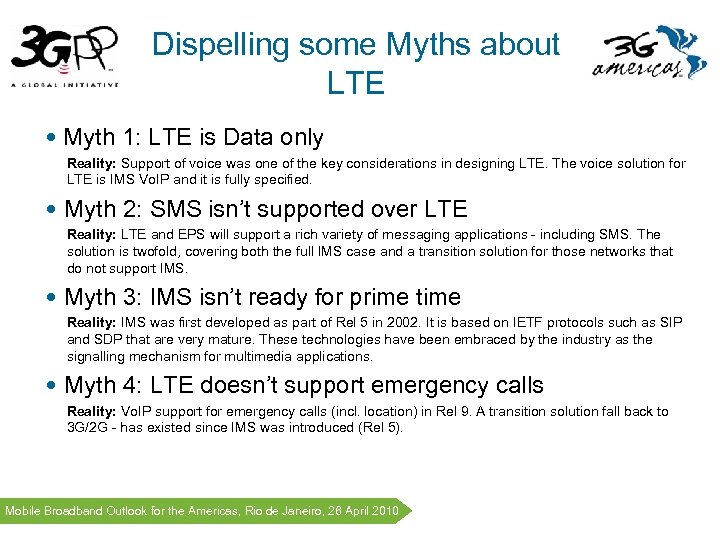 Dispelling some Myths about LTE • Myth 1: LTE is Data only Reality: Support of voice was one of the key considerations in designing LTE. The voice solution for LTE is IMS Vo. IP and it is fully specified. • Myth 2: SMS isn’t supported over LTE Reality: LTE and EPS will support a rich variety of messaging applications - including SMS. The solution is twofold, covering both the full IMS case and a transition solution for those networks that do not support IMS. • Myth 3: IMS isn’t ready for prime time Reality: IMS was first developed as part of Rel 5 in 2002. It is based on IETF protocols such as SIP and SDP that are very mature. These technologies have been embraced by the industry as the signalling mechanism for multimedia applications. • Myth 4: LTE doesn’t support emergency calls Reality: Vo. IP support for emergency calls (incl. location) in Rel 9. A transition solution fall back to 3 G/2 G - has existed since IMS was introduced (Rel 5). Mobile Broadband Outlook for the Americas, Rio de Janeiro, 26 April 2010 # 1 13
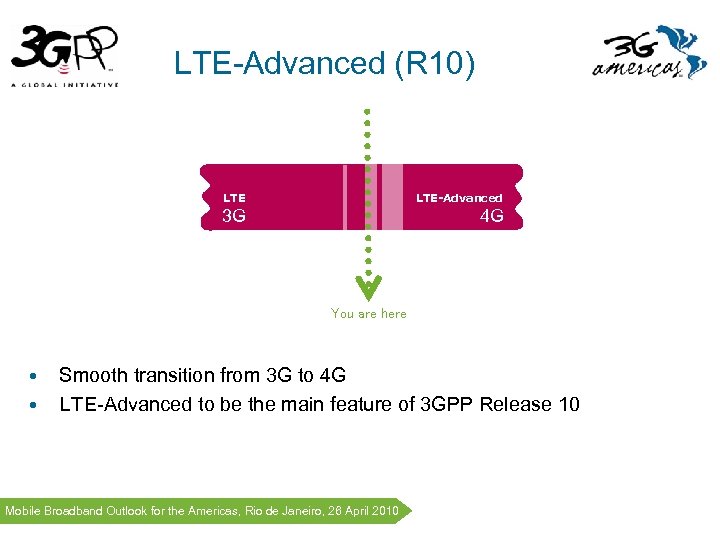 LTE-Advanced (R 10) LTE-Advanced 3 G 4 G You are here • • Smooth transition from 3 G to 4 G LTE-Advanced to be the main feature of 3 GPP Release 10 Mobile Broadband Outlook for the Americas, Rio de Janeiro, 26 April 2010 # 1 14
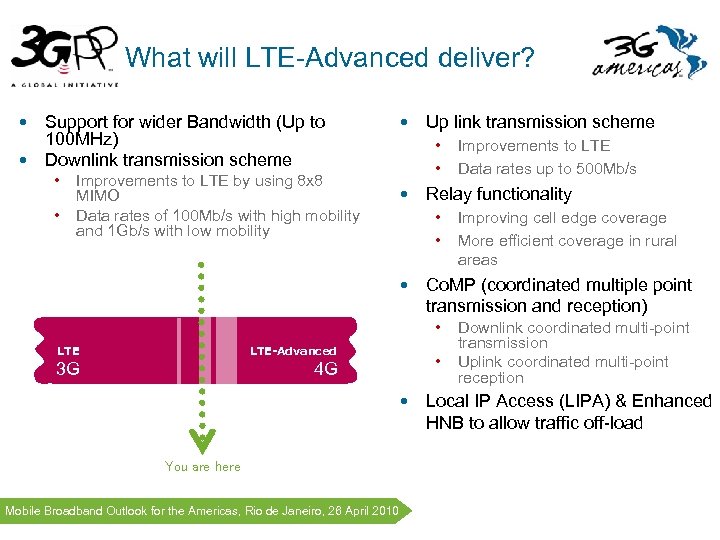 What will LTE-Advanced deliver? • Support for wider Bandwidth (Up to 100 MHz) • Downlink transmission scheme • • Improvements to LTE by using 8 x 8 MIMO Data rates of 100 Mb/s with high mobility and 1 Gb/s with low mobility • Up link transmission scheme • • Improvements to LTE Data rates up to 500 Mb/s • Relay functionality • • Improving cell edge coverage More efficient coverage in rural areas • Co. MP (coordinated multiple point transmission and reception) • LTE-Advanced 3 G 4 G • Downlink coordinated multi-point transmission Uplink coordinated multi-point reception • Local IP Access (LIPA) & Enhanced HNB to allow traffic off-load You are here Mobile Broadband Outlook for the Americas, Rio de Janeiro, 26 April 2010 # 1 15
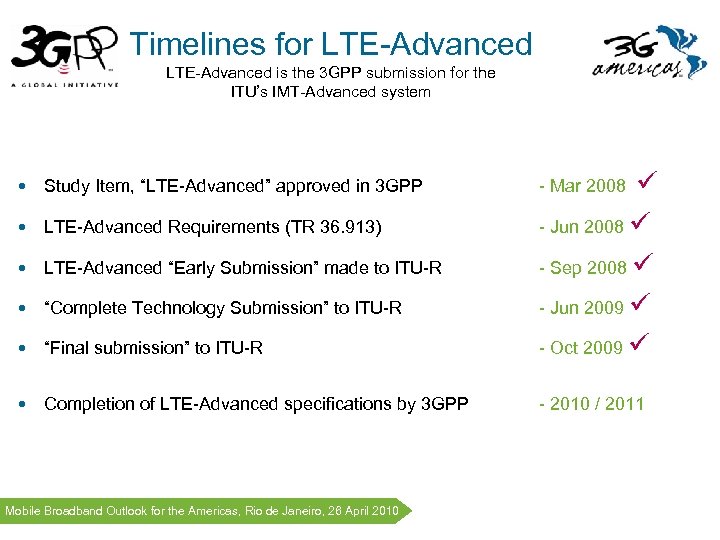 Timelines for LTE-Advanced is the 3 GPP submission for the ITU’s IMT-Advanced system • “Final submission” to ITU-R - Jun 2008 - Sep 2008 - Jun 2009 - Oct 2009 • Completion of LTE-Advanced specifications by 3 GPP - 2010 / 2011 • Study Item, “LTE-Advanced” approved in 3 GPP • LTE-Advanced Requirements (TR 36. 913) • LTE-Advanced “Early Submission” made to ITU-R • “Complete Technology Submission” to ITU-R Mobile Broadband Outlook for the Americas, Rio de Janeiro, 26 April 2010 - Mar 2008 # 1 16
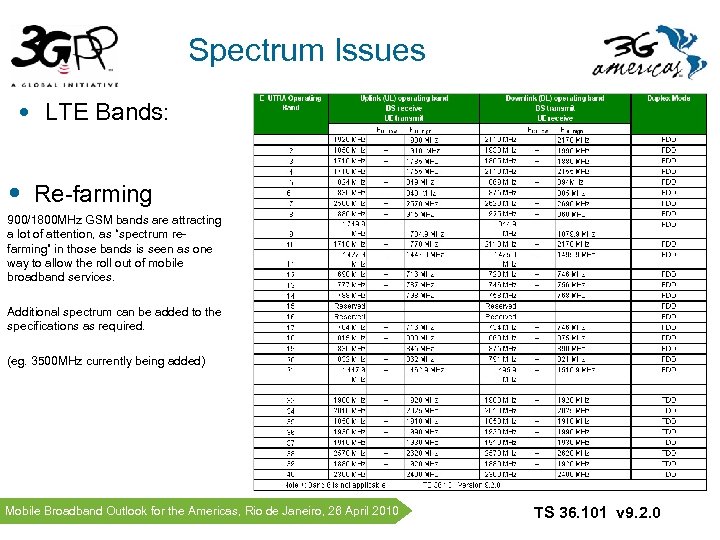 Spectrum Issues • LTE Bands: • Re-farming 900/1800 MHz GSM bands are attracting a lot of attention, as “spectrum refarming” in those bands is seen as one way to allow the roll out of mobile broadband services. Additional spectrum can be added to the specifications as required. (eg. 3500 MHz currently being added) Mobile Broadband Outlook for the Americas, Rio de Janeiro, 26 April 2010 TS 36. 101 v 9. 2. 0 # 1 17
 Home (e) Node B • In Rel 8, 3 GPP specified UTRA and LTE femtocells • Home (e) Node B is the 3 GPP term for a femtocell • HNB = UTRA femtocell • He. NB = LTE femtocell • Improvements developed in Rel 9 • • Improved idle mode handling Active mode mobility support to/from cells of H(e)NB Support open/hybrid mode access to cells of H(e)NBs O&M improvements Mobile Broadband Outlook for the Americas, Rio de Janeiro, 26 April 2010 # 1
 Offloading and Traffic Breakout • Various traffic offload mechanisms were developed. • These mechanisms are being defined in Rel 10. • Local IP Access (LIPA) is used from a femtocell to access local network resources (such as a printer) • IP Flow Mobility and Seamless Offload (IFOM) is used to carry some of a UE’s traffic over wifi to offload femto access. • Selected IP Traffic Offload (SIPTO) is used to offload the mobile core network by breaking traffic out of the network early. • SIPTO for femtocells may be deferred to a later release Mobile Broadband Outlook for the Americas, Rio de Janeiro, 26 April 2010 # 1
 Machine Type Communications • • Work started on this in Rel 10 14 MTC Features identified • In Rel 10, 3 GPP will focus on the general functionality required to support these features • • • • • Low Mobility Time Controlled Time Tolerant Packet Switched (PS) Only Small Data Transmissions Mobile Originated Only Infrequent Mobile Terminated MTC Monitoring Priority Alarm Message (PAM) Secure Connection Location Specific Trigger Network Provided Destination for Uplink Data Infrequent Transmission Group Based MTC Features Overload control (Radio Network Congestion use case, Signalling Network Congestion use case and Core Network Congestion use case) Addressing Identifiers Subscription control Security Mobile Broadband Outlook for the Americas, Rio de Janeiro, 26 April 2010 # 1
 Fixed Mobile Convergence • 3 GPP is working with BBF to support FMC with convergence using EPC • Convergence addresses IP session mobility, authentication, and policy • 3 Phase plan adopted • Phase 1 is basic interworking between fixed and wireless • Phase 2 provides offloading of traffic • Phase 3 provides convergence of network nodes • Phase 1 target is Rel 10. Mobile Broadband Outlook for the Americas, Rio de Janeiro, 26 April 2010 # 1
 Conclusions • 3 GPP LTE is set to be the major enabler for mobile broadband • LTE is being evolved into LTE-Advanced • 3 GPP is progressing work on all radio interface generations • 3 GPP is also addressing a variety of key areas • Femtocells • Traffic Offload • Machine 2 machine communications • Fixed Mobile Convergence Mobile Broadband Outlook for the Americas, Rio de Janeiro, 26 April 2010 # 1 22
 Availability of Specifications All 3 GPP specifications can be freely downloaded from www. 3 gpp. org Or can be obtained from the 3 GPP Organisational Partners (ARIB, ATIS, CCSA, ETSI, TTA, TTC) A DVD of the full set of 3 GPP specifications available at the 3 GPP Desk Mobile Broadband Outlook for the Americas, Rio de Janeiro, 26 April 2010 # 1 23
 More Information www. 3 gpp. org contact@3 gpp. org Or contact one of the Partners: Mobile Broadband Outlook for the Americas, Rio de Janeiro, 26 April 2010 # 1 24