


 Скачать презентацию 3 GPP OMA Workshop Click Frankfurt
b4f90a77381a12384d22f3e8902f641c.ppt
- Количество слайдов: 96
 3 GPP – OMA Workshop • Click Frankfurt, 15 September 2003 to edit Master text styles • Second level A Phased Approach to Standardization • Third level • Fourth level • Fifth level John M Meredith 3 GPP Specifications Manager ETSI Mobile Competence Centre (john. meredith@etsi. org) John M Meredith – 2003 -09 -15 1
 1 Introduction • • • Click to edit Master text styles 2 Rules and procedures Second level 3 Meetings Third level 4 Following the work Fourth level 5 Phased approach, Releases Fifth level 6 Project management, the Work Plan 7 Specs: drafting, maintaining, … John M Meredith – 2003 -09 -15 2
 1 Introduction • • • Click to edit Master text styles 2 Rules and procedures Second level 3 Meetings Third level 4 Following the work Fourth level 5 Phased approach, Releases Fifth level 6 Project management, the Work Plan 7 Specs: drafting, maintaining, … John M Meredith – 2003 -09 -15 3
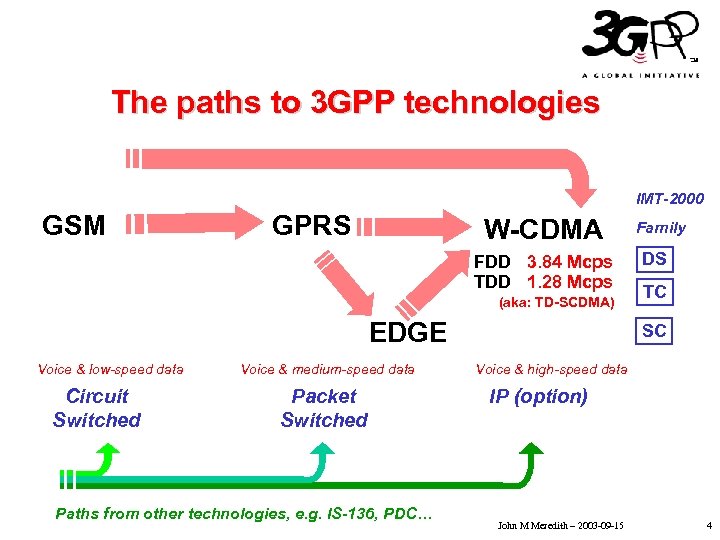 The paths to 3 GPP technologies • Click to edit Master text styles • Second level GPRS GSM W-CDMA • Third level FDD 3. 84 Mcps TDD 1. 28 Mcps (aka: TD-SCDMA) • Fourth level EDGE • Fifth level Voice & low-speed data Circuit Switched Voice & medium-speed data Packet Switched Paths from other technologies, e. g. IS-136, PDC… IMT-2000 Family DS TC SC Voice & high-speed data IP (option) John M Meredith – 2003 -09 -15 4
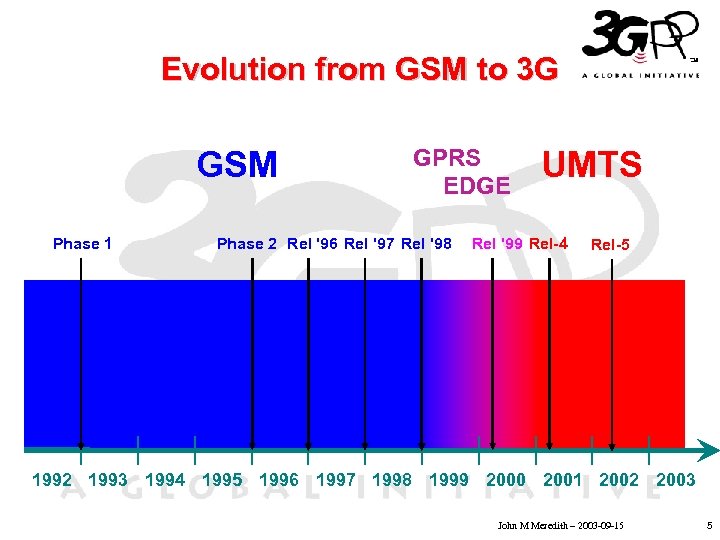 Evolution from GSM to 3 G GPRS GSM UMTS Click to edit Master text styles EDGE • • Second level Phase 2 Phase 1 • Third level • Fourth level • Fifth level Rel '96 Rel '97 Rel '98 Rel '99 Rel-4 Rel-5 1992 1993 1994 1995 1996 1997 1998 1999 2000 2001 2002 2003 John M Meredith – 2003 -09 -15 5
 1 Introduction • • • Click to edit Master text styles 2 Rules and procedures Second level 3 Meetings Third level 4 Following the work Fourth level 5 Phased approach, Releases Fifth level 6 Project management, the Work Plan 7 Specs: drafting, maintaining, … John M Meredith – 2003 -09 -15 6
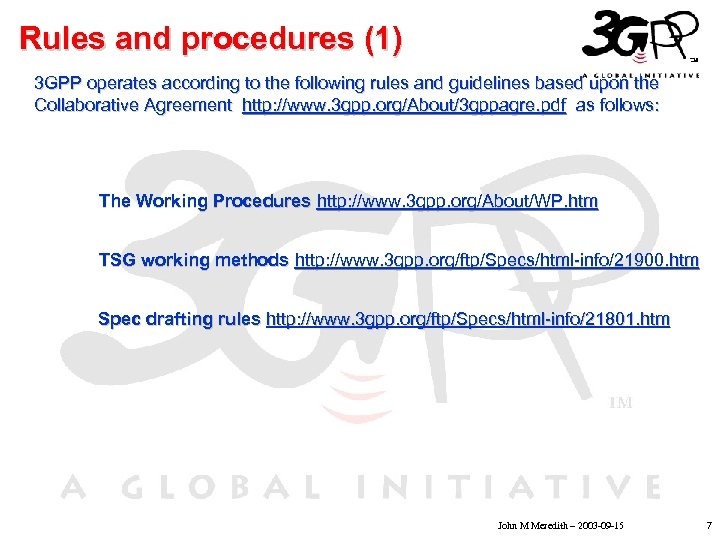 Rules and procedures (1) 3 GPP operates according to the following rules and guidelines based upon the Collaborative Agreement http: //www. 3 gpp. org/About/3 gppagre. pdf as follows: • • • Click to edit Master text styles The Working Procedures http: //www. 3 gpp. org/About/WP. htm Second level TSG working methods http: //www. 3 gpp. org/ftp/Specs/html-info/21900. htm Third level Fourth level Spec drafting rules http: //www. 3 gpp. org/ftp/Specs/html-info/21801. htm Fifth level John M Meredith – 2003 -09 -15 7
 Rules and procedures (2) The Working Procedures http: //www. 3 gpp. org/About/WP. htm • • • Click to edit Master text styles Second level Third level Fourth level Fifth level These cover procedural issues such as holding meetings, electing officials, participation rights, IPR policy, and so on. The Working Procedures are the top level of rules, and apply to all groups working under the banner of 3 GPP from PCG downwards. If you have a question on rules and procedures, look here first. John M Meredith – 2003 -09 -15 8
 Rules and procedures (3) • Click to edit Master text styles • Second level • Third methods TSG workinglevel http: //www. 3 gpp. org/ftp/Specs/html-info/21900. htm TR 21. 900 gives detailed procedural guidance on the creation of new specifications • Fourth level and their management (drafting, change control, filenames, etc. ). It also covers the creation and management of work items, and gives further guidance on the running • Fifth level of TSGs and their WGs (e-mail exploders, e-mail decision making, etc. ). John M Meredith – 2003 -09 -15 9
 Rules and procedures (4) • Click to edit Master text styles • Second level • Third level • Fourth level • Fifth level Spec drafting rules http: //www. 3 gpp. org/ftp/Specs/html-info/21801. htm Based on rules originally developed within ISO and long since adapted for use in most other international and national standardization bodies, TR 21. 801 provides detailed instructions on the creation and modification of TSs and TRs. It covers both general guidance (e. g. the use of modal auxiliary verbs) and specific conventions (which word processor styles to use for different purposes). It also includes a list of permissible software tools (word processor, SDL chart generator, TTCN tool, graphics software, etc. ). John M Meredith – 2003 -09 -15 10
 1 Introduction • • • Click to edit Master text styles 2 Rules and procedures Second level 3 Meetings Third level 4 Following the work Fourth level 5 Phased approach, Releases Fifth level 6 Project management, the Work Plan 7 Specs: drafting, maintaining, … John M Meredith – 2003 -09 -15 11
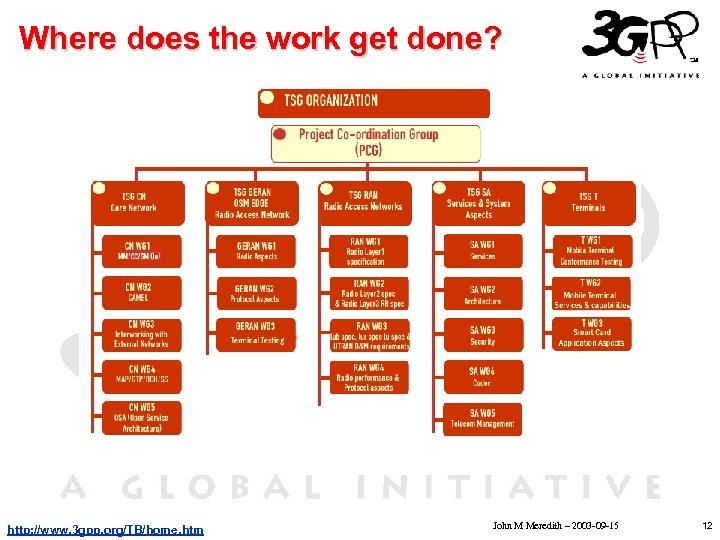 Where does the work get done? • • • Click to edit Master text styles Second level Third level Fourth level Fifth level http: //www. 3 gpp. org/TB/home. htm John M Meredith – 2003 -09 -15 12
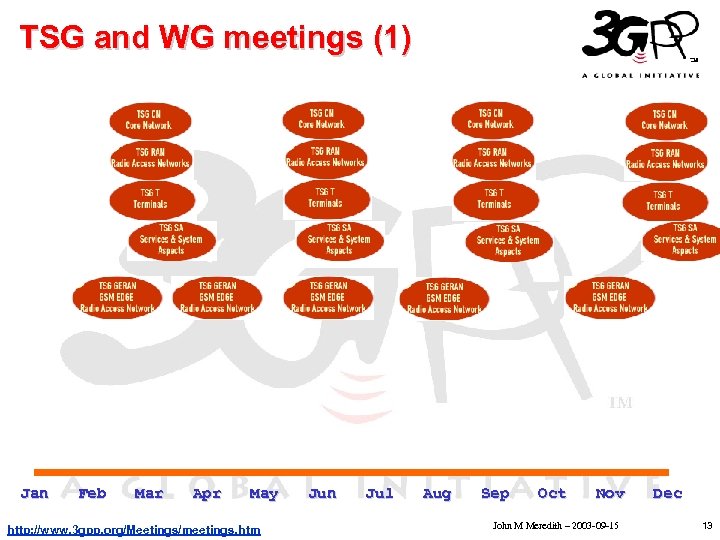 TSG and WG meetings (1) • • • Jan Click to edit Master text styles Second level Third level Fourth level Fifth level Feb Mar Apr May http: //www. 3 gpp. org/Meetings/meetings. htm Jun Jul Aug Sep Oct Nov Dec John M Meredith – 2003 -09 -15 13
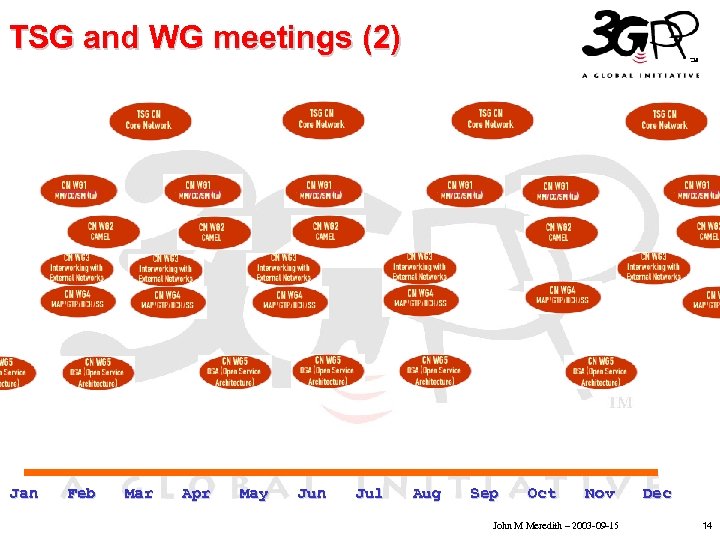 TSG and WG meetings (2) • • • Jan Click to edit Master text styles Second level Third level Fourth level Fifth level Feb Mar Apr May Jun Jul Aug Sep Oct Nov Dec John M Meredith – 2003 -09 -15 14
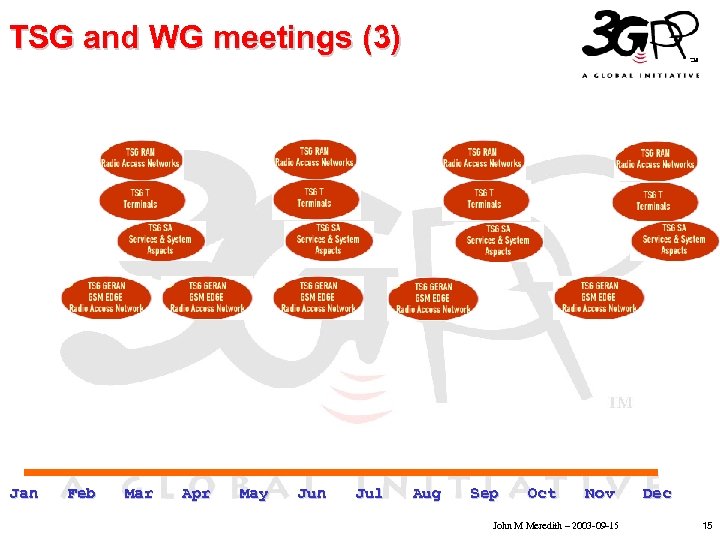 TSG and WG meetings (3) • • • Jan Click to edit Master text styles Second level Third level Fourth level Fifth level Feb Mar Apr May Jun Jul Aug Sep Oct Nov Dec John M Meredith – 2003 -09 -15 15
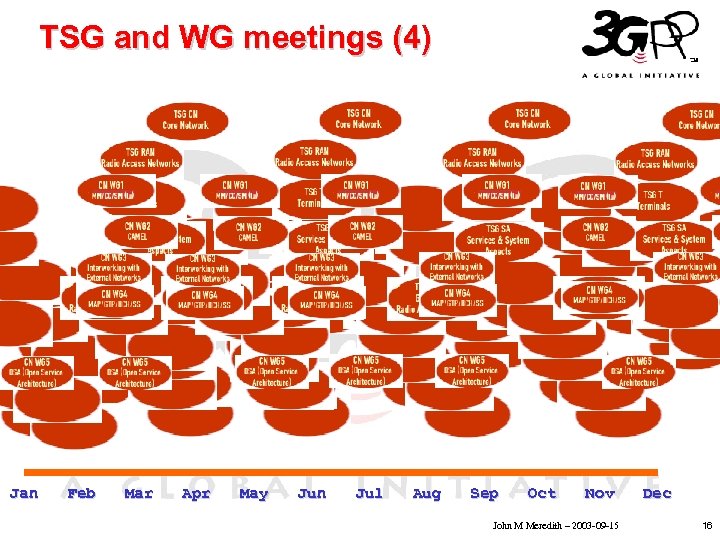 TSG and WG meetings (4) • • • Jan Click to edit Master text styles Second level Third level Fourth level Fifth level Feb Mar Apr May Jun Jul Aug Sep Oct Nov Dec John M Meredith – 2003 -09 -15 16
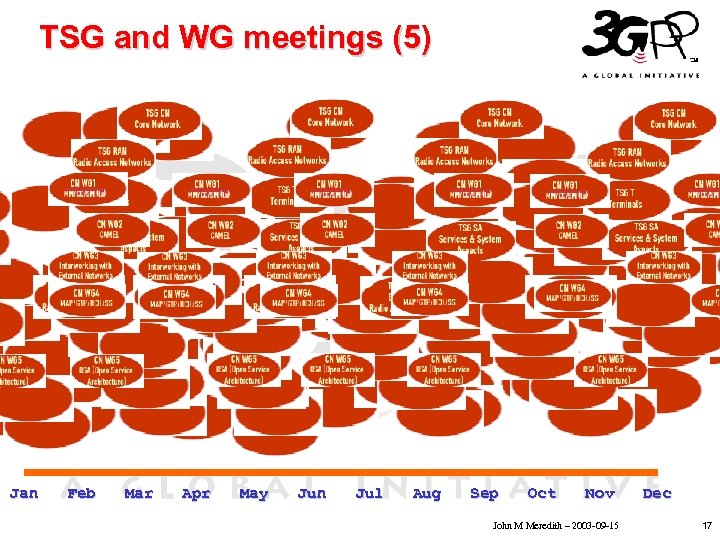 TSG and WG meetings (5) • • • Jan Click to edit Master text styles Second level Third level Fourth level Fifth level Feb Mar Apr May Jun Jul Aug Sep Oct Nov Dec John M Meredith – 2003 -09 -15 17
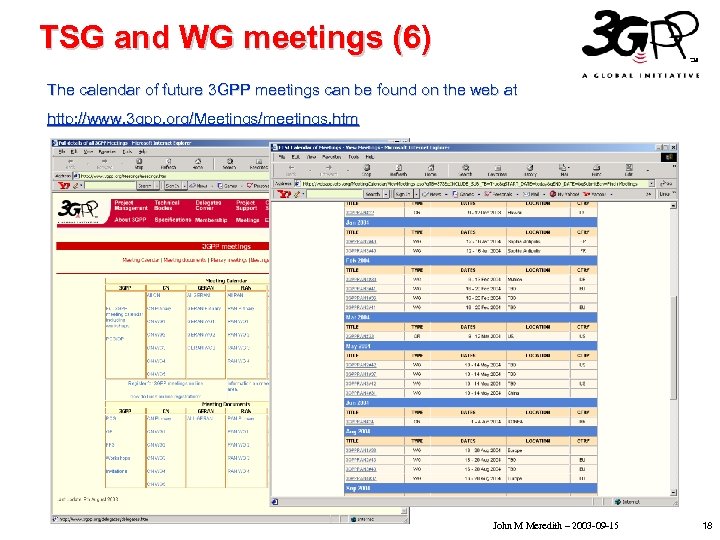 TSG and WG meetings (6) The calendar of future 3 GPP meetings can be found on the web at http: //www. 3 gpp. org/Meetings/meetings. htm • • • Click to edit Master text styles Second level Third level Fourth level Fifth level John M Meredith – 2003 -09 -15 18
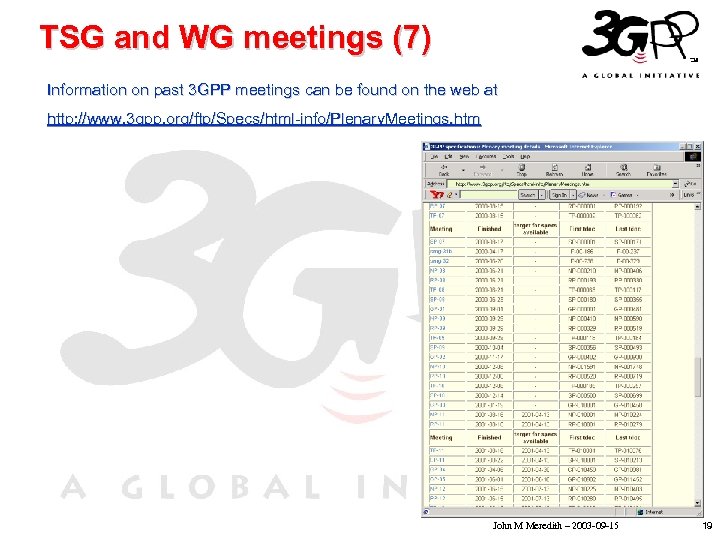 TSG and WG meetings (7) Information on past 3 GPP meetings can be found on the web at http: //www. 3 gpp. org/ftp/Specs/html-info/Plenary. Meetings. htm • • • Click to edit Master text styles Second level Third level Fourth level Fifth level John M Meredith – 2003 -09 -15 19
 1 Introduction • • • Click to edit Master text styles 2 Rules and procedures Second level 3 Meetings Third level 4 Following the work Fourth level 5 Phased approach, Releases Fifth level 6 Project management, the Work Plan 7 Specs: drafting, maintaining, … John M Meredith – 2003 -09 -15 20
 How do I follow what is happening where? Help!! The guiding principles of 3 GPP are openness and ease of access to the results. • Click to edit Master text styles The following slides show the means by which those principles are upheld, so that • Second level the whole community of subscribers / users, • Third level network operators, equipment manufacturers, and • Fourth level national administrators can • Fifth level of 3 GPP’s labours, whether or not they have been active benefit from the fruits participants. All information is publicly available on the 3 GPP web site http: //www. 3 gpp. org/. John M Meredith – 2003 -09 -15 21
 Following the work (1) Each TSG and each Working Group have declared terms of reference. This makes it relatively easy to determine which group you need to follow if you are interested in a particular area of work. • Click to edit Master text styles http: //www. 3 gpp. org/TB/home. htm • Second level • Third level Every TSG and every WG has an e-mail exploder. In most cases, anybody can join the exploder(s) in which he has an interest. There is no restriction to • Fourth level representatives of 3 GPP Individual Members, to active participants, etc – anybody can join. • Fifth level http: //www. 3 gpp. org/email/lists. htm The meeting calendar for all groups is set well in advance. Increasingly, registration of intended participation in meetings can be done on-line. http: //www. 3 gpp. org/Meetings/meetings. htm#calendar. John M Meredith – 2003 -09 -15 22
 Following the work (2) All meeting documents – invitation, agenda, contributions (so called “temporary documents”), meeting report, etc – are available on the file server, and remain there indefinitely. • Click to edit Master text styles • Second level All TSGs and WGs use a standardized file naming convention. From the file name, you • Third level can determine the originating TSG or WG • Fourthinlevelthe document was created, and the year which via the table at: • Fifth level http: //www. 3 gpp. org/ftp/Specs/html-info/Plenary. Meetings. htm the meeting number* at which it was presented. You can thus easily get to a given document of interest. * At the time of writing, this table only covers plenary TSG meetings. It is hoped to expand it to cover WGs in due course. . John M Meredith – 2003 -09 -15 23
 Following the work (3) The agreed work plan is published after every TSG SA meeting, and forms the basis for the programme for the next three months. (More details on the management of the work plan are given later in this presentation. ) • Click to edit Master text styles http: //www. 3 gpp. org/Management/Work. Plan. htm • Second level • Third level The specifications resulting from the Working Groups’ activities are available on the file server, and can level • Fourth be downloaded individually or en masse. For a given spec, you can also track the change history from version to version. (More details on how to find • Fifth level the spec which interests you are given later in this presentation. ) http: //www. 3 gpp. org/specs/numbering. htm John M Meredith – 2003 -09 -15 24
 Following the work (4) If, after all that, you still cannot find the information you need. . . • Click to edit Master text styles • Second level The contact coordinates of all TSG and WG officials (Chairmen, Vice-Chairmen, • Third level Secretaries) are available, as are those of the Support Team. http: //www. 3 gpp. org/tb/officials. htm • Fourth level http: //www. 3 gpp. org/Support/MCC_photos. htm • Fifth level John M Meredith – 2003 -09 -15 25
 1 Introduction • • • Click to edit Master text styles 2 Rules and procedures Second level 3 Meetings Third level 4 Following the work Fourth level 5 Phased approach, Releases Fifth level 6 Project management, the Work Plan 7 Specs: drafting, maintaining, … John M Meredith – 2003 -09 -15 26
 3 GPP Releases (1) Specifications are grouped into “Releases” • • • Click to edit Master text styles Second level A mobile system be constructed based on Third level cancomprise a given Release. the set of all specifications which Fourth level A Release differs from the previous Release by having added Fifth level functionality introduced as a result of ongoing standardization work. http: //www. 3 gpp. org/specs/releases. htm John M Meredith – 2003 -09 -15 27
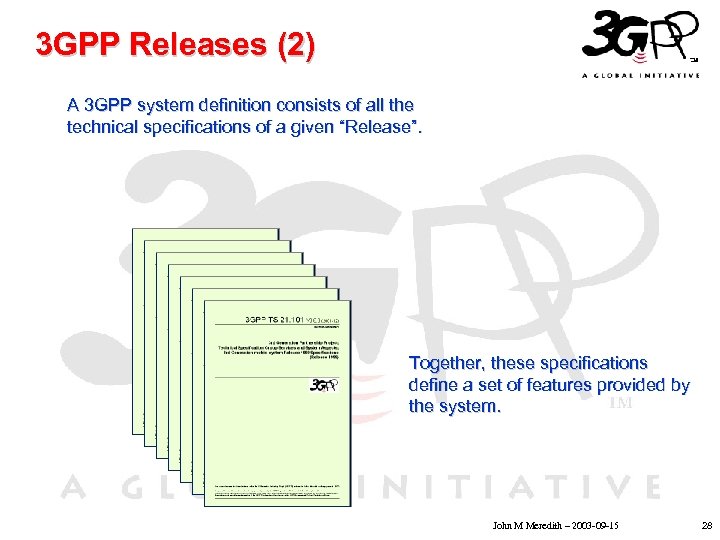 3 GPP Releases (2) A 3 GPP system definition consists of all the technical specifications of a given “Release”. • • • Click to edit Master text styles Second level Third level Fourth level Fifth level Together, these specifications define a set of features provided by the system. John M Meredith – 2003 -09 -15 28
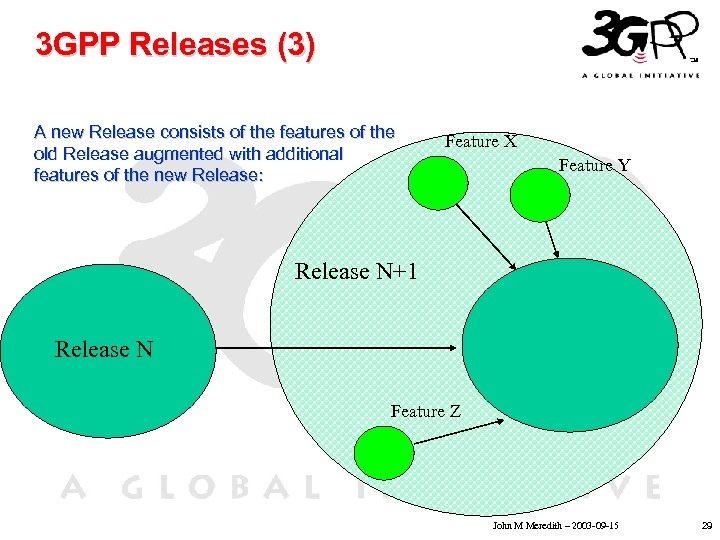 3 GPP Releases (3) A new Release consists of the features of the old Release augmented with additional features of the new Release: • Click to edit Master text • Second level • Third level • Fourth level • Fifth Release N level Feature X styles Feature Y Release N+1 Feature Z John M Meredith – 2003 -09 -15 29
 1 Introduction • • • Click to edit Master text styles 2 Rules and procedures Second level 3 Meetings Third level 4 Following the work Fourth level 5 Phased approach, Releases Fifth level 6 Project management, the Work Plan 7 Specs: drafting, maintaining, … John M Meredith – 2003 -09 -15 30
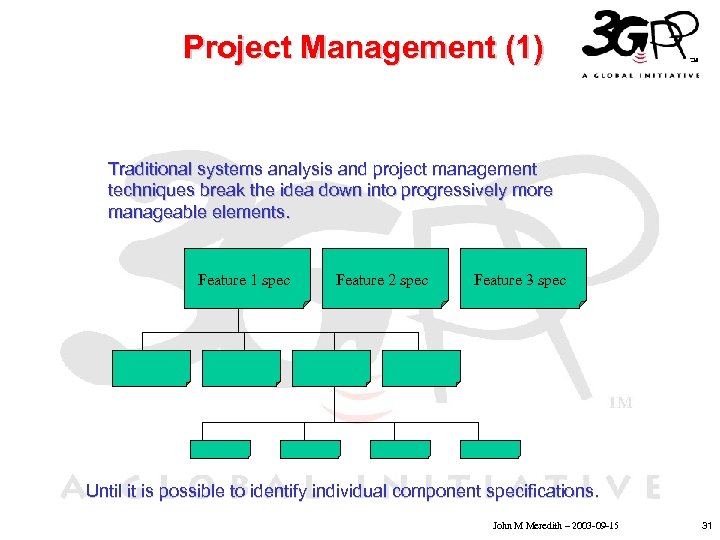 Project Management (1) • • • Traditional Click to systems analysis andinto progressively more edit the idea down project management Master text styles techniques break manageable elements. Second level Third level Feature 1 spec Feature 2 spec Feature 3 spec Fourth level Fifth level Until it is possible to identify individual component specifications. John M Meredith – 2003 -09 -15 31
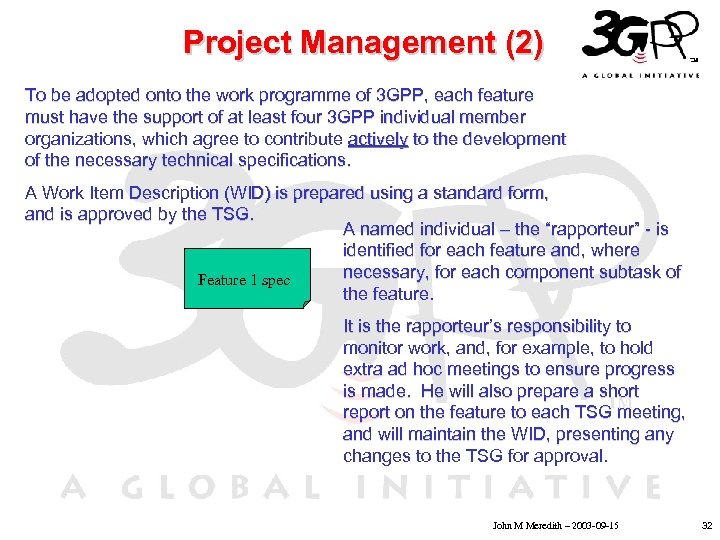 Project Management (2) To be adopted onto the work programme of 3 GPP, each feature must have the support of at least four 3 GPP individual member organizations, which agree to contribute actively to the development of the necessary technical specifications. • Click to edit Master text styles A Work Item Description (WID) is prepared using a standard form, and is approved by the TSG. • Second level A named individual – the “rapporteur” - is identified for each feature and, where • Third level necessary, for each component subtask of Feature 1 spec the feature. • Fourth level • Fifth level It is the rapporteur’s responsibility to monitor work, and, for example, to hold extra ad hoc meetings to ensure progress is made. He will also prepare a short report on the feature to each TSG meeting, and will maintain the WID, presenting any changes to the TSG for approval. John M Meredith – 2003 -09 -15 32
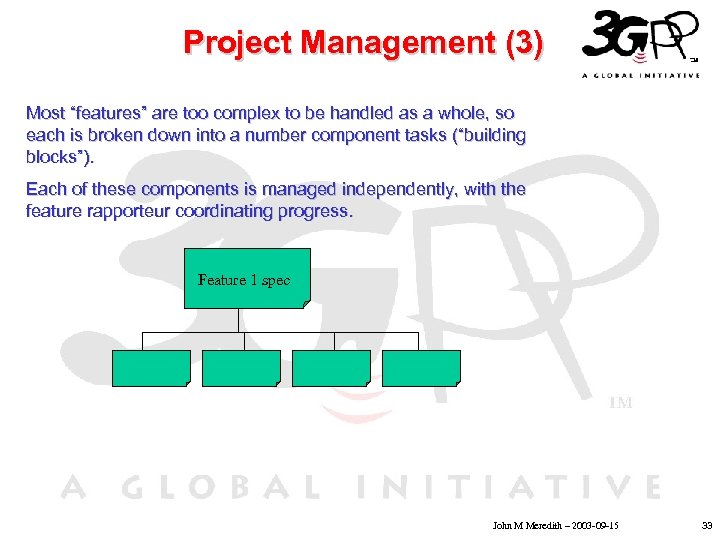 Project Management (3) Most “features” are too complex to be handled as a whole, so each is broken down into a number component tasks (“building blocks”). • these components managed text styles Each of Click to editis. Masterindependently, with the feature rapporteur coordinating progress. • • Second level Third level Feature 1 spec Fourth level Fifth level John M Meredith – 2003 -09 -15 33
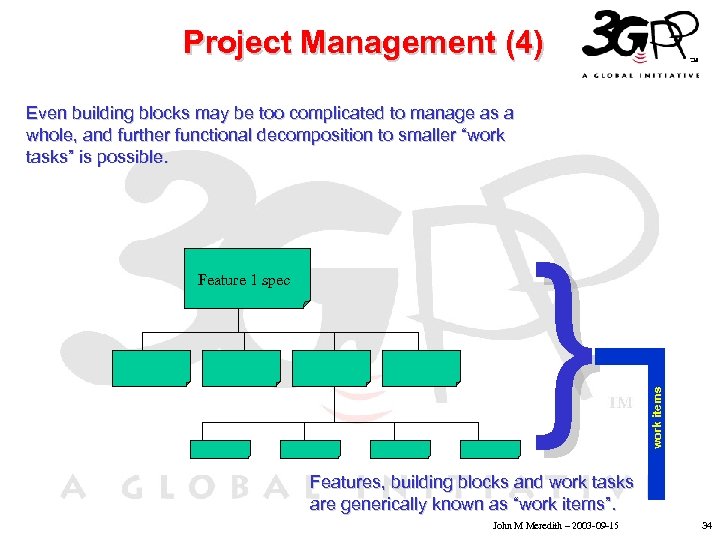 Project Management (4) • • • Click to edit Master text styles Second level Third level Feature 1 spec Fourth level Fifth level } work items Even building blocks may be too complicated to manage as a whole, and further functional decomposition to smaller “work tasks” is possible. Features, building blocks and work tasks are generically known as “work items”. John M Meredith – 2003 -09 -15 34
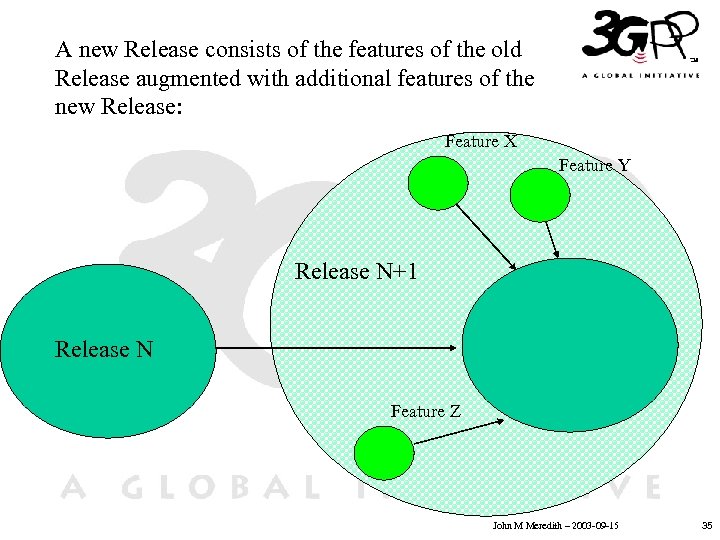 A new Release consists of the features of the old Release augmented with additional features of the new Release: Feature X • Click to edit Master text styles • Second level • Third level Release N+1 • Fourth level • Fifth Release N level Feature Y Feature Z John M Meredith – 2003 -09 -15 35
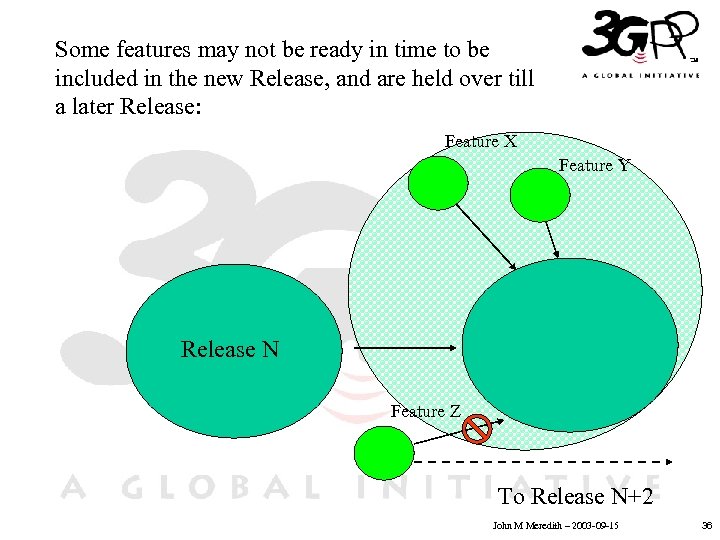 Some features may not be ready in time to be included in the new Release, and are held over till a later Release: Feature X • • • Click to edit Master text styles Second level Third level Fourth level Fifth level Release N Feature Y Feature Z To Release N+2 John M Meredith – 2003 -09 -15 36
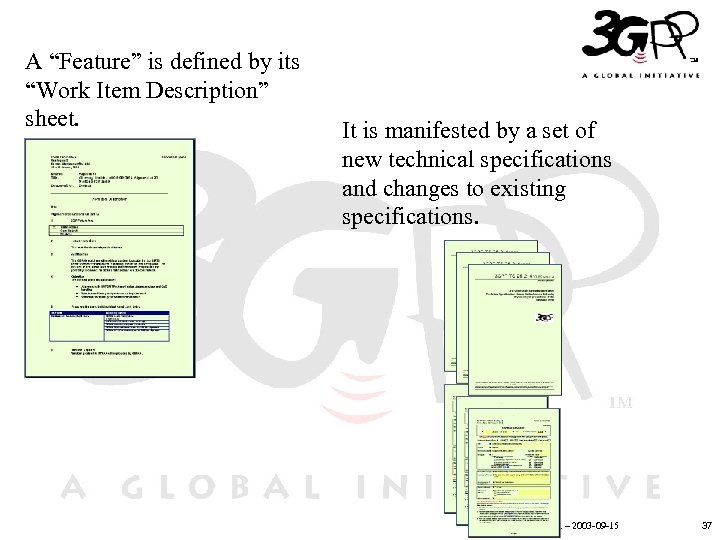 A “Feature” is defined by its “Work Item Description” sheet. It is manifested by a set of new technical specifications • Click to edit Masterand changes to existing text styles specifications. • Second level • • • Third level Fourth level Fifth level John M Meredith – 2003 -09 -15 37
 Remember that a Feature is defined as: "new or substantially enhanced functionality which represents added value to the existing system" [3 GPP TR 21. 900]. • Click to edit Master text styles This definition presumes that Features are defined in a • Second level commercial, non-technical way. Thus even senior management may see at a glance the commercial and financial • Third level implications of adding, or not adding, a feature to the system. • Fourth level • Fifth level John M Meredith – 2003 -09 -15 38
 A Feature can be broken down into “building blocks”, which can in turn be broken down into “work tasks”. In fact, the functional decomposition of a Feature into lower level tasks is • Click to edit Master text styles rather ad hoc, and depends on the complexity of each • Second level individual Feature. • Third level As the level of break-down increases, the lower levels will be defined in progressively more technical terms. The number of • Fourth levels of decomposition should be sufficient to allow • Fifth level reasonably accurate estimation and progress tracking of the work. The number of levels should be restricted by this aspect, and not continued to artificially deep nesting simply because further breakdown is possible; it is only necessary to go into sufficient detail to allow a reasonably accurate degree of project management. John M Meredith – 2003 -09 -15 39
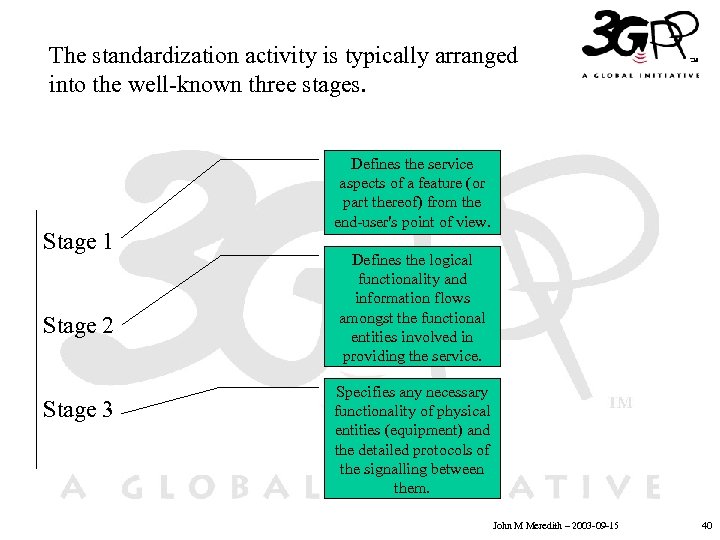 The standardization activity is typically arranged into the well-known three stages. Defines the service aspects of a feature (or part thereof) from the end-user's point of view. • Click to edit Master text styles • Second level Stage 1 Defines the logical • Third level functionality and information flows • Fourth level amongst the functional Stage 2 entities involved in • Fifth level providing the service. Stage 3 Specifies any necessary functionality of physical entities (equipment) and the detailed protocols of the signalling between them. John M Meredith – 2003 -09 -15 40
 For complex Features, stage 1 may be preceded by a feasibility study (sometimes called "stage 0") to analyse the market and potential technical difficulties of a given service or approach. • Click to edit Master text styles Sometimes TSGs (notably RAN) create pre-standardization • Second level "study items" which produce reports forming the foundation for subsequent concrete standardization in "work items". • Third level • Fourth level • Fifth level John M Meredith – 2003 -09 -15 41
 Stage 1 specifications are normally produced by TSG SA 1, and stage 2 specifications by SA 2, though the stage 2 may need specialist knowledge from other TSGs' working groups. • • • Click to edit Master text styles Second level Third level Fourth level Fifth level John M Meredith – 2003 -09 -15 42
 A separate stage 3 specification will be required for each protocol concerned with providing the service, which may well impact the whole equipment chain from User Equipment, • Click to edit Master text styles through the Radio Access Network, to the Core Network, and on to network management interfaces, and to fixed networks. • Second level The service may require new codecs. Depending on the nature • Third level of the Feature, it may only be necessary to change existing • Fourth level specifications rather than to create completely new ones. This is particularly so at stage 3, where the service has to co-exist • Fifth level with all other services. However, this will vary from case to case. John M Meredith – 2003 -09 -15 43
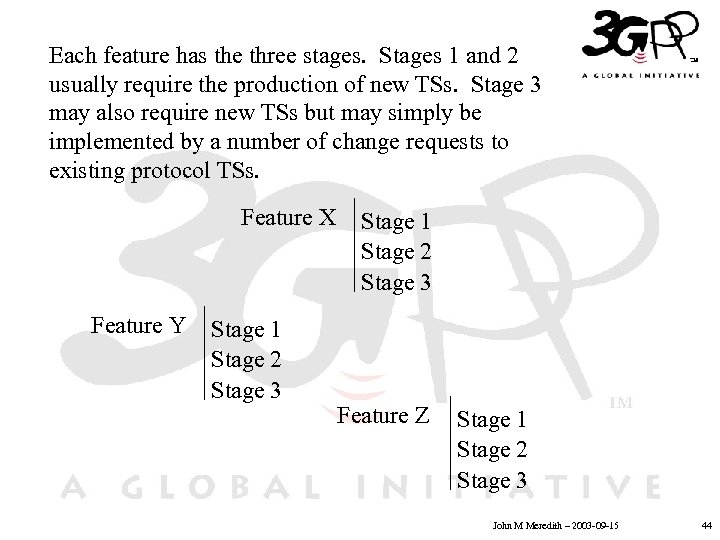 Each feature has the three stages. Stages 1 and 2 usually require the production of new TSs. Stage 3 may also require new TSs but may simply be implemented by a number of change requests to existing protocol TSs. • Click to edit Master text styles • • Feature X Stage 1 Second level Stage 2 Third level Stage 3 Fourth level Feature Y Stage 1 Fifth level Stage 2 Stage 3 Feature Z Stage 1 Stage 2 Stage 3 John M Meredith – 2003 -09 -15 44
 Further stages not originally envisaged by CCITT are the development of Operations and Maintenance (O&M) specifications (mainly within SA 5) and of • Test specifications. Whilst O&M specs can be Click to edit Master text styles • developed more or less at the same time as the stage Second level 3 protocols, it is usually prudent to wait until the • protocols are fairly stable (i. e. field tested) before Third level • embarking on detailed test specifications. Thus Fourth level whilst the O&M specs may be only six months • behind the stages 3, the test specs follow a year or Fifth level more later. John M Meredith – 2003 -09 -15 45
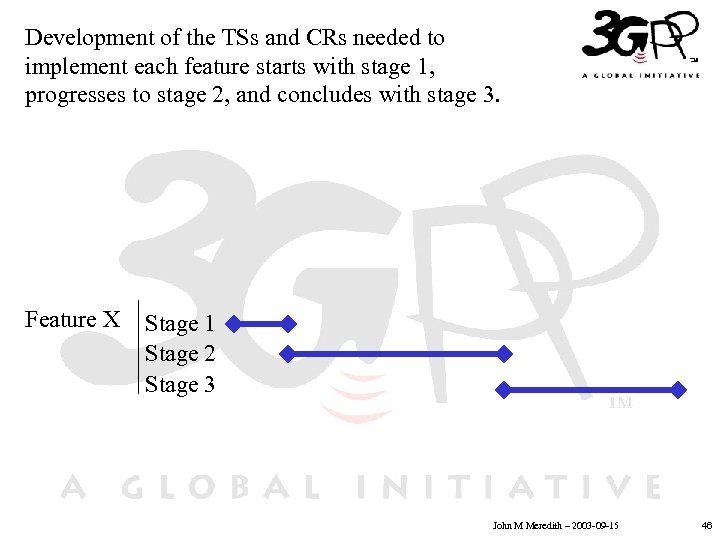 Development of the TSs and CRs needed to implement each feature starts with stage 1, progresses to stage 2, and concludes with stage 3. • Click to edit Master text styles • Second level • Third level • Fourth level Feature X Stage 1 • Fifth. Stage 2 level Stage 3 John M Meredith – 2003 -09 -15 46
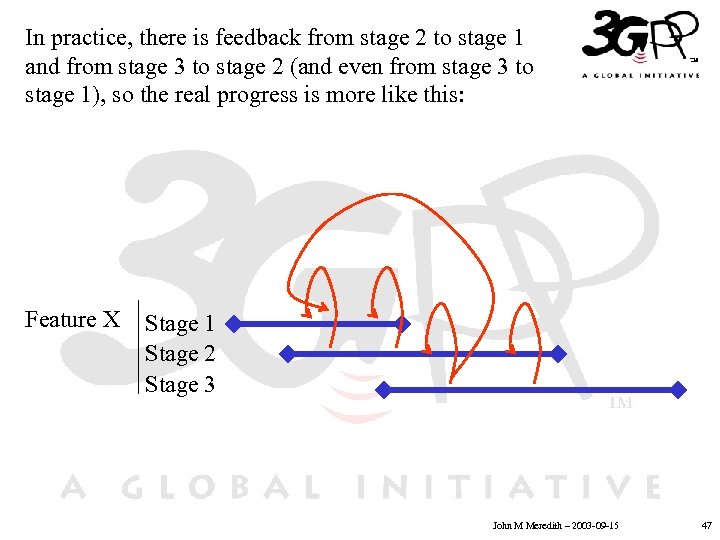 In practice, there is feedback from stage 2 to stage 1 and from stage 3 to stage 2 (and even from stage 3 to stage 1), so the real progress is more like this: • Click to edit Master text styles • Second level • Third level • Fourth level Feature X Stage 1 • Fifth. Stage 2 level Stage 3 John M Meredith – 2003 -09 -15 47
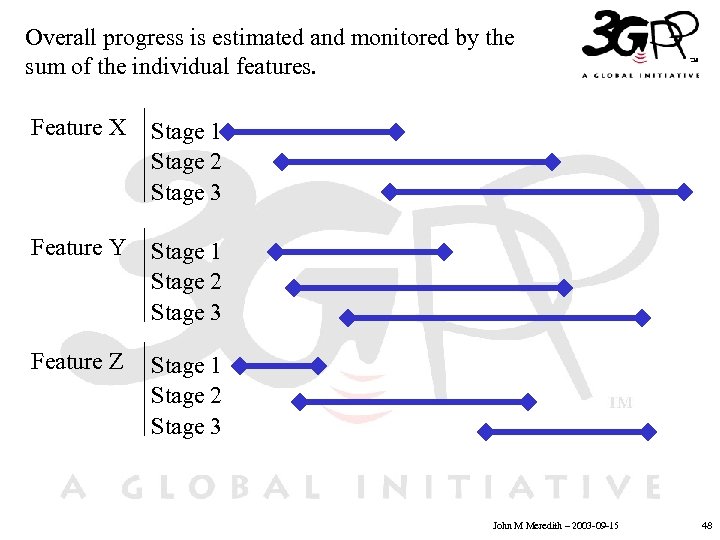 Overall progress is estimated and monitored by the sum of the individual features. Feature X Stage 1 Stage 2 • Click. Stage 3 Master text styles to edit • Second level Feature Y Stage 1 • Third level Stage 2 • Fourth level Stage 3 • Fifth level Feature Z Stage 1 Stage 2 Stage 3 John M Meredith – 2003 -09 -15 48
 For good technical and commercial reasons, a “freeze” date is set for each Release. At the point of freezing a Release, the list of features to be included in the Release is fixed, and any features under • Click to edit Master text styles development which cannot be completed within an agreed time frame • Second level are postponed to a later Release. A feature is “completed” when all its component specifications are stable enough to be published by the • Third level SDOs and implemented by equipment manufacturers and network • Fourth level operators. • Fifth level Prior to “freezing”, the following milestones must have been achieved: John M Meredith – 2003 -09 -15 49
 Prior to “freezing”, the following milestones must have been achieved: • The features to be included in the Release will have been determined. (And any features which are to be delayed to a later • Click to edit Master text styles Release will have been identified. ) • Second level • For each feature, the stage 1 specifications must have been • Third completed. level • Fourth level • In addition, the stage 2 specifications should have been • Fifth level completed, or very nearly so. • Further, the stage 3 specifications should have been completed, or are planned to be completed within a fairly short time span. John M Meredith – 2003 -09 -15 50
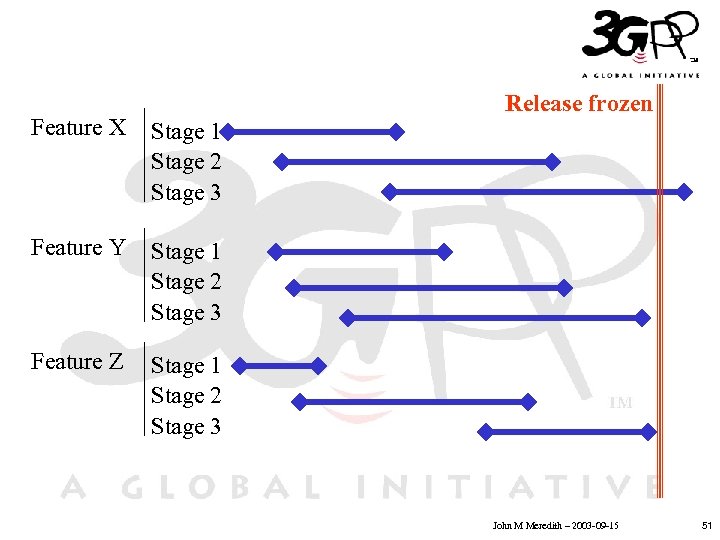 Release frozen Feature X Stage 1 Stage 2 • Click. Stage 3 Master text styles to edit • Second level Feature Y Stage 1 • Third level Stage 2 • Fourth level Stage 3 • Fifth level Feature Z Stage 1 Stage 2 Stage 3 John M Meredith – 2003 -09 -15 51
 The justification for these requirements is that • It must be declared which features are provided by the new Release (and which are not). • Click to edit Master text styles • • Second level It must be clear what benefits each new feature will bring to users (i. e. the stage 1 specs must be stable). • Third level • It must be clear that the feature can be implemented with no • Fourth level fundamental obstacle (i. e. the stage 2 specs must be reasonably • Fifth level stable). • The protocols needed to implement the features must be available, or at least it must be clear when they will be available (i. e. the stage 3 specs must be reasonably well developed and a definite target date envisaged for them to be considered stable enough to implement with acceptable commercial risk). John M Meredith – 2003 -09 -15 52
 At the moment of freezing the Release, all outstanding issues for each feature must be identified, and target dates set for their resolution. • Click to edit Master text styles • All specs should be planned to be stable Second level within a reasonably short time – say six • months (two plenary meetings) at the most. Third level • Fourth level • Fifth level John M Meredith – 2003 -09 -15 53
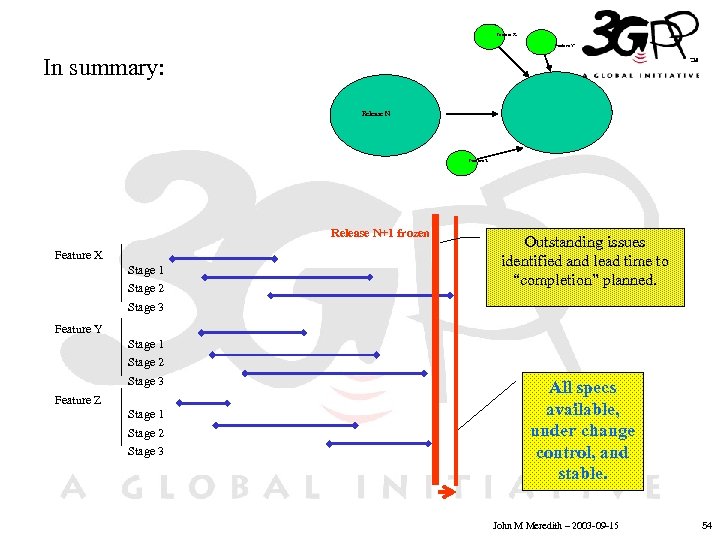 Feature X Feature Y In summary: Release N Feature Z • Click to edit Master text styles • Second level Release N+1 frozen Feature X • Third level Stage 1 Stage 2 • Fourth level Stage 3 Feature Y Stage 1 • Fifth level Outstanding issues identified and lead time to “completion” planned. Stage 2 Stage 3 Feature Z Stage 1 Stage 2 Stage 3 All specs available, under change control, and stable. John M Meredith – 2003 -09 -15 54
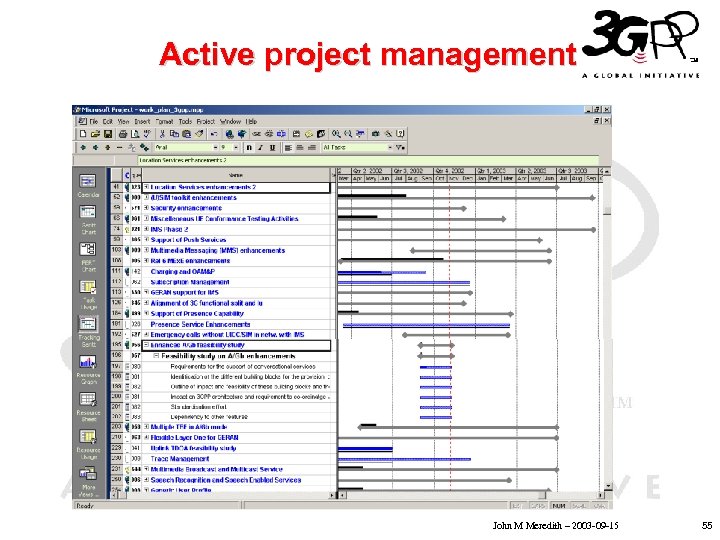 Active project management • • • Click to edit Master text styles Second level Third level Fourth level Fifth level John M Meredith – 2003 -09 -15 55
 Active project management 3 G Release 99 contained more or less the same functionality as GSM R 99, but of course using the new UTRA radio access network technology (W-CDMA). • • • Click to edit Master text styles Second level Third level Fourth level Fifth level The 3 GPP work plan can be consulted at: http: //www. 3 gpp. org/ftp/Information/WORK_PLAN/ John M Meredith – 2003 -09 -15 56
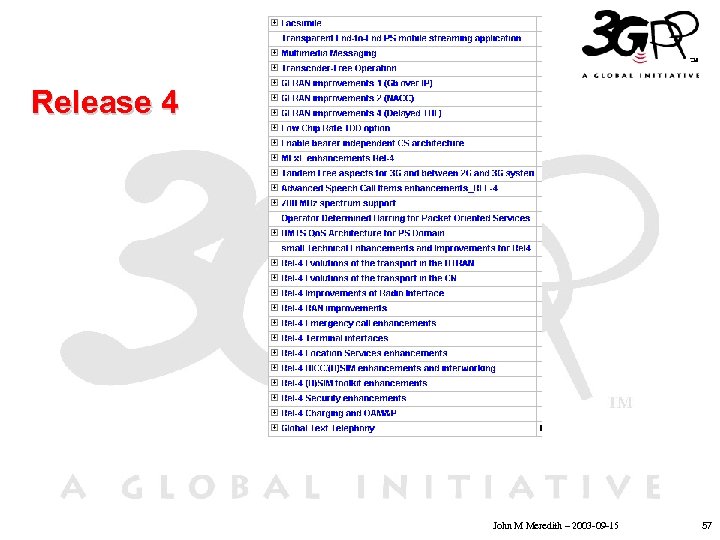 Release 4 • • • Click to edit Master text styles Second level Third level Fourth level Fifth level John M Meredith – 2003 -09 -15 57
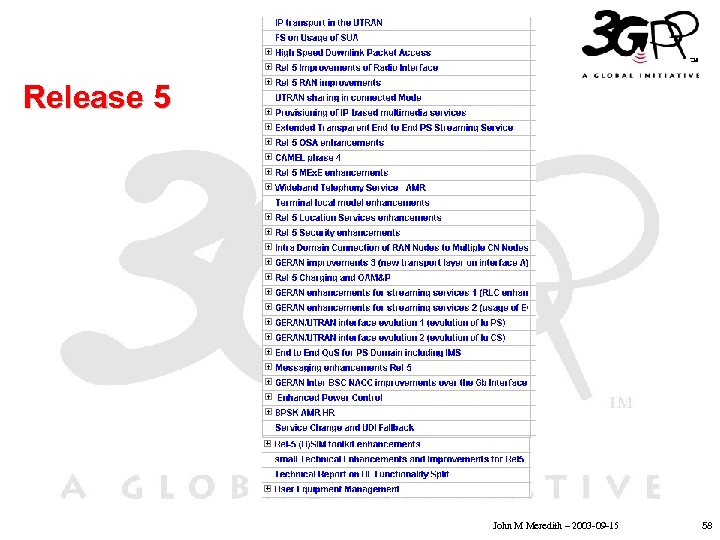 Release 5 • • • Click to edit Master text styles Second level Third level Fourth level Fifth level John M Meredith – 2003 -09 -15 58
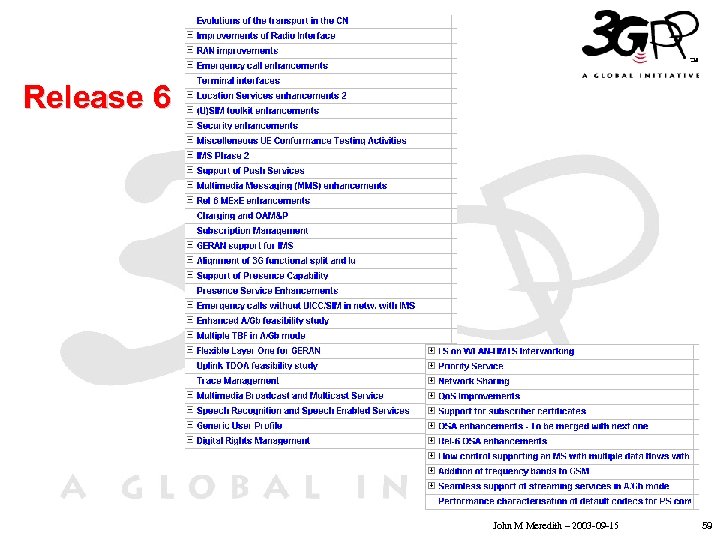 Release 6 • • • Click to edit Master text styles Second level Third level Fourth level Fifth level John M Meredith – 2003 -09 -15 59
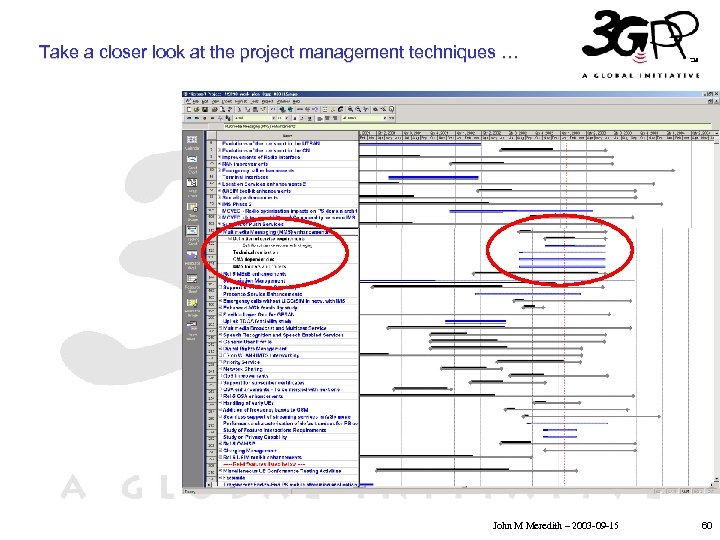 Take a closer look at the project management techniques … • • • Click to edit Master text styles Second level Third level Fourth level Fifth level John M Meredith – 2003 -09 -15 60
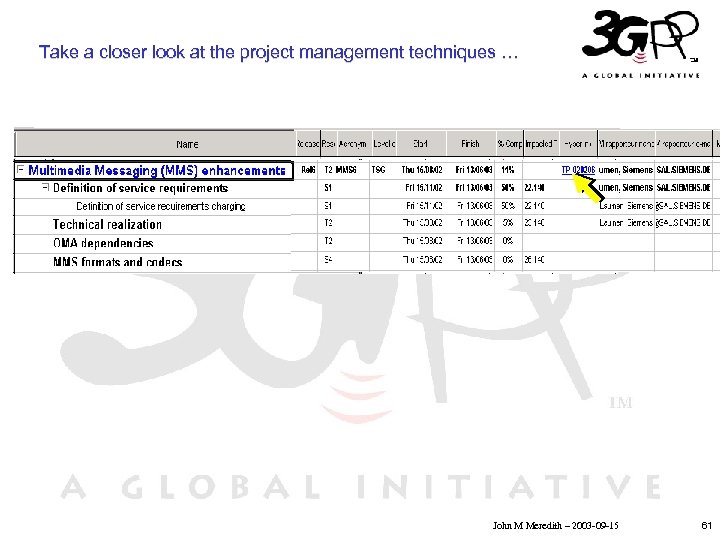 Take a closer look at the project management techniques … • • • Click to edit Master text styles Second level Third level Fourth level Fifth level John M Meredith – 2003 -09 -15 61
 • • • Click to edit Master text styles Second level Third level Fourth level Fifth level John M Meredith – 2003 -09 -15 62
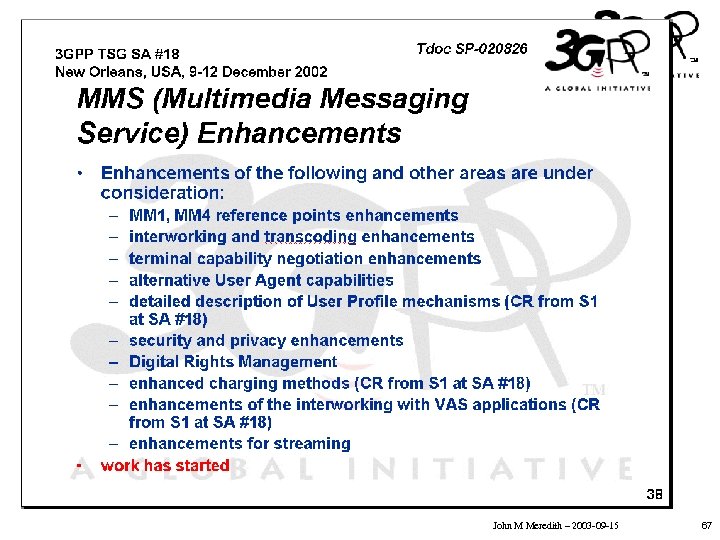
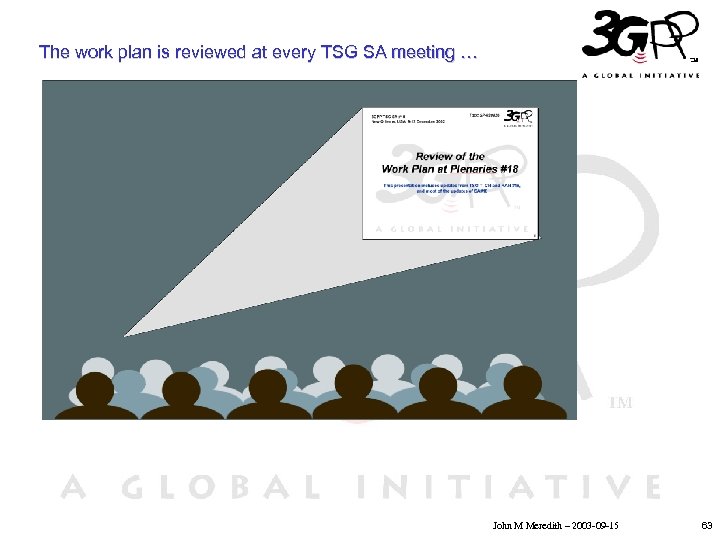 The work plan is reviewed at every TSG SA meeting … • • • Click to edit Master text styles Second level Third level Fourth level Fifth level John M Meredith – 2003 -09 -15 63
 • • • Click to edit Master text styles Second level Third level Fourth level Fifth level John M Meredith – 2003 -09 -15 64
 • • • Click to edit Master text styles Second level Third level Fourth level Fifth level John M Meredith – 2003 -09 -15 65
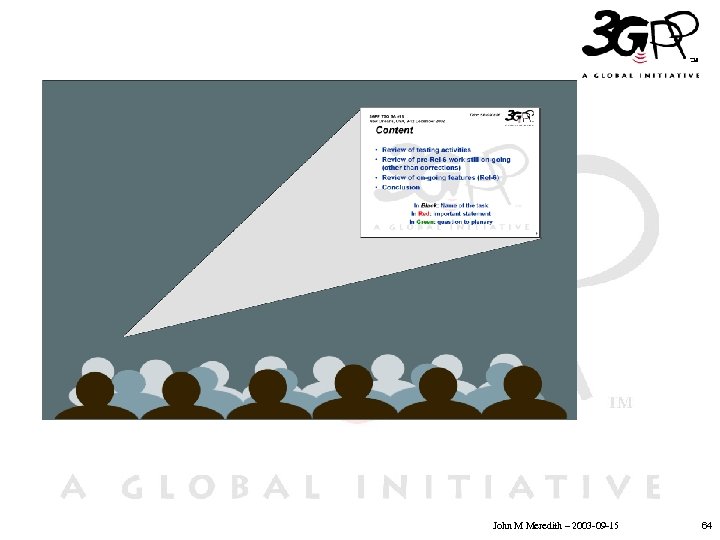
 Every Feature (top level functional enhancement) is examined in sufficient detail to ensure that • Its definition is (still) correct, and that • It is making adequate progress according to plan. • • • Click to edit Master text styles Second level Third level Fourth level Fifth level John M Meredith – 2003 -09 -15 66
 • • • Click to edit Master text styles Second level Third level Fourth level Fifth level John M Meredith – 2003 -09 -15 67
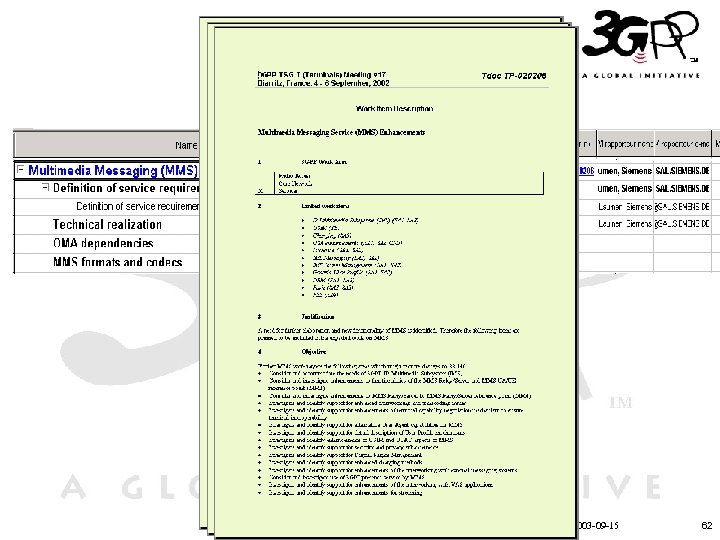
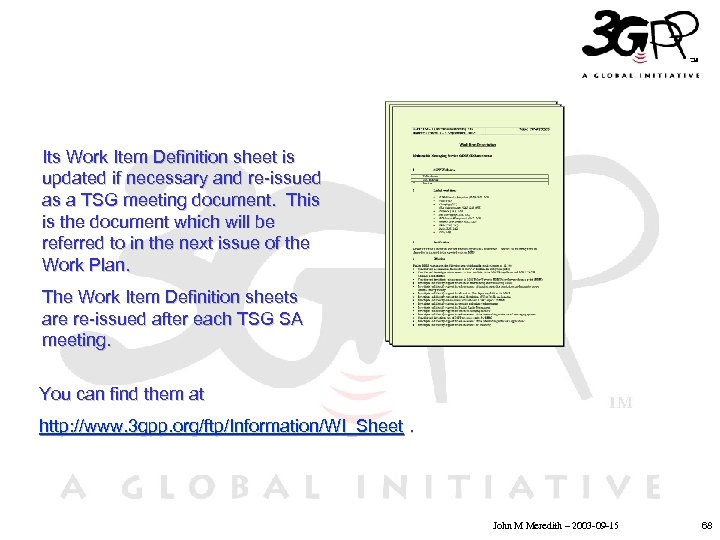 Its Work Item Definition sheet is updated if necessary and re-issued • Click to edit Master as a TSG meeting document. This • document which will be is the Second level referred to in the next issue of the • Plan. Work Third level text styles The Work Item Definition sheets • Fourth level are re-issued after each TSG SA meeting. • Fifth level You can find them at http: //www. 3 gpp. org/ftp/Information/WI_Sheet. John M Meredith – 2003 -09 -15 68
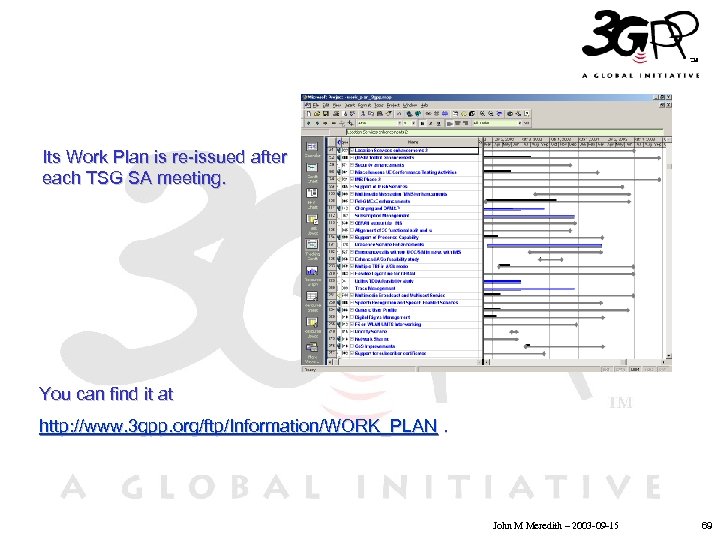 Its Work Plan is re-issued after each TSG SA meeting. • Click to edit Master • • text styles Second level Third level Fourth level Fifth level You can find it at http: //www. 3 gpp. org/ftp/Information/WORK_PLAN. John M Meredith – 2003 -09 -15 69
 1 Introduction • • • Click to edit Master text styles 2 Rules and procedures Second level 3 Meetings Third level 4 Following the work Fourth level 5 Phased approach, Releases Fifth level 6 Project management, the Work Plan 7 Specs: drafting, maintaining, … John M Meredith – 2003 -09 -15 70
 Drafting and maintaining the technical specifications The work items result in new technical specifications, or • enhancements to existing ones … Click to edit Master • • text styles Second level Third level Fourth level Fifth level John M Meredith – 2003 -09 -15 71
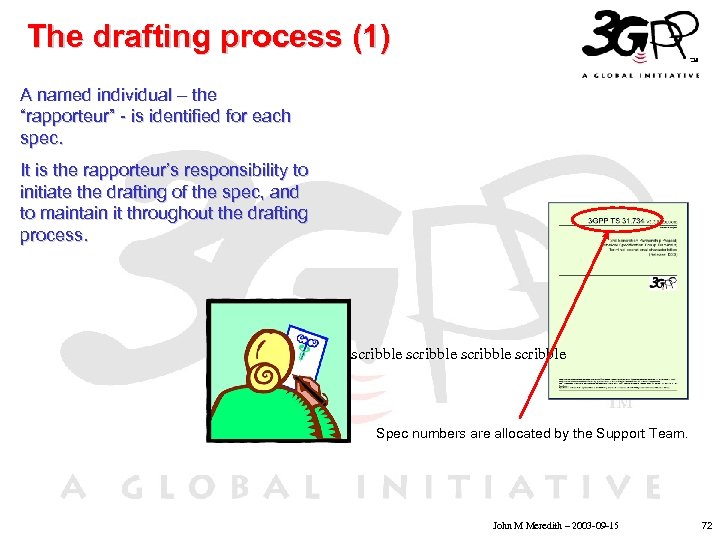 The drafting process (1) A named individual – the “rapporteur” - is identified for each spec. It is the rapporteur’s responsibility to • Click to edit Master initiate the drafting of the spec, and to maintain it throughout the drafting • Second level process. • • • Third level Fourth level Fifth level text styles scribble Spec numbers are allocated by the Support Team. John M Meredith – 2003 -09 -15 72
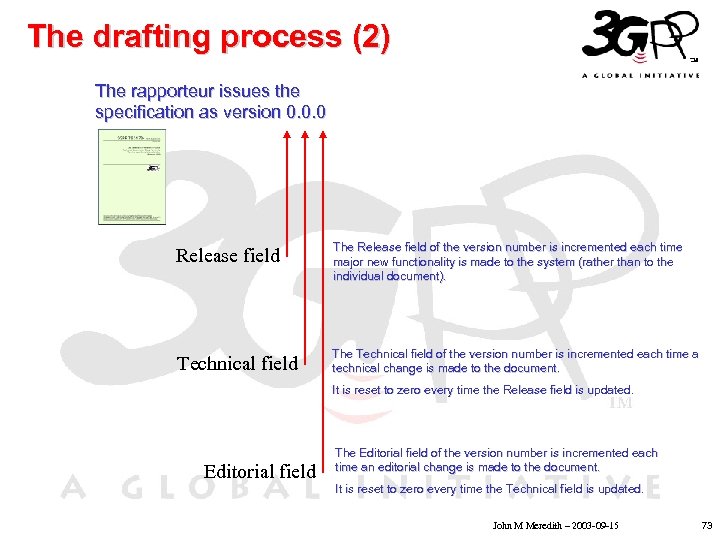 The drafting process (2) The rapporteur issues the specification as version 0. 0. 0 • • • Click to edit Master text styles Second level The Release field of the version number is incremented each time Release field major new functionality is made to the system (rather than to the Third level individual document). Fourth level Fifth level The Technical field of the version number is incremented each time a Technical field technical change is made to the document. It is reset to zero every time the Release field is updated. Editorial field The Editorial field of the version number is incremented each time an editorial change is made to the document. It is reset to zero every time the Technical field is updated. John M Meredith – 2003 -09 -15 73
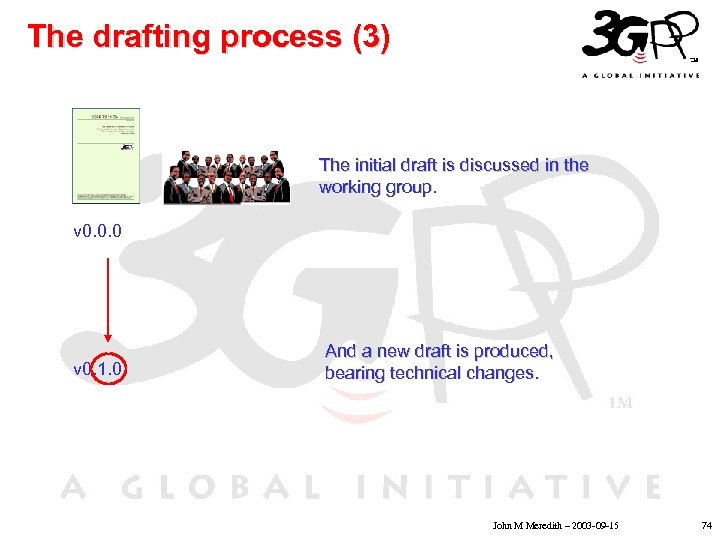 The drafting process (3) The initial draft is discussed in the Master text styles working group. • Click to edit • v 0. 0. 0 Second level • Third level • Fourth level • Fifth level v 0. 1. 0 And a new draft is produced, bearing technical changes. John M Meredith – 2003 -09 -15 74
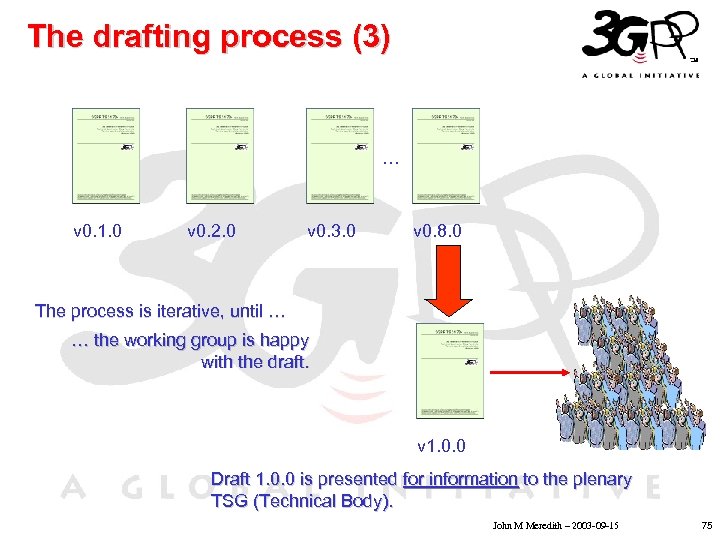 The drafting process (3) … • Click to edit Master text styles • v 0. 1. 0 Secondv 0. 2. 0 level v 0. 3. 0 v 0. 8. 0 • Third level • Fourth level The process is iterative, until … the working group • …Fifth level is happy with the draft. v 1. 0. 0 Draft 1. 0. 0 is presented for information to the plenary TSG (Technical Body). John M Meredith – 2003 -09 -15 75
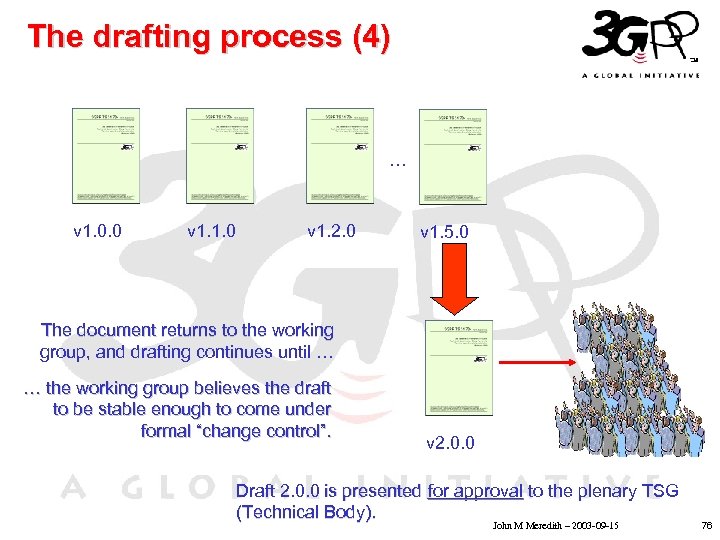 The drafting process (4) … • Click to edit Master text styles • v 1. 0. 0 Secondv 1. 1. 0 level v 1. 2. 0 v 1. 5. 0 • Third level • Fourth level The document returns to the working • Fifth level group, and drafting continues until … … the working group believes the draft to be stable enough to come under formal “change control”. v 2. 0. 0 Draft 2. 0. 0 is presented for approval to the plenary TSG (Technical Body). John M Meredith – 2003 -09 -15 76
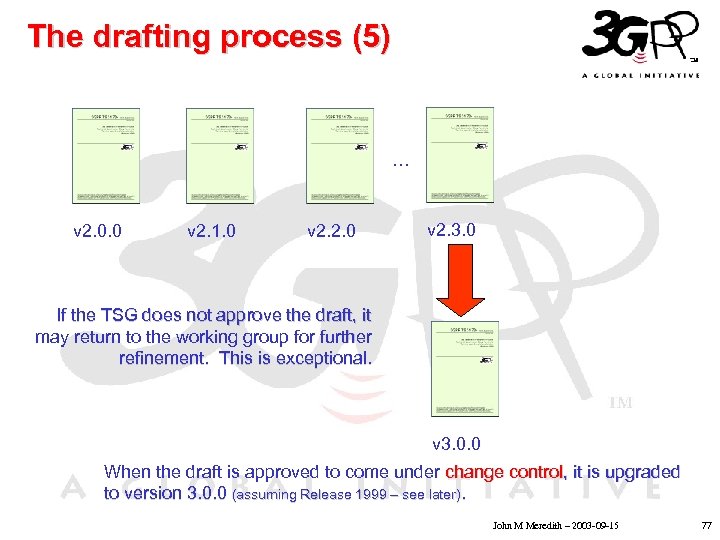 The drafting process (5) … • Click to edit Master text styles • v 2. 0. 0 Secondv 2. 1. 0 level v 2. 3. 0 v 2. 2. 0 • Third level • the TSG does level the draft, it Fourth not approve If may return to the working group for further • Fifth level refinement. This is exceptional. v 3. 0. 0 When the draft is approved to come under change control, it is upgraded to version 3. 0. 0 (assuming Release 1999 – see later). John M Meredith – 2003 -09 -15 77
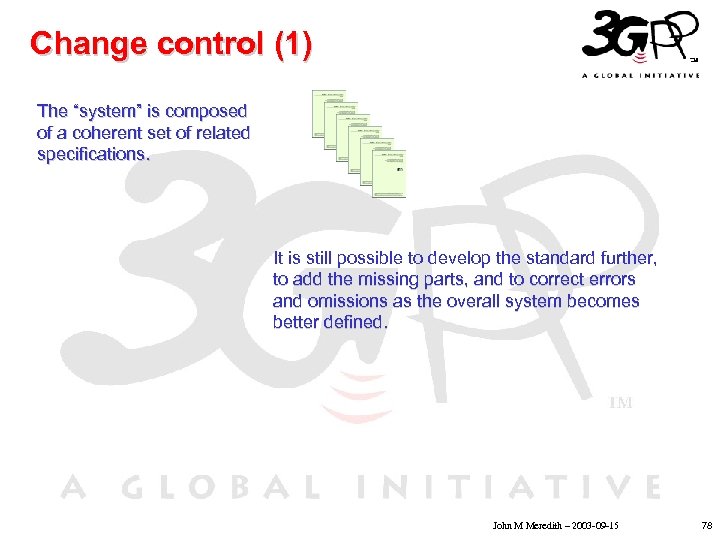 Change control (1) The “system” is composed of a coherent set of related specifications. • • • Click to edit Master text styles Second level It is still possible to develop the standard further, Third level to add the missing parts, and to correct errors Fourth level and omissions as the overall system becomes better defined. Fifth level John M Meredith – 2003 -09 -15 78
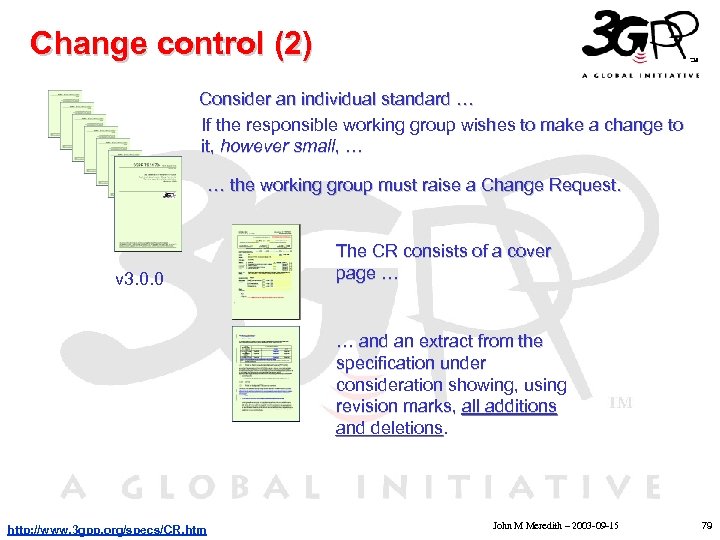 Change control (2) Consider an individual standard … If the responsible working group wishes to make a change to it, however small, … • • • Click to edit Master text styles … the working group must raise a Change Request. Second level The CR consists of a cover Third level page … v 3. 0. 0 Fourth level … and an extract from the Fifth level http: //www. 3 gpp. org/specs/CR. htm specification under consideration showing, using revision marks, all additions and deletions. John M Meredith – 2003 -09 -15 79
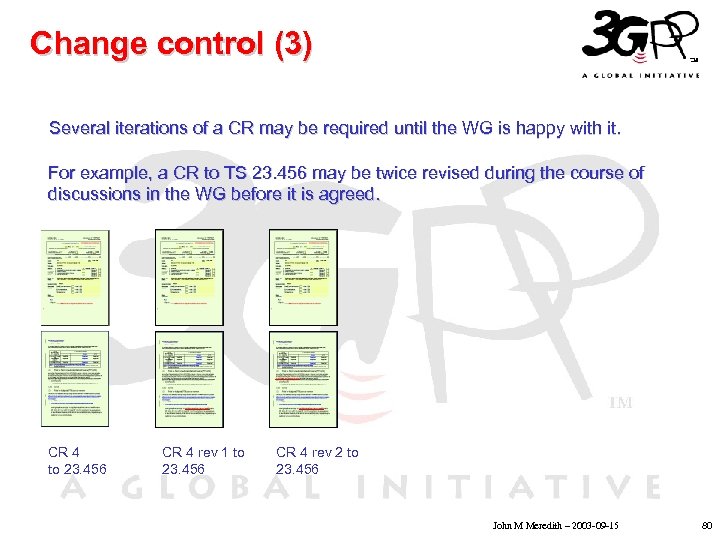 Change control (3) Several iterations of a CR may be required until the WG is happy with it. For example, a CRedit 23. 456 may be twice revised during the course of to • Click to WGTS Master text styles discussions in the before it is agreed. • • Second level Third level Fourth level Fifth level CR 4 to 23. 456 CR 4 rev 1 to 23. 456 CR 4 rev 2 to 23. 456 John M Meredith – 2003 -09 -15 80
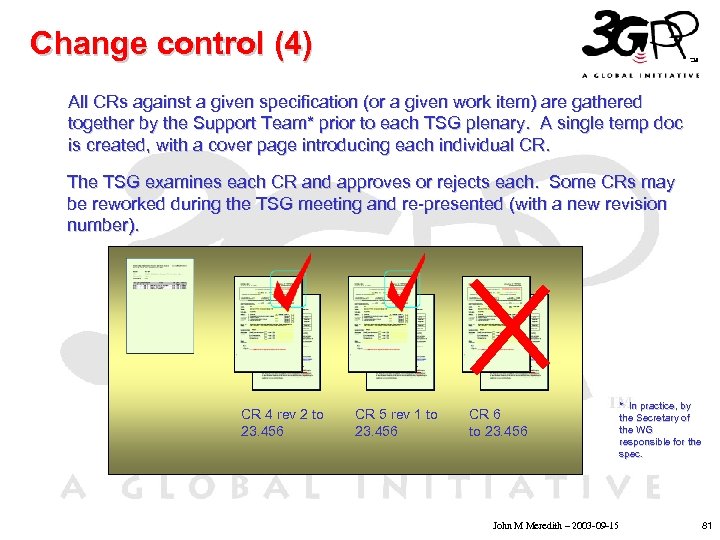 Change control (4) All CRs against a given specification (or a given work item) are gathered together by the Support Team* prior to each TSG plenary. A single temp doc is created, with a cover page introducing each individual CR. • The TSG examines each CR and approvesstyles each. Some CRs may Click to edit Master text or rejects be reworked during the TSG meeting and re-presented (with a new revision • number). Second level • Third level • Fourth level • Fifth level CR 4 rev 2 to 23. 456 CR 5 rev 1 to 23. 456 CR 6 to 23. 456 * In practice, by the Secretary of the WG responsible for the spec. John M Meredith – 2003 -09 -15 81
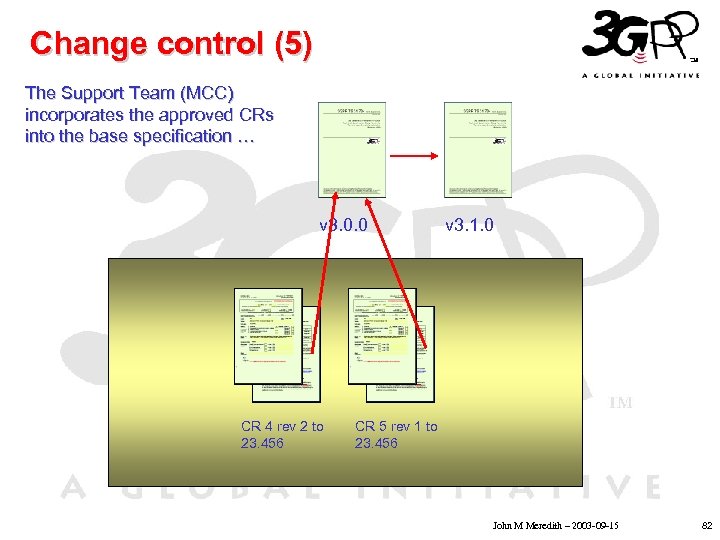 Change control (5) The Support Team (MCC) incorporates the approved CRs into the base specification … • • • Click to edit Master text styles Second level v 3. 0. 0 v 3. 1. 0 Third level Fourth level Fifth level CR 4 rev 2 to 23. 456 CR 5 rev 1 to 23. 456 John M Meredith – 2003 -09 -15 82
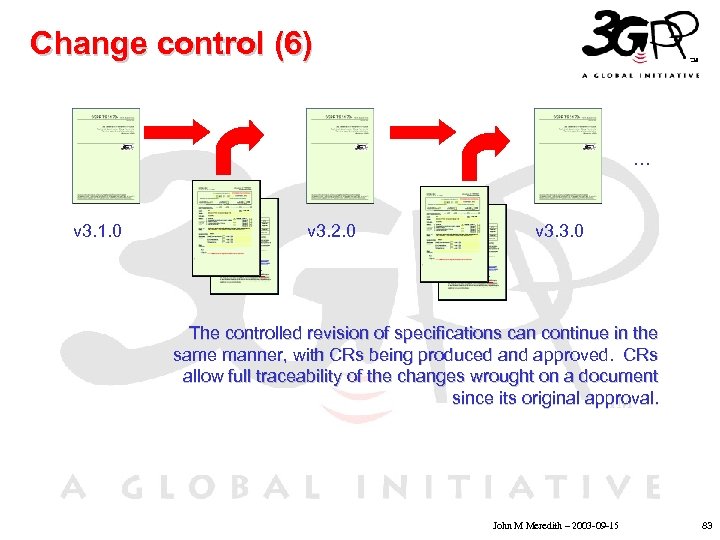 Change control (6) … • Click to edit Master text styles • v 3. 1. 0 Second level v 3. 2. 0 v 3. 3. 0 • Third level • Fourth level The controlled revision of specifications can continue the • Fifth level manner, with CRs being produced and approved. in. CRs same allow full traceability of the changes wrought on a document since its original approval. John M Meredith – 2003 -09 -15 83
 Change control (7) Using the Change Control mechanism described, it is always possible to: • See the differences from one version of a spec to the next. • Click to edit Master text styles • If necessary, back-track by de-implementing Change Requests which • Second level prove to be flawed. • • Third level of specifications a system is to be built to. Know exactly what set • Fourth level • Fifth level John M Meredith – 2003 -09 -15 84
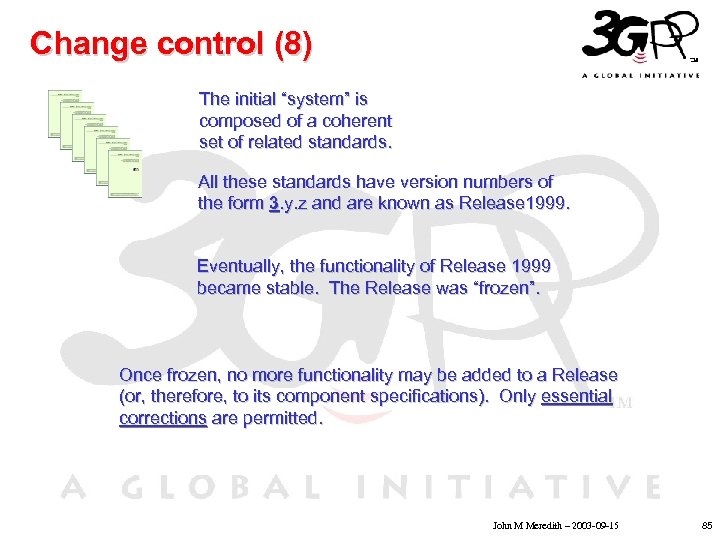 Change control (8) The initial “system” is composed of a coherent set of related standards. • • • Click to edit Master textversion numbers of All these standards have styles the form 3. y. z and are known as Release 1999. Second level Third level Eventually, the functionality of Release 1999 became Fourth level stable. The Release was “frozen”. Fifth level Once frozen, no more functionality may be added to a Release (or, therefore, to its component specifications). Only essential corrections are permitted. John M Meredith – 2003 -09 -15 85
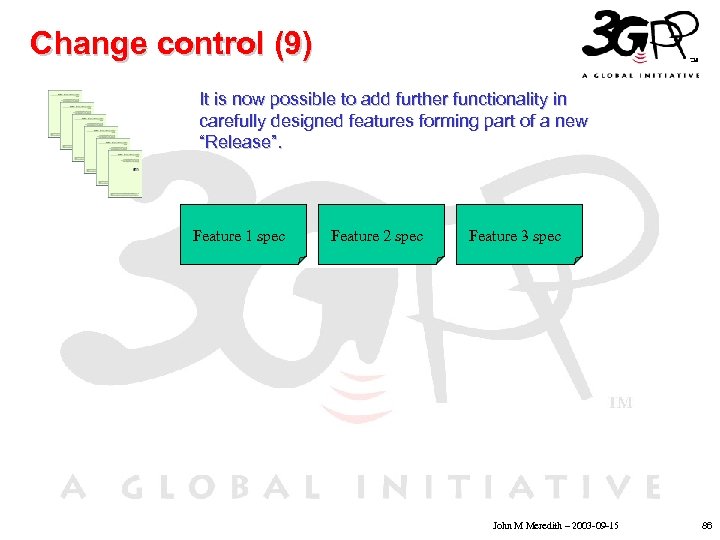 Change control (9) It is now possible to add further functionality in carefully designed features forming part of a new “Release”. • • • Click to edit Master text styles Second level Feature 1 spec Feature 2 spec Feature 3 spec Third level Fourth level Fifth level John M Meredith – 2003 -09 -15 86
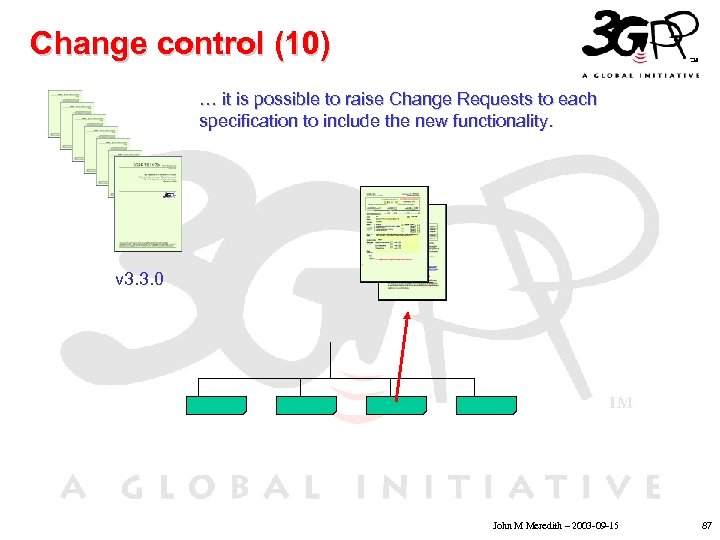 Change control (10) … it is possible to raise Change Requests to each specification to include the new functionality. • • • Click to edit Master text styles Second level Third level v 3. 3. 0 Fourth level Fifth level John M Meredith – 2003 -09 -15 87
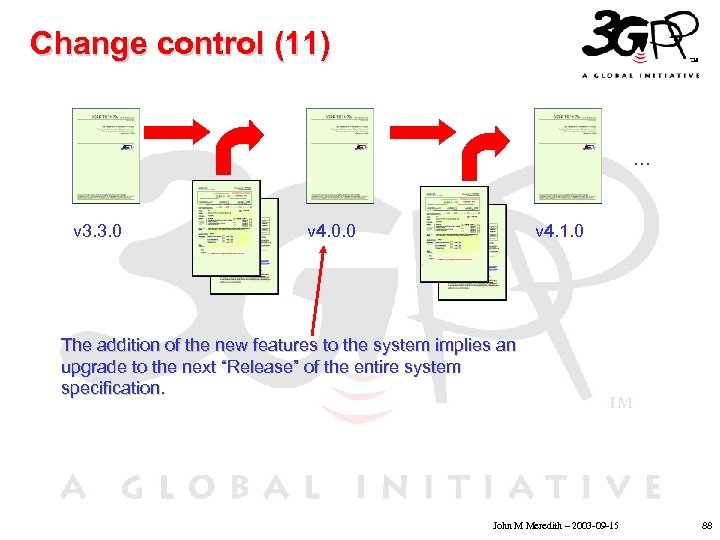 Change control (11) • Click to edit Master text styles • v 3. 3. 0 Second level v 4. 0. 0 • Third level • Fourth level • Fifth levelnew features to the system implies an The addition of the … v 4. 1. 0 upgrade to the next “Release” of the entire system specification. John M Meredith – 2003 -09 -15 88
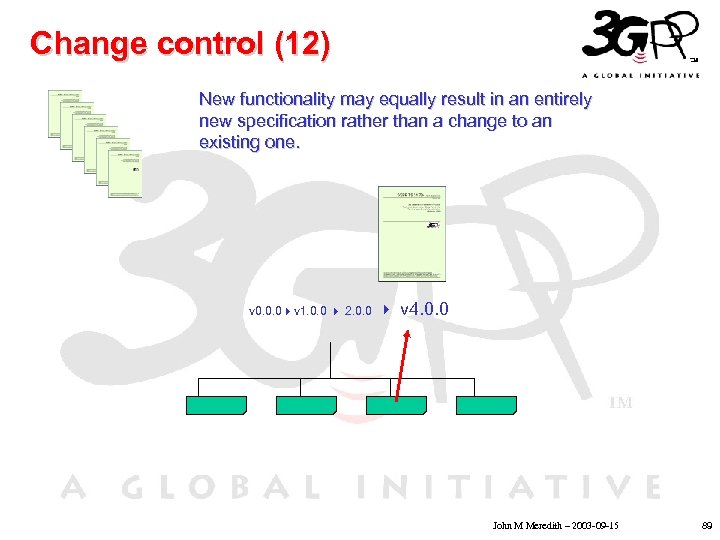 Change control (12) New functionality may equally result in an entirely new specification rather than a change to an existing one. • • • Click to edit Master text styles Second level Third level Fourth level v 0. 0. 0 v 1. 0. 0 2. 0. 0 v 4. 0. 0 Fifth level John M Meredith – 2003 -09 -15 89
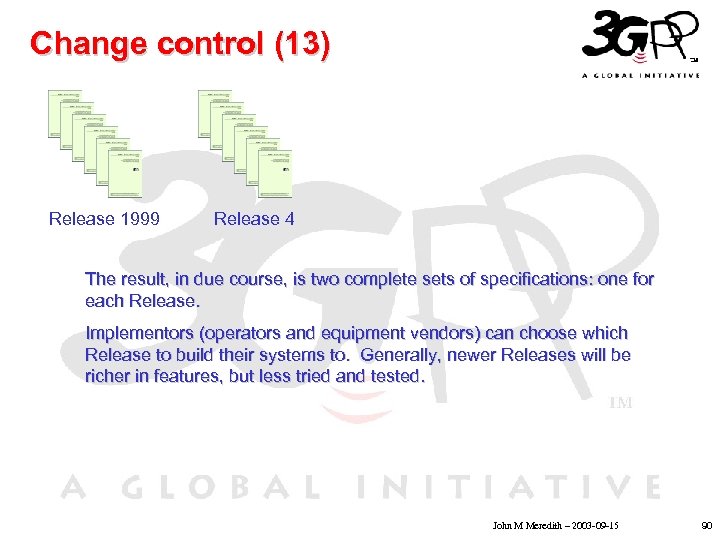 Change control (13) • Click to edit Master text styles Release 1999 Release • Second level 4 • Third level The result, in due course, is two complete sets of specifications: one for • each Release. Fourth level • Implementors (operators and equipment vendors) can choose will be Fifth to build their systems to. Generally, newer Releases which level Release richer in features, but less tried and tested. John M Meredith – 2003 -09 -15 90
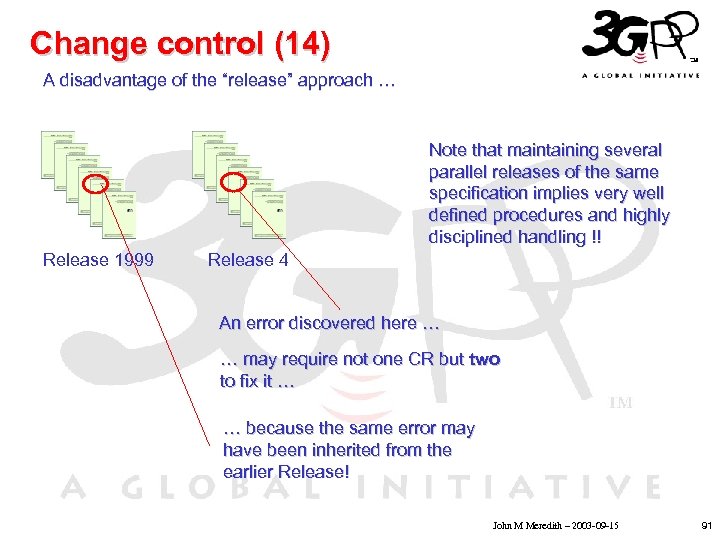 Change control (14) A disadvantage of the “release” approach … Note that maintaining several parallel styles releases of the same specification implies very well defined procedures and highly disciplined handling !! • Click to edit Master text • Second level Release 1999 level Release 4 • Third • Fourth level An error discovered here … • Fifth level … may require not one CR but two to fix it … … because the same error may have been inherited from the earlier Release! John M Meredith – 2003 -09 -15 91
 Change control (15) A change control system along the lines described has enabled the GSM specifications to have undergone nine controlled releases, and has allowed a smooth transition from second generation digital mobile communications • Click to to third Master re-using as many of the basic edit generation, text styles elements as possible. This mechanism requires meticulous project planning and control… • Second level • • • Third level Fourth level Fifth level John M Meredith – 2003 -09 -15 92
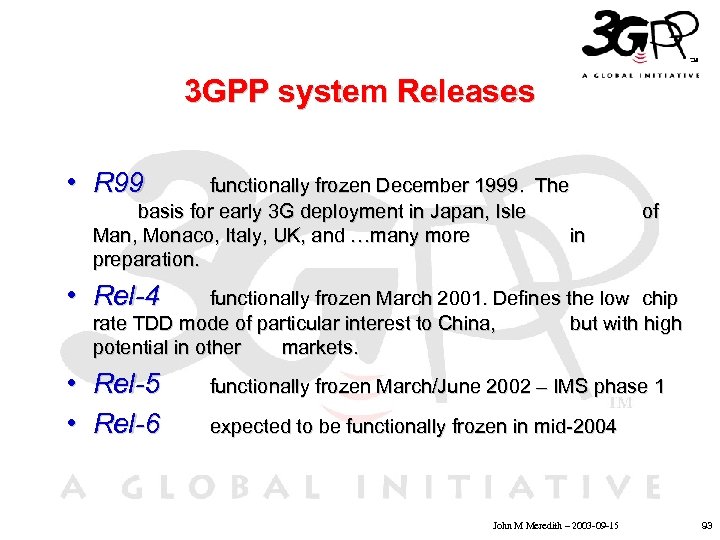 3 GPP system Releases • • • Click to edit Master text styles R 99 functionally frozen December 1999. The basis level of Secondfor early 3 G deployment in Japan, Isle Man, Monaco, Italy, UK, and …many more in preparation. Third level Rel-4 functionally frozen March 2001. Defines the low chip Fourth level rate TDD mode of particular interest to China, but with high Fifth level potential in other markets. • Rel-5 • Rel-6 functionally frozen March/June 2002 – IMS phase 1 expected to be functionally frozen in mid-2004 John M Meredith – 2003 -09 -15 93
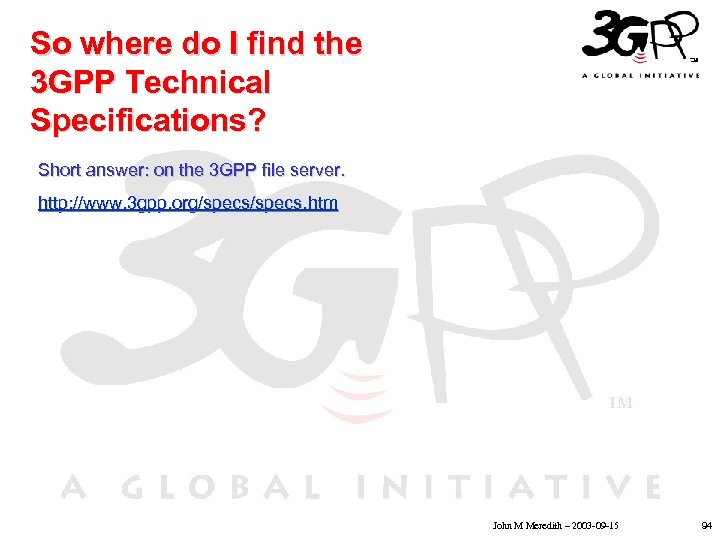 So where do I find the 3 GPP Technical Specifications? Short answer: on the 3 GPP file server. • Click to edit Master text styles http: //www. 3 gpp. org/specs. htm • Second level • Third level • Fourth level • Fifth level John M Meredith – 2003 -09 -15 94
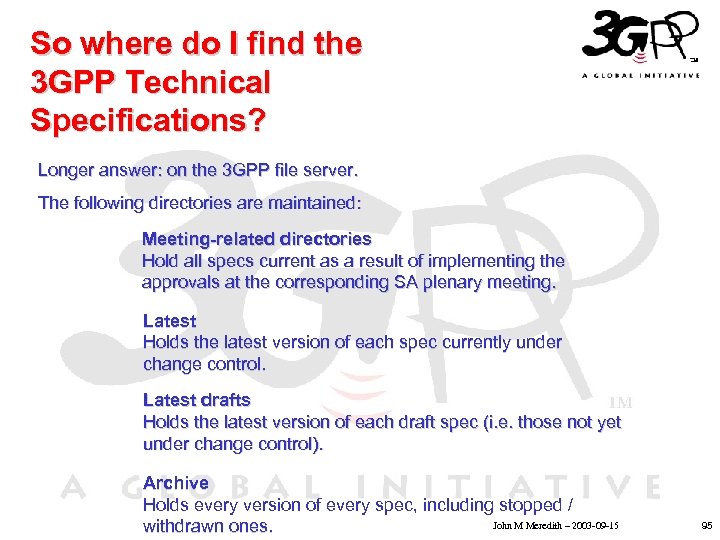 So where do I find the 3 GPP Technical Specifications? Longer answer: on the 3 GPP file server. • Click to edit Master text styles The following directories are maintained: • Second level Meeting-related directories Hold all specs • Third level current as a result of implementing the approvals at the corresponding SA plenary meeting. • Fourth level Latest • Fifth level latest version of each spec currently under Holds the change control. Latest drafts Holds the latest version of each draft spec (i. e. those not yet under change control). Archive Holds every version of every spec, including stopped / John M Meredith – 2003 -09 -15 95 withdrawn ones.
 • • • Click Foredit Master text styles visit to more information please Second level http: //www. 3 gpp. org Third level Or contact Fourth level Fifth leveljohn. meredith@etsi. org John M Meredith – 2003 -09 -15 96