 Скачать презентацию 3 G Tutorial Brough Turner Marc Orange
a0d2ee7b840b2c3cfdc76298fc7e875e.ppt
- Количество слайдов: 126



3 G Tutorial Brough Turner & Marc Orange Originally presented at Fall VON 2002
Preface. . . l The authors would like to acknowledgement material contributions from: n n n l We intend ongoing improvements to this tutorial and solicit your comments at: n n l Murtaza Amiji, NMS Communications Samuel S. May, Senior Research Analyst, US Bancorp Piper Jaffray Others as noted on specific slides rbt@nmss. com and/or marc_orange@nmss. com For the latest version go to: n http: //www. nmscommunications. com/3 Gtutorial www. nmscommunications. com
Outline l History and evolution of mobile radio n n l Brief history of cellular wireless telephony Radio technology today: TDMA, CDMA Demographics and market trends today 3 G vision, 3 G migration paths Evolving network architectures n n Based on GSM-MAP or on IS-41 today 3 GPP versus 3 GPP 2 evolution paths 3 G utilization of softswitches, Vo. IP and SIP Potential for convergence www. nmscommunications. com
Outline (continued) l Evolving services n n n l Applications & application frameworks n l SMS, EMS, MMS messaging Location Video and IP multimedia Is there a Killer App? Business models n What’s really happening? When? 4 www. nmscommunications. com
3 G Tutorial l l History and Evolution of Mobile Radio Evolving Network Architectures Evolving Services Applications Business Models www. nmscommunications. com
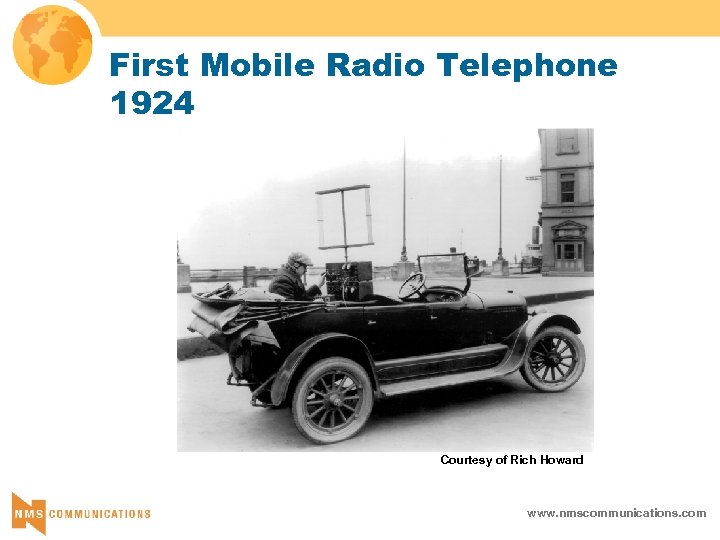
First Mobile Radio Telephone 1924 Courtesy of Rich Howard www. nmscommunications. com
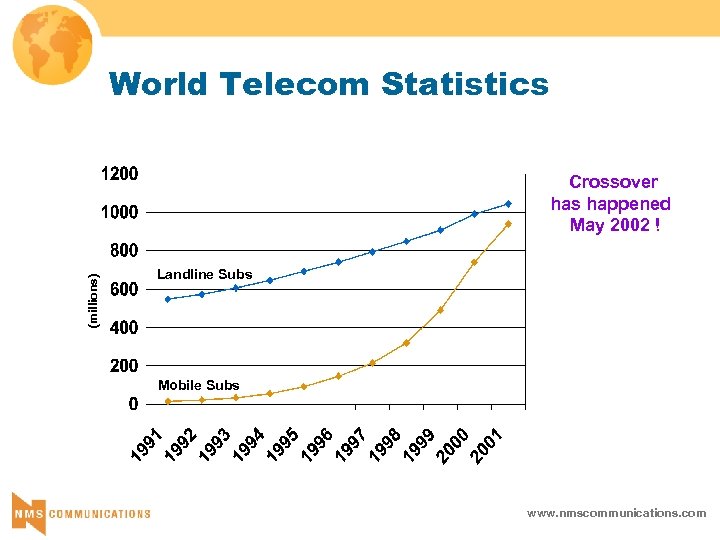
World Telecom Statistics (millions) Crossover has happened May 2002 ! Landline Subs Mobile Subs www. nmscommunications. com
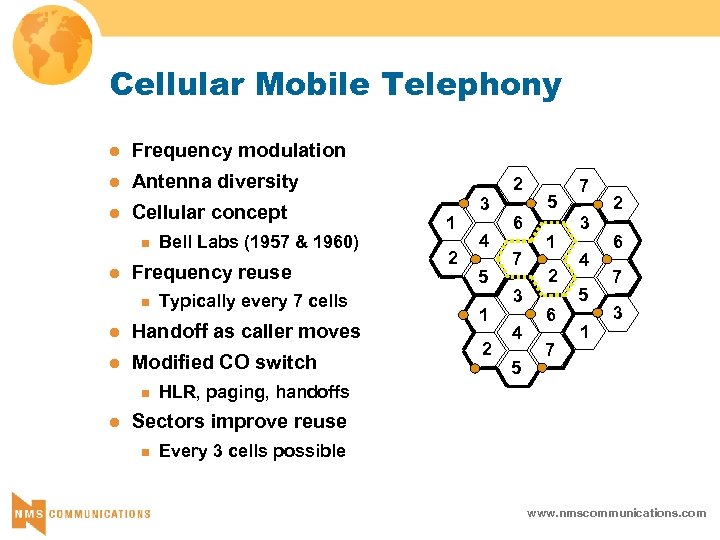
Cellular Mobile Telephony l Frequency modulation l Antenna diversity l Cellular concept n l Bell Labs (1957 & 1960) Frequency reuse n Typically every 7 cells l Handoff as caller moves l Modified CO switch n l 2 1 2 3 4 5 1 2 6 7 3 4 5 5 1 2 6 7 7 3 4 5 1 2 6 7 3 HLR, paging, handoffs Sectors improve reuse n Every 3 cells possible www. nmscommunications. com
First Generation l Advanced Mobile Phone Service (AMPS) n n l Nordic Mobile Telephony (NMT) n n n l US trials 1978; deployed in Japan (’ 79) & US (’ 83) 800 MHz band — two 20 MHz bands TIA-553 Still widely used in US and many parts of the world Sweden, Norway, Demark & Finland Launched 1981; now largely retired 450 MHz; later at 900 MHz (NMT 900) Total Access Communications System (TACS) n n British design; similar to AMPS; deployed 1985 Some TACS-900 systems still in use in Europe www. nmscommunications. com
Second Generation — 2 G l l Digital systems Leverage technology to increase capacity n l l Speech compression; digital signal processing Utilize/extend “Intelligent Network” concepts Improve fraud prevention Add new services There a wide diversity of 2 G systems n n n IS-54/ IS-136 North American TDMA; PDC (Japan) i. DEN DECT and PHS IS-95 CDMA (cdma. One) GSM www. nmscommunications. com
D-AMPS/ TDMA & PDC l Speech coded as digital bit stream n n l Time division multiple access (TDMA) n l l Development through 1980 s; bakeoff 1987 IS-54 / IS-136 standards in US TIA ATT Wireless & Cingular use IS-136 today n l 3 calls per radio channel using repeating time slices Deployed 1993 (PDC 1994) n l Compression plus error protection bits Aggressive compression limits voice quality Plan to migrate to GSM and then to W-CDMA PDC dominant cellular system in Japan today n NTT Do. Co. Mo has largest PDC network www. nmscommunications. com
i. DEN l l Used by Nextel Motorola proprietary system n n l 800 MHz private mobile radio (PMR) spectrum n l Just below 800 MHz cellular band Special protocol supports fast “Push-to-Talk” n l Time division multiple access technology Based on GSM architecture Digital replacement for old PMR services Nextel has highest APRU in US market due to “Direct Connect” push-to-talk service www. nmscommunications. com
DECT and PHS l l Also based on time division multiple access Digital European Cordless Telephony n n l Focus on business use, i. e. wireless PBX Very small cells; In building propagation issues Wide bandwidth (32 kbps channels) High-quality voice and/or ISDN data Personal Handiphone Service n n n Similar performance (32 kbps channels) Deployed across Japanese cities (high pop. density) 4 channel base station uses one ISDN BRI line Base stations on top of phone booths Legacy in Japan; new deployments in China today www. nmscommunications. com
North American CDMA (cdma. One) l Code Division Multiple Access n n l Qualcomm demo in 1989 n l l All users share same frequency band Discussed in detail later as CDMA is basis for 3 G Claimed improved capacity & simplified planning First deployment in Hong Kong late 1994 Major success in Korea (1 M subs by 1996) Used by Verizon and Sprint in US Simplest 3 G migration story today www. nmscommunications. com
cdma. One — IS-95 l l TIA standard IS-95 (ANSI-95) in 1993 IS-95 deployed in the 800 MHz cellular band n l Evolution fixes bugs and adds data n n n l J-STD-08 variant deployed in 1900 MHz US “PCS” band IS-95 A provides data rates up to 14. 4 kbps IS-95 B provides rates up to 64 kbps (2. 5 G) Both A and B are compatible with J-STD-08 All variants designed for TIA IS-41 core networks (ANSI 41) www. nmscommunications. com
GSM l « Groupe Special Mobile » , later changed to « Global System for Mobile » n n l Services launched 1991 n n n l Joint European effort beginning in 1982 Focus on seamless roaming across Europe Time division multiple access (8 users per 200 KHz) 900 MHz band; later extended to 1800 MHz Added 1900 MHz (US PCS bands) GSM is dominant world standard today n n n Well defined interfaces; many competitors Network effect (Metcalfe’s law) took hold in late 1990 s Tri-band GSM phone can roam the world today www. nmscommunications. com
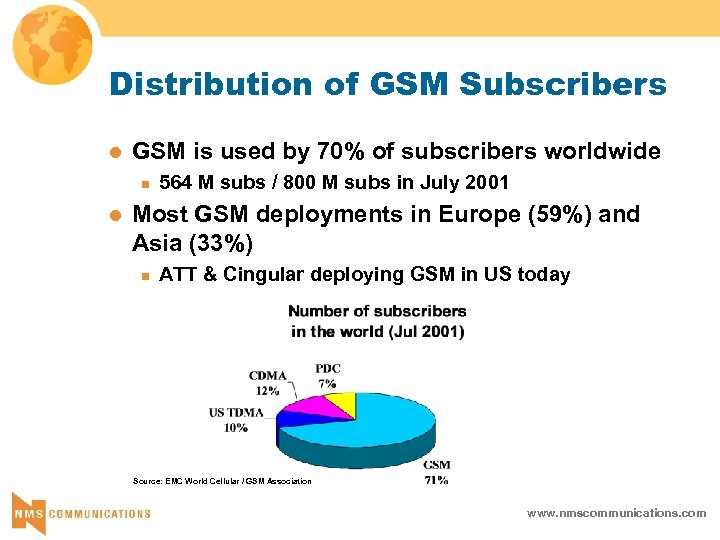
Distribution of GSM Subscribers l GSM is used by 70% of subscribers worldwide n l 564 M subs / 800 M subs in July 2001 Most GSM deployments in Europe (59%) and Asia (33%) n ATT & Cingular deploying GSM in US today Source: EMC World Cellular / GSM Association www. nmscommunications. com
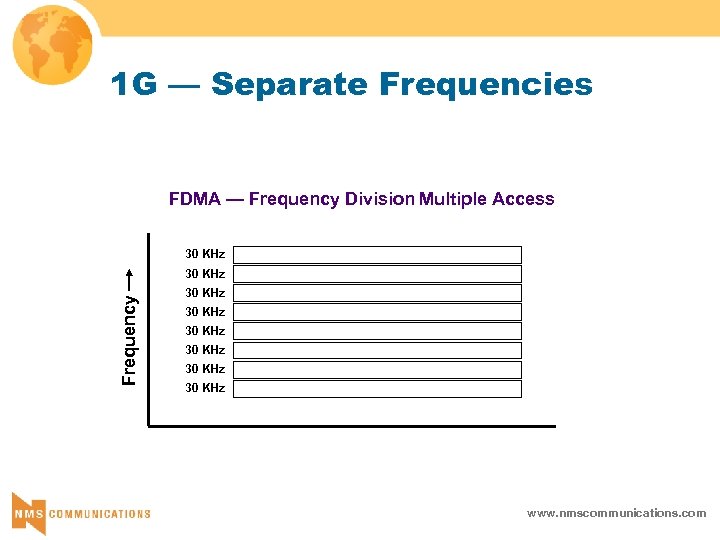
1 G — Separate Frequencies FDMA — Frequency Division Multiple Access 30 KHz Frequency 30 KHz 30 KHz www. nmscommunications. com
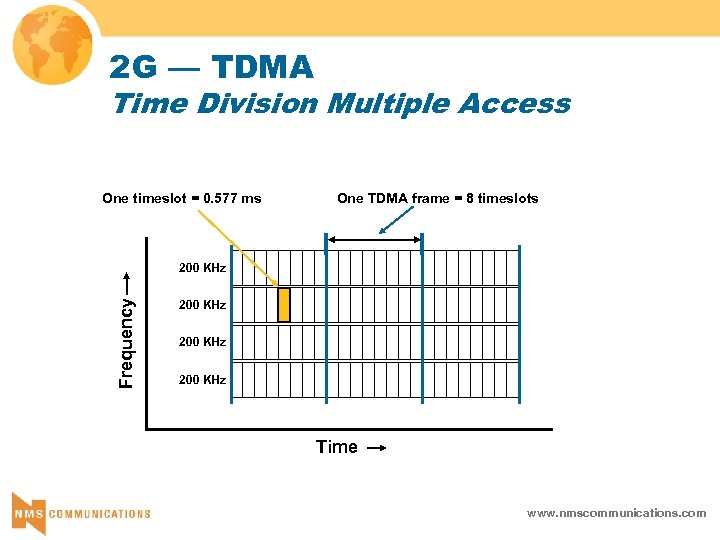
2 G — TDMA Time Division Multiple Access One timeslot = 0. 577 ms One TDMA frame = 8 timeslots Frequency 200 KHz Time www. nmscommunications. com
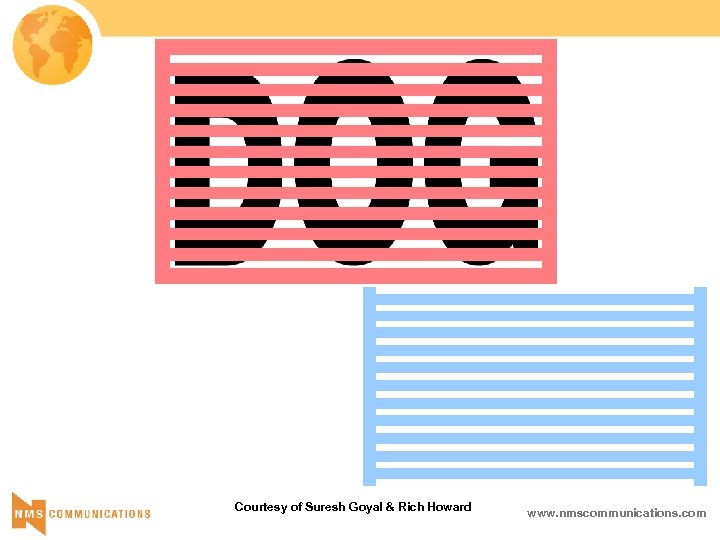
2 G & 3 G — CDMA Code Division Multiple Access l Spread spectrum modulation n l All users share same (large) block of spectrum n n l Originally developed for the military Resists jamming and many kinds of interference Coded modulation hidden from those w/o the code One for one frequency reuse Soft handoffs possible Almost all accepted 3 G radio standards are based on CDMA 2000, W-CDMA and TD-SCDMA www. nmscommunications. com
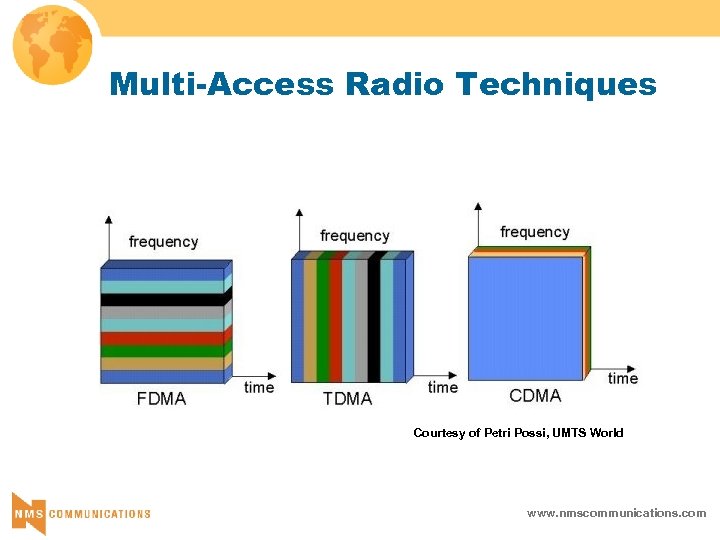
Multi-Access Radio Techniques Courtesy of Petri Possi, UMTS World www. nmscommunications. com

Courtesy of Suresh Goyal & Rich Howard www. nmscommunications. com
Courtesy of Suresh Goyal & Rich Howard www. nmscommunications. com

Courtesy of Suresh Goyal & Rich Howard www. nmscommunications. com

Courtesy of Suresh Goyal & Rich Howard www. nmscommunications. com
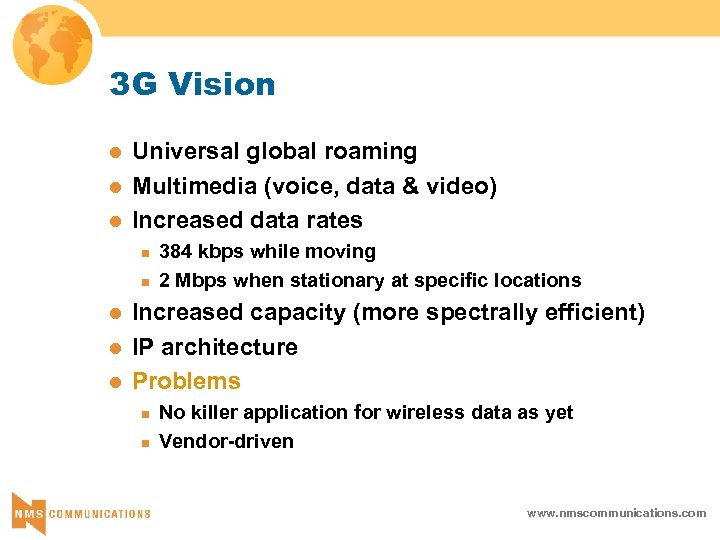
3 G Vision l l l Universal global roaming Multimedia (voice, data & video) Increased data rates n n l l l 384 kbps while moving 2 Mbps when stationary at specific locations Increased capacity (more spectrally efficient) IP architecture Problems n n No killer application for wireless data as yet Vendor-driven www. nmscommunications. com
International Standardization l ITU (International Telecommunication Union) n l IMT-2000 n l ITU’s umbrella name for 3 G which stands for International Mobile Telecommunications 2000 National and regional standards bodies are collaborating in 3 G partnership projects n l Radio standards and spectrum ARIB, TIA, TTC, CWTS. T 1, ETSI - refer to reference slides at the end for names and links 3 G Partnership Projects (3 GPP & 3 GPP 2) n Focused on evolution of access and core networks www. nmscommunications. com
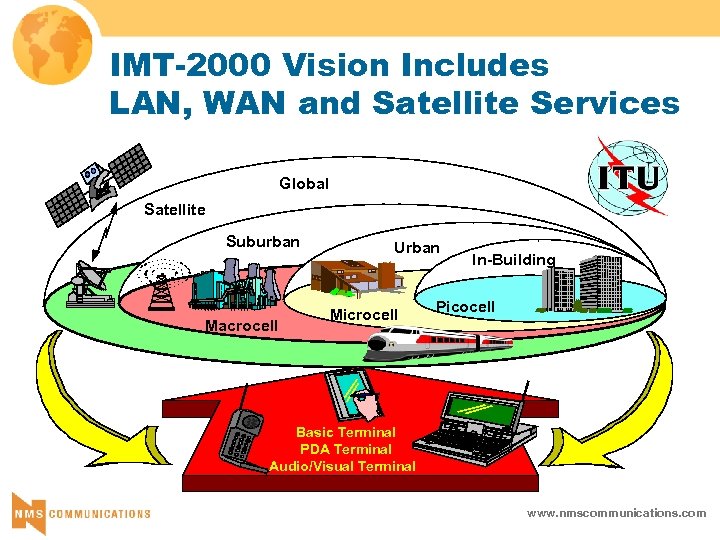
IMT-2000 Vision Includes LAN, WAN and Satellite Services Global Satellite Suburban Macrocell Urban Microcell In-Building Picocell Basic Terminal PDA Terminal Audio/Visual Terminal www. nmscommunications. com
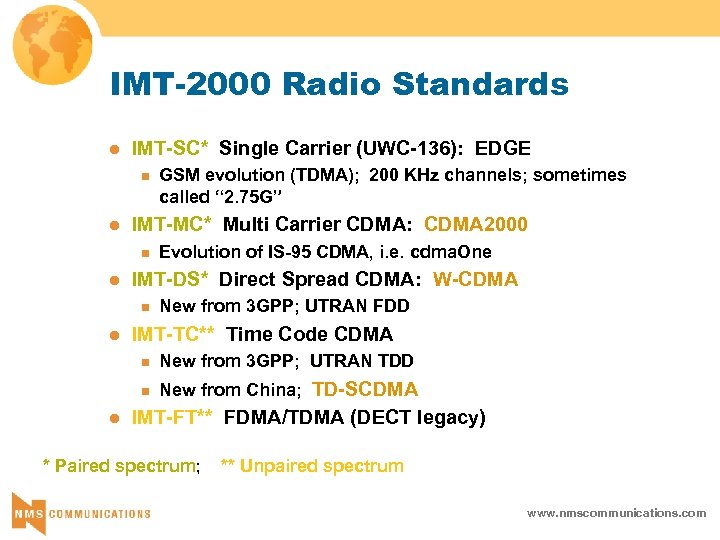
IMT-2000 Radio Standards l IMT-SC* Single Carrier (UWC-136): EDGE n l IMT-MC* Multi Carrier CDMA: CDMA 2000 n l Evolution of IS-95 CDMA, i. e. cdma. One IMT-DS* Direct Spread CDMA: W-CDMA n l GSM evolution (TDMA); 200 KHz channels; sometimes called “ 2. 75 G” New from 3 GPP; UTRAN FDD IMT-TC** Time Code CDMA n n l New from 3 GPP; UTRAN TDD New from China; TD-SCDMA IMT-FT** FDMA/TDMA (DECT legacy) * Paired spectrum; ** Unpaired spectrum www. nmscommunications. com
CDMA 2000 Pros and Cons l Evolution from original Qualcomm CDMA n l Better migration story from 2 G to 3 G n n l cdma. One operators don’t need additional spectrum 1 x. EVD 0 promises higher data rates than UMTS, i. e. W-CDMA Better spectral efficiency than W-CDMA(? ) n l Now known as cdma. One or IS-95 Arguable (and argued!) CDMA 2000 core network less mature n n cmda. One interfaces were vendor-specific Hopefully CDMA 2000 vendors will comply w/ 3 GPP 2 www. nmscommunications. com
W-CDMA (UMTS) Pros and Cons l Wideband CDMA n l Committed standard for Europe and likely migration path for other GSM operators n l l Leverages GSM’s dominant position Requires substantial new spectrum n l Standard for Universal Mobile Telephone Service (UMTS) 5 MHz each way (symmetric) Legally mandated in Europe and elsewhere Sales of new spectrum completed in Europe n At prices that now seem exorbitant www. nmscommunications. com
TD-SCDMA l l Time division duplex (TDD) Chinese development n l l l Good match for asymmetrical traffic! Single spectral band (1. 6 MHz) possible Costs relatively low n n n l Will be deployed in China Handset smaller and may cost less Power consumption lower TDD has the highest spectrum efficiency Power amplifiers must be very linear n Relatively hard to meet specifications www. nmscommunications. com
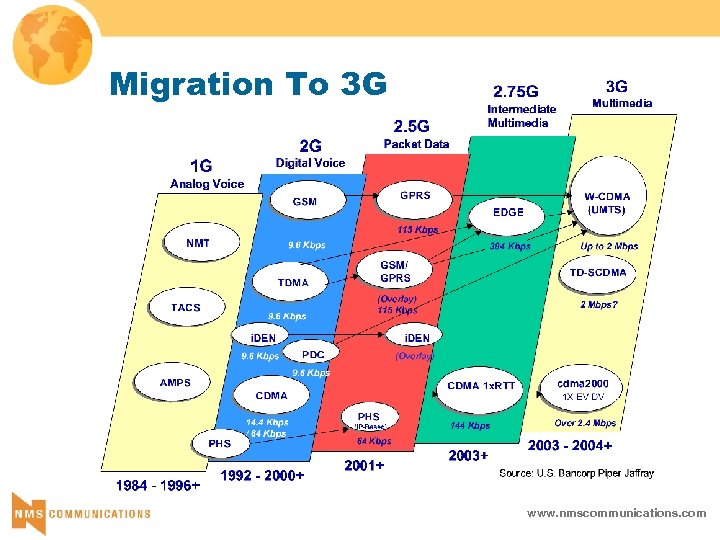
Migration To 3 G www. nmscommunications. com
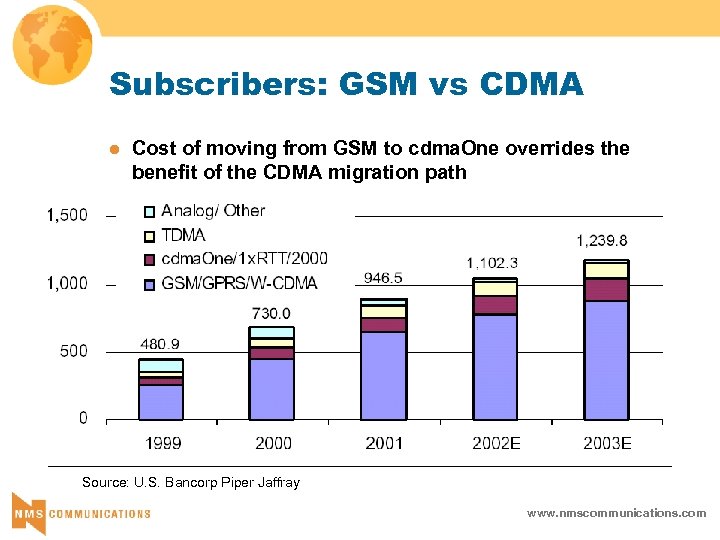
Subscribers: GSM vs CDMA l Cost of moving from GSM to cdma. One overrides the benefit of the CDMA migration path Source: U. S. Bancorp Piper Jaffray www. nmscommunications. com
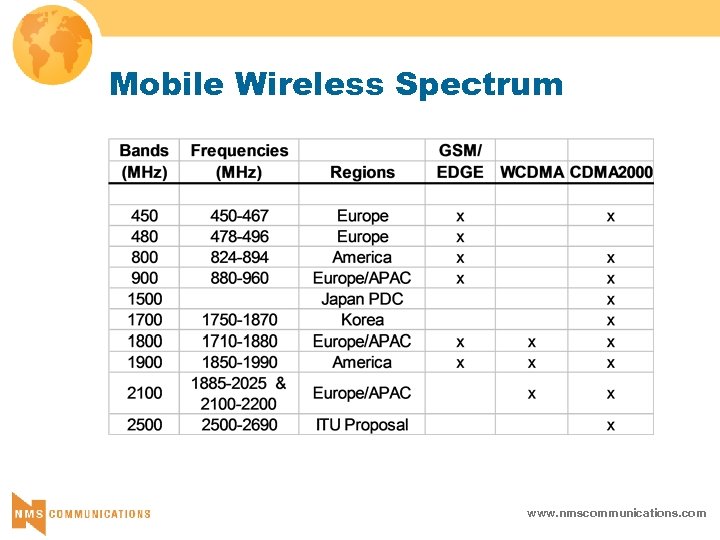
Mobile Wireless Spectrum www. nmscommunications. com
Prospects for Global Roaming l l Multiple vocoders (AMR, EVRC, SMV, …) Six or more spectral bands n l 800, 900, 1800, 1900, 2100, 2500, …? MHz At least four modulation variants n GSM (TDMA), W-CDMA, CDMA 2000, TD-SCMDA The handset approach Advanced silicon l Software defined radio l Improved batteries Two cycles of Moore’s law? i. e. 3 yrs? l www. nmscommunications. com
3 G Tutorial l l History and Evolution of Mobile Radio Evolving Network Architectures Evolving Services Applications Business Models www. nmscommunications. com
Evolving CN Architectures l l Two widely deployed architectures today GSM-MAP — used by GSM operators n l ANSI-41 MAP — used with AMPS, TDMA & cdma. One n l “Mobile Application Part” defines extra (SS 7 -based) signaling for mobility, authentication, etc. TIA (ANSI) standard for “cellular radio telecommunications inter-system operation” Each evolving to common “all IP” vision n n “All IP” still being defined — many years away GAIT (GSM ANSI Interoperability Team) provides a path for interoperation today www. nmscommunications. com
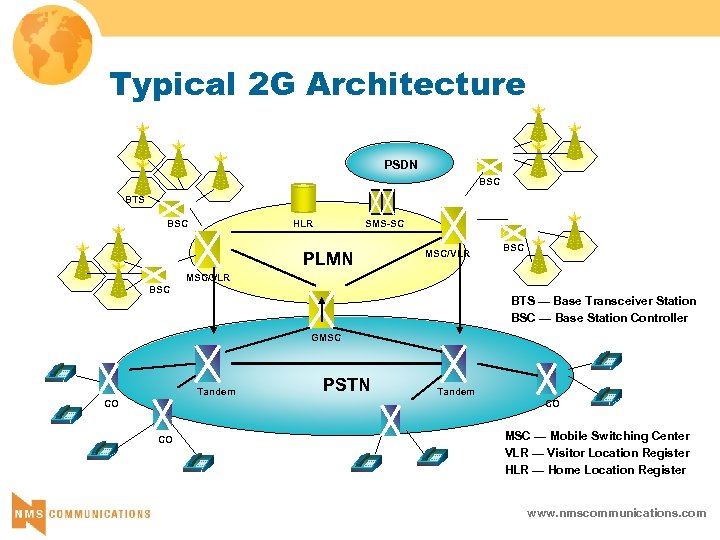
Typical 2 G Architecture PSDN BSC BTS BSC HLR SMS-SC PLMN MSC/VLR BSC BTS — Base Transceiver Station BSC — Base Station Controller GMSC Tandem CO PSTN Tandem CO CO MSC — Mobile Switching Center VLR — Visitor Location Register HLR — Home Location Register www. nmscommunications. com
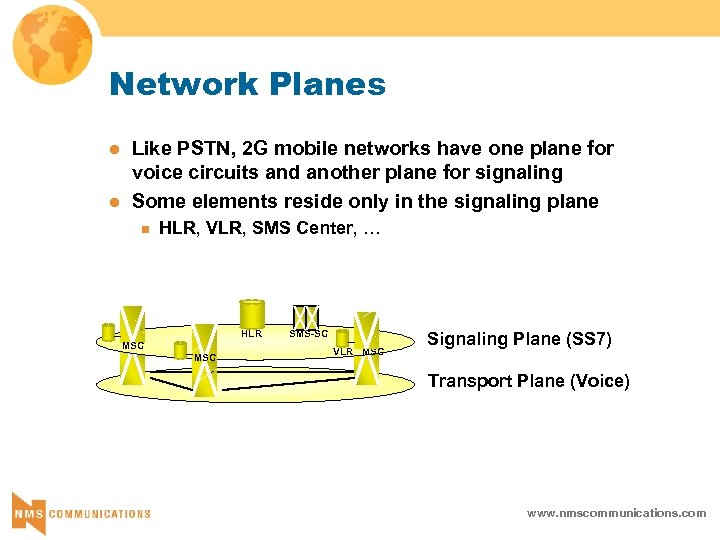
Network Planes l l Like PSTN, 2 G mobile networks have one plane for voice circuits and another plane for signaling Some elements reside only in the signaling plane n HLR, VLR, SMS Center, … HLR MSC SMS-SC VLR MSC Signaling Plane (SS 7) Transport Plane (Voice) www. nmscommunications. com
Signaling in Core Network l Based on SS 7 n l GSM MAP and ANSI-41 services n n n l ISUP and specific Application Parts Mobility, call-handling, O&M Authentication, supplementary services SMS, … Location registers for mobility management n n HLR: home location register has permanent data VLR: visitor location register keeps local copy for roamers www. nmscommunications. com
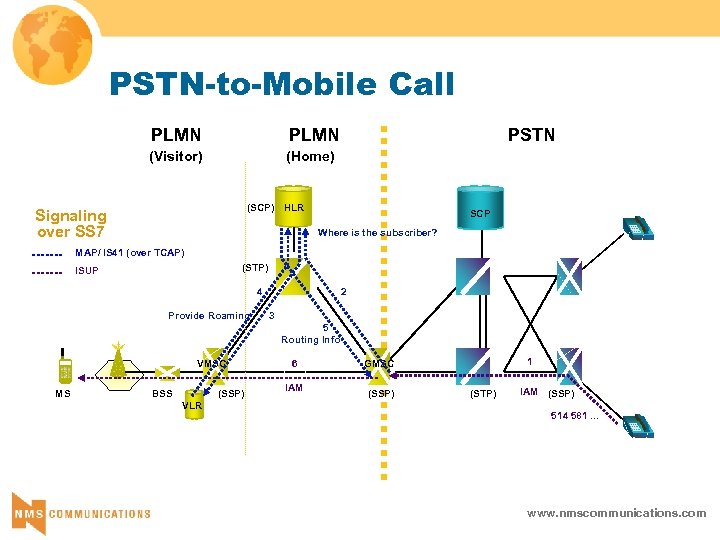
PSTN-to-Mobile Call PLMN (Visitor) PSTN (Home) (SCP) HLR Signaling over SS 7 SCP Where is the subscriber? MAP/ IS 41 (over TCAP) (STP) ISUP 4 Provide Roaming 2 3 5 Routing Info VMSC MS BSS (SSP) VLR 6 IAM 1 GMSC (SSP) (STP) IAM (SSP) 514 581. . . www. nmscommunications. com
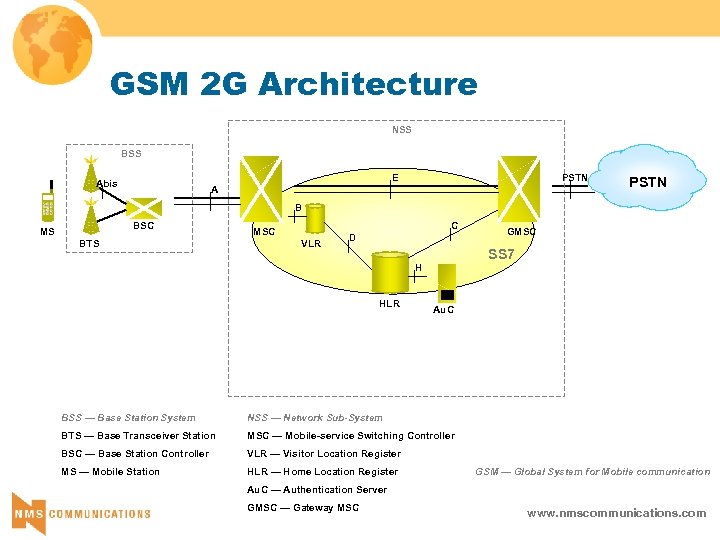
GSM 2 G Architecture NSS BSS E Abis PSTN A PSTN B BSC MS BTS C MSC VLR D SS 7 H HLR GMSC Au. C BSS — Base Station System NSS — Network Sub-System BTS — Base Transceiver Station MSC — Mobile-service Switching Controller BSC — Base Station Controller VLR — Visitor Location Register MS — Mobile Station HLR — Home Location Register GSM — Global System for Mobile communication Au. C — Authentication Server GMSC — Gateway MSC www. nmscommunications. com
Enhancing GSM l l New technology since mid-90 s Global standard — most widely deployed n l Frequency hopping n l Overcome fading Synchronization between cells n n l significant payback for enhancements DFCA: dynamic frequency and channel assignment l Allocate radio resources to minimize interference Also used to determine mobile’s location TFO — Tandem Free Operation www. nmscommunications. com
TFO Concepts l l Improve voice quality by disabling unneeded transcoders during mobile-to-mobile calls Operate with existing networks (BSCs, MSCs) n n n l New TRAU negotiates TFO in-band after call setup TFO frames use LSBits of 64 Kbps circuit to carry compressed speech frames and TFO signaling MSBits still carry normal G. 711 speech samples Limitations n n n Same speech codec in each handset Digital transparency in core network (EC off!) TFO disabled upon cell handover, call transfer, inband DTMF, announcements or conferencing www. nmscommunications. com
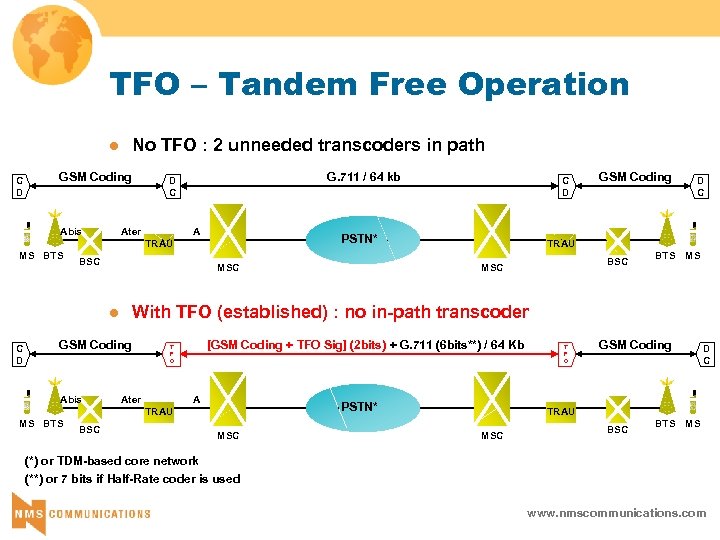
TFO – Tandem Free Operation No TFO : 2 unneeded transcoders in path l C D GSM Coding Abis G. 711 / 64 kb D C Ater A PSTN* TRAU MS BTS BSC MSC GSM Coding Abis BSC D C TRAU BSC MSC [GSM Coding + TFO Sig] (2 bits) + G. 711 (6 bits**) / 64 Kb T F O Ater A PSTN* TRAU MS BTS GSM Coding BTS MS With TFO (established) : no in-path transcoder l C D MSC T F O GSM Coding D C TRAU MSC BTS MS (*) or TDM-based core network (**) or 7 bits if Half-Rate coder is used www. nmscommunications. com
New Vocoders: AMR & SMV l AMR: Adaptive multi-rate n n l SMV: Selectable mode vocoder n l Defined by 3 GPP 2 for CDMA 2000 Many available coding rates n n l Defined for UMTS (W-CDMA) Being retrofitted for GSM AMR 8 rates: 12. 2, 10. 2, 7. 95, 7. 4, 6. 7, 5. 9, 5. 15 & 4. 75 bps, plus silence frames (near 0 bps) SMV 4 rates: 8. 5, 4, 2 & 0. 8 kbps Lower bit rates allow more error correction n Dynamically adjust to radio interference conditions www. nmscommunications. com
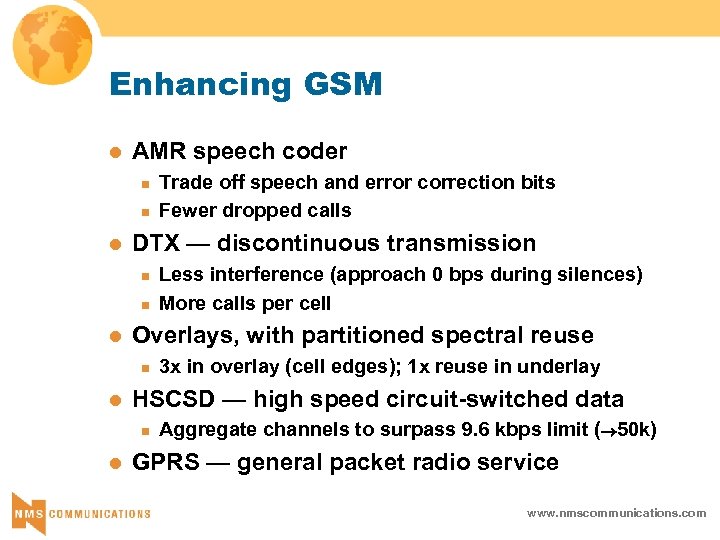
Enhancing GSM l AMR speech coder n n l DTX — discontinuous transmission n n l 3 x in overlay (cell edges); 1 x reuse in underlay HSCSD — high speed circuit-switched data n l Less interference (approach 0 bps during silences) More calls per cell Overlays, with partitioned spectral reuse n l Trade off speech and error correction bits Fewer dropped calls Aggregate channels to surpass 9. 6 kbps limit ( 50 k) GPRS — general packet radio service www. nmscommunications. com
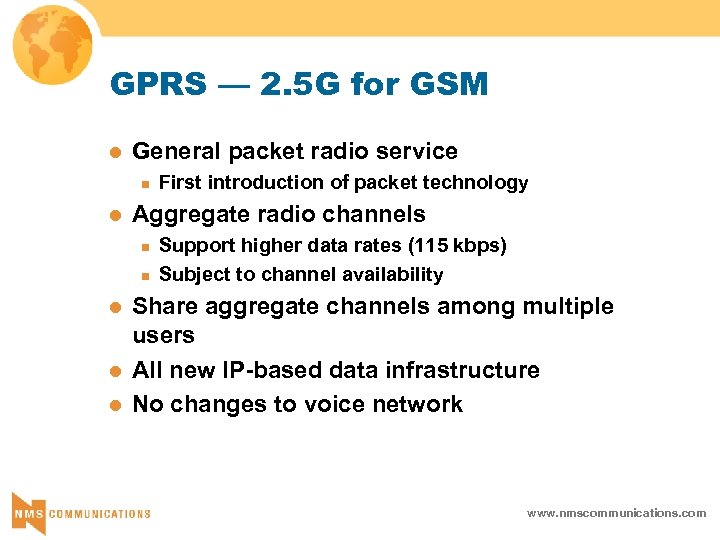
GPRS — 2. 5 G for GSM l General packet radio service n l Aggregate radio channels n n l l l First introduction of packet technology Support higher data rates (115 kbps) Subject to channel availability Share aggregate channels among multiple users All new IP-based data infrastructure No changes to voice network www. nmscommunications. com
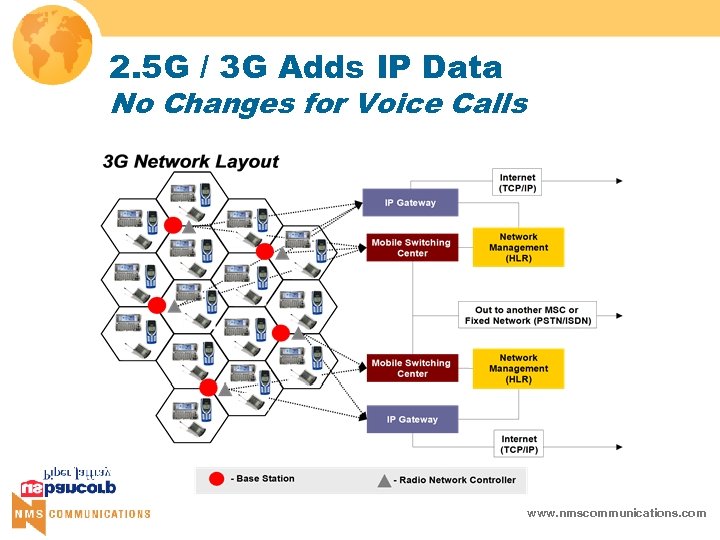
2. 5 G / 3 G Adds IP Data No Changes for Voice Calls www. nmscommunications. com
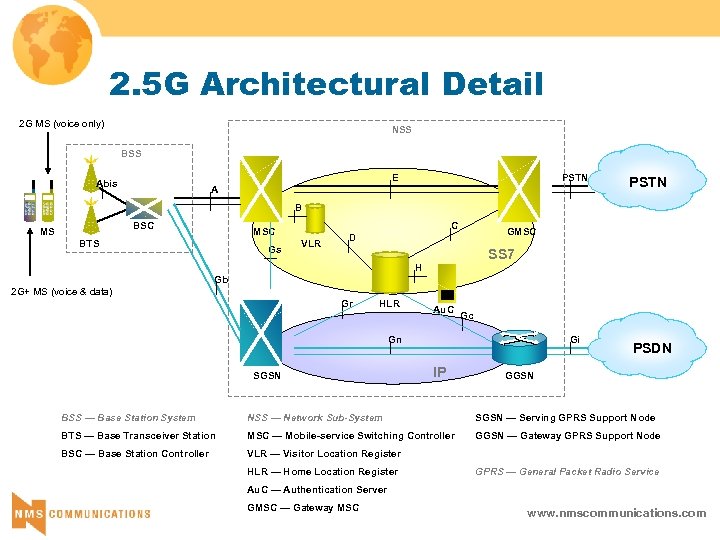
2. 5 G Architectural Detail 2 G MS (voice only) NSS BSS E Abis PSTN A PSTN B BSC MSC BTS Gs VLR GMSC D SS 7 H Gb 2 G+ MS (voice & data) Gr HLR Au. C Gc Gi Gn SGSN IP PSDN GGSN BSS — Base Station System NSS — Network Sub-System SGSN — Serving GPRS Support Node BTS — Base Transceiver Station MSC — Mobile-service Switching Controller GGSN — Gateway GPRS Support Node BSC — Base Station Controller VLR — Visitor Location Register HLR — Home Location Register GPRS — General Packet Radio Service Au. C — Authentication Server GMSC — Gateway MSC www. nmscommunications. com
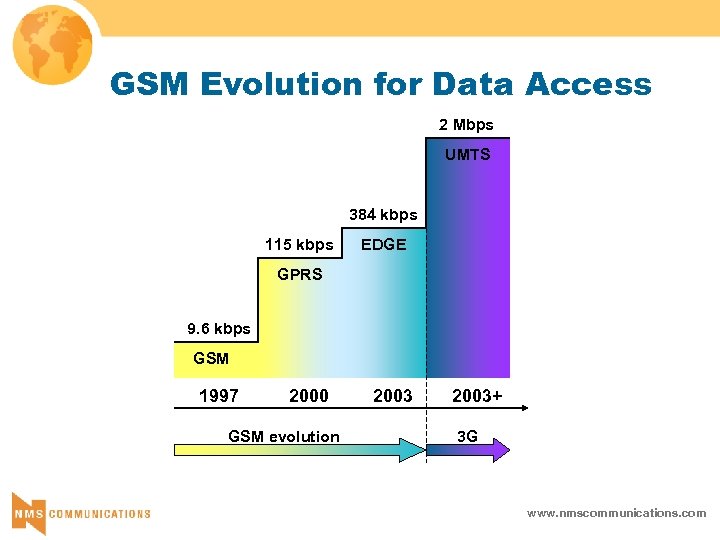
GSM Evolution for Data Access 2 Mbps UMTS 384 kbps 115 kbps EDGE GPRS 9. 6 kbps GSM 1997 2000 GSM evolution 2003+ 3 G www. nmscommunications. com
EDGE l l Enhanced Data rates for Global Evolution Increased data rates with GSM compatibility n n n l Still 200 KHz bands; still TDMA 8 -PSK modulation: 3 bits/symbol give 3 X data rate Shorter range (more sensitive to noise/interference) GAIT — GSM/ANSI-136 interoperability team n n Allows IS-136 TDMA operators to migrate to EDGE New GSM/ EDGE radios but evolved ANSI-41 core network www. nmscommunications. com
3 G Partnership Project (3 GPP) l 3 GPP defining migration from GSM to UMTS (W-CDMA) n l 3 GPP Release 99 n l Adds softswitch/ voice gateways and packet core 3 GPP Release 5 n l Adds 3 G radios 3 GPP Release 4 n l Core network evolves from GSM-only to support GSM, GPRS and new W-CDMA facilities First IP Multimedia Services (IMS) w/ SIP & Qo. S 3 GPP Release 6 n “All IP” network; contents of r 6 still being defined www. nmscommunications. com
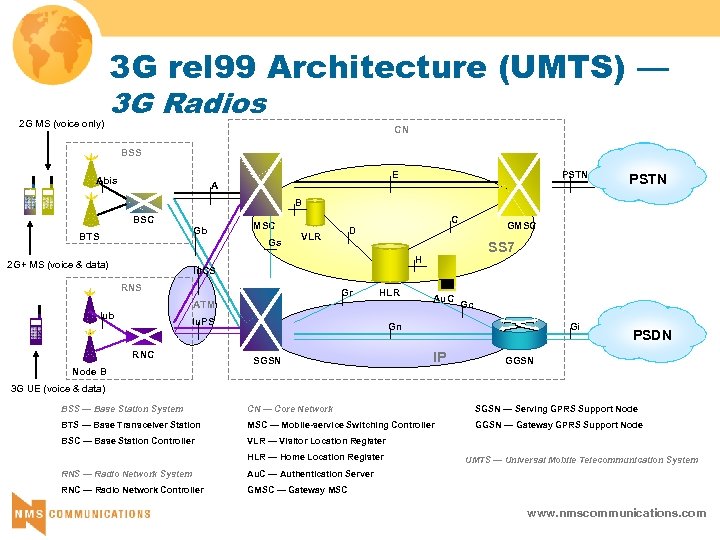
3 G rel 99 Architecture (UMTS) — 2 G MS (voice only) 3 G Radios CN BSS E Abis PSTN A PSTN B BSC Gb BTS C MSC Gs GMSC D VLR SS 7 H 2 G+ MS (voice & data) Iu. CS RNS Gr HLR ATM Iub Iu. PS RNC Au. C Gc Gn SGSN Gi IP PSDN GGSN Node B 3 G UE (voice & data) BSS — Base Station System CN — Core Network SGSN — Serving GPRS Support Node BTS — Base Transceiver Station MSC — Mobile-service Switching Controller GGSN — Gateway GPRS Support Node BSC — Base Station Controller VLR — Visitor Location Register HLR — Home Location Register RNS — Radio Network System Au. C — Authentication Server RNC — Radio Network Controller UMTS — Universal Mobile Telecommunication System GMSC — Gateway MSC www. nmscommunications. com
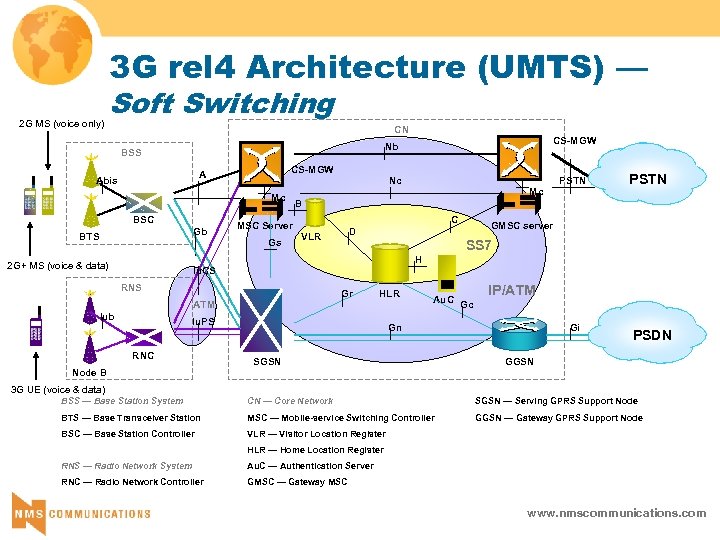
3 G rel 4 Architecture (UMTS) — 2 G MS (voice only) Soft Switching CN CS-MGW A Abis Nc Mc BSC Gb BTS CS-MGW Nb BSS PSTN B C MSC Server Gs PSTN Mc GMSC server D VLR SS 7 H 2 G+ MS (voice & data) Iu. CS RNS Gr HLR ATM Iub Iu. PS RNC Au. C IP/ATM Gc Gn SGSN Gi PSDN GGSN Node B 3 G UE (voice & data) BSS — Base Station System CN — Core Network SGSN — Serving GPRS Support Node BTS — Base Transceiver Station MSC — Mobile-service Switching Controller GGSN — Gateway GPRS Support Node BSC — Base Station Controller VLR — Visitor Location Register HLR — Home Location Register RNS — Radio Network System Au. C — Authentication Server RNC — Radio Network Controller GMSC — Gateway MSC www. nmscommunications. com
Transcoder Free Operation (Tr. FO) l Improve voice quality by avoiding unneeded transcoders n l like TFO but using packet-based core network Out-of-band negociation n Select same codec at both ends during call setup Supports sudden channel rearrangement (handovers, etc. ) via signaling procedures When Tr. FO impossible, TFO can be attempted l e. g. transit between packet-based and circuitbased core networks www. nmscommunications. com
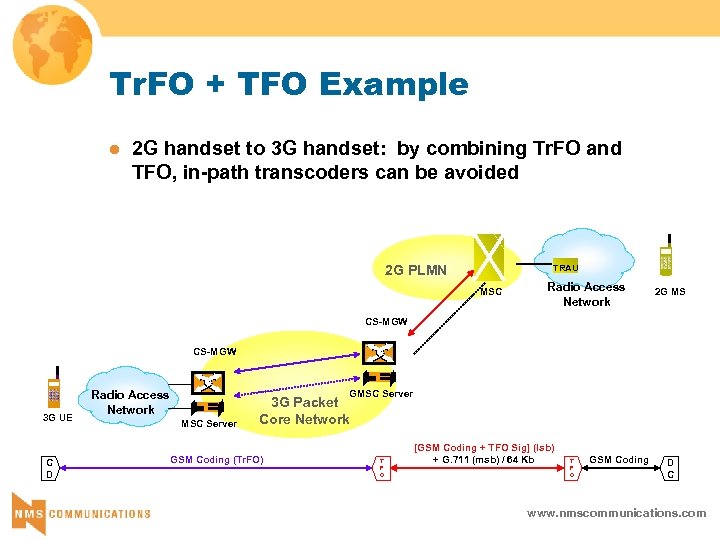
Tr. FO + TFO Example l 2 G handset to 3 G handset: by combining Tr. FO and TFO, in-path transcoders can be avoided 2 G PLMN TRAU MSC Radio Access Network 2 G MS CS-MGW 3 G UE C D GMSC Server Radio Access Network MSC Server 3 G Packet Core Network GSM Coding (Tr. FO) T F O [GSM Coding + TFO Sig] (lsb) + G. 711 (msb) / 64 Kb T F O GSM Coding D C www. nmscommunications. com
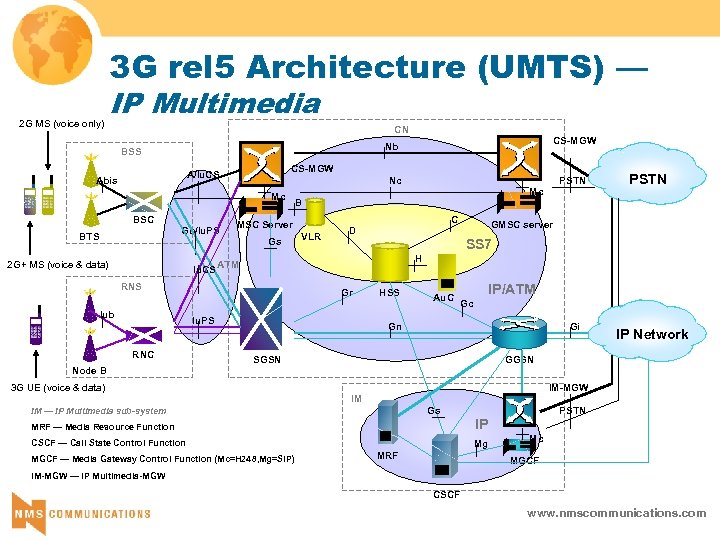
3 G rel 5 Architecture (UMTS) — 2 G MS (voice only) IP Multimedia CN CS-MGW A/Iu. CS Abis Nc Mc BSC BTS CS-MGW Nb BSS Gb/Iu. PS 2 G+ MS (voice & data) Iu. CS C VLR SS 7 ATM Gr Iu. PS RNC GMSC server D H RNS Iub PSTN B MSC Server Gs PSTN Mc HSS Au. C IP/ATM Gc Gn Gi SGSN IP Network GGSN Node B 3 G UE (voice & data) IM-MGW IM Gs IM — IP Multimedia sub-system PSTN MRF — Media Resource Function IP CSCF — Call State Control Function Mg MGCF — Media Gateway Control Function (Mc=H 248, Mg=SIP) MRF Mc MGCF IM-MGW — IP Multimedia-MGW CSCF www. nmscommunications. com
3 GPP Rel. 6 Objectives l IP Multimedia Services, phase 2 n l l IMS messaging and group management Wireless LAN interworking Speech enabled services n Distributed speech recognition (DSR) l Number portability Other enhancements l Scope and definition in progress l www. nmscommunications. com
3 GPP 2 Defines IS-41 Evolution l 3 rd Generation Partnership Project “Two” n n l Evolution of IS-41 to “all IP” more direct but not any faster n l l l Separate organization, as 3 GPP closely tied to GSM and UMTS Goal of ultimate merger (3 GPP + 3 GPP 2) remains Skips ATM stage 1 x. RTT — IP packet support (like GPRS) 1 x. EVDV — adds softswitch/ voice gateways 3 x — triples radio data rates www. nmscommunications. com
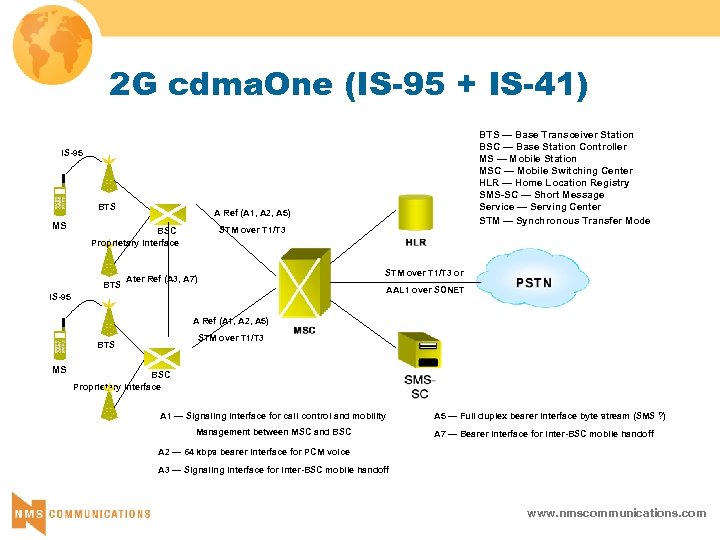
2 G cdma. One (IS-95 + IS-41) BTS — Base Transceiver Station BSC — Base Station Controller MS — Mobile Station MSC — Mobile Switching Center HLR — Home Location Registry SMS-SC — Short Message Service — Serving Center STM — Synchronous Transfer Mode IS-95 BTS MS A Ref (A 1, A 2, A 5) STM over T 1/T 3 BSC Proprietary Interface BTS STM over T 1/T 3 or Ater Ref (A 3, A 7) AAL 1 over SONET IS-95 A Ref (A 1, A 2, A 5) STM over T 1/T 3 BTS MS BSC Proprietary Interface A 1 — Signaling interface for call control and mobility Management between MSC and BSC A 5 — Full duplex bearer interface byte stream (SMS ? ) A 7 — Bearer interface for inter-BSC mobile handoff A 2 — 64 kbps bearer interface for PCM voice A 3 — Signaling interface for inter-BSC mobile handoff www. nmscommunications. com
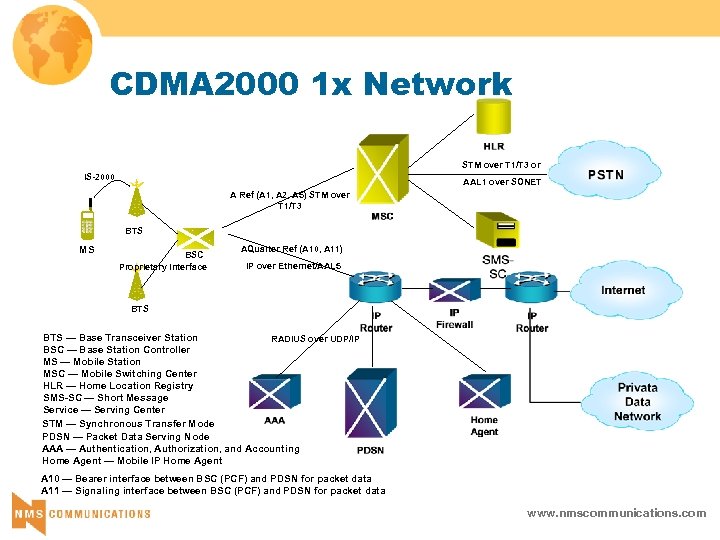
CDMA 2000 1 x Network STM over T 1/T 3 or IS-2000 AAL 1 over SONET A Ref (A 1, A 2, A 5) STM over T 1/T 3 BTS MS BSC Proprietary Interface AQuarter Ref (A 10, A 11) IP over Ethernet/AAL 5 BTS — Base Transceiver Station RADIUS over UDP/IP BSC — Base Station Controller MS — Mobile Station MSC — Mobile Switching Center HLR — Home Location Registry SMS-SC — Short Message Service — Serving Center STM — Synchronous Transfer Mode PDSN — Packet Data Serving Node AAA — Authentication, Authorization, and Accounting Home Agent — Mobile IP Home Agent A 10 — Bearer interface between BSC (PCF) and PDSN for packet data A 11 — Signaling interface between BSC (PCF) and PDSN for packet data www. nmscommunications. com
Packet Data Serving Node (PDSN) l l Establish, maintain, and terminate PPP sessions with mobile station Support simple and mobile IP services n l Handle authentication, authorization, and accounting (AAA) for mobile station n l l Act as mobile IP Foreign Agent for visiting mobile station Uses RADIUS protocol Route packets between mobile stations and external packet data networks Collect usage data and forward to AAA server www. nmscommunications. com
AAA Server and Home Agent l AAA server n n n l Authentication: PPP and mobile IP connections Authorization: service profile and security key distribution and management Accounting: usage data for billing Mobile IP Home Agent n n Track location of mobile IP subscribers when they move from one network to another Receive packets on behalf of the mobile node when node is attached to a foreign network and deliver packets to mobile’s current point of attachment www. nmscommunications. com
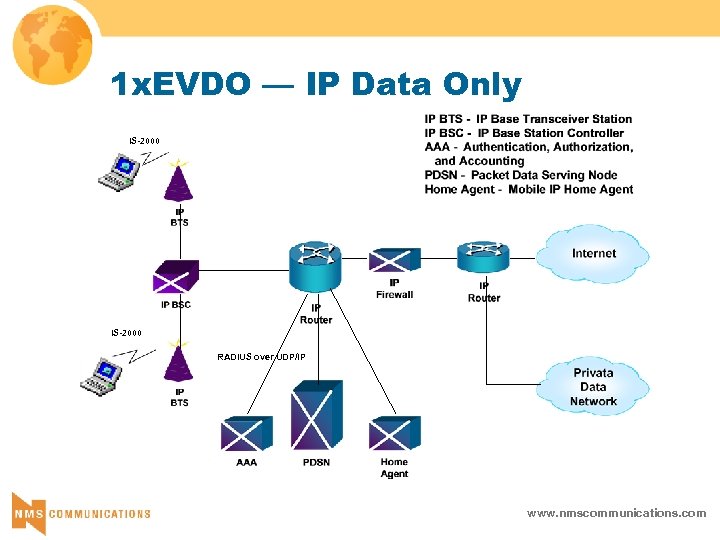
1 x. EVDO — IP Data Only IS-2000 RADIUS over UDP/IP www. nmscommunications. com
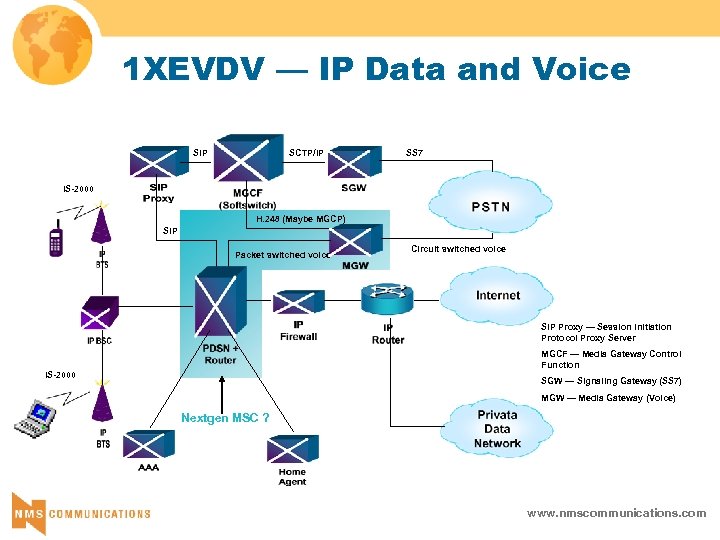
1 XEVDV — IP Data and Voice SIP SCTP/IP SS 7 IS-2000 H. 248 (Maybe MGCP) SIP Packet switched voice Circuit switched voice SIP Proxy — Session Initiation Protocol Proxy Server MGCF — Media Gateway Control Function IS-2000 SGW — Signaling Gateway (SS 7) MGW — Media Gateway (Voice) Nextgen MSC ? www. nmscommunications. com
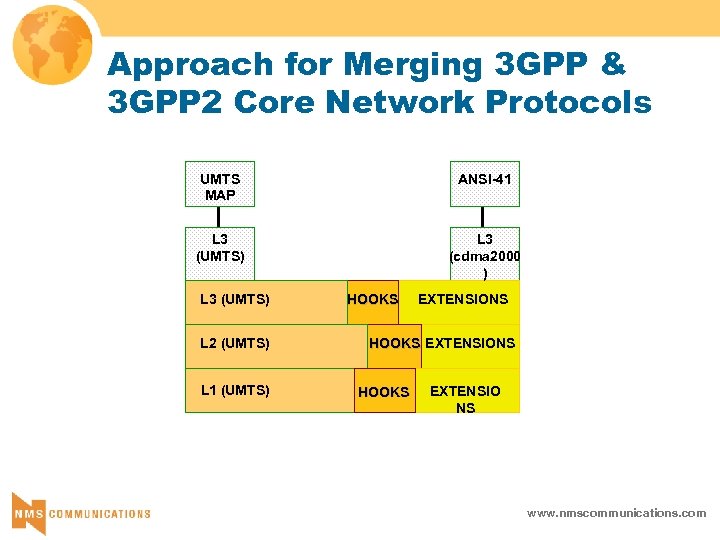
Approach for Merging 3 GPP & 3 GPP 2 Core Network Protocols UMTS MAP ANSI-41 L 3 (UMTS) L 3 (cdma 2000 ) L 3 (UMTS) L 2 (UMTS) L 1 (UMTS) HOOKS EXTENSIONS HOOKS EXTENSIO NS www. nmscommunications. com
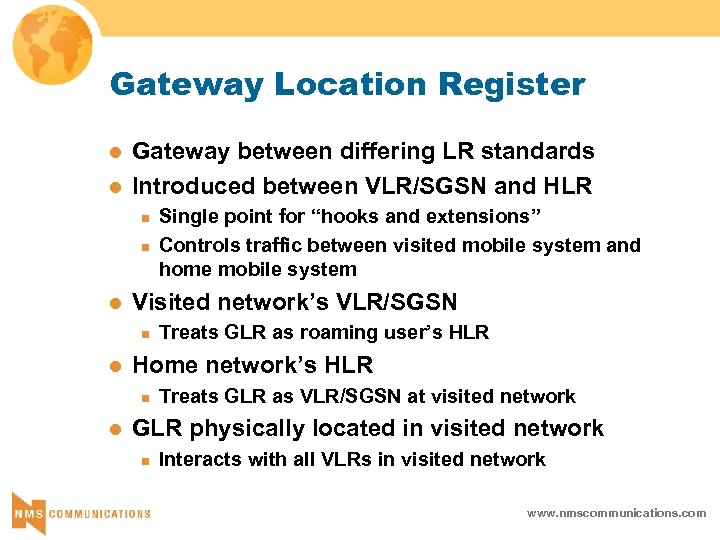
Gateway Location Register l l Gateway between differing LR standards Introduced between VLR/SGSN and HLR n n l Visited network’s VLR/SGSN n l Treats GLR as roaming user’s HLR Home network’s HLR n l Single point for “hooks and extensions” Controls traffic between visited mobile system and home mobile system Treats GLR as VLR/SGSN at visited network GLR physically located in visited network n Interacts with all VLRs in visited network www. nmscommunications. com
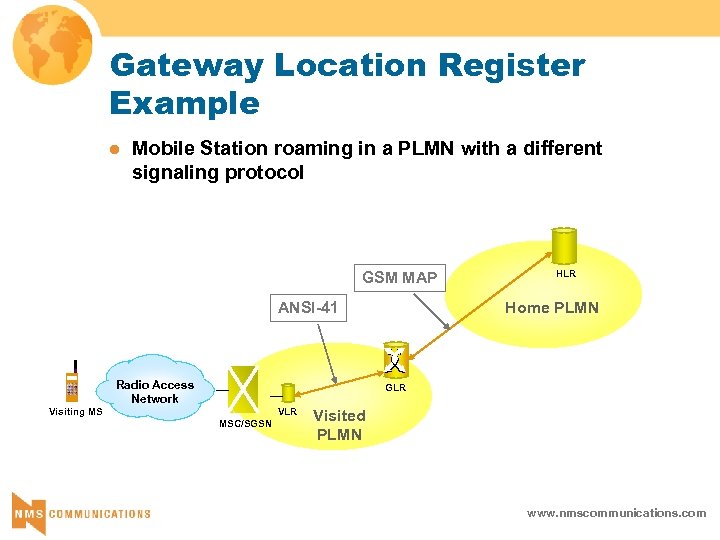
Gateway Location Register Example l Mobile Station roaming in a PLMN with a different signaling protocol GSM MAP ANSI-41 Radio Access Network HLR Home PLMN GLR Visiting MS VLR MSC/SGSN Visited PLMN www. nmscommunications. com
3 GPP / 3 GPP 2 Harmonization l Joint meetings address interoperability and roaming n l « Hooks and Extensions » help to converge n l Near term fix Target all-IP core harmonization n l Handsets, radio network, core network Leverage common specifications (esp. IETF RFCs) Align terms, interfaces and functional entities Developing Harmonization Reference Model (HRM) 3 GPP’s IP Mutilmedia Services and 3 GPP 2’s Multi-Media Domain almost aligned www. nmscommunications. com
3 G Tutorial l l History and Evolution of Mobile Radio Evolving Network Architectures Evolving Services Applications Business Models www. nmscommunications. com
Up and Coming Mobile Services l l l SMS, EMS, MMS Location-based services 3 G-324 M Video Vo. IP w/o Qo. S; Push-to-Talk IP Multimedia Services (w/ Qo. S) Converged “All IP” networks — the Vision www. nmscommunications. com
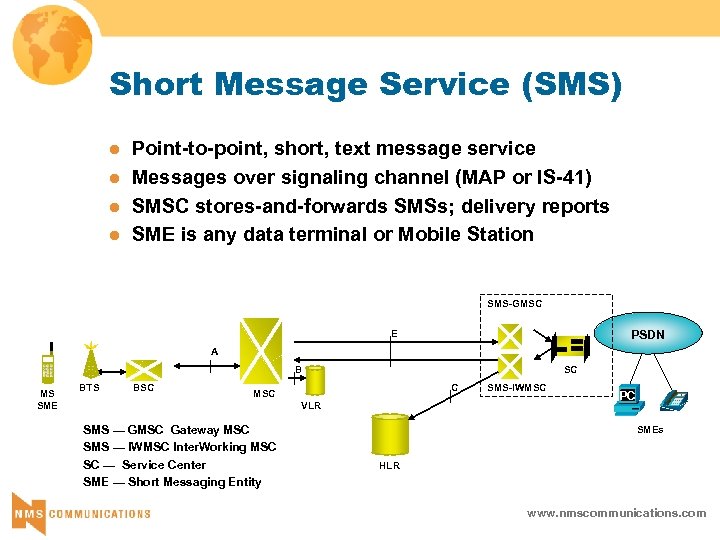
Short Message Service (SMS) l l Point-to-point, short, text message service Messages over signaling channel (MAP or IS-41) SMSC stores-and-forwards SMSs; delivery reports SME is any data terminal or Mobile Station SMS-GMSC E PSDN A B MS SME BTS BSC SC C MSC VLR SMS — GMSC Gateway MSC SMS — IWMSC Inter. Working MSC SC — Service Center SME — Short Messaging Entity SMS-IWMSC PC SMEs HLR www. nmscommunications. com
SMS Principles l Basic services n n l SM Service Center (3 GPP) aka Message Center (3 GPP 2) n l SM MT (Mobile Terminated) SM MO (Mobile Originated) (3 GPP 2) SM MO can be cancelled (3 GPP 2) User can acknowledge Relays and store-and-forwards SMSs Payload of up to 140 bytes, but n n Can be compressed (MS-to-MS) And/or segmented in several SMs www. nmscommunications. com
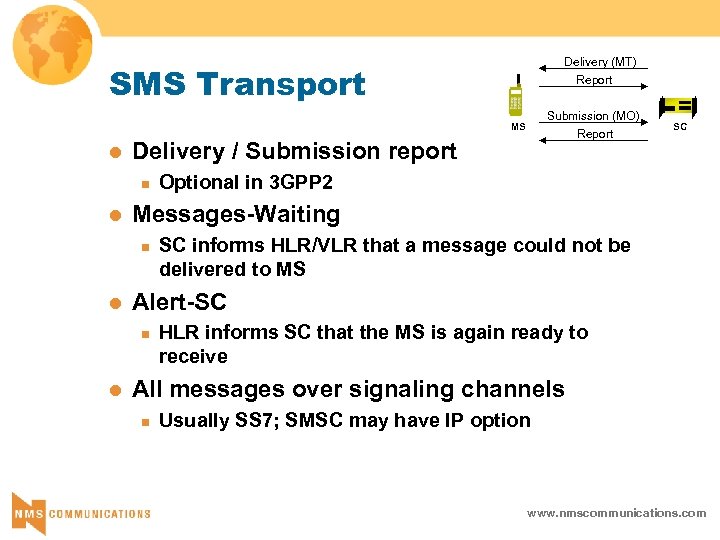
Delivery (MT) SMS Transport Report Submission (MO) MS l Delivery / Submission report n l Optional in 3 GPP 2 SC informs HLR/VLR that a message could not be delivered to MS Alert-SC n l SC Messages-Waiting n l Report HLR informs SC that the MS is again ready to receive All messages over signaling channels n Usually SS 7; SMSC may have IP option www. nmscommunications. com
EMS Principles l l l Enhanced Message Service Leverages SMS infrastructure Formatting attributes in payload allow: n n l Text formatting (alignment, font size, style, colour…) Pictures (e. g. 255 x 255 color) or vector-based graphics Animations Sounds Interoperable with 2 G SMS mobiles n n 2 G SMS spec had room for payload formatting 2 G MS ignore special formats www. nmscommunications. com
MMS Principles (1) l Non-real-time, multi-media message service n n n l Uses IP data path & IP protocols (not SS 7) n l Text; Speech (AMR coding) Audio (MP 3, synthetic MIDI) Image, graphics (JPEG, GIF, PNG) Video (MPEG 4, H. 263) Will evolve with multimedia technologies WAP, HTTP, SMTP, etc. Adapts to terminal capabilities n n n Media format conversions (JPEG to GIF) Media type conversions (fax to image) SMS (2 G) terminal inter-working www. nmscommunications. com
MMS Principles (2) l l MMs can be forwarded (w/o downloading), and may have a validity period One or multiple addressees Addressing by phone number (E. 164) or email address (RFC 822) Extended reporting n l l submission, storage, delivery, reading, deletion Supports an MMBox, i. e. a mail box Optional support of media streaming (RTP/RTSP) www. nmscommunications. com
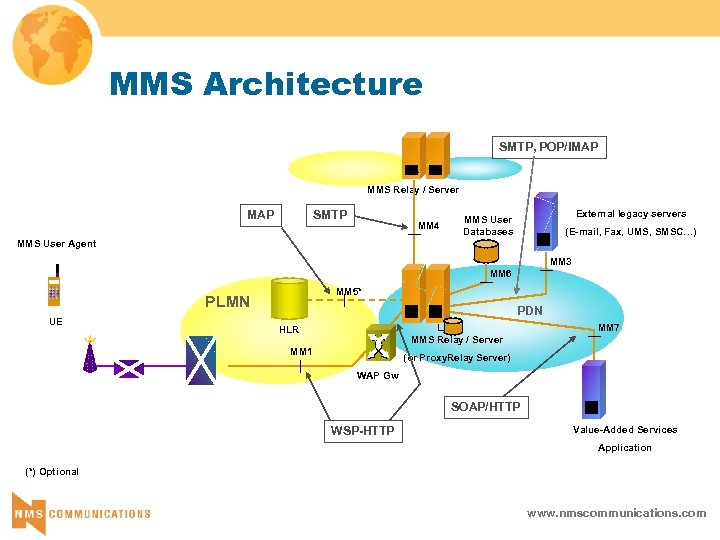
MMS Architecture SMTP, POP/IMAP SN SN MMS Relay / Server MAP SMTP MM 4 External legacy servers MMS User Databases SN MMS User Agent (E-mail, Fax, UMS, SMSC…) MM 3 MM 6 MM 5* PLMN UE PDN SN SN MM 7 HLR MMS Relay / Server MM 1 (or Proxy. Relay Server) WAP Gw SOAP/HTTP WSP-HTTP SN Value-Added Services Application (*) Optional www. nmscommunications. com
Location l Driven by e 911 requirements in US n n l l Potential revenue from location-based services Several technical approaches n n n l In network technologies (measurements at cell sites) Handset technologies Network-assisted handset approaches Plus additional core network infrastructure n l FCC mandated; not yet functioning as desired Most operators are operating under “waivers” Location computation and mobile location servers Significant privacy issues www. nmscommunications. com
Location Technology l l Cell identity: crude but available today Based on timing n l Based on timing and triangulation n n l TA: Timing Advance (distance from GSM BTS) TOA: Time of Arrival TDOA: Time Difference of Arrival EOTD: Enhanced Observed Time Difference AOA: Angle of Arrival Based on satellite navigation systems n n GPS: Global Positioning System A-GPS: Assisted GPS www. nmscommunications. com
Location-Based Services l Emergency services n l Value-added personal services n l coupons or offers from nearby stores Network internal n l friend finder, directions Commercial services n l E 911 - Enhanced 911 Traffic & coverage measurements Lawful intercept extensions n law enforcement locates suspect www. nmscommunications. com
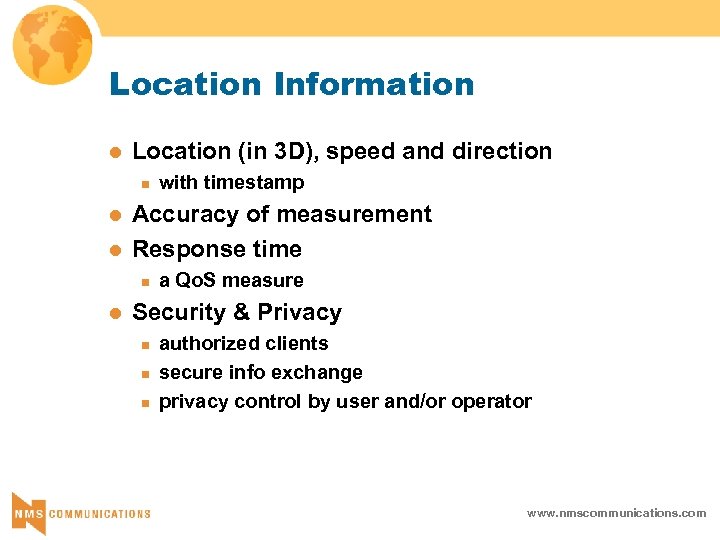
Location Information l Location (in 3 D), speed and direction n l l Accuracy of measurement Response time n l with timestamp a Qo. S measure Security & Privacy n n n authorized clients secure info exchange privacy control by user and/or operator www. nmscommunications. com
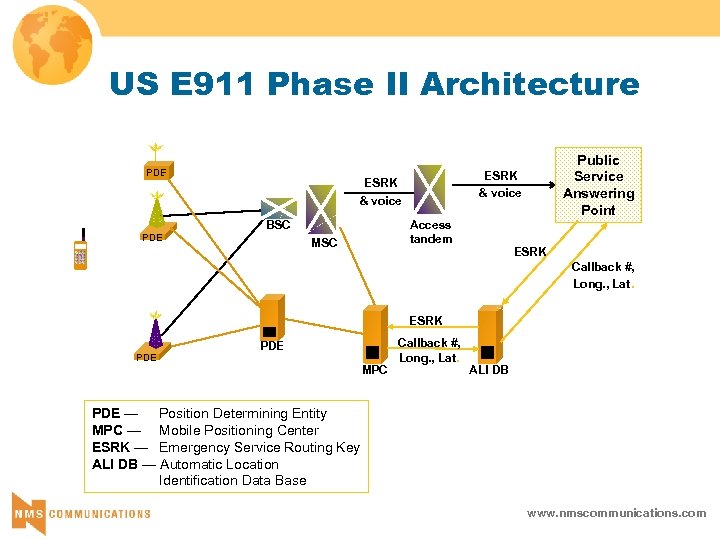
US E 911 Phase II Architecture PDE ESRK & voice BSC MSC Public Service Answering Point Access tandem ESRK Callback #, Long. , Lat. PDE SN PDE ESRK Callback #, SN Long. , Lat. SN MPC ALI DB PDE — Position Determining Entity MPC — Mobile Positioning Center ESRK — Emergency Service Routing Key ALI DB — Automatic Location Identification Data Base www. nmscommunications. com
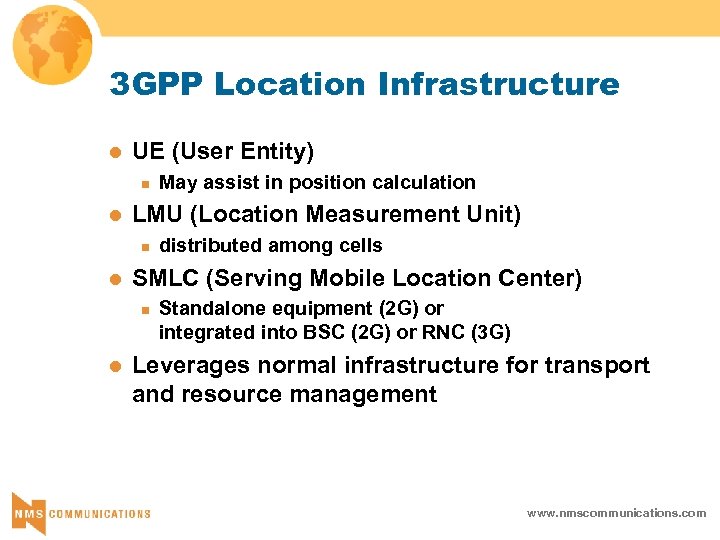
3 GPP Location Infrastructure l UE (User Entity) n l LMU (Location Measurement Unit) n l distributed among cells SMLC (Serving Mobile Location Center) n l May assist in position calculation Standalone equipment (2 G) or integrated into BSC (2 G) or RNC (3 G) Leverages normal infrastructure for transport and resource management www. nmscommunications. com
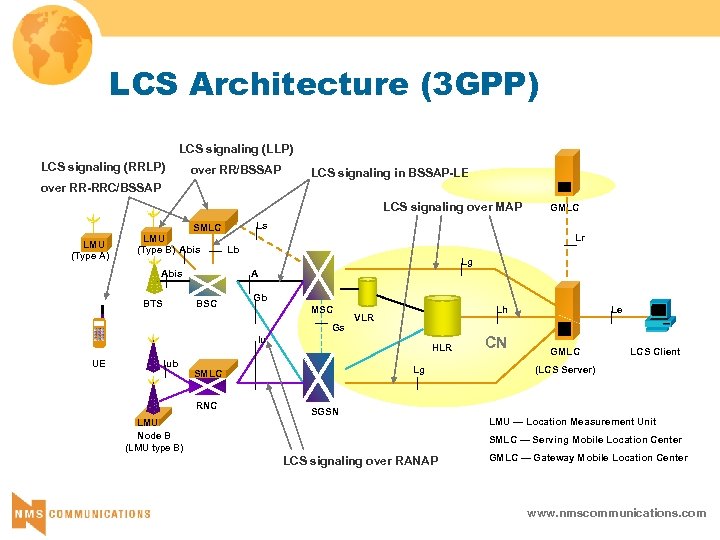
LCS Architecture (3 GPP) LCS signaling (LLP) LCS signaling (RRLP) over RR/BSSAP LCS signaling in BSSAP-LE SN over RR-RRC/BSSAP LCS signaling over MAP LMU (Type A) SMLC LMU (Type B) Abis Lb Ls Lr Lg Abis BTS A BSC Gb MSC Gs Lh VLR Iu UE GMLC Iub HLR Lg SMLC RNC SGSN LMU Node B (LMU type B) CN Le SN GMLC LCS Client (LCS Server) LMU — Location Measurement Unit SMLC — Serving Mobile Location Center LCS signaling over RANAP GMLC — Gateway Mobile Location Center www. nmscommunications. com
Location Request l MLP — Mobile Location Protocol n n n l l GMLC is the Location Server Interrogates HLR to find visited MSC/SGSN n n l From Location Interop Forum Based on HTTP/SSL/XML Allows Internet clients to request location services Roaming user can be located UE can be idle, but not off ! Immediate or deferred result www. nmscommunications. com
3 G-324 M Video Services l Initial mobile video service uses 3 G data bandwidth w/o IP multimedia infrastructure n l Leverage high speed circuit-switch data path n n n l Deployed by Do. Co. Mo in Japan today 64 kbps H. 324 video structure MPEG 4 video coding AMR audio coding Supports video clips, video streaming and live video conversations n n MS to MS MS to Internet or ISDN with gateways www. nmscommunications. com
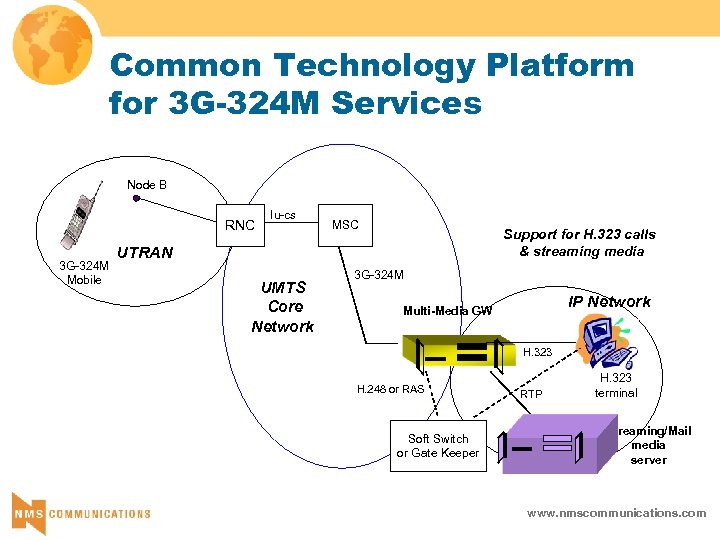
Common Technology Platform for 3 G-324 M Services Node B RNC 3 G-324 M Mobile Iu-cs MSC Support for H. 323 calls & streaming media UTRAN UMTS Core Network 3 G-324 M IP Network Multi-Media GW H. 323 H. 248 or RAS Soft Switch or Gate Keeper RTP H. 323 terminal Streaming/Mail media server www. nmscommunications. com
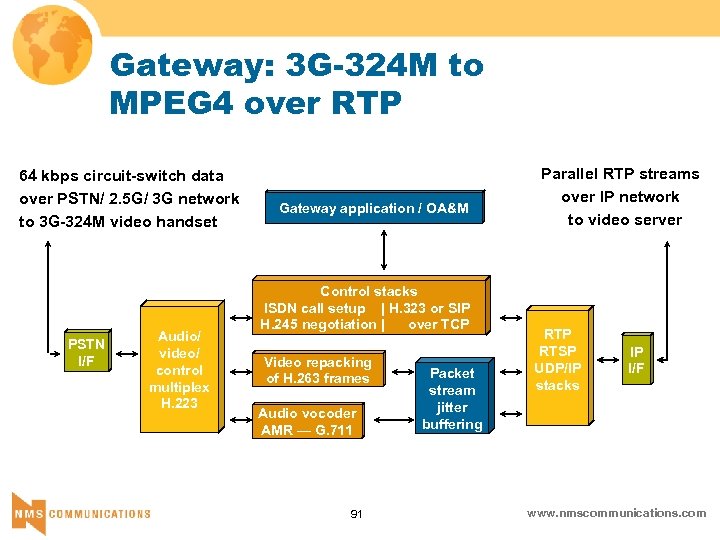
Gateway: 3 G-324 M to MPEG 4 over RTP 64 kbps circuit-switch data over PSTN/ 2. 5 G/ 3 G network to 3 G-324 M video handset PSTN I/F Audio/ video/ control multiplex H. 223 Gateway application / OA&M Control stacks ISDN call setup | H. 323 or SIP H. 245 negotiation | over TCP Video repacking of H. 263 frames Audio vocoder AMR — G. 711 91 Packet stream jitter buffering Parallel RTP streams over IP network to video server RTP RTSP UDP/IP stacks IP I/F www. nmscommunications. com
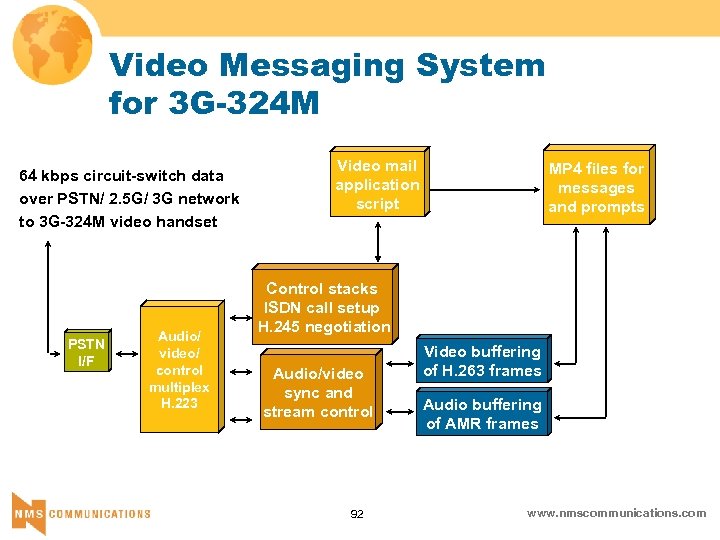
Video Messaging System for 3 G-324 M 64 kbps circuit-switch data over PSTN/ 2. 5 G/ 3 G network to 3 G-324 M video handset PSTN I/F Audio/ video/ control multiplex H. 223 Video mail application script MP 4 files for messages and prompts Control stacks ISDN call setup H. 245 negotiation Audio/video sync and stream control 92 Video buffering of H. 263 frames Audio buffering of AMR frames www. nmscommunications. com
Push-to. Talk Vo. IP before Qo. S is Available l Nextel’s “Direct Connect” service credited with getting them 20 -25% extra ARPU n n l Push-to-talk is half duplex n l Short delays OK Issues remain n l Based on totally proprietary i. DEN Other carriers extremely jealous Always on IP isn’t always on; radio connection suspended if unused; 2 -3 seconds to re-establish Sprint has announced they will be offering a push-to-talk service on their 1 x. RTT network www. nmscommunications. com
«All IP» Services l l l IP Multimedia Subsystem (IMS) — 3 GPP Multi-Media Domain (MMD) — 3 GPP 2 Voice and video over IP with quality of service guarantees n l Obsoletes circuit-switched voice equipment Target for converging the two disparate core network architectures www. nmscommunications. com
IMS / MMD Services l l l Presence Location Instant Messaging (voice+video) Conferencing Media Streaming / Annoucements Multi-player gaming with voice channel www. nmscommunications. com
3 G Qo. S l l Substantial new requirements on the radio access network Traffic classes n l Conversational, streaming, interactive, background Ability to specify n n n Traffic handling priority Allocation/retention priority Error rates (bits and/ or SDUs) Transfer delay Data rates (maximum and guaranteed) Deliver in order (Y/N) www. nmscommunications. com
IMS Concepts (1) l Core network based on Internet concepts n n l Utilize existing radio infrastructure n n l Independent of circuit-switched networks Packet-switched transport for signaling and bearer traffic UTRAN — 3 G (W-CDMA) radio network GERAN — GSM evolved radio network Utilize evolving handsets www. nmscommunications. com
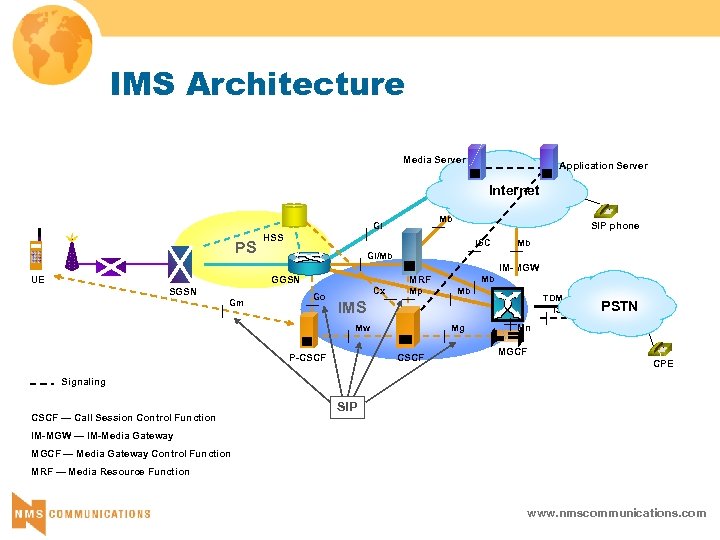
IMS Architecture Media Server Application Server Internet Mb Gi PS SIP phone HSS ISC Mb Gi/Mb IM-MGW UE GGSN SGSN Gm Mb MRF Go Cx Mp Mb TDM ISUP IMS Mw P-CSCF Mg CSCF PSTN Mn MGCF CPE Signaling CSCF — Call Session Control Function SIP IM-MGW — IM-Media Gateway MGCF — Media Gateway Control Function MRF — Media Resource Function www. nmscommunications. com
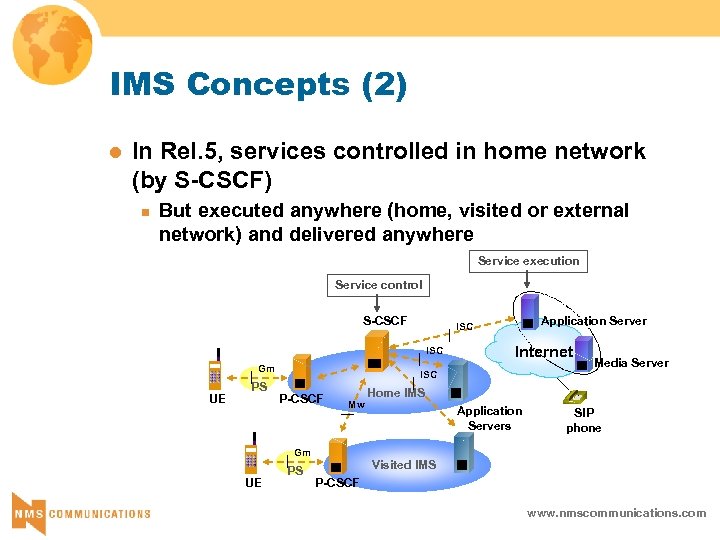
IMS Concepts (2) l In Rel. 5, services controlled in home network (by S-CSCF) n But executed anywhere (home, visited or external network) and delivered anywhere Service execution Service control S-CSCF ISC Gm UE PS Internet ISC P-CSCF Mw Gm UE Application Server ISC PS Media Server Home IMS Application Servers SIP phone Visited IMS P-CSCF www. nmscommunications. com
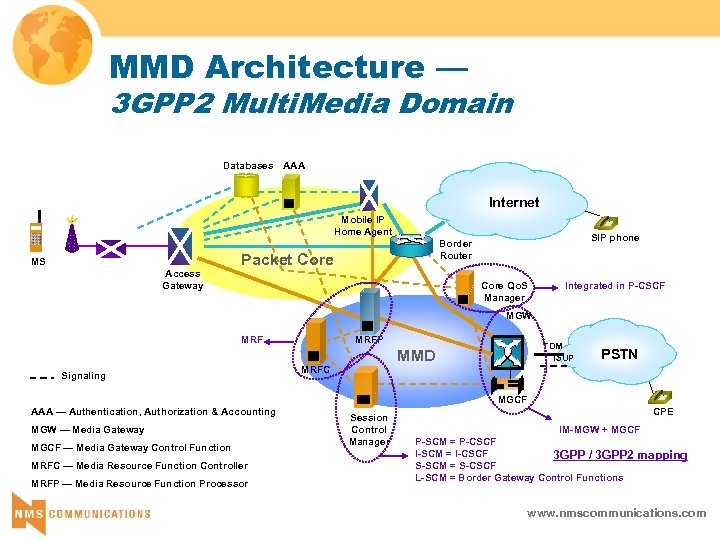
MMD Architecture — 3 GPP 2 Multi. Media Domain Databases AAA Internet Mobile IP Home Agent MS Access Gateway SIP phone Border Router Packet Core Qo. S Manager Integrated in P-CSCF MGW MRF Signaling MRFP TDM ISUP MMD MRFC PSTN MGCF AAA — Authentication, Authorization & Accounting MGW — Media Gateway MGCF — Media Gateway Control Function MRFC — Media Resource Function Controller MRFP — Media Resource Function Processor Session Control Manager CPE IM-MGW + MGCF P-SCM = P-CSCF I-SCM = I-CSCF 3 GPP / 3 GPP 2 mapping S-SCM = S-CSCF L-SCM = Border Gateway Control Functions www. nmscommunications. com
3 G Tutorial l l History and Evolution of Mobile Radio Evolving Network Architectures Evolving Services Applications Business Models www. nmscommunications. com
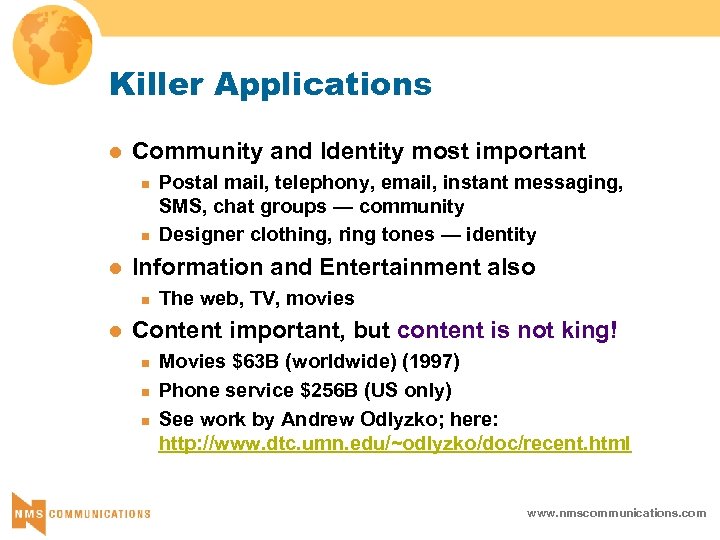
Killer Applications l Community and Identity most important n n l Information and Entertainment also n l Postal mail, telephony, email, instant messaging, SMS, chat groups — community Designer clothing, ring tones — identity The web, TV, movies Content important, but content is not king! n n n Movies $63 B (worldwide) (1997) Phone service $256 B (US only) See work by Andrew Odlyzko; here: http: //www. dtc. umn. edu/~odlyzko/doc/recent. html www. nmscommunications. com
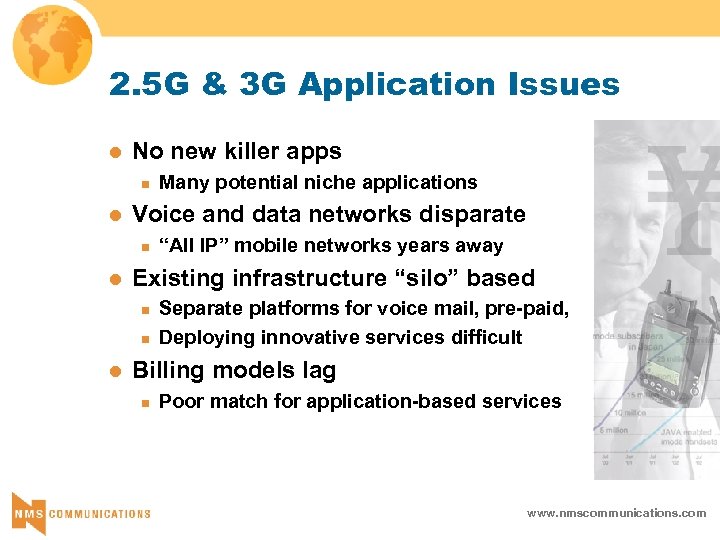
2. 5 G & 3 G Application Issues l No new killer apps n l Voice and data networks disparate n l “All IP” mobile networks years away Existing infrastructure “silo” based n n l Many potential niche applications Separate platforms for voice mail, pre-paid, Deploying innovative services difficult Billing models lag n Poor match for application-based services www. nmscommunications. com
Multimodal Services and Multi-Application Platforms l Combined voice and data applications n n n l Today, without “all IP” infrastructure Text messaging plus speech recognition-enabled voice services Evolve from as new services become available Multi-application platform n n n Integrate TDM voice and IP data Support multiple applications Flexible billing and provisioning www. nmscommunications. com
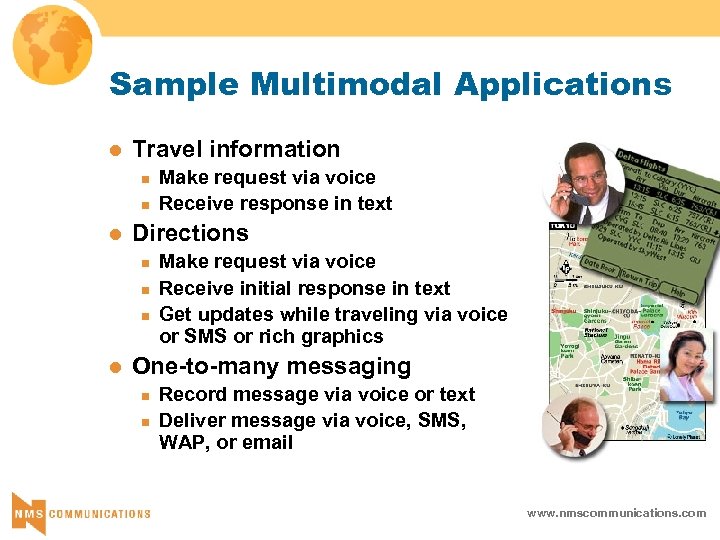
Sample Multimodal Applications l Travel information n n l Directions n n n l Make request via voice Receive response in text Make request via voice Receive initial response in text Get updates while traveling via voice or SMS or rich graphics One-to-many messaging n n Record message via voice or text Deliver message via voice, SMS, WAP, or email www. nmscommunications. com
More Multimodal Examples l Purchasing famous person’s voice for your personal answering message n n n l Unified communications n l Text or voice menus Voice to hear message Voice or text to select (and authorize payment) While listening to a voice message from a customer, obtain a text display of recent customer activity Emergency response team n n SMS and voice alert Voice conference, and text updates, while traveling to site of emergency www. nmscommunications. com
Early Deployments l Cricket matches (Hutchinson India) n n l Information delivery (SFR France) n n l SMS alert at start of coverage Live voice coverage or text updates SMS broadcast with phone # & URL Choice of text display or voice (text-to-speech) Yellow pages (Platinet Israel) n n Adding voice menus to existing text-based service Voice flattens menus, eases access www. nmscommunications. com
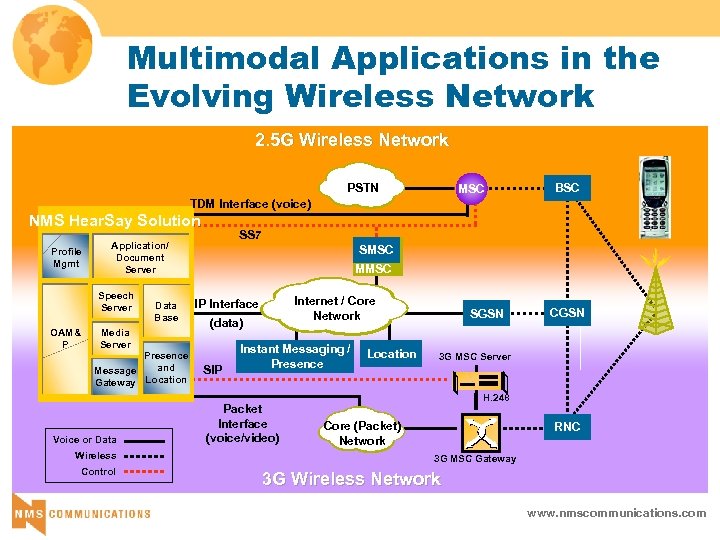
Multimodal Applications in the Evolving Wireless Network 2. 5 G Wireless Network PSTN MSC BSC TDM Interface (voice) NMS Hear. Say Solution Profile Mgmt Speech Server OAM& P SS 7 Application/ Document Server Data Base Media Server Presence and Message Location Gateway Voice or Data Wireless Control SMSC MMSC Internet / Core Network IP Interface (data) SIP Instant Messaging / Presence Packet Interface (voice/video) Location SGSN CGSN 3 G MSC Server H. 248 Core (Packet) Network RNC 3 G MSC Gateway 3 G Wireless Network www. nmscommunications. com
3 G Tutorial l l History and Evolution of Mobile Radio Evolving Network Architectures Evolving Services Applications Business Models www. nmscommunications. com
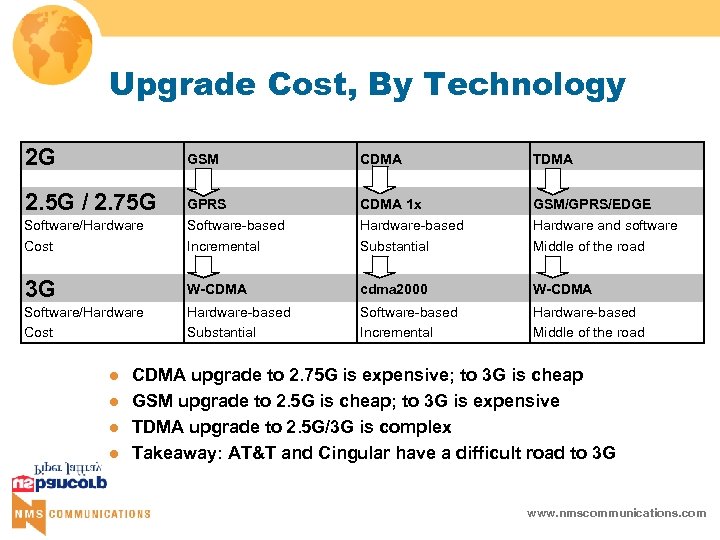
Upgrade Cost, By Technology 2 G GSM CDMA TDMA Software/Hardware GPRS Software-based CDMA 1 x Hardware-based GSM/GPRS/EDGE Hardware and software Cost Incremental Substantial Middle of the road 3 G W-CDMA cdma 2000 W-CDMA Software/Hardware Cost Hardware-based Substantial Software-based Incremental Hardware-based Middle of the road 2. 5 G / 2. 75 G l l CDMA upgrade to 2. 75 G is expensive; to 3 G is cheap GSM upgrade to 2. 5 G is cheap; to 3 G is expensive TDMA upgrade to 2. 5 G/3 G is complex Takeaway: AT&T and Cingular have a difficult road to 3 G www. nmscommunications. com
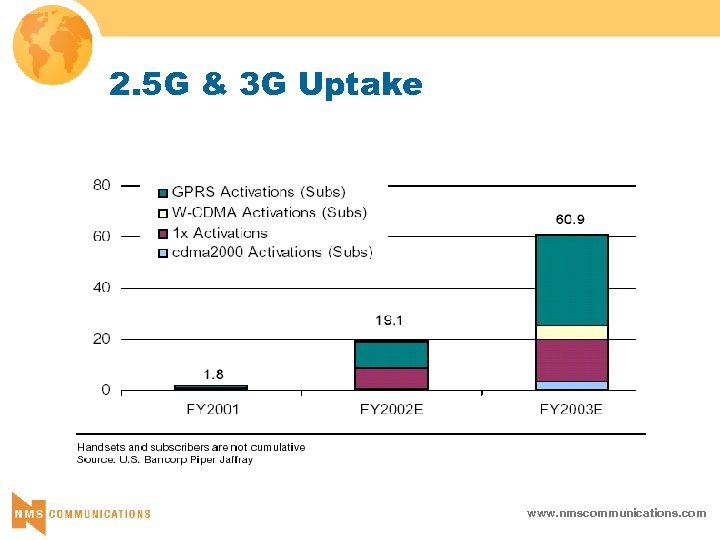
2. 5 G & 3 G Uptake www. nmscommunications. com
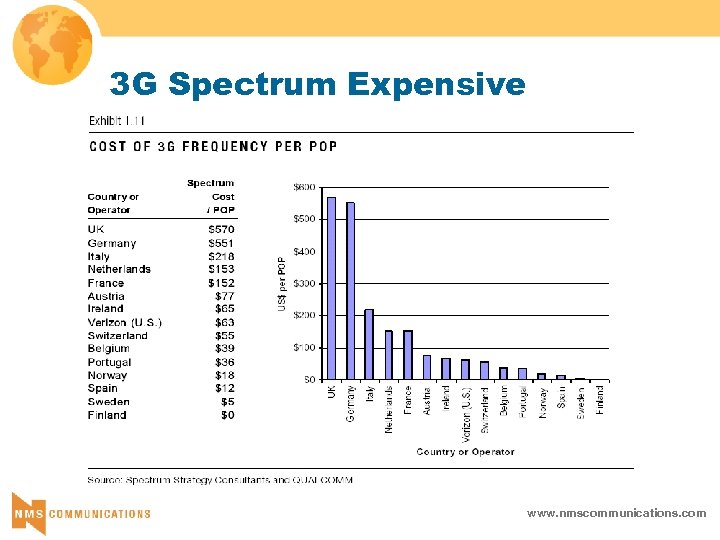
3 G Spectrum Expensive www. nmscommunications. com
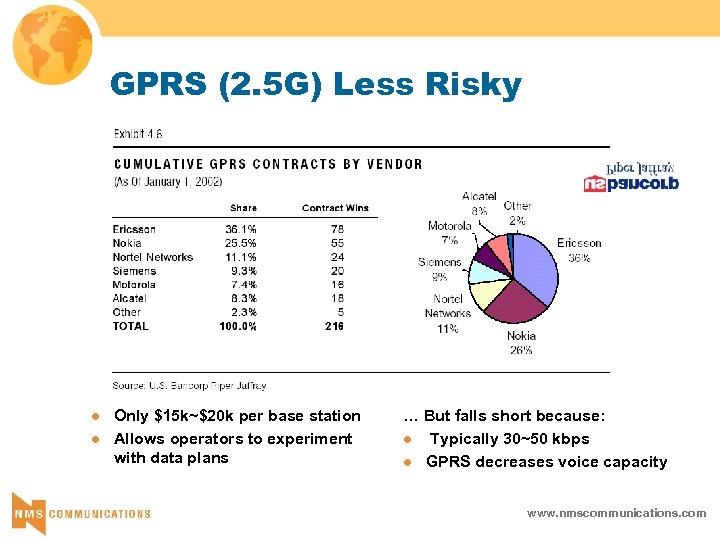
GPRS (2. 5 G) Less Risky l l Only $15 k~$20 k per base station Allows operators to experiment with data plans … But falls short because: l Typically 30~50 kbps l GPRS decreases voice capacity www. nmscommunications. com
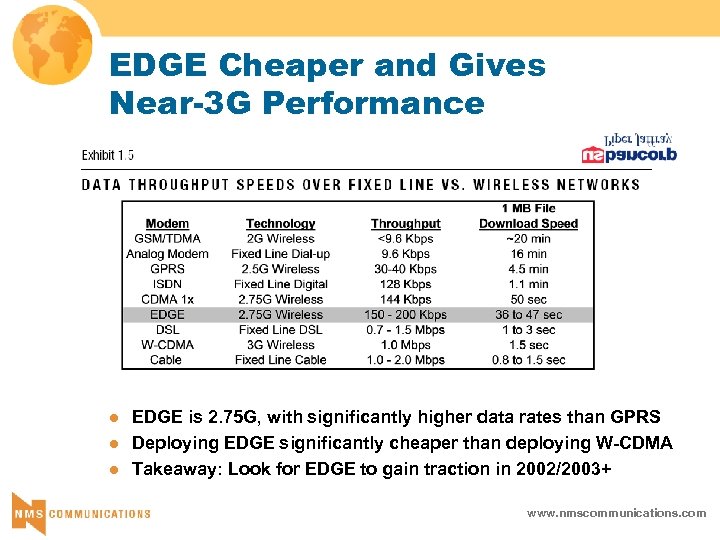
EDGE Cheaper and Gives Near-3 G Performance l l l EDGE is 2. 75 G, with significantly higher data rates than GPRS Deploying EDGE significantly cheaper than deploying W-CDMA Takeaway: Look for EDGE to gain traction in 2002/2003+ www. nmscommunications. com
Long Life for 2. 5 G & 2. 75 G “We believe the shelf life of 2. 5 G and 2. 75 G will be significantly longer than most pundits have predicted. Operators need to gain valuable experience in how to market packet data services before pushing forward with the construction of new 3 G networks. “ n Sam May, US Bancorp Piper Jaffray l Operators need to learn how to make money with data Likely to stay many years with GPRS/EDGE/CDMA 1 x l Bottom line: wide-scale 3 G will be pushed out l www. nmscommunications. com
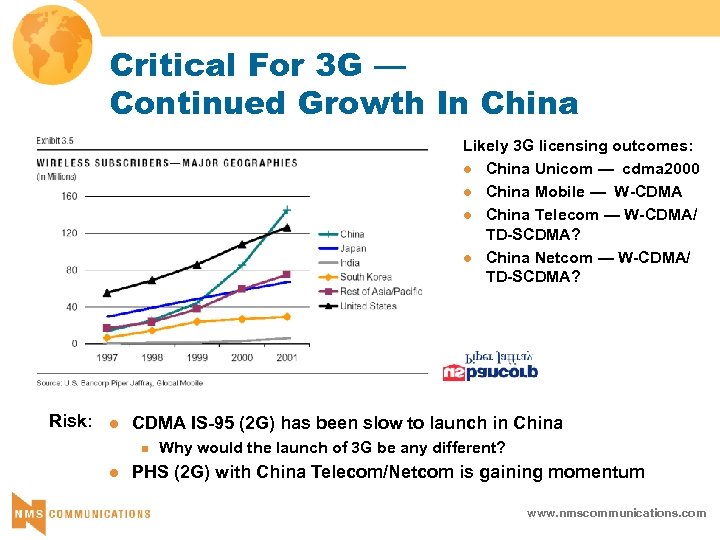
Critical For 3 G — Continued Growth In China Likely 3 G licensing outcomes: l China Unicom — cdma 2000 l China Mobile — W-CDMA l China Telecom — W-CDMA/ TD-SCDMA? l China Netcom — W-CDMA/ TD-SCDMA? Risk: l CDMA IS-95 (2 G) has been slow to launch in China n l Why would the launch of 3 G be any different? PHS (2 G) with China Telecom/Netcom is gaining momentum www. nmscommunications. com
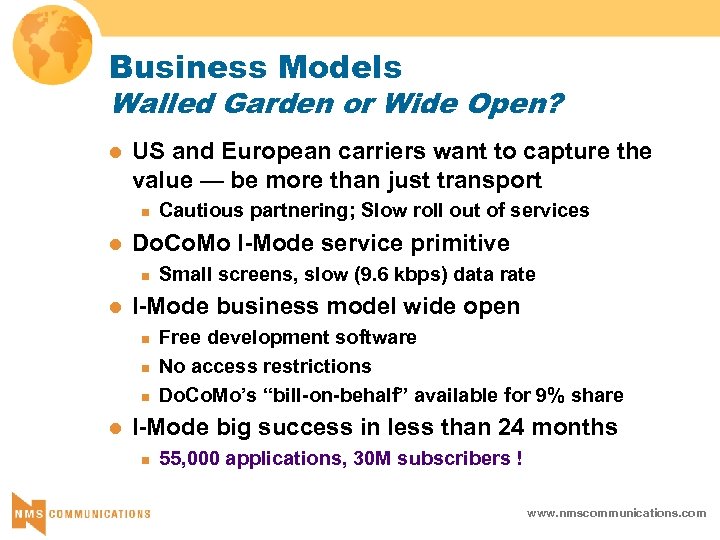
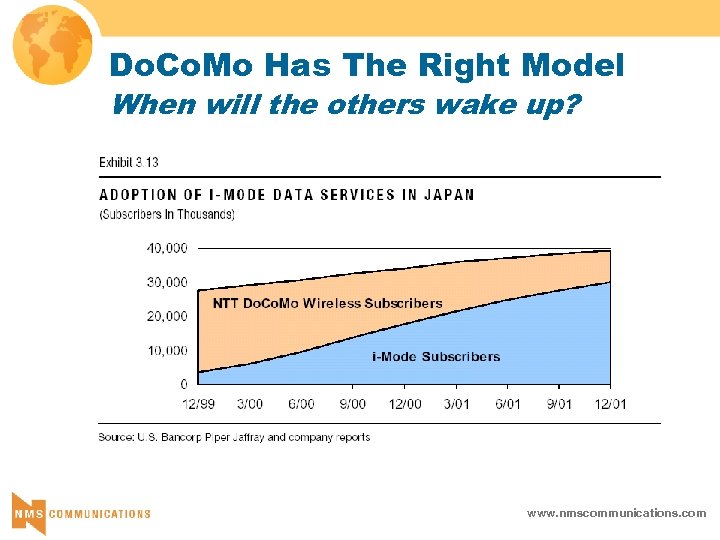
Business Models Walled Garden or Wide Open? l US and European carriers want to capture the value — be more than just transport n l Do. Co. Mo I-Mode service primitive n l Small screens, slow (9. 6 kbps) data rate I-Mode business model wide open n l Cautious partnering; Slow roll out of services Free development software No access restrictions Do. Co. Mo’s “bill-on-behalf” available for 9% share I-Mode big success in less than 24 months n 55, 000 applications, 30 M subscribers ! www. nmscommunications. com
Do. Co. Mo Has The Right Model When will the others wake up? www. nmscommunications. com
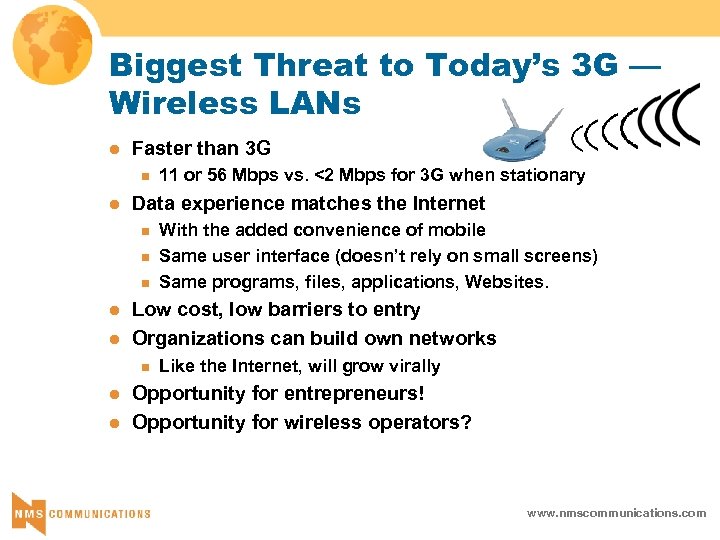
Biggest Threat to Today’s 3 G — Wireless LANs l Faster than 3 G n l Data experience matches the Internet n n n l l l With the added convenience of mobile Same user interface (doesn’t rely on small screens) Same programs, files, applications, Websites. Low cost, low barriers to entry Organizations can build own networks n l 11 or 56 Mbps vs. <2 Mbps for 3 G when stationary Like the Internet, will grow virally Opportunity for entrepreneurs! Opportunity for wireless operators? www. nmscommunications. com
N M S C O M M U N I C A T I O N S brough_turner@nmss. com marc_orange@nmss. com www. nmss. com
Additional Reference Material www. nmscommunications. com
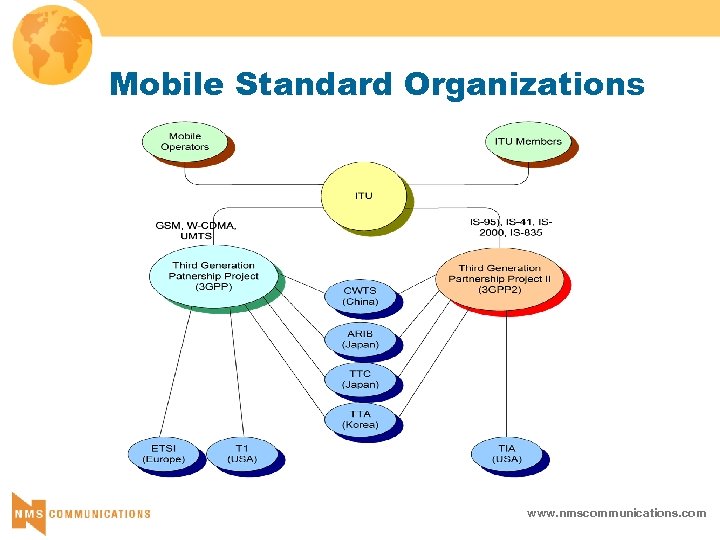
Mobile Standard Organizations www. nmscommunications. com
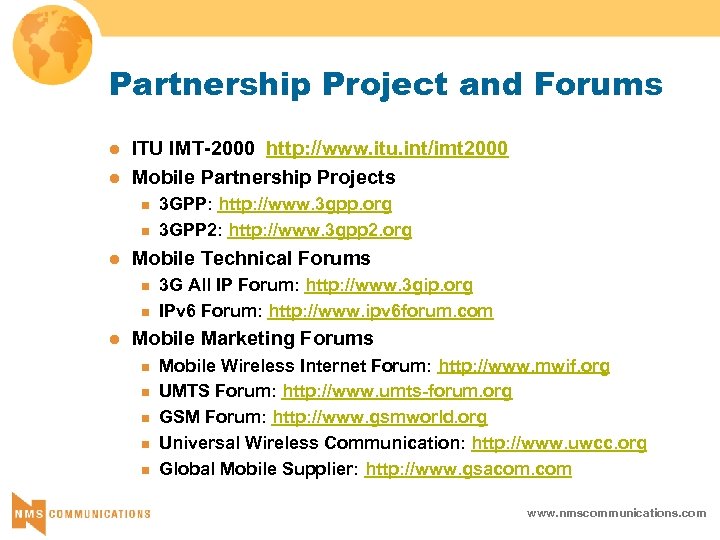
Partnership Project and Forums l l ITU IMT-2000 http: //www. itu. int/imt 2000 Mobile Partnership Projects n n l Mobile Technical Forums n n l 3 GPP: http: //www. 3 gpp. org 3 GPP 2: http: //www. 3 gpp 2. org 3 G All IP Forum: http: //www. 3 gip. org IPv 6 Forum: http: //www. ipv 6 forum. com Mobile Marketing Forums n n n Mobile Wireless Internet Forum: http: //www. mwif. org UMTS Forum: http: //www. umts-forum. org GSM Forum: http: //www. gsmworld. org Universal Wireless Communication: http: //www. uwcc. org Global Mobile Supplier: http: //www. gsacom. com www. nmscommunications. com
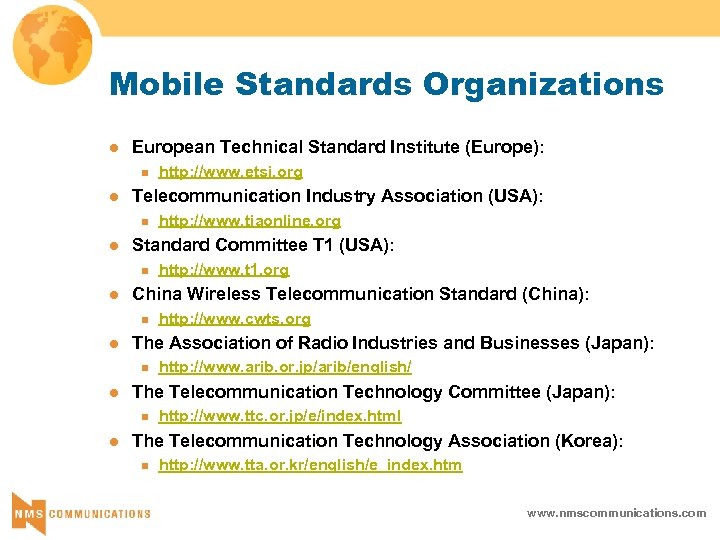
Mobile Standards Organizations l European Technical Standard Institute (Europe): n l Telecommunication Industry Association (USA): n l http: //www. arib. or. jp/arib/english/ The Telecommunication Technology Committee (Japan): n l http: //www. cwts. org The Association of Radio Industries and Businesses (Japan): n l http: //www. t 1. org China Wireless Telecommunication Standard (China): n l http: //www. tiaonline. org Standard Committee T 1 (USA): n l http: //www. etsi. org http: //www. ttc. or. jp/e/index. html The Telecommunication Technology Association (Korea): n http: //www. tta. or. kr/english/e_index. htm www. nmscommunications. com
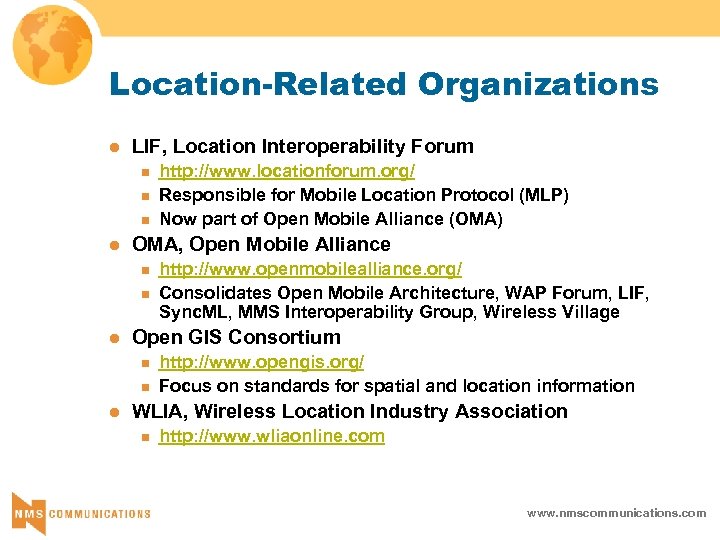
Location-Related Organizations l LIF, Location Interoperability Forum n n n l OMA, Open Mobile Alliance n n l http: //www. openmobilealliance. org/ Consolidates Open Mobile Architecture, WAP Forum, LIF, Sync. ML, MMS Interoperability Group, Wireless Village Open GIS Consortium n n l http: //www. locationforum. org/ Responsible for Mobile Location Protocol (MLP) Now part of Open Mobile Alliance (OMA) http: //www. opengis. org/ Focus on standards for spatial and location information WLIA, Wireless Location Industry Association n http: //www. wliaonline. com www. nmscommunications. com
N M S C O M M U N I C A T I O N S brough_turner@nmss. com marc_orange@nmss. com www. nmss. com
Скачать презентацию 3 G Tutorial Brough Turner Marc Orange
a0d2ee7b840b2c3cfdc76298fc7e875e.ppt