


3 D Printing
We will talk about… What is 3 D printing? How does 3 D printing work? Processes and technologies Examples and applications of 3 D printing in future Industry growth Printers from Russian producers Our offer and experience
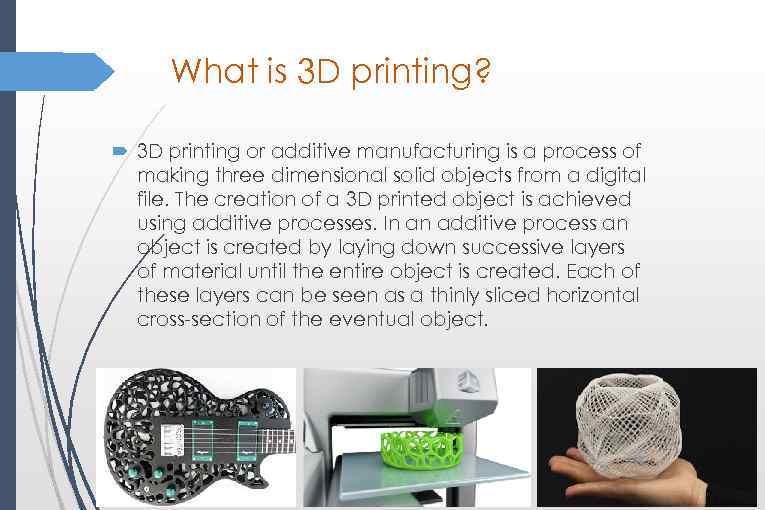
What is 3 D printing? 3 D printing or additive manufacturing is a process of making three dimensional solid objects from a digital file. The creation of a 3 D printed object is achieved using additive processes. In an additive process an object is created by laying down successive layers of material until the entire object is created. Each of these layers can be seen as a thinly sliced horizontal cross-section of the eventual object.
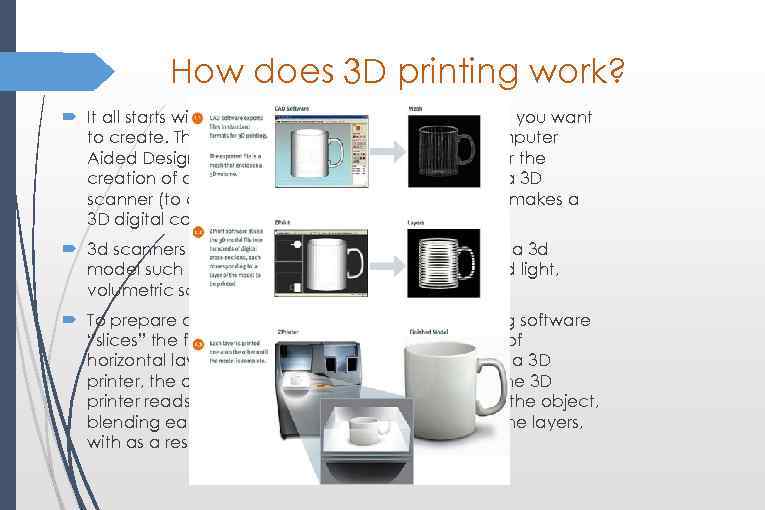
How does 3 D printing work? It all starts with making a virtual design of the object you want to create. This virtual design is made in a CAD (Computer Aided Design) file using a 3 D modeling program (for the creation of a totally new object) or with the use of a 3 D scanner (to copy an existing object). A 3 D scanner makes a 3 D digital copy of an object. 3 d scanners use different technologies to generate a 3 d model such as time-of-flight, structured / modulated light, volumetric scanning and many more. To prepare a digital file for printing, the 3 D modeling software “slices” the final model into hundreds or thousands of horizontal layers. When the sliced file is uploaded in a 3 D printer, the object can be created layer by layer. The 3 D printer reads every slice (or 2 D image) and creates the object, blending each layer with hardly any visible sign of the layers, with as a result the three dimensional object.
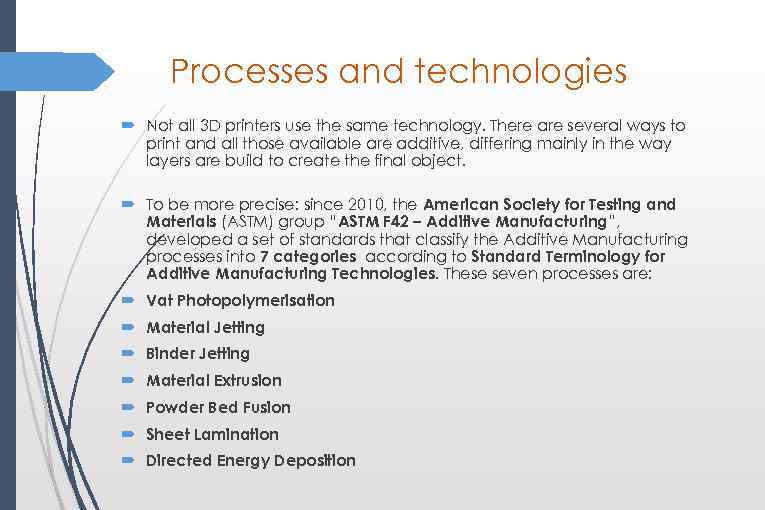
Processes and technologies Not all 3 D printers use the same technology. There are several ways to print and all those available are additive, differing mainly in the way layers are build to create the final object. To be more precise: since 2010, the American Society for Testing and Materials (ASTM) group “ASTM F 42 – Additive Manufacturing”, developed a set of standards that classify the Additive Manufacturing processes into 7 categories according to Standard Terminology for Additive Manufacturing Technologies. These seven processes are: Vat Photopolymerisation Material Jetting Binder Jetting Material Extrusion Powder Bed Fusion Sheet Lamination Directed Energy Deposition
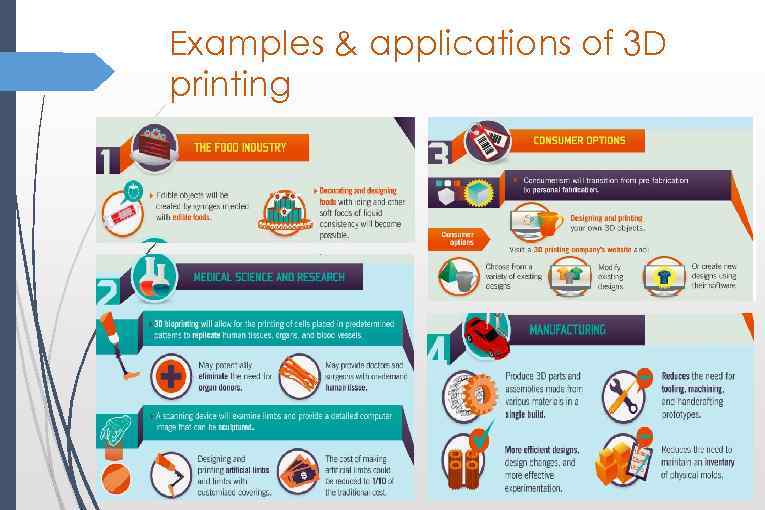
Examples & applications of 3 D printing
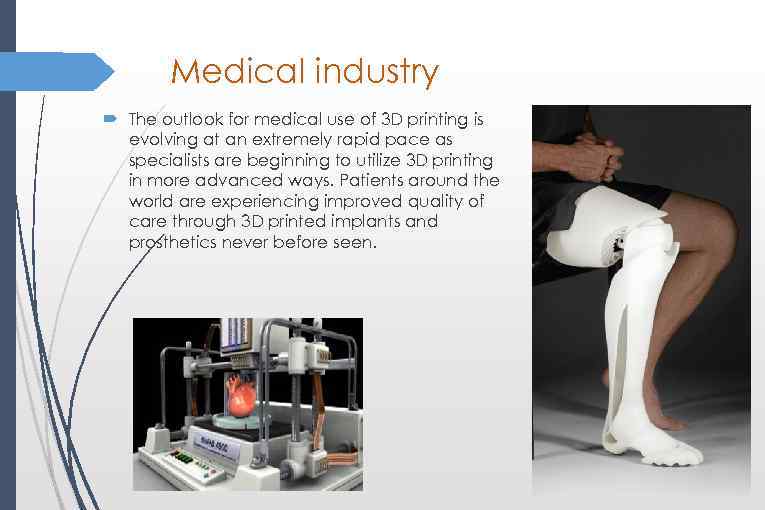
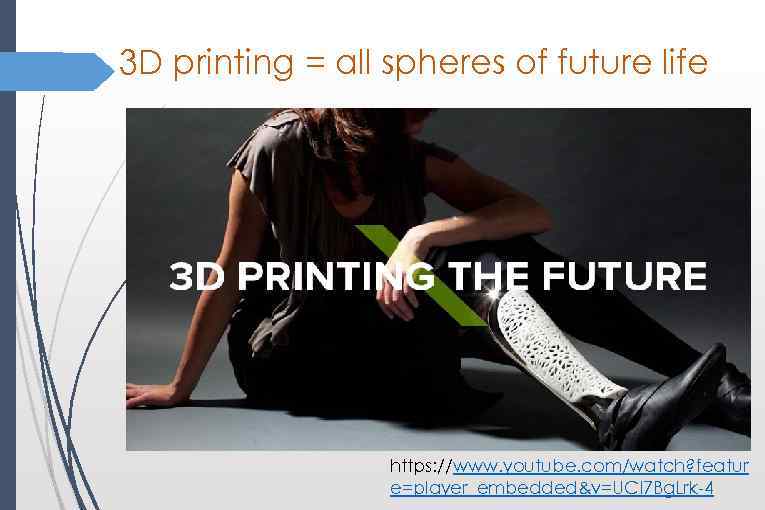
Medical industry The outlook for medical use of 3 D printing is evolving at an extremely rapid pace as specialists are beginning to utilize 3 D printing in more advanced ways. Patients around the world are experiencing improved quality of care through 3 D printed implants and prosthetics never before seen.
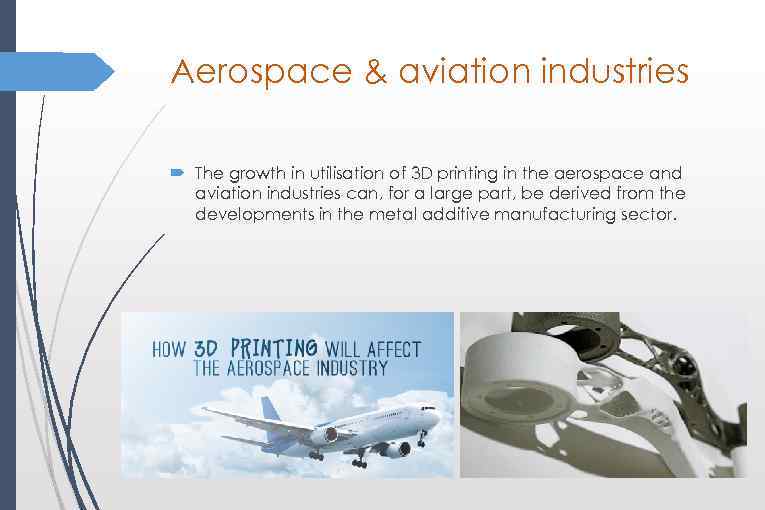
Aerospace & aviation industries The growth in utilisation of 3 D printing in the aerospace and aviation industries can, for a large part, be derived from the developments in the metal additive manufacturing sector.
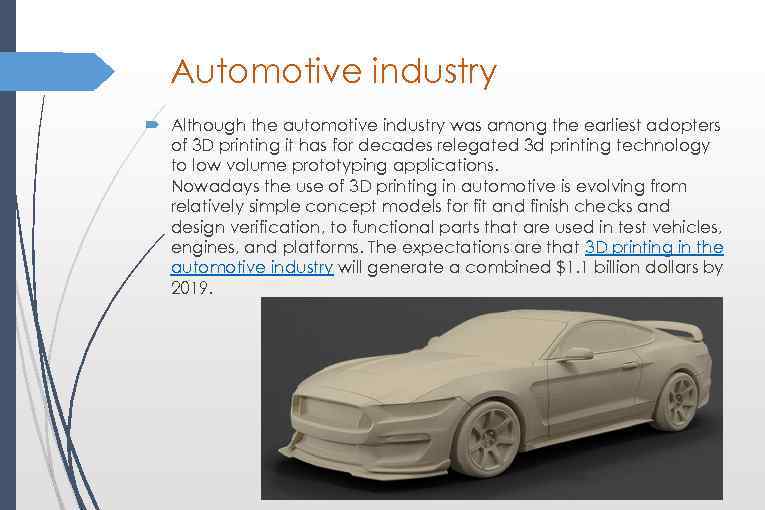
Automotive industry Although the automotive industry was among the earliest adopters of 3 D printing it has for decades relegated 3 d printing technology to low volume prototyping applications. Nowadays the use of 3 D printing in automotive is evolving from relatively simple concept models for fit and finish checks and design verification, to functional parts that are used in test vehicles, engines, and platforms. The expectations are that 3 D printing in the automotive industry will generate a combined $1. 1 billion dollars by 2019.
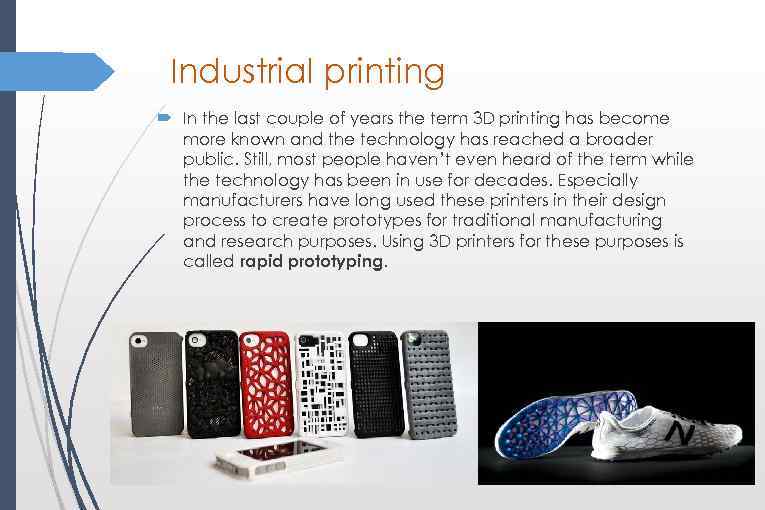
Industrial printing In the last couple of years the term 3 D printing has become more known and the technology has reached a broader public. Still, most people haven’t even heard of the term while the technology has been in use for decades. Especially manufacturers have long used these printers in their design process to create prototypes for traditional manufacturing and research purposes. Using 3 D printers for these purposes is called rapid prototyping.
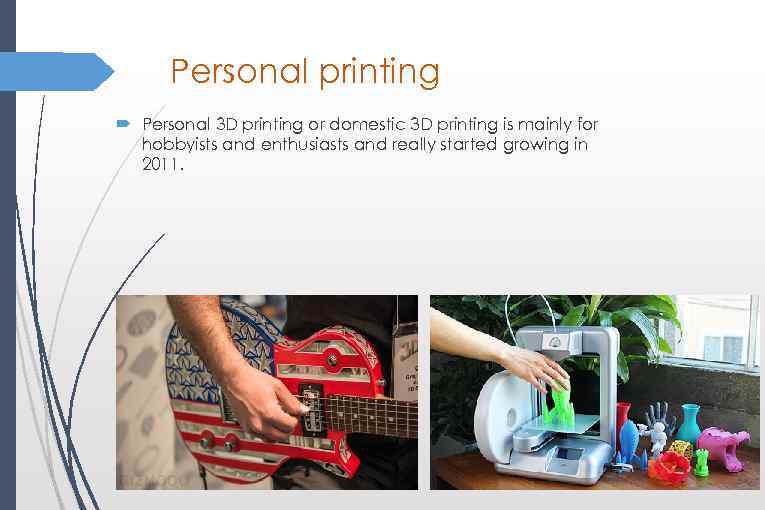
Personal printing Personal 3 D printing or domestic 3 D printing is mainly for hobbyists and enthusiasts and really started growing in 2011.
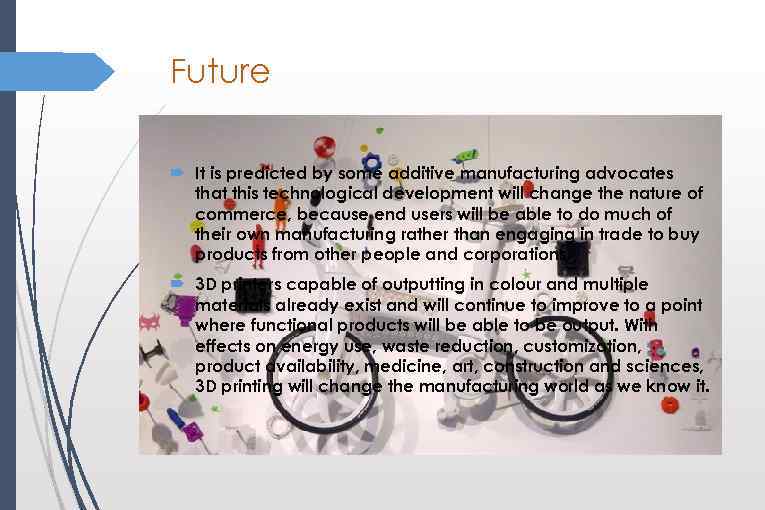
Future It is predicted by some additive manufacturing advocates that this technological development will change the nature of commerce, because end users will be able to do much of their own manufacturing rather than engaging in trade to buy products from other people and corporations. 3 D printers capable of outputting in colour and multiple materials already exist and will continue to improve to a point where functional products will be able to be output. With effects on energy use, waste reduction, customization, product availability, medicine, art, construction and sciences, 3 D printing will change the manufacturing world as we know it.
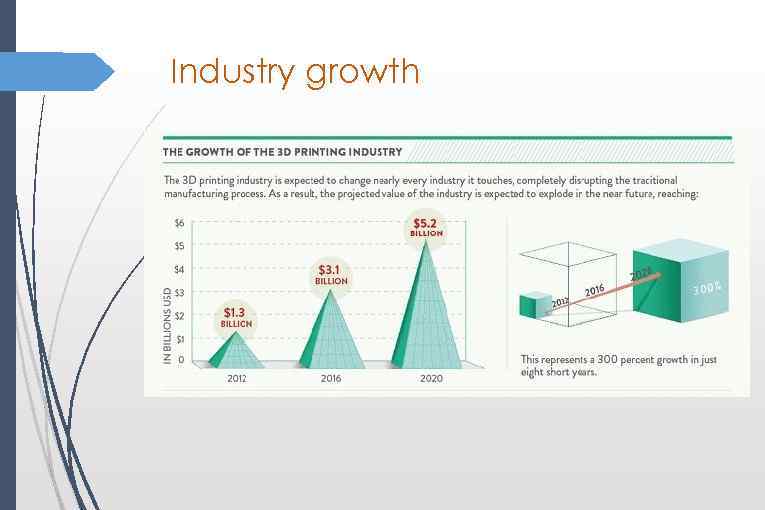
Industry growth
Printers from Russian producers ● Full metal construction ● The possibility to use the plastic of any quality ● High speed of printing without loosing of product quality ● Easy in service ● No name brand
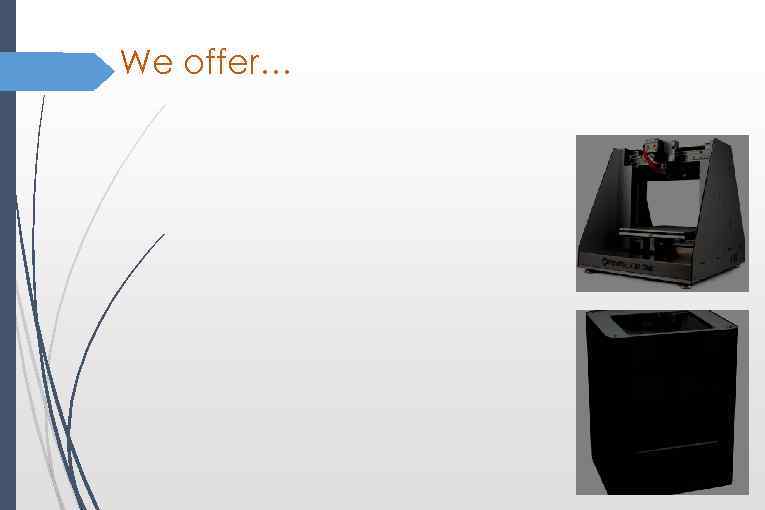
We offer…
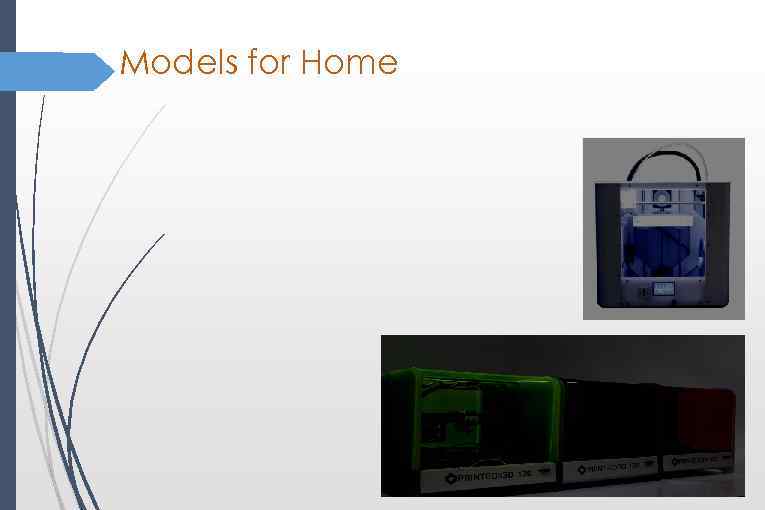
Models for Home
Our own experience in Russia
3 D printing = all spheres of future life https: //www. youtube. com/watch? featur e=player_embedded&v=UCI 7 Bg. Lrk-4
