


 Скачать презентацию 3 19 2018 Language Articulatory Phonetics Top
2ce05f7d4e42c3f8388e0a3ed17664f1.ppt
- Количество слайдов: 46
 3/19/2018 • Language » Articulatory Phonetics ◊ Top down processes » Syntax » Lexical and semantic factors Oh freddled guntbuggly, thy micturations are to me As plurdled gabbleblothchits on a lugid bee Groop, I implore thee, my foonting turlingdromes And booptiously drangle me with crinkly bindlewurdles Or I will rend thee in the gobberwarts With my blurglecruncheon, see if I don’t Prostetnic Vogon Jeltz Hitchhiker’s Guide to the Galaxy ◊ Case Grammar » Neuropsychology of language ◊ Classical Localization Model » Neurophysiology of language Study Questions. • How has sentence ambiguity been used to study the psycholinguistics of grammar. • Describe the classical localization model of brain and language. How do different aphasias relate to the model. Give examples.
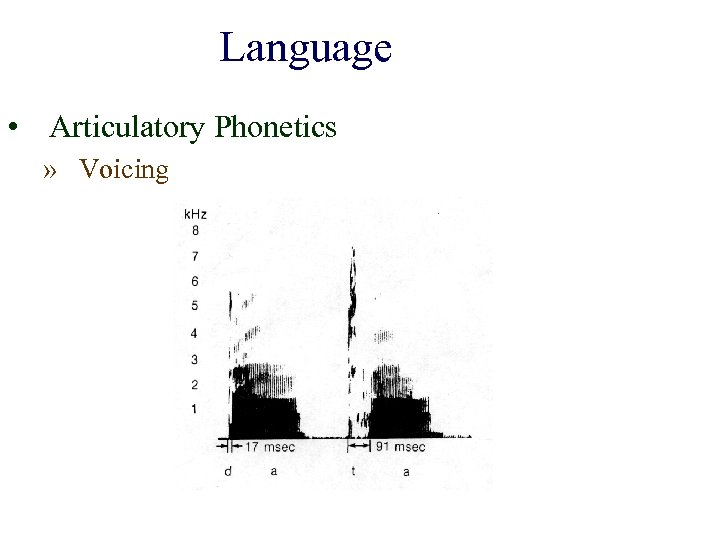 Language • Articulatory Phonetics » Voicing
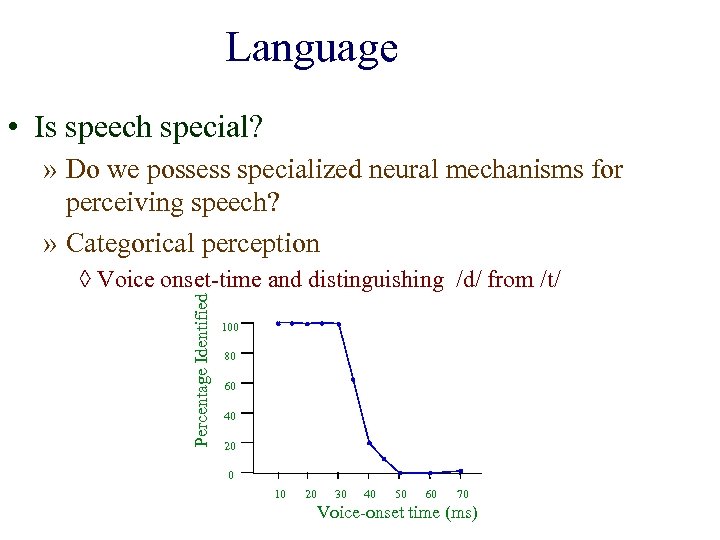 Language • Is speech special? » Do we possess specialized neural mechanisms for perceiving speech? » Categorical perception Percentage Identified ◊ Voice onset-time and distinguishing /d/ from /t/ 100 80 60 40 20 0 10 20 30 40 50 60 70 Voice-onset time (ms)
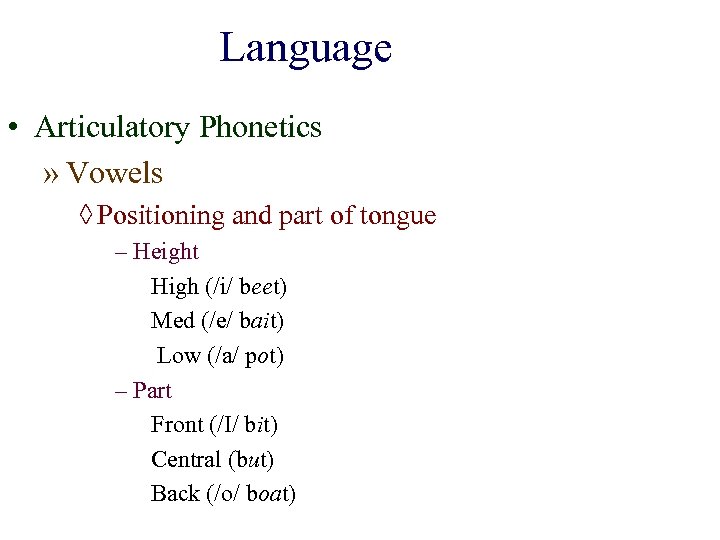 Language • Articulatory Phonetics » Vowels ◊ Positioning and part of tongue – Height High (/i/ beet) Med (/e/ bait) Low (/a/ pot) – Part Front (/I/ bit) Central (but) Back (/o/ boat)
 Language • The search for invariants » Distinctive features » Problems with a simple bottom-up approach ◊ There are no periods of silence between phonemes – The speech spectrograph
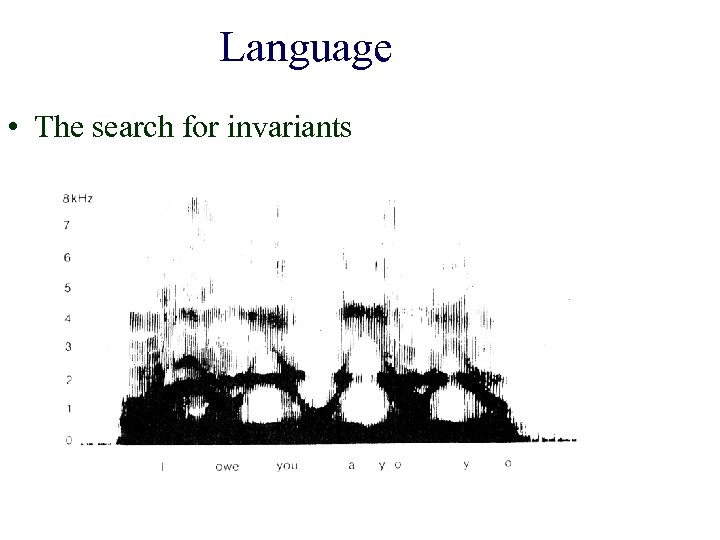 Language • The search for invariants
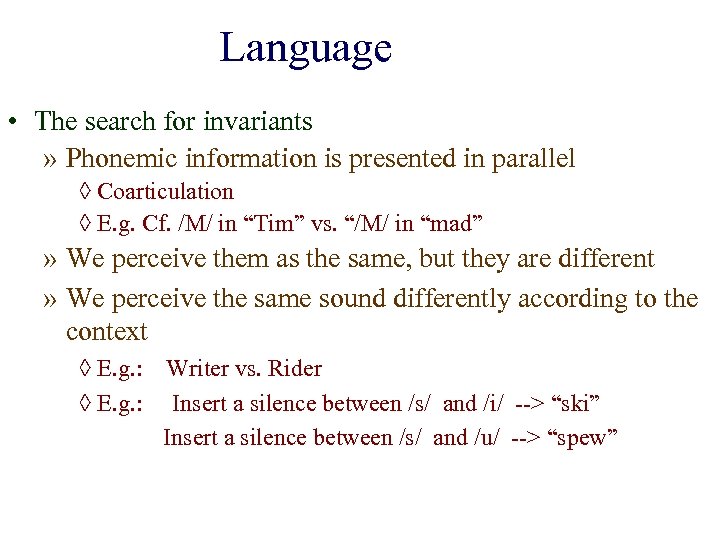 Language • The search for invariants » Phonemic information is presented in parallel ◊ Coarticulation ◊ E. g. Cf. /M/ in “Tim” vs. “/M/ in “mad” » We perceive them as the same, but they are different » We perceive the same sound differently according to the context ◊ E. g. : Writer vs. Rider ◊ E. g. : Insert a silence between /s/ and /i/ --> “ski” Insert a silence between /s/ and /u/ --> “spew”
 Language • Top down processes » Phonemic restoration effect (Warren, 1970) ◊ Their respective legi*latures ◊ Found a *eel on the axle ◊ Found a *eel on the shoe
 Language • Perceiving conversational speech » Two main problems: ◊ There are no physical boundaries between words – Anna Mary candy lights since imp pulp lay things – ( An American delights in simple play things) ◊ Speech is sloppy – He wants to kiss this Guy? – Misheard Lyrics (www. kissthisguy. com) – This was the best buy vs. She is a bad girl
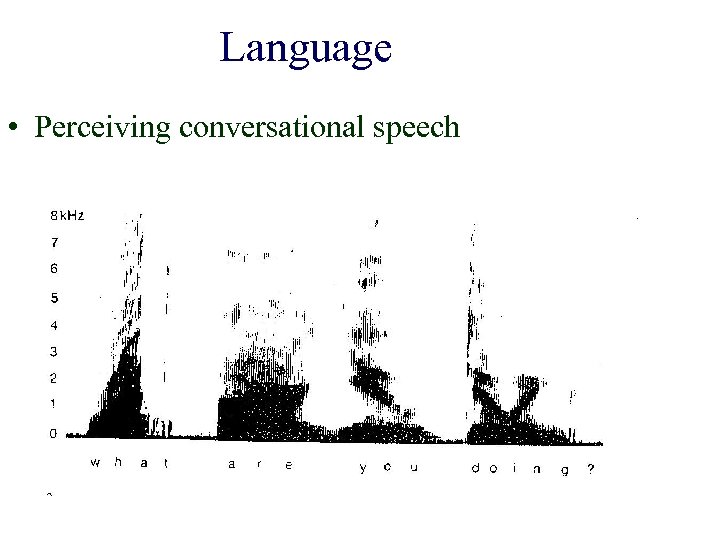 Language • Perceiving conversational speech
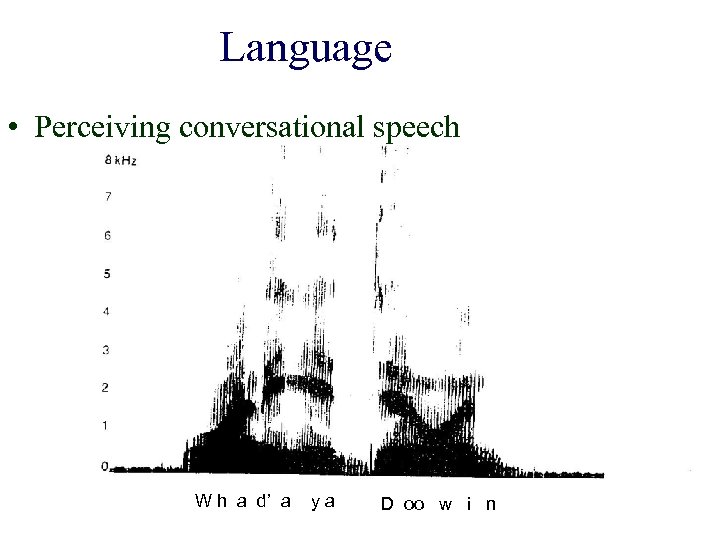 Language • Perceiving conversational speech W h a d’ a ya D oo w i n
 Language • Top-down processes and speech perception » Phonemic perception ◊ The Mc. Gurk Effect » Sentence comprenension ◊ Miller & Isard (1963) – Participants shadow sentences: Grammatic: Bears steal honey from the hive. Semantically incorrect: Bears shoot honey on the highways. Ungrammatic: Across bears eyes honey the bill.
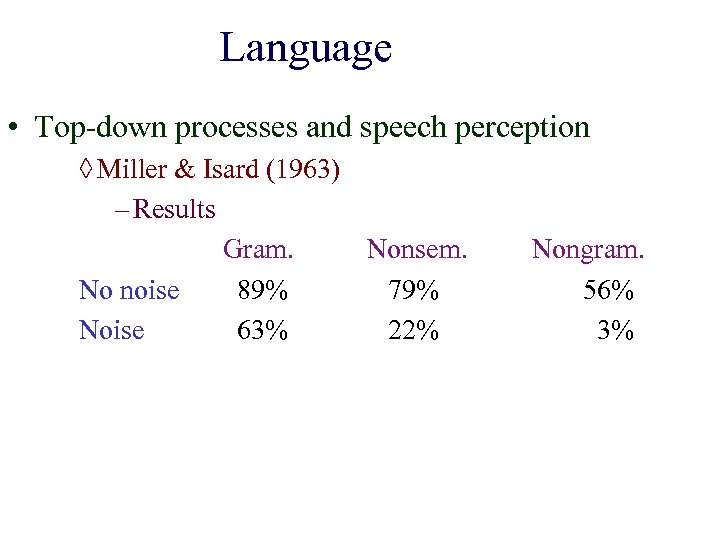 Language • Top-down processes and speech perception ◊ Miller & Isard (1963) – Results Gram. Nonsem. No noise 89% 79% Noise 63% 22% Nongram. 56% 3%
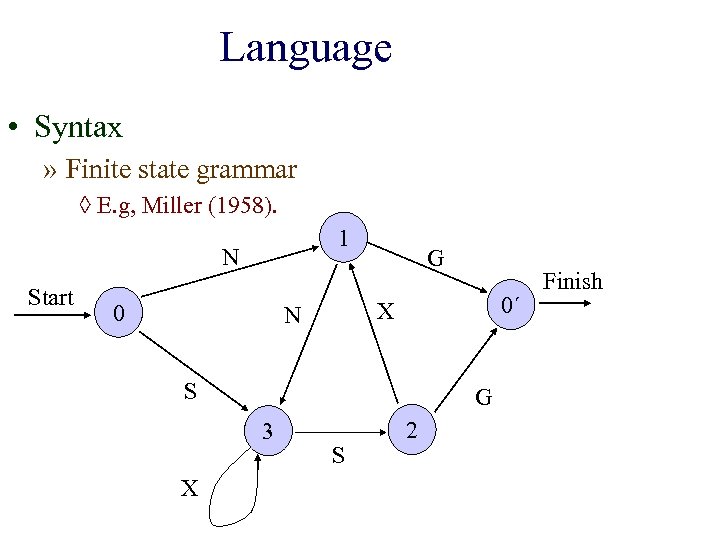 Language • Syntax » Finite state grammar ◊ E. g, Miller (1958). 1 N Start 0 G 0´ X N S G 3 X S 2 Finish
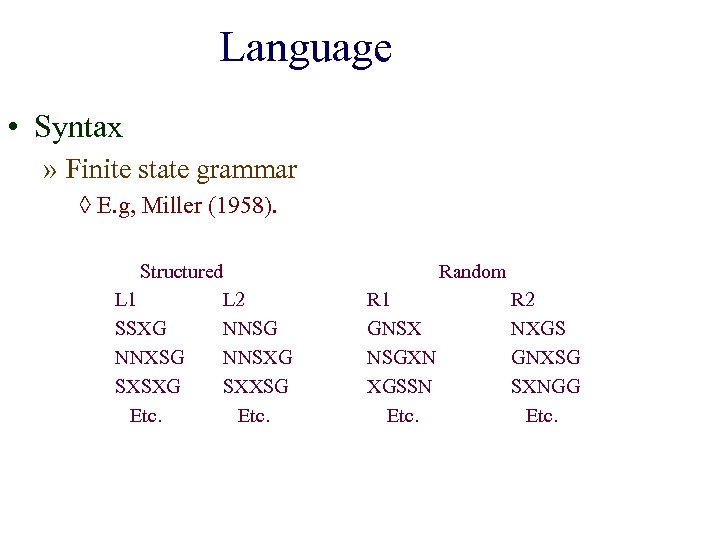 Language • Syntax » Finite state grammar ◊ E. g, Miller (1958). Structured L 1 L 2 SSXG NNSG NNXSG NNSXG SXXSG Etc. Random R 1 GNSX NSGXN XGSSN Etc. R 2 NXGS GNXSG SXNGG Etc.
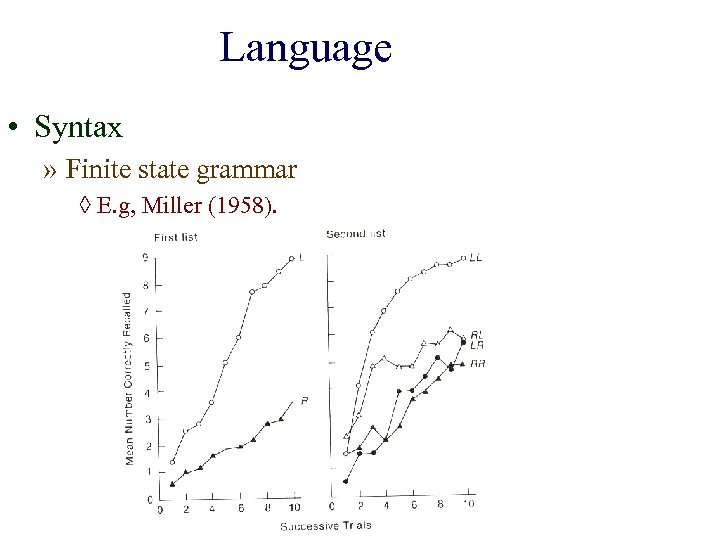 Language • Syntax » Finite state grammar ◊ E. g, Miller (1958).
 Language • Syntax » Finite state grammar ◊ Problems with finite state grammar – Linguistic competence – Judgements of grammaticity (Chomsky) e. g. , Colourless green ideas sleep furiously (For words never paired together) – Judgements of agrammaticity (Miller and Selfridge) e. g. , Was he went to the newspaper is in deep end. (For words often paired together) – Resolving/explaining ambiguity e. g. , They are cooking apples.
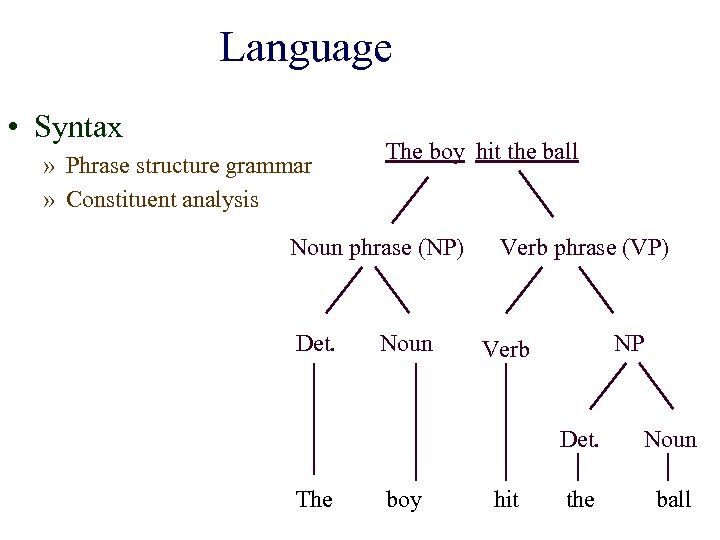 Language • Syntax » Phrase structure grammar » Constituent analysis The boy hit the ball Noun phrase (NP) Det. Noun Verb phrase (VP) NP Verb Det. The boy hit Noun the ball
 Language • Syntax » Phrase structure grammar ◊ Three types of sentences – Grammatical / meaningful: maps onto only one phrase structure. – Nongrammatical: cannot be mapped onto a phrase structure – Grammatical / ambiguous: maps onto more than one phrase structure. e. g. , They are flying planes
 Language • Syntax » Transformational grammar ◊ Some ambiguous sentences are not explained by phrase structure E. g, Visiting relatives can be boring ◊ Both interpretations map onto the same phrase structure. . . but, they map onto different meanings » Surface structure: Superficial appearance (i. e. , phrase structure). » Deep structure: The meaning of the sentence. » Transformational rules: convert the deep structure into a surface structure (a sentence ready to be spoke)
 Language • Syntax » Resolving ambiguity (Mc. Kay, 1966) ◊ Lexical ambiguity – E. g. , Although he was continually bothered by the cold … – Control: headache ◊ Surface ambiguity – E. g. , Although Hannibal sent troops over a week ago … – Control: almost ◊ Underlying ambiguity – E. g. , Knowing that visiting relatives could be bothersome …. – Control: visiting some
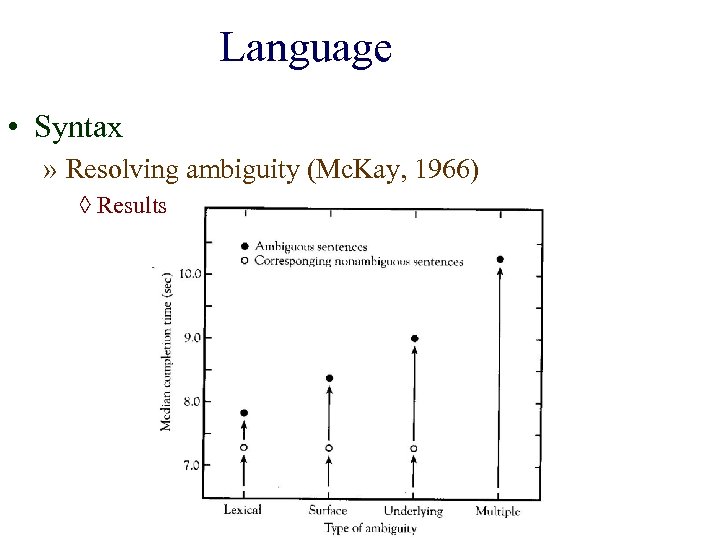 Language • Syntax » Resolving ambiguity (Mc. Kay, 1966) ◊ Results
 Language • Syntax » Case grammar ◊ Semantic analysis involves determining the semantic role of each word or concept and computing sentence meaning based on that analysis. ◊ E. g, A] The key will open the door B] The janitor will open the door with the key – The ‘key’ is the subject of [A] and an object in [B] but serves the same role in each sentence.
 Language • Syntax » Interaction between syntax and semantics ◊ Fillenbaum (1974) – Had subjects read and then paraphrase several sentences – Normal sentences: Threat: Don’t print that or I will sue you. Control: John got off the bus and went to the store – Perverse/disordered Threat: Don’t print that or I won’t sue you Control: John went in the store and got on the bus. – Results: Perverse: 50% normalized in their paraphrases Disordered: 60 % normalized. When subjects checked their work, they missed half of the errors…
 Nice we’re having weather isn’t it?
 Brain & Language • Neuropsychology of language » Aphasia: Language deficits resulting from brain-related disorders and injury. ◊ Very common – 40 % of all strokes produce some aphasia » Broca’s Aphasia ◊ Paul Broca - studied patient Leborgne (A. K. A. ’Tan’) – – – Treated for leg injury Died a few days later Autopsied brain Discovered ‘Broca’s area’ Left Hemisphere dominance for language
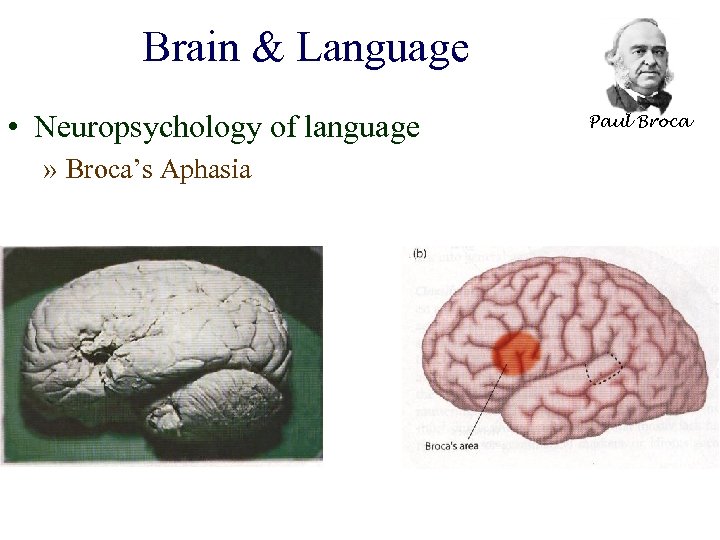 Brain & Language • Neuropsychology of language » Broca’s Aphasia Paul Broca
 Brain & Language • Neuropsychology of language Paul Broca » Broca’s Aphasia ◊ Production Deficits – Problems in producing fluent language – Range from ‘Tan, tan, …’ to short phrases – Lack function words and grammar May retain idioms (‘fit as a fiddle’) or songs – Proximity to motor cortex Dysarthria: loss of control over articulatory muscles Speech Apraxia: Unable to program voluntary articulatory movements.
 Brain & Language • Neuropsychology of language » Broca’s Aphasia ◊ Comprehension deficits – Unable to analyze precise grammatical information E. g. “The Boy ate the cookie” Who ate the Cookie? “Boy ate cookie” Implied grammar (cookies don’t eat boys) “The Boy was kicked by the girl” Who kicked whom? “Boy kick girl” Paul Broca
 Brain & Language • Neuropsychology of language » Wernicke’s Aphasia Carl Wernicke ◊ Carl Wernicke, 1870 s – Examined two patients Problems understanding language following strokes Fluent but nonsensical speech Poor language comprehension Proximity to auditory sensory areas (Wernicke proposed word memory area)
 Brain & Language • Neuropsychology of language » Wernicke’s Aphasia Carl Wernicke ◊ Production deficits – Sounds fluent (e. g. , foreign language) – Neologistic (invented words) – Semantic substitutions E. g. I called my mother on the television and did not understand the romers by the door.
 Brain & Language • Neuropsychology of language » Wernicke’s Aphasia Carl Wernicke ◊ Comprehension deficits – Do not recognize the incomprehensibility of their own sentences – Do not comprehend written or spoken language ◊ “Here and gone again” – Aphasia improves over time – Anomia: Losing the ability to retrieve words (nouns)
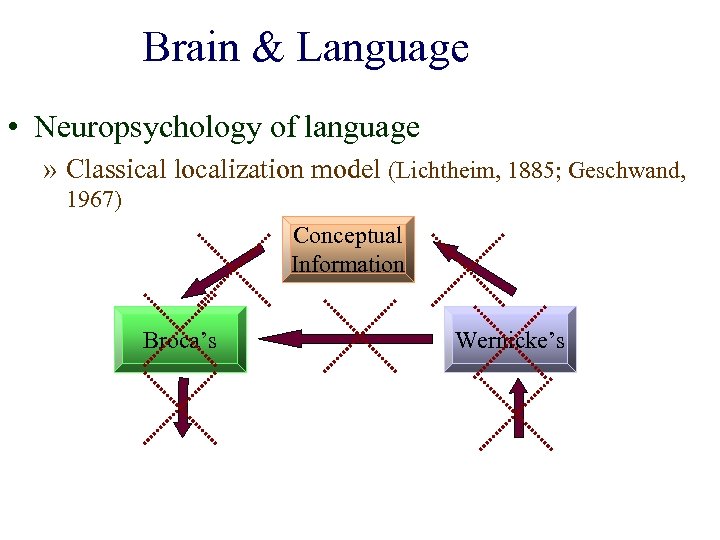 Brain & Language • Neuropsychology of language » Classical localization model (Lichtheim, 1885; Geschwand, 1967) Conceptual Information Broca’s Wernicke’s
 Brain & Language • Neuropsychology of language » Classical localization model (Lichtheim, 1885; Geschwand, 1967) ◊ Damage to main areas – Broca’s Aphasia – Wernicke’s Aphasia ◊ Damage to connections – Conduction aphasia – Transcortical sensory aphasia
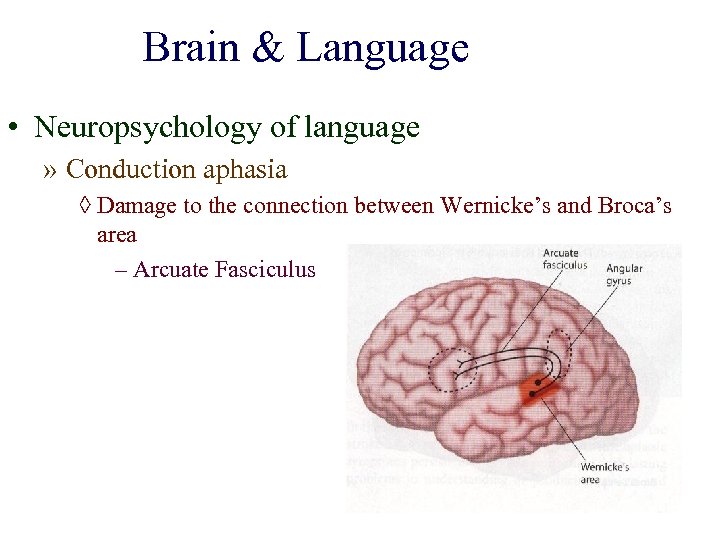 Brain & Language • Neuropsychology of language » Conduction aphasia ◊ Damage to the connection between Wernicke’s and Broca’s area – Arcuate Fasciculus
 Brain & Language • Neuropsychology of language » Conduction aphasia ◊ Production deficits – Problems producing spontaneous speech – Problem repeating speech – Sometimes use words incorrectly ◊ Comprehension – Can understand spoken/written words – Can hear their own speech errors, but cannot correct them
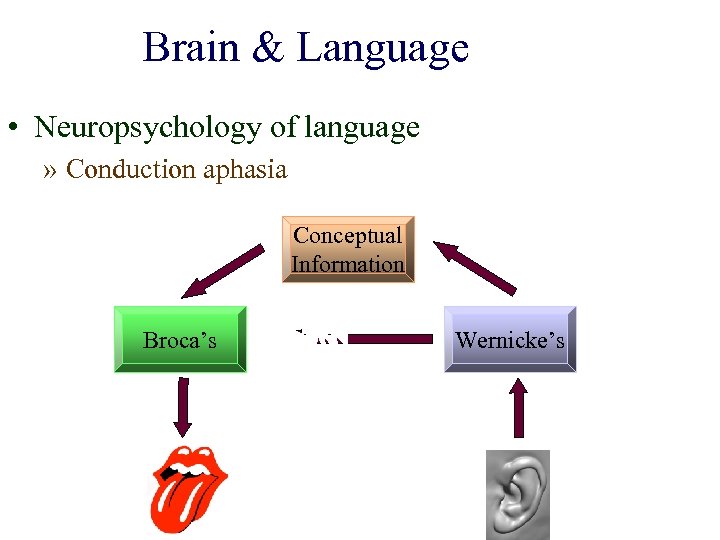 Brain & Language • Neuropsychology of language » Conduction aphasia Conceptual Information Broca’s Wernicke’s
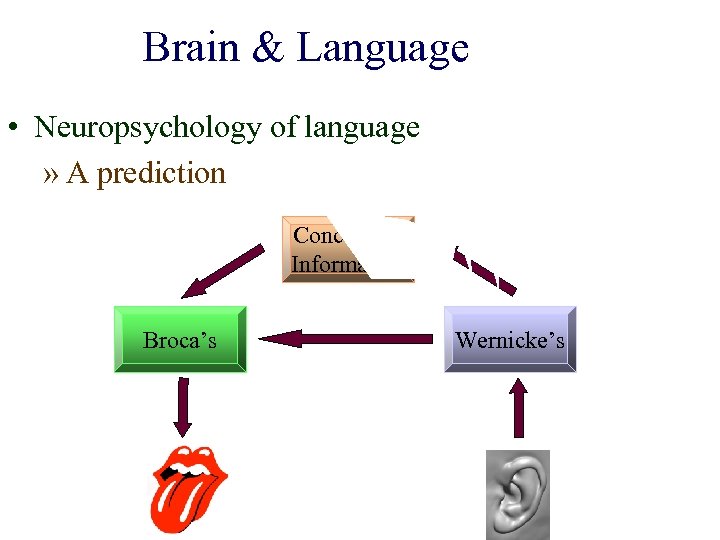 Brain & Language • Neuropsychology of language » A prediction Conceptual Information Broca’s Wernicke’s
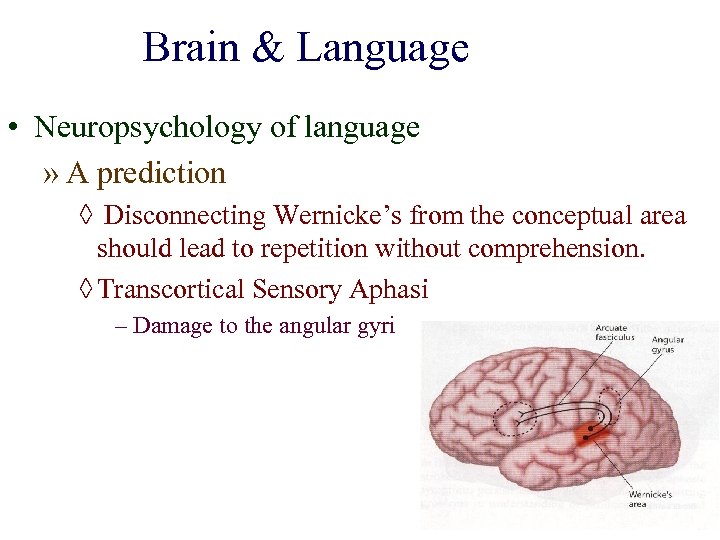 Brain & Language • Neuropsychology of language » A prediction ◊ Disconnecting Wernicke’s from the conceptual area should lead to repetition without comprehension. ◊ Transcortical Sensory Aphasi – Damage to the angular gyri
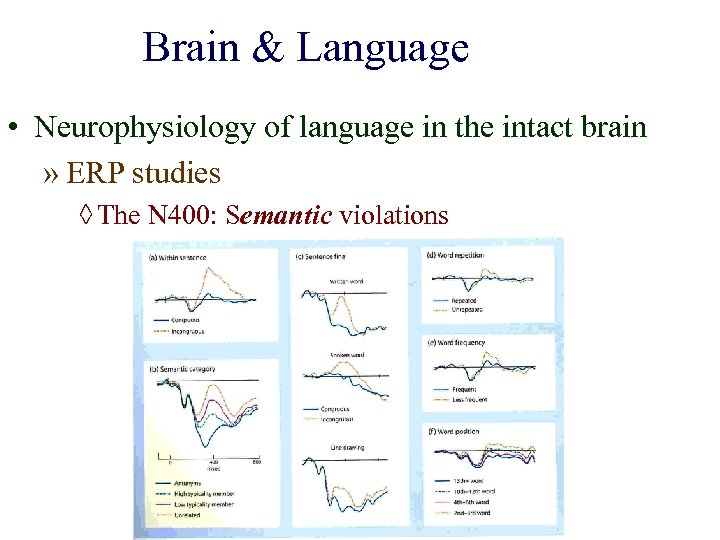 Brain & Language • Neurophysiology of language in the intact brain » ERP studies ◊ The N 400: Semantic violations
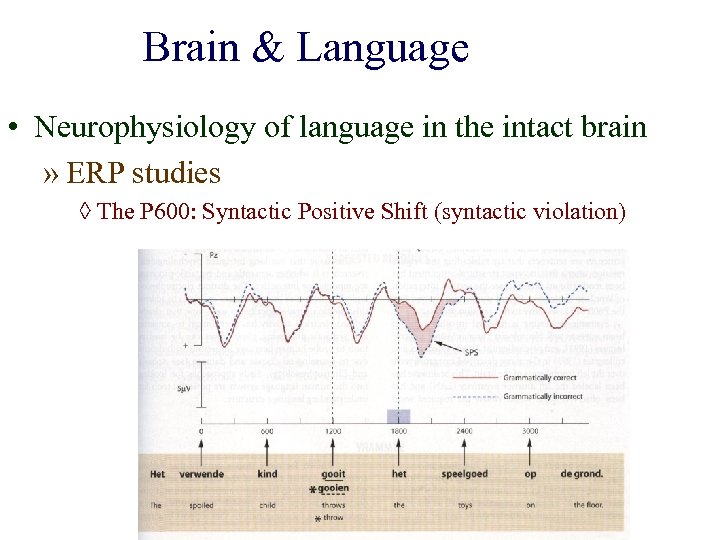 Brain & Language • Neurophysiology of language in the intact brain » ERP studies ◊ The P 600: Syntactic Positive Shift (syntactic violation)
 Brain & Language • Neurophysiology of language in the intact brain ◊ Dispreferred continuation of ambiguous sentences – E. g. , The spy saw the cop with the binoculars Who has the binoculars? “The spy has the binoculars” -> preferred continuation ◊ The N 400 and aphasia – Swaab et al. Patients listened to sentences that had an anomalous word at the end.
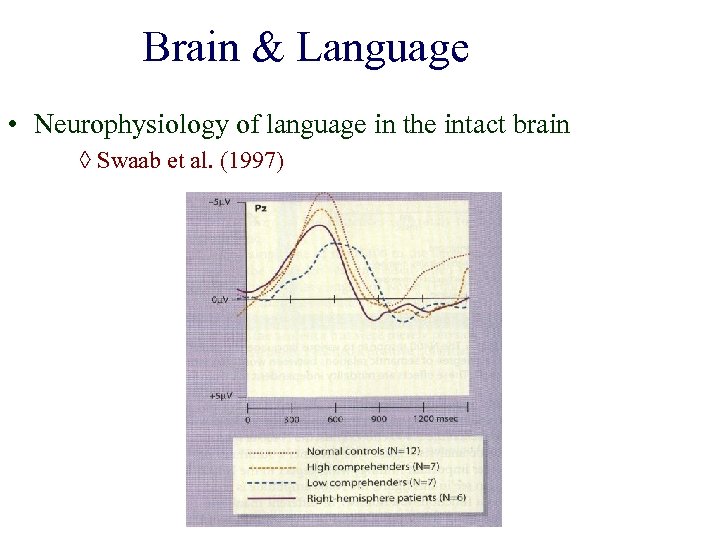 Brain & Language • Neurophysiology of language in the intact brain ◊ Swaab et al. (1997)
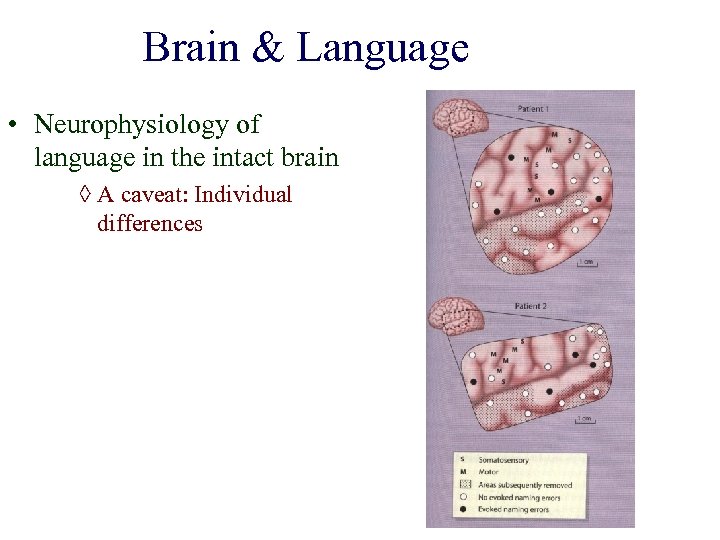
 Brain & Language • Neurophysiology of language in the intact brain ◊ A caveat: Individual differences – Stimulation mapping of the brain Neurosurgery around left hemisphere language areas – A couple hundred of partients – Correlation with effects in Wernicke and Broca’s area are week Some patients have naming problems in the area, not all. – Anatomical localizations vary considerably.
 Brain & Language • Neurophysiology of language in the intact brain ◊ A caveat: Individual differences