 Скачать презентацию 3 18 2018 Fish Web Collaborative Towards an Integrated View
57f1c76d2152d65808ab4815225f0200.ppt
- Количество слайдов: 43



3/18/2018 Fish Web Collaborative: Towards an Integrated View of Fish Distribution Information for Ontario Craig Onafrychuk Fisheries Metadata Officer Information Management & Spatial Analysis Unit Southern Science and Information Section Fish Web Collaborative Ministry of Natural Resources
Current Situation • Many agencies and community-based monitoring groups are collecting fish community and habitat information • Information is collected using various methods • Data are stored on agency networks or individual personal computers • As a result: – Fish distribution data are undiscoverable, uncoordinated and unstandardized – Difficult to access information on fish communities and habitat necessary to make resource management decisions – Difficult to test effects of regulations, habitat improvements or other management techniques – Difficult to make comparisons across spatial and temporal scales Fish Web Collaborative
Purpose of the Fish Web Collaborative • To develop a multi-organizational collaborative model for the management of fish distribution data in Ontario and establish a single standardized source accessible over the Internet • Goals/Results: – Increase communication & data sharing – Reduce costs – Data analysis: increase sample size; compare across time & space Fish Web Collaborative
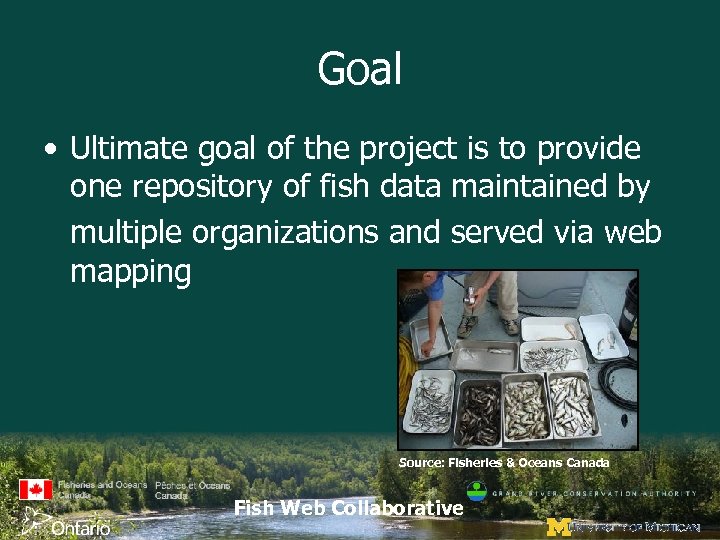
Goal • Ultimate goal of the project is to provide one repository of fish data maintained by multiple organizations and served via web mapping Source: Fisheries & Oceans Canada Fish Web Collaborative
Phases of the Fish Web Collaborative • Phase 1: Develop thematic data standards for fish distribution information (this project) – completed by Sept 2008 • (Proposed) Phase 2: Publish thematic data on fish distribution in Ontario waterbodies on the internet – Oct 2008 – Oct 2009 • (Proposed) Phase 3: Develop a web-based application to enable the community of practice to continue to contribute fish distribution – October 2009 – March 2010 Fish Web Collaborative
Objectives for Funding • To develop and implement thematic geospatial data organized around a particular theme (i. e. , Fish Distribution) • Standards which allow for interorganizational exchange and interoperability • Project must be collaborative and support an identified end-user community Fish Web Collaborative
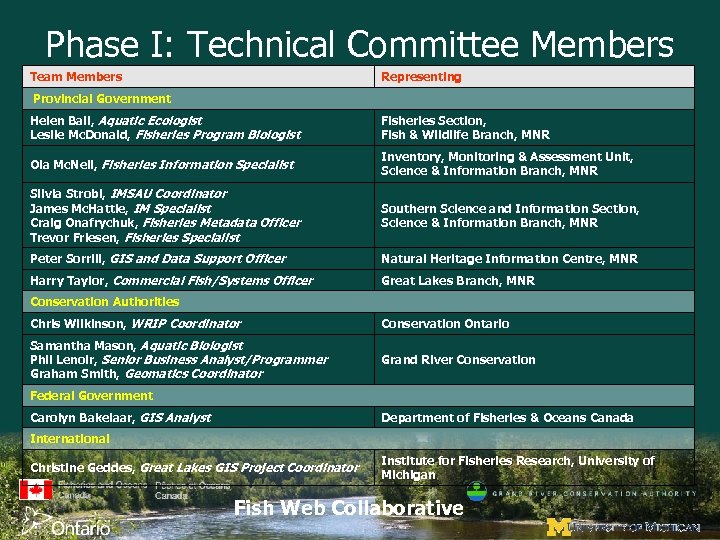
Phase I: Technical Committee Members Team Members Representing Provincial Government Helen Ball, Aquatic Ecologist Leslie Mc. Donald, Fisheries Program Biologist Fisheries Section, Fish & Wildlife Branch, MNR Ola Mc. Neil, Fisheries Information Specialist Inventory, Monitoring & Assessment Unit, Science & Information Branch, MNR Silvia Strobl, IMSAU Coordinator James Mc. Hattie, IM Specialist Craig Onafrychuk, Fisheries Metadata Officer Trevor Friesen, Fisheries Specialist Southern Science and Information Section, Science & Information Branch, MNR Peter Sorrill, GIS and Data Support Officer Natural Heritage Information Centre, MNR Harry Taylor, Commercial Fish/Systems Officer Great Lakes Branch, MNR Conservation Authorities Chris Wilkinson, WRIP Coordinator Conservation Ontario Samantha Mason, Aquatic Biologist Phil Lenoir, Senior Business Analyst/Programmer Graham Smith, Geomatics Coordinator Grand River Conservation Federal Government Carolyn Bakelaar, GIS Analyst Department of Fisheries & Oceans Canada International Christine Geddes, Great Lakes GIS Project Coordinator Institute for Fisheries Research, University of Michigan Fish Web Collaborative
Technical Team – Member Roles • Provide technical direction • Empowered to actively participate on behalf of their organization • Communicate progress to & solicit information from home organization (esp. senior management) • Coordinate the cataloguing of fish distribution data with Metadata Coordinator • Support delivery of User Needs Workshops Fish Web Collaborative
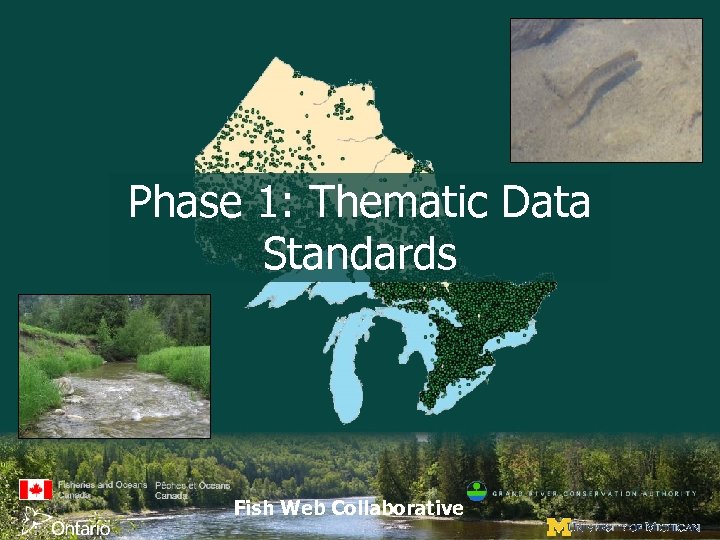
Phase 1: Thematic Data Standards Fish Web Collaborative
Phase 1 Goals • Compile a comprehensive list of existing fish data sources • Document the essential descriptive and administrative information to support discovery, access and use of existing fish data sources • Conduct workshops with users to develop a consensus-based data model Fish Web Collaborative
What is Metadata? • High-level descriptions which enables the discovery and analysis of data • At the very least, metadata answers some fundamental questions about data: – – – Who created the data? Who maintains it? What is the content of the data? What is its structure? Where was the data collected? Where is it stored? When was the data collected? When was it produced? Why was the data created? What is the purpose? How was it produced? How can it be accessed? What data quality can you expect? Fish Web Collaborative
Collecting Metadata: A Team Approach • Identify a Metadata Coordinator – User of standards and tools • Establish a production process – Interview method or individual entry – Common templates • Engage appropriate specialists – Data owner (You the practitioner) – GIS Specialist / Metadata Clerk Source: USGS Geo. Connections Training Fish Web Collaborative
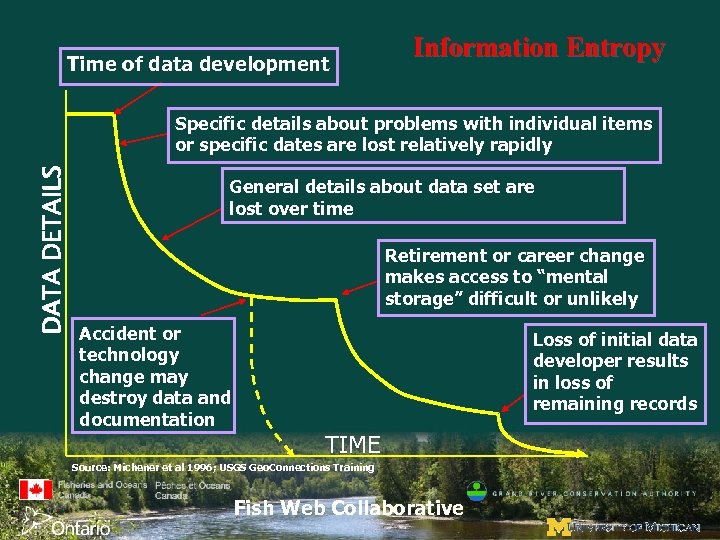
Time of data development Information Entropy DATA DETAILS Specific details about problems with individual items or specific dates are lost relatively rapidly General details about data set are lost over time Retirement or career change makes access to “mental storage” difficult or unlikely Accident or technology change may destroy data and documentation Loss of initial data developer results in loss of remaining records TIME Source: Michener et al 1996; USGS Geo. Connections Training Fish Web Collaborative
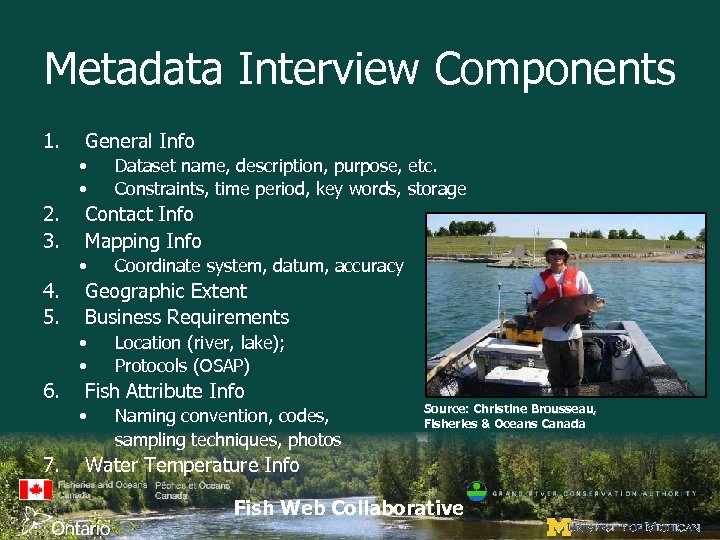
Metadata Interview Components 1. General Info • • 2. 3. Contact Info Mapping Info • 4. 5. Location (river, lake); Protocols (OSAP) Fish Attribute Info • 7. Coordinate system, datum, accuracy Geographic Extent Business Requirements • • 6. Dataset name, description, purpose, etc. Constraints, time period, key words, storage Naming convention, codes, sampling techniques, photos Source: Christine Brousseau, Fisheries & Oceans Canada Water Temperature Info Fish Web Collaborative
Metadata Standards and Tools • Ontario Land Information Directory (OLID) Metadata Directory metadata editor – Catalogue tool and repository • Metadata records catalogued according to the Government of Ontario IT Standard (GO-ITS 72) Geospatial Metadata Standard – Based on the North American Profile of ISO 19115: 2003 • Compliant with Canadian Geospatial Data Infrastructure (CGDI) endorsed standards – OLID is a registered repository with Geo. Connections and is discoverable via Geo. Connection’s Discovery Portal Fish Web Collaborative
How is the Fish Web Collaborative Unique? • Metadata collection is being conducted on behalf of agency • Maintenance of record is transferred to agency • Metadata being published prior to data publication – Ontario Land Information Directory (OLID): http: //lioapp. lrc. gov. on. ca/edwin. asp – Geo. Connections Discovery Portal: http: //geodiscover. cgdi. ca/ • Metadata catalogue host – Conservation Ontario: http: //conservation-ontario. on. ca/projects/fishweb. html Fish Web Collaborative
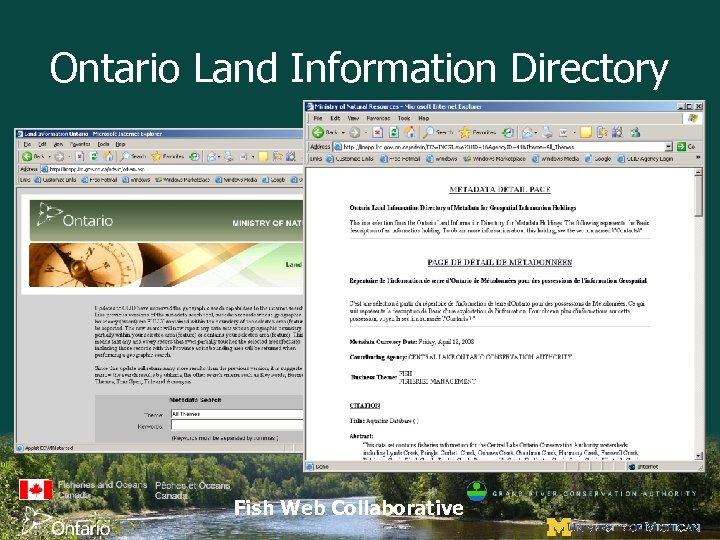
Ontario Land Information Directory Fish Web Collaborative
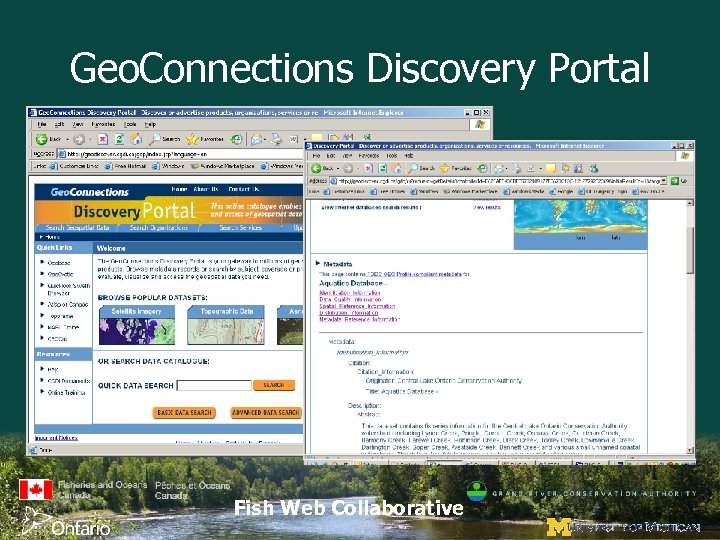
Geo. Connections Discovery Portal Fish Web Collaborative
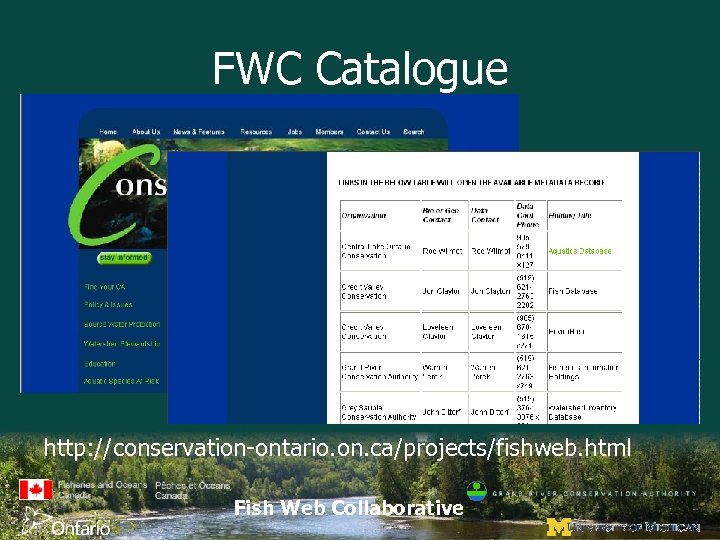
FWC Catalogue http: //conservation-ontario. on. ca/projects/fishweb. html Fish Web Collaborative
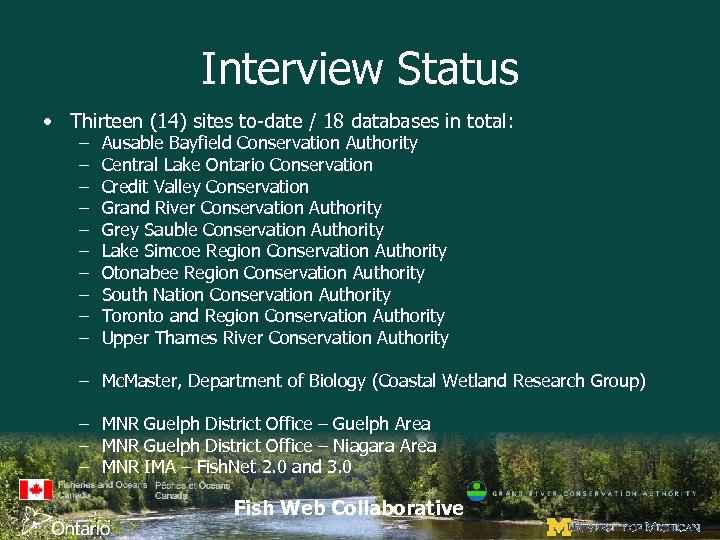
Interview Status • Thirteen (14) sites to-date / 18 databases in total: – – – – – Ausable Bayfield Conservation Authority Central Lake Ontario Conservation Credit Valley Conservation Grand River Conservation Authority Grey Sauble Conservation Authority Lake Simcoe Region Conservation Authority Otonabee Region Conservation Authority South Nation Conservation Authority Toronto and Region Conservation Authority Upper Thames River Conservation Authority – Mc. Master, Department of Biology (Coastal Wetland Research Group) – MNR Guelph District Office – Guelph Area – MNR Guelph District Office – Niagara Area – MNR IMA – Fish. Net 2. 0 and 3. 0 Fish Web Collaborative
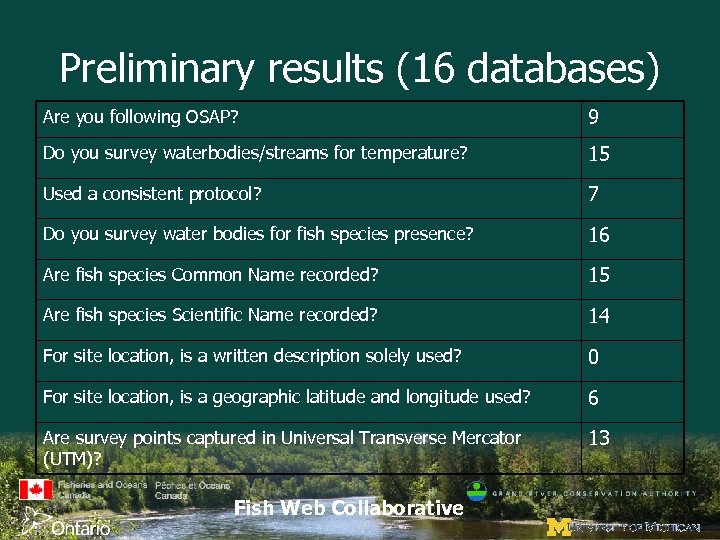
Preliminary results (16 databases) Are you following OSAP? 9 Do you survey waterbodies/streams for temperature? 15 Used a consistent protocol? 7 Do you survey water bodies for fish species presence? 16 Are fish species Common Name recorded? 15 Are fish species Scientific Name recorded? 14 For site location, is a written description solely used? 0 For site location, is a geographic latitude and longitude used? 6 Are survey points captured in Universal Transverse Mercator (UTM)? 13 Fish Web Collaborative
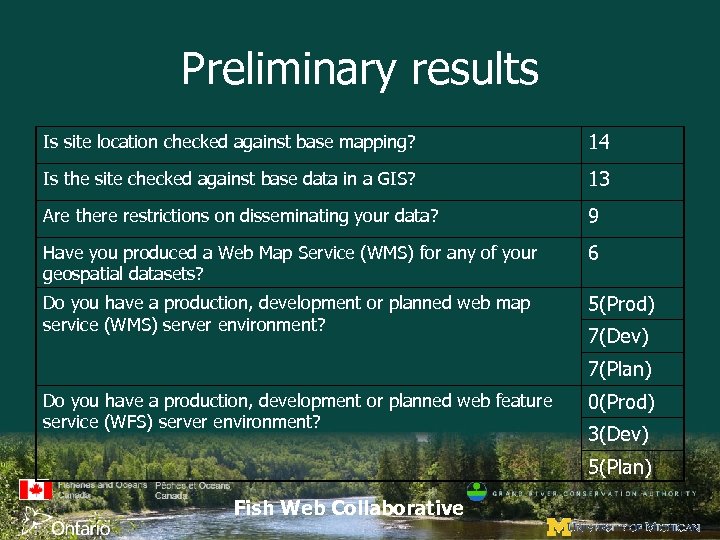
Preliminary results Is site location checked against base mapping? 14 Is the site checked against base data in a GIS? 13 Are there restrictions on disseminating your data? 9 Have you produced a Web Map Service (WMS) for any of your geospatial datasets? 6 Do you have a production, development or planned web map service (WMS) server environment? 5(Prod) 7(Dev) 7(Plan) Do you have a production, development or planned web feature service (WFS) server environment? 0(Prod) 3(Dev) 5(Plan) Fish Web Collaborative
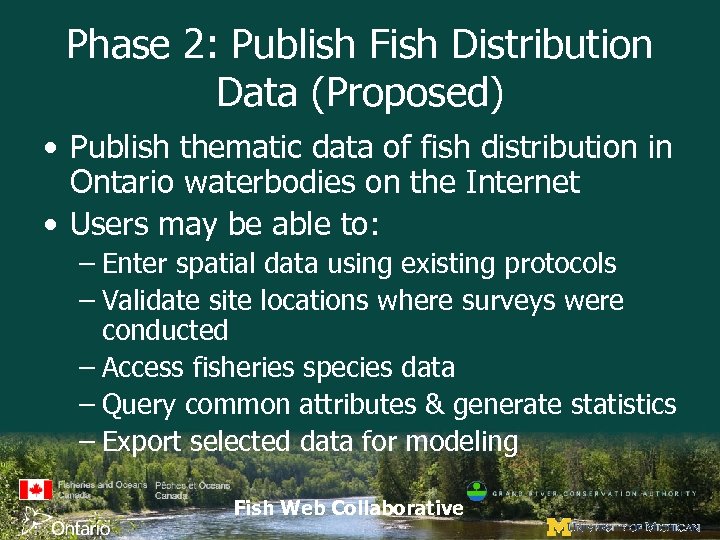
Phase 2: Publish Fish Distribution Data (Proposed) • Publish thematic data of fish distribution in Ontario waterbodies on the Internet • Users may be able to: – Enter spatial data using existing protocols – Validate site locations where surveys were conducted – Access fisheries species data – Query common attributes & generate statistics – Export selected data for modeling Fish Web Collaborative
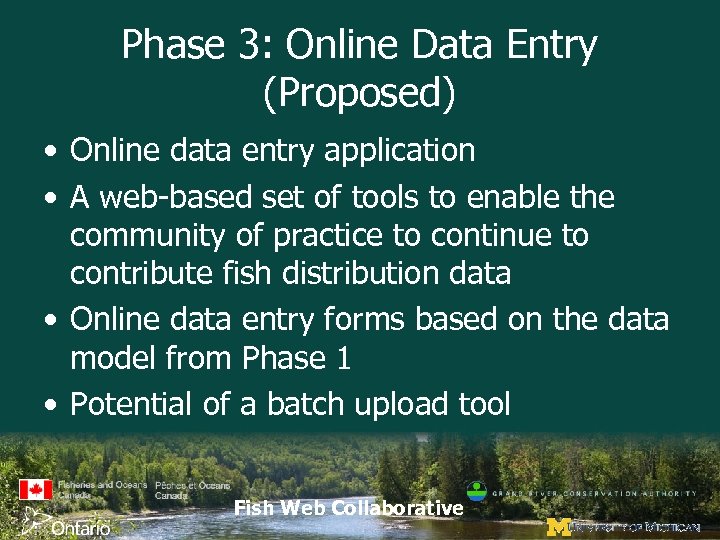
Phase 3: Online Data Entry (Proposed) • Online data entry application • A web-based set of tools to enable the community of practice to continue to contribute fish distribution data • Online data entry forms based on the data model from Phase 1 • Potential of a batch upload tool Fish Web Collaborative
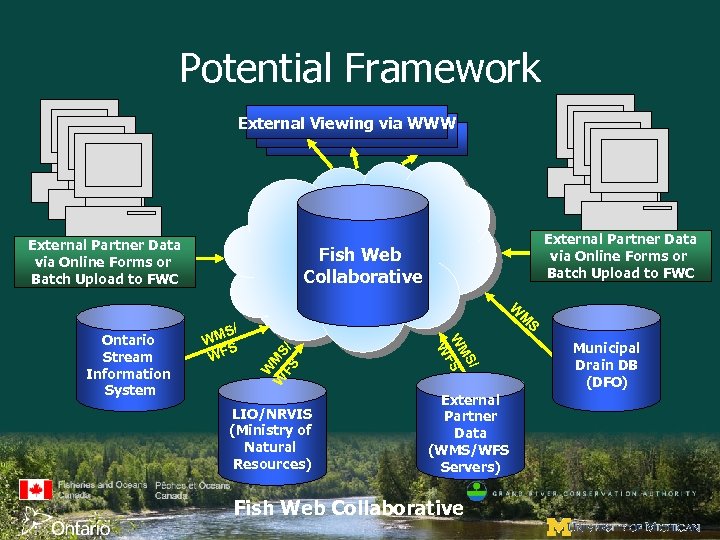
Potential Framework External Viewing via WWW External Partner Data via Online Forms or Batch Upload to FWC Fish Web Collaborative W M W W MS FS / S S/ WM S WF LIO/NRVIS (Ministry of Natural Resources) / MS W FS W Ontario Stream Information System External Partner Data (WMS/WFS Servers) Fish Web Collaborative Municipal Drain DB (DFO)
Review: Fish Websites in North America Fish Web Collaborative
Iowa Rivers Information System Iowa Department of Natural Resources, Iowa State University, and U. S. Geological Survey Fish Web Collaborative
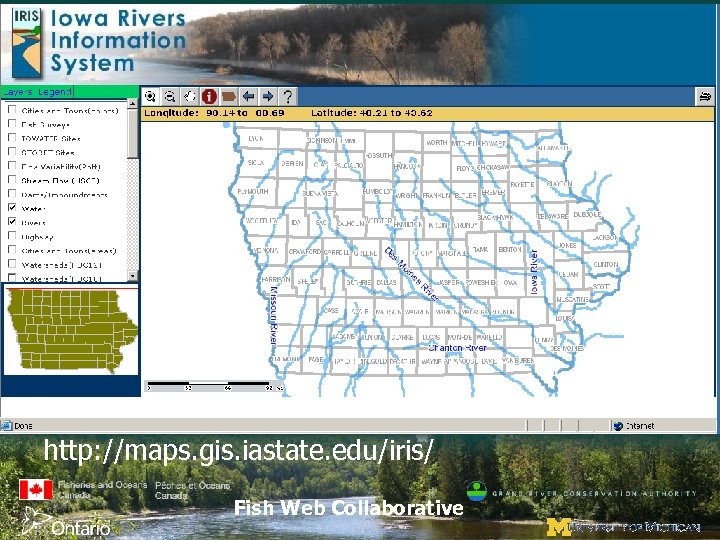
http: //maps. gis. iastate. edu/iris/ Fish Web Collaborative
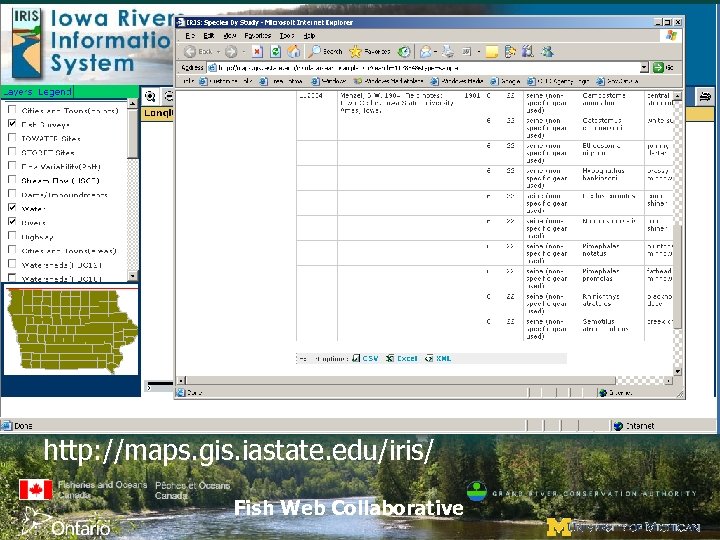
http: //maps. gis. iastate. edu/iris/ Fish Web Collaborative
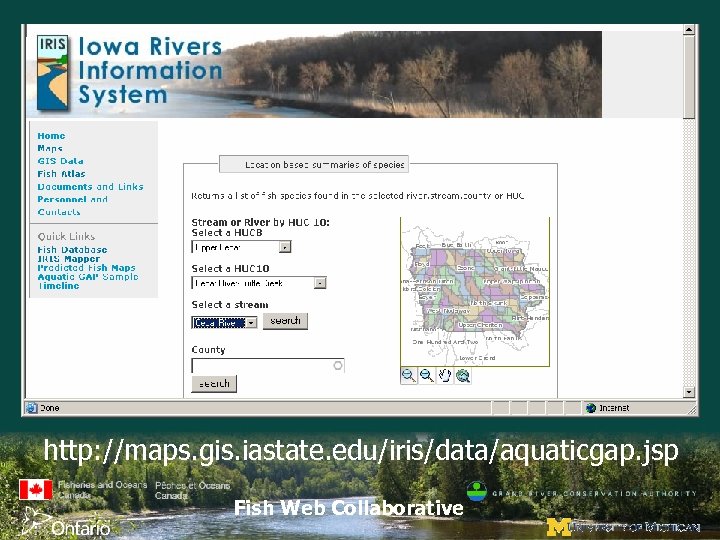
http: //maps. gis. iastate. edu/iris/data/aquaticgap. jsp Fish Web Collaborative
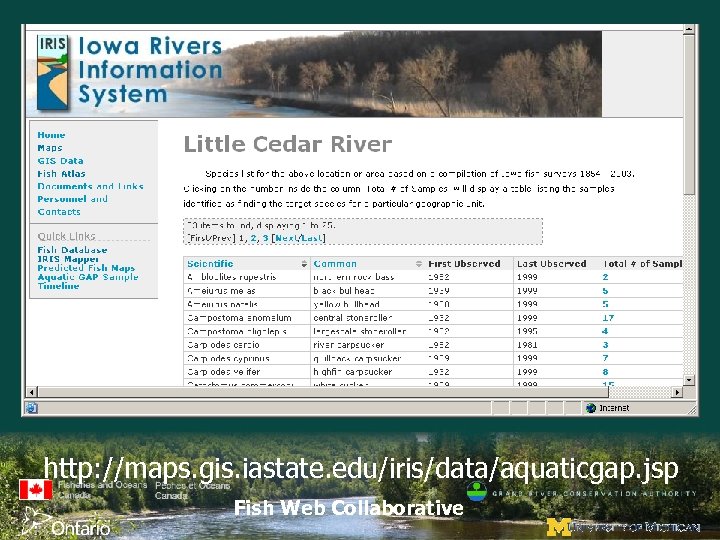
http: //maps. gis. iastate. edu/iris/data/aquaticgap. jsp Fish Web Collaborative
Wisconsin Dept of Natural Resources & Wisconsin Aquatic Gap Mapping Application “Fish Mapper” Fish Web Collaborative
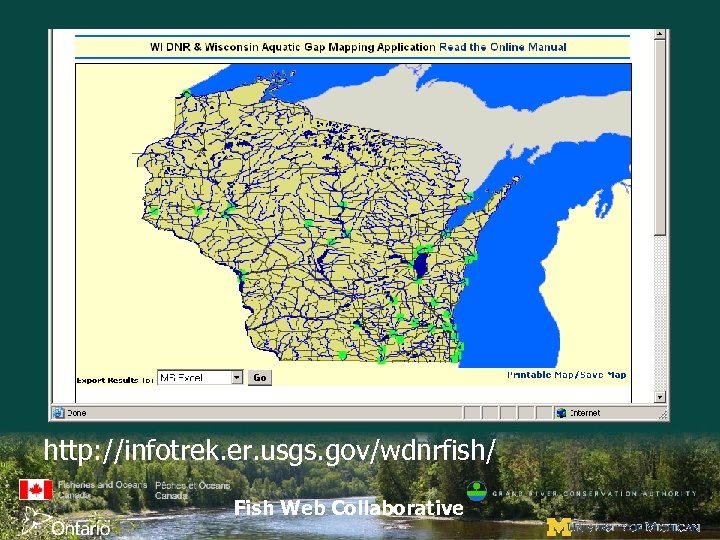
http: //infotrek. er. usgs. gov/wdnrfish/ Fish Web Collaborative
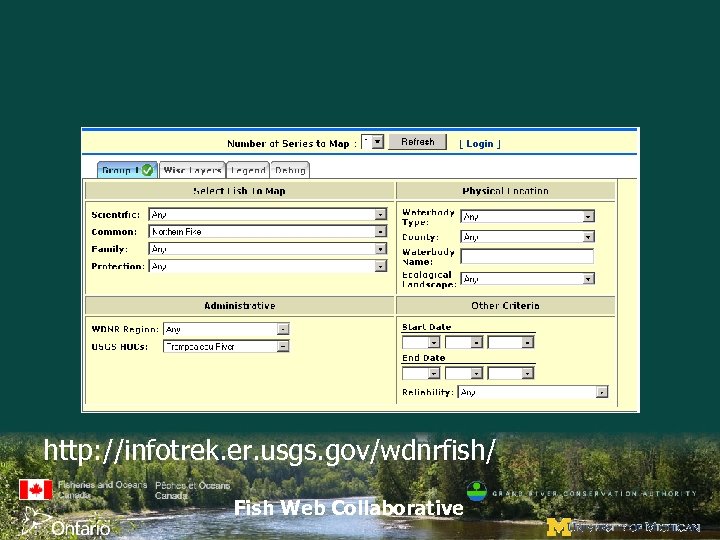
http: //infotrek. er. usgs. gov/wdnrfish/ Fish Web Collaborative
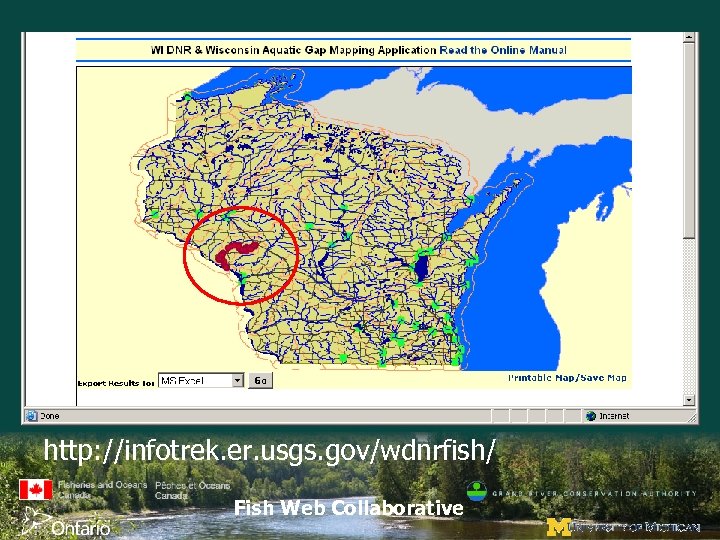
http: //infotrek. er. usgs. gov/wdnrfish/ Fish Web Collaborative
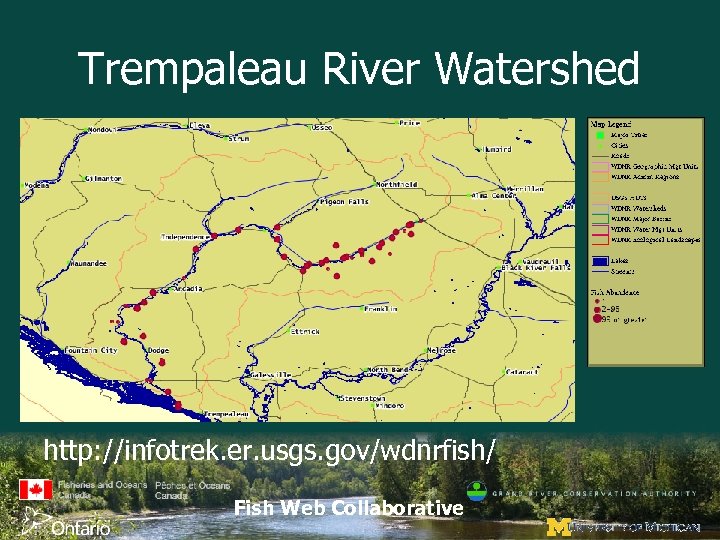
Trempaleau River Watershed http: //infotrek. er. usgs. gov/wdnrfish/ Fish Web Collaborative
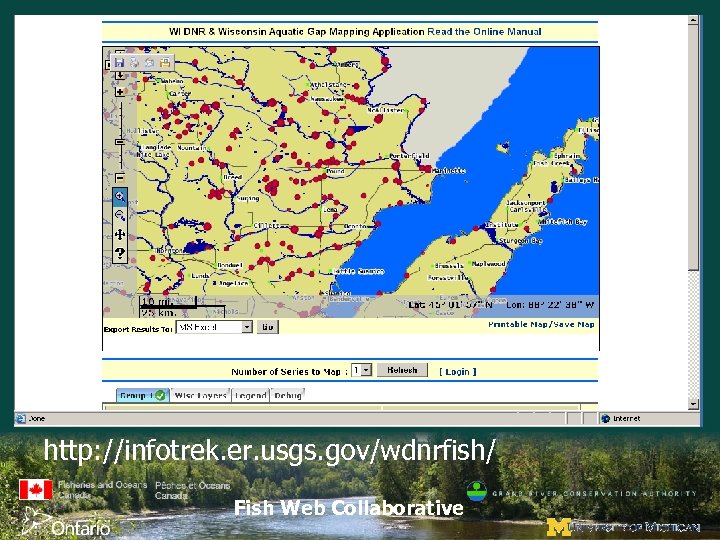
http: //infotrek. er. usgs. gov/wdnrfish/ Fish Web Collaborative
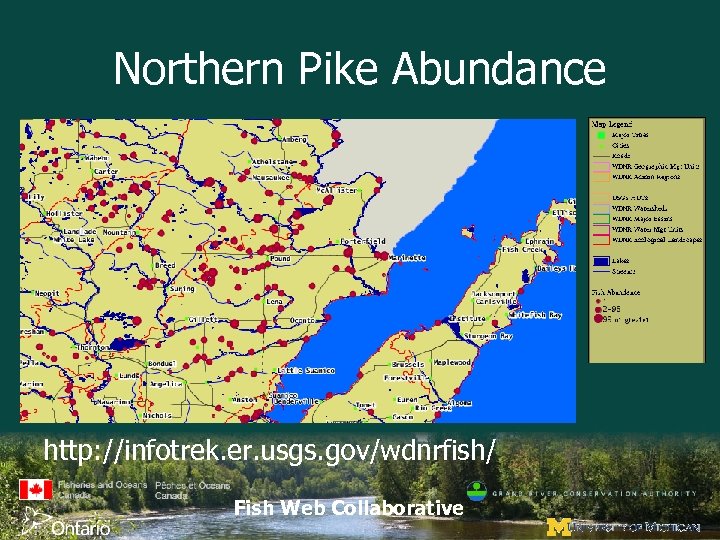
Northern Pike Abundance http: //infotrek. er. usgs. gov/wdnrfish/ Fish Web Collaborative
Minnesota Department of Natural Resources (DNR) Eco Services/Fisheries Fishes of Minnesota Map. Server Application (in development) Fish Web Collaborative
Fishes of Minnesota Map. Server Application • Project Objective: – Serve fish species distribution data over the Internet – Leverage the Fishes of Minnesota (FOM) database as the source – Enable users to query by multiple criteria and display point locations of fish species occurrences – Create printable species range maps – Provide a basic introduction to fish species distribution across Minnesota, with links to relevant resources Source: Minnesota Department of Natural Resources Fisheries Fish Web Collaborative
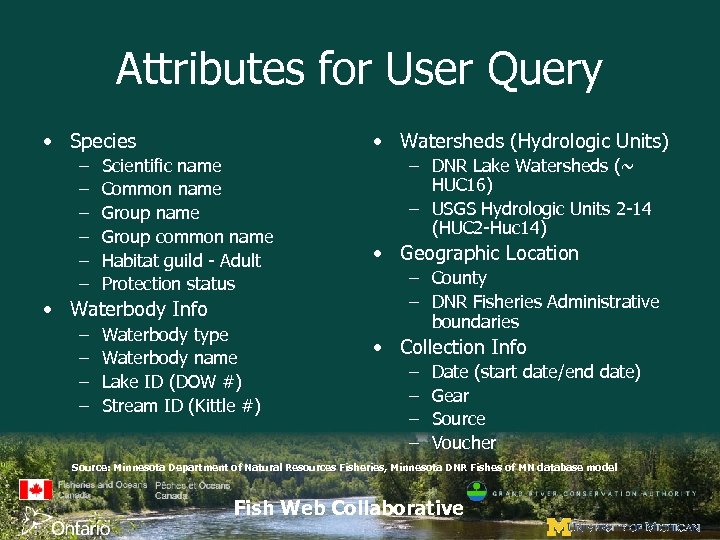
Attributes for User Query • Species – – – • Watersheds (Hydrologic Units) Scientific name Common name Group common name Habitat guild - Adult Protection status • Waterbody Info – – Waterbody type Waterbody name Lake ID (DOW #) Stream ID (Kittle #) – DNR Lake Watersheds (~ HUC 16) – USGS Hydrologic Units 2 -14 (HUC 2 -Huc 14) • Geographic Location – County – DNR Fisheries Administrative boundaries • Collection Info – – Date (start date/end date) Gear Source Voucher Source: Minnesota Department of Natural Resources Fisheries, Minnesota DNR Fishes of MN database model Fish Web Collaborative
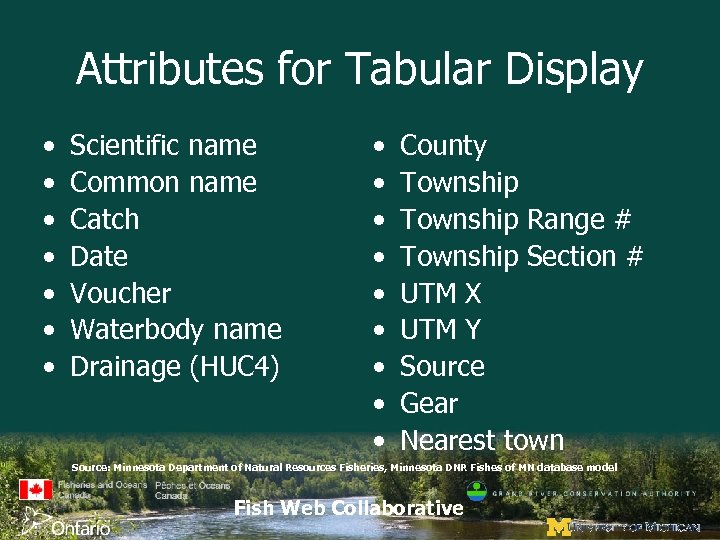
Attributes for Tabular Display • • Scientific name Common name Catch Date Voucher Waterbody name Drainage (HUC 4) • • • County Township Range # Township Section # UTM X UTM Y Source Gear Nearest town Source: Minnesota Department of Natural Resources Fisheries, Minnesota DNR Fishes of MN database model Fish Web Collaborative
Discussion – Questions? Craig Onafrychuk Fisheries Metadata Officer, Southern Science and Information, MNR Tel: 705 755 -3288 craig. onafrychuk@ontario. ca Fish Web Collaborative
Скачать презентацию 3 18 2018 Fish Web Collaborative Towards an Integrated View
57f1c76d2152d65808ab4815225f0200.ppt