


 Скачать презентацию 3 17 2018 Waves W Richards Worthing High School
ebdc096a71232854f772afa4c53c360e.ppt
- Количество слайдов: 35
 3/17/2018 Waves W Richards Worthing High School
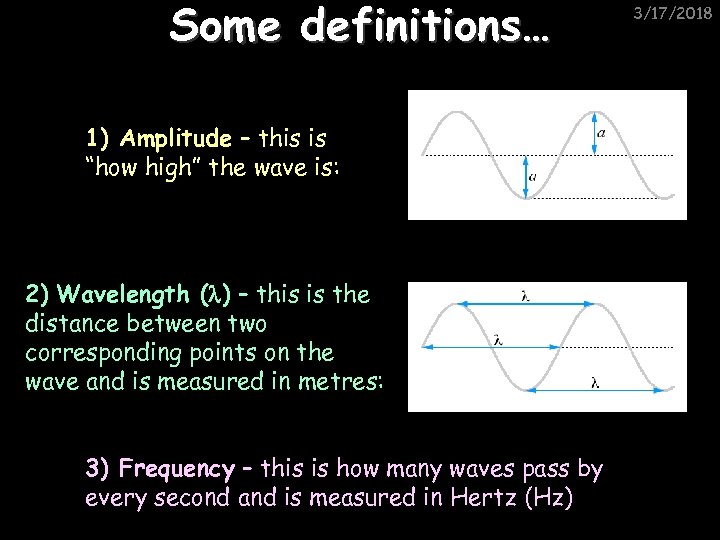 Some definitions… 1) Amplitude – this is “how high” the wave is: 2) Wavelength ( ) – this is the distance between two corresponding points on the wave and is measured in metres: 3) Frequency – this is how many waves pass by every second and is measured in Hertz (Hz) 3/17/2018
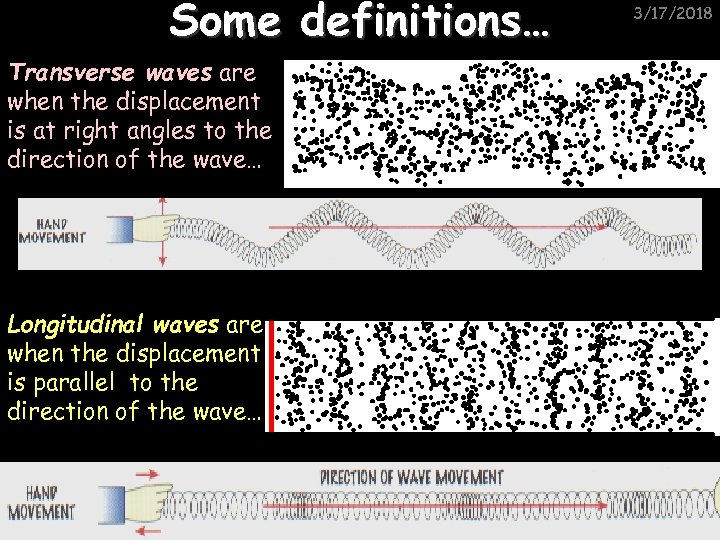 Some definitions… Transverse waves are when the displacement is at right angles to the direction of the wave… Longitudinal waves are when the displacement is parallel to the direction of the wave… 3/17/2018
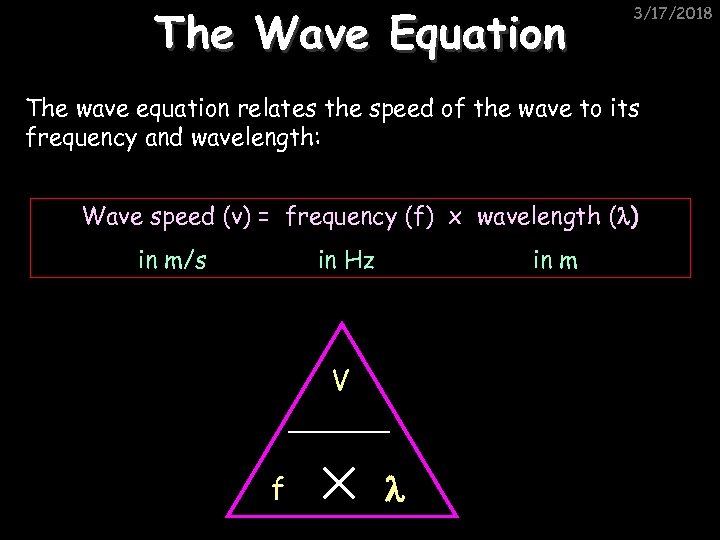 The Wave Equation 3/17/2018 The wave equation relates the speed of the wave to its frequency and wavelength: Wave speed (v) = frequency (f) x wavelength ( ) in m/s in Hz in m V f
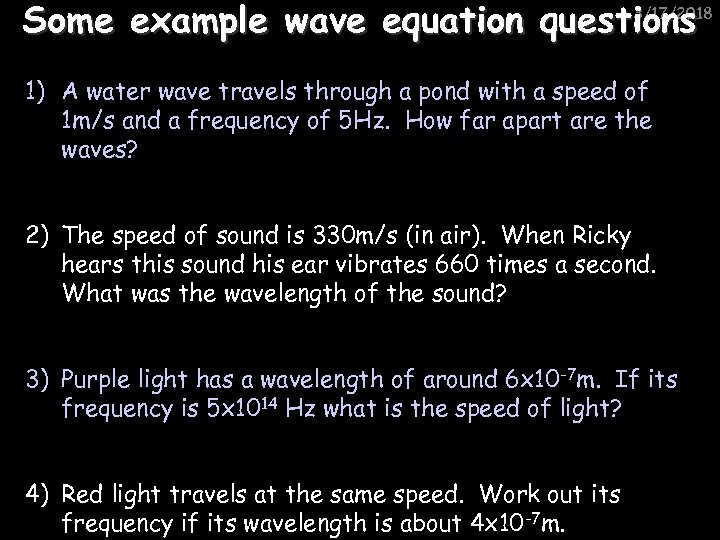 Some example wave equation questions 3/17/2018 1) A water wave travels through a pond with a speed of 1 m/s and a frequency of 5 Hz. How far apart are the waves? 2) The speed of sound is 330 m/s (in air). When Ricky hears this sound his ear vibrates 660 times a second. What was the wavelength of the sound? 3) Purple light has a wavelength of around 6 x 10 -7 m. If its frequency is 5 x 10¹⁴ Hz what is the speed of light? 4) Red light travels at the same speed. Work out its frequency if its wavelength is about 4 x 10 -7 m.
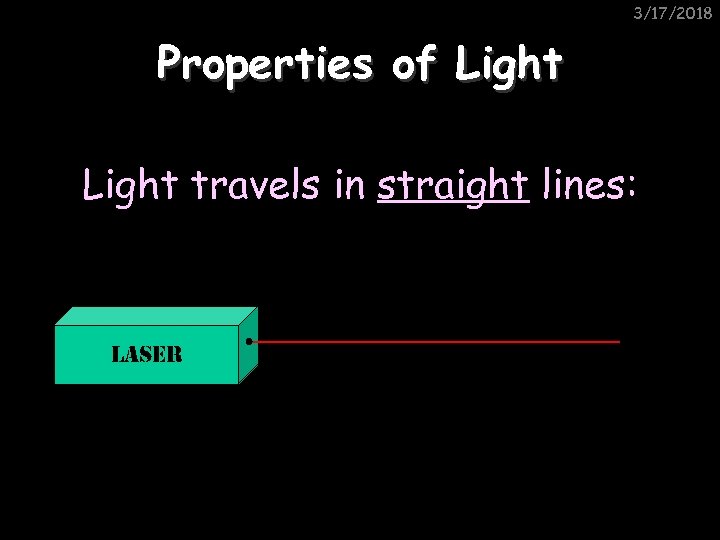 3/17/2018 Properties of Light travels in straight lines: Laser
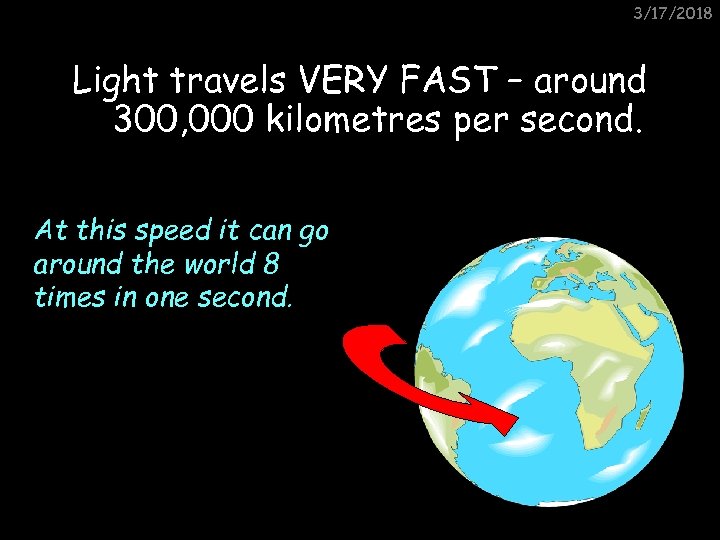 3/17/2018 Light travels VERY FAST – around 300, 000 kilometres per second. At this speed it can go around the world 8 times in one second.
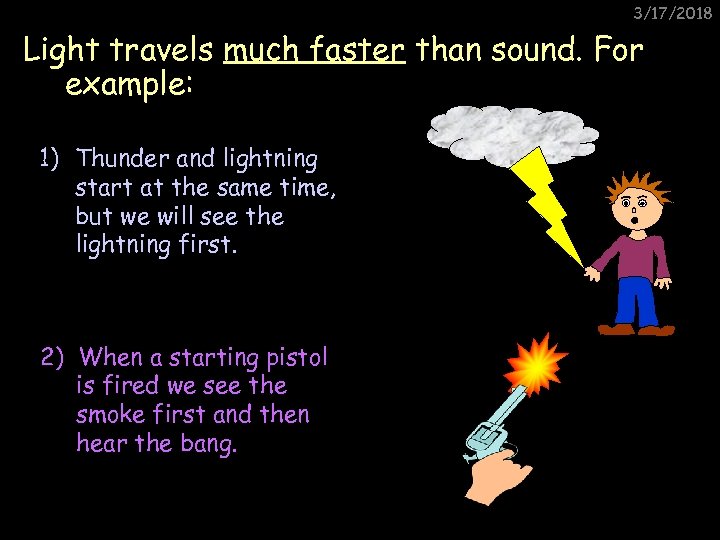 3/17/2018 Light travels much faster than sound. For example: 1) Thunder and lightning start at the same time, but we will see the lightning first. 2) When a starting pistol is fired we see the smoke first and then hear the bang.
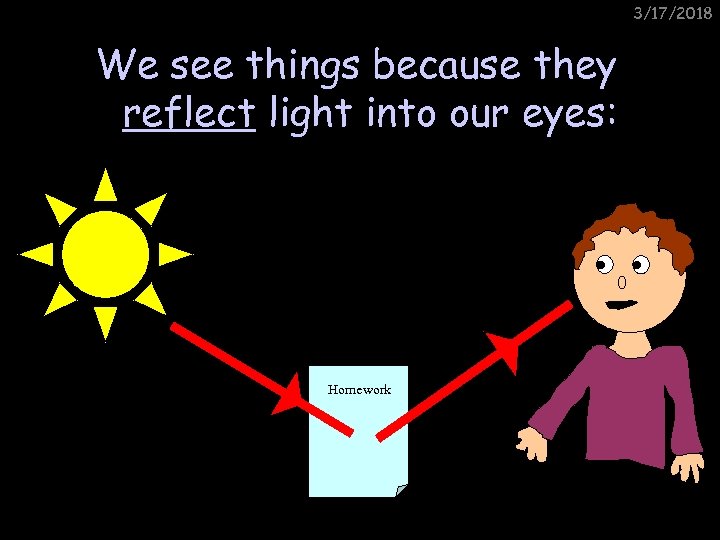 3/17/2018 We see things because they reflect light into our eyes: Homework
 3/17/2018 Luminous and non-luminous objects A luminous object is one that produces light. A non-luminous object is one that reflects light. Luminous objects Reflectors
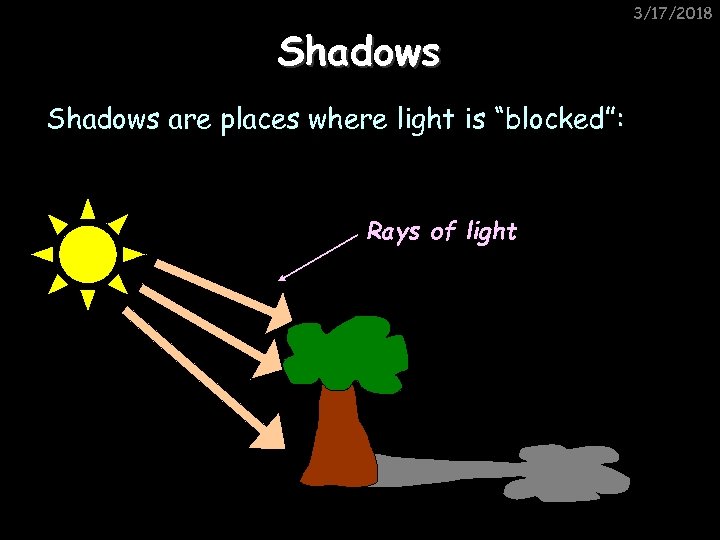 Shadows are places where light is “blocked”: Rays of light 3/17/2018
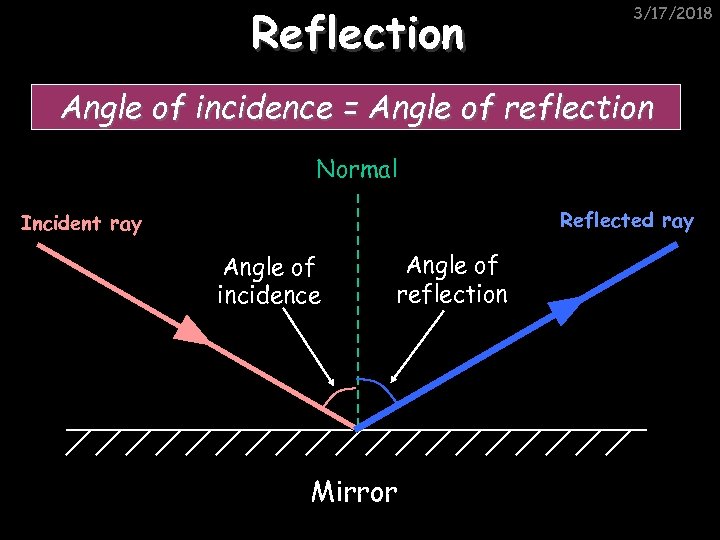 Reflection 3/17/2018 Angle of incidence = Angle of reflection Normal Reflected ray Incident ray Angle of incidence Angle of reflection Mirror
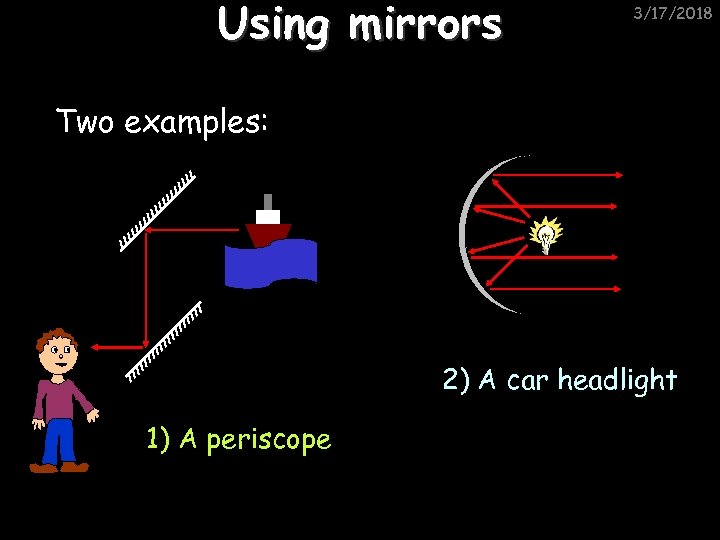 Using mirrors 3/17/2018 Two examples: 2) A car headlight 1) A periscope
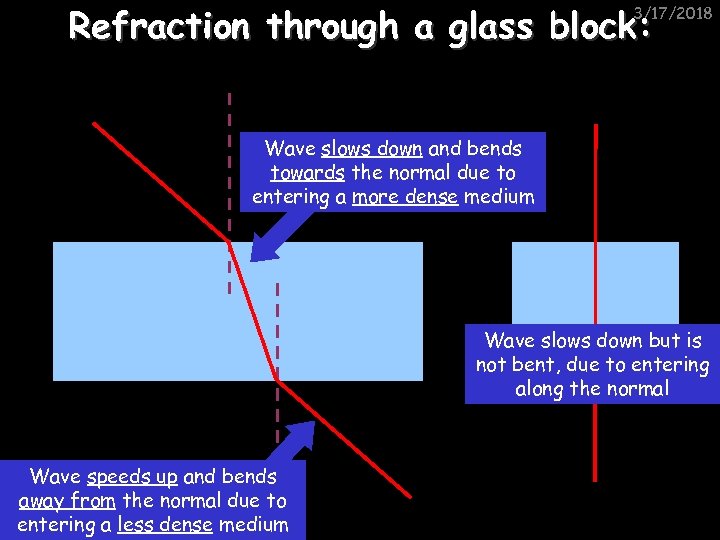 Refraction through a glass block: 3/17/2018 Wave slows down and bends towards the normal due to entering a more dense medium Wave slows down but is not bent, due to entering along the normal Wave speeds up and bends away from the normal due to entering a less dense medium
 3/17/2018
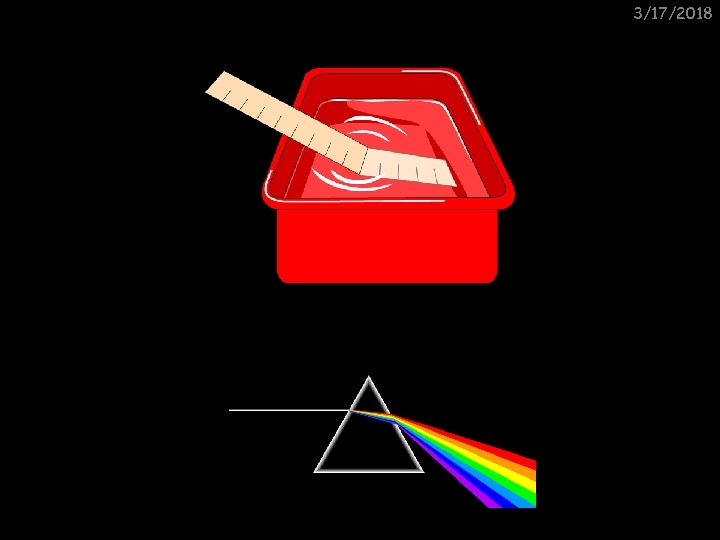
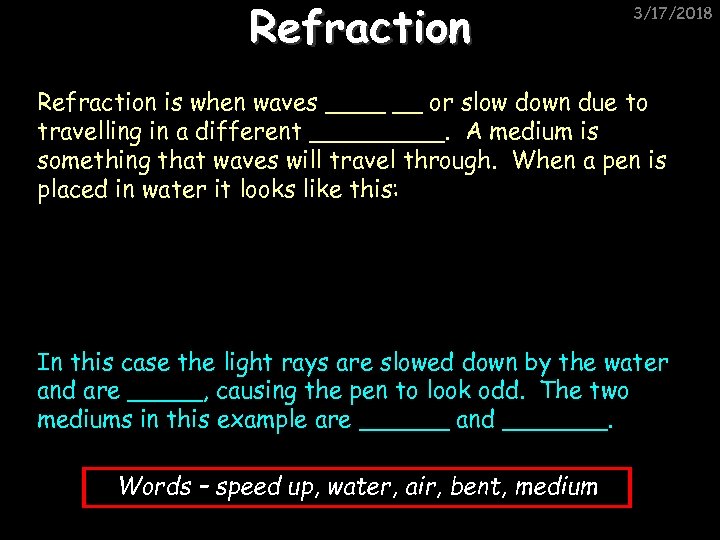 Refraction 3/17/2018 Refraction is when waves ____ __ or slow down due to travelling in a different _____. A medium is something that waves will travel through. When a pen is placed in water it looks like this: In this case the light rays are slowed down by the water and are _____, causing the pen to look odd. The two mediums in this example are ______ and _______. Words – speed up, water, air, bent, medium
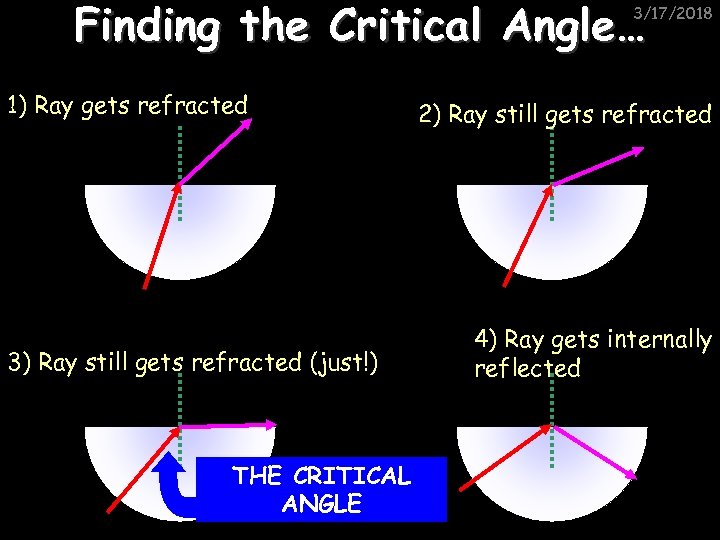 Finding the Critical Angle… 3/17/2018 1) Ray gets refracted 3) Ray still gets refracted (just!) THE CRITICAL ANGLE 2) Ray still gets refracted 4) Ray gets internally reflected
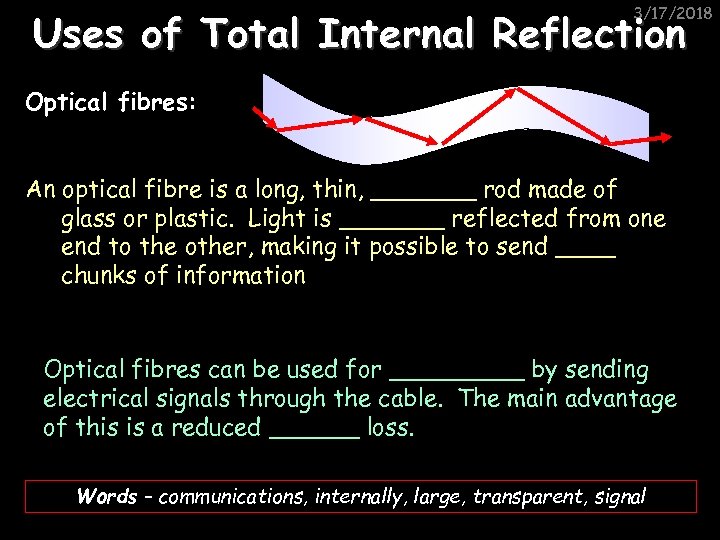 3/17/2018 Uses of Total Internal Reflection Optical fibres: An optical fibre is a long, thin, _______ rod made of glass or plastic. Light is _______ reflected from one end to the other, making it possible to send ____ chunks of information Optical fibres can be used for _____ by sending electrical signals through the cable. The main advantage of this is a reduced ______ loss. Words – communications, internally, large, transparent, signal
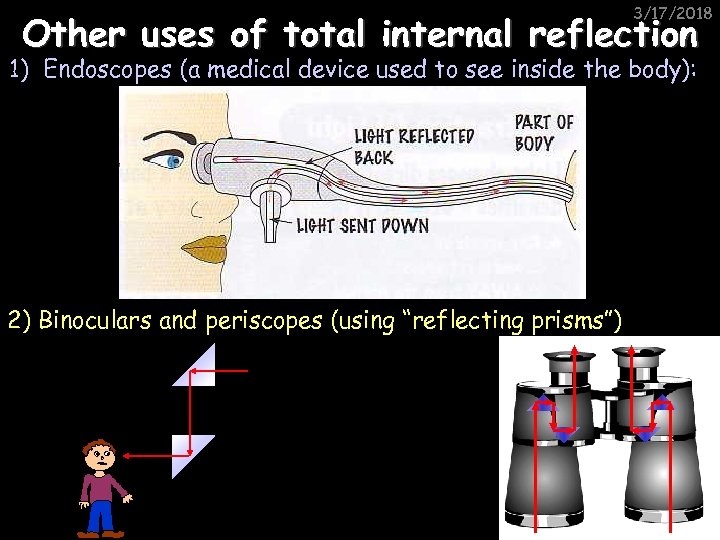 3/17/2018 Other uses of total internal reflection 1) Endoscopes (a medical device used to see inside the body): 2) Binoculars and periscopes (using “reflecting prisms”)
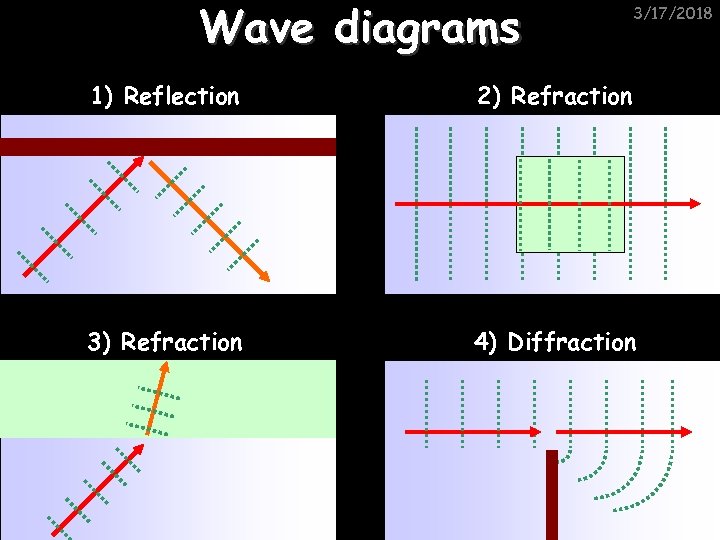 Wave diagrams 3/17/2018 1) Reflection 2) Refraction 3) Refraction 4) Diffraction
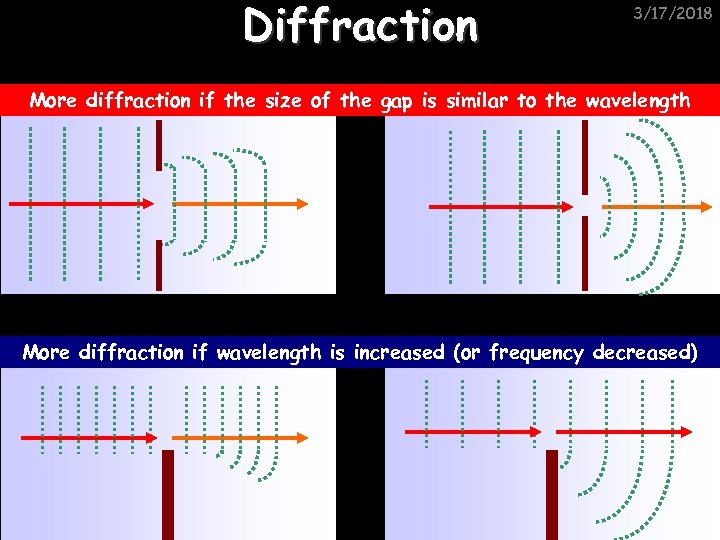 Diffraction 3/17/2018 More diffraction if the size of the gap is similar to the wavelength More diffraction if wavelength is increased (or frequency decreased)
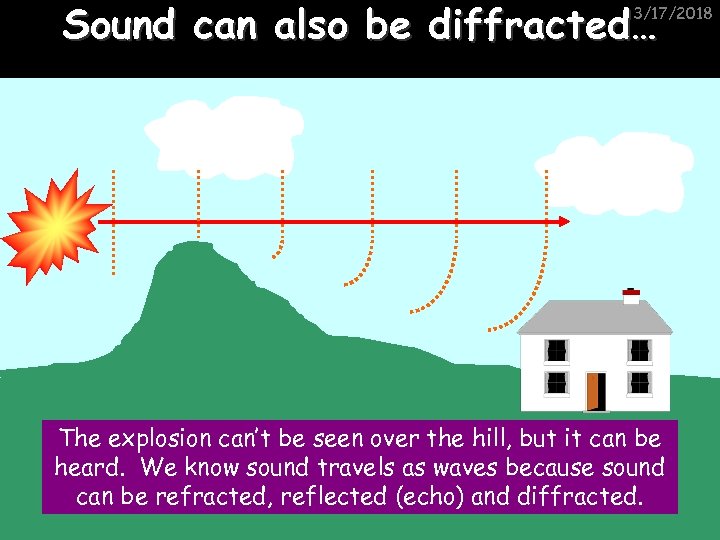 Sound can also be diffracted… 3/17/2018 The explosion can’t be seen over the hill, but it can be heard. We know sound travels as waves because sound can be refracted, reflected (echo) and diffracted.
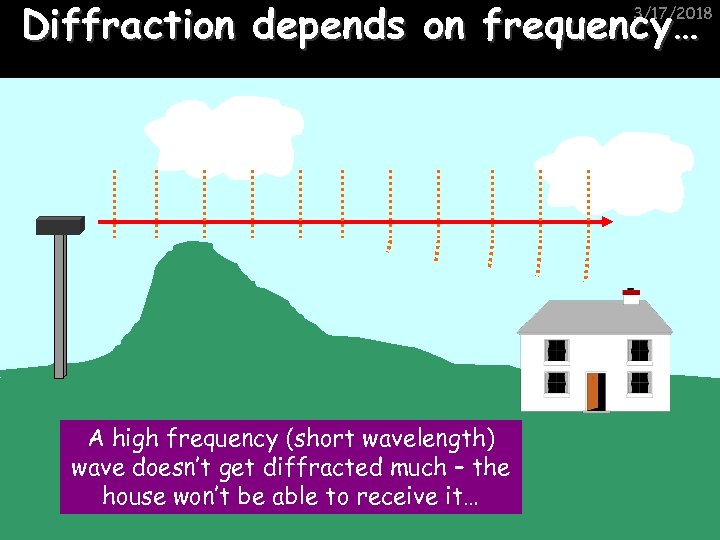 Diffraction depends on frequency… 3/17/2018 A high frequency (short wavelength) wave doesn’t get diffracted much – the house won’t be able to receive it…
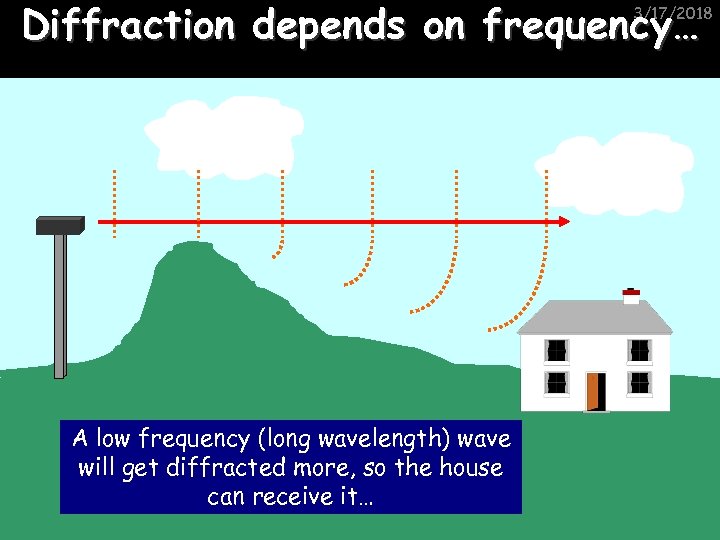 Diffraction depends on frequency… 3/17/2018 A low frequency (long wavelength) wave will get diffracted more, so the house can receive it…
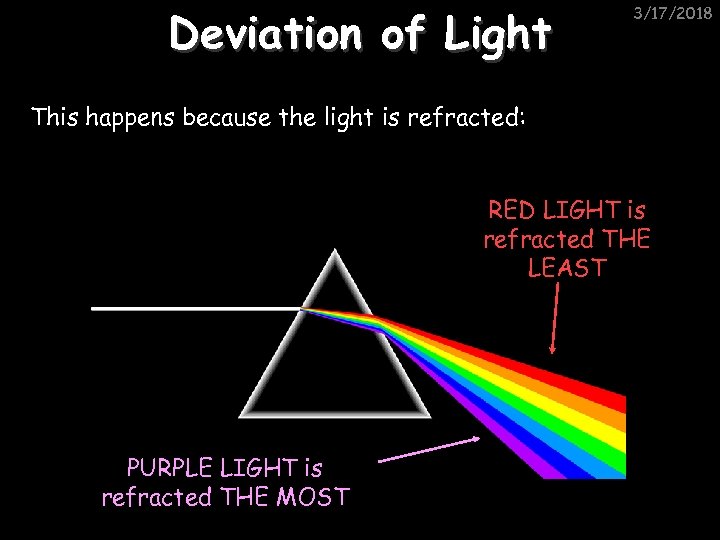 Deviation of Light 3/17/2018 This happens because the light is refracted: RED LIGHT is refracted THE LEAST PURPLE LIGHT is refracted THE MOST
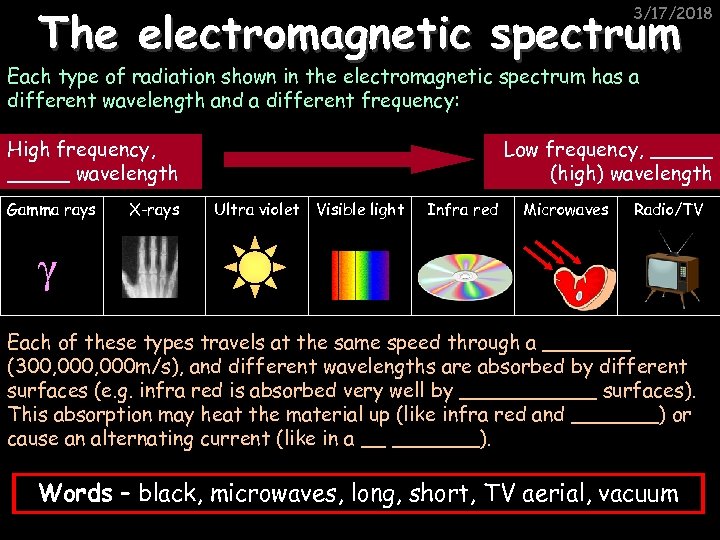 The electromagnetic spectrum 3/17/2018 Each type of radiation shown in the electromagnetic spectrum has a different wavelength and a different frequency: High frequency, _____ wavelength Gamma rays X-rays Low frequency, _____ (high) wavelength Ultra violet Visible light Infra red Microwaves Radio/TV γ Each of these types travels at the same speed through a _______ (300, 000 m/s), and different wavelengths are absorbed by different surfaces (e. g. infra red is absorbed very well by ______ surfaces). This absorption may heat the material up (like infra red and _______) or cause an alternating current (like in a __ _______). Words – black, microwaves, long, short, TV aerial, vacuum
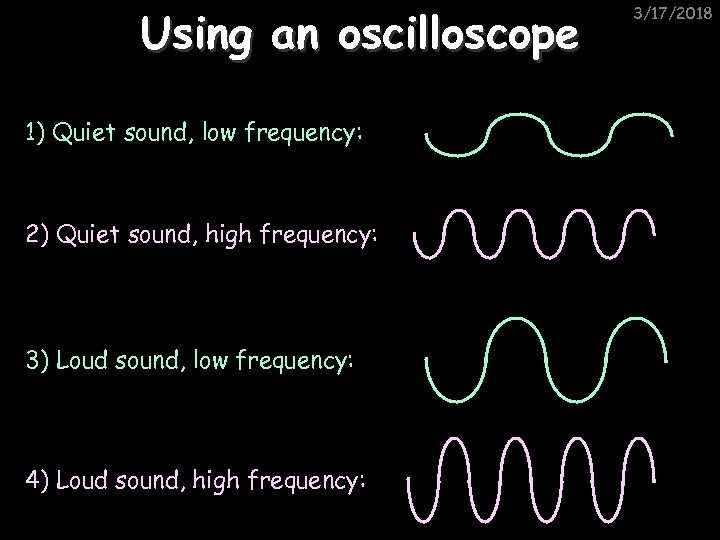 Using an oscilloscope 1) Quiet sound, low frequency: 2) Quiet sound, high frequency: 3) Loud sound, low frequency: 4) Loud sound, high frequency: 3/17/2018
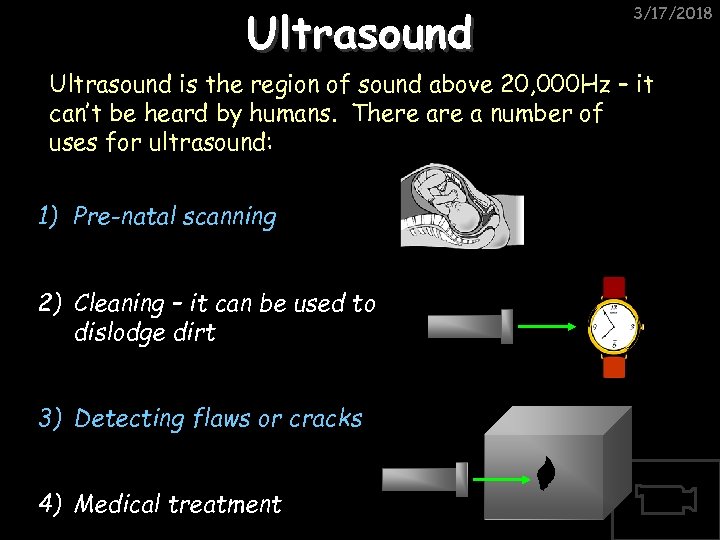 Ultrasound 3/17/2018 Ultrasound is the region of sound above 20, 000 Hz – it can’t be heard by humans. There a number of uses for ultrasound: 1) Pre-natal scanning 2) Cleaning – it can be used to dislodge dirt 3) Detecting flaws or cracks 4) Medical treatment
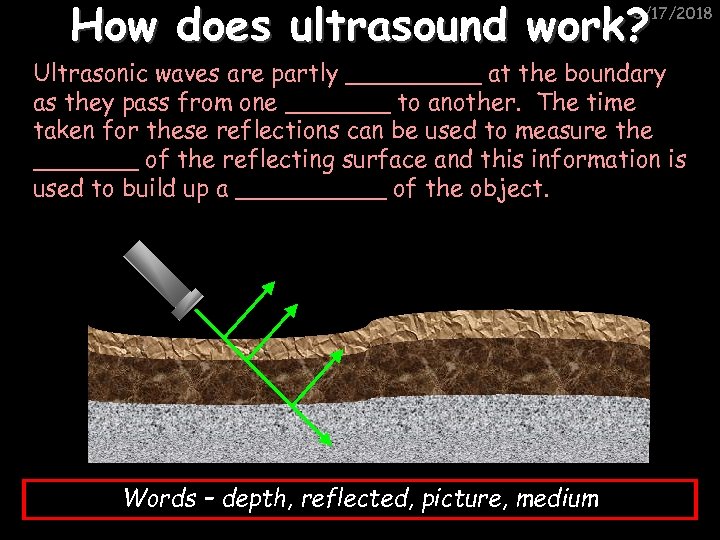 How does ultrasound work? 3/17/2018 Ultrasonic waves are partly _____ at the boundary as they pass from one _______ to another. The time taken for these reflections can be used to measure the _______ of the reflecting surface and this information is used to build up a _____ of the object. Words – depth, reflected, picture, medium
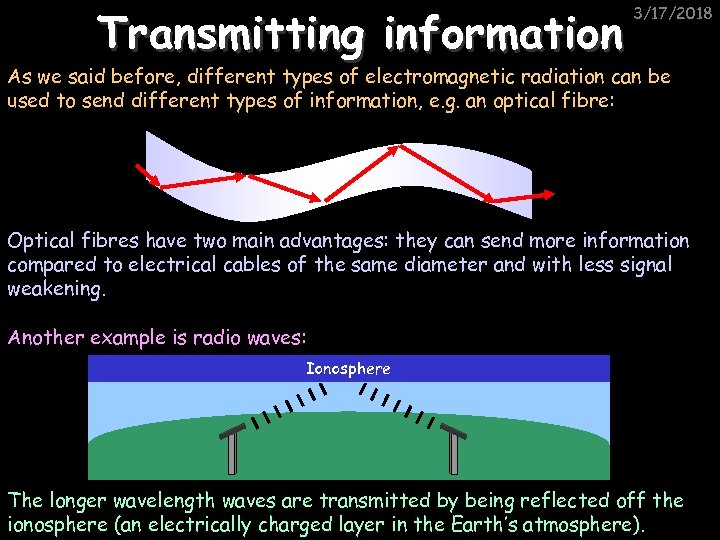 Transmitting information 3/17/2018 As we said before, different types of electromagnetic radiation can be used to send different types of information, e. g. an optical fibre: Optical fibres have two main advantages: they can send more information compared to electrical cables of the same diameter and with less signal weakening. Another example is radio waves: Ionosphere The longer wavelength waves are transmitted by being reflected off the ionosphere (an electrically charged layer in the Earth’s atmosphere).
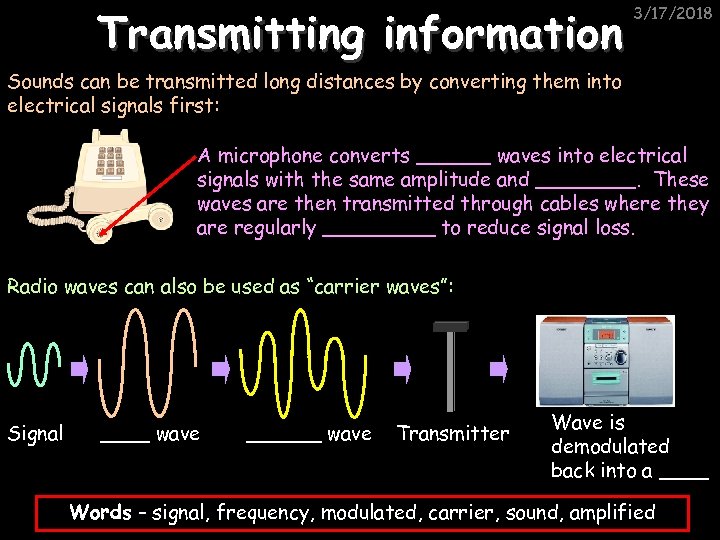 Transmitting information 3/17/2018 Sounds can be transmitted long distances by converting them into electrical signals first: A microphone converts ______ waves into electrical signals with the same amplitude and ____. These waves are then transmitted through cables where they are regularly _____ to reduce signal loss. Radio waves can also be used as “carrier waves”: Signal ____ wave ______ wave Transmitter Wave is demodulated back into a ____ Words – signal, frequency, modulated, carrier, sound, amplified
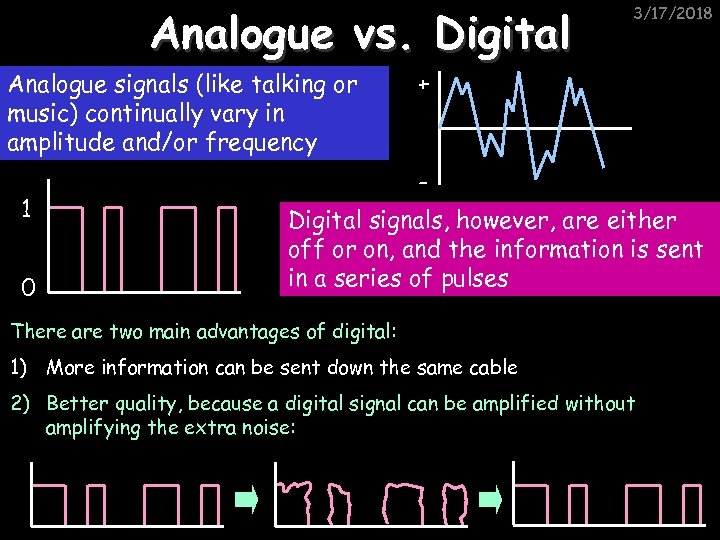 Analogue vs. Digital Analogue signals (like talking or music) continually vary in amplitude and/or frequency 1 0 3/17/2018 + Digital signals, however, are either off or on, and the information is sent in a series of pulses There are two main advantages of digital: 1) More information can be sent down the same cable 2) Better quality, because a digital signal can be amplified without amplifying the extra noise:
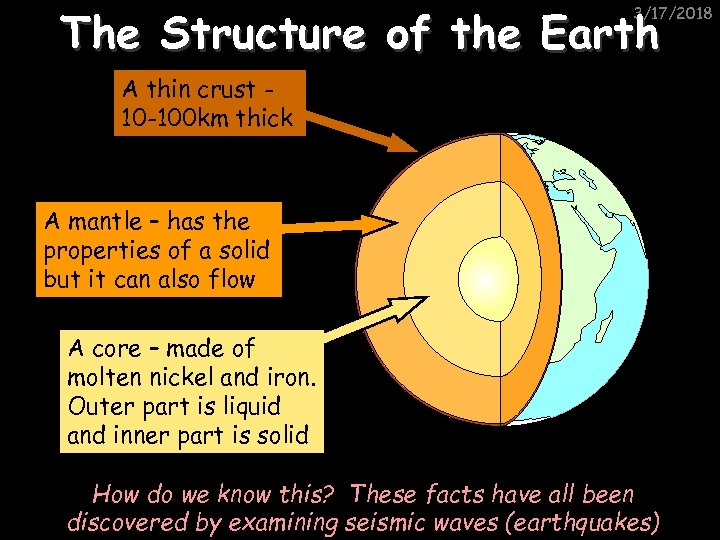 The Structure of the Earth 3/17/2018 A thin crust 10 -100 km thick A mantle – has the properties of a solid but it can also flow A core – made of molten nickel and iron. Outer part is liquid and inner part is solid How do we know this? These facts have all been discovered by examining seismic waves (earthquakes)
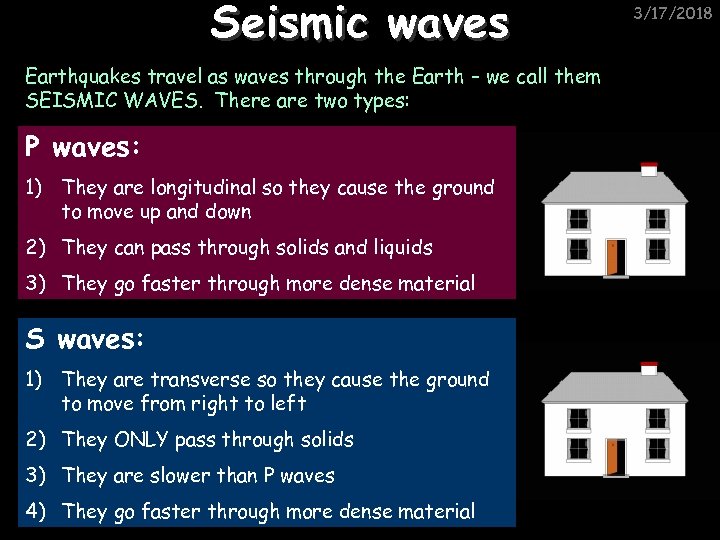 Seismic waves Earthquakes travel as waves through the Earth – we call them SEISMIC WAVES. There are two types: P waves: 1) They are longitudinal so they cause the ground to move up and down 2) They can pass through solids and liquids 3) They go faster through more dense material S waves: 1) They are transverse so they cause the ground to move from right to left 2) They ONLY pass through solids 3) They are slower than P waves 4) They go faster through more dense material 3/17/2018
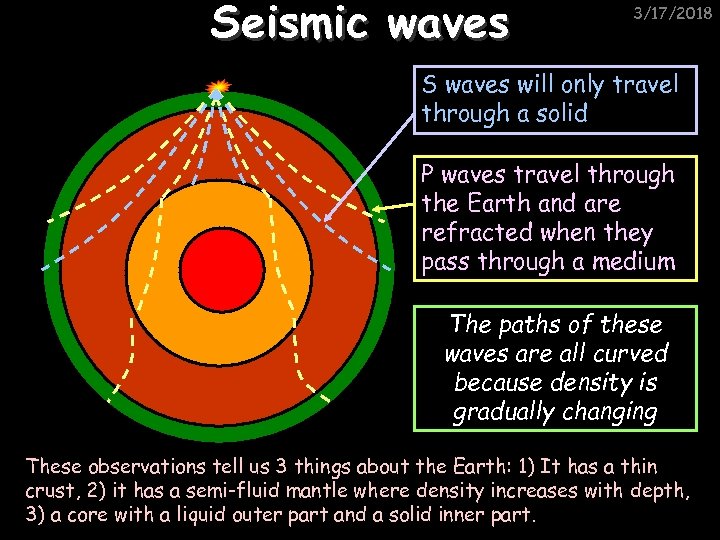 Seismic waves 3/17/2018 S waves will only travel through a solid P waves travel through the Earth and are refracted when they pass through a medium The paths of these waves are all curved because density is gradually changing These observations tell us 3 things about the Earth: 1) It has a thin crust, 2) it has a semi-fluid mantle where density increases with depth, 3) a core with a liquid outer part and a solid inner part.