


 Скачать презентацию 3 16 2018 Unit 2 Physics for your Future
b4ec3db7e6efd7857ad56ecfbe2dd692.ppt
- Количество слайдов: 117
 3/16/2018 Unit 2 – Physics for your Future (Ed. Excel)
 Topic 1 – Static and Current Electricity 3/16/2018
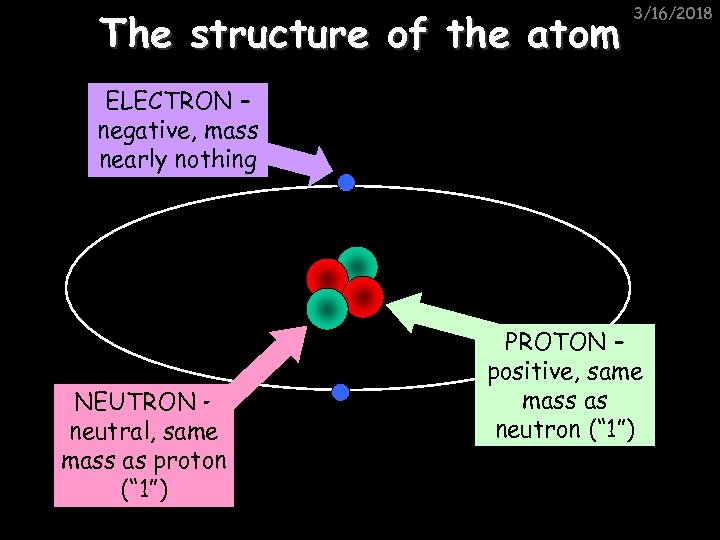 The structure of the atom 3/16/2018 ELECTRON – negative, mass nearly nothing NEUTRON – neutral, same mass as proton (“ 1”) PROTON – positive, same mass as neutron (“ 1”)
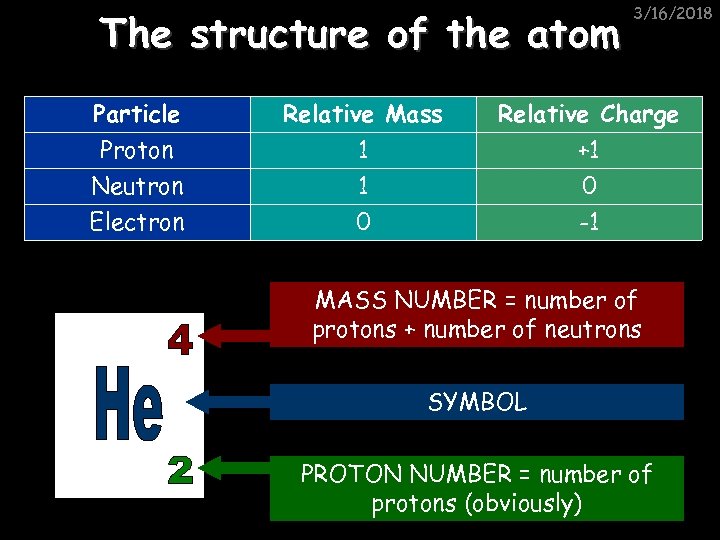 The structure of the atom Particle Proton Neutron Electron Relative Mass 1 1 0 3/16/2018 Relative Charge +1 0 -1 MASS NUMBER = number of protons + number of neutrons SYMBOL PROTON NUMBER = number of protons (obviously)
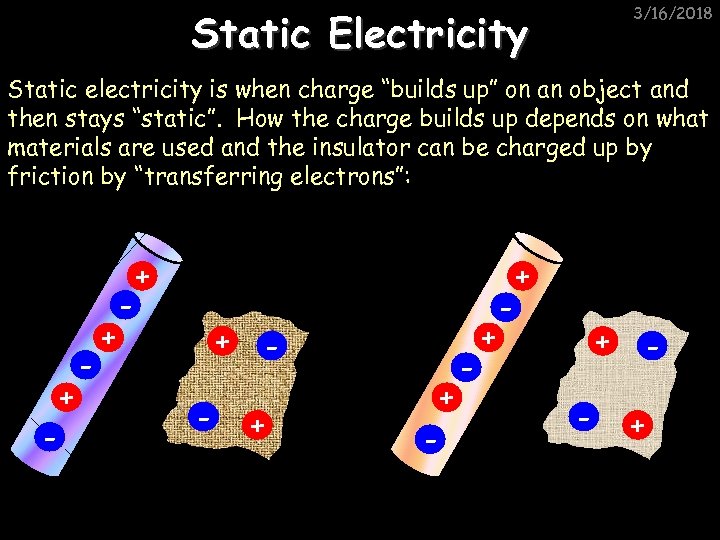 3/16/2018 Static Electricity Static electricity is when charge “builds up” on an object and then stays “static”. How the charge builds up depends on what materials are used and the insulator can be charged up by friction by “transferring electrons”: - + - + - +
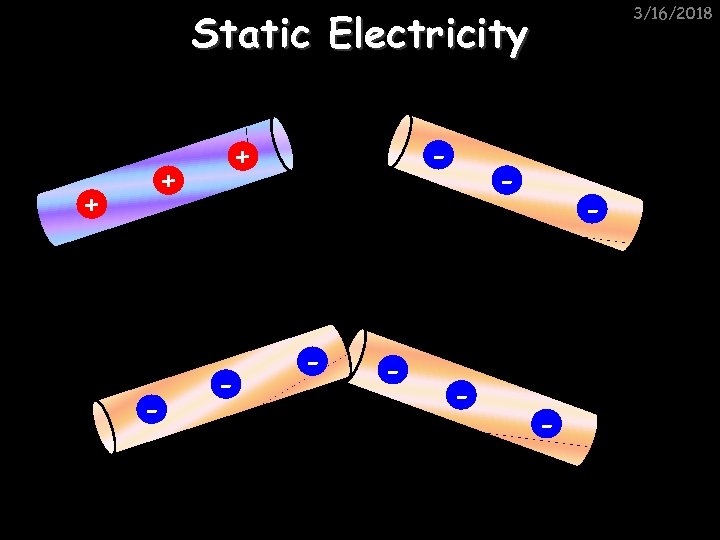 3/16/2018 Static Electricity + + - - - - -
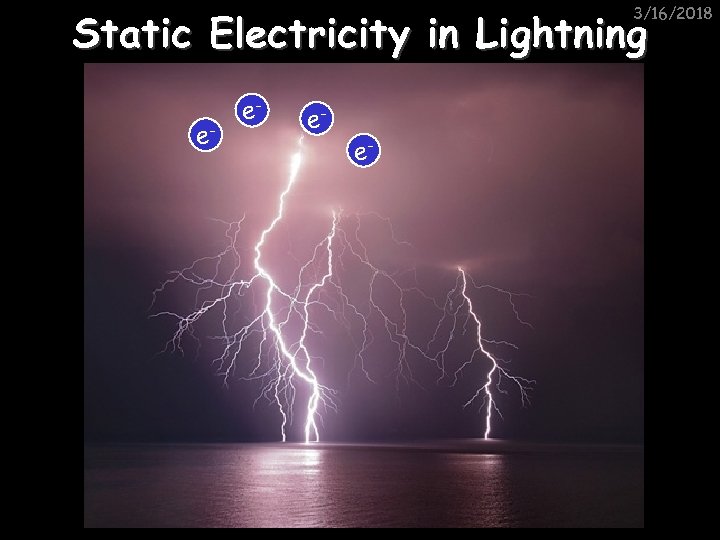 3/16/2018 Static Electricity in Lightning e- e-
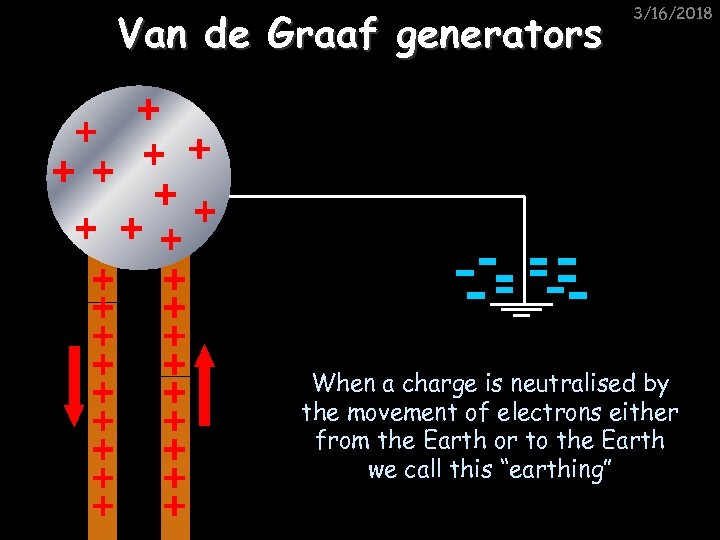 Van de Graaf generators 3/16/2018 When a charge is neutralised by the movement of electrons either from the Earth or to the Earth we call this “earthing”
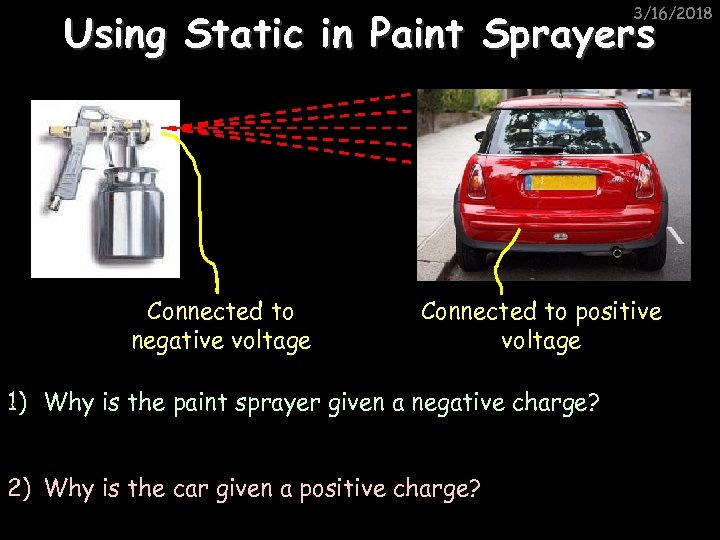 3/16/2018 Using Static in Paint Sprayers Connected to negative voltage Connected to positive voltage 1) Why is the paint sprayer given a negative charge? 2) Why is the car given a positive charge?
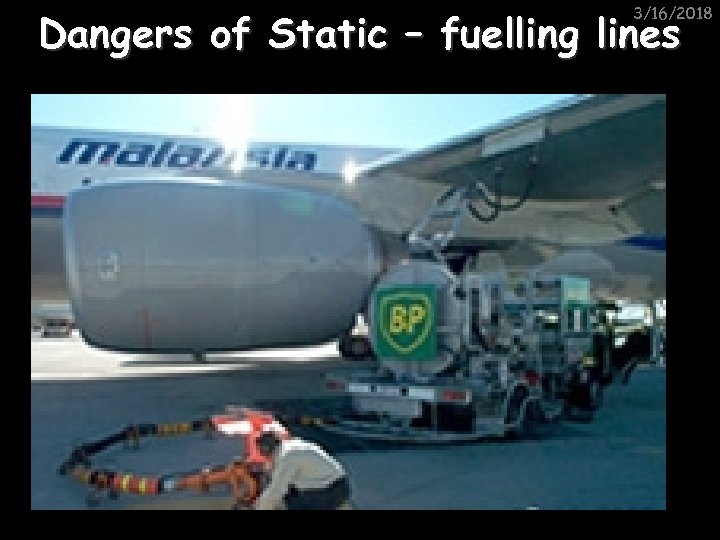 3/16/2018 Dangers of Static – fuelling lines
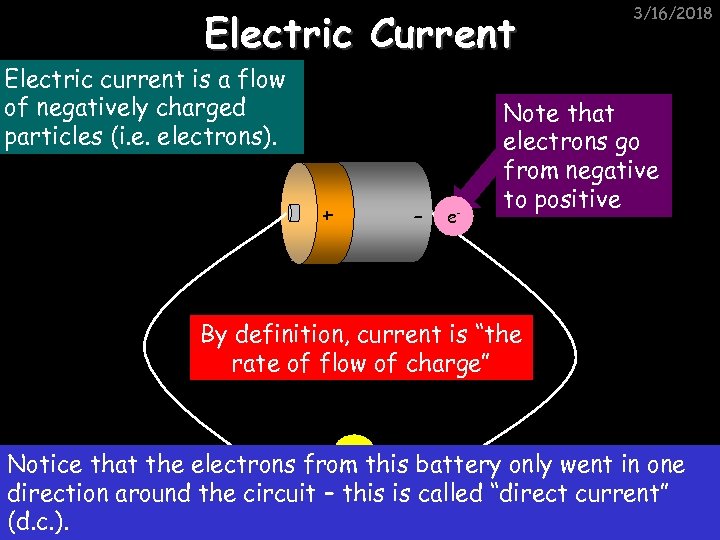 Electric Current Electric current is a flow of negatively charged particles (i. e. electrons). + - e- 3/16/2018 Note that electrons go from negative to positive By definition, current is “the rate of flow of charge” Notice that the electrons from this battery only went in one direction around the circuit – this is called “direct current” e(d. c. ).
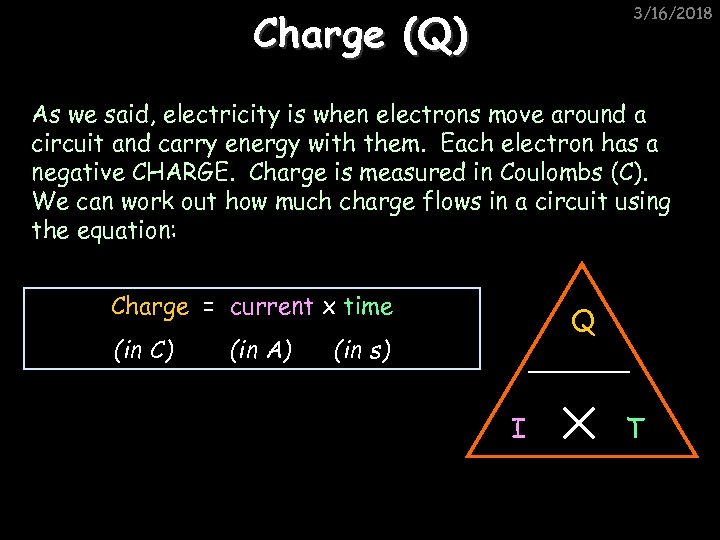 3/16/2018 Charge (Q) As we said, electricity is when electrons move around a circuit and carry energy with them. Each electron has a negative CHARGE. Charge is measured in Coulombs (C). We can work out how much charge flows in a circuit using the equation: Charge = current x time (in C) (in A) Q (in s) I T
 Topic 2 – Controlling and Using Electric Current 3/16/2018
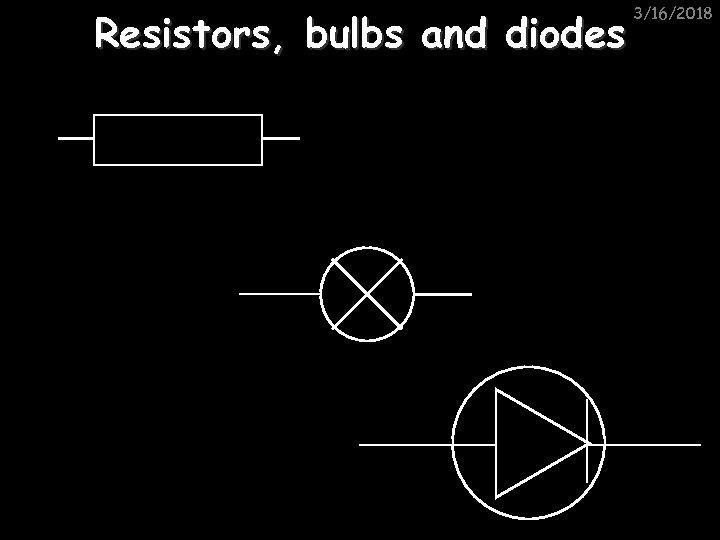
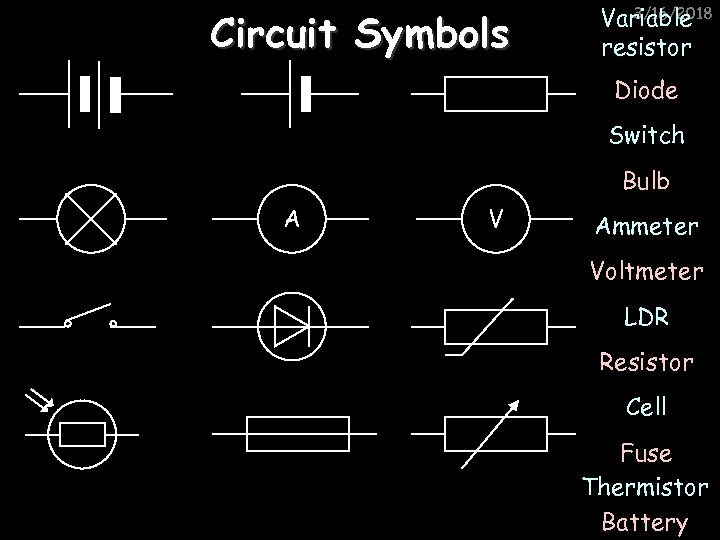 Circuit Symbols 3/16/2018 Variable resistor Diode Switch Bulb A V Ammeter Voltmeter LDR Resistor Cell Fuse Thermistor Battery
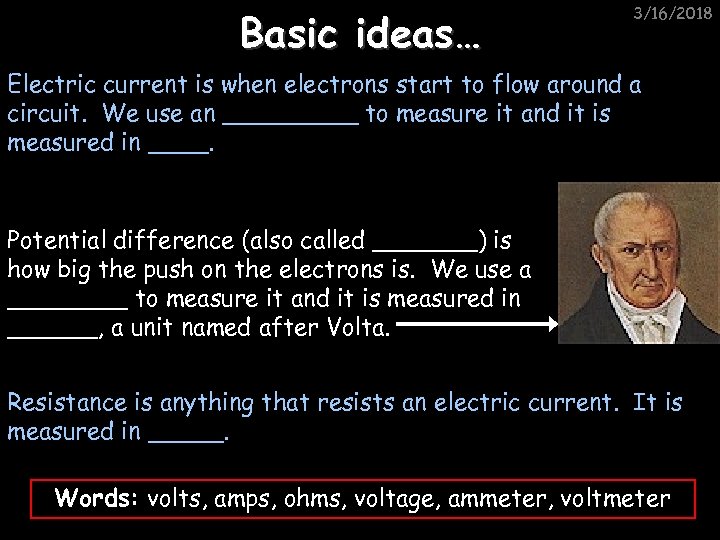 Basic ideas… 3/16/2018 Electric current is when electrons start to flow around a circuit. We use an _____ to measure it and it is measured in ____. Potential difference (also called _______) is how big the push on the electrons is. We use a ____ to measure it and it is measured in ______, a unit named after Volta. Resistance is anything that resists an electric current. It is measured in _____. Words: volts, amps, ohms, voltage, ammeter, voltmeter
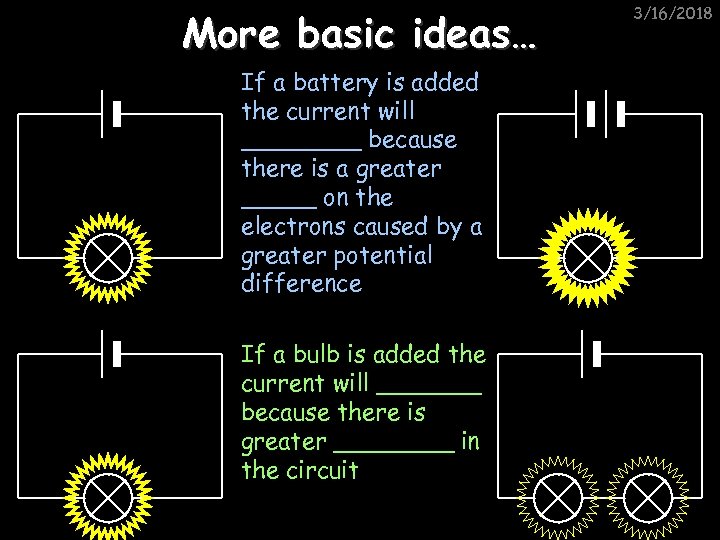 More basic ideas… If a battery is added the current will ____ because there is a greater _____ on the electrons caused by a greater potential difference If a bulb is added the current will _______ because there is greater ____ in the circuit 3/16/2018
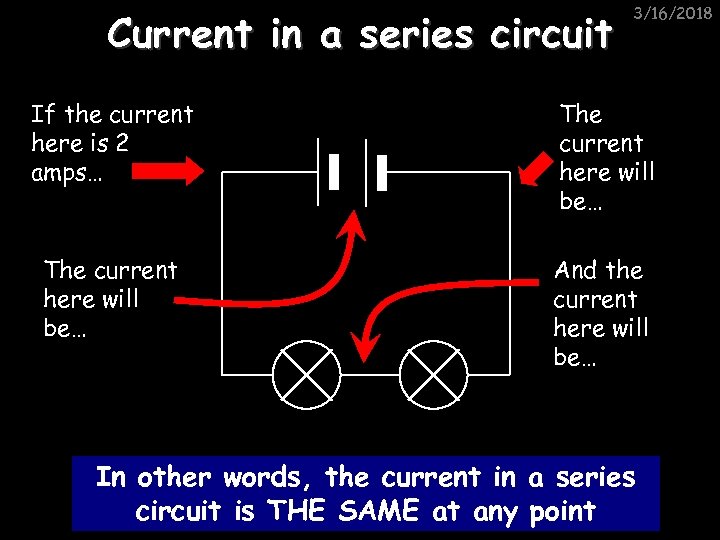 Current in a series circuit 3/16/2018 If the current here is 2 amps… The current here will be… And the current here will be… In other words, the current in a series circuit is THE SAME at any point
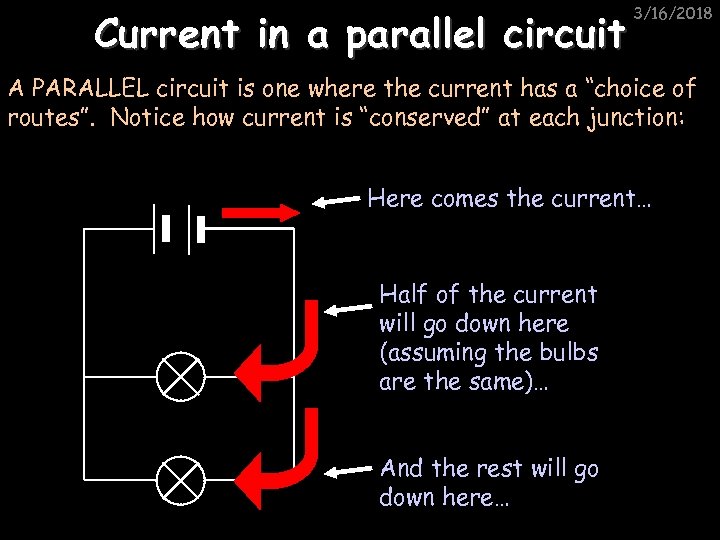 Current in a parallel circuit 3/16/2018 A PARALLEL circuit is one where the current has a “choice of routes”. Notice how current is “conserved” at each junction: Here comes the current… Half of the current will go down here (assuming the bulbs are the same)… And the rest will go down here…
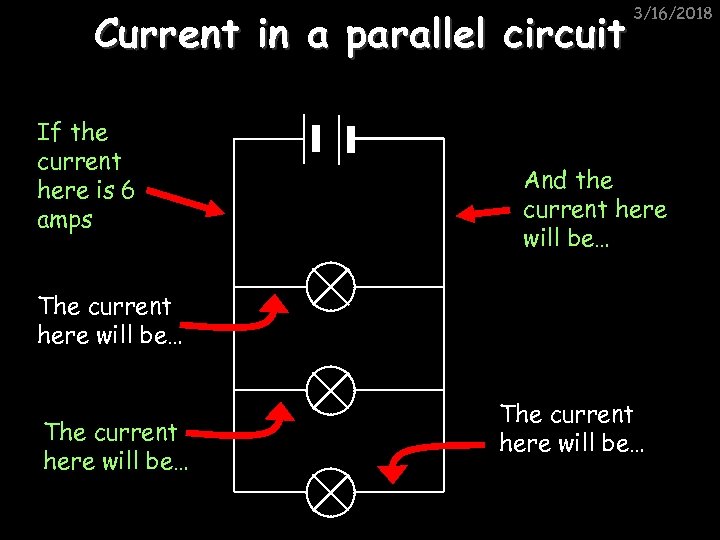 Current in a parallel circuit If the current here is 6 amps 3/16/2018 And the current here will be… The current here will be…
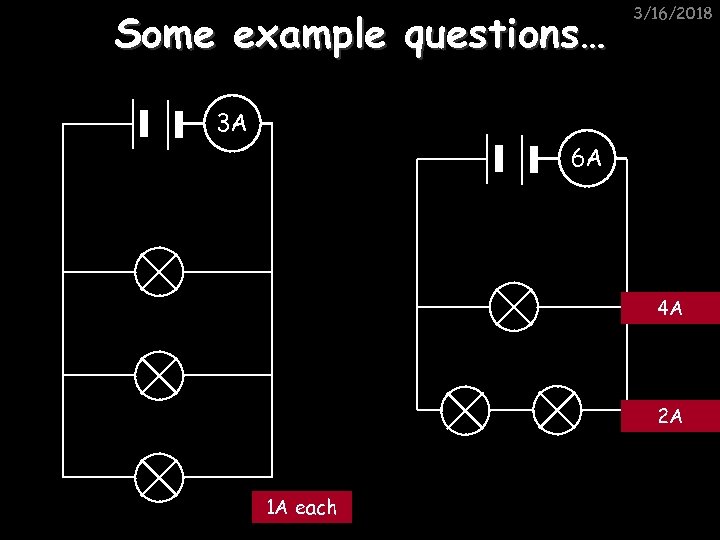 Some example questions… 3/16/2018 3 A 6 A 4 A 2 A 1 A each
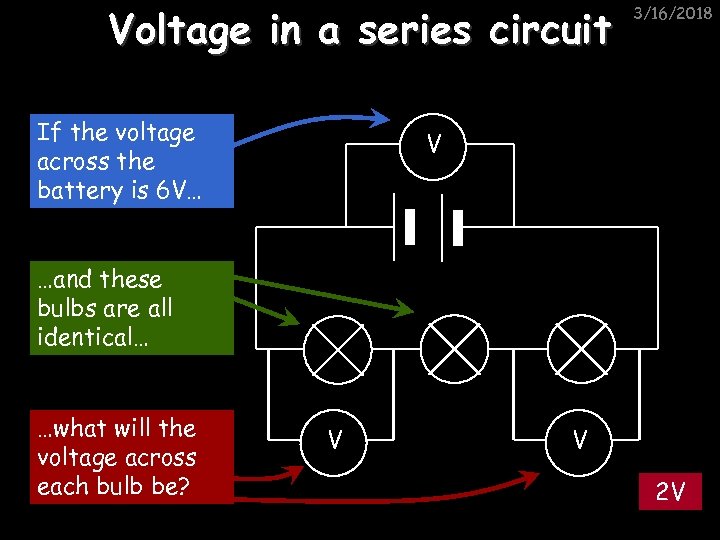 Voltage in a series circuit If the voltage across the battery is 6 V… 3/16/2018 V …and these bulbs are all identical… …what will the voltage across each bulb be? V V 2 V
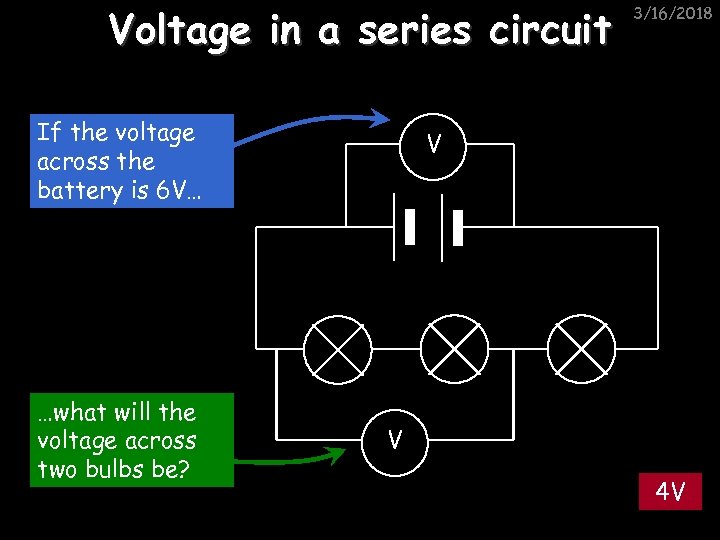 Voltage in a series circuit If the voltage across the battery is 6 V… …what will the voltage across two bulbs be? 3/16/2018 V V 4 V
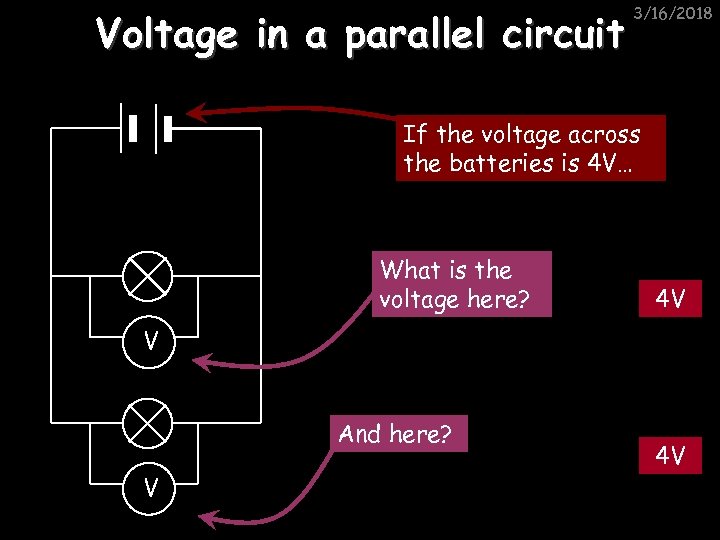 Voltage in a parallel circuit 3/16/2018 If the voltage across the batteries is 4 V… What is the voltage here? 4 V V And here? V 4 V
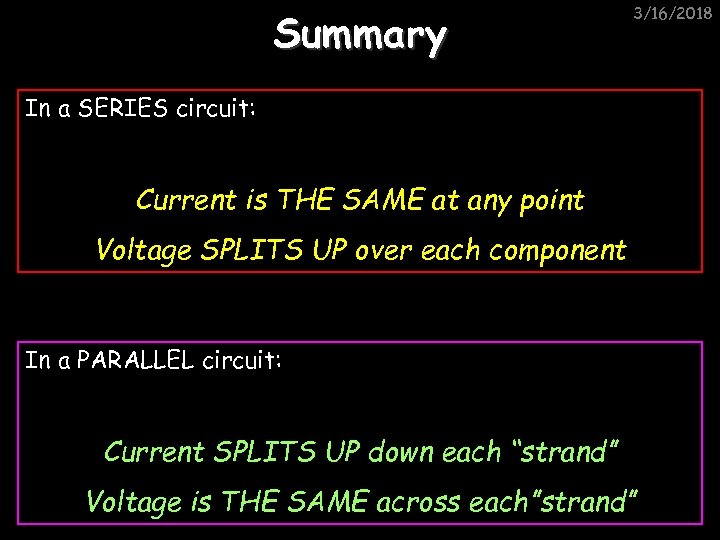 Summary 3/16/2018 In a SERIES circuit: Current is THE SAME at any point Voltage SPLITS UP over each component In a PARALLEL circuit: Current SPLITS UP down each “strand” Voltage is THE SAME across each”strand”
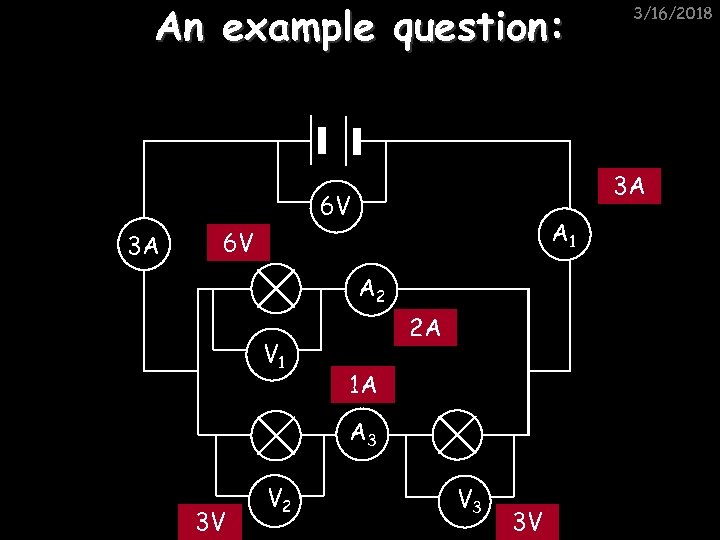 An example question: 3 A 6 V 3 A A 1 6 V A 2 V 1 2 A 1 A A 3 3 V V 2 3/16/2018 V 3 3 V
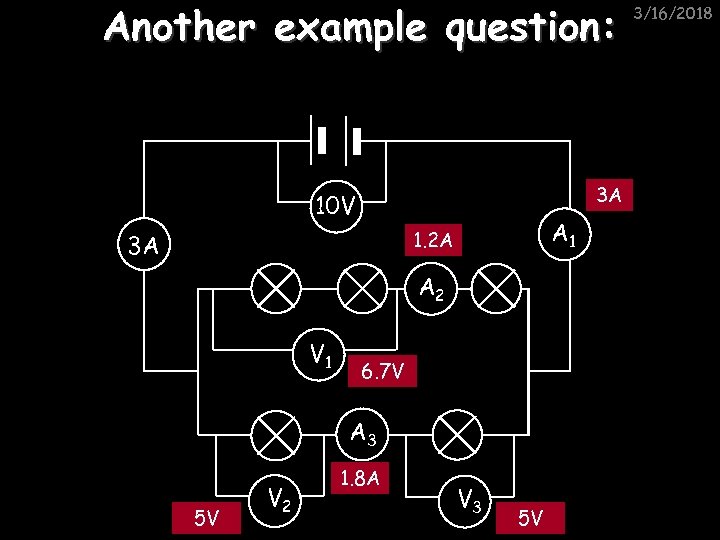 Another example question: 3 A 10 V A 1 1. 2 A 3 A A 2 V 1 6. 7 V A 3 5 V V 2 1. 8 A V 3 5 V 3/16/2018
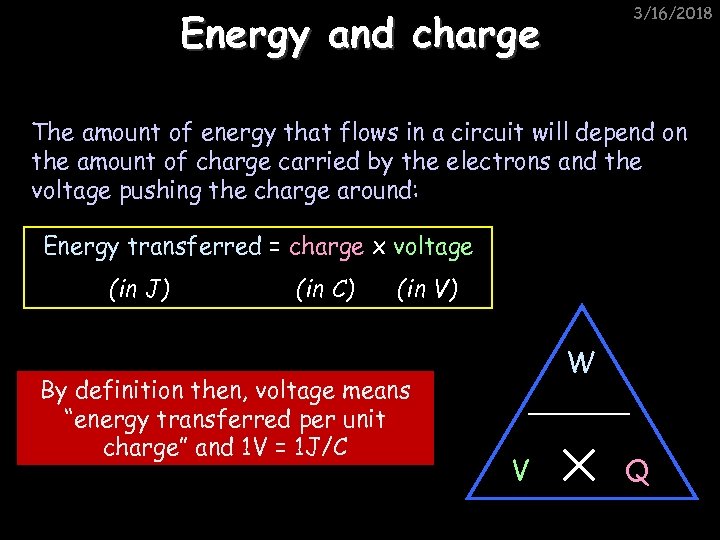 3/16/2018 Energy and charge The amount of energy that flows in a circuit will depend on the amount of charge carried by the electrons and the voltage pushing the charge around: Energy transferred = charge x voltage (in J) (in C) (in V) By definition then, voltage means “energy transferred per unit charge” and 1 V = 1 J/C W V Q
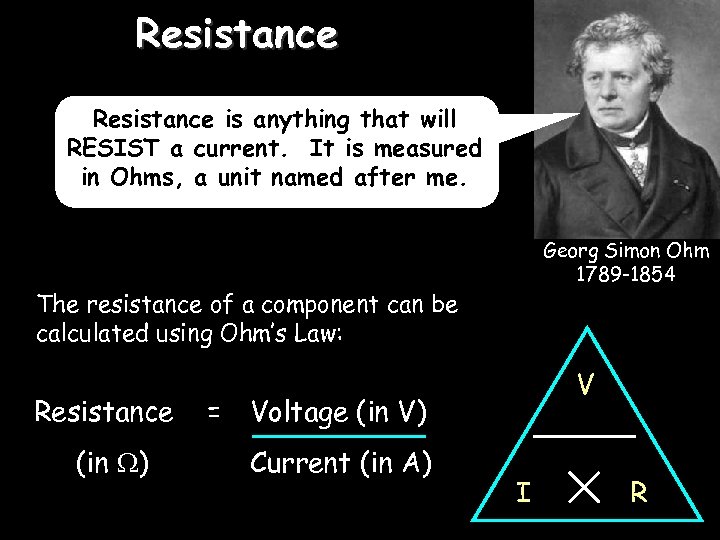 3/16/2018 Resistance is anything that will RESIST a current. It is measured in Ohms, a unit named after me. Georg Simon Ohm 1789 -1854 The resistance of a component can be calculated using Ohm’s Law: Resistance (in ) = V Voltage (in V) Current (in A) I R
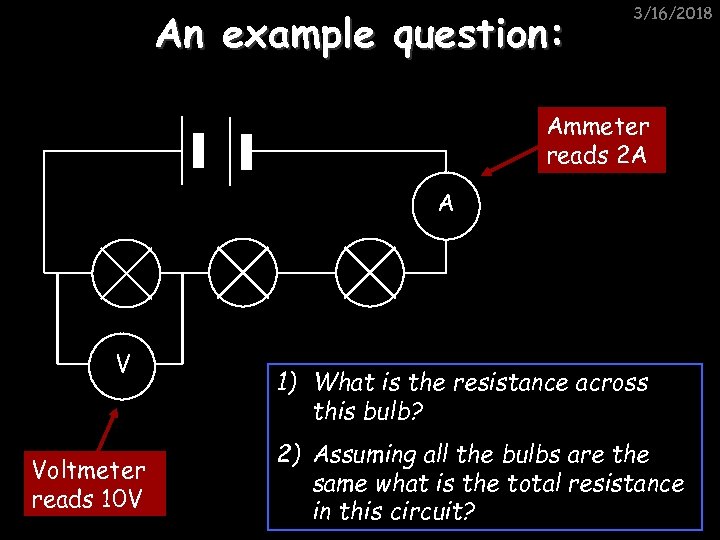 An example question: 3/16/2018 Ammeter reads 2 A A V Voltmeter reads 10 V 1) What is the resistance across this bulb? 2) Assuming all the bulbs are the same what is the total resistance in this circuit?
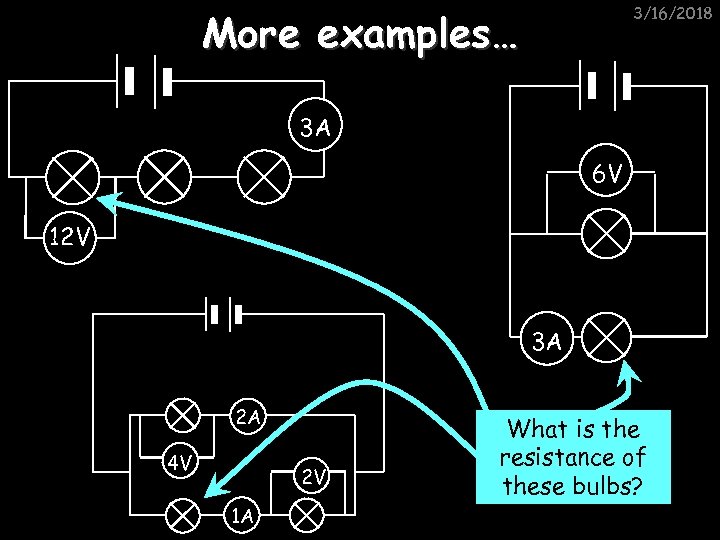 3/16/2018 More examples… 3 A 6 V 12 V 3 A 2 A 4 V 2 V 1 A What is the resistance of these bulbs?
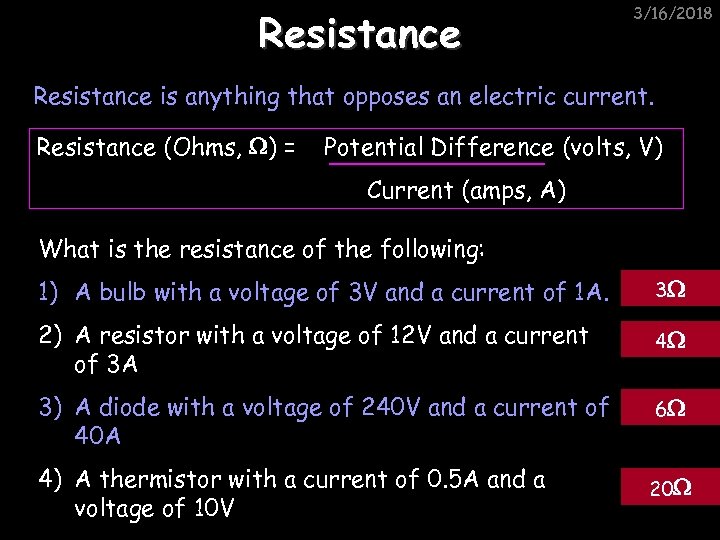 Resistance 3/16/2018 Resistance is anything that opposes an electric current. Resistance (Ohms, ) = Potential Difference (volts, V) Current (amps, A) What is the resistance of the following: 1) A bulb with a voltage of 3 V and a current of 1 A. 3 2) A resistor with a voltage of 12 V and a current of 3 A 4 3) A diode with a voltage of 240 V and a current of 40 A 6 4) A thermistor with a current of 0. 5 A and a voltage of 10 V 20
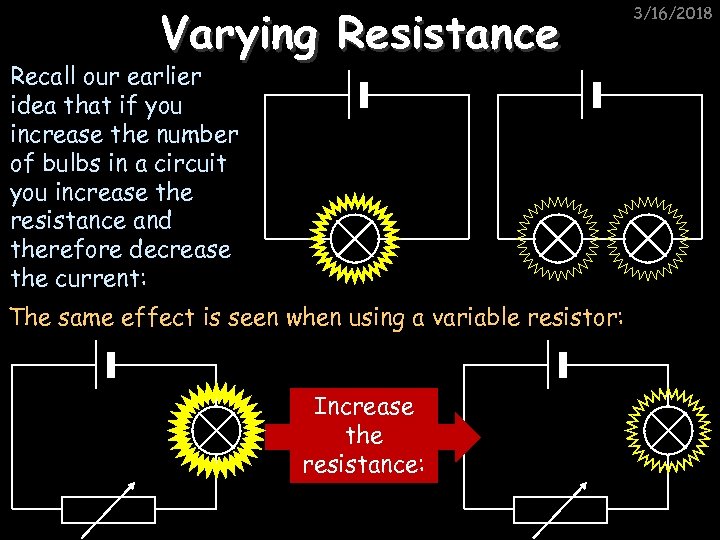 Varying Resistance Recall our earlier idea that if you increase the number of bulbs in a circuit you increase the resistance and therefore decrease the current: The same effect is seen when using a variable resistor: Increase the resistance: 3/16/2018
 Resistors, bulbs and diodes 3/16/2018
 Current-Voltage Graphs Voltage on powerpack/V 12 10 … -10 -12 Current/A 3/16/2018 Voltage/V
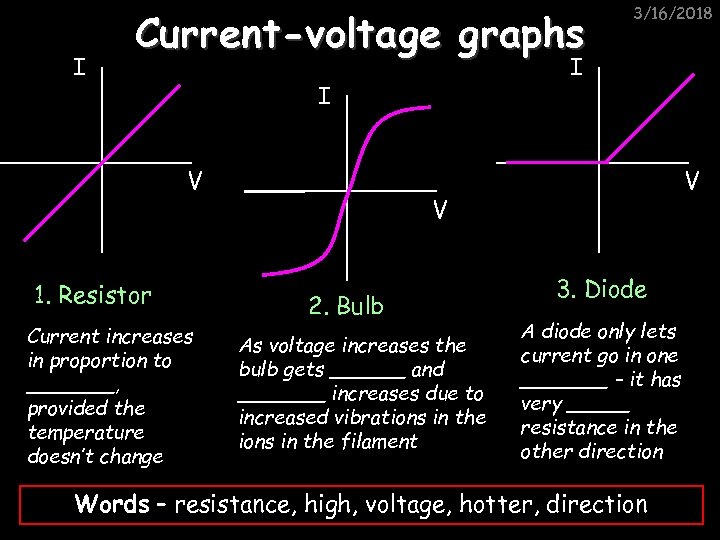 I Current-voltage graphs I I V 1. Resistor Current increases in proportion to _______, provided the temperature doesn’t change 3/16/2018 V V 2. Bulb As voltage increases the bulb gets ______ and _______ increases due to increased vibrations in the filament 3. Diode A diode only lets current go in one _______ – it has very _____ resistance in the other direction Words – resistance, high, voltage, hotter, direction
 LDRs and Thermistors 3/16/2018
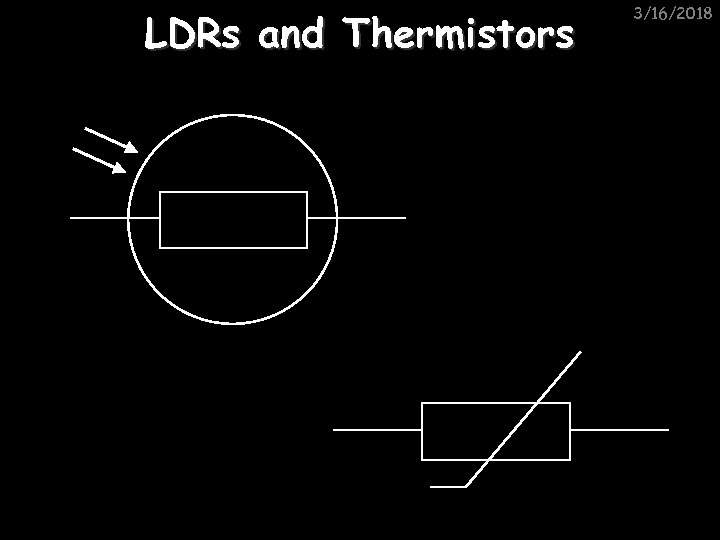
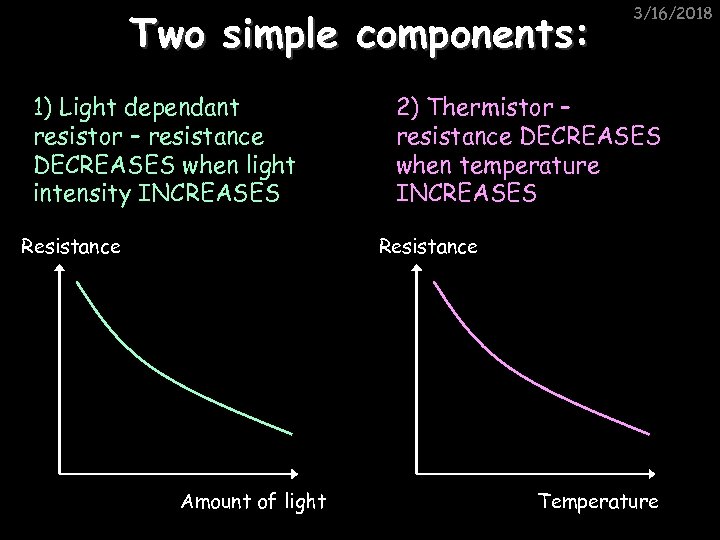 Two simple components: 1) Light dependant resistor – resistance DECREASES when light intensity INCREASES Resistance 3/16/2018 2) Thermistor – resistance DECREASES when temperature INCREASES Resistance Amount of light Temperature
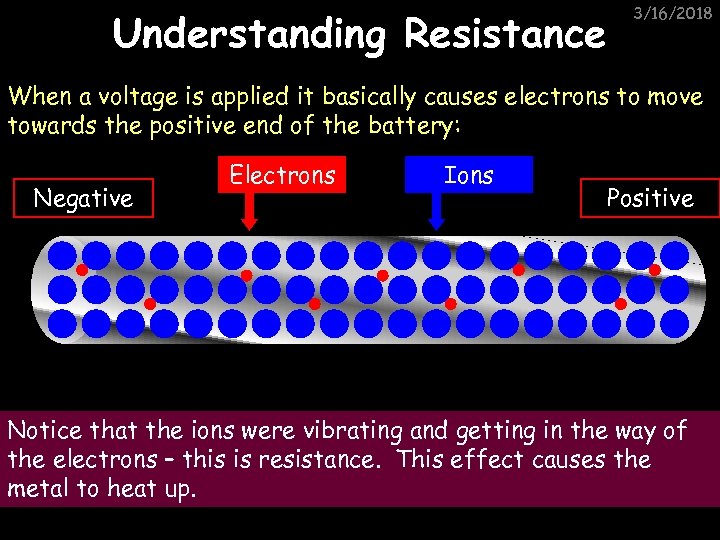 Understanding Resistance 3/16/2018 When a voltage is applied it basically causes electrons to move towards the positive end of the battery: Negative Electrons Ions Positive Notice that the ions were vibrating and getting in the way of the electrons – this is resistance. This effect causes the metal to heat up.
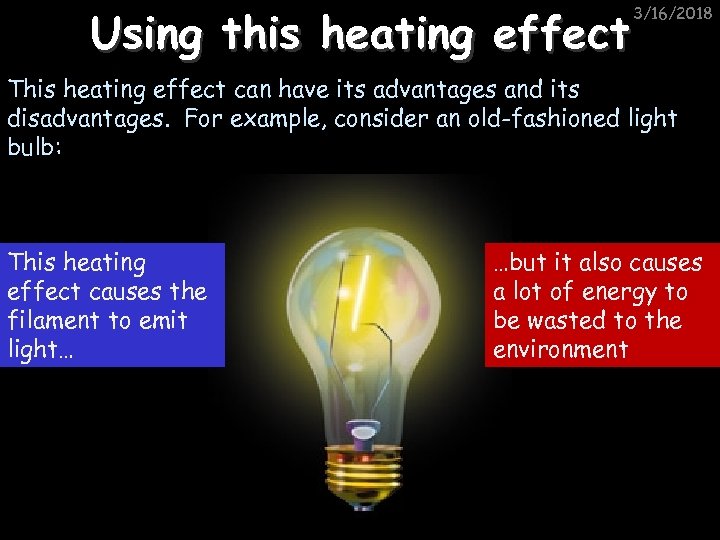 Using this heating effect 3/16/2018 This heating effect can have its advantages and its disadvantages. For example, consider an old-fashioned light bulb: This heating effect causes the filament to emit light… …but it also causes a lot of energy to be wasted to the environment
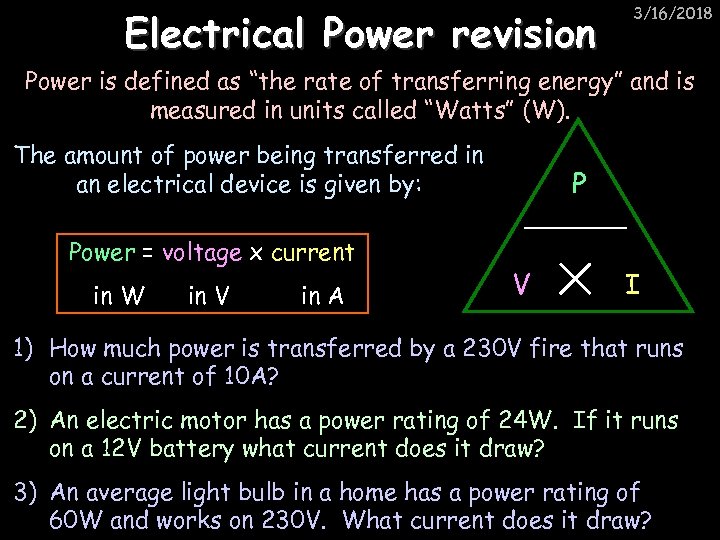 Electrical Power revision 3/16/2018 Power is defined as “the rate of transferring energy” and is measured in units called “Watts” (W). The amount of power being transferred in an electrical device is given by: Power = voltage x current in W in V in A P V I 1) How much power is transferred by a 230 V fire that runs on a current of 10 A? 2) An electric motor has a power rating of 24 W. If it runs on a 12 V battery what current does it draw? 3) An average light bulb in a home has a power rating of 60 W and works on 230 V. What current does it draw?
 Energy and Power 3/16/2018 The POWER RATING of an appliance is simply how much energy it uses every second. In other words, 1 Watt = 1 Joule per second Energy transferred (J) = power (W) x time (s) OR Energy (J) = current (A) x voltage (V) x time (s)
 Topic 3 – Motion and Forces 3/16/2018
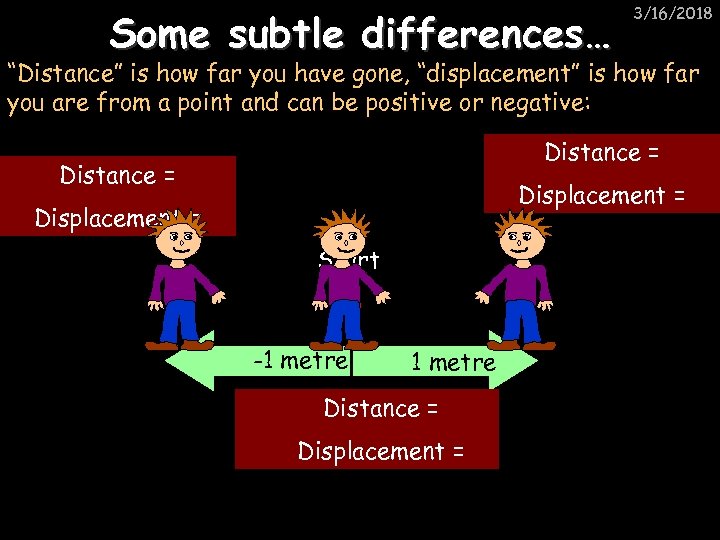 Some subtle differences… 3/16/2018 “Distance” is how far you have gone, “displacement” is how far you are from a point and can be positive or negative: Distance = Displacement = Start -1 metre Distance = = Distance Displacement = = Displacement
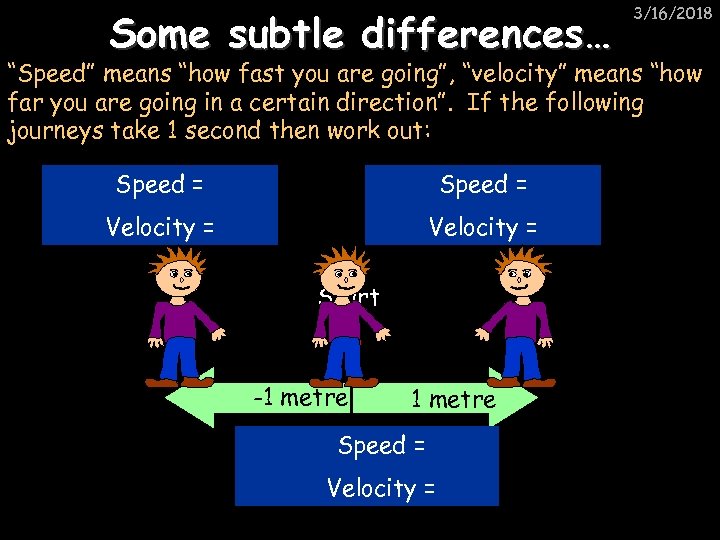 Some subtle differences… 3/16/2018 “Speed” means “how fast you are going”, “velocity” means “how far you are going in a certain direction”. If the following journeys take 1 second then work out: Speed = Velocity = Start -1 metre Speed = = Speed Velocity = = Velocity
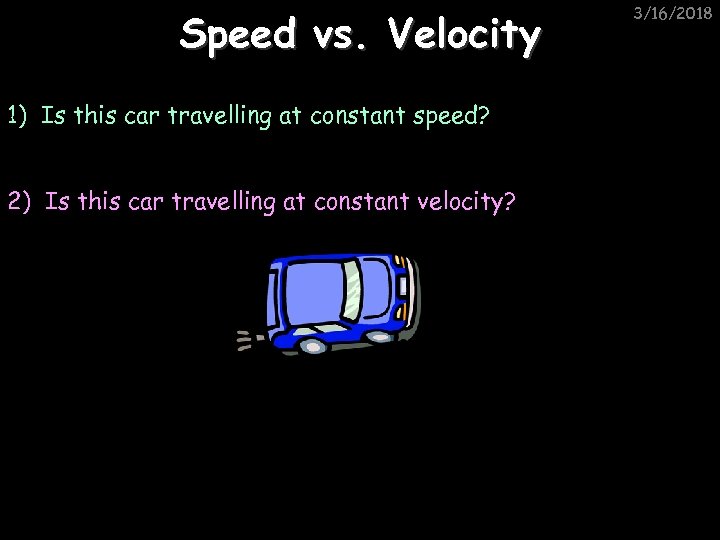 Speed vs. Velocity 1) Is this car travelling at constant speed? 2) Is this car travelling at constant velocity? 3/16/2018
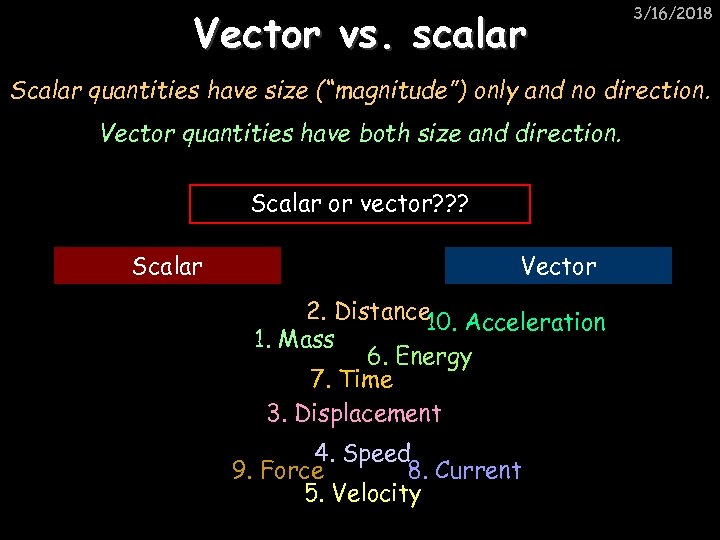 Vector vs. scalar 3/16/2018 Scalar quantities have size (“magnitude”) only and no direction. Vector quantities have both size and direction. Scalar or vector? ? ? Scalar Vector 2. Distance Acceleration 10. 1. Mass 6. Energy 7. Time 3. Displacement 4. Speed 9. Force 8. Current 5. Velocity
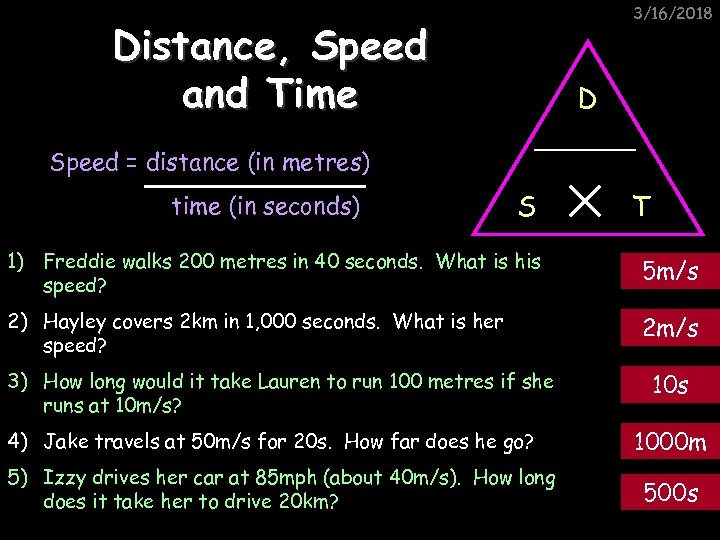 3/16/2018 Distance, Speed and Time D Speed = distance (in metres) time (in seconds) S T 1) Freddie walks 200 metres in 40 seconds. What is his speed? 5 m/s 2) Hayley covers 2 km in 1, 000 seconds. What is her speed? 2 m/s 3) How long would it take Lauren to run 100 metres if she runs at 10 m/s? 4) Jake travels at 50 m/s for 20 s. How far does he go? 5) Izzy drives her car at 85 mph (about 40 m/s). How long does it take her to drive 20 km? 10 s 1000 m 500 s
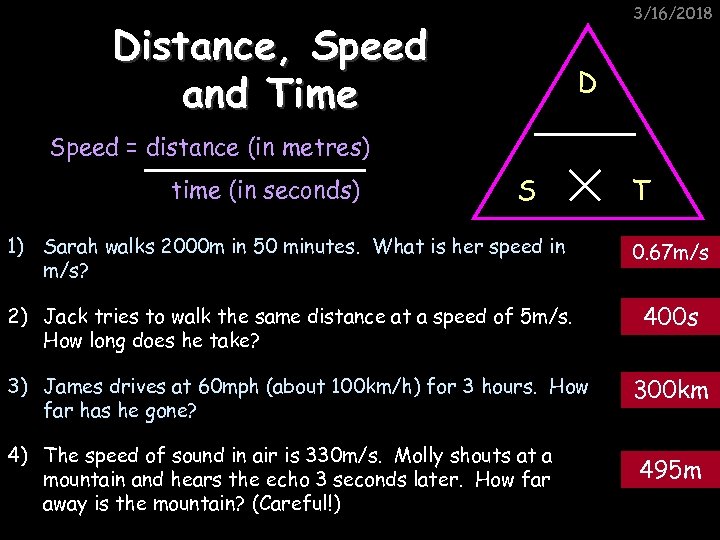 3/16/2018 Distance, Speed and Time D Speed = distance (in metres) time (in seconds) S T 1) Sarah walks 2000 m in 50 minutes. What is her speed in m/s? 0. 67 m/s 2) Jack tries to walk the same distance at a speed of 5 m/s. How long does he take? 400 s 3) James drives at 60 mph (about 100 km/h) for 3 hours. How far has he gone? 4) The speed of sound in air is 330 m/s. Molly shouts at a mountain and hears the echo 3 seconds later. How far away is the mountain? (Careful!) 300 km 495 m
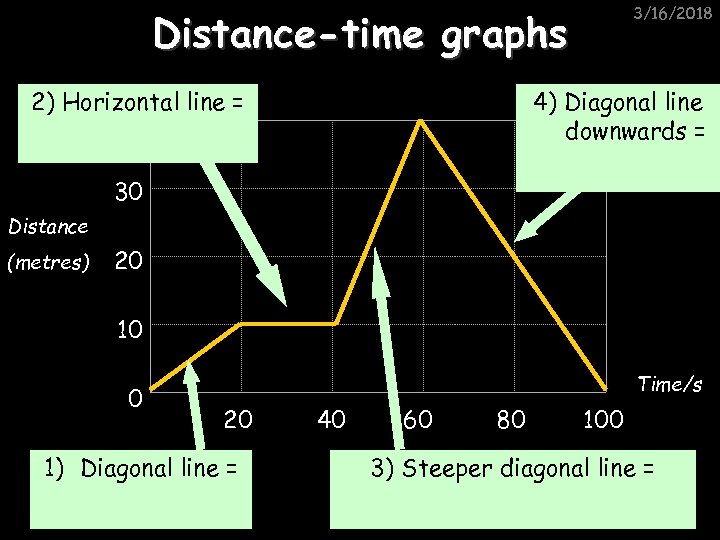 3/16/2018 Distance-time graphs 2) Horizontal line = 40 4) Diagonal line downwards = 30 Distance (metres) 20 10 0 Time/s 20 1) Diagonal line = 40 60 80 100 3) Steeper diagonal line =
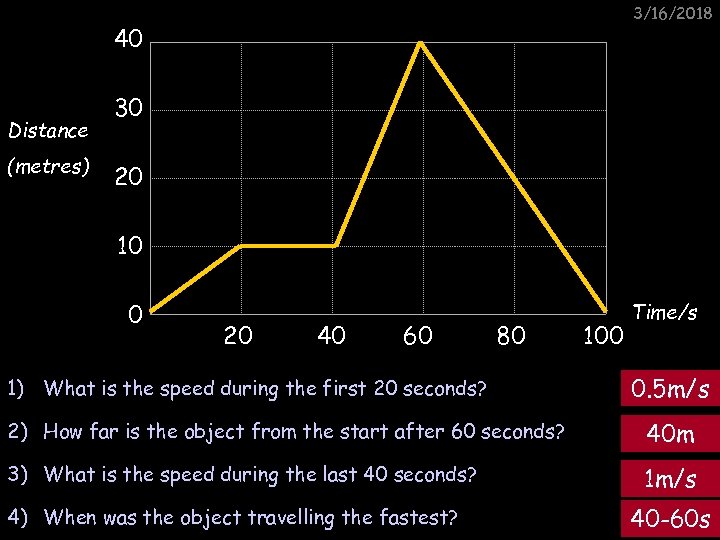 3/16/2018 40 Distance (metres) 30 20 10 0 20 40 60 80 1) What is the speed during the first 20 seconds? 100 Time/s 0. 5 m/s 2) How far is the object from the start after 60 seconds? 40 m 3) What is the speed during the last 40 seconds? 1 m/s 4) When was the object travelling the fastest? 40 -60 s
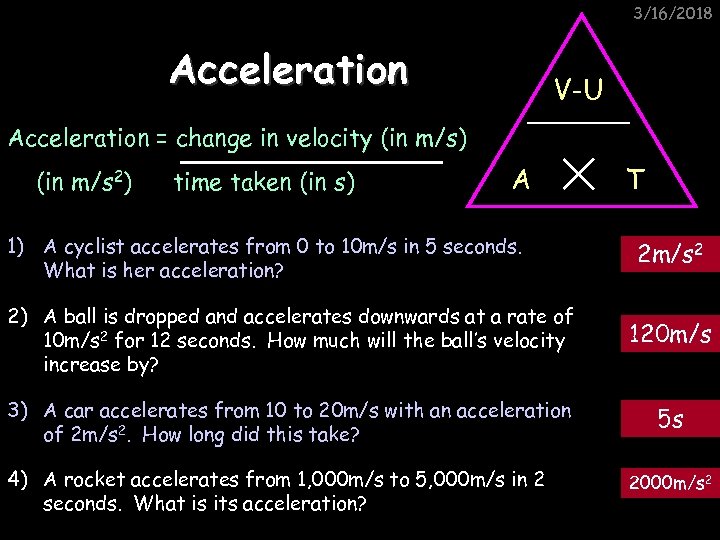 3/16/2018 Acceleration V-U Acceleration = change in velocity (in m/s) (in m/s 2) time taken (in s) A 1) A cyclist accelerates from 0 to 10 m/s in 5 seconds. What is her acceleration? T 2 m/s 2 2) A ball is dropped and accelerates downwards at a rate of 10 m/s 2 for 12 seconds. How much will the ball’s velocity increase by? 120 m/s 3) A car accelerates from 10 to 20 m/s with an acceleration of 2 m/s 2. How long did this take? 5 s 4) A rocket accelerates from 1, 000 m/s to 5, 000 m/s in 2 seconds. What is its acceleration? 2000 m/s 2
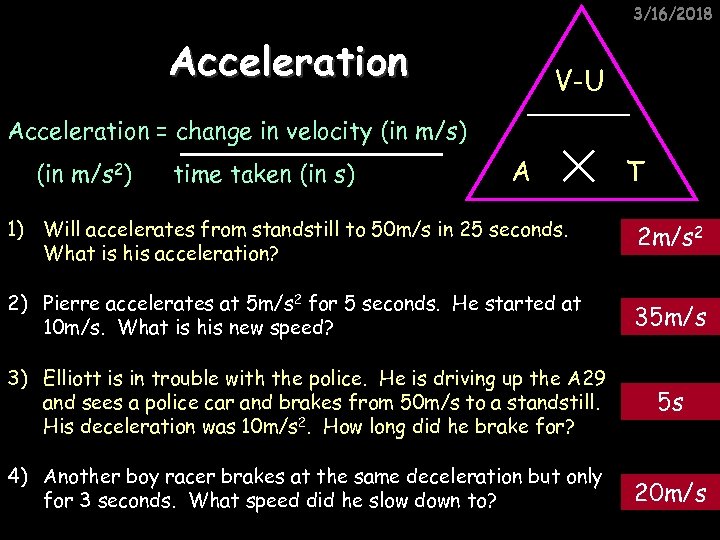 3/16/2018 Acceleration V-U Acceleration = change in velocity (in m/s) (in m/s 2) time taken (in s) A T 1) Will accelerates from standstill to 50 m/s in 25 seconds. What is his acceleration? 2 m/s 2 2) Pierre accelerates at 5 m/s 2 for 5 seconds. He started at 10 m/s. What is his new speed? 35 m/s 3) Elliott is in trouble with the police. He is driving up the A 29 and sees a police car and brakes from 50 m/s to a standstill. His deceleration was 10 m/s 2. How long did he brake for? 5 s 4) Another boy racer brakes at the same deceleration but only for 3 seconds. What speed did he slow down to? 20 m/s
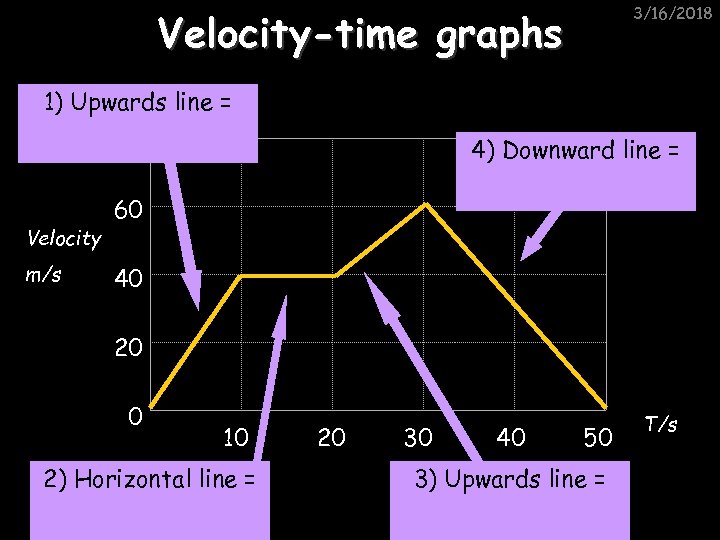 3/16/2018 Velocity-time graphs 1) Upwards line = 80 Velocity m/s 4) Downward line = 60 40 20 0 10 2) Horizontal line = 20 30 40 50 3) Upwards line = T/s
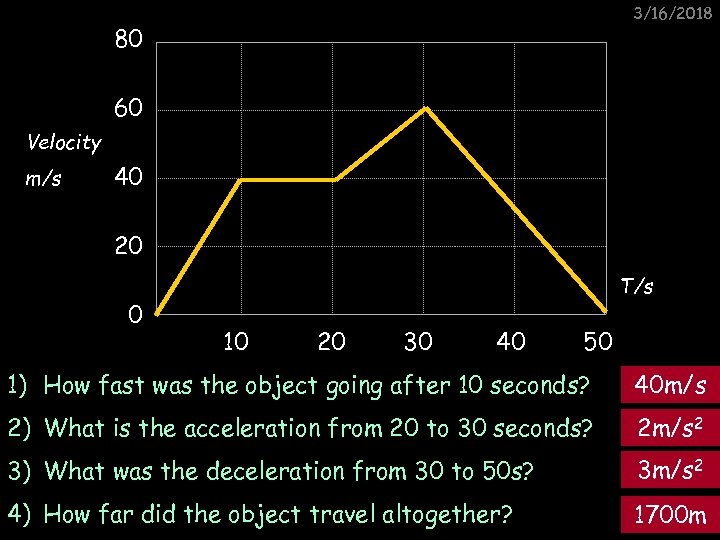 3/16/2018 80 60 Velocity m/s 40 20 0 T/s 10 20 30 40 50 1) How fast was the object going after 10 seconds? 40 m/s 2) What is the acceleration from 20 to 30 seconds? 2 m/s 2 3) What was the deceleration from 30 to 50 s? 3 m/s 2 4) How far did the object travel altogether? 1700 m
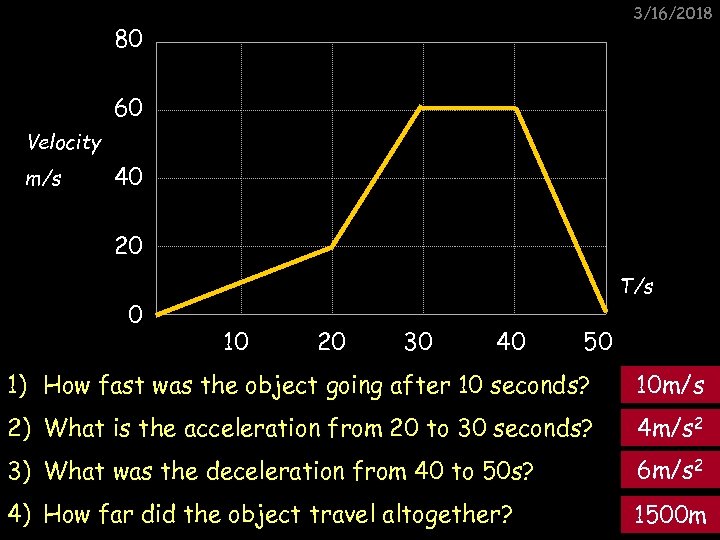 3/16/2018 80 60 Velocity m/s 40 20 0 T/s 10 20 30 40 50 1) How fast was the object going after 10 seconds? 10 m/s 2) What is the acceleration from 20 to 30 seconds? 4 m/s 2 3) What was the deceleration from 40 to 50 s? 6 m/s 2 4) How far did the object travel altogether? 1500 m
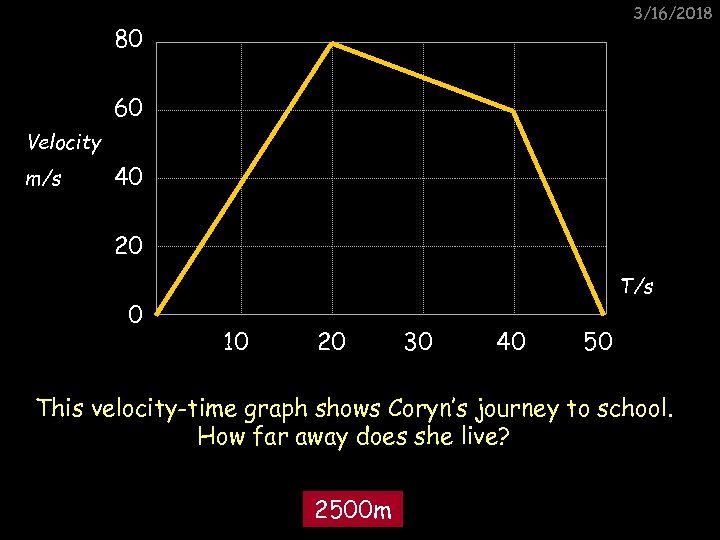 3/16/2018 80 60 Velocity m/s 40 20 0 T/s 10 20 30 40 50 This velocity-time graph shows Coryn’s journey to school. How far away does she live? 2500 m
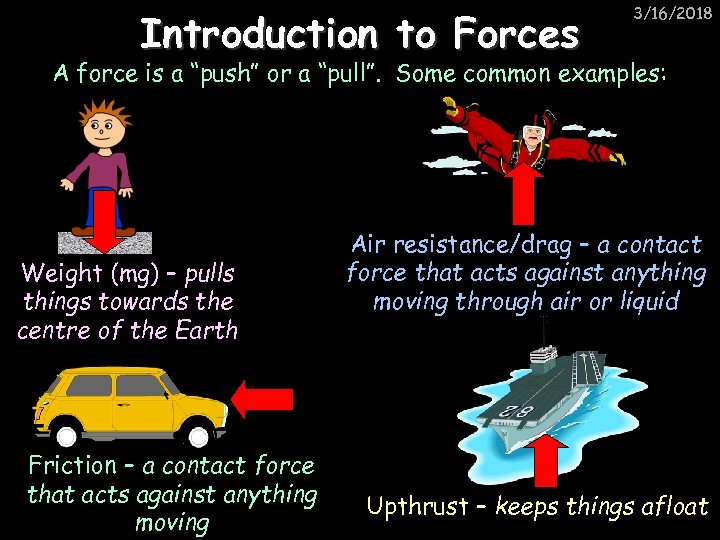 Introduction to Forces 3/16/2018 A force is a “push” or a “pull”. Some common examples: Weight (mg) – pulls things towards the centre of the Earth Friction – a contact force that acts against anything moving Air resistance/drag – a contact force that acts against anything moving through air or liquid Upthrust – keeps things afloat
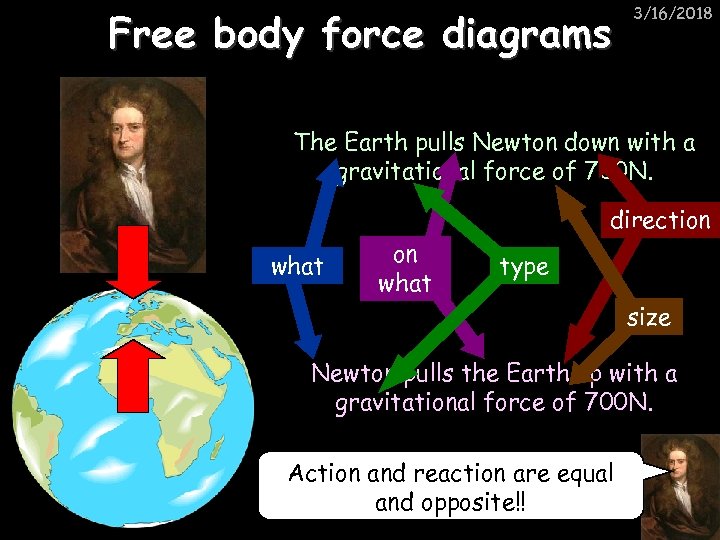 Free body force diagrams 3/16/2018 The Earth pulls Newton down with a gravitational force of 700 N. direction what type size Newton pulls the Earth up with a gravitational force of 700 N. Action and reaction are equal and opposite!!
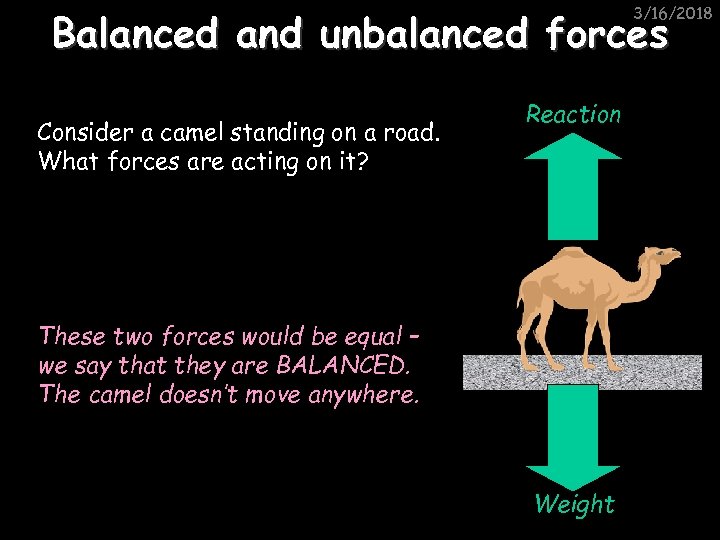 3/16/2018 Balanced and unbalanced forces Consider a camel standing on a road. What forces are acting on it? Reaction These two forces would be equal – we say that they are BALANCED. The camel doesn’t move anywhere. Weight
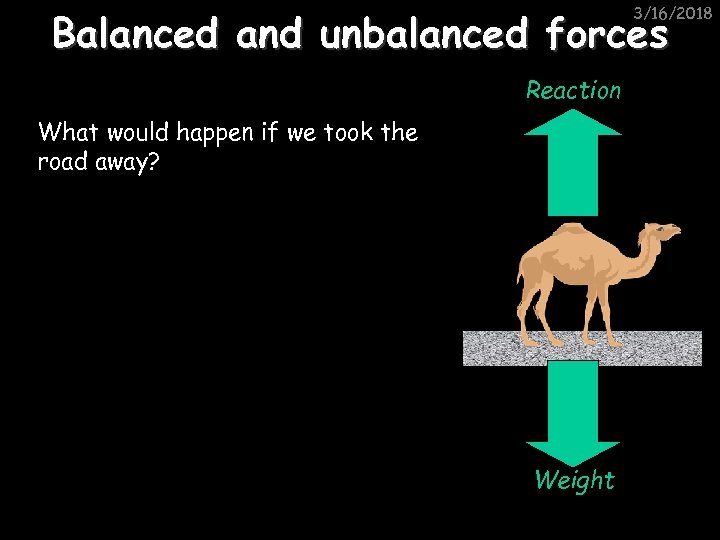 3/16/2018 Balanced and unbalanced forces Reaction What would happen if we took the road away? Weight
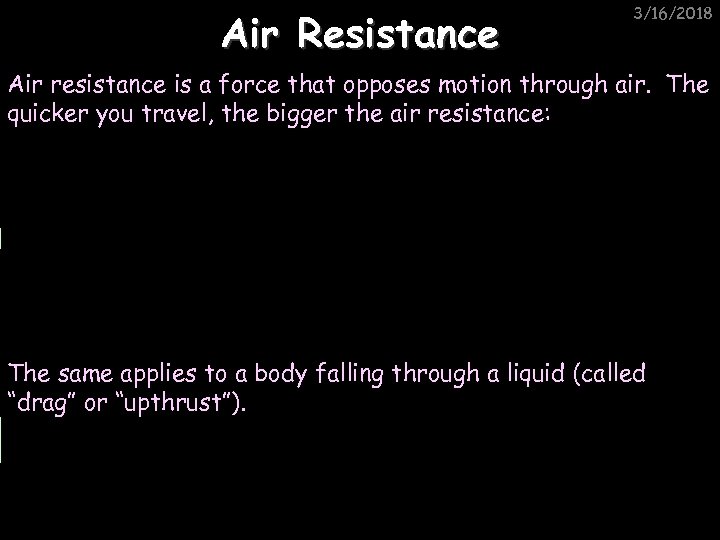 Air Resistance 3/16/2018 Air resistance is a force that opposes motion through air. The quicker you travel, the bigger the air resistance: The same applies to a body falling through a liquid (called “drag” or “upthrust”).
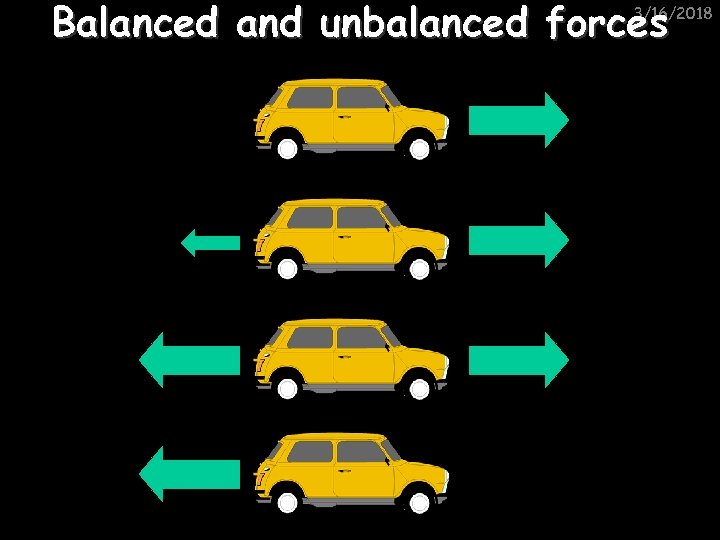 Balanced and unbalanced forces 3/16/2018
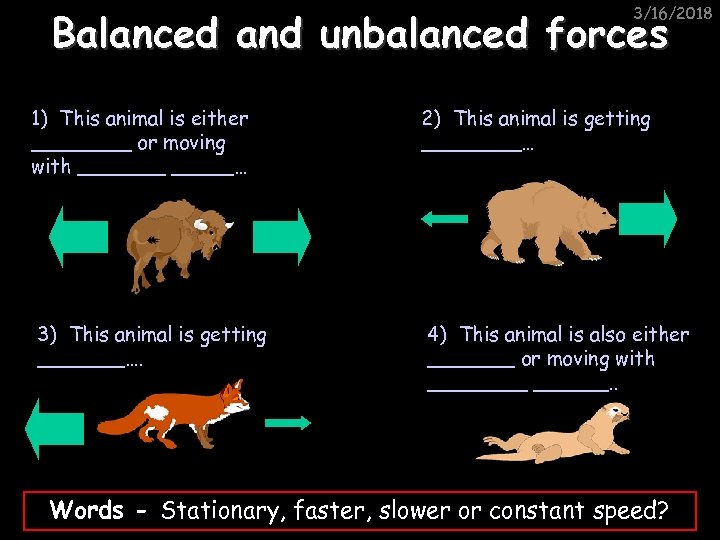 3/16/2018 Balanced and unbalanced forces 1) This animal is either ____ or moving with _______… 3) This animal is getting _______…. 2) This animal is getting ____… 4) This animal is also either _______ or moving with ______. . Words - Stationary, faster, slower or constant speed?
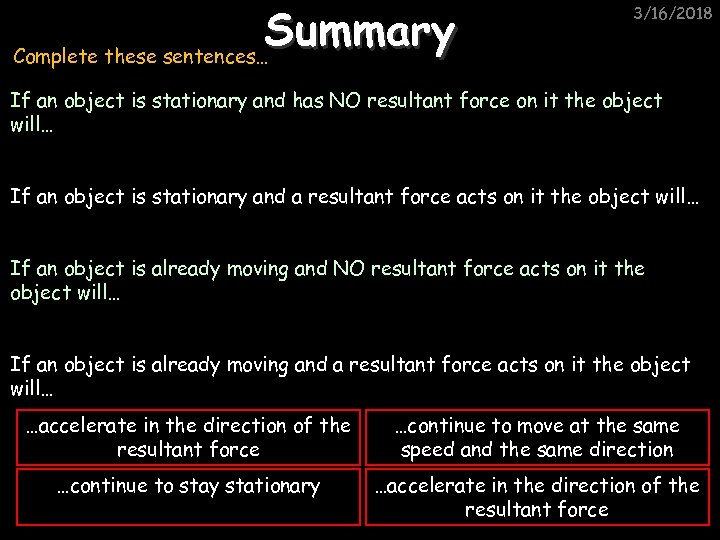 Summary Complete these sentences… 3/16/2018 If an object is stationary and has NO resultant force on it the object will… If an object is stationary and a resultant force acts on it the object will… If an object is already moving and NO resultant force acts on it the object will… If an object is already moving and a resultant force acts on it the object will… …accelerate in the direction of the resultant force …continue to move at the same speed and the same direction …continue to stay stationary …accelerate in the direction of the resultant force
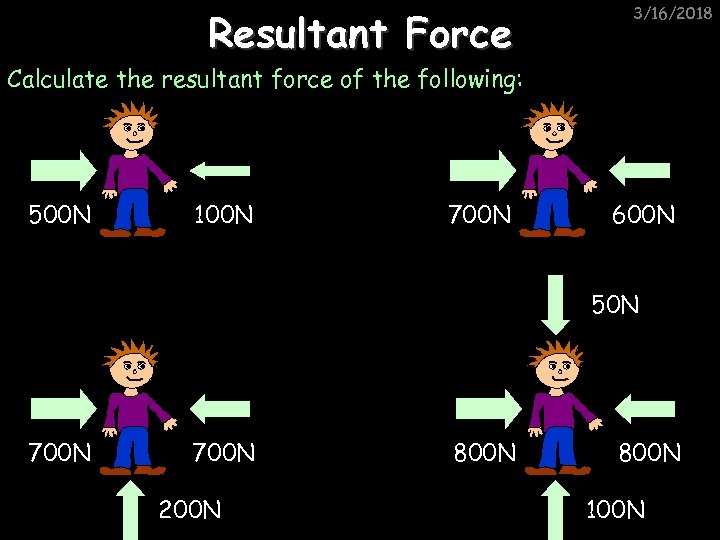 Resultant Force 3/16/2018 Calculate the resultant force of the following: 500 N 100 N 700 N 600 N 50 N 700 N 200 N 800 N 100 N
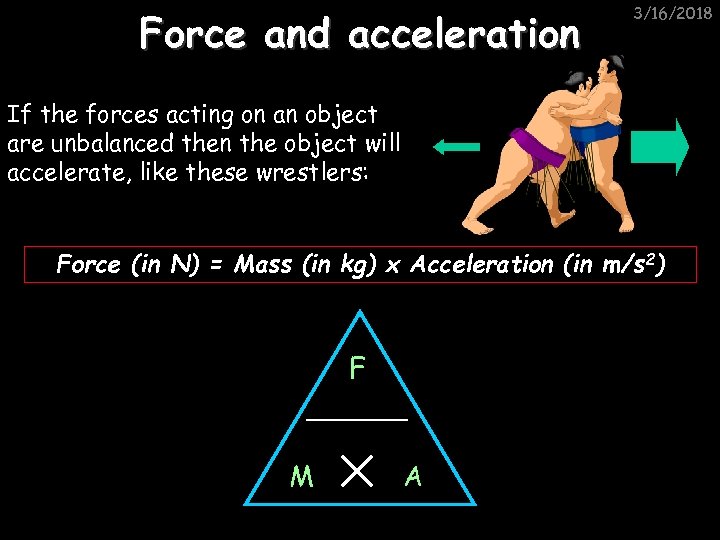 Force and acceleration 3/16/2018 If the forces acting on an object are unbalanced then the object will accelerate, like these wrestlers: Force (in N) = Mass (in kg) x Acceleration (in m/s 2) F M A
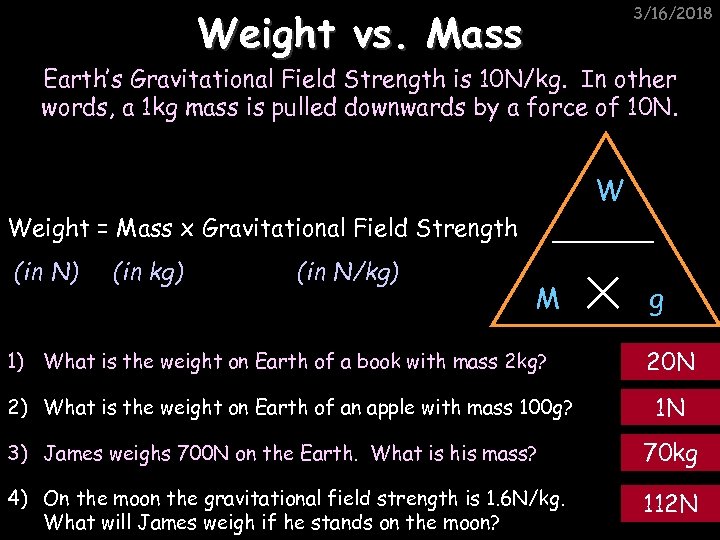 3/16/2018 Weight vs. Mass Earth’s Gravitational Field Strength is 10 N/kg. In other words, a 1 kg mass is pulled downwards by a force of 10 N. W Weight = Mass x Gravitational Field Strength (in N) (in kg) (in N/kg) M 1) What is the weight on Earth of a book with mass 2 kg? 2) What is the weight on Earth of an apple with mass 100 g? g 20 N 1 N 3) James weighs 700 N on the Earth. What is his mass? 70 kg 4) On the moon the gravitational field strength is 1. 6 N/kg. What will James weigh if he stands on the moon? 112 N
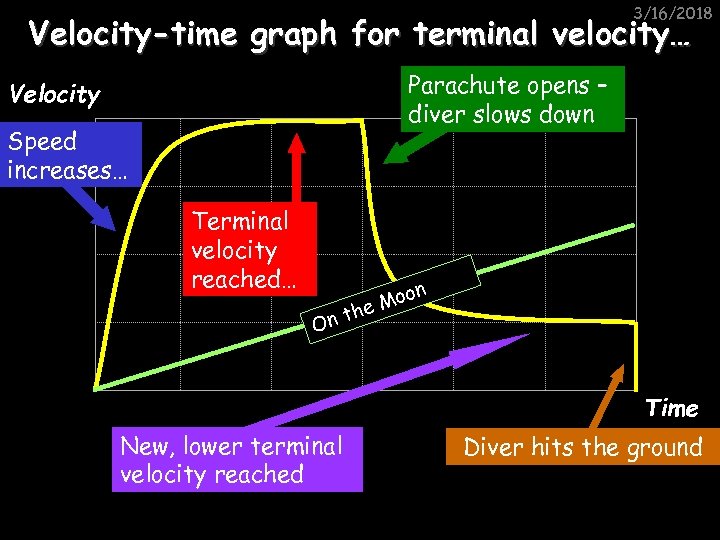
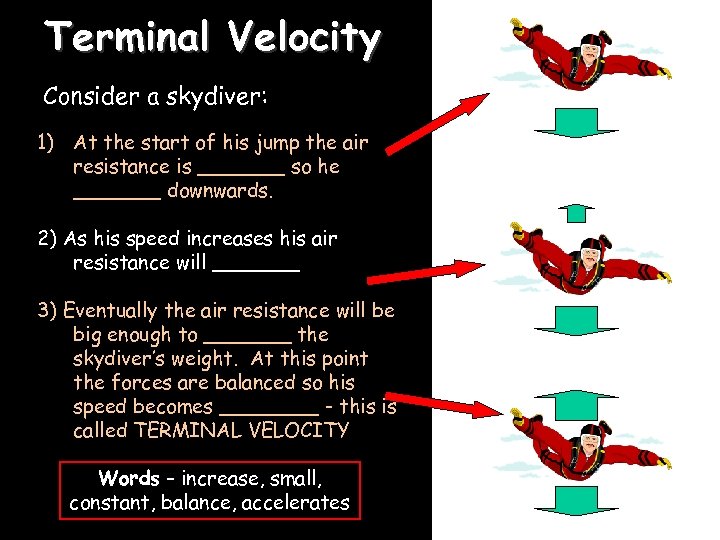 Terminal Velocity Consider a skydiver: 1) At the start of his jump the air resistance is _______ so he _______ downwards. 2) As his speed increases his air resistance will _______ 3) Eventually the air resistance will be big enough to _______ the skydiver’s weight. At this point the forces are balanced so his speed becomes ____ - this is called TERMINAL VELOCITY Words – increase, small, constant, balance, accelerates 3/16/2018
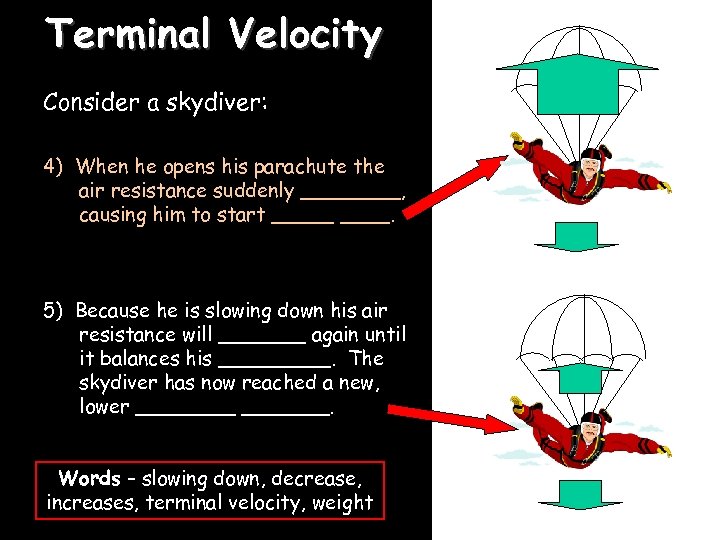 Terminal Velocity Consider a skydiver: 4) When he opens his parachute the air resistance suddenly ____, causing him to start _____. 5) Because he is slowing down his air resistance will _______ again until it balances his _____. The skydiver has now reached a new, lower _______. Words – slowing down, decrease, increases, terminal velocity, weight 3/16/2018
 3/16/2018 Velocity-time graph for terminal velocity… Parachute opens – diver slows down Velocity Speed increases… Terminal velocity reached… On n Moo he t Time New, lower terminal velocity reached Diver hits the ground
 Topic 4 – Momentum, Energy, Work and Power 3/16/2018
 Stopping a car… 3/16/2018 What two things must the driver of the car do in order to stop in time?
 Tiredness Too many drugs Heavy vehicle Tyres/brakes worn out Stopping a car… Thinking distance (reaction time) Braking distance 3/16/2018 Too much alcohol Poor visibility Wet/icy roads Driving too fast Total Stopping Distance = Thinking Distance + Braking Distance
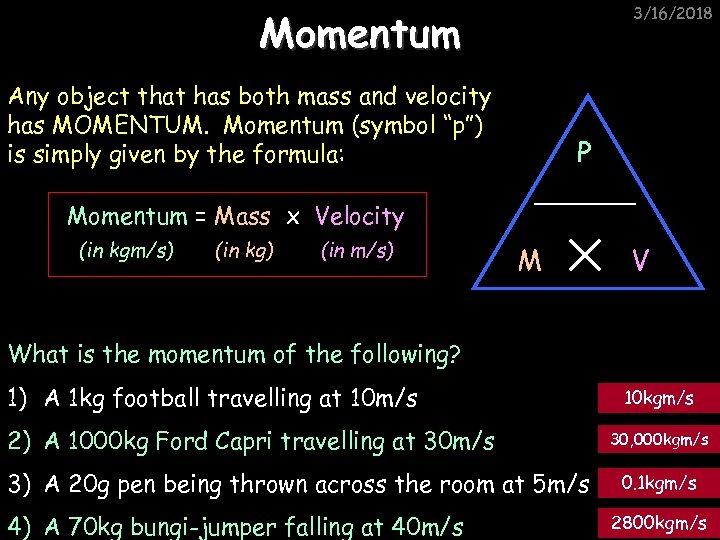 3/16/2018 Momentum Any object that has both mass and velocity has MOMENTUM. Momentum (symbol “p”) is simply given by the formula: P Momentum = Mass x Velocity (in kgm/s) (in kg) (in m/s) M V What is the momentum of the following? 1) A 1 kg football travelling at 10 m/s 2) A 1000 kg Ford Capri travelling at 30 m/s 3) A 20 g pen being thrown across the room at 5 m/s 4) A 70 kg bungi-jumper falling at 40 m/s 10 kgm/s 30, 000 kgm/s 0. 1 kgm/s 2800 kgm/s
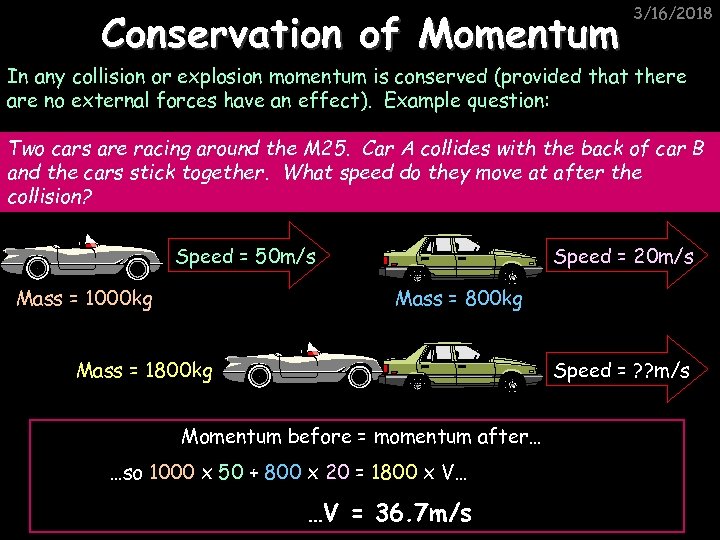 Conservation of Momentum 3/16/2018 In any collision or explosion momentum is conserved (provided that there are no external forces have an effect). Example question: Two cars are racing around the M 25. Car A collides with the back of car B and the cars stick together. What speed do they move at after the collision? Speed = 50 m/s Mass = 1000 kg Speed = 20 m/s Mass = 800 kg Mass = 1800 kg Speed = ? ? m/s Momentum before = momentum after… …so 1000 x 50 + 800 x 20 = 1800 x V… …V = 36. 7 m/s
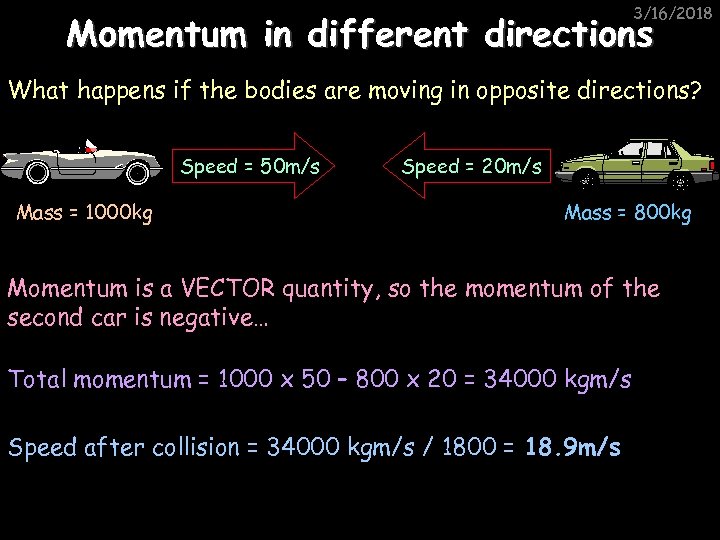 3/16/2018 Momentum in different directions What happens if the bodies are moving in opposite directions? Speed = 50 m/s Mass = 1000 kg Speed = 20 m/s Mass = 800 kg Momentum is a VECTOR quantity, so the momentum of the second car is negative… Total momentum = 1000 x 50 – 800 x 20 = 34000 kgm/s Speed after collision = 34000 kgm/s / 1800 = 18. 9 m/s
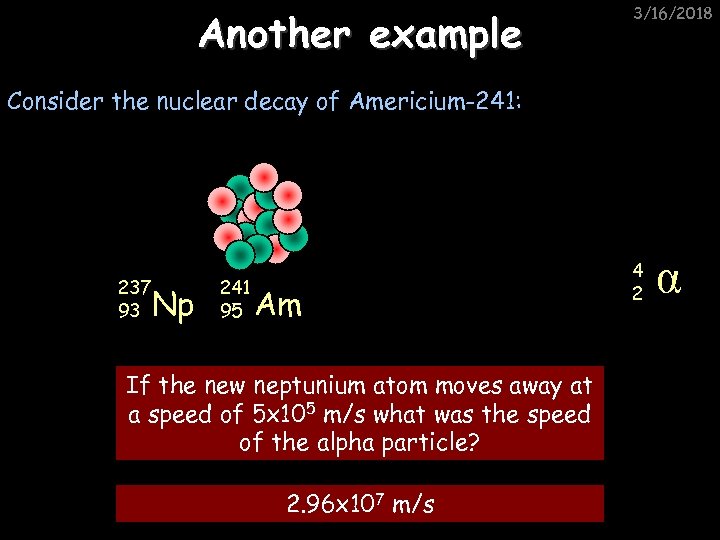 Another example 3/16/2018 Consider the nuclear decay of Americium-241: 237 93 Np 241 95 Am If the new neptunium atom moves away at a speed of 5 x 10⁵ m/s what was the speed of the alpha particle? 2. 96 x 107 m/s 4 2 α
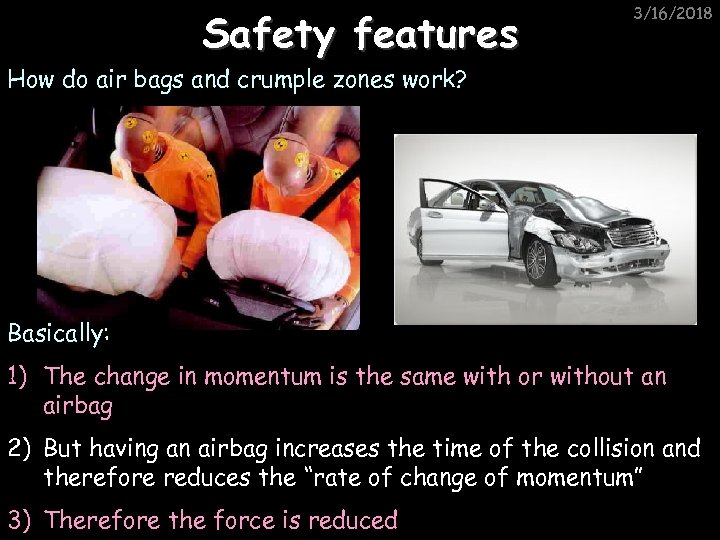 Safety features 3/16/2018 How do air bags and crumple zones work? Basically: 1) The change in momentum is the same with or without an airbag 2) But having an airbag increases the time of the collision and therefore reduces the “rate of change of momentum” 3) Therefore the force is reduced
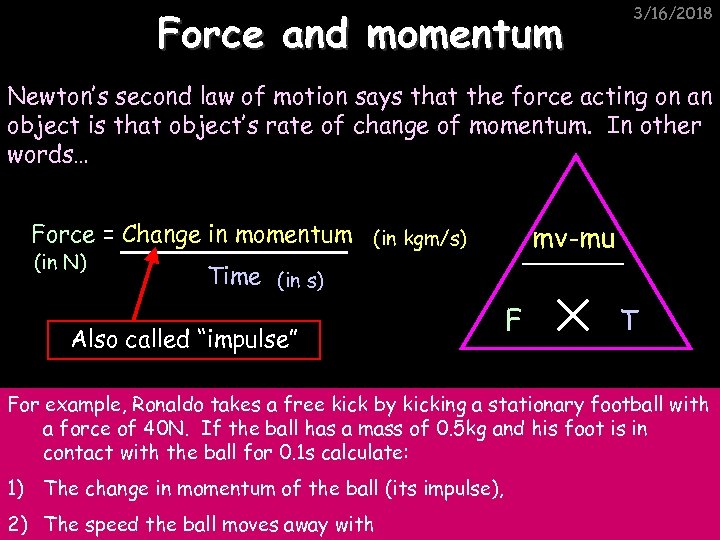 Force and momentum 3/16/2018 Newton’s second law of motion says that the force acting on an object is that object’s rate of change of momentum. In other words… Force = Change in momentum (in kgm/s) (in N) mv-mu Time (in s) Also called “impulse” F T For example, Ronaldo takes a free kick by kicking a stationary football with a force of 40 N. If the ball has a mass of 0. 5 kg and his foot is in contact with the ball for 0. 1 s calculate: 1) The change in momentum of the ball (its impulse), 2) The speed the ball moves away with
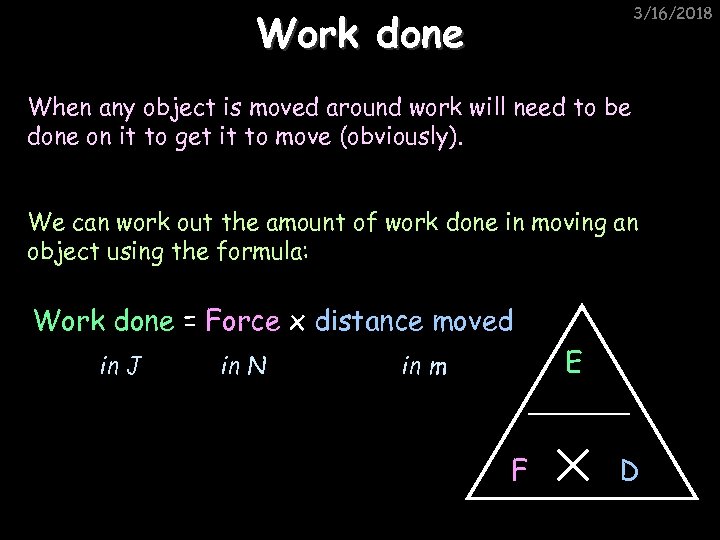 3/16/2018 Work done When any object is moved around work will need to be done on it to get it to move (obviously). We can work out the amount of work done in moving an object using the formula: Work done = Force x distance moved in J in N E in m F D
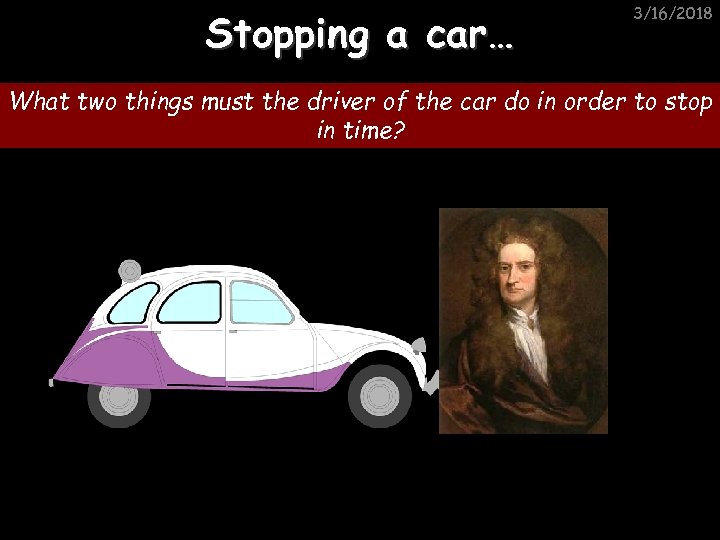
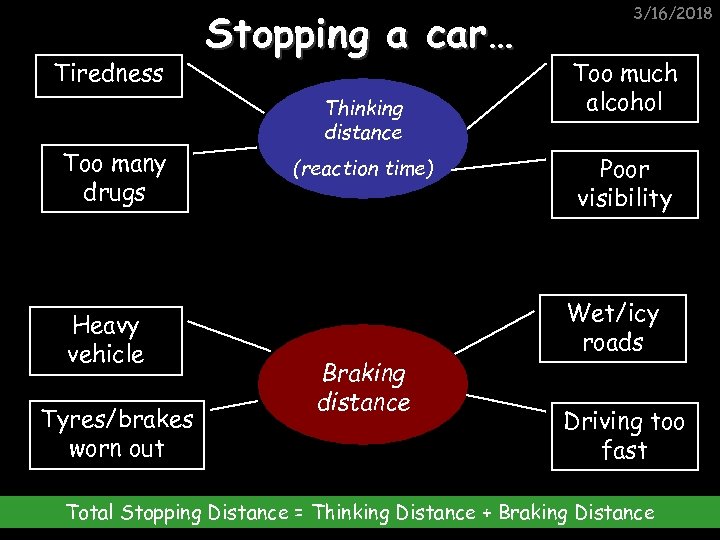
 Stopping a car… 3/16/2018 Recall our earlier situation regarding stopping distances…
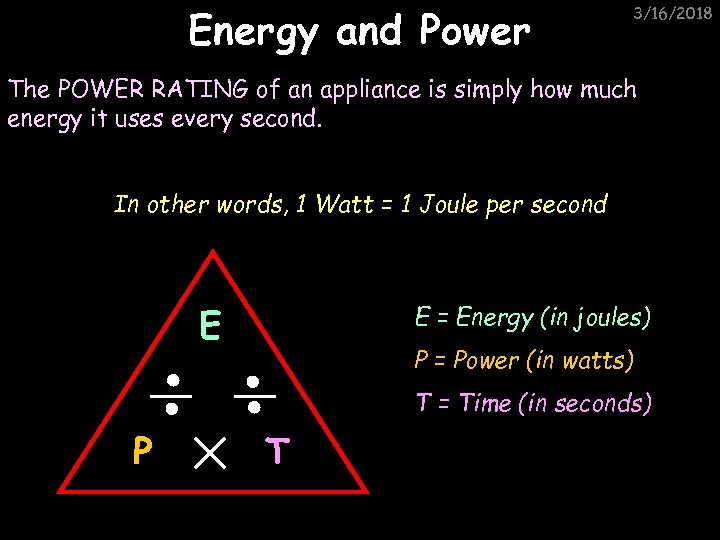 Energy and Power 3/16/2018 The POWER RATING of an appliance is simply how much energy it uses every second. In other words, 1 Watt = 1 Joule per second E E = Energy (in joules) P = Power (in watts) T = Time (in seconds) P T
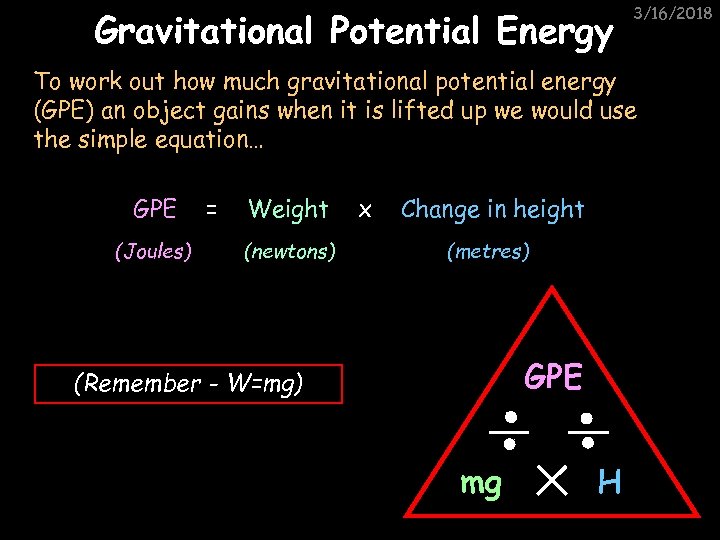 Gravitational Potential Energy 3/16/2018 To work out how much gravitational potential energy (GPE) an object gains when it is lifted up we would use the simple equation… GPE (Joules) = Weight (newtons) x Change in height (metres) GPE (Remember - W=mg) mg H
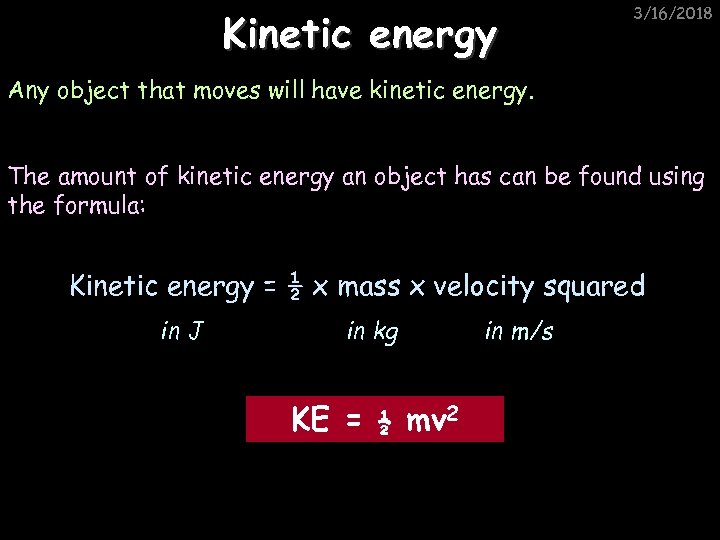 Kinetic energy 3/16/2018 Any object that moves will have kinetic energy. The amount of kinetic energy an object has can be found using the formula: Kinetic energy = ½ x mass x velocity squared in J in kg KE = ½ in m/s mv 2
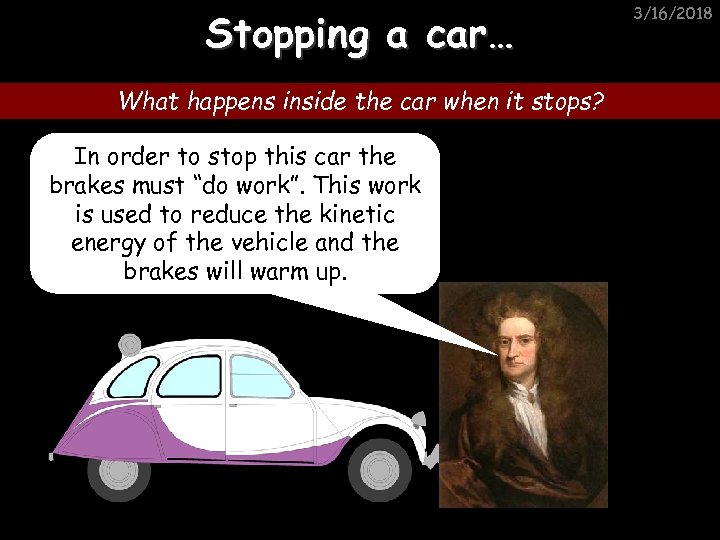 Stopping a car… What happens inside the car when it stops? In order to stop this car the brakes must “do work”. This work is used to reduce the kinetic energy of the vehicle and the brakes will warm up. 3/16/2018
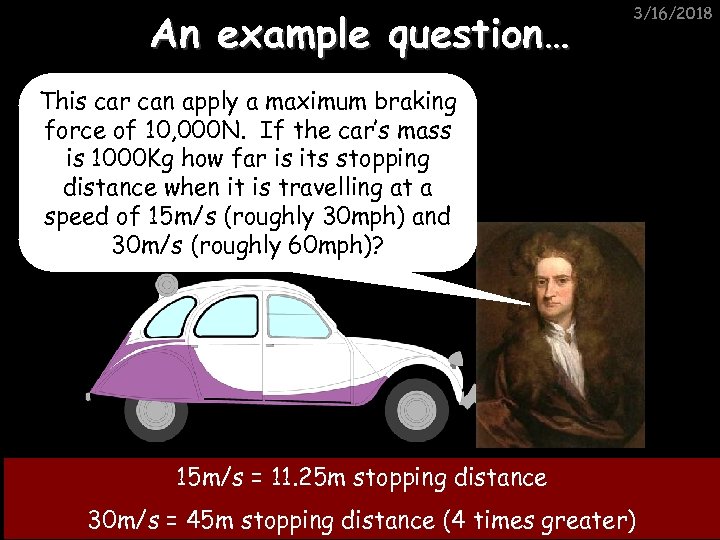 An example question… 3/16/2018 This car can apply a maximum braking force of 10, 000 N. If the car’s mass is 1000 Kg how far is its stopping distance when it is travelling at a speed of 15 m/s (roughly 30 mph) and 30 m/s (roughly 60 mph)? 15 m/s = 11. 25 m stopping distance 30 m/s = 45 m stopping distance (4 times greater)
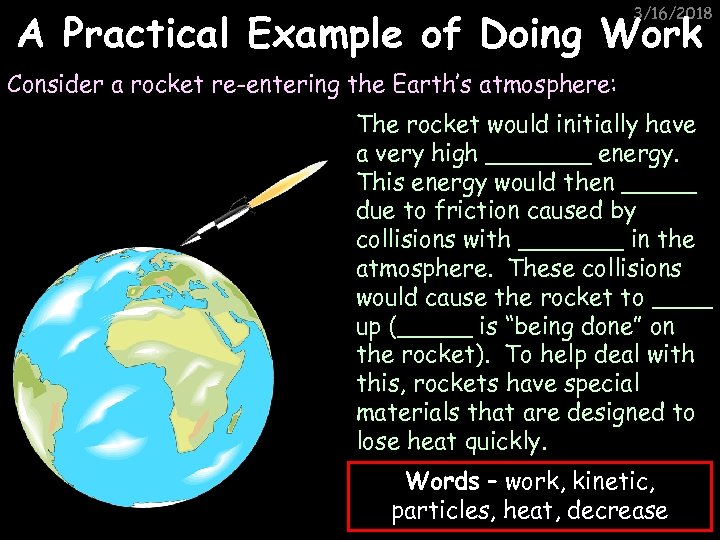 3/16/2018 A Practical Example of Doing Work Consider a rocket re-entering the Earth’s atmosphere: The rocket would initially have a very high _______ energy. This energy would then _____ due to friction caused by collisions with _______ in the atmosphere. These collisions would cause the rocket to ____ up (_____ is “being done” on the rocket). To help deal with this, rockets have special materials that are designed to lose heat quickly. Words – work, kinetic, particles, heat, decrease
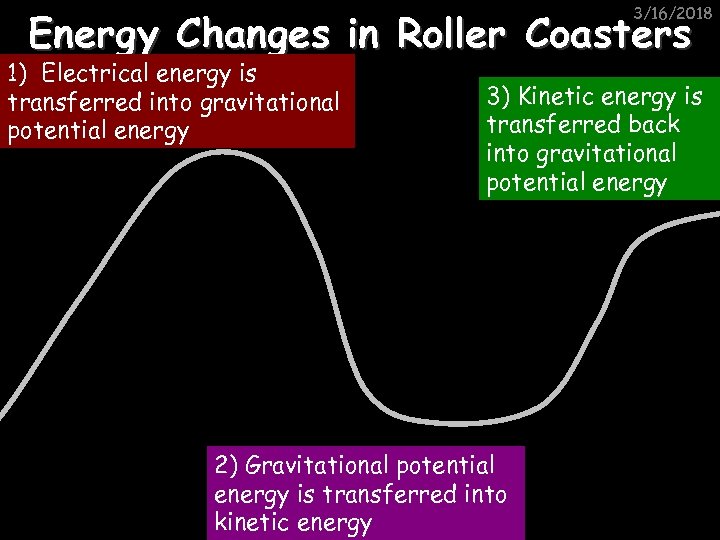 3/16/2018 Energy Changes in Roller Coasters 1) Electrical energy is transferred into gravitational potential energy 3) Kinetic energy is transferred back into gravitational potential energy 2) Gravitational potential energy is transferred into kinetic energy
 Topic 5 – Nuclear Fission and Nuclear Fusion 3/16/2018
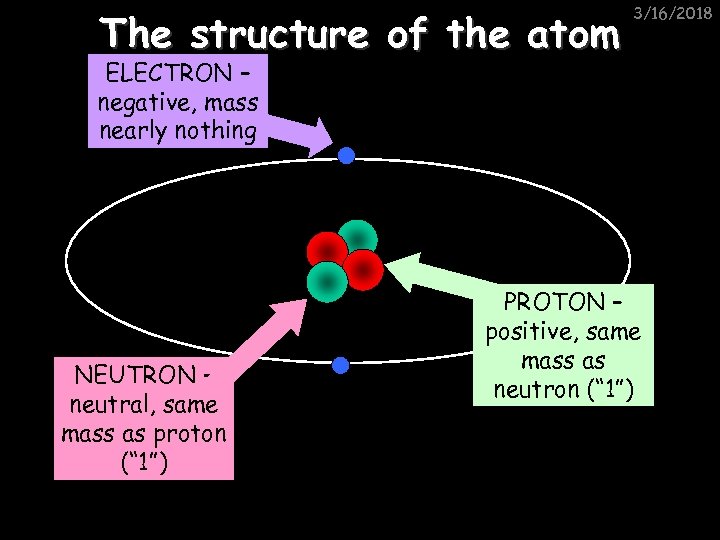 The structure of the atom 3/16/2018 ELECTRON – negative, mass nearly nothing NEUTRON – neutral, same mass as proton (“ 1”) PROTON – positive, same mass as neutron (“ 1”)
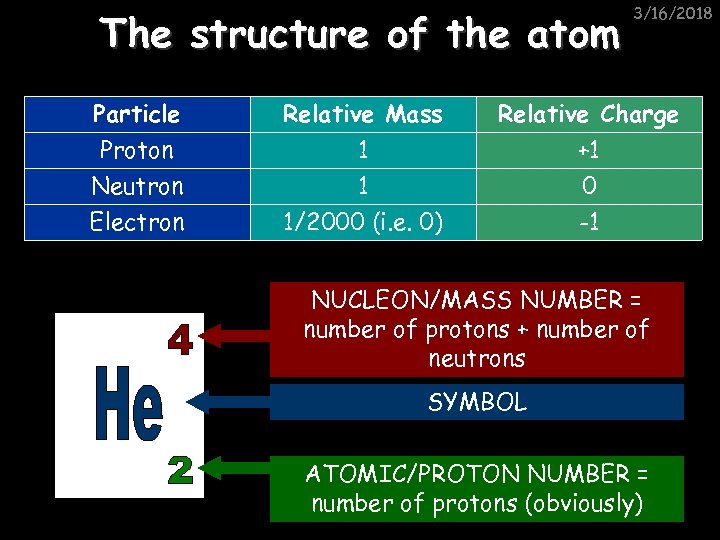 The structure of the atom Particle Proton Neutron Electron Relative Mass 1 1 1/2000 (i. e. 0) 3/16/2018 Relative Charge +1 0 -1 NUCLEON/MASS NUMBER = number of protons + number of neutrons SYMBOL ATOMIC/PROTON NUMBER = number of protons (obviously)
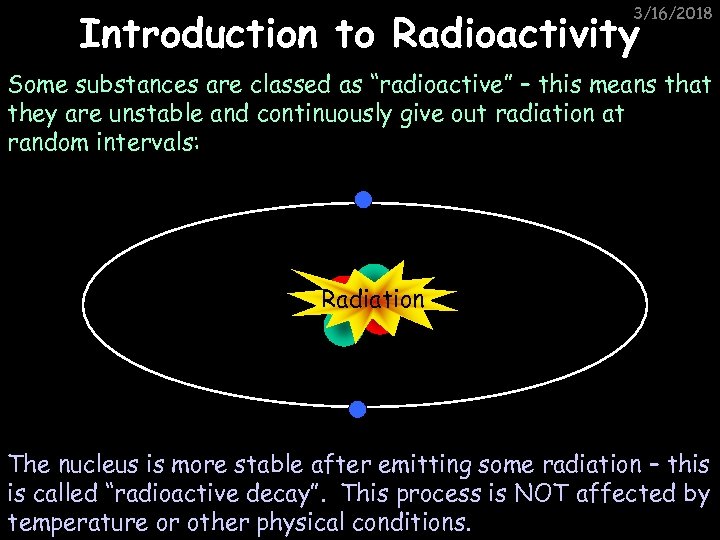 3/16/2018 Introduction to Radioactivity Some substances are classed as “radioactive” – this means that they are unstable and continuously give out radiation at random intervals: Radiation The nucleus is more stable after emitting some radiation – this is called “radioactive decay”. This process is NOT affected by temperature or other physical conditions.
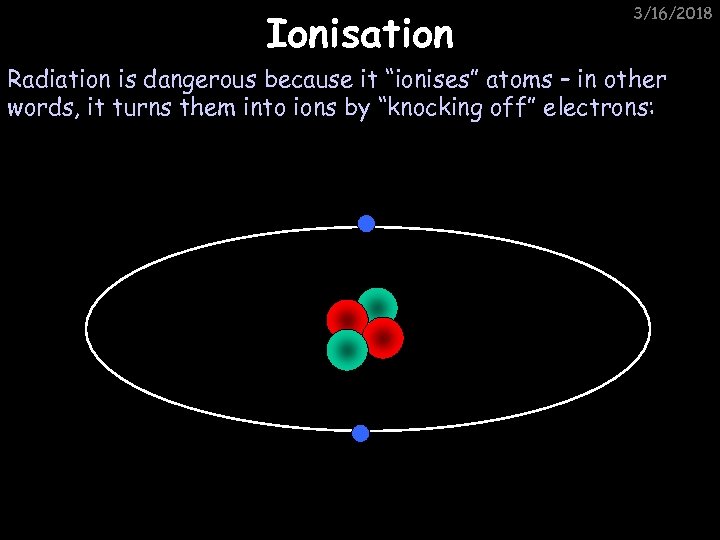 Ionisation 3/16/2018 Radiation is dangerous because it “ionises” atoms – in other words, it turns them into ions by “knocking off” electrons:
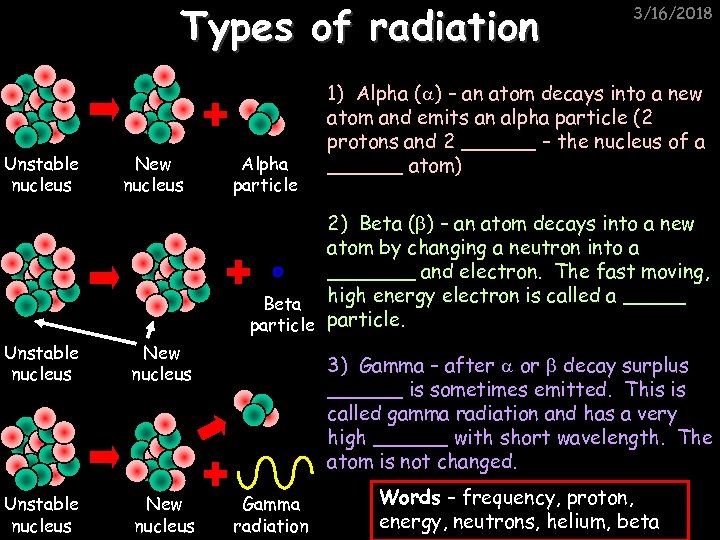 Types of radiation Unstable nucleus New nucleus Alpha particle 3/16/2018 1) Alpha ( ) – an atom decays into a new atom and emits an alpha particle (2 protons and 2 ______ – the nucleus of a ______ atom) 2) Beta ( ) – an atom decays into a new atom by changing a neutron into a _______ and electron. The fast moving, Beta high energy electron is called a _____ particle. Unstable nucleus New nucleus 3) Gamma – after or decay surplus ______ is sometimes emitted. This is called gamma radiation and has a very high ______ with short wavelength. The atom is not changed. Gamma radiation Words – frequency, proton, energy, neutrons, helium, beta
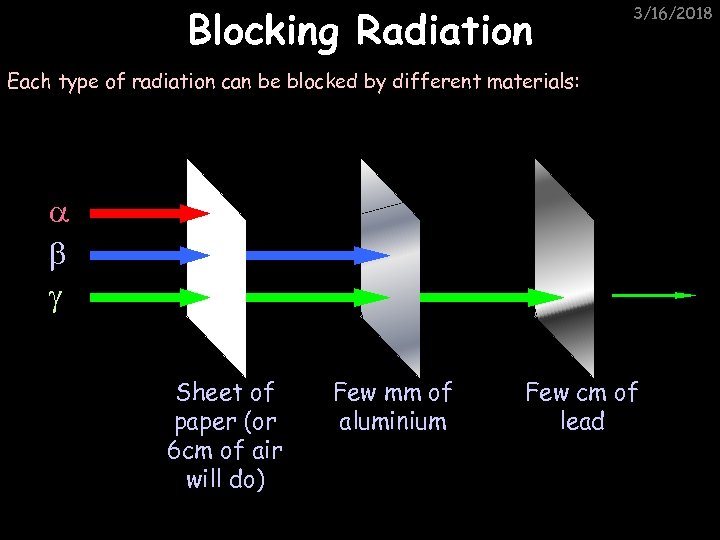 Blocking Radiation 3/16/2018 Each type of radiation can be blocked by different materials: Sheet of paper (or 6 cm of air will do) Few mm of aluminium Few cm of lead
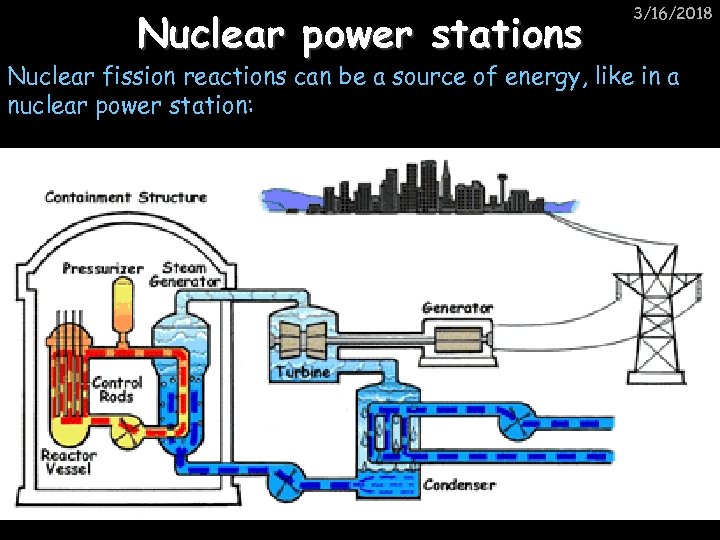 Nuclear power stations 3/16/2018 Nuclear fission reactions can be a source of energy, like in a nuclear power station:
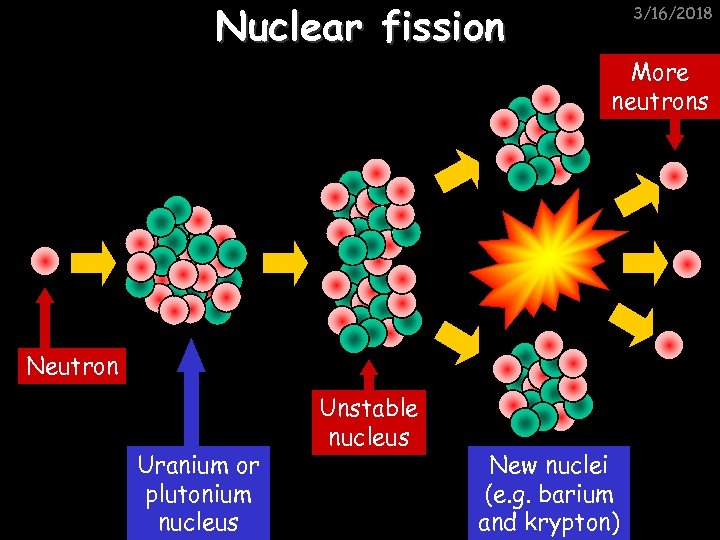 Nuclear fission 3/16/2018 More neutrons Neutron Uranium or plutonium nucleus Unstable nucleus New nuclei (e. g. barium and krypton)
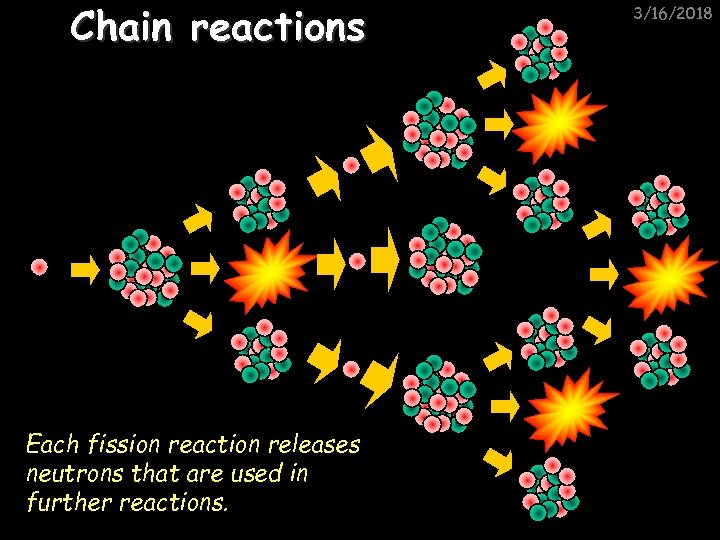 Chain reactions Each fission reaction releases neutrons that are used in further reactions. 3/16/2018
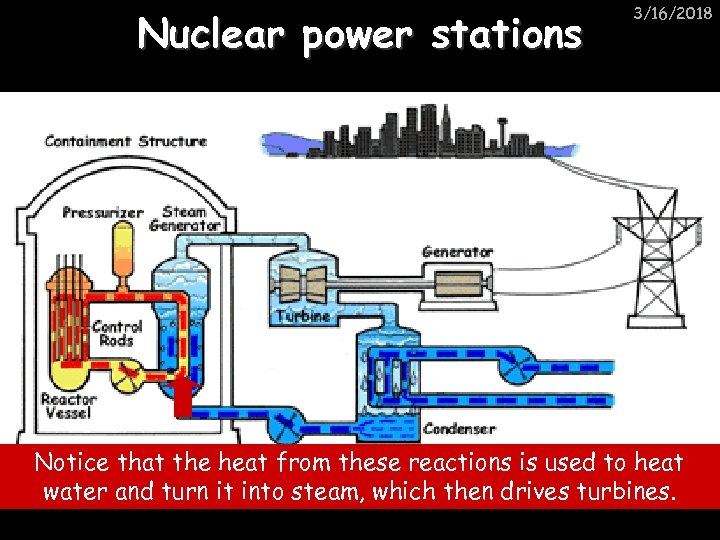 Nuclear power stations 3/16/2018 Notice that the heat from these reactions is used to heat water and turn it into steam, which then drives turbines.
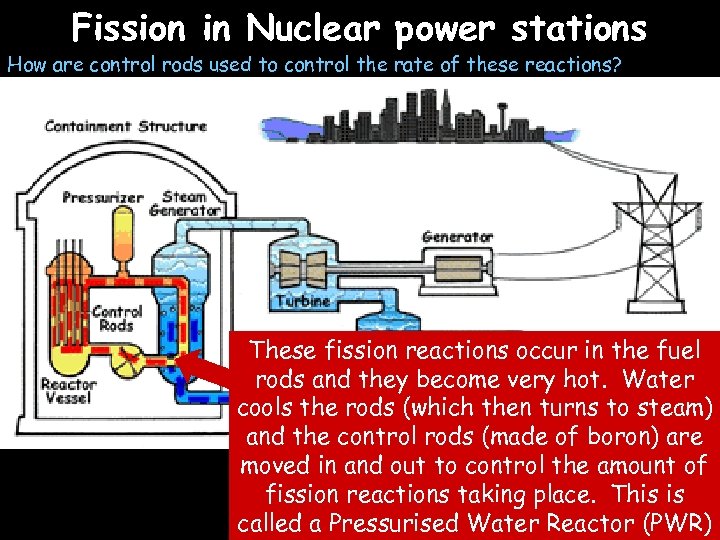 Fission in Nuclear power stations How are control rods used to control the rate of these reactions? These fission reactions occur in the fuel rods and they become very hot. Water cools the rods (which then turns to steam) and the control rods (made of boron) are moved in and out to control the amount of fission reactions taking place. This is called a Pressurised Water Reactor (PWR)
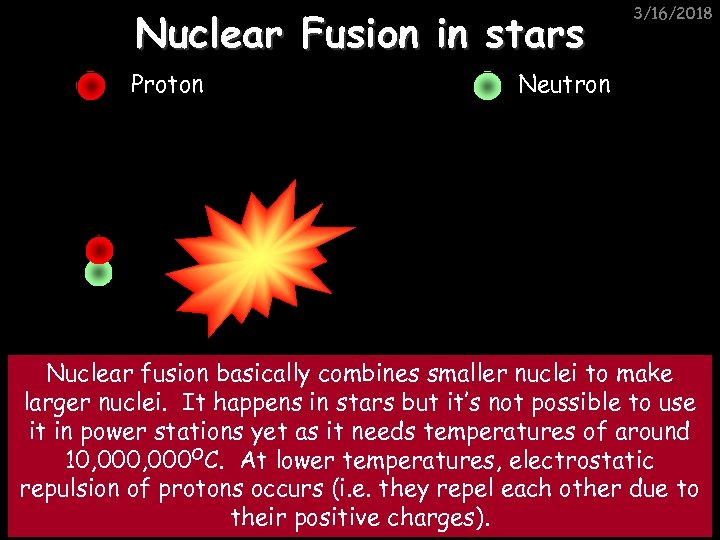 Nuclear Fusion in stars Proton 3/16/2018 Neutron Nuclear fusion basically combines smaller nuclei to make larger nuclei. It happens in stars but it’s not possible to use it in power stations yet as it needs temperatures of around 10, 000 OC. At lower temperatures, electrostatic repulsion of protons occurs (i. e. they repel each other due to their positive charges).
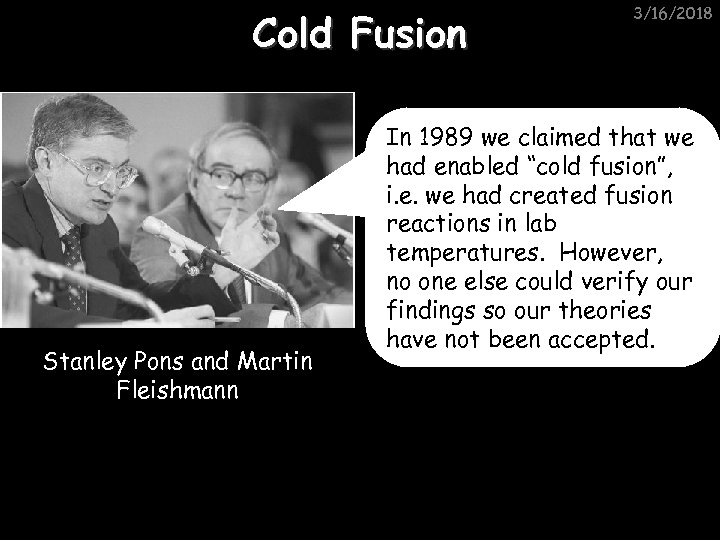 Cold Fusion Stanley Pons and Martin Fleishmann 3/16/2018 In 1989 we claimed that we had enabled “cold fusion”, i. e. we had created fusion reactions in lab temperatures. However, no one else could verify our findings so our theories have not been accepted.
 3/16/2018 Topic 6 – Advantages and Disadvantages of using Radioactive Materials
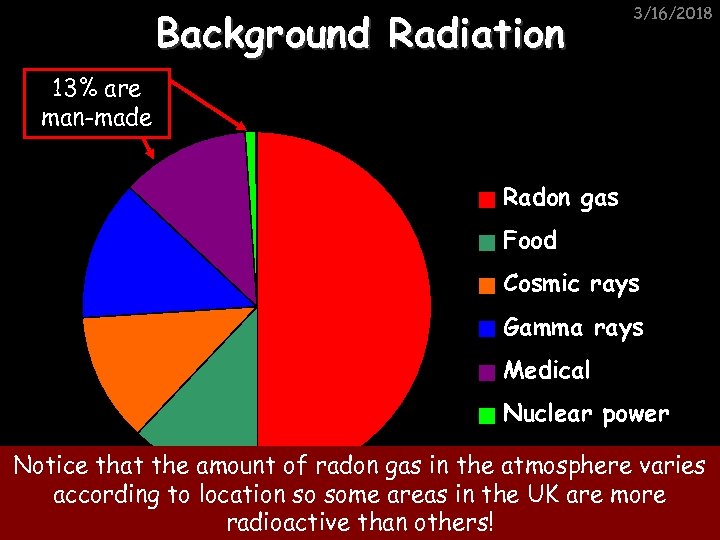 Background Radiation 3/16/2018 13% are man-made Radon gas Food Cosmic rays Gamma rays Medical Nuclear power Notice that the amount of radon gas in the atmosphere varies according to location so some areas in the UK are more radioactive than others!
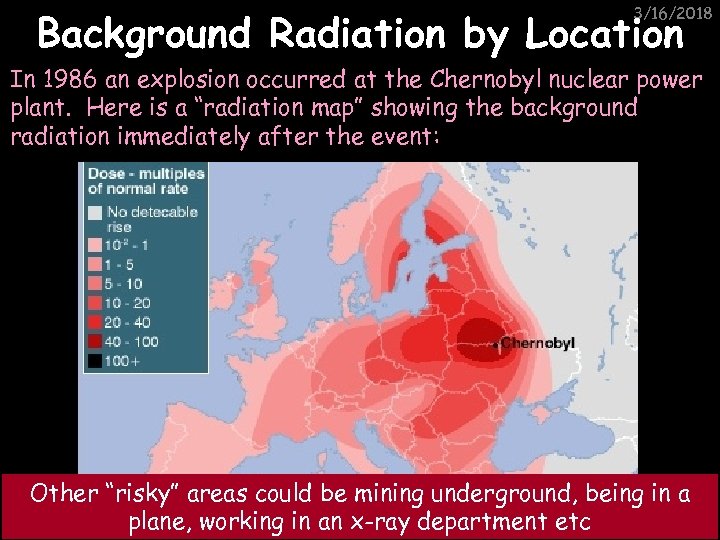 3/16/2018 Background Radiation by Location In 1986 an explosion occurred at the Chernobyl nuclear power plant. Here is a “radiation map” showing the background radiation immediately after the event: Other “risky” areas could be mining underground, being in a plane, working in an x-ray department etc
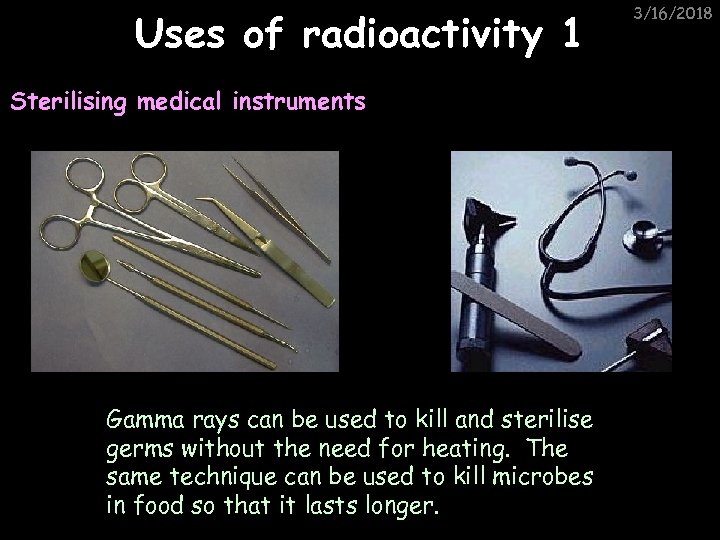 Uses of radioactivity 1 Sterilising medical instruments Gamma rays can be used to kill and sterilise germs without the need for heating. The same technique can be used to kill microbes in food so that it lasts longer. 3/16/2018
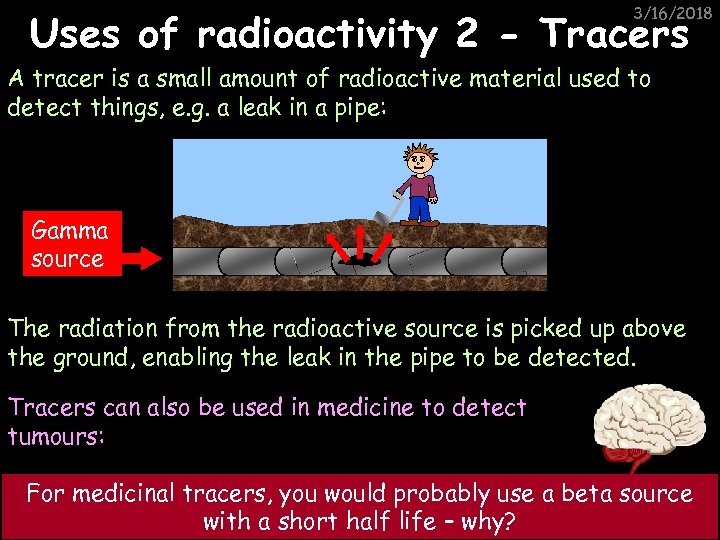 3/16/2018 Uses of radioactivity 2 - Tracers A tracer is a small amount of radioactive material used to detect things, e. g. a leak in a pipe: Gamma source The radiation from the radioactive source is picked up above the ground, enabling the leak in the pipe to be detected. Tracers can also be used in medicine to detect tumours: For medicinal tracers, you would probably use a beta source with a short half life – why?
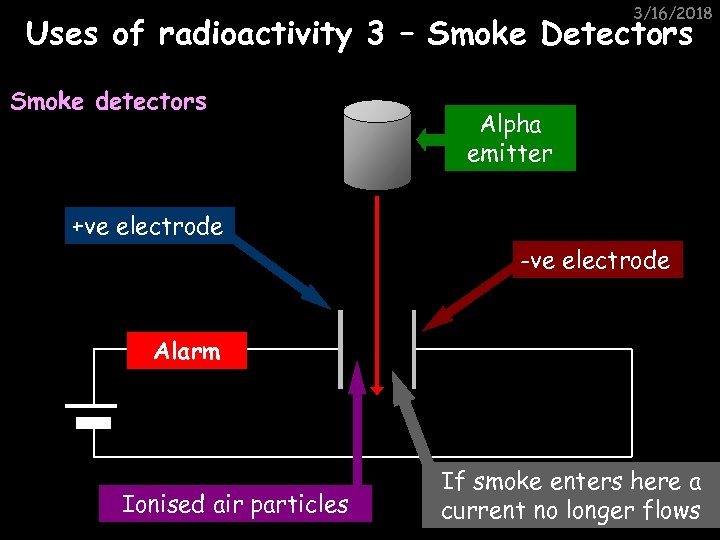 3/16/2018 Uses of radioactivity 3 – Smoke Detectors Smoke detectors Alpha emitter +ve electrode -ve electrode Alarm Ionised air particles If smoke enters here a current no longer flows
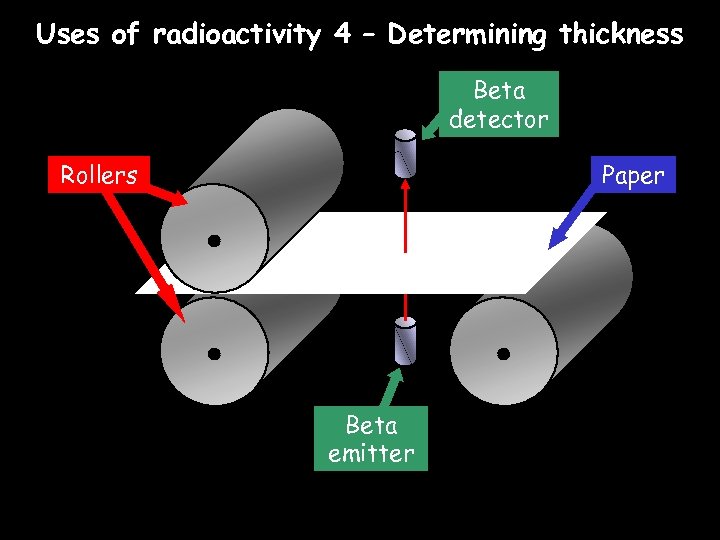 Uses of radioactivity 4 – Determining thickness Beta detector Rollers Paper Beta emitter
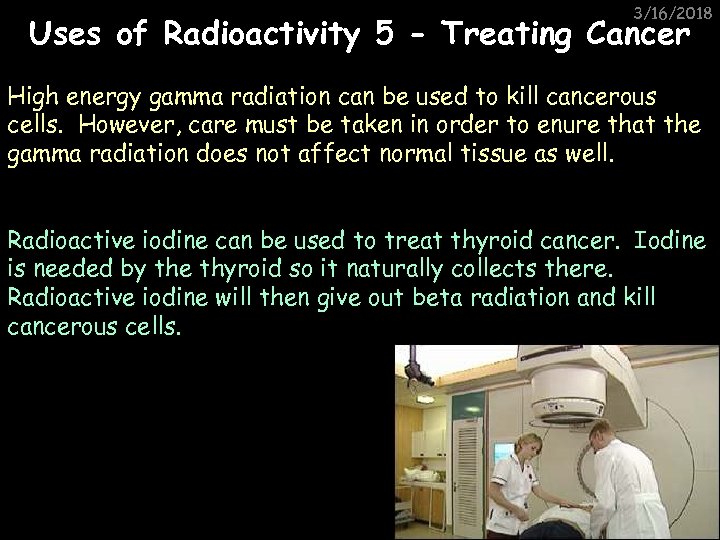 3/16/2018 Uses of Radioactivity 5 - Treating Cancer High energy gamma radiation can be used to kill cancerous cells. However, care must be taken in order to enure that the gamma radiation does not affect normal tissue as well. Radioactive iodine can be used to treat thyroid cancer. Iodine is needed by the thyroid so it naturally collects there. Radioactive iodine will then give out beta radiation and kill cancerous cells.
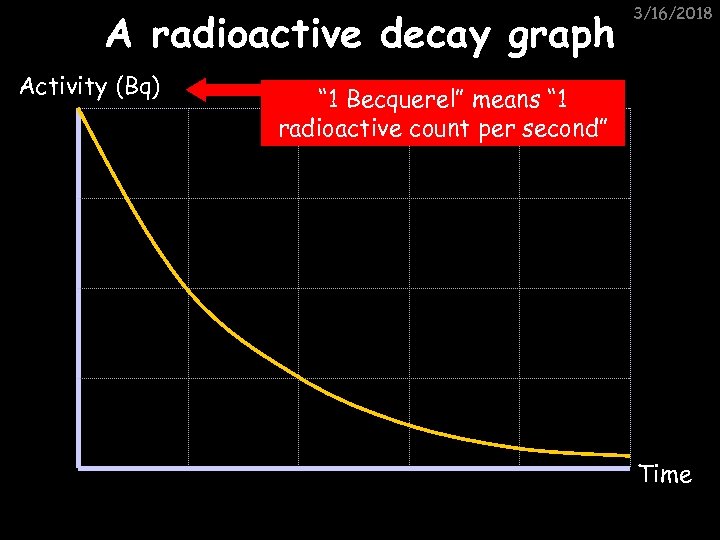 A radioactive decay graph Activity (Bq) 3/16/2018 “ 1 Becquerel” means “ 1 radioactive count per second” Time
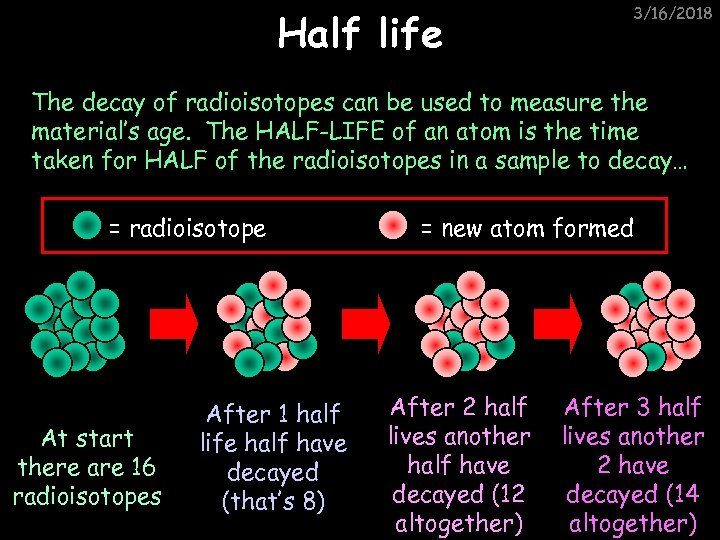 Half life 3/16/2018 The decay of radioisotopes can be used to measure the material’s age. The HALF-LIFE of an atom is the time taken for HALF of the radioisotopes in a sample to decay… = radioisotope At start there are 16 radioisotopes After 1 half life half have decayed (that’s 8) = new atom formed After 2 half lives another half have decayed (12 altogether) After 3 half lives another 2 have decayed (14 altogether)
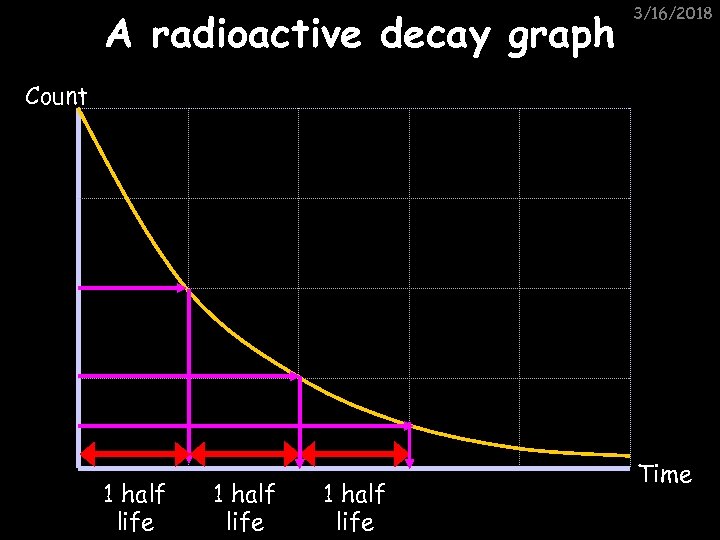 A radioactive decay graph 3/16/2018 Count 1 half life Time
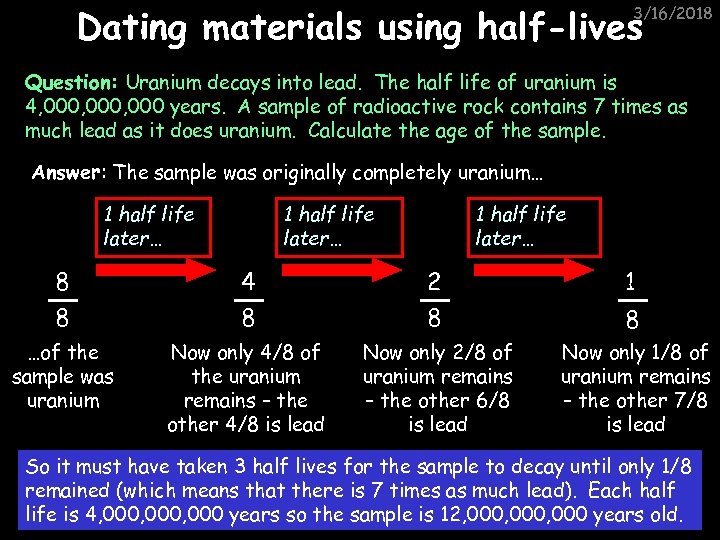 Dating materials using half-lives 3/16/2018 Question: Uranium decays into lead. The half life of uranium is 4, 000, 000 years. A sample of radioactive rock contains 7 times as much lead as it does uranium. Calculate the age of the sample. Answer: The sample was originally completely uranium… 1 half life later… 8 8 4 8 2 8 1 …of the sample was uranium Now only 4/8 of the uranium remains – the other 4/8 is lead Now only 2/8 of uranium remains – the other 6/8 is lead Now only 1/8 of uranium remains – the other 7/8 is lead 8 So it must have taken 3 half lives for the sample to decay until only 1/8 remained (which means that there is 7 times as much lead). Each half life is 4, 000, 000 years so the sample is 12, 000, 000 years old.
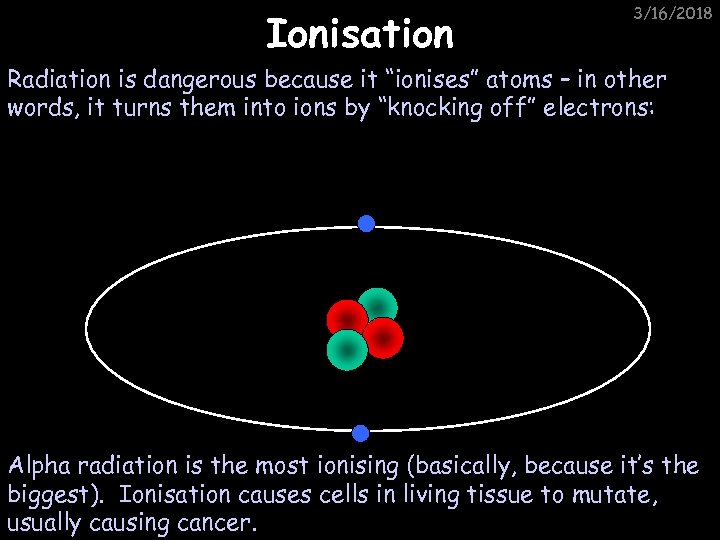 Ionisation 3/16/2018 Radiation is dangerous because it “ionises” atoms – in other words, it turns them into ions by “knocking off” electrons: Alpha radiation is the most ionising (basically, because it’s the biggest). Ionisation causes cells in living tissue to mutate, usually causing cancer.
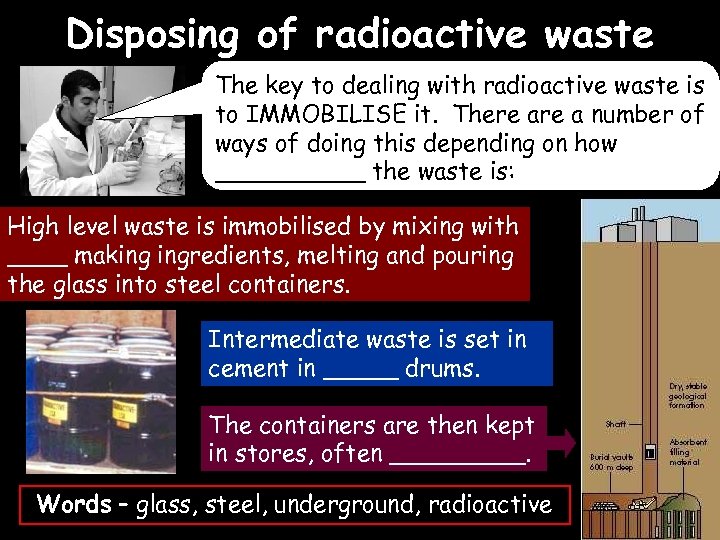 Disposing of radioactive waste The key to dealing with radioactive waste is to IMMOBILISE it. There a number of ways of doing this depending on how _____ the waste is: High level waste is immobilised by mixing with ____ making ingredients, melting and pouring the glass into steel containers. Intermediate waste is set in cement in _____ drums. The containers are then kept in stores, often _____. Words – glass, steel, underground, radioactive
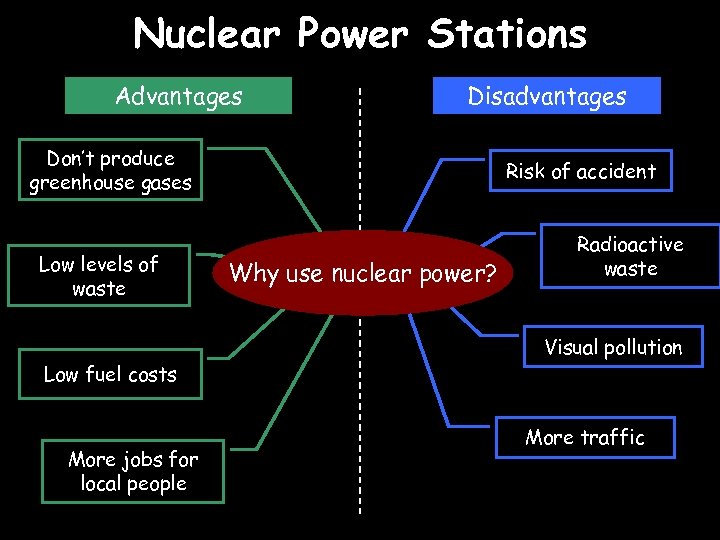 Nuclear Power Stations Advantages Disadvantages Don’t produce greenhouse gases Low levels of waste Low fuel costs More jobs for local people Risk of accident Why use nuclear power? Radioactive waste Visual pollution More traffic