 Скачать презентацию 3 16 2018 February 2006 doc IEEE 802 22
4a2c28faaafd4ab191cc50bc6ce3e24c.ppt
- Количество слайдов: 82



3/16/2018 February 2006 doc. : IEEE 802. 22 -06/0032 r 0 Analysis of Proposed Sensing Schemes IEEE P 802. 22 Wireless RANs Date: 2006 -03 -06 Authors: Notice: This document has been prepared to assist IEEE 802. 22. It is offered as a basis for discussion and is not binding on the contributing individual(s) or organization(s). The material in this document is subject to change in form and content after further study. The contributor(s) reserve(s) the right to add, amend or withdraw material contained herein. Release: The contributor grants a free, irrevocable license to the IEEE to incorporate material contained in this contribution, and any modifications thereof, in the creation of an IEEE Standards publication; to copyright in the IEEE’s name any IEEE Standards publication even though it may include portions of this contribution; and at the IEEE’s sole discretion to permit others to reproduce in whole or in part the resulting IEEE Standards publication. The contributor also acknowledges and accepts that this contribution may be made public by IEEE 802. 22. Patent Policy and Procedures: The contributor is familiar with the IEEE 802 Patent Policy and Procedures http: //standards. ieee. org/guides/bylaws/sb-bylaws. pdf including the statement "IEEE standards may include the known use of patent(s), including patent applications, provided the IEEE receives assurance from the patent holder or applicant with respect to patents essential for compliance with both mandatory and optional portions of the standard. " Early disclosure to the Working Group of patent information that might be relevant to the standard is essential to reduce the possibility for delays in the development process and increase the likelihood that the draft publication will be approved for publication. Please notify the Chair Carl R. Stevenson as early as possible, in written or electronic form, if patented technology (or technology under patent application) might be incorporated into a draft standard being developed within the IEEE 802. 22 Working Group. If you have questions, contact the IEEE Patent Committee Administrator at patcom@iee. org. > Submission Soo-Young Chang, Huawei Slide 1
3/16/2018 February 2006 doc. : IEEE 802. 22 -06/0032 r 0 ANALYSIS OF PROPOSED SENSING SCHEMES FOR IEEE 802. 22 WRAN Soo-Young Chang Huawei Submission Soo-Young Chang, Huawei Slide 2
3/16/2018 February 2006 doc. : IEEE 802. 22 -06/0032 r 0 INTRODUCTION Submission Soo-Young Chang, Huawei Slide 3
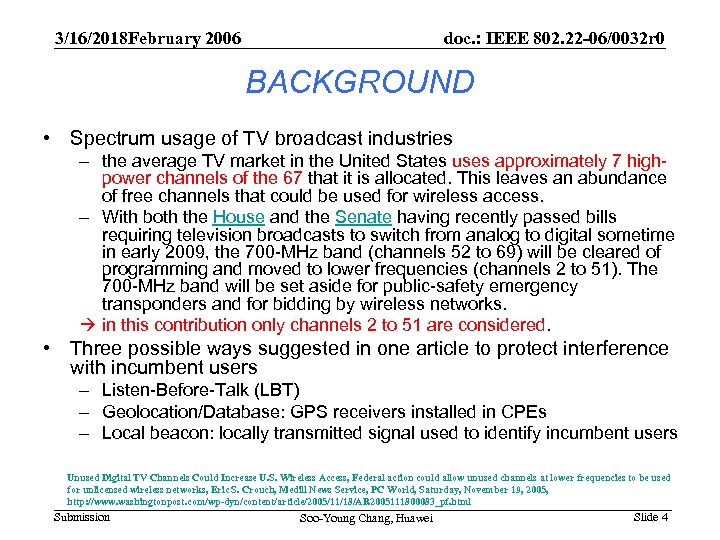
3/16/2018 February 2006 doc. : IEEE 802. 22 -06/0032 r 0 BACKGROUND • Spectrum usage of TV broadcast industries – the average TV market in the United States uses approximately 7 highpower channels of the 67 that it is allocated. This leaves an abundance of free channels that could be used for wireless access. – With both the House and the Senate having recently passed bills requiring television broadcasts to switch from analog to digital sometime in early 2009, the 700 -MHz band (channels 52 to 69) will be cleared of programming and moved to lower frequencies (channels 2 to 51). The 700 -MHz band will be set aside for public-safety emergency transponders and for bidding by wireless networks. in this contribution only channels 2 to 51 are considered. • Three possible ways suggested in one article to protect interference with incumbent users – Listen-Before-Talk (LBT) – Geolocation/Database: GPS receivers installed in CPEs – Local beacon: locally transmitted signal used to identify incumbent users Unused Digital TV Channels Could Increase U. S. Wireless Access, Federal action could allow unused channels at lower frequencies to be used for unlicensed wireless networks, Eric S. Crouch, Medill News Service, PC World, Saturday, November 19, 2005, http: //www. washingtonpost. com/wp-dyn/content/article/2005/11/18/AR 2005111800083_pf. html Submission Soo-Young Chang, Huawei Slide 4
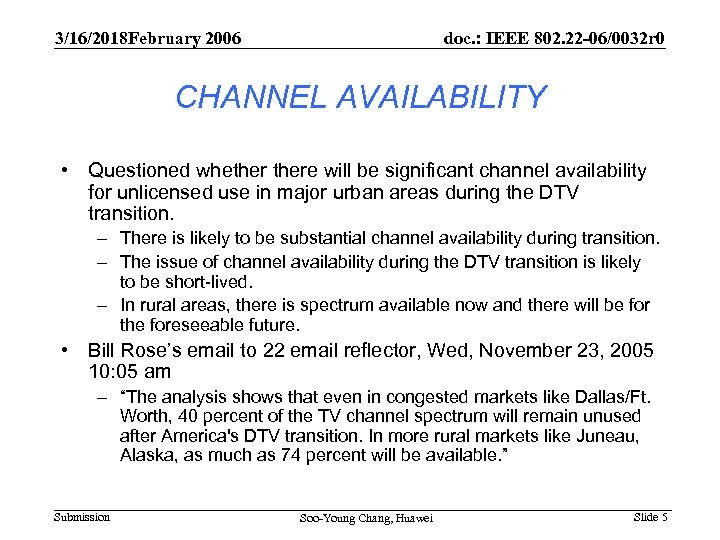
3/16/2018 February 2006 doc. : IEEE 802. 22 -06/0032 r 0 CHANNEL AVAILABILITY • Questioned whethere will be significant channel availability for unlicensed use in major urban areas during the DTV transition. – There is likely to be substantial channel availability during transition. – The issue of channel availability during the DTV transition is likely to be short-lived. – In rural areas, there is spectrum available now and there will be for the foreseeable future. • Bill Rose’s email to 22 email reflector, Wed, November 23, 2005 10: 05 am – “The analysis shows that even in congested markets like Dallas/Ft. Worth, 40 percent of the TV channel spectrum will remain unused after America's DTV transition. In more rural markets like Juneau, Alaska, as much as 74 percent will be available. ” Submission Soo-Young Chang, Huawei Slide 5
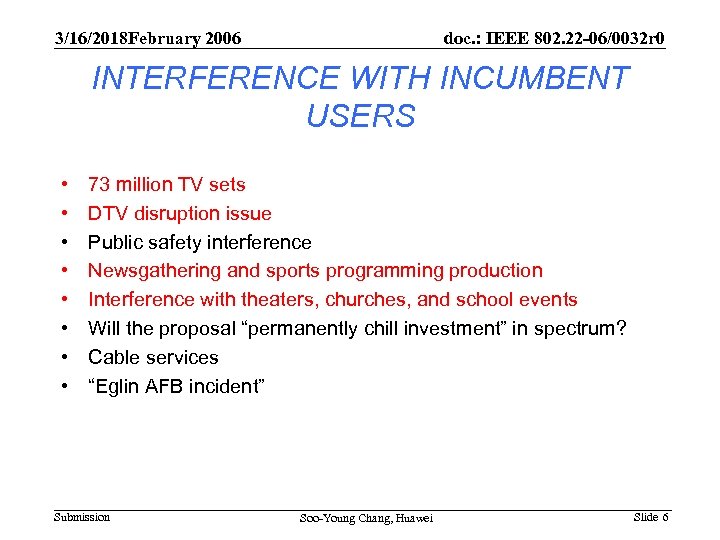
3/16/2018 February 2006 doc. : IEEE 802. 22 -06/0032 r 0 INTERFERENCE WITH INCUMBENT USERS • • 73 million TV sets DTV disruption issue Public safety interference Newsgathering and sports programming production Interference with theaters, churches, and school events Will the proposal “permanently chill investment” in spectrum? Cable services “Eglin AFB incident” Submission Soo-Young Chang, Huawei Slide 6
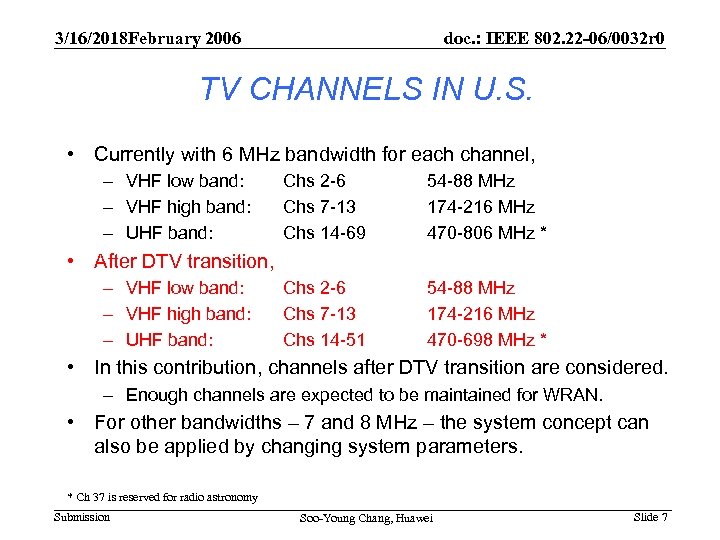
3/16/2018 February 2006 doc. : IEEE 802. 22 -06/0032 r 0 TV CHANNELS IN U. S. • Currently with 6 MHz bandwidth for each channel, – VHF low band: – VHF high band: – UHF band: Chs 2 -6 Chs 7 -13 Chs 14 -69 54 -88 MHz 174 -216 MHz 470 -806 MHz * Chs 2 -6 Chs 7 -13 Chs 14 -51 54 -88 MHz 174 -216 MHz 470 -698 MHz * • After DTV transition, – VHF low band: – VHF high band: – UHF band: • In this contribution, channels after DTV transition are considered. – Enough channels are expected to be maintained for WRAN. • For other bandwidths – 7 and 8 MHz – the system concept can also be applied by changing system parameters. * Ch 37 is reserved for radio astronomy Submission Soo-Young Chang, Huawei Slide 7
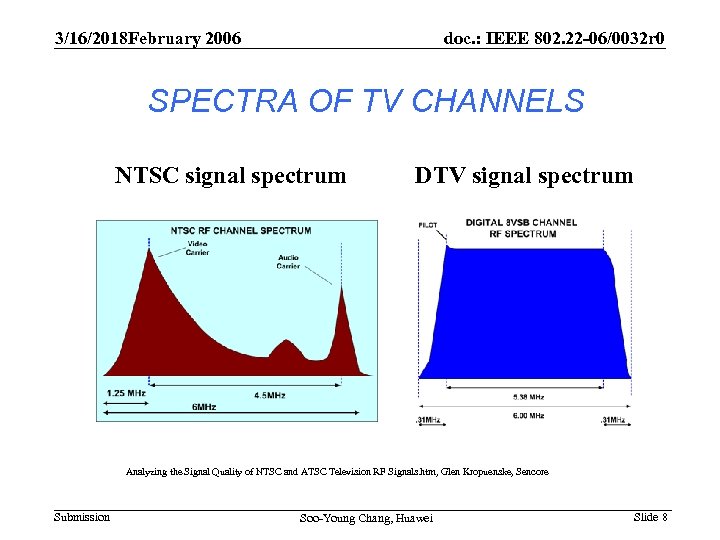
3/16/2018 February 2006 doc. : IEEE 802. 22 -06/0032 r 0 SPECTRA OF TV CHANNELS NTSC signal spectrum DTV signal spectrum Analyzing the Signal Quality of NTSC and ATSC Television RF Signals. htm, Glen Kropuenske, Sencore Submission Soo-Young Chang, Huawei Slide 8
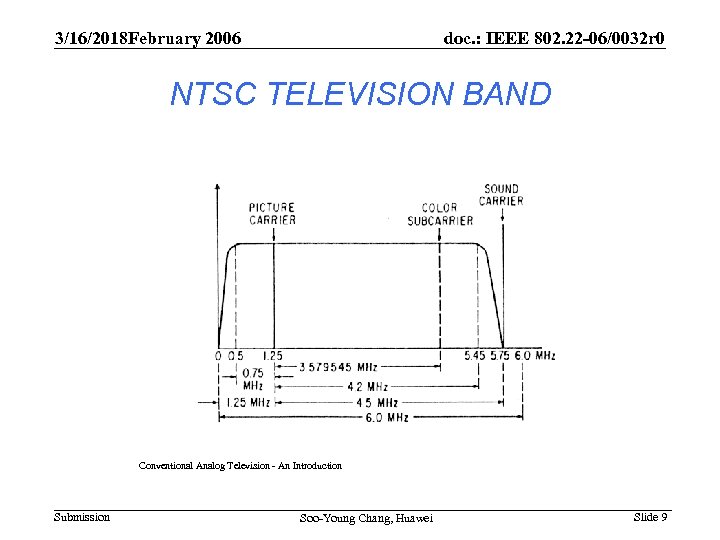
3/16/2018 February 2006 doc. : IEEE 802. 22 -06/0032 r 0 NTSC TELEVISION BAND Conventional Analog Television - An Introduction Submission Soo-Young Chang, Huawei Slide 9
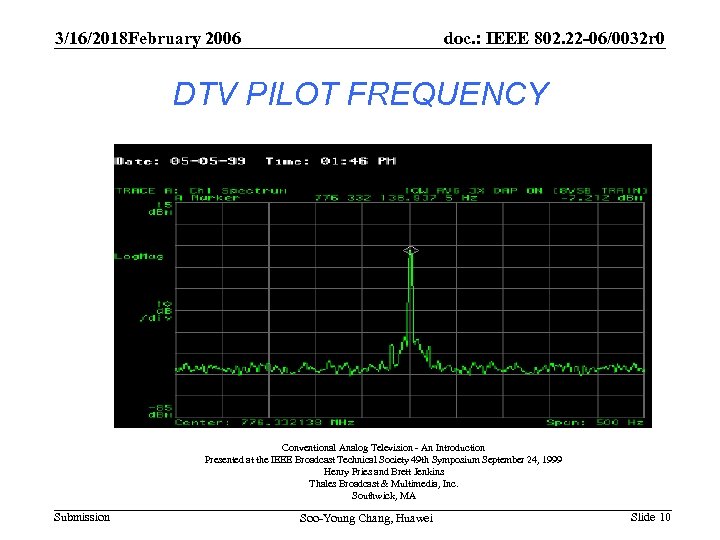
3/16/2018 February 2006 doc. : IEEE 802. 22 -06/0032 r 0 DTV PILOT FREQUENCY Conventional Analog Television - An Introduction Presented at the IEEE Broadcast Technical Society 49 th Symposium September 24, 1999 Henry Fries and Brett Jenkins Thales Broadcast & Multimedia, Inc. Southwick, MA Submission Soo-Young Chang, Huawei Slide 10
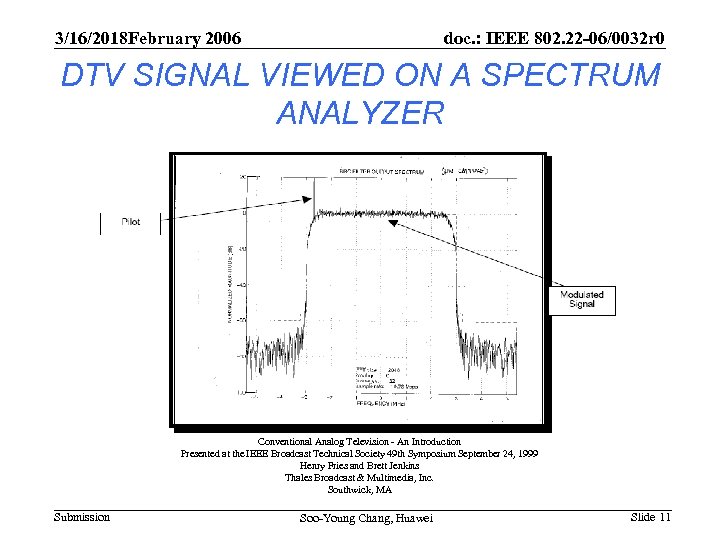
3/16/2018 February 2006 doc. : IEEE 802. 22 -06/0032 r 0 DTV SIGNAL VIEWED ON A SPECTRUM ANALYZER Conventional Analog Television - An Introduction Presented at the IEEE Broadcast Technical Society 49 th Symposium September 24, 1999 Henry Fries and Brett Jenkins Thales Broadcast & Multimedia, Inc. Southwick, MA Submission Soo-Young Chang, Huawei Slide 11
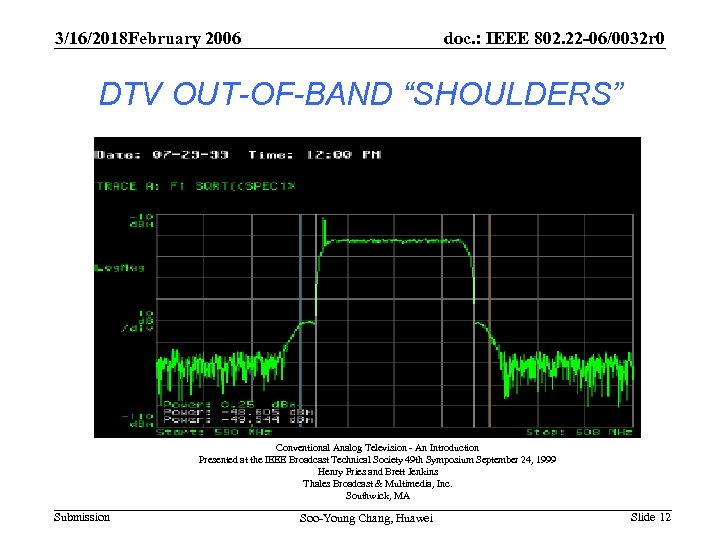
3/16/2018 February 2006 doc. : IEEE 802. 22 -06/0032 r 0 DTV OUT-OF-BAND “SHOULDERS” Conventional Analog Television - An Introduction Presented at the IEEE Broadcast Technical Society 49 th Symposium September 24, 1999 Henry Fries and Brett Jenkins Thales Broadcast & Multimedia, Inc. Southwick, MA Submission Soo-Young Chang, Huawei Slide 12
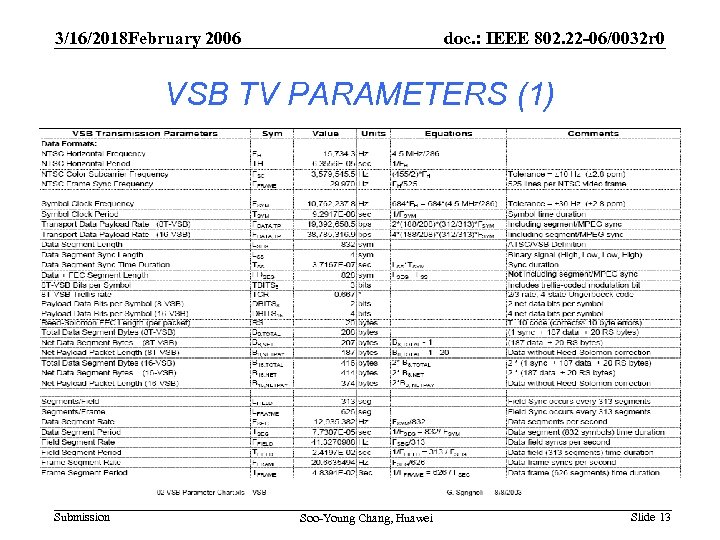
3/16/2018 February 2006 doc. : IEEE 802. 22 -06/0032 r 0 VSB TV PARAMETERS (1) Submission Soo-Young Chang, Huawei Slide 13
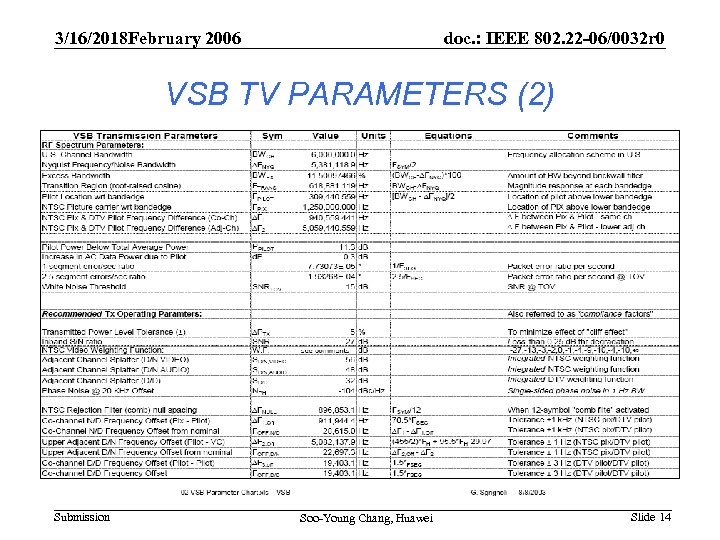
3/16/2018 February 2006 doc. : IEEE 802. 22 -06/0032 r 0 VSB TV PARAMETERS (2) Submission Soo-Young Chang, Huawei Slide 14
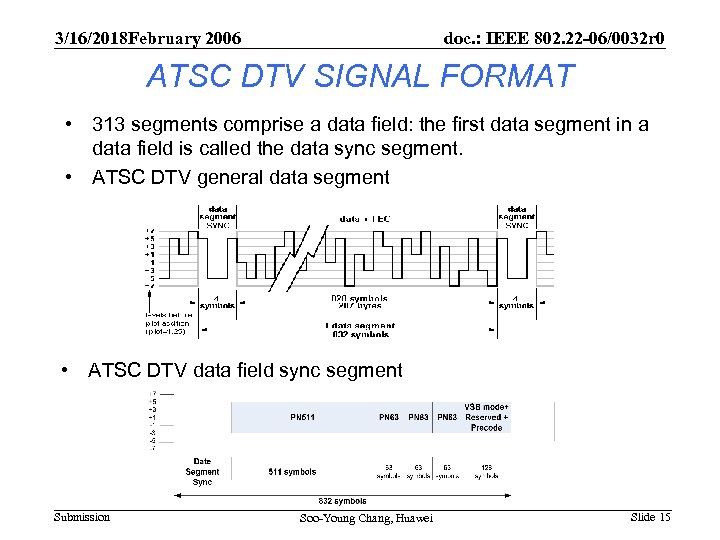
3/16/2018 February 2006 doc. : IEEE 802. 22 -06/0032 r 0 ATSC DTV SIGNAL FORMAT • 313 segments comprise a data field: the first data segment in a data field is called the data sync segment. • ATSC DTV general data segment • ATSC DTV data field sync segment Submission Soo-Young Chang, Huawei Slide 15
3/16/2018 February 2006 doc. : IEEE 802. 22 -06/0032 r 0 PROTECTION OF PART 74 DEVICES (1) • Most microphones use analog modulation (FM) • Bandwidth: 200 KHz • Power: max. 250 m. W (24 d. Bm) in UHF band – But usually operate at less than 50 m. W – Ex. Power 10 m. W, antenna gain -10 d. Bi, body absorption 27 d. B, range 100 m, then mim. received power level: -95 d. Bm • Required WRAN CPE out-of-band emission level to protect Part 74 devices: 6. 2 u. V/m (15. 8 d. Bu. V/m measured at 3 m in 120 KHz) • Path loss needed between microphone receiver and L-E devices beyond 1 m (required D/U = 20 d. B) – High power WRAN devices (4 W): 129 d. B – Low power L-E devices (100 m. W): 113 d. B Submission Soo-Young Chang, Huawei Slide 16
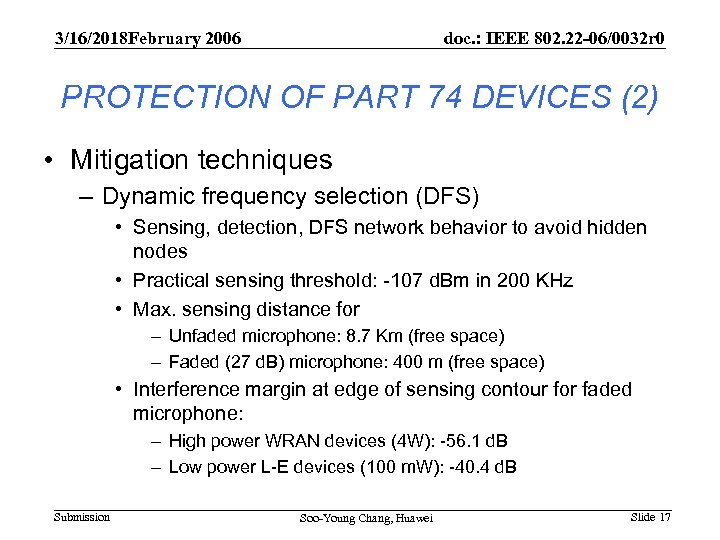
3/16/2018 February 2006 doc. : IEEE 802. 22 -06/0032 r 0 PROTECTION OF PART 74 DEVICES (2) • Mitigation techniques – Dynamic frequency selection (DFS) • Sensing, detection, DFS network behavior to avoid hidden nodes • Practical sensing threshold: -107 d. Bm in 200 KHz • Max. sensing distance for – Unfaded microphone: 8. 7 Km (free space) – Faded (27 d. B) microphone: 400 m (free space) • Interference margin at edge of sensing contour for faded microphone: – High power WRAN devices (4 W): -56. 1 d. B – Low power L-E devices (100 m. W): -40. 4 d. B Submission Soo-Young Chang, Huawei Slide 17
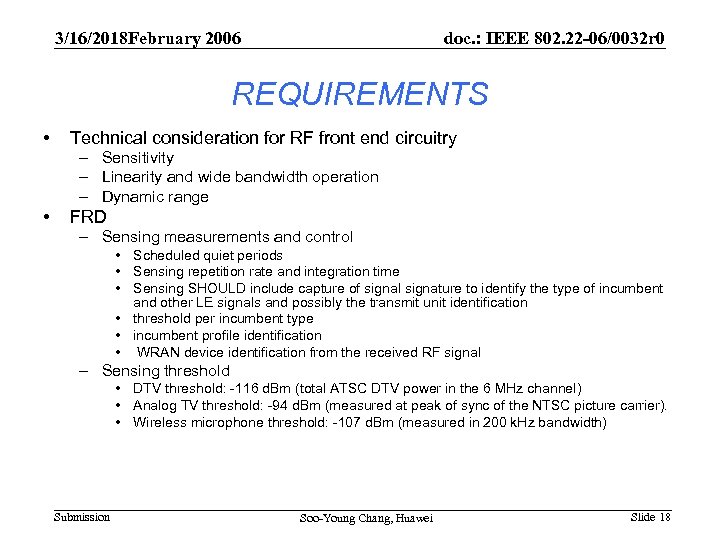
3/16/2018 February 2006 doc. : IEEE 802. 22 -06/0032 r 0 REQUIREMENTS • Technical consideration for RF front end circuitry – Sensitivity – Linearity and wide bandwidth operation – Dynamic range • FRD – Sensing measurements and control • Scheduled quiet periods • Sensing repetition rate and integration time • Sensing SHOULD include capture of signal signature to identify the type of incumbent and other LE signals and possibly the transmit unit identification • threshold per incumbent type • incumbent profile identification • WRAN device identification from the received RF signal – Sensing threshold • DTV threshold: -116 d. Bm (total ATSC DTV power in the 6 MHz channel) • Analog TV threshold: -94 d. Bm (measured at peak of sync of the NTSC picture carrier). • Wireless microphone threshold: -107 d. Bm (measured in 200 k. Hz bandwidth) Submission Soo-Young Chang, Huawei Slide 18
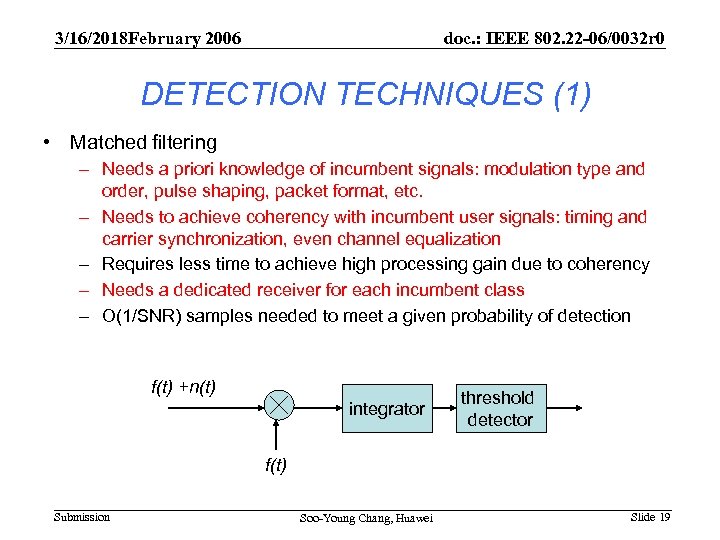
3/16/2018 February 2006 doc. : IEEE 802. 22 -06/0032 r 0 DETECTION TECHNIQUES (1) • Matched filtering – Needs a priori knowledge of incumbent signals: modulation type and order, pulse shaping, packet format, etc. – Needs to achieve coherency with incumbent user signals: timing and carrier synchronization, even channel equalization – Requires less time to achieve high processing gain due to coherency – Needs a dedicated receiver for each incumbent class – O(1/SNR) samples needed to meet a given probability of detection f(t) +n(t) integrator threshold detector f(t) Submission Soo-Young Chang, Huawei Slide 19
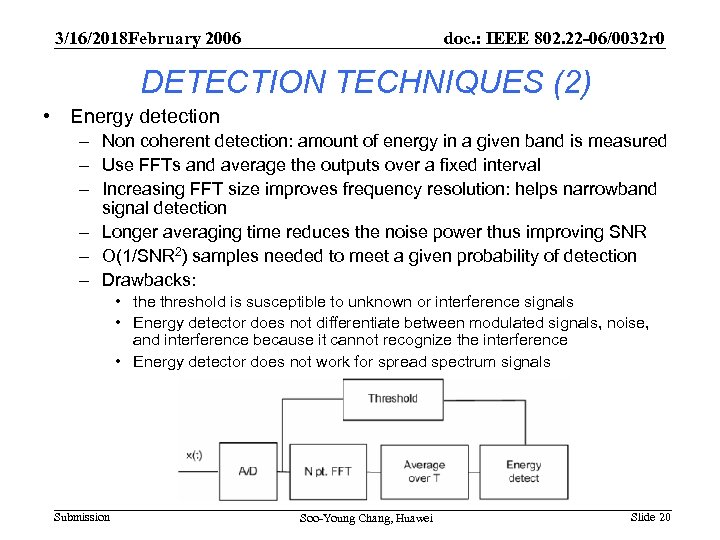
3/16/2018 February 2006 doc. : IEEE 802. 22 -06/0032 r 0 DETECTION TECHNIQUES (2) • Energy detection – Non coherent detection: amount of energy in a given band is measured – Use FFTs and average the outputs over a fixed interval – Increasing FFT size improves frequency resolution: helps narrowband signal detection – Longer averaging time reduces the noise power thus improving SNR – O(1/SNR 2) samples needed to meet a given probability of detection – Drawbacks: • the threshold is susceptible to unknown or interference signals • Energy detector does not differentiate between modulated signals, noise, and interference because it cannot recognize the interference • Energy detector does not work for spread spectrum signals Submission Soo-Young Chang, Huawei Slide 20
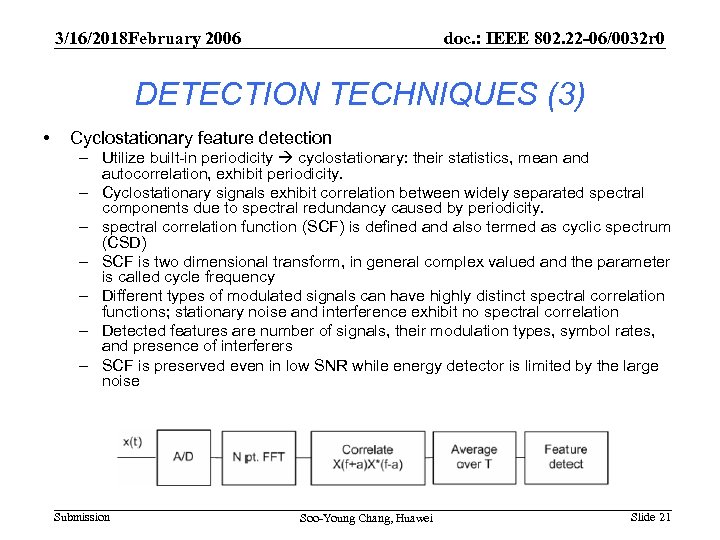
3/16/2018 February 2006 doc. : IEEE 802. 22 -06/0032 r 0 DETECTION TECHNIQUES (3) • Cyclostationary feature detection – Utilize built-in periodicity cyclostationary: their statistics, mean and autocorrelation, exhibit periodicity. – Cyclostationary signals exhibit correlation between widely separated spectral components due to spectral redundancy caused by periodicity. – spectral correlation function (SCF) is defined and also termed as cyclic spectrum (CSD) – SCF is two dimensional transform, in general complex valued and the parameter is called cycle frequency – Different types of modulated signals can have highly distinct spectral correlation functions; stationary noise and interference exhibit no spectral correlation – Detected features are number of signals, their modulation types, symbol rates, and presence of interferers – SCF is preserved even in low SNR while energy detector is limited by the large noise Submission Soo-Young Chang, Huawei Slide 21
3/16/2018 February 2006 doc. : IEEE 802. 22 -06/0032 r 0 ISSUES TO BE OVERCOME • Hidden node problem – Cognitive radio is shadowed – In severe multipath fading – Inside buildings with high penetration loss • Local spectrum sensing Submission Soo-Young Chang, Huawei Slide 22
3/16/2018 February 2006 doc. : IEEE 802. 22 -06/0032 r 0 REFERENCES • Danijela Cabric, et al. , Implementation Issues in Spectrum Sensing for Cognitive Radios, Berkeley Wireless Research Center, University of California, Berkeley, http: //bwrc. eecs. berkeley. edu/Publications/2004/PRESENTATIONS/ dc. smm. asilomar/asilomar_paper_danijela. pdf • Gerald Chouinard, CRC, IEEE 802. 22 -06/0006 r 0 Submission Soo-Young Chang, Huawei Slide 23
3/16/2018 February 2006 doc. : IEEE 802. 22 -06/0032 r 0 ETRI/FT/I 2 R /MOTOROLA/PHILIPS /SAMSUNG/THOMSON Submission Soo-Young Chang, Huawei Slide 24
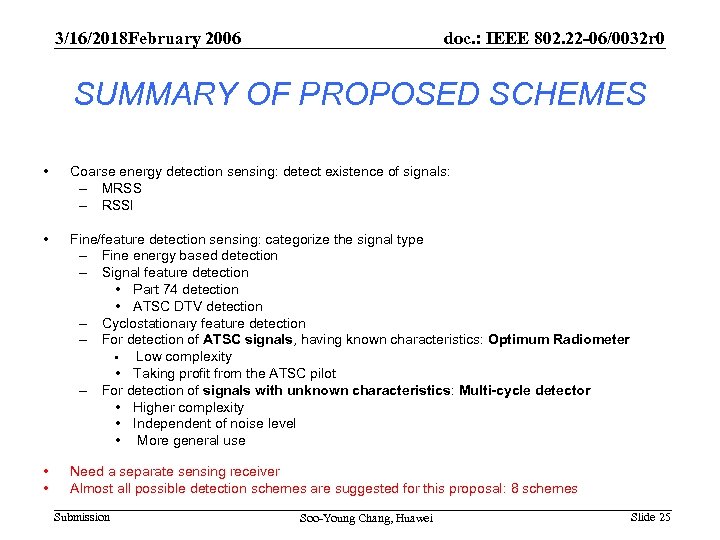
3/16/2018 February 2006 doc. : IEEE 802. 22 -06/0032 r 0 SUMMARY OF PROPOSED SCHEMES • Coarse energy detection sensing: detect existence of signals: – MRSS – RSSI • Fine/feature detection sensing: categorize the signal type – Fine energy based detection – Signal feature detection • Part 74 detection • ATSC DTV detection – Cyclostationary feature detection – For detection of ATSC signals, having known characteristics: Optimum Radiometer • Low complexity • Taking profit from the ATSC pilot – For detection of signals with unknown characteristics: Multi-cycle detector • Higher complexity • Independent of noise level • More general use • • Need a separate sensing receiver Almost all possible detection schemes are suggested for this proposal: 8 schemes Submission Soo-Young Chang, Huawei Slide 25
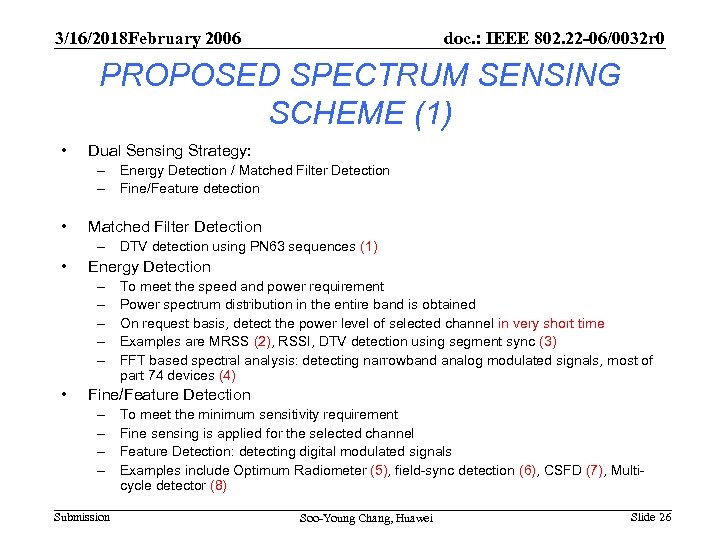
3/16/2018 February 2006 doc. : IEEE 802. 22 -06/0032 r 0 PROPOSED SPECTRUM SENSING SCHEME (1) • Dual Sensing Strategy: – Energy Detection / Matched Filter Detection – Fine/Feature detection • Matched Filter Detection – DTV detection using PN 63 sequences (1) • Energy Detection – – – • To meet the speed and power requirement Power spectrum distribution in the entire band is obtained On request basis, detect the power level of selected channel in very short time Examples are MRSS (2), RSSI, DTV detection using segment sync (3) FFT based spectral analysis: detecting narrowband analog modulated signals, most of part 74 devices (4) Fine/Feature Detection – – Submission To meet the minimum sensitivity requirement Fine sensing is applied for the selected channel Feature Detection: detecting digital modulated signals Examples include Optimum Radiometer (5), field-sync detection (6), CSFD (7), Multicycle detector (8) Soo-Young Chang, Huawei Slide 26
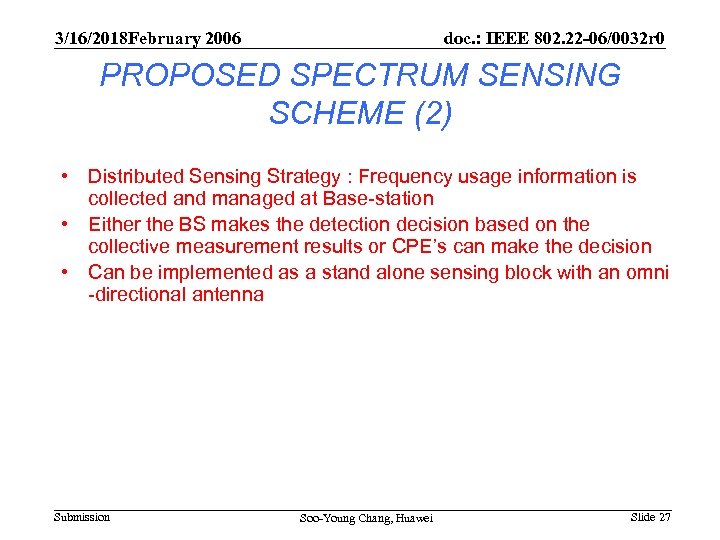
3/16/2018 February 2006 doc. : IEEE 802. 22 -06/0032 r 0 PROPOSED SPECTRUM SENSING SCHEME (2) • Distributed Sensing Strategy : Frequency usage information is collected and managed at Base-station • Either the BS makes the detection decision based on the collective measurement results or CPE’s can make the decision • Can be implemented as a stand alone sensing block with an omni -directional antenna Submission Soo-Young Chang, Huawei Slide 27
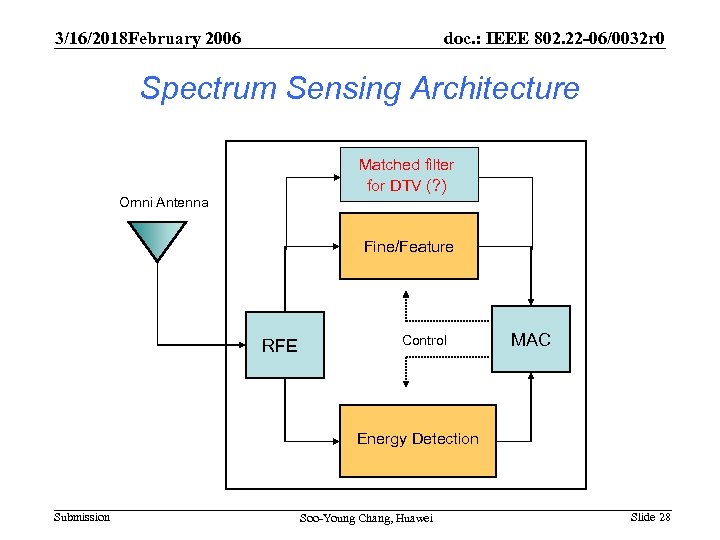
3/16/2018 February 2006 doc. : IEEE 802. 22 -06/0032 r 0 Spectrum Sensing Architecture Matched filter for DTV (? ) Omni Antenna Fine/Feature RFE Control MAC Energy Detection Submission Soo-Young Chang, Huawei Slide 28
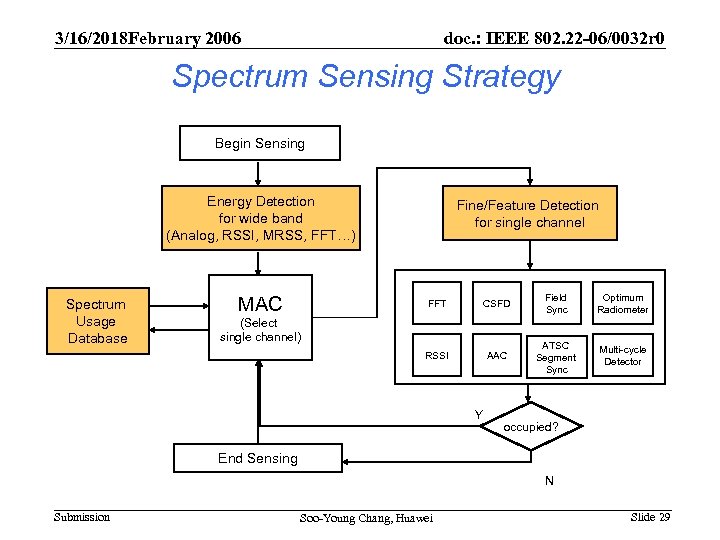
3/16/2018 February 2006 doc. : IEEE 802. 22 -06/0032 r 0 Spectrum Sensing Strategy Begin Sensing Energy Detection for wide band (Analog, RSSI, MRSS, FFT…) Fine/Feature Detection for single channel FFT MAC CSFD Field Sync Optimum Radiometer RSSI Spectrum Usage Database AAC ATSC Segment Sync Multi-cycle Detector (Select single channel) Y occupied? End Sensing N Submission Soo-Young Chang, Huawei Slide 29
3/16/2018 February 2006 doc. : IEEE 802. 22 -06/0032 r 0 MATCHED FILTER DETECTION • DTV detection using PN 63 sequences Submission Soo-Young Chang, Huawei Slide 30
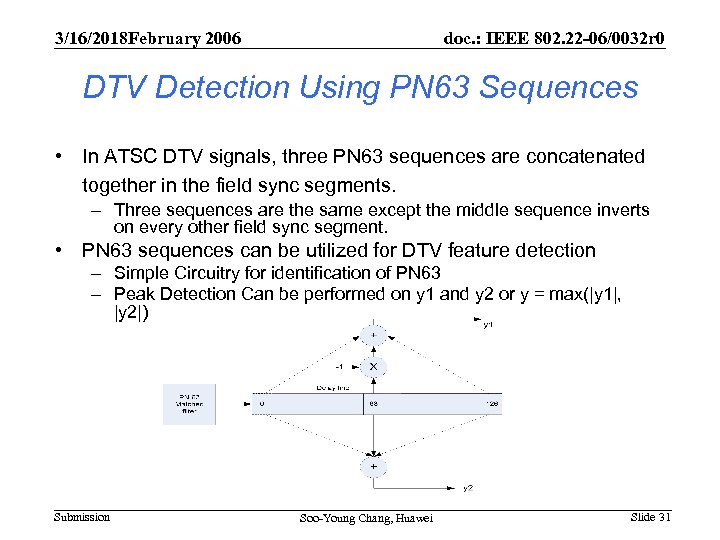
3/16/2018 February 2006 doc. : IEEE 802. 22 -06/0032 r 0 DTV Detection Using PN 63 Sequences • In ATSC DTV signals, three PN 63 sequences are concatenated together in the field sync segments. – Three sequences are the same except the middle sequence inverts on every other field sync segment. • PN 63 sequences can be utilized for DTV feature detection – Simple Circuitry for identification of PN 63 – Peak Detection Can be performed on y 1 and y 2 or y = max(|y 1|, |y 2|) Submission Soo-Young Chang, Huawei Slide 31
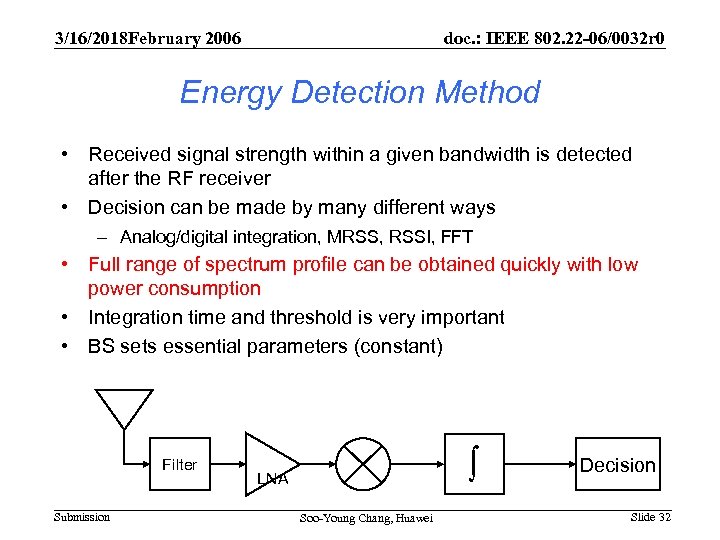
3/16/2018 February 2006 doc. : IEEE 802. 22 -06/0032 r 0 Energy Detection Method • Received signal strength within a given bandwidth is detected after the RF receiver • Decision can be made by many different ways – Analog/digital integration, MRSS, RSSI, FFT • Full range of spectrum profile can be obtained quickly with low power consumption • Integration time and threshold is very important • BS sets essential parameters (constant) Filter Submission LNA Soo-Young Chang, Huawei Decision Slide 32
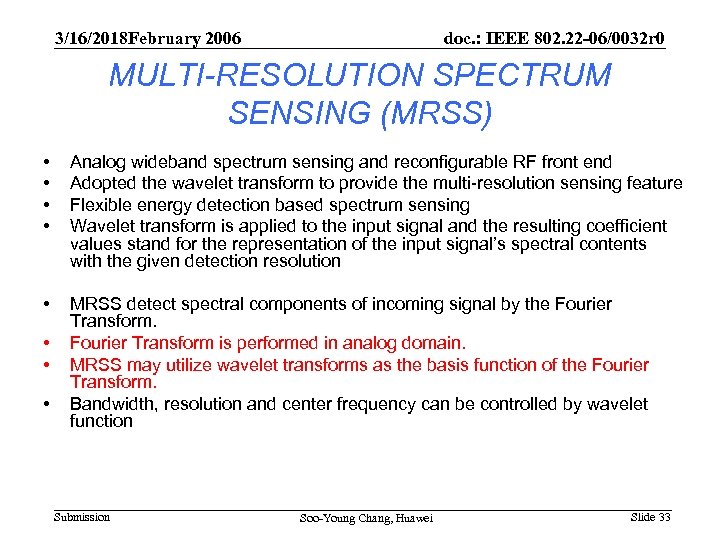
3/16/2018 February 2006 doc. : IEEE 802. 22 -06/0032 r 0 MULTI-RESOLUTION SPECTRUM SENSING (MRSS) • • Analog wideband spectrum sensing and reconfigurable RF front end Adopted the wavelet transform to provide the multi-resolution sensing feature Flexible energy detection based spectrum sensing Wavelet transform is applied to the input signal and the resulting coefficient values stand for the representation of the input signal’s spectral contents with the given detection resolution • MRSS detect spectral components of incoming signal by the Fourier Transform is performed in analog domain. MRSS may utilize wavelet transforms as the basis function of the Fourier Transform. Bandwidth, resolution and center frequency can be controlled by wavelet function • • • Submission Soo-Young Chang, Huawei Slide 33
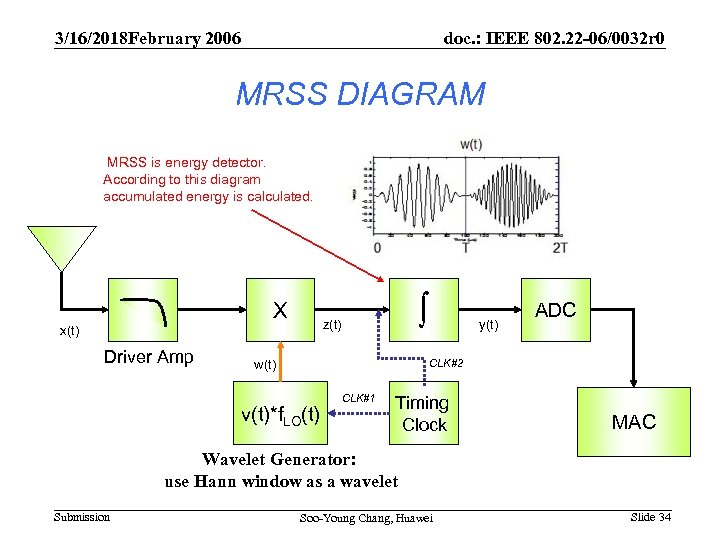
3/16/2018 February 2006 doc. : IEEE 802. 22 -06/0032 r 0 MRSS DIAGRAM MRSS is energy detector. According to this diagram accumulated energy is calculated. X x(t) Driver Amp z(t) y(t) ADC CLK#2 w(t) v(t)*f. LO(t) CLK#1 Timing Clock MAC Wavelet Generator: use Hann window as a wavelet Submission Soo-Young Chang, Huawei Slide 34
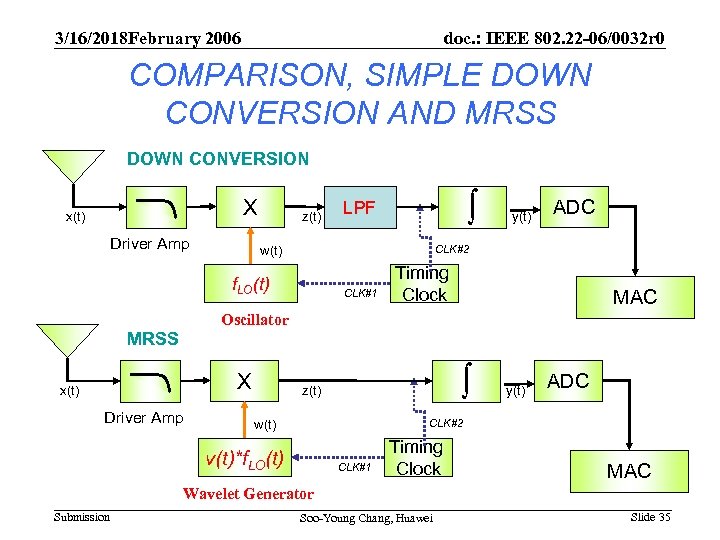
3/16/2018 February 2006 doc. : IEEE 802. 22 -06/0032 r 0 COMPARISON, SIMPLE DOWN CONVERSION AND MRSS DOWN CONVERSION X x(t) Driver Amp z(t) LPF y(t) ADC CLK#2 w(t) f. LO(t) CLK#1 Timing Clock MAC Oscillator MRSS X x(t) Driver Amp z(t) y(t) ADC CLK#2 w(t) v(t)*f. LO(t) CLK#1 Timing Clock MAC Wavelet Generator Submission Soo-Young Chang, Huawei Slide 35
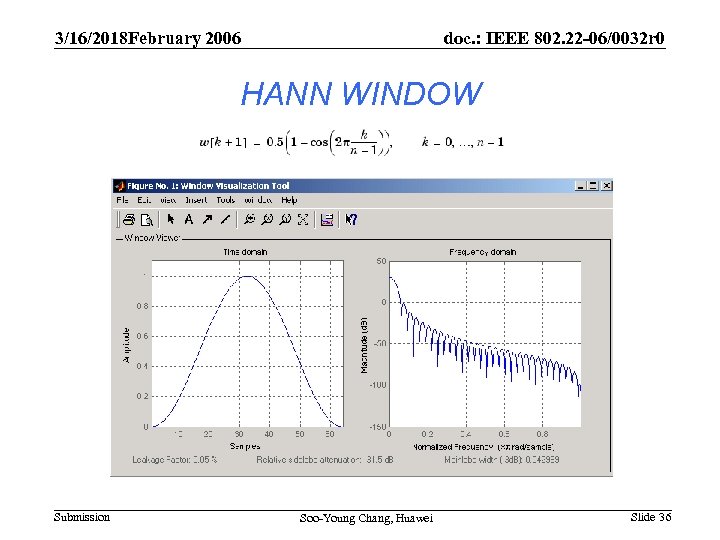
3/16/2018 February 2006 doc. : IEEE 802. 22 -06/0032 r 0 HANN WINDOW Submission Soo-Young Chang, Huawei Slide 36
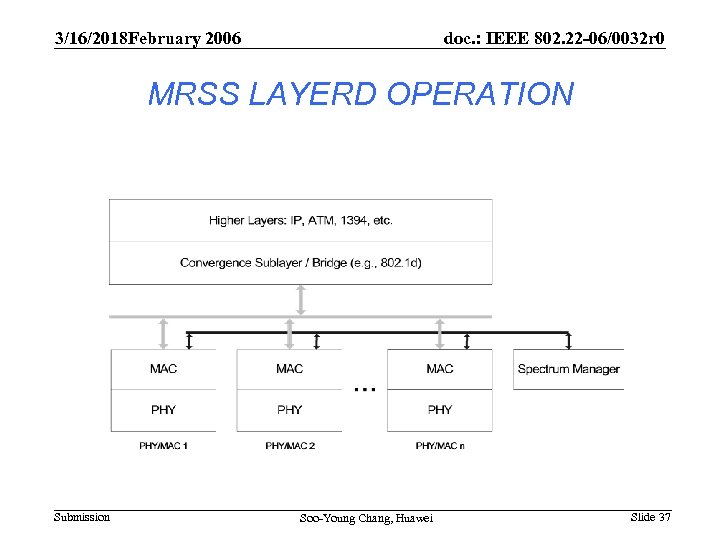
3/16/2018 February 2006 doc. : IEEE 802. 22 -06/0032 r 0 MRSS LAYERD OPERATION Submission Soo-Young Chang, Huawei Slide 37
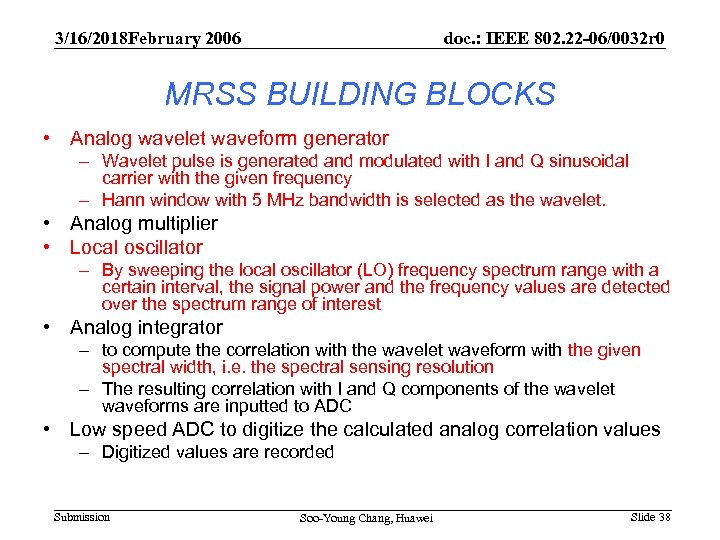
3/16/2018 February 2006 doc. : IEEE 802. 22 -06/0032 r 0 MRSS BUILDING BLOCKS • Analog wavelet waveform generator – Wavelet pulse is generated and modulated with I and Q sinusoidal carrier with the given frequency – Hann window with 5 MHz bandwidth is selected as the wavelet. • Analog multiplier • Local oscillator – By sweeping the local oscillator (LO) frequency spectrum range with a certain interval, the signal power and the frequency values are detected over the spectrum range of interest • Analog integrator – to compute the correlation with the wavelet waveform with the given spectral width, i. e. the spectral sensing resolution – The resulting correlation with I and Q components of the wavelet waveforms are inputted to ADC • Low speed ADC to digitize the calculated analog correlation values – Digitized values are recorded Submission Soo-Young Chang, Huawei Slide 38
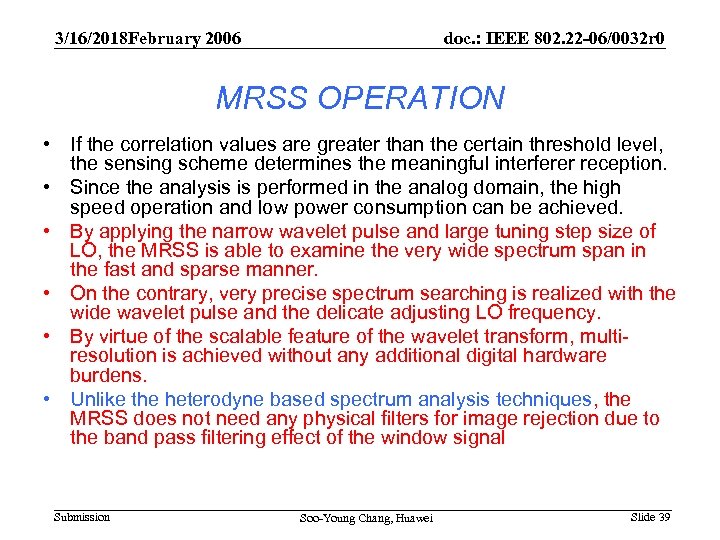
3/16/2018 February 2006 doc. : IEEE 802. 22 -06/0032 r 0 MRSS OPERATION • If the correlation values are greater than the certain threshold level, the sensing scheme determines the meaningful interferer reception. • Since the analysis is performed in the analog domain, the high speed operation and low power consumption can be achieved. • By applying the narrow wavelet pulse and large tuning step size of LO, the MRSS is able to examine the very wide spectrum span in the fast and sparse manner. • On the contrary, very precise spectrum searching is realized with the wide wavelet pulse and the delicate adjusting LO frequency. • By virtue of the scalable feature of the wavelet transform, multiresolution is achieved without any additional digital hardware burdens. • Unlike the heterodyne based spectrum analysis techniques, the MRSS does not need any physical filters for image rejection due to the band pass filtering effect of the window signal Submission Soo-Young Chang, Huawei Slide 39
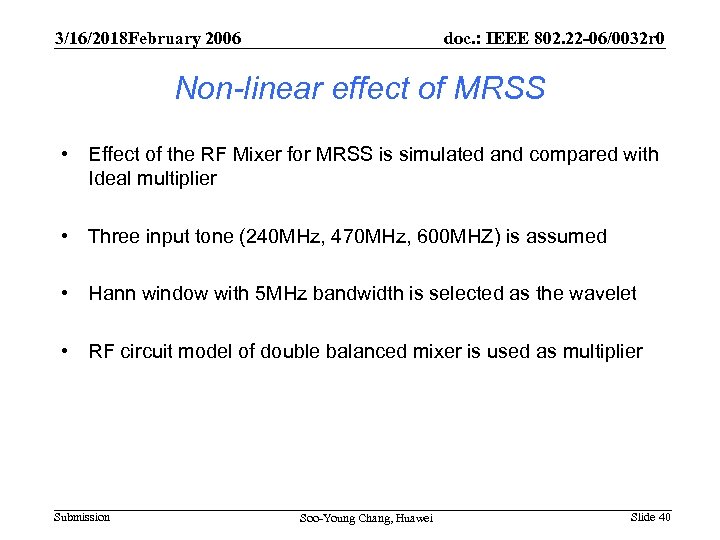
3/16/2018 February 2006 doc. : IEEE 802. 22 -06/0032 r 0 Non-linear effect of MRSS • Effect of the RF Mixer for MRSS is simulated and compared with Ideal multiplier • Three input tone (240 MHz, 470 MHz, 600 MHZ) is assumed • Hann window with 5 MHz bandwidth is selected as the wavelet • RF circuit model of double balanced mixer is used as multiplier Submission Soo-Young Chang, Huawei Slide 40
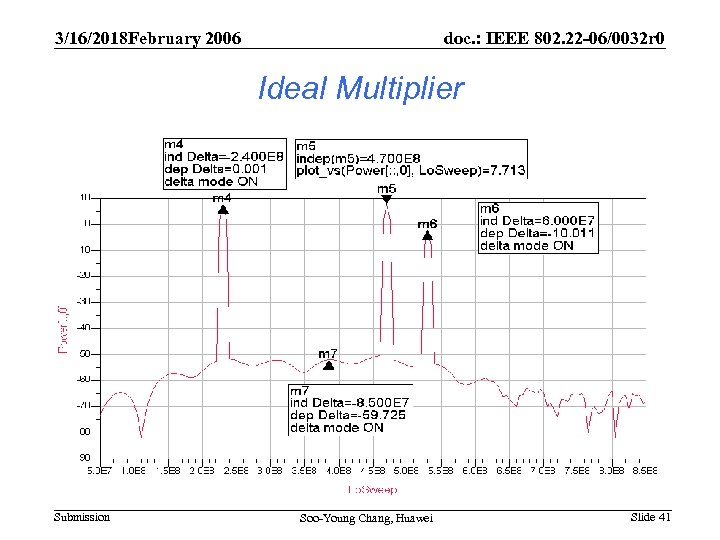
3/16/2018 February 2006 doc. : IEEE 802. 22 -06/0032 r 0 Ideal Multiplier Submission Soo-Young Chang, Huawei Slide 41
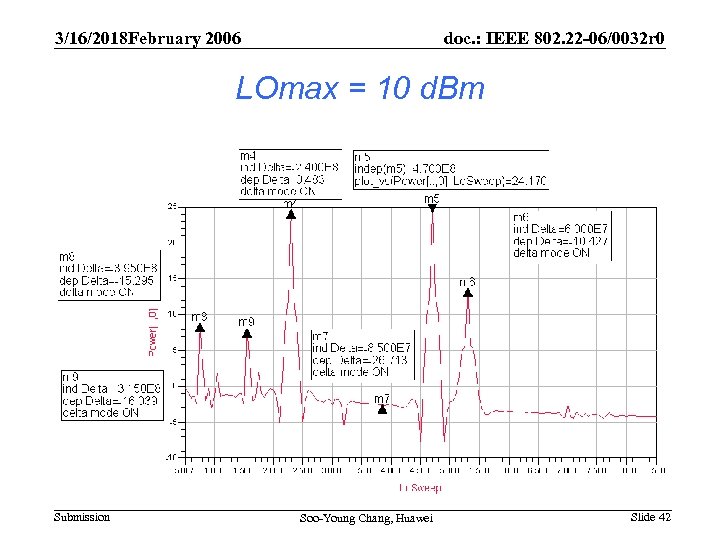
3/16/2018 February 2006 doc. : IEEE 802. 22 -06/0032 r 0 LOmax = 10 d. Bm Submission Soo-Young Chang, Huawei Slide 42
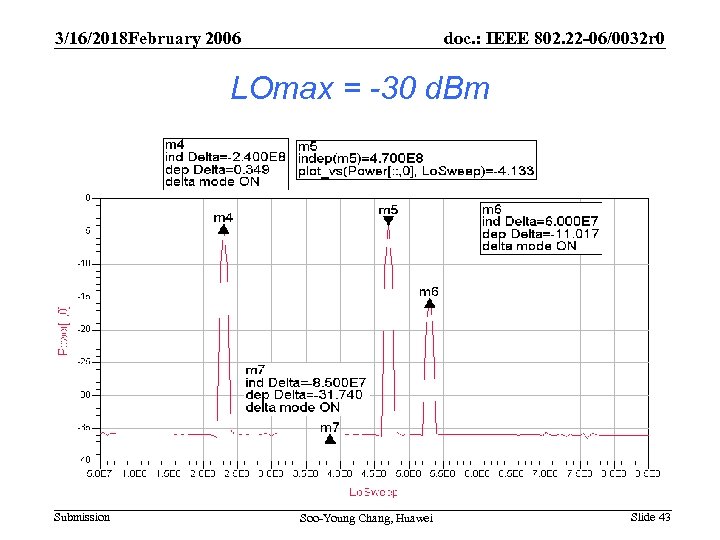
3/16/2018 February 2006 doc. : IEEE 802. 22 -06/0032 r 0 LOmax = -30 d. Bm Submission Soo-Young Chang, Huawei Slide 43
3/16/2018 February 2006 doc. : IEEE 802. 22 -06/0032 r 0 Result of MRSS • Mixer non-linear effect is significantly depend on the LO power level • RF mixer can be used as the multiplier, if operating in the linear mode • By adjusting LO power for wavelet generator can suppressing the unwanted harmonic component Submission Soo-Young Chang, Huawei Slide 44
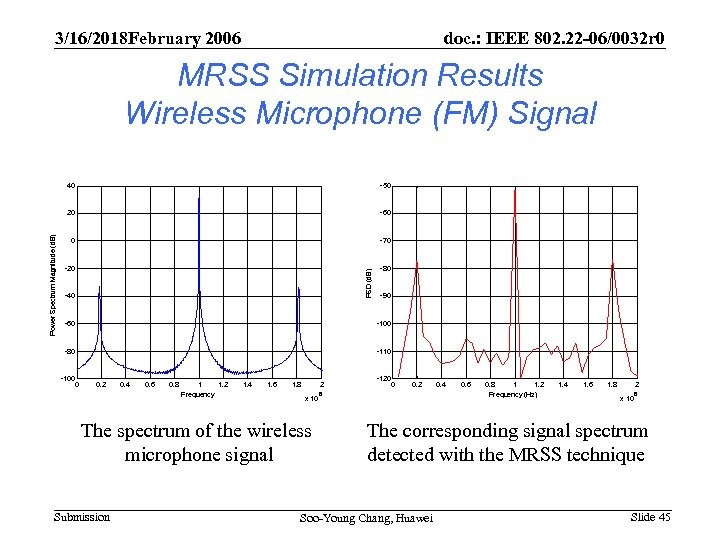
3/16/2018 February 2006 doc. : IEEE 802. 22 -06/0032 r 0 MRSS Simulation Results Wireless Microphone (FM) Signal -60 0 -70 -20 -80 PSD (d. B) -50 20 Power Spectrum Magnitude (d. B) 40 -90 -60 -100 -80 -110 -100 0 0. 2 0. 4 0. 6 0. 8 1 1. 2 Frequency 1. 4 1. 6 1. 8 2 x 10 The spectrum of the wireless microphone signal Submission -120 0 0. 2 6 0. 4 0. 6 0. 8 1 1. 2 Frequency (Hz) 1. 4 1. 6 1. 8 2 x 10 6 The corresponding signal spectrum detected with the MRSS technique Soo-Young Chang, Huawei Slide 45
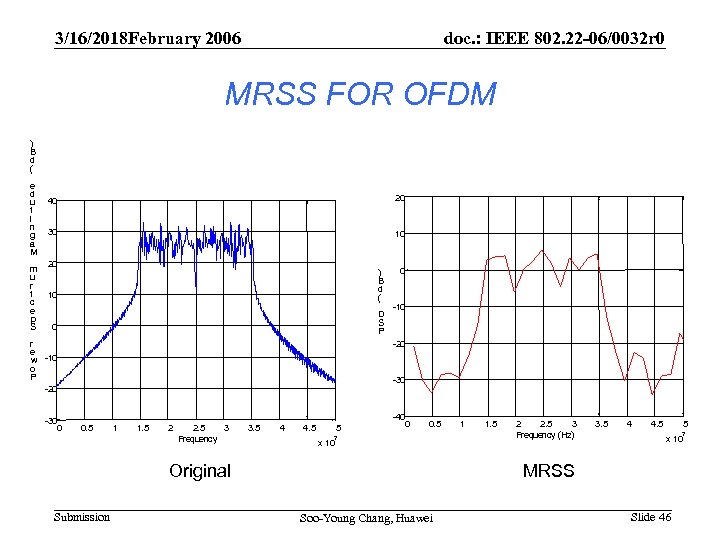
3/16/2018 February 2006 doc. : IEEE 802. 22 -06/0032 r 0 MRSS FOR OFDM ) B d ( e d u t i n g a M m u r t c e p S 40 20 30 10 20 ) B d ( 10 D S P 0 r e w -10 o P -20 -30 0 -10 -20 -30 -40 0 0. 5 1 1. 5 2 2. 5 3 Frequency 3. 5 4 4. 5 5 0 0. 5 7 x 10 Original Submission 1 1. 5 2 2. 5 3 Frequency (Hz) 3. 5 4 4. 5 5 7 x 10 MRSS Soo-Young Chang, Huawei Slide 46
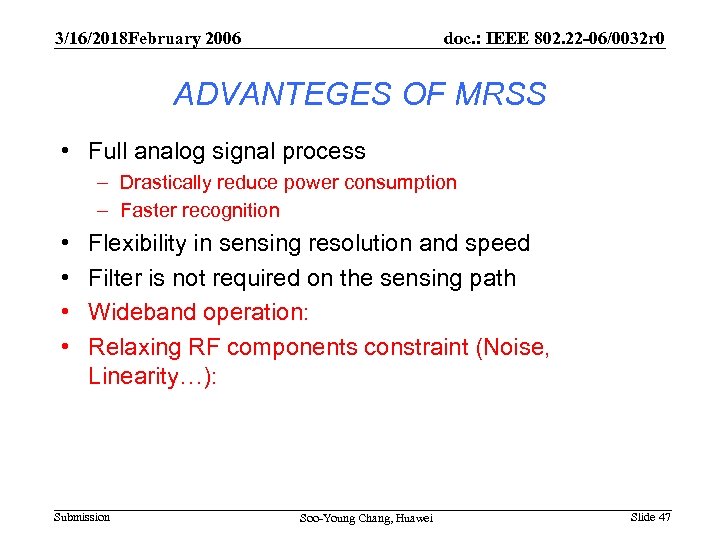
3/16/2018 February 2006 doc. : IEEE 802. 22 -06/0032 r 0 ADVANTEGES OF MRSS • Full analog signal process – Drastically reduce power consumption – Faster recognition • • Flexibility in sensing resolution and speed Filter is not required on the sensing path Wideband operation: Relaxing RF components constraint (Noise, Linearity…): Submission Soo-Young Chang, Huawei Slide 47
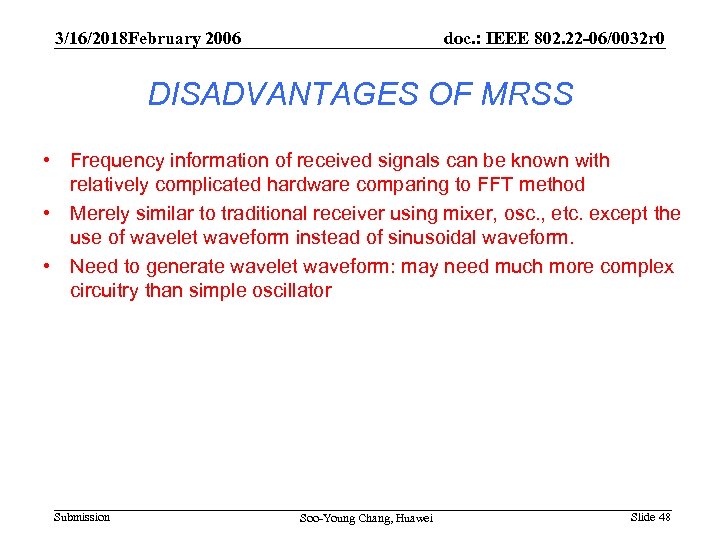
3/16/2018 February 2006 doc. : IEEE 802. 22 -06/0032 r 0 DISADVANTAGES OF MRSS • Frequency information of received signals can be known with relatively complicated hardware comparing to FFT method • Merely similar to traditional receiver using mixer, osc. , etc. except the use of wavelet waveform instead of sinusoidal waveform. • Need to generate wavelet waveform: may need much more complex circuitry than simple oscillator Submission Soo-Young Chang, Huawei Slide 48
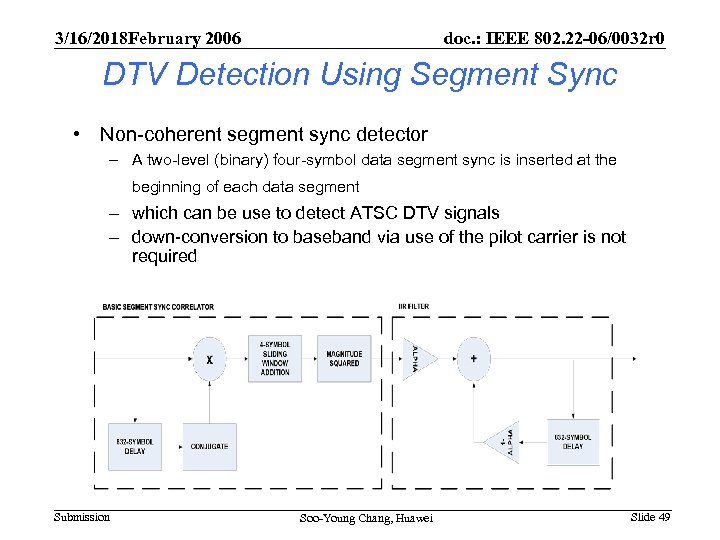
3/16/2018 February 2006 doc. : IEEE 802. 22 -06/0032 r 0 DTV Detection Using Segment Sync • Non-coherent segment sync detector – A two-level (binary) four-symbol data segment sync is inserted at the beginning of each data segment – which can be use to detect ATSC DTV signals – down-conversion to baseband via use of the pilot carrier is not required Submission Soo-Young Chang, Huawei Slide 49
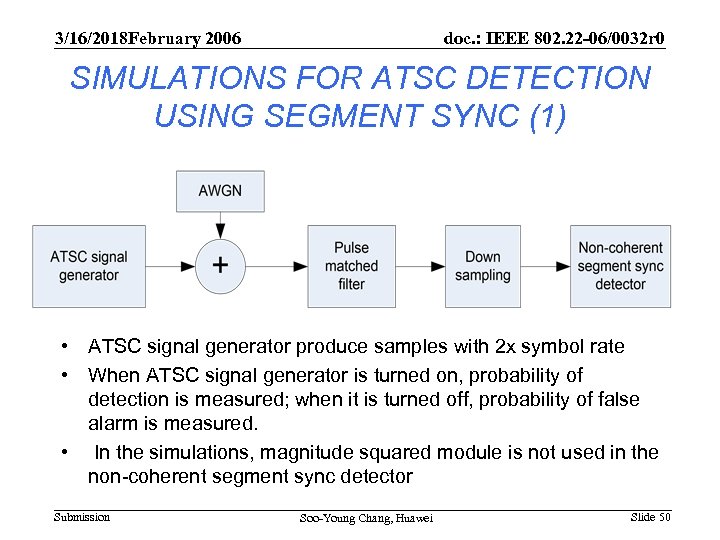
3/16/2018 February 2006 doc. : IEEE 802. 22 -06/0032 r 0 SIMULATIONS FOR ATSC DETECTION USING SEGMENT SYNC (1) • ATSC signal generator produce samples with 2 x symbol rate • When ATSC signal generator is turned on, probability of detection is measured; when it is turned off, probability of false alarm is measured. • In the simulations, magnitude squared module is not used in the non-coherent segment sync detector Submission Soo-Young Chang, Huawei Slide 50
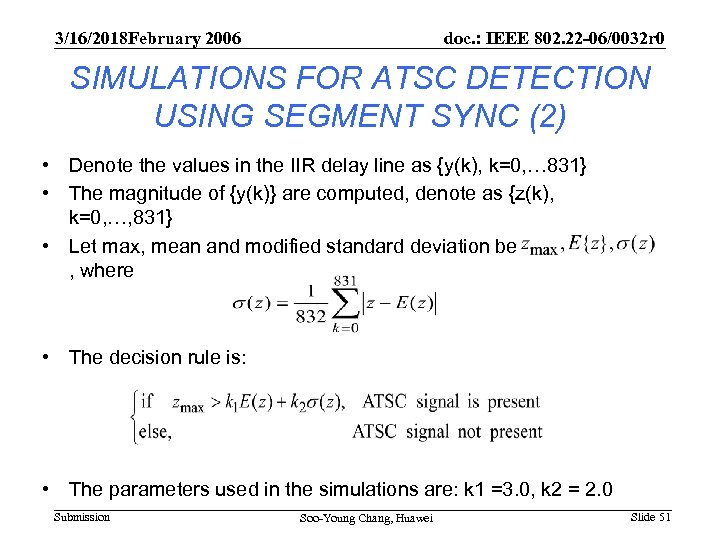
3/16/2018 February 2006 doc. : IEEE 802. 22 -06/0032 r 0 SIMULATIONS FOR ATSC DETECTION USING SEGMENT SYNC (2) • Denote the values in the IIR delay line as {y(k), k=0, … 831} • The magnitude of {y(k)} are computed, denote as {z(k), k=0, …, 831} • Let max, mean and modified standard deviation be , where • The decision rule is: • The parameters used in the simulations are: k 1 =3. 0, k 2 = 2. 0 Submission Soo-Young Chang, Huawei Slide 51
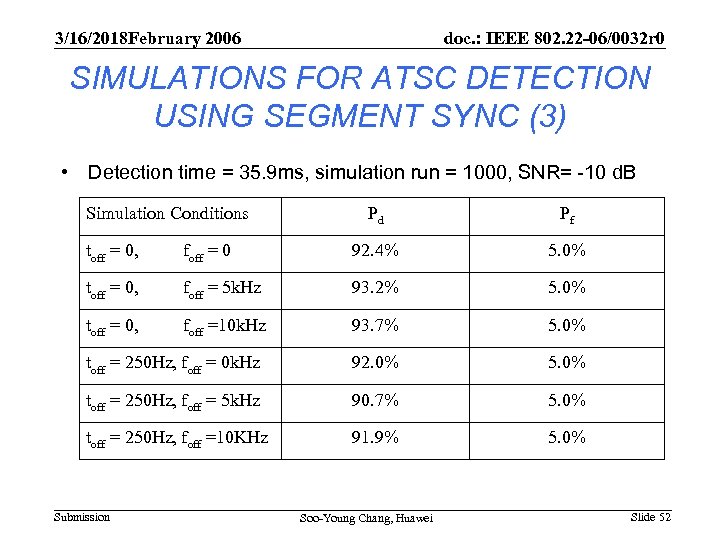
3/16/2018 February 2006 doc. : IEEE 802. 22 -06/0032 r 0 SIMULATIONS FOR ATSC DETECTION USING SEGMENT SYNC (3) • Detection time = 35. 9 ms, simulation run = 1000, SNR= -10 d. B Simulation Conditions Pd Pf toff = 0, foff = 0 92. 4% 5. 0% toff = 0, foff = 5 k. Hz 93. 2% 5. 0% toff = 0, foff =10 k. Hz 93. 7% 5. 0% toff = 250 Hz, foff = 0 k. Hz 92. 0% 5. 0% toff = 250 Hz, foff = 5 k. Hz 90. 7% 5. 0% toff = 250 Hz, foff =10 KHz 91. 9% 5. 0% Submission Soo-Young Chang, Huawei Slide 52
3/16/2018 February 2006 doc. : IEEE 802. 22 -06/0032 r 0 SYNCHRONIZATION USING STRONG DTV SIGNALS • DTV signal Sensing performance may be improved – by increasing the accuracy of the timing and/or carrier frequency references in the receiver, which is difficult to achieve if the DTV signal for sensing is very weak • Proposed method: receive a strong station on another frequency – Observe the timing and frequency offsets and use the settings to calibrate the receiver – It relies on the stability and known frequency allocation of DTV channels. – It also relies on the short term stability of the frequency reference in the receiver. Submission Soo-Young Chang, Huawei Slide 53
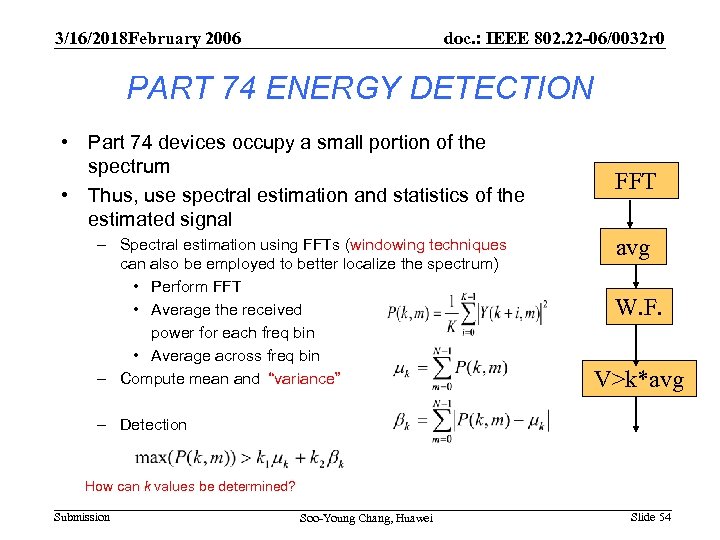
3/16/2018 February 2006 doc. : IEEE 802. 22 -06/0032 r 0 PART 74 ENERGY DETECTION • Part 74 devices occupy a small portion of the spectrum • Thus, use spectral estimation and statistics of the estimated signal – Spectral estimation using FFTs (windowing techniques can also be employed to better localize the spectrum) • Perform FFT • Average the received power for each freq bin • Average across freq bin – Compute mean and “variance” FFT avg W. F. V>k*avg – Detection How can k values be determined? Submission Soo-Young Chang, Huawei Slide 54
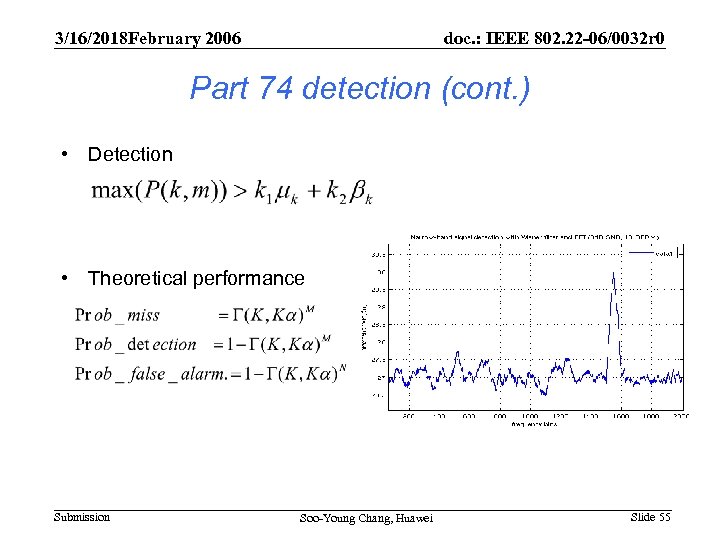
3/16/2018 February 2006 doc. : IEEE 802. 22 -06/0032 r 0 Part 74 detection (cont. ) • Detection • Theoretical performance Submission Soo-Young Chang, Huawei Slide 55
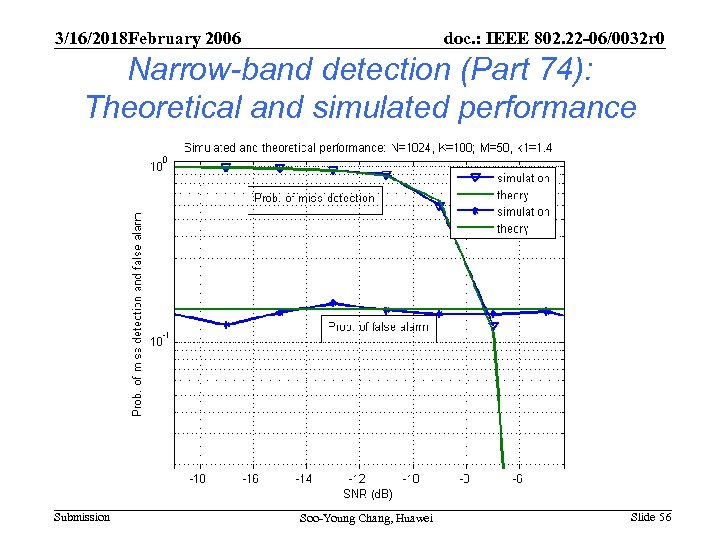
3/16/2018 February 2006 doc. : IEEE 802. 22 -06/0032 r 0 Narrow-band detection (Part 74): Theoretical and simulated performance Submission Soo-Young Chang, Huawei Slide 56
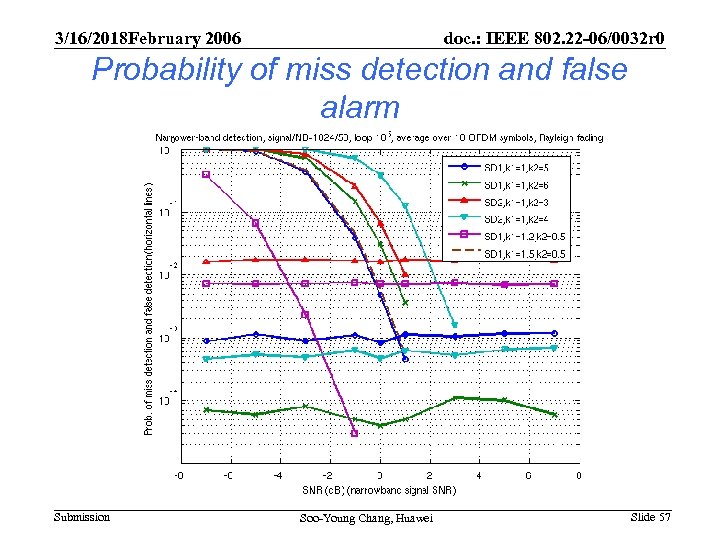
3/16/2018 February 2006 doc. : IEEE 802. 22 -06/0032 r 0 Probability of miss detection and false alarm Submission Soo-Young Chang, Huawei Slide 57
3/16/2018 February 2006 doc. : IEEE 802. 22 -06/0032 r 0 FINE/FEATURE DETECTION • Upon request by the BS, simple energy based detection • Three detection methods suggested – Fine energy based detection • Comparing the energy estimated by using the previous one – Signal feature detection • Part 74 devices • ATSC DTV detection – Optimum radiometer – Cyclostationary feature detection • Single-cycle detector • Multi-cycle detector Submission Soo-Young Chang, Huawei Slide 58
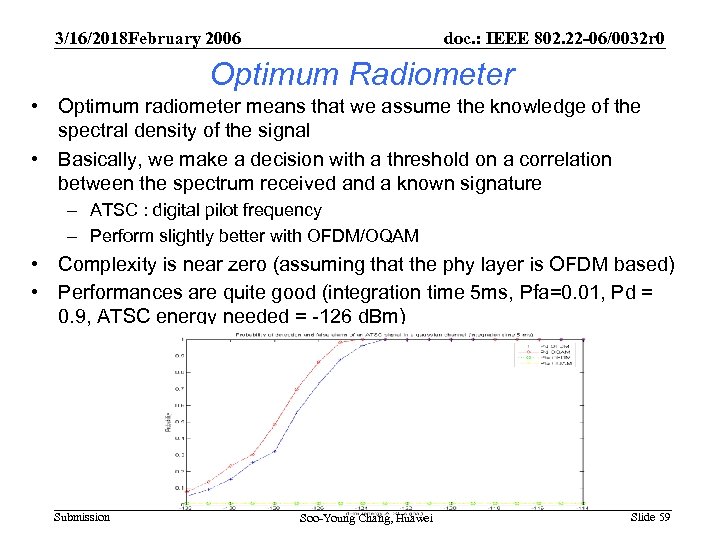
3/16/2018 February 2006 doc. : IEEE 802. 22 -06/0032 r 0 Optimum Radiometer • Optimum radiometer means that we assume the knowledge of the spectral density of the signal • Basically, we make a decision with a threshold on a correlation between the spectrum received and a known signature – ATSC : digital pilot frequency – Perform slightly better with OFDM/OQAM • Complexity is near zero (assuming that the phy layer is OFDM based) • Performances are quite good (integration time 5 ms, Pfa=0. 01, Pd = 0. 9, ATSC energy needed = -126 d. Bm) Submission Soo-Young Chang, Huawei Slide 59
3/16/2018 February 2006 doc. : IEEE 802. 22 -06/0032 r 0 DTV SIGNAL FEATURE DETECION USING FIELD SYNC/CORRELATION • Should not be sensitive to frequency selective fading, and receiver impairments (e. g. , frequency error) • Use field sync correlation detection for ATSC, similar correlation for other standards – Compare correlation peak to the mean of the standard deviation of the correlation – Characterized theoretical performance – Experimental tests Submission Soo-Young Chang, Huawei Slide 60
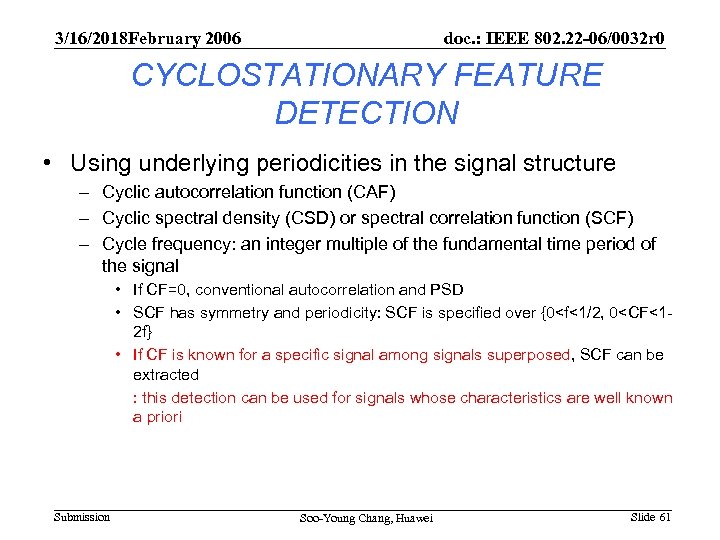
3/16/2018 February 2006 doc. : IEEE 802. 22 -06/0032 r 0 CYCLOSTATIONARY FEATURE DETECTION • Using underlying periodicities in the signal structure – Cyclic autocorrelation function (CAF) – Cyclic spectral density (CSD) or spectral correlation function (SCF) – Cycle frequency: an integer multiple of the fundamental time period of the signal • If CF=0, conventional autocorrelation and PSD • SCF has symmetry and periodicity: SCF is specified over {0<f<1/2, 0<CF<12 f} • If CF is known for a specific signal among signals superposed, SCF can be extracted : this detection can be used for signals whose characteristics are well known a priori Submission Soo-Young Chang, Huawei Slide 61
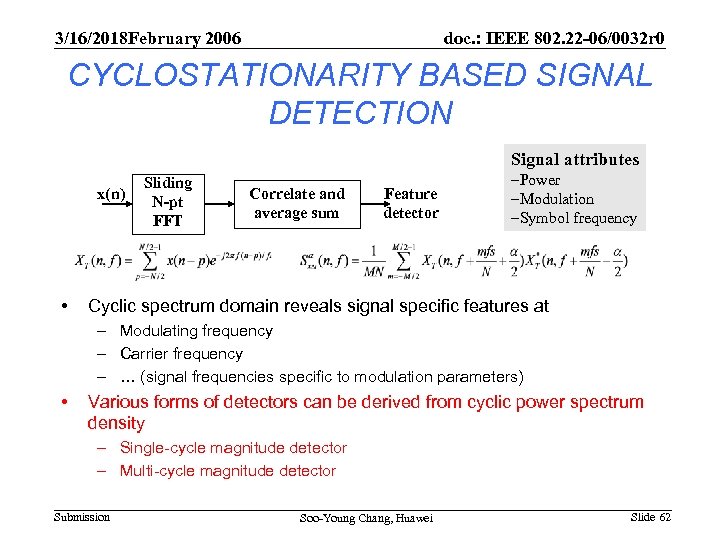
3/16/2018 February 2006 doc. : IEEE 802. 22 -06/0032 r 0 CYCLOSTATIONARITY BASED SIGNAL DETECTION Signal attributes x(n) • Sliding N-pt FFT Correlate and average sum Feature detector –Power –Modulation –Symbol frequency Cyclic spectrum domain reveals signal specific features at – Modulating frequency – Carrier frequency – … (signal frequencies specific to modulation parameters) • Various forms of detectors can be derived from cyclic power spectrum density – Single-cycle magnitude detector – Multi-cycle magnitude detector Submission Soo-Young Chang, Huawei Slide 62
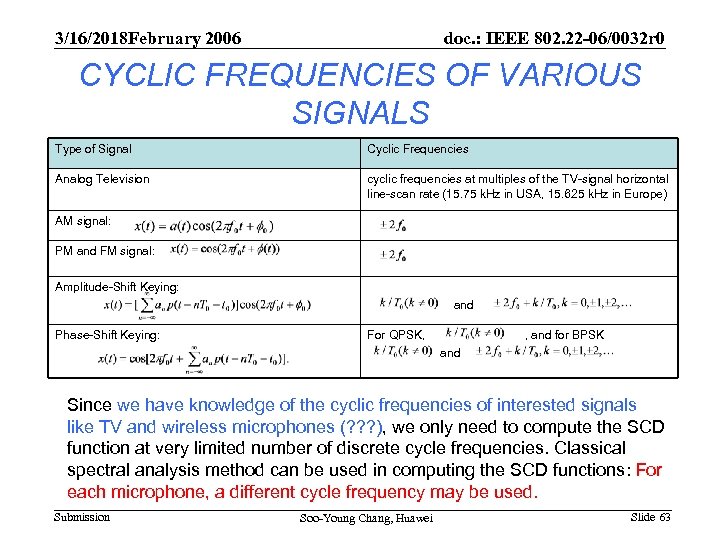
3/16/2018 February 2006 doc. : IEEE 802. 22 -06/0032 r 0 CYCLIC FREQUENCIES OF VARIOUS SIGNALS Type of Signal Cyclic Frequencies Analog Television cyclic frequencies at multiples of the TV-signal horizontal line-scan rate (15. 75 k. Hz in USA, 15. 625 k. Hz in Europe) AM signal: PM and FM signal: Amplitude-Shift Keying: and Phase-Shift Keying: For QPSK, , and for BPSK and Since we have knowledge of the cyclic frequencies of interested signals like TV and wireless microphones (? ? ? ), we only need to compute the SCD function at very limited number of discrete cycle frequencies. Classical spectral analysis method can be used in computing the SCD functions: For each microphone, a different cycle frequency may be used. Submission Soo-Young Chang, Huawei Slide 63
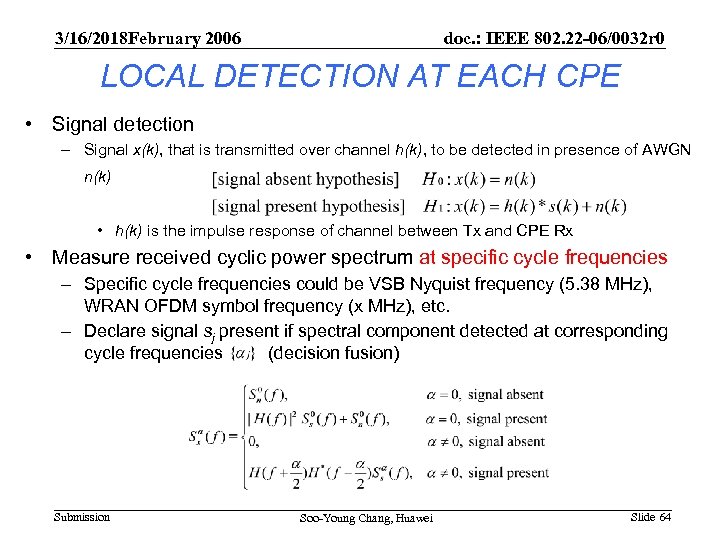
3/16/2018 February 2006 doc. : IEEE 802. 22 -06/0032 r 0 LOCAL DETECTION AT EACH CPE • Signal detection – Signal x(k), that is transmitted over channel h(k), to be detected in presence of AWGN n(k) • h(k) is the impulse response of channel between Tx and CPE Rx • Measure received cyclic power spectrum at specific cycle frequencies – Specific cycle frequencies could be VSB Nyquist frequency (5. 38 MHz), WRAN OFDM symbol frequency (x MHz), etc. – Declare signal sj present if spectral component detected at corresponding cycle frequencies (decision fusion) Submission Soo-Young Chang, Huawei Slide 64
3/16/2018 February 2006 doc. : IEEE 802. 22 -06/0032 r 0 Multi-cycle detector • • Telecommunication signals are well modeled as cyclostationary signal however the noise is usually taken to be stationary. The test for occupied frequency band is a test for presence of cycles in the received radio signal. When possible existing signals in a given band are unknown, a test over a range of cyclic frequencies can be helpful. A multi-cycle detector does not suppose any knowledge on signals to be detected nor on the noise level. Performances are quite good but the algorithm requires more computation. The complexity added by the Multi-cycle detector can be justified when searching to detect the presence of radio signals with unknown characteristics (e. g. competitive radio-cognitive systems). More detailed information may be provided at a later stage, if this solution is acceptable to be included in the joint proposal Submission Soo-Young Chang, Huawei Slide 65
3/16/2018 February 2006 doc. : IEEE 802. 22 -06/0032 r 0 Detection algorithm modes • Basic mode of detection algorithm – Detection of signal energy (from alpha = 0 spectral content) – Used in high SNR regimes for pilot/carrier/signature detection type schemes – Eg. , pilot about 11 d. B below at 310 KHz carrier offset from lower end frequency • Enhanced mode of detection algorithm – Detection of spectral features (spectral content at signal symbol frequency, carrier frequency, …) – Used in low SNR regimes – Especially useful during initialization procedures where BS is looking for an empty channel in possibly low SNR conditions Submission Soo-Young Chang, Huawei Slide 66
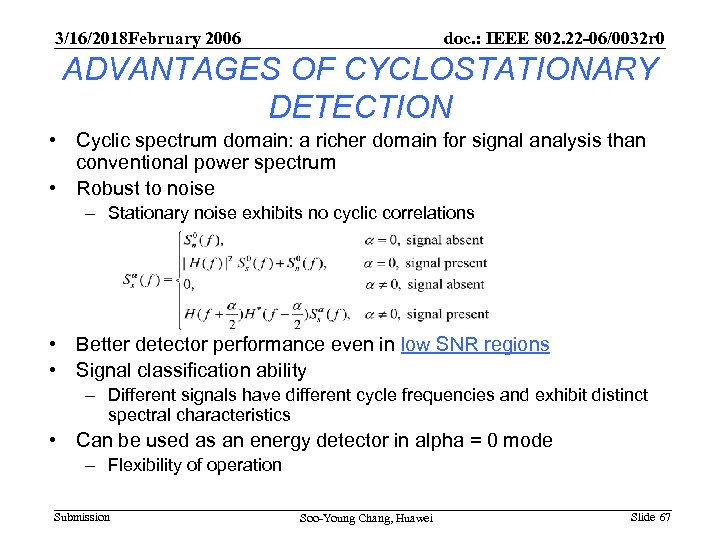
3/16/2018 February 2006 doc. : IEEE 802. 22 -06/0032 r 0 ADVANTAGES OF CYCLOSTATIONARY DETECTION • Cyclic spectrum domain: a richer domain for signal analysis than conventional power spectrum • Robust to noise – Stationary noise exhibits no cyclic correlations • Better detector performance even in low SNR regions • Signal classification ability – Different signals have different cycle frequencies and exhibit distinct spectral characteristics • Can be used as an energy detector in alpha = 0 mode – Flexibility of operation Submission Soo-Young Chang, Huawei Slide 67
3/16/2018 February 2006 doc. : IEEE 802. 22 -06/0032 r 0 DISADVANTAGES OF CYCLOSTATIONARY DETECTION • More complex processing needed than energy detection: high speed sensing can not be achieved • A priori knowledge of target signal characteristics needed can not be applied for unknown signals: cycle frequency should be known a priori practically almost impossible to detect microphone signals • At one time, only one signal can be detected: for multiple signal detection, multiple detectors should be implemented or slow detection should be allowed. That means one detection cycle is needed for a DTV signal, and then another one is for a NTSC signal, so on. Submission Soo-Young Chang, Huawei Slide 68
3/16/2018 February 2006 doc. : IEEE 802. 22 -06/0032 r 0 REFERENCES • Yongsik Hur, et al, A Wideband Analog Multi-Resolution Spectrum sensing (MRSS) Technique for Cognitive Radio (CR) Systems, Information for Paper ID 3534, ISCAS 2006 • Marital Bellec, et al, IEEE 802. 22 -06/0004 r 0, Jan. 2006 • Marital Bellec, et al, IEEE 802. 22 -06/0005 r 3, Feb. 2006 Submission Soo-Young Chang, Huawei Slide 69
3/16/2018 February 2006 doc. : IEEE 802. 22 -06/0032 r 0 HUAWEI/NEXTWAVE /RUNCOM/STMICRO Submission Soo-Young Chang, Huawei Slide 70
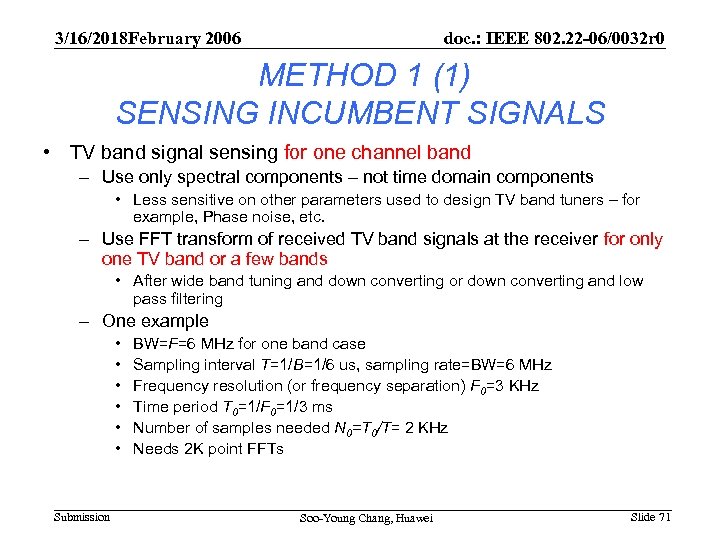
3/16/2018 February 2006 doc. : IEEE 802. 22 -06/0032 r 0 METHOD 1 (1) SENSING INCUMBENT SIGNALS • TV band signal sensing for one channel band – Use only spectral components – not time domain components • Less sensitive on other parameters used to design TV band tuners – for example, Phase noise, etc. – Use FFT transform of received TV band signals at the receiver for only one TV band or a few bands • After wide band tuning and down converting or down converting and low pass filtering – One example • • • Submission BW=F=6 MHz for one band case Sampling interval T=1/B=1/6 us, sampling rate=BW=6 MHz Frequency resolution (or frequency separation) F 0=3 KHz Time period T 0=1/F 0=1/3 ms Number of samples needed N 0=T 0/T= 2 KHz Needs 2 K point FFTs Soo-Young Chang, Huawei Slide 71
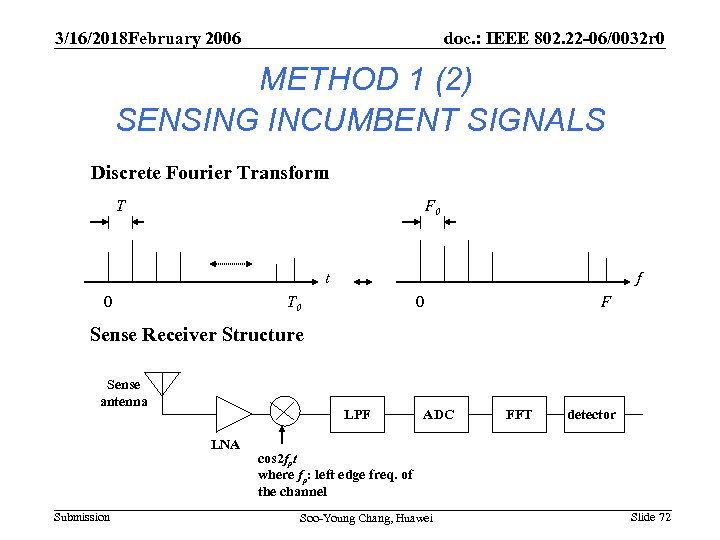
3/16/2018 February 2006 doc. : IEEE 802. 22 -06/0032 r 0 METHOD 1 (2) SENSING INCUMBENT SIGNALS Discrete Fourier Transform T F 0 t 0 f T 0 0 F Sense Receiver Structure Sense antenna LPF LNA Submission ADC FFT detector cos 2 fpt where fp: left edge freq. of the channel Soo-Young Chang, Huawei Slide 72
3/16/2018 February 2006 doc. : IEEE 802. 22 -06/0032 r 0 METHOD 1 (3) SENSING INCUMBENT SIGNALS • Sensing procedure for TV signals – Several to many frequency components taken in a 6 MHz band depending on the sensing accuracy • for ex. , F 50, F 103, F 200, F 417, and F 1200 – Compare these values • Correlation method: compare the shape of spectrum of received signals – Calculate correlations with pre-stored values for NTSC and DTV signals – If one of these values is larger than predetermined values, the judgment is that NTSC or DTV signal exists. • Pilot detection method: check whether a pilot signal exists – Calculate the ratio of pilot component to another component – If F 417/F 1200 > thn, this signal is NTSC – If F 103/F 1200 > thd, this signal is DTV – Average frequency component values for several symbol periods to have better sensing results Submission Soo-Young Chang, Huawei Slide 73
3/16/2018 February 2006 doc. : IEEE 802. 22 -06/0032 r 0 METHOD 1 (4) SENSING INCUMBENT SIGNALS • Sensing procedure for wireless microphone signals – Two types of wireless microphone systems according to frequency usage • Single frequency systems • Frequency agile systems – Wireless systems should NOT be operated on the same frequency as a local TV station. • Only open (unoccupied) frequencies should be used. In the U. S. , each major city has different local TV stations. – Microphone signal detection procedure: sensing the spectral components using FFT devices • For ex. , for every 3 KHz in a 6 MHz band a spectral component is measured and compared with other components: two comparison methods used for DTC and NTSC signals can be applied • If considerable components in a 200 KHz band exist, a wireless microphone is considered to be operated in that band: – For the previous case, if consecutive six components spaced equally in 200 KHz have considerable amount of energy, a microphone signal is detected. • Or much correlation with stored microphone signals exists, a wireless microphone is considered to be operated in that band. Submission Soo-Young Chang, Huawei Slide 74
3/16/2018 February 2006 doc. : IEEE 802. 22 -06/0032 r 0 METHOD 2 (1) SENSING INCUMBENT SIGNALS • After DTV transition in the U. S. , – VHF low band: – VHF high band: – UHF band: Chs 2 -6 Chs 7 -13 Chs 14 -51 54 -88 MHz 174 -216 MHz 470 -698 MHz * • n consecutive bands in VHF High or UHF band selected for WRAN services – The whole band of n bands is divided into n*l subbands • Each band has l subbands; each subband has 6000/l KHz bandwidth – At receiver, the received signal after down conversion is inputted to a l*n point FFT • By comparing FFT output signals, currently operated incumbent users can be identified and categorized – NTSC, DTV, or Part 74 devices • With this method all incumbent signal throughout the whole band (n TV bands) can be detected simultaneously – Periodically all CPEs and BSs can do this sensing to update the list of active incumbent users * Ch 37 is reserved for radio astronomy Submission Soo-Young Chang, Huawei Slide 75
3/16/2018 February 2006 doc. : IEEE 802. 22 -06/0032 r 0 METHOD 2 (2) SENSING INCUMBENT SIGNALS • NTSC signal sensing – After down conversion with (fp+1. 25) MHz frequency shift, the received signal is inputted to l*n point FFT devices – Compare the FFT outputs • DTV signal sensing – After down conversion with (fp+0. 30944) MHz frequency shift, the received signal is inputted to l*n point FFT devices – Compare the FFT outputs • Part 74 device sensing – After down conversion with fp MHz frequency shift, the received signal is inputted to l*n point FFT devices – Compare the FFT outputs • Various comparison methods can be considered – Correlation method or pilot detection method used in Method 1 is suggested for TV signals – If some consecutive strong components in 200 KHz exist, Part 74 device is considered to operate in this band. Or correlation method will be applied for Part 74 device signals. Submission Soo-Young Chang, Huawei Slide 76
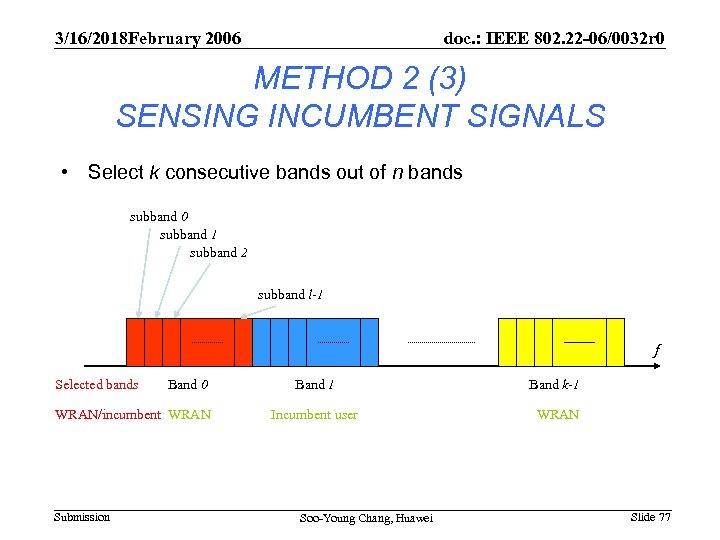
3/16/2018 February 2006 doc. : IEEE 802. 22 -06/0032 r 0 METHOD 2 (3) SENSING INCUMBENT SIGNALS • Select k consecutive bands out of n bands subband 0 subband 1 subband 2 subband l-1 f Selected bands Band 0 WRAN/incumbent WRAN Submission Band 1 Band k-1 Incumbent user WRAN Soo-Young Chang, Huawei Slide 77
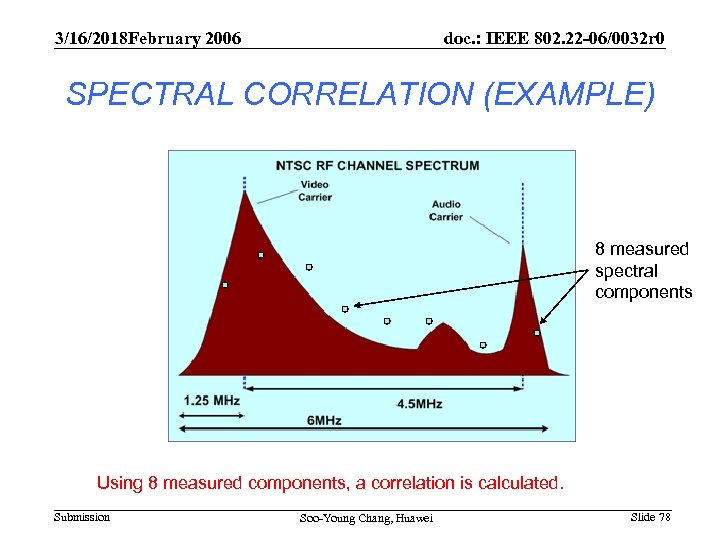
3/16/2018 February 2006 doc. : IEEE 802. 22 -06/0032 r 0 SPECTRAL CORRELATION (EXAMPLE) 8 measured spectral components Using 8 measured components, a correlation is calculated. Submission Soo-Young Chang, Huawei Slide 78
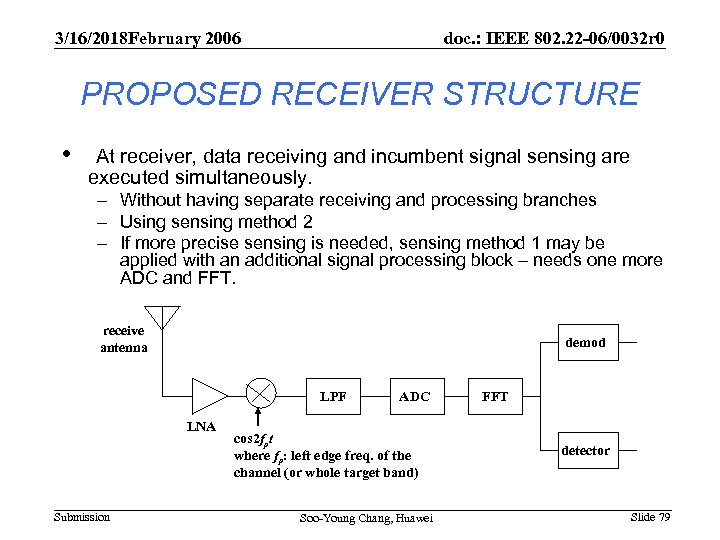
3/16/2018 February 2006 doc. : IEEE 802. 22 -06/0032 r 0 PROPOSED RECEIVER STRUCTURE • At receiver, data receiving and incumbent signal sensing are executed simultaneously. – Without having separate receiving and processing branches – Using sensing method 2 – If more precise sensing is needed, sensing method 1 may be applied with an additional signal processing block – needs one more ADC and FFT. receive antenna demod LPF LNA Submission ADC cos 2 fpt where fp: left edge freq. of the channel (or whole target band) Soo-Young Chang, Huawei FFT detector Slide 79
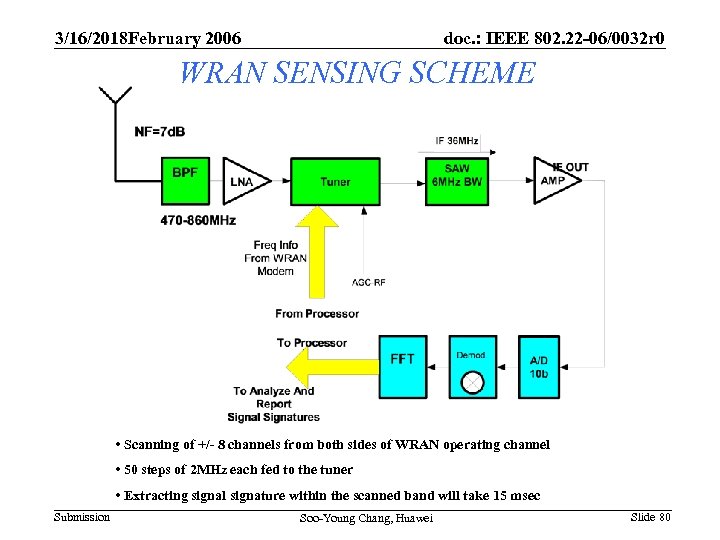
3/16/2018 February 2006 doc. : IEEE 802. 22 -06/0032 r 0 WRAN SENSING SCHEME • Scanning of +/- 8 channels from both sides of WRAN operating channel • 50 steps of 2 MHz each fed to the tuner • Extracting signal signature within the scanned band will take 15 msec Submission Soo-Young Chang, Huawei Slide 80
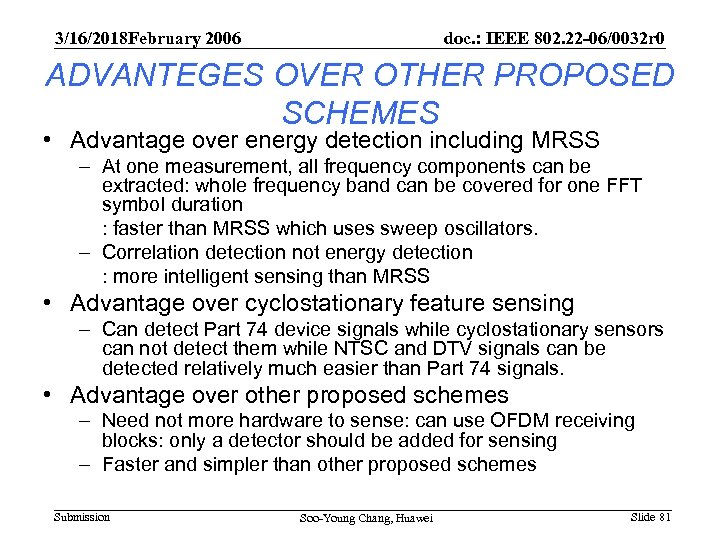
3/16/2018 February 2006 doc. : IEEE 802. 22 -06/0032 r 0 ADVANTEGES OVER OTHER PROPOSED SCHEMES • Advantage over energy detection including MRSS – At one measurement, all frequency components can be extracted: whole frequency band can be covered for one FFT symbol duration : faster than MRSS which uses sweep oscillators. – Correlation detection not energy detection : more intelligent sensing than MRSS • Advantage over cyclostationary feature sensing – Can detect Part 74 device signals while cyclostationary sensors can not detect them while NTSC and DTV signals can be detected relatively much easier than Part 74 signals. • Advantage over other proposed schemes – Need not more hardware to sense: can use OFDM receiving blocks: only a detector should be added for sensing – Faster and simpler than other proposed schemes Submission Soo-Young Chang, Huawei Slide 81
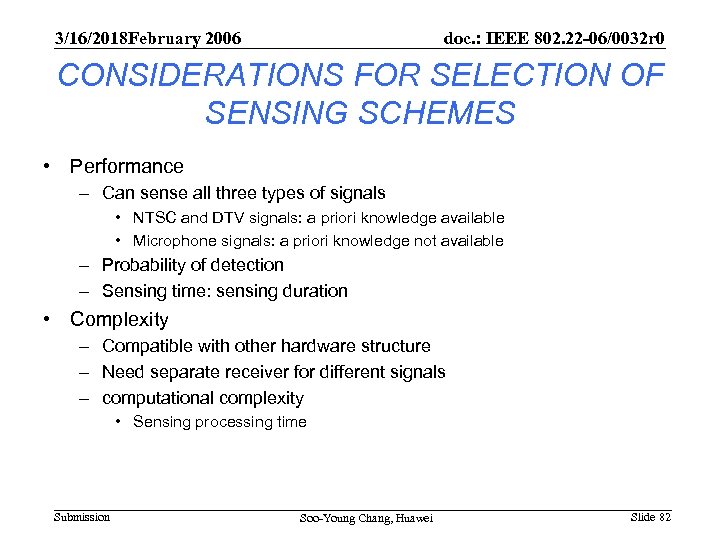
3/16/2018 February 2006 doc. : IEEE 802. 22 -06/0032 r 0 CONSIDERATIONS FOR SELECTION OF SENSING SCHEMES • Performance – Can sense all three types of signals • NTSC and DTV signals: a priori knowledge available • Microphone signals: a priori knowledge not available – Probability of detection – Sensing time: sensing duration • Complexity – Compatible with other hardware structure – Need separate receiver for different signals – computational complexity • Sensing processing time Submission Soo-Young Chang, Huawei Slide 82
Скачать презентацию 3 16 2018 February 2006 doc IEEE 802 22
4a2c28faaafd4ab191cc50bc6ce3e24c.ppt