 Скачать презентацию 3 15 2018 www dovetailinc org Carbon Credits Ecosystem
326ea9af06795f0fc32196435de5ff4f.ppt
- Количество слайдов: 41



3/15/2018 www. dovetailinc. org Carbon Credits & Ecosystem Markets for Private Landowners Katie Fernholz Dovetail Partners, Inc. www. dovetailinc. org
3/15/2018 www. dovetailinc. org Overview The Basics – What are Carbon Credits & Ecosystem Markets? What opportunities currently exists and what are the pros and cons? Case Studies/Examples A Strategic Future – What can be done now to get where we want to be? Questions?
3/15/2018 The Basics www. dovetailinc. org What are Carbon Credits & Ecosystem Markets? Ecosystem Markets: A method of providing a payment structure (or revenue stream) to support providers of ecosystem services (water filtration, climate regulation, nutrient cycling, flood control, etc. ) Other market-based mechanisms that can drive environmental behaviors include tax incentives and subsides, public payment programs, and private or voluntary eco-labels and consumer actions. Requirements for developing an ecosystem market: 1) Define the ecosystem service, 2) Measure the service, 3) Pay for and invest in the service
3/15/2018 www. dovetailinc. org The Carbon Example Carbon Credits (aka Carbon Offsets) are a market-based financial mechanism for supporting behaviors that result in measurable, verified increases in carbon storage (or decreases in carbon dioxide, CO 2, emissions). Carbon Credits can be voluntary or regulatory; domestic or international; large or small projects; short or long commitments; and are associated with everything from landfills to farms to forests to power plants.
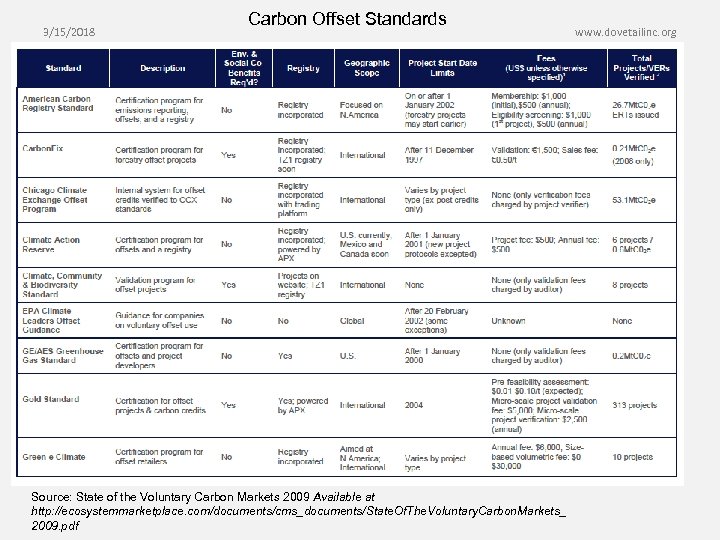
3/15/2018 Carbon Offset Standards Source: State of the Voluntary Carbon Markets 2009 Available at http: //ecosystemmarketplace. com/documents/cms_documents/State. Of. The. Voluntary. Carbon. Markets_ 2009. pdf www. dovetailinc. org
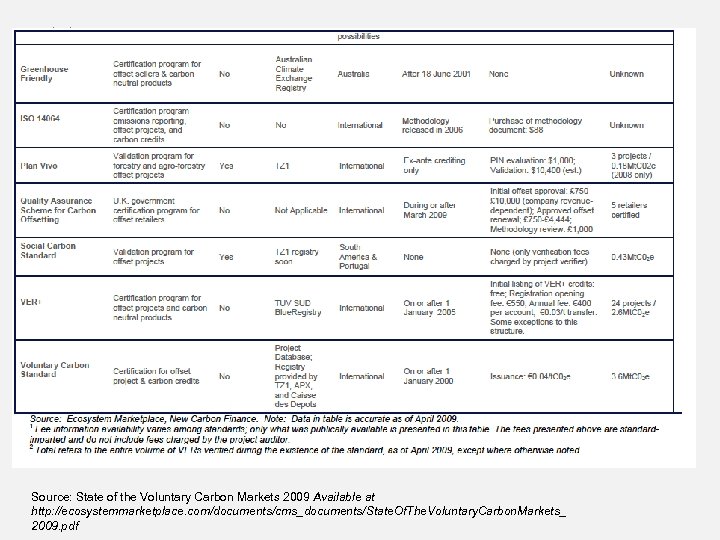
3/15/2018 Source: State of the Voluntary Carbon Markets 2009 Available at http: //ecosystemmarketplace. com/documents/cms_documents/State. Of. The. Voluntary. Carbon. Markets_ 2009. pdf www. dovetailinc. org
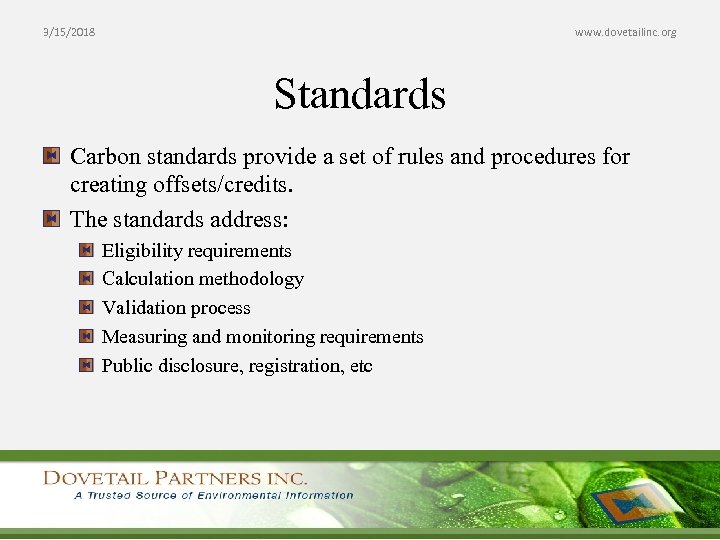
3/15/2018 www. dovetailinc. org Standards Carbon standards provide a set of rules and procedures for creating offsets/credits. The standards address: Eligibility requirements Calculation methodology Validation process Measuring and monitoring requirements Public disclosure, registration, etc
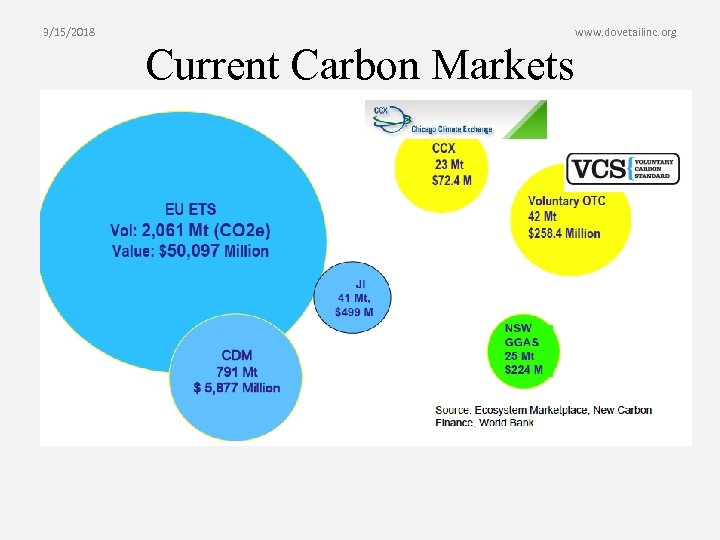
3/15/2018 www. dovetailinc. org Current Carbon Markets
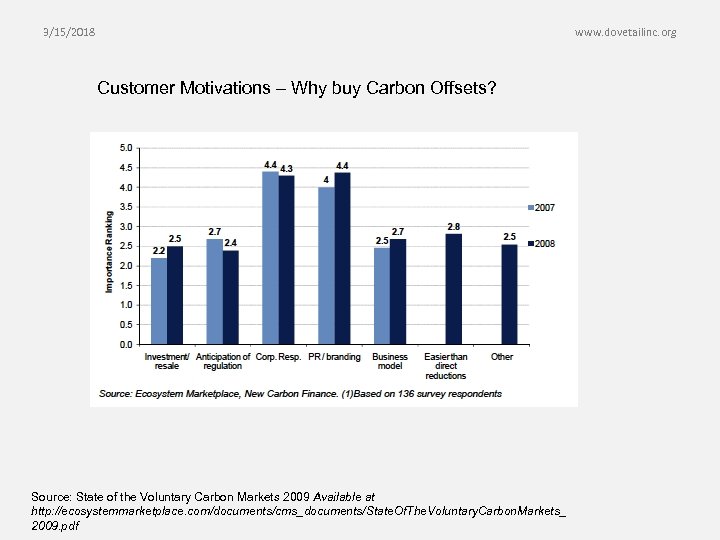
3/15/2018 www. dovetailinc. org Customer Motivations – Why buy Carbon Offsets? Source: State of the Voluntary Carbon Markets 2009 Available at http: //ecosystemmarketplace. com/documents/cms_documents/State. Of. The. Voluntary. Carbon. Markets_ 2009. pdf
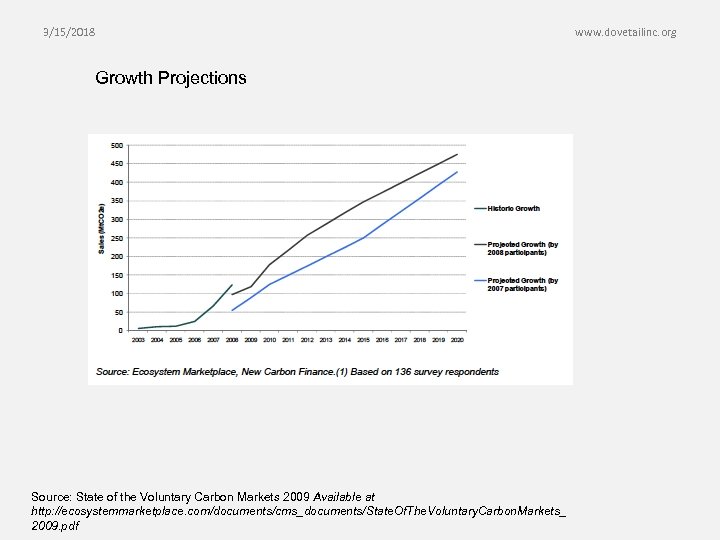
3/15/2018 www. dovetailinc. org Growth Projections Source: State of the Voluntary Carbon Markets 2009 Available at http: //ecosystemmarketplace. com/documents/cms_documents/State. Of. The. Voluntary. Carbon. Markets_ 2009. pdf
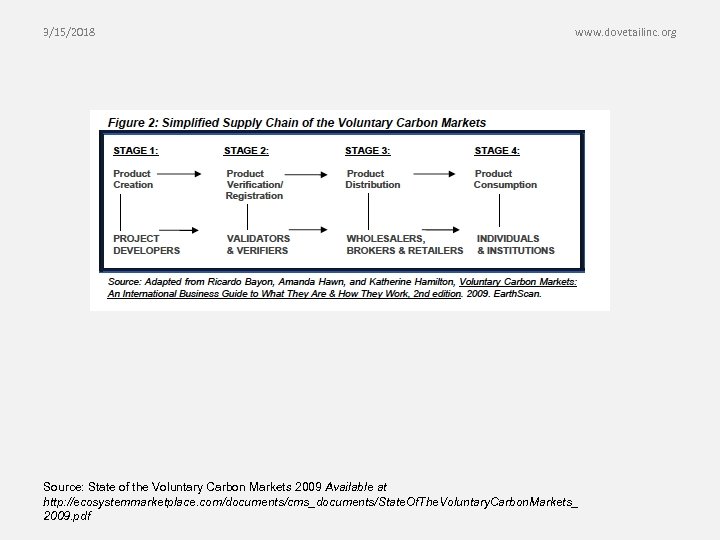
3/15/2018 www. dovetailinc. org Source: State of the Voluntary Carbon Markets 2009 Available at http: //ecosystemmarketplace. com/documents/cms_documents/State. Of. The. Voluntary. Carbon. Markets_ 2009. pdf
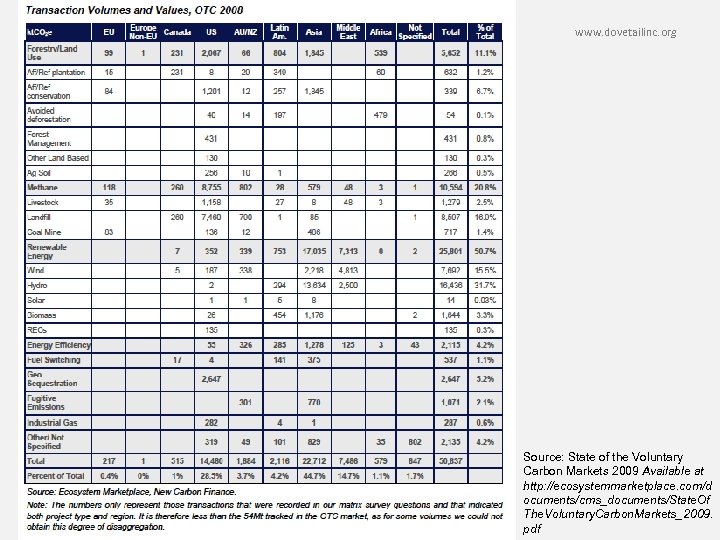
3/15/2018 www. dovetailinc. org Source: State of the Voluntary Carbon Markets 2009 Available at http: //ecosystemmarketplace. com/d ocuments/cms_documents/State. Of The. Voluntary. Carbon. Markets_2009. pdf
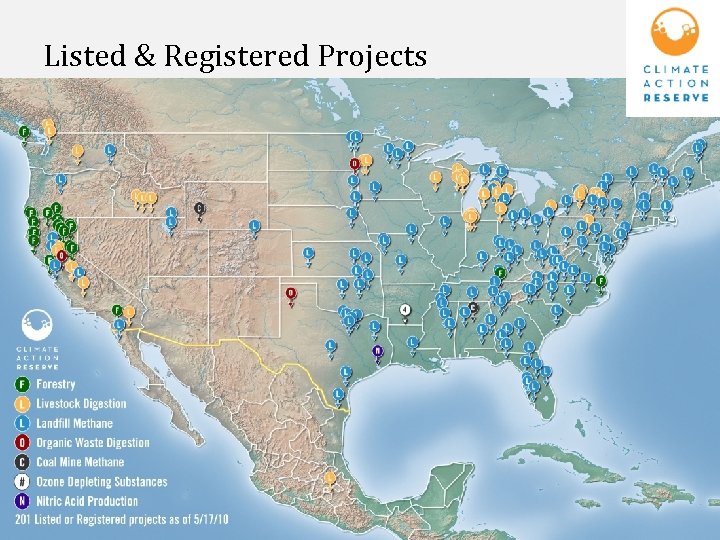
Listed & Registered Projects
3/15/2018 www. dovetailinc. org North Woods Carbon Credit Partnership • Understand the implications of Forest Carbon Offset Markets for managed forests in Minnesota • Create a structure to evaluate forest carbon stocks under existing Forest Carbon Offset Standards • Evaluate Potential of Payments for other Ecosystem Services in the North Woods
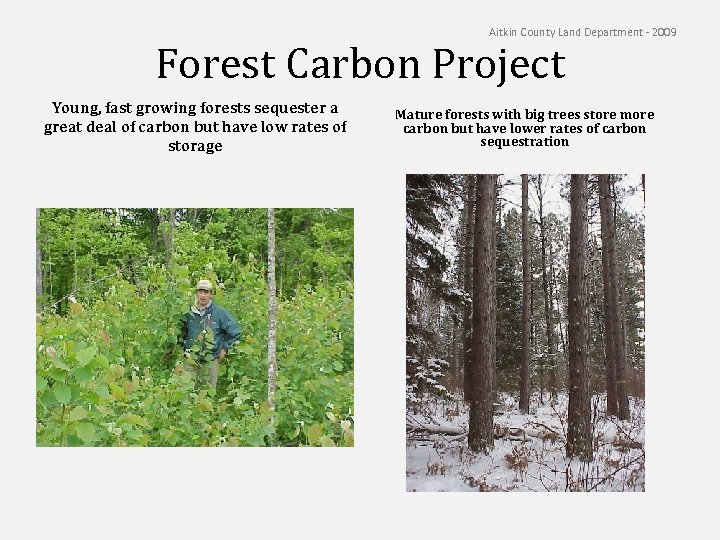
Aitkin County Land Department - 2009 Forest Carbon Project Young, fast growing forests sequester a great deal of carbon but have low rates of storage Mature forests with big trees store more carbon but have lower rates of carbon sequestration
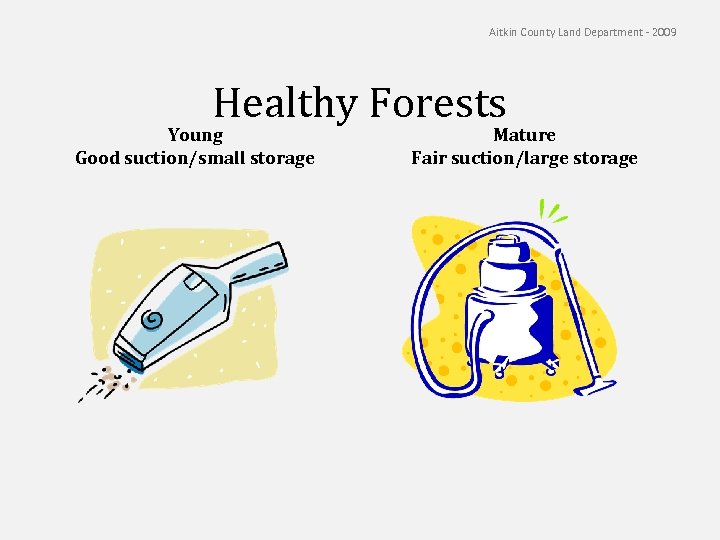
Aitkin County Land Department - 2009 Healthy Forests Young Good suction/small storage Mature Fair suction/large storage
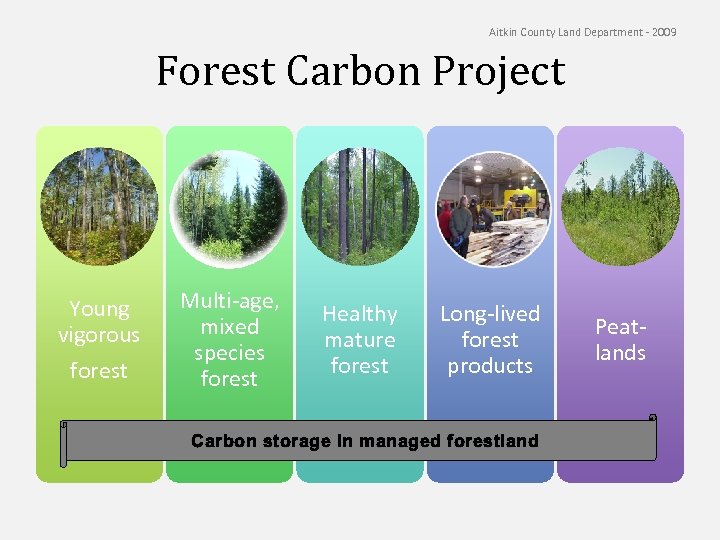
Aitkin County Land Department - 2009 Forest Carbon Project Young vigorous forest Multi-age, mixed species forest Healthy mature forest Long-lived forest products Carbon storage in managed forestland Peatlands
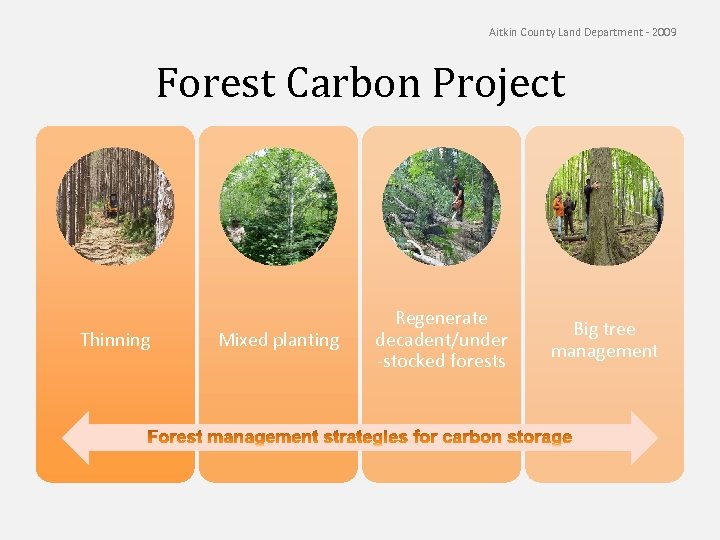
Aitkin County Land Department - 2009 Forest Carbon Project Thinning Mixed planting Regenerate decadent/under -stocked forests Big tree management
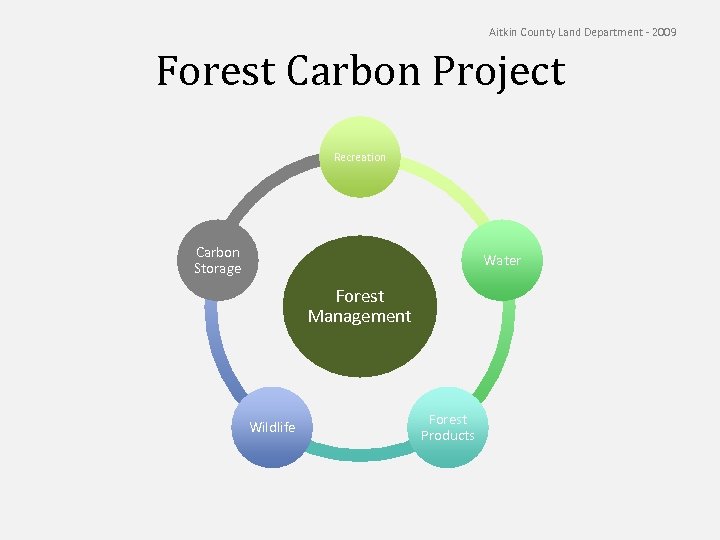
Aitkin County Land Department - 2009 Forest Carbon Project Recreation Carbon Storage Water Forest Management Wildlife Forest Products
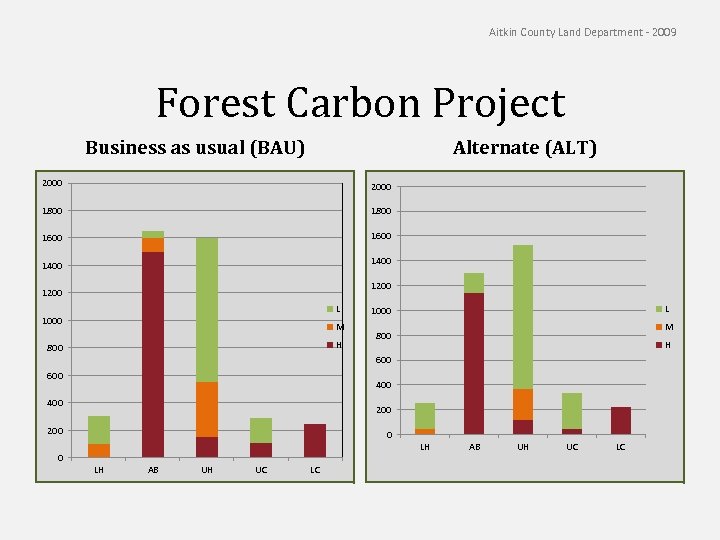
Aitkin County Land Department - 2009 Forest Carbon Project Business as usual (BAU) Alternate (ALT) 2000 1800 1600 1400 1200 L 1000 M H 800 L 1000 M 800 H 600 400 200 0 LH AB UH UC LC
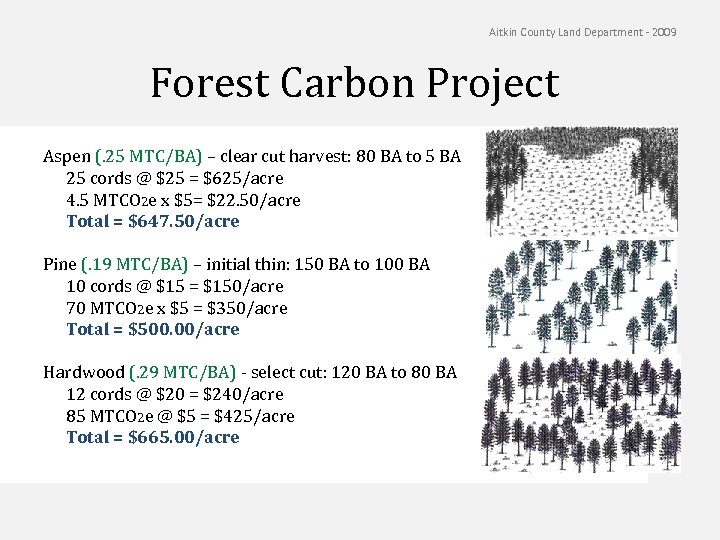
Aitkin County Land Department - 2009 Forest Carbon Project Aspen (. 25 MTC/BA) – clear cut harvest: 80 BA to 5 BA 25 cords @ $25 = $625/acre 4. 5 MTCO 2 e x $5= $22. 50/acre Total = $647. 50/acre Pine (. 19 MTC/BA) – initial thin: 150 BA to 100 BA 10 cords @ $15 = $150/acre 70 MTCO 2 e x $5 = $350/acre Total = $500. 00/acre Hardwood (. 29 MTC/BA) - select cut: 120 BA to 80 BA 12 cords @ $20 = $240/acre 85 MTCO 2 e @ $5 = $425/acre Total = $665. 00/acre
3/15/2018 www. dovetailinc. org Results & Findings - Need for common baseline approach and/or regionally appropriate approved methodology for “improved forest management” projects
Forest Project Types • Improved Forest Management – Implementation of activities that increase forest-based sequestration and/or decrease emissions • Reforestation – Less than 10% canopy cover for at least 10 years, or following a significant natural disturbance that has removed at least 20% of the trees • Avoided Conversion – Removing a significant conversion threat to non-forest use and dedicating the forest to continued forest cover.
Reforestation Projects • Credits based on sequestered carbon from reforestation project tree growth over time • Baseline is simulated future characterization of carbon stocks without reforestation activity • Project allowed if project land base has undergone significant natural disturbance and the landowner is not required by law to reforest or if land has been out of forest cover for at least 10 years • Economic evaluation required to determine that reforestation activity would not have otherwise occurred for projects following natural disturbance
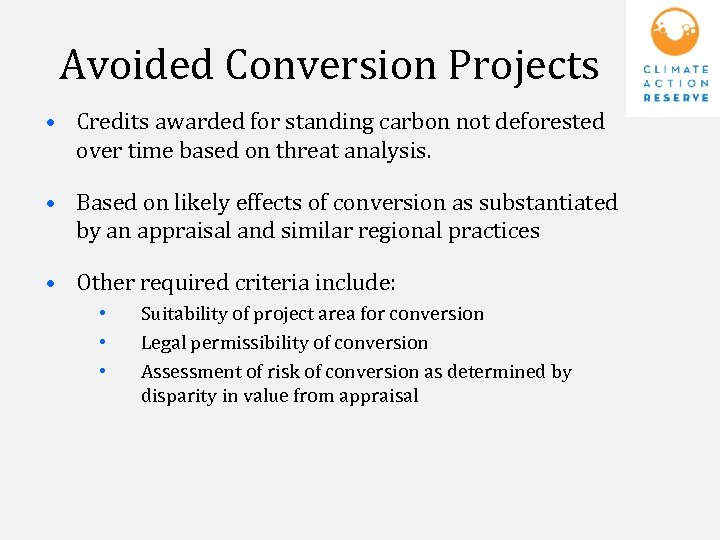
Avoided Conversion Projects • Credits awarded for standing carbon not deforested over time based on threat analysis. • Based on likely effects of conversion as substantiated by an appraisal and similar regional practices • Other required criteria include: • • • Suitability of project area for conversion Legal permissibility of conversion Assessment of risk of conversion as determined by disparity in value from appraisal
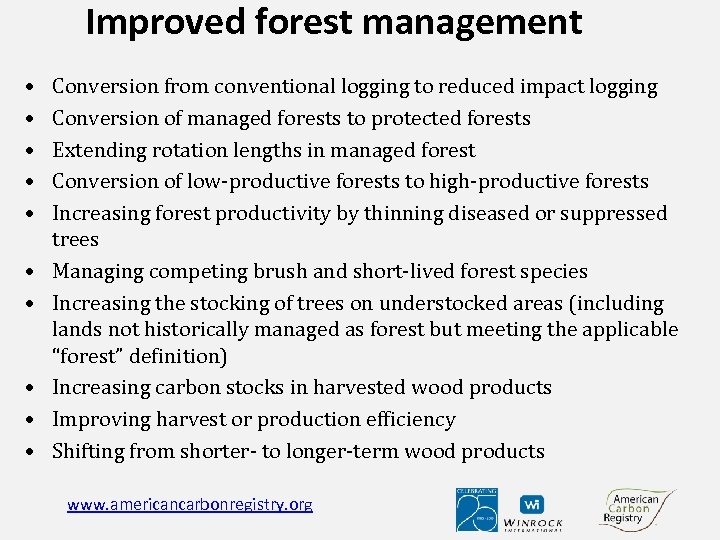
Improved forest management • • • Conversion from conventional logging to reduced impact logging Conversion of managed forests to protected forests Extending rotation lengths in managed forest Conversion of low-productive forests to high-productive forests Increasing forest productivity by thinning diseased or suppressed trees Managing competing brush and short-lived forest species Increasing the stocking of trees on understocked areas (including lands not historically managed as forest but meeting the applicable “forest” definition) Increasing carbon stocks in harvested wood products Improving harvest or production efficiency Shifting from shorter- to longer-term wood products www. americancarbonregistry. org
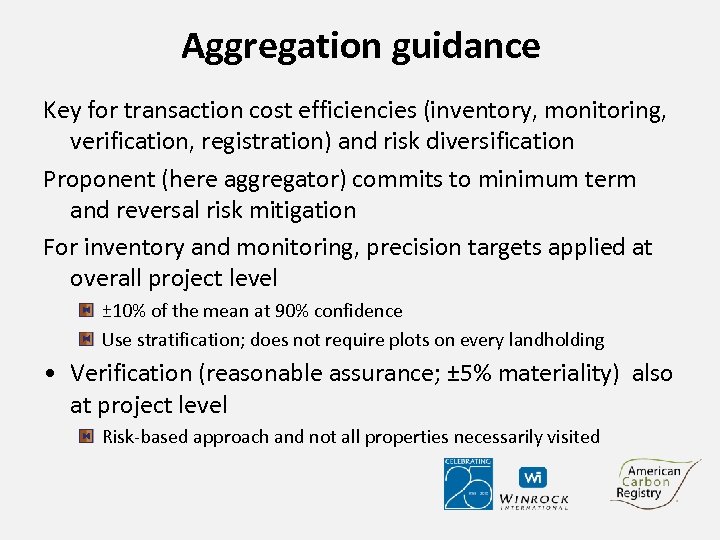
Aggregation guidance Key for transaction cost efficiencies (inventory, monitoring, verification, registration) and risk diversification Proponent (here aggregator) commits to minimum term and reversal risk mitigation For inventory and monitoring, precision targets applied at overall project level ± 10% of the mean at 90% confidence Use stratification; does not require plots on every landholding • Verification (reasonable assurance; ± 5% materiality) also at project level Risk-based approach and not all properties necessarily visited
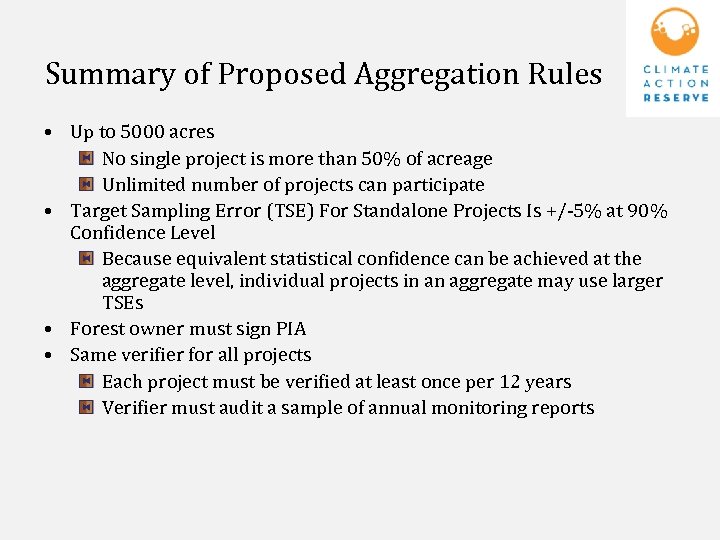
Summary of Proposed Aggregation Rules • Up to 5000 acres No single project is more than 50% of acreage Unlimited number of projects can participate • Target Sampling Error (TSE) For Standalone Projects Is +/-5% at 90% Confidence Level Because equivalent statistical confidence can be achieved at the aggregate level, individual projects in an aggregate may use larger TSEs • Forest owner must sign PIA • Same verifier for all projects Each project must be verified at least once per 12 years Verifier must audit a sample of annual monitoring reports

3/15/2018 www. dovetailinc. org One more consideration….
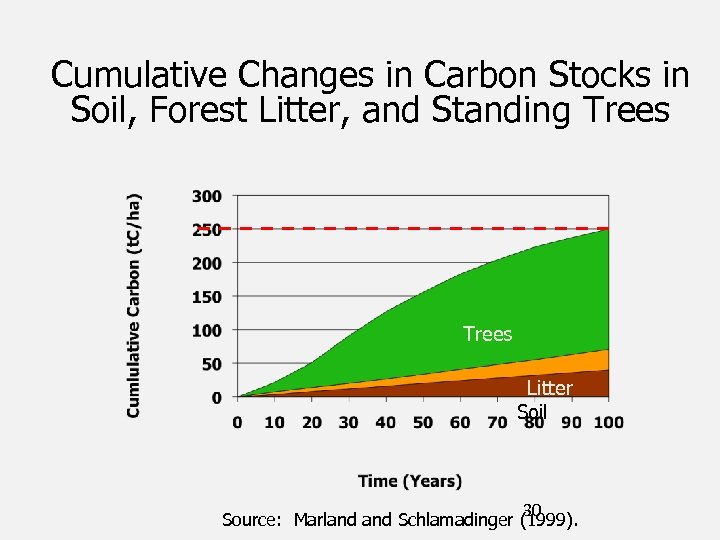
Cumulative Changes in Carbon Stocks in Soil, Forest Litter, and Standing Trees Litter Soil 30 Source: Marland Schlamadinger (1999).
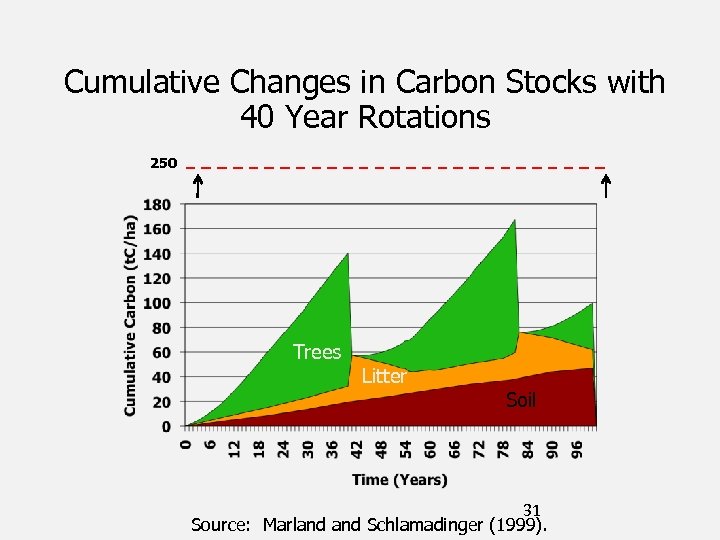
Cumulative Changes in Carbon Stocks with 40 Year Rotations 250 Trees Litter Soil 31 Source: Marland Schlamadinger (1999).
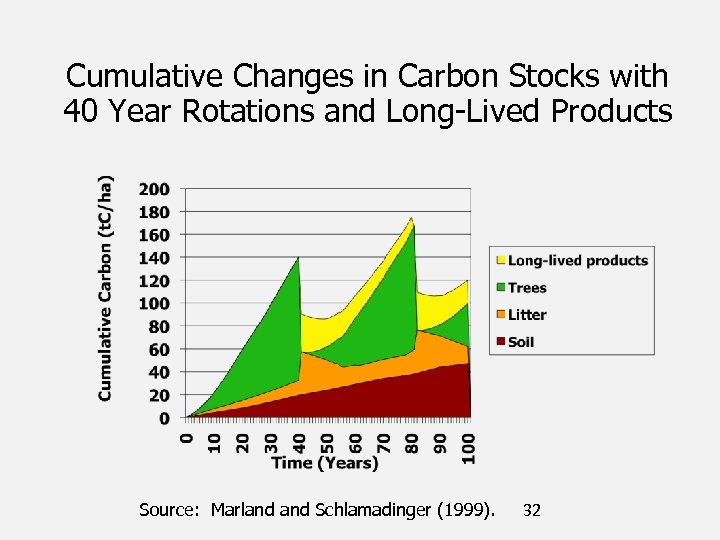
Cumulative Changes in Carbon Stocks with 40 Year Rotations and Long-Lived Products Source: Marland Schlamadinger (1999). 32
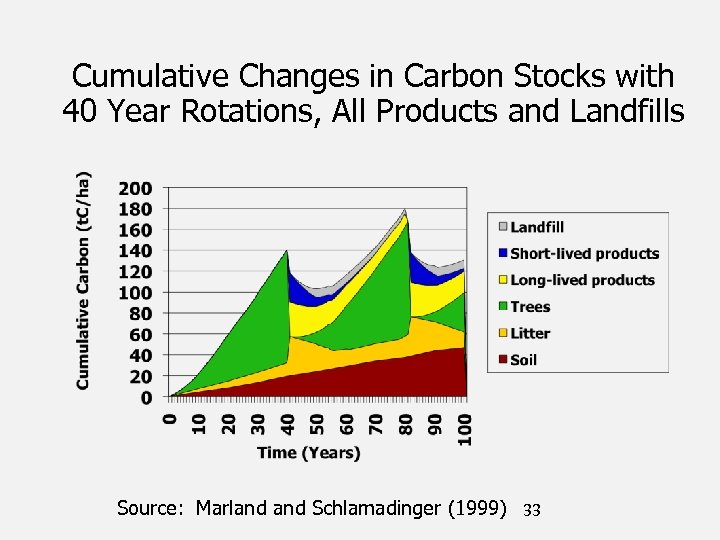
Cumulative Changes in Carbon Stocks with 40 Year Rotations, All Products and Landfills Source: Marland Schlamadinger (1999) 33
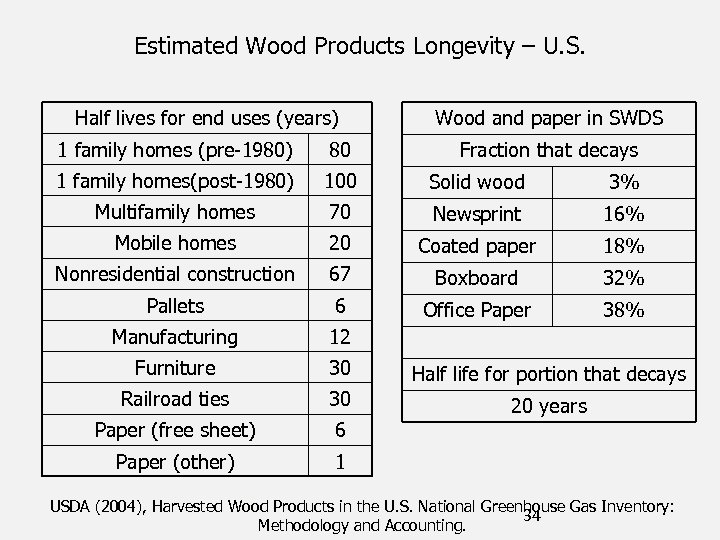
Estimated Wood Products Longevity – U. S. Half lives for end uses (years) Wood and paper in SWDS 1 family homes (pre-1980) 80 1 family homes(post-1980) 100 Solid wood 3% Multifamily homes 70 Newsprint 16% Mobile homes 20 Coated paper 18% Nonresidential construction 67 Boxboard 32% Pallets 6 Office Paper 38% Manufacturing 12 Furniture 30 Half life for portion that decays Railroad ties 30 Paper (free sheet) 6 20 years Paper (other) 1 Fraction that decays USDA (2004), Harvested Wood Products in the U. S. National Greenhouse Gas Inventory: 34 Methodology and Accounting.
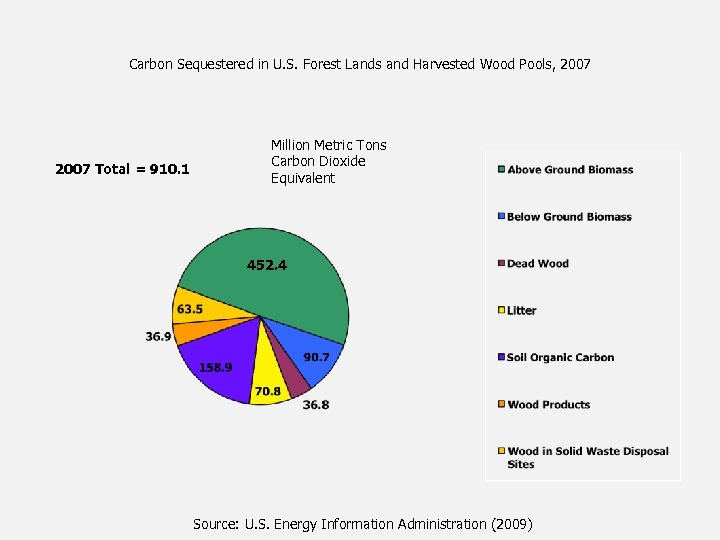
Carbon Sequestered in U. S. Forest Lands and Harvested Wood Pools, 2007 Total = 910. 1 Million Metric Tons Carbon Dioxide Equivalent 452. 4 Source: U. S. Energy Information Administration (2009)
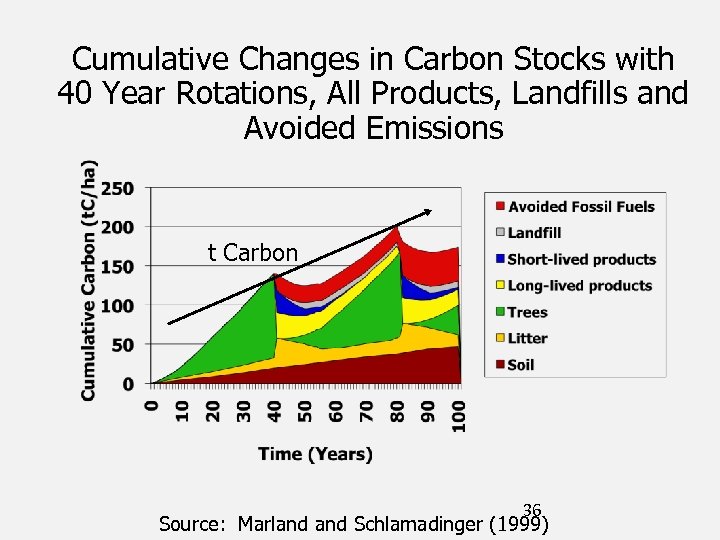
Cumulative Changes in Carbon Stocks with 40 Year Rotations, All Products, Landfills and Avoided Emissions t Carbon 36 Source: Marland Schlamadinger (1999)
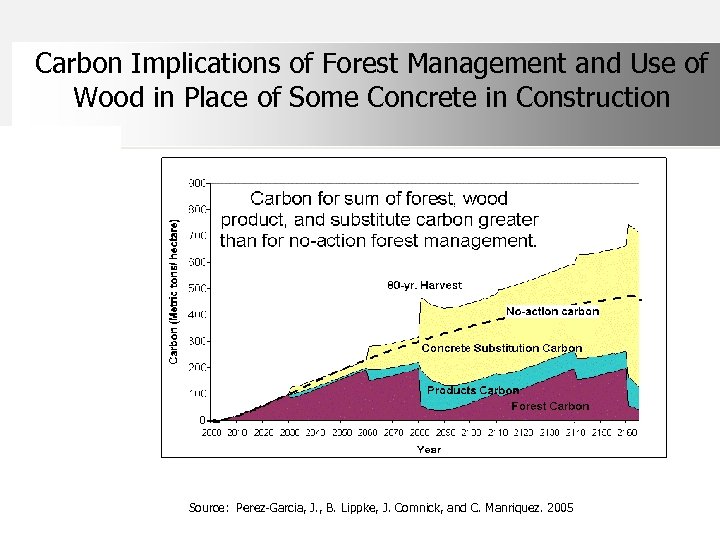
Carbon Implications of Forest Management and Use of Wood in Place of Some Concrete in Construction Source: Perez-Garcia, J. , B. Lippke, J. Comnick, and C. Manriquez. 2005 37
Accounting for Carbon in Harvested Wood Products Within the CAR Program • Determine the amount of carbon in harvested wood products delivered to mills. • Account for mill efficiencies. • Determine quantity of carbon contained within long-lived products. • Estimate average carbon storage over 100 -year period in products in use for various product categories. • Estimate average carbon storage over 100 -year period in landfills for various product categories.
3/15/2018 www. dovetailinc. org . . and that’s not all! • Water Quality Ecosystem Services • Water Quality Trading for addressing point and nonpoint source pollution (nutrients, sediments, temperature, bacteria, heavy metals, storm water flows) • Stream Mitigation Banking (stream channel, banks, buffers, hydrology) • Wetland Mitigation Banks • Conservation Banks (endangered species habitat) Source: http: //www. pca. state. mn. us/water-permits-and-rules/water-rulemaking/water-quality-trading-rule-development. html#trading http: //www. pca. state. mn. us/index. php? option =com_docman&task=doc_download&gid=10268&Itemid=
3/15/2018 A Strategic Future www. dovetailinc. org Requirements for developing an ecosystem market: 1) Define the ecosystem service, 2) Measure the service, 3) Pay for and invest in the service The MFL Program is compatible with existing carbon standards and aggregator structures Opportunities exist for carbon credits for improved forest management, tree planting, avoided conversion, wood products, etc. Opportunities exist for water quality and habitat services Projects can be developed under existing protocols or with project-specific, state, or regionally developed methodologies
3/15/2018 www. dovetailinc. org Questions? Dovetail Reports: Wood Products and Carbon Protocols: Carbon Storage and Low Energy Intensity Should Be Considered Ecosystem Markets: New Mechanisms to Support Forestry www. dovetailinc. org Dovetail Partners, 612 -333 -0430, info@dovetailinc. org
Скачать презентацию 3 15 2018 www dovetailinc org Carbon Credits Ecosystem
326ea9af06795f0fc32196435de5ff4f.ppt