 Скачать презентацию 3 1 sterile neutrino Nu Fact Jacobo López Pavón IFT
26a05148dd6b55ad6c9ff71af2772222.ppt
- Количество слайдов: 45



3+1 sterile neutrino @Nu. Fact Jacobo López–Pavón IFT UAM/CSIC Nu. Flavour Coseners House, Abingdon, UK 8 -10 June, 2009
Based on a collaboration with: Andrea Donini, Ken-ichi Fuki, Davide Meloni and Osamu Yasuda e-Print: [ar. Xiv: 0812. 3703]
Motivations • Neutrino masses and mixing → evidence of Physics Beyond the SM • Sterile neutrinos strongly affect the oscillation physics • This is what LSND seems to indicate: the existence of a fourth sterile neutrino, much heavier than the rest light neutrinos. • Experiments such as Mini. Boone do not confirm the LSND results. • Difficult to accommodate all oscillation data including LSND in 4 neutrino models. Tension remains in 3+2 and 3+3 models.
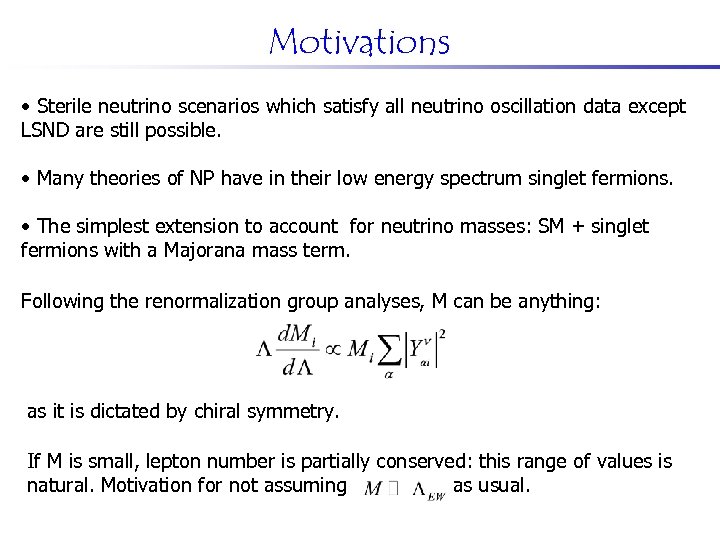
Motivations • Sterile neutrino scenarios which satisfy all neutrino oscillation data except LSND are still possible. • Many theories of NP have in their low energy spectrum singlet fermions. • The simplest extension to account for neutrino masses: SM + singlet fermions with a Majorana mass term. Following the renormalization group analyses, M can be anything: as it is dictated by chiral symmetry. If M is small, lepton number is partially conserved: this range of values is natural. Motivation for not assuming as usual.
Goals We will analyze the future sensitivity to the new parameters associated to the 3+1 sterile model in a Nu. Fact, without imposing LSND constraints but considering the information from the rest of present experiments. Study of CP violation in the context of sterile neutrino
Set-up • 50 Ge. V Nu. Fact useful muon decays/year/baseline Hybrid-MIND detectors @ L=3000 km and L=7500 km Both polarities running for 4 years each 4 kton MECC + 50 kton MIND VS • 20 Ge. V Nu. Fact (ISS scenario) useful muon decays/year/baseline Hybrid-MIND detectors @ L=4000 km and L=7500 km Both polarities running for 4 years each 4 kton MECC + 50 kton MIND
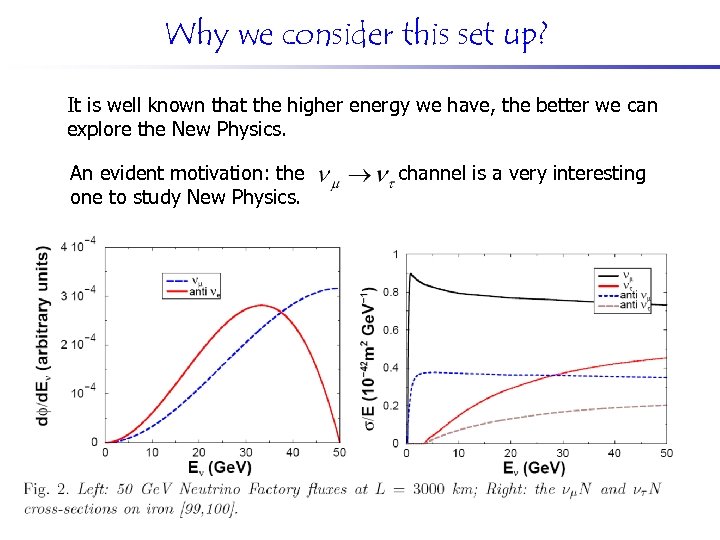
Why we consider this set up? It is well known that the higher energy we have, the better we can explore the New Physics. An evident motivation: the one to study New Physics. channel is a very interesting
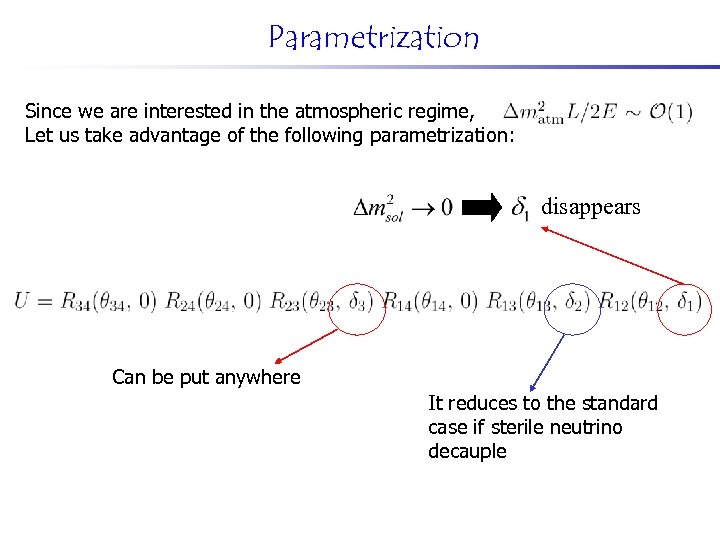
Parametrization Since we are interested in the atmospheric regime, Let us take advantage of the following parametrization: , disappears Can be put anywhere It reduces to the standard case if sterile neutrino decauple
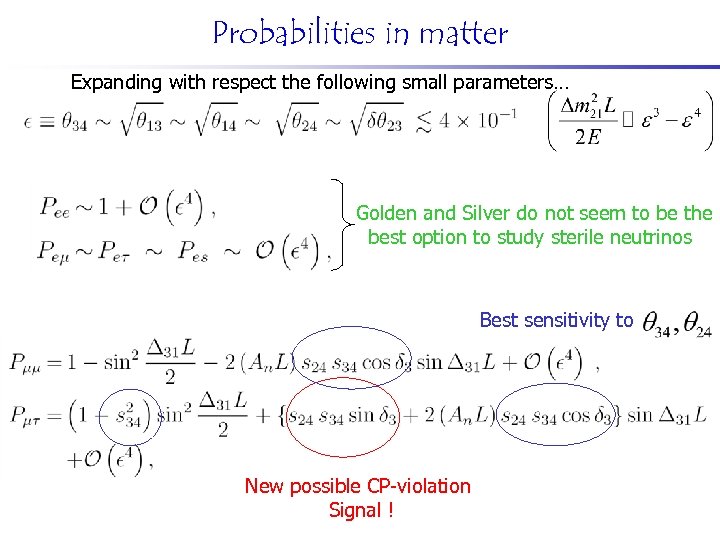
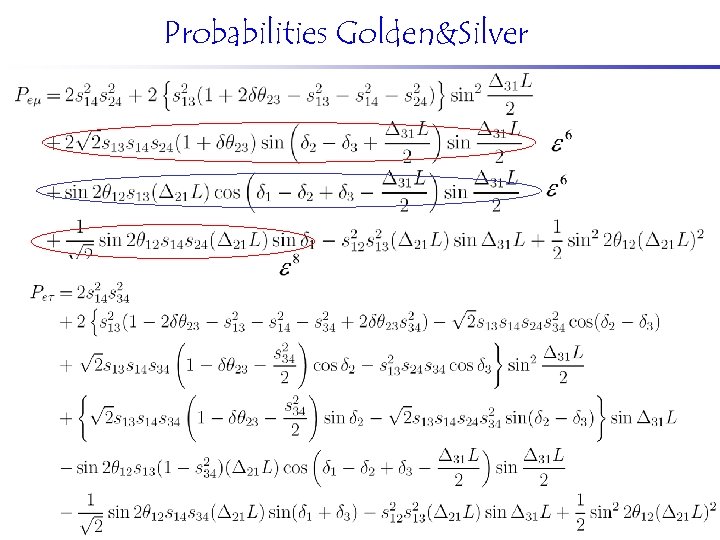
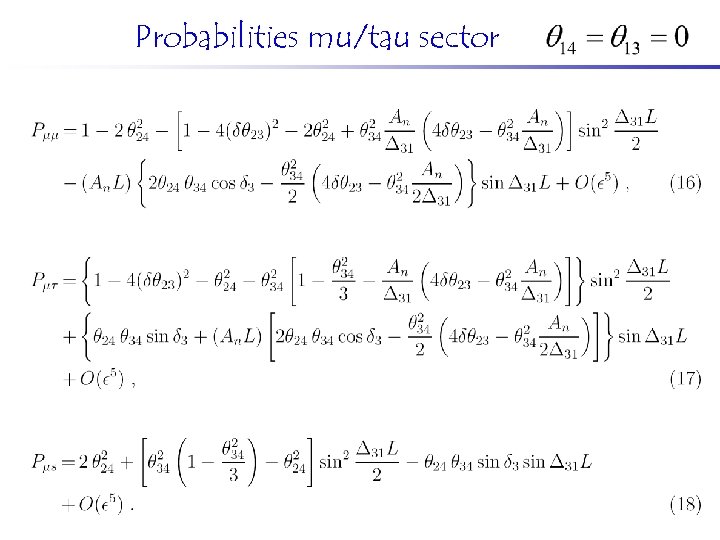
Probabilities in matter Expanding with respect the following small parameters… Golden and Silver do not seem to be the best option to study sterile neutrinos Best sensitivity to New possible CP-violation Signal !
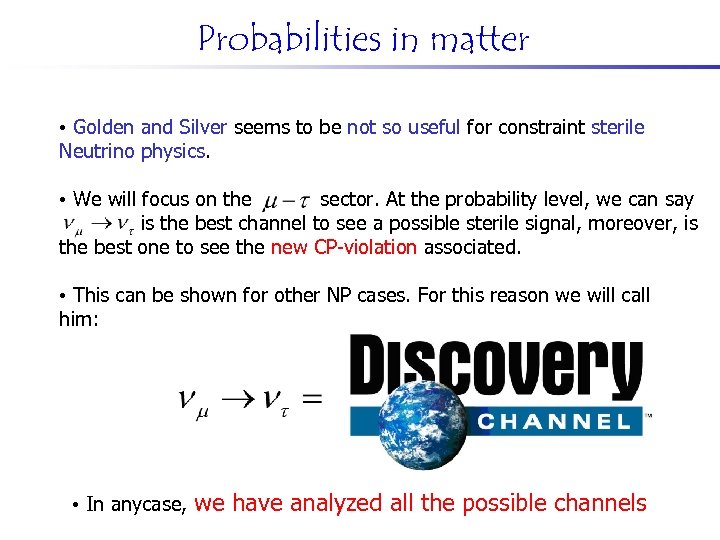
Probabilities in matter • Golden and Silver seems to be not so useful for constraint sterile Neutrino physics. • We will focus on the sector. At the probability level, we can say is the best channel to see a possible sterile signal, moreover, is the best one to see the new CP-violation associated. • This can be shown for other NP cases. For this reason we will call him: • In anycase, we have analyzed all the possible channels
Sensitivities
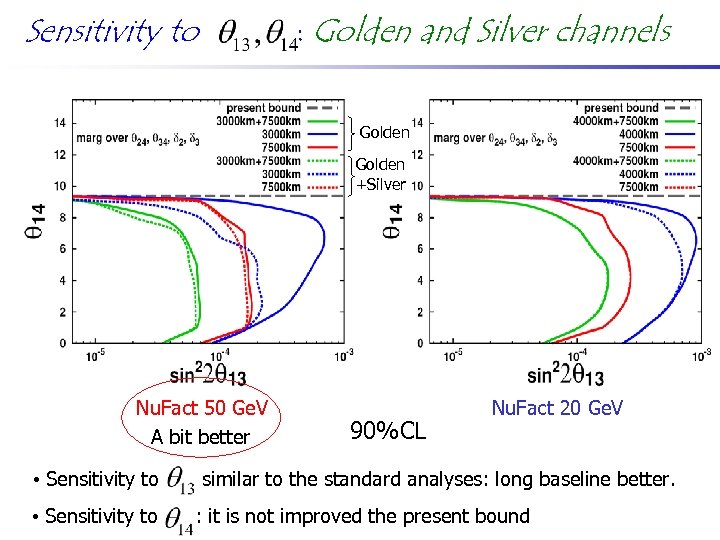
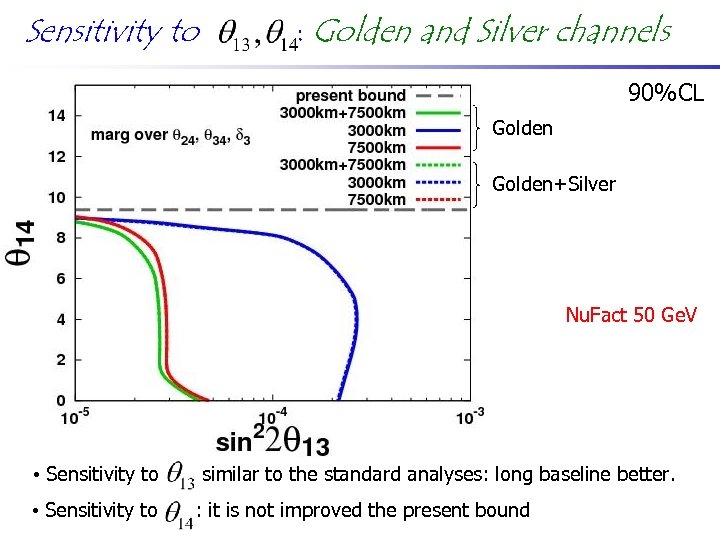
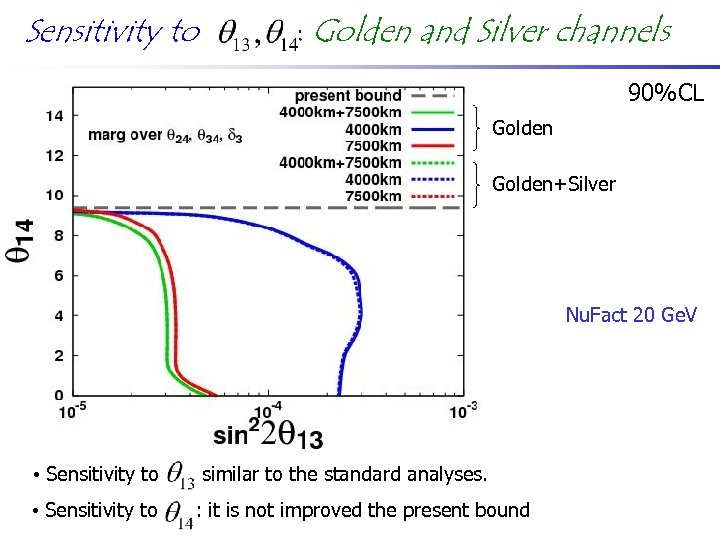
Sensitivity to : Golden and Silver channels Golden +Silver Nu. Fact 50 Ge. V A bit better • Sensitivity to 90%CL Nu. Fact 20 Ge. V similar to the standard analyses: long baseline better. : it is not improved the present bound
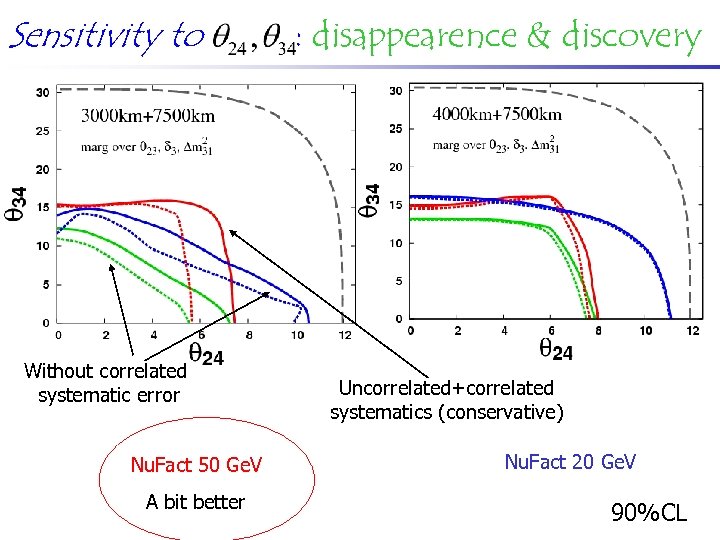
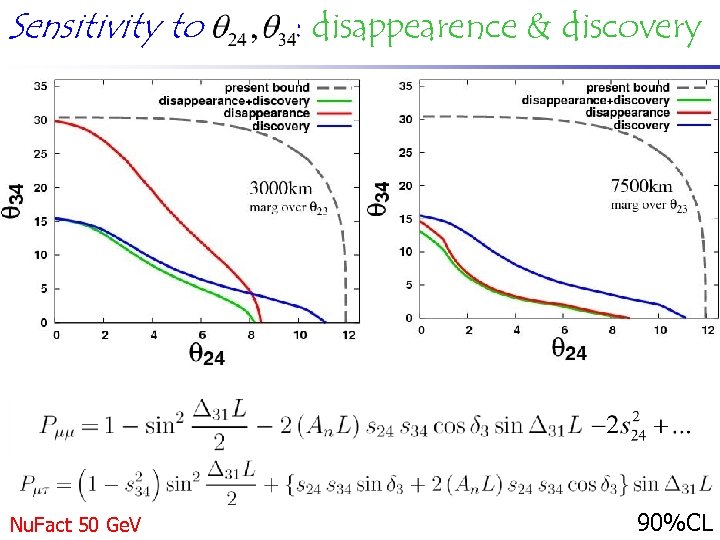
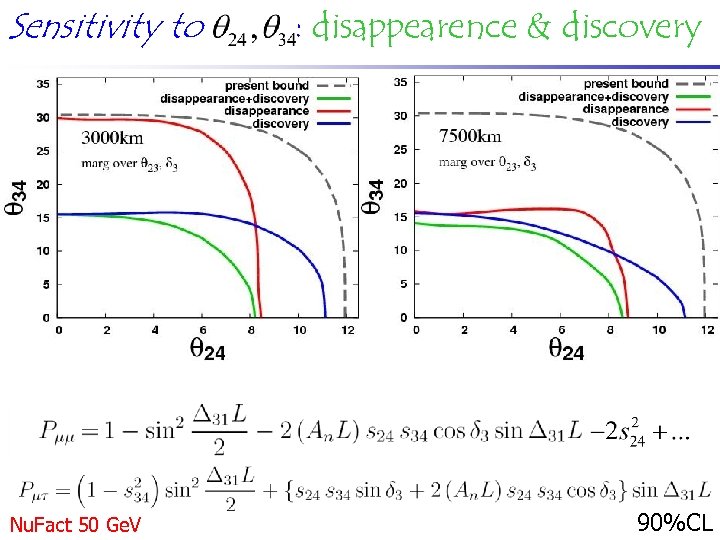
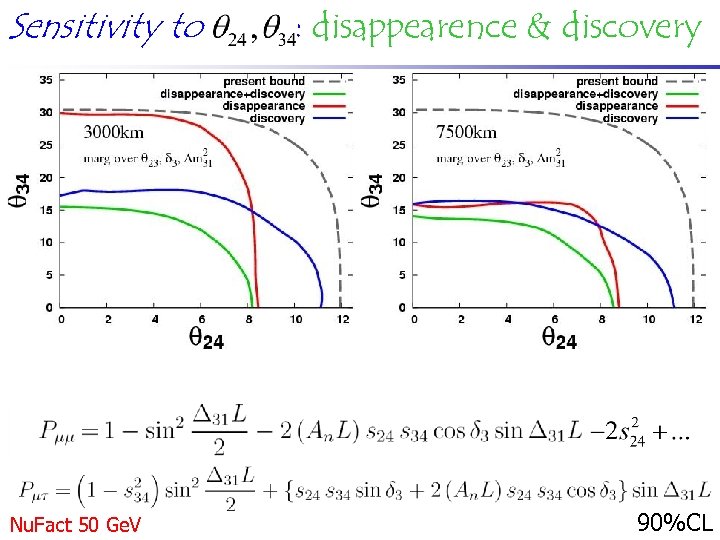
Sensitivity to Without correlated systematic error Nu. Fact 50 Ge. V A bit better : disappearence & discovery Uncorrelated+correlated systematics (conservative) Nu. Fact 20 Ge. V 90%CL
Signals
Could we measure the new phases ?
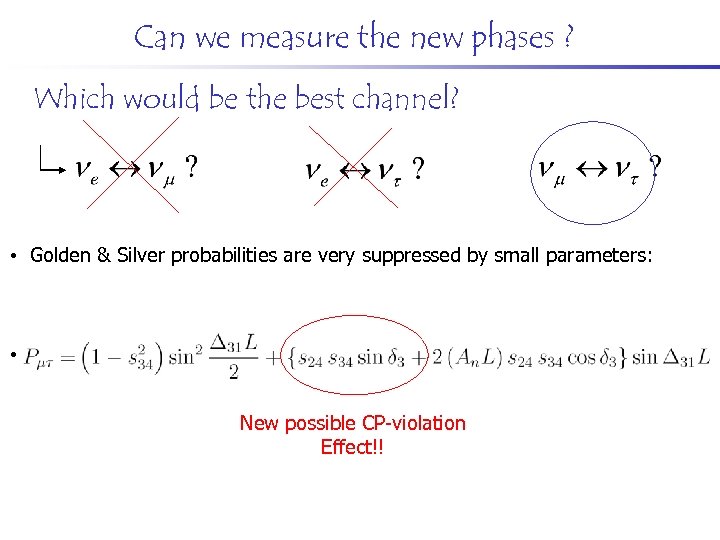
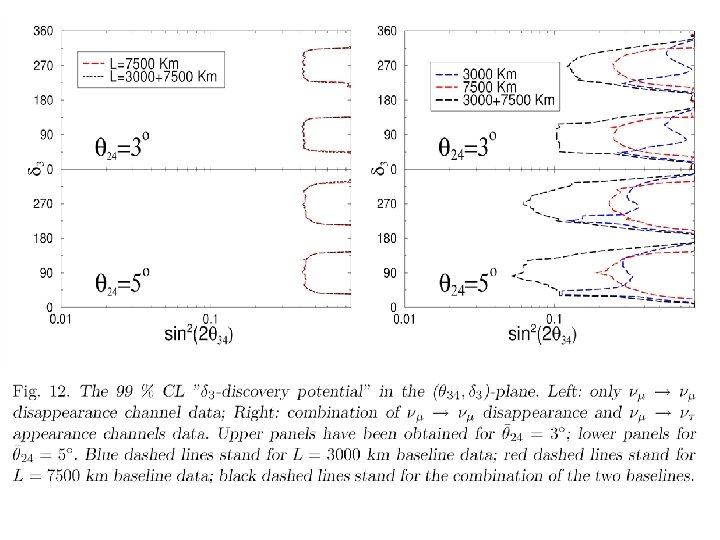
Can we measure the new phases ? Which would be the best channel? • Golden & Silver probabilities are very suppressed by small parameters: • New possible CP-violation Effect!!
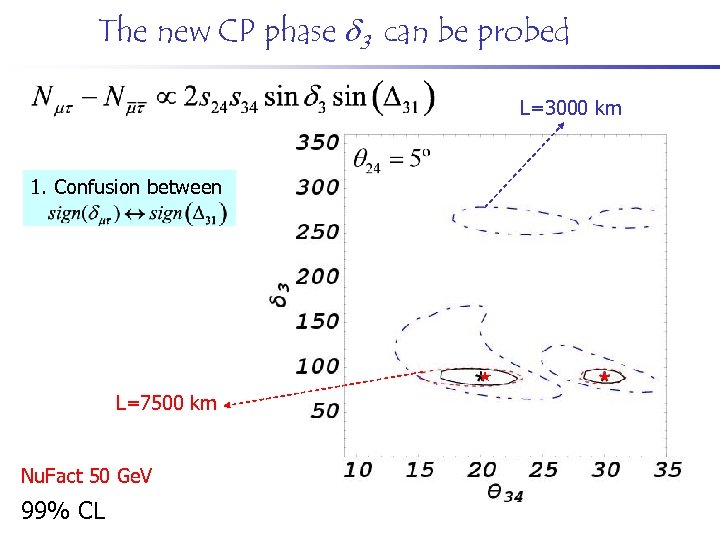
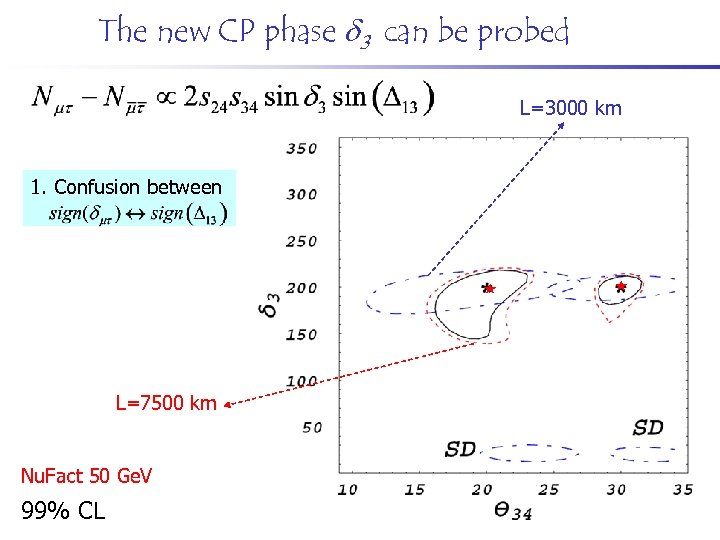
The new CP phase 3 can be probed L=3000 km 1. Confusion between L=7500 km Nu. Fact 50 Ge. V 99% CL
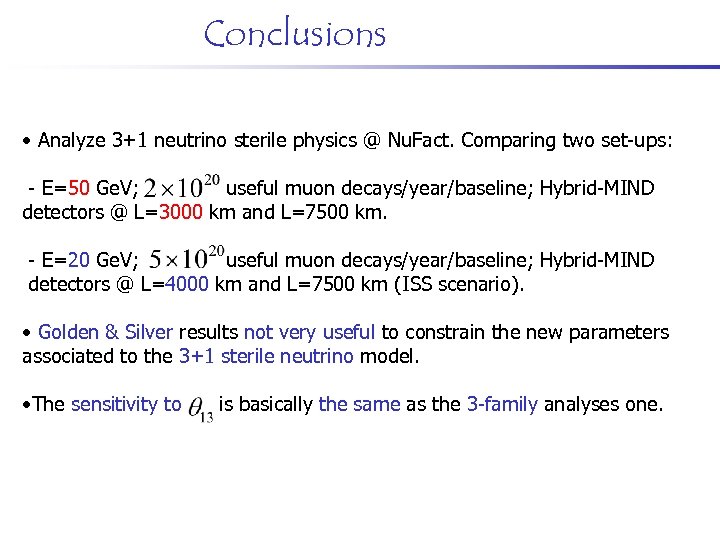
Conclusions • Analyze 3+1 neutrino sterile physics @ Nu. Fact. Comparing two set-ups: - E=50 Ge. V; useful muon decays/year/baseline; Hybrid-MIND detectors @ L=3000 km and L=7500 km. - E=20 Ge. V; useful muon decays/year/baseline; Hybrid-MIND detectors @ L=4000 km and L=7500 km (ISS scenario). • Golden & Silver results not very useful to constrain the new parameters associated to the 3+1 sterile neutrino model. • The sensitivity to is basically the same as the 3 -family analyses one.
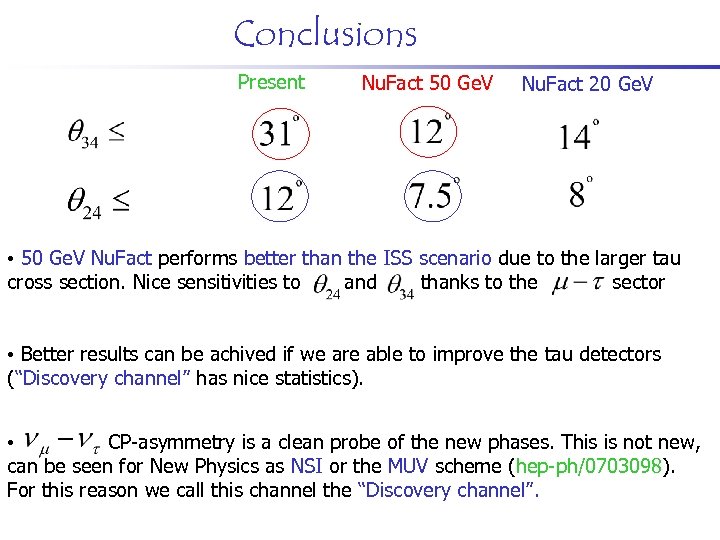
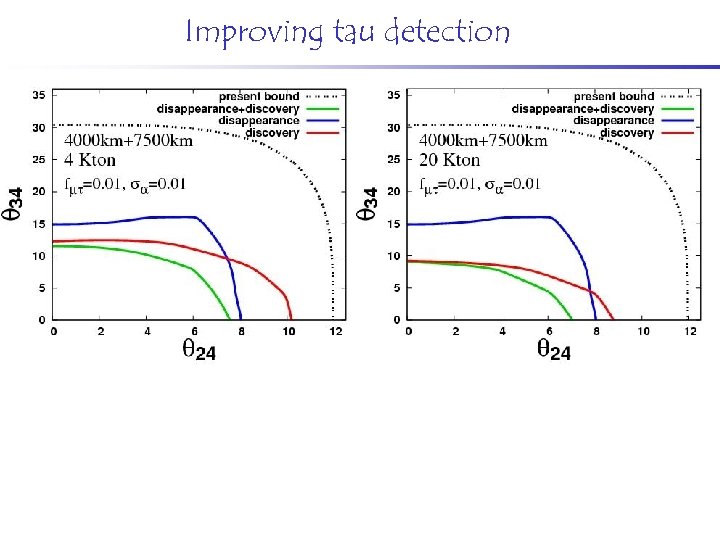
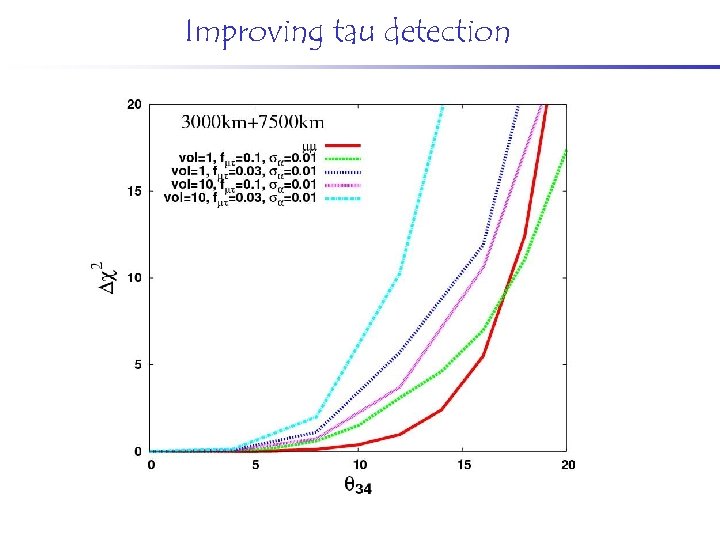
Conclusions Present Nu. Fact 50 Ge. V Nu. Fact 20 Ge. V • 50 Ge. V Nu. Fact performs better than the ISS scenario due to the larger tau cross section. Nice sensitivities to and thanks to the sector • Better results can be achived if we are able to improve the tau detectors (“Discovery channel” has nice statistics). • CP-asymmetry is a clean probe of the new phases. This is not new, can be seen for New Physics as NSI or the MUV scheme (hep-ph/0703098). For this reason we call this channel the “Discovery channel”.

Back-up slides
Probabilities Golden&Silver
The new CP phase 3 can be probed L=3000 km 1. Confusion between L=7500 km Nu. Fact 50 Ge. V 99% CL
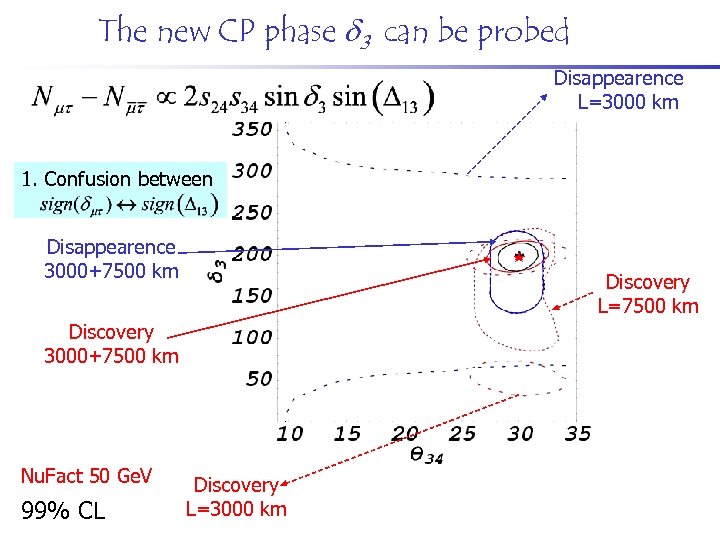
The new CP phase 3 can be probed Disappearence L=3000 km 1. Confusion between Disappearence 3000+7500 km Discovery L=7500 km Discovery 3000+7500 km Nu. Fact 50 Ge. V 99% CL Discovery L=3000 km
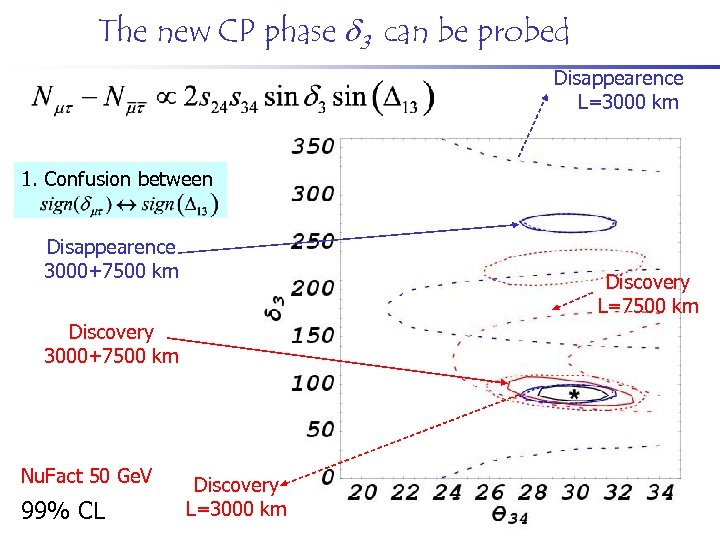
The new CP phase 3 can be probed Disappearence L=3000 km 1. Confusion between Disappearence 3000+7500 km Discovery L=7500 km Discovery 3000+7500 km Nu. Fact 50 Ge. V 99% CL Discovery L=3000 km
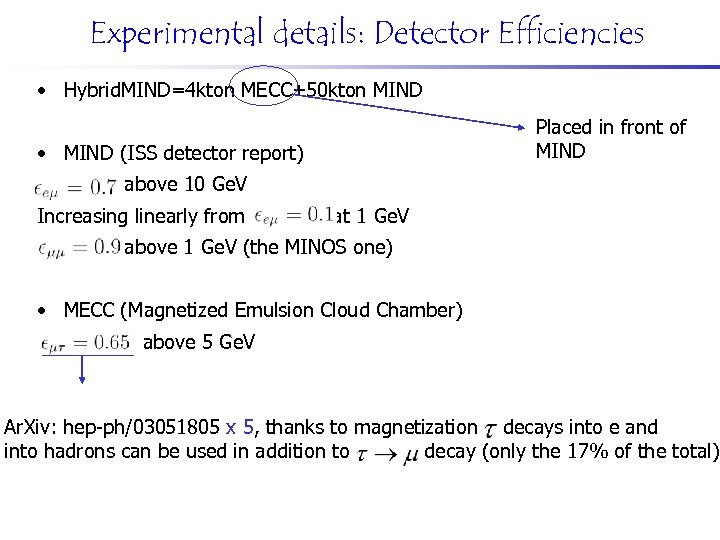
Experimental details: Detector Efficiencies • Hybrid. MIND=4 kton MECC+50 kton MIND Placed in front of MIND • MIND (ISS detector report) above 10 Ge. V Increasing linearly from at 1 Ge. V above 1 Ge. V (the MINOS one) • MECC (Magnetized Emulsion Cloud Chamber) above 5 Ge. V Ar. Xiv: hep-ph/03051805 x 5, thanks to magnetization decays into e and into hadrons can be used in addition to decay (only the 17% of the total)
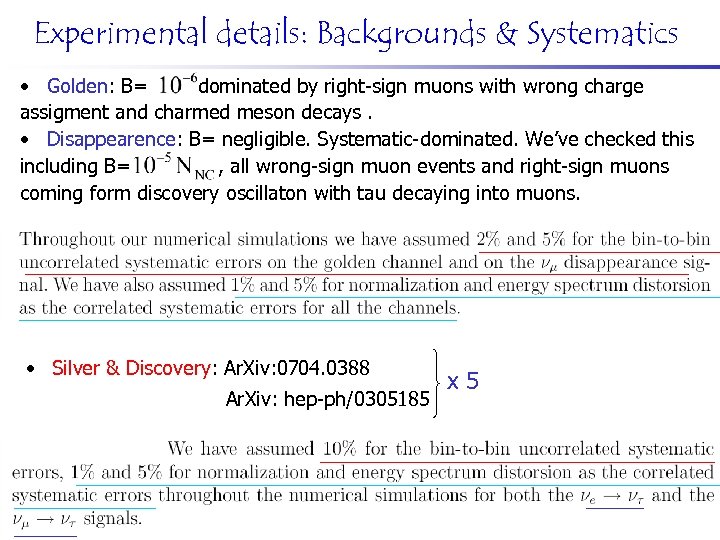
Experimental details: Backgrounds & Systematics • Golden: B= dominated by right-sign muons with wrong charge assigment and charmed meson decays. • Disappearence: B= negligible. Systematic-dominated. We’ve checked this including B= , all wrong-sign muon events and right-sign muons coming form discovery oscillaton with tau decaying into muons. • Silver & Discovery: Ar. Xiv: 0704. 0388 Ar. Xiv: hep-ph/0305185 x 5
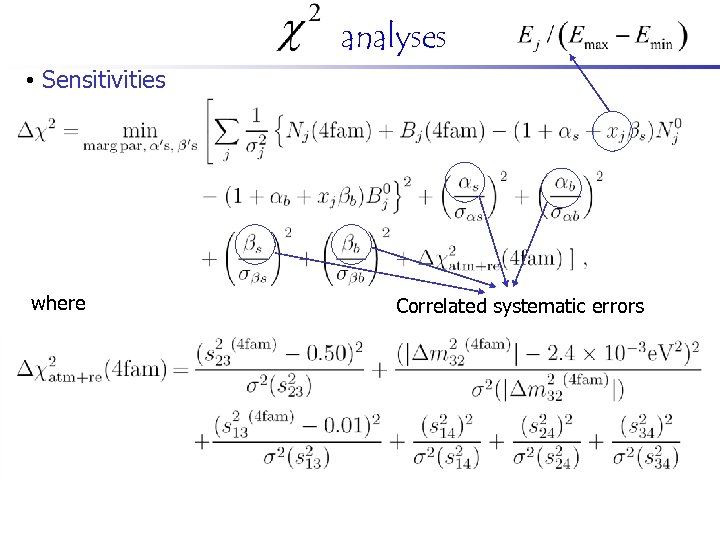
analyses • Sensitivities where Correlated systematic errors
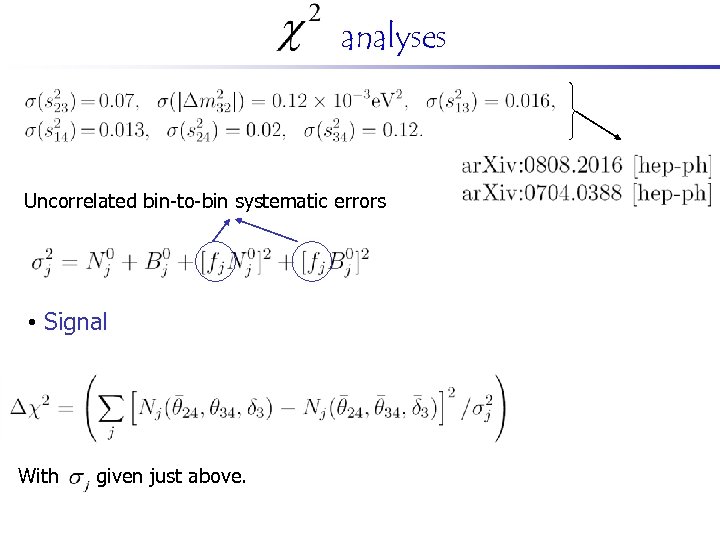
analyses Uncorrelated bin-to-bin systematic errors • Signal With given just above.
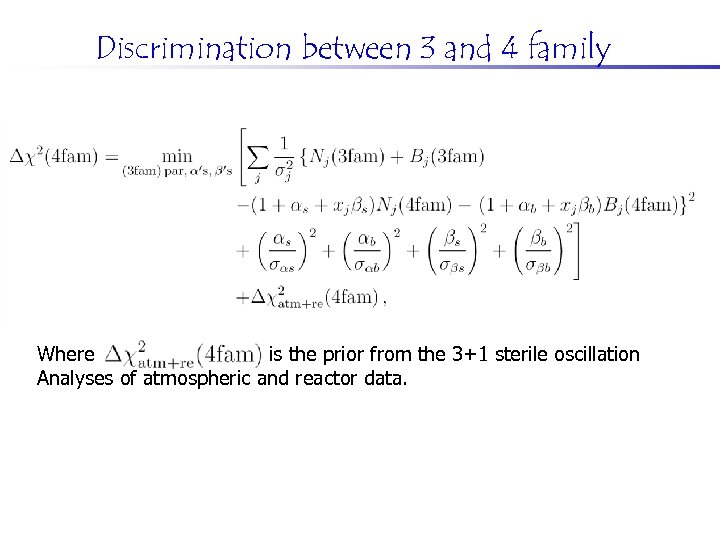
Discrimination between 3 and 4 family Where is the prior from the 3+1 sterile oscillation Analyses of atmospheric and reactor data.
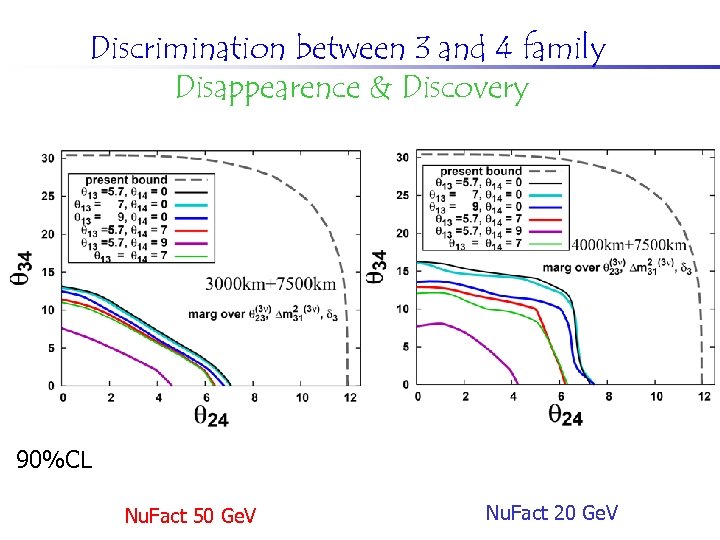
Discrimination between 3 and 4 family Disappearence & Discovery 90%CL Nu. Fact 50 Ge. V Nu. Fact 20 Ge. V
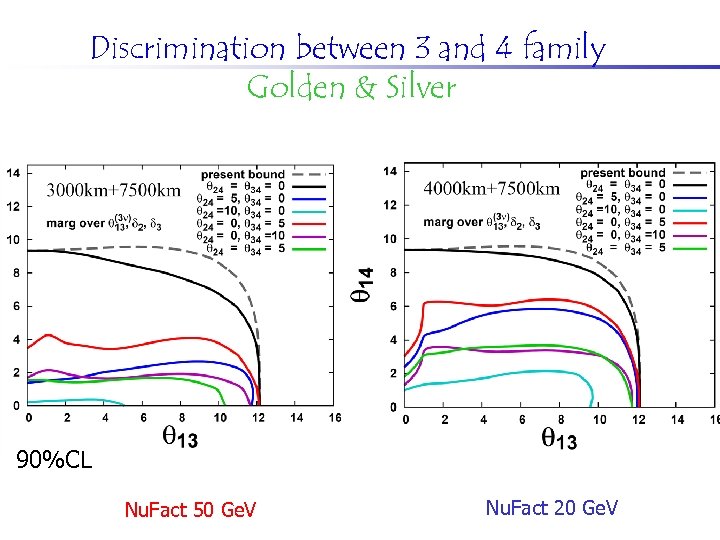
Discrimination between 3 and 4 family Golden & Silver 90%CL Nu. Fact 50 Ge. V Nu. Fact 20 Ge. V
Can the measurement of the 3 -family Dirac phase be affected by the sterile neutrinos ?
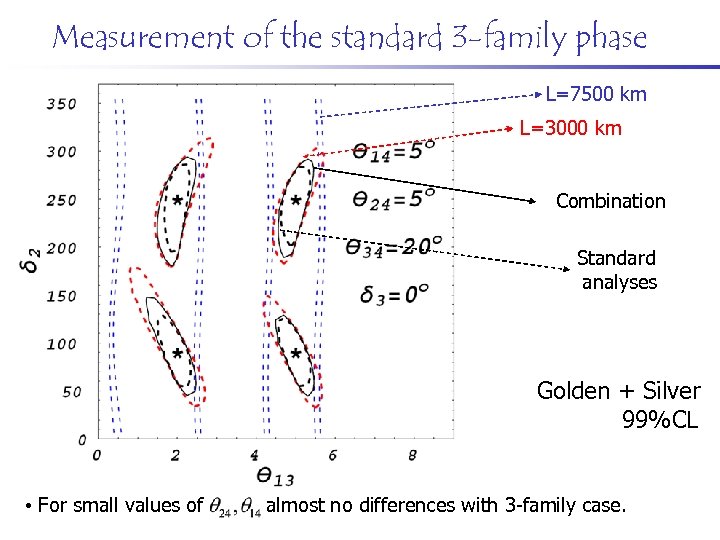
Measurement of the standard 3 -family phase L=7500 km L=3000 km Combination Standard analyses Golden + Silver 99%CL • For small values of almost no differences with 3 -family case.
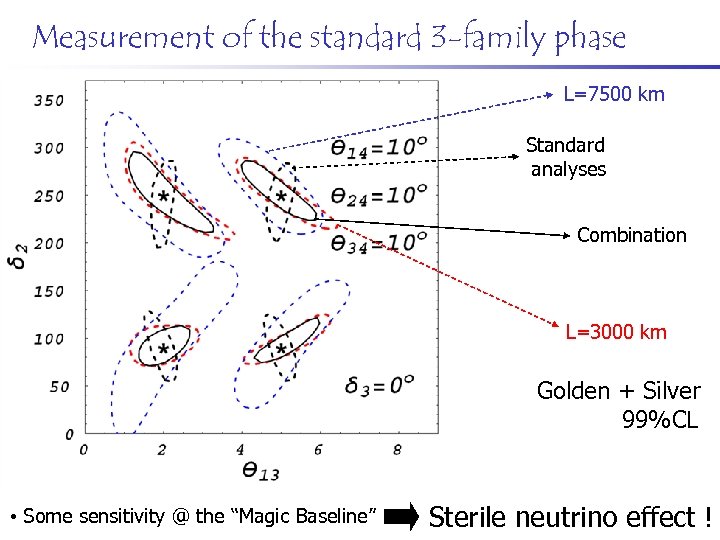
Measurement of the standard 3 -family phase L=7500 km Standard analyses Combination L=3000 km Golden + Silver 99%CL • Some sensitivity @ the “Magic Baseline” Sterile neutrino effect !
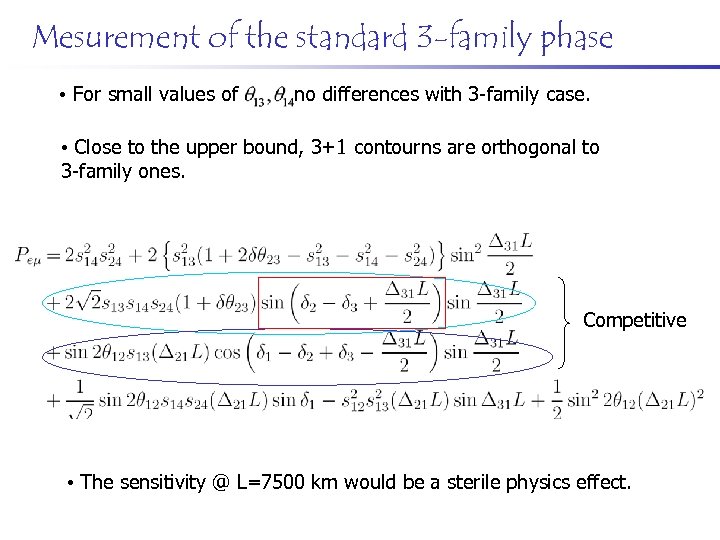
Mesurement of the standard 3 -family phase • For small values of no differences with 3 -family case. • Close to the upper bound, 3+1 contourns are orthogonal to 3 -family ones. Competitive • The sensitivity @ L=7500 km would be a sterile physics effect.
Sensitivity to Nu. Fact 50 Ge. V : disappearence & discovery 90%CL
Sensitivity to Nu. Fact 50 Ge. V : disappearence & discovery 90%CL
Sensitivity to Nu. Fact 50 Ge. V : disappearence & discovery 90%CL
Probabilities mu/tau sector
Improving tau detection
Improving tau detection
Sensitivity to : Golden and Silver channels 90%CL Golden+Silver Nu. Fact 50 Ge. V • Sensitivity to similar to the standard analyses: long baseline better. : it is not improved the present bound
Sensitivity to : Golden and Silver channels 90%CL Golden+Silver Nu. Fact 20 Ge. V • Sensitivity to similar to the standard analyses. : it is not improved the present bound
Скачать презентацию 3 1 sterile neutrino Nu Fact Jacobo López Pavón IFT
26a05148dd6b55ad6c9ff71af2772222.ppt