 Скачать презентацию 27 th October 2009 Aircraft Operational Fuel Savings
70a742907daea65149e8b2562d866d26.ppt
- Количество слайдов: 55



27 th October 2009 “Aircraft Operational Fuel Savings & Noise Reduction - Past and Future” Captain Hugh DIBLEY MICLT, FRIN, FRAe. S DDCL & Royal Aeronautical Society CEAS 2009 27 Oct 09 – Hugh DIBLEY : “Aircraft Operational Fuel Savings & Noise Reduction - Past and Future” 1 /55
1. 2. 3. 4. 5. 6. 7. 8. 9. 10. 11. 12. 13. 14. 15. Lecture Summary Simplified Aircraft Flight Profile – for a Single Aircraft Efficiency Loss as ATC must Separate Aircraft then Merge to Land Pre-Flight Planning – Cost of Carrying Extra Fuel on the Sector Departure Noise Abatement Procedures Cruise - Fuel Savings & Crew Situational Awareness Descent – Large opportunity for Fuel Savings Approach – Large opportunity for Fuel Savings & Noise Reduction Steep Approaches – to reduce noise? Crews’ Ability to Save Fuel/Time by Choosing Approach & Runway Past Examples of Operational Fuel Savings Possible Future Operational Fuel Savings “Future” ATM Fuel Savings Being Achieved NOW – USA “Future” ATM Fuel Savings Being Achieved NOW - Europe Accidents which Need NOT have Happened Conclusion CEAS 2009 27 Oct 09 – Hugh DIBLEY : “Aircraft Operational Fuel Savings & Noise Reduction - Past and Future” 2 /55
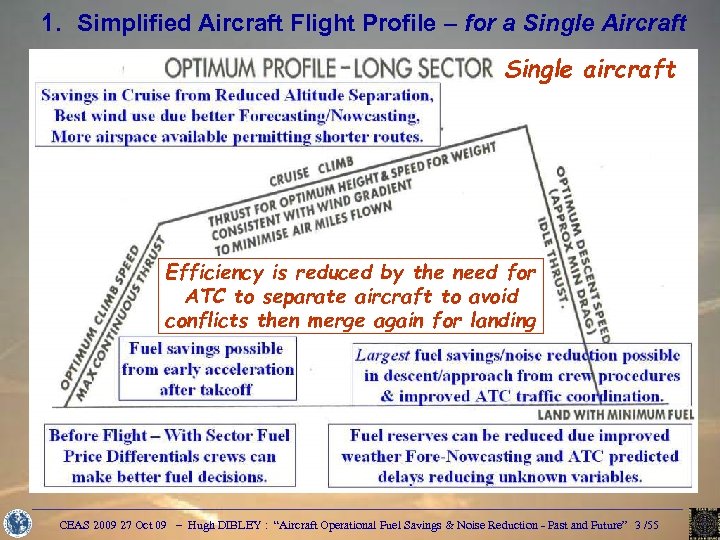
1. Simplified Aircraft Flight Profile – for a Single Aircraft Single aircraft Efficiency is reduced by the need for ATC to separate aircraft to avoid conflicts then merge again for landing CEAS 2009 27 Oct 09 – Hugh DIBLEY : “Aircraft Operational Fuel Savings & Noise Reduction - Past and Future” 3 /55
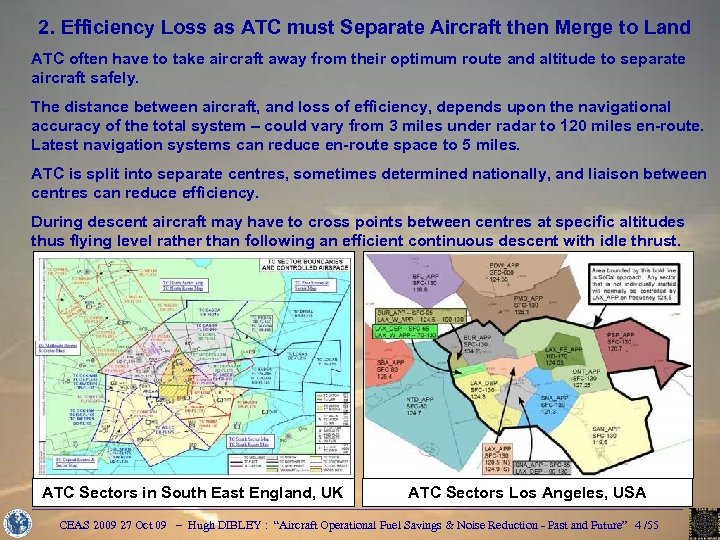
2. Efficiency Loss as ATC must Separate Aircraft then Merge to Land ATC often have to take aircraft away from their optimum route and altitude to separate aircraft safely. The distance between aircraft, and loss of efficiency, depends upon the navigational accuracy of the total system – could vary from 3 miles under radar to 120 miles en-route. Latest navigation systems can reduce en-route space to 5 miles. ATC is split into separate centres, sometimes determined nationally, and liaison between centres can reduce efficiency. During descent aircraft may have to cross points between centres at specific altitudes thus flying level rather than following an efficient continuous descent with idle thrust. ATC Sectors in South East England, UK ATC Sectors Los Angeles, USA CEAS 2009 27 Oct 09 – Hugh DIBLEY : “Aircraft Operational Fuel Savings & Noise Reduction - Past and Future” 4 /55
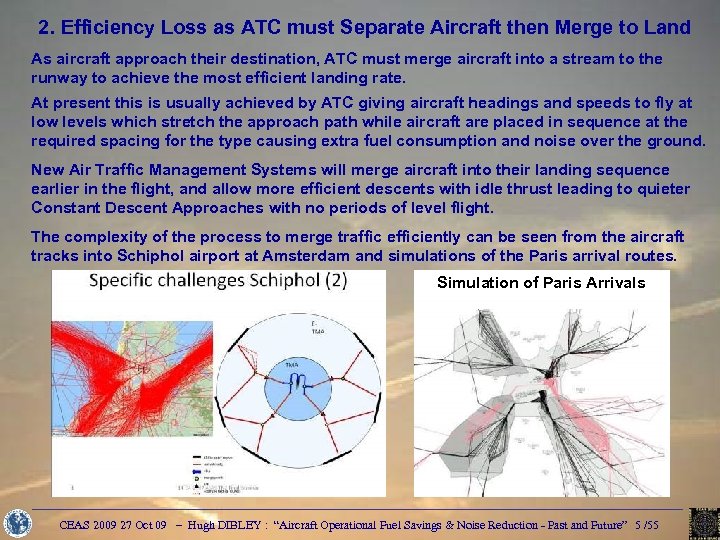
2. Efficiency Loss as ATC must Separate Aircraft then Merge to Land As aircraft approach their destination, ATC must merge aircraft into a stream to the runway to achieve the most efficient landing rate. At present this is usually achieved by ATC giving aircraft headings and speeds to fly at low levels which stretch the approach path while aircraft are placed in sequence at the required spacing for the type causing extra fuel consumption and noise over the ground. New Air Traffic Management Systems will merge aircraft into their landing sequence earlier in the flight, and allow more efficient descents with idle thrust leading to quieter Constant Descent Approaches with no periods of level flight. The complexity of the process to merge traffic efficiently can be seen from the aircraft tracks into Schiphol airport at Amsterdam and simulations of the Paris arrival routes. Simulation of Paris Arrivals CEAS 2009 27 Oct 09 – Hugh DIBLEY : “Aircraft Operational Fuel Savings & Noise Reduction - Past and Future” 5 /55
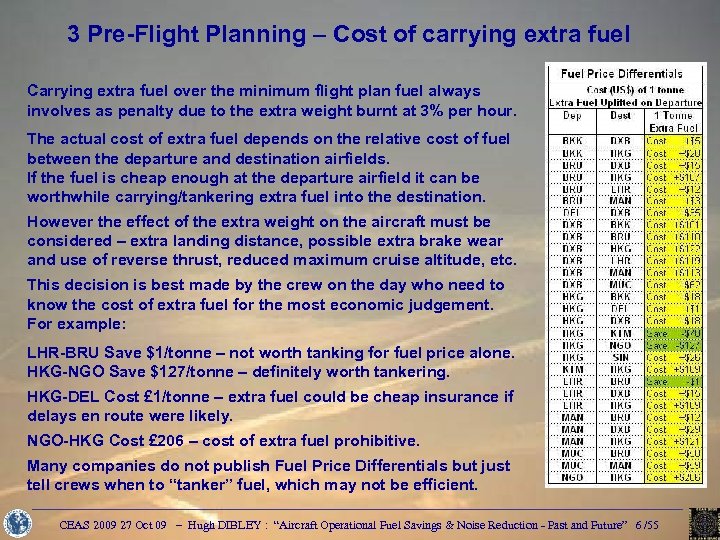
3 Pre-Flight Planning – Cost of carrying extra fuel Carrying extra fuel over the minimum flight plan fuel always involves as penalty due to the extra weight burnt at 3% per hour. The actual cost of extra fuel depends on the relative cost of fuel between the departure and destination airfields. If the fuel is cheap enough at the departure airfield it can be worthwhile carrying/tankering extra fuel into the destination. However the effect of the extra weight on the aircraft must be considered – extra landing distance, possible extra brake wear and use of reverse thrust, reduced maximum cruise altitude, etc. This decision is best made by the crew on the day who need to know the cost of extra fuel for the most economic judgement. For example: LHR-BRU Save $1/tonne – not worth tanking for fuel price alone. HKG-NGO Save $127/tonne – definitely worth tankering. HKG-DEL Cost £ 1/tonne – extra fuel could be cheap insurance if delays en route were likely. NGO-HKG Cost £ 206 – cost of extra fuel prohibitive. Many companies do not publish Fuel Price Differentials but just tell crews when to “tanker” fuel, which may not be efficient. CEAS 2009 27 Oct 09 – Hugh DIBLEY : “Aircraft Operational Fuel Savings & Noise Reduction - Past and Future” 6 /55
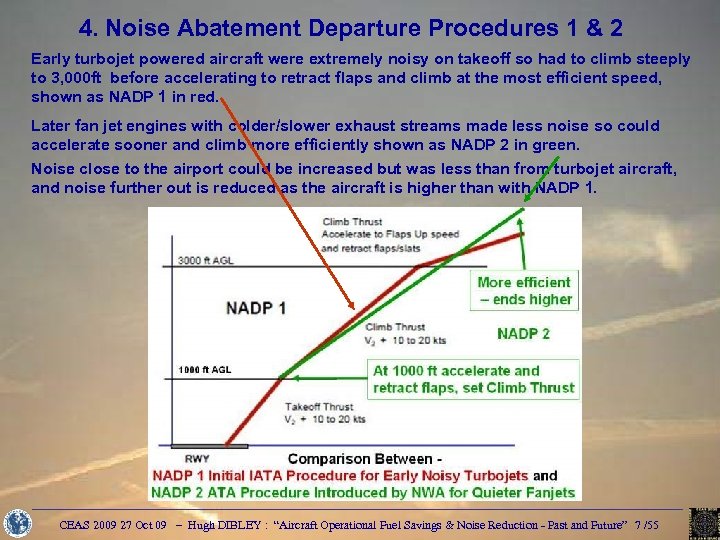
4. Noise Abatement Departure Procedures 1 & 2 Early turbojet powered aircraft were extremely noisy on takeoff so had to climb steeply to 3, 000 ft before accelerating to retract flaps and climb at the most efficient speed, shown as NADP 1 in red. Later fan jet engines with colder/slower exhaust streams made less noise so could accelerate sooner and climb more efficiently shown as NADP 2 in green. Noise close to the airport could be increased but was less than from turbojet aircraft, and noise further out is reduced as the aircraft is higher than with NADP 1. CEAS 2009 27 Oct 09 – Hugh DIBLEY : “Aircraft Operational Fuel Savings & Noise Reduction - Past and Future” 7 /55
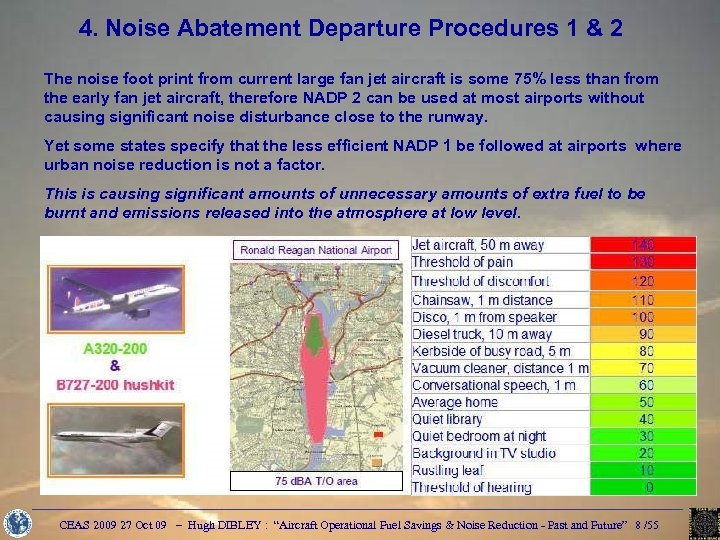
4. Noise Abatement Departure Procedures 1 & 2 The noise foot print from current large fan jet aircraft is some 75% less than from the early fan jet aircraft, therefore NADP 2 can be used at most airports without causing significant noise disturbance close to the runway. Yet some states specify that the less efficient NADP 1 be followed at airports where urban noise reduction is not a factor. This is causing significant amounts of unnecessary amounts of extra fuel to be burnt and emissions released into the atmosphere at low level. CEAS 2009 27 Oct 09 – Hugh DIBLEY : “Aircraft Operational Fuel Savings & Noise Reduction - Past and Future” 8 /55
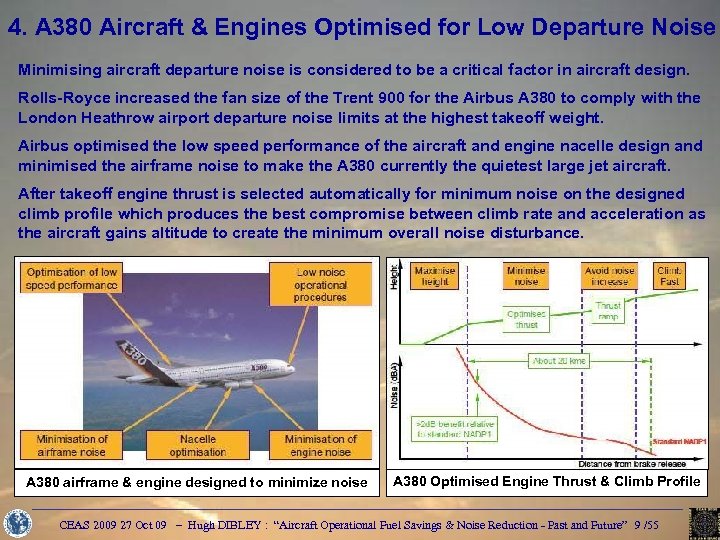
4. A 380 Aircraft & Engines Optimised for Low Departure Noise Minimising aircraft departure noise is considered to be a critical factor in aircraft design. Rolls-Royce increased the fan size of the Trent 900 for the Airbus A 380 to comply with the London Heathrow airport departure noise limits at the highest takeoff weight. Airbus optimised the low speed performance of the aircraft and engine nacelle design and minimised the airframe noise to make the A 380 currently the quietest large jet aircraft. After takeoff engine thrust is selected automatically for minimum noise on the designed climb profile which produces the best compromise between climb rate and acceleration as the aircraft gains altitude to create the minimum overall noise disturbance. A 380 airframe & engine designed to minimize noise A 380 Optimised Engine Thrust & Climb Profile CEAS 2009 27 Oct 09 – Hugh DIBLEY : “Aircraft Operational Fuel Savings & Noise Reduction - Past and Future” 9 /55
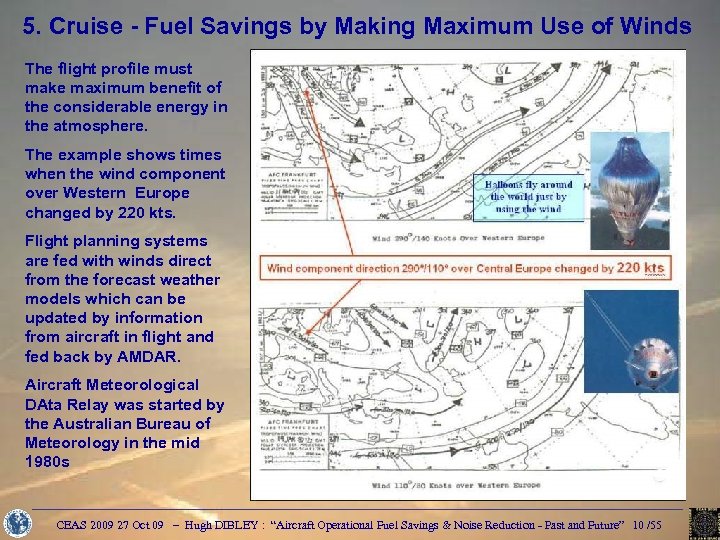
5. Cruise - Fuel Savings by Making Maximum Use of Winds The flight profile must make maximum benefit of the considerable energy in the atmosphere. The example shows times when the wind component over Western Europe changed by 220 kts. Flight planning systems are fed with winds direct from the forecast weather models which can be updated by information from aircraft in flight and fed back by AMDAR. Aircraft Meteorological DAta Relay was started by the Australian Bureau of Meteorology in the mid 1980 s CEAS 2009 27 Oct 09 – Hugh DIBLEY : “Aircraft Operational Fuel Savings & Noise Reduction - Past and Future” 10 /55
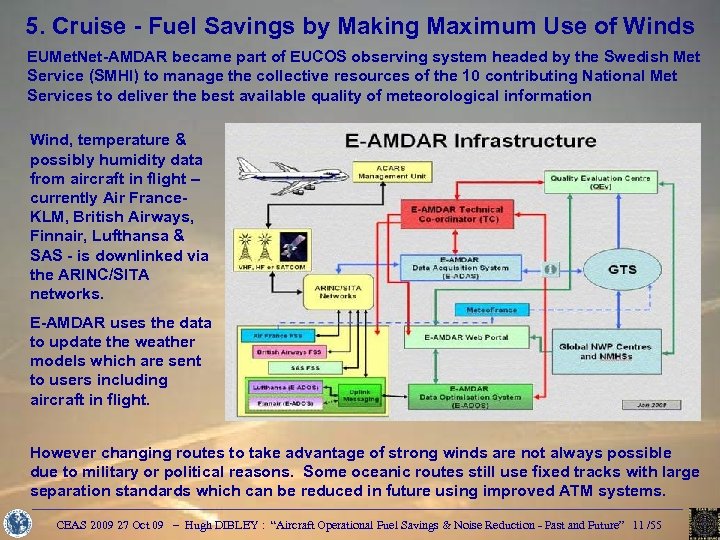
5. Cruise - Fuel Savings by Making Maximum Use of Winds EUMet. Net-AMDAR became part of EUCOS observing system headed by the Swedish Met Service (SMHI) to manage the collective resources of the 10 contributing National Met Services to deliver the best available quality of meteorological information Wind, temperature & possibly humidity data from aircraft in flight – currently Air France. KLM, British Airways, Finnair, Lufthansa & SAS - is downlinked via the ARINC/SITA networks. E-AMDAR uses the data to update the weather models which are sent to users including aircraft in flight. However changing routes to take advantage of strong winds are not always possible due to military or political reasons. Some oceanic routes still use fixed tracks with large separation standards which can be reduced in future using improved ATM systems. CEAS 2009 27 Oct 09 – Hugh DIBLEY : “Aircraft Operational Fuel Savings & Noise Reduction - Past and Future” 11 /55
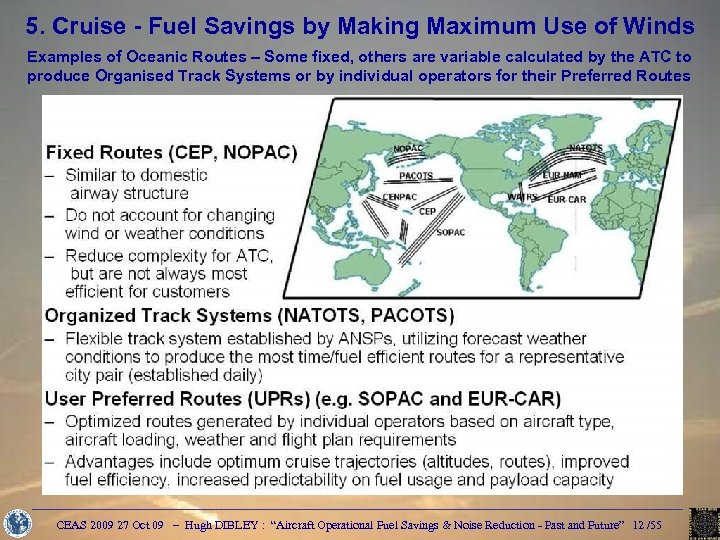
5. Cruise - Fuel Savings by Making Maximum Use of Winds Examples of Oceanic Routes – Some fixed, others are variable calculated by the ATC to produce Organised Track Systems or by individual operators for their Preferred Routes CEAS 2009 27 Oct 09 – Hugh DIBLEY : “Aircraft Operational Fuel Savings & Noise Reduction - Past and Future” 12 /55
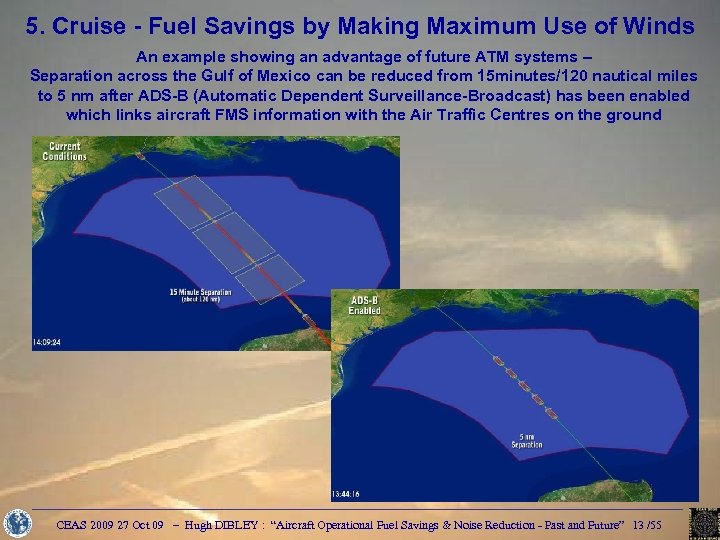
5. Cruise - Fuel Savings by Making Maximum Use of Winds An example showing an advantage of future ATM systems – Separation across the Gulf of Mexico can be reduced from 15 minutes/120 nautical miles to 5 nm after ADS-B (Automatic Dependent Surveillance-Broadcast) has been enabled which links aircraft FMS information with the Air Traffic Centres on the ground CEAS 2009 27 Oct 09 – Hugh DIBLEY : “Aircraft Operational Fuel Savings & Noise Reduction - Past and Future” 13 /55
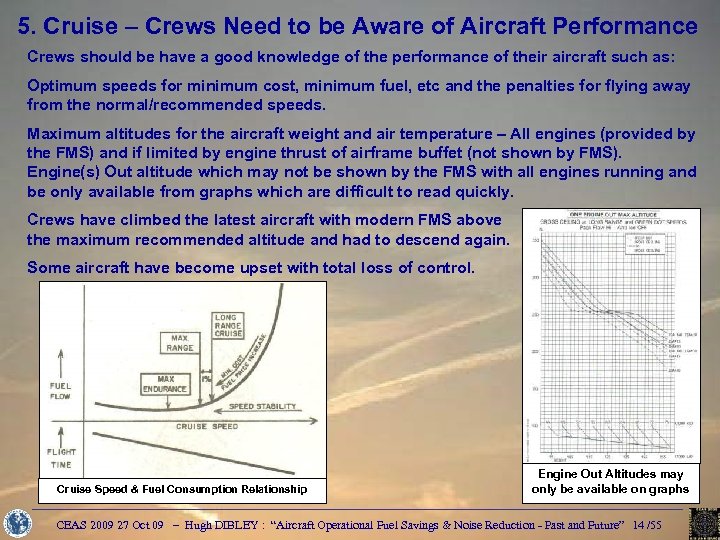
5. Cruise – Crews Need to be Aware of Aircraft Performance Crews should be have a good knowledge of the performance of their aircraft such as: Optimum speeds for minimum cost, minimum fuel, etc and the penalties for flying away from the normal/recommended speeds. Maximum altitudes for the aircraft weight and air temperature – All engines (provided by the FMS) and if limited by engine thrust of airframe buffet (not shown by FMS). Engine(s) Out altitude which may not be shown by the FMS with all engines running and be only available from graphs which are difficult to read quickly. Crews have climbed the latest aircraft with modern FMS above the maximum recommended altitude and had to descend again. Some aircraft have become upset with total loss of control. Cruise Speed & Fuel Consumption Relationship Engine Out Altitudes may only be available on graphs CEAS 2009 27 Oct 09 – Hugh DIBLEY : “Aircraft Operational Fuel Savings & Noise Reduction - Past and Future” 14 /55
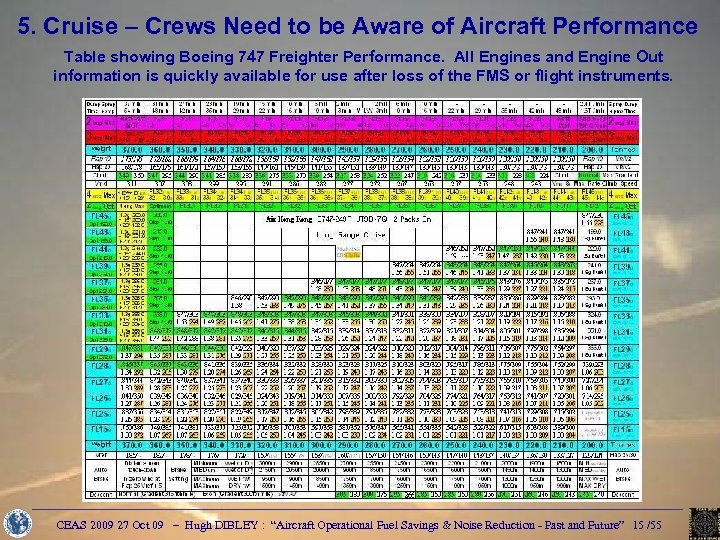
5. Cruise – Crews Need to be Aware of Aircraft Performance Table showing Boeing 747 Freighter Performance. All Engines and Engine Out information is quickly available for use after loss of the FMS or flight instruments. CEAS 2009 27 Oct 09 – Hugh DIBLEY : “Aircraft Operational Fuel Savings & Noise Reduction - Past and Future” 15 /55
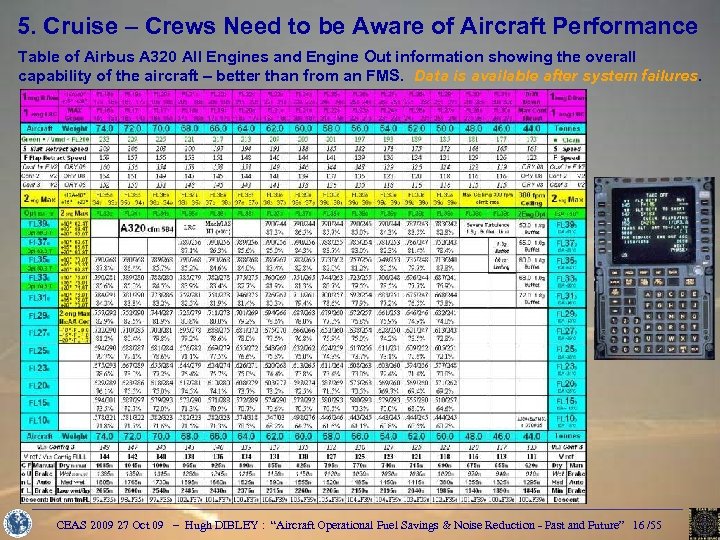
5. Cruise – Crews Need to be Aware of Aircraft Performance Table of Airbus A 320 All Engines and Engine Out information showing the overall capability of the aircraft – better than from an FMS. Data is available after system failures. CEAS 2009 27 Oct 09 – Hugh DIBLEY : “Aircraft Operational Fuel Savings & Noise Reduction - Past and Future” 16 /55
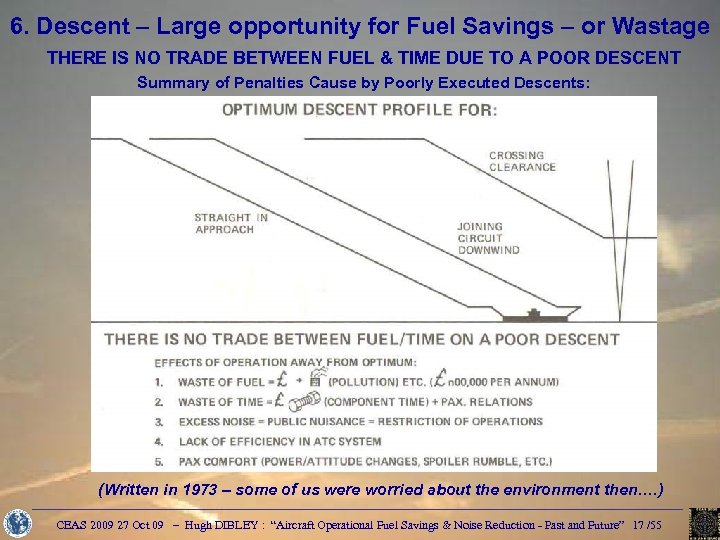
6. Descent – Large opportunity for Fuel Savings – or Wastage THERE IS NO TRADE BETWEEN FUEL & TIME DUE TO A POOR DESCENT Summary of Penalties Cause by Poorly Executed Descents: (Written in 1973 – some of us were worried about the environment then…. ) CEAS 2009 27 Oct 09 – Hugh DIBLEY : “Aircraft Operational Fuel Savings & Noise Reduction - Past and Future” 17 /55
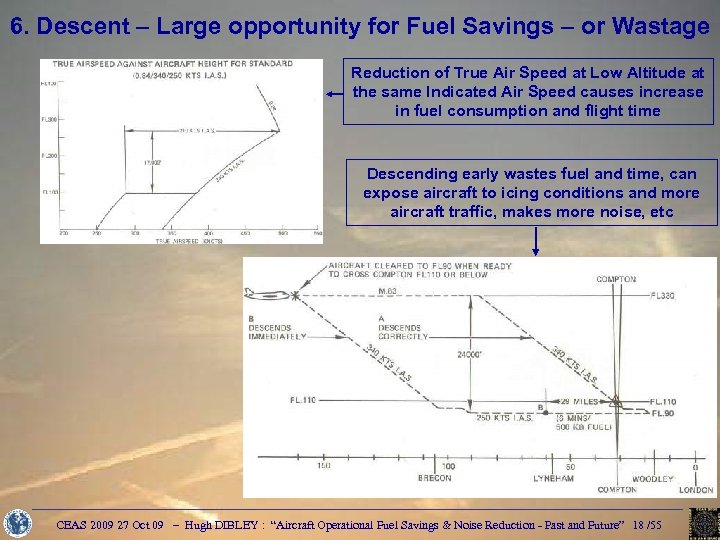
6. Descent – Large opportunity for Fuel Savings – or Wastage Reduction of True Air Speed at Low Altitude at the same Indicated Air Speed causes increase in fuel consumption and flight time Descending early wastes fuel and time, can expose aircraft to icing conditions and more aircraft traffic, makes more noise, etc CEAS 2009 27 Oct 09 – Hugh DIBLEY : “Aircraft Operational Fuel Savings & Noise Reduction - Past and Future” 18 /55
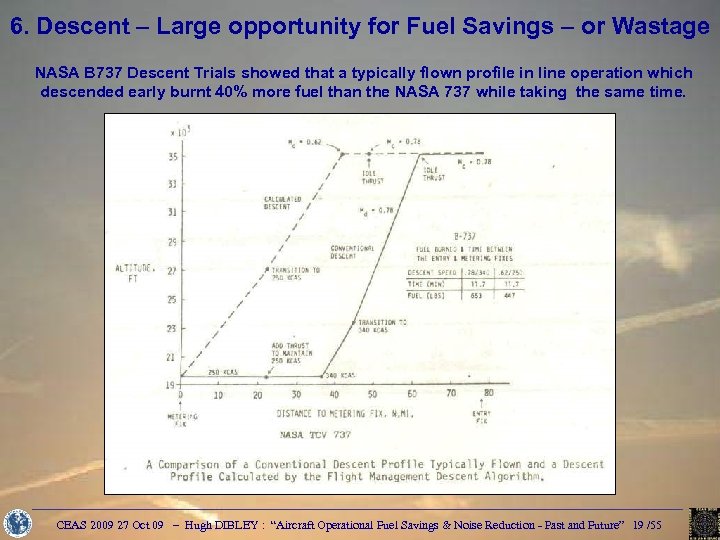
6. Descent – Large opportunity for Fuel Savings – or Wastage NASA B 737 Descent Trials showed that a typically flown profile in line operation which descended early burnt 40% more fuel than the NASA 737 while taking the same time. CEAS 2009 27 Oct 09 – Hugh DIBLEY : “Aircraft Operational Fuel Savings & Noise Reduction - Past and Future” 19 /55
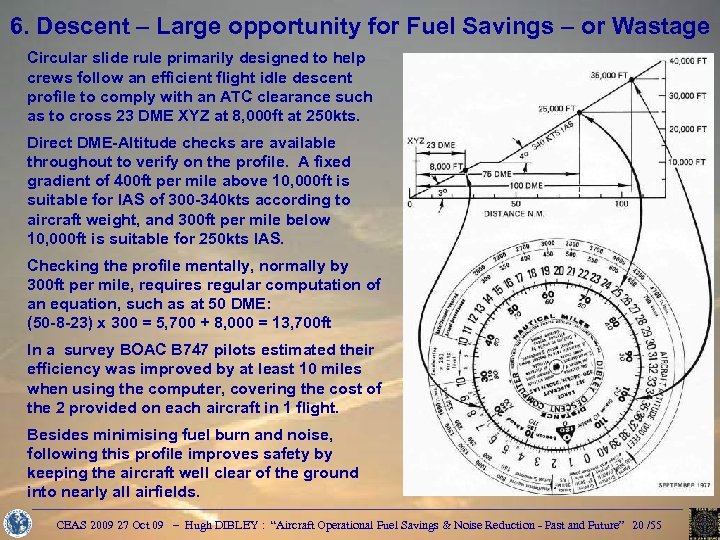
6. Descent – Large opportunity for Fuel Savings – or Wastage Circular slide rule primarily designed to help crews follow an efficient flight idle descent profile to comply with an ATC clearance such as to cross 23 DME XYZ at 8, 000 ft at 250 kts. Direct DME-Altitude checks are available throughout to verify on the profile. A fixed gradient of 400 ft per mile above 10, 000 ft is suitable for IAS of 300 -340 kts according to aircraft weight, and 300 ft per mile below 10, 000 ft is suitable for 250 kts IAS. Checking the profile mentally, normally by 300 ft per mile, requires regular computation of an equation, such as at 50 DME: (50 -8 -23) x 300 = 5, 700 + 8, 000 = 13, 700 ft In a survey BOAC B 747 pilots estimated their efficiency was improved by at least 10 miles when using the computer, covering the cost of the 2 provided on each aircraft in 1 flight. Besides minimising fuel burn and noise, following this profile improves safety by keeping the aircraft well clear of the ground into nearly all airfields. CEAS 2009 27 Oct 09 – Hugh DIBLEY : “Aircraft Operational Fuel Savings & Noise Reduction - Past and Future” 20 /55
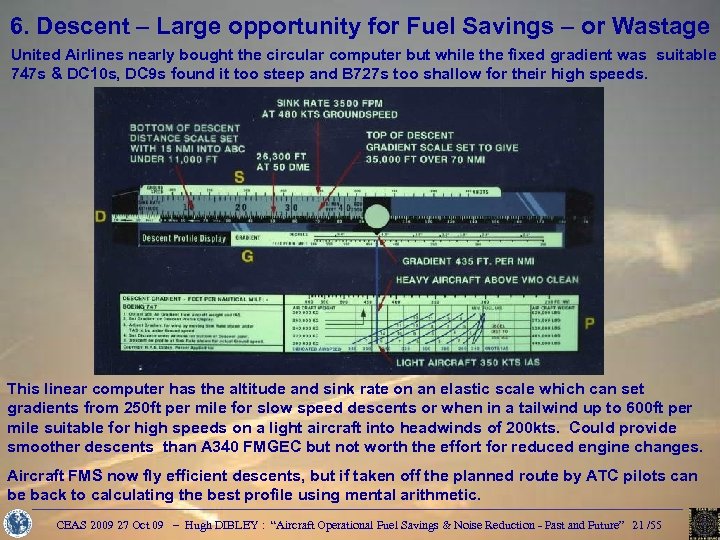
6. Descent – Large opportunity for Fuel Savings – or Wastage United Airlines nearly bought the circular computer but while the fixed gradient was suitable 747 s & DC 10 s, DC 9 s found it too steep and B 727 s too shallow for their high speeds. This linear computer has the altitude and sink rate on an elastic scale which can set gradients from 250 ft per mile for slow speed descents or when in a tailwind up to 600 ft per mile suitable for high speeds on a light aircraft into headwinds of 200 kts. Could provide smoother descents than A 340 FMGEC but not worth the effort for reduced engine changes. Aircraft FMS now fly efficient descents, but if taken off the planned route by ATC pilots can be back to calculating the best profile using mental arithmetic. CEAS 2009 27 Oct 09 – Hugh DIBLEY : “Aircraft Operational Fuel Savings & Noise Reduction - Past and Future” 21 /55
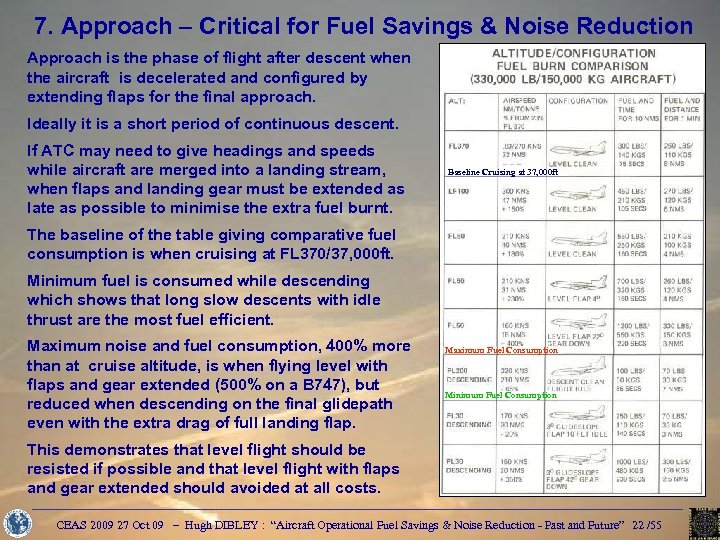
7. Approach – Critical for Fuel Savings & Noise Reduction Approach is the phase of flight after descent when the aircraft is decelerated and configured by extending flaps for the final approach. Ideally it is a short period of continuous descent. If ATC may need to give headings and speeds while aircraft are merged into a landing stream, when flaps and landing gear must be extended as late as possible to minimise the extra fuel burnt. Baseline Cruising at 37, 000 ft The baseline of the table giving comparative fuel consumption is when cruising at FL 370/37, 000 ft. Minimum fuel is consumed while descending which shows that long slow descents with idle thrust are the most fuel efficient. Maximum noise and fuel consumption, 400% more than at cruise altitude, is when flying level with flaps and gear extended (500% on a B 747), but reduced when descending on the final glidepath even with the extra drag of full landing flap. Maximum Fuel Consumption Minimum Fuel Consumption This demonstrates that level flight should be resisted if possible and that level flight with flaps and gear extended should avoided at all costs. CEAS 2009 27 Oct 09 – Hugh DIBLEY : “Aircraft Operational Fuel Savings & Noise Reduction - Past and Future” 22 /55
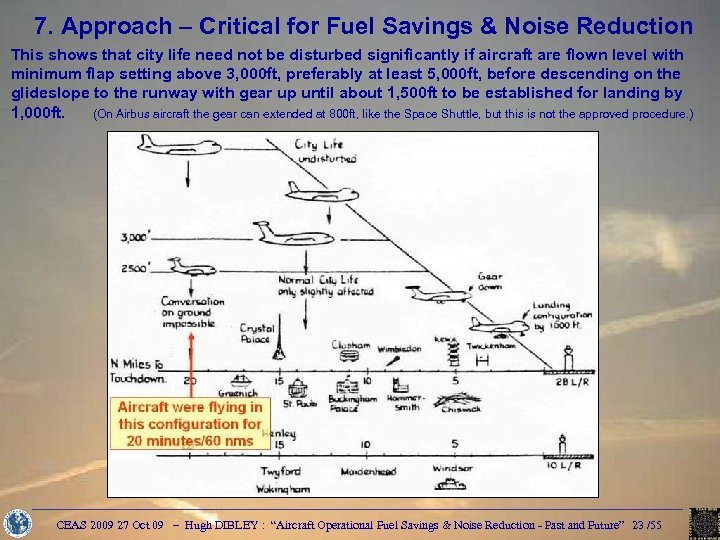
7. Approach – Critical for Fuel Savings & Noise Reduction This shows that city life need not be disturbed significantly if aircraft are flown level with minimum flap setting above 3, 000 ft, preferably at least 5, 000 ft, before descending on the glideslope to the runway with gear up until about 1, 500 ft to be established for landing by 1, 000 ft. (On Airbus aircraft the gear can extended at 800 ft, like the Space Shuttle, but this is not the approved procedure. ) CEAS 2009 27 Oct 09 – Hugh DIBLEY : “Aircraft Operational Fuel Savings & Noise Reduction - Past and Future” 23 /55
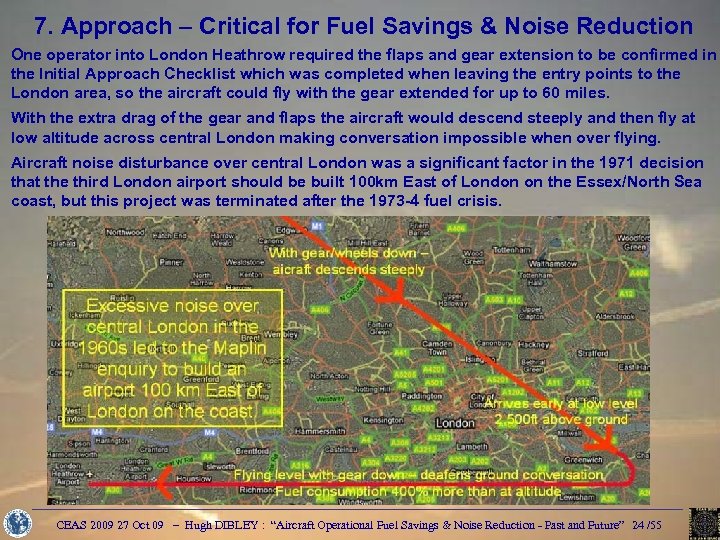
7. Approach – Critical for Fuel Savings & Noise Reduction One operator into London Heathrow required the flaps and gear extension to be confirmed in the Initial Approach Checklist which was completed when leaving the entry points to the London area, so the aircraft could fly with the gear extended for up to 60 miles. With the extra drag of the gear and flaps the aircraft would descend steeply and then fly at low altitude across central London making conversation impossible when over flying. Aircraft noise disturbance over central London was a significant factor in the 1971 decision that the third London airport should be built 100 km East of London on the Essex/North Sea coast, but this project was terminated after the 1973 -4 fuel crisis. CEAS 2009 27 Oct 09 – Hugh DIBLEY : “Aircraft Operational Fuel Savings & Noise Reduction - Past and Future” 24 /55
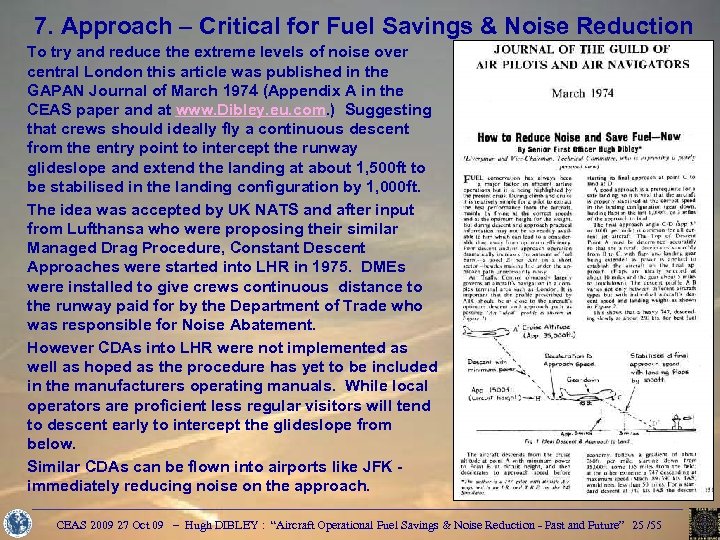
7. Approach – Critical for Fuel Savings & Noise Reduction To try and reduce the extreme levels of noise over central London this article was published in the GAPAN Journal of March 1974 (Appendix A in the CEAS paper and at www. Dibley. eu. com. ) Suggesting that crews should ideally fly a continuous descent from the entry point to intercept the runway glideslope and extend the landing at about 1, 500 ft to be stabilised in the landing configuration by 1, 000 ft. The idea was accepted by UK NATS and after input from Lufthansa who were proposing their similar Managed Drag Procedure, Constant Descent Approaches were started into LHR in 1975. DMEs were installed to give crews continuous distance to the runway paid for by the Department of Trade who was responsible for Noise Abatement. However CDAs into LHR were not implemented as well as hoped as the procedure has yet to be included in the manufacturers operating manuals. While local operators are proficient less regular visitors will tend to descent early to intercept the glideslope from below. Similar CDAs can be flown into airports like JFK immediately reducing noise on the approach. CEAS 2009 27 Oct 09 – Hugh DIBLEY : “Aircraft Operational Fuel Savings & Noise Reduction - Past and Future” 25 /55
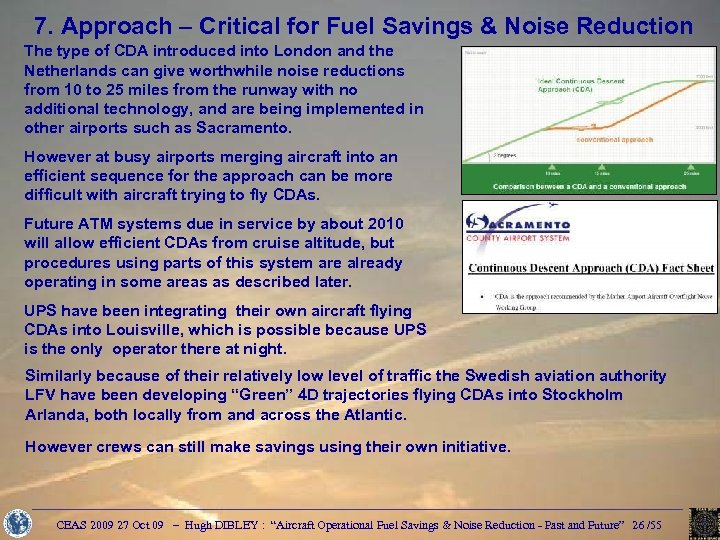
7. Approach – Critical for Fuel Savings & Noise Reduction The type of CDA introduced into London and the Netherlands can give worthwhile noise reductions from 10 to 25 miles from the runway with no additional technology, and are being implemented in other airports such as Sacramento. However at busy airports merging aircraft into an efficient sequence for the approach can be more difficult with aircraft trying to fly CDAs. Future ATM systems due in service by about 2010 will allow efficient CDAs from cruise altitude, but procedures using parts of this system are already operating in some areas as described later. UPS have been integrating their own aircraft flying CDAs into Louisville, which is possible because UPS is the only operator there at night. Similarly because of their relatively low level of traffic the Swedish aviation authority LFV have been developing “Green” 4 D trajectories flying CDAs into Stockholm Arlanda, both locally from and across the Atlantic. However crews can still make savings using their own initiative. CEAS 2009 27 Oct 09 – Hugh DIBLEY : “Aircraft Operational Fuel Savings & Noise Reduction - Past and Future” 26 /55
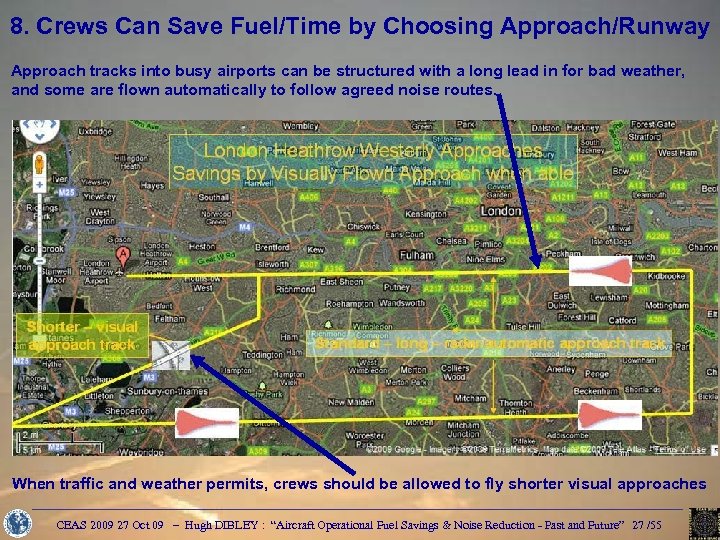
8. Crews Can Save Fuel/Time by Choosing Approach/Runway Approach tracks into busy airports can be structured with a long lead in for bad weather, and some are flown automatically to follow agreed noise routes. When traffic and weather permits, crews should be allowed to fly shorter visual approaches CEAS 2009 27 Oct 09 – Hugh DIBLEY : “Aircraft Operational Fuel Savings & Noise Reduction - Past and Future” 27 /55
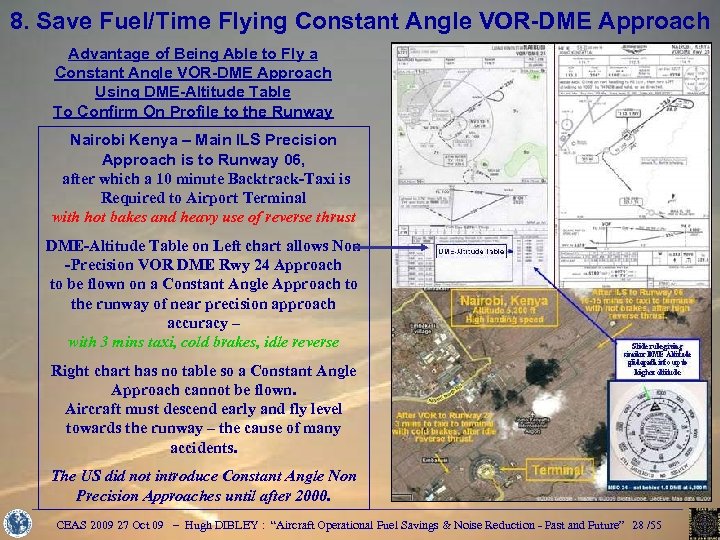
8. Save Fuel/Time Flying Constant Angle VOR-DME Approach Advantage of Being Able to Fly a Constant Angle VOR-DME Approach Using DME-Altitude Table To Confirm On Profile to the Runway Nairobi Kenya – Main ILS Precision Approach is to Runway 06, after which a 10 minute Backtrack-Taxi is Required to Airport Terminal with hot bakes and heavy use of reverse thrust DME-Altitude Table on Left chart allows Non -Precision VOR DME Rwy 24 Approach to be flown on a Constant Angle Approach to the runway of near precision approach accuracy – with 3 mins taxi, cold brakes, idle reverse Right chart has no table so a Constant Angle Approach cannot be flown. Aircraft must descend early and fly level towards the runway – the cause of many accidents. The US did not introduce Constant Angle Non Precision Approaches until after 2000. CEAS 2009 27 Oct 09 – Hugh DIBLEY : “Aircraft Operational Fuel Savings & Noise Reduction - Past and Future” 28 /55
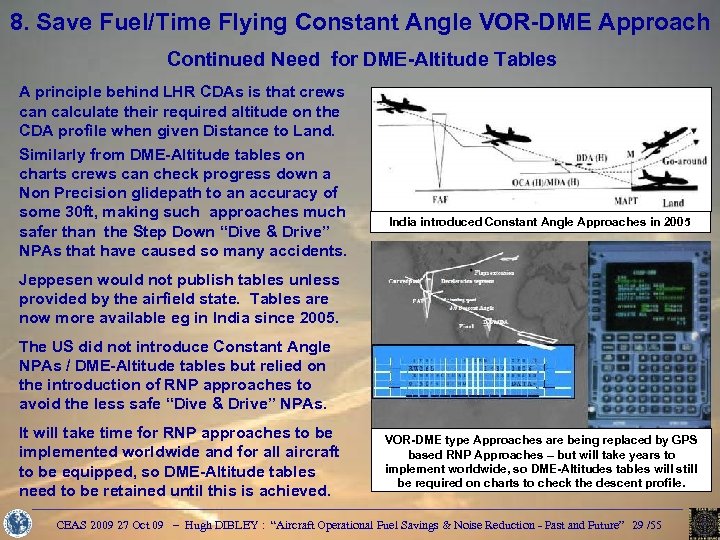
8. Save Fuel/Time Flying Constant Angle VOR-DME Approach Continued Need for DME-Altitude Tables A principle behind LHR CDAs is that crews can calculate their required altitude on the CDA profile when given Distance to Land. Similarly from DME-Altitude tables on charts crews can check progress down a Non Precision glidepath to an accuracy of some 30 ft, making such approaches much safer than the Step Down “Dive & Drive” NPAs that have caused so many accidents. India introduced Constant Angle Approaches in 2005 Jeppesen would not publish tables unless provided by the airfield state. Tables are now more available eg in India since 2005. The US did not introduce Constant Angle NPAs / DME-Altitude tables but relied on the introduction of RNP approaches to avoid the less safe “Dive & Drive” NPAs. It will take time for RNP approaches to be implemented worldwide and for all aircraft to be equipped, so DME-Altitude tables need to be retained until this is achieved. VOR-DME type Approaches are being replaced by GPS based RNP Approaches – but will take years to implement worldwide, so DME-Altitudes tables will still be required on charts to check the descent profile. CEAS 2009 27 Oct 09 – Hugh DIBLEY : “Aircraft Operational Fuel Savings & Noise Reduction - Past and Future” 29 /55
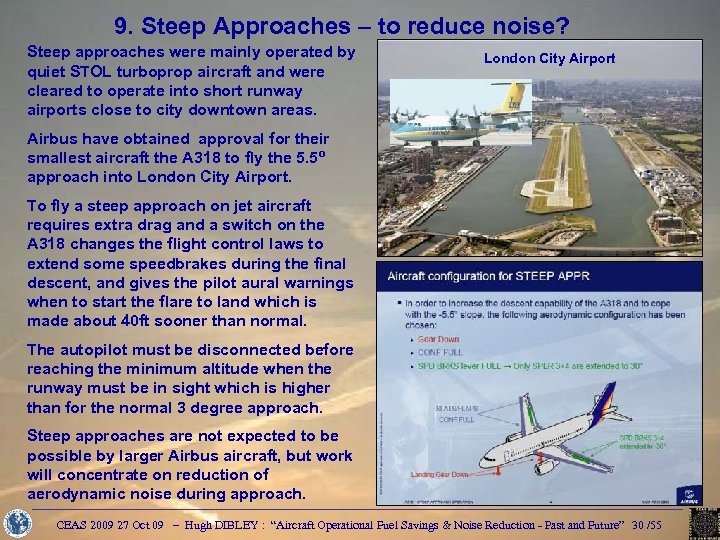
9. Steep Approaches – to reduce noise? Steep approaches were mainly operated by quiet STOL turboprop aircraft and were cleared to operate into short runway airports close to city downtown areas. London City Airport Airbus have obtained approval for their smallest aircraft the A 318 to fly the 5. 5º approach into London City Airport. To fly a steep approach on jet aircraft requires extra drag and a switch on the A 318 changes the flight control laws to extend some speedbrakes during the final descent, and gives the pilot aural warnings when to start the flare to land which is made about 40 ft sooner than normal. The autopilot must be disconnected before reaching the minimum altitude when the runway must be in sight which is higher than for the normal 3 degree approach. Steep approaches are not expected to be possible by larger Airbus aircraft, but work will concentrate on reduction of aerodynamic noise during approach. CEAS 2009 27 Oct 09 – Hugh DIBLEY : “Aircraft Operational Fuel Savings & Noise Reduction - Past and Future” 30 /55
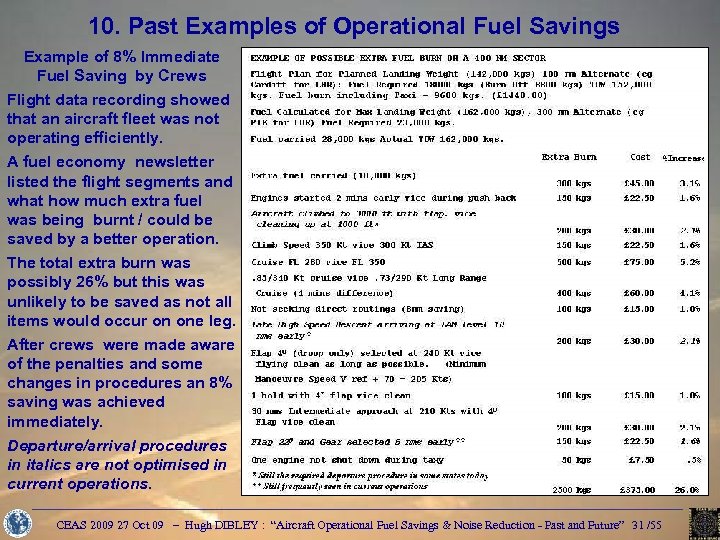
10. Past Examples of Operational Fuel Savings Example of 8% Immediate Fuel Saving by Crews Flight data recording showed that an aircraft fleet was not operating efficiently. A fuel economy newsletter listed the flight segments and what how much extra fuel was being burnt / could be saved by a better operation. The total extra burn was possibly 26% but this was unlikely to be saved as not all items would occur on one leg. After crews were made aware of the penalties and some changes in procedures an 8% saving was achieved immediately. Departure/arrival procedures in italics are not optimised in current operations. CEAS 2009 27 Oct 09 – Hugh DIBLEY : “Aircraft Operational Fuel Savings & Noise Reduction - Past and Future” 31 /55
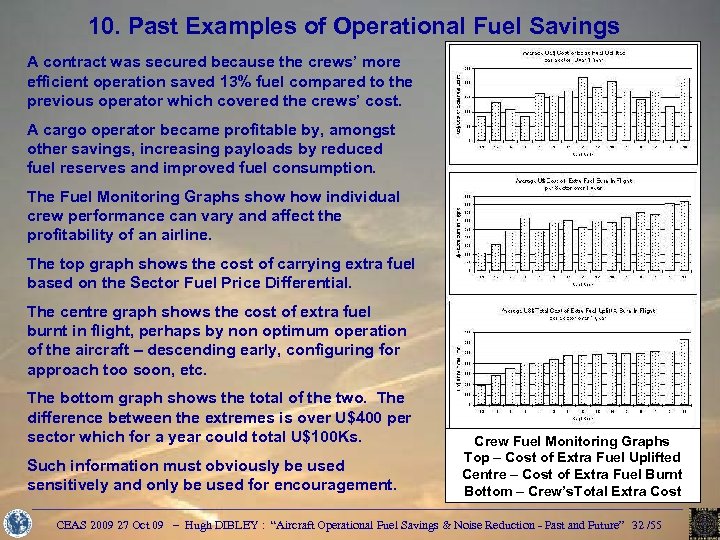
10. Past Examples of Operational Fuel Savings A contract was secured because the crews’ more efficient operation saved 13% fuel compared to the previous operator which covered the crews’ cost. A cargo operator became profitable by, amongst other savings, increasing payloads by reduced fuel reserves and improved fuel consumption. The Fuel Monitoring Graphs show individual crew performance can vary and affect the profitability of an airline. The top graph shows the cost of carrying extra fuel based on the Sector Fuel Price Differential. The centre graph shows the cost of extra fuel burnt in flight, perhaps by non optimum operation of the aircraft – descending early, configuring for approach too soon, etc. The bottom graph shows the total of the two. The difference between the extremes is over U$400 per sector which for a year could total U$100 Ks. Such information must obviously be used sensitively and only be used for encouragement. Crew Fuel Monitoring Graphs Top – Cost of Extra Fuel Uplifted Centre – Cost of Extra Fuel Burnt Bottom – Crew’s. Total Extra Cost CEAS 2009 27 Oct 09 – Hugh DIBLEY : “Aircraft Operational Fuel Savings & Noise Reduction - Past and Future” 32 /55
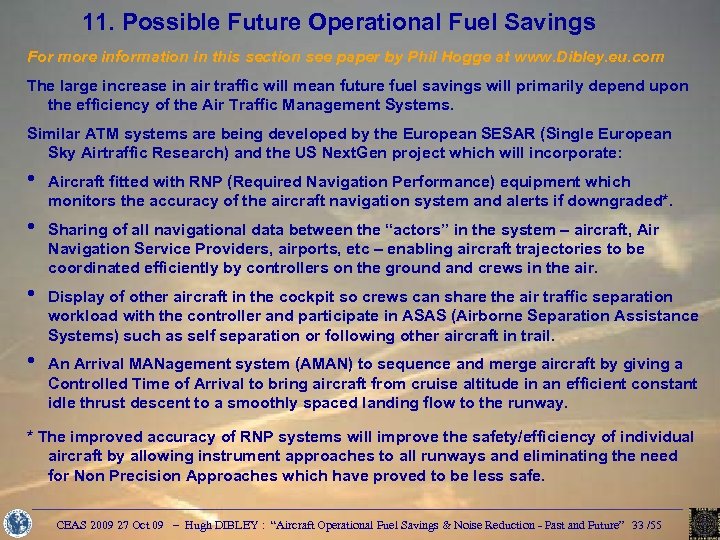
11. Possible Future Operational Fuel Savings For more information in this section see paper by Phil Hogge at www. Dibley. eu. com The large increase in air traffic will mean future fuel savings will primarily depend upon the efficiency of the Air Traffic Management Systems. Similar ATM systems are being developed by the European SESAR (Single European Sky Airtraffic Research) and the US Next. Gen project which will incorporate: • Aircraft fitted with RNP (Required Navigation Performance) equipment which monitors the accuracy of the aircraft navigation system and alerts if downgraded*. • Sharing of all navigational data between the “actors” in the system – aircraft, Air Navigation Service Providers, airports, etc – enabling aircraft trajectories to be coordinated efficiently by controllers on the ground and crews in the air. • Display of other aircraft in the cockpit so crews can share the air traffic separation workload with the controller and participate in ASAS (Airborne Separation Assistance Systems) such as self separation or following other aircraft in trail. • An Arrival MANagement system (AMAN) to sequence and merge aircraft by giving a Controlled Time of Arrival to bring aircraft from cruise altitude in an efficient constant idle thrust descent to a smoothly spaced landing flow to the runway. * The improved accuracy of RNP systems will improve the safety/efficiency of individual aircraft by allowing instrument approaches to all runways and eliminating the need for Non Precision Approaches which have proved to be less safe. CEAS 2009 27 Oct 09 – Hugh DIBLEY : “Aircraft Operational Fuel Savings & Noise Reduction - Past and Future” 33 /55
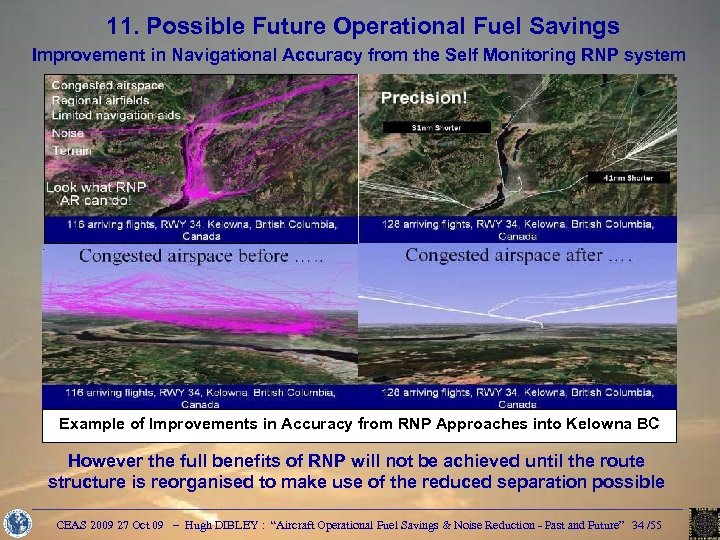
11. Possible Future Operational Fuel Savings Improvement in Navigational Accuracy from the Self Monitoring RNP system Example of Improvements in Accuracy from RNP Approaches into Kelowna BC However the full benefits of RNP will not be achieved until the route structure is reorganised to make use of the reduced separation possible CEAS 2009 27 Oct 09 – Hugh DIBLEY : “Aircraft Operational Fuel Savings & Noise Reduction - Past and Future” 34 /55
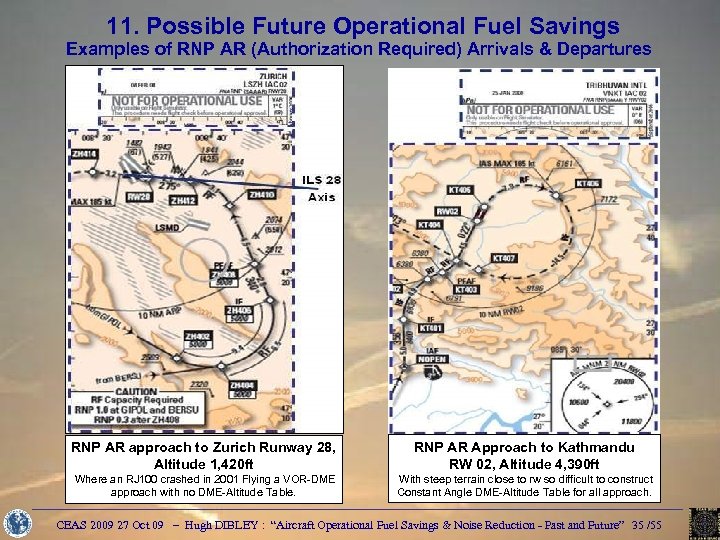
11. Possible Future Operational Fuel Savings Examples of RNP AR (Authorization Required) Arrivals & Departures RNP AR approach to Zurich Runway 28, Altitude 1, 420 ft RNP AR Approach to Kathmandu RW 02, Altitude 4, 390 ft Where an RJ 100 crashed in 2001 Flying a VOR-DME approach with no DME-Altitude Table. With steep terrain close to rw so difficult to construct Constant Angle DME-Altitude Table for all approach. CEAS 2009 27 Oct 09 – Hugh DIBLEY : “Aircraft Operational Fuel Savings & Noise Reduction - Past and Future” 35 /55
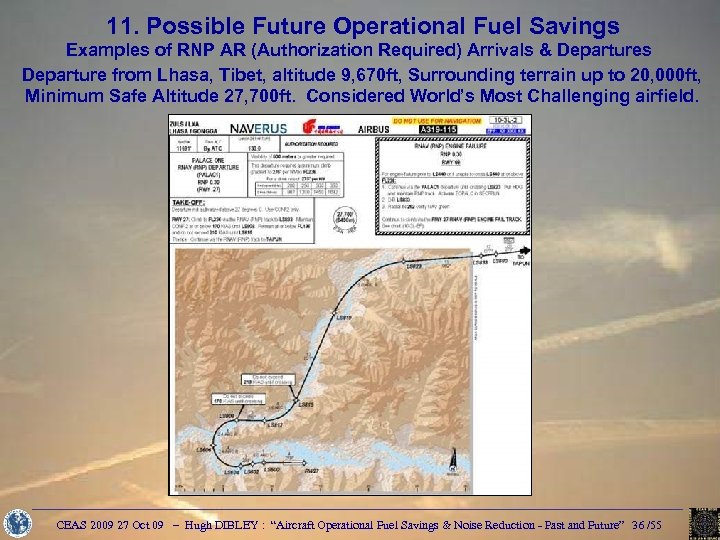
11. Possible Future Operational Fuel Savings Examples of RNP AR (Authorization Required) Arrivals & Departures Departure from Lhasa, Tibet, altitude 9, 670 ft, Surrounding terrain up to 20, 000 ft, Minimum Safe Altitude 27, 700 ft. Considered World’s Most Challenging airfield. CEAS 2009 27 Oct 09 – Hugh DIBLEY : “Aircraft Operational Fuel Savings & Noise Reduction - Past and Future” 36 /55
Video of * China Airlines RNP AR Approach into Lhasa, Tibet Using NAVERUS Equipment * Requires NAVERUS. wmv video (31 Mb) to run from Power. Point, or. flv (9 Mb) run from outside Power. Point CEAS 2009 27 Oct 09 – Hugh DIBLEY : “Aircraft Operational Fuel Savings & Noise Reduction - Past and Future” 37 /55
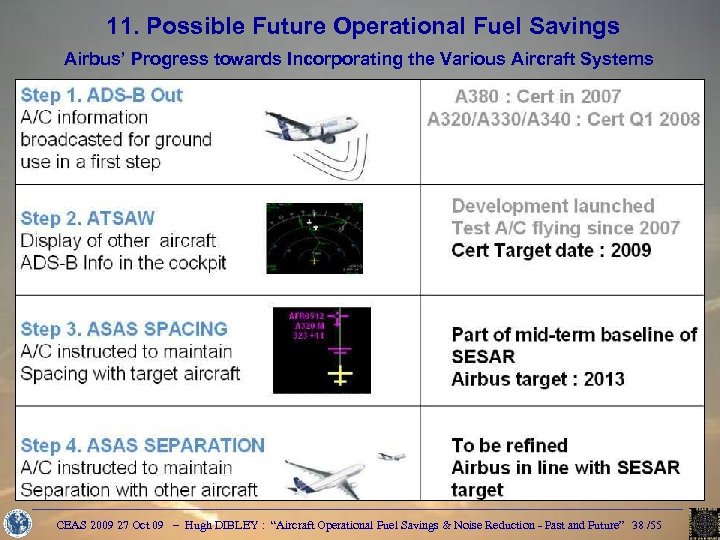
11. Possible Future Operational Fuel Savings Airbus’ Progress towards Incorporating the Various Aircraft Systems CEAS 2009 27 Oct 09 – Hugh DIBLEY : “Aircraft Operational Fuel Savings & Noise Reduction - Past and Future” 38 /55
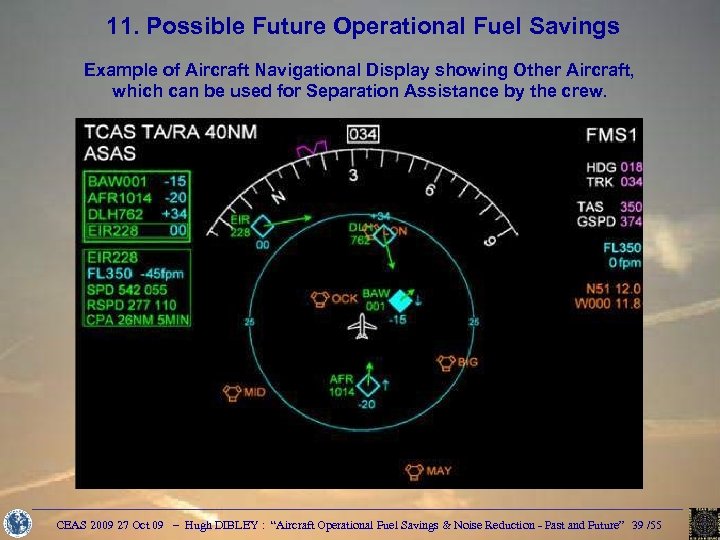
11. Possible Future Operational Fuel Savings Example of Aircraft Navigational Display showing Other Aircraft, which can be used for Separation Assistance by the crew. CEAS 2009 27 Oct 09 – Hugh DIBLEY : “Aircraft Operational Fuel Savings & Noise Reduction - Past and Future” 39 /55
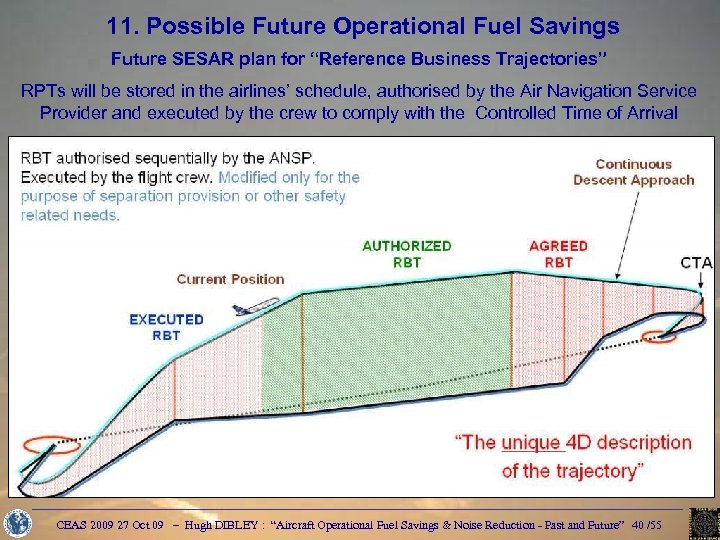
11. Possible Future Operational Fuel Savings Future SESAR plan for “Reference Business Trajectories” RPTs will be stored in the airlines’ schedule, authorised by the Air Navigation Service Provider and executed by the crew to comply with the Controlled Time of Arrival CEAS 2009 27 Oct 09 – Hugh DIBLEY : “Aircraft Operational Fuel Savings & Noise Reduction - Past and Future” 40 /55
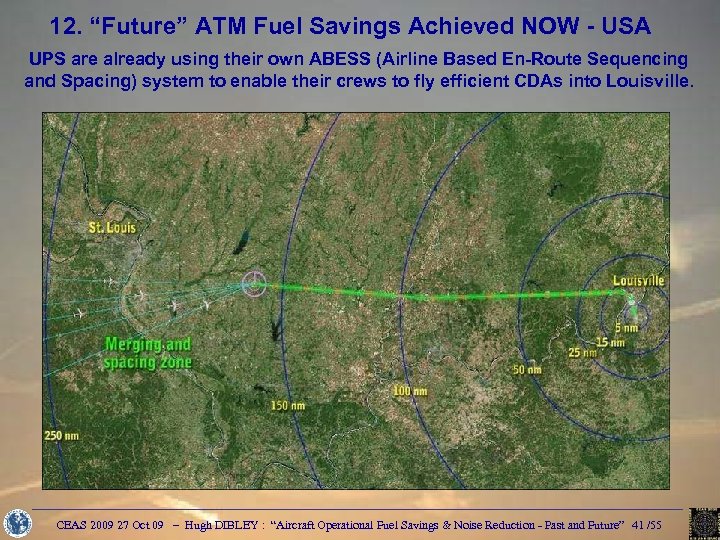
12. “Future” ATM Fuel Savings Achieved NOW - USA UPS are already using their own ABESS (Airline Based En-Route Sequencing and Spacing) system to enable their crews to fly efficient CDAs into Louisville. CEAS 2009 27 Oct 09 – Hugh DIBLEY : “Aircraft Operational Fuel Savings & Noise Reduction - Past and Future” 41 /55
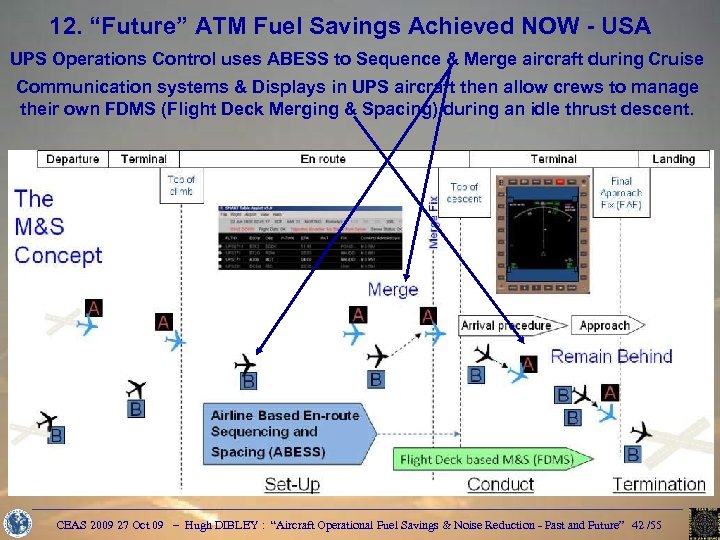
12. “Future” ATM Fuel Savings Achieved NOW - USA UPS Operations Control uses ABESS to Sequence & Merge aircraft during Cruise Communication systems & Displays in UPS aircraft then allow crews to manage their own FDMS (Flight Deck Merging & Spacing) during an idle thrust descent. CEAS 2009 27 Oct 09 – Hugh DIBLEY : “Aircraft Operational Fuel Savings & Noise Reduction - Past and Future” 42 /55
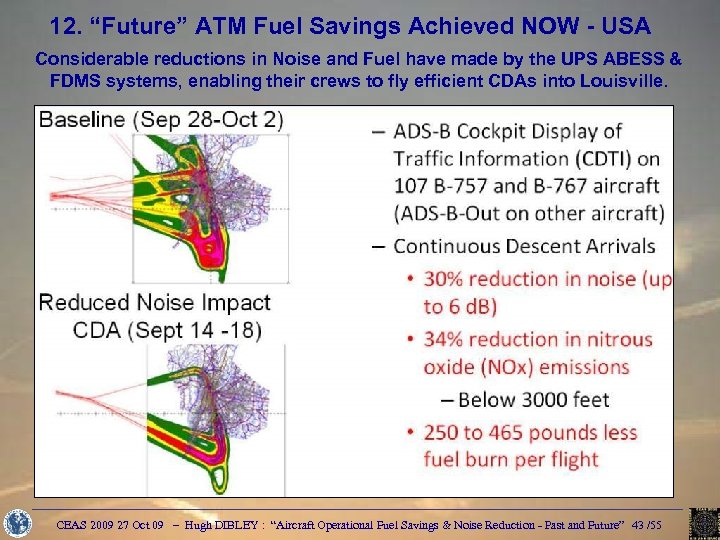
12. “Future” ATM Fuel Savings Achieved NOW - USA Considerable reductions in Noise and Fuel have made by the UPS ABESS & FDMS systems, enabling their crews to fly efficient CDAs into Louisville. CEAS 2009 27 Oct 09 – Hugh DIBLEY : “Aircraft Operational Fuel Savings & Noise Reduction - Past and Future” 43 /55
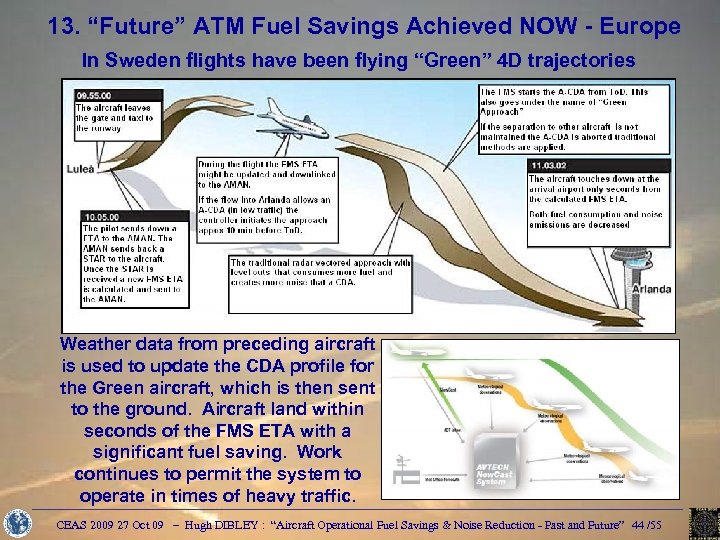
13. “Future” ATM Fuel Savings Achieved NOW - Europe In Sweden flights have been flying “Green” 4 D trajectories Weather data from preceding aircraft is used to update the CDA profile for the Green aircraft, which is then sent to the ground. Aircraft land within seconds of the FMS ETA with a significant fuel saving. Work continues to permit the system to operate in times of heavy traffic. CEAS 2009 27 Oct 09 – Hugh DIBLEY : “Aircraft Operational Fuel Savings & Noise Reduction - Past and Future” 44 /55
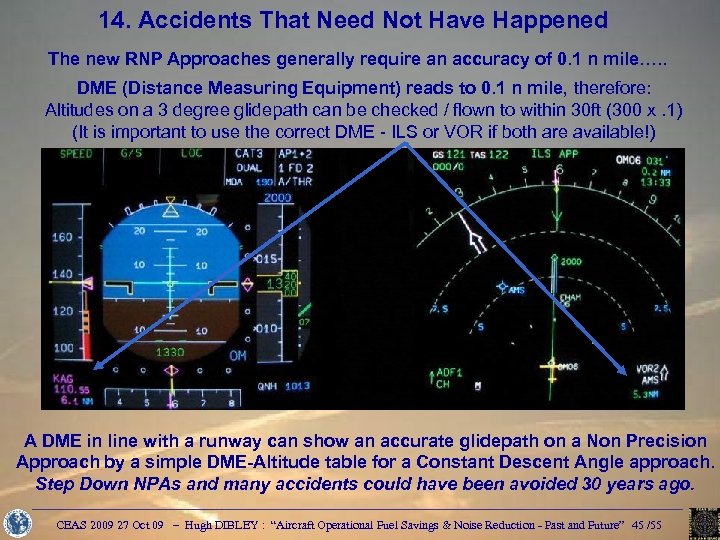
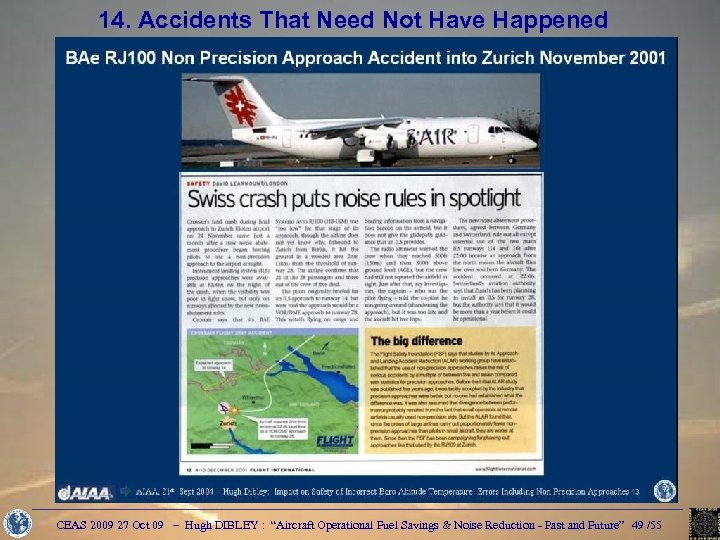
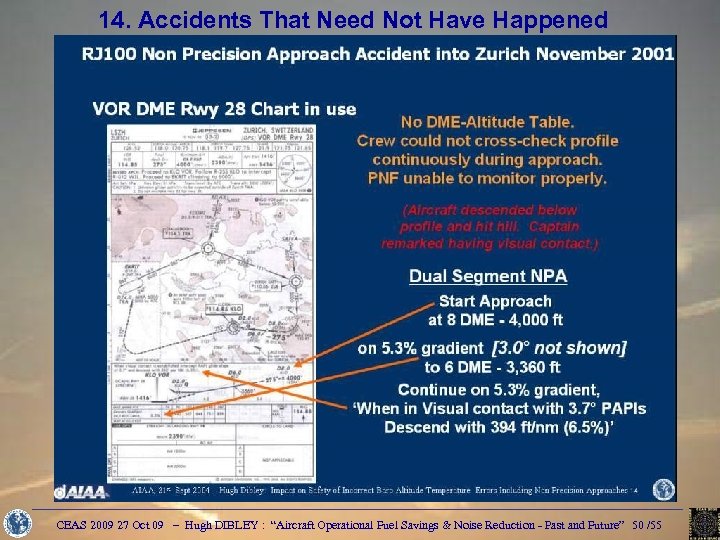
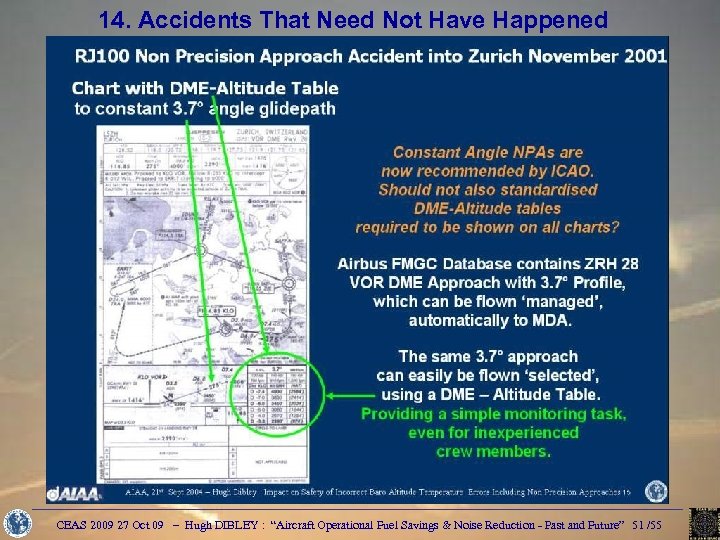
14. Accidents That Need Not Have Happened The new RNP Approaches generally require an accuracy of 0. 1 n mile…. . DME (Distance Measuring Equipment) reads to 0. 1 n mile, therefore: Altitudes on a 3 degree glidepath can be checked / flown to within 30 ft (300 x. 1) (It is important to use the correct DME - ILS or VOR if both are available!) A DME in line with a runway can show an accurate glidepath on a Non Precision Approach by a simple DME-Altitude table for a Constant Descent Angle approach. Step Down NPAs and many accidents could have been avoided 30 years ago. CEAS 2009 27 Oct 09 – Hugh DIBLEY : “Aircraft Operational Fuel Savings & Noise Reduction - Past and Future” 45 /55
14. Accidents That Need Not Have Happened CEAS 2009 27 Oct 09 – Hugh DIBLEY : “Aircraft Operational Fuel Savings & Noise Reduction - Past and Future” 46 /55
14. Accidents That Need Not Have Happened CEAS 2009 27 Oct 09 – Hugh DIBLEY : “Aircraft Operational Fuel Savings & Noise Reduction - Past and Future” 47 /55
14. Accidents That Need Not Have Happened CEAS 2009 27 Oct 09 – Hugh DIBLEY : “Aircraft Operational Fuel Savings & Noise Reduction - Past and Future” 48 /55
14. Accidents That Need Not Have Happened CEAS 2009 27 Oct 09 – Hugh DIBLEY : “Aircraft Operational Fuel Savings & Noise Reduction - Past and Future” 49 /55
14. Accidents That Need Not Have Happened CEAS 2009 27 Oct 09 – Hugh DIBLEY : “Aircraft Operational Fuel Savings & Noise Reduction - Past and Future” 50 /55
14. Accidents That Need Not Have Happened CEAS 2009 27 Oct 09 – Hugh DIBLEY : “Aircraft Operational Fuel Savings & Noise Reduction - Past and Future” 51 /55
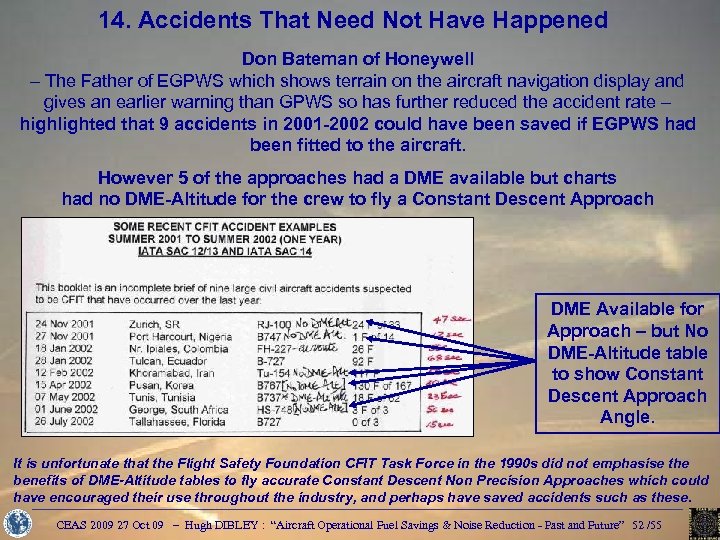
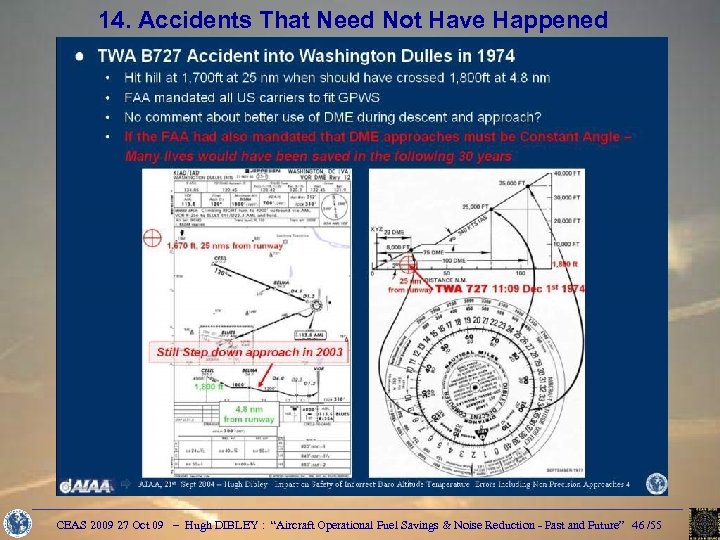
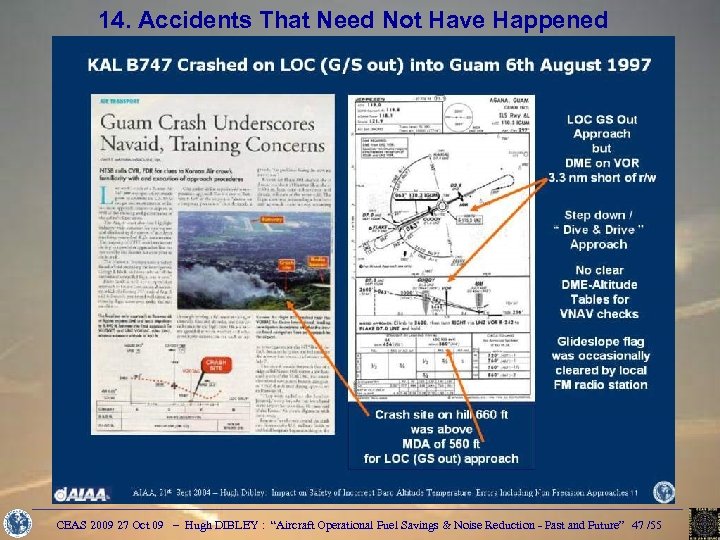
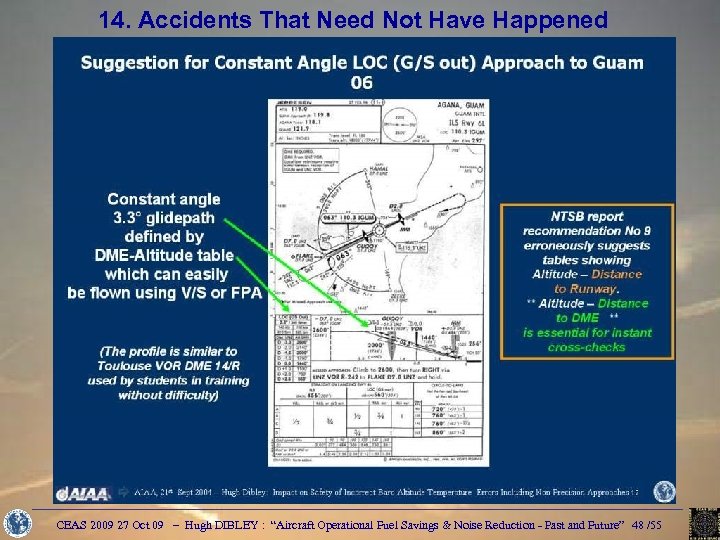
14. Accidents That Need Not Have Happened Don Bateman of Honeywell – The Father of EGPWS which shows terrain on the aircraft navigation display and gives an earlier warning than GPWS so has further reduced the accident rate – highlighted that 9 accidents in 2001 -2002 could have been saved if EGPWS had been fitted to the aircraft. However 5 of the approaches had a DME available but charts had no DME-Altitude for the crew to fly a Constant Descent Approach DME Available for Approach – but No DME-Altitude table to show Constant Descent Approach Angle. It is unfortunate that the Flight Safety Foundation CFIT Task Force in the 1990 s did not emphasise the benefits of DME-Altitude tables to fly accurate Constant Descent Non Precision Approaches which could have encouraged their use throughout the industry, and perhaps have saved accidents such as these. CEAS 2009 27 Oct 09 – Hugh DIBLEY : “Aircraft Operational Fuel Savings & Noise Reduction - Past and Future” 52 /55
15. Conclusion – Make Use of New Equipment NOW! I hope this presentation has given an insight into operational savings which can be made by the Flight Crew. On early less automated aircraft crews could make substantial savings if they made best use of the information that was available to operate as efficiently as was possible at the time, but on the other hand considerable waste and disturbance to the environment could occur by operating away from the norm. In due course the future sophisticated aircraft and ATM systems should be capable of keeping the aircraft operation close to optimum, and with flight crews and ground controllers working together this should enhance their understanding of each others’ roles and bring further benefits to the industry. However many of the features of the systems can be used NOW – just as UPS have implemented their in ABESS and FDMS to fly efficient CDAs into Louisville. Why cannot the UK make better use of FMS 4 D capability to give aircraft arriving from the West a Required Arrival Time reduce to wasteful holding? Why do not airlines campaign to use this facility? It is extraordinary to have an aircraft fly for 13 hours from HKG and then hold because it is too early to land before a time which has been published by the airport years in advance! And for those engineers who still feel that pilots have already been designed out of the system…. CEAS 2009 27 Oct 09 – Hugh DIBLEY : “Aircraft Operational Fuel Savings & Noise Reduction - Past and Future” 53 /55
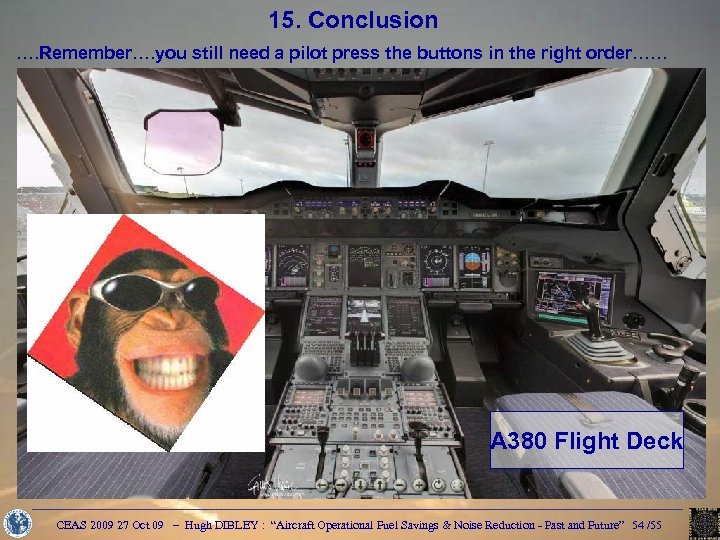
15. Conclusion …. Remember…. you still need a pilot press the buttons in the right order…… A 380 Flight Deck CEAS 2009 27 Oct 09 – Hugh DIBLEY : “Aircraft Operational Fuel Savings & Noise Reduction - Past and Future” 54 /55
27 th October 2009 “Aircraft Operational Fuel Savings & Noise Reduction - Past and Future” Thank you for you attention Captain Hugh DIBLEY DDCL & Royal Aeronautical Society CEAS 2009 27 Oct 09 – Hugh DIBLEY : “Aircraft Operational Fuel Savings & Noise Reduction - Past and Future” 55 /55
Скачать презентацию 27 th October 2009 Aircraft Operational Fuel Savings
70a742907daea65149e8b2562d866d26.ppt