


 Скачать презентацию 263 f Week 1 This material
39f85ad83de728cfa4bece4461a92a4f.ppt
- Количество слайдов: 28
 263 f – Week 1 • This material is posted to assist you by providing examples used in class re Week One introductory material • The material on Ancient Olympic Games is more detailed than what will be customary in order to stay on course schedule
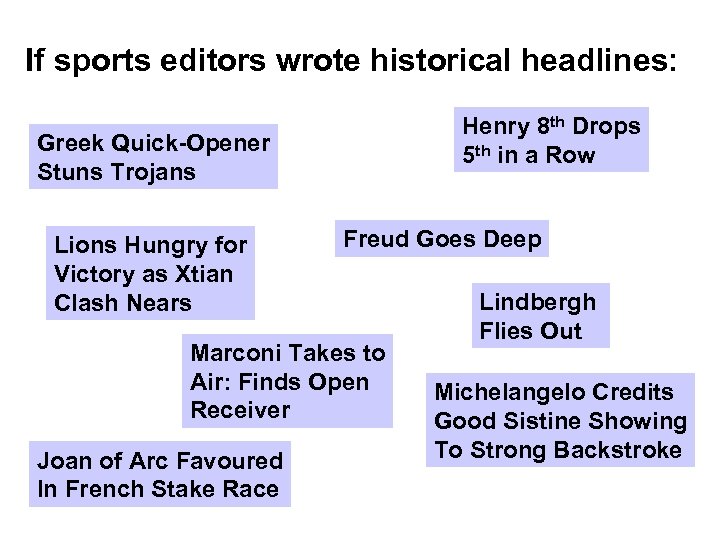 If sports editors wrote historical headlines: Henry 8 th Drops 5 th in a Row Greek Quick-Opener Stuns Trojans Lions Hungry for Victory as Xtian Clash Nears Freud Goes Deep Marconi Takes to Air: Finds Open Receiver Joan of Arc Favoured In French Stake Race Lindbergh Flies Out Michelangelo Credits Good Sistine Showing To Strong Backstroke
 History & Sport history • What is it that makes or marks history ? • What is history ? • What do you know about Cdn history and/or Cdn sport history • What makes good history
 Observations by Mr Dooley: • “ I know history isn’t true Hinnessy, cause it ain’t like what I see every day in Halstead Street. If a man comes along with a history for Greece or Rome that’ll show me the people fightin’, getting’ drunk, makin’ love, getting’ married, owin’ the grocery man, and bein’ without hard coal, I’ll believe there was a Greece or Rome but not before…. History is a post mortem examination. It tells you what a country died for. But I’d like to know what a country lived for!” ~Caroline Ware, The Cultural Approach to History
 What is history ? • • Chron study of recorded time ? Study of great people ? Study of politics over time ? The interaction of character with circumstances over time ? • All of the above ? Others ?
 What is history ? • History is historiography
 What is history ? • History is historiography • History is either –The events of the past –The record of the past
 Understanding History • “…only a part of what was observed in the past was remembered by those who observed it; only a part of what was remembered was recorded; only a part of what was recorded has survived; only a part of what has survived has come to the historian’s attention; only a part of what has come to their attention is credible; only a part of what is credible has been grasped or can be expounded or narrated by the historian” ~ Louis Gottschalk
 What is history ? • Point is we DO history • Research >> Analysis >> Writing • History is NOT the past: “Historian tries to reconstruct the past; often, she merely creates it” • Consider the Donnellys story: ~ The Black Donnellys - Kelly ~ The Donnellys Must Die - Miller
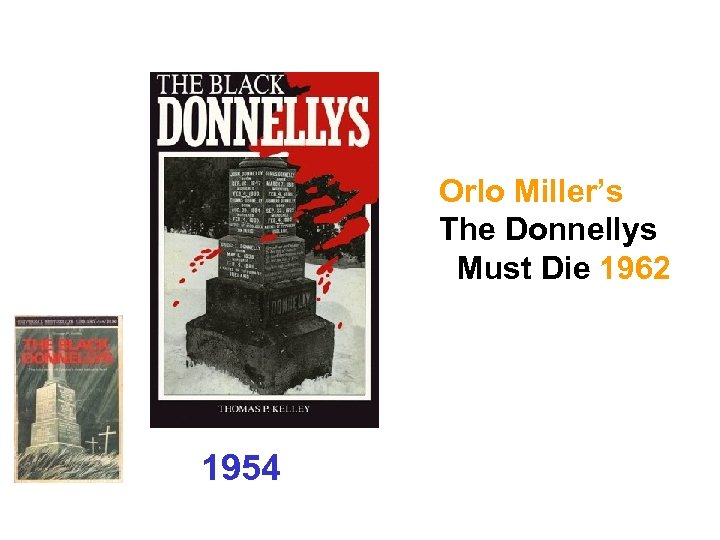 Orlo Miller’s The Donnellys Must Die 1962 1954
 http: //www. donnellys. com/Photos. html
![The Process of DOING history [ schema ]: Historian doing history Actor’s Real sit](https://present5.com/presentation/39f85ad83de728cfa4bece4461a92a4f/image-13.jpg "The Process of DOING history [ schema ]: Historian doing history Actor’s Real sit") The Process of DOING history [ schema ]: Historian doing history Actor’s Real sit Actor’s interp of situation Action Intended Unt’d cons
The Process of DOING history [ schema ]: Historian doing history Actor’s Real sit Actor’s interp of situation Action Intended Unt’d cons
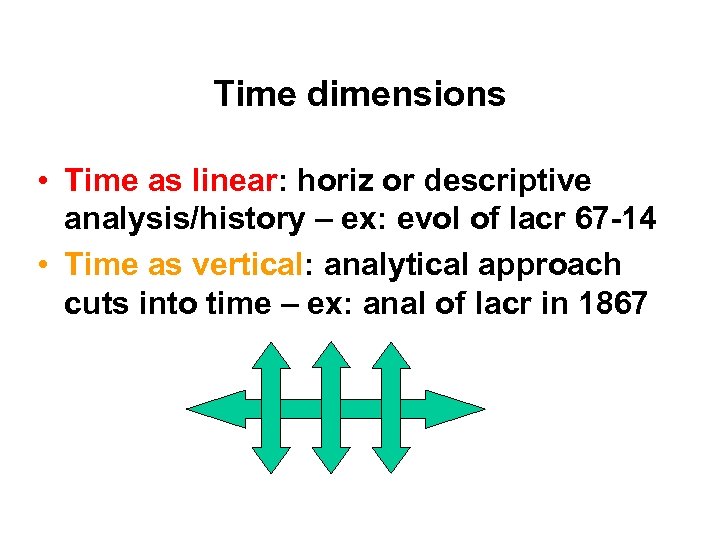 Time dimensions • Time as linear: horiz or descriptive analysis/history – ex: evol of lacr 67 -14 • Time as vertical: analytical approach cuts into time – ex: anal of lacr in 1867
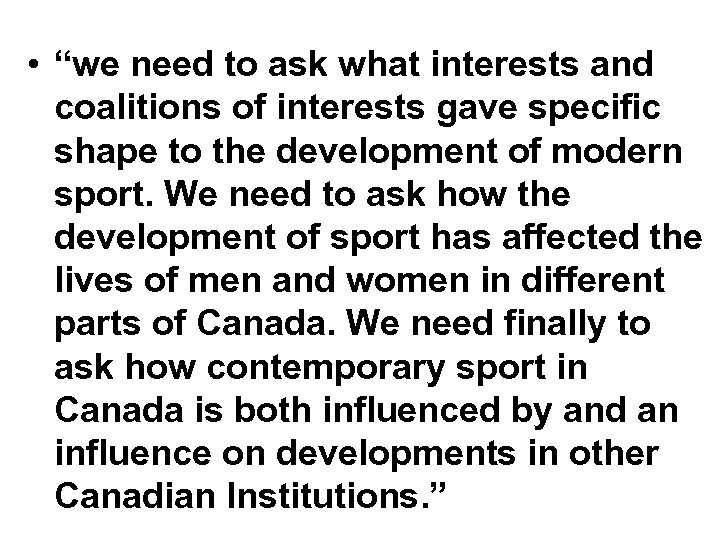 • “we need to ask what interests and coalitions of interests gave specific shape to the development of modern sport. We need to ask how the development of sport has affected the lives of men and women in different parts of Canada. We need finally to ask how contemporary sport in Canada is both influenced by and an influence on developments in other Canadian Institutions. ”
 Classical Greece and the National Athletic Festivals: • Ancient Olympics founded sometime in 8 th C BCE • Most prominent of some 1300 such Gr festivals • Popular bec Grks delighted in physical excellence – agonistic ideal • Not just games, but cultural (music, poetry, art) & religious celebrations
 Ancient Olympic Games • 776 BCE to 393 ACE, nearly 12 centuries as quad festival • Little variance to events: Ch races; foot races; discus, javelin, wr, boxing • Stade race of 200 yds • Sacred grounds of Olympia; olive wreath ideal • Women banned
 Ancient Olympic Games – the ‘How’: • Fairness was critical value • Race starts w trumpet then husplex (’ 56) • Longer than stade, had turning post; always went counter-clockwise • Pentathlon and halteres – 55 feet; amentum w javelin; boxing and himantes
 Modern sport roots in Ancient Greece: • Our sporting inheritance with - types of events - concepts of discipline, training, beauty, excellence, struggle - celebrations - values – amateurism, character • Festivals became more professionalized by 4 th C ACE
 Roman Sport: • 2 eras here: Republican Rome of 2 nd century BCE to just before birth of Christ – will not deal with its sport • Roman Empire – dominated Medit world for some 4 centuries – 100 mill pop • Rome w aqueducts, paved roads, parks, libraries all w 1. 5 mill in 17 km circumference – apt living, smelly; very prosperous
 Roman Sport: • Leisure time cannot be overemph • 159 public holidays/year at height of Empire; 93 of these devoted to Games [ ludi ] at public expense • Chariot racing in Circus Maximus; Gladatorial combats; wild beast fights; naval battles; athletic contests
 Decline of Roman Sport • • • Economic decline by 400 ACE Growing Xtian fanaticism ag body Plagues, earthquakes, famine Barbarian invasions Contribs to Modern sport ? – prof; spectatorship; gambling; excesses and win emphasis
 Medieval and Renaissance Sport • • • “decline” of civiliz during M-Ages Warring elite, poverty of masses Feudal system Asceticism of Xtian church Chivalry w tournaments & jousts as lavish displays of medieval pageantry • Renaiss or re-birth of Civiliz around 14 th C w ‘scientific’ discoveries – golf, tennis, archery, animal-baiting but no organization
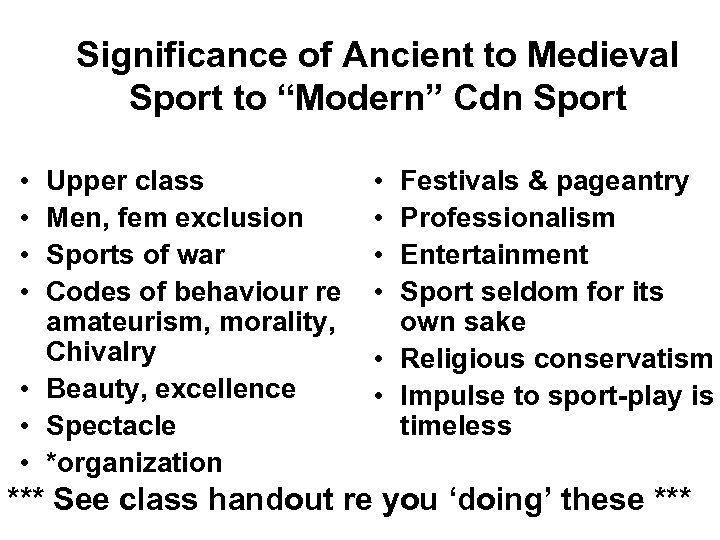 Significance of Ancient to Medieval Sport to “Modern” Cdn Sport • • Upper class Men, fem exclusion Sports of war Codes of behaviour re amateurism, morality, Chivalry • Beauty, excellence • Spectacle • *organization • • Festivals & pageantry Professionalism Entertainment Sport seldom for its own sake • Religious conservatism • Impulse to sport-play is timeless *** See class handout re you ‘doing’ these ***
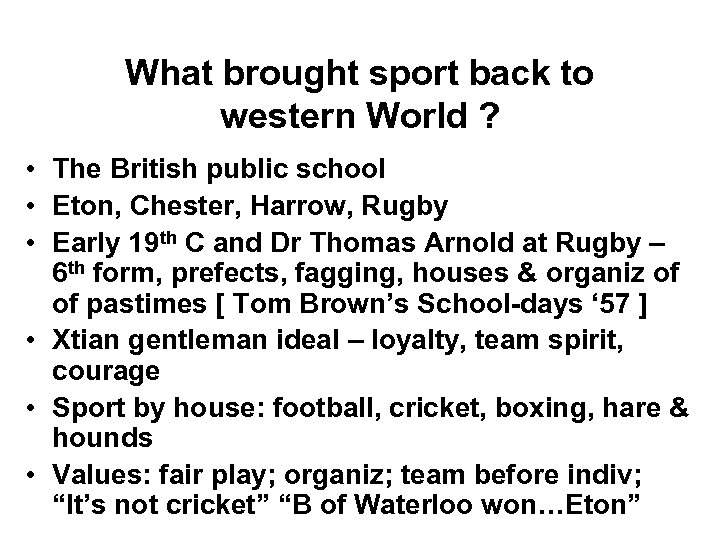 What brought sport back to western World ? • The British public school • Eton, Chester, Harrow, Rugby • Early 19 th C and Dr Thomas Arnold at Rugby – 6 th form, prefects, fagging, houses & organiz of of pastimes [ Tom Brown’s School-days ‘ 57 ] • Xtian gentleman ideal – loyalty, team spirit, courage • Sport by house: football, cricket, boxing, hare & hounds • Values: fair play; organiz; team before indiv; “It’s not cricket” “B of Waterloo won…Eton”