 Скачать презентацию 26 Business Cycles Unemployment and Inflation Mc Graw-Hill Irwin
Business Cycles, Unemployment, and Inflation.ppt
- Количество слайдов: 19



26 Business Cycles, Unemployment, and Inflation Mc. Graw-Hill/Irwin Copyright © 2012 by The Mc. Graw-Hill Companies, Inc. All rights reserved.
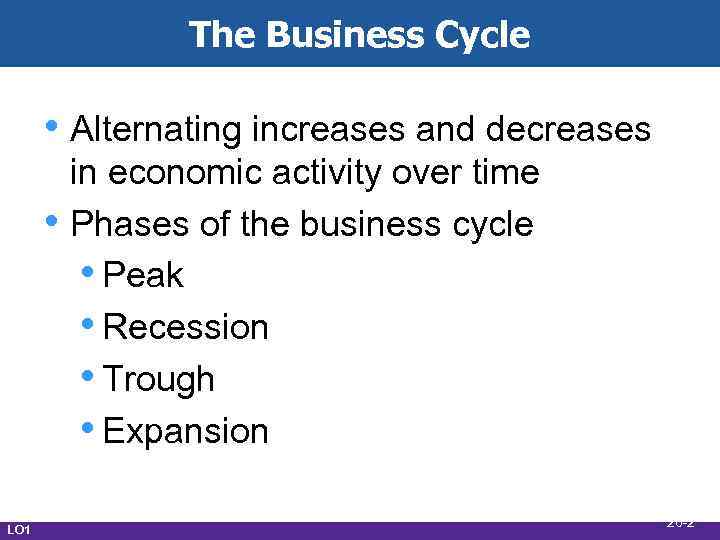
The Business Cycle • Alternating increases and decreases • LO 1 in economic activity over time Phases of the business cycle • Peak • Recession • Trough • Expansion 26 -2
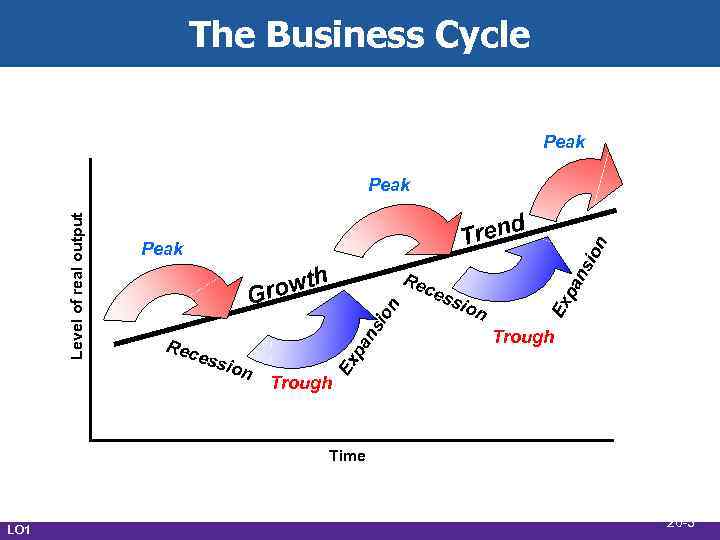
The Business Cycle Peak h rowt G ess ion n pa ns io Rec Re ces sio n Ex pa ns ion d Tren Trough Ex Level of real output Peak Trough Time LO 1 26 -3
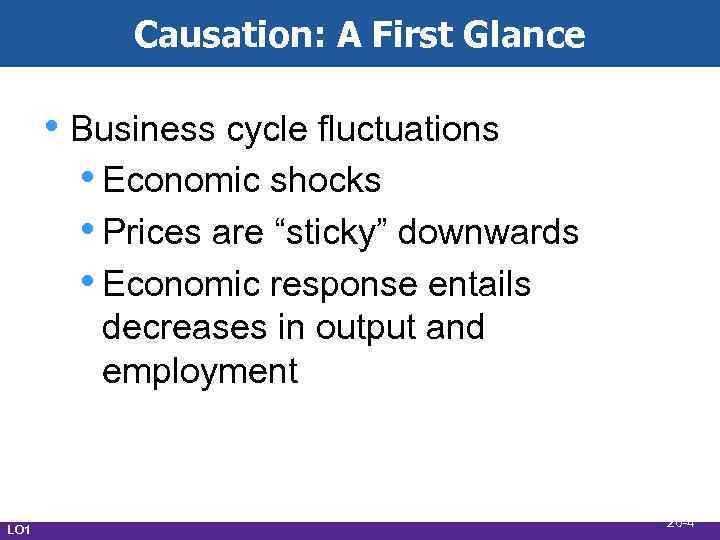
Causation: A First Glance • Business cycle fluctuations • Economic shocks • Prices are “sticky” downwards • Economic response entails decreases in output and employment LO 1 26 -4
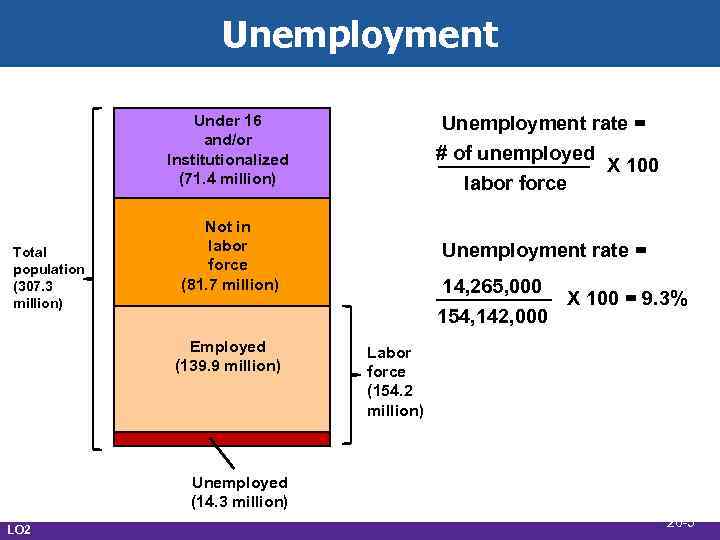
Unemployment Under 16 and/or Institutionalized (71. 4 million) Total population (307. 3 million) Unemployment rate = # of unemployed X 100 labor force Not in labor force (81. 7 million) Unemployment rate = 14, 265, 000 154, 142, 000 Employed (139. 9 million) X 100 = 9. 3% Labor force (154. 2 million) Unemployed (14. 3 million) LO 2 26 -5
Unemployment • Criticisms of unemployment • Involuntary part-time workers counted as if full-time • Discouraged workers are not counted as unemployed LO 2 26 -6
Types of Unemployment • Frictional unemployment • Individuals searching for jobs or • • LO 3 waiting to take jobs soon Structural unemployment • Occurs due to changes in the structure of the demand for labor Cyclical unemployment • Caused by the recession phase of the business cycle 26 -7
Definition of Full Employment • Natural Rate of Unemployment (NRU) • Full employment level of unemployment • Can vary over time • Demographic changes • Changing job search methods • Public policy changes • Actual unemployment can be above or fall below the NRU LO 3 26 -8
Economic Cost of Unemployment • GDP Gap • GDP gap = actual GDP – potential • LO 3 GDP • Can be negative or positive Okun’s Law • Every 1% of cyclical unemployment creates a 2% GDP gap 26 -9
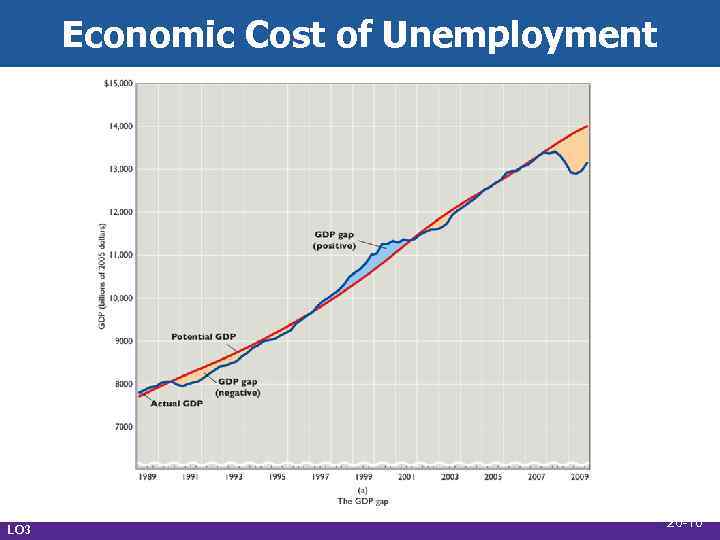
Economic Cost of Unemployment LO 3 26 -10
Unequal Burdens • Occupation • Age • Race and ethnicity • Gender • Education • Duration LO 3 26 -11
Noneconomic Costs • Loss of skills and loss of self-respect • Plummeting morale • Family disintegration • Poverty and reduced hope • Heightened racial and ethnic tensions • Suicide, homicide, fatal heart attacks, • LO 3 mental illness Can lead to violent social and political change 26 -12
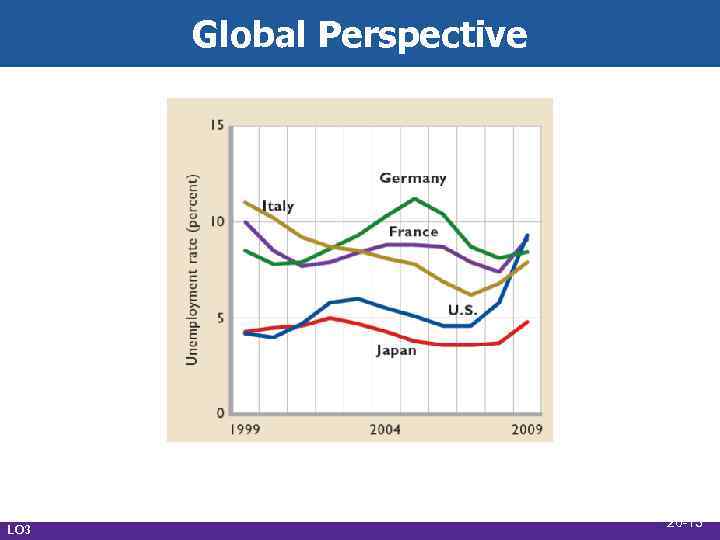
Global Perspective LO 3 26 -13
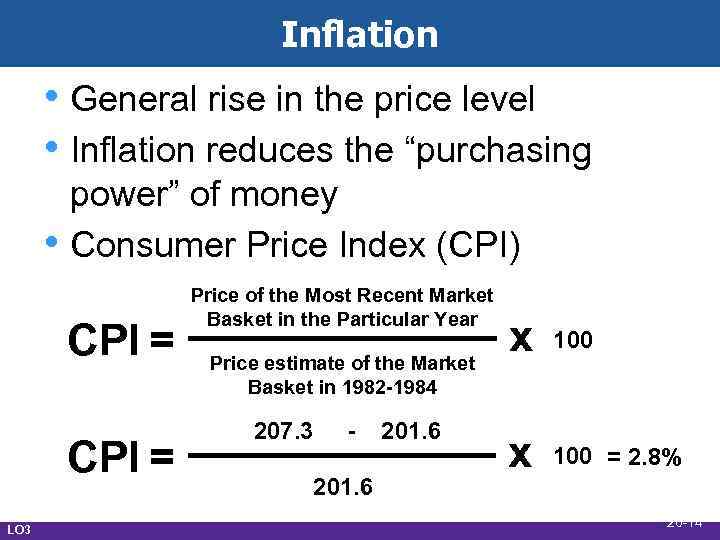
Inflation • General rise in the price level • Inflation reduces the “purchasing • power” of money Consumer Price Index (CPI) CPI = LO 3 Price of the Most Recent Market Basket in the Particular Year Price estimate of the Market Basket in 1982 -1984 207. 3 - 201. 6 x 100 = 2. 8% 26 -14
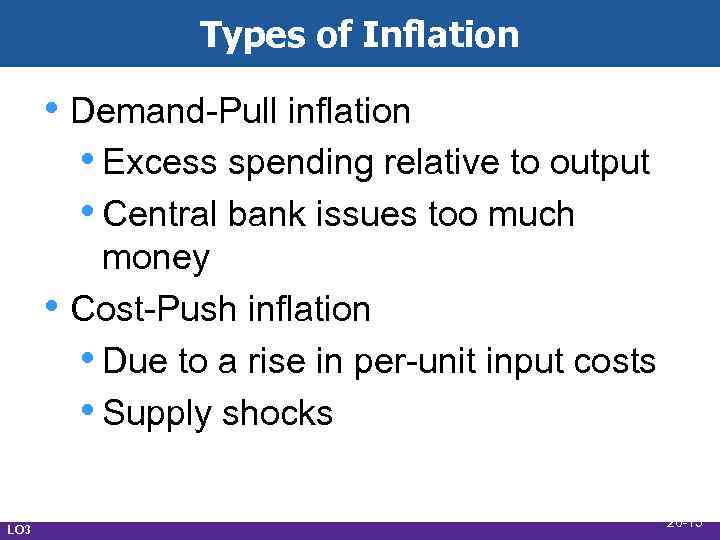
Types of Inflation • Demand-Pull inflation • Excess spending relative to output • Central bank issues too much • LO 3 money Cost-Push inflation • Due to a rise in per-unit input costs • Supply shocks 26 -15
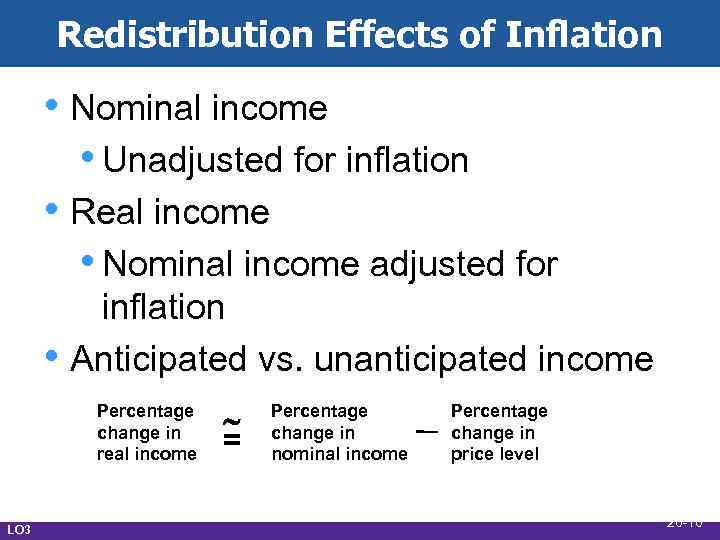
Redistribution Effects of Inflation • Nominal income • Unadjusted for inflation • Real income • Nominal income adjusted for • inflation Anticipated vs. unanticipated income Percentage change in real income LO 3 = Percentage change in nominal income Percentage change in price level 26 -16
Who is Hurt by Inflation? • Fixed-income receivers • Real incomes fall • Savers • Value of accumulated savings • LO 3 deteriorates Creditors • Lenders get paid back in “cheaper dollars” 26 -17
Who is Unaffected by Inflation? • Flexible-income receivers • COLAs • Social Security recipients • Union members • Debtors • Pay back the loan with “cheaper dollars” LO 3 26 -18
Does Inflation Affect Output? • Cost-push inflation • Reduces real output • Redistributes a decreased level of • LO 3 real income Demand-pull inflation • One view is that zero inflation is best • Another view is that mild inflation is best 26 -19
Скачать презентацию 26 Business Cycles Unemployment and Inflation Mc Graw-Hill Irwin
Business Cycles, Unemployment, and Inflation.ppt