


 Скачать презентацию 25 Years of Essential Medicines 1977 — 2002
49631d836198e965dcd84206b7aced3d.ppt
- Количество слайдов: 24
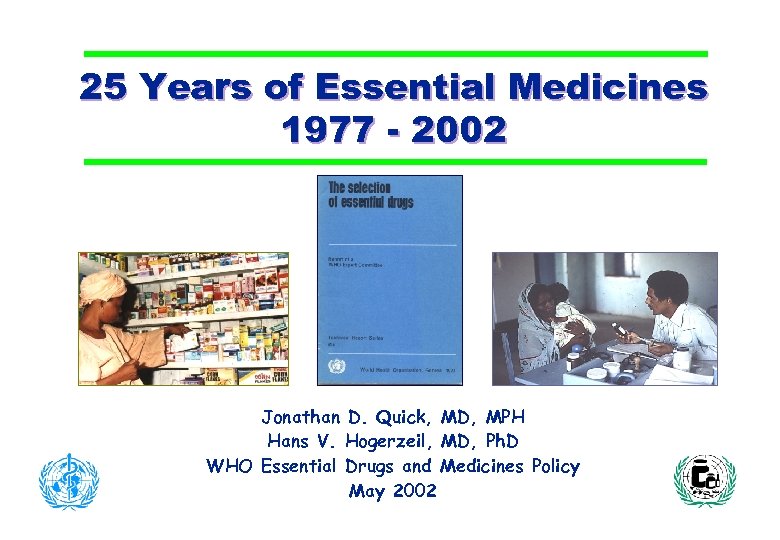 25 Years of Essential Medicines 1977 - 2002 Jonathan D. Quick, MD, MPH Hans V. Hogerzeil, MD, Ph. D WHO Essential Drugs and Medicines Policy May 2002
 Overview of the presentation 1. Achievements 1977 - 2002 2. Unfinished agenda 3. The selection of essential medicines 4. Promising developments 2 25 years
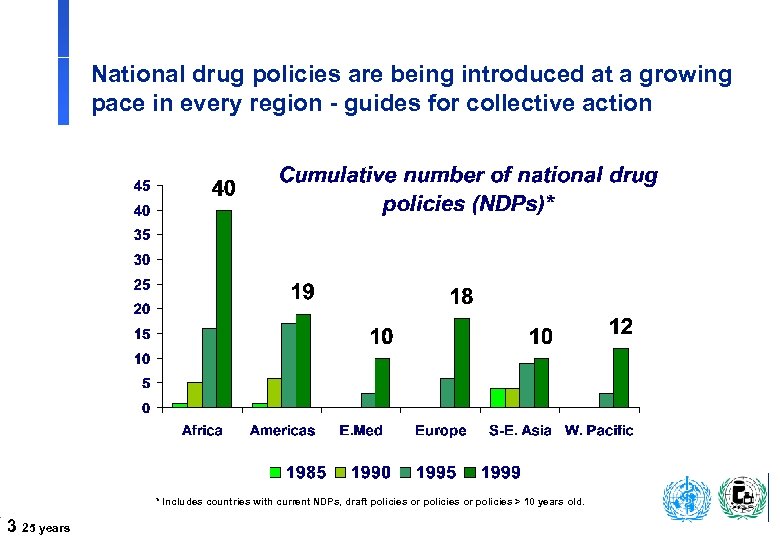 Achievements National drug policies are being introduced at a growing pace in every region - guides for collective action * Includes countries with current NDPs, draft policies or policies > 10 years old. 3 25 years
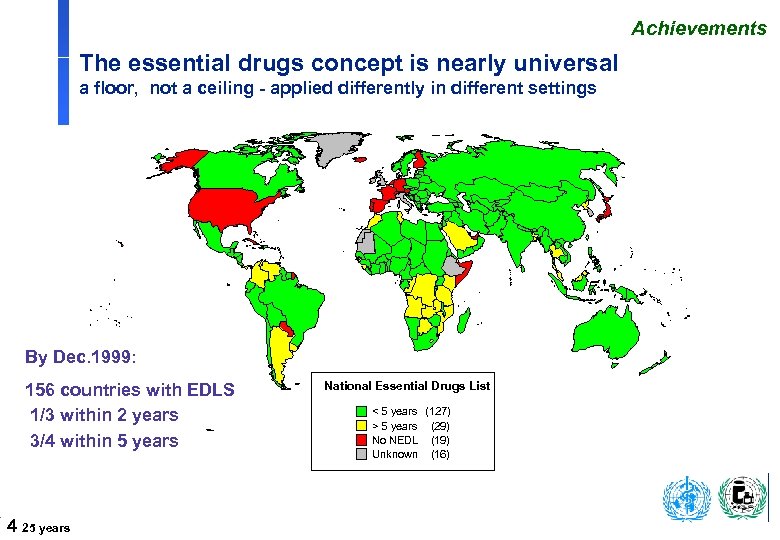 Achievements The essential drugs concept is nearly universal a floor, not a ceiling - applied differently in different settings By Dec. 1999: 156 countries with EDLS 1/3 within 2 years 3/4 within 5 years National Essential Drugs List < 5 years (127) > 5 years (29) No NEDL (19) Unknown (16) Countries with an official selective list for training, supply, reimbursement or related health objectives. Some countries have selective state/provincial lists instead of or in addition to national lists. 4 25 years
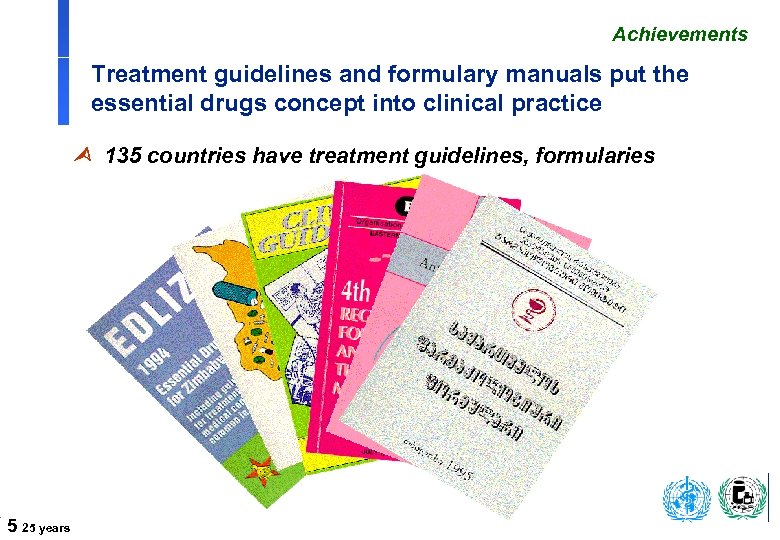 Achievements Treatment guidelines and formulary manuals put the essential drugs concept into clinical practice 135 countries have treatment guidelines, formularies 5 25 years
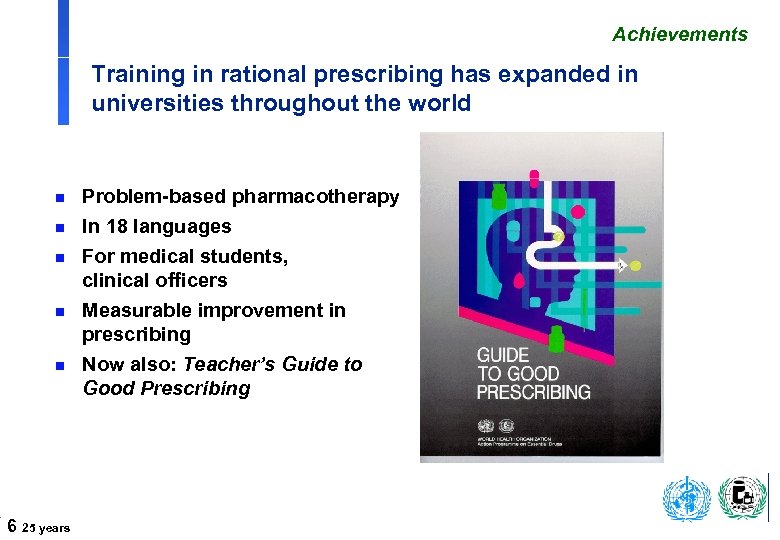 DAP’s role Achievements Training in rational prescribing has expanded in universities throughout the world n n n 6 25 years Problem-based pharmacotherapy In 18 languages For medical students, clinical officers Measurable improvement in prescribing Now also: Teacher’s Guide to Good Prescribing
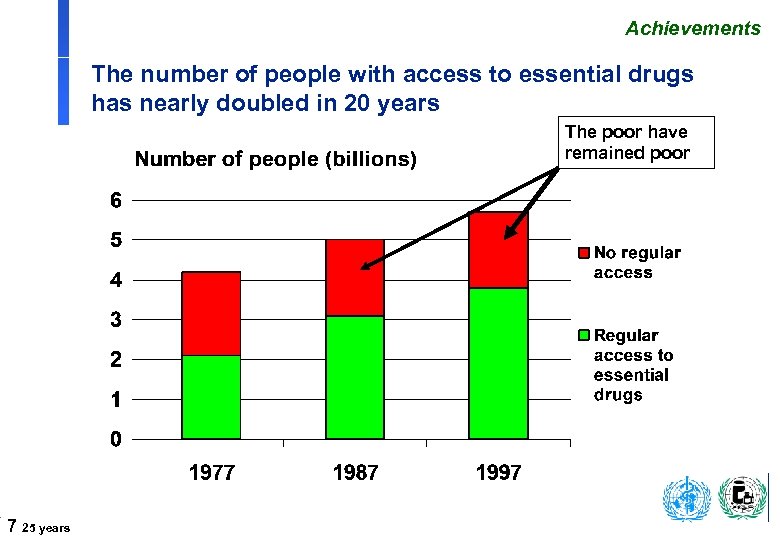 Achievements The number of people with access to essential drugs has nearly doubled in 20 years The poor have remained poor 7 25 years
 Much has been achieved in 25 years. . . but…. . 8 25 years
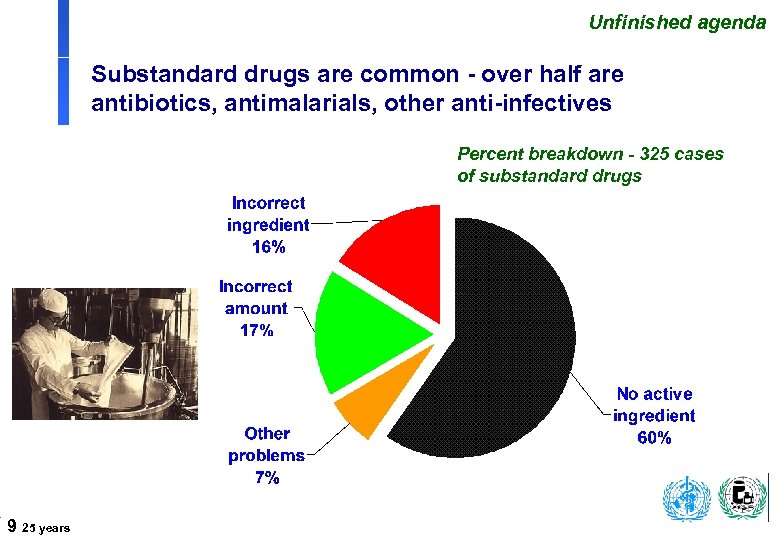 Unfinished agenda Substandard drugs are common - over half are antibiotics, antimalarials, other anti-infectives Percent breakdown - 325 cases of substandard drugs 9 25 years
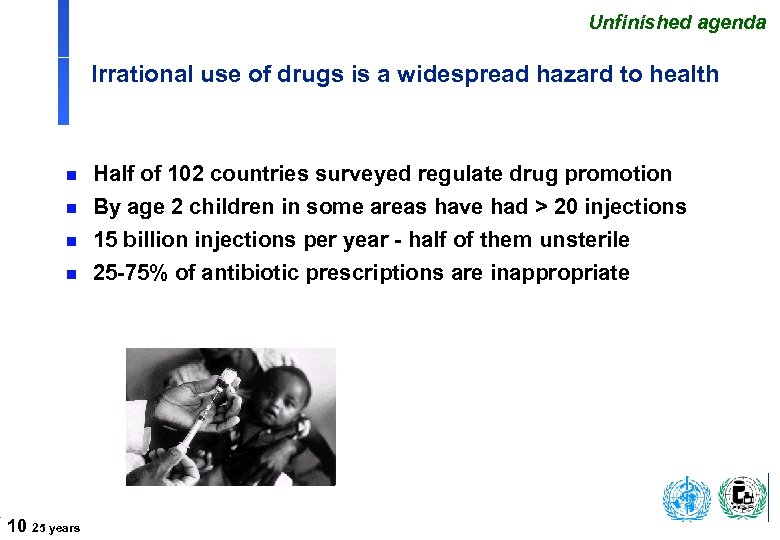 Unfinished agenda Irrational use of drugs is a widespread hazard to health n n 10 25 years Half of 102 countries surveyed regulate drug promotion By age 2 children in some areas have had > 20 injections 15 billion injections per year - half of them unsterile 25 -75% of antibiotic prescriptions are inappropriate
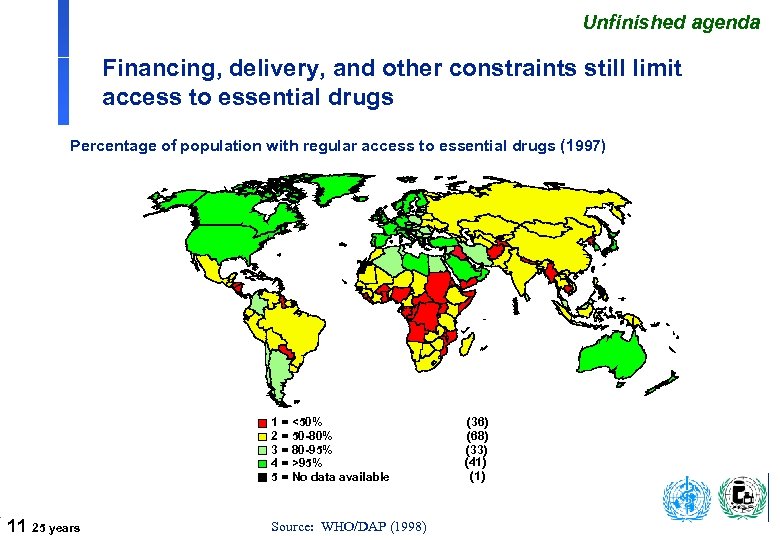 Unfinished agenda Financing, delivery, and other constraints still limit access to essential drugs Percentage of population with regular access to essential drugs (1997) 1 = <50% 2 = 50 -80% 3 = 80 -95% 4 = >95% 5 = No data available 11 25 years Source: WHO/DAP (1998) (36) (68) (33) (41) (36)
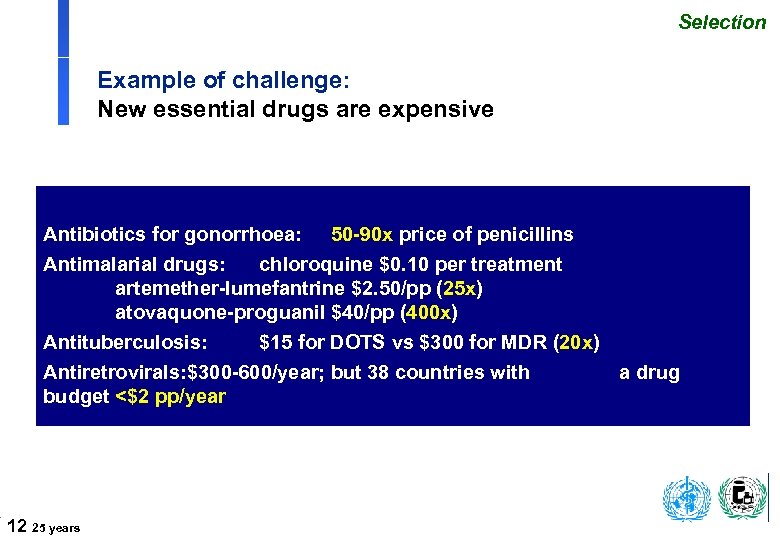 Selection Example of challenge: New essential drugs are expensive Antibiotics for gonorrhoea: 50 -90 x price of penicillins Antimalarial drugs: chloroquine $0. 10 per treatment artemether-lumefantrine $2. 50/pp (25 x) atovaquone-proguanil $40/pp (400 x) Antituberculosis: $15 for DOTS vs $300 for MDR (20 x) Antiretrovirals: $300 -600/year; but 38 countries with a drug budget <$2 pp/year 12 25 years
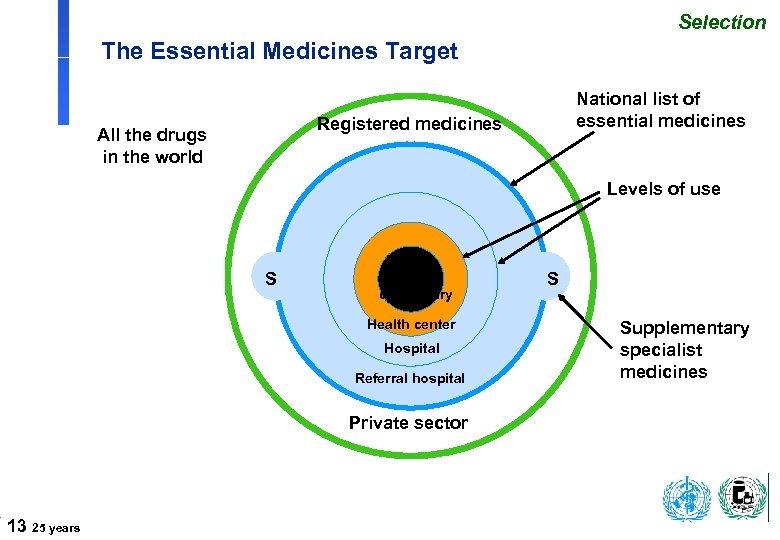 Selection The Essential Medicines Target National list of essential medicines Registered medicines All the drugs in the world Levels of use S CHW dispensary Health center Hospital Referral hospital Private sector 13 25 years S Supplementary specialist medicines
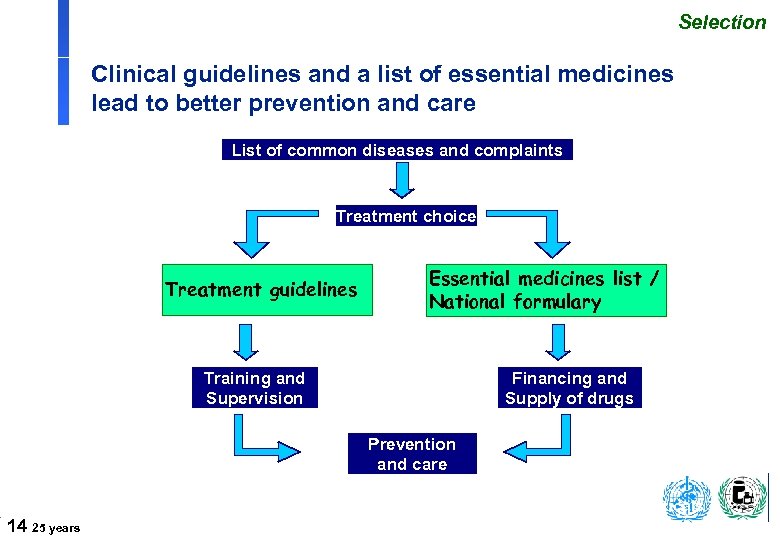 Selection Clinical guidelines and a list of essential medicines lead to better prevention and care List of common diseases and complaints Treatment choice Treatment guidelines Essential medicines list / National formulary Training and Supervision Financing and Supply of drugs Prevention and care Health Technology and Pharmaceuticals 14 25 years
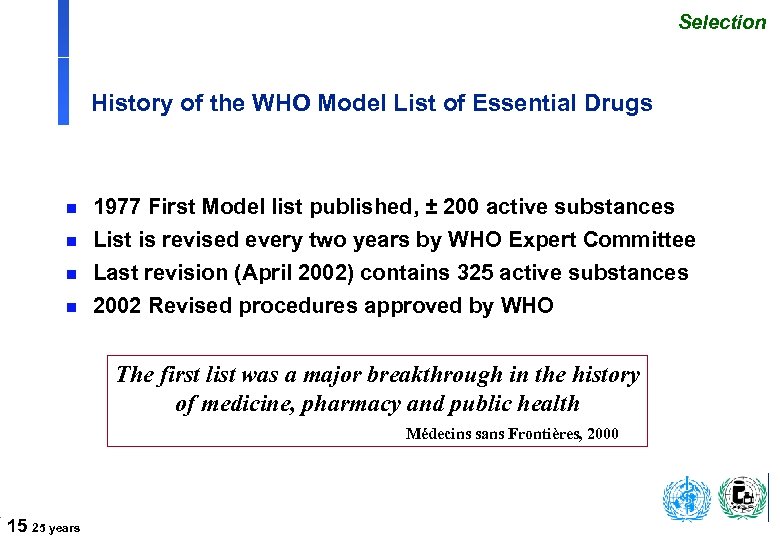 Selection History of the WHO Model List of Essential Drugs n 1977 First Model list published, ± 200 active substances List is revised every two years by WHO Expert Committee Last revision (April 2002) contains 325 active substances n 2002 Revised procedures approved by WHO n n The first list was a major breakthrough in the history of medicine, pharmacy and public health Médecins sans Frontières, 2000 15 25 years
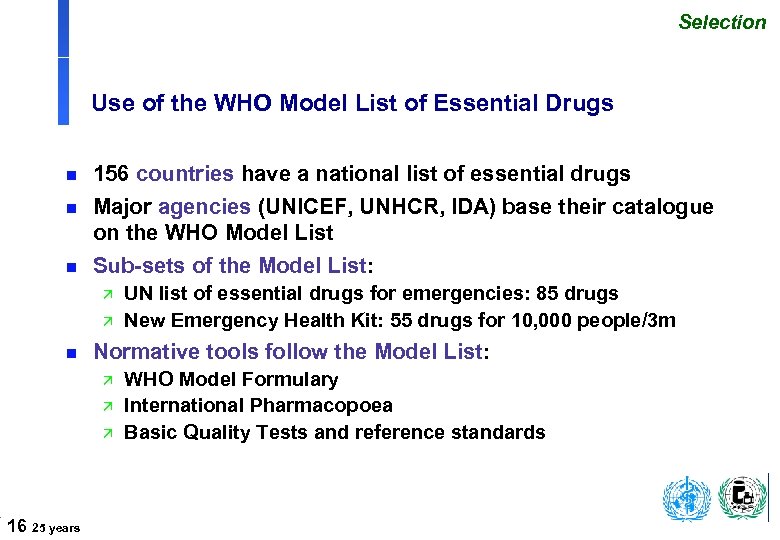 Selection Use of the WHO Model List of Essential Drugs n n n 156 countries have a national list of essential drugs Major agencies (UNICEF, UNHCR, IDA) base their catalogue on the WHO Model List Sub-sets of the Model List: ä ä n Normative tools follow the Model List: ä ä ä 16 25 years UN list of essential drugs for emergencies: 85 drugs New Emergency Health Kit: 55 drugs for 10, 000 people/3 m WHO Model Formulary International Pharmacopoea Basic Quality Tests and reference standards
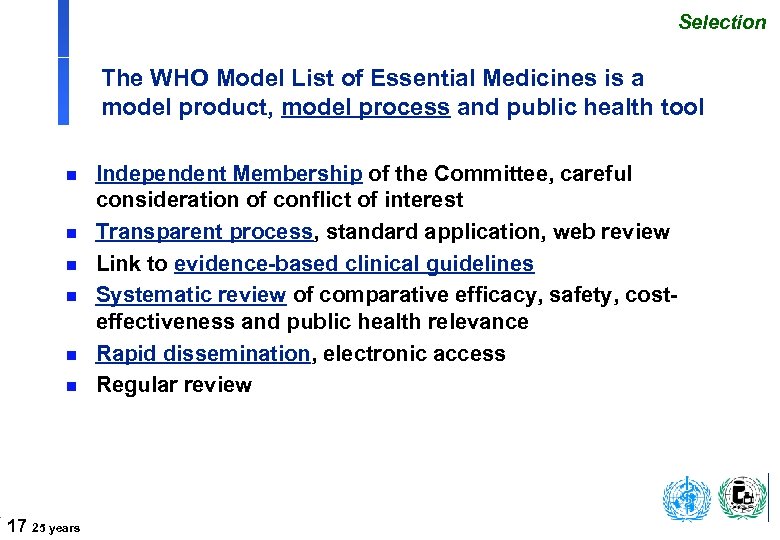 Selection The WHO Model List of Essential Medicines is a model product, model process and public health tool n n n 17 25 years Independent Membership of the Committee, careful consideration of conflict of interest Transparent process, standard application, web review Link to evidence-based clinical guidelines Systematic review of comparative efficacy, safety, costeffectiveness and public health relevance Rapid dissemination, electronic access Regular review
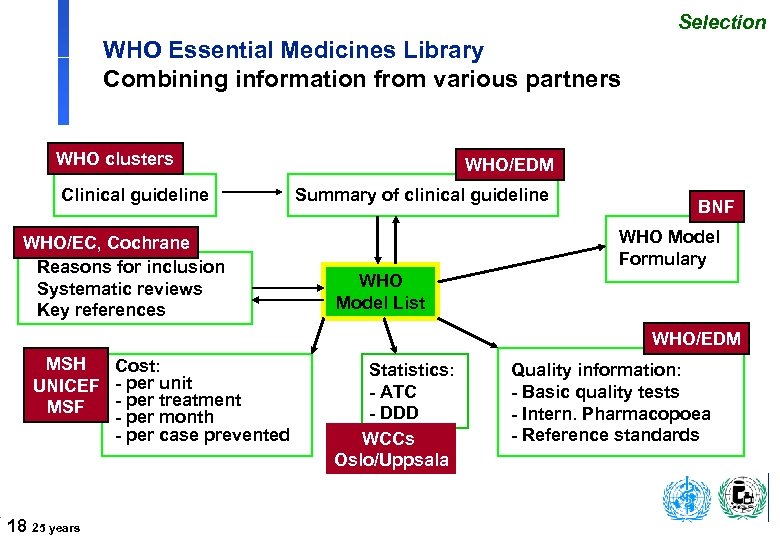 Selection WHO Essential Medicines Library Combining information from various partners WHO clusters Clinical guideline WHO/EC, Cochrane Reasons for inclusion Systematic reviews Key references WHO/EDM Summary of clinical guideline BNF WHO Model Formulary WHO Model List WHO/EDM MSH Cost: UNICEF - per unit - per treatment MSF - per month - per case prevented 18 25 years Statistics: - ATC - DDD WCCs Oslo/Uppsala Quality information: - Basic quality tests - Intern. Pharmacopoea - Reference standards
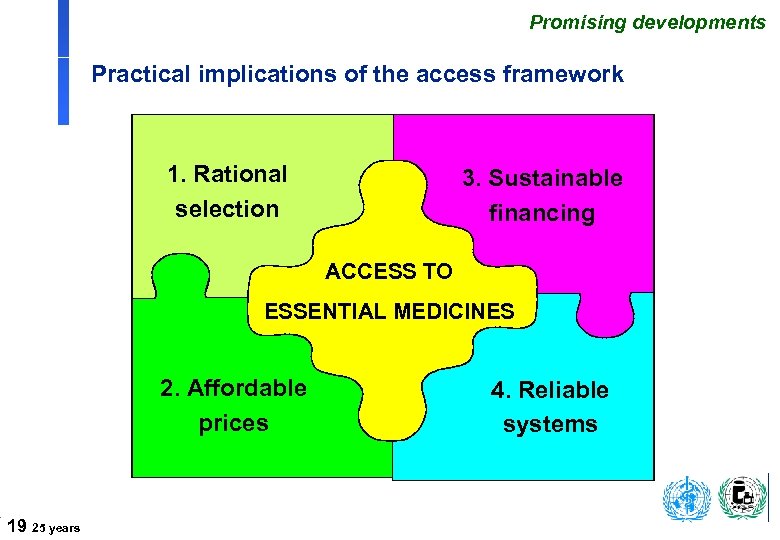 Promising developments Practical implications of the access framework 1. Rational selection 3. Sustainable financing ACCESS TO ESSENTIAL MEDICINES 2. Affordable prices 19 25 years 4. Reliable systems
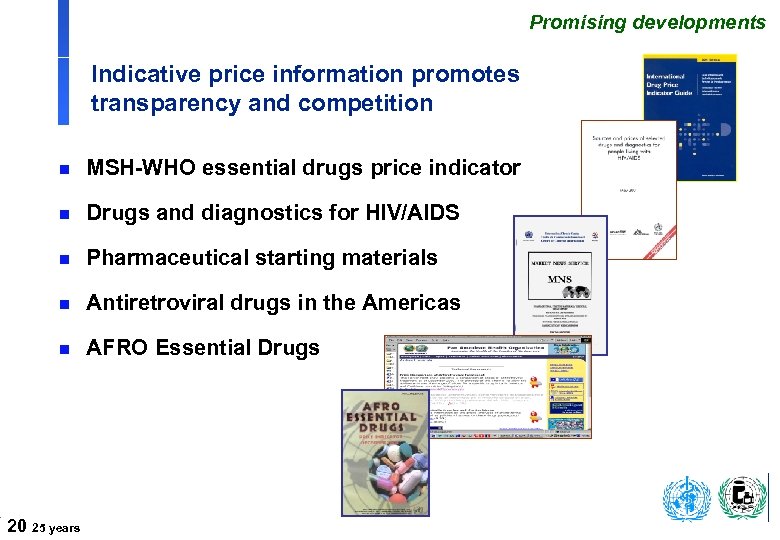 Promising developments Indicative price information promotes transparency and competition n MSH-WHO essential drugs price indicator n Drugs and diagnostics for HIV/AIDS n Pharmaceutical starting materials n Antiretroviral drugs in the Americas n AFRO Essential Drugs 20 25 years
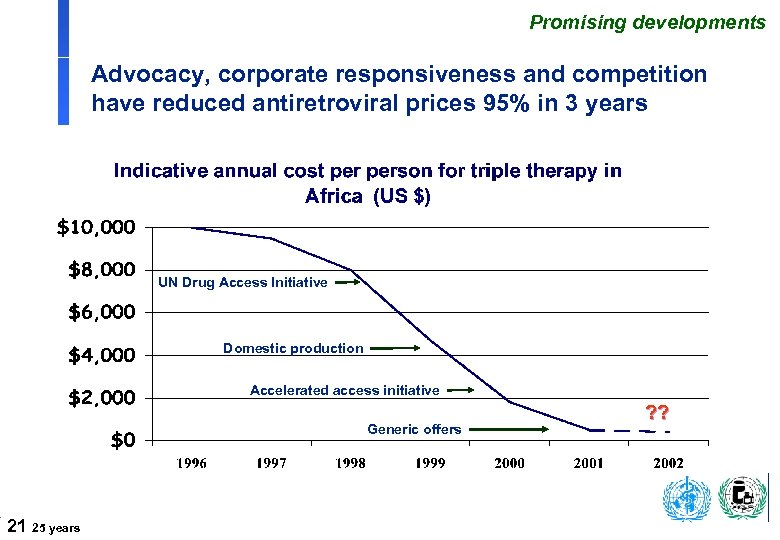 Promising developments Advocacy, corporate responsiveness and competition have reduced antiretroviral prices 95% in 3 years UN Drug Access Initiative Domestic production Accelerated access initiative Generic offers 21 25 years ? ?
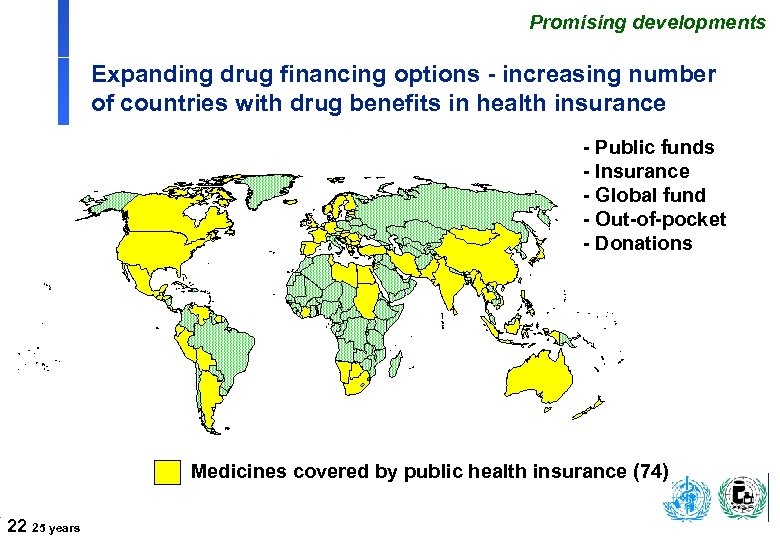 Promising developments Expanding drug financing options - increasing number of countries with drug benefits in health insurance - Public funds - Insurance - Global fund - Out-of-pocket - Donations Medicines covered by public health insurance (74) 22 25 years
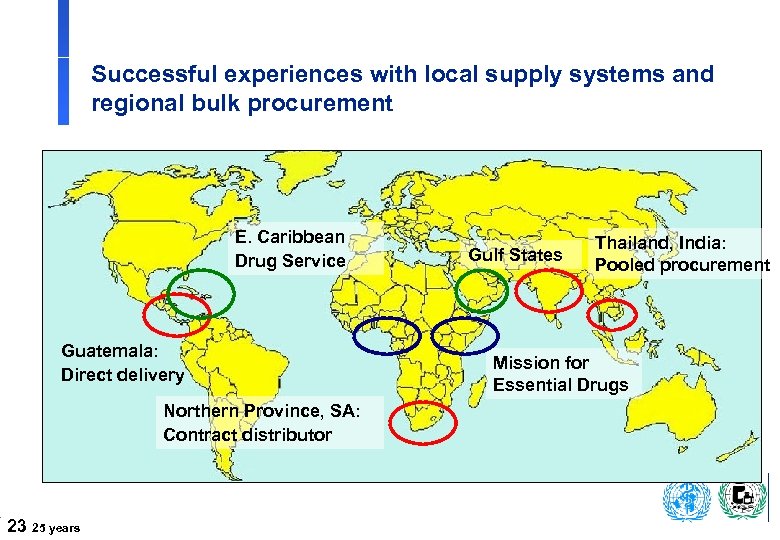 Successful experiences with local supply systems and regional bulk procurement E. Caribbean Drug Service Guatemala: Direct delivery Northern Province, SA: Contract distributor 23 25 years Gulf States Thailand, India: Pooled procurement Mission for Essential Drugs
 Conclusion The essential drugs concept more valid than ever n Much has been achieved in 25 years n Yet the unfinished agenda is large - quality, access, use n The Model List of Essential Medicines remains a strong public health tool n There are promising developments for access pricing, financing, supply systems and quality 24 25 years