


 Скачать презентацию 25 Economic Growth Mc Graw-Hill Irwin Copyright 2012
петя.ppt
- Количество слайдов: 15
 25 Economic Growth Mc. Graw-Hill/Irwin Copyright © 2012 by The Mc. Graw-Hill Companies, Inc. All rights reserved.
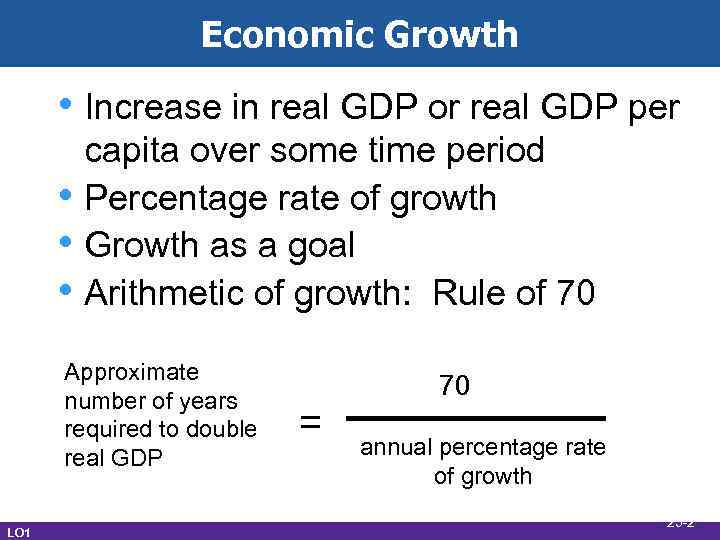 Economic Growth • Increase in real GDP or real GDP per • • • capita over some time period Percentage rate of growth Growth as a goal Arithmetic of growth: Rule of 70 Approximate number of years required to double real GDP LO 1 = 70 annual percentage rate of growth 25 -2
 Economic Growth • Growth in U. S. real GDP 1950 -2009 • Increased 6 fold • 3. 2% per year • Growth in U. S. real GDP per capita • Increased more than 3 fold • 2% per year • Qualifications • Improved products and services • Added leisure • Other impacts LO 1 25 -3
 Modern Economic Growth • Began with the Industrial Revolution • • • LO 2 in late 1700 s Ongoing increases in living standards Time for leisure Social change Democracy Human lifespan doubled 25 -4
 Modern Economic Growth • Began in Britain • Has spread slowly • Starting date main cause of worldwide • LO 2 differences in living standards Catching up is possible • Leader countries invent technology • Follower countries adopt technology • Can grow faster 25 -5
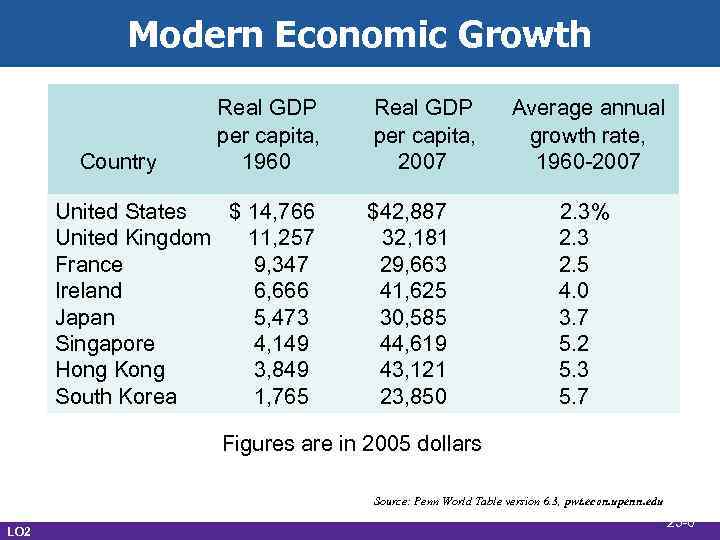 Modern Economic Growth Country Real GDP per capita, 1960 United States $ 14, 766 United Kingdom 11, 257 France 9, 347 Ireland 6, 666 Japan 5, 473 Singapore 4, 149 Hong Kong 3, 849 South Korea 1, 765 Real GDP per capita, 2007 $42, 887 32, 181 29, 663 41, 625 30, 585 44, 619 43, 121 23, 850 Average annual growth rate, 1960 -2007 2. 3% 2. 3 2. 5 4. 0 3. 7 5. 2 5. 3 5. 7 Figures are in 2005 dollars Source: Penn World Table version 6. 3, pwt. econ. upenn. edu LO 2 25 -6
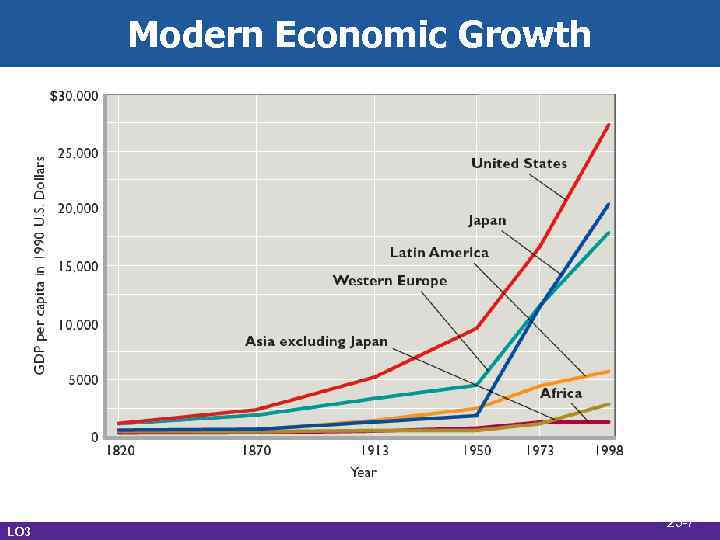 Modern Economic Growth LO 3 25 -7
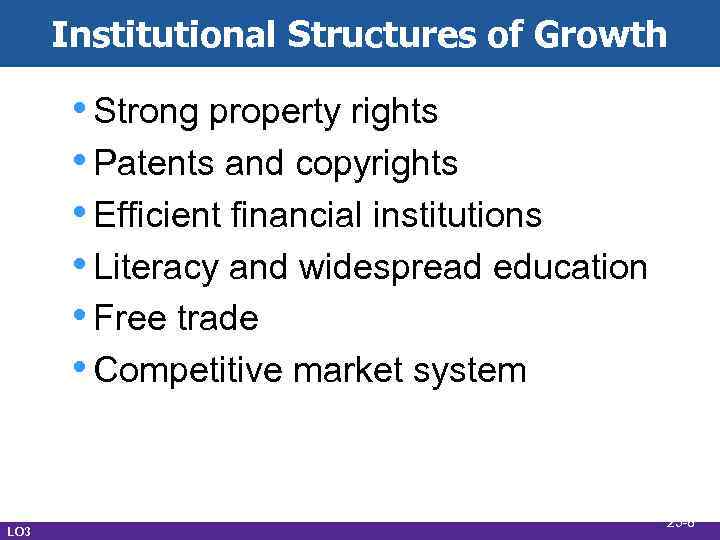 Institutional Structures of Growth • Strong property rights • Patents and copyrights • Efficient financial institutions • Literacy and widespread education • Free trade • Competitive market system LO 3 25 -8
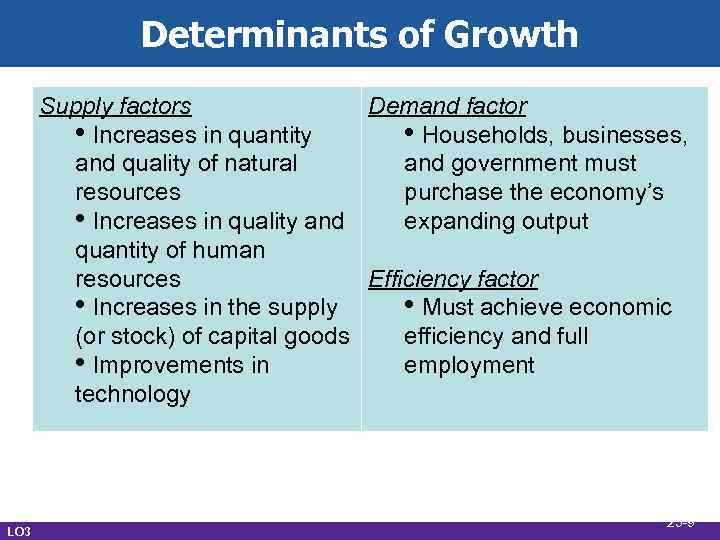 Determinants of Growth Supply factors Demand factor • Increases in quantity • Households, businesses, and quality of natural and government must resources purchase the economy’s • Increases in quality and expanding output quantity of human resources Efficiency factor • Increases in the supply • Must achieve economic (or stock) of capital goods efficiency and full • Improvements in employment technology LO 3 25 -9
 Accounting for Growth • Factors affecting productivity growth • Technological advance (40%) • Quantity of capital (30%) • Education and training (15%) • Economies of scale and resource allocation (15%) LO 3 25 -10
 Productivity Growth • Average rate of growth • 1. 5% per year 1973 -1995 • 2. 8% per year 1995 -2009 • Affects real output, real income, and • LO 4 real wages Pay higher wages without lowering profit 25 -11
 Productivity Growth LO 4 • Microchip/information technology • New firms and increasing returns • Sources of increasing returns • More specialized inputs • Spreading of development costs • Simultaneous consumption • Network effects • Learning by doing • Global competition 25 -12
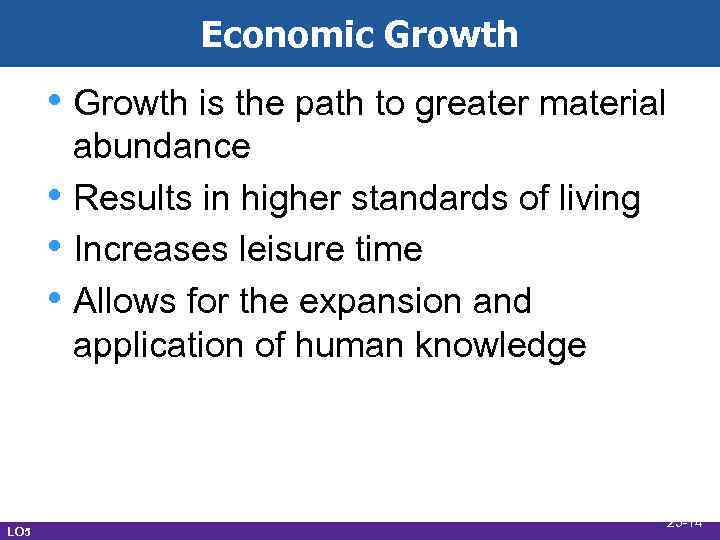
 Economic Growth • Is economic growth desirable and • • LO 5 sustainable? The antigrowth view • Environmental and resource issues In defense of economic growth • Higher standard of living • Human imagination can solve environmental and resource issues 25 -13
 Economic Growth • Growth is the path to greater material • • • LO 5 abundance Results in higher standards of living Increases leisure time Allows for the expansion and application of human knowledge 25 -14
 Global Perspective LO 5 25 -15