


 Скачать презентацию 240 -650 Principles of Pattern Recognition Montri Karnjanadecha
aa1d58282591aba6dcd0349b13c6edfc.ppt
- Количество слайдов: 40
 240 -650 Principles of Pattern Recognition Montri Karnjanadecha montri@coe. psu. ac. th http: //fivedots. coe. psu. ac. th/~montri 240 -572: Chapter 1: Introduction 1
 Chapter 1 Introduction 240 -572: Chapter 1: Introduction 2
 Outline • Pattern Recognition System • The Design Cycle • Learning and Adaptation • Read Chapter 1 (Duda, Hart, and Stork) 240 -572: Chapter 1: Introduction 3
 Motivations • Pattern recognition has many very valuable civil as well as military applications – – Automated target recognition Automated Processing Systems New Human Computer Interface Biometrics 240 -572: Chapter 1: Introduction 4
 Handwritten Address Interpretation System • HWAI - http: //www. cedar. buffalo. edu/HWAI/ – The HWAI (Handwritten Address Interpretation) System was developed at Center of Excellence for Document Analysis and Recognition (CEDAR) at University at Buffalo, The State University of New York. It resulted from many years of research at CEDAR on the problems of Address Block location, Handwritten Digit/Character/Word Recognition, Database Compression, Information Retrieval, Real-Time Image Processing, and Loosely. Coupled Multiprocessing. – The following presentation is based on the demonstration pages at HWAI 240 -572: Chapter 1: Introduction 5
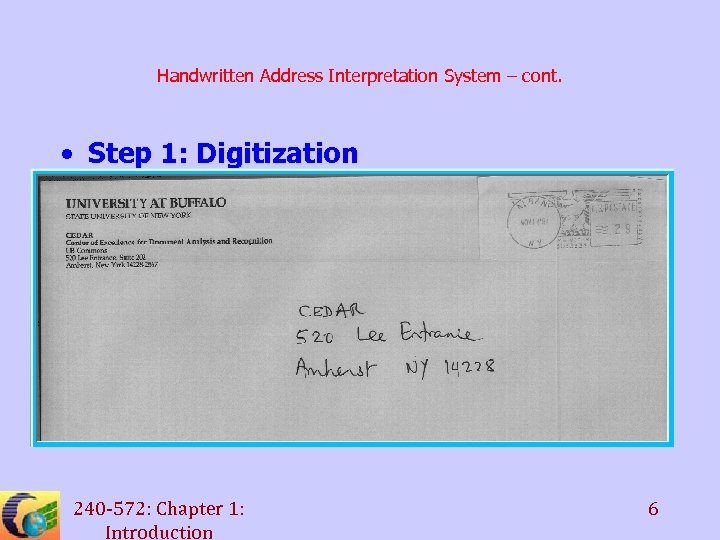 Handwritten Address Interpretation System – cont. • Step 1: Digitization 240 -572: Chapter 1: Introduction 6
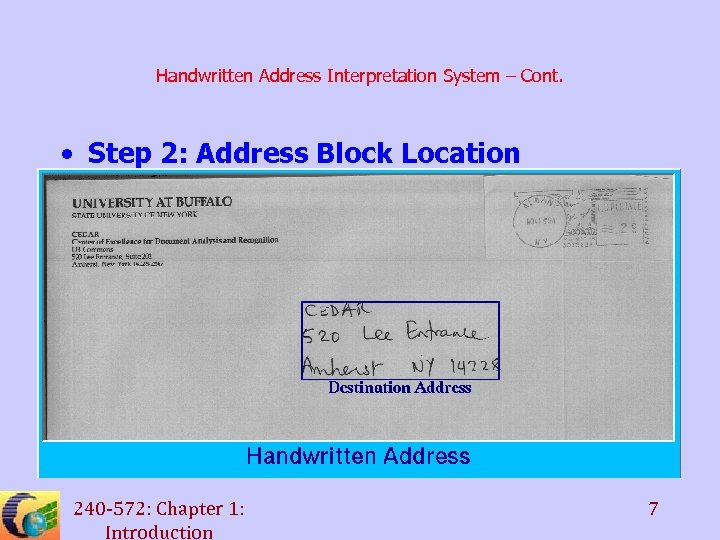 Handwritten Address Interpretation System – Cont. • Step 2: Address Block Location 240 -572: Chapter 1: Introduction 7
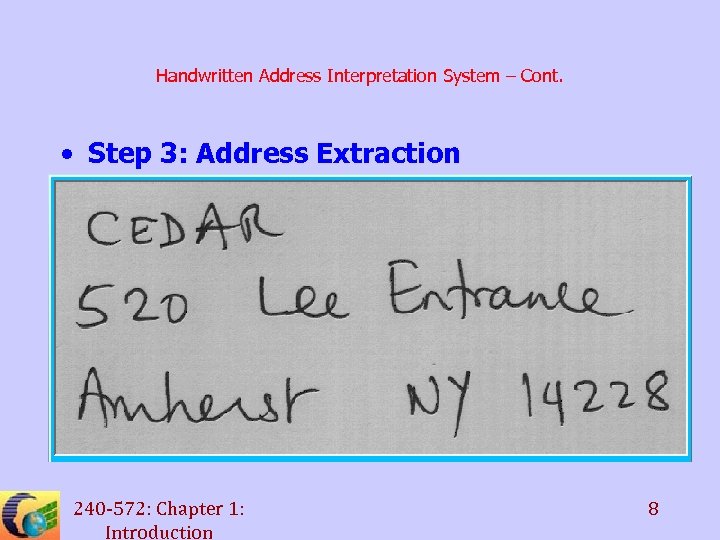 Handwritten Address Interpretation System – Cont. • Step 3: Address Extraction 240 -572: Chapter 1: Introduction 8
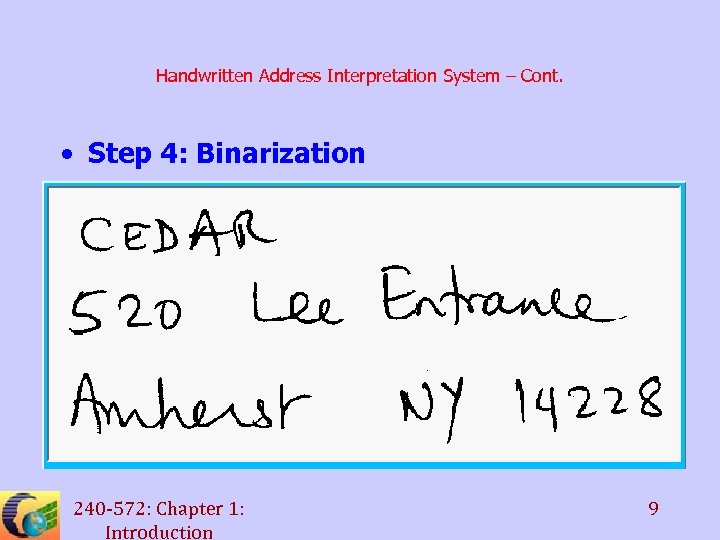 Handwritten Address Interpretation System – Cont. • Step 4: Binarization 240 -572: Chapter 1: Introduction 9
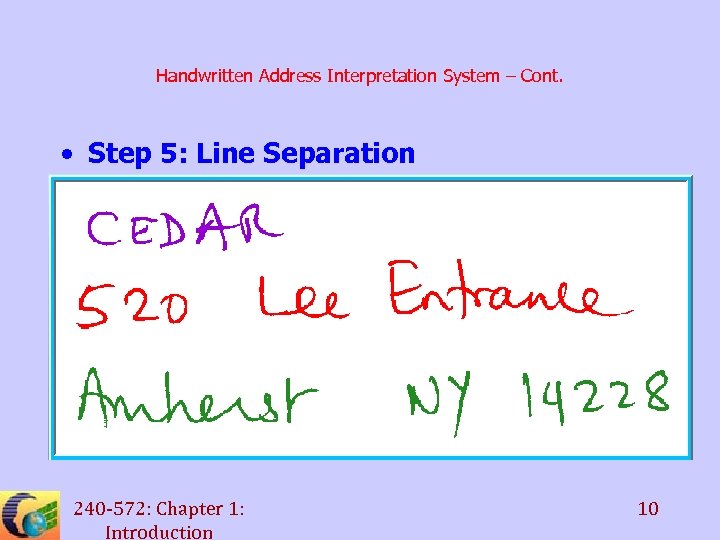 Handwritten Address Interpretation System – Cont. • Step 5: Line Separation 240 -572: Chapter 1: Introduction 10
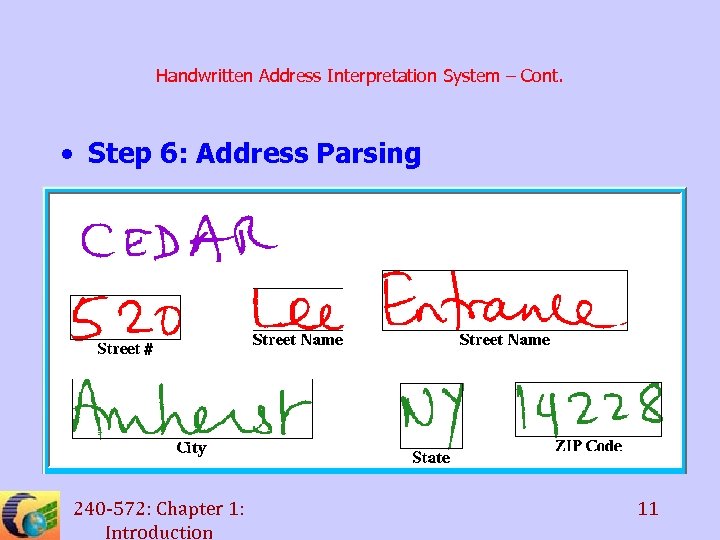 Handwritten Address Interpretation System – Cont. • Step 6: Address Parsing 240 -572: Chapter 1: Introduction 11
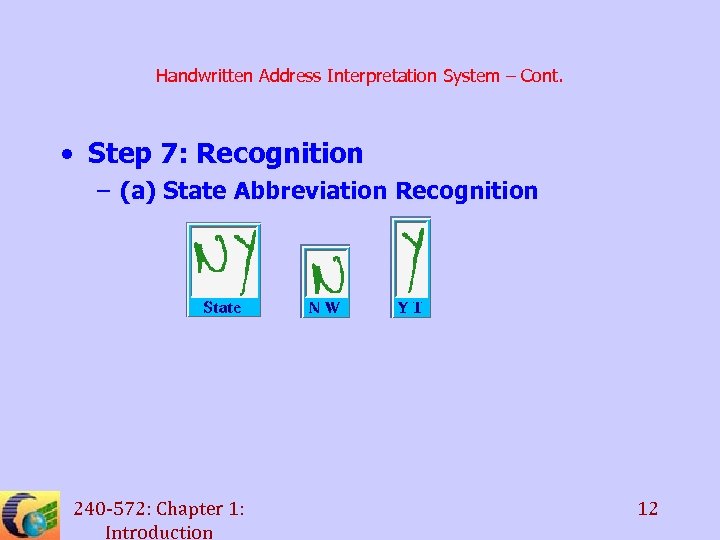 Handwritten Address Interpretation System – Cont. • Step 7: Recognition – (a) State Abbreviation Recognition 240 -572: Chapter 1: Introduction 12
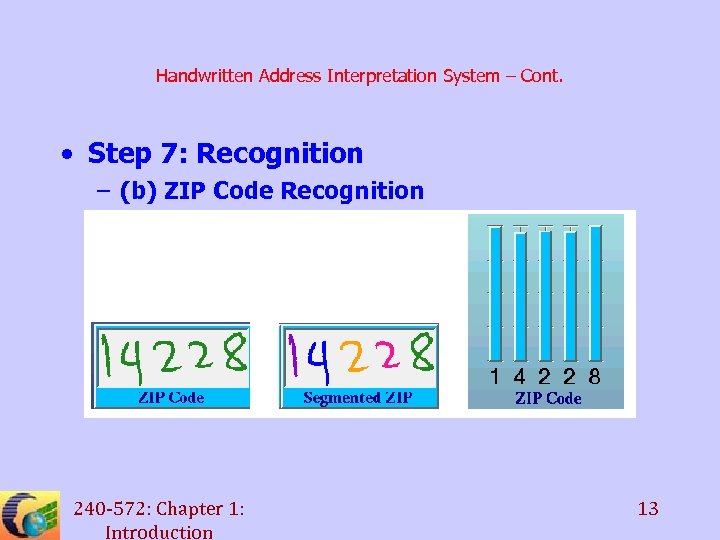 Handwritten Address Interpretation System – Cont. • Step 7: Recognition – (b) ZIP Code Recognition 240 -572: Chapter 1: Introduction 13
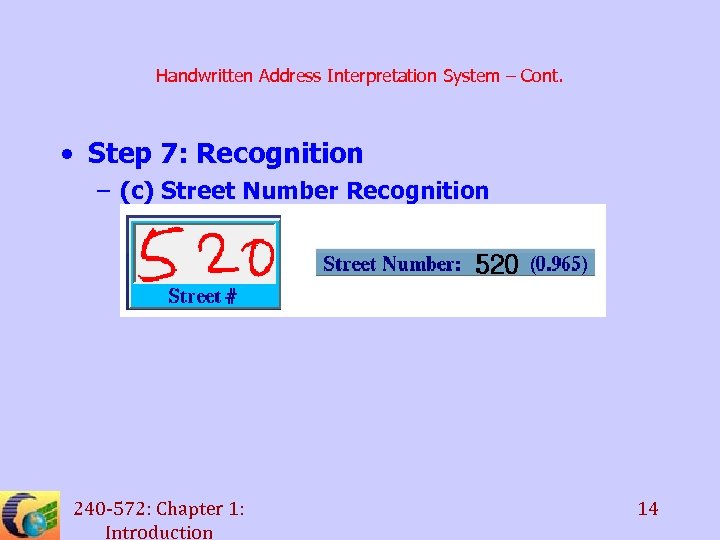 Handwritten Address Interpretation System – Cont. • Step 7: Recognition – (c) Street Number Recognition 240 -572: Chapter 1: Introduction 14
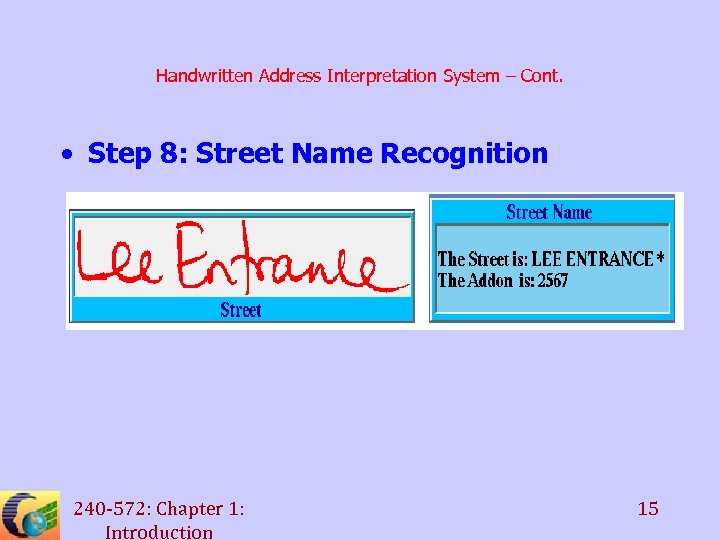 Handwritten Address Interpretation System – Cont. • Step 8: Street Name Recognition 240 -572: Chapter 1: Introduction 15
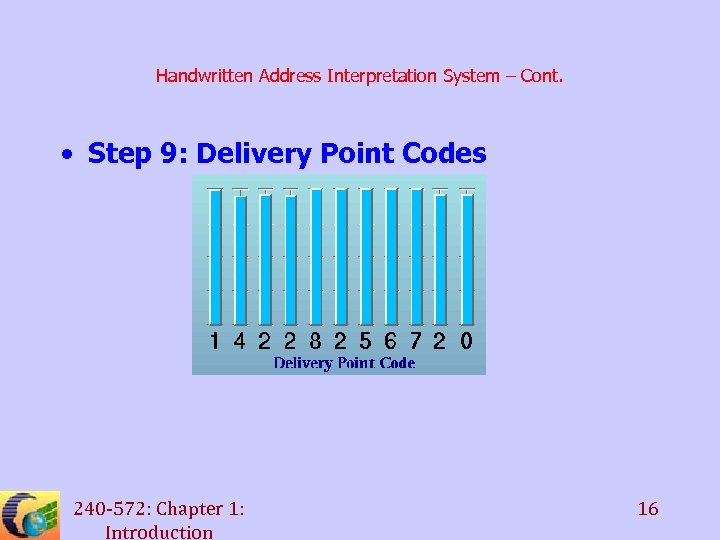 Handwritten Address Interpretation System – Cont. • Step 9: Delivery Point Codes 240 -572: Chapter 1: Introduction 16
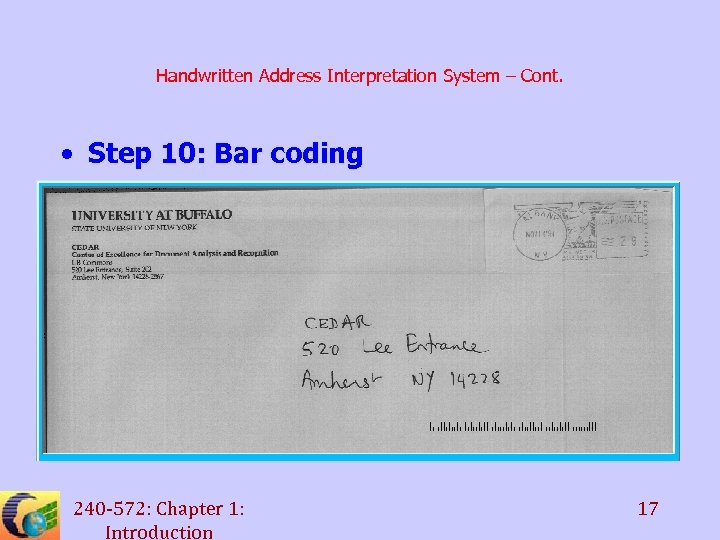 Handwritten Address Interpretation System – Cont. • Step 10: Bar coding 240 -572: Chapter 1: Introduction 17
 IBM Voice Systems • Voice enabling e-bussiness http: //www-4. ibm. com/software/speech/enterprise/dcenter/demo_0. html – Get information through speech recognition software Via. Voice 240 -572: Chapter 1: Introduction 18
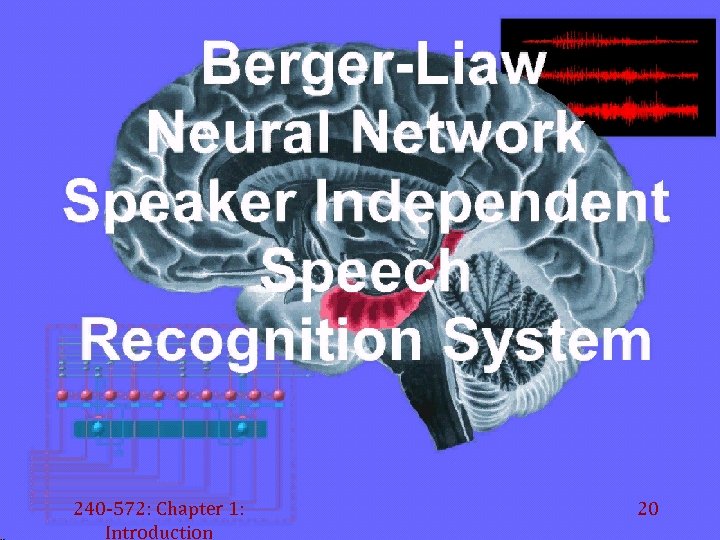
 Machine Demonstrates Superhuman Speech Recognition Abilities • Developed by Jim-Shih Liaw and Theodore W. Berger at University of Southern California • The following is the claim – “University of Southern California biomedical engineers have created the world's first machine system that can recognize spoken words better than humans can. A fundamental rethinking of a long-underperforming computer architecture led to their achievement”. 240 -572: Chapter 1: Introduction 19
 240 -572: Chapter 1: Introduction 20
 Statistical Pattern Recognition • In statistical pattern recognition, recognition is done by classifying the input (represented as a set of measurements) into predefined categories • The core questions we want to address – What is the best we can do (statistically) when a set of measurements is given for input? – Which measurements should be used if we can choose a subset of all the measurements? 240 -572: Chapter 1: Introduction 21
 A Simple Example • Suppose that we are given two classes w 1 and w 2 – P(w 1) = 0. 7 – P(w 2) = 0. 3 – No measurement is given • Guessing – What shall we do to recognize a given input? – What is the best we can do statistically? Why? 240 -572: Chapter 1: Introduction 22
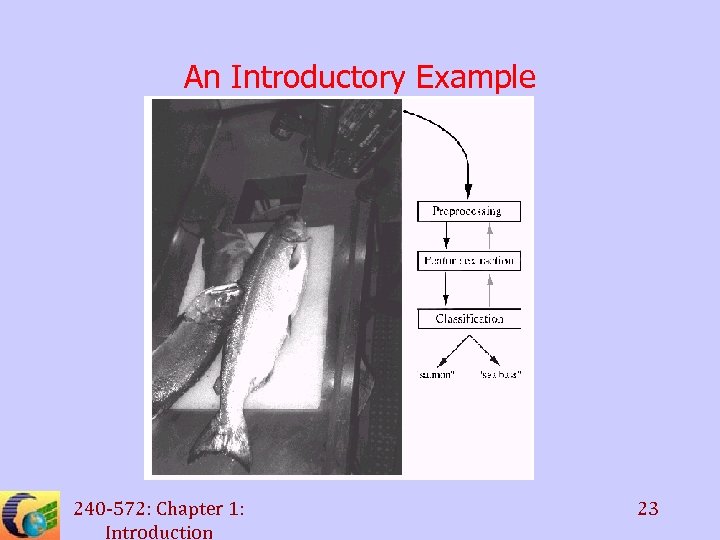 An Introductory Example 240 -572: Chapter 1: Introduction 23
 Terminology • Features – Measurements available to the pattern recognition system • Models – Each class is represented by a description in mathematical forms, called a model • Preprocessing – Segmentation • Isolate the object of interest from the background and other objects 240 -572: Chapter 1: Introduction 24
 Terminology - cont. • Feature extraction – Is the measuring process that produces the measurements, or called features • Training samples – Models for classes are often specified by samples with known labels. These samples are called training samples 240 -572: Chapter 1: Introduction 25
 Terminology - cont. • Cost/risk – The cost of a decision associated with the recognition result • Decision theory – The theory on optimal decision rules 240 -572: Chapter 1: Introduction 26
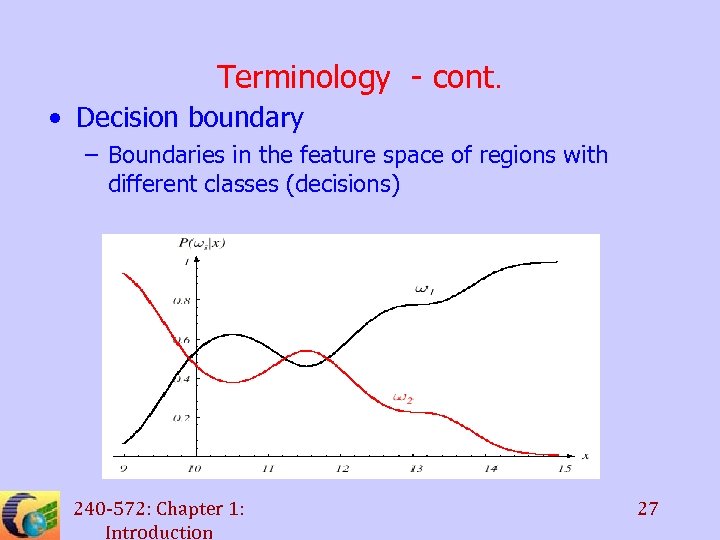 Terminology - cont. • Decision boundary – Boundaries in the feature space of regions with different classes (decisions) 240 -572: Chapter 1: Introduction 27
 Terminology - cont. • Generalization – While classes can be specified by training samples with known labels, the goal of a recognition system is to recognize novel inputs – When a recognition system is over-fitted to training samples, it may give bad performance for typical inputs 240 -572: Chapter 1: Introduction 28
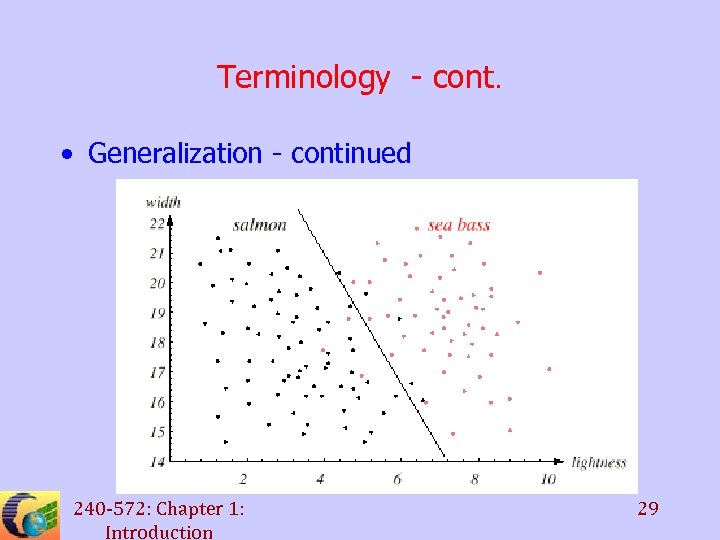 Terminology - cont. • Generalization - continued 240 -572: Chapter 1: Introduction 29
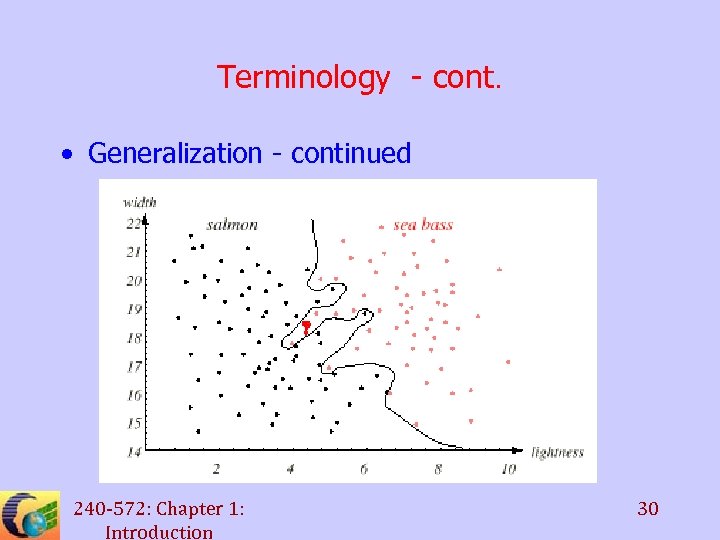 Terminology - cont. • Generalization - continued 240 -572: Chapter 1: Introduction 30
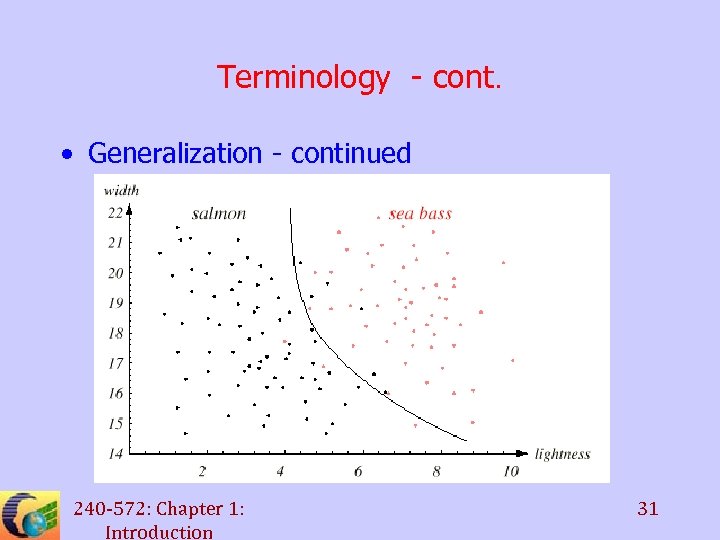 Terminology - cont. • Generalization - continued 240 -572: Chapter 1: Introduction 31
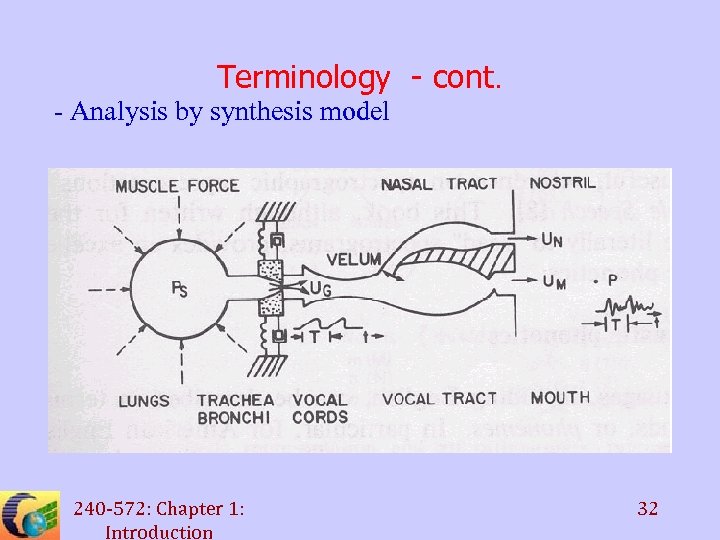 Terminology - cont. - Analysis by synthesis model 240 -572: Chapter 1: Introduction 32
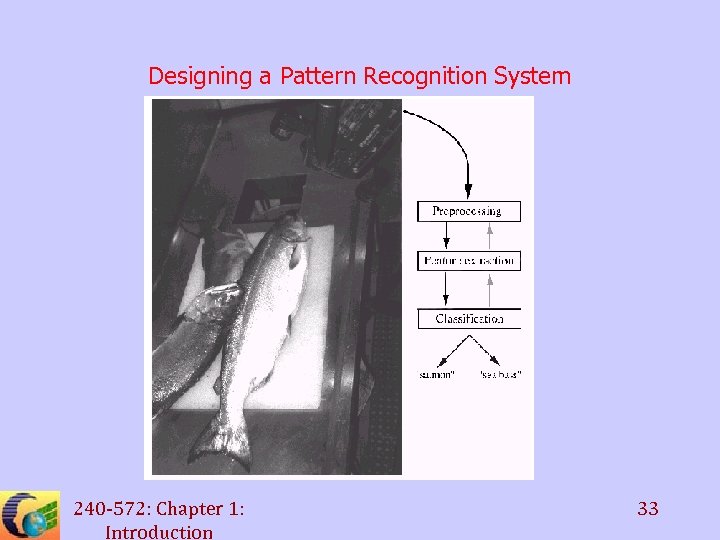 Designing a Pattern Recognition System 240 -572: Chapter 1: Introduction 33
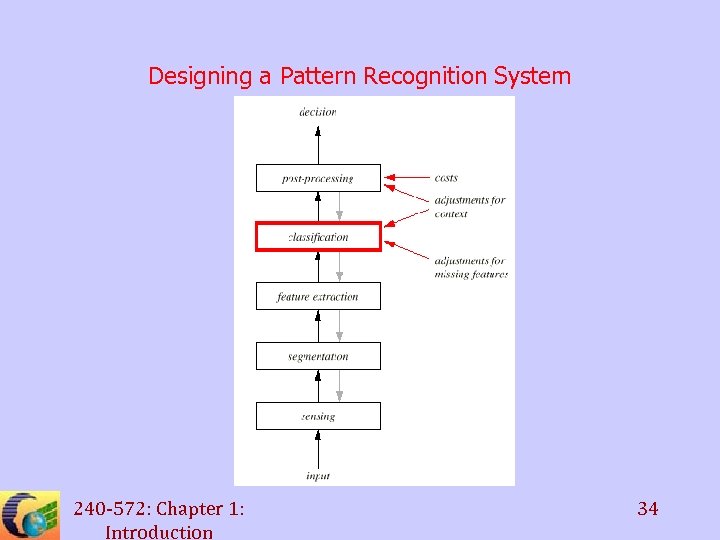 Designing a Pattern Recognition System 240 -572: Chapter 1: Introduction 34
 Steps in a Pattern Recognition System • Sensing – Measuring of features, such as a digital camera, or a microphone – We assume the measurements are given • Segmentation and grouping – In the fish example, we have to isolate a fish from other fishes, other non-fish objects, or the background – Segmentation/grouping is a very difficult problem 240 -572: Chapter 1: Introduction 35
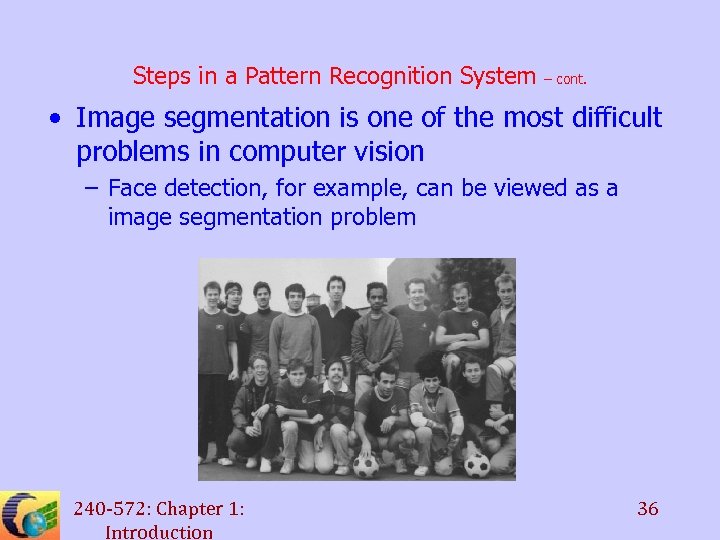 Steps in a Pattern Recognition System – cont. • Image segmentation is one of the most difficult problems in computer vision – Face detection, for example, can be viewed as a image segmentation problem 240 -572: Chapter 1: Introduction 36
 Steps in a Pattern Recognition System – cont • In speech recognition, the segmentation problem is called source separation – Mixed speech signal – Separated signal source 1 – Separated signal source 2 240 -572: Chapter 1: Introduction 37
 Steps in a Pattern Recognition System – cont. • Feature extraction/selection – A critical step for pattern recognition – Seeking distinguishing features that are invariant to irrelevant transformations of the input – Biometrics can be viewed as a feature selection problem • Classification • Post-processing – Context information – Multiple classifiers 240 -572: Chapter 1: Introduction 38
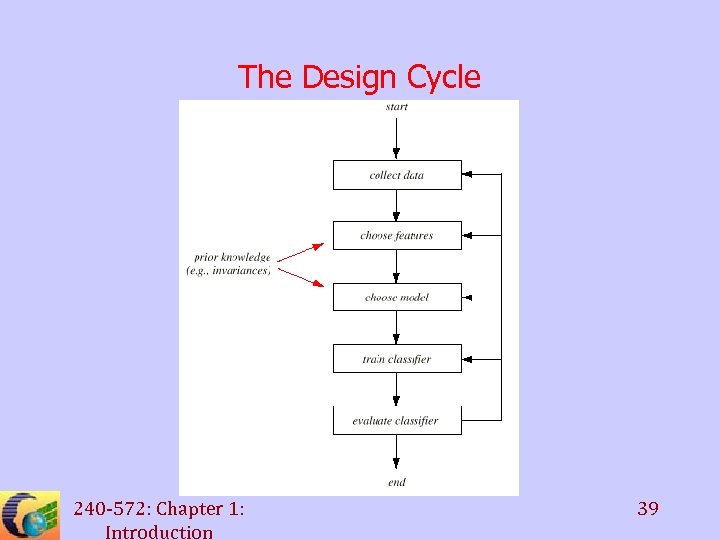 The Design Cycle 240 -572: Chapter 1: Introduction 39
 Learning • Supervised learning – A category label is given for each pattern in a training set • Unsupervised learning – The system forms clusters or natural groupings of the input patterns – The study of category formation • Reinforcement learning – No desired output is provided; the feedback is given 240 -572: Chapter 1: Introduction 40