


 Скачать презентацию 22 Chapter Corporate Stock Money and Capital Markets
c52dc5b745df13e0298314b925af0902.ppt
- Количество слайдов: 28
 22 Chapter Corporate Stock Money and Capital Markets Financial Institutions and Instruments in a Global Marketplace Eighth Edition Peter S. Rose Mc. Graw Hill / Irwin Slides by Yee-Tien (Ted) Fu
 22 - 2 Learning Objectives w To learn about the characteristics of common and preferred corporate stock. w To understand the organization and operation of the stock market today. w To compare and contrast the roles and functions of the organized stock exchanges and the over-the-counter market. w To explore the issue of market efficiency. Mc. Graw Hill / Irwin 2003 by The Mc. Graw-Hill Companies, Inc. All rights reserved.
 22 - 3 Characteristics of Corporate Stock w All corporate stock represents an ownership interest in a corporation, conferring on the holder a number of rights as well as risks. w Common stock represents a residual claim against the assets of the issuing firm, entitling the owner to share in the net earnings of the firm when it is profitable and to share in the net market value (after all debts are paid) of the company’s assets if it is liquidated. Mc. Graw Hill / Irwin 2003 by The Mc. Graw-Hill Companies, Inc. All rights reserved.
 22 - 4 Characteristics of Corporate Stock w Preferred stock carries a stated annual dividend expressed as a percent of the stock’s par value. w Preferred stockholders have a prior claim over the firm’s assets and earnings relative to the claims of common stockholders, although creditors must still be paid first. w Preferred shares generally provide less income but are less risky than common stock. Mc. Graw Hill / Irwin 2003 by The Mc. Graw-Hill Companies, Inc. All rights reserved.
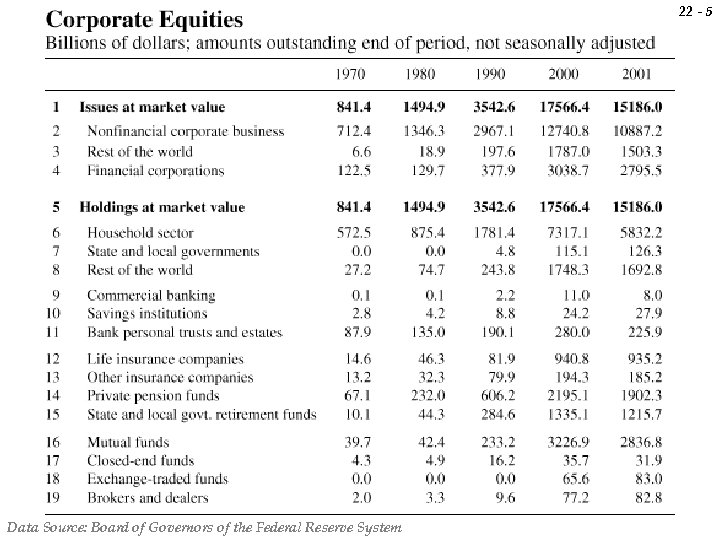 22 - 5 Stock Market Investors Data Source: Board of Governors of the Federal Reserve System
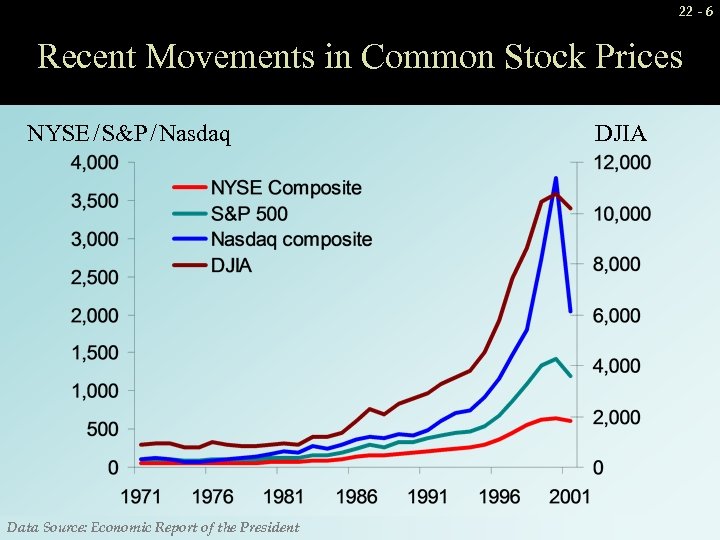 22 - 6 Recent Movements in Common Stock Prices NYSE / S&P / Nasdaq Data Source: Economic Report of the President Mc. Graw Hill / Irwin DJIA 2003 by The Mc. Graw-Hill Companies, Inc. All rights reserved.
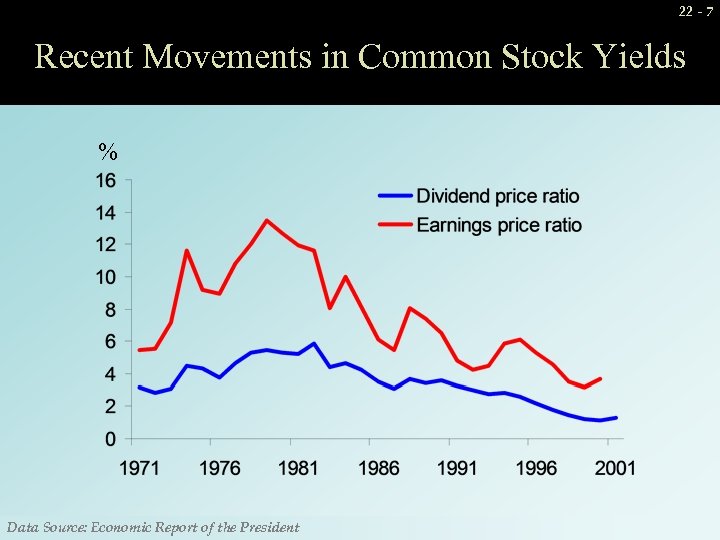 22 - 7 Recent Movements in Common Stock Yields % Data Source: Economic Report of the President Mc. Graw Hill / Irwin 2003 by The Mc. Graw-Hill Companies, Inc. All rights reserved.
 22 - 8 Characteristics of the Corporate Stock Market w There are two main branches of the market for trading corporate stock. Organized exchanges – Trading is governed by regulations and formal procedures designed to ensure competitive pricing and an active market for the stock of the largest firms. Over-the-counter (OTC) market – This more informal market involves the trading of stock through brokers. Mc. Graw Hill / Irwin 2003 by The Mc. Graw-Hill Companies, Inc. All rights reserved.
 22 - 9 The Major Organized Exchanges w The New York Stock Exchange (NYSE) and Chicago Board of Trade (CBOT) are organized exchanges. They have: a physical location for trading è trading posts è formal trading rules è listing requirements è a board of directors è member firms and seats è Mc. Graw Hill / Irwin 2003 by The Mc. Graw-Hill Companies, Inc. All rights reserved.
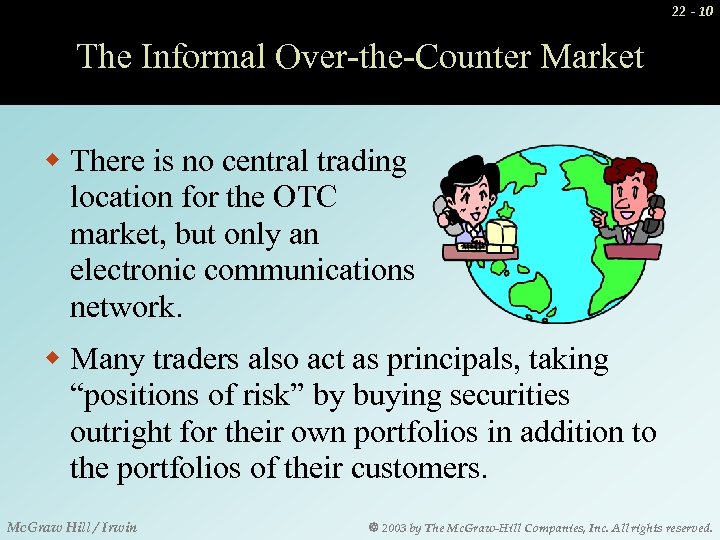 22 - 10 The Informal Over-the-Counter Market w There is no central trading location for the OTC market, but only an electronic communications network. w Many traders also act as principals, taking “positions of risk” by buying securities outright for their own portfolios in addition to the portfolios of their customers. Mc. Graw Hill / Irwin 2003 by The Mc. Graw-Hill Companies, Inc. All rights reserved.
 22 - 11 The Third Market w The market for securities listed on a stock exchange but traded over the counter is known as the third market. w Broker and dealer firms that are not exchange members are active in this market. w The third market was set up to supply large blocks of shares to institutional investors, and it has been a catalyst in reducing brokerage fees and promoting trading efficiency. Mc. Graw Hill / Irwin 2003 by The Mc. Graw-Hill Companies, Inc. All rights reserved.
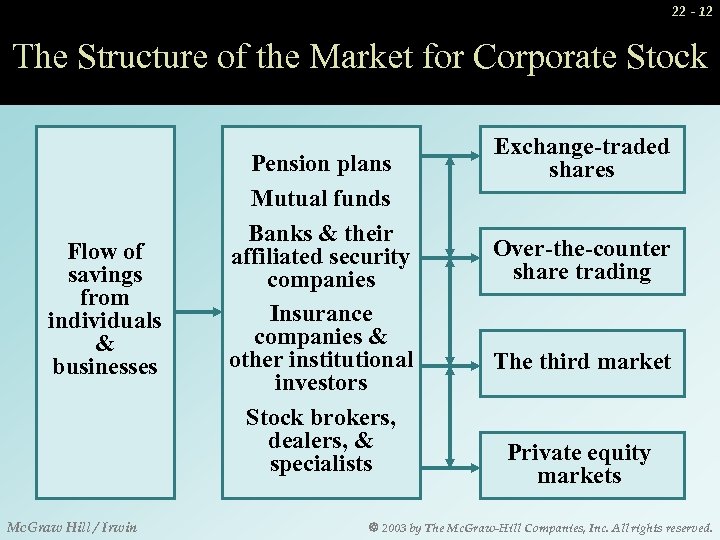 22 - 12 The Structure of the Market for Corporate Stock Flow of savings from individuals & businesses Mc. Graw Hill / Irwin Pension plans Mutual funds Banks & their affiliated security companies Insurance companies & other institutional investors Stock brokers, dealers, & specialists Exchange-traded shares Over-the-counter share trading The third market Private equity markets 2003 by The Mc. Graw-Hill Companies, Inc. All rights reserved.
 22 - 13 The Private Equity Market w New businesses, privately held companies and partnerships, troubled firms, and even larger publicly traded companies can conduct a private sale of stock in the private equity market to finance their acquisitions and other investments, as well as to support out-of-theordinary financial transactions. Mc. Graw Hill / Irwin 2003 by The Mc. Graw-Hill Companies, Inc. All rights reserved.
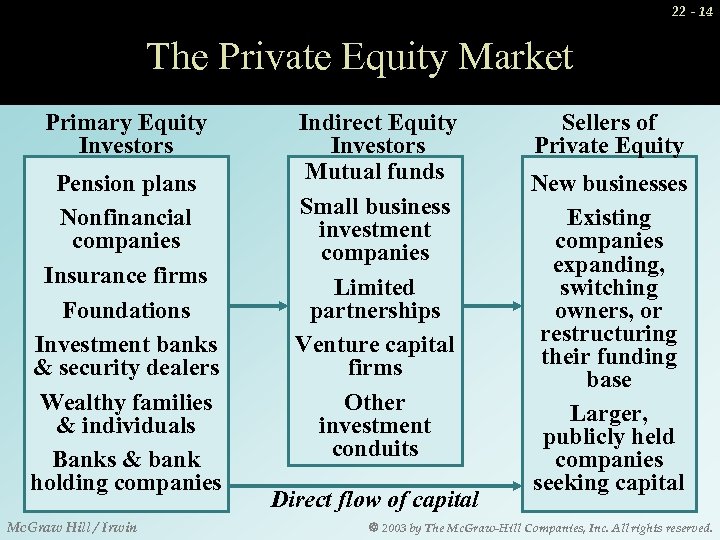 22 - 14 The Private Equity Market Primary Equity Investors Pension plans Nonfinancial companies Insurance firms Foundations Investment banks & security dealers Wealthy families & individuals Banks & bank holding companies Mc. Graw Hill / Irwin Indirect Equity Investors Mutual funds Small business investment companies Limited partnerships Venture capital firms Other investment conduits Direct flow of capital Sellers of Private Equity New businesses Existing companies expanding, switching owners, or restructuring their funding base Larger, publicly held companies seeking capital 2003 by The Mc. Graw-Hill Companies, Inc. All rights reserved.
 22 - 15 The Market for Stock Options w Paralleling the exchange and OTC markets for stock are markets for stock options. w Today, listed or exchange-traded call and put options are popular, along with OTC or negotiated options purchased through brokers and dealers. w The options markets have also grown to include options and futures contracts for stock indexes. Mc. Graw Hill / Irwin 2003 by The Mc. Graw-Hill Companies, Inc. All rights reserved.
 22 - 16 The Rise of Program Trading w Many analysts believe that stock markets have become more volatile due to the widespread use of computerized program trading. w One type of program trading involves buying and selling stock index futures contracts for protection against stock price declines. w Another type involves dynamic hedging strategies that adjust a portfolio to limit its exposure to adverse market developments. Mc. Graw Hill / Irwin 2003 by The Mc. Graw-Hill Companies, Inc. All rights reserved.
 The Development of A Unified International Market for Stock 22 - 17 w One of the most significant developments in recent decades has been a movement to weld all parts of the equities market together into a single market for all traders and investors. w The 1975 Securities Act Amendments instructed the Securities and Exchange Commission (SEC) to “facilitate the establishment of a national market system for securities. ” Mc. Graw Hill / Irwin 2003 by The Mc. Graw-Hill Companies, Inc. All rights reserved.
 The Development of A Unified International Market for Stock 22 - 18 w The development of the Intermarket Trading System (ITS) enabled brokers and specialists to compare bid and ask prices on all the major U. S. exchanges for about 700 stocks. w The National Association of Security Dealers (NASD) also moved to promote a broader market system by further automating price quotations on OTC stock. Mc. Graw Hill / Irwin 2003 by The Mc. Graw-Hill Companies, Inc. All rights reserved.
 The Development of A Unified International Market for Stock 22 - 19 w The 1982 Shelf Registration Rule allowed many large firms to sell new corporate stocks and bonds any time during the two years after the issue has been registered with the SEC. Mc. Graw Hill / Irwin 2003 by The Mc. Graw-Hill Companies, Inc. All rights reserved.
 The Development of A Unified International Market for Stock 22 - 20 w A rapid growth area in the internationalization of the stock market is the cross-listing of stocks on various exchanges around the globe across different time zones. w In response, U. S. exchanges have announced plans for extended trading hours as well as after-hours trading. Mc. Graw Hill / Irwin 2003 by The Mc. Graw-Hill Companies, Inc. All rights reserved.
 The Development of A Unified International Market for Stock 22 - 21 w The development of international financial instruments like the American depository receipts (ADRs) has also strengthened the links between U. S. and foreign stock markets. w ADRs are dollar-denominated claims on foreign shares of stock that are kept in safekeeping by U. S. financial institutions. Mc. Graw Hill / Irwin 2003 by The Mc. Graw-Hill Companies, Inc. All rights reserved.
 22 - 22 Random Walk and Efficient Markets w One popular modern theory regarding the valuation of stocks is the random walk theory. w According to theory, successive changes in the price of a stock are random fluctuations around that stock’s intrinsic value, and these changes are independent of the sequence of price changes that occurred in the past. w But of course, many analysts still subscribe to technical analysis. Mc. Graw Hill / Irwin 2003 by The Mc. Graw-Hill Companies, Inc. All rights reserved.
 22 - 23 Random Walk and Efficient Markets w The random walk notion is supplemented by the broader efficient markets hypothesis. w In a perfectly efficient securities market, existing stock prices fully reflect the latest information available on the profitability and risk of business firms. w Most researchers agree that financial markets are efficient, though they may disagree on the degree of efficiency. Mc. Graw Hill / Irwin 2003 by The Mc. Graw-Hill Companies, Inc. All rights reserved.
 22 - 24 Money and Capital Markets in Cyberspace w Find out more about the performance of corporate stock by visiting: http: //www. cfonews. com/ è http: //money. cnn. com/ è http: //www. stocktabloid. com/index. shtml è http: //www. newsmax. com/moneynews/ è http: //www. nyse. com/ è Mc. Graw Hill / Irwin 2003 by The Mc. Graw-Hill Companies, Inc. All rights reserved.
 22 - 25 Chapter Review w Characteristics of Corporate Stock Common Stock è Preferred Stock è w Stock Market Investors w Characteristics of the Corporate Stock Market The Major Organized Exchanges è The Informal Over-the-Counter Market è Mc. Graw Hill / Irwin 2003 by The Mc. Graw-Hill Companies, Inc. All rights reserved.
 22 - 26 Chapter Review w The Third Market: Trading in Listed Securities Off the Exchange w The Private Equity Market w The Market for Stock Options è The Growth of Options Markets w The Rise of Program Trading Mc. Graw Hill / Irwin 2003 by The Mc. Graw-Hill Companies, Inc. All rights reserved.
 22 - 27 Chapter Review w The Development of a Unified International Market for Stock The National Market System è NASD and Automated Price Quotations è The Advent of Shelf Registration è Global Trading in Equities è The Development of ADRs è Mc. Graw Hill / Irwin 2003 by The Mc. Graw-Hill Companies, Inc. All rights reserved.
 22 - 28 Chapter Review w Random Walk and Efficient Markets The Efficient Markets Hypothesis è Recent Research Findings about the EMH è Mc. Graw Hill / Irwin 2003 by The Mc. Graw-Hill Companies, Inc. All rights reserved.