


 Скачать презентацию 22 CFR 216 Environmental Impact Assessment Legal Requirements
705d8bfe91afdf83c0f33209c0566323.ppt
- Количество слайдов: 35
 22 CFR 216 Environmental Impact Assessment Legal Requirements of every USAID development activity to reduce risks
 So. . . What Is 22 CFR 216? o o Title 22 of the Code of Federal Regulations, Part 216 It is USAID’s procedures to undertake environmental impact assessment of our programs
 Who Is Responsible? o o Every USAID officer who has any role with USAID funded projects Every implementing partner who seeks USAID funds USAID has a small staff of environmental professionals who provide advice and hold program/technical/procurement officers accountable General Counsel and Inspector General staff provide additional support to environmental officers
 Why bother? o o o o o It is state-of-the-art development It produces optimal results It avoids harming people in host countries and U. S. It creates practical civil society and democracy It averts negative economic growth It avoids diplomatic problems It engenders public trust in USAID It allows USAID to exist It is the law
 What Does 22 CFR 216 Say? o o o Every program, project, activity or amendment must undergo environmental impact assessment prior to obligation of funds Potential impacts must be considered and mitigative measures or design changes incorporated This process is documented in writing and is open to the public
 And What Else? o o Decisions are recommended by a Mission Director and approved by a Bureau Environmental Officer in AID/W Impact assessment is a two-step process – an initial assessment is undertaken at the beginning of design, and if needed a more detailed assessment may be required
 More. . . o o The initial assessment is called either a request for Categorical Exclusion (CE) for certain non-controversial types of projects, or an Initial Environmental Examination (IEE) for projects that may have limited potential impacts Projects that are identified as having potentially substantive impacts progress to a Scoping Exercise (Scoping)
 More. . . o o A Scoping Exercise results in a statement of work for an Environmental Assessment (EA) – both should include public participation In rare cases, a project may require an Environmental Impact Statement (EIS) undertaken under domestic U. S. regulations
 More. . . o Public participation is an important element for a number of reasons: n n It ensures all issues are surfaced It builds civil society, instills democratic values and engenders trust It creates buy-in and public ownership for the project which optimizes results It is required for Scopings and EAs, and is recommended for IEEs
 Special 22 CFR 216 Issue: Pesticides o o o Pesticides are a commonly encountered element in agriculture and health activities USAID has special procedures within 22 CFR 216 to address pesticide procurement and/or use One should not avoid using pesticides when they are needed, rather one should ensure they are properly selected and safely used
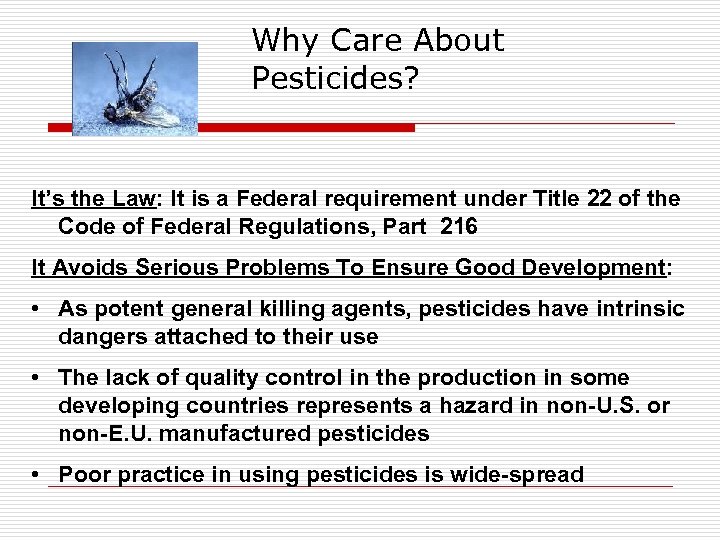 Why Care About Pesticides? It’s the Law: It is a Federal requirement under Title 22 of the Code of Federal Regulations, Part 216 It Avoids Serious Problems To Ensure Good Development: • As potent general killing agents, pesticides have intrinsic dangers attached to their use • The lack of quality control in the production in some developing countries represents a hazard in non-U. S. or non-E. U. manufactured pesticides • Poor practice in using pesticides is wide-spread
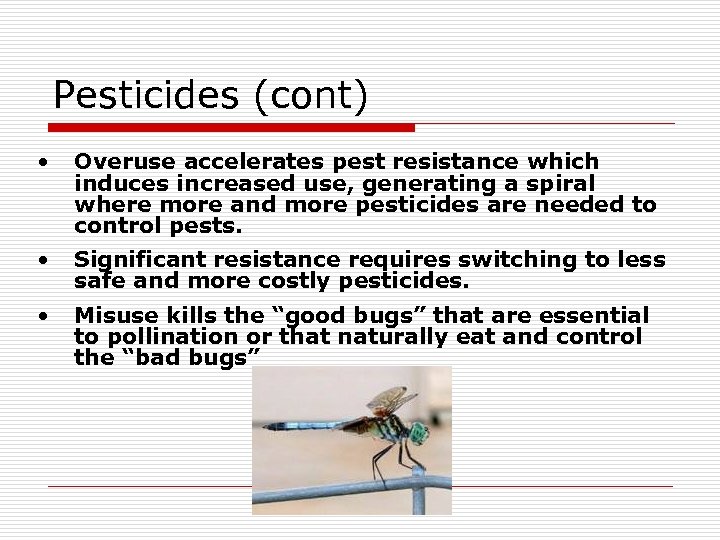 Pesticides (cont) • Overuse accelerates pest resistance which induces increased use, generating a spiral where more and more pesticides are needed to control pests. • Significant resistance requires switching to less safe and more costly pesticides. • Misuse kills the “good bugs” that are essential to pollination or that naturally eat and control the “bad bugs”
 Pesticides (cont) • Misuse can result in chronic sickness, birth defects, cancers, sterility, loss of workdays and even death of farmers, farm laborers, processors and consumers • Misuse can result in refusal of individual export shipments or even long-term cancellation of a country’s ability to export to the U. S. , Europe, Japan and other major markets • Movement of pesticides off site can poison ecosystems that support people downstream or downwind
 What Not to Do o o The following three photos are just three disturbing examples of what not to do in any program where pesticides are used Realistically, these situations and many others just as bad, tend to be quite common and the project beneficiaries are injured by them
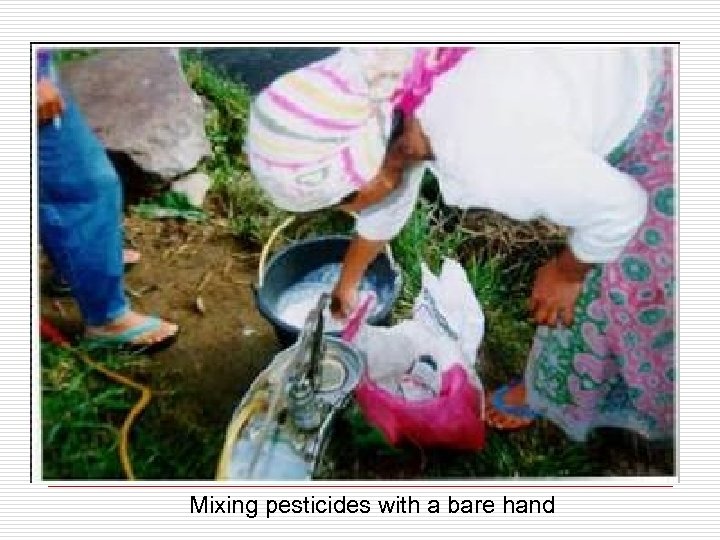 Mixing pesticides with a bare hand
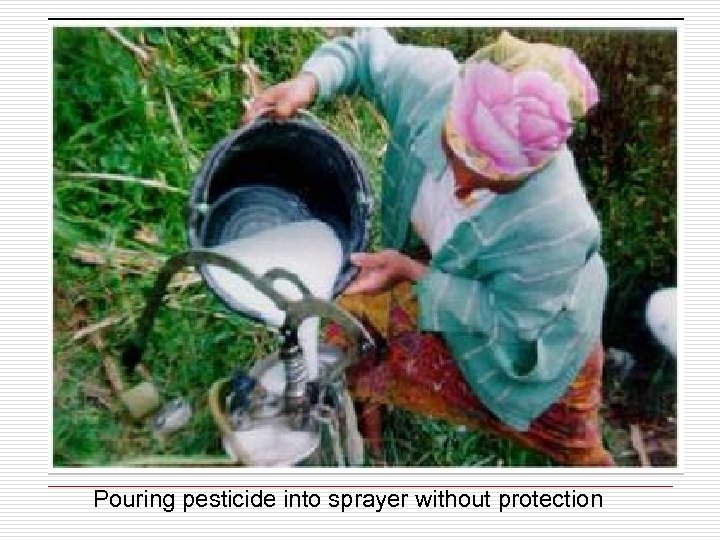 Pouring pesticide into sprayer without protection
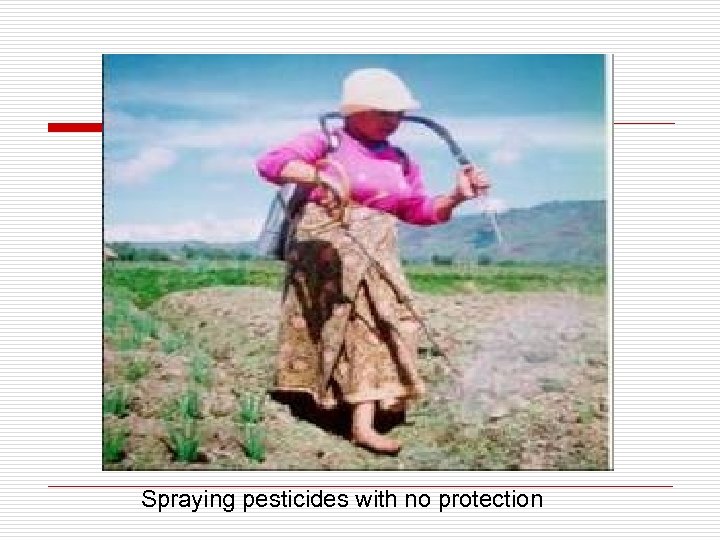 Spraying pesticides with no protection
 The result. . . o o The health workers in the next two photos are trying to help these injured people treat the harm created by a poorly designed initial project. It has diverted their time and resources from their usual work addressing other important health issues for the community Had there been an appropriate environmental impact assessment in such cases, combined with monitoring to ensure proper pesticide safety and use, this could have been avoided
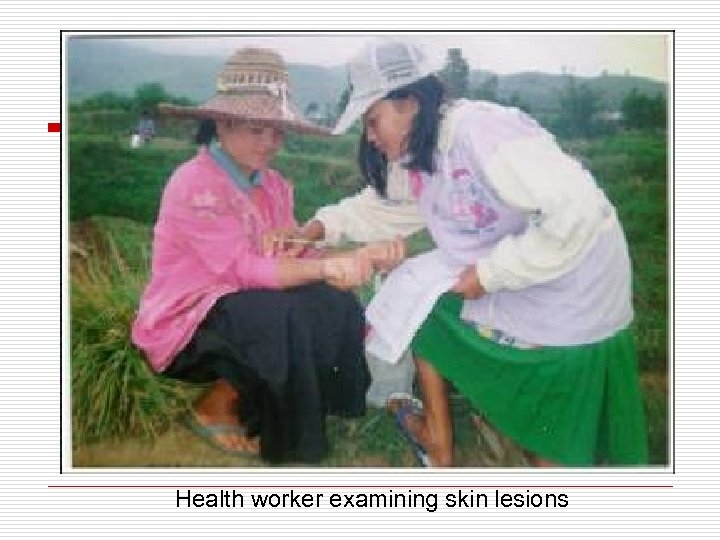 Health worker examining skin lesions
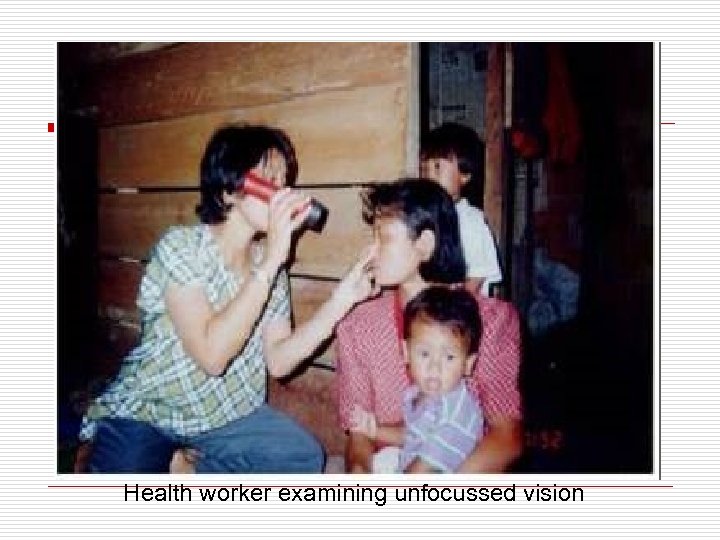 Health worker examining unfocussed vision
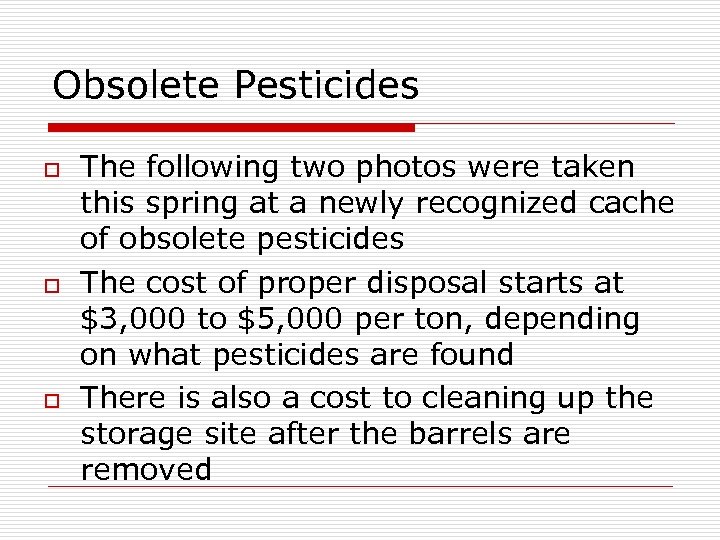 Obsolete Pesticides o o o The following two photos were taken this spring at a newly recognized cache of obsolete pesticides The cost of proper disposal starts at $3, 000 to $5, 000 per ton, depending on what pesticides are found There is also a cost to cleaning up the storage site after the barrels are removed
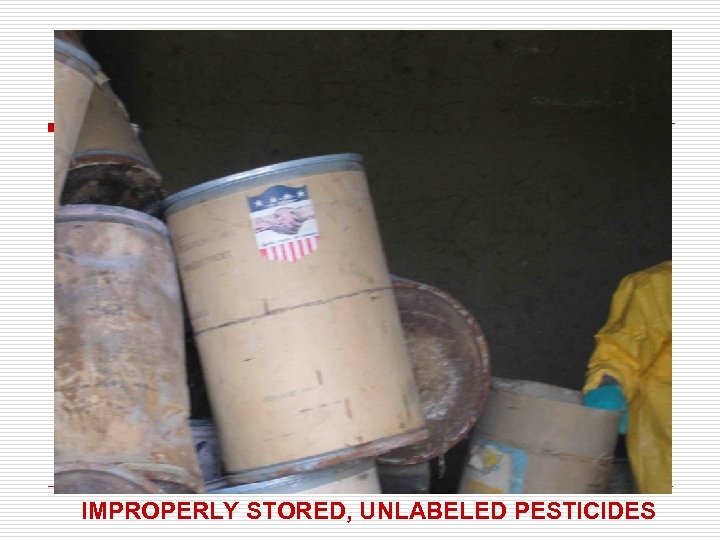 IMPROPERLY STORED, UNLABELED PESTICIDES
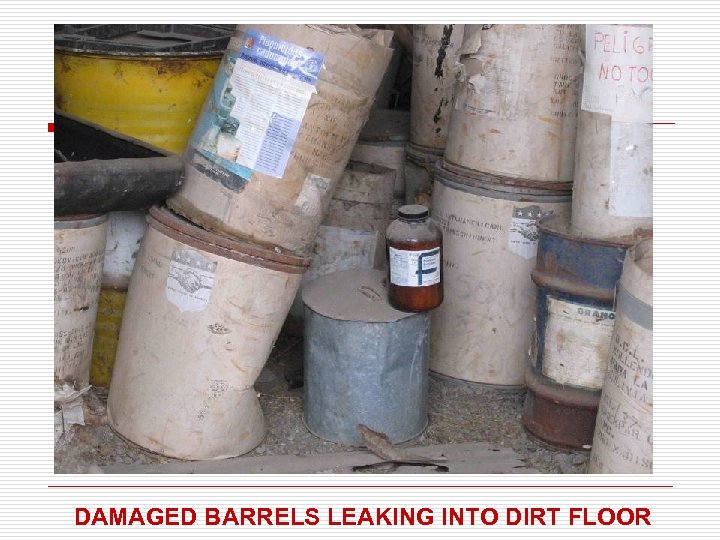 DAMAGED BARRELS LEAKING INTO DIRT FLOOR
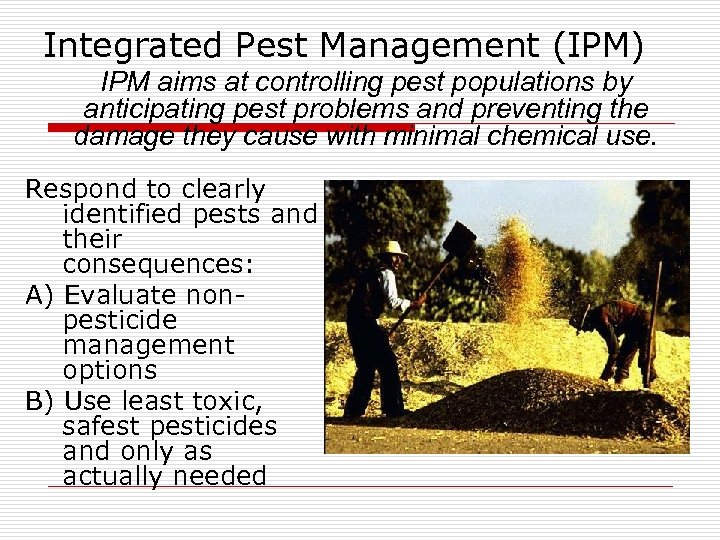 Integrated Pest Management (IPM) IPM aims at controlling pest populations by anticipating pest problems and preventing the damage they cause with minimal chemical use. Respond to clearly identified pests and their consequences: A) Evaluate nonpesticide management options B) Use least toxic, safest pesticides and only as actually needed
 USAID IPM Policy It is USAID policy to rely on Integrated Pest Management (IPM) as the framework for every activity (agricultural, health or other) that involves pesticide procurement or use
 22 CFR 216. 3(b) Pesticide Procedures o o Applies to EVERY project that will EITHER procure OR use one or more pesticides For pesticides approved by the U. S. Environmental Protection Agency for same or similar use, the IEE or EA must address the 12 items in this section of 22 CFR 216.
 Required Elements for 216 Approval o o o EPA registration status Basis for selection Extent IPM is used Application methods and safety equipment Toxicology and mitigation measures Efficacy o o o Target vs. nontarget species Site’s natural conditions Availability of alternatives Country’s ability to control and regulate pesticides Training for uses Monitoring provisions
 For More Potentially Risky Pesticides o o For projects procuring or using EPA approved, restricted use pesticides – a user hazard evaluation is mandatory For projects proposing to use non-EPA approved pesticides, an Environmental Assessment or Environmental Impact Statement is needed
 Selecting Pesticides and Using them Safely o o o If pesticides are to be used, a “Pesticide Evaluation Report and Safe Use Action Plan” (PERSUAP) is a helpful analysis tool to meet 22 CFR 216 requirements The PERSUAP should analyze threats, consequences and safety issues related to pesticide use PERSUAPs can be challenging to implement so adequate resources and management attention are required in project design
 PER-SUAP o o PER: (Pesticide Evaluation Report) Reports must be precise and adapted to local realities. EPA label assumptions about the target population and capacity to enforce compliance need to be tailored to developing country situations SUAP: (Safe Use Action Plan) Reflects practical actions which can be taken by the implmenting partner to reduce the risks generated by pesticide use
 PERSUAP Note that: o If a USAID partner intends to use pesticides through their promotion, purchase or use, they will need an expert pesticide advisor for the preparation of both the IEE or EA and the PERSUAP.
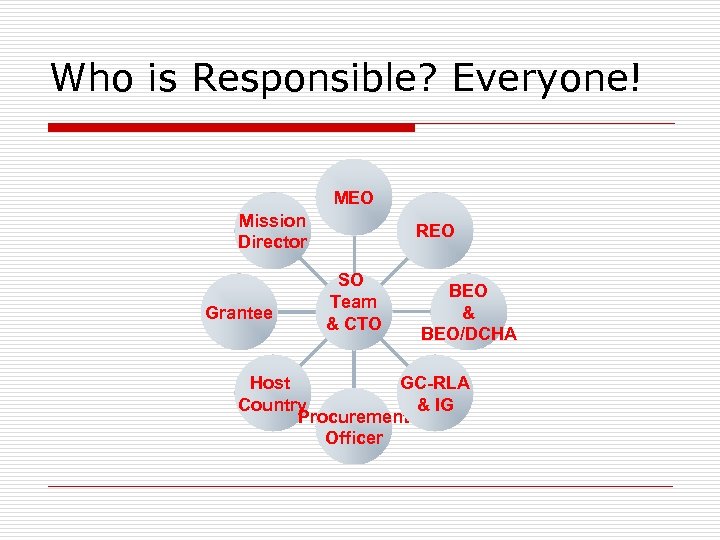 Who is Responsible? Everyone! MEO Mission Director Grantee REO SO Team & CTO BEO & BEO/DCHA Host GC-RLA Country & IG Procurement Officer
 REFERENCES Useful Pesticide Web Sites: www. epa. gov/pesticides/reregistration/status. htm www. pmep. cce. cornell/edu/profiles/extoxnet www. pesticideinfo. org www. epa. gov/pesticides/safety/healthcare/handbook/ handbook. htm (English and Spanish versions of pesticide poisoning recognition handbook) Note: The information in these websites is useful for development professionals but does not substitute for an expert to apply it correctly
 So Where Do I Get A Copy Of 22 CFR 216? o o 22 CFR 216 is found in ADS Chapter 200 It is on the USAID internal and external websites http: //www. usaid. gov/our_work/envir onment/compliance A Spanish translation is on the websites
 Questions And Discussion