 Скачать презентацию 21 st Century College English Book 3 Unit
9cb933e8215857f38536c5be79d5a7f9.ppt
- Количество слайдов: 98



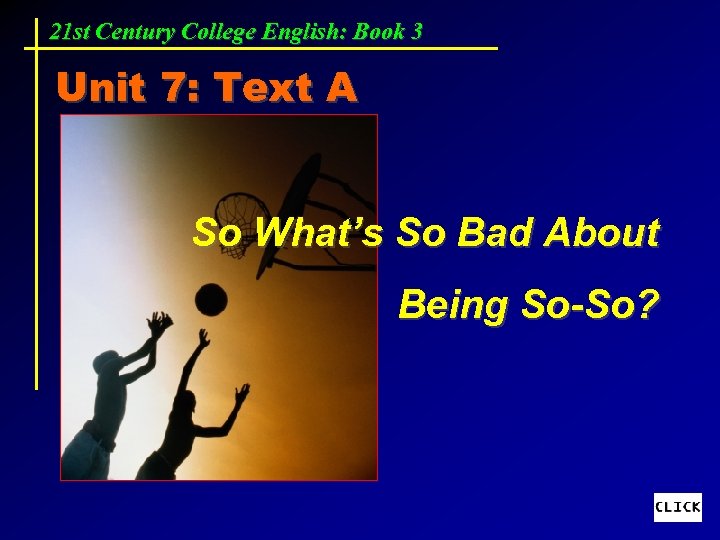
21 st Century College English: Book 3 Unit 7: Text A So What’s So Bad About Being So-So?
Unit 7: Text A • Lead-in Activities • Text Organization • Reading and Writing Skills • Language Points • Guided Practice • Assignment So What’s So Bad about Being So-So?
Lead-in Activities Questions for Discussion • Do you have any hobbies? What’s your attitude toward hobbies? • What do you think is the most important thing that contributes to a happy life? • Which one is more important, doing something for fun or doing something perfectly?
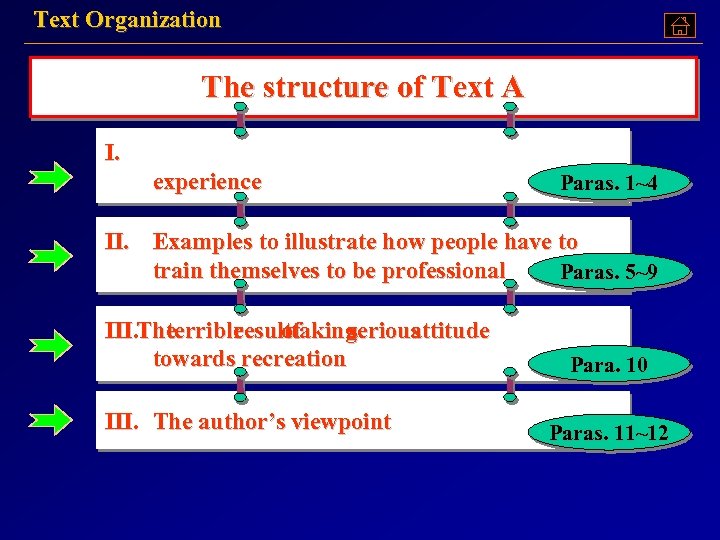
Text Organization The structure of Text A I. experience Paras. 1~4 II. Examples to illustrate how people have to train themselves to be professional Paras. 5~9 III. The terrible resulttaking of a serious attitude towards recreation III. The author’s viewpoint Para. 10 Paras. 11~12
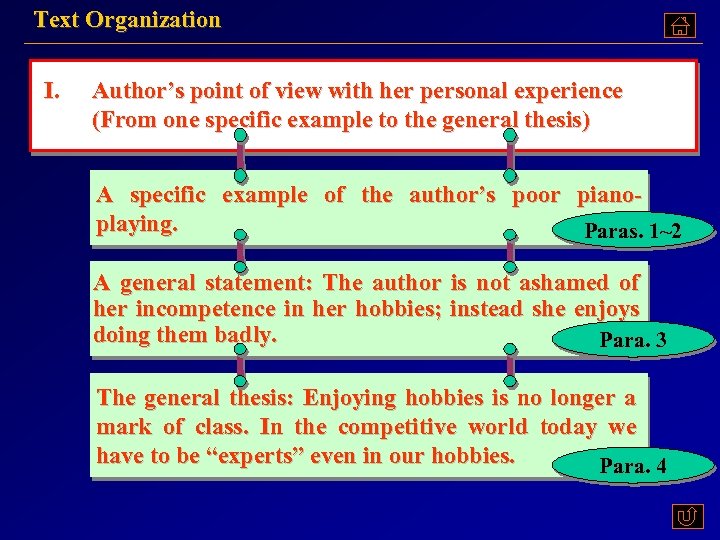
Text Organization I. Author’s point of view with her personal experience (From one specific example to the general thesis) A specific example of the author’s poor pianoplaying. Paras. 1~2 A general statement: The author is not ashamed of her incompetence in her hobbies; instead she enjoys doing them badly. Para. 3 The general thesis: Enjoying hobbies is no longer a mark of class. In the competitive world today we have to be “experts” even in our hobbies. Para. 4
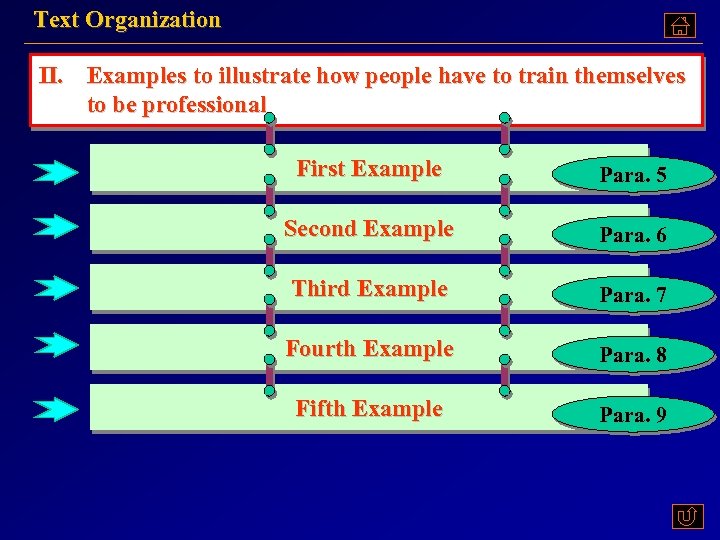
Text Organization II. Examples to illustrate how people have to train themselves to be professional First Example Para. 5 Second Example Para. 6 Third Example Para. 7 Fourth Example Para. 8 Fifth Example Para. 9
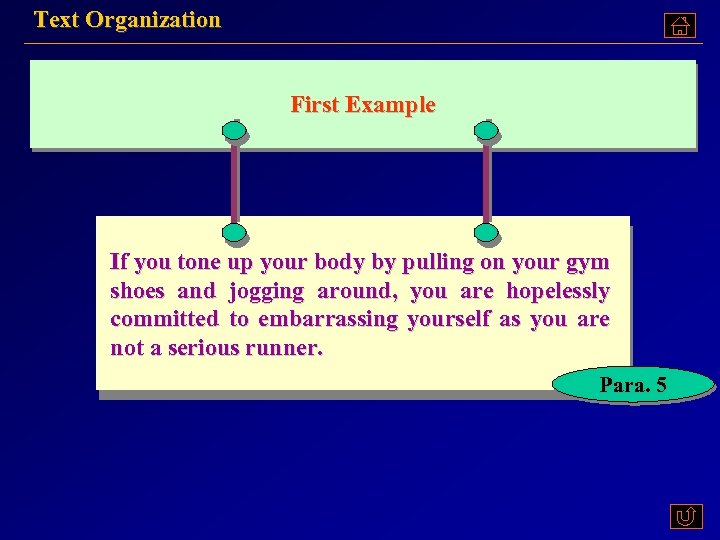
Text Organization First Example If you tone up your body by pulling on your gym shoes and jogging around, you are hopelessly committed to embarrassing yourself as you are not a serious runner. Para. 5
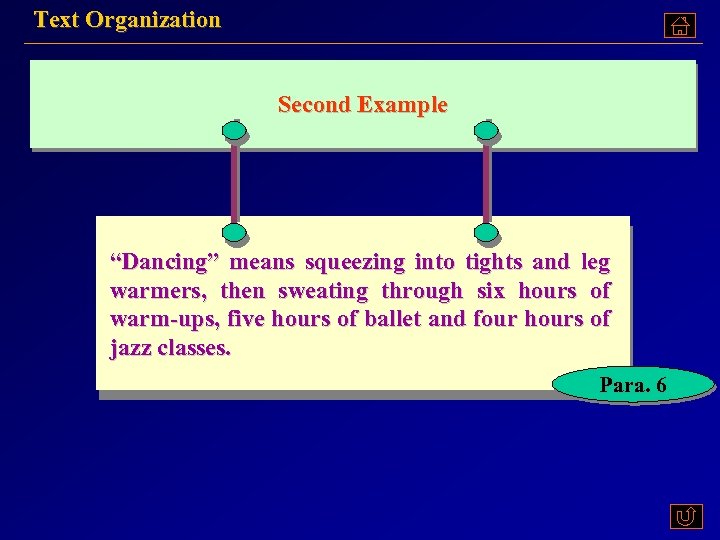
Text Organization Second Example “Dancing” means squeezing into tights and leg warmers, then sweating through six hours of warm-ups, five hours of ballet and four hours of jazz classes. Para. 6
Text Organization Third Example A child who doesn’t know the difference between a goal kick and a head shot would be looked down upon by his friends and be deprived of the right of joining a soccer team. Para. 7
Text Organization Fourth Example A girl of nine is worrying about getting into the best tennis school as she is afraid that her technique is not up to the standards though she practices five or six hours a week. Para. 8
Text Organization Fifth Example Any lower level of accomplishment would embarrass the woman in the study a foreign language. Para. 9
Text Organization The terrible result of taking a serious attitude towards recreation Many people avoid activities they might enjoy because they lack the time or the energy to tackle them “seriously”. Some people work so hard at their hobbies that they develop psychological problems.
Text Organization The author’s viewpoint • It’s time we put a stop to all this. Keep enthusiasm independent of success and enjoy “the joy of creative fooling around”. • The author follows this philosophy herself. She indicates her interest in learning how to play golf and playing it only for fun.
Reading and Writing Skills 1) The specific-to-general structure (take Text A for example) The author starts with a specific example (her bad piano-playing); She then moves to a more general statement about herself; And this leads to her general thesis. 2) Understanding idiomatic expressions To hypothesizing the meaning of idiomatic expressions with the context clues ― examples, explanations, contrasts or parallel phrases.
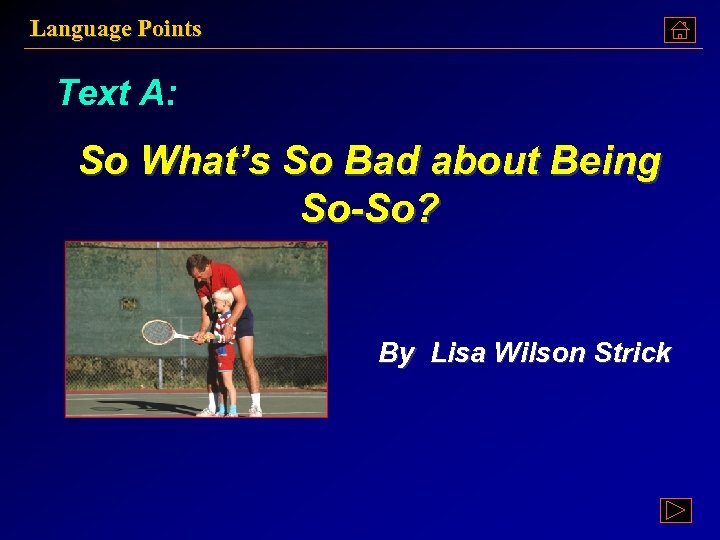
Language Points Text A: So What’s So Bad about Being So-So? By Lisa Wilson Strick
Language Points So What’s So Bad about Being So-So? by Lisa Wilson Strick 1 The other afternoon I was playing the piano when my seven-year-old walked in. He stopped and listened for a while, then said: “You don’t play that thing very well, do you, Mom? ” 2 No, I don’t. My performance would make any serious music student weep, but I don’t care. I’ve enjoyed playing the piano badly for years.
Language Points
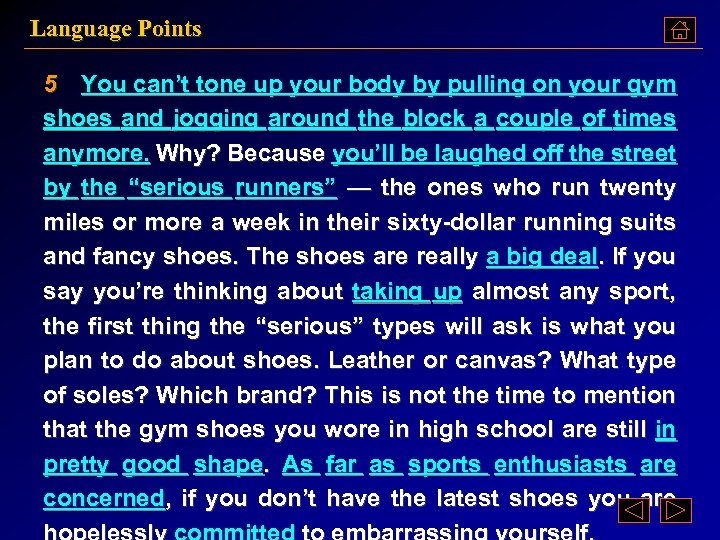
Language Points 5 You can’t tone up your body by pulling on your gym shoes and jogging around the block a couple of times anymore. Why? Because you’ll be laughed off the street by the “serious runners” — the ones who run twenty miles or more a week in their sixty-dollar running suits and fancy shoes. The shoes are really a big deal. If you say you’re thinking about taking up almost any sport, the first thing the “serious” types will ask is what you plan to do about shoes. Leather or canvas? What type of soles? Which brand? This is not the time to mention that the gym shoes you wore in high school are still in pretty good shape. As far as sports enthusiasts are concerned, if you don’t have the latest shoes you are
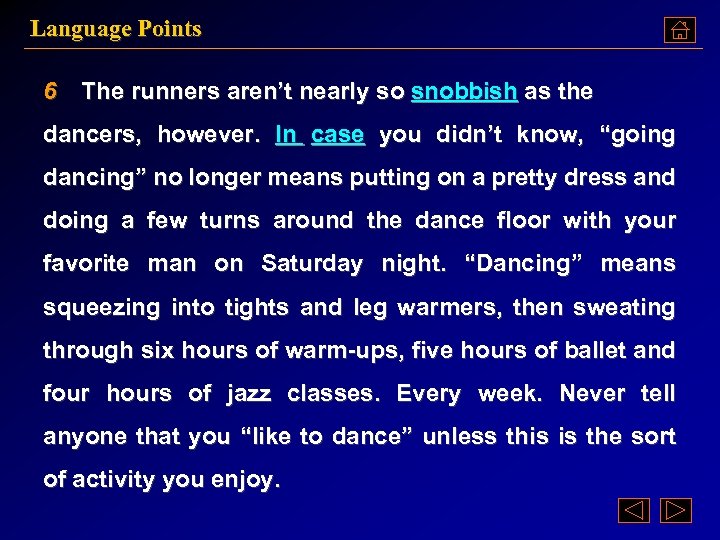
Language Points 6 The runners aren’t nearly so snobbish as the dancers, however. In case you didn’t know, “going dancing” no longer means putting on a pretty dress and doing a few turns around the dance floor with your favorite man on Saturday night. “Dancing” means squeezing into tights and leg warmers, then sweating through six hours of warm-ups, five hours of ballet and four hours of jazz classes. Every week. Never tell anyone that you “like to dance” unless this is the sort of activity you enjoy.
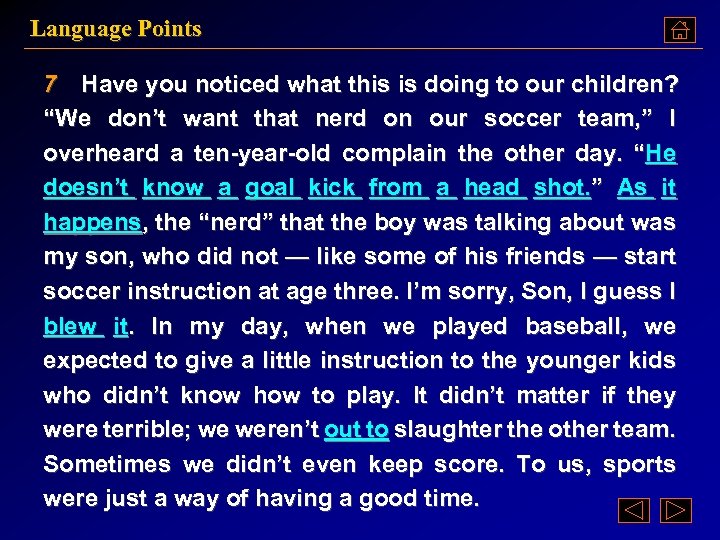
Language Points 7 Have you noticed what this is doing to our children? “We don’t want that nerd on our soccer team, ” I overheard a ten-year-old complain the other day. “He doesn’t know a goal kick from a head shot. ” As it happens, the “nerd” that the boy was talking about was my son, who did not — like some of his friends — start soccer instruction at age three. I’m sorry, Son, I guess I blew it. In my day, when we played baseball, we expected to give a little instruction to the younger kids who didn’t know how to play. It didn’t matter if they were terrible; we weren’t out to slaughter the other team. Sometimes we didn’t even keep score. To us, sports were just a way of having a good time.
Language Points 8 I don’t think kids have as much fun as they used to. Competition keeps getting in the way. The daughter of a neighbor is a nervous wreck worrying about getting into the best tennis school. “I was a late starter, ” she told me, “and I only get to practice five or six hours a week, so my technique may not be up to their standards. ” The child is nine. She doesn’t want to be a tennis player when she grows up; she wants to be a nurse. I asked what she likes to do for fun in her free time. She seemed to think it was an odd question. “Well, I don’t actually have a lot of free time, ” she said. “Homework and tennis and piano lessons kind of eat it all up. I have piano lessons three times a week now, so I have a good
Language Points 9 Ambition, drive and the desire to excel are all great within limits, but I don’t know where the limits are anymore. I know a woman who’s been complaining for years that she hasn’t got the time to study a foreign language. I’ve pointed out that an evening course in French or Italian would take only a couple of hours a week, but she keeps putting it off. I suspect that what she hasn’t got the time for is to become completely fluent within one year — and that any lower level of accomplishment would embarrass her. Instead she spends her evenings watching TV and tidying up her closets — occupations at which no particular expertise
Language Points 10 I know lots of other people, too, who avoid activities they might enjoy because they lack the time or the energy to tackle them “seriously. ” It strikes me as so silly. We are talking about recreation. I have nothing against self-improvement. But when I hear a teenager muttering “practice makes perfect” as he grimly makes his four-hundred-and-twenty-seventh try at hooking the basketball into the net left-handed, I wonder if some of us aren’t improving ourselves right into the insane asylum.
Language Points 11 I think it’s time we put a stop to all this. For sanity’s sake, each of us should vow to take up something new this week — and to make sure we never master it completely. Sing along with grand opera. Make peculiar -looking objects out of clay. I can tell you from experience that a homemade cake still tastes pretty good even if it doesn’t look perfect. The point is to enjoy being a beginner again; to rediscover the joy of creative fooling around. If you find it difficult, ask any two-year-old to teach you. Two-year-olds have a gift for tackling the impossible with enthusiasm; repeated failure hardly discourages them at all.
Language Points 12 As for me, I’m getting a little out of shape, so I’m looking into golf. A lot of people I know enjoy it, and it doesn’t look too hard. Given a couple of lessons, I should be stumbling gracelessly around the golf course and playing badly in no time at all.
the other afternoon — on the afternoon a few days ago Also: the other day (para. 7), the other morning, etc. Examples: • I met a friend from my hometown the other day and we had lunch together. • Have you forgotten what happened the other week?
My performance would make any serious music student weep. . . serious — a. deeply interested; devoted Translate: Example: • If serious about becoming an actress, you need A you’re learner tends to think independently. proper training. Key: 认真的学者趋向于独立思考。 More to learn
My performance would make any serious music student weep. . . weep — v. to shed (tears) as an expression of emotion Cf. Example: cry. The criminal wept bitter tears of regret at the trial. • sob — Cry and weep both involve the shedding ofand weeping — Sob describes a mixture of broken speech tears; cry more strongly implies accompanying sound or gasping marked by convulsive (痉挛性的) breathing e. g. The kept sobbing, as if her heart would break. She baby cried all night, causing another sleepless night for the family.
every now and then (every) now and then — sometimes but not very often or regularly Make a sentence with the phrase: Examples: • Now and then my new method appears to work. ? • I still see her for lunch every now and then, but not as often as I used to.
out of style — unfashionable; out of fashion Example: • A style does not go out of style as long as it adapts itself to its period. — Coco Chanel (1883– 1971), French couturiere (女服设计师).
a mark of class — a symbol of a person’s social position; a characteristic feature which indicates that a person is cultured and civilized Examples: • His shirt was ironed and that was a mark of class. • Wearing a pair of sun glasses in the house is hardly a mark of class.
pursuit — n. something that one spends time doing, esp. an activity that one enjoys doing when not working Examples: • Games like chess are rather intellectual pursuits. • She said she didn't have much opportunity for leisure pursuits, but that when she had the time, she liked painting.
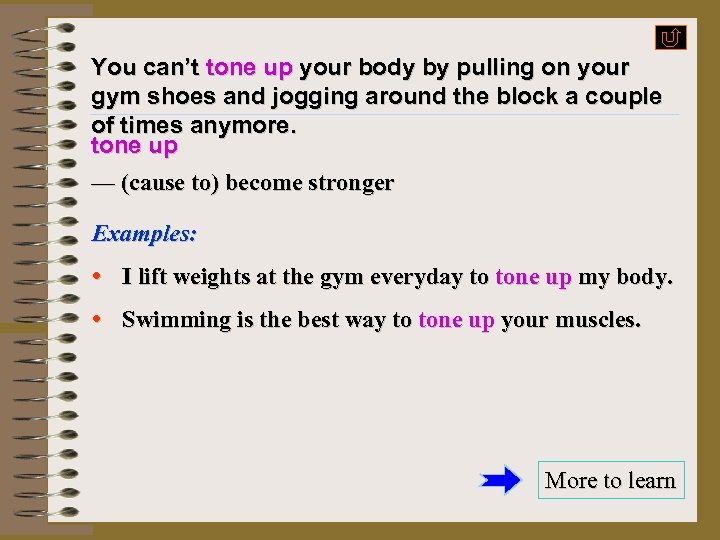
You can’t tone up your body by pulling on your gym shoes and jogging around the block a couple of times anymore. tone up — (cause to) become stronger Examples: • I lift weights at the gym everyday to tone up my body. • Swimming is the best way to tone up your muscles. More to learn
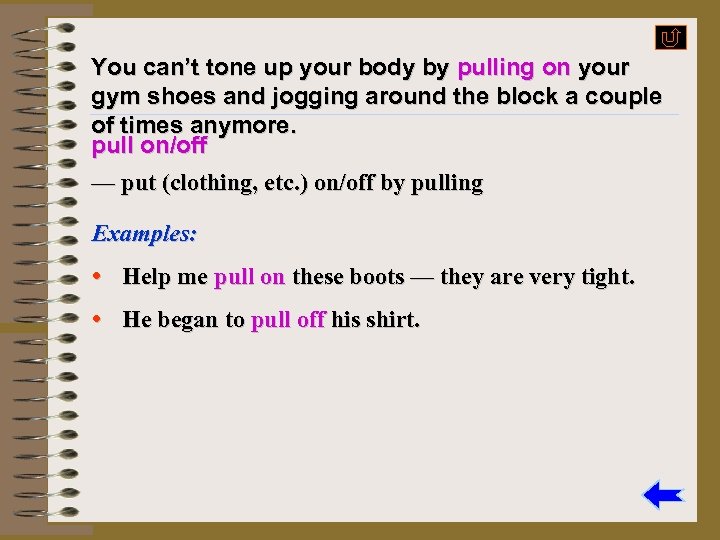
You can’t tone up your body by pulling on your gym shoes and jogging around the block a couple of times anymore. pull on/off — put (clothing, etc. ) on/off by pulling Examples: • Help me pull on these boots — they are very tight. • He began to pull off his shirt.
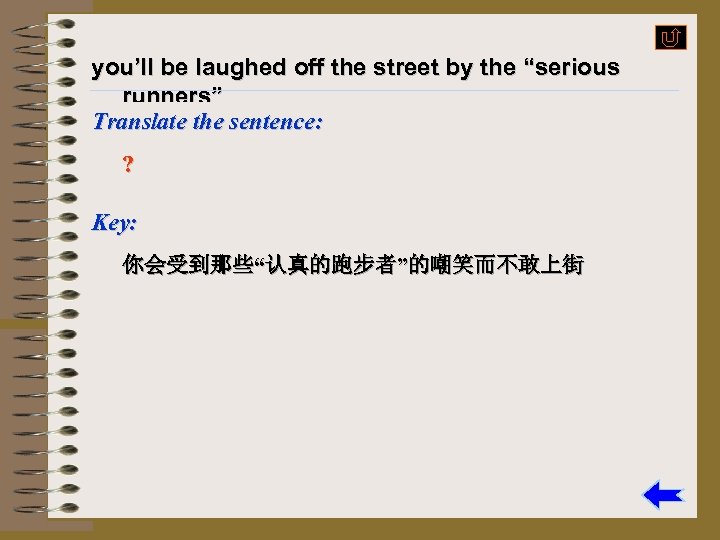
you’ll be laughed off the street by the “serious runners” Translate the sentence: ? Key: 你会受到那些“认真的跑步者”的嘲笑而不敢上街
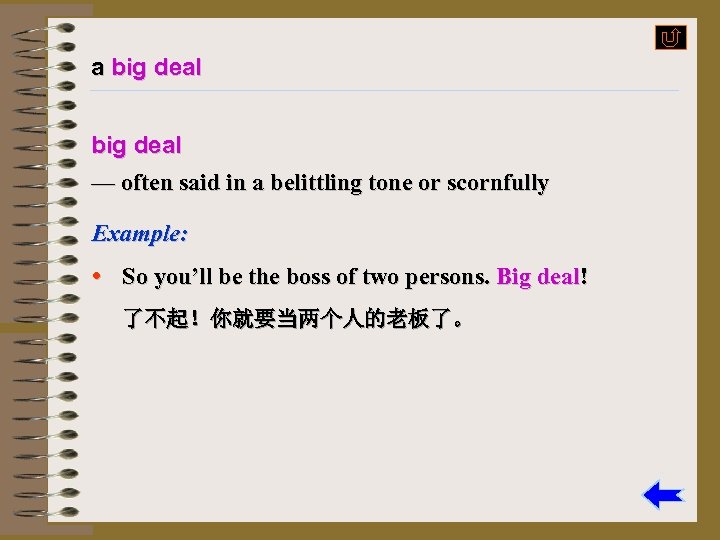
a big deal — often said in a belittling tone or scornfully Example: • So you’ll be the boss of two persons. Big deal! 了不起!你就要当两个人的老板了。
take up (an activity, subject, etc. ) — become interested in it and spend time doing it, either as a hobby or as a career Examples: • I thought I’d take up fishing. • He decided to take up a career.
in pretty good shape be in (good, bad, etc. ) shape — be in (good, bad, etc. ) condition Examples: • The house was in absolutely good shape. • She runs 3 miles every day to keep herself in shape.
As far as sports enthusiasts are concerned as far as (sb. ) be concerned — in sb. ’s opinion Example: • As far as the students are concerned, college life should not be only a period of lessons and tests. More to do
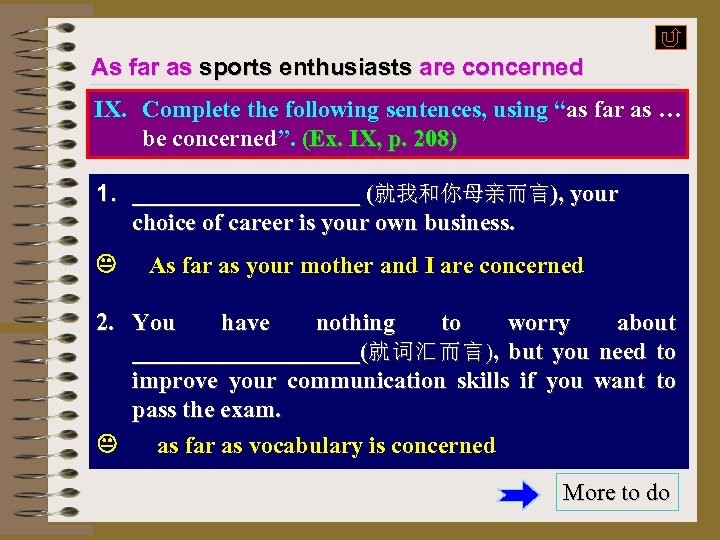
As far as sports enthusiasts are concerned IX. Complete the following sentences, using “as far as … be concerned”. (Ex. IX, p. 208) 1. __________ (就我和你母亲而言), your choice of career is your own business. As far as your mother and I are concerned 2. You have nothing to worry about __________(就 词 汇 而 言 ), but you need to improve your communication skills if you want to pass the exam. as far as vocabulary is concerned More to do
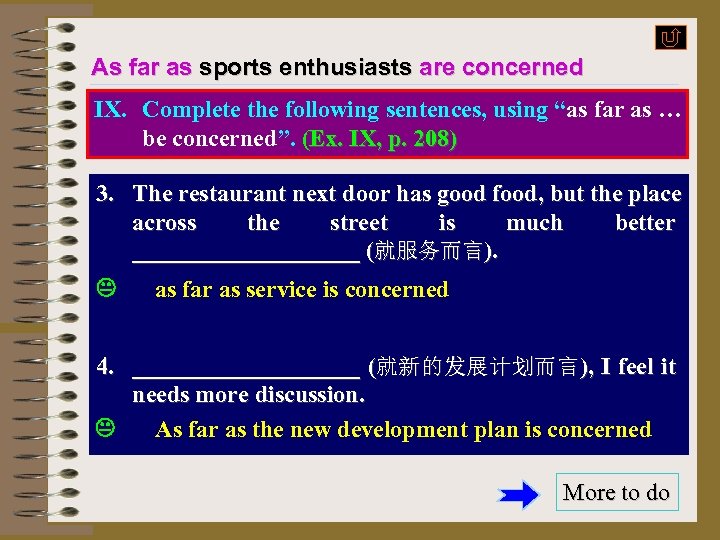
As far as sports enthusiasts are concerned IX. Complete the following sentences, using “as far as … be concerned”. (Ex. IX, p. 208) 3. The restaurant next door has good food, but the place across the street is much better __________ (就服务而言). as far as service is concerned 4. __________ (就新的发展计划而言), I feel it needs more discussion. As far as the new development plan is concerned More to do
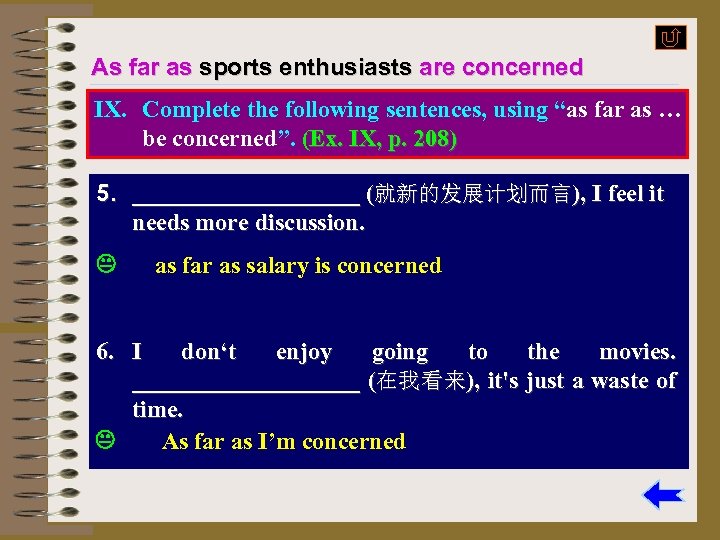
As far as sports enthusiasts are concerned IX. Complete the following sentences, using “as far as … be concerned”. (Ex. IX, p. 208) 5. __________ (就新的发展计划而言), I feel it needs more discussion. as far as salary is concerned 6. I don‘t enjoy going to the movies. __________ (在我看来), it's just a waste of time. As far as I’m concerned
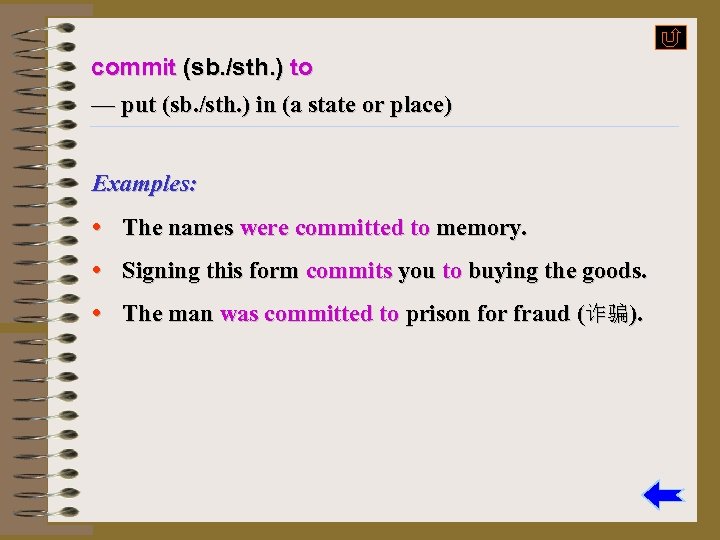
commit (sb. /sth. ) to — put (sb. /sth. ) in (a state or place) Examples: • The names were committed to memory. • Signing this form commits you to buying the goods. • The man was committed to prison for fraud (诈骗).
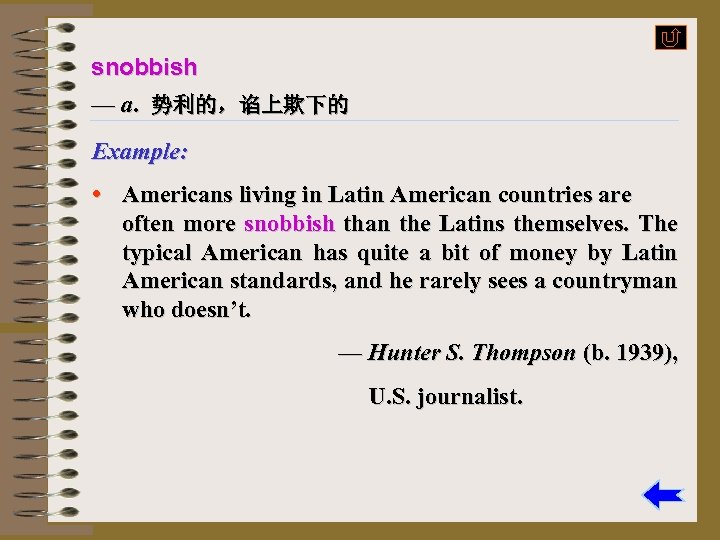
snobbish — a. 势利的,谄上欺下的 Example: • Americans living in Latin American countries are often more snobbish than the Latins themselves. The typical American has quite a bit of money by Latin American standards, and he rarely sees a countryman who doesn’t. — Hunter S. Thompson (b. 1939), U. S. journalist.
in case — In case is used when you are giving a piece of information in order to introduce the reason why you are giving it. Examples: • In case you didn’t know, there are three basic wines: red, white and rose. • Mary, in case you’ve forgotten, hasn’t forgiven you.
He doesn’t know a goal kick from a head shot. Paraphrase the sentence: ? Key: — He is unable to tell the difference between a goal kick and a head shot. Or: He knows nothing about soccer.
as it happens (happened) — by chance; although not planned Translate: Example: • As it happens, I know someone who might be able to 碰巧我有几分钟的空。 give Key: you some advice. As it happened, I had a few minutes to spare.
blew it — (infml) do clumsily or badly; mishandle; ruin Note: Blow it is often used when you are given an opportunity but you fail to take advantage of it by doing or saying something wrong. Examples: • It was your last chance and you blew it! • I guess I blew it when I turned down the job offer, didn’t I?
be out to do/for sth. — want or intend to do/to achieve sth. Examples: • You might feel that they’re out to use your house as a free hotel. • Mark my words — he’s only out for one thing and that’s her money.
get in the way — to obstruct or delay the progress of Examples: • She won’t let anything get in the way of her ambitions. • May nothing stand in the way of your future happiness together.
a nervous wreck — a person in bad mental condition wreck n. — a person who is physically or mentally broken down or worn out
Homework and tennis and piano lessons kind of eat it all up. kind of — (infml) somewhat; to some extent Note: Kind of is used adverbially when you say that something is partly tree or partly the case but does not fully describe the situation, or if you are uncertain about what you are saying or wondering if you are using the right word. Examples: • Actually, I felt kind of sorry for him. • I kind of thought you might help me. More to learn
Homework and tennis and piano lessons kind of eat it all up. eat up — use or consume in large quantities, often used with time, money, or fuel to mean Examples: • A big car like that eats up petrol. • Rising costs were eating up most of the profits.
shot — n. (infml) is an attempt to do or achieve something you have not done before. Examples: • I can’t get the last two answers in this crossword — here, you have a shot. • I thought I’d have a shot at making my own wine since we’ve got all these grapes.
drive — n. motivation or urge Examples: • With the drive to survive, he finally walked out of the desert. • The drive to develop western China attracts talents from all over the country.
suspect — v. imagine or suppose that sth. exist Examples: • He suspected danger and stopped. Cf. doubt v. — not believe; feel uncertain (about) e. g. I doubt his honesty.
occupation — an activity in which you engage habitually, either something that you do for pleasure or as part of your daily life or a job or profession Examples: • Cycling was his favorite occupation. • Everyone, irrespective of age, sex or occupation, is qualified to take part in the game.
It strikes me as so silly. — I think that’s very silly. strike sb. as (adj. / n. ) — have an effect on sb. or impress sb. (in the way specified) Examples: • The plan strikes me as ridiculous. • Henry strikes me as a very dull boy.
recreation — n. an enjoyable activity in which you exercise your body or mind when not working Examples: • Sport and recreation have always been part of university life. • His favorite recreations are golf and tennis.
hooking the basketball — n. expert knowledge or skill, esp. in a particular field hook Example: • Mr. Woods hooked the ball right into the hole.
for sanity’s sake — in order to remain mentally healthy sanity — The quality or condition of being sane; soundness of mind
Make peculiar-looking objects out of clay. Cf. peculiar, odd, strange — Peculiar implies marked or conspicuous distinctiveness, odd stresses a departure from the usual, the normal, or the regular, while strange, the most comprehensive of the three words, suggest unfamiliarity. Examples: • This difference arises from the peculiar character of the US government. • Some great men have odd habits. • To most of us the art of India is strange. More to learn
Make peculiar-looking objects out of clay. Cf. clay, soil, mud — Clay is earth that is used to make things such as pots, soil is the top layer of earth in which plants grow, and mud is wet and sticky earth sometimes used for building a house. Examples: • A clay pigeon is a disk made of clay fired into the air to be shot at for sport. • The soil here is very fertile. • The boy was covered with mud.
fool around — behave in a playful, silly, or irresponsible way without thinking seriously about what you are doing Examples: • We spend the afternoon fooling around on the beach. • Don’t fool around with matches.
out of shape — unhealthy and unable to do a lot of physical activity without getting tired Useful phrases with “shape”: take shape of in good (bad) shape the shape — in good (bad) condition definite become clearer or more the form of e. g. • Not many segments of the Great Wallin the shape ofto After three months of research, my thesis begins a The symbolic building was designed are in good take ship. shape.
Guided Practice • Vocabulary • Cloze • Translation • Structure So What’s So Bad about Being So-So?
Vocabulary 《读写教程 III》: Ex. III, p. 204
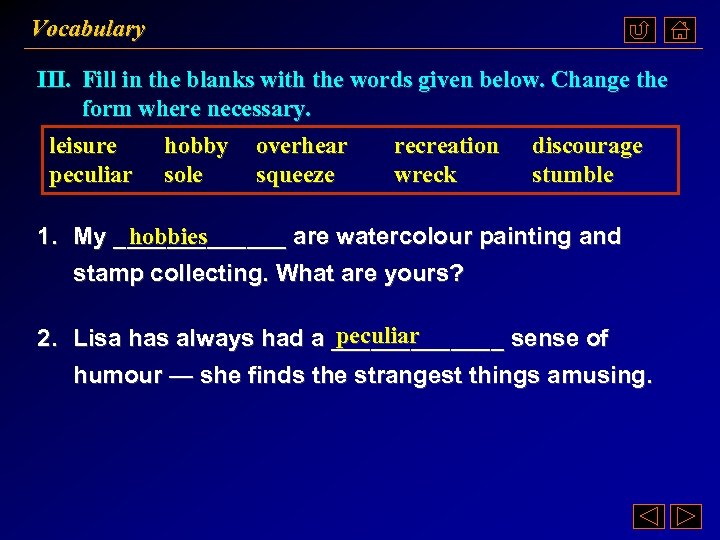
Vocabulary III. Fill in the blanks with the words given below. Change the form where necessary. leisure peculiar hobby sole overhear squeeze recreation wreck discourage stumble 1. My _______ are watercolour painting and hobbies stamp collecting. What are yours? peculiar 2. Lisa has always had a _______ sense of humour — she finds the strangest things amusing.
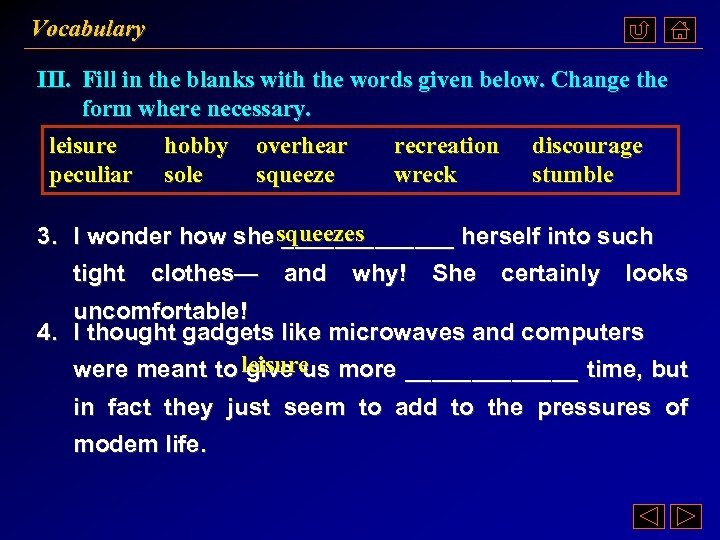
Vocabulary III. Fill in the blanks with the words given below. Change the form where necessary. leisure peculiar hobby sole overhear squeeze recreation wreck discourage stumble 3. I wonder how she squeezes _______ herself into such tight clothes— and why! She certainly looks uncomfortable! 4. I thought gadgets like microwaves and computers were meant to leisure more _______ time, but give us in fact they just seem to add to the pressures of modem life.
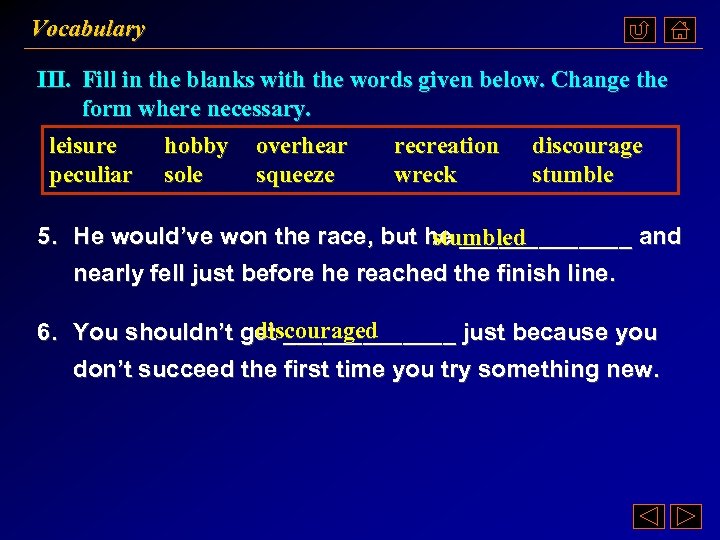
Vocabulary III. Fill in the blanks with the words given below. Change the form where necessary. leisure peculiar hobby sole overhear squeeze recreation wreck discourage stumble 5. He would’ve won the race, but he _______ and stumbled nearly fell just before he reached the finish line. discouraged 6. You shouldn’t get _______ just because you don’t succeed the first time you try something new.
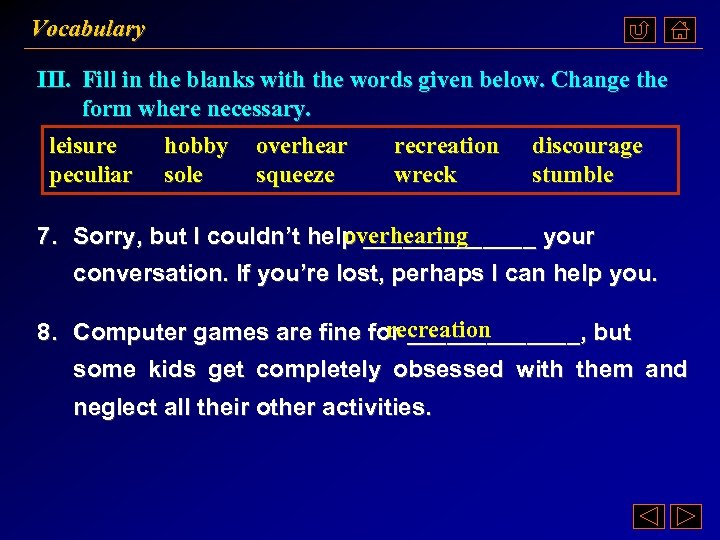
Vocabulary III. Fill in the blanks with the words given below. Change the form where necessary. leisure peculiar hobby sole overhear squeeze recreation wreck discourage stumble overhearing 7. Sorry, but I couldn’t help _______ your conversation. If you’re lost, perhaps I can help you. recreation 8. Computer games are fine for _______, but some kids get completely obsessed with them and neglect all their other activities.
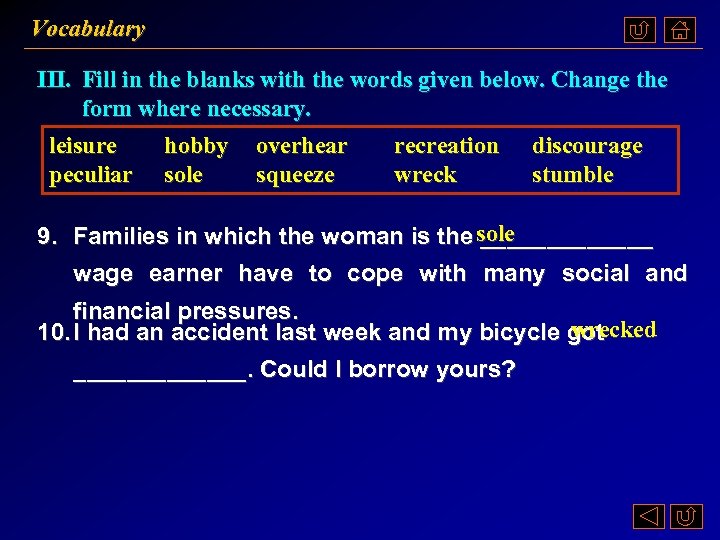
Vocabulary III. Fill in the blanks with the words given below. Change the form where necessary. leisure peculiar hobby sole overhear squeeze recreation wreck discourage stumble 9. Families in which the woman is the sole _______ wage earner have to cope with many social and financial pressures. wrecked 10. I had an accident last week and my bicycle got _______. Could I borrow yours?
Cloze 《读写教程 III》: Ex. XI, p. 209
Cloze Select the most appropriate word from the four choices given. The choice “ 0” means that no additional word is appropriate.
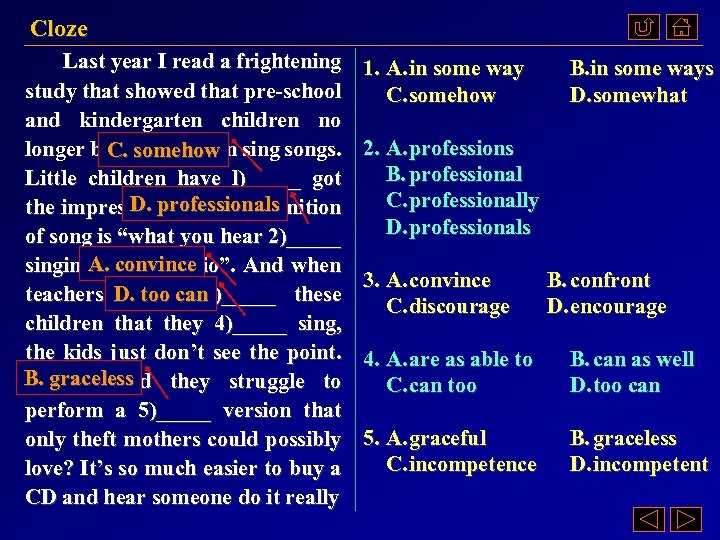
Cloze Last year I read a frightening study that showed that pre-school and kindergarten children no longer believe they can sing songs. C. somehow Little children have l)_____ got D. professionals the impression that the definition of song is “what you hear 2)_____ A. convince singing on the radio”. And when teachers D. tooto 3)_____ these try can children that they 4)_____ sing, the kids just don’t see the point. B. graceless Why should they struggle to perform a 5)_____ version that only theft mothers could possibly love? It’s so much easier to buy a CD and hear someone do it really 1. A. in some way C. somehow B. in some ways D. somewhat 2. A. professions B. professional C. professionally D. professionals 3. A. convince C. discourage B. confront D. encourage 4. A. are as able to C. can too B. can as well D. too can 5. A. graceful C. incompetence B. graceless D. incompetent
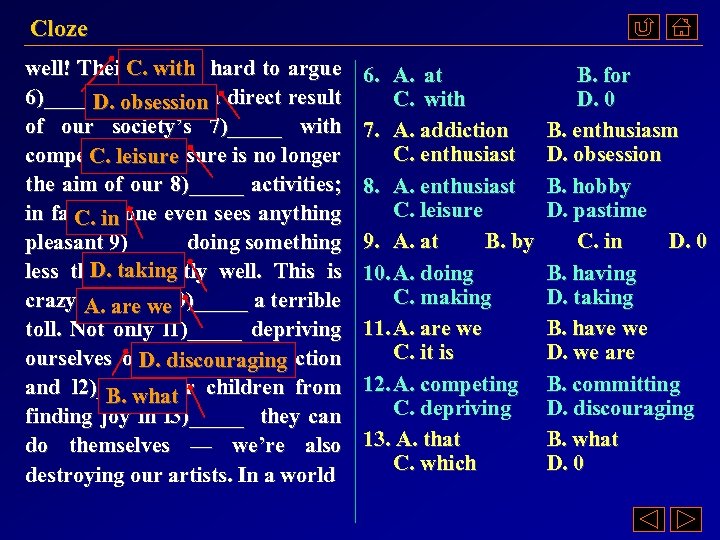
Cloze well! Their. C. with hard to argue logic is 6)_____ — and it’s a direct result D. obsession of our society’s 7)_____ with competence. Pleasure is no longer C. leisure the aim of our 8)_____ activities; in fact no one even sees anything C. in pleasant 9)_____ doing something D. perfectly well. This is less than taking crazy. A. are wel 0)_____ a terrible And it’s toll. Not only l 1)_____ depriving ourselves of. D. discouraging creative satisfaction and l 2)_____ our children from B. what finding joy in l 3)_____ they can do themselves — we’re also destroying our artists. In a world 6. A. at C. with 7. A. addiction C. enthusiast 8. A. enthusiast C. leisure 9. A. at B. by 10. A. doing C. making 11. A. are we C. it is 12. A. competing C. depriving 13. A. that C. which B. for D. 0 B. enthusiasm D. obsession B. hobby D. pastime C. in D. 0 B. having D. taking B. have we D. we are B. committing D. discouraging B. what D. 0
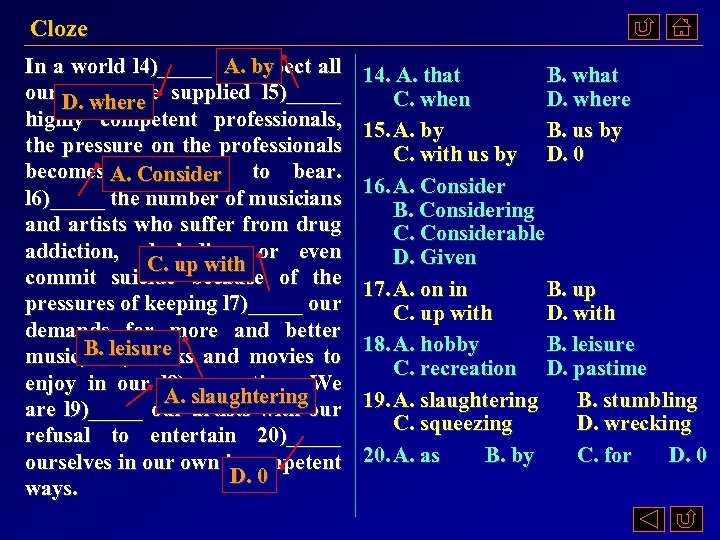
Cloze In a world l 4)_____ we by A. expect all our D. where supplied l 5)_____ art to be highly competent professionals, the pressure on the professionals becomes A. too great to bear. Consider l 6)_____ the number of musicians and artists who suffer from drug addiction, alcoholism or even C. up with commit suicide because of the pressures of keeping l 7)_____ our demands for more and better music, B. leisure and movies to art, books enjoy in our l 8)_____ time. We A. slaughtering are l 9)_____ our artists with our refusal to entertain 20)_____ ourselves in our own incompetent D. 0 ways. 14. A. that B. what C. when D. where 15. A. by B. us by C. with us by D. 0 16. A. Consider B. Considering C. Considerable D. Given 17. A. on in B. up C. up with D. with 18. A. hobby B. leisure C. recreation D. pastime 19. A. slaughtering B. stumbling C. squeezing D. wrecking 20. A. as B. by C. for D. 0
Translation • Translation Ø Ex. XIII

Translation — English to Chinese 《读写教程 III》: Ex. XII, p. 210
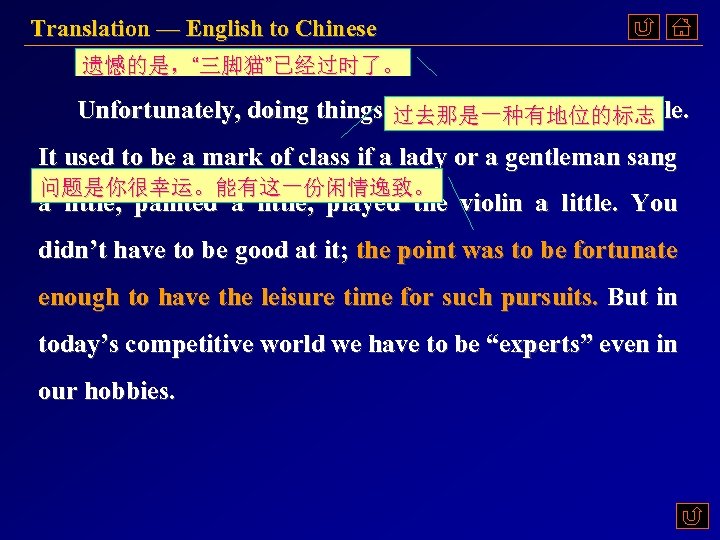
Translation — English to Chinese 遗憾的是,“三脚猫”已经过时了。 Unfortunately, doing things badly has gone out of style. 过去那是一种有地位的标志 It used to be a mark of class if a lady or a gentleman sang 问题是你很幸运。能有这一份闲情逸致。 a little, painted a little, played the violin a little. You didn’t have to be good at it; the point was to be fortunate enough to have the leisure time for such pursuits. But in today’s competitive world we have to be “experts” even in our hobbies.

Translation — Chinese to English 《读写教程 III》: Ex. XIII, p. 211
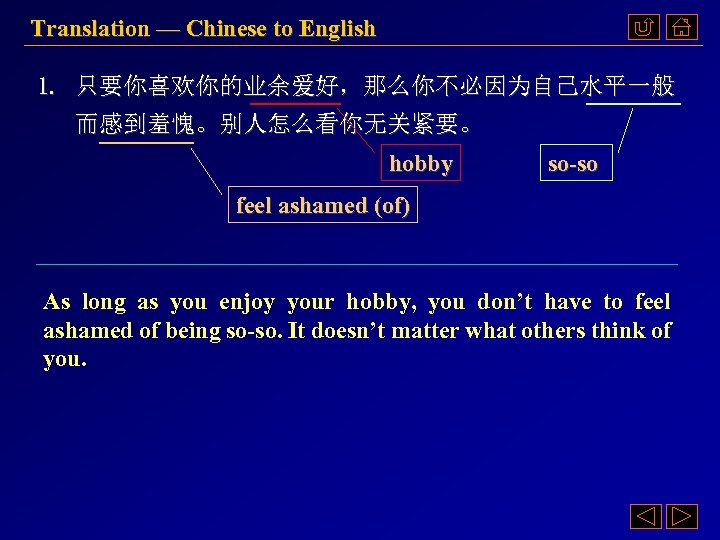
Translation — Chinese to English 1. 只要你喜欢你的业余爱好,那么你不必因为自己水平一般 而感到羞愧。别人怎么看你无关紧要。 hobby so-so feel ashamed (of) As long as you enjoy your hobby, you don’t have to feel ashamed of being so-so. It doesn’t matter what others think of you.
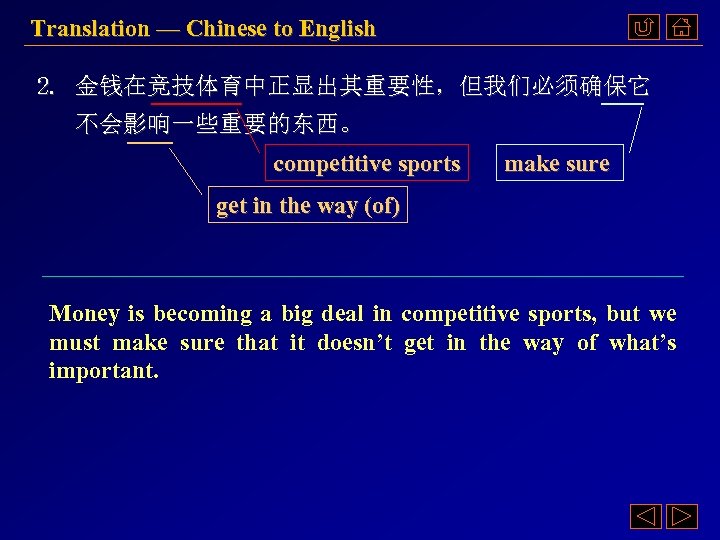
Translation — Chinese to English 2. 金钱在竞技体育中正显出其重要性,但我们必须确保它 不会影响一些重要的东西。 competitive sports make sure get in the way (of) Money is becoming a big deal in competitive sports, but we must make sure that it doesn’t get in the way of what’s important.
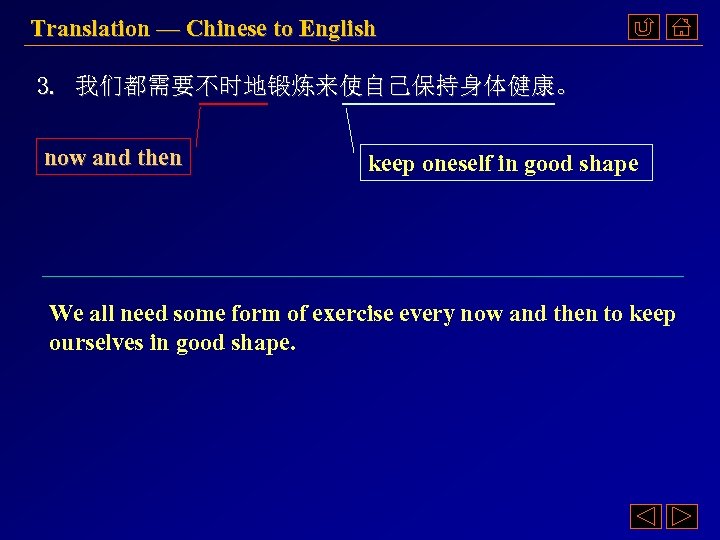
Translation — Chinese to English 3. 我们都需要不时地锻炼来使自己保持身体健康。 now and then keep oneself in good shape We all need some form of exercise every now and then to keep ourselves in good shape.
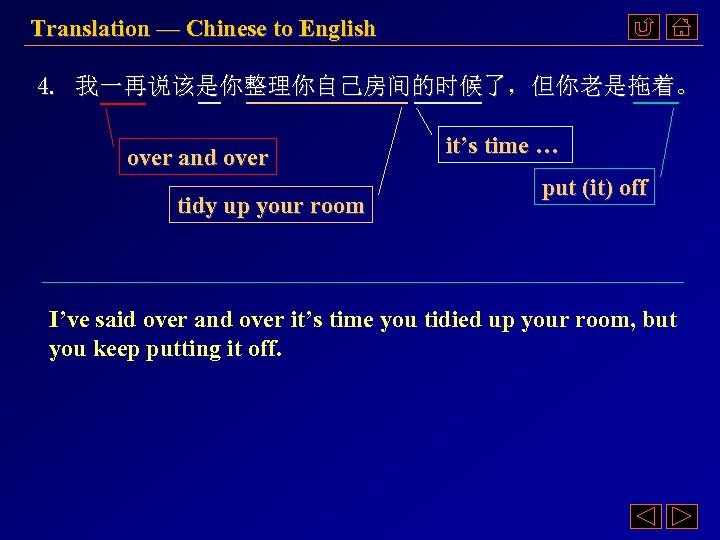
Translation — Chinese to English 4. 我一再说该是你整理你自己房间的时候了,但你老是拖着。 over and over tidy up your room it’s time … put (it) off I’ve said over and over it’s time you tidied up your room, but you keep putting it off.
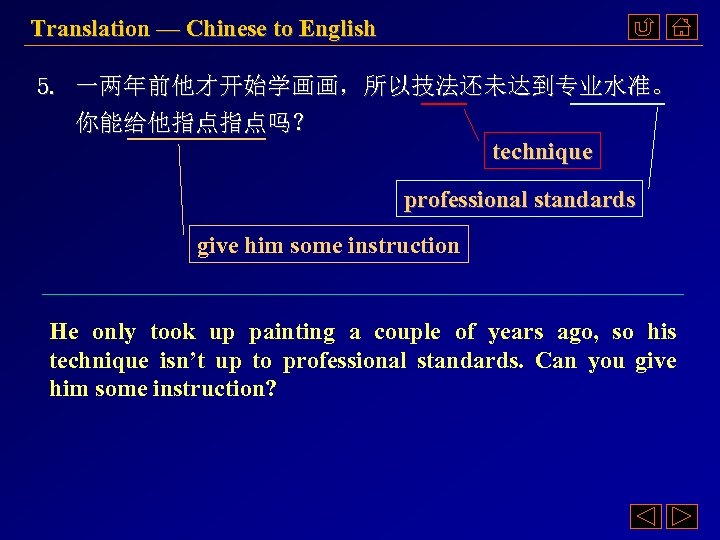
Translation — Chinese to English 5. 一两年前他才开始学画画,所以技法还未达到专业水准。 你能给他指点指点吗? technique professional standards give him some instruction He only took up painting a couple of years ago, so his technique isn’t up to professional standards. Can you give him some instruction?
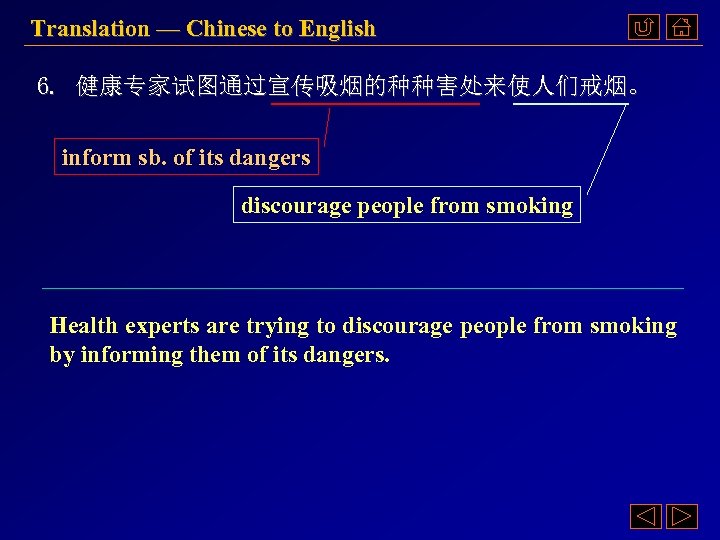
Translation — Chinese to English 6. 健康专家试图通过宣传吸烟的种种害处来使人们戒烟。 inform sb. of its dangers discourage people from smoking Health experts are trying to discourage people from smoking by informing them of its dangers.
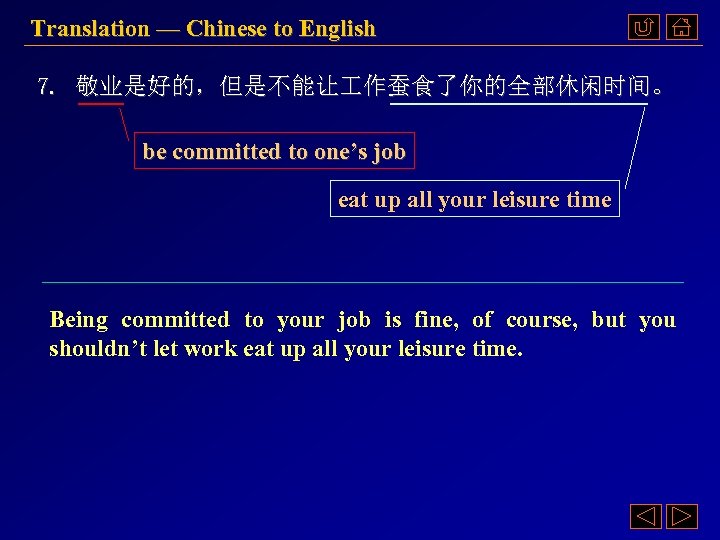
Translation — Chinese to English 7. 敬业是好的,但是不能让 作蚕食了你的全部休闲时间。 be committed to one’s job eat up all your leisure time Being committed to your job is fine, of course, but you shouldn’t let work eat up all your leisure time.
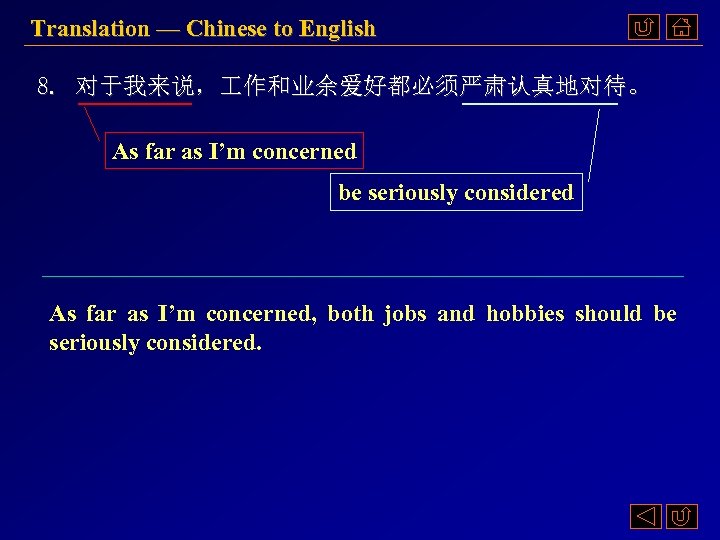
Translation — Chinese to English 8. 对于我来说, 作和业余爱好都必须严肃认真地对待。 As far as I’m concerned be seriously considered As far as I’m concerned, both jobs and hobbies should be seriously considered.
Structured Writing 《读写教程 III》: Ex. XV, p. 213
Structured Writing Look again at the first four paragraphs of Text A to see how the author starts from a specific example, moves to a general statement and then leads to a general thesis.
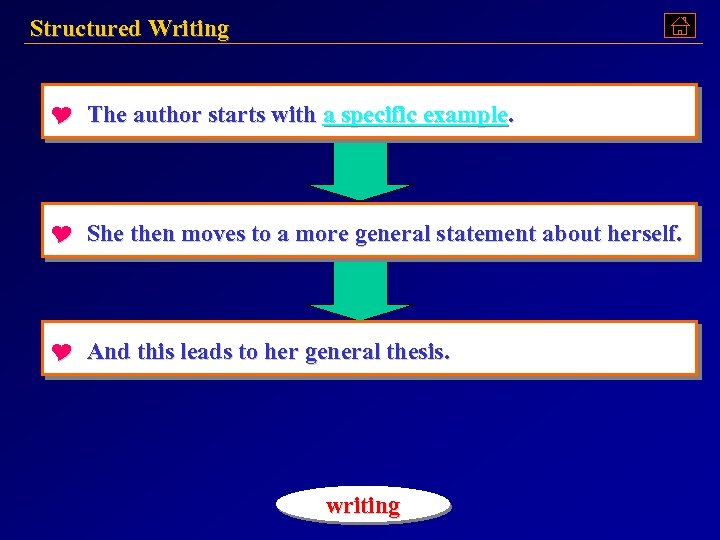
Structured Writing Y The author starts with a specific example. Y She then moves to a more general statement about herself. Y And this leads to her general thesis. writing
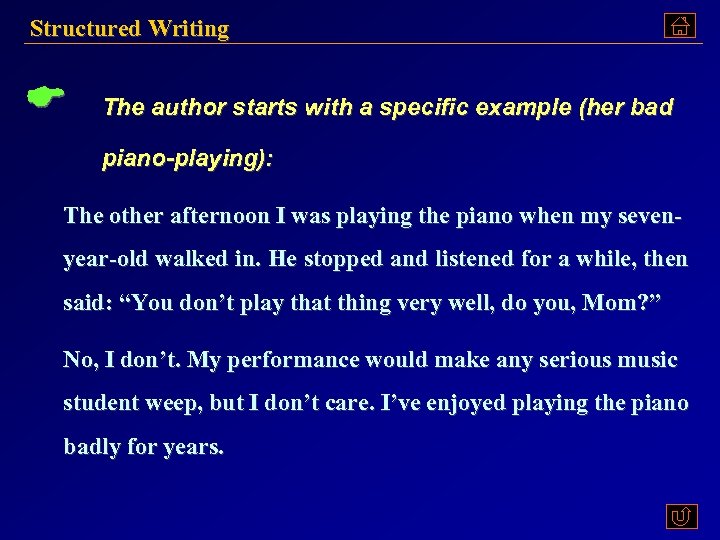
Structured Writing The author starts with a specific example (her bad piano-playing): The other afternoon I was playing the piano when my sevenyear-old walked in. He stopped and listened for a while, then said: “You don’t play that thing very well, do you, Mom? ” No, I don’t. My performance would make any serious music student weep, but I don’t care. I’ve enjoyed playing the piano badly for years.
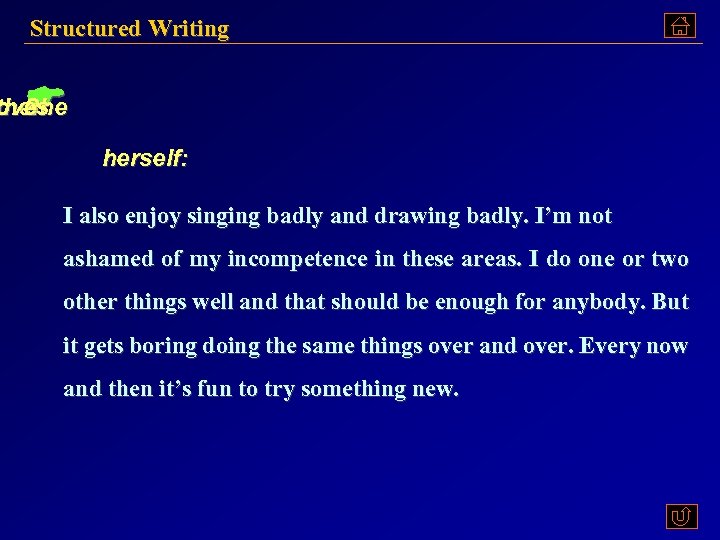
Structured Writing o She oves then herself: I also enjoy singing badly and drawing badly. I’m not ashamed of my incompetence in these areas. I do one or two other things well and that should be enough for anybody. But it gets boring doing the same things over and over. Every now and then it’s fun to try something new.
Structured Writing And this leads to her general thesis: Unfortunately, doing things badly has gone out of style. It used to be a mark of class if a lady or a gentleman sang a little, painted a little, played the violin a little. You didn’t have to be good at it; the point was to be fortunate enough to have the leisure time for such pursuits. But in today’s competitive world we have to be “experts” even in our hobbies.
Structured Writing Use the same specific-to-general structure to introduce a thesis of your own. Here are some ideas you can choose from: 1. Haste Makes Waste 2. A Small Act of Kindness 3. Harmony with Nature Sample Essay
Structured Writing Yesterday afternoon I was reading a magazine when my roommate shouted at me. She said, “It’s a beautiful day outside! You can’t just read all day!” Yes, I can. My ability to read at any time drives my roommates crazy, but I don’t care. I enjoy reading, and I’m good at it. I’ve been good at it all my life. I’m proud of my competence in reading, which I’ve achieved only through years of practice. I can read not only at any time, but also in just about any situation. Every now and then I try reading in some new place or position, just because it’s fun to try something new. Reading used to be a mark of accomplishment if a person read widely and miscellaneously. In today’s business world, the so-called social life eats up much of my reading time, but reading is still part of my life.
Assignment 1. Review Text A 2. Do exercises: • Structure (Ex. X, p. 209) • Cloze (Ex. XI, p. 209) • Translation (Ex. XII, p. 210) 3. Structured Writing (p. 213)
Скачать презентацию 21 st Century College English Book 3 Unit
9cb933e8215857f38536c5be79d5a7f9.ppt