 Скачать презентацию 2017 SOCIAL PROTECTION WEEK 29 NOVEMBER 2017 NEW
8b361261f73c1f71b4badf88f25c6db2.ppt
- Количество слайдов: 18



2017 SOCIAL PROTECTION WEEK 29 NOVEMBER 2017 NEW GOVERNMENT COMPLEX LUSAKA PRESENTATION ON CHILD SENSITIVE SOCIAL PROTECTION
Outline 1. 2. 3. 4. 5. Background Objectives Programme Performance Challenges On-going and Upcoming Priorities
Background v In Zambia, experiences of vulnerability resulting from violation of human rights are common, particularly among woman and children. v Vulnerability is also reinforced by eventualities such as HIV/AIDS, widowhood, orphan hood, delinquency, human trafficking, gender based violence and other vices that affect the wellbeing of individuals. v Programmes being implemented to address vulnerability of individual fall under the protection pillar and these include, provision of places of safety to victims, Child welfare programmes, Anti-Gender Based (GBV) activities, Anti-Human Trafficking (HT) activities Correctional Services and Legal Aid Services.
Objectives v. To protect vulnerable populations from all forms of abuse, violence, exploitation, discrimination, denial and neglect; v. To enhance the social status and progressive realization of socio-economic and cultural rights of the excluded and marginalised. v. To generate a data system to identify the vulnerable individuals
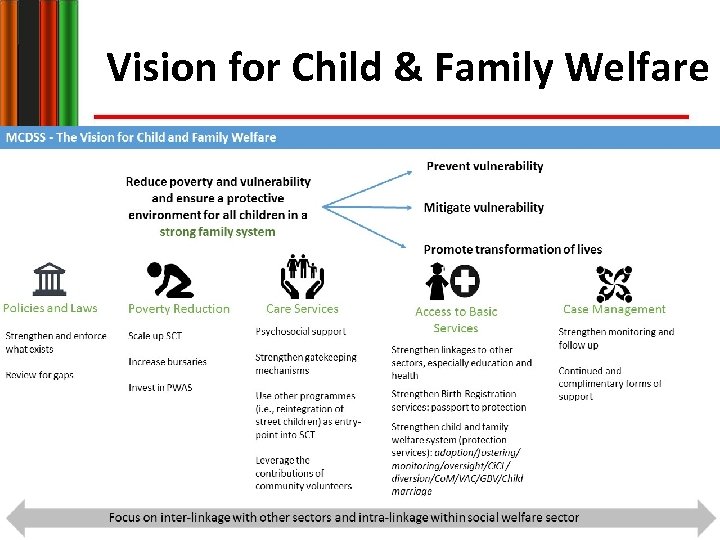
Vision for Child & Family Welfare
Gender Based Violence v The fast track Courts for Anti-GBV established in Lusaka and Central Province with a view to roll out. v The Gender Equity and Equality Act No. 22 of 2015 put in place and being reinforced. v Awareness raising conducted in selected districts on the risks of GBV v Establish Safe House/Shelters (Places of safety) Secured land/Sites in Chongwe, Sesheke, Chirundu, Mbala and Chipata Districts for the construction/ renovation works for safe houses for survivors of GBV. Working with IOM and World Vision in these projects. v The Ministry MCDSS currently runs the Mansa Place of Safety
Orphans and Vulnerable Children v Review and development of the National Child Policy finalised, and a National Action Plan developed and being implemented. v National Assessment of Child Care Facilities – was completed and report officially disseminated in September, 2017. v Report reviewed that 6, 022 children were resident in 178 CCFs in Zambia v Completed the development of Alternative Care Package for vulnerable children in need of care (the family is the best environment for child care).
Alternative Care Guidelines • Finalization and launch of Alternative Care Regulatory Framework - Standardized guidance on the provision of Emergency Care, Foster Care, Intercountry and Local Adoption, Family Tracing and Reintegration for children in need of care • Inclusion of provisions on intercountry Adoption in the draft Children’s Code Bill • Establishment of National Alternative Care Technical Working Group • Phase roll out of newly developed case management tools
Juvenile Justice v Completed the development of Diversion Operational Framework. Will be piloted in 3 Districts: Lusaka, Kitwe and Ndola v Diversion aims at responding to child offending by way of diversion out of the formal criminal justice system, in accordance with the UN Convention on the Rights of the Child (UNCRC). (by all possible means endeavour to avoid child incarceration and provide more child-sensitive counselling and correctional procedures and support to the family)
Developing Data Base System v Completed the development of the National database called Zambia Orphans Management Information System (ZOMIS)* v The Database still requires upgrading and improving security features (in view of accommodating case management approach – referral to services) v The Ministry with the CPs (USAid, Unicef) is targeting to complete all works and begin the CB training for the end users before end of the year 2017. v It is expected that this system will enhance the identification, collection and management of information on OVCs in Zambia and to inform Policy Direction.
Human Trafficking v Zambia is a source, transit, and destination country for men, women, and children subjected to forced labor and sex trafficking (2016 Trafficking in Persons Report) v Some cases reported: ü 14 girls from Shangombo, Sioma area trafficked through Sesheke border. About 8 intercepted and returned home. ü 95 Ethiopians out of which 19 died due to suffocation in a Zambian registered truck intercepted along pedigal road – Zambia – Congo DR border ü 4 Malawian girls being trafficked intercepted in Zambia. Suspected Trafficker (Malawian). ü Trafficking of Children for child labour purposes in Eastern, Southern and Western Provinces involved in cattle heading ü Young girls trafficked to S. Africa, Namibia, Middle East for domestic work
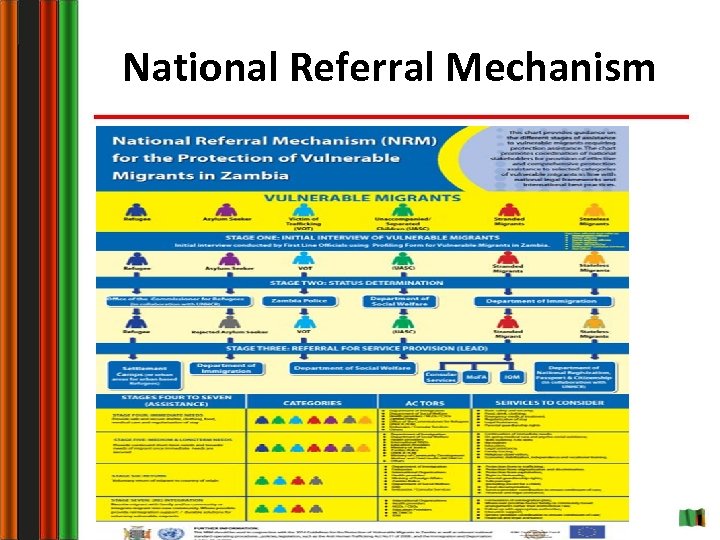
National Referral Mechanism
Ending Child Marriage • Zambia is part of the AU campaign to end child marriage • Child marriage has been found to be a decision taken in light of very limited and very poor choices • Social protection addresses the main driver, which is poverty • Initiatives in a number of districts implemented conjointly with traditional and community leaders
Cash plus Care • Upcoming pilot projects in Rufunsa and Mufulira Districts • Develop case management framework to combine cash transfers and care services • Coordinate government and civil society structures and services • Beyond cash – vulnerable children and adolescents need more than just cash – Eg. Education, Health, Nutrition, Protection, Sexual Reproductive Health
SCT – HIV linkags • The Adolescent Cash Transfer Learning initiative (ACTLi) operational in 15 districts • Joint implementation of MCDSS and MOH • Provide adolescent-sensitive access to sexual reproductive health in rural health facilities – peer educators, adolescent friendly corners • Reach out to adolescents in SCT families to ensure they use these services • Reduce HIV, teenage pregnancies, keep girls in school
Keeping Girls in School • The Keeping Girls in School (KGS) project is part of the GEWEL project • KGS identifies girls in social cash transfer households who are out of secondary school and pays their school fees • Joint project between MCDSS, Mo. GE and Mo. G • Includes a package with school supplies and menstrual hygiene products
Early Childhood Development • The first 1000 days between conception and the third birthday are critical in the development of an embryo/infant • Developmental Impact lost in this time cannot be regained • Nutrition, Health and Early Child Education key • Discussions about the role social protection needs to play, e. g. through the cash transfer
Thank You! End of Presentation
Скачать презентацию 2017 SOCIAL PROTECTION WEEK 29 NOVEMBER 2017 NEW
8b361261f73c1f71b4badf88f25c6db2.ppt