


 Скачать презентацию 2017 Geographical Association Conference University of Surrey A
f35afb6e8a08d7475bfb7d61811d6970.ppt
- Количество слайдов: 24
 2017 Geographical Association Conference University of Surrey A Brave New World? Joined up learning from sixth forms to university… Richard Waller 1 & Gill Miller 2 1 School of Geography, Geology & the Environment, Keele University r. i. waller@keele. ac. uk @wallersaur 2 Department of Geography and International Development, Chester University. g. miller@chester. ac. uk
 Information Literacy Huge increases in the sheer volume of information being produced and made freely available… BUT - How do you find what you’re looking for? How do you decide what to use and what to ignore? How do you make the best use of what you find? Information literacy refers to the knowledge & skills required to make effective use of information sources. Progressive development central to success in academic study – especially relevant to independent project work (required component of new A-level).
 A vital skill set… “IL is the set of skills and knowledge that not only allows us to find, evaluate, and use the information we need, but perhaps more importantly, allows us to filter out the information we don’t need. IL skills are the necessary tools that help us successfully navigate the present and future landscape of information. ” Eisenberg, M. B. 2008. Information Literacy: Essential skills for the Information Age. Journal of Library & Information Technology, 28 (2), p 40.
 Workshop Outline 1. Different types of information resource 2. Devising effective search strategies 3. Making effective use of resources within assessed work Focus parts 2 and 3 on “Water & Carbon Cycles” – core theme for new A-level
 1. Different types of resource
 Opening questions… What are the potential sources of information you students can use when working on an assignment? What are their pros and cons? Do you have specific “go to” sources of information?
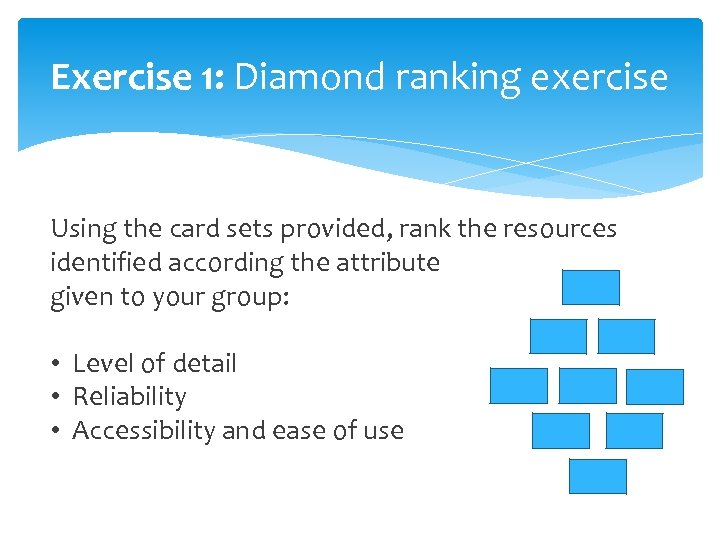 Exercise 1: Diamond ranking exercise Using the card sets provided, rank the resources identified according the attribute given to your group: • Level of detail • Reliability • Accessibility and ease of use
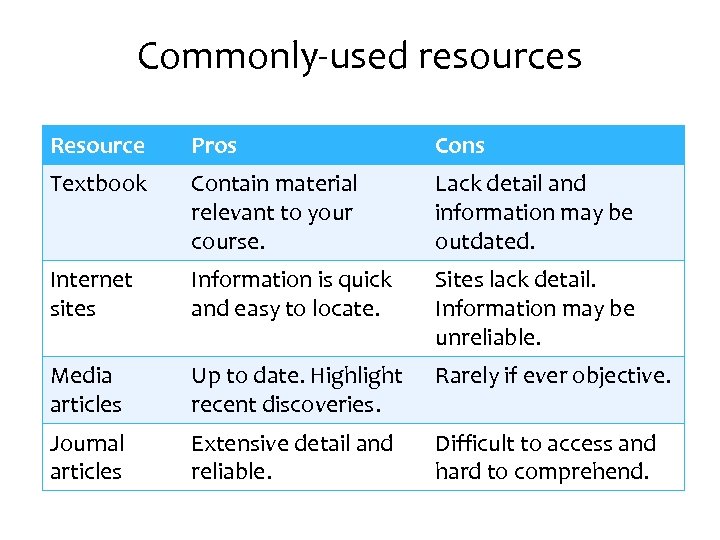 Commonly-used resources Resource Pros Cons Textbook Contain material relevant to your course. Lack detail and information may be outdated. Internet sites Information is quick and easy to locate. Sites lack detail. Information may be unreliable. Media articles Up to date. Highlight recent discoveries. Rarely if ever objective. Journal articles Extensive detail and reliable. Difficult to access and hard to comprehend.
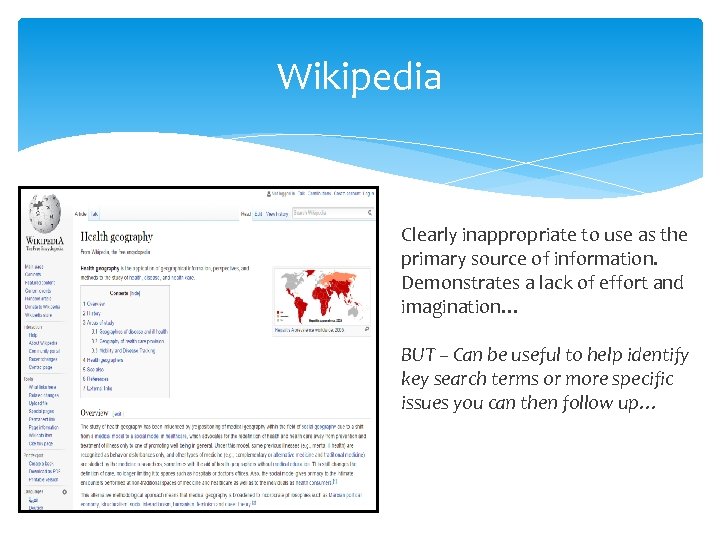 Wikipedia Clearly inappropriate to use as the primary source of information. Demonstrates a lack of effort and imagination… BUT – Can be useful to help identify key search terms or more specific issues you can then follow up…
 2. Devising effective search strategies
 2. Devising effective search strategies Secret to accessing information quickly and easily using search engines is devising appropriate search strategies. Two key components: Key words or phrases. Boolean operators (AND, OR etc. ). N. B. Emphasise the need to experiment and commit some time before your searches bear fruit…
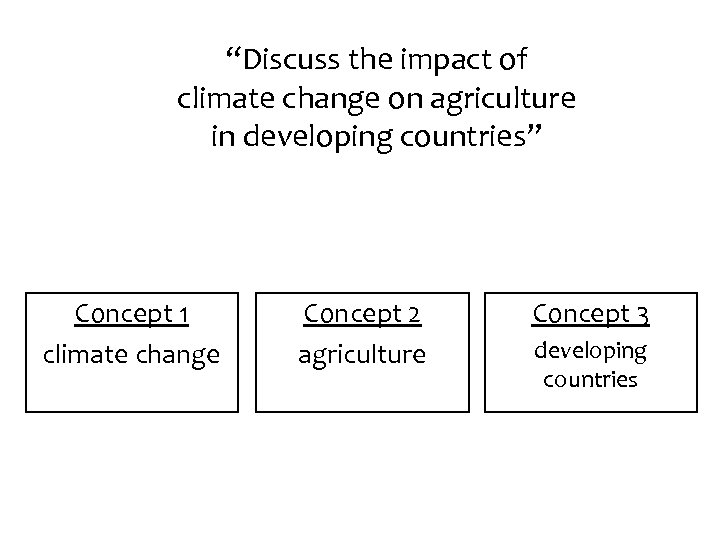 “Discuss the impact of climate change on agriculture in developing countries” Concept 1 climate change Concept 2 agriculture Concept 3 developing countries
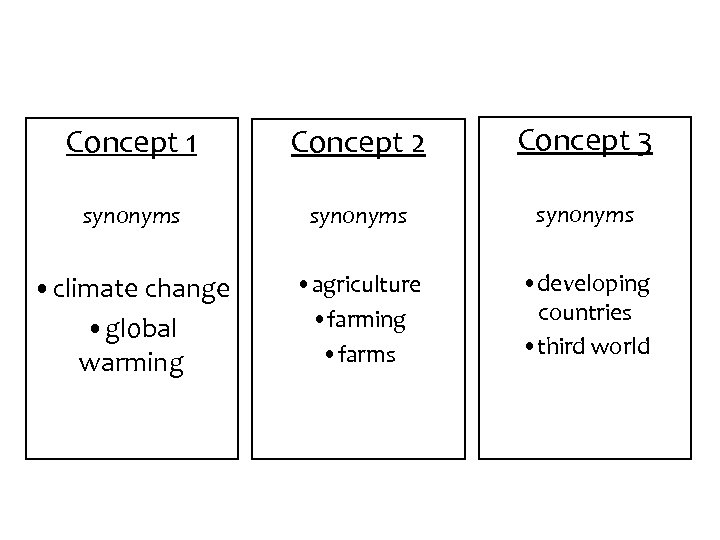 Concept 1 Concept 2 Concept 3 synonyms • climate change • global warming • agriculture • farming • farms • developing countries • third world
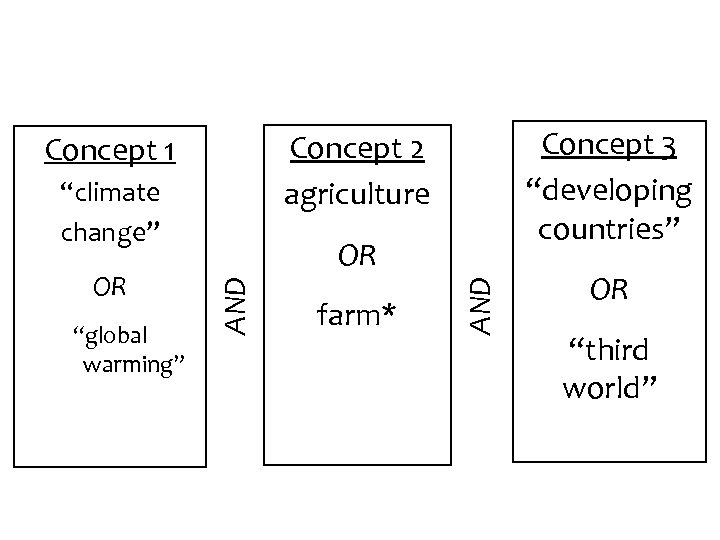 “climate change” farm* AND “global warming” OR AND OR Concept 3 “developing countries” Concept 2 agriculture Concept 1 OR “third world”
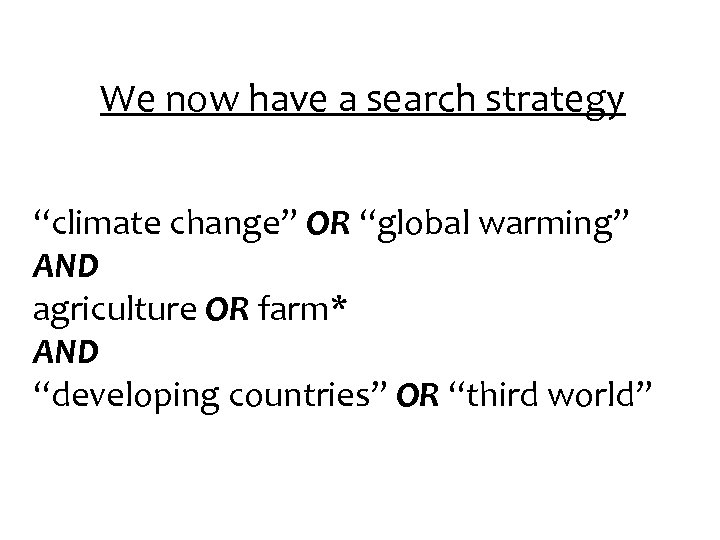 We now have a search strategy “climate change” OR “global warming” AND agriculture OR farm* AND “developing countries” OR “third world”
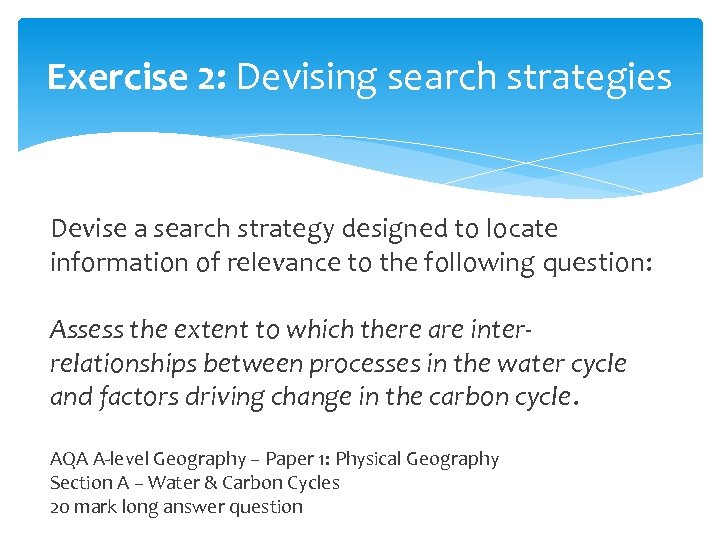 Exercise 2: Devising search strategies Devise a search strategy designed to locate information of relevance to the following question: Assess the extent to which there are interrelationships between processes in the water cycle and factors driving change in the carbon cycle. AQA A-level Geography – Paper 1: Physical Geography Section A – Water & Carbon Cycles 20 mark long answer question
 3. Making effective use of resources
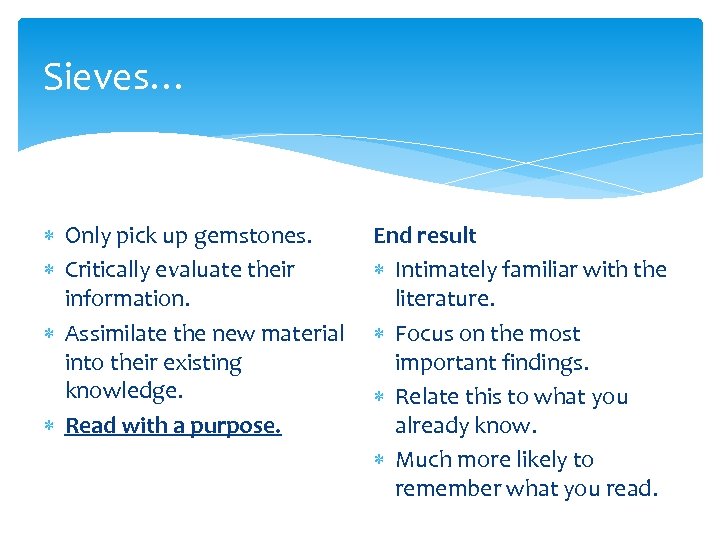 Sieves… Only pick up gemstones. Critically evaluate their information. Assimilate the new material into their existing knowledge. Read with a purpose. End result Intimately familiar with the literature. Focus on the most important findings. Relate this to what you already know. Much more likely to remember what you read.
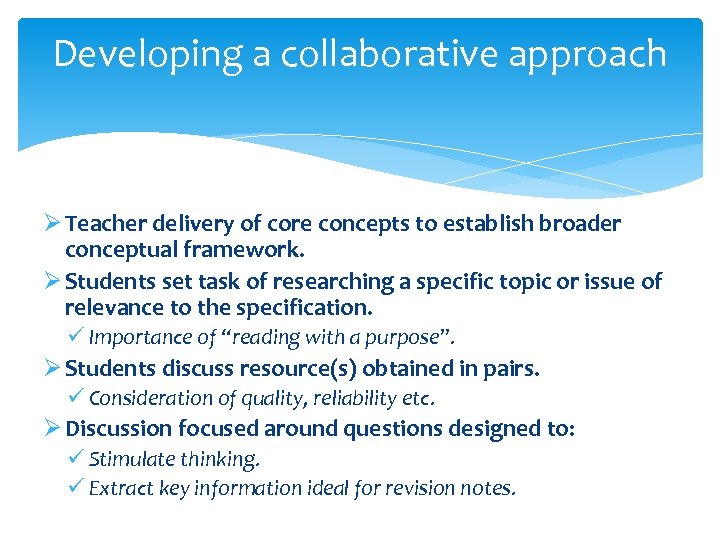 Developing a collaborative approach Ø Teacher delivery of core concepts to establish broader conceptual framework. Ø Students set task of researching a specific topic or issue of relevance to the specification. ü Importance of “reading with a purpose”. Ø Students discuss resource(s) obtained in pairs. ü Consideration of quality, reliability etc. Ø Discussion focused around questions designed to: ü Stimulate thinking. ü Extract key information ideal for revision notes.
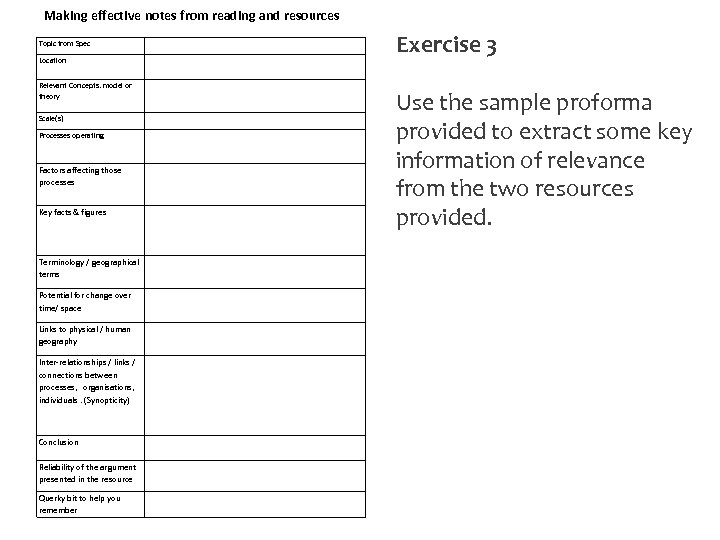 Making effective notes from reading and resources Topic from Spec Location Relevant Concepts. model or theory Scale(s) Processes operating Factors affecting those processes Key facts & figures Terminology / geographical terms Potential for change over time/ space Links to physical / human geography Inter-relationships / links / connections between processes, organisations, individuals. (Synopticity) Conclusion Reliability of the argument presented in the resource Querky bit to help you remember Exercise 3 Use the sample proforma provided to extract some key information of relevance from the two resources provided.
 Concluding Recommendations Explicit coverage of information literacy skills will help students to address various key challenges of the new A-level. Encourage use of a variety of resources and recognise their provenance to respond to demand for greater depth of understanding. Encourage confidence / competence when exploring literature, even if it’s just the ‘big picture’ – key transition skill. Students need sufficient information to use /analyse, rather than so much that they can only provide a narrative.
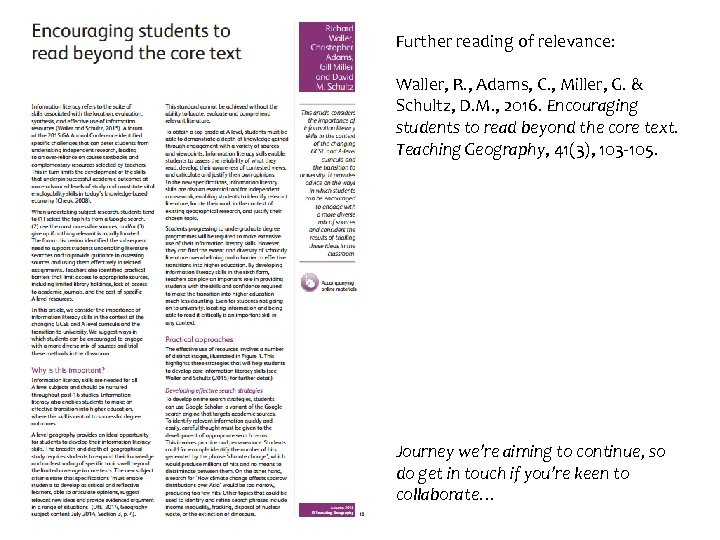 Further reading of relevance: Waller, R. , Adams, C. , Miller, G. & Schultz, D. M. , 2016. Encouraging students to read beyond the core text. Teaching Geography, 41(3), 103 -105. Journey we’re aiming to continue, so do get in touch if you’re keen to collaborate…
 Acknowledgements Geographical Association and the post-16 committee for allowing us to run the workshop. Invaluable discussions with Chris Adams and other teachers on the application of information literacy skills in schools. Financial support from Keele University to support attendance at this year’s GA meeting (RIW).
 Contact Details Richard Waller r. i. waller@keele. ac. uk @wallersaur Gill Miller g. miller@chester. ac. uk