


 Скачать презентацию 2016 meeting of experts involved in CEPEJ co-operation
0dd87bcb9f8c437de6b40a36a2c1e3a5.ppt
- Количество слайдов: 5
 2016 meeting of experts involved in CEPEJ co-operation programmes Summary of the challenges encountered and good practice
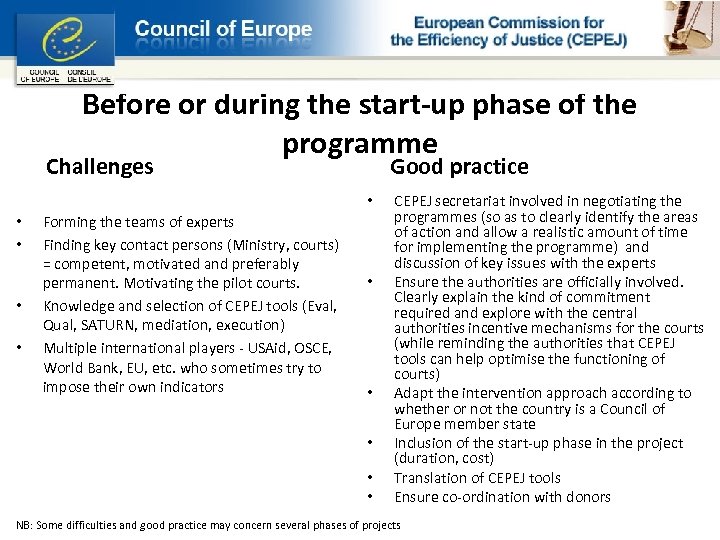 Before or during the start-up phase of the programme Good practice Challenges • • • Forming the teams of experts Finding key contact persons (Ministry, courts) = competent, motivated and preferably permanent. Motivating the pilot courts. Knowledge and selection of CEPEJ tools (Eval, Qual, SATURN, mediation, execution) Multiple international players - USAid, OSCE, World Bank, EU, etc. who sometimes try to impose their own indicators • • • CEPEJ secretariat involved in negotiating the programmes (so as to clearly identify the areas of action and allow a realistic amount of time for implementing the programme) and discussion of key issues with the experts Ensure the authorities are officially involved. Clearly explain the kind of commitment required and explore with the central authorities incentive mechanisms for the courts (while reminding the authorities that CEPEJ tools can help optimise the functioning of courts) Adapt the intervention approach according to whether or not the country is a Council of Europe member state Inclusion of the start-up phase in the project (duration, cost) Translation of CEPEJ tools Ensure co-ordination with donors NB: Some difficulties and good practice may concern several phases of projects
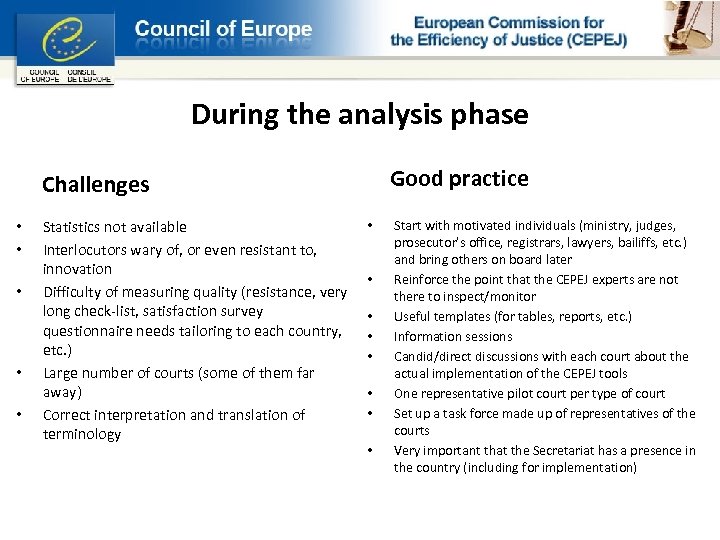 During the analysis phase Good practice Challenges • • • Statistics not available Interlocutors wary of, or even resistant to, innovation Difficulty of measuring quality (resistance, very long check-list, satisfaction survey questionnaire needs tailoring to each country, etc. ) Large number of courts (some of them far away) Correct interpretation and translation of terminology • • Start with motivated individuals (ministry, judges, prosecutor’s office, registrars, lawyers, bailiffs, etc. ) and bring others on board later Reinforce the point that the CEPEJ experts are not there to inspect/monitor Useful templates (for tables, reports, etc. ) Information sessions Candid/direct discussions with each court about the actual implementation of the CEPEJ tools One representative pilot court per type of court Set up a task force made up of representatives of the courts Very important that the Secretariat has a presence in the country (including for implementation)
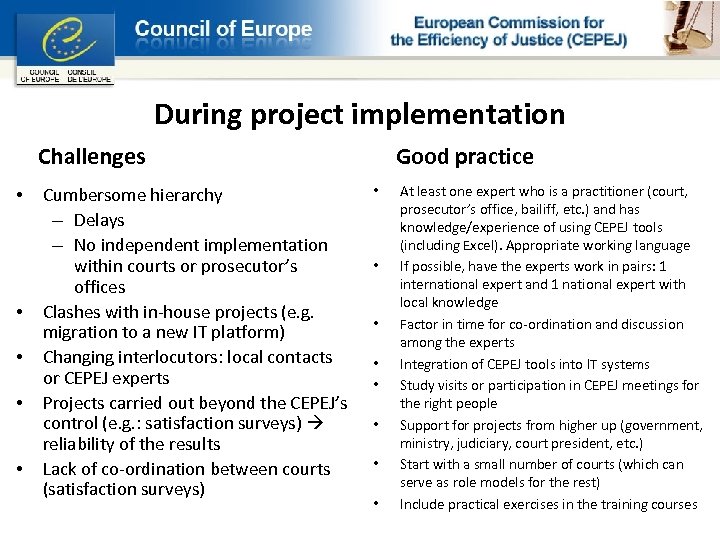 During project implementation Challenges • • • Cumbersome hierarchy – Delays – No independent implementation within courts or prosecutor’s offices Clashes with in-house projects (e. g. migration to a new IT platform) Changing interlocutors: local contacts or CEPEJ experts Projects carried out beyond the CEPEJ’s control (e. g. : satisfaction surveys) reliability of the results Lack of co-ordination between courts (satisfaction surveys) Good practice • • At least one expert who is a practitioner (court, prosecutor’s office, bailiff, etc. ) and has knowledge/experience of using CEPEJ tools (including Excel). Appropriate working language If possible, have the experts work in pairs: 1 international expert and 1 national expert with local knowledge Factor in time for co-ordination and discussion among the experts Integration of CEPEJ tools into IT systems Study visits or participation in CEPEJ meetings for the right people Support for projects from higher up (government, ministry, judiciary, court president, etc. ) Start with a small number of courts (which can serve as role models for the rest) Include practical exercises in the training courses
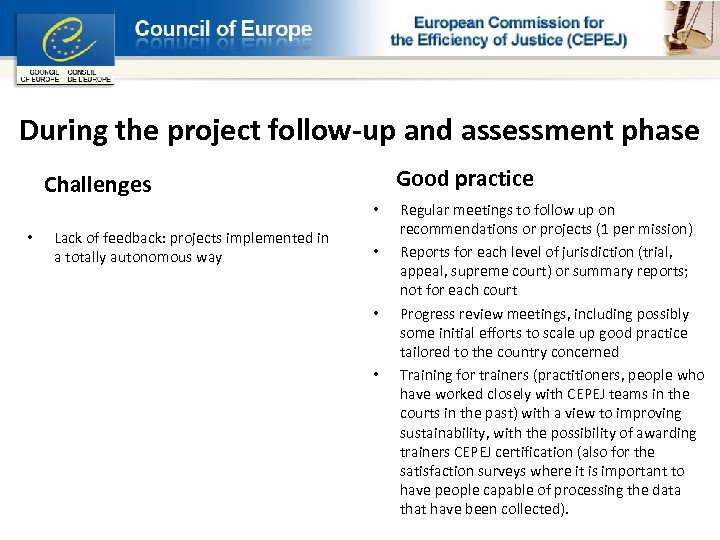 During the project follow-up and assessment phase Good practice Challenges • • Lack of feedback: projects implemented in a totally autonomous way • • • Regular meetings to follow up on recommendations or projects (1 per mission) Reports for each level of jurisdiction (trial, appeal, supreme court) or summary reports; not for each court Progress review meetings, including possibly some initial efforts to scale up good practice tailored to the country concerned Training for trainers (practitioners, people who have worked closely with CEPEJ teams in the courts in the past) with a view to improving sustainability, with the possibility of awarding trainers CEPEJ certification (also for the satisfaction surveys where it is important to have people capable of processing the data that have been collected).