 Скачать презентацию 2016 Alumni Webinar Series It s 10 p
7c3241399311b419d43e726228c6a18a.ppt
- Количество слайдов: 47




2016 Alumni Webinar Series
It’s 10 p. m. ! Do You Know Where Your Collections Are? Library and Archival Security Gregor Trinkaus-Randall, M. A. L. S. , F. S. A. A. , C. A. UW-Madison SLIS Alumni Webinar Series May 24, 2016
![Introduction “[Libraries and archives] in every stage of their development have an obligation to](https://present5.com/presentation/7c3241399311b419d43e726228c6a18a/image-3.jpg "Introduction “[Libraries and archives] in every stage of their development have an obligation to")
Introduction “[Libraries and archives] in every stage of their development have an obligation to protect their collections from loss and from damage of any sort, and they have an obligation to protect their staff and their visitors as far as possible from hazards that may exist in work, study, and exhibition areas. ” 3
Responsibilities • Responsible for building collections and for processing, cataloging, preservation, access, security, and safe storage • Accept responsibility for providing proper housing, storage, and protection for materials (Responsible Custody) – Ensure that the materials do not deteriorate and are not lost through theft or mutilation • Responsible for making security a basic library function 4
Security • “Freedom from damage. ” (Webster) • “Measures taken to protect materials from unauthorized access, change, destruction, or other threats. ” (A Glossary for Archival and Records Terminology) 5
Security and the Collections • Security is a primary staff responsibility, yet it is one of the most difficult to enforce – Must enforce the security rules and regulations uniformly with all researchers – Must provide access to the materials with security – Must ensure the preservation and security of the collections 6
Reasons for Security Planning • Stewardship of these collections is our professional, and sometimes legal, responsibility. • Morale issues can be addressed more easily 7
Security Operations • Deterring theft of library and archival materials • Identification of missing items • Controlling the environment • Preparing for, preventing and responding to disasters • Protecting exhibited and loaned materials • Insuring valuable holdings 8
Evaluating Library and Archival Security • No two repositories have the same needs • Take into account their own library’s or archives’ unique nature, collections, mission, buildings, and locations • Survey each area of library or archives – Determine what materials should be protected against what threats – Think broadly when considering threats 9
Evaluating Library and Archival Security – Be hard on yourselves at this point – Consider security issues from a collection’s point of arrival to time of consultation • Consider the modus operandi of thieves • Remember: It is far more economical to provide protection for collections than to recover them from a theft, a fire, or a natural disaster 10
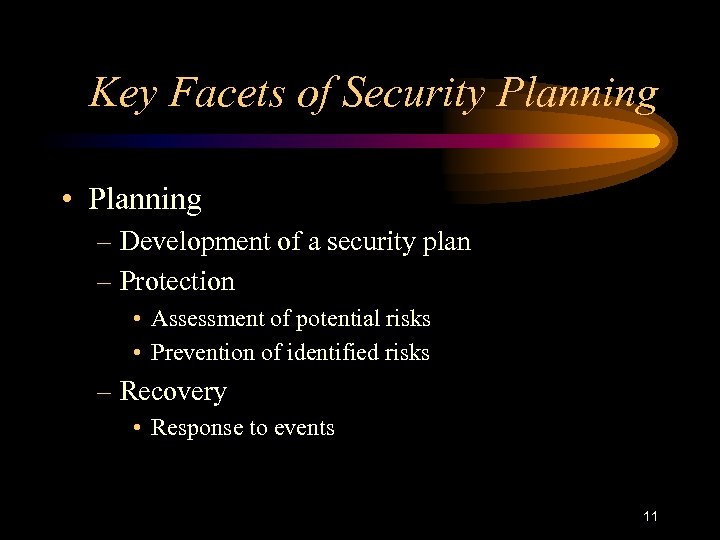
Key Facets of Security Planning • Planning – Development of a security plan – Protection • Assessment of potential risks • Prevention of identified risks – Recovery • Response to events 11
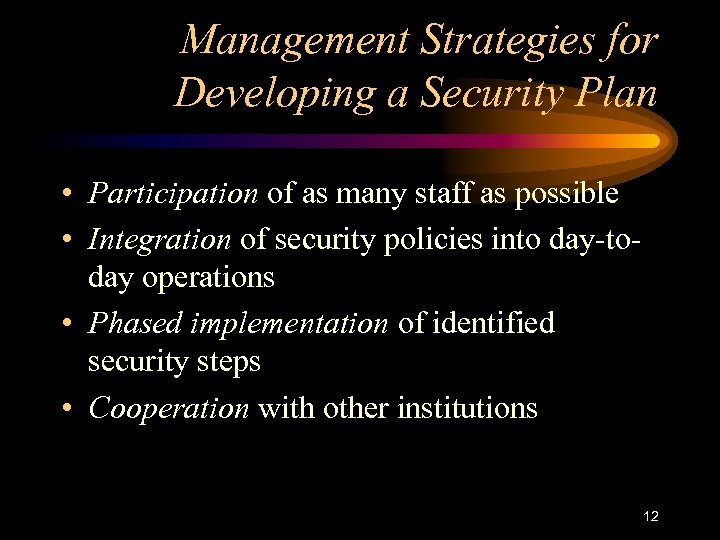
Management Strategies for Developing a Security Plan • Participation of as many staff as possible • Integration of security policies into day-today operations • Phased implementation of identified security steps • Cooperation with other institutions 12
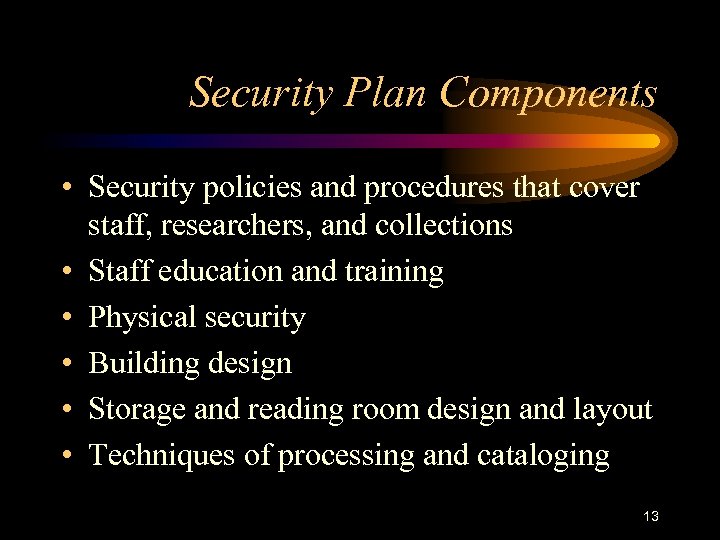
Security Plan Components • Security policies and procedures that cover staff, researchers, and collections • Staff education and training • Physical security • Building design • Storage and reading room design and layout • Techniques of processing and cataloging 13
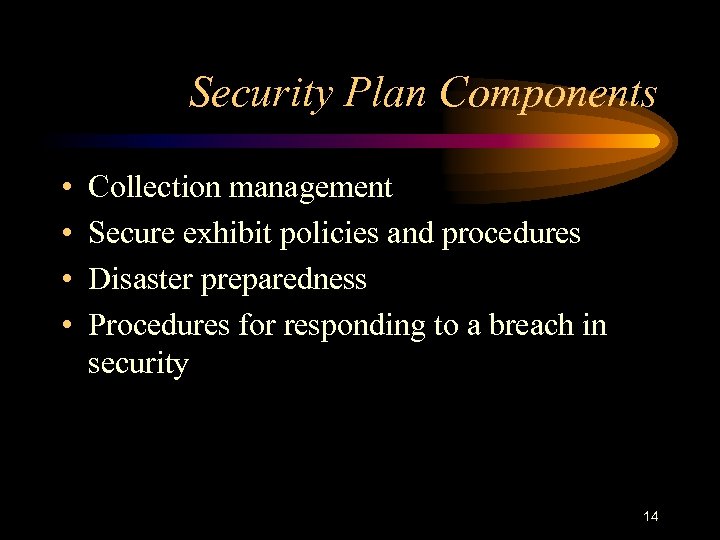
Security Plan Components • • Collection management Secure exhibit policies and procedures Disaster preparedness Procedures for responding to a breach in security 14
Security Plan Requirements • Written • Approved by the highest authority in the institution • Distributed to, and signed off on, by the staff at all levels 15
Deterrents and Prevention of Theft • Special kind of protection – Highly selective as to how it is implemented • Need to address issues of theft, recovery, environment, and disasters • Items with marketable value should be identified, appraised, and scheduled • Determine what kind of protection is necessary and feasible for your institution 16
Physical Security Measures • • Locking and access systems Perimeter Detection Equipment Lighting and alarms Surveillance equipment 17
Security Steps To Be Taken • Public access to public areas only! • Identification badges worn by repair, construction, and custodial staff especially, but all staff preferably • Develop clear and specific closing procedures • Create and maintain complete, accurate, and up-to-date records of holdings, their contents, and their locations 18
Security Steps To Be Taken – Accession and cataloging records, finding aids, signed call slips, conservation reports, collection condition surveys, loan and exhibition forms, ownership records, literary property rights (when applicable) • Trace the material’s existence in the institution – Marketable items may need to be removed from collection – Special insurance policies are a possibility 19
Security Steps To Be Taken • Monitor all exits at all times • Supervise the use of all materials of any value • Work with book and manuscript dealers and other libraries and archives 20
Arrangement of Manuscript Collections • Arrangement and description of manuscript collections – Creates an order for the materials – Provides staff with a good knowledge and documentation of what is in the collections – Traces the existence of the collections in the institution 21
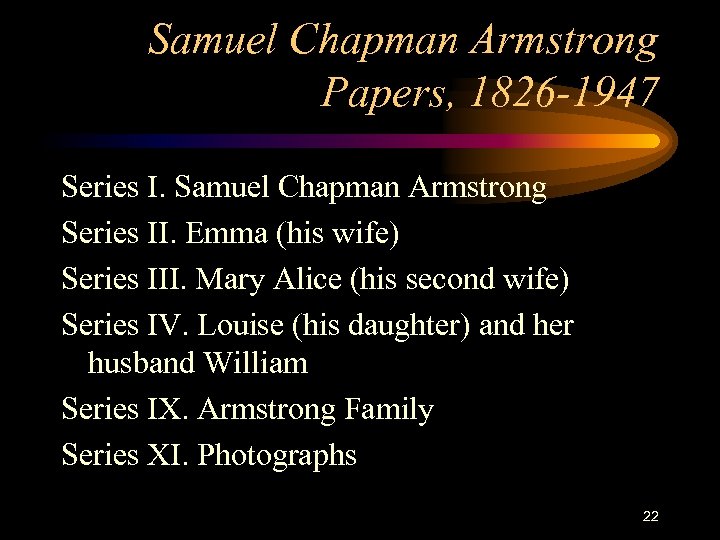
Samuel Chapman Armstrong Papers, 1826 -1947 Series I. Samuel Chapman Armstrong Series II. Emma (his wife) Series III. Mary Alice (his second wife) Series IV. Louise (his daughter) and her husband William Series IX. Armstrong Family Series XI. Photographs 22
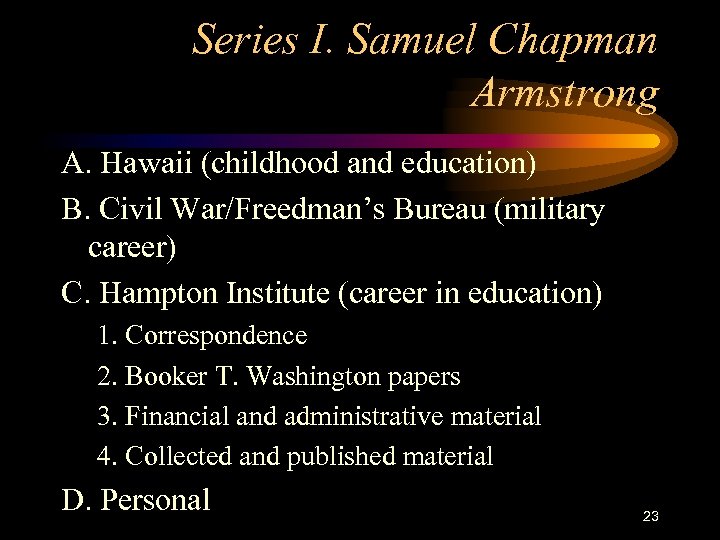
Series I. Samuel Chapman Armstrong A. Hawaii (childhood and education) B. Civil War/Freedman’s Bureau (military career) C. Hampton Institute (career in education) 1. Correspondence 2. Booker T. Washington papers 3. Financial and administrative material 4. Collected and published material D. Personal 23
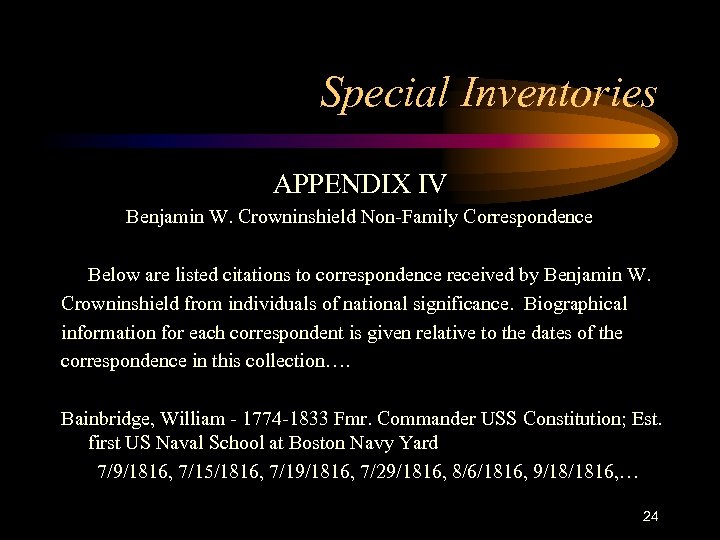
Special Inventories APPENDIX IV Benjamin W. Crowninshield Non-Family Correspondence Below are listed citations to correspondence received by Benjamin W. Crowninshield from individuals of national significance. Biographical information for each correspondent is given relative to the dates of the correspondence in this collection…. Bainbridge, William - 1774 -1833 Fmr. Commander USS Constitution; Est. first US Naval School at Boston Navy Yard 7/9/1816, 7/15/1816, 7/19/1816, 7/29/1816, 8/6/1816, 9/18/1816, … 24
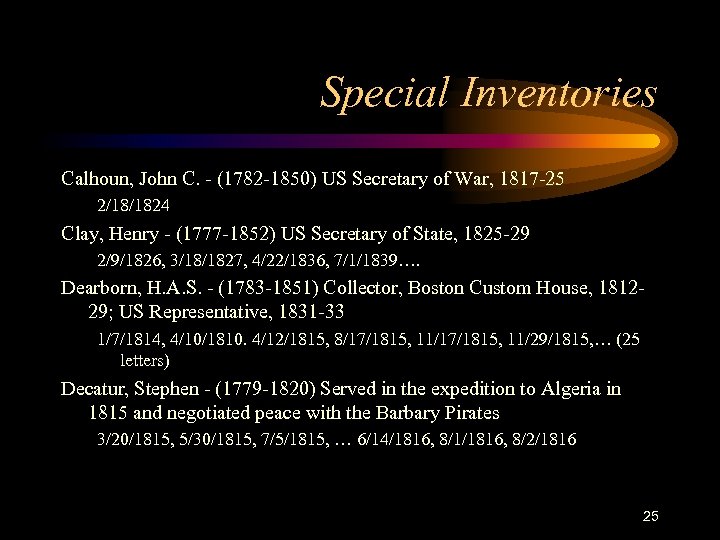
Special Inventories Calhoun, John C. - (1782 -1850) US Secretary of War, 1817 -25 2/18/1824 Clay, Henry - (1777 -1852) US Secretary of State, 1825 -29 2/9/1826, 3/18/1827, 4/22/1836, 7/1/1839…. Dearborn, H. A. S. - (1783 -1851) Collector, Boston Custom House, 181229; US Representative, 1831 -33 1/7/1814, 4/10/1810. 4/12/1815, 8/17/1815, 11/29/1815, … (25 letters) Decatur, Stephen - (1779 -1820) Served in the expedition to Algeria in 1815 and negotiated peace with the Barbary Pirates 3/20/1815, 5/30/1815, 7/5/1815, … 6/14/1816, 8/1/1816, 8/2/1816 25
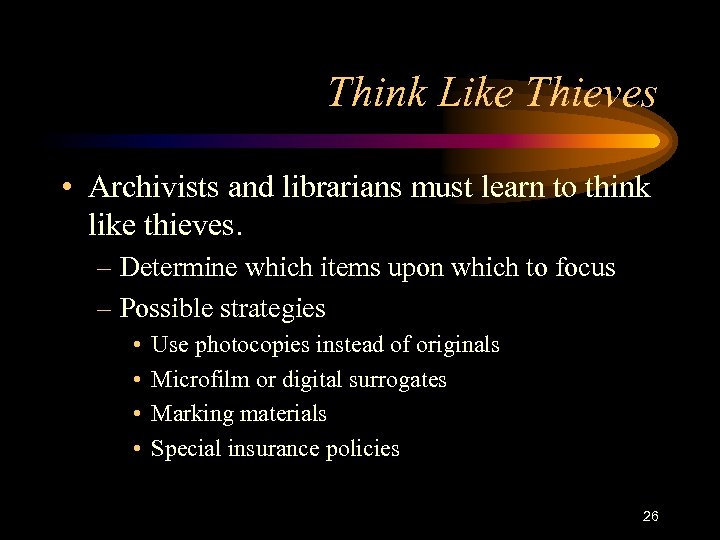
Think Like Thieves • Archivists and librarians must learn to think like thieves. – Determine which items upon which to focus – Possible strategies • • Use photocopies instead of originals Microfilm or digital surrogates Marking materials Special insurance policies 26
Security in the Reading Room • Encompasses sign-in, personal belongings, staff surveillance, environmental controls, water and fire threats, and staff training • Reference Service – Good service leads to more secure library or archives program – Reference interview 27
Security in the Reading Room • Rules and regulations – Contract between researcher and institution! – Develop and improve upon with input from staff – Alert researchers to security concerns of library or archives – Universal components but also are often institution-specific 28
Security in the Reading Room – Permit librarian or archivist to set ground rules for consulting materials – Must be uniformly enforced – Require positive (photo) identification – To be read and signed by researcher – All personal belongings to be stored in locker or secure area – Consult materials ONLY in reading room 29
Security in the Reading Room – All materials handled carefully and left in order found – Note taking in pencil only on blank paper – Information on copyright and publication – Other institution-specific regulations – All photocopying done only at discretion of and by the staff • Staff – Well-trained staff is crucial to security 30
Security in the Reading Room • Reading Room physical arrangement – Chairs should be only on one side of the tables facing the Reference Desk – Reference Desk should provide clear view of all researchers facing the Desk – Provide carts on which materials can be kept instead of on the tables 31
Reading Room & Closed Stacks Environmental Concerns • Temperature: – No higher than 75 o F. and preferably below to 70 o F. (+/- 2 o F. on daily and annual basis) • The lower the better for the collections • Relative humidity (RH): – 30%-55% with minimal fluctuation if possible • In the mid-range is preferable 32
Reading Room & Closed Stacks Light Concerns • Light: – 200 -400 lux (20 -40 foot candles) maximum – 300 -600 lux (30 -60 foot candles) maximum for general/circulating collections • UV Radiation: – (<75 u. W/Lumen and <20 u. W/M 2) 33
Security in Closed Stacks • Greatest threat is from staff or privileged persons – MUST restrict access to materials in stacks • Public access to public areas ONLY – Disgruntled, unreliable, and untrustworthy staff pose a threat to collections (approximately 25% of thefts are inside jobs) 34
Security in Closed Stacks – Pleasant, efficient, vigilant, etc. staff are one of greatest assets for protection of materials • Most repositories have little to fear from staff • Closed stacks often become “open” following a disaster – Use of ID badges, close supervision, and increased security overall is crucial 35
Staff Education • Seriousness of security needs to be understood by all staff – Integral part of everyone’s position description – Implementation is responsibility of ALL staff – Key and access policies must be clear – Many researcher rules also apply to staff – Be aware of possible breaches in security 36
Crisis Management • Disaster response – Staff and patron safety is of primary importance – Implement disaster preparedness plan – Address vulnerability of collections from a security point of view – Use of identification badges, sign-in and signout procedures, supervision of staff and volunteers must be implemented 37
Crisis Management • Suspected theft – Often suspicion comes from an outside source such as a manuscript or rare book dealer who is calling to inquire about a volume or manuscript – Sometimes comes to light because of an altered bibliographic record – Sometimes there is a pattern of systematic loss without explanation 38
Crisis Management – Recovery usually depends on quick action, bolstered by a written security plan, and previous contacts with dealers – Suspicious activities by patron or other staff member • No action to be taken unless activity is actually witnessed by staff person – Internal theft is always a problem and must be thoroughly investigated and documented before any confrontation 39
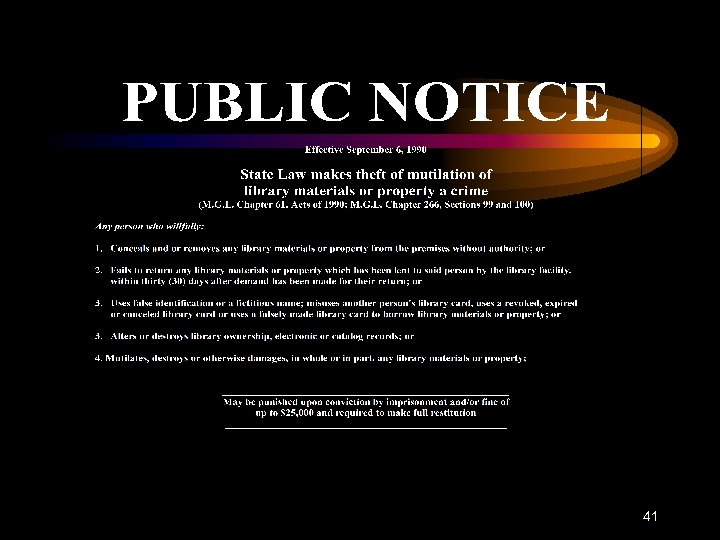
Crisis Management • Insurance policies – Can play a major role in the recovery of stolen materials • Must investigate various types of policies and choose appropriate one • State and federal laws – Be aware of current laws in your state and applicable federal laws before acting • Have a commitment to enforcing the applicable ones 40
41
Security Conclusions • “Special Collections” and archives are special and therefore have “special rules and regulations” • Rules and regulations are there to protect the materials so they can be consulted in the future – Once the materials are gone they may well be gone forever 42
Security Conclusions – Prevent accidental damage – Apply to ALL persons • No one singled out or excused – Contract between researcher and institution • Institution provides for patron’s research needs • Researcher follows rules and regulations – Seriousness of security is crucial to be understood in library or archives 43
Security Conclusions – Implementation is responsibility of ALL staff – Activities aimed at protection of library or archival collections lie at core of any good security system • Few librarians or archivists know the value of their collections/holdings • Security is not just fancy locks, motion detectors, fire alarms, sprinklers, etc. 44
Security Conclusions • Security is a state of mind integral to a librarian’s or an archivist’s modus operandi • Fancy equipment does little if policies, procedures, and activities or librarians and archivists are lax and present a “devil-maycare” attitude • Policies and procedures are at the core of any security program 45
Security Conclusions • Finally, the librarian or archivist must be friendly, cordial, and helpful but also firm and resolute in enforcing security 46
It’s 10 p. m. . Do You Know Where Your Collections Are? Library and Archival Security Gregor Trinkaus-Randall, M. A. L. S. , F. S. A. A. , C. A. Preservation Specialist Massachusetts Board of Library Commissioners (617) 725 -1860 x 236 or (800) 952 -7403 x 236 gregor. trinkaus-randall@state. ma. us www. mass. gov/mblc/costepma
Скачать презентацию 2016 Alumni Webinar Series It s 10 p
7c3241399311b419d43e726228c6a18a.ppt