 Скачать презентацию 2014 Pearson Education Inc LEARNING OBJECTIVES
497ab3260e71238ae2eb262820447754.ppt
- Количество слайдов: 48



© 2014 Pearson Education, Inc.
LEARNING OBJECTIVES After studying this chapter, you should be able to: 7. 1 Explain what derivatives are and distinguish between using them to hedge and using them to speculate. 7. 2 Define forward contracts. 7. 3 Discuss how futures contracts can be used to hedge and to speculate. 7. 4 Distinguish between call options and put options and explain how they are used. 7. 5 Define swaps and explain how they can be used to reduce risk. © 2014 Pearson Education, Inc.
Using Financial Derivatives to Reduce Risk • Warren Buffet, nicknamed the “Oracle of Omaha, ” once remarked that financial derivatives were “financial weapons of mass destruction. ” • Financial derivatives indeed played an important role in the financial crisis of 2007 -2009. • Despite Buffett’s denunciations, derivatives are important for the financial system by providing investors with risk-sharing, liquidity, and information services. © 2014 Pearson Education, Inc.
Key Issue and Question Issue: During the 2007– 2009 financial crisis, some investors, economists, and policymakers argued that financial derivatives had contributed to the severity of the crisis. Question: Are financial derivatives “weapons of financial mass destruction”? © 2014 Pearson Education, Inc. 4 of 50
7. 1 Learning Objective Explain what derivatives are and distinguish between using them to hedge and using them to speculate. © 2014 Pearson Education, Inc. 5 of 50
Derivatives, Hedging, and Speculating A derivative is an asset that derives its economic value from an underlying asset, such as a stock or a bond. • Derivatives can serve as a type of insurance (or hedging) against price changes in underlying assets. Hedge is to take action to reduce risk. • If insurance or hedging is available on an economic activity, more of that activity will occur. • But derivatives can also be used to speculate. To speculate is to place financial bets in an attempt to profit from movements in asset prices. Derivatives, Hedging, and Speculating © 2014 Pearson Education, Inc. 6 of 50
• Speculation and speculators provide two useful functions: 1. When a hedger sells a derivative to a speculator, they transfer risk to the speculator. 2. Speculators provide essential liquidity; otherwise, there would not be a sufficient number of buyers and sellers for the market to operate efficiently. Derivatives, Hedging, and Speculating © 2014 Pearson Education, Inc. 7 of 50
7. 2 Learning Objective Define forward contracts. © 2014 Pearson Education, Inc. 8 of 50
Forward Contracts A forward contract is an agreement to buy or sell an asset at an agreed upon price at a future time. • Forward contracts are instruments in forward transactions – transactions agreed to be in the present by settled in the future. • Forward contracts give firms and investors an opportunity to hedge the risk on transactions that depend on future prices. • Forward contracts generally involve an agreement in the present to exchange a given amount of a commodity (e. g. , oil, gold, or wheat) or a financial asset (e. g. , Treasury bills) at a future date for a set price. Forward Contracts © 2014 Pearson Education, Inc. 9 of 50
• Key features of a forward contract: Spot price is the price at which a commodity or financial asset can be sold at the current date. Settlement date is the date for the delivery of a commodity or financial asset specified in a forward contract. • Forward contracts are specific in terms, so they are: o illiquid o subject to one specific type of default risk—counterparty risk Counterparty risk is the risk that the counterparty (the other side of the transaction) will default. Forward Contracts © 2014 Pearson Education, Inc. 10 of 50
7. 3 Learning Objective Discuss how futures contracts can be used to hedge and to speculate. © 2014 Pearson Education, Inc. 11 of 50
Futures Contracts A futures contract is a standardized contract to buy or sell a specified amount of a commodity or financial asset on a specific future date. • Differences from forward contracts: 1. Futures contracts are traded on exchanges, e. g. , the Chicago Board of Trade (CBOT) and the New York Mercantile Exchange (NYMEX). 2. Futures contracts typically specify a quantity of the underlying asset to be delivered but do not fix the price. 3. The prices of futures contract can change continually as contracts are traded on the exchange (or clearinghouse). Futures Contracts © 2014 Pearson Education, Inc. 12 of 50
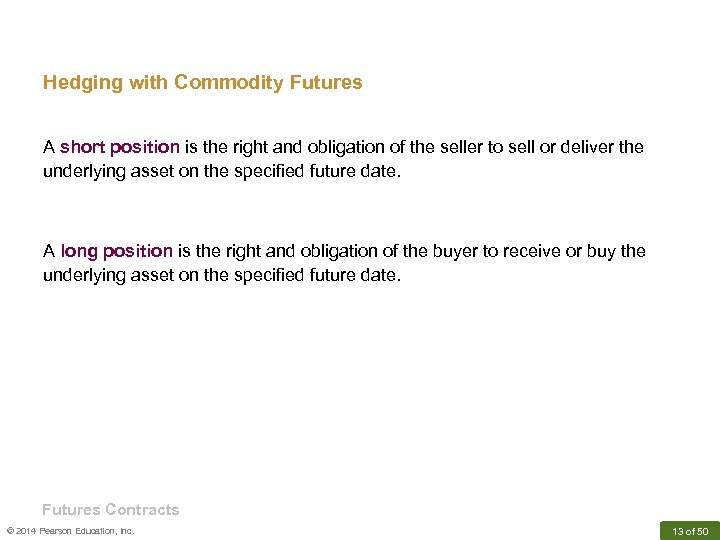
Hedging with Commodity Futures A short position is the right and obligation of the seller to sell or deliver the underlying asset on the specified future date. A long position is the right and obligation of the buyer to receive or buy the underlying asset on the specified future date. Futures Contracts © 2014 Pearson Education, Inc. 13 of 50
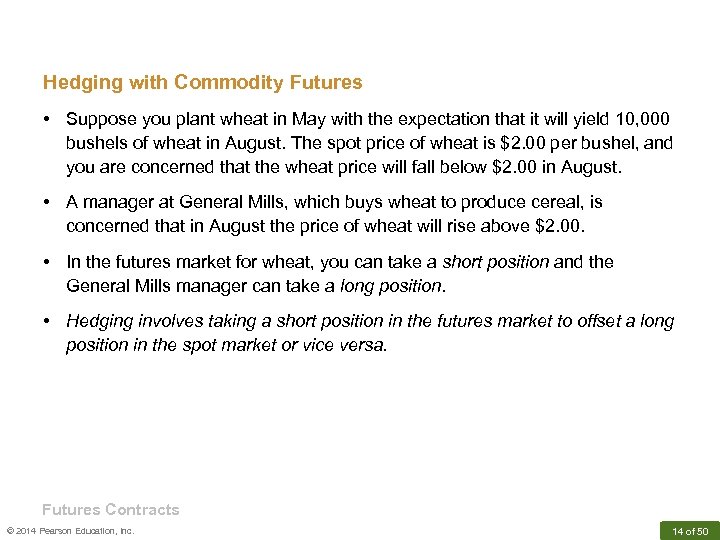
Hedging with Commodity Futures • Suppose you plant wheat in May with the expectation that it will yield 10, 000 bushels of wheat in August. The spot price of wheat is $2. 00 per bushel, and you are concerned that the wheat price will fall below $2. 00 in August. • A manager at General Mills, which buys wheat to produce cereal, is concerned that in August the price of wheat will rise above $2. 00. • In the futures market for wheat, you can take a short position and the General Mills manager can take a long position. • Hedging involves taking a short position in the futures market to offset a long position in the spot market or vice versa. Futures Contracts © 2014 Pearson Education, Inc. 14 of 50
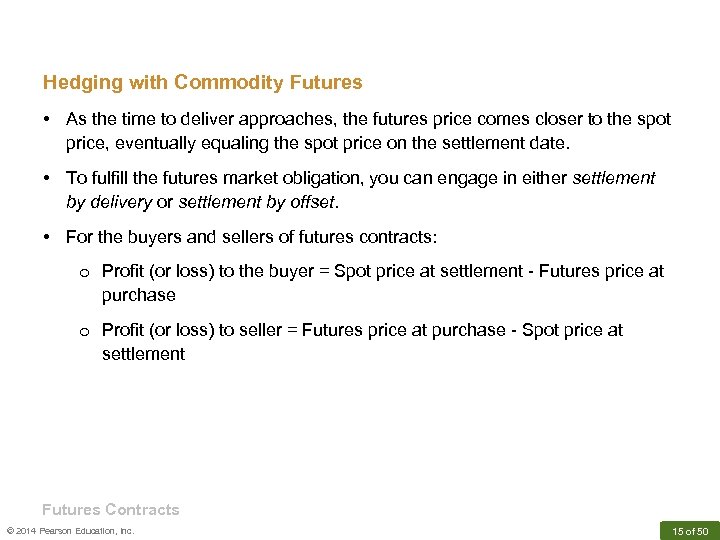
Hedging with Commodity Futures • As the time to deliver approaches, the futures price comes closer to the spot price, eventually equaling the spot price on the settlement date. • To fulfill the futures market obligation, you can engage in either settlement by delivery or settlement by offset. • For the buyers and sellers of futures contracts: o Profit (or loss) to the buyer = Spot price at settlement - Futures price at purchase o Profit (or loss) to seller = Futures price at purchase - Spot price at settlement Futures Contracts © 2014 Pearson Education, Inc. 15 of 50
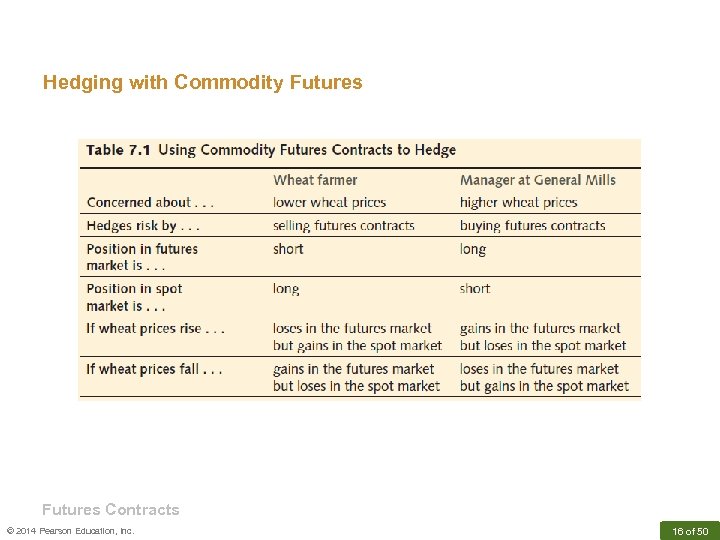
Hedging with Commodity Futures Contracts © 2014 Pearson Education, Inc. 16 of 50
Making the Connection Should Farmers Be Afraid of the Dodd-Frank Act? • During the financial crisis of 2007– 2009, some policymakers and economists argued that the use of derivatives had destabilized the financial system. • The Wall Street Reform and Consumer Protection Act (or Dodd-Frank Act) of 2010 places additional restrictions on trading in derivatives. • Farmers were worried that (1) they might have to post more collateral to trade futures, and (2) small community banks and special agriculture banks might no longer be allowed to offer forward contracts. • In 2012, firms and cooperatives that used derivatives to hedge risk were exempt from regulations. Futures Contracts © 2014 Pearson Education, Inc. 17 of 50
Speculating with Commodity Futures Investors who are not connected with the wheat market can also use wheat futures to speculate on the price of wheat. If you were convinced that the spot price of wheat was going to be lower in August than the current futures price, you could sell wheat futures with the intention of buying them back at the lower price on or before the settlement date. Futures Contracts © 2014 Pearson Education, Inc. 18 of 50
Hedging and Speculating with Financial Futures • Today most futures traded are financial futures: Treasury securities, stock indexes, and currencies. • An investor who believes that she has superior insight into future interest rates can use the futures market to speculate. • If you wish to speculate that future interest rates will be lower (or higher) than expected, you could buy (or sell) Treasury futures contracts. Futures Contracts © 2014 Pearson Education, Inc. 19 of 50
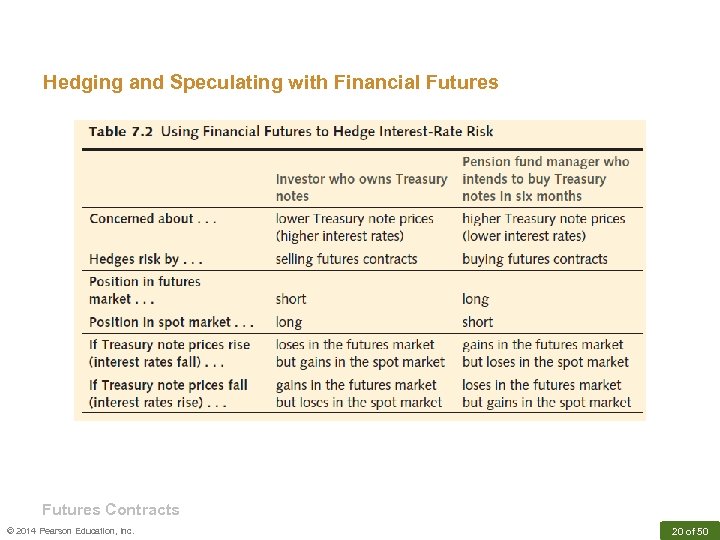
Hedging and Speculating with Financial Futures Contracts © 2014 Pearson Education, Inc. 20 of 50
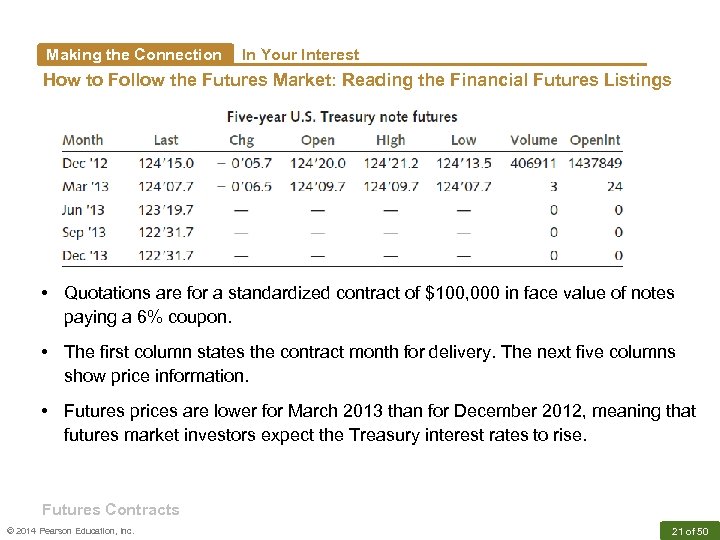
Making the Connection In Your Interest How to Follow the Futures Market: Reading the Financial Futures Listings • Quotations are for a standardized contract of $100, 000 in face value of notes paying a 6% coupon. • The first column states the contract month for delivery. The next five columns show price information. • Futures prices are lower for March 2013 than for December 2012, meaning that futures market investors expect the Treasury interest rates to rise. Futures Contracts © 2014 Pearson Education, Inc. 21 of 50
Solved Problem 7. 3 In Your Interest How Can You Hedge an Investment in Treasury Notes When Interest Rates Are Low? After the financial crisis of 2007– 2009, interest rates fell to very low levels. In 2012, many investors still bought bonds despite their low yields and a Wall Street Journal article’s warning about a “nasty bear market in bonds. ” a. What does a bear market in bonds mean? b. What might cause a bear market in bonds? b. How might it be possible to hedge the risk of investing in bonds? Futures Contracts © 2014 Pearson Education, Inc. 22 of 50
Solved Problem 7. 3 In Your Interest How Can You Hedge an Investment in Treasury Notes When Interest Rates Are Low? Solving the Problem Step 1 Review the chapter material. Step 2 Answer part (a) by explaining what a bear market in bonds would be. A bear market refers to a price decline of at least 20%. Step 3 Answer part (b) by explaining what might cause a bear market in bonds. A bear market in bonds could result from investors expecting a higher future inflation rate, which will result in higher nominal interest rates (Fisher effect) and lower bond prices. Step 4 Answer part (c) by explaining how you can hedge the risk of investing in bonds. Investors who own bonds are long in the spot market for bonds, so the appropriate hedge calls for them to go short in the futures market by selling futures contracts. Futures Contracts © 2014 Pearson Education, Inc. 23 of 50
Trading in the Futures Market Margin requirement is the minimum deposit that an exchange requires from the buyer or seller of a financial asset. • Example: Futures contracts for U. S. Treasury notes are standardized at a face value of $100, 000 of notes. The CBOT requires that buyers and sellers deposit a minimum of $1, 100 for each contract into a margin account. Marking to market is a daily settlement in which the exchange transfers funds from a buyer’s account to a seller’s account or vice versa, depending on changes in the price of the contract. Futures Contracts © 2014 Pearson Education, Inc. 24 of 50
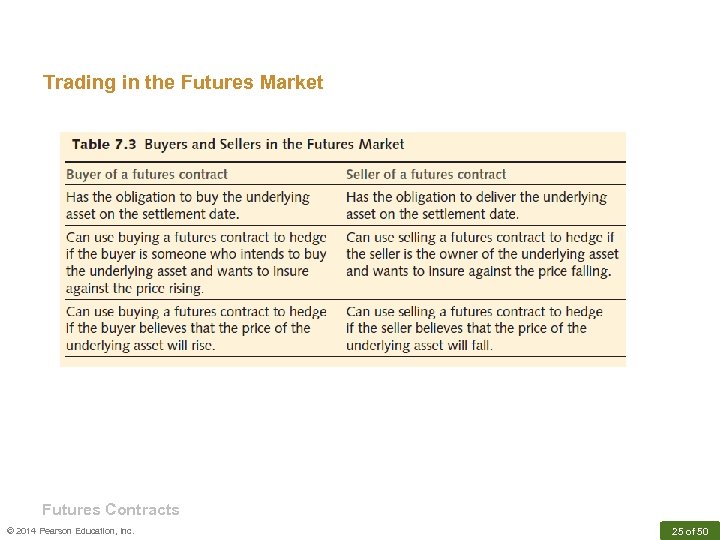
Trading in the Futures Market Futures Contracts © 2014 Pearson Education, Inc. 25 of 50
7. 4 Learning Objective Distinguish between call options and put options and explain how they are used. © 2014 Pearson Education, Inc. 26 of 50
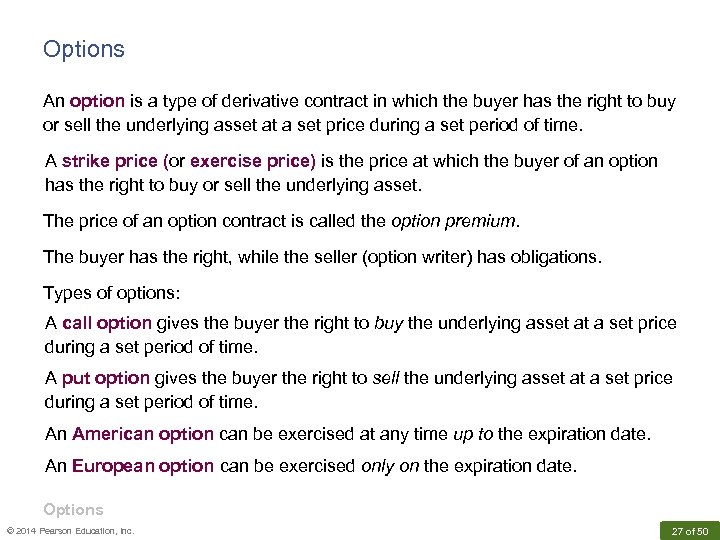
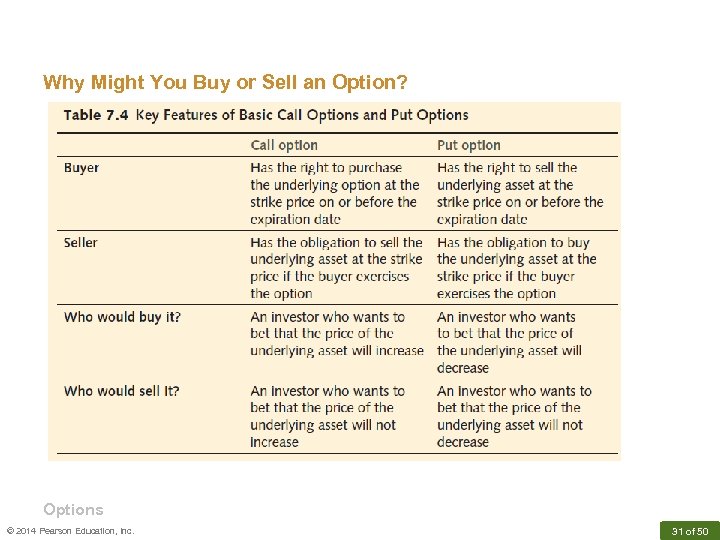
Options An option is a type of derivative contract in which the buyer has the right to buy or sell the underlying asset at a set price during a set period of time. A strike price (or exercise price) is the price at which the buyer of an option has the right to buy or sell the underlying asset. The price of an option contract is called the option premium. The buyer has the right, while the seller (option writer) has obligations. Types of options: A call option gives the buyer the right to buy the underlying asset at a set price during a set period of time. A put option gives the buyer the right to sell the underlying asset at a set price during a set period of time. An American option can be exercised at any time up to the expiration date. An European option can be exercised only on the expiration date. Options © 2014 Pearson Education, Inc. 27 of 50
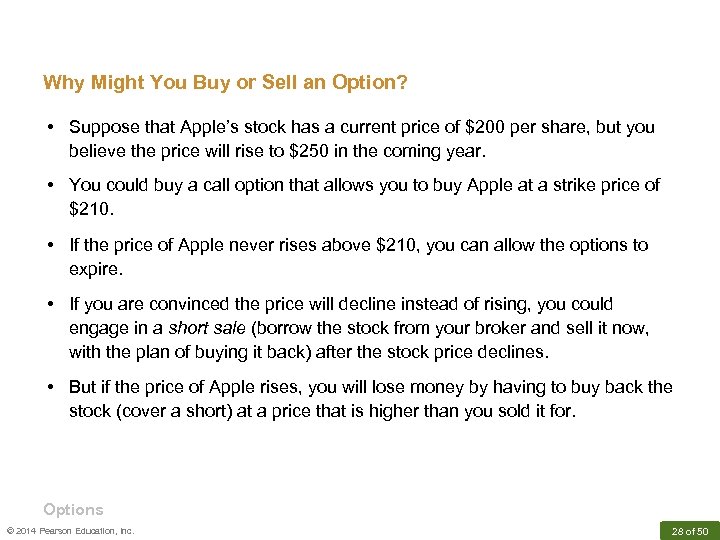
Why Might You Buy or Sell an Option? • Suppose that Apple’s stock has a current price of $200 per share, but you believe the price will rise to $250 in the coming year. • You could buy a call option that allows you to buy Apple at a strike price of $210. • If the price of Apple never rises above $210, you can allow the options to expire. • If you are convinced the price will decline instead of rising, you could engage in a short sale (borrow the stock from your broker and sell it now, with the plan of buying it back) after the stock price declines. • But if the price of Apple rises, you will lose money by having to buy back the stock (cover a short) at a price that is higher than you sold it for. Options © 2014 Pearson Education, Inc. 28 of 50
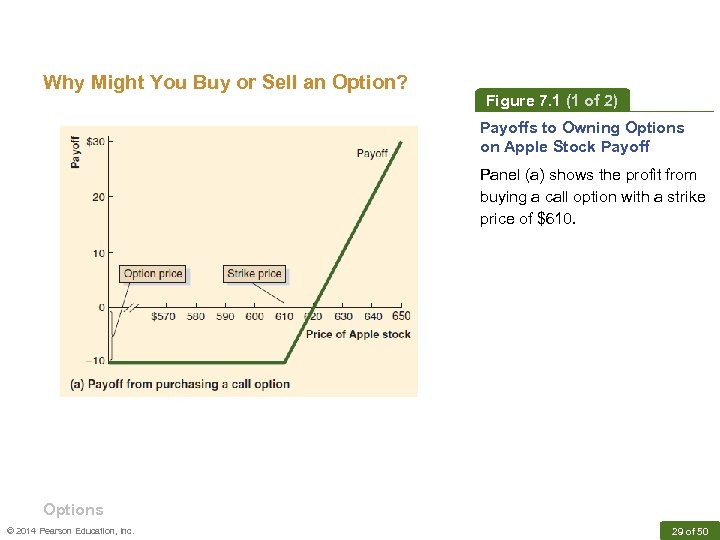
Why Might You Buy or Sell an Option? Figure 7. 1 (1 of 2) Payoffs to Owning Options on Apple Stock Payoff Panel (a) shows the profit from buying a call option with a strike price of $610. Options © 2014 Pearson Education, Inc. 29 of 50
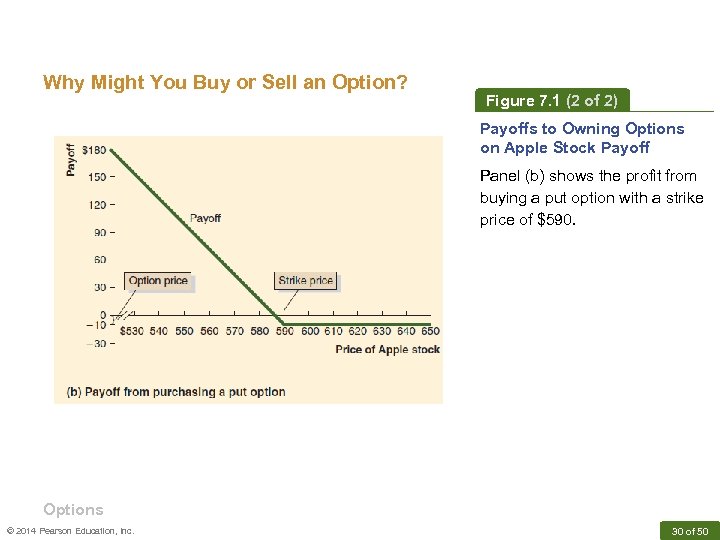
Why Might You Buy or Sell an Option? Figure 7. 1 (2 of 2) Payoffs to Owning Options on Apple Stock Payoff Panel (b) shows the profit from buying a put option with a strike price of $590. Options © 2014 Pearson Education, Inc. 30 of 50
Why Might You Buy or Sell an Option? Options © 2014 Pearson Education, Inc. 31 of 50
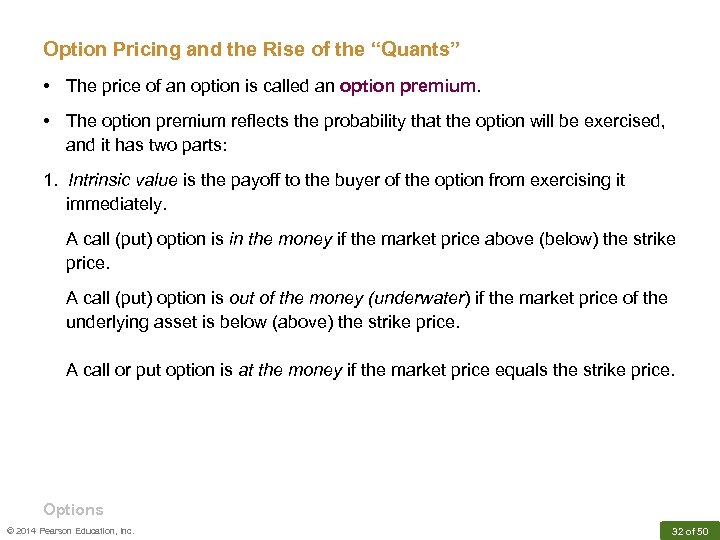
Option Pricing and the Rise of the “Quants” • The price of an option is called an option premium. • The option premium reflects the probability that the option will be exercised, and it has two parts: 1. Intrinsic value is the payoff to the buyer of the option from exercising it immediately. A call (put) option is in the money if the market price above (below) the strike price. A call (put) option is out of the money (underwater) if the market price of the underlying asset is below (above) the strike price. A call or put option is at the money if the market price equals the strike price. Options © 2014 Pearson Education, Inc. 32 of 50
Option Pricing and the Rise of the “Quants” 2. An option premium has a time value, which is determined by the option’s expiration date and the stock price’s volatility: • The further away in time an option’s expiration date, the larger the option premium. • The greater the volatility in the price of the underlying asset, the larger the option premium. • The Black-Scholes formula provides a tool for optimal pricing of options and led to an explosive growth in options trading. • People who evaluate and price new securities are known in Wall Street as “rocket scientists” or “quants. ” Options © 2014 Pearson Education, Inc. 33 of 50
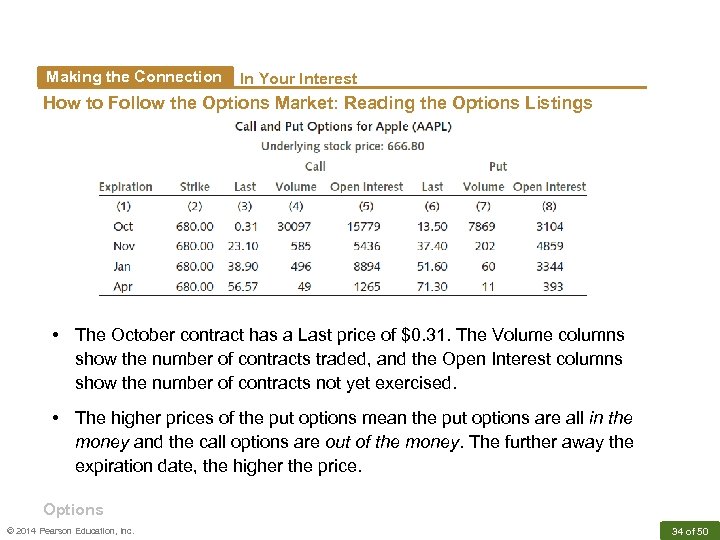
Making the Connection In Your Interest How to Follow the Options Market: Reading the Options Listings • The October contract has a Last price of $0. 31. The Volume columns show the number of contracts traded, and the Open Interest columns show the number of contracts not yet exercised. • The higher prices of the put options mean the put options are all in the money and the call options are out of the money. The further away the expiration date, the higher the price. Options © 2014 Pearson Education, Inc. 34 of 50
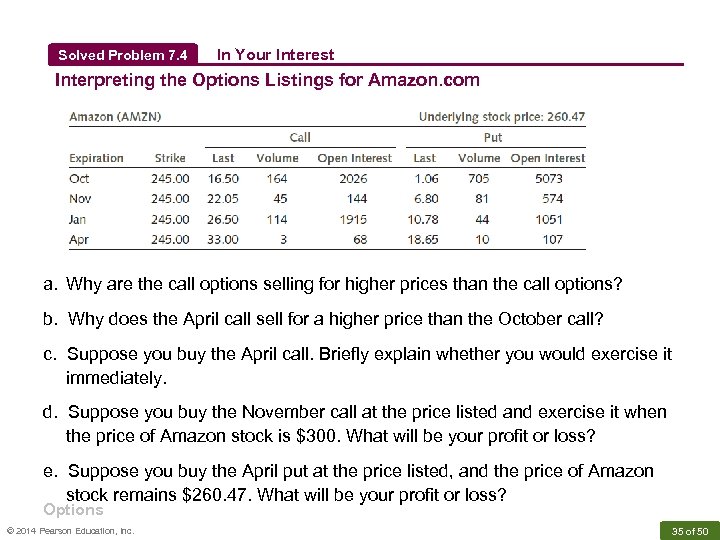
Solved Problem 7. 4 In Your Interest Interpreting the Options Listings for Amazon. com a. Why are the call options selling for higher prices than the call options? b. Why does the April call sell for a higher price than the October call? c. Suppose you buy the April call. Briefly explain whether you would exercise it immediately. d. Suppose you buy the November call at the price listed and exercise it when the price of Amazon stock is $300. What will be your profit or loss? e. Suppose you buy the April put at the price listed, and the price of Amazon stock remains $260. 47. What will be your profit or loss? Options © 2014 Pearson Education, Inc. 35 of 50
Solved Problem 7. 4 In Your Interest Solving the Problem Step 1 Review the chapter material. Step 2 Answer part (a) by explaining why the call options are selling for higher prices than the put options. The strike price of $245. 00 is less than the stock price of $260. 47. So, the call options are all in the money and the puts are all out of the money. Step 3 Answer part (b) by explaining why the April call sells for a higher price than the October call. The price of an option represents the option’s intrinsic value plus its time value. The further away the expiration date, the greater the chance that the intrinsic value of the option will increase, and the higher the price of the option. Options © 2014 Pearson Education, Inc. 36 of 50
Solved Problem 7. 4 In Your Interest Solving the Problem (continued) Step 4 Answer part (c) by explaining whether you would exercise the April call immediately. The price of the call is $33. 00, so you would not buy the call to exercise it immediately. You would buy the call only if you expect that the stock price would fall before the expiration date so that the intrinsic value of the call would be greater than $33. 30. Step 5 Answer part (d) by calculating your profit or loss from buying the November call and exercising it when the price of Amazon stock is $300. If you exercise the November call with a strike price of $245. 00 and a stock price at $300, you will earn $55 minus the option price of $22. 05, so the profit per share is $32. 95. Step 6 Answer part (e) by calculating your profit or loss from buying the April put if the price of Amazon remains at $260. 47. If the price of Amazon remains at $260. 47, the April put will remain out of money, so you make a loss equal to the option’s price of $18. 65 per share. Options © 2014 Pearson Education, Inc. 37 of 50
Using Options to Manage Risk • Firms, banks, and individual investors can use options and futures to hedge the risk from fluctuations in financial asset prices. • Options are more expensive than futures but have the advantage that the maximum loss an options buyer will incur is the option premium. • Many hedgers buy options, not on the underlying asset, but on a futures contract derived from that asset. Options © 2014 Pearson Education, Inc. 38 of 50
Making the Connection In Your Interest How Much Volatility Should You Expect in the Stock Market? • One measure of stock price volatility that investors expect is through the use of prices of options. • The Chicago Board Options Exchange (CBOE) constructed the Market Volatility Index (VIX) using the prices of put and call options on the S&P 500 index. • When investors expect volatility in stock prices to increase, they increase their demand for options, thus driving up their prices and VIX. • During the financial crisis of 2007 -2009, VIX reached record levels following the collapse of Lehman Brothers investment bank. • An investor who wanted to hedge against an increase in volatility in the market would buy VIX futures. A speculator who wanted to bet on a decrease in market volatility would sell VIX futures. Options © 2014 Pearson Education, Inc. 39 of 50
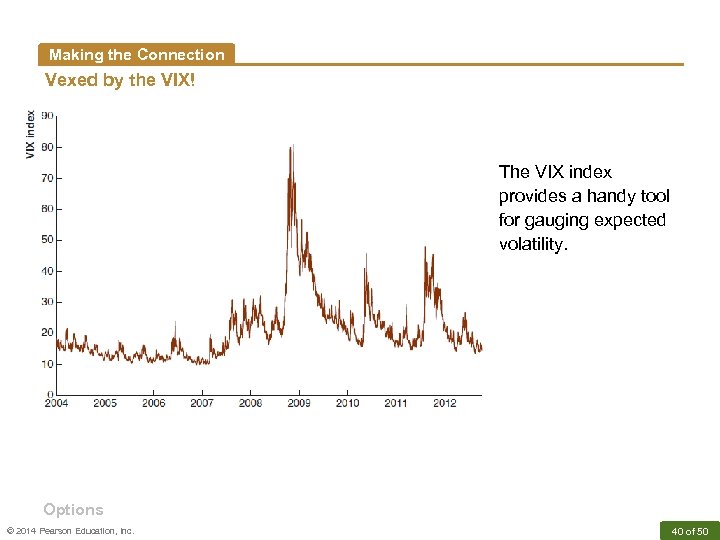
Making the Connection Vexed by the VIX! The VIX index provides a handy tool for gauging expected volatility. Options © 2014 Pearson Education, Inc. 40 of 50
7. 5 Learning Objective Define swaps and explain how they can be used to reduce risk. © 2014 Pearson Education, Inc. 41 of 50
Swaps A swap is an agreement between two or more counterparties to exchange sets of cash flows over some future period. Unlike futures and options, the terms of swaps are flexible. Interest-Rate Swaps Interest-rate swaps are contracts under which counterparties agree to swap interest payments over a specified period on a fixed dollar amount (notional principal). • The interest rate is often based on LIBOR (London Interbank Offered Rate). • Why participate in interest-rate swaps? One motivation is transferring interest-rate risk to parties that are more willing to bear it. Swaps © 2014 Pearson Education, Inc. 42 of 50
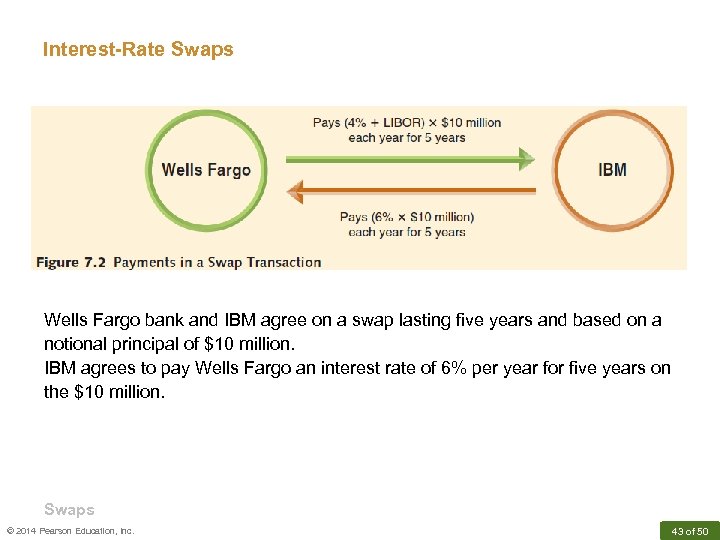
Interest-Rate Swaps Wells Fargo bank and IBM agree on a swap lasting five years and based on a notional principal of $10 million. IBM agrees to pay Wells Fargo an interest rate of 6% per year for five years on the $10 million. Swaps © 2014 Pearson Education, Inc. 43 of 50
Currency Swaps and Credit Swaps A currency swap is a contract in which counterparties agree to exchange principal amounts denominated in different currencies. • A basic currency swap has 3 steps: 1. The two parties exchange the principal amount in the two currencies. 2. The parties exchange periodic interest payments over the life of the agreement. 3. The parties exchange the principal amount again at the conclusion of the swap. • Why participate in currency swaps? Firms may have a comparative advantage in borrowing in their domestic currency. With a swap, both parties may be able to borrow cheaply. Swaps © 2014 Pearson Education, Inc. 44 of 50
Currency Swaps and Credit Swaps A credit swap is a contract in which interest-rate payments are exchanged, with the intention of reducing default risk. • Example: If two banks have difficulty diversifying their portfolios, they can reduce their risk by swapping payment streams on some of their loans. Swaps © 2014 Pearson Education, Inc. 45 of 50
Credit Default Swaps A credit default swap is a derivative that requires the seller to make payments to the buyer if the price of the underlying security declines in value; like an insurance. • During the financial crisis of 2007– 2009, they were most widely used along with mortgage-backed securities and collateralized debt obligations (CDOs). • The issuer of a credit default swap on a mortgage-backed security receives payments from the buyer in exchange for promising to make payments to the buyer if the security goes into default. • The heavy losses that American International Group (AIG) and other firms and investors suffered on credit default swaps deepened the financial crisis and led more regulations. Swaps © 2014 Pearson Education, Inc. 46 of 50
Making the Connection Are Derivatives “Financial Weapons of Mass Destruction”? • Warren Buffett identified three problems with derivatives particularly not traded on exchanges: 1. Derivatives are thinly traded, and dealers use prices predicted by models that may be inaccurate. 2. Many derivatives are not regulated and firms may not set aside sufficient reserves to offset potential losses. 3. Because derivatives are not traded in exchanges, they involve substantial counterparty risk. Swaps © 2014 Pearson Education, Inc. 47 of 50
Answering the Key Question At the beginning of this chapter, we asked the question: “Are financial derivatives ‘weapons of financial mass destruction’? ” Futures and exchange-traded options play an important role in the financial system and provide the important service of risk sharing. Warren Buffett has argued that some derivatives contributed to the financial crisis. While not all derivatives are “weapons of financial mass destruction, ” there are new regulations to ensure that derivatives do not destabilize the financial system. © 2014 Pearson Education, Inc. 48 of 50
Скачать презентацию 2014 Pearson Education Inc LEARNING OBJECTIVES
497ab3260e71238ae2eb262820447754.ppt