Скачать презентацию 2012 SQA Central Training New Centers Venue
caf363e756053d95c587077fd356df0d.ppt
- Количество слайдов: 105
 2012 SQA Central Training (New Centers) Venue – BISU, Beijing 9, Sept 2012 9. 00 am– 5: 00 pm Mary Gao
 Introduction and Welcome Please switch off mobile phones
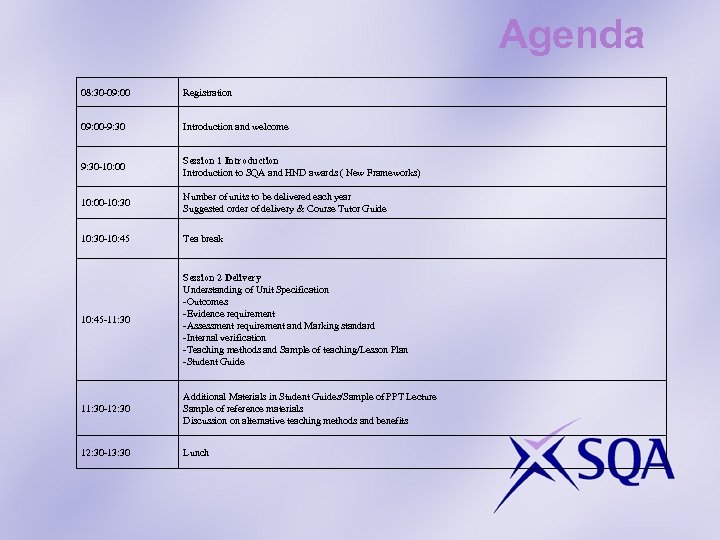 Agenda 08: 30 -09: 00 Registration 09: 00 -9: 30 Introduction and welcome 9: 30 -10: 00 Session 1 Introduction to SQA and HND awards ( New Frameworks) 10: 00 -10: 30 Number of units to be delivered each year Suggested order of delivery & Course Tutor Guide 10: 30 -10: 45 Tea break 10: 45 -11: 30 Session 2 Delivery Understanding of Unit Specification -Outcomes -Evidence requirement -Assessment requirement and Marking standard -Internal verification -Teaching methods and Sample of teaching/Lesson Plan -Student Guide 11: 30 -12: 30 Additional Materials in Student Guides/Sample of PPT Lecture Sample of reference materials Discussion on alternative teaching methods and benefits 12: 30 -13: 30 Lunch
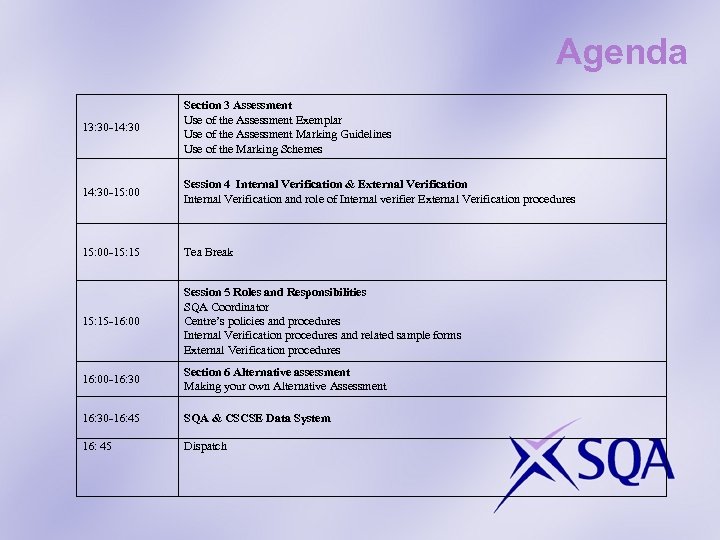 Agenda 13: 30 -14: 30 Section 3 Assessment Use of the Assessment Exemplar Use of the Assessment Marking Guidelines Use of the Marking Schemes 14: 30 -15: 00 Session 4 Internal Verification & External Verification Internal Verification and role of Internal verifier External Verification procedures 15: 00 -15: 15 Tea Break 15: 15 -16: 00 Session 5 Roles and Responsibilities SQA Coordinator Centre’s policies and procedures Internal Verification procedures and related sample forms External Verification procedures 16: 00 -16: 30 Section 6 Alternative assessment Making your own Alternative Assessment 16: 30 -16: 45 SQA & CSCSE Data System 16: 45 Dispatch
 About the Scottish Qualifications Authority (SQA) w SQA is an executive non-departmental public body (NDPB) sponsored by the Scottish Executive Education Department. It is the national body in Scotland responsible for the development, accreditation, assessment and certification of qualifications other than degrees w The overall aim of the SQA is to manage the qualifications system below degree level to allow students to fulfill their potential to participate in the economy, society and communities of Scotland w There approximately 650 staff located at our Glasgow and Edinburgh sites w There approximately 1, 750 centers approved to offer our range of qualifications.
 SQA’s Main Function SQA's functions are to: w devise, develop and validate qualifications, and keep them under review w accredit qualifications w approve education and training establishments as being suitable for entering people for these qualifications w arrange for, assist in, and carry out, the assessment of people taking SQA qualifications w quality assure education and training establishments which offer SQA qualifications w issue certificates to candidates.
 Session 1 Introduction to HND Group Awards
 HND China Group Awards - HND Business with Marketing HND Business with Accounting HND Business with HR HND Business with IT HND Financial Services HND Administration and Information Technology HND Global Trade and Business HND Supply Chain Management HND Computing: Software Development/Technical Support/Networking & Internet Tech HND Hospitality Management HND Travel and Tourism
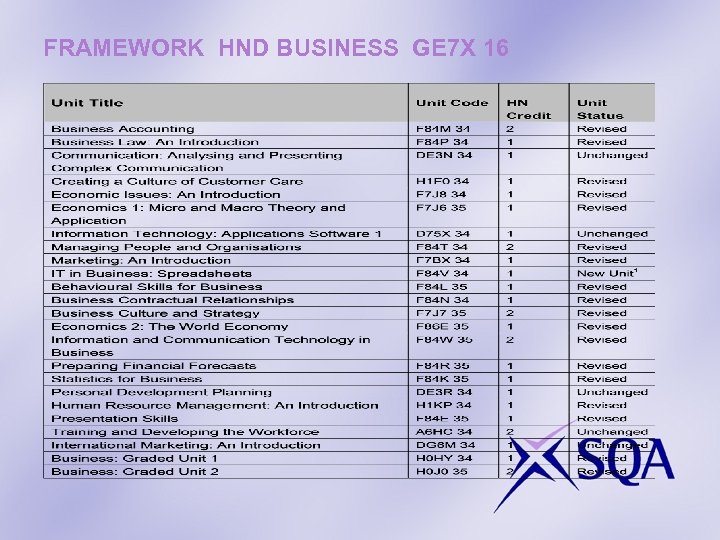 FRAMEWORK HND BUSINESS GE 7 X 16
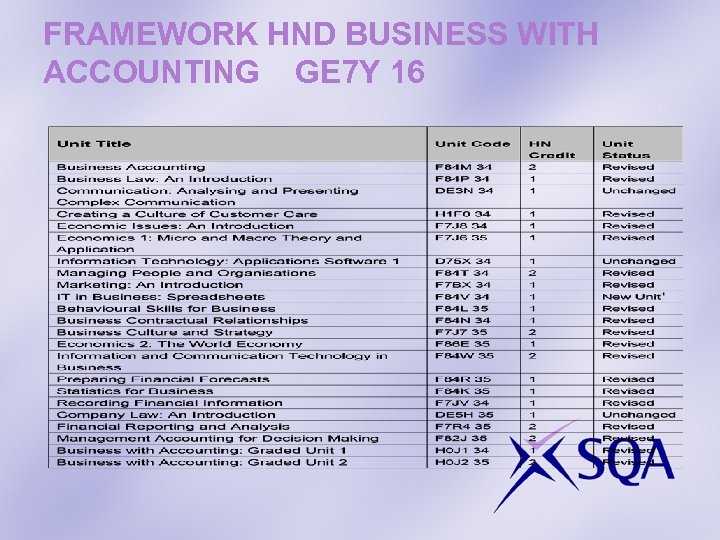 FRAMEWORK HND BUSINESS WITH ACCOUNTING GE 7 Y 16
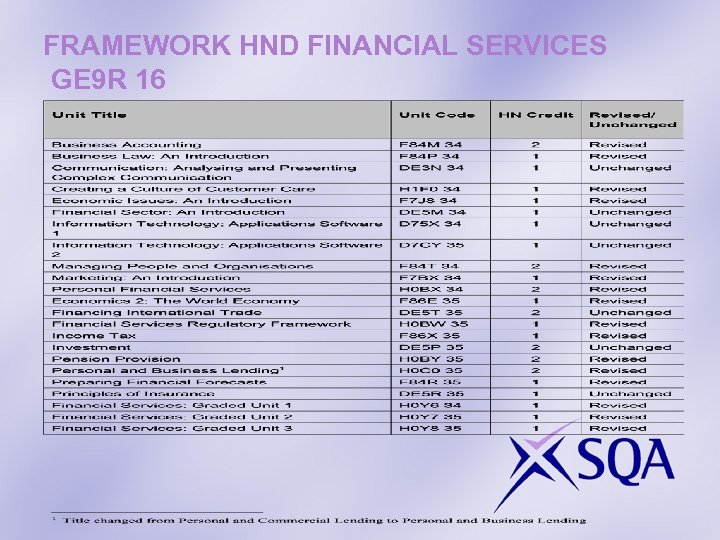 FRAMEWORK HND FINANCIAL SERVICES GE 9 R 16
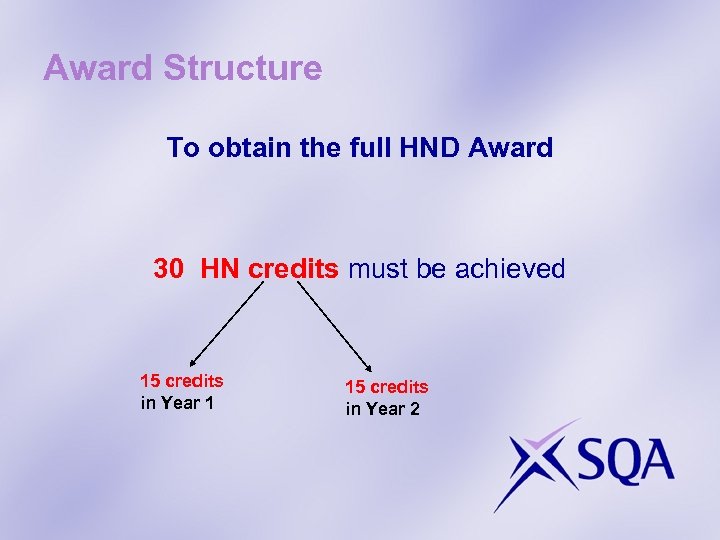 Award Structure To obtain the full HND Award 30 HN credits must be achieved 15 credits in Year 1 15 credits in Year 2
 Teaching order/Schedule of the Units w Not mandatory w Based on your own center’s availability w But need to follow suggested order w Teaching order of units should be agreed internally
 Resources Provided by SQA China website www. cn. sqa. org. uk ü ü Framework-list of unit Suggested order of delivery Course Tutor Guide Unit Specification ( details exactly what to deliver and assess) ü Assessment Exemplar ( sample of typical assessment for each outcome unit) ü Learning Guide (contains same teaching materials)
 HND Tutor Guide Business
 Session 2 Delivery
 w Understanding of Unit Specification w Assessment Guideline (what should assess and what should not) w Marking Guideline w Interpreting US & Apply in your delivery
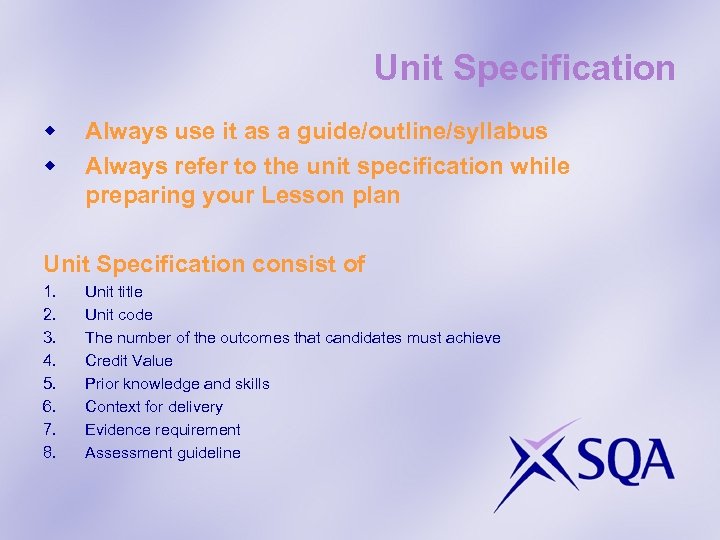 Unit Specification w w Always use it as a guide/outline/syllabus Always refer to the unit specification while preparing your Lesson plan Unit Specification consist of 1. 2. 3. 4. 5. 6. 7. 8. Unit title Unit code The number of the outcomes that candidates must achieve Credit Value Prior knowledge and skills Context for delivery Evidence requirement Assessment guideline
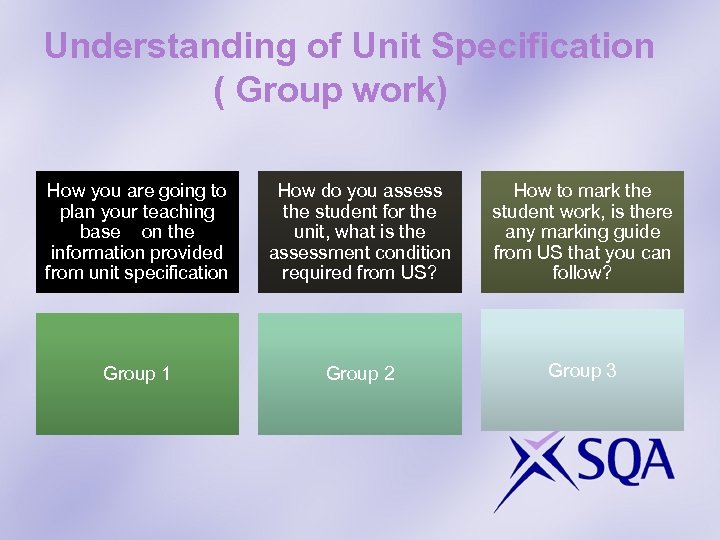 Understanding of Unit Specification ( Group work) How you are going to plan your teaching base on the information provided from unit specification How do you assess the student for the unit, what is the assessment condition required from US? How to mark the student work, is there any marking guide from US that you can follow? Group 1 Group 2 Group 3
 Unit Specification w Sample Unit Specification ( paper copy provided) F 7 J 8 34 Economic Issues: An Introduction ( Group 1)
 Unit Specification F 84 T 34 Managing People and Organizations ( Group 2)
 Unit Specification F 84 M 34 Business Accounting ( Group 3)
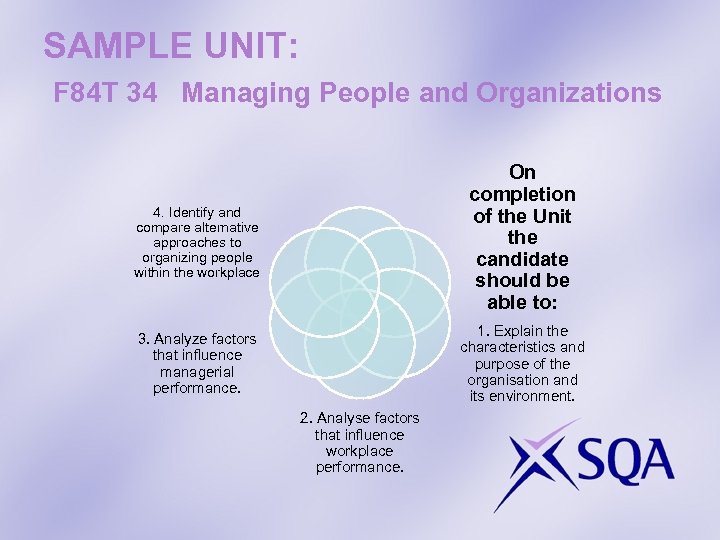 SAMPLE UNIT: F 84 T 34 Managing People and Organizations 4. Identify and compare alternative approaches to organizing people within the workplace On completion of the Unit the candidate should be able to: 3. Analyze factors that influence managerial performance. 1. Explain the characteristics and purpose of the organisation and its environment. 2. Analyse factors that influence workplace performance.
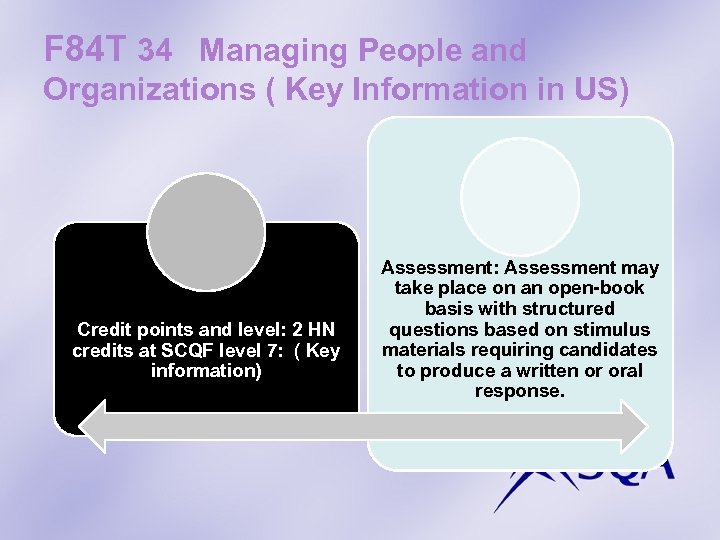 F 84 T 34 Managing People and Organizations ( Key Information in US) Credit points and level: 2 HN credits at SCQF level 7: ( Key information) Assessment: Assessment may take place on an open-book basis with structured questions based on stimulus materials requiring candidates to produce a written or oral response.
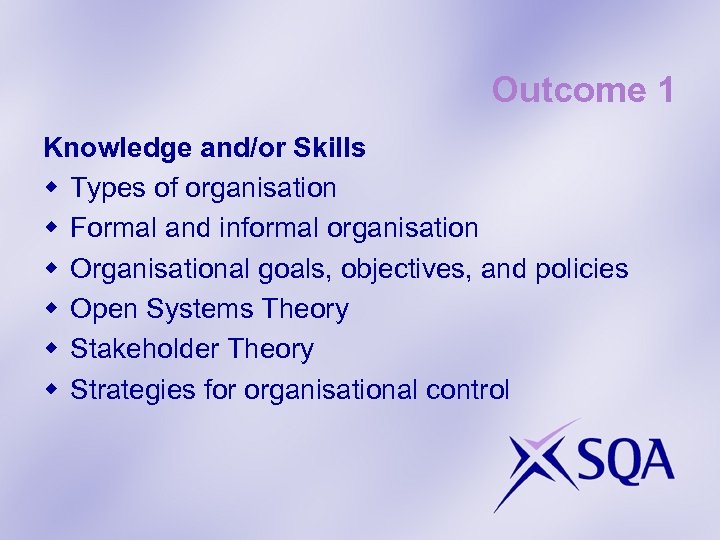 Outcome 1 Knowledge and/or Skills w Types of organisation w Formal and informal organisation w Organisational goals, objectives, and policies w Open Systems Theory w Stakeholder Theory w Strategies for organisational control
 Outcome 1 Evidence Requirements w Candidates will need to provide evidence to demonstrate their Knowledge and/or Skills by showing that they can: w correctly identify the main differences between the formal organisation and informal organisation w clearly illustrate the relationship between organisational goals, objectives, and policy and justify their contribution to the effective management of a given organisation w explain the nature of Open Systems Theory and apply it to a given organisation w outline the different stakeholders of an organisation and explain the influence and interest of each stakeholder in a given organisation w propose a strategy of control in a given organisation
 F 84 T 34 Managing People and Organizations ( Key Information in US) w Assessment Guidelines It is possible that either of two different forms of assessment could be used to generate the necessary evidence. The first method of assessment could be an openbook response covering Outcomes 1 to 4. It could be based on a case study of a real or fictitious organisation which, for Outcome 4, would require a solution to a structural problem of a work/organisation. Candidates will be required to examine the given problem and prepare and present their solutions to the problem. If desired this could be presented in a way which would give candidates an opportunity to provide content which may provide opportunity for integration with Communication: Analysing and Presenting Complex Information (DE 3 N 34). While it is recommended that some form of case study stimuli be used for assessment purposes, candidates who have current or past work experience may be able to base their response upon an organisation in which they have or do work. A single case study based upon a real or fictitious organisation can be used for the assessment of all four Outcomes or for any combination of Outcomes.
 F 84 T 34 Managing People and Organizations ( Continue) w A second possible option for assessment would be to use separate case studies for each Outcome. If this is the case studies are likely to be shorter. Candidates who have access to a suitable organisation could complete Outcome 4 with reference to that organisation. w It is unlikely that candidates will be assessed via a single submission. Individual Outcomes and/or logical groupings of Outcomes (for example Outcomes 1 and 4 or Outcomes 2 and 3) will most likely provide candidates with the best opportunities to satisfy the Evidence Requirements of the Unit. Where centres wish, opportunities exist to use more than one instrument of assessment. For example, in addition to the use of structured questions for an Outcome(s), some form of group assessment could be used for Outcome 2.

 Using Learning Guides w This is teaching and learning outline provided by SQA w It contains introduction to the SQA and units, some learning material listed for this unit, suggested learning plan, additional reading material, solution to the self-assessment questions and activities w The student guide should only be regarded as a guide. It is not a textbook. It is individual tutor’s responsibility to provide supplementary learning material to contextualize this providing local examples to assist candidates’ learning w Learning guides should be used by both teachers and students
 Additional Reference materials( to be identified by staff) w w w E-books Websites Textbooks from bookstore Newspaper or magazine SQA China website ( where you could find more relevant learning and teaching materials )
 The reference material provided for Unit of Marketing: An Introduction Textbook w Marketing Management, Millennium Edition/Philip Kotler w Principles of Marketing/Philip Kotler & Gary Armstrong w Marketing: An Introduction/SQA student guide w E-book: The Principle of the Marketing/by phillip Kotler Website: w http: //www. advancewebdesign. com/clients/case. asp w http: //www. thetimes 100. co. uk/index. php w http: //www. smeal. psu. edu/isbm/links. html w http: //www. startups. co. uk/d. Gbgha. Zz. GDy 1 emi. Fopsb. html w http: //primevisibility. com/marketing-case-studies. html w http: //www. mapmechanics. com/gcsalesmktingcasestudies. htm w http: //marketing. otago. ac. nz/Marketing/study/100 level. html
 Teaching Plan/Lesson Plan Factors to be considered when preparing your lesson plan w w w w Objectives Learners Needs Time Content Assessment/Assignment Teaching Methods Resources Reassessment NB: Assessment must not be left to the end of each semester
 Teaching and Learning Plan: w w w Outlines a whole unit Topics to be covered in each session shows where assessments fit in Always prepare in advance Course Leader should keep the copy This is one of the teaching evidence requested on external moderation
 Lesson Plans w Objectives w Give details of – Enabling objectives – Methods of delivery ( including Activities) – Resources required – Timing of Assessment and Reassessment
 Learning Objectives w Student centred rather than teaching centred w State what the learner will know or be able to do as a result of the lesson w Can assess learner to determine if the objectives have been achieved ( formative assessment first)
 Learning Styles Question: Why is it that two people can attend the same lecture or course or training session - one will say ‘that was really good, I’ve learned a lot today’ whilst the other one will say ‘ that was not very good, I didn’t learn anything today’. Answer: Their learning styles are likely to be different - what part they were asked to play in that learning experience will influence their learning that day.
 Knowing and understanding that our own learning style and the learning style of our students is having an impact on their learning gives us challenges for our delivery of that learning.
 Group Activity In groups, discuss the Lesson plan you could write for a given unit in class: You have 20 minutes to complete this activity
 w Questions?
 Afternoon Sections
 w Section 3 Assessment w Session 4 Internal Verification & External Verification w Session 5 Roles and Responsibilities( of SQA Coordinator, IV and EV) w Section 6 Alternative assessment w SQA & CSCSE Data System
 Session 3 Assessments/Reassessment w There are various types of assessments w Initially, we must use the assessment exemplar provided by SQA (this provides an example of the number of assessments for a unit, the type of assessments and the standard) w For students who fail an assessment, you will have to have a second assessment to re-assess. This must be different from the first assessment. You will have to develop your own assessments for re-assessment, you must to send to SQA for prior verification w You must develop the assessment sample solutions and marking scheme , and, put it through your internal verification system then send it to SQA at least 3 months before you intend to use it.
 Types of Assessments w Take-home report w Class-based test with (without) additional notes allowed to be taken in, e. g 1 X A 4 note sheet Type of questions: w One single question w Set of structured questions w Based on source material w Multiple choice Type of Assessments w Formative assessment (to allow teachers to gauge if students are ready to take the final assessments) w Summertime Assessment (Final results are based on this)
 Marking Assessments w This is a vital part for staff, students and SQA w SQA must ensure that the students studying in China meet the standard in Scotland w Marking must be fair – and be seen to be fair – by all concerned w Different Lecturers will not always agree on what standards are acceptable w Tutors need patience and care when marking because it is in relation to the External verification and final unit result. w Marking should have tutor’s comments, not just noted as Satisfactory or Unsatisfactory
 Cross-Marking w It is of critical importance that a system of crossmarking is in place in your centre w This involves identifying one person – usually the Unit Leader – who will clarify what is a pass and what is not w Cross-marking does not mean that the work of one student is marked twice by two different lecturers w The Unit Leader will only require to sample some of the assessments to ensure standards are maintained between classes.
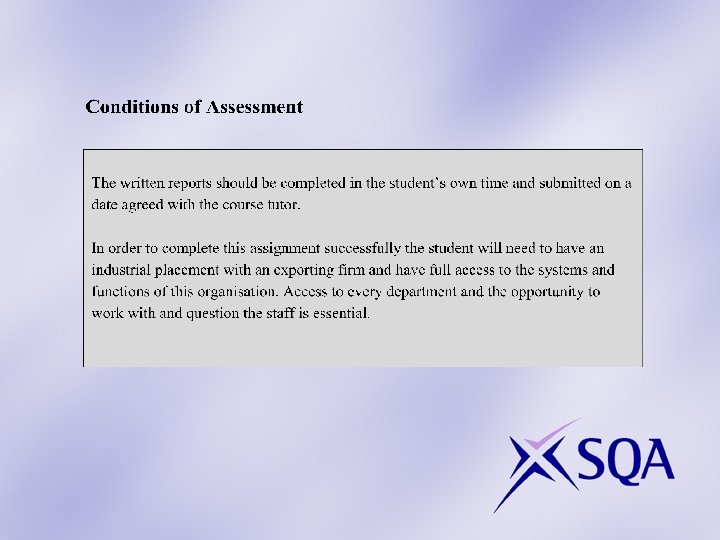
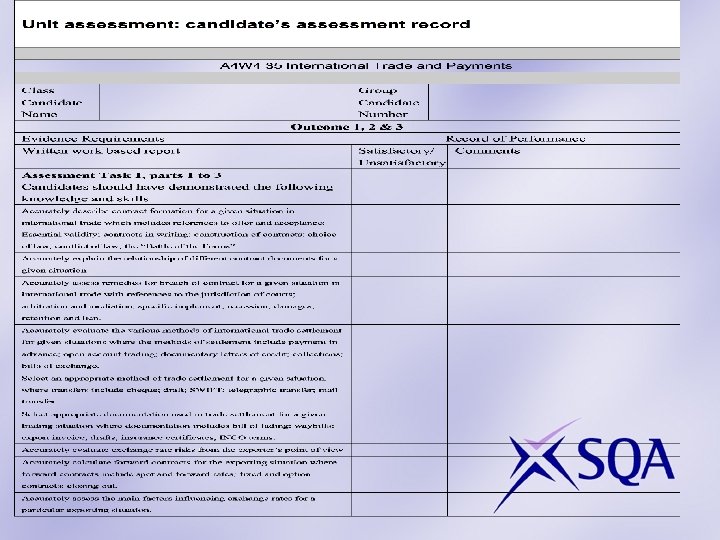
 Explanation on using Assessment exemplar Assessment Exemplars for Higher National Units w Unit: A 4 W 4 35 International Trade and Payments
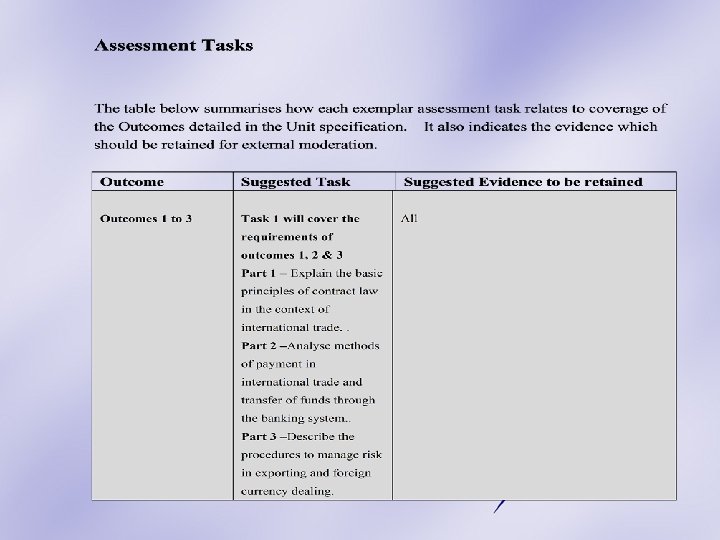
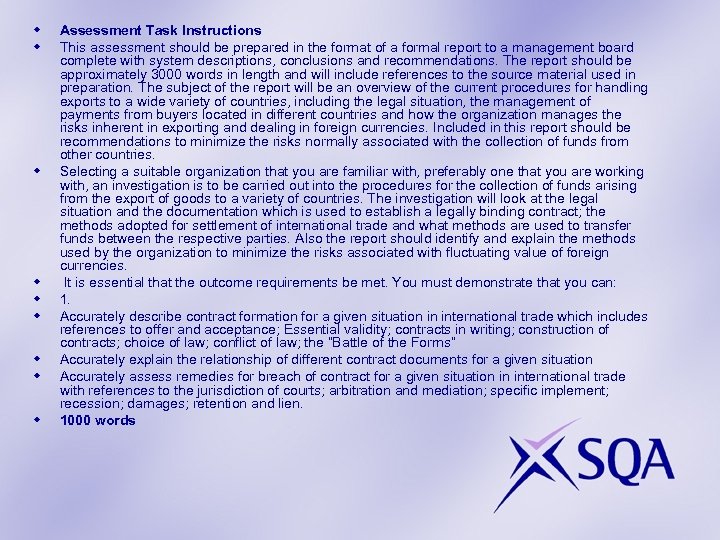 w w w w w Assessment Task Instructions This assessment should be prepared in the format of a formal report to a management board complete with system descriptions, conclusions and recommendations. The report should be approximately 3000 words in length and will include references to the source material used in preparation. The subject of the report will be an overview of the current procedures for handling exports to a wide variety of countries, including the legal situation, the management of payments from buyers located in different countries and how the organization manages the risks inherent in exporting and dealing in foreign currencies. Included in this report should be recommendations to minimize the risks normally associated with the collection of funds from other countries. Selecting a suitable organization that you are familiar with, preferably one that you are working with, an investigation is to be carried out into the procedures for the collection of funds arising from the export of goods to a variety of countries. The investigation will look at the legal situation and the documentation which is used to establish a legally binding contract; the methods adopted for settlement of international trade and what methods are used to transfer funds between the respective parties. Also the report should identify and explain the methods used by the organization to minimize the risks associated with fluctuating value of foreign currencies. It is essential that the outcome requirements be met. You must demonstrate that you can: 1. Accurately describe contract formation for a given situation in international trade which includes references to offer and acceptance; Essential validity; contracts in writing; construction of contracts; choice of law; conflict of law; the “Battle of the Forms” Accurately explain the relationship of different contract documents for a given situation Accurately assess remedies for breach of contract for a given situation in international trade with references to the jurisdiction of courts; arbitration and mediation; specific implement; recession; damages; retention and lien. 1000 words
 Sample of the marking scheme w Assessment Checklists Note- these are useful for marking, but it is an idea to have a separate standard form to record the final results ( i. e after-any re-assessment)
 Re-assessment will be required when Students fail to meet more than just a few evidence requirements on the first attempt w If students only fail to meet one or two parts of the criteria, it is acceptable to ask them to redo only the one or two parts. w Each unit only has one assessment exemplar, and some of these contain tasks for reassessing one or more outcomes. It is the course tutor’s job to prepare another one for students to be re- assessed. A Subject specialist must write the new centre assessment ( and sample solutions and marking scheme), then it must be checked by another subject specialist (internal qualify), only then, if it any changes have been made, should it be sent to SQA for prior verification.
 Graded Units
 Purpose of this Session w To identify the different between ‘Units’ and ‘ Graded Units’ w To examine the Graded Unit for Year One w To interpret the Assessment Conditions required w To grade mock assessment responses
 Graded Unit The purpose of a Graded Unit is to: w assess the candidates’ ability to retain and integrate the knowledge and/or skills gained in the contributory units w Grade candidate achievement
 Graded Unit To achieve an HND Business students must pass all – w the Unit Assessments and w two Graded Units
 Graded Unit In Year One for HND Business w there is only one Graded Unit (single credit) w it is Examination-based with closed book assessment w it is a written examination of 3 hours ( Note: All HND awards only have ONE single credit graded unit in Year 1, however, it will not always be an examination. The unit specification for the Graded Units in the award you will be delivering will specify exactly what requirements are)
 Graded Unit 1( HND Global Trade & Business) w The questions in the examination will be based on a Case Study of an organisation w The Case Study must be given to Candidates 10 days prior to the examination w The questions must be unseen until the actual time of the examination w To pass Graded Units, Candidates must attain 50% of the available marks - A pass=70%-100% B pass=60%-69% C pass=50%-59% (Below 50%=Fail)
 Graded Unit 1 (Business) Students should have completed or be in the process of completing the following units in order to be able to undertake the Graded Unit: w. Business Accounting w. Economic Issues: An Introduction w. Managing People and Organisations w. Marketing: An Introduction These four units will form the basis of the four main topic areas from which the questions on the Case Study will be taken.
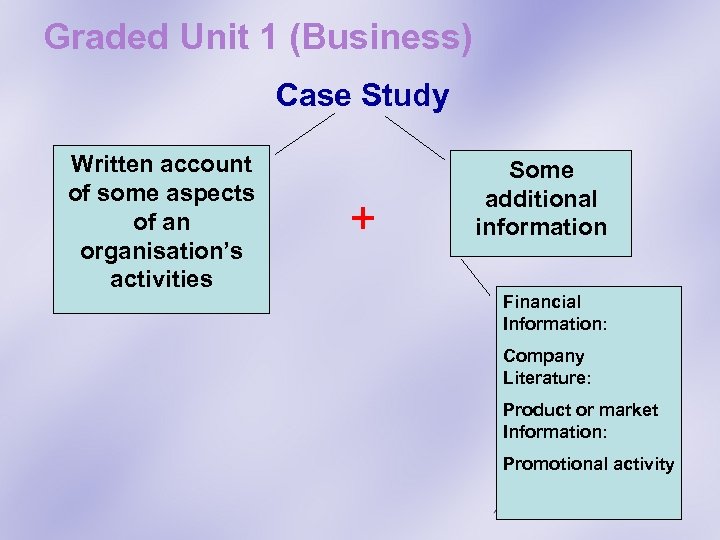 Graded Unit 1 (Business) Case Study Written account of some aspects of an organisation’s activities + Some additional information Financial Information: Company Literature: Product or market Information: Promotional activity
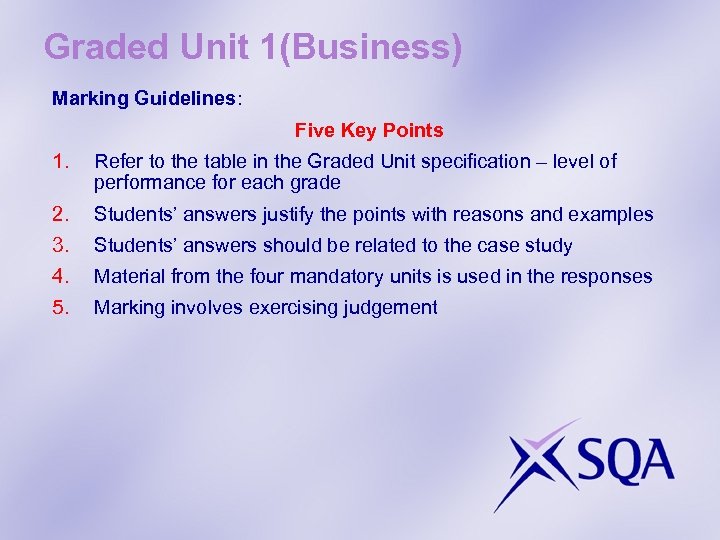 Graded Unit 1(Business) Marking Guidelines: Five Key Points 1. Refer to the table in the Graded Unit specification – level of performance for each grade 2. Students’ answers justify the points with reasons and examples 3. Students’ answers should be related to the case study 4. Material from the four mandatory units is used in the responses 5. Marking involves exercising judgement
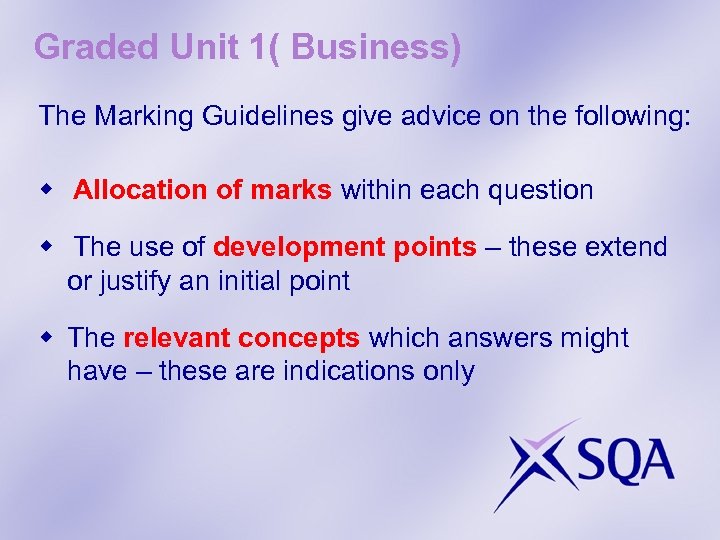 Graded Unit 1( Business) The Marking Guidelines give advice on the following: w Allocation of marks within each question w The use of development points – these extend or justify an initial point w The relevant concepts which answers might have – these are indications only
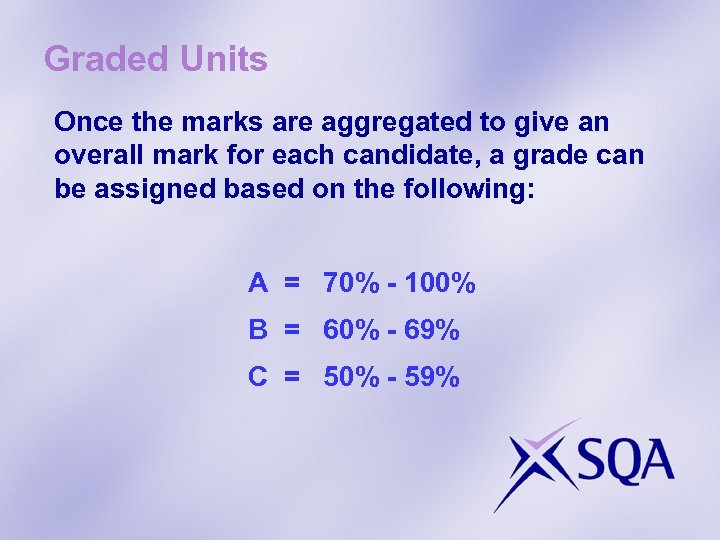 Graded Units Once the marks are aggregated to give an overall mark for each candidate, a grade can be assigned based on the following: A = 70% - 100% B = 60% - 69% C = 50% - 59%
 Session 4 Internal Verification & External Verification
 Internal Verification Process
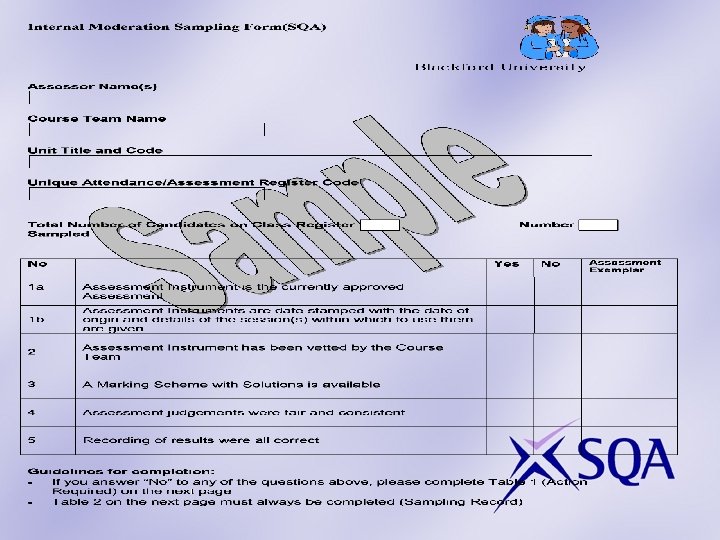
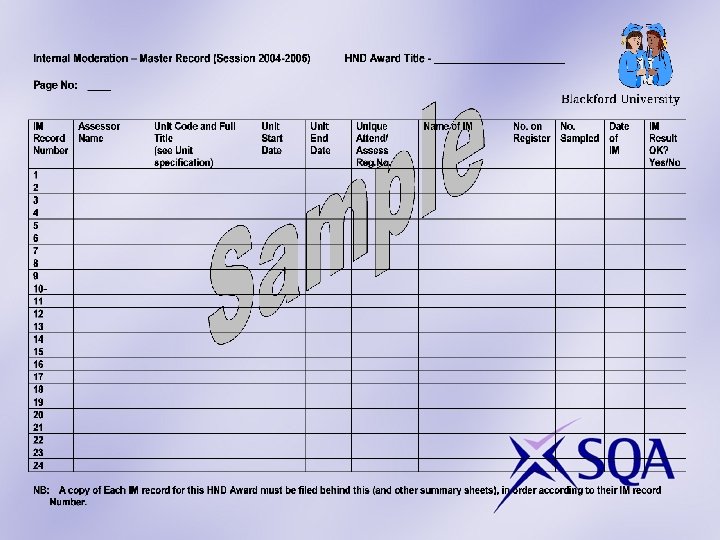
 Internal verification (IV) procedures and its suggested forms w Staff in the centre will undertake internal verification w Internal verification must take place as soon as possible after each assessment event. w Centre must have at least two subject experts, one to teach and another to carry out IV w IV is someone check another’s work whether they agree with pass/fail and marking judgment of someone else. w Prepare your staff information and list the assessors and Internal verifiers w Sampling procedure w Findings, comments, signature and date of IV
 Responsibilities of Internal Verifiers include w w w w Monitoring samples of assessor performance to ensure that assessment is being conducted properly. * Liaison with the external verifier * Identifying issues arising out of the assessment decisions and taking appropriate action. * Ensuring that the internal verification process is conducted in a supportive manner. * Keeping records and completing internal verification forms. * Ensuring that the results of the monitoring are communicated to assessment teams and appropriate management. * Checking that arrangements for assessment are satisfactory. * Ensuring that there is an effective appeals procedure. * Supporting the assessors. * Ensuring that the programme teams meet regularly to: – discuss assessment plans – discuss assessment decisions – compare evidence – develop a shared understanding of the appropriateness and sufficiency of the evidence * Ensuring that the course team operates an effective system of recording * Ensuring that recording procedures allows cross-referencing * Ensuring that the system allows feedback to students
 Course Team Meeting The course team for GTB will include all these teaching/assessing and/or internally verifying all units in the GTB framework) w w w w w Meeting will decide upon: Assessment methods Assessments to be used Answer guides to assessment Assessment schedule ( assessment must not always be left to the end of the semester- continuous assessment) Resources required Cross-marking system IV feedback Implementing feedback from EV Review
 Course Team Meeting w Essential for every award being delivered w First meeting should take place before semester begins w A team will be put in place for each award stating who the Unit Leader is and which staff are members of the award Team w Every lecturer who is involved with a Unit will be a member of the course team w Discussion will focus on the good practice and problems and concerns with teaching and learning, assessment and internal verification
 Action Minutes with follow-up w The centre must make sure that any action points made from course meeting must be followed and the progression must be recorded.
 Three Stage IV Process This could be found from SQA website and about IV job in the three stage of - Before delivery - Sampling - Review
 Deal with Plagiarism The centres should make a control of this and ensure that assessment evidence is the candidates’ own work.
 External Verification Procedure and EV’s role and responsibility
 External Verification procedure and forms w External moderators will be appointed by the SQA. They will have qualifications and experience which is relevant and specific to the vocational areas. The role of the external moderator is to verify that the assessment system at the centres is valid and reliable. Responsibilities of external moderators include:
 w Verifying assessment practice at the centre by; – sampling assessment practice – checking consistency of interpretation of standards – monitoring and reporting on assessment practice and procedures – identifying where corrective action by the centre is necessary – helping to ensure that disputes regarding assessment are resolved equitably. w * Maintaining records of visits and providing feedback – maintaining a moderation record, identifying frequency and purpose of visits. – Producing regular and accurate reports. – Drawing the attention of the awarding body to concerns regarding the design and implementation of assessment. w * Providing information, advisory and support services to Centres – maintaining an effective relationship with internal moderators – ensuring centres are fully aware of the SQA requirements and procedures. – Advising on appropriate planning, resourcing, quality assurance and recording requirements. – Ensuring consistency of standards across centres.
 Center requirement w Staff development/timetabling w Resources w External Link w Motivating and Supporting Staff
 Documents need prepare for EV w w w w A copy of the unit specification that you have been using Your teaching pack Student learning materials Assessment materials and marking schemes Students’ work that has been assessed by you Records of Achievement (eg class registers) Any records you have of internal moderation that has been carried out w Records of Course Team Meetings (and evidence of any progress towards ‘action recommended’ from these meetings, or completed action)
 Action Feedback From External SQA w Actions made by external verifier on the day of the visit/or centre verification must be followed by the centre and the completion day of the remediation must be met.
 SQA Roles and Responsibilities
 Suggested Induction Programme ⁻ Check student names against list of those accepted ⁻ Issue information packs (ie Award Title and structure, unit titles, timetable etc) ⁻ Students to complete form with personal details (for tutor contact etc) w Welcome and introduction (by Course/Programme Leader) w Purpose of induction w Explanation of fire drills etc, smoking policy and use of mobile phones in class w Introduction to student-centred learning w Centre procedures – i. e attendance, assessment procedures and appeals w Assessment and reassessment w Plagiarism
 Suggested Induction Programme w Department staffing (brief introduction to staff delivering units within the award framework) w Role of Course Team Leader w Role of Lecturers w Role of Course Teams (including student representatives) w Assessment procedures, including reassessment and deadlines w Session calendar and class times w Academic routes (ie progression) w Programme leader to explain timetables w Support available to candidates
 Centre Handbook(s) = Centre Procedures What are these? w Documented procedures - ie guides for carrying out work associated with SQA qualifications in the centre eg Roles and responsibilities of the SQA Co-Ordinator and staff assessing and/or internally moderating Why are they needed? w To apply standard procedures in different teaching areas in a centre, and to record them (in the event of staff, or other changes) Consider these as: w An ‘in-house’ (Centre) Quality Manual
 Procedures and Systems - Suggestions Roles and responsibilities ü SQA Co-Ordinator ü Teachers (ie Assessors) ü Internal Moderators ü Students (candidates) Policies, Procedures and Documents - Standardisation ü Conduct of assessments, marking, recording results and submitting internally (ie to whom, and by what means), retention and storage of marked candidate evidence ü Internal Moderation (IV) (ensuring assessment decisions are correct and consistent, recording IM activity, sampling) ü Appeals (against an assessment decision, & recording) ü External Moderation (preparation for, and taking action on recommendations, if any)
 Procedures and Systems - Suggestions Policies, Procedures and Documents - Standardisation ü ü ü ü ü Equal Opportunities Health and Safety Induction (for new staff) Induction (for students) Guidance and Support (for Staff) ie in-house staff training/updating on SQA and centre procedures Continuous Professional Development (CPD) - ie subject specific, for those assessing and/or internally moderating Submitting results to the SQA Co-Ordinator Sending files to CHS for Processing Resolving errors in CHS files
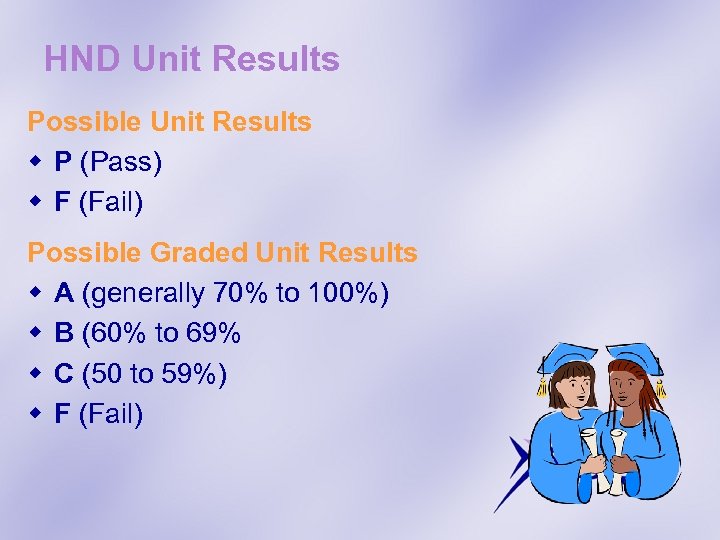 HND Unit Results Possible Unit Results w P (Pass) w F (Fail) Possible Graded Unit Results w A (generally 70% to 100%) w B (60% to 69% w C (50 to 59%) w F (Fail)
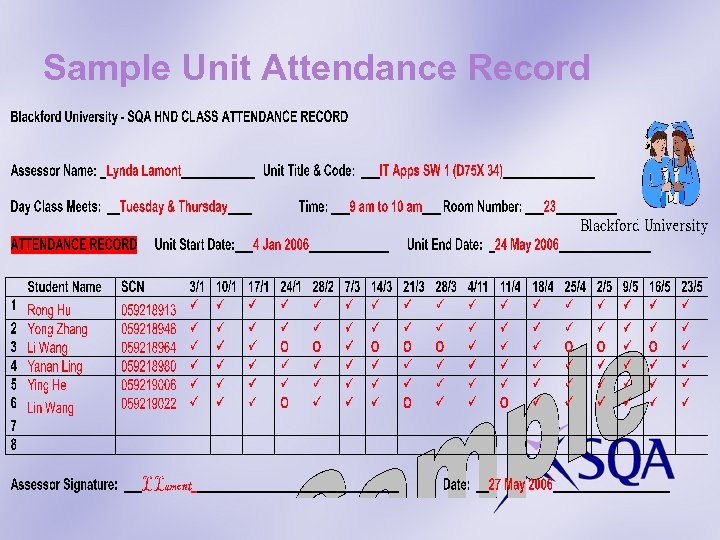 Sample Unit Attendance Record
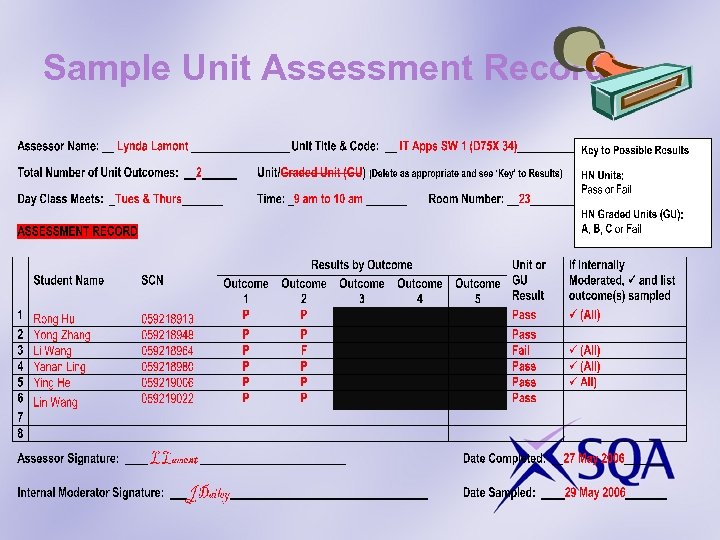 Sample Unit Assessment Record
 Graded Unit Question and Answer Session
 Section 6 Alternative assessment
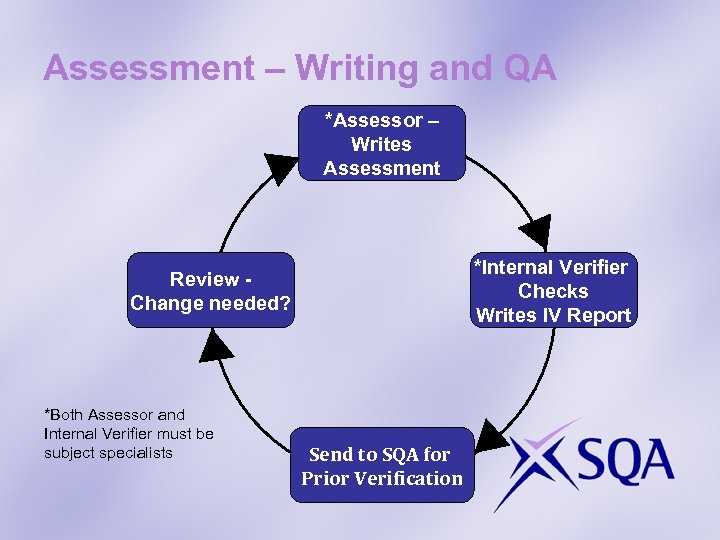 Assessment – Writing and QA *Assessor – Writes Assessment *Internal Verifier Checks Writes IV Report Review Change needed? *Both Assessor and Internal Verifier must be subject specialists Send to SQA for Prior Verification
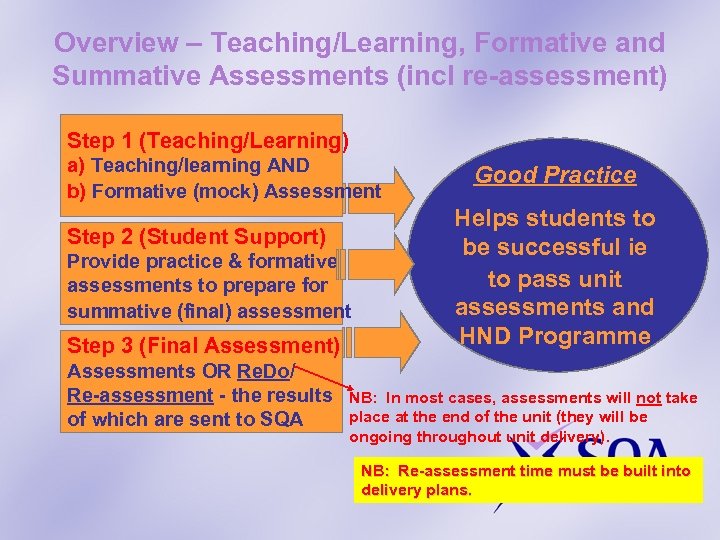 Overview – Teaching/Learning, Formative and Summative Assessments (incl re-assessment) Step 1 (Teaching/Learning) a) Teaching/learning AND b) Formative (mock) Assessment Step 2 (Student Support) Provide practice & formative assessments to prepare for summative (final) assessment Step 3 (Final Assessment) Assessments OR Re. Do/ Re-assessment - the results of which are sent to SQA Good Practice Helps students to be successful ie to pass unit assessments and HND Programme NB: In most cases, assessments will not take place at the end of the unit (they will be ongoing throughout unit delivery). NB: Re-assessment time must be built into delivery plans.
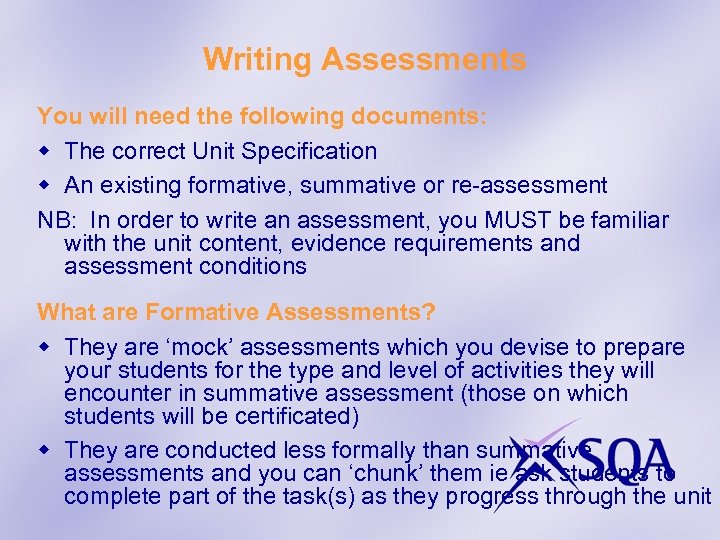 Writing Assessments You will need the following documents: w The correct Unit Specification w An existing formative, summative or re-assessment NB: In order to write an assessment, you MUST be familiar with the unit content, evidence requirements and assessment conditions What are Formative Assessments? w They are ‘mock’ assessments which you devise to prepare your students for the type and level of activities they will encounter in summative assessment (those on which students will be certificated) w They are conducted less formally than summative assessments and you can ‘chunk’ them ie ask students to complete part of the task(s) as they progress through the unit
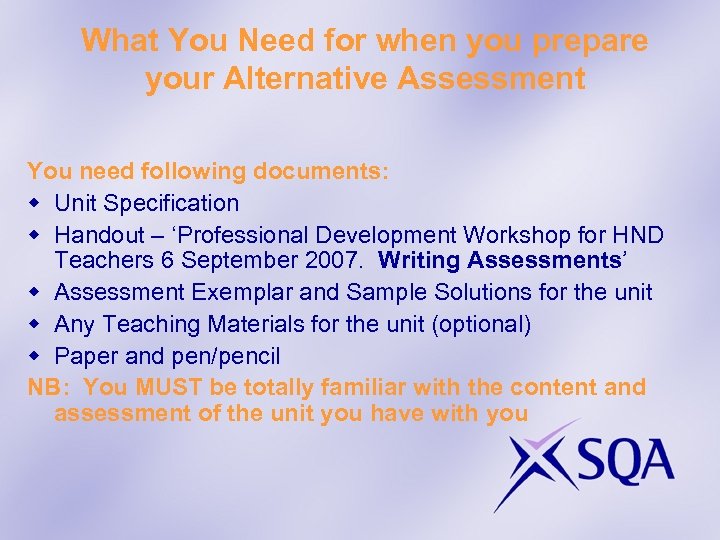 What You Need for when you prepare your Alternative Assessment You need following documents: w Unit Specification w Handout – ‘Professional Development Workshop for HND Teachers 6 September 2007. Writing Assessments’ w Assessment Exemplar and Sample Solutions for the unit w Any Teaching Materials for the unit (optional) w Paper and pen/pencil NB: You MUST be totally familiar with the content and assessment of the unit you have with you
 Aim – To Write an Assessment (including sample solutions) Resources Required (for the Unit YOU have delivered): - Compulsory - Unit Specification & Assessment Exemplar - Optional - Teaching Material for the unit w Individually, write an assessment task AND sample solutions and/or marking scheme for this unit NB: Where someone else attending the Workshop has brought resources for the same unit, you are free to work together w Please discuss any points with your peers and/or the SQA representatives will facilitate
 Valid Assessments – Refer to the Unit Specification To be valid, an assessment must include each element specified in the unit specification. It must have: w The correct number, and type(s) of assessment tasks - ie a unit with 2 outcomes may have 2 assessment tasks (or one holistic task), and it may be a project or practical task(s) w Assessment conditions specified - eg ‘all work submitted must be entirely your own’, and/or it may require to be completed within a specified timescale while being supervised (similar to exam conditions) w Sample solutions and/or a marking scheme - eg if practical tasks in an IT unit, the writer should work through all practical tasks and include the solution for each stage of the assessment task. If the task is to produce a 1500 word report, the writer should provide a summary of all required answers, and/or a list of suggested acceptable answers. If marks are required, an indication of where these are allocated must also be given.
 Assessments Written by You Must not: w Be in the SQA shell (with all the additional notes etc) w Contain the SQA logo Should: w Only consist of assessment tasks and sample solutions/marking schemes w Have your centre number, centre name (and possibly also your centre logo) w Have a version number and/or date devised/ revised in a footer (and page numbers) See sample centre devised assessment
 SQA & CSCSE Data System
 Data Transfer System w In 2005 SQA RED was introduced – easy transfer of information between centres and SQA – database of information on students w In 2011 introduction of CSH – Easy transfer of information between centres and SQA – Database of information on students – Inputting information once
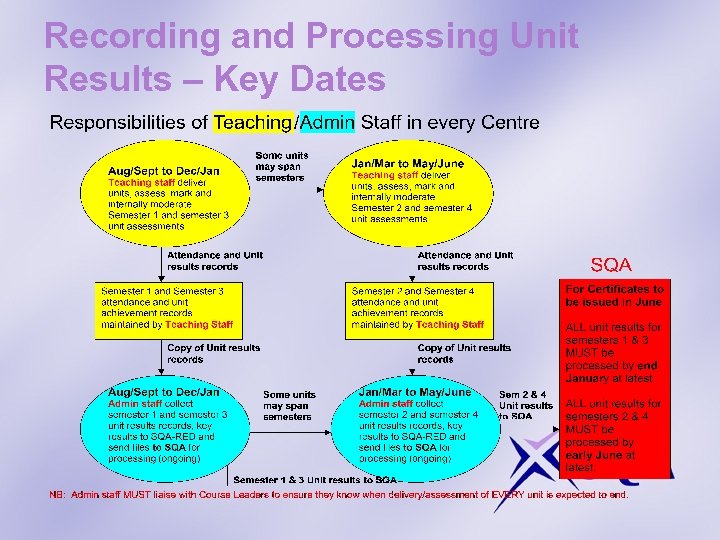 Recording and Processing Unit Results – Key Dates
 Useful Contact Numbers w Mary Gao (China Representative/China Quality Enhancement Manager) Tel: 0086 85251111/323 (mary. gaocbbc@sqa. org. uk) Mobile in China – 13511059721