


 Скачать презентацию 2011 PE Review Michael C Hirschi Ph D
7f1a9bb90622d57d798ab2eca9e18b69.ppt
- Количество слайдов: 97
 2011 PE Review: Michael C. Hirschi, Ph. D, PE, D. WRE Professor and Assistant Dean University of Illinois mch@illinois. edu
 Acknowledgements: Rod Huffman, PE Review coordinator Daniel Yoder (2006 presenter) Rabi Mohtar & Majdi Abu Najm (2010 presenters)
 Topics • Principles of Soil Physics (some duplication with Management session) • Soil Strength & Mechanics • Sediment Transport • Erosion Control • Slope Stabilization
 Sources • Environmental Soil Physics; Hillel; 1998 Hi • Essentials of Soil Mechanics & Foundations, 2 nd ed. ; Mc. Carthy; 1982; M • Soil and Water Conservation Engineering – 4 th ed. Schwab, Fangmeier, Elliott, Frevert: S 4 – 5 th ed. Fangmeier, Elliott, Workman, Huffman, Schwab: S 5 • Design Hydrology & Sedimentology for Small Catchments; Haan, Barfield, Hayes: H • USLE/RUSLE Handout: HO
 Soil Physics & Mechanics • Soil classes and particle size distributions • Soil water – Content – Potential – Flow • Soil strength & mechanics
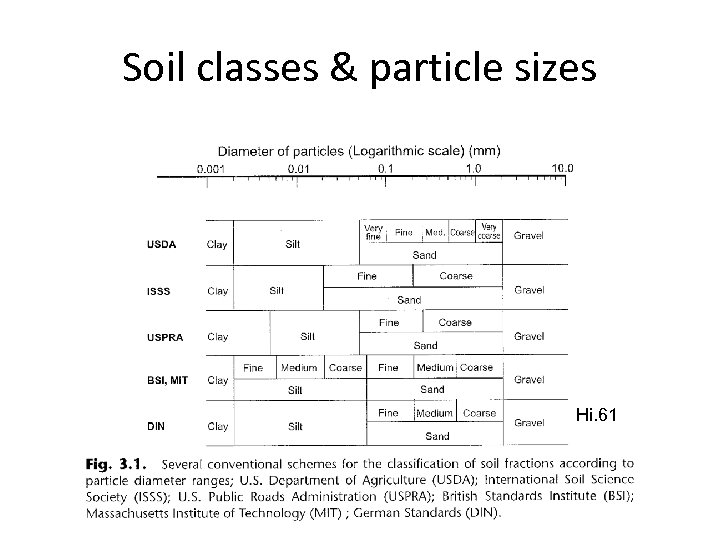 Soil classes & particle sizes Hi. 61
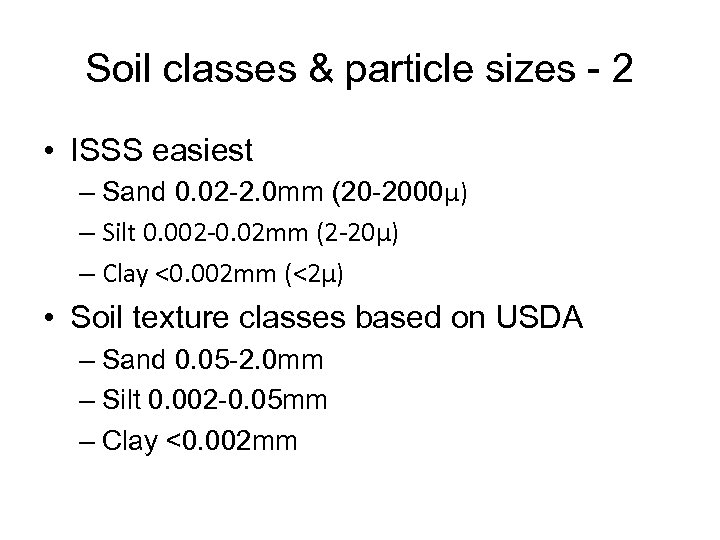 Soil classes & particle sizes - 2 • ISSS easiest – Sand 0. 02 -2. 0 mm (20 -2000μ) – Silt 0. 002 -0. 02 mm (2 -20μ) – Clay <0. 002 mm (<2μ) • Soil texture classes based on USDA – Sand 0. 05 -2. 0 mm – Silt 0. 002 -0. 05 mm – Clay <0. 002 mm
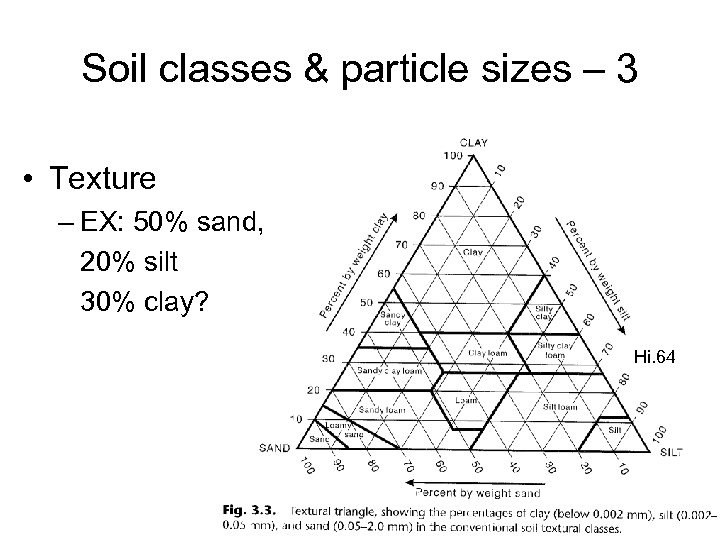 Soil classes & particle sizes – 3 • Texture – EX: 50% sand, 20% silt 30% clay? Hi. 64
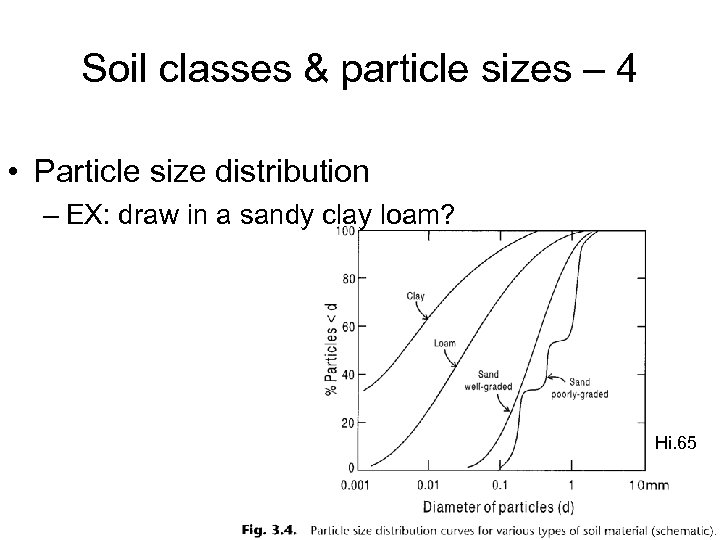 Soil classes & particle sizes – 4 • Particle size distribution – EX: draw in a sandy clay loam? Hi. 65
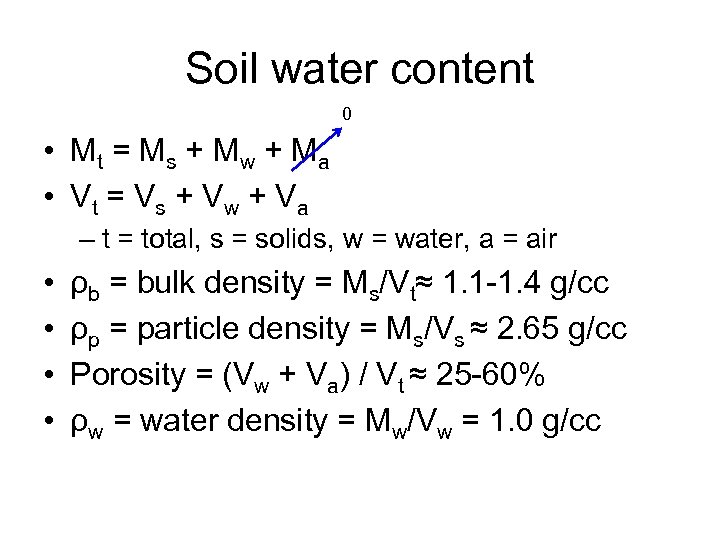 Soil water content 0 • Mt = M s + M w + M a • Vt = V s + V w + V a – t = total, s = solids, w = water, a = air • • ρb = bulk density = Ms/Vt≈ 1. 1 -1. 4 g/cc ρp = particle density = Ms/Vs ≈ 2. 65 g/cc Porosity = (Vw + Va) / Vt ≈ 25 -60% ρw = water density = Mw/Vw = 1. 0 g/cc
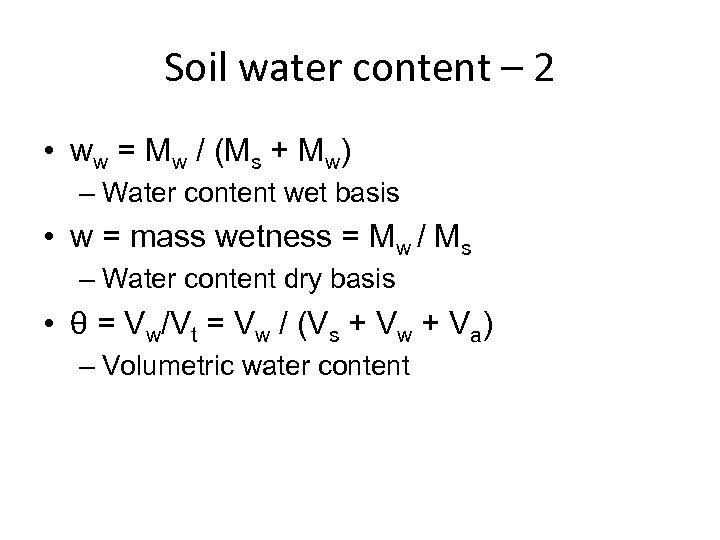 Soil water content – 2 • ww = Mw / (Ms + Mw) – Water content wet basis • w = mass wetness = Mw / Ms – Water content dry basis • θ = Vw/Vt = Vw / (Vs + Vw + Va) – Volumetric water content
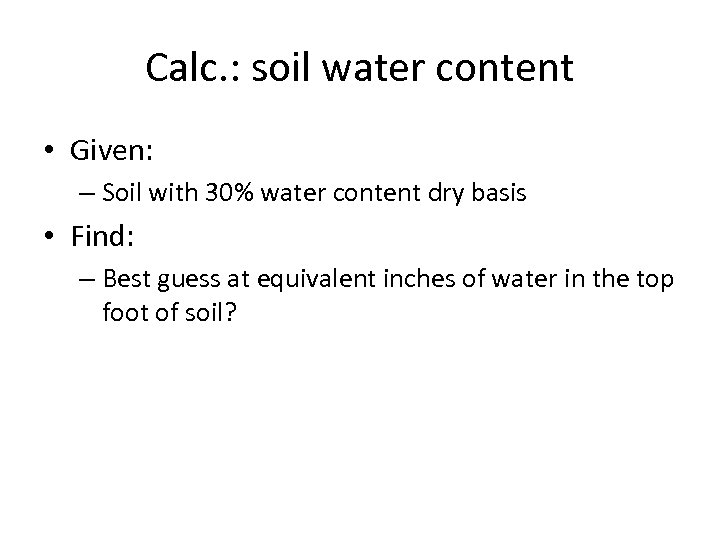 Calc. : soil water content • Given: – Soil with 30% water content dry basis • Find: – Best guess at equivalent inches of water in the top foot of soil?
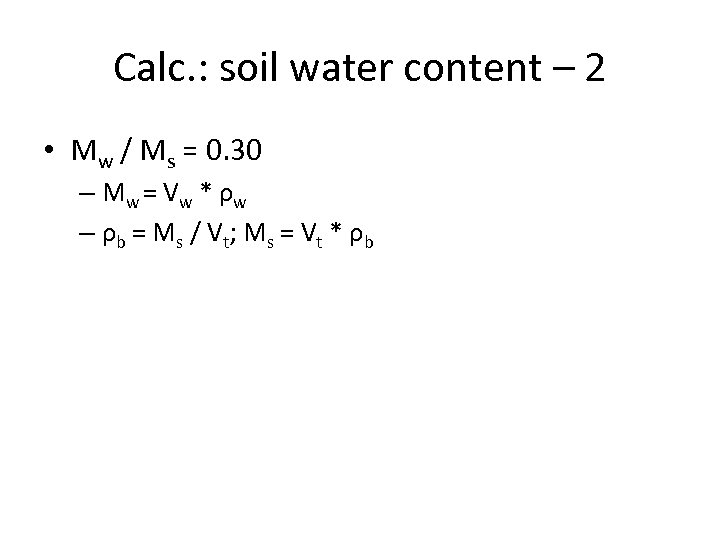 Calc. : soil water content – 2 • Mw / Ms = 0. 30 – M w = Vw * ρ w – ρ b = M s / V t; M s = Vt * ρ b
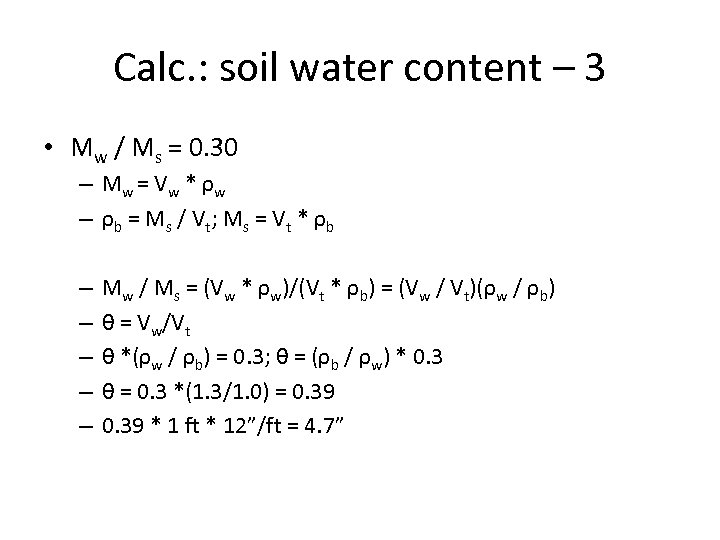 Calc. : soil water content – 3 • Mw / Ms = 0. 30 – M w = Vw * ρ w – ρ b = M s / V t; M s = Vt * ρ b – – – Mw / Ms = (Vw * ρw)/(Vt * ρb) = (Vw / Vt)(ρw / ρb) θ = Vw/Vt θ *(ρw / ρb) = 0. 3; θ = (ρb / ρw) * 0. 3 θ = 0. 3 *(1. 3/1. 0) = 0. 39 * 1 ft * 12”/ft = 4. 7”
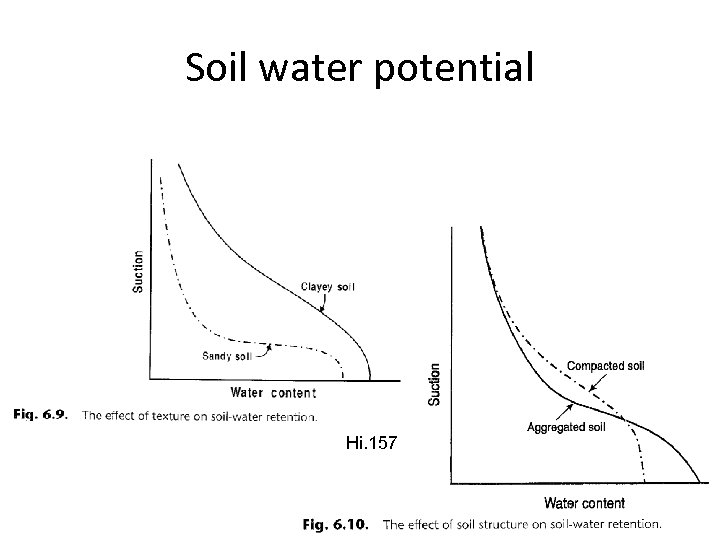 Soil water potential Hi. 157
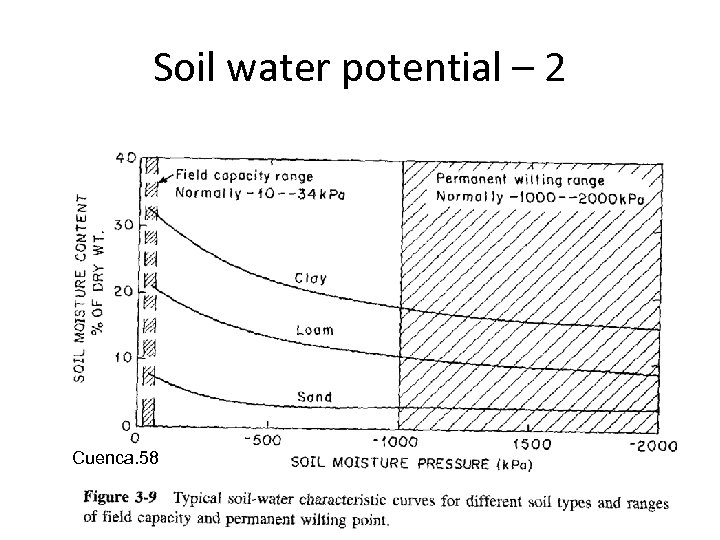 Soil water potential – 2 Cuenca. 58
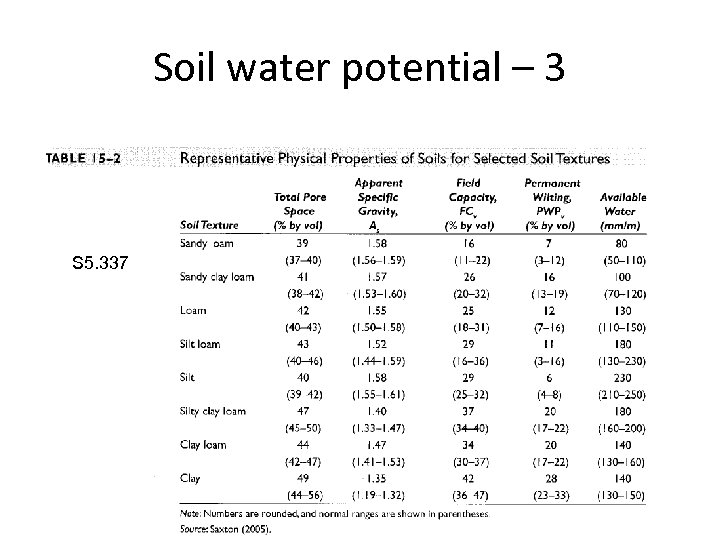 Soil water potential – 3 S 5. 337
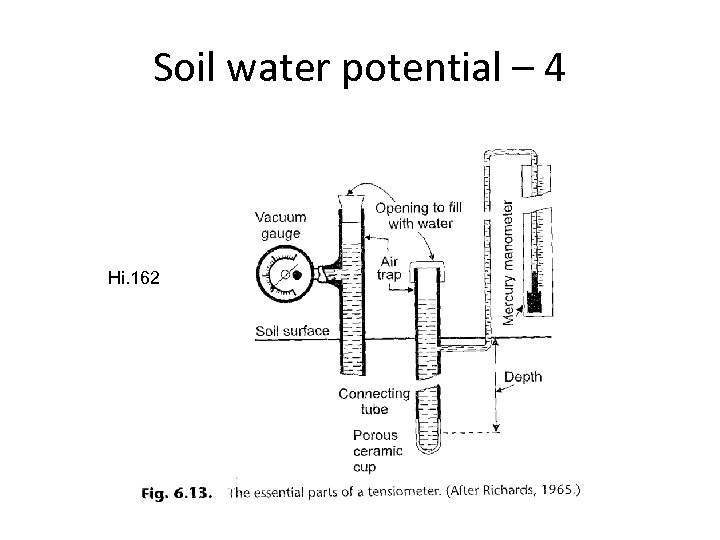 Soil water potential – 4 Hi. 162
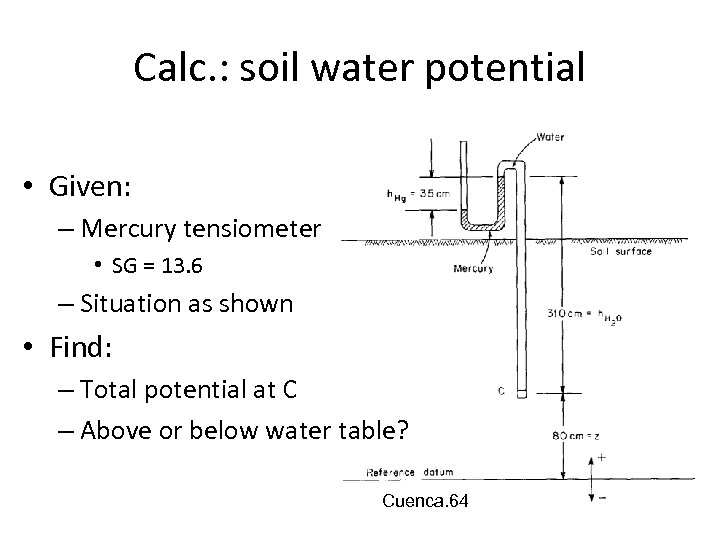 Calc. : soil water potential • Given: – Mercury tensiometer • SG = 13. 6 – Situation as shown • Find: – Total potential at C – Above or below water table? Cuenca. 64
 Calc. : soil water potential - 2 • 1) pick datum • 2) add pressures – Suction – Water depth – Gravity • T = z + pos – = -86 cm – Above water table
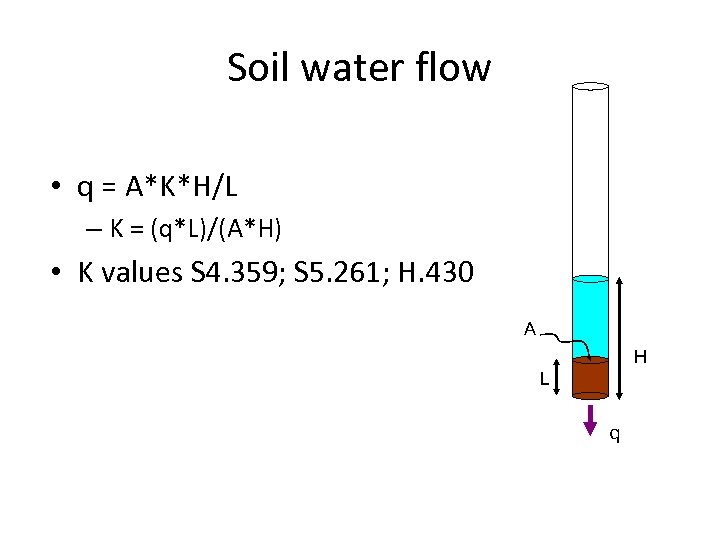 Soil water flow • q = A*K*H/L – K = (q*L)/(A*H) • K values S 4. 359; S 5. 261; H. 430 A H L q
 Calc. : soil water flow • Given: – Need 50000 gpd through a 1 -ft thick sand filter with K = 8 ft/d, and a total driving head of 3 ft • Find : – Required diameter for circular tank?
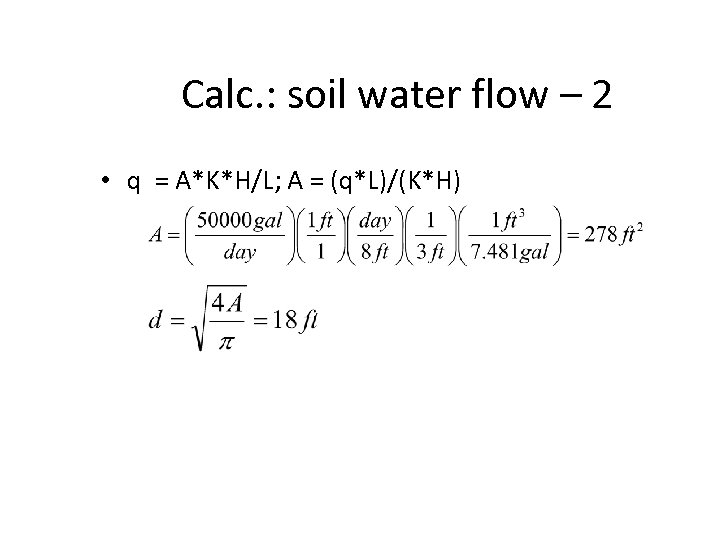 Calc. : soil water flow – 2 • q = A*K*H/L; A = (q*L)/(K*H)
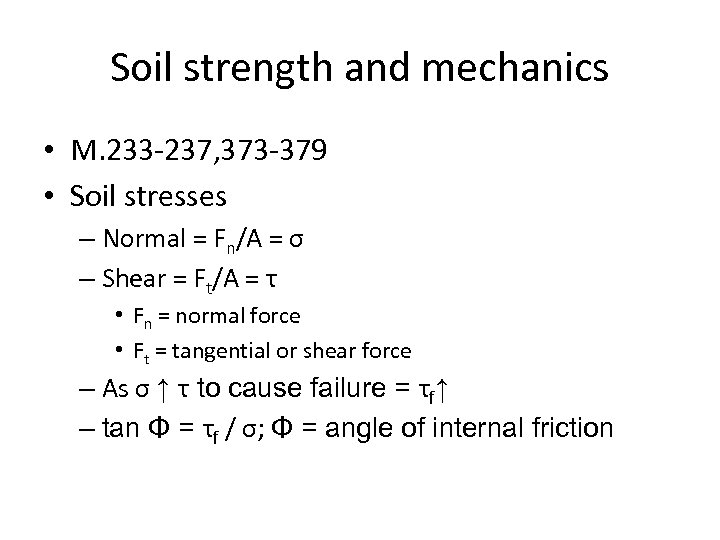 Soil strength and mechanics • M. 233 -237, 373 -379 • Soil stresses – Normal = Fn/A = σ – Shear = Ft/A = τ • Fn = normal force • Ft = tangential or shear force – As σ ↑ τ to cause failure = τf↑ – tan Φ = τf / σ; Φ = angle of internal friction
 Soil strength and mechanics – 2 M. 234
 Calc. : soil strength • Given: – Well-graded sand; density 124 lb/ft 3 • Find: – Ultimate shear strength 6 ft below surface?
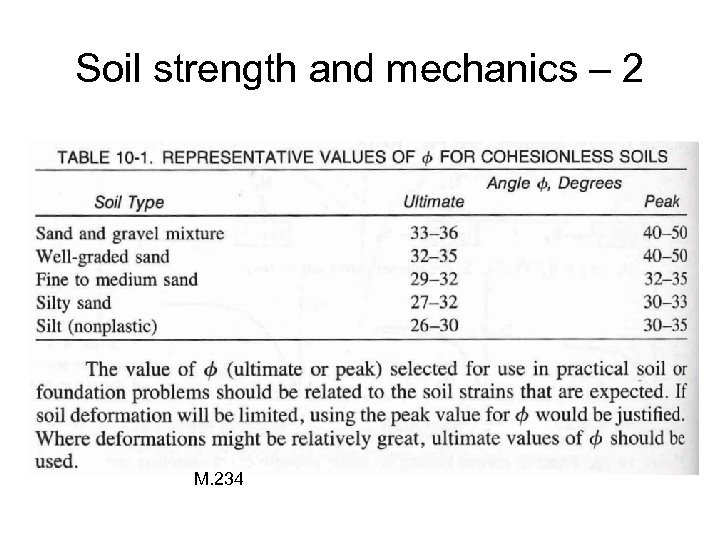
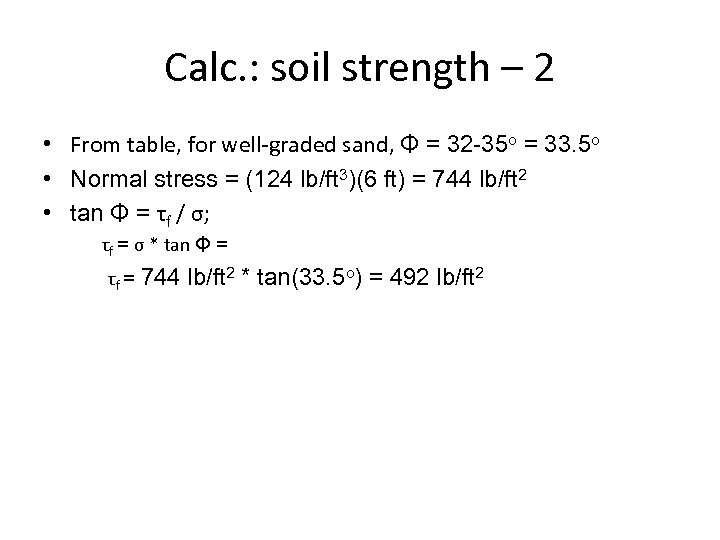 Calc. : soil strength – 2 • From table, for well-graded sand, Φ = 32 -35 o = 33. 5 o • Normal stress = (124 lb/ft 3)(6 ft) = 744 lb/ft 2 • tan Φ = τf / σ; τf = σ * tan Φ = τf = 744 lb/ft 2 * tan(33. 5 o) = 492 lb/ft 2
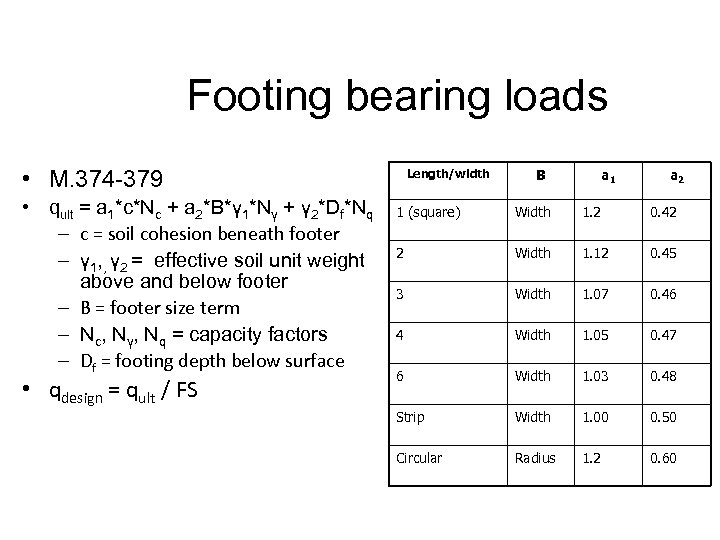 Footing bearing loads • M. 374 -379 • qult = a 1*c*Nc + a 2*B*γ 1*Nγ + γ 2*Df*Nq – c = soil cohesion beneath footer – γ 1, , γ 2 = effective soil unit weight above and below footer – B = footer size term – Nc, Nγ, Nq = capacity factors – Df = footing depth below surface • qdesign = qult / FS Length/width B a 1 a 2 1 (square) Width 1. 2 0. 42 2 Width 1. 12 0. 45 3 Width 1. 07 0. 46 4 Width 1. 05 0. 47 6 Width 1. 03 0. 48 Strip Width 1. 00 0. 50 Circular Radius 1. 2 0. 60
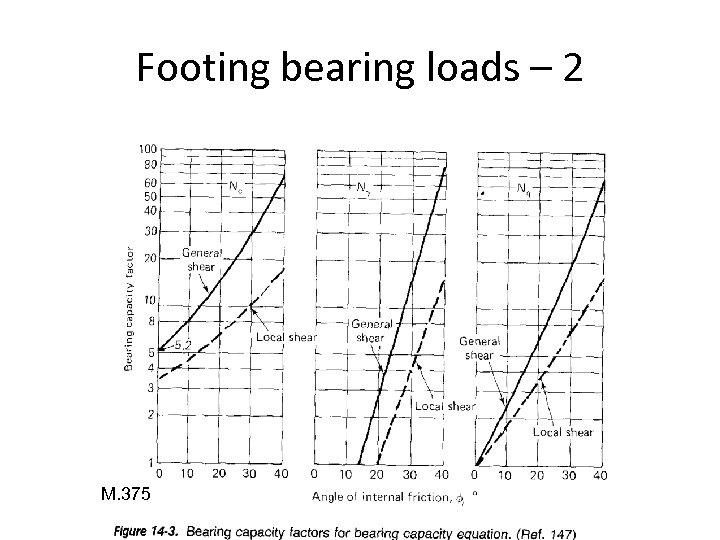 Footing bearing loads – 2 M. 375
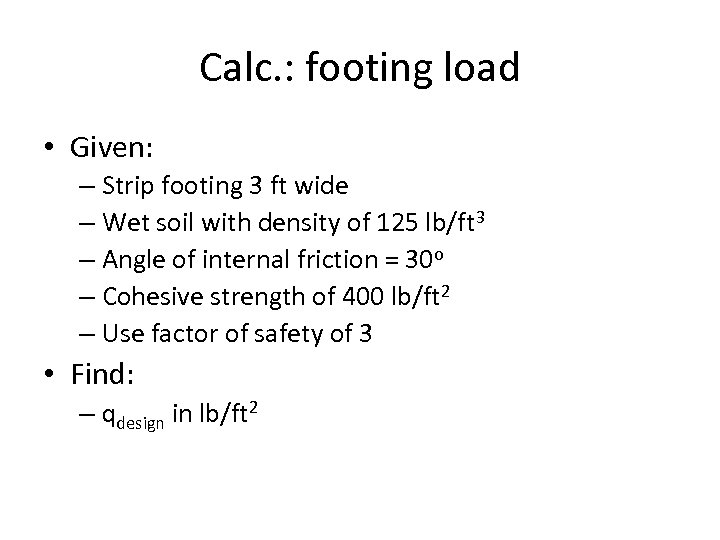 Calc. : footing load • Given: – Strip footing 3 ft wide – Wet soil with density of 125 lb/ft 3 – Angle of internal friction = 30 o – Cohesive strength of 400 lb/ft 2 – Use factor of safety of 3 • Find: – qdesign in lb/ft 2
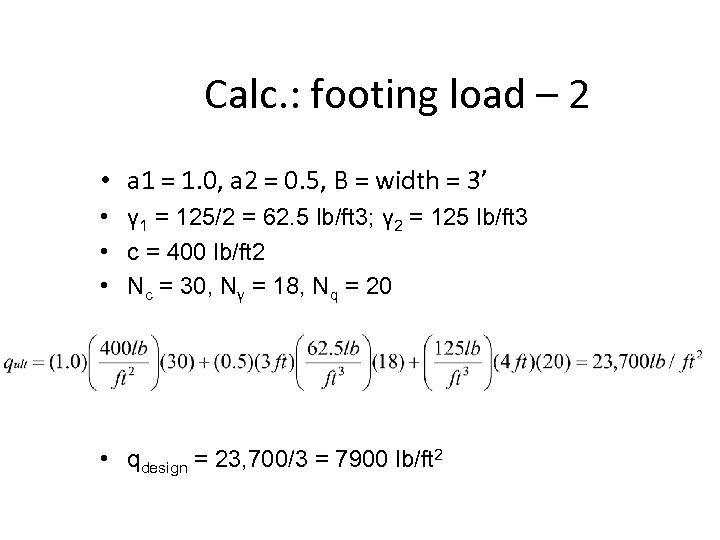 Calc. : footing load – 2 • a 1 = 1. 0, a 2 = 0. 5, B = width = 3’ • γ 1 = 125/2 = 62. 5 lb/ft 3; γ 2 = 125 lb/ft 3 • c = 400 lb/ft 2 • Nc = 30, Nγ = 18, Nq = 20 • qdesign = 23, 700/3 = 7900 lb/ft 2
 Soil compaction and density • Soil compaction – Greater strength – Dependent on water content • Proctor test – Pack soil into mold with pounding – Modified Proctor > 56000 ft-lbs
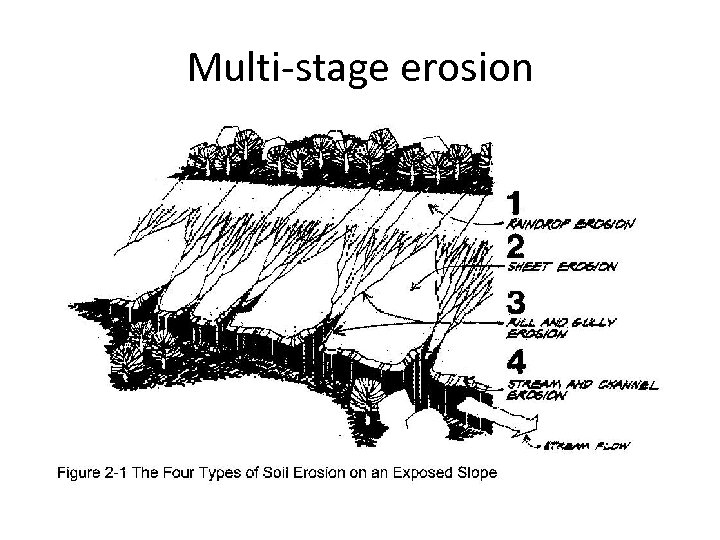
 The Erosion Process • Soil erosion is a multi-step process: – Soil particle/aggregate detachment – Soil particle/aggregate transport – Soil particle/aggregate deposition • There must be detachment and transport for erosion to occur • Deposition (sedimentation) will occur somewhere downstream
 A little soils review… • Soil primary particles: – Sand, 0. 05 mm to 2 mm, 2. 65 g/cc density – Silt, 0. 002 mm to 0. 05 mm, 2. 65 g/cc – Clay, <0. 002 mm, 2. 6 g/cc • Soil aggregates, chemically/electrically bonded sets of primary particles: – Large, in the sand range, 1. 6 g/cc – Small, in the large silt range, 1. 8 g/cc • These aggregate sizes are approximately those used in the CREAMS model (USDA-ARS)
 Detachment • There are many sources of force and energy required to detach soil particles & aggregates: – Raindrop impact – Shallow surface flow shear – Concentrated flow shear – Many more, at larger scales
 Transportation • Many of the same processes contribute force and energy for soil particle & aggregate transport: – Raindrop impact – Shallow surface flow – Concentrated surface flow – Channelized flow – Others
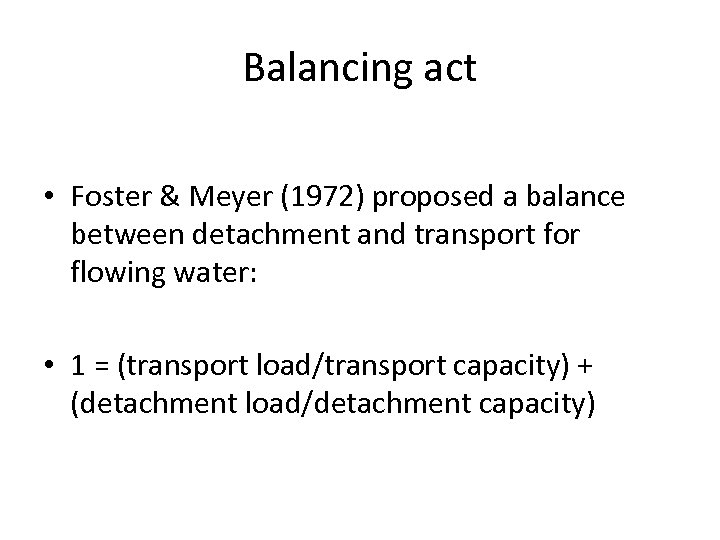 Balancing act • Foster & Meyer (1972) proposed a balance between detachment and transport for flowing water: • 1 = (transport load/transport capacity) + (detachment load/detachment capacity)
 Essentially, if the flow is using all its transport capacity transporting sediment, there’s nothing left to detach more. Likewise, if the flow is detaching new sediment at detachment capacity, there’s no capacity to transport any sediment. Natural systems balance out…
 Example • In the 80’s and 90’s there was a successful push to conservation tillage as a method to reduce sediment in lakes and streams • In many situations, no improvement was seen, but streambank erosion became more of a problem than it was in the past • I contend that now that the streams are receiving cleaner water (because of less upland erosion), but at similar rates, from farm fields, the stream uses less of its erosive energy to transport load it receives from runoff water, so it has capacity to undercut banks and scour the streambed
 Multi-stage erosion
 Soil erosion and sediment yield • • • Hillslope erosion Channel system erosion Sediment delivery to streams Sediment transport in streams Slope stability
 Hillslope soil erosion • S 4. 91 -111; S 5. 134 -156; H. 238 -285 • Background – Detachment • Raindrop impact • By turbulent overland flow – Runoff – Transport downslope • By runoff
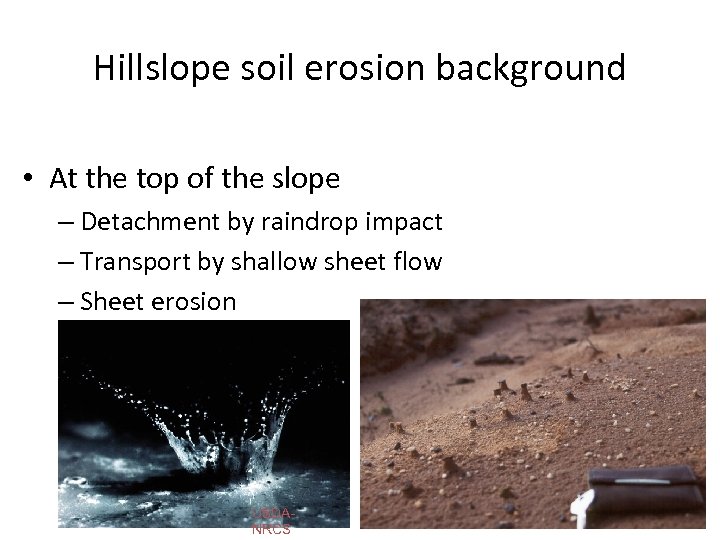 Hillslope soil erosion background • At the top of the slope – Detachment by raindrop impact – Transport by shallow sheet flow – Sheet erosion USDANRCS
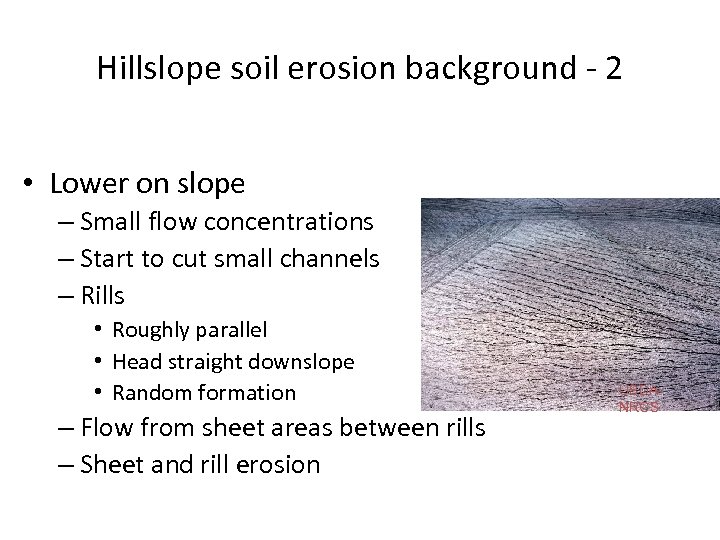 Hillslope soil erosion background - 2 • Lower on slope – Small flow concentrations – Start to cut small channels – Rills • Roughly parallel • Head straight downslope • Random formation – Flow from sheet areas between rills – Sheet and rill erosion USDANRCS
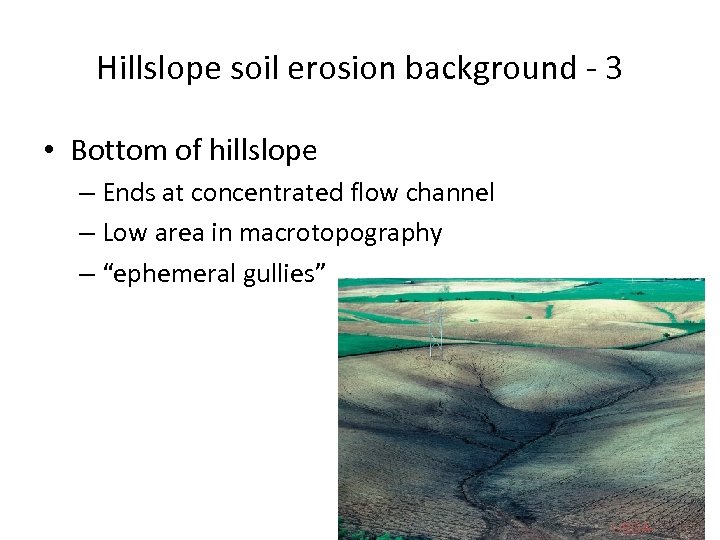 Hillslope soil erosion background - 3 • Bottom of hillslope – Ends at concentrated flow channel – Low area in macrotopography – “ephemeral gullies” USDA-
 Hillslope erosion factors • Rainfall erosivity – Intensity – Total storm energy • Soil erodibility • Topography – Slope length – Steepness • Management – Reduce local erosion – Change runoff path – Slow and spread runoff => deposition
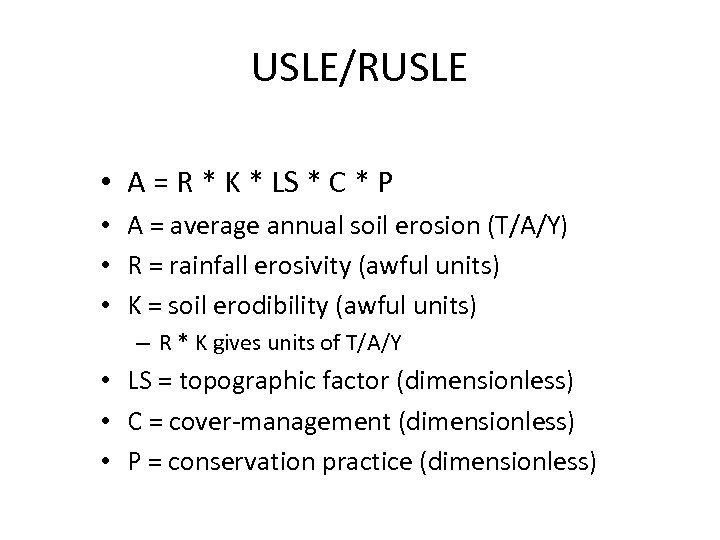 USLE/RUSLE • A = R * K * LS * C * P • A = average annual soil erosion (T/A/Y) • R = rainfall erosivity (awful units) • K = soil erodibility (awful units) – R * K gives units of T/A/Y • LS = topographic factor (dimensionless) • C = cover-management (dimensionless) • P = conservation practice (dimensionless)
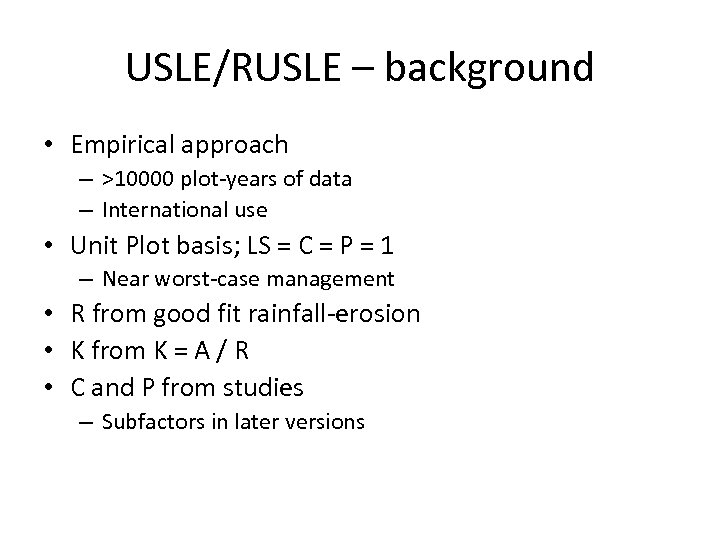 USLE/RUSLE – background • Empirical approach – >10000 plot-years of data – International use • Unit Plot basis; LS = C = P = 1 – Near worst-case management • R from good fit rainfall-erosion • K from K = A / R • C and P from studies – Subfactors in later versions
 USLE/RUSLE – approach • Lookup – Maps, tables, figures – Databases • Process-based calculations – Show changes over time – Where don’t have good data
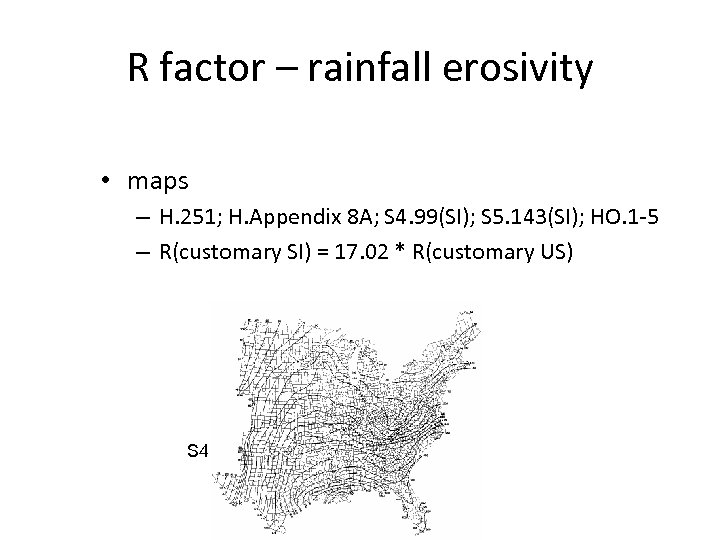 R factor – rainfall erosivity • maps – H. 251; H. Appendix 8 A; S 4. 99(SI); S 5. 143(SI); HO. 1 -5 – R(customary SI) = 17. 02 * R(customary US) S 4
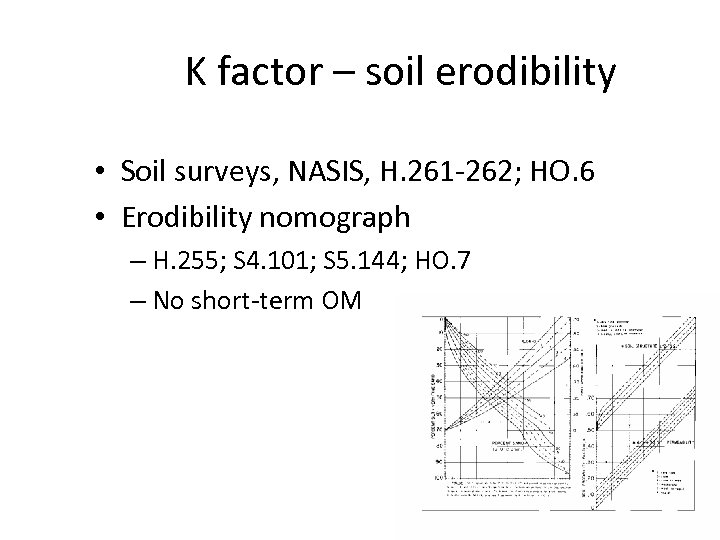 K factor – soil erodibility • Soil surveys, NASIS, H. 261 -262; HO. 6 • Erodibility nomograph – H. 255; S 4. 101; S 5. 144; HO. 7 – No short-term OM
 LS – topography factor • New tables & figures – H. 264; HO. 8 • Know susceptibility to rilling – High for highly disturbed soils – Low for consolidated soils
 C – cover-management factor • Part of normal management scheme • Lookup: S 4. 102; S 5. 146; H. 266; H. Appendix 8; HO. 9 • Change over time
 C – cover-management factor - 2 • Subfactor approach (RUSLE) – C = PLU * CC * SR * SM; all 0 -1 • PLU = prior land use – roots, buried biomass, soil consolidation • CC = canopy cover; % cover & fall height • SC = exp(-b * % cover) – B = 0. 05 if rills dominant; 0. 035 typical; 0. 025 interrill • SR = roughness; set by tillage, reduces over time • SM = soil moisture; used only in NWRR
 P – conservation practice factor • Common practices – Contouring, stripcropping, terraces • Change flow patterns or cause deposition • Lookup tables – S 4. 103; S 5. 146; H. 281; HO. 10
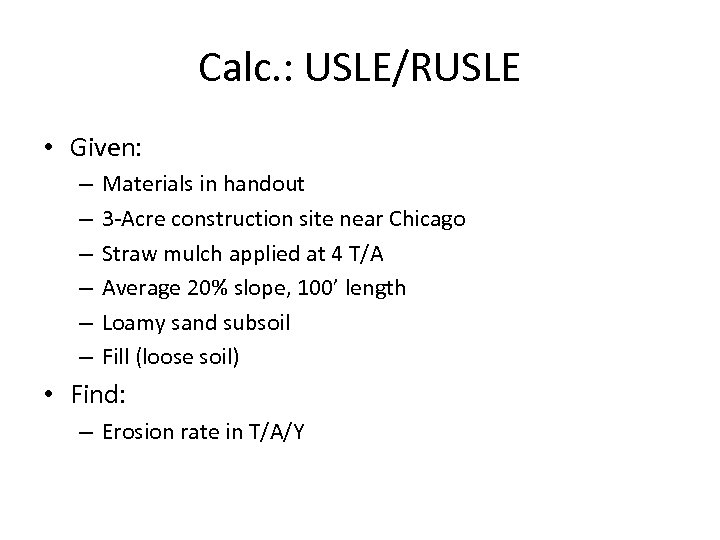 Calc. : USLE/RUSLE • Given: – – – Materials in handout 3 -Acre construction site near Chicago Straw mulch applied at 4 T/A Average 20% slope, 100’ length Loamy sand subsoil Fill (loose soil) • Find: – Erosion rate in T/A/Y
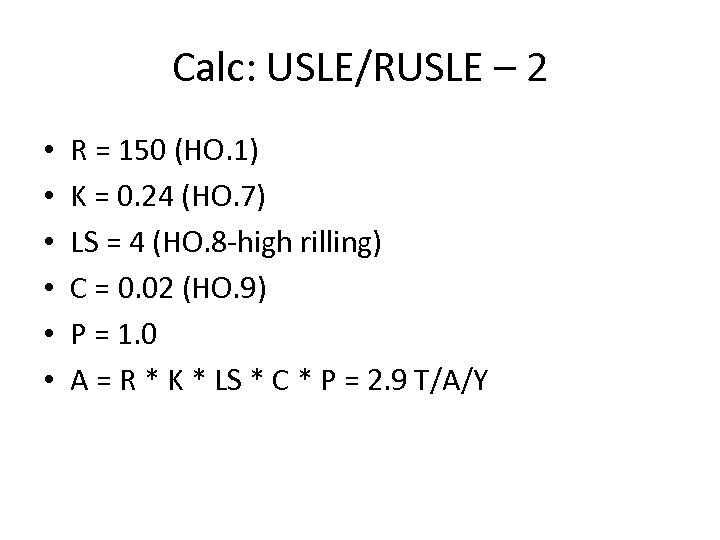 Calc: USLE/RUSLE – 2 • • • R = 150 (HO. 1) K = 0. 24 (HO. 7) LS = 4 (HO. 8 -high rilling) C = 0. 02 (HO. 9) P = 1. 0 A = R * K * LS * C * P = 2. 9 T/A/Y
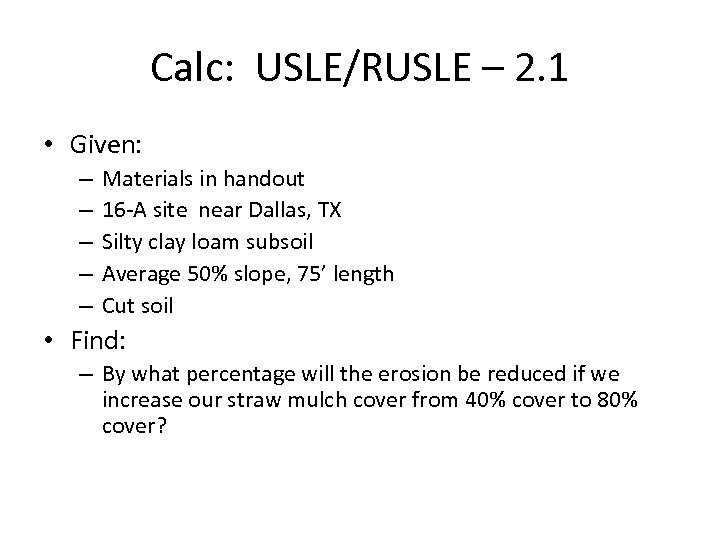 Calc: USLE/RUSLE – 2. 1 • Given: – – – Materials in handout 16 -A site near Dallas, TX Silty clay loam subsoil Average 50% slope, 75’ length Cut soil • Find: – By what percentage will the erosion be reduced if we increase our straw mulch cover from 40% cover to 80% cover?
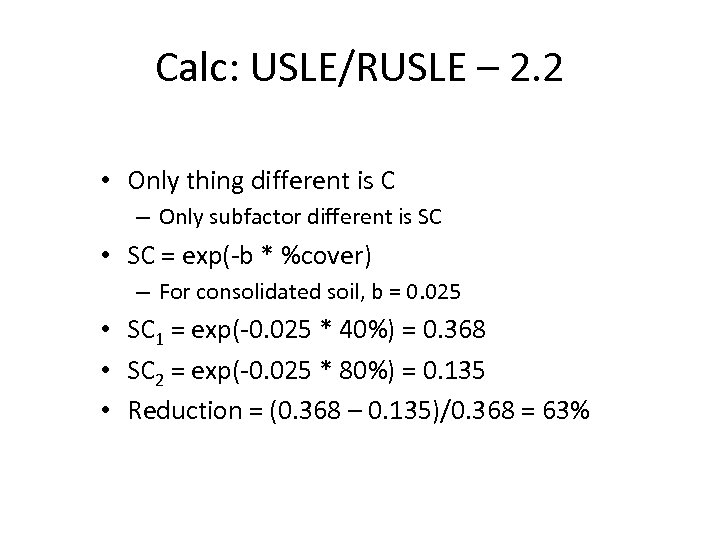 Calc: USLE/RUSLE – 2. 2 • Only thing different is C – Only subfactor different is SC • SC = exp(-b * %cover) – For consolidated soil, b = 0. 025 • SC 1 = exp(-0. 025 * 40%) = 0. 368 • SC 2 = exp(-0. 025 * 80%) = 0. 135 • Reduction = (0. 368 – 0. 135)/0. 368 = 63%
 Sediment delivery • USLE/RUSLE for hillslopes – Erosion – Delivery • Erosion critical for soil resource conservation • Delivery critical for water quality – Movement through channel system
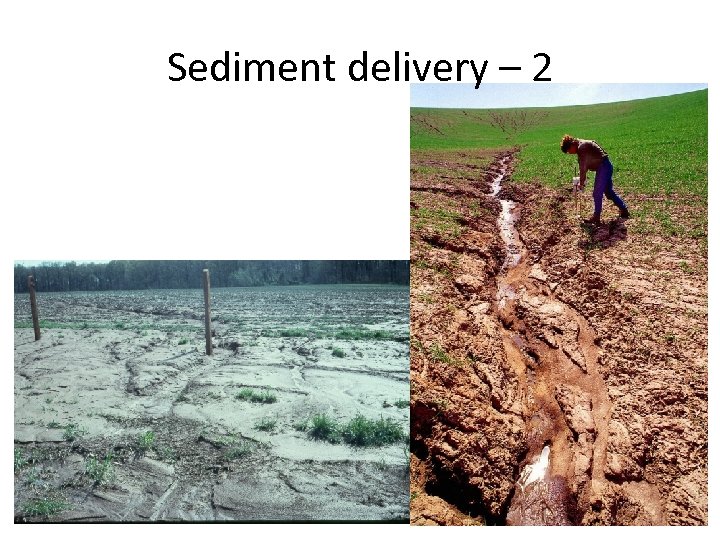 Sediment delivery – 2
 Sediment delivery – 3 • SDR (Sediment Delivery Ratio) – Hillslope erosion – Empirical fit for watershed delivery • Channel erosion/deposition modeling – Erosion – Transport – Deposition
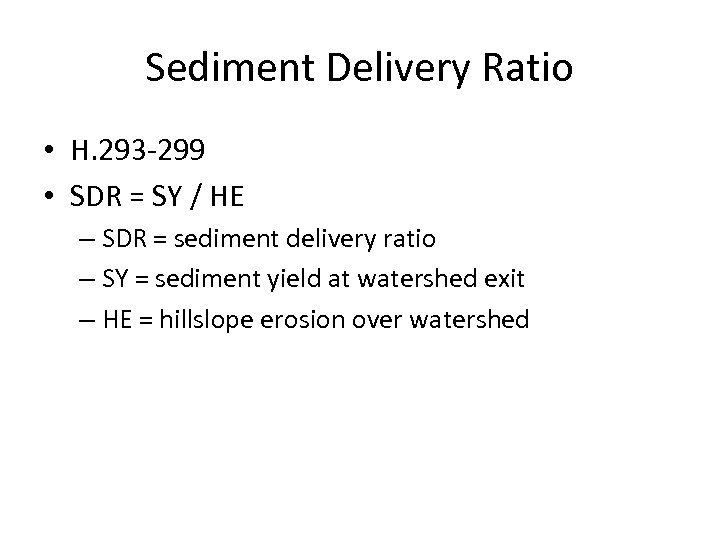 Sediment Delivery Ratio • H. 293 -299 • SDR = SY / HE – SDR = sediment delivery ratio – SY = sediment yield at watershed exit – HE = hillslope erosion over watershed
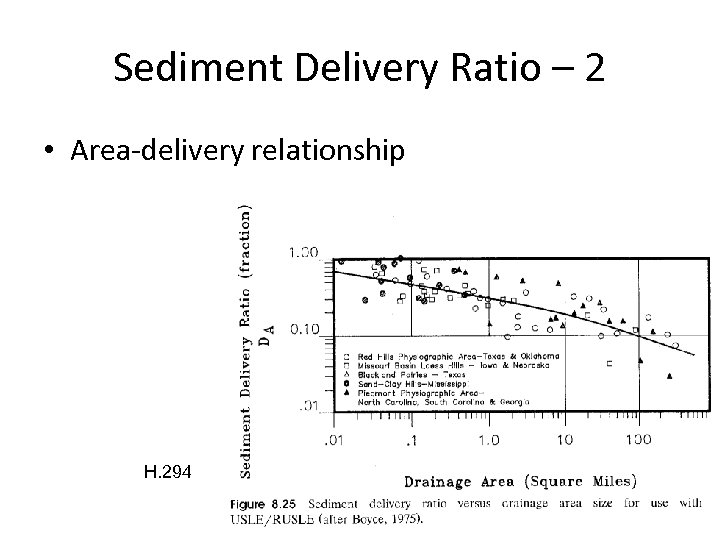 Sediment Delivery Ratio – 2 • Area-delivery relationship H. 294
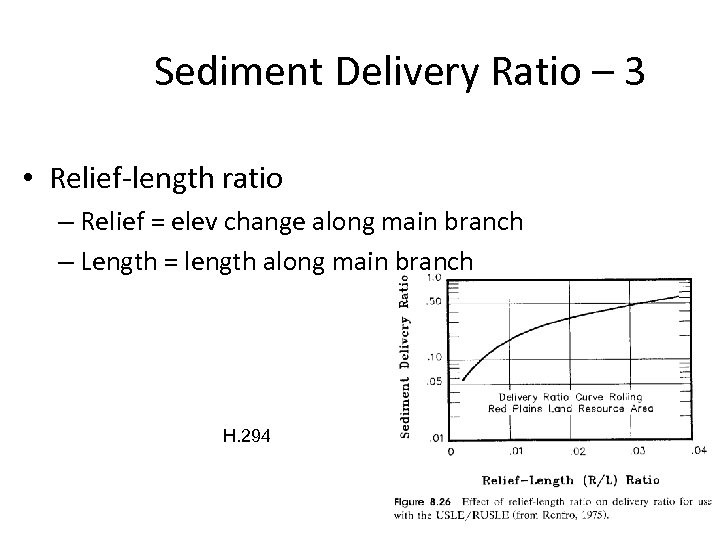 Sediment Delivery Ratio – 3 • Relief-length ratio – Relief = elev change along main branch – Length = length along main branch H. 294
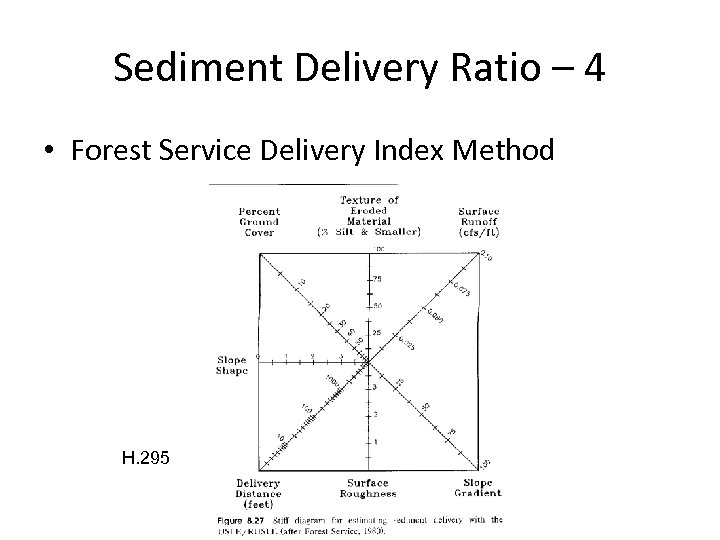 Sediment Delivery Ratio – 4 • Forest Service Delivery Index Method H. 295
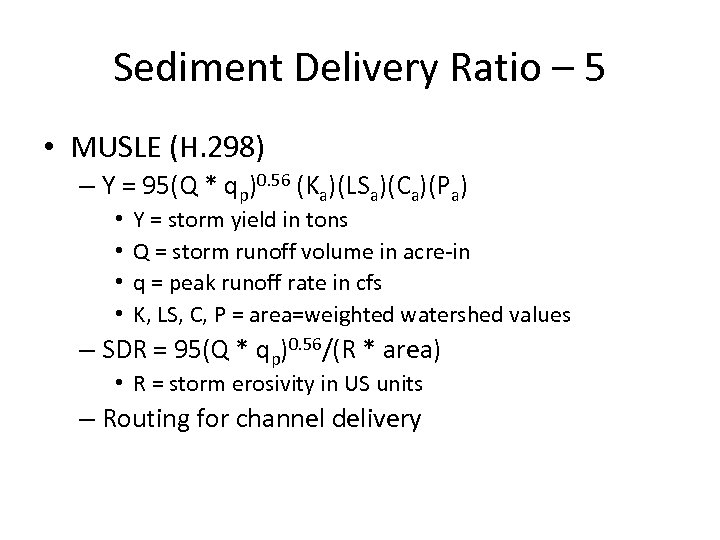 Sediment Delivery Ratio – 5 • MUSLE (H. 298) – Y = 95(Q * qp)0. 56 (Ka)(LSa)(Ca)(Pa) • • Y = storm yield in tons Q = storm runoff volume in acre-in q = peak runoff rate in cfs K, LS, C, P = area=weighted watershed values – SDR = 95(Q * qp)0. 56/(R * area) • R = storm erosivity in US units – Routing for channel delivery
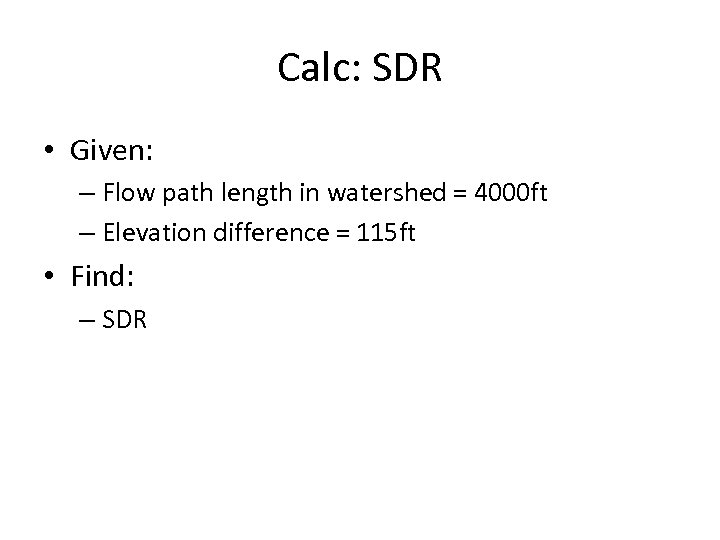 Calc: SDR • Given: – Flow path length in watershed = 4000 ft – Elevation difference = 115 ft • Find: – SDR
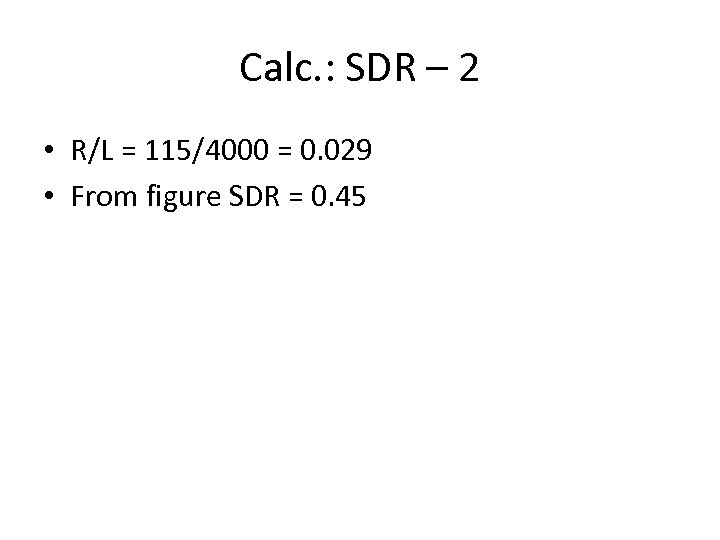 Calc. : SDR – 2 • R/L = 115/4000 = 0. 029 • From figure SDR = 0. 45
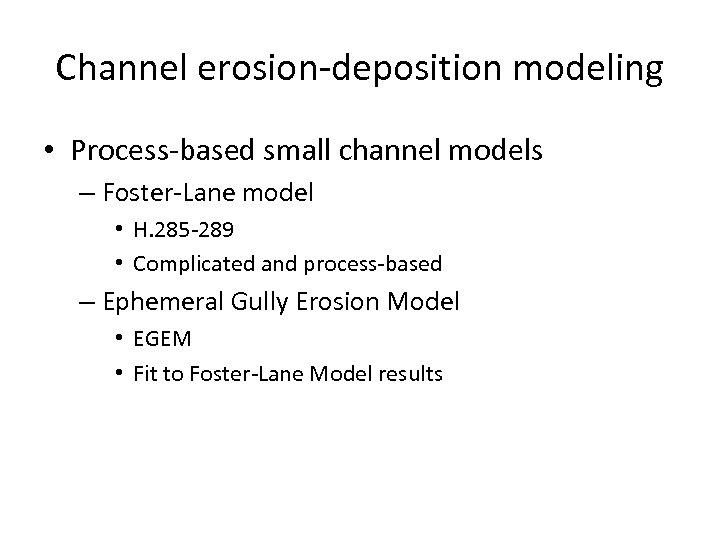 Channel erosion-deposition modeling • Process-based small channel models – Foster-Lane model • H. 285 -289 • Complicated and process-based – Ephemeral Gully Erosion Model • EGEM • Fit to Foster-Lane Model results
 Channel erosion-deposition modeling – 2 • Large-channel models – Sediment transport – Channel morphology
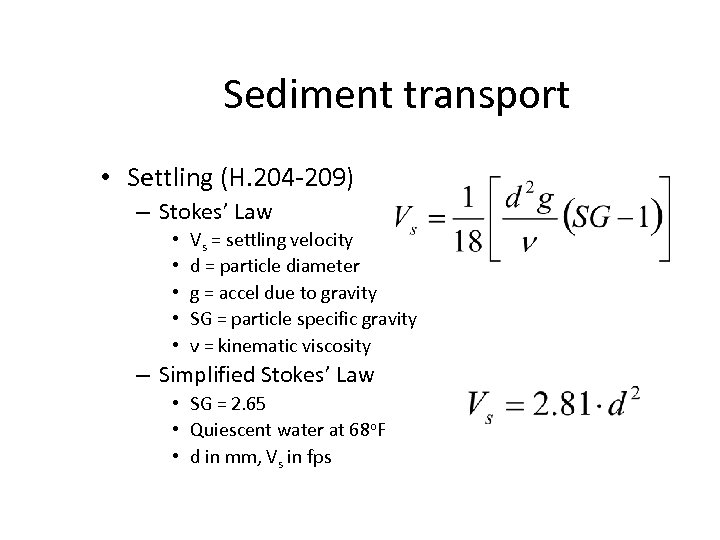 Sediment transport • Settling (H. 204 -209) – Stokes’ Law • • • Vs = settling velocity d = particle diameter g = accel due to gravity SG = particle specific gravity ν = kinematic viscosity – Simplified Stokes’ Law • SG = 2. 65 • Quiescent water at 68 o. F • d in mm, Vs in fps
 Calc. : Stokes’ Law settling • Given: – ISSS soil particle size classification • Find: – Settling velocities of largest sand, silt, and clay particles
 Calc. : Stokes’ Law settling – 2 • ISSS classification – Largest particles size • Clay = 0. 002 mm • Silt = 0. 2 mm • Sand = 2 mm – Vs, clay = 1. 12*10 -4 fps = 0. 04 ft/hr = 0. 97 ft/day – Vs, silt = 0. 11 fps = 405 ft/hr = 1. 83 mi/day – Vs, sand = 11. 24 fps = 7. 66 mph = 184 mi/day
 Calc. : Stokes’ Law settling • Given: – Stokes’ Law settling • Find: particles larger than what size can be assumed to settle 1 ft in one hour?
 Calc. : Stokes’ Law settling – 2 • Vs = [(1 ft)/(1 hr)](1 hr/3600 s) = 2. 778*10 -4 fps • d = (Vs/2. 81)1/2 = 0. 00994 mm
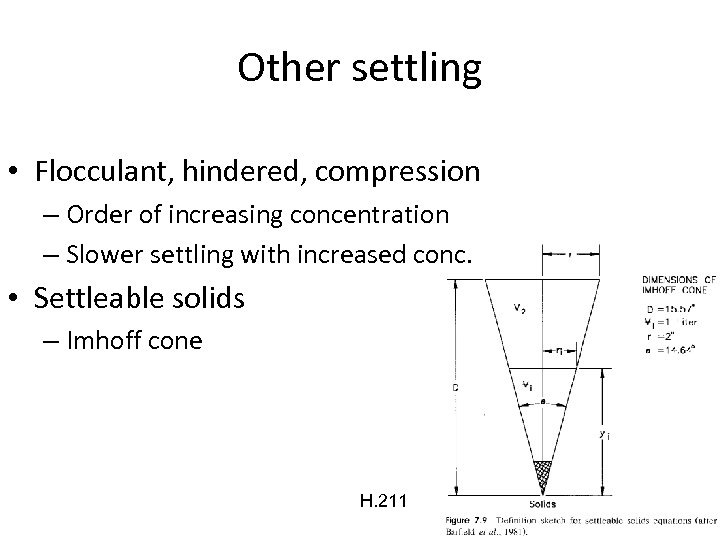 Other settling • Flocculant, hindered, compression – Order of increasing concentration – Slower settling with increased conc. • Settleable solids – Imhoff cone H. 211
 Sediment transport relationships • H. 223 -233 • Bedload – Einstein equation • Suspended load • Total load – Yalin total load equation • Vavg, d, SG, r, т, тc – Yang stream power relationship • Stream power instead of critical shear
 Channel morphology • H. 391 -419 • Channel cross-section – Width B, depth D, avg. vel. U, suspended sediment load qs, flow rate q – B = C a * q a, D = C b * q b , U = C c * q c , qs = Cd * q d – Ca, Cb, Cc, Cd, a, b, c, d = fit coefficients & exponents
 Channel morphology – 2 • Channel-forming discharge – Greatest impact on channel itself – Return period ≈ 1. 5 years • Channel roughness
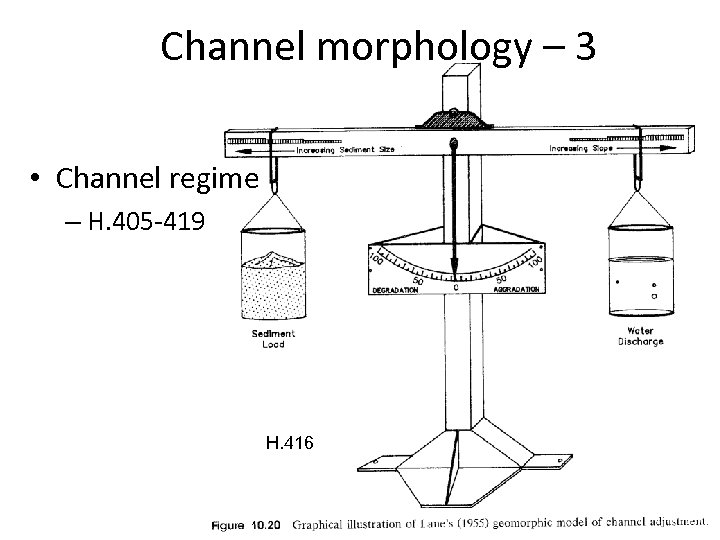 Channel morphology – 3 • Channel regime – H. 405 -419 H. 416
 Application of process knowledge to control • Limit individual parts to limit whole – Limit detachment – Limit transport • Enhance deposition strategically – Where damage is minimal – Where cleanup is possible
 Control of Soil Erosion by Water • Detachment limiting strategies – Reduce raindrop impact (“Stop the Drops”) – Reduce runoff – Reduce detachment capacity of runoff – Increase soil resistance to erosive forces • Transport limiting strategies – Reduce runoff volume – Reduce runoff transport capacity (“Slow the Flow”)
 Example – No-Till • Detachment – Raindrop impact detachment is very low due to high surface cover percentage – Flow shear detachment is low due to low velocities caused by tortuous flow path – Soil is resistant to erosion because of low disturbance • Transport – Raindrop transport is limited by surface residue – Flow transport is limited by increased infiltration, lessening runoff – Flow transport is further limited by small dams created by surface residue
 Example – Mulch on newly seeded area • Detachment – Raindrop impact detachment is very low due to high surface cover percentage – Flow shear detachment is low due to low velocities caused by tortuous flow path • Transport – Raindrop transport is limited by surface residue – Flow transport is limited by increased infiltration, lessening runoff – Flow transport is further limited by small dams created by surface residue
 Comparison of no-till vs. mulch • Detachment – Likely higher with mulch for same surface cover fraction because of higher soil disturbance for seedbed preparation – Likely higher for no-till following dry years because amount of residue cover is dictated by prior year crop growth • Transport – Likely higher for mulch, unless “cut” in because no-till residue is effectively “cut” in during planting, at least for a small area, hopefully across slope – Likely higher for mulch situation because seedbed prep likely reduced average aggregate diameter
 Control of Sediment in Runoff • Reduce transport capacity of flow • Enhance deposition of sediment
 Reduce transport capacity • Slow the flow – Barriers • Must let water pass, though slowly • Must be flow-stable, even after use • Must be where maintenance is possible – Reduce slope steepness • Channel must be of adequate capacity • Increase infiltration
 Enhance deposition of sediment • Use flocculant to increase sedimentation – Usually in sedimentation ponds when other methods are not adequate – Expensive…
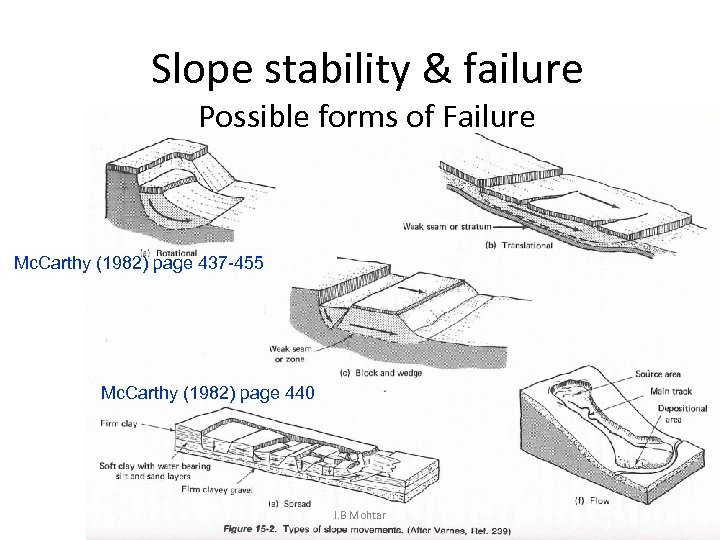 Slope stability & failure Possible forms of Failure Mc. Carthy (1982) page 437 -455 Mc. Carthy (1982) page 440 I. B Mohtar 90
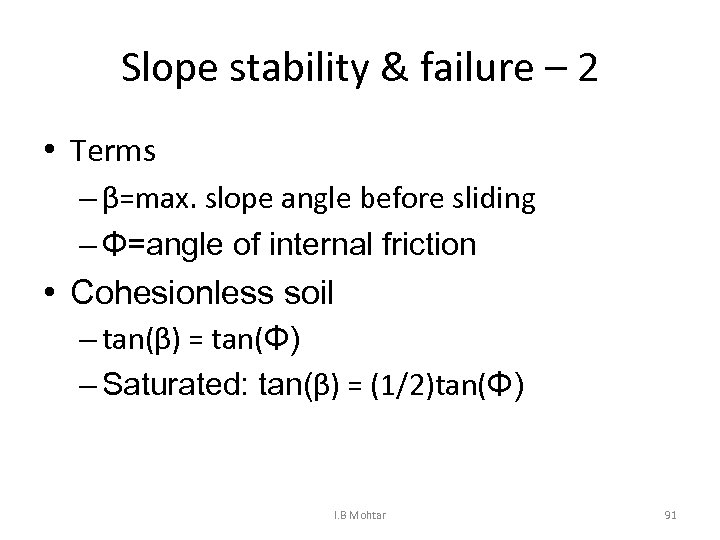 Slope stability & failure – 2 • Terms – β=max. slope angle before sliding – Φ=angle of internal friction • Cohesionless soil – tan(β) = tan(Φ) – Saturated: tan(β) = (1/2)tan(Φ) I. B Mohtar 91
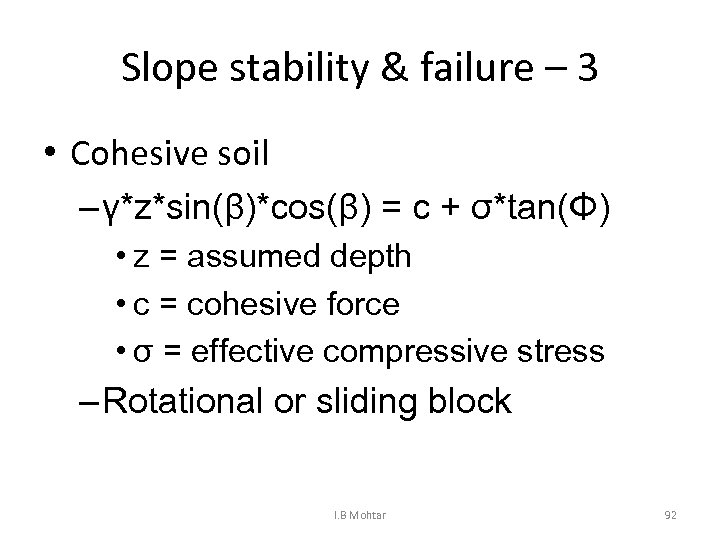 Slope stability & failure – 3 • Cohesive soil – γ*z*sin(β)*cos(β) = c + σ*tan(Φ) • z = assumed depth • c = cohesive force • σ = effective compressive stress – Rotational or sliding block I. B Mohtar 92
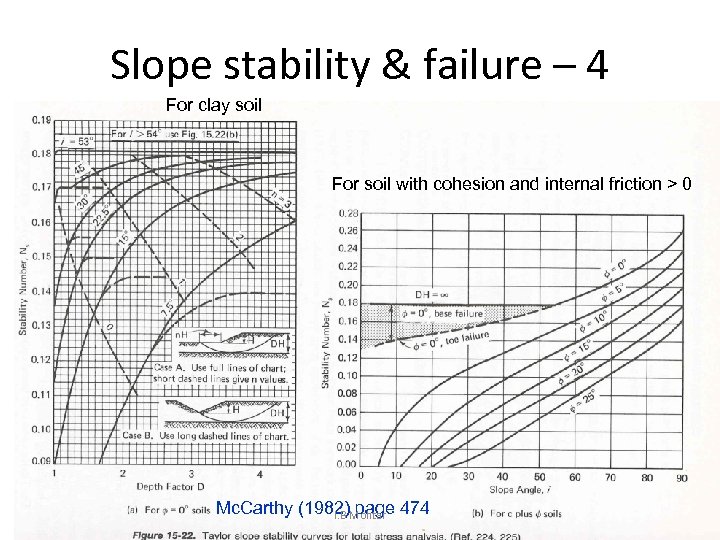 Slope stability & failure – 4 For clay soil For soil with cohesion and internal friction > 0 Mc. Carthy (1982)Mohtar 474 I. B page 93
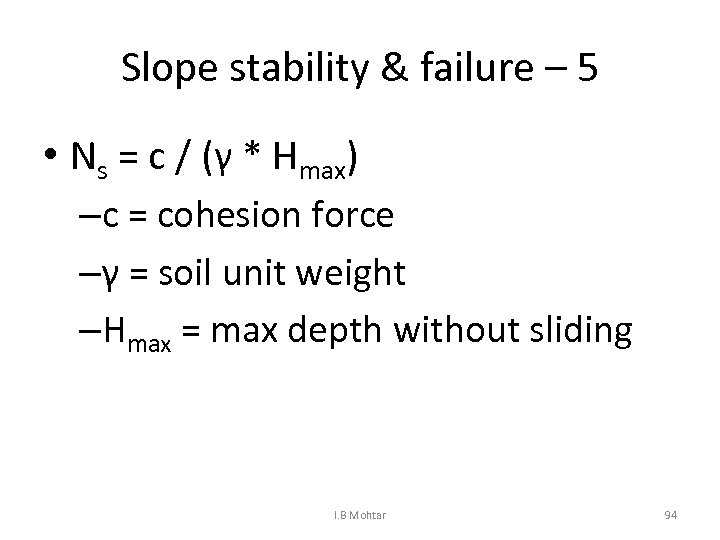 Slope stability & failure – 5 • Ns = c / (γ * Hmax) –c = cohesion force –γ = soil unit weight –Hmax = max depth without sliding I. B Mohtar 94
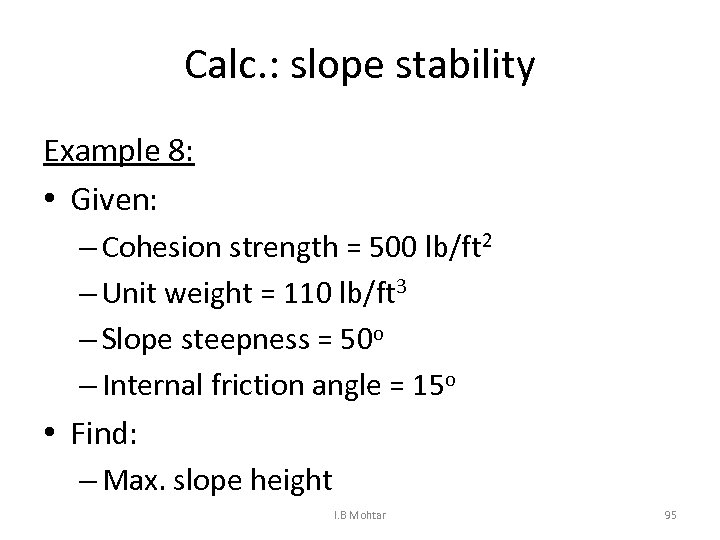 Calc. : slope stability Example 8: • Given: – Cohesion strength = 500 lb/ft 2 – Unit weight = 110 lb/ft 3 – Slope steepness = 50 o – Internal friction angle = 15 o • Find: – Max. slope height I. B Mohtar 95
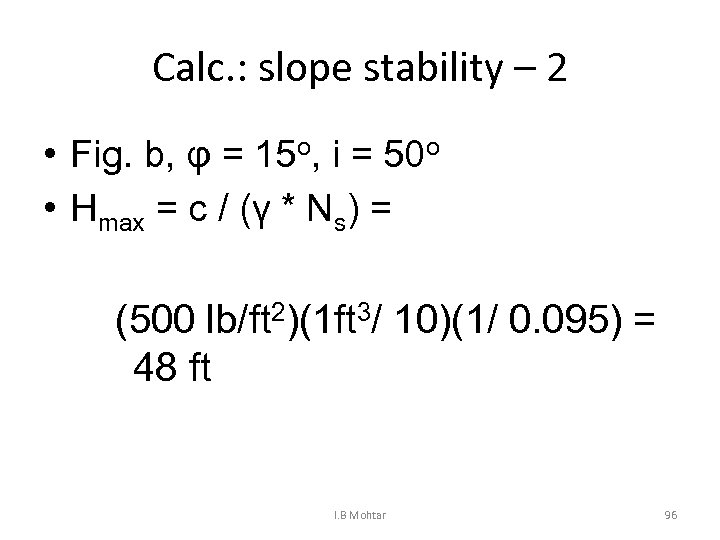 Calc. : slope stability – 2 • Fig. b, φ = 15 o, i = 50 o • Hmax = c / (γ * Ns) = (500 lb/ft 2)(1 ft 3/ 10)(1/ 0. 095) = 48 ft I. B Mohtar 96
 Questions?