


 Скачать презентацию 2011 -2012 Massachusetts Acute Care Hospital Healthcare Employees
6ee582dd6e1ee31894ca2f5046ccad39.ppt
- Количество слайдов: 21
 2011 -2012 Massachusetts Acute Care Hospital Healthcare Employees Influenza Vaccination Update Public Health Council May 9, 2012 Iyah Romm Director of Policy, Health Planning, and Strategic Development Bureau of Health Care Safety and Quality
 Massachusetts Department of Public Health Presentation Overview • Reporting: Background and Context • Acute Care Hospital 2011 -2012 Employee Vaccination • Next Steps
 Massachusetts Department of Public Health Why Healthcare Personnel Vaccination? • Healthcare personnel (HCP) may be an important source of transmission of the influenza virus. • The most effective method of preventing influenza and its potentially serious complications is annual immunization. • As well as protecting patients, vaccination of HCP has been shown to reduce absenteeism among healthy workers, resulting in financial savings to healthcare facilities. • Despite the strong recommendation of major public health agencies, professional societies and healthcare organizations for annual, universal immunization of healthcare workers against influenza, overall rates of immunization among healthcare workers has remained low. • Identified as a measure of patient safety and is the right thing to do!
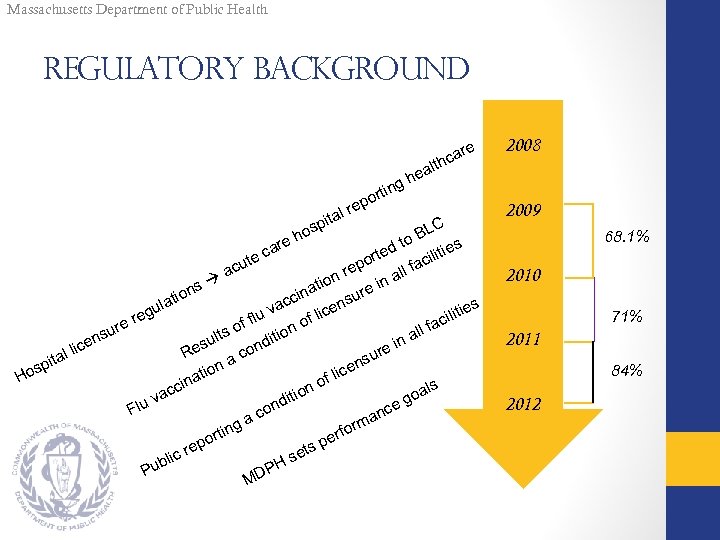 Massachusetts Department of Public Health Regulatory Background e car h 2008 lt in rt po re l pita s a he g C BL to es c ted r iliti e c ut po ll fa re ac n a s atio ure in in on lati acc icens es u eg iliti lu v of l c r f f ure ll fa s o on lt a iti ns esu cond e in lice r l R nsu pita n a s tio lice Ho na of ci ls n oa itio vac g d Flu nce con a a ng orm rf rti po pe ts re lic se b H Pu DP M 2009 ho re a 68. 1% 2010 71% 2011 84% 2012
 Massachusetts Department of Public Health 2011 -2012 MDPH Established Acute Care Hospital Performance Goal • Overall goal is for acute care hospital healthcare employee vaccination rates to be greater than 90% • No hospital will report a rate less than 73%, which is 2 percentage points above the Massachusetts average rate in 2010 -2011
 Massachusetts Department of Public Health Influenza Reporting Requirements 2011 -2012 • Acute care hospitals must report: • the total # of employees at the facility as of December 31, 2011. • the # of employees vaccinated between 8/1/2011 and 3/31/2012. • the # of employees vaccinated by the hospital between 8/1/2011 and 3/31/2012. • the # of employees vaccinated outside the hospital between 8/1/2011 and 3/31/2012. • the # of employees who declined influenza vaccination during the 20112012 flu season.
 Massachusetts Department of Public Health Definition of an Employee • Employees are defined as part and full time individuals who are on the facility payroll as of December 31, 2011. • Employees with no direct patient contact need to be included in both the total number of employees and the number of employees vaccinated.
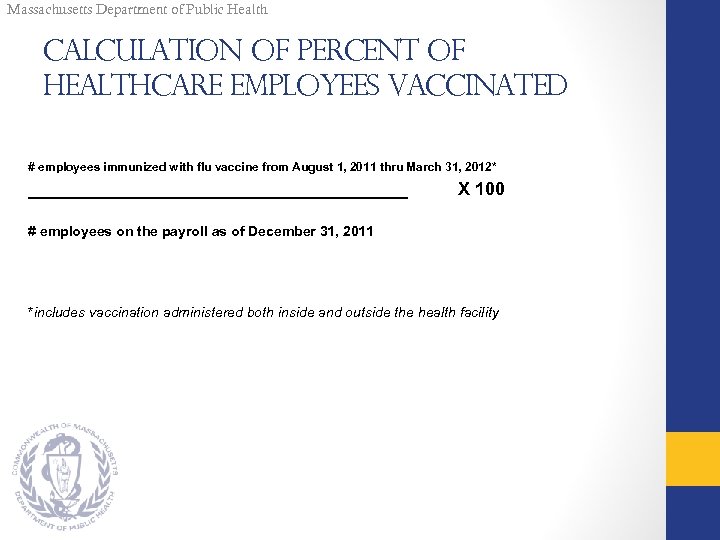 Massachusetts Department of Public Health Calculation of Percent of Healthcare Employees Vaccinated # employees immunized with flu vaccine from August 1, 2011 thru March 31, 2012* ___________________ X 100 # employees on the payroll as of December 31, 2011 *includes vaccination administered both inside and outside the health facility
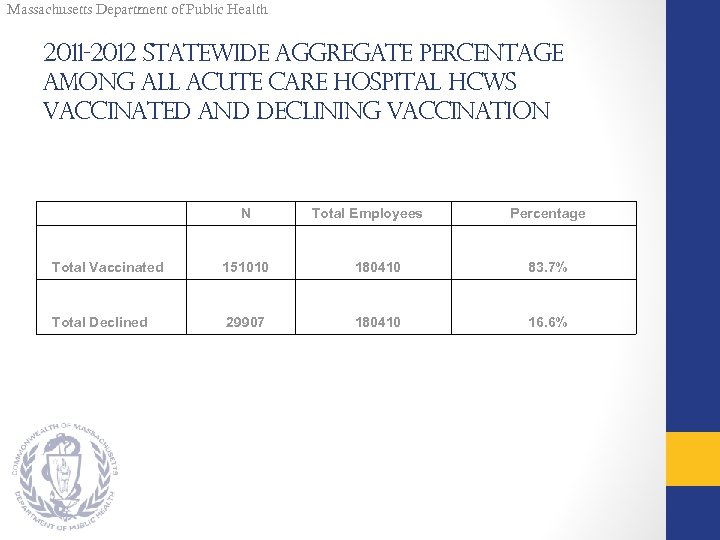 Massachusetts Department of Public Health 2011 -2012 Statewide aggregate Percentage among all acute care hospital HCWs Vaccinated and Declining Vaccination N Total Employees Percentage Total Vaccinated 151010 180410 83. 7% Total Declined 29907 180410 16. 6%
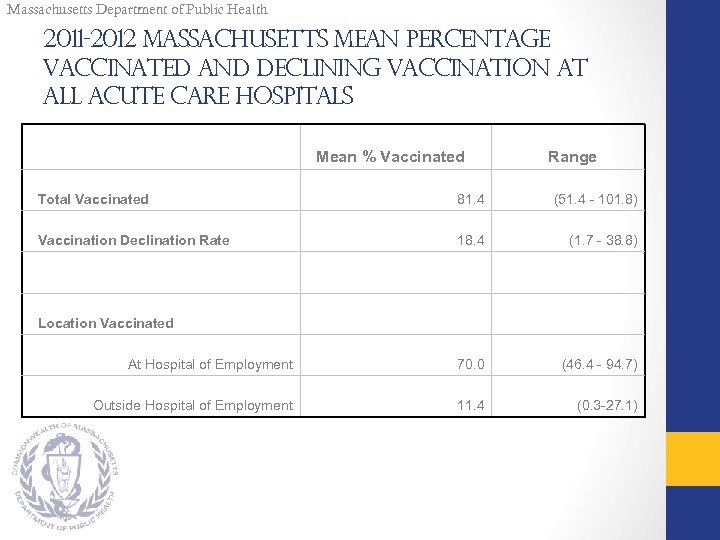 Massachusetts Department of Public Health 2011 -2012 Massachusetts Mean Percentage Vaccinated and Declining Vaccination at all Acute Care Hospitals Mean % Vaccinated Range Total Vaccinated 81. 4 (51. 4 - 101. 8) Vaccination Declination Rate 18. 4 (1. 7 - 38. 8) Location Vaccinated At Hospital of Employment 70. 0 (46. 4 - 94. 7) Outside Hospital of Employment 11. 4 (0. 3 -27. 1)
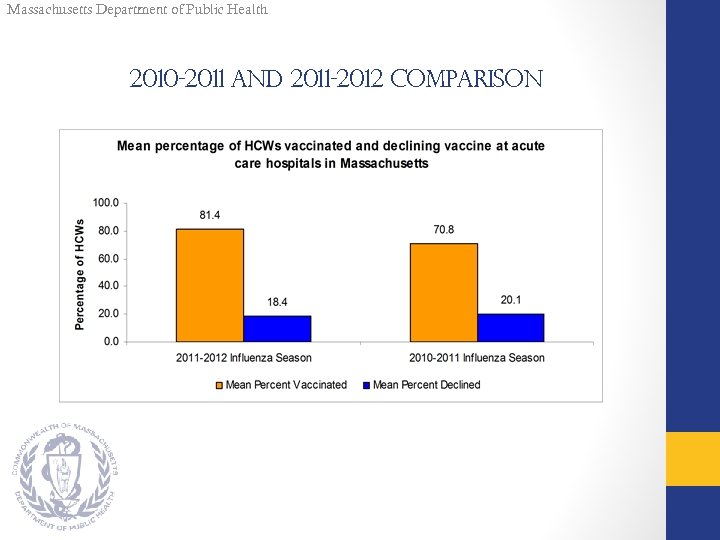 Massachusetts Department of Public Health 2010 -2011 and 2011 -2012 Comparison
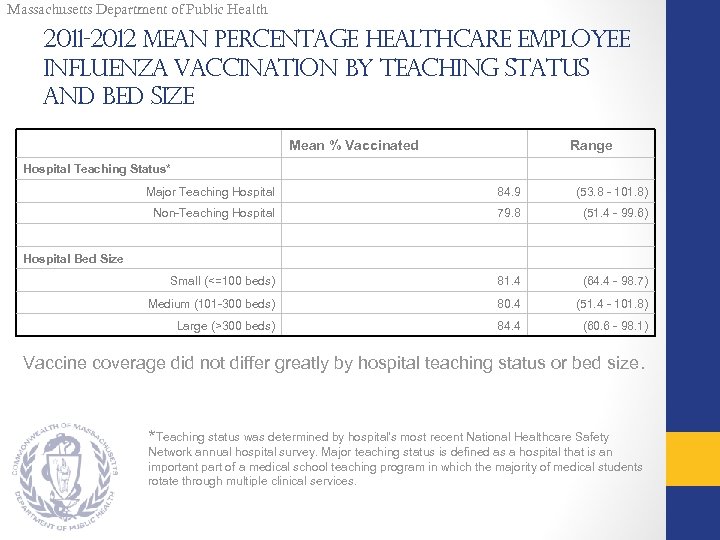 Massachusetts Department of Public Health 2011 -2012 Mean percentage Healthcare Employee Influenza Vaccination by Teaching Status and Bed Size Mean % Vaccinated Hospital Teaching Status* Range Major Teaching Hospital 84. 9 (53. 8 - 101. 8) Non-Teaching Hospital 79. 8 (51. 4 - 99. 6) Hospital Bed Size Small (<=100 beds) 81. 4 (64. 4 - 98. 7) Medium (101 -300 beds) 80. 4 (51. 4 - 101. 8) Large (>300 beds) 84. 4 (60. 6 - 98. 1) Vaccine coverage did not differ greatly by hospital teaching status or bed size. *Teaching status was determined by hospital’s most recent National Healthcare Safety Network annual hospital survey. Major teaching status is defined as a hospital that is an important part of a medical school teaching program in which the majority of medical students rotate through multiple clinical services.
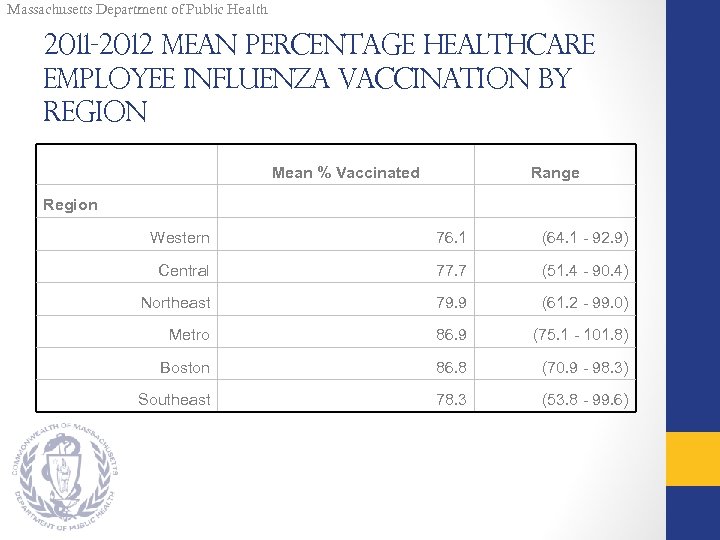 Massachusetts Department of Public Health 2011 -2012 Mean Percentage Healthcare Employee Influenza Vaccination by Region Mean % Vaccinated Region Range Western 76. 1 (64. 1 - 92. 9) Central 77. 7 (51. 4 - 90. 4) Northeast 79. 9 (61. 2 - 99. 0) Metro 86. 9 (75. 1 - 101. 8) Boston 86. 8 (70. 9 - 98. 3) Southeast 78. 3 (53. 8 - 99. 6)
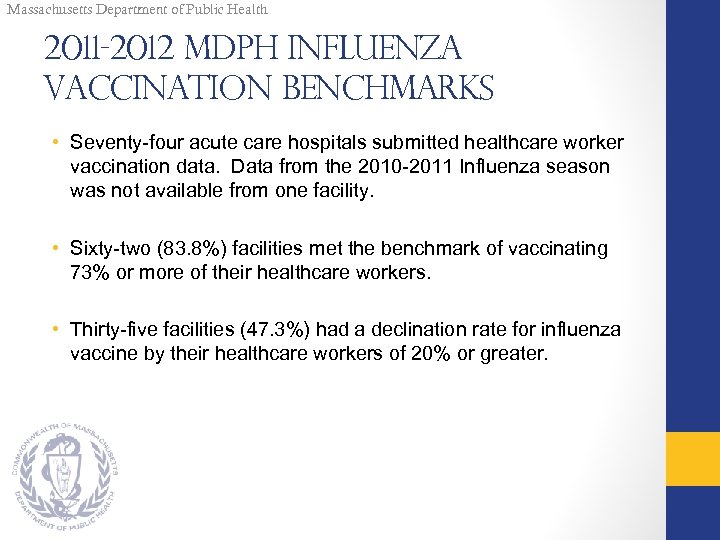 Massachusetts Department of Public Health 2011 -2012 MDPH Influenza Vaccination Benchmarks • Seventy-four acute care hospitals submitted healthcare worker vaccination data. Data from the 2010 -2011 Influenza season was not available from one facility. • Sixty-two (83. 8%) facilities met the benchmark of vaccinating 73% or more of their healthcare workers. • Thirty-five facilities (47. 3%) had a declination rate for influenza vaccine by their healthcare workers of 20% or greater.
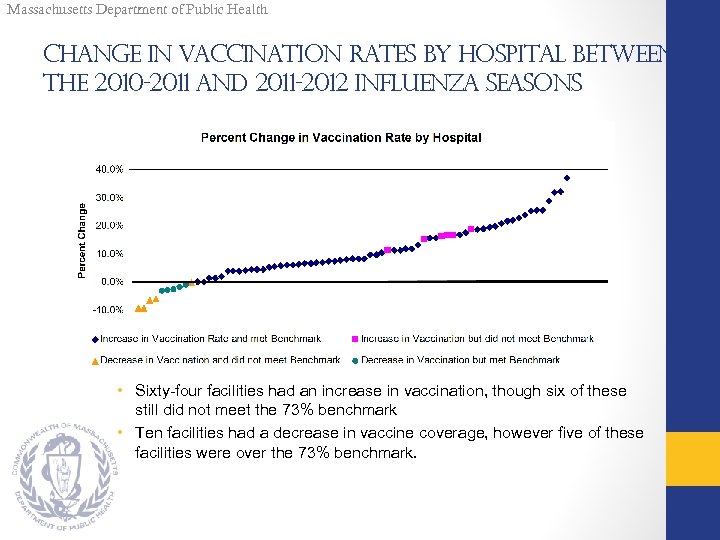 Massachusetts Department of Public Health Change in Vaccination Rates by Hospital between the 2010 -2011 and 2011 -2012 Influenza Seasons • Sixty-four facilities had an increase in vaccination, though six of these still did not meet the 73% benchmark • Ten facilities had a decrease in vaccine coverage, however five of these facilities were over the 73% benchmark.
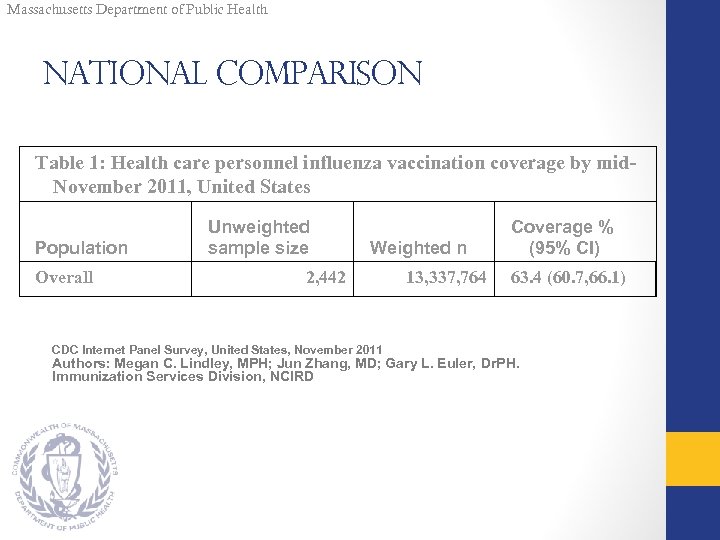 Massachusetts Department of Public Health National Comparison Table 1: Health care personnel influenza vaccination coverage by mid. November 2011, United States Population Overall Unweighted sample size Weighted n 2, 442 CDC Internet Panel Survey, United States, November 2011 13, 337, 764 Coverage % (95% CI) 63. 4 (60. 7, 66. 1) Authors: Megan C. Lindley, MPH; Jun Zhang, MD; Gary L. Euler, Dr. PH. Immunization Services Division, NCIRD
 Massachusetts Department of Public Health Best Practices for increasing influenza vaccination rates among healthcare workers • MDPH contacted hospitals that have been particularly effective in increasing influenza vaccination rates among healthcare workers • Outreach to high performers reporting greater than 90% influenza vaccination coverage • Effective sharing of best practices can help organizations to design and implement successful programs • Key lessons from successful programs can help others replicate success
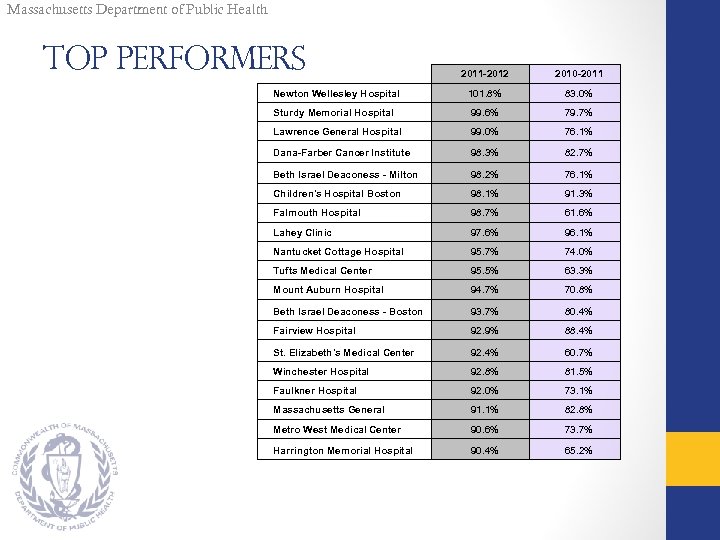 Massachusetts Department of Public Health Top Performers 2011 -2012 2010 -2011 Newton Wellesley Hospital 101. 8% 83. 0% Sturdy Memorial Hospital 99. 6% 79. 7% Lawrence General Hospital 99. 0% 76. 1% Dana-Farber Cancer Institute 98. 3% 82. 7% Beth Israel Deaconess - Milton 98. 2% 76. 1% Children's Hospital Boston 98. 1% 91. 3% Falmouth Hospital 98. 7% 61. 6% Lahey Clinic 97. 6% 96. 1% Nantucket Cottage Hospital 95. 7% 74. 0% Tufts Medical Center 95. 5% 63. 3% Mount Auburn Hospital 94. 7% 70. 8% Beth Israel Deaconess - Boston 93. 7% 80. 4% Fairview Hospital 92. 9% 88. 4% St. Elizabeth's Medical Center 92. 4% 60. 7% Winchester Hospital 92. 8% 81. 5% Faulkner Hospital 92. 0% 73. 1% Massachusetts General 91. 1% 82. 8% Metro West Medical Center 90. 6% 73. 7% Harrington Memorial Hospital 90. 4% 65. 2%
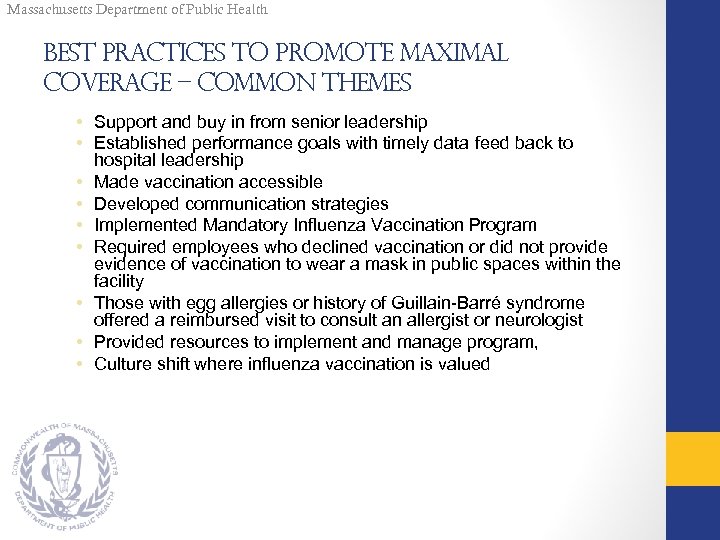 Massachusetts Department of Public Health Best Practices to Promote Maximal Coverage – Common Themes • Support and buy in from senior leadership • Established performance goals with timely data feed back to hospital leadership • Made vaccination accessible • Developed communication strategies • Implemented Mandatory Influenza Vaccination Program • Required employees who declined vaccination or did not provide evidence of vaccination to wear a mask in public spaces within the facility • Those with egg allergies or history of Guillain-Barré syndrome offered a reimbursed visit to consult an allergist or neurologist • Provided resources to implement and manage program, • Culture shift where influenza vaccination is valued
 Massachusetts Department of Public Health Next Steps • MDPH will contact Chief Quality Officers (or Chief Medical Officers) in underperforming hospitals to offer technical support • Letters of commendation will be sent to hospitals reporting greater than 90% influenza vaccination coverage and to the top 10% of hospitals reporting the greatest improvement when compared to data collected during 2010 -2011 • Letters will be sent to all hospitals that failed to meet the established MDPH performance goal • Complete follow-up and data analysis in additional licensed healthcare facilities (ambulatory surgical centers, clinics, dialysis long term care facilities and nonacute hospitals)
 Massachusetts Department of Public Health Thank you Massachusetts Department of Public Health Bureau of Health Care Safety & Quality 99 Chauncy Street, 11 th Floor Boston, MA 02111 617. 753. 8000 For Further Information, Please Contact Iyah Romm Director of Policy, Health Planning and Strategic Development (iyah. romm@state. ma. us)