


 Скачать презентацию 2010_ISOE_Asian ALARA Symposium Current Status of Radiological Protection
3e5dd93184cb8b8950fab17dc18eea65.ppt
- Количество слайдов: 36
 2010_ISOE_Asian ALARA Symposium Current Status of Radiological Protection in NPPs of Korea 2010. 8. 31 Byoung-il, Lee Korea Hydro & Nuclear Power Co. , LTD Radiation Health Research Institute
 Contents 3 3 3 National accreditation program of radiation dosimetry system NPP’s ALARA program 3 Exposure trends of NPP workers 3 RHRI’s activity for NPP’s RP
 Current Status of Radiological Protection in NPPs in Korea National accreditation program of radiation dosimetry system KHNP - Radiation Health Research Institute
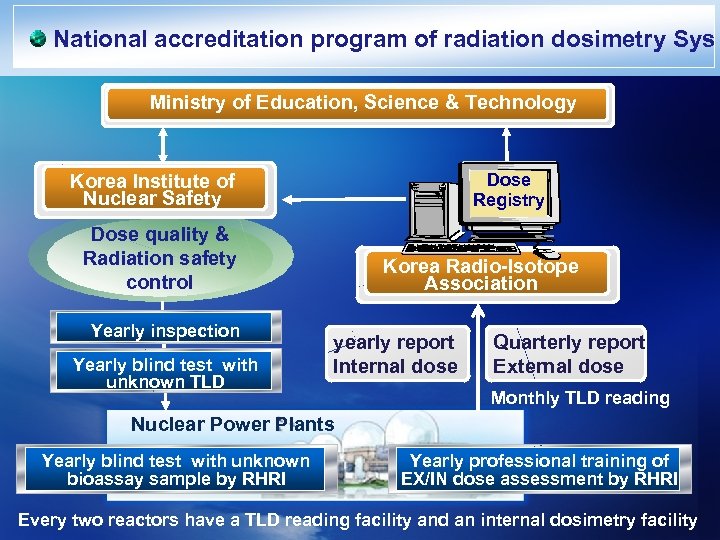 National accreditation program of radiation dosimetry Sys Ministry of Education, Science & Technology Korea Institute of Nuclear Safety Dose Registry Dose quality & Radiation safety control Yearly inspection Yearly blind test with unknown TLD Korea Radio-Isotope Association yearly report Internal dose Quarterly report External dose Monthly TLD reading Nuclear Power Plants Yearly blind test with unknown bioassay sample by RHRI Yearly professional training of EX/IN dose assessment by RHRI Every two reactors have a TLD reading facility and an internal dosimetry facility
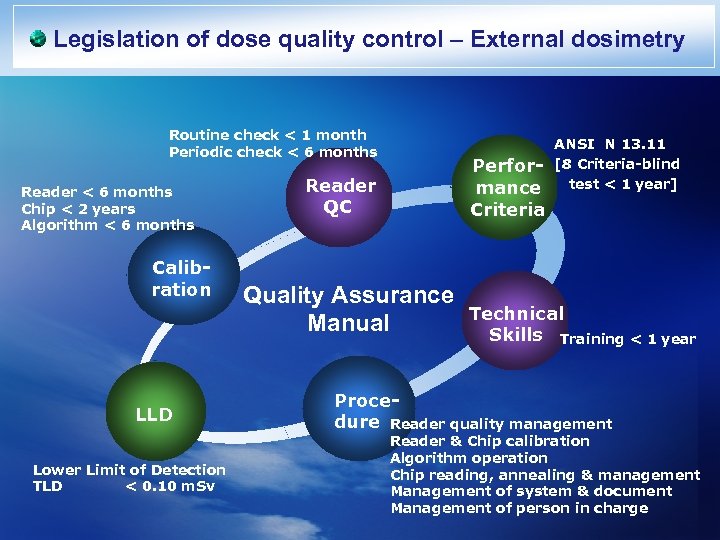 Legislation of dose quality control – External dosimetry Routine check < 1 month Periodic check < 6 months Reader < 6 months Chip < 2 years Algorithm < 6 months Calibration LLD Lower Limit of Detection TLD < 0. 10 m. Sv Performance Criteria Reader QC Quality Assurance Manual ANSI N 13. 11 [8 Criteria-blind test < 1 year] Technical Skills Training < 1 year Procedure Reader quality management Reader & Chip calibration Algorithm operation Chip reading, annealing & management Management of system & document Management of person in charge
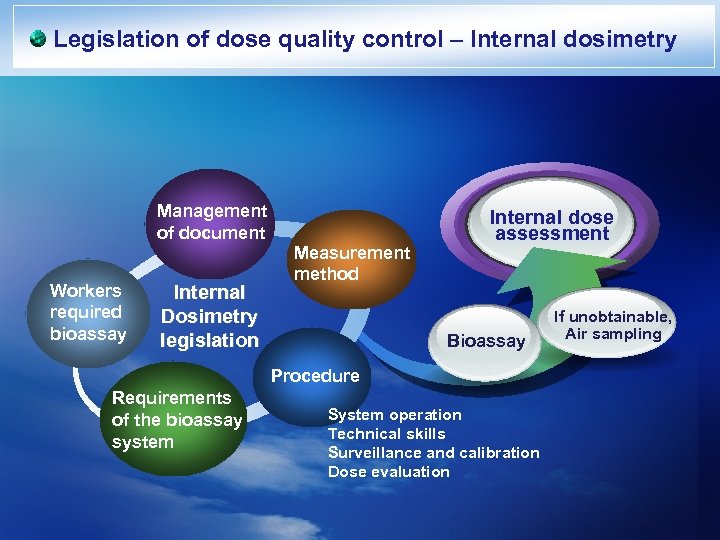 Legislation of dose quality control – Internal dosimetry Management of document Workers required bioassay Internal Dosimetry legislation Measurement method Internal dose assessment Bioassay Procedure Requirements of the bioassay system System operation Technical skills Surveillance and calibration Dose evaluation If unobtainable, Air sampling
 Current Status of Radiological Protection in NPPs in Korea NPP’s dosimetry system KHNP - Radiation Health Research Institute
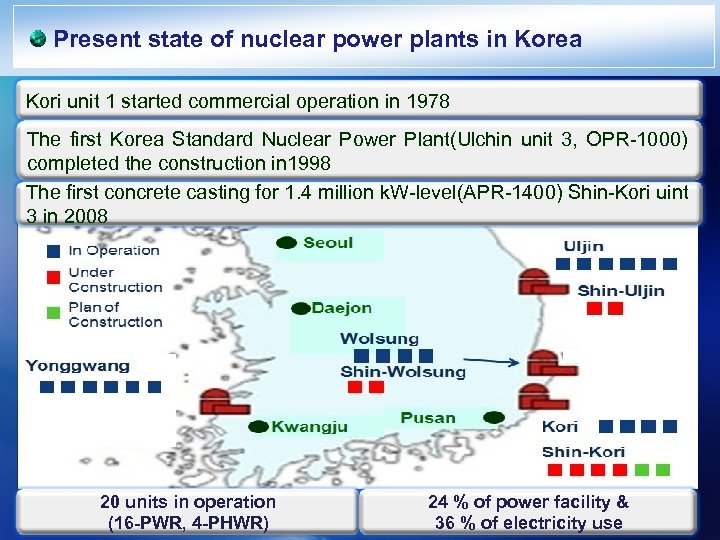 Present state of nuclear power plants in Korea Kori unit 1 started commercial operation in 1978 The first Korea Standard Nuclear Power Plant(Ulchin unit 3, OPR-1000) completed the construction in 1998 The first concrete casting for 1. 4 million k. W-level(APR-1400) Shin-Kori uint 3 in 2008 20 units in operation (16 -PWR, 4 -PHWR) 24 % of power facility & 36 % of electricity use
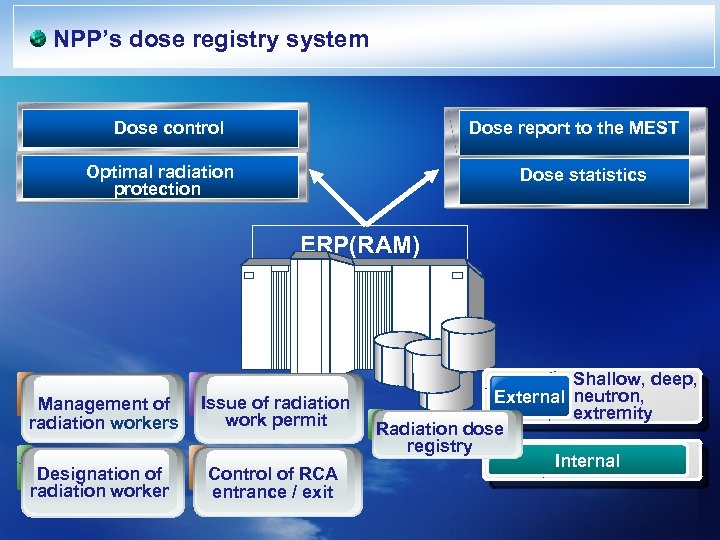 NPP’s dose registry system Dose report to the MEST Dose control Optimal radiation protection Dose statistics ERP(RAM) System Management of radiation workers Issue of radiation work permit Designation of radiation worker Control of RCA entrance / exit Shallow, deep, External neutron, extremity Radiation dose registry Internal
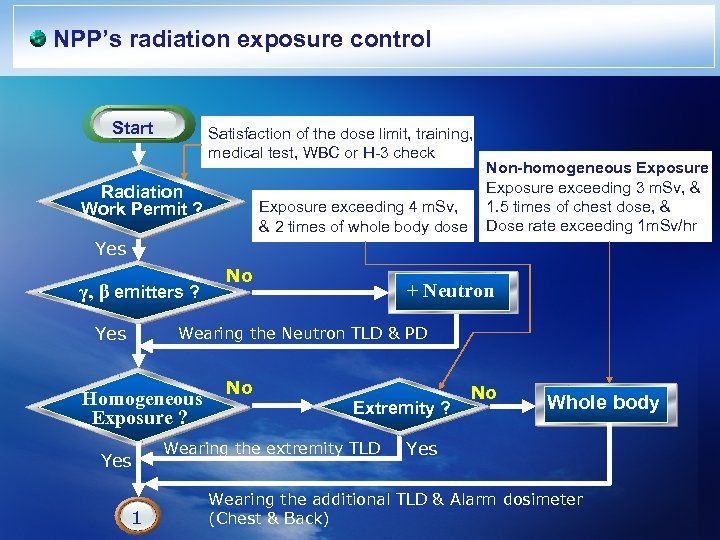 NPP’s radiation exposure control Start Satisfaction of the dose limit, training, medical test, WBC or H-3 check Radiation Work Permit ? Exposure exceeding 4 m. Sv, & 2 times of whole body dose Non-homogeneous Exposure exceeding 3 m. Sv, & 1. 5 times of chest dose, & Dose rate exceeding 1 m. Sv/hr Yes γ, β emitters ? Yes No + Neutron Wearing the Neutron TLD & PD Homogeneous Exposure ? Yes 1 No Extremity ? Wearing the extremity TLD No Whole body Yes Wearing the additional TLD & Alarm dosimeter (Chest & Back)
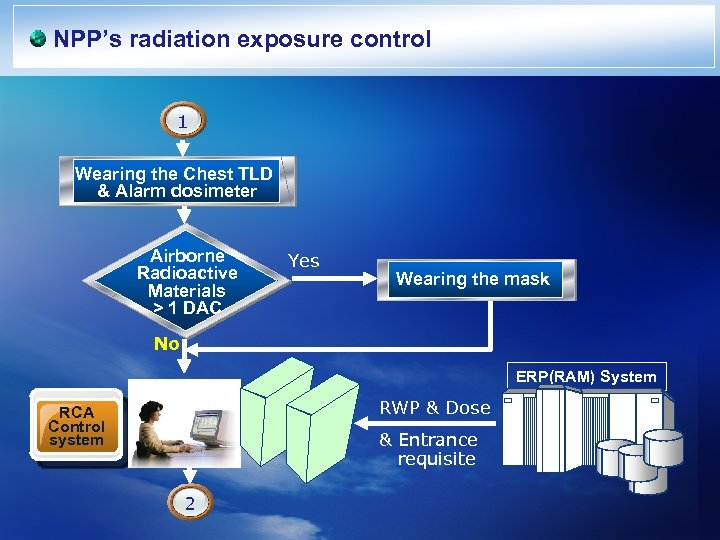 NPP’s radiation exposure control 1 Wearing the Chest TLD & Alarm dosimeter Airborne Radioactive Materials > 1 DAC Yes Wearing the mask No ERP(RAM) System RWP & Dose RCA Control system & Entrance requisite 2
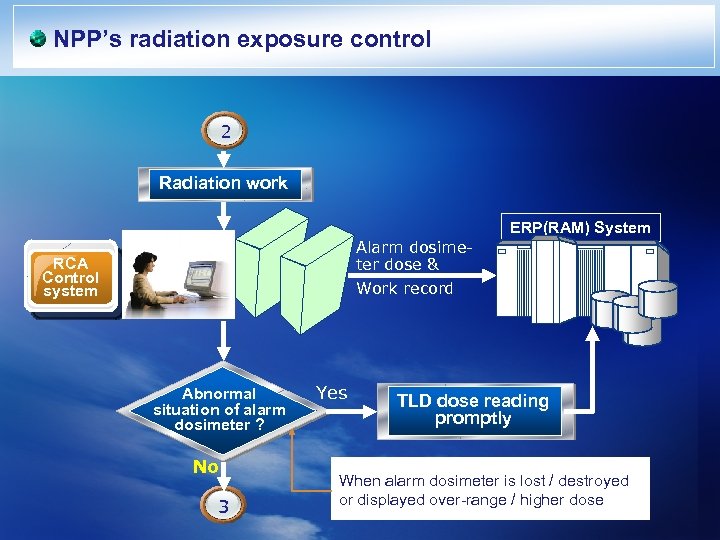 NPP’s radiation exposure control 2 Radiation work ERP(RAM) System Alarm dosimeter dose & RCA Control system Work record Abnormal situation of alarm dosimeter ? No 3 Yes TLD dose reading promptly When alarm dosimeter is lost / destroyed or displayed over-range / higher dose
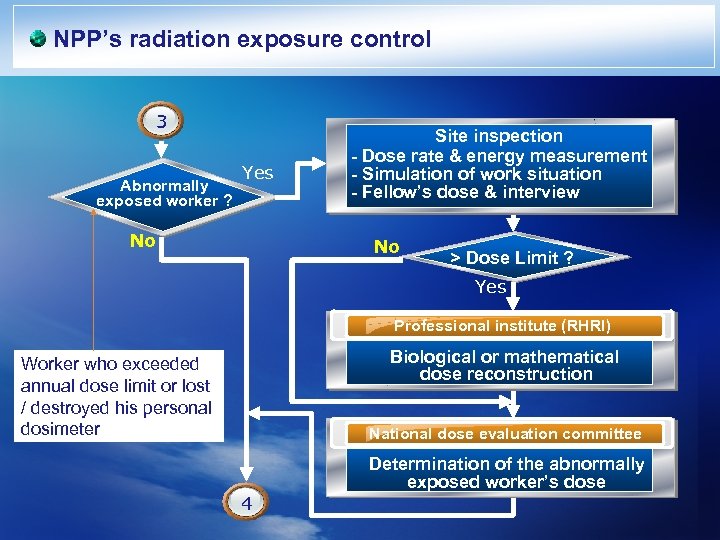 NPP’s radiation exposure control 3 Abnormally exposed worker ? Yes No Site inspection - Dose rate & energy measurement - Simulation of work situation - Fellow’s dose & interview No > Dose Limit ? Yes Professional institute (RHRI) Biological or mathematical dose reconstruction Worker who exceeded annual dose limit or lost / destroyed his personal dosimeter National dose evaluation committee Determination of the abnormally exposed worker’s dose 4
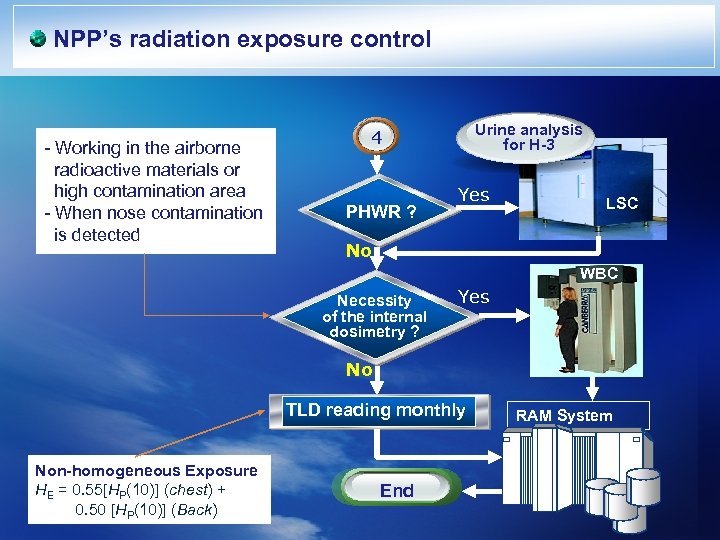 NPP’s radiation exposure control - Working in the airborne radioactive materials or high contamination area - When nose contamination is detected Urine analysis for H-3 4 PHWR ? Yes LSC No WBC Necessity of the internal dosimetry ? Yes No TLD reading monthly Non-homogeneous Exposure HE = 0. 55[HP(10)] (chest) + 0. 50 [HP(10)] (Back) End RAM System
 Current Status of Radiological Protection in NPPs in Korea NPPs’ ALARA Program KHNP - Radiation Health Research Institute
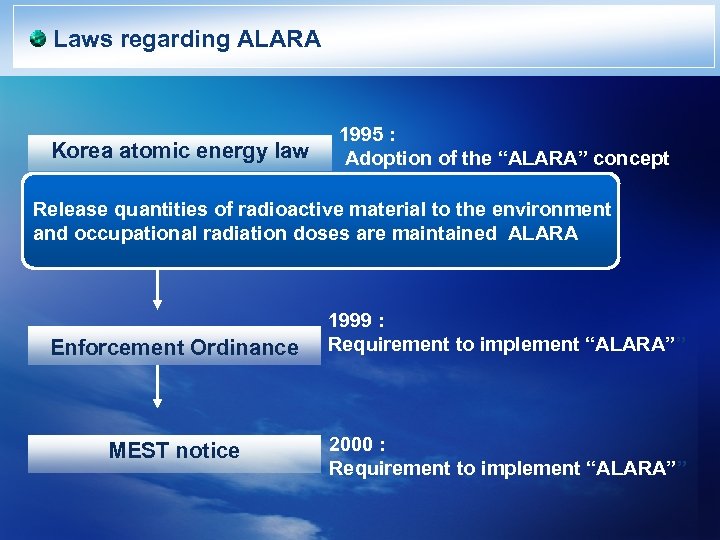 Laws regarding ALARA Korea atomic energy law 1995 : Adoption of the “ALARA” concept Release quantities of radioactive material to the environment and occupational radiation doses are maintained ALARA Enforcement Ordinance MEST notice 1999 : Requirement to implement “ALARA”” 2000 : Requirement to implement “ALARA””
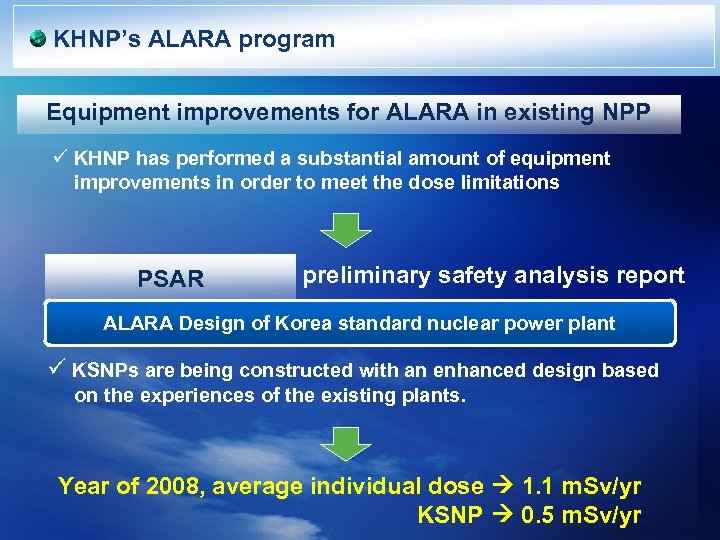 KHNP’s ALARA program Equipment improvements for ALARA in existing NPP ü KHNP has performed a substantial amount of equipment improvements in order to meet the dose limitations PSAR preliminary safety analysis report ALARA Design of Korea standard nuclear power plant ü KSNPs are being constructed with an enhanced design based on the experiences of the existing plants. Year of 2008, average individual dose 1. 1 m. Sv/yr KSNP 0. 5 m. Sv/yr
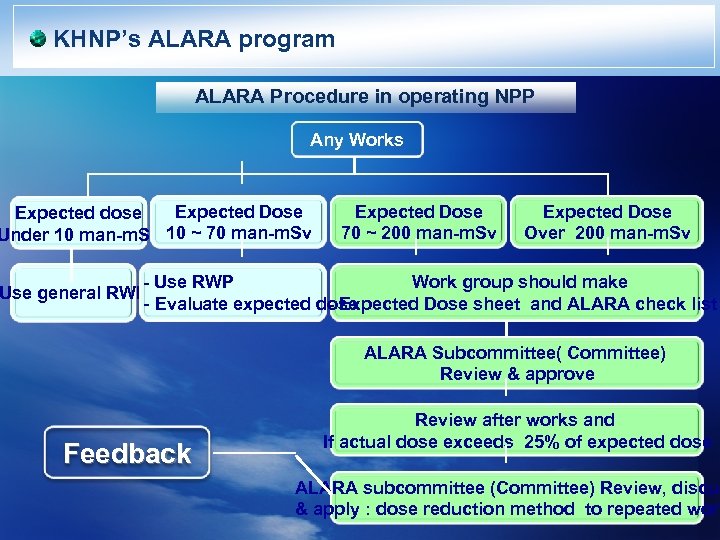 KHNP’s ALARA program ALARA Procedure in operating NPP Any Works Expected Dose Expected dose Under 10 man-m. Sv 10 ~ 70 man-m. Sv Expected Dose 70 ~ 200 man-m. Sv Expected Dose Over 200 man-m. Sv - Use RWP Work group should make Use general RWP - Evaluate expected dose - Expected Dose sheet and ALARA check list ALARA Subcommittee( Committee) Review & approve Feedback Review after works and If actual dose exceeds 25% of expected dose ALARA subcommittee (Committee) Review, discus & apply : dose reduction method to repeated work
 Current Status of Radiological Protection in NPPs in Korea Exposure trends of NPP workers KHNP - Radiation Health Research Institute
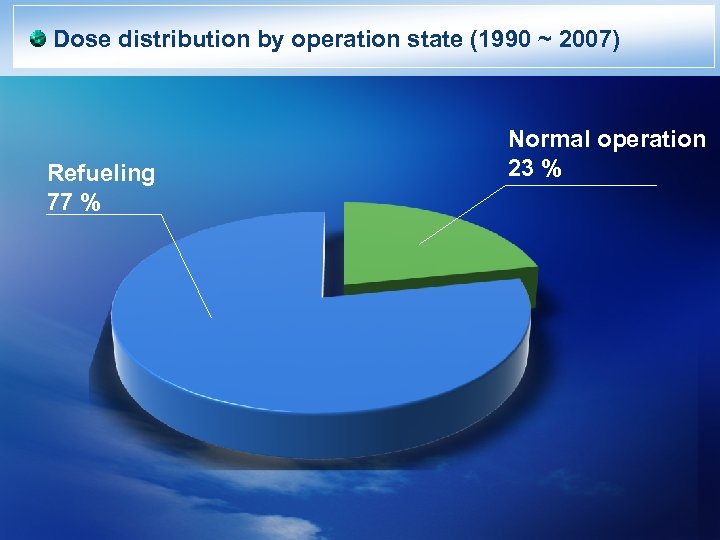 Dose distribution by operation state (1990 ~ 2007) Refueling 77 % Normal operation 23 %
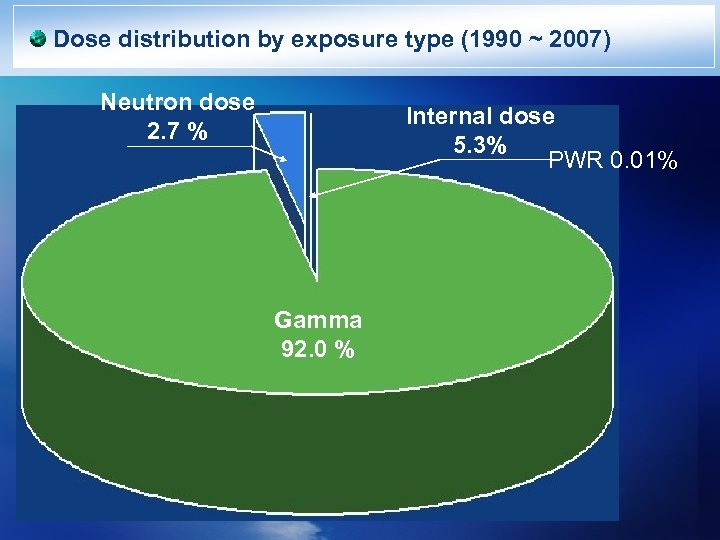 Dose distribution by exposure type (1990 ~ 2007) Neutron dose 2. 7 % Internal dose 5. 3% PWR 0. 01% Gamma 92. 0 %
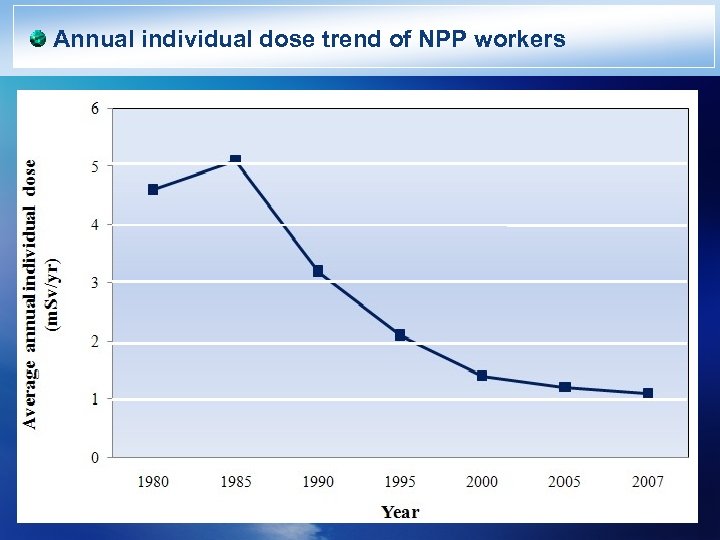 Annual individual dose trend of NPP workers
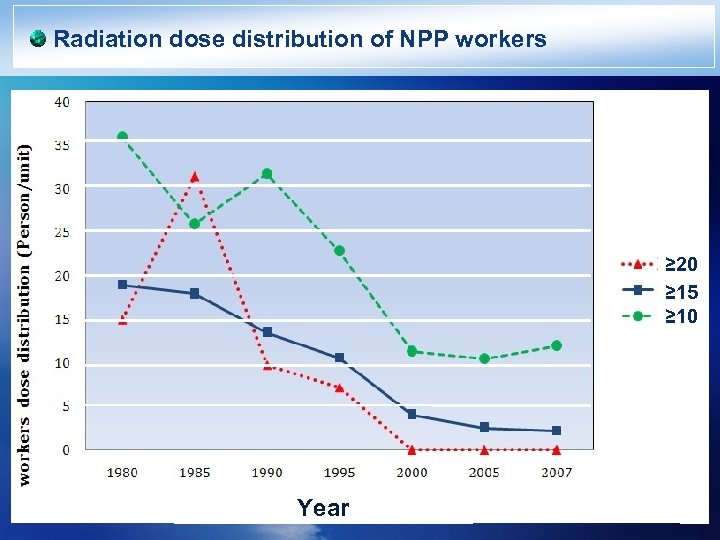 Radiation dose distribution of NPP workers ≥ 20 ≥ 15 ≥ 10 Year
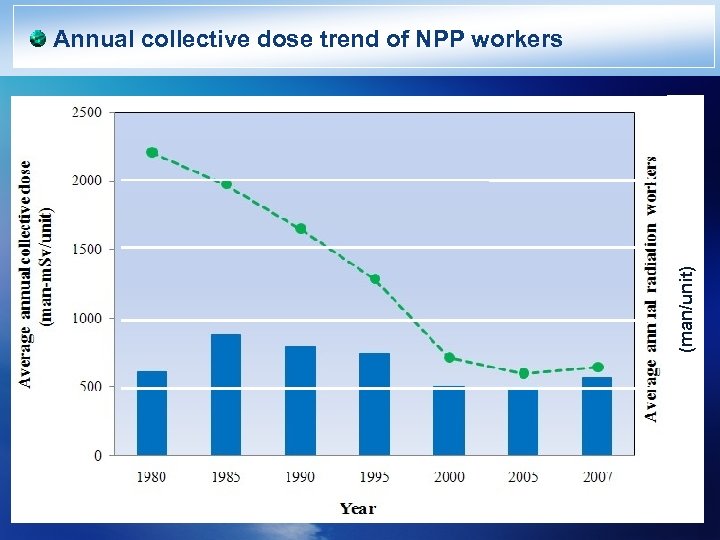 (man/unit) Annual collective dose trend of NPP workers
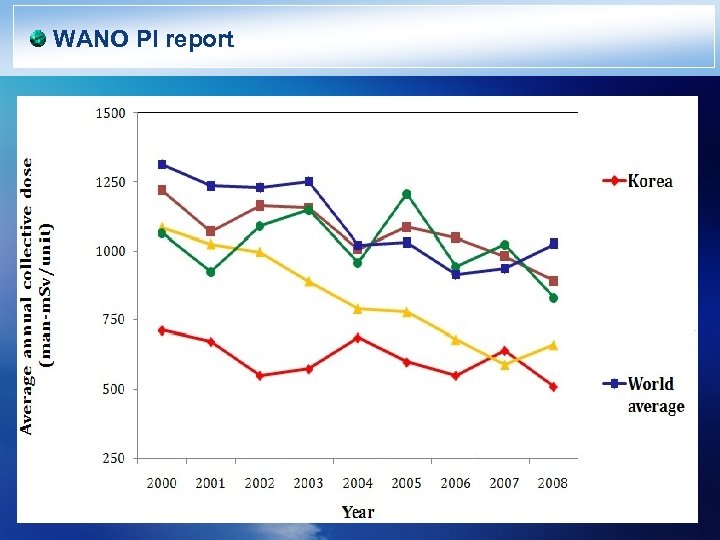 WANO PI report
 Current Status of Radiological Protection in NPPs in Korea RHRI’s Activity for NPP’s RP KHNP - Radiation Health Research Institute
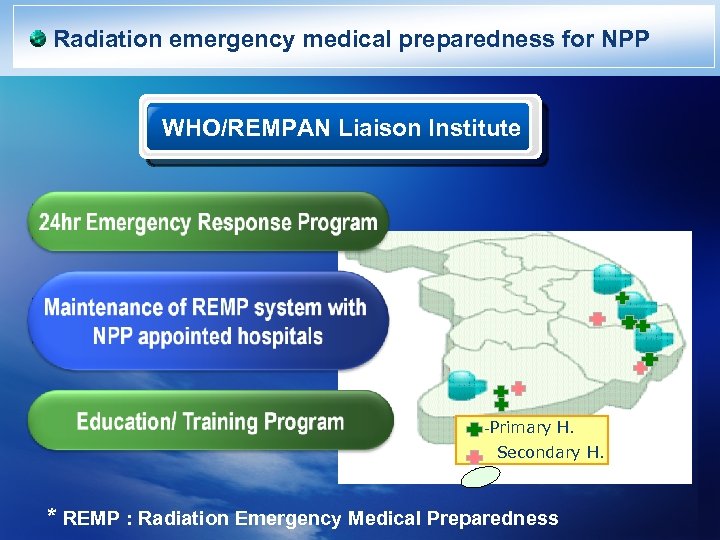 Radiation emergency medical preparedness for NPP WHO/REMPAN Liaison Institute -Primary H. Secondary H. * REMP : Radiation Emergency Medical Preparedness
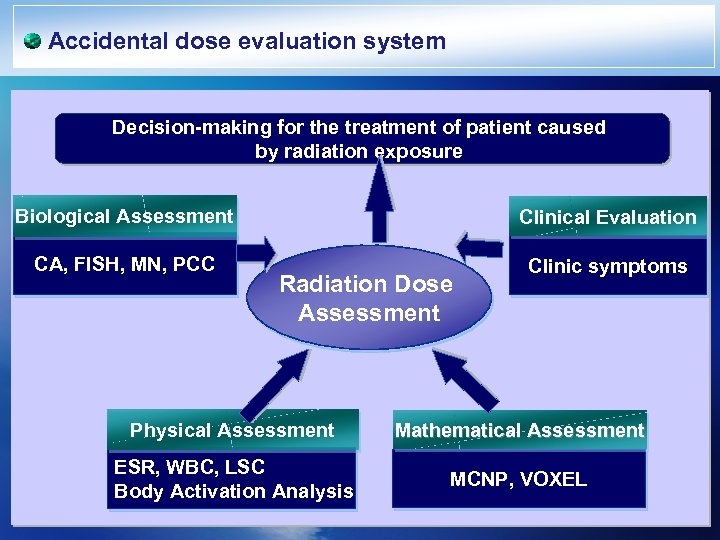 Accidental dose evaluation system Decision-making for the treatment of patient caused by radiation exposure Biological Assessment Clinical Evaluation CA, FISH, MN, PCC Clinic symptoms Radiation Dose Assessment Physical Assessment Mathematical Assessment ESR, WBC, LSC Body Activation Analysis MCNP, VOXEL
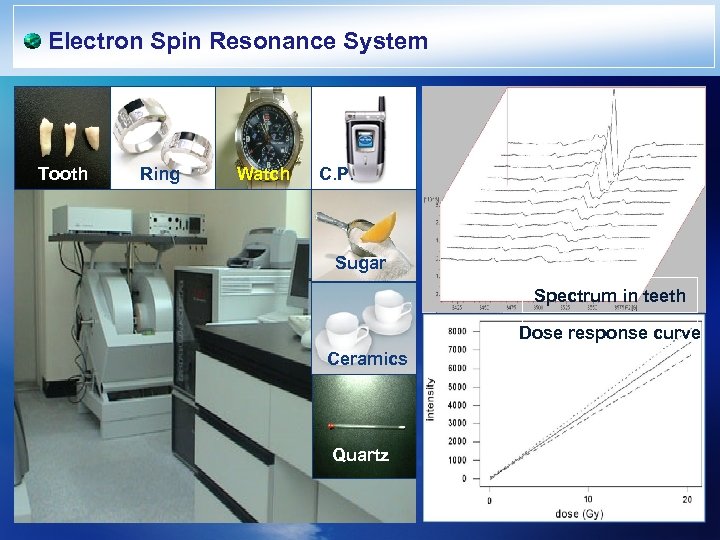 Electron Spin Resonance System Tooth Ring Watch C. P. Sugar Spectrum in teeth Dose response curve Ceramics Quartz
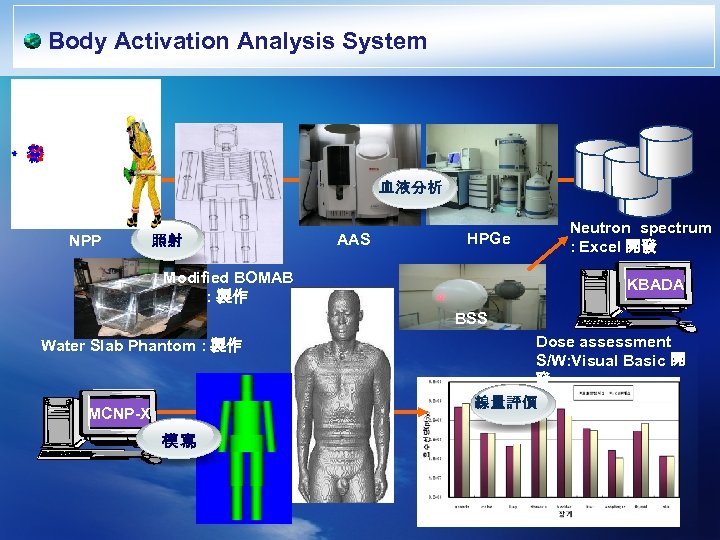 Body Activation Analysis System 血液分析 NPP 照射 AAS HPGe Modified BOMAB : 製作 Neutron spectrum : Excel 開發 KBADA BSS Water Slab Phantom : 製作 MCNP-X 模寫 Dose assessment S/W: Visual Basic 開 發 線量評價
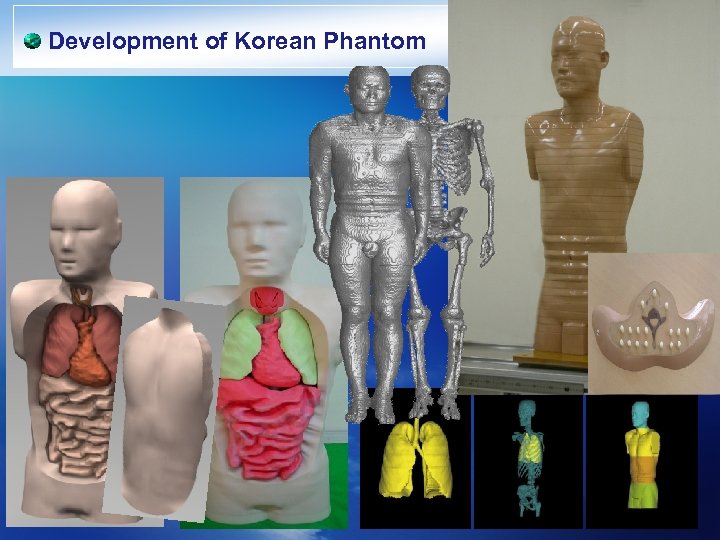 Development of Korean Phantom
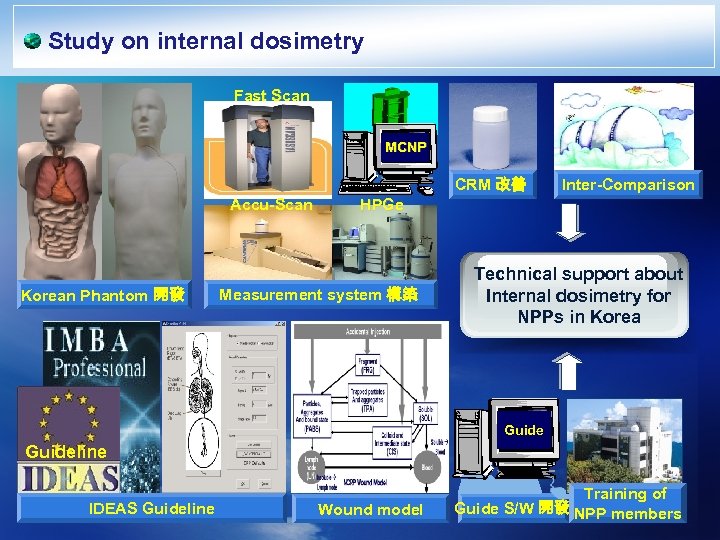 Study on internal dosimetry Fast Scan MCNP CRM 改善 Accu-Scan Korean Phantom 開發 Inter-Comparison HPGe Measurement system 構築 Technical support about Internal dosimetry for NPPs in Korea Guideline IDEAS Guideline Wound model Training of Guide S/W 開發 NPP members
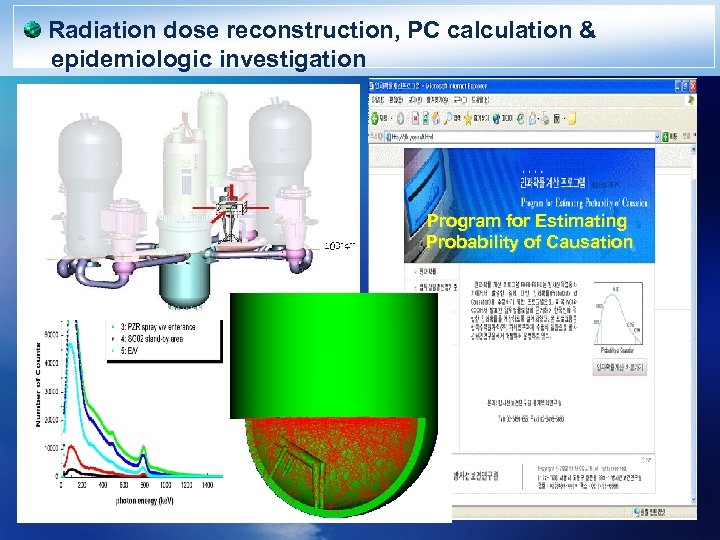 Radiation dose reconstruction, PC calculation & epidemiologic investigation Program for Estimating Probability of Causation
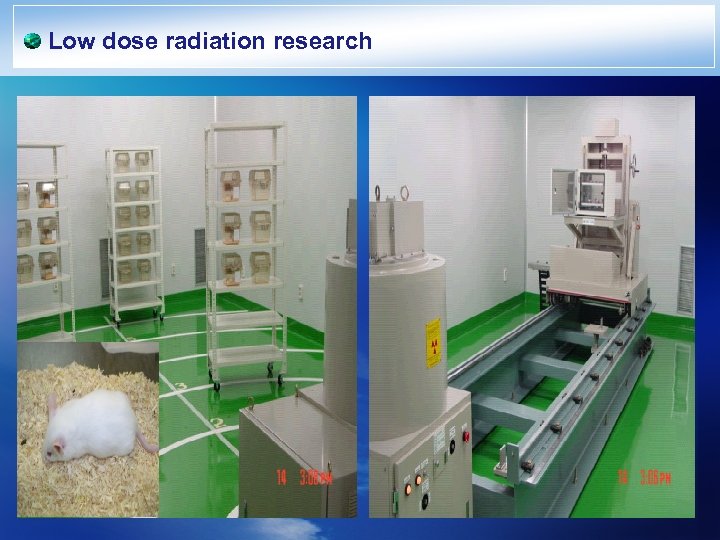 Low dose radiation research
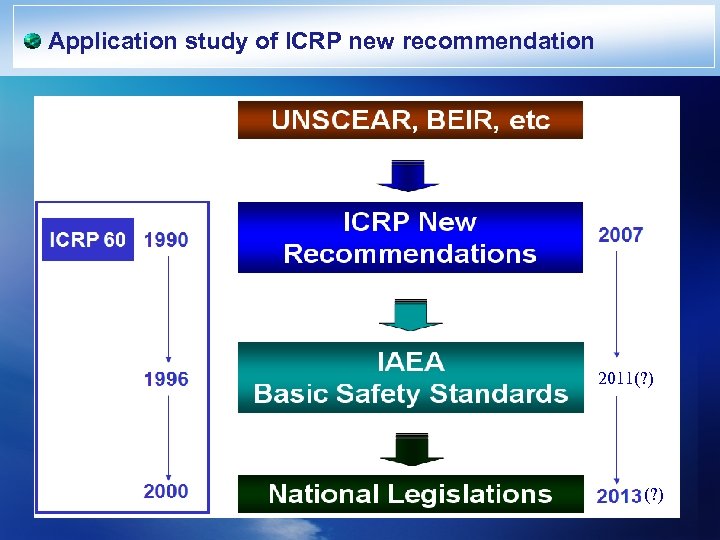 Application study of ICRP new recommendation 2011(? )
 Korea Hydro & Nuclear Power Co. , LTD Radiation Health Research Institute